Posts Tagged ‘FBI’
2012 PRESIDENTIAL RACE, ABC NEWS, BARACK OBAMA, BAY OF PIGS, CBS NEWS, CIA, CNN, COLD WAR, COMMUNISM, CUBA, FACEBOOK, FBI, FLORIDA, GUS RUSSO, JOHN F. KENNEDY, JOHN ROSELLI, LIVE BY THE SWORD, MAFIA, MITT ROMNEY, NBC NEWS, NEWT GINGRICH, RICK SANTORUM, ROBERT F. KENNEDY, ROBERT MCNAMARA, RON PAUL, SAM GIANCANA, THE LOS ANGELES TIMES, THE NEW YORK TIMES, THE WASHINGTON POST, TWITTER
In Bureaucracy, History, Military, Politics on July 28, 2014 at 10:39 am
John and Robert Kennedy knew what they were doing. They waged a vicious war against Fidel Castro–a war someone had to lose.”
So writes Gus Russo in Live By the Sword: The Secret War Against Castro and the Death of JFK, published in 1998.
During the Cuban Missile Crisis, Robert Kennedy–referring to the 1941 Japanese attack on Pearl Harbor–had resisted demands for a “sneak attack” on Cuba by saying: “I don’t want my brother to be the Tojo of the 1960s.”
But in the fall of 1963, the Kennedys planned such an attack on Cuba just one month before the November, 1964 Presidential election.
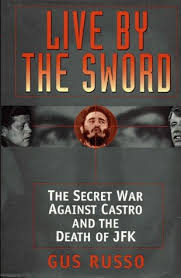
In what is almost certainly the definitive account of the assassination of President John F. Kennedy, Russo reaches some startling–but highly documented–conclusions:
- Lee Harvey Oswald assassinated Kennedy.
- He did it alone.
- Oswald, a former Marine, was a committed Marxist–whose hero was Castro.
- The CIA’s ongoing campaign to overthrow and/or assassinate Castro was an open secret throughout the Gulf.
- Oswald visited New Orleans in the spring of 1963.
- There he learned that Castro was in the crosshairs of the CIA.
- Oswald told his Russian-born wife, Marina: “Fidel Castro needs defenders. I’m going to join his army of volunteers.”
- Jack Ruby, a Dallas nightclub owner, murdered Oswald because he was distraught over Kennedy’s death.
- Ruby was not part of a Mafia conspiracy to silence Oswald.
- Skeptics of the Warren Commission–which concluded that Oswald had acted alone–asked the wrong question: “Who killed Kennedy?”
- They should have asked: “Why was he killed?”
- The answer–according to Russo: “The Kennedys’ relentless pursuit of Castro and Cuba backfired in tragedy on that terrible day in November, 1963.”
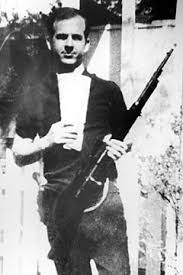
Lee Harvey Oswald
Another book well worth reading about America’s Cuban obsession during the early 1960s is American Tabloid, by James Ellroy.
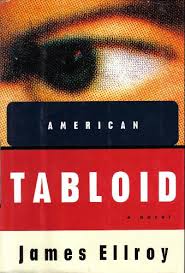
Although a novel, it vividly captures the atmosphere of intrigue, danger and sleaziness that permeated that era in a way that dry, historical documents never can.
“The 50s are finished,” reads its paperback dust jacket. “Zealous young lawyer Robert Kennedy has a red-hot jones to nail Jimmy Hoffa. JFK has his eyes on the Oval Office.
“J. Edgar Hoover is swooping down on the Red Menace. Howard Hughes is dodging subpoenas and digging up Kennedy dirt. And Castro is mopping up the bloody aftermath of his new Communist nation….
“Mob bosses, politicos, snitches, psychos, fall guys and femmes fatale. They’re mixing up a Molotov cocktail guaranteed to end the country’s innocence with a bang.”
Among the legacies of America’s twisted romance with anti-Castro Cubans:
- Following the JFK assassination, there was a coverup–to safeguard the reputation of the United States government and that of its newly-martyred President.
- Thus, the CIA and FBI concealed the anti-Castro assassination plots from the Warren Commission investigating Kennedy’s assassination.
- Other participating officials in the cover-up included Attorney General Robert F. Kennedy and President Lyndon B. Johnson.
- This secrecy ignited the widespread–and false–belief that the President had died at the hands of a government conspiracy.
- Robert Kennedy feared that his relentless pursuit of Castro might have backfired against JFK, leading Castro to “take out” the President first.
- Fearing his own assassination if he continued Kennedy’s efforts to murder Castro, President Johnson ordered the CIA to halt its campaign to overthrow and/or assassinate the Cuban leader.
- The huge Cuban community throughout Florida–and especially Miami–continues to exert a blackmail influence on American politics.
- Right-wing politicians from Richard Nixon to Newt Gingrich have reaped electoral rewards by catering to the demands of this hate-obsessed voting block.
- As a result, the United States still refuses to open diplomatic relations with Cuba–even though it has done so with such former enemies as the Soviet Union, China and Vietnam.
- Cuban ex-patriots still hope that the United States will launch a full-scale military invasion of the island to remove Castro.
- These alleged Cuban patriots fear to risk their own lives by returning to Cuba and launching an uprising against him.
That crisis stemmed from our twisted obsession with Cuba, an obsession that continues today.
Texas Congressman Ron Paul is correct:
“But I think it’s time…to quit this isolation business of not talking to people. We talked to the Soviets. We talk to the Chinese. And we opened up trade, and we’re not killing each other now.
“We fought with the Vietnamese for a long time. We finally gave up, started talking to them, now we trade with them. I don’t know why…the Cuban people should be so intimidating.”
It’s time to end the half-century contamination of American politics by those Cubans who live for their hatred of Fidel Castro and those political candidates who live to exploit it.
It’s long past time to end this wag-the-dog relationship. A population of about 1,700,000 Cubans should not be allowed to shape the domestic and foreign policy of a nation of 300 million.
Those who continue to hate–or love–Castro should be left to their own private feud. But that is a feud they should settle on their own island, and not from the shores of the United States.
2012 PRESIDENTIAL RACE, ABC NEWS, BARACK OBAMA, BAY OF PIGS, CBS NEWS, CIA, CNN, COLD WAR, COMMUNISM, CUBA, FACEBOOK, FBI, FLORIDA, JOHN F. KENNEDY, JOHN ROSELLI, MAFIA, MITT ROMNEY, NBC NEWS, NEWT GINGRICH, RICK SANTORUM, ROBERT F. KENNEDY, RON PAUL, SAM GIANCANA, THE LOS ANGELES TIMES, THE NEW YORK TIMES, THE WASHINGTON POST, TWITTER
In Bureaucracy, History, Military, Social commentary on July 25, 2014 at 1:01 pm
On April 17, 1961, the U.S. Navy landed 1,700 CIA-trained Cuban exiles ashore at Cuba’s Bay of Pigs.
President John F. Kennedy–wanting to disguise the role of the United States in the invasion–refused to commit U.S. Marines and Air Force bombers to the invasion.
Long forewarned of the coming invasion, Fidel Castro sent in his forces to decimate the invaders.
Kennedy took responsibility for the failure. But privately he blamed Castro for refusing to be overthrown.
As a result, Kennedy and his brother, Robert–then Attorney General–created their own covert operation to depose Castro.
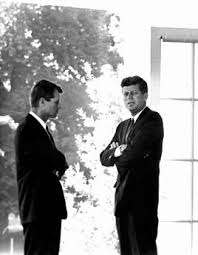
Robert and John F. Kennedy
Known as the Special Group, and overseen by Robert Kennedy, it launched a secret war against the Castro regime, code-named Operation Mongoose.
“We were hysterical about Castro at about the time of the Bay of Pigs and thereafter,” Secretary of Defense Robert S. McNamara later testified before Congress about these efforts. “And there was pressure from JFK and RFK to do something about Castro.”
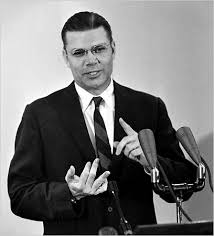
Robert S. McNamara
Nor was everyone in the CIA enthusiastic about the “get Castro” effort.
“Everyone at CIA was surprised at Kennedy’s obsession with Fidel,” recalled Sam Halpern, who was assigned to the Cuba Project. “They thought it was a waste of time. We all knew [Castro] couldn’t hurt us. Most of us at CIA initially liked Kennedy, but why go after this little guy?
“One thing is for sure: Kennedy wasn’t doing it out of national security concerns. It was a personal thing. The Kennedy family felt personally burnt by the Bay of Pigs and sought revenge.”
It was all-out war. Among the tactics used:
- Hiring Cuban gangsters to murder Cuban police officials and Soviet technicians.
- Sabotaging mines.
- Paying up to $100,000 per “hit” for the murder or kidnapping of Cuban officials.
- Using biological and chemical warfare against the Cuban sugar industry.
“Bobby (Kennedy) wanted boom and bang all over the island,” recalled Halpern. “It was stupid. The pressure from the White House was very great.”
Among that “boom and bang” were a series of assassination plots against Castro, in which the Mafia was to be a key player.
Chicago Mobster Johnny Rosselli proposed a simple plan: through its underworld connections in Cuba, the Mafia would recruit a Cuban in Castro’s entourage, such as a waiter or bodyguard, who would poison him.
The CIA’s Technical Services division produced a botulinus toxin which was then injected into Castro’s favorite brand of cigars. The CIA also produced simpler botulinus toxin pills that could be dissolved in his food or drink.
But the deputized Mafia contacts failed to deliver any of the poisons to Castro.
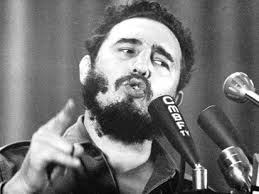
Fidel Castro
As Rosselli explained to the CIA, the first poisoner had been discharged from Castro’s employ before he could kill him, while a back-up agent got “cold feet.”
Other proposals or attempts included:
- Planting colorful seashells rigged to explode at a site where Castro liked to go skindiving.
- Trying to arrange for his being presented with a wetsuit impregnated with noxious bacteria and mould spores, or with lethal chemical agents.
- Attempting to infect Castro’s scuba regulator with tuberculous bacilli.
- Trying to douse his handkerchiefs, tea and coffee with other lethal bacteria.
Americans would rightly label such methods as “terrorist” if another power used them against the United States today. And the Cuban government saw the situation exactly the same way.
So Castro appealed to Nikita Khrushchev, leader of the Soviet Union, for assistance.
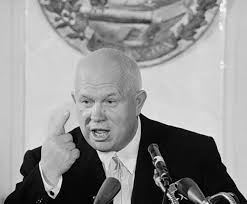
Nikita Khrushchev
Khrushchev was quick to comply: “We must not allow the communist infant to be strangled in its crib,” he told members of his inncer circle.
By October, 1962, the Soviet Union had sent more than 40,000 soldiers, 1,300 field pieces, 700 anti-airctaft guns, 350 tanks and 150 jets to Cuba to deter another invasion.
Khrushchev also began supplying Castro with nuclear-tipped ballistic missiles–whose discovery, on October 15, 1962, ignited the single most dangerous confrontation of the Cold War.
Suddenly, the two most powerful nuclear countries–the United States and the Soviet Union–found themselves on the brink of nuclear war.
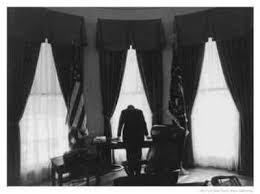
John F. Kennedy in the Oval Office
At the time, Kennedy officials claimed they couldn’t understand why Khrushchev had placed nuclear missiles in Cuba. “Maybe Khrushchev’s gone mad” was a typical musing.
None of these officials admitted that JFK had been waging a no-holds-barred campaign to overthrow the Cuban government and assassinate its leader.
The crisis ended when, after 13 harrowing days, Khrushchev agreed to remove the missiles from Cuba. Behind its resolution lay a promise by the Kennedy administration to not invade Cuba.
But President Kennedy was not finished with Castro. While continuing the campaign of sabotage throughout Cuba, the Kennedys were preparing something far bigger: A fullscale American invasion of the island.
On October 4, 1963, the Joint Chiefs of Staff submitted its latest version of the invasion plan, known as OPLAN 380-63. Its timetable went:
- January, 1964: Infiltration into Cuba by Cuban exiles.
- July 15, 1964: U.S. conventional forces join the fray.
- August 3, 1964: All-out U.S. air strikes on Cuba.
- October 1, 1964: Full-scale invasion to install “a government friendly to the U.S.”
But then fate–in the otherwise unimpressive form of Lee Harvey Oswald–suddenly intervened.
2012 PRESIDENTIAL RACE, ABC NEWS, BARACK OBAMA, BAY OF PIGS, CARLOS MARCELLO, CBS NEWS, CIA, CNN, COLD WAR, COMMUNISM, CUBA, FACEBOOK, FBI, FLORIDA, JOHN F. KENNEDY, JOHN ROSELLI, MAFIA, MITT ROMNEY, NBC NEWS, NEWT GINGRICH, RICK SANTORUM, ROBERT F. KENNEDY, ROBERT MCNAMARA, RON PAUL, SAM GIANCANA, THE LOS ANGELES TIMES, THE NEW YORK TIMES, THE WASHINGTON POST, TWITTER
In Bureaucracy, History, Military, Politics on July 24, 2014 at 11:51 am
On January 23, 2012, Newt Gingrich, Rick Santorum, Mitt Romney and Ron Paul–all seeking the Republican nomination for President–attended a candidates’ debate in Tampa, Florida.
Gingrich, Santorum and Romney played to the huge–and influential–Cuban community in Florida, especially in Miami.
All three had carefully avoided military service. But all three “chickenhawks” now wanted to show how eagerly they could send others into harm’s way.
Former House Speaker Gingrich spoke for all three when he said: “The policy of the United States should be aggressively to overthrow the [Castro] regime and to do everything we can to support those Cubans who want freedom.”
Only Texas Congressman Ron Paul–who had served as a flight surgeon in the U.S. Air Force from 1963 to 1968–dared to call for normalization of relations between the United States and Cuba.
But even Paul refused to say that the “chickenhawk” bravado of his fellow Republicans ignored a great many ugly historical truths. Among these:

- In October, 1962, Castro stopped regularly scheduled travel between the two countries, and asylum seekers began sailing from Cuba to Florida.
- Between 1962 and 1979, hundreds of thousands of Cubans entered the United States under the Attorney General’s parole authority.
- The overwhelming majority of Cubans who immigrated into the United States settled in Florida, whose political, economic, and cultural life they transformed.
- By 2008, more than 1.24 million Cuban Americans were living in the United States, mostly in South Florida, where the population of Miami was about one-third Cuban.
- Many of these Cubans viewed themselves as political exiles, rather than immigrants, hoping to return to Cuba after its communist regime fell from power.
- The large number of Cubans in South Florida, particularly in Miami’s “Little Havana,” allowed them to preserve their culture and customs to a degree rare for immigrant groups.
- These discontented immigrants became a potential force for politicians to court.
- Unsurprisingly, most of their votes went to Right-wing Republicans.
John F. Kennedy was the first President to face this dilemma.

John F. Kennedy
During the closing months of the administration of President Dwight D. Eisenhower, the CIA had begun training Cuban exiles for an invasion of their former homeland.
The goal: To do what Castro had done–seek refuge in the mountains and launch a successful anti-Castro revolution.
But word of the coming invasion quickly leaked: The exiles were terrible secret-keepers. (A joke at the CIA went: “A Cuban thinks a secret is something you tell to only 300 people.”)
Kennedy insisted the invasion must appear to be an entirely Cuban enterprise. He refused to commit U.S. Marines and Air Force bombers.
The invasion force was quickly overwhelmed at the Bay of Pigs, with hundreds of its men taken prisoner.
Kennedy publicly took the blame for its failure: “Victory has a hundred fathers but defeat is an orphan.” But privately he seethed, and ordered the CIA to redouble its efforts to remove Castro at all costs.
To make certain his order was carried out, he appointed his brother, Robert–then Attorney General–to oversee the CIA’s “Castro removal” program.
It’s here that America’s obsession with Cuba entered its darkest and most disgraceful period.
The CIA and the Mafia entered into an unholy alliance to assassinate Castro–each for its own benefit.
The CIA wanted to please Kennedy. The Mafia wanted to regain its casino and brothel holdings that had made Cuba the playground of the rich in pre-Castro times.
The CIA supplied poisons and explosives to various members of the Mafia. It was then up to the mobsters to assassinate Castro.
The available sources disagree on what actually happened. Some believe that the Mob made a genuine effort to “whack” Fidel.
Others are convinced the mobsters simply ran a scam on the government. They pretended to carry out their “patriotic duty” while in fact making no effort at all to penetrate Castro’s security.
The mobsters hoped to use their pose as patriots to win immunity from future prosecution.
The CIA asked John Roselli, a mobster linked to the Chicago syndicate, to go to Florida in 1961 and 1962 to organize assassination teams of Cuban exiles. They were to infiltrate their homeland and assassinate Castro.

John Roselli
Rosselli called upon two other crime figures: Chicago Mafia boss Sam Giancana and Santos Trafficante, the Costra Nostra chieftain for Cuba, to help him.
Giancana, using the name “Sam Gold” in his dealings with the CIA, was being hounded by the FBI on direct orders of Attorney General Kennedy.

Sam Giancana
9/11, ABC NEWS, AL QAEDA, BARACK OBAMA, CBS NEWS, CNN, CONCEALED WEAPONS BESTS, COP KILLER BULLETS, CRIME, DELTA FORCE, DRUG ENFORCEMENT ADMINISTRATION, ERIC HOLDER, FBI, FEDERAL ASSAULT WEAPONS BAN, GABRIELLE GIFFORDS, GEORGE ZIMMERMAN, GREEN BERETS, GUN CONTROL, GUNFIGHT AT THE O.K. CORRAL, NATIONAL RIFLE ASSOCIATION, NBC NEWS, NUCLEAR WEAPONS, OSAMA BIN LADEN, SECOND AMENDMENT, SELF-DEFENSE, SEPTEMBER 11 ATTACKS, STAND-YOUR-GROUND LAWS, TALIBAN, TERRORISM, THE LOS ANGELES TIMES, THE NEW YORK TIMES, THE WASHINGTON POST, TRAVON MARTIN, TUSCON SHOOTINGS, U.S. CONSTITUTION, U.S. NAVY SEALS, WAYNE LAPIERRE
In Bureaucracy, Business, History, Law, Law Enforcement, Military, Politics, Social commentary on May 28, 2014 at 12:11 am
In peace, sons bury fathers, but in war fathers bury sons.
–Herodotus
Among the major accomplishments of the National Rifle Association:
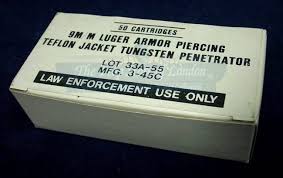
- The NRA has steadfastly defended the right to own Teflon-coated “cop killer” bullets,” whose only purpose is to penetrate bullet-resistant vests worn by law enforcement officers.
- The NRA and its lobbying arm, the Institute for Legislative Action, is responsible for the “stand-your-ground” ordinances now in effect in more than half the states. These allow for the use of deadly force in self-defense, without any obligation to attempt to retreat first.
- In 2012, the NRA rushed to the defense of accused murderer George Zimmerman, the self-appointed “community watchman” who ignored police orders to stop following 17-year-old Trayvon Martin and ended up shooting him.
- Police did not initially charge Zimmerman because of Florida’s “Stand-Your-Ground” law, which the NRA had rammed through the legislature.
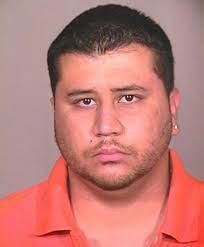
George Zimmerman
- On February 26, 2012, Zimmerman shot unarmed Trayvon Martin, who was wearing a “hoodie.” In March, the NRA issued its own version of a “hoodie”–the Concealed Carry Hooded Sweatshirt, designed to hide firearms. Selling on the NRA’s website for $60 to $65, it is advertised thusly:
- “Inside the sweatshirt you’ll find left and right concealment pockets. The included Velcro®-backed holster and double mag pouch can be repositioned inside the pockets for optimum draw. Ideal for carrying your favorite compact to mid-size pistol, the NRA Concealed Carry Hooded Sweatshirt gives you an extra tactical edge, because its unstructured, casual design appears incapable of concealing a heavy firearm – but it does so with ease!”
- Anyone—including convicted criminals—can buy these “hide-a-gun” sweatshirts, putting both the public and law enforcers at deadly risk.
- The NRA often claims that law-abiding citizens defend themselves with guns millions of times every year. But the FBI has determined that, of the approximately 11,000 gun homicides every year, fewer than 300 are justifiable self-defense killings.
- The NRA supports loopholes that allow criminals to buy guns without background checks, or allow terrorists to buy all the AK-47s they desire.
- The NRA’s executive vice president, Wayne LaPierre, tried to defeat Barack Obama in 2008 and 2012. Yet the President has meekly signed legislation allowing guns to be brought into national parks and onto Amtrak trains. Since becoming Chief Executive, he has made no effort to curb gun violence.
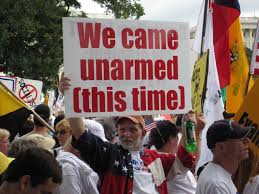
- High-capacity magazines were prohibited under the 1994 Federal Assault Weapons Ban. It expired in 2004. The NRA–aided by the Bush administration and Republicans generally–easily overcame efforts to renew the ban.
- Political scientist Robert Spitzer, author of the book The Politics of Gun Control, notes that since the passage of the 1993 Brady Handgun Violence Prevention Act and the assault weapons ban in 1994, state and national laws have been drifting toward more open gun access:
- “In 1988, there were about 18 states that had state laws that made it pretty easy for civilians to carry concealed hand guns around in society. By 2011, that number is up to 39 or 40 states having liberalized laws, depending on how you count it, and the NRA has worked very diligently at the state level to win political victories there, and they’ve really been quite successful.”
- On January 8, 2011, Democratic Rep. Gabrielle Giffords was shot in the head while meeting with constituents outside a Tucson, Arizona, grocery store. Also killed was Arizona’s chief U.S. District judge, John Roll, who had just stopped by to see his friend Giffords after celebrating Mass. The total number of victims: six dead, 13 wounded. Severely brain-damaged, Giffords was forced to resign her Congressional seat.
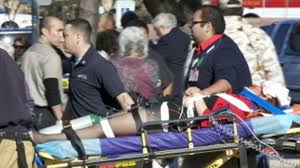
Rep. Gabrielle Giffords after being shot
- “The NRA’s response to the Tucson shootings has been to say as little as possible and to keep its head down,” said Spitzer. “And their approach even more has been to say as little as possible and to simply issue a statement of condolence to the families of those who were injured or killed and to wait for the political storm to pass over and then to pick up politics as usual.”
- In the spring of 2012, the House Oversight Committee prepared to vote on whether to hold U.S. Attorney General Eric Holder in contempt for allegedly refusing to provide documents related to “Fast and Furious.” This was an undercover operation launched by the Bush administration to track firearms being sold to Mexican drug cartels.
- The NRA notified Congressional members that how they voted would reflect how the NRA rated them in “candidate evaluations” for the November elections. This amounted to blatant extortion, since the NRA has long accused Holder of having an “anti-gun” agenda.
Summing up the current state of gun politics in America, the April 21, 2012 edition of The Economist noted:
“The debate about guns is no longer over whether assault rifles ought to be banned, but over whether guns should be allowed in bars, churches and colleges.”
That is precisely the aim of the NRA–an America where anyplace, anytime, can be turned into the gunfight at the O.K. Corral.
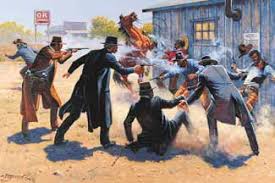
Gunfight at the O.K. Corral – October 26, 1881
And that is precisely what the United States is fast becoming.
Except, so far, the vast majority of victims have not been armed gunfighters but unarmed innocents. And it’s been the “gun rights” types whom the NRA supports who have done the killing.
9/11, ABC NEWS, AL QAEDA, BARACK OBAMA, CBS NEWS, CNN, CONCEALED WEAPONS BESTS, COP KILLER BULLETS, CRIME, DELTA FORCE, DRUG ENFORCEMENT ADMINISTRATION, ERIC HOLDER, FBI, FEDERAL ASSAULT WEAPONS BAN, GABRIELLE GIFFORDS, GEORGE ZIMMERMAN, GREEN BERETS, GUN CONTROL, GUNFIGHT AT THE O.K. CORRAL, NATIONAL RIFLE ASSOCIATION, NBC NEWS, NUCLEAR WEAPONS, OSAMA BIN LADEN, SECOND AMENDMENT, SELF-DEFENSE, SEPTEMBER 11 ATTACKS, STAND-YOUR-GROUND LAWS, TALIBAN, TERRORISM, THE LOS ANGELES TIMES, THE NEW YORK TIMES, THE WASHINGTON POST, TRAVON MARTIN, TUSCON SHOOTINGS, U.S. CONSTITUTION, U.S. NAVY SEALS, WAYNE LAPIERRE
In Business, History, Law, Law Enforcement, Military, Politics, Social commentary on May 27, 2014 at 12:02 am
On September 11, 2001, Islamic terrorists snuffed out the lives of 3,000 Americans in New York, Washington, D.C. and Pennsylvania.
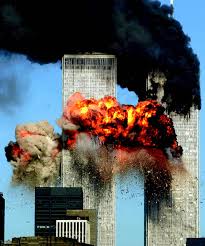
World Trade Center – September 11, 2001
But within less than a month, American warplanes began carpet-bombing Afghanistan, whose rogue Islamic “government” refused to surrender Osama bin Laden, the mastermind of the attacks.
By December, the power of the Taliban was broken–and bin Laden was driven into hiding in Pakistan.
For more than ten years, the United States–through its global military and espionage networks–has relentlessly hunted down most of those responsible for that September carnage.
On May 1, 2011, U.S. Navy SEALS invaded bin Laden’s fortified mansion in Abbottabad, Pakistan–and shot him dead.
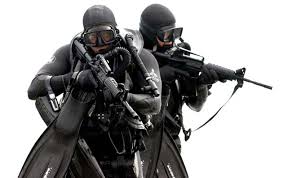
U.S. Navy SEALs
Now, consider these statistics of death, supplied by the Brady Campaign to Prevent Gun Violence:
- One in three people in the U.S. knows someone who has been shot.
- On average, 32 Americans are murdered with guns every day and 140 are treated for a gun assault in an emergency room.
- Every day on average, 51 people kill themselves with a firearm.
- Another 45 people are shot or killed in an accident with a gun.
- U.S. firearm homicide rates are 20 times higher than the combined rates of 22 countries that are our peers in wealth and population.
- A gun in the home is 22 times more likely to be used to kill or injure in a domestic homicide, suicide, or unintentional shooting than to be used in self-defense.
- More than one in five U.S. teenagers (ages 14 to 17) report having witnessed a shooting.
- An average of eight children and teens under the age of 20 are killed by guns every day.
- American children die by guns 11 times as often as children in other high-income countries.
- Youth (ages 0 to 19) in the most rural U.S. counties are as likely to die from a gunshot as those living in the most urban counties.
- Rural children die of more gun suicides and unintentional shooting deaths.
- Urban children die more often of gun homicides.
- Firearm homicide is the second-leading cause of death (after motor vehicle crashes) for young people ages 1-19 in the U.S.
- In 2007, more pre-school-aged children (85) were killed by guns than police officers were killed in the line of duty.
- Medical treatment, criminal justice proceedings, new security precautions, and reductions in quality of life are estimated to cost U.S. citizens $100 billion annually.
- The lifetime medical cost for all gun violence victims in the United States is estimated at $2.3 billion, with almost half the costs borne by taxpayers.
In short, in one year on average:
- More than 100,000 Americans are shot in murders, assault, suicides, suicide attempts, accidents or by police intervention.
- 31,537 people die from gun violence.
- 18,783 people kill themselves.
- 584 people are killed accidentally.
- 334 are killed by police intervention.
- 252 die but intent is not known.
- 71,386 people survive gun injuries.
(These statistics are based on death certificates and estimates from emergency room admissions.)
And who, more than anyone (including the actual killers themselves) has made all this carnage possible?
The National Rifle Association (NRA), of course.
But unlike the leadership of Al Qaeda, that of the NRA is not simply known, but celebrated.
Its director, Wayne LaPierre, is courted as a rock star by both Democrats and Republicans seeking NRA political endorsements–and campaign contributions.

Wayne LaPierre
He frequently appears as an honored guest at testimonial dinners and political conventions.
The largest of the 13 national pro-gun groups, the NRA has nearly 4 million members, who focus most of their time lobbying Congress for unlimited “gun rights.”
The NRA claims that its mission is to “protect” the Second Amendment to the United States Constitution, which states:
“A well regulated Militia, being necessary to the security of a free State, the right of the people to keep and bear Arms, shall not be infringed.”
NRA members conveniently ignore the first half of that sentence: “A well regulated Militia, being necessary to the security of a free State….”
For the NRA, the Second Amendment is the Constitution, and the rest of the document is a mere appendage.
At the time Congress ratified the Constitution in 1788, the United States was not a world power.
A mere 26 years later, the British seized and burned Washington, D.C., after repeatedly defeating American armies. On the frontier, settlers had to defend themselves against hostile Indians and marauding bandits.
Only after World War II did the country maintain a powerful standing army during peacetime.
But World War II ended 69 years ago, and today the United States is a far different country than it was in 1788:
-
It boasts a nuclear arsenal that can turn any country into thermonuclear ash–anytime an American President decides to do so.
-
It boasts an Army, Navy, Air Force and Marine Corps that can target any enemy, anywhere in the world.
-
Its Special Forces–Green Berets, Delta Force and Navy SEALS–are rightly feared by international terrorists.
-
American Intelligence has have come a long way since 9/11. The FBI’s top priority is to prevent another such terrorist attack, not simply investigate it afterward.
-
And waging war on criminals generally are about 836,787 full-time sworn local/state/Federal law enforcement officers.
- If a criminal flees or conducts business across state lines, powerful Federal law enforcement agencies–such as the FBI and Drug Enforcement Administration–can put him out of business.
But apparently the NRA hasn’t gotten the word.
9/11, ABC NEWS, ASSOCIATED PRESS, BILL DE BLASIO, CBS NEWS, CIA, CNN, COUNTERTERRORISM DIVISION, DEMOGRAPHICS UNIT, DEPARTMENT OF HOMELAND SECURITY, FACEBOOK, FBI, ISLAM, KU KLUX KLAN, MICHAEL BLOOMBERG, NATIONAL SECURITY AGENCY, NBC NEWS, NYPD, POLITICAL CORRETENESS, RAYMOND KELLY, TERRORISM, THE LOS ANGELES TIMES, THE NEW YORK TIMES, THE WASHINGTON POST, TWITTER, WILLIAM C. SULLIVAN, WORLD TRADE CENTER
In Bureaucracy, History, Law, Law Enforcement, Politics, Social commentary on April 30, 2014 at 12:00 am
Since 1993, New York City–as the financial capital of the nation–has been Target Number Two for Islamic extremists.
Only Washington, D.C.–the nation’s political capital–outranks it as the city Islamic terrorists most want to destroy.
But for large numbers of New York’s Islamic community, this is unimportant. What is important, to them, is their being viewed with distrust by the NYPD.
“The Demographics Unit created psychological warfare in our community,” said Linda Sarsour, of the Arab American Association of New York.
‘Those documents, they showed where we live. That’s the cafe where I eat. That’s where I pray. That’s where I buy my groceries.
“They were able to see [our] entire lives on those maps. And it completely messed with the psyche of the community.”
But that’s entirely the point of having an effective Intelligence unit: To disrupt “the psyche” of those who plan acts of violence against a community.
In 1964, the FBI launched such a counterintelligence program–in Bureau-speak, a COINTELPRO–against the Ku Klux Klan.
Up to that point, Klansmen had shot, lynched and bombed their way across the Deep South, especially in Alabama and Mississippi. Many Southern sheriffs and police chiefs were Klan sympathizers, if not outright members and accomplices.
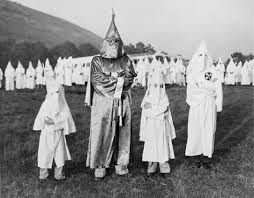
Ku Klux Klansmen in a meeting
The FBI’s covert action program aimed to “expose, disrupt and otherwise neutralize” Ku Klux Klan groups through a wide range of legal and extra-legal methods.
FBI Special Agents:
- Planted electronic surveillance devices in Klan meeting places.
- Carried out “black bag jobs”–burglaries–to steal Klan membership lists.
- Contacted the news media to publicize arrests and identify Klan leaders.
- Informed the employers of known Klansmen of their employees’ criminal activity, resulting in the firing of untold numbers of them.
- Developed informants within Klans and sewed a climate of distrust and fear among Klansmen.
- Beat and harassed Klansmen who threatened and harassed them.
“They were dirty, rough fellows,” recalled William C. Sullivan, who headed the FBI’s Domestic Intelligence Division in the 1960s. “And we went after them with rough, tough methods.

William C. Sullivan
“When the Klan reached 14,000 in the mid-sixties, I asked to take over the investigation of the Klan. When I left the Bureau in 1971, the Klan was down to a completely disorganized 4,300. It was broken.”
Click here: The Bureau My Thirty Years in Hoover’s FBI: William C Sullivan, Sam Sloan, Bill Brown: 9784871873383: Amazon.com:
And for more than a decade, the Demographics Unit of the NYPD’s Counterterrorism Division worked diligently to prevent another major terrorist attack on New York City.

Agent at NYPD Counterterrorism Division Center
Then, in 2013, New York City voters elected Democrat Bill de Blazio as Michael Bloomberg’s successor as mayor.
For de Blasio, scoring Politically Correct points with New York’s uber-liberal community was more important than supporting a proven deterrent to terrorism.
Click here: New York Drops Unit That Spied on Muslims – NYTimes.com
De Blazio promised to give new Yorkers “a police force that keeps our city safe, but that is also respectful and fair.
“This reform [disbanding the Demographics Unit] is a critical step forward in easing tensions between the police and the communities they serve, so that our cops and our citizens can help one another go after the real bad guys,” he claimed.
In Washington, 34 members of Congress demanded an FBI investigation into the NYPD’s covert surveillance program.
Attorney General Eric Holder said he found reports about the operations disturbing. The Department of Justice said it was reviewing complaints received from Muslims and their supporters.
All of this contradicted the warning provided by a Federal judge on February 20, 2014.
U.S. District Judge William Martini in Newark, N.J., threw out a suit brought against the NYPD by eight New Jersey Muslims.
They claimed that the NYPD’s surveillance of mosques, restaurants and schools in the state since 2002 was unconstitutional because Muslims were being targeted solely on the basis of their religion.
In his ruling, however, Martini disagreed:
“The police could not have monitored New Jersey for Muslim terrorist activities without monitoring the Muslim community itself.
“The motive for the program was not solely to discriminate against Muslims, but rather to find Muslim terrorists hiding among ordinary, law-abiding Muslims.”
Both NYPD Cmmissioner Raymond Kelly and Deputy Commissioner of Intelligence David Cohen chose to retire in 2013.
The Demographics Unit of the NYPD’s Counterterrorism Division was officially disbanded on April 15. Detectives that had been assigned to it were transferred to other duties within the Intelligence Division.
Jawad Rasul, one of the students on the whitewater rafting trip in upstate New York, was enraged when he learned that his name was included in the police report.
“It forces me to look around wherever I am now,” Rasul said.
So now he knows how Americans feel when they spot Muslim women wearing chadors that hide their faces from view, or even burqas that cover their entire bodies (and any explosive devices they might be carrying).
Political Correctness mavens might laugh or sneer at such a warning. But Al Qaeda has used exactly that tactic repeatedly–and successfully–against Afghan military forces.
Osama bin Laden was forced to spend his last years in a Pakistani house watching movies on TV. But that didn’t stop him from continuing to plot further acts of destruction against “infidel Crusaders.”
Among the plots he sought to unleash was the assassination of President Barack Obama.
It was simply America’s good fortune that the Navy SEALS got him first.
9/11, ABC NEWS, ASSOCIATED PRESS, BILL DE BLASIO, CBS NEWS, CIA, CNN, COUNTERTERRORISM DIVISION, DEMOGRAPHICS UNIT, DEPARTMENT OF HOMELAND SECURITY, FACEBOOK, FBI, ISLAM, KU KLUX KLAN, MICHAEL BLOOMBERG, NATIONAL SECURITY AGENCY, NBC NEWS, NYPD, POLITICAL CORRETENESS, RAYMOND KELLY, TERRORISM, THE LOS ANGELES TIMES, THE NEW YORK TIMES, THE WASHINGTON POST, TWITTER, WILLIAM C. SULLIVAN, WORLD TRADE CENTER
In Bureaucracy, History, Law, Law Enforcement, Politics, Social commentary on April 29, 2014 at 12:02 am
In creating the NYPD’s Counterterrorism Division, David Cohen had a secret weapon: The latent resources of the NYPD. Many of its officers were foreign-born, making them ideal espionage operatives
His Afghan- or Pakistan-born linguists could easily monitor chat rooms in Kabul or Peshawar, looking for Islamics seeking to carry out attacks on New York City.
The FBI, on the other hand, fearing divided loyalties, usually rejected hiring foreign-born applicants: “Oooh, [you] grew up in Pakistan,” mocked Cohen. “We can’t use you.”
Cohen realized that some analysts made better report-writers than streetwise detectives. And some detectives were better at unearthing criminal secrets than desk-bound analysts.
So Cohen decided to pair Ivy-league-educated analysts with veteran detectives. Together, they could pool their talents and compensate for each other’s weaknesses.
Perhaps most importantly, Cohen’s unit was not judged by the number of arrests or convictions generated by its activities.
Its purpose was to disrupt terror cells and prevent terrorist acts, not to prosecute individuals after they had unleashed destruction.

Agents of NYPD’s Counterterrorism Unit
Meanwhile, the CIA, FBI, Department of Homeland Security and the National Security Agency watched with growing anger as the NYPD trespassed on their jealously guarded turf.
What right did a mere local police department–even one of 33,000 sworn officers–have to conduct overseas Intelligence operations?
Cohen, in turn, was not shy in answering: We relied on you Feds to protect us in 1993 and 2001–and look at what happened.
And events soon proved the need for such a stepped-up anti-terrorism effort.
Since September 11, 2001, there have been 16 known terrorist plots against New York City. Among these:
- In 2002, Iyman Faris, a U.S.-based al-Qaeda operative, planned to cut the Brooklyn Bridge’s support cables. But due to NYPD anti-terrorism efforts, Faris called off the plot, telling al-Qaeda leaders that “the weather is too hot.” He was arrested, pled guilty, and sentenced to 20 years’ imprisonment.
- In 2006, Dhiren Barot was sentenced to life in prison by a United Kingdom court for planning to attack targets both in the UK and the United States. These included the New York Stock Exchange and, Citigroup’s headquarters in Midtown Manhattan.
- Shahawar Matin Siraj and James Elshafay plotted in 2004 to place bombs in the Herald Square subway station in Manhattan. Elshafay had already chosen potential targets before he met an NYPD informant in early 2004. Both men were arrested, convicted and sentenced to prison.
- In 2006, four men plotted to detonate the jet-fuel storage tanks and supply lines for John F. Kennedy Airport in order to cause wide-scale destruction and economic disruption. All four were arrested and sentenced to prison–three of them for life.
- In September 2009, the New York City subway system was targeted by three men who planned to set off bombs in the subway during rush hour shortly after the eighth anniversary of 9/11. All three were arrested. Two pled guilty and await sentencing; the third has been sentenced to life imprisonment.
- Faisal Shahzad, a Pakistan-American residing in Connecticut, tried but failed to set explode a car bomb in Times Square on May 1, 2010. Cooperation between NYPD and the FBI led to his identification and arrest 53 hours after the attempt, as he tried to flee the country. Shahzad pled guilty to all charges against him and was sentenced to life in prison.
All of these plots were foiled by the NYPD, the FBI, or by a combination of these agencies.
Then, after more than a decade’s successes in foiling a series of Islamic plots against New York City, disaster struck the NYPD’s Counterterrorism Division.
On February 18, 2012, the Associated Press (AP) broke the news that the NYPD had monitored Muslim college students far more broadly than previously known.
According to the AP:
- The NYPD conducted surveillance at schools far removed from New York.
- These included Yale University in New Haven, Connecticut, and the University of Pennsylvania.
- Detectives daily tracked Muslim student websites and recorded the names of professors and students.

- The NYPD, with CIA help, monitored Muslims where they ate, shopped and worshiped.
- The NYPD placed undercover officers at Muslim student associations in colleges within New York City.
- In one NYPD operation, an undercover officer accompanied 18 Muslim City College students on a whitewater rafting trip in upstate New York. He noted the names of those who were officers of the Muslim Student Association.
To put this act of journalistic treachery into historical context: Imagine the New York Times leaking the exact timetable for the D-Day invasion to agents of Nazi Germany.
New York’s Islamic community had long accused the NYPD of “profiling” its members. Armed with the AP’s revelations, Islamics rushed to capitalize on them.
“I see a violation of civil rights here,” said Tanweer Haq, chaplain of the Muslim Student Association at Syracuse University, upon learning of the AP’s revelations.
“Nobody wants to be on the list of the FBI or the NYPD or whatever. Muslim students want to have their own lives, their own privacy and enjoy the same freedoms and opportunities that everybody else has.”
That’s true. But no other nationality has so often attacked Americans within the last 35 years–nor continues to pose so great a threat to this country.
9/11, ABC NEWS, ASSOCIATED PRESS, BILL DE BLASIO, CBS NEWS, CIA, CNN, COUNTERTERRORISM DIVISION, DEMOGRAPHICS UNIT, DEPARTMENT OF HOMELAND SECURITY, FACEBOOK, FBI, ISLAM, KU KLUX KLAN, MICHAEL BLOOMBERG, NATIONAL SECURITY AGENCY, NBC NEWS, NYPD, POLITICAL CORRETENESS, RAYMOND KELLY, TERRORISM, THE LOS ANGELES TIMES, THE NEW YORK TIMES, THE WASHINGTON POST, TWITTER, WILLIAM C. SULLIVAN, WORLD TRADE CENTER
In Bureaucracy, History, Law, Law Enforcement, Politics, Social commentary on April 28, 2014 at 12:01 am
There is a famous joke about racial profiling that’s long made the rounds of the Internet. It appears in the guise of a “history test,” and offers such multiple-choice questions as: I
n 1972 at the Munich Olympics, athletes were kidnapped and massacred by:
- Olga Corbett
- Sitting Bull
- Arnold Schwarzenegger
- Muslim male extremists mostly between the ages of 17 and 40
In 1979, the US embassy in Iran was taken over by:
- Lost Norwegians
- Elvis
- A tour bus full of 80-year-old women
- Muslim male extremists mostly between the ages of 17 and 40
During the 1980s a number of Americans were kidnapped in Lebanon by:
- John Dillinger
- The King of Sweden
- The Boy Scouts
- Muslim male extremists mostly between the ages of 17 and 40
In 1983, the US Marine barracks in Beirut was blown up by:
- A pizza delivery boy
- Pee Wee Herman
- Geraldo Rivera
- Muslim male extremists mostly between the ages of 17 and 40
In 1985, the cruise ship Achille Lauro was highjacked and a 70-year-old American passenger was murdered and thrown overboard in his wheelchair by:
- The Smurfs
- Davy Jones
- The Little Mermaid
- Muslim male extremists mostly between the ages of 17 and 40
In 1988, Pan Am Flight 103 was bombed by:
- Scooby Doo
- The Tooth Fairy
- Butch Cassidy and the Sundance Kid
- Muslim male extremists mostly between the ages of 17 and 40
On September 11, 2001, four airliners were hijacked. Two were used as missiles to take out the World Trade Center; one crashed into the Pentagon; and the other was diverted and crashed by the passengers. Thousands of people were killed by:
- Bugs Bunny, Wiley E. Coyote, Daffy Duck and Elmer Fudd
- The Supreme Court of Florida
- Mr. Bean
- Muslim male extremists mostly between the ages of 17 and 40
Do you see a pattern here to justify profiling? To ensure that we Americans never offend anyone, particularly fanatics intent on killing us, airport security screeners should not profile certain people.
They must conduct random searches of 80-year-old women, little kids, airline pilots with proper identification, Secret Service agents of the President’s security detail, 85-year-old Congressmen with metal hips, and Medal of Honor winner-winning and former Governor Joe Foss.
But they should leave Muslim males between the ages of 17 and 40 alone because profiling is not Politically Correct. When are we going to wake up to reality?
* * * * *
It’s well to remember the bitter truth behind this joke, especially in light of the April 15 headline on the National Public Radio website:
NYPD SHUTS DOWN
CONTROVERSIAL UNIT
THAT SPIED ON MUSLIMS
Click here: NYPD Shuts Down Controversial Unit That Spied On Muslims : The Two-Way : NPR
Yes, on April 15, the New York Police Department said it would disband a special unit charged with carrying out secret surveillance of Muslim groups.
Formed in 2003, the Demographics Unit had sent plainclothes detectives to secretly listen in on Islamic sermons in mosques, infiltrate Muslim neighborhoods and spy on individuals and groups.

The goal: To unearth terror cells before they could launch deadly attacks against New York City residents.
The unit had been established–as part of a worldwide Intelligence network operated by the NYPD–during the Mayorship of Republican/Independent Michael Bloomberg.
Commanding the NYPD was Raymond Kelly, a veteran of 47 years in the agency. Kelly had served in 25 different commands and as Police Commissioner from 1992 to 1994. Reappointed in 2002, he retired from the NYPD in 2013.
A lifelong New Yorker, Kelly had seen his city twice targeted by Islamic extremists in eight years.
The first attack had come in 1993, with the unsuccessful bombing attempt on the World Trade Center. The second–and this time successful–attack on the Center had come eight years later, on September 11, 2001.
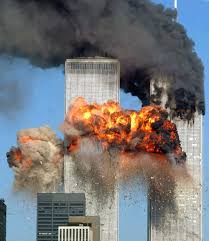
World Trade Center – September 11, 2001
With 2,977 New Yorkers obliterated in less than two hours, Kelly knew his city could no longer rely on the FBI and CIA to safeguard its residents.
He decided to borrow a page from the FBI’s own history.
Decades ago, the Bureau had created legal attaches–“Legats,” in Bureau-speak–in police departments around the world. These contacts had provided the FBI with invaluable Intelligence on wanted fugitives and imminent acts of criminality.
Now the NYPD would arm itself with the same weapon.
Through these liaisons, the NYPD would tap into the Intelligence resources of police departments and espionage agencies throughout the world.
The NYPD greatly expanded the ranks of its Counterterrorism Division. More than 600 officers and operatives both stateside and worldwide now stood guard over New York City.
Click here: Amazon.com: Securing the City: Inside America’s Best Counterterror Force–The NYPD eBook: Christopher Dickey: Book
Heading this division was David Cohen as Deputy Commissioner of Intelligence. He had previously served as Deputy Director for Operations at the CIA, overseeing domestic missions in the 1980s and overseas assignments in the 1990s.
Given the full backing of Mayor Bloomberg and Commissioner Kelly, Cohen soon had twice as many fluent Arabic speakers on his staff as the entire FBI.
His agents spoke some 50 languages and dialects, which matched the reported linguistic capabilities of the CIA.
ABC NEWS, ALEX JONES, ALTERNET, AMERICABLOG, AP, BABY BOOMER RESISTANCE, BARACK OBAMA, BBC, BLOOMBERG NEWS, BUREAU OF LAND MANAGEMENT, BUZZFEED, CBS NEWS, CIVIL WAR, CLIVEN BUNDY, CNN, CROOKS AND LIARS, DAILY KOS, FBI, FIVETHIRTYEIGHT, HARPER’S MAGAZINE, HUFFINGTON POST, MEDIA MATTERS, MILITIA GROUPS, MOTHER JONES, MOVEON, MSNBC, NBC NEWS, NEVADA, NEW REPUBLIC, NEWSDAY, NEWSWEEK, NICCOLO MACHIAVELLI, NPR, PBS NEWSHOUR, POLITICO, POLITICUSUSA, RAW STORY, REUTERS, SALON, SEATTLE TIMES, SLATE, SWAT TEAMS, TALKING POINTS MEMO, THE ATLANTIC, THE CHICAGO SUN-TIMES, THE CHICAGO TRIBUNE, THE DAILY BEAST, THE DAILY BLOG, THE DISCOURSES, THE GUARDIAN, THE HILL, THE HUFFINGTON POST, THE INTERCEPT, THE LOS ANGELES TIMES, THE NATION, THE NEW REPUBLIC, THE NEW YORK TIMES, THE NEW YORKER, THE PRINCE, THE VILLAGE VOICE, THE WASHINGTON POST, THINKPROGRESS, TIME, TRUTHDIG, TRUTHOUT, TWITTER, U.S. MARSHALS SERVICE, U.S. NEWS & WORLD REPORT, ULYSSES S. GRANT, UPI, WILLIAM T. SHERMAN
In Bureaucracy, History, Law, Law Enforcement, Politics, Social commentary on April 23, 2014 at 1:00 am
President Barack Obama–or at least Neil Kornze, the director of the Federal Bureau of Land Management (BLM)–has some serious lessons to learn about the uses of power.
For more than 20 years, Cliven Bundy, a Nevada cattle rancher, has refused to pay fees for grazing cattle on public lands, some 80 miles north of Las Vegas.
BLM says Bundy now owes close to $1 million. He says his family has used the land since the 1870s and doesn’t recognize the federal government’s jurisdiction.
In 2013, a federal judge ordered Bundy to remove his livestock. He ignored the order, and in early April, 2014, BLM agents rounded up more than 400 of his cattle.
Over the weekend of April 12-13, armed militia members and states’ right protesters showed up to challenge the move.
Bureau of Land Management logo
Rather than risk violence, the BLM did an about-face and released the cattle.
Right-wing bloggers and commentators have portrayed the incident as a victory over Federal tyranny.
According to Alex Jones’ Infowars.com: “Historic! Feds Forced to Surrender to American Citizens.”
Right-wingers have depicted Bundy as a put-upon Everyman being “squeeaed” by the dictatorial Federal government.
They have deliberately ignored a number of inconvenient truths–such as:
- He claims that his grazing rights were established in 1880 when his ancestors settled the land where his ranch sits.
- But the Nevada constitution–adopted in 1864 as a condition of statehood–contradicts Bundy’s right to operate as a law unto himself.
- The constitution says: “The people inhabiting said territory do agree and declare, that they forever disclaim all right and title to the unappropriated public lands lying within said territory, and that the same shall be and remain at the sole and entire disposition of the United States.”
- In 1934, the Taylor Grazing Act gave existing ranchers permits allowing them to run their herds on federal land.
- In turn, ranchers paid user fees, which were lower than what most private landowners would have charged.
- In 1993, the Federal government launched an effort to protect the endangered desert tortoise.
- Certain grasslands were placed off-limits for grazing, and the government bought out the permits of some ranchers.
- Among others, Bundy refused to sell and kept grazing his cattle on restricted federal land without a permit.
- Amidst mounting fees and fines, Bundy repeatedly slugged it out in court against government lawyers. He lost.
- In 1998, a federal judge permanently barred him from letting his cattle graze on protected federal land.
- In early April, 2014, BLM agents–charged with overseeing grazing rights–began rounding up Bundy’s cattle to remove them from federal property.
Bundy’s family and other ranchers–backed up by a motley assortment of self-declared militiamen armed with rifles and pistols–confronted the agents.
Fearing another Waco–regarded by Right-wing Americans as a second Alamo–the BLM agents backed down and released Bundy’s cattle. And then retreated.
While Right-wingers hail this as a victory for “states’ rights,” the truth is considerably different.
Bundy’s refusal to recognize the federal government’s jurisdiction amounts to: “I will recognize–and obey–only those laws that I happen to agree with.”
And the BLM’s performance offers a texbook lesson on how not to promote respect for the law–or for those who enforce it.
As Niccolo Machiavelli, the father of modern political science warned more than 500 years ago in The Prince:
[A ruler] is rendered despicable by being thought changeable, frivolous, effeminate, timid and irresolute—which [he] must guard against as a rock of danger….
[He] must contrive that his actions show grandeur, spirit, gravity and fortitude.
As to the government of his subjects, let his sentence be irrevocable, and let him adhere to his decisions so that no one may think of deceiving or cozening him.
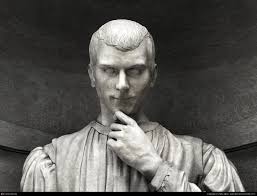
Niccolo Machiavelli
In his master-work, The Discouorses, he outlines the consequences of allowing lawbreakers to go unpunished:
...Having established rewards for good actions and penalties for evil ones, and having rewarded a citizen for conduct who afterwards commits a wrong, he should be chastised for that without regard to his previous merits….
For if a citizen who has rendered some eminent service to the state should add to the reputation and influence which he has thereby acquired the confident audacity of being able to commit any wrong without fear of punishment, he will in a little while become so insolent and overbearing as to put an end to all power of the law.
The conduct of the agents of BLM has violated that sage counsel on all counts.
BLM agents should have expected trouble from Right-wing militia groups–and come fully prepared to deal with it.
The FBI and the U.S. Marshals Service, for example, have created SWAT teams to deal with those who threaten violence against the Federal Government.
Civil War General William Tecumseh Sherman had a formula for dealing with domestic terrorists of his own time.
Writing to his commander, Ulysses S. Grant, about the best way to treat Confederate guerrillas, he advised:
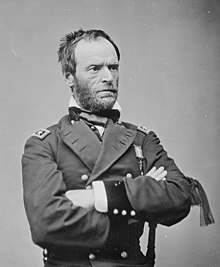
General Willilam Tecumseh Sherman
“They cannot be made to love us, but they may be made to fear us. We cannot change the hearts of those people of the South.
“But we can make war so terrible that they will realize the fact that . . . they are still mortal and should exhaust all peaceful remedies before they fly to war.”
ABC NEWS, APALACHIN RAID, BUGGING, CBS NEWS, CLYDE TYOLSON, CNN, ELECTRONIC SURVEILLANCE, FACEBOOK, FBI, FEDERAL BUREAU OF NARCOTICS, ILLEGAL ALIENS, IMMIGRATION AND CUSTOMS ENFORCEMENT, IRAN, IRAN-CONTRA, J. EDGAR HOOVER, MAFIA, MEYER LANSKY, NBC NEWS, NICARAGUA, OLIVER NORTH, ORGANIZED CRIME, ROBERT F. KENNEDY, Ronald Reagan, SANDINISTAS, SENATE LABOR RACKETS COMMITTEE, THE LOS ANGELES TIMES, THE NEW YORK TIMES, THE WASHINGTON POST, TOP HOODLUM PROGRAM, TWITTER, WAL-MART, WIRETAPPING
In Bureaucracy, Business, History, Law, Law Enforcement, Politics, Social commentary on April 9, 2014 at 12:01 am
In 1959,, J. Edgar Hoover, the legendary director of the FBI, declared war on the Mafia.
He set up a Top Hoodlum Program and encouraged his agents to use wiretapping and electronic surveillance (“bugging”) to make up for lost time and Intelligence.
But Hoover also imposed a series of restrictions that could destroy an agent’s professional and personal life.
William E. Roemer, Jr., assigned to the FBI’s Chicago field office, was one of the first agents to volunteer for such duty.
In his memoirs, Man Against the Mob, published in 1989, Roemer laid out the dangers that went with such work:
- If confronted by police or mobsters, agents were to try to escape without being identified.
- If caught by police, agents were not to identify themselves as FBI employees.
- They were to carry no badges, credentials or guns–or anything else connecting themselves with the FBI.
- If they were arrested by police and the truth emerged about their FBI employment, the Bureau would claim they were “rogue agents” acting on their own.
- Such agents were not to refute the FBI’s portrayal of them as “rogues.”

If he had been arrested by the Chicago Police Department and identified as an FBI agent, Roemer would have:
- Definitely been fired from his position as an FBI agent.
- Almost certainly been convicted for at least breaking and entering.
- Disbarred from the legal profession (Roemer was an attorney).
- Perhaps served a prison sentence.
- Been disgraced as a convicted felon.
- Been unable to serve in his chosen profession of law enforcement.
Given the huge risks involved, many agents, unsurprisingly, wanted nothing to do with “black bag jobs.”
The agents who took them on were so committed to penetrating the Mob that they willingly accepted Hoover’s dictates.
In 1989, Roemer speculated that former Marine Lieutenant Colonel Oliver North had fallen victim to such a “Mission: Impossible” scenario: “The secretary will disavow any knowledge of your actions….”
In 1986, Ronald Reagan’s “arms-for-hostages” deal known as Iran-Contra had been exposed.
To retrieve seven Americans taken hostage in Beirut, Lebanon, Reagan had secretly agreed to sell some of America’s most sophisticated missiles to Iran.
During this operation, several Reagan officials–including North–diverted proceeds from the sale of those missiles to fund Reagan’s illegal war against the Sandinistas in Nicaragua.
In Roemer’s view: North had followed orders from his superiors without question. But when the time came for those superiors to step forward and protect him, they didn’t.
They let him take the fall.
Roemer speculated that North had been led to believe he would be rescued from criminal prosecution. Instead, in 1989, he was convicted for
- accepting an illegal gratuity;
- aiding and abetting in the obstruction of a congressional inquiry; and
- ordering the destruction of documents via his secretary, Fawn Hall.
That is how many employers expect their employees to act: To carry out whatever assignments they are given and take the blame if anything goes wrong.
Take the case of Wal-Mart Stores, Inc., the world’s biggest retailer.
In March, 2005, Wal-Mart escaped criminal charges when it agreed to pay $11 million to end a federal probe into its use of illegal aliens as janitors.
Agents from Immigration and Customs Enforcement (ICE) raided 60 Wal-Mart stores across 21 states in October, 2003. The raids led to the arrest of 245 illegal aliens.

Federal authorities had uncovered the cases of an estimated 345 illegal aliens contracted as janitors at Wal-Mart stores.
Many of the workers worked seven days or nights a week without overtime pay or injury compensation. Those who worked nights were often locked in the store until the morning.
According to Federal officials, court-authorized wiretaps revealed that Wal-Mart executives knew their subcontractors hired illegal aliens.
Once the raids began, Federal agents invaded the company’s headquarters in Bentonville, Ark., seizing boxes of records from the office of a mid-level executive.
Click here: Wal-Mart Settles Illegal Immigrant Case for $11M | Fox News
Of course, Wal-Mart admitted no wrongdoing in the case. Instead, it blamed its subcontractors for hiring illegal aliens and claiming that Wal-Mart hadn’t been aware of this.
Which, of course, is nonsense.
Just as the FBI would have had no compunctions about letting its agents take the fall for following orders right from the pen of J. Edgar Hoover, Wal-Mart meant to sacrifice its subcontractors for doing precisely what the company’s executives wanted them to do.
The only reason Wal-Mart couldn’t make this work: The Feds had, for once, treated corporate executives like Mafia leaders and had tapped their phones.
Click here: Wal-Mart to review workers – Business – EVTNow
Which holds a lesson for how Federal law enforcement agencies should treat future corporate executives when their companies are found violating the law.
Instead of seeing CEOs as “captains of industry,” a far more realistic approach would be giving this term a new meaning: Corrupt Egotistical Oligarchs.
A smart investigator/prosecutor should always remember:
Widespread illegal and corrupt behavior cannot happen among the employees of a major government agency or private corporation unless:
- Those at the top have ordered it and are profiting from it; or
- Those at the top don’t want to know about it and have taken no steps to prevent or punish it.


2012 PRESIDENTIAL RACE, ABC NEWS, BARACK OBAMA, BAY OF PIGS, CBS NEWS, CIA, CNN, COLD WAR, COMMUNISM, CUBA, FACEBOOK, FBI, FLORIDA, JOHN F. KENNEDY, JOHN ROSELLI, MAFIA, MITT ROMNEY, NBC NEWS, NEWT GINGRICH, RICK SANTORUM, ROBERT F. KENNEDY, RON PAUL, SAM GIANCANA, THE LOS ANGELES TIMES, THE NEW YORK TIMES, THE WASHINGTON POST, TWITTER
MICHAEL CORLEONE IS SMILING: PART TWO (OF THREE)
In Bureaucracy, History, Military, Social commentary on July 25, 2014 at 1:01 pmOn April 17, 1961, the U.S. Navy landed 1,700 CIA-trained Cuban exiles ashore at Cuba’s Bay of Pigs.
President John F. Kennedy–wanting to disguise the role of the United States in the invasion–refused to commit U.S. Marines and Air Force bombers to the invasion.
Long forewarned of the coming invasion, Fidel Castro sent in his forces to decimate the invaders.
Kennedy took responsibility for the failure. But privately he blamed Castro for refusing to be overthrown.
As a result, Kennedy and his brother, Robert–then Attorney General–created their own covert operation to depose Castro.
Robert and John F. Kennedy
Known as the Special Group, and overseen by Robert Kennedy, it launched a secret war against the Castro regime, code-named Operation Mongoose.
“We were hysterical about Castro at about the time of the Bay of Pigs and thereafter,” Secretary of Defense Robert S. McNamara later testified before Congress about these efforts. “And there was pressure from JFK and RFK to do something about Castro.”
Robert S. McNamara
Nor was everyone in the CIA enthusiastic about the “get Castro” effort.
“Everyone at CIA was surprised at Kennedy’s obsession with Fidel,” recalled Sam Halpern, who was assigned to the Cuba Project. “They thought it was a waste of time. We all knew [Castro] couldn’t hurt us. Most of us at CIA initially liked Kennedy, but why go after this little guy?
“One thing is for sure: Kennedy wasn’t doing it out of national security concerns. It was a personal thing. The Kennedy family felt personally burnt by the Bay of Pigs and sought revenge.”
It was all-out war. Among the tactics used:
“Bobby (Kennedy) wanted boom and bang all over the island,” recalled Halpern. “It was stupid. The pressure from the White House was very great.”
Among that “boom and bang” were a series of assassination plots against Castro, in which the Mafia was to be a key player.
Chicago Mobster Johnny Rosselli proposed a simple plan: through its underworld connections in Cuba, the Mafia would recruit a Cuban in Castro’s entourage, such as a waiter or bodyguard, who would poison him.
The CIA’s Technical Services division produced a botulinus toxin which was then injected into Castro’s favorite brand of cigars. The CIA also produced simpler botulinus toxin pills that could be dissolved in his food or drink.
But the deputized Mafia contacts failed to deliver any of the poisons to Castro.
Fidel Castro
As Rosselli explained to the CIA, the first poisoner had been discharged from Castro’s employ before he could kill him, while a back-up agent got “cold feet.”
Other proposals or attempts included:
Americans would rightly label such methods as “terrorist” if another power used them against the United States today. And the Cuban government saw the situation exactly the same way.
So Castro appealed to Nikita Khrushchev, leader of the Soviet Union, for assistance.
Nikita Khrushchev
Khrushchev was quick to comply: “We must not allow the communist infant to be strangled in its crib,” he told members of his inncer circle.
By October, 1962, the Soviet Union had sent more than 40,000 soldiers, 1,300 field pieces, 700 anti-airctaft guns, 350 tanks and 150 jets to Cuba to deter another invasion.
Khrushchev also began supplying Castro with nuclear-tipped ballistic missiles–whose discovery, on October 15, 1962, ignited the single most dangerous confrontation of the Cold War.
Suddenly, the two most powerful nuclear countries–the United States and the Soviet Union–found themselves on the brink of nuclear war.
John F. Kennedy in the Oval Office
At the time, Kennedy officials claimed they couldn’t understand why Khrushchev had placed nuclear missiles in Cuba. “Maybe Khrushchev’s gone mad” was a typical musing.
None of these officials admitted that JFK had been waging a no-holds-barred campaign to overthrow the Cuban government and assassinate its leader.
The crisis ended when, after 13 harrowing days, Khrushchev agreed to remove the missiles from Cuba. Behind its resolution lay a promise by the Kennedy administration to not invade Cuba.
But President Kennedy was not finished with Castro. While continuing the campaign of sabotage throughout Cuba, the Kennedys were preparing something far bigger: A fullscale American invasion of the island.
On October 4, 1963, the Joint Chiefs of Staff submitted its latest version of the invasion plan, known as OPLAN 380-63. Its timetable went:
But then fate–in the otherwise unimpressive form of Lee Harvey Oswald–suddenly intervened.
Share this: