Posts Tagged ‘DONALD TRUMP’
2016 PRESIDENTIAL RACE, ABC NEWS, ALTERNET, AMERICABLOG, AP, BABY BOOMER RESISTANCE, BBC, BERNIE SANDERS, BLOOD FEUD, BLOOMBERG NEWS, BROTHERS: THE HIDDEN HISTORY OF THE KENNEDY YEARS, BUZZFEED, CARLOS MARCELLO, CBS NEWS, CIA, CNN, COTTER SMITH, CROOKS AND LIARS, CUBA, DAILY KOS, DAVID TALBOT, DONALD TRUMP, ERNEST BORGNINE, FBI, FIDEL CASTRO, FIVETHIRTYEIGHT, GUS RUSSO, HARPER’S MAGAZINE, HILLARY CLINTON, HUFFINGTON POST, INTERNATIONAL BROTHERHOOD OF TEAMSTERS, J. EDGAR HOOVER, JAMES R. HOFFA, JUSTICE DEPARTMENT, LIVE BY THE SWORD: THE SECRET WAR AGAINST CASTRO AND THE DEATH OF JFK, MAFIA, MEDIA MATTERS, MOTHER JONES, MOVEON, MSNBC, NBC NEWS, NEW REPUBLIC, NEWSDAY, NEWSWEEK, NPR, PBS NEWSHOUR, POLITICO, POLITICUSUSA, RAFAEL EDWARD CRUZ, RAW STORY, REUTERS, ROBERT BLAKE, ROBERT F. KENNEDY, SALON, SAM GROOM, SEATTLE TIMES, Secret Service, SENATE LABOR RACKETS COMMITTEE, SLATE, TALKING POINTS MEMO, THE ATLANTIC, THE CHICAGO SUN-TIMES, THE CHICAGO TRIBUNE, THE DAILY BEAST, THE DAILY BLOG, THE GUARDIAN, THE HILL, THE HUFFINGTON POST, THE INTERCEPT, THE LOS ANGELES TIMES, THE NATION, THE NEW REPUBLIC, THE NEW YORK TIMES, THE NEW YORKER, THE VILLAGE VOICE, THE WALL STREET JOURNAL, THE WASHINGTON POST, THINKPROGRESS, TIME, TRUTHDIG, TRUTHOUT, TWITTER, U.S. NEWS & WORLD REPORT, UPI
In Bureaucracy, History, Law, Law Enforcement, Politics, Social commentary on April 25, 2016 at 12:10 am
The 1983 TV mini-series, Blood Feud, chronicles the decade-long struggle between Robert F. Kennedy (Cotter Smith) and James R. Hoffa (Robert Blake), president of the International Brotherhood of Teamsters Union.
With Kennedy as Attorney General and facing relentless pressure from the Justice Department, the Mafia despairs of a solution. At a swanky restaurant, several high-ranking Mafiosi agree that “something” must be done.
On November 22, 1963, President John F. Kennedy is assassinated in Dallas, Texas.
Blood Feud clearly implies that the Mafia was responsible.
[The House Assassinations Committee investigated this possibility in 1978, and determined that Carlos Marcello, the Mafia boss of New Orleans, had the means, motive and opportunity to kill JFK. But it could not find any conclusive evidence of his involvement.]
Even with the President dead, RFK’s Justice Department continues to pursue Hoffa. In 1964, he is finally convicted of jury tampering and sentenced to 13 years’ imprisonment.
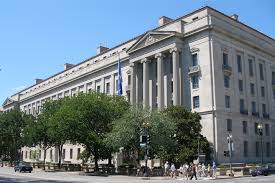
U.S. Department of Justice
Hoping to avoid prison, Hoffa phones Robert Kennedy, offering future Teamsters support if RFK runs for President. To prove he can deliver, he tells Kennedy that the Teamsters have even penetrated the FBI.
[In March, 1964, Kennedy met with Hoffa on an airfield at Dulles International Airport in Washington, D.C. He was accompanied by two Secret Service agents from the detail assigned to ex-First Lady Jacqueline Kennedy.
[FBI Director J. Edgar Hoover, no longer afraid to cross RFK, had withdrawn the agents previously assigned to guard Kennedy.
[Accompanying Hoffa were two muscular bodyguards–at least one of whom was packing two pistols in shoulder holsters.
[While the Secret Service agents watched from a respectful distance, Kennedy spoke quietly with Hoffa. The Attorney General showed a document to Hoffa, and the Teamsters leader at times nodded or shook his head.
[The agents drove Kennedy back to Washington. During the ride, he said nothing about the reason for the meeting.
[David Talbot, in his book, Brothers: The Hidden History of the Kennedy Years, speculates that it could have been to discuss Hoffa’s conviction for jury tampering.
[But Gus Russo–author of Live By the Sword: The Secret War Against Castro and the Death of JFK–writes that the reason might have been Dallas.
[Perhaps, he speculates, RFK had wanted to look into Hoffa’s eyes while asking him: Did you have anything to do with the assassination? RFK had, in fact, done this with CIA Director John McCone almost immediately after his brother’s death.]
In Blood Feud, Kennedy confronts J. Edgar Hoover (Ernest Borgnine) and accuses him of illegally planting wiretaps in Mob hangouts all over the country.
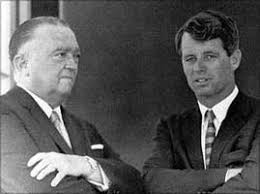
J. Edgar Hoover and Robert F. Kennedy
Hoover retorts that this had been the only way to obtain the prosecution-worthy intelligence Kennedy had demanded: “You loved that flow of information. You didn’t want it to stop.”
Kennedy: Why did you keep the FBI out of the fight against the Mob for decades?
Hoover: “Every agency that came to grips with them got corrupted by their money.”
[So far as is known, Hoover never made any such confession. Historians continue to guess his reason for leaving the Mob alone for decades.]
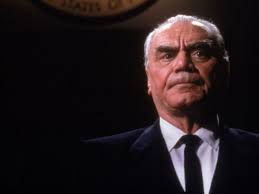

Ernest Borgnine as J. Edgar Hoover
RFK then mentions the CIA’s plots to employ the Mob to assassinate Cuban dictator Fidel Castro
[The agency had wanted to please President Kennedy, and the Mafia had wanted to regain its casinos lost to the Cuban Revolution. The role the Kennedy brothers played in the CIA’s assassination plots remains murky, and has been the subject of endless speculation.]
“The CIA, doing business with the Mob,” says Kennedy. “The FBI, leaking information to its enemies [the Teamsters].” Then, sadly: “I guess it’s true–everyone does business with everyone.”
[So far as is known, the FBI did not pass on secrets to the Teamsters. But during the 1970s, the Mafia penetrated the Cleveland FBI office through bribes to a secretary. Several FBI Mob informants were “clipped” as a result.]
In 1967, Hoffa goes to prison. He stays there until, in 1971, President Richard Nixon commutes his sentence in hopes of gaining Teamsters’ support for his 1972 re-election.
Kennedy leaves the Justice Department in 1964 and is elected U.S. Senator from New York. In 1968 he runs for President. On June 5, after winning the California primary, he’s assassinated.
In Blood Feud, just before his assassination, RFK asks: “How will I ever really know if the Mob killed Jack because of my anti-Mob crusade?”
Hoffa schemes to return to the presidency of the Teamsters–a post now held by his successor, Frank Fitzsimmons. He runs the union in a more relaxed style than Hoffa, thus giving the Mob greater control over its pension fund.
And the Mafia likes it that way.
On July 30, 1975, Hoffa disappears from the parking lot of the Machus Red Fox Restaurant near Detroit. He had gone there to meet with two Mafia leaders.
Almost 41 years after the death of James R. Hoffa, and almost 48 years after that of Robert F. Kennedy:
- Labor unions are a shadow of their former power.
- The threat they once represented to national prosperity has been replaced by that of predatory corporations like Enron and AIG.
- The war RFK began on the Mafia has continued, sending countless mobsters to prison.
- Millions of Americans who once expected the Federal Government to protect them from crime now believe the Government is their biggest threat.
- The idealism that fueled RFK’s life has virtually disappeared from politics.
2016 PRESIDENTIAL RACE, ABC NEWS, ABCNEWS, ALTERNET, AMERICABLOG, AP, BABY BOOMER RESISTANCE, BBC, BERNIE SANDERS, BLOOD FEUD, BLOOMBERG NEWS, BROTHERS: THE HIDDEN HISTORY OF THE KENNEDY YEARS, BUZZFEED, CARLOS MARCELLO, CBS NEWS, CIA, CNN, COTTER SMITH, CROOKS AND LIARS, CUBA, DAILY KOS, DAVID TALBOT, DONALD TRUMP, ERNEST BORGNINE, FBI, FIDEL CASTRO, FIVETHIRTYEIGHT, GUS RUSSO, HARPER’S MAGAZINE, HILLARY CLINTON, HUFFINGTON POST, INTERNATIONAL BROTHERHOOD OF TEAMSTERS, J. EDGAR HOOVER, JAMES R. HOFFA, JOHN F. KENNEDY, JUSTICE DEPARTMENT, LIVE BY THE SWORD: THE SECRET WAR AGAINST CASTRO AND THE DEATH OF JFK, MAFIA, MEDIA MATTERS, MOTHER JONES, MOVEON, MSNBC, NBC NEWS, NEW REPUBLIC, NEWSDAY, NEWSWEEK, NPR, PBS NEWSHOUR, POLITICO, POLITICUSUSA, RAFAEL EDWARD CRUZ, RAW STORY, REUTERS, ROBERT BLAKE, ROBERT F. KENNEDY, SALON, SAM GROOM, SEATTLE TIMES, Secret Service, SENATE LABOR RACKETS COMMITTEE, SLATE, TALKING POINTS MEMO, THE ATLANTIC, THE CHICAGO SUN-TIMES, THE CHICAGO TRIBUNE, THE DAILY BEAST, THE DAILY BLOG, THE GUARDIAN, THE HILL, THE HUFFINGTON POST, THE INTERCEPT, THE LOS ANGELES TIMES, THE NATION, THE NEW REPUBLIC, THE NEW YORK TIMES, THE NEW YORKER, THE VILLAGE VOICE, THE WALL STREET JOURNAL, THE WASHINGTON POST, THINKPROGRESS, TIME, TRUTHDIG, TRUTHOUT, TWITTER, U.S. NEWS & WORLD REPORT, UPI
In Bureaucracy, History, Law, Law Enforcement, Politics, Social commentary on April 22, 2016 at 12:10 am
The 1983 TV mini-series, Blood Feud, chronicles the decade-long struggle between Robert F. Kennedy and James R. Hoffa.
Having “helped” Kennedy (Cotter Smith) to oust corrupt Teamsters President Dave Beck, Hoffa (Robert Blake) believes that Kennedy should now be satisfied: “He’s got his scalp. Now he can move on to other things while I run the union.”
But Hoffa has guessed wrong–with fatal results. Realizing that he’s been “played” by Hoffa, a furious Kennedy strikes back.
He orders increased surveillance of Hoffa and his topmost associates. He subpoenas union records and members of both the Teamsters and the Mafia to appear before his committee in public hearings.
And he tries to enlist the aid of legendary FBI Director J. Edgar Hoover (Ernest Borgnine). But Hoover wants no part of a war against organized crime, whose existence he refuses to admit.

Meanwhile, Kennedy’s confrontations with Hoffa grow increasingly fierce. In open hearings, Kennedy accuses Hoffa of receiving kickbacks in the name of his wife. Hoffa damns him for “dirtying my wife’s name.”
Kennedy secures an indictment against Hoffa for hiring a spy to infiltrate the Senate Labor Rackets Committee. He’s so certain of a conviction that he tells the press he’ll “jump off the Capitol building” if Hoffa beats the rap.
But Hoffa’s lawyer, Edward Bennett Williams (Jose Ferrer) puts Kennedy himself on the witness stand. There he portrays Kennedy as a spoiled rich man who’s waging a vendetta against Hoffa.
Hoffa beats the rap, and offers to send Kennedy a parachute. But he jokingly warns reporters: “Hey, Bobby, you better have it checked. I don’t trust myself!”
By 1959, Robert Kennedy’s work as chief counsel for the Senate Labor Rackets Committee is over. But not his determination to send Teamsters President James Hoffa to prison.
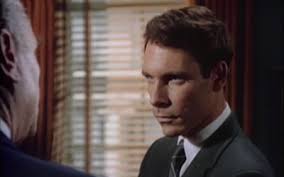
Cotter Smith as Robert Kennedy
Throughout 1960, he manages the Presidential campaign for his brother, John F. Kennedy (Sam Groom). By a margin of only 100,000 votes, JFK wins the election.
Hoffa thinks that his troubles are over, that “Bobby” will move on to other pursuits and forget about the Teamsters.
Hoffa is partly right: Kennedy moves on to another job. But it’s the office of United States Attorney General.
JFK, needing someone in the Cabinet he can trust completely, browbeats Robert into becoming the the nation’s top cop.
For Hoffa, it’s a nightmare come true.
As Attorney General, Kennedy no longer has to beg J. Edgar Hoover to attack organized crime. He can–and does–order him to do so.
Throughout the country, the Mafia feels a new heat as FBI agents plant illegal electronic microphones (“bugs”) in their innermost sanctums. Agents openly tail mobsters–and send them to prison in large numbers.
And Kennedy sets up a special unit, composed of topflight prosecutors and investigators, to go after just one man: James Riddle Hoffa. The press comes to call it the “Get Hoffa” squad.
Hoffa continues to beat federal prosecutors in court. But he believes he’s under constant surveillance by the FBI, and his nerves are starting to crack.
Convinced that the FBI has bugged his office, he literally tears apart the room, hoping to find the bug. But he fails to do so.
What he doesn’t know is he’s facing a more personal danger–from one of his closest associates.
He tells a trusted colleague, Edward Grady Partin (Brian Dennehy) how easy it would be to assassinate Kennedy with a rifle or bomb.
Later, Partin gets into a legal jam–and is abandoned by the Teamsters. Hoping to cut a deal, he relays word to the Justice Department of Hoffa’s threats against the Attorney General.
Now working for the Justice Department, Partin sends in reports on Hoffa’s juror-bribing efforts in yet another trial. Hoffa again beats the rap–but now Kennedy has the insider’s proof he needs to put him away for years.
Meanwhile, the Mafia despairs of the increasing pressure of the Justice Department. At a swanky restaurant, several high-ranking members agree that “something” must be done.
[Although this scene is fictional, it’s clearly based on an infamous outburst of Carlos Marcello, the longtime Mafia boss of New Orleans.
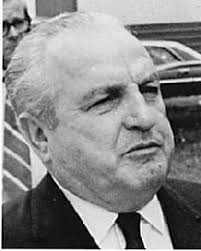
Carlos Marcello
[In 1961, Marcello was deported to his native Guatemala on orders by RFK. After illegally re-entering the country, he swore vengeance against the Attorney General.
[In September, 1962, during a meeting with several mob colleagues, he flew into a rage when someone mentioned Kennedy.
“Take the stone out of my shoe!” he shouted, echoing a Sicilian curse. “Don’t you worry about that little Bobby sonofabitch. He’s going to be taken care of!”
[When one of his colleagues warned that murdering RFK would trigger the wrath of his brother, President John F.Kennedy, Marcello replied: “In Sicily they say if you want to kill a dog you don’t cut off the tail. You go for the head.”
[Marcello believed that the death of President Kennedy would render the Attorney General powerless. And he added that he planned to use a “nut” to do the job.]
On November 22, 1963, President John F. Kennedy is assassinated in Dallas, Texas.
Blood Feud clearly implies that the Mafia was responsible.
2016 PRESIDENTIAL RACE, ABC NEWS, ALTERNET, AMERICABLOG, AP, BABY BOOMER RESISTANCE, BBC, BERNIE SANDERS, BLOOD FEUD, BLOOMBERG NEWS, BROTHERS: THE HIDDEN HISTORY OF THE KENNEDY YEARS, BUZZFEED, CARLOS MARCELLO, CBS NEWS, CIA, CNN, COTTER SMITH, CROOKS AND LIARS, CUBA, DAILY KOS, DAVID TALBOT, DONALD TRUMP, ERNEST BORGNINE, FBI, FIDEL CASTRO, FIVETHIRTYEIGHT, GUS RUSSO, HARPER’S MAGAZINE, HILLARY CLINTON, HUFFINGTON POST, INTERNATIONAL BROTHERHOOD OF TEAMSTERS, J. EDGAR HOOVER, JAMES R. HOFFA, JOHN F. KENNEDY, JUSTICE DEPARTMENT, LIVE BY THE SWORD: THE SECRET WAR AGAINST CASTRO AND THE DEATH OF JFK, MAFIA, MEDIA MATTERS, MOTHER JONES, MOVEON, MSNBC, NBC NEWS, NEW REPUBLIC, NEWSDAY, NEWSWEEK, NPR, PBS NEWSHOUR, POLITICO, POLITICUSUSA, RAFAEL EDWARD CRUZ, RAW STORY, REUTERS, ROBERT BLAKE, ROBERT F. KENNEDY, SALON, SAM GROOM, SEATTLE TIMES, Secret Service, SENATE LABOR RACKETS COMMITTEE, SLATE, TALKING POINTS MEMO, THE ATLANTIC, THE CHICAGO SUN-TIMES, THE CHICAGO TRIBUNE, THE DAILY BEAST, THE DAILY BLOG, THE GUARDIAN, THE HILL, THE HUFFINGTON POST, THE INTERCEPT, THE LOS ANGELES TIMES, THE NATION, THE NEW REPUBLIC, THE NEW YORK TIMES, THE NEW YORKER, THE VILLAGE VOICE, THE WALL STREET JOURNAL, THE WASHINGTON POST, THINKPROGRESS, TIME, TRUTHDIG, TRUTHOUT, TWITTER, U.S. NEWS & WORLD REPORT, UPI
In Bureaucracy, History, Law, Law Enforcement, Politics, Social commentary on April 21, 2016 at 12:37 pm
Today, America has four major candidates running for President: Donald Trump, Rafael Edward Cruz, Hillary Clinton and Bernie Sanders.
Trump is a billionaire businessman; Cruz is a U.S. Senator from Texas; Clinton is a former First Lady, U.S. Senator and Secretary of State; and Sanders is a U.S. Senator from Vermont.
Despite the great differences in their backgrounds, they all share one thing in common: Extremely high negatives among voters.
But 48 years ago, Senator Robert Francis Kennedy aroused passions of an altogether different sort.
Kennedy had been a United States Attorney General (1961-1964) and Senator (1964-1968). But it was his connection to his beloved and assassinated brother, President John F. Kennedy, for which he was best known.

Robert F. Kennedy campaigning for President
Millions saw RFK as the only candidate who could make life better for America’s impoverished–while standing firmly against those who threatened the Nation’s safety.
As television correspondent Charles Quinn observed: “I talked to a girl in Hawaii who was for [George] Wallace [the segregationist governor of Alabama]. And I said ‘Really?’ [She said] ‘Yeah, but my real candidate is dead.’
“You know what I think it was? All these whites, all these blue collar people who supported Kennedy…all of these people felt that Kennedy would really do what he thought best for the black people, but, at the same time, would not tolerate lawlessness and violence.
“They were willing to gamble…because they knew in their hearts that the country was not right. They were willing to gamble on this man who would try to keep things within reasonable order; and at the same time do some of the things they knew really should be done.”
Campaigning for the Presidency in 1968, RFK had just won the crucial California primary on June 4–when he was shot in the back of the head. His killer: Sirhan Sirhan, a young Palestinian furious at Kennedy’s support for Israel.
On June 8, 1,200 men and women boarded a specially-reserved passenger train at New York’s Pennsylvania Station. They were accompanying Kennedy’s body to its final resting place at Arlington National Cemetery.
As the train slowly moved along 225 miles of track, throngs of men, women and children lined the rails to pay their final respects to a man they considered a genuine hero.
Little Leaguers clutched their baseball caps across their chests. Uniformed firemen and policemen saluted. Burly men in shirtsleeves held hardhats over their hearts. Black men in overalls waved small American flags. Women from all levels of society stood and cried.

A nation says goodbye to Robert Kennedy
Commenting on RFK’s legacy, historian William L. O’Neil wrote in Coming Apart: An Informal History of America in the 1960′s:
“…He aimed so high that he must be judged for what he meant to do, and, through error and tragic accident, failed at….He will also be remembered as an extraordinary human being who, though hated by some, was perhaps more deeply loved by his countrymen than any man of his time.
“That too must be entered into the final account, and it is no small thing. With his death something precious disappeared from public life.”
Eleven years earlier, as a young, idealistic attorney, Kennedy had declared war on James Riddle Hoffa, the president of the Mafia-dominated International Brotherhood of Teamsters Union.
As chief counsel for the Senate Labor Rackets Committee, Kennedy was appalled at the corruption he discovered among high-ranking Teamster officials. As he saw it, under Hoffa’s leadership, the union was nothing less than “a conspiracy of evil.”
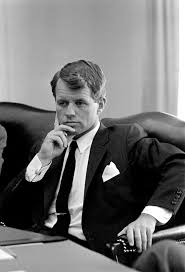
Robert Francis Kennedy as Chief Counsel, Senate Labor Rackets Committee
Hoffa, in turn, held an equally unflattering view of Kennedy. “A rich punk,” said Hoffa, who didn’t know or care about “the average workingman.”
In 1983, Blood Feud, a two-part TV mini-series, depicted the 11-year animosity between Kennedy and Hoffa. Although it took some dramatic liberties, its portrayal of the major events of that period remains essentially accurate.
Today, labor unions are a rapidly-vanishing species, commanding far less political influence than they did 50 years ago. As a result, young viewers of this series may find it hard to believe that labor ever held such sway, or that the Teamsters posed such a threat.
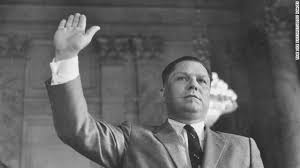
James Riddle Hoffa testifying before the Senate Labor Rackets Committee
And in an age when millions see “Big Government” as the enemy, they may feel strong reservations about the all-out war that Robert F. Kennedy waged against Hoffa.
Blood Feud opens in 1957, when Hoffa (Robert Blake) is a rising figure within the Teamsters. Kennedy (Cotter Smith) is chief counsel for the Senate Labor Rackets Committee.
At first, Hoffa tries to ingratiate himself with Kennedy, telling him: “I know everybody who can help me and anybody who can hurt me.”
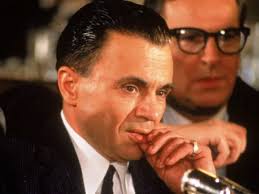
Robert Blake as James R. Hoffa
A wily Hoffa decides to parley Kennedy’s anti-corruption zeal into a path to power for himself. Via his attorney, Eddie Cheyfitz, he feeds Kennedy incriminating evidence against Dave Beck, president of the Teamsters.
Confronted with a Senate subpoena, Beck flees the country–paving the way for Hoffa to assume the top position in the union. Hoffa believes he has solved two problems at once.
2016 PRESIDENTIAL RACE, ABC NEWS, ADOLF HITLER, CBS NEWS, CNN, DAVID BROOKS, DONALD TRUMP, EDUARDO "TED" CRUZ, FACEBOOK, FOX NEWS, HEINZ GUDERIAN, MARK SHIELDS, MEGYN KELLY, PBS NEWSHOUR, REPUBLICANS, ROBERT PAYNE, THE CHICAGO SUN-TIMES, THE CHICAGO TRIBUNE, THE LIFE AND DEATH OF ADOLF HITLER, THE LOS ANGELES TIMES, THE NEW YORK TIMES, THE WASHINGTON POST, TWITTER, WOMEN
In Bureaucracy, History, Politics, Social commentary on April 20, 2016 at 12:05 am
Syndicated columnist Mark Shields and New York Times columnist David Brooks appear every Friday on the PBS Newshour to review the week’s major political events.
On March 25, Shields–a liberal, and Brooks, a conservative–came to some disturbingly similar conclusions about Donald Trump.
Eerily, their conclusions echo those reached by former Panzer General Heinz Guderian about German dictator Adolf Hitler.
Guderian created the concept of motorized blitzkrieg warfare, whereby masses of tanks and planes moved in coordination to strike at the vital nerve centers of an enemy.
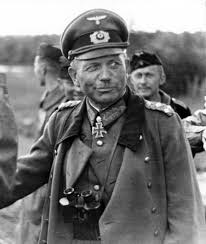
Heinz Guderian
As a result, Guderian enabled Hitler to conquer France in only six weeks in 1940, and to come to the brink of crushing the Soviet Union in 1941.
He recounted his career as the foremost tank commander of the Third Reich in his 1950 autobiography, Panzer Leader.
Moderator Judy Woodruff noted that “polls show Trump’s standing with women voters has worsened in recent months.”
A Washington Post/ABC News poll reveals that 64% of women say they have a strongly unfavorable reaction to Trump. That’s 18 points higher than it was in August, 2015.
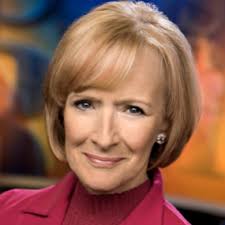
Judy Woddruff
This led David Brooks to declare that Trump has shown “a consistent misogynistic view of women as arm candy, as pieces of meat. It’s a consistent attitude toward women which is the stuff of a diseased adolescent.”
Judy Woodruff noted that Fox News Correspondent Megyn Kelly “has asked him tough questions” in a recent debate.
MARK SHIELDS: “She just asked him tough questions and was totally fair, by everybody else’s standards.
“But there is something really creepy about this that’s beyond locker room. It’s almost like a stalker, and I just–I thought this was–it actually did the impossible. It made Ted Cruz look like an honorable, tough guy on the right side of an issue.”
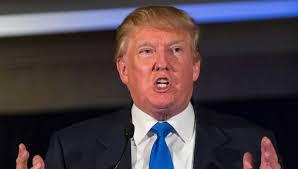
Donald Trump
HEINZ GUDERIAN: Once in power, Hitler quickly–and violently–eliminated his opposition.
He make no attempt to disguise this aspect of his character, because the opposition was weak and divided and soon collapsed after the first violent attack.
This allowed Hitler to pass laws which destroyed the safeguards enacted by the Weimar Republic against the the dangers of dictatorship.
MARK SHIELDS: “And I don’t know at what point it becomes…politically, he’s still leading. And I would have to say he’s the overwhelming favorite for the Republican nomination.”
HEINZ GUDERIAN: Hitler promised to “make Germany great again” both domestically and internationally. And this won him many followers. In time he controlled the largest party in the land and this allowed him, by democratic procedure, to assume power.
DAVID BROOKS: “The odd thing about [Trump’s] whole career and his whole language, his whole world view is there is no room for love in it. You get a sense of a man who received no love, can give no love, so his relationship with women, it has no love in it. It’s trophy.”
HEINZ GUDERIAN: [Hitler] was isolated as a human being. He had no real friend. There was nobody who was really close to him.
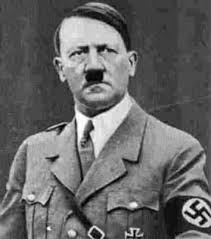
Adolf Hitler
There was nobody he could talk to freely and openly. And just as he never found a true friend, he was denied the ability to deeply love a woman.
DAVID BROOKS: “And [Trump’s] relationship toward the world is one of competition and beating, and as if he’s going to win by competition what other people get by love.”
HEINZ GUDERIAN: Everything on this earth that casts a glow of warmth over our life as mortals–friendship with fine men, the pure love for a wife, affection for one’s own children–all this was and forever remained unknown to him.
DAVID BROOKS: “And so you really are seeing someone who just has an odd psychology unleavened by kindness and charity, but where it’s all winners and losers, beating and being beat. And that’s part of the authoritarian personality, but it comes out in his attitude towards women.”
HEINZ GUDERIAN: He lived alone, cherishing his loneliness, with only his gigantic plans for company.
His relationship with Eva Braun may seem to contradict what I have written. But it is obvious that she could not have had any influence over him. And this is unfortunate, for it could only have been a softening one.
* * * * *
In his bestselling 1973 biography, The Life and Death of Adolf Hitler, British historian Robert Payne harshly condemned the German people for the rise of the Nazi dictator:
“[They] allowed themselves to be seduced by him and came to enjoy the experience….[They] followed him with joy and enthusiasm because he gave them license to pillage and murder to their hearts’ content.”
There is a very real danger that millions of ignorant, hate-filled, Right-wing Americans will catapult Donald Trump–a man with an “odd psychology unleavened by kindness and charity”–into the Presidency.
And that this man–“who received no love, can give no love”–will assume all the awesome power that goes with that office.
If that happens, future historians–if there are any–may similarly condemn those Americans who stood by like “good Germans” and allowed their country to fall into the hands of a ruthless tyrant.
2016 PRESIDENTIAL RACE, ABC NEWS, ADOLF HITLER, CBS NEWS, CNN, DAVID BROOKS, DONALD TRUMP, EDUARDO "TED" CRUZ, FACEBOOK, FOX NEWS, HEINZ GUDERIAN, MARK SHIELDS, MEGYN KELLY, NBC NEWS, PBS NEWSHOUR, REPUBLICANS, ROBERT PAYNE, THE CHICAGO SUN-TIMES, THE CHICAGO TRIBUNE, THE LIFE AND DEATH OF ADOLF HITLER, THE LOS ANGELES TIMES, THE NEW YORK TIMES, THE WASHINGTON POST, TWITTER, WOMEN
In Bureaucracy, Business, History, Politics, Social commentary on April 19, 2016 at 12:11 am
Syndicated columnist Mark Shields and New York Times columnist David Brooks appear every Friday on the PBS Newshour to review the week’s major political events.
On March 25, Shields–a liberal, and Brooks, a conservative–came to some disturbingly similar conclusions about the character of Republican Presidential front-runner Donald Trump.
As the business magnate moves ever closer to winning the 2016 Republican Presidential nomination, both columnists appear increasingly dismayed.
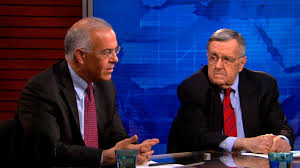
David Brooks and Mark Shields
Eerily, their conclusions about Trump’s character echo those reached by former Panzer General Heinz Guderian about German dictator Adolf Hitler.
Guderian created the concept of motorized blitzkrieg warfare, whereby masses of tanks and planes moved in coordination to strike at the vital nerve centers of an enemy.
As a result, Guderian enabled Hitler to conquer France in only six weeks in 1940, and to come to the brink of crushing the Soviet Union in 1941.
He recounted his career as the foremost tank commander of the Third Reich in his 1950 autobiography, Panzer Leader.

Heinz Guderian
Moderator Judy Woodruff opened the discussion by alluding to the blood feud raging between Trump and his fellow Republican, Texas U.S. Senator Eduardo “Ted” Cruz.
Both are seeking their party’s Presidential nomination–and both are ruthlessly determined to attain it.
Cruz accused Trump of behind a recent National Enquirer story charging him with having a series of extramarital affairs.
An anti-Trump Super PAC posted on Facebook a photo of a scantily-clad Melania Trump–his wife. The photo had been taken 16 years ago when, as a model, she posed for “British GQ.
Its publication came just ahead of the primary caucuses in sexually conservative Utah, which Cruz won.
Trump quickly responded on Twitter, accusing the Cruz campaign of leaking the photo, warning Cruz: “Be careful or I will spill the beans on your wife.”
Cruz struck back, defending his wife, Heidi, and calling Trump a coward. The next day, Trump retweeted an unflattering image of Mrs. Cruz.
This “war of the wives” has cost Trump dearly in his standing with American women. In March, a Washington Post/ABC News poll showed that 64% of women felt highly unfavorably disposed toward him.
DAVID BROOKS: “The Trump comparison of the looks of the wives, he does have, over the course of his life, a consistent misogynistic view of women as arm candy, as pieces of meat.
“It’s a consistent attitude toward women which is the stuff of a diseased adolescent.

Donald Trump
“And so we have seen a bit of that show up again. But if you go back over his past, calling into radio shows bragging about his affairs, talking about his sex life in public, he is childish in his immaturity. And his–even his misogyny is a childish misogyny….
“He’s of a different order than your normal candidate. And this whole week is just another reminder of that.”
HEINZ GUDERIAN: As Hitler’s self-confidence grew, and as his power became more firmly established both inside and outside Germany, he became overbearing and arrogant. Everyone appeared to him unimportant compared to himself.
Previously, Hitler had been open to practical considerations, and willing to discuss matters with others. But now he became increasingly autocratic.
Judy Woodruff asked Mark Shields if the uproar over Donald Trump’s disdain for women could really hurt his candidacy.
MARK SHIELDS: The ad featuring a scantily-clad Melania Trump “elicited from Donald Trump the worst of his personality, the bullying, the misogyny, as David has said, brought it out.
“But I think it’s more than childish and juvenile and adolescent. There is something creepy about this, his attitude toward women.
“Take Megyn Kelly of FOX News, who he just has an absolute obsession about, and he’s constantly writing about, you know, how awful she is and no talent and this and that.
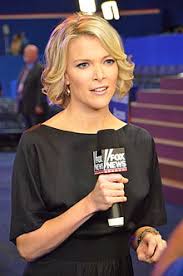
Megyn Kelly
“And I don’t know if he’s just never had women–strong, independent women in his life who have spoken to him. It doesn’t seem that way….”
HEINZ GUDERIAN: Hitler’s most outstanding quality was his will power. It was by this that he compelled men to follow him.
When Hitler spoke to a small group he closely observed each person to determine how his words were affecting each man present.
If he noticed that some member of the group was not being swayed by his speech, he spoke directly to that person until he believed he had won him over.
But if the target of his persuasive effort still remained obstinate, Hitler would exclaim: “I haven’t convinced that man!”
His immediate reaction was to get rid of such people. As he grew increasingly successful, he grew increasingly intolerant.
ABC NEWS, ALTERNET, AMERICABLOG, ANCHOR BABIES, AP, BABY BOOMER RESISTANCE, BARACK OBAMA, BBC, BLOOMBERG NEWS, BUZZFEED, CBS NEWS, CNN, CROOKS AND LIARS, DAILY KOZ, DONALD TRUMP, FACEBOOK, FBI, FIVETHIRTYEIGHT, HARPER’S MAGAZINE, HUFFINGTON POST, ILLEGAL ALIENS, illegal immigration, IMMIGRATION AND CUSTOMS ENFORCEMENT (ICE), JUSTICE DEPARTMENT, Kamala Harris, MEDIA MATTERS, MEXICO, MICHELLE OBAMA, MOTHER JONES, MOVEON, MSNBC, NBC NEWS, NEW REPUBLIC, NEWSDAY, NEWSWEEK, NPR, PBS NEWSHOUR, POLITICO, POLITICUSUSA, RACKETEER INFLUENCED CORRUPT ORGANIZATIONS ACT, RAW STORY, REUTERS, SALON, SAN FRANCISCO, sanctuary cities, SEATTLE TIMES, SLATE, TALKING POINTS MEMO, THE ATLANTIC, THE CHICAGO SUN-TIMES, THE CHICAGO TRIBUNE, THE DAILY BEAST, THE DAILY BLOG, THE GUARDIAN, THE HILL, THE HUFFINGTON POST, THE LOS ANGELES TIMES, THE NATION, THE NEW REPUBLIC, THE NEW YORK TIMES, THE NEW YORKER, THE VILLAGE VOICE, THE WALL STREET JOURNAL, THE WASHINGTON POST, THINKPROGRESS, TIME, TRUTHDIG, TRUTHOUT, TWITTER, TWO POLITICAL JUNKIES, U.S. NEWS & WORLD REPORT, U.S.-MEXICO WALL, UPI, USA TODAY, USA TODAY DONALD TRUMP, WAL-MART
In Bureaucracy, Business, History, Law, Law Enforcement, Politics, Social commentary on April 12, 2016 at 12:04 am
According to Donald Trump, stopping illegal immigration is easy.
Just build a massive, impenetrable wall along the U.S./Mexican border to keep out Mexican immigrants.
“Building a wall is easy, and it can be done inexpensively,” Trump said in an interview. “It’s not even a difficult project if you know what you’re doing.”
Really?
Among the obstacles to erecting such a barrier:
- The United States/Mexican border stretches for 1,954 miles—and encompasses rivers, deserts and mountains.
- Environmental and engineering problems.
- Squabbles with ranchers who don’t want to give up any of their land.
- Building such a wall would cost untold billions of dollars.
- Drug traffickers and alien smugglers could easily tunnel under it into the United States—as they are now doing.
Click here: Trump says building a U.S.-Mexico wall is ‘easy.’ But is it really? – The Washington Post
There are, in fact, cheaper and more effective remedies for combating illegal immigration.
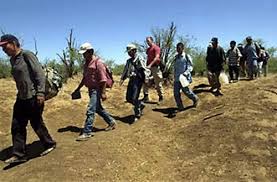
Illegal aliens crossing into the United States
(1) The Justice Department should vigorously attack the “sanctuary movement” that officially thwarts the immigration laws of the United States.
Among the 31 “sanctuary cities” of this country: Washington, D.C.; New York City; Los Angeles; Chicago; San Francisco; Santa Ana; San Diego; Salt Lake City; Phoenix; Dallas; Houston; Austin; Detroit; Jersey City; Minneapolis; Miami; Denver; Baltimore; Seattle; Portland, Oregon; New Haven, Connecticut; and Portland, Maine.
These cities have adopted “sanctuary” ordinances that do not allow municipal funds or resources to be used to enforce federal immigration laws, usually by not allowing police or municipal employees to inquire about one’s immigration status.
(2) The most effective way to combat this movement: Indict the highest-ranking officials of those cities who have actively violated Federal immigration laws.
In San Francisco, for example, former District Attorney Kamala Harris—who is now Vice President of the United States—created a secret and illegal program called Back on Track, which provided training for jobs that illegal aliens could not legally hold.
![]() She also prevented Immigration and Customs Enforcement (ICE) from deporting even those illegal aliens convicted of a felony.
She also prevented Immigration and Customs Enforcement (ICE) from deporting even those illegal aliens convicted of a felony.
(3) Even if some indicted officials escaped conviction, the results would prove worthwhile.
City officials would be forced to spend huge sums of their own money for attorneys and face months or even years of prosecution.
And this, in turn, would send a devastating warning to officials in other “sanctuary cities” that the same fate lies in store for them.
(4) CEOs whose companies—like Wal-Mart—systematically employ illegal aliens should be held directly accountable for the actions of their subordinates.
They should be indicted by the Justice Department under the Racketeer Influenced Corrupt Organizations (RICO) Act, the way Mafia bosses are prosecuted for ordering their own subordinates to commit crimes.
Upon conviction, the CEO should be sentenced to a mandatory prison term of at least 20 years.
This would prove a more effective remedy for combating illegal immigration than stationing tens of thousands of soldiers on the U.S./Mexican border.
CEOs forced to account for their subordinates’ actions would take drastic steps to ensure that their companies strictly complied with Federal immigration laws.
(5) The Government should stop granting automatic citizenship to “anchor babies” born to illegal aliens in the United States.
A comparable practice would be allowing bank robbers who had eluded the FBI to keep their illegally-obtained loot.
A person who violates the bank robbery laws of the United States is legally prosecutable for bank robbery, whether he’s immediately arrested or remains uncaught for years. The same should be true for those born illegally within this country.
If they’re not here legally at the time of birth, they should not be considered citizens and should—like their parents—be subject to deportation.
(6) The United States Government–from the President on down–should scrap its apologetic tone on the right to control its national borders.
First Lady Michelle Obama—accompanied by Margarita Zavala, the wife of then-Mexican President Felipe Calderon—was visiting a second-grade class in Silver Spring, Maryland.
A second-grade girl said: “My Mom, she says says that Barack Obama is taking everybody away that doesn’t have papers.”
“Yeah, well, that’s something that we have to work on right?”
Replied Mrs. Obama. “To make sure that people can be here with the right kind of papers, right?”
The girl then said: “But my mom doesn’t have any….”
Obama: “Well, we’ll have to work on that. We have to fix that, and everybody’s got to work together in Congress to make sure that happens.”
The Mexican Government doesn’t consider itself racist for strictly enforcing its immigration laws.
The United States Government should not consider itself racist for insisting on the right to do the same.
(7) Voting materials and ballots should be published in one language: English.
In Mexico, voting materials are published in one language—Spanish.
Throughout the United States, millions of Mexican illegals refuse to learn English and yet demand that voting materials and ballots be made available to them in Spanish.
(8) The United States should impose economic and even military sanctions against countries—such as China and Mexico—whose citizens make up the bulk of illegal aliens.
Mexico, for example, uses its American border to rid itself of those who might demand major reforms in the country’s political and economic institutions.
Such nations must learn that dumping their unwanteds on the United States now comes at an unfavorably high price. Otherwise those dumpings will continue.
ABC NEWS, AL QAEDA, BARACK OBAMA, BRUSSELS, CBS NEWS, CIA, CNN, DONALD TRUMP, EDUARDO "TED" CRUZ, FACEBOOK, FBI, GUANTANAMO, ISLAM, ISLAMIC STATE OF IRAQ AND SYRIA (ISIS), NBC NEWS, NEWT GINGRICH, NICCOLO MACHIAVELLI, PARIS, PENTAGON, RICK SANTORUM, RUDOLPH GIULIANI, SAN BERNADINO, SUPREME COURT, TERRORISM, THE DISCOURSES, THE LOS ANGELES TIMES, THE NEW YORK TIMES, THE WASHINGTON POST, TORTURE, TWITTER, WATERBOARDING
In Bureaucracy, History, Law, Law Enforcement, Military, Politics, Social commentary on April 5, 2016 at 12:11 am
Donald Trump has made a return to waterboarding terrorism suspects a prime issue in his campaign for the 2016 Republican Presidential nomination.
And a recent Reuters/lpsos poll shows that nearly two-thirds of Americans believe that the use of torture can be justified to force suspected terrorists to talk.
A growing fear by Americans of Islamic terrorism has been ignited by a series of deadly Islamic terrorist attacks in Europe and the United States.

Humiliating a prisoner in Iraq
In fact, however, torture, generally, and waterboarding in particular, have proven worthless at obtaining reliable information.
Victims will say anything they think their captors want to hear to stop the agony.
Yoshia Chee, a Special Forces veteran of Vietnam, recalled his use of torture against suspected Vietcong:
“One of the favorite things was popping one of their eyeballs out with a spoon….
“If I had one of my eyeballs hanging out, I’d say I killed Kennedy. I’d agree to anything in the whole world.
“We would do that, and they still wouldn’t talk….You rarely got anything out of them. Just more hatred. More reason to fight back.”
Click here: Strange Ground: An Oral History Of Americans In Vietnam, 1945-1975: Harry Maurer: 9780306808395: Amazon.com: Books
During the George W. Bush Presidency, the CIA relied on harsh physical punishments–beatings, humiliations and waterboarding–to convince suspects to talk. These were euphemistically referred to as “enhanced interrogation techniques.”
Upon assuming the Presidency in 2009, Barack Obama ordered an immediate halt to such methods. Since then, Republicans generally and their Presidential aspirants in particular have harshly criticized Obama’s decision.
Like Trump, they claim that Obama has endangered American security in the name of Political Correctness. In turn, Obama has argued that the use of torture produces unreliable information and inflames Muslim hatred of America.
Meanwhile, the FBI has applied its traditional “kill them with kindness” approach to interrogation. And agents found this yielded far greater results.
For one thing, most Al Qaeda members relished appearing before grand juries.
Unlike organized crime members, they were talkative–and even tried to proselytize to the jury members. They were proud of what they had done–and wanted to talk.
“This is what the FBI does,” said Mike Rolince, an FBI expert on counter-terrorism. “Nearly 100% of the terrorists we’ve taken into custody have confessed. The CIA wasn’t trained. They don’t do interrogations.”
According to The Threat Matrix: The FBI at War in the Age of Global Terror (2011) jihadists had been taught to expect severe torture at tha hands of American interrogators.
Writes Author Garrett M. Graff:
“Often, in the FBI’s experience, their best cooperation came when detainees realized they weren’t going to get tortured, that the United States wasn’t the Great Satan. Interrogators were figuring out…that not playing into Al Qaeda’s propaganda could produce victories.”
And the FBI isn’t alone in believing that acts of simple humanity can turn even sworn enemies into allies.
No less an authority on “real-politick” than Niccolo Machiavelli reached the same conclusion more than 500 years ago.
In his small and notorious book, The Prince, he writes about the methods a ruler must use to gain power. But in his larger and lesser-known work, The Discourses, he outlines the ways that liberty can be maintained in a republic.
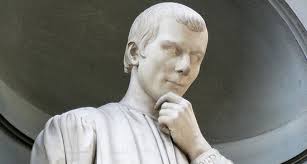
Niccolo Machiavelli
For Machiavelli, only a well-protected state can hope for peace and prosperity. Toward that end, he wrote at length about the best ways to succeed militarily. And in war, humanity can prevail at least as often as severity.
Consider the following example from The Discourses:
Camillus [a Roman general] was besieging the city of the Faliscians, and had surrounded it….A teacher charged with the education of the children of some of the noblest families of that city [to ingratiate himself] with Camillus and the Romans, led these children…into the Roman camp.
And presenting them to Camillus [the teacher] said to him, “By means of these children as hostages, you will be able to compel the city to surrender.”
Camillus not only declined the offer but had the teacher stripped and his hands tied behind his back….[Then Camillus] had a rod put into the hands of each of the children…[and] directed them to whip [the teacher] all the way back to the city.
Upon learning this fact, the citizens of Faliscia were so much touched by the humanity and integrity of Camillus, that they surrendered the place to him without any further defense.
This example shows that an act of humanity and benevolence will at all times have more influence over the minds of men than violence and ferocity.
It also proves that provinces and cities which no armies…could conquer, have yielded to an act of humanity, benevolence, chastity or generosity.
This truth should be kept firmly in mind whenever Right-wingers start bragging about their own patriotism and willingness to get “down and dirty” with America’s enemies.
Many–like Newt Gingrich, Rudolph Giuliani, Rick Santorum, Eduardo “Ted” Cruz and Donald Trump–did their heroic best to avoid military service. These “chickenhawks” talk tough and are always ready to send others into battle–but keep themselves well out of harm’s way.
Such men are not merely contemptible; they are dangerous.
ABC NEWS, AL QAEDA, BARACK OBAMA, BRUSSELS, CBS NEWS, CIA, CNN, DONALD TRUMP, FACEBOOK, FBI, GUANTANAMO, ISLAM, ISLAMIC STATE OF IRAQ AND SYRIA (ISIS), NBC NEWS, NEWT GINGRICH, NICCOLO MACHIAVELLI, PARIS, PENTAGON, RICK SANTORUM, RUDLOPH GIULIANI, SAN BERNADINO, SUPREME COURT, TERRORISM, THE CHICAGO SUN-TIMES, THE CHICAGO TRIBUNE, THE LOS ANGELES TIMES, THE NEW YORK TIMES, THE WASHINGTON POST, TORTURE, TWITTER, WATERBOARDING
In Bureaucracy, History, Law, Law Enforcement, Military, Politics, Social commentary on April 4, 2016 at 12:09 am
Nearly two-thirds of Americans believe that the use of torture can be justified to force suspected terrorists to talk, according to a March 30 Reuters/lpsos poll.
A growing fear by Americans of Islamic terrorism has been ignited by a series of deadly Islamic terrorist attacks in Europe and the United States.
- On November 13, 2015 in Paris, France, terrorists belonging to the Islamic State of Iraq and Syria (ISIS) killed more than 100 people.
- On December 2, a married Islamic couple shot and killed 14 people at the Department of Public Health in San Bernardino, California.
- And on March 22, a series of ISIS attacks struck Brussels, Belgium. Two explosions at the city’s main international airport and a third in a subway station killed 31 persons and injured 270 more.
Click here: Most Americans Say Torturing Suspected Terrorists Is Justifiable
And the chief beneficiary of this growing fear among Americans is likely to be Donald Trump.
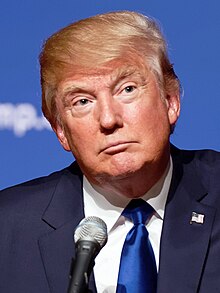
Donald Trump
Since declaring his candidacy for the 2016 Republican nomination for President in June, 2015, Trump has made the use of torture a major campaign issue. He has promised to end the waterboarding ban that President Barack Obama declared at the start of his term in 2009.
During a campaign event at Arizona’s Sun City retirement community, Trump said he would reinstate waterboarding and techniques that are “so much worse” and “much stronger.”
“Don’t tell me it doesn’t work–torture works,” Trump said. “Okay, folks? Torture–you know, half these guys [say]: ‘torture doesn’t work.’ Believe me, it works. Okay?”
And in a February 15 Op-Ed piece for USA Today, Trump declared: “I will do whatever it takes.
“I have made it clear in my campaign that I would support and endorse the use of enhanced interrogation techniques if the use of these methods would enhance the protection and safety of the nation,” he wrote.
“Though the effectiveness of many of these methods may be in dispute, nothing should be taken off the table when American lives are at stake.
“The enemy is cutting off the heads of Christians and drowning them in cages, and yet we are too politically correct to respond in kind.”
The Reuters/lpsos online poll of 1,976 Americans occurred between March 22 and 28. Among its findings:
- About 25% said that the use of torture can “often” be justified against suspected terrorists.
- Another 38% said such tactics were “sometimes” appropriate in order to obtain information.
- Only 15% opposed torture under all circumstances.
Past surveys found Americans less comfortable with the controversial tactic.
In 2014, a poll by Amnesty International revealed that about 45% of Americans supported the use of torture against terrorism suspects.
Unfortunately for Americans, the truth about torture generally–and waterboarding in particular–is that it doesn’t work.
Victims will say anything they think their captors want to hear to stop the agony. And, in fact, subsequent investigations have shown that just that happened with Al Qaeda suspects.

Waterboarding a captive
Shortly after the invasion of Afghanistan in October, 2001, hundreds of Al Qaeda members started falling into American hands. And so did a great many others who were simply accused by rival warlords of being Al Qaeda members.
The only way to learn if Al Qaeda was planning any more 9/11-style attacks on the United States was to interrogate those suspected captives. The question was: How?
The CIA and the Pentagon quickly took the “gloves off” approach. Their methods included such “stress techniques” as playing loud music and flashing strobe lights to keep detainees awake.
Some were “softened up” prior to interrogation by “third-degree” beatings. And still others were waterboarded.
In 2003, an FBI agent observing a CIA “interrogation” at Guantanamo was stunned to see a detainee sitting on the floor, wrapped in an Israeli flag. Nearby, music blared and strobe slights flashed.
In Osama bin Laden’s 1998 declaration of war against America, he had accused the country of being controlled by the Jews, saying the United States “served the Jews’ petty state.”
Draping an Islamic captive with an Israeli flag could only confirm such propaganda.
The FBI, on the other hand, followed its traditional “kill them with kindness” approach to interrogation.
Pat D’Amuro, a veteran FBI agent who had led the Bureau’s investigation into the 1998 bombing of the American embasy in Nairobi, Kenya, warned FBI Director Robert Mueller III:
The FBI should not be a party in the use of “enhanced intrrogation techniques.” They wouldn’t work and wouldn’t produce the dramatic results the CIA hoped for.
But there was a bigger danger, D’Amuro warned: “We’ll be handing every future defense attorney Giglio material.”
The Supreme Court had ruled in Giglio vs. the United States (1972) that the personal credibility of a government official was admissible in court.
Any FBI agent who made use of extra-legal interrogation techniques could potentially have that issue raised every time he testified in court on any other matter.
It was a defense attorney’s dream-come-true recipe for impeaching an agent’s credibility–and thus ruin his investigative career.
ABC NEWS, ADOLF HITLER, AL QAEDA, ARTHUR M. CUMMINGS, BARACK OBAMA, BOKO HARAM, BOSTON MARATHON BOMBING, CANADA, CBS NEWS, CNN, DAVID CAMERON, DONALD TRUMP, FACEBOOK, FBI, HATE CRIMES, ISLAM, ISLAMIC STATE OF IRAQ AND SYRIA, MOHAMMED, NAZI GERMANY, NBC NEWS, POLITICAL CORRECTNESS, RELIGION, ROBERT MEULLER III, RONALD KESSLER, SAMUEL HUNTINGTON, STEVEN EMERSON, TALIBAN, TERRORISM, THE CLASH OF CIVILIZATIONS, THE INVESTIGATIVE PROJECT ON TERRORISM, THE LOS ANGELES TIMES, THE NEW YORK TIMES, THE SECRETS OF THE FBI, THE WALL STREET JOURNAL, THE WASHINGTON POST, THE WHITE CLIFFS OF DOVER, TWITTER, VERA LYNN, WORLD TRADE CENTER, WORLD WAR ii
In Bureaucracy, History, Military, Politics, Social commentary on March 29, 2016 at 12:08 am
During World War II, British singer Vera Lynn comforted her war-weary fellow citizens with a poignant rendition of “The White Cliffs of Dover.”
The appeal of the song lay in its promise that, once Nazi Germany was defeated, peace and normality would return.
Click here: Vera Lynn: The White Cliffs of Dover – YouTube
And despite being threatened with invasion in 1940 and devastated by massive bombing raids in 1940-41, citizens of Great Britain could take heart in the following:
- Nazi Germany had a capitol–Berlin–and a single, all-powerful leader–Adolf Hitler. Once Berlin was occupied and Hitler dead or captured, the war would be over.
- And, for all their ferocity, German soldiers were easy to recognize: They wore gray uniforms, spoke German and waved flags emblazoned with swastikas or imperial eagles.
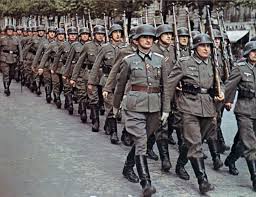
Wehrmacht soldiers marching through conquered France
Today, Western nations under attack by Islamic “holy warriors” face none of those advantages. Islam has no single capitol city–or leader.
Nor do Islam’s jihadist legions wear uniforms. Many of them don’t speak Arabic or wear clothing associated with Arabs, such as flowing robes and headdresses.
More ominously, millions of Islam’s potential “warriors” live within the very Western nations they despise. They can get all the instruction and inspiration they need to wreck havoc simply by going to the Internet.
Or, if they have the money, by traveling overseas to such terrorist-recruiting centers as in Syria or Afghanistan.
And yet, faced with an unprecedented threat to their security, many Western leaders refuse to publicly acknowledge this fundamental truth:
Even if the West isn’t at war with Islam, Islam is at war with the West.
Leaders like President Barack Obama, who insisted, at a White House Summit on Countering Violent Extremism in February, 2015: “We are not at war with Islam. We are at war with people who have perverted Islam.”

David Cameron
And leaders like British Prime Minister David Cameron, who said on August 29, 2014: “Islam is a religion observed peacefully by over a billion people. Islamist extremism is a poisonous ideology observed by a minority.”
It was at this same press conference that Cameron announced that United Kingdom authorities would soon begin revoking the passports of British citizens traveling to Syria.
Arthur M. Cummings, the FBI’s executive assistant director for national security, has no use for such Politically Correct terms as “man-caused disasters” to refer to terrorism. Nor does he shy away from terms such as “jihadists” or “Islamists.”
“Of course Islamists dominate the terrorism of today,” he says bluntly.
In May, 2014, Steven Emerson, a nationally recognized expert on terrorism, posted an ad in The New York Times, warning about the dangers of PC-imposed censorship:
“Our nation’s security and its cherished value of free speech has been endangered by the bullying campaigns of radical Islamic groups, masquerading as ‘civil rights’ organizations, to remove any reference to the Islamist motivation behind Islamic terrorist attacks.
“These groups have pressured or otherwise colluded with Hollywood, the news media, museums, book publishers, law enforcement and the Obama Administration in censoring the words ‘Islamist’, ‘Islamic terrorism’, ‘radical Islam’ and ‘jihad’ in discussing or referencing the threat and danger of Islamic terrorism.
“This is the new form of the jihadist threat we face. It’s an attack on one of our most sacred freedoms—free speech—and it endangers our very national security. How can we win the war against radical Islam if we can’t even name the enemy?”
He has a point–and a highly legitimate one.
Imagine the United States fighting World War II–and President Franklin Roosevelt banning the use of “fascist” in referring to Nazi Germany or “imperialist” in describing Imperial Japan.
Imagine CNN-like coverage of the Nazi extermination camps, with their piles of rotting corpses and smoking gas ovens, while a commentator reminds us that “Nazism is an ideology of peace.”
Then consider these Islamic terrorist outrages of our own time:
- The 9/11 attacks on the World Trade Center in New York City and the Pentagon in Washington, D.C., which snuffed out the lives of 3,000 Americans.
- The 2004 bombing of Madrid’s commuter train system.
- The attack on the London subway in 2005.
- The killing of 13 U.S. Army personnel at Fort Hood, Texas, by a Muslim army major in 2009.
- The bombing of the Boston Marathon in 2013.
- The kidnapping of 300 Nigerian schoolgirls by Boko Haram in 2014.
- The slaughter of 12 people at a Paris satirical magazine that had published cartoons about the Prophet Mohammed in 2015.
- The murders of more than 100 people in ISIS attacks across Paris in 2015.
- A series of deadly terrorist attacks in Brussels, killing 31 and injuring 270 in 2016.
In every one of these attacks, the perpetrators openly announced that their actions had been motivated by their Islamic beliefs.
In his groundbreaking book, The Clash of Civilizations (1996) Samuel Huntington, the late political scientist at Harvard University, noted:
“The fundamental problem for the West is not Islamic fundamentalism. It is Islam, a different civilisation whose people are convinced of the superiority of their culture and are obsessed with the inferiority of their power.”
The West may not be at war with Islam–as countless Western politicians repeatedly assert. But Islamics have no qualms about declaring that they are at war with the West.
ABC NEWS, ADOLF HITLER, AL QAEDA, ARTHUR M. CUMMINGS, BARACK OBAMA, BOKO HARAM, BOSTON MARATHON BOMBING, CANADA, CBS NEWS, CNN, DAVID CAMERON, DENMARK, DONALD TRUMP, FACEBOOK, FBI, HATE CRIMES, INVESTIGATIVE PROJECT ON TERRORISM, ISLAM, ISLAMIC STATE OF IRAQ AND SYRIA, MOHAMMED, NAZI GERMANY, NBC NEWS, NIGER, POLITICAL CORRECTNESS, RELIGION, ROBERT MEULLER III, RONALD KESSLER, SAMUEL HUNTINGTON, STEVEN EMERSON, TALIBAN, TERRORISM, THE CHICAGO SUN-TIMES, THE CHICAGO TRIBUNE, THE CLASH OF CIVILIZATIONS, THE LOS ANGELES TIMES, THE SECRETS OF THE FBI, THE WALL STREET JOURNAL, THE WASHINGTON POST, THE WHITE CLIFFS OF DOVER, TWITTER, VERA LYNN, WORLD TRADE CENTER, WORLD WAR ii
In Bureaucracy, History, Military, Politics, Social commentary on March 27, 2016 at 11:58 pm
The headline on the CNN website said it all–or seemed to: “Religion’s Week From Hell.”
Then came the first paragraph: “Whether you believe that religious violence is fueled by faith or is a symptom of larger factors–political instability, poverty, cultural chaos–one thing seems clear: Last week was hellish for religion.”
The story–published on the CNN website on February 18, 2015–then outlined a series of atrocities committed in the name of religion:
“Across several continents, including North America, Europe, Central Asia and Africa, scores of religious believers suffered and died in brutal attacks over the past seven days.”
Click here: Religion’s week from hell – CNN.com
And here was the day-by-day chronicle of slaughter:
Monday–February 9:
- Boko Haram, the Islamic group based in Nigeria, attacked several towns in Cameroon, kidnapping 20 people. They also exploded a car bomb in Niger. At the time, the death toll was unclear.
Tuesday–February 10:
- Craig Hicks, an athiest who ranted against religion on the Internet, was charged with killing three young Muslim students in Chapel Hill, North Carolina.
Wednesday–February 11:
- The Islamic State of Iraq and Syria (ISIS) attacked Kurdish forces in northern Iraq and Iraqi civilians in Baghdad. At least 31 people were killed in Baghdad by ISIS bombs.
Thursday–February 12:
- Al Qaeda seized a key military base in Baihan, Yemen, killing four Yemeni soldiers. They then took control of the town’s weaponry.
- With the United States’ having already closed its embassy in Yemen, Italy, Germany and Saudi Arabia did the same.
Friday–February 13:
- Boko Haram killed 21 people in attacks on Mbuta and Akida villages in Nigeria.
- The Islamic terror group also killed four civilians and a soldier in neighboring Chad.
- In Peshawar, Pakistan, the Taliban attacked a Shia mosque, killing 19 and wounding dozens.
Saturday–February 14:
- In Copenhagen, Denmark, an Islamic gunman fired at attendees of a free-speech forum, where a Swedish cartoonist was scheduled to speak. His alleged crime: Depicting the Prophet Mohammed. Casualties: Three officers wounded and one 55-year-old man killed.
- Hours later, the same terrorist visited a Copenhagen synagogue. Opening fire, he wounded two officers and killed a private security guard.
Sunday–February 15:
- ISIS released a video showing its members beheading more than a dozen members of Egypt’s Coptic Christian minority on a Libyan beach.
So much for “religion’s week from hell.”
Except that the title of this story was completely misleading. It would have been more accurately entitled: “Islamic Religion’s Week of Hell.”

ISIS member beheading a helpless captive
Of the 13 atrocities detailed above, all but one showcased Islamics as the murderers.
The single exception was that of Craig Hicks, an athiest who was charged with shooting three Muslim college students in Chapel Hill, North Carolina.
It was this case–and not any of the others–that brought Muslims to demand “justice.” Muslims immediately urged the Obama administration to investigate the murders as a hate crime.
Suzanne Barakat, the sister of one of the victims, said the students had been murdered because they were Muslims. She said that the killings should be considered an act of terrorism: “It’s time people call it what it is.”
But getting Islamics to label other Islamics as terrorists is an entirely different matter.
According to author Ronald Kessler, this has caused serious problems for the FBI. In his 2011 book, The Secrets of the FBI, Kessler notes the refusal of the Islamic community to identify known or potential terrorists within its ranks.
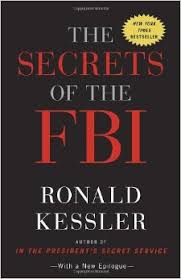
Says Arthur M. Cummings, the Bureau’s executive assistant director for national security: “I had this discussion with the director of a very prominent Muslim organization here in [Washington] D.C. And he said, ‘Why are you guys always looking at the Muslim community?’”
“I can name the homegrown cells, all of whom are Muslim, all of whom were seeking to kill Americans,” replied Cummings. “It’s not the Irish, it’s not the French, it’s not the Catholics, it’s not the Protestants. It’s the Muslims.”
Occasionally, Muslims will condemn Al Qaeda. But “rarely do we have them coming to us and saying, ‘There are three guys in the community that we’re very concerned about.’” said Cummings.
“They don’t want anyone to know they have extremists in their community. Well, beautiful. Except do you read the newspapers? Everybody already knows it. The horse has left the barn.
“So there’s a lot of talk about engagement. But, realistically, we’ve got a long, long way to go.”
At one community meeting, an Islamic leader suggested to Cummings that then-FBI director Robert Meuller III should pose for a picture with his group’s members. The reason: To show that Islamics are partners in the “war on terror.”
“When you bring to my attention real extremists who are here to plan and do something, who are here supporting terrorism,” said Cummings, “then I promise you, I will have the director stand up on the stage with you.”
“That could never happen,” replied the Islamic leader. “We would lose our constituency. We could never admit to bringing someone to the FBI.”
Donald Trump–alone of the Republican and Democratic candidates for President–has dared to say the un-sayable: Islam is at war with us.
And this candor–coupled with repeated Islamic atrocities–has propelled him to the front of Republican candidates.


&docid=SiluTuHYHtjaZM&tbnid=uLB-PLYDVdkkVM%3A&w=455&h=341&ei=zeN_VI_hKYHjoATGs4Bo&ved=0CAIQxiAwAA&iact=c)


.jpg)


2016 PRESIDENTIAL RACE, ABC NEWS, ALTERNET, AMERICABLOG, AP, BABY BOOMER RESISTANCE, BBC, BERNIE SANDERS, BLOOD FEUD, BLOOMBERG NEWS, BROTHERS: THE HIDDEN HISTORY OF THE KENNEDY YEARS, BUZZFEED, CARLOS MARCELLO, CBS NEWS, CIA, CNN, COTTER SMITH, CROOKS AND LIARS, CUBA, DAILY KOS, DAVID TALBOT, DONALD TRUMP, ERNEST BORGNINE, FBI, FIDEL CASTRO, FIVETHIRTYEIGHT, GUS RUSSO, HARPER’S MAGAZINE, HILLARY CLINTON, HUFFINGTON POST, INTERNATIONAL BROTHERHOOD OF TEAMSTERS, J. EDGAR HOOVER, JAMES R. HOFFA, JUSTICE DEPARTMENT, LIVE BY THE SWORD: THE SECRET WAR AGAINST CASTRO AND THE DEATH OF JFK, MAFIA, MEDIA MATTERS, MOTHER JONES, MOVEON, MSNBC, NBC NEWS, NEW REPUBLIC, NEWSDAY, NEWSWEEK, NPR, PBS NEWSHOUR, POLITICO, POLITICUSUSA, RAFAEL EDWARD CRUZ, RAW STORY, REUTERS, ROBERT BLAKE, ROBERT F. KENNEDY, SALON, SAM GROOM, SEATTLE TIMES, Secret Service, SENATE LABOR RACKETS COMMITTEE, SLATE, TALKING POINTS MEMO, THE ATLANTIC, THE CHICAGO SUN-TIMES, THE CHICAGO TRIBUNE, THE DAILY BEAST, THE DAILY BLOG, THE GUARDIAN, THE HILL, THE HUFFINGTON POST, THE INTERCEPT, THE LOS ANGELES TIMES, THE NATION, THE NEW REPUBLIC, THE NEW YORK TIMES, THE NEW YORKER, THE VILLAGE VOICE, THE WALL STREET JOURNAL, THE WASHINGTON POST, THINKPROGRESS, TIME, TRUTHDIG, TRUTHOUT, TWITTER, U.S. NEWS & WORLD REPORT, UPI
A CLASH OF TITANS: PART THREE (END)
In Bureaucracy, History, Law, Law Enforcement, Politics, Social commentary on April 25, 2016 at 12:10 amThe 1983 TV mini-series, Blood Feud, chronicles the decade-long struggle between Robert F. Kennedy (Cotter Smith) and James R. Hoffa (Robert Blake), president of the International Brotherhood of Teamsters Union.
With Kennedy as Attorney General and facing relentless pressure from the Justice Department, the Mafia despairs of a solution. At a swanky restaurant, several high-ranking Mafiosi agree that “something” must be done.
On November 22, 1963, President John F. Kennedy is assassinated in Dallas, Texas.
Blood Feud clearly implies that the Mafia was responsible.
[The House Assassinations Committee investigated this possibility in 1978, and determined that Carlos Marcello, the Mafia boss of New Orleans, had the means, motive and opportunity to kill JFK. But it could not find any conclusive evidence of his involvement.]
Even with the President dead, RFK’s Justice Department continues to pursue Hoffa. In 1964, he is finally convicted of jury tampering and sentenced to 13 years’ imprisonment.
U.S. Department of Justice
Hoping to avoid prison, Hoffa phones Robert Kennedy, offering future Teamsters support if RFK runs for President. To prove he can deliver, he tells Kennedy that the Teamsters have even penetrated the FBI.
[In March, 1964, Kennedy met with Hoffa on an airfield at Dulles International Airport in Washington, D.C. He was accompanied by two Secret Service agents from the detail assigned to ex-First Lady Jacqueline Kennedy.
[FBI Director J. Edgar Hoover, no longer afraid to cross RFK, had withdrawn the agents previously assigned to guard Kennedy.
[Accompanying Hoffa were two muscular bodyguards–at least one of whom was packing two pistols in shoulder holsters.
[While the Secret Service agents watched from a respectful distance, Kennedy spoke quietly with Hoffa. The Attorney General showed a document to Hoffa, and the Teamsters leader at times nodded or shook his head.
[The agents drove Kennedy back to Washington. During the ride, he said nothing about the reason for the meeting.
[David Talbot, in his book, Brothers: The Hidden History of the Kennedy Years, speculates that it could have been to discuss Hoffa’s conviction for jury tampering.
[But Gus Russo–author of Live By the Sword: The Secret War Against Castro and the Death of JFK–writes that the reason might have been Dallas.
[Perhaps, he speculates, RFK had wanted to look into Hoffa’s eyes while asking him: Did you have anything to do with the assassination? RFK had, in fact, done this with CIA Director John McCone almost immediately after his brother’s death.]
In Blood Feud, Kennedy confronts J. Edgar Hoover (Ernest Borgnine) and accuses him of illegally planting wiretaps in Mob hangouts all over the country.
J. Edgar Hoover and Robert F. Kennedy
Hoover retorts that this had been the only way to obtain the prosecution-worthy intelligence Kennedy had demanded: “You loved that flow of information. You didn’t want it to stop.”
Kennedy: Why did you keep the FBI out of the fight against the Mob for decades?
Hoover: “Every agency that came to grips with them got corrupted by their money.”
[So far as is known, Hoover never made any such confession. Historians continue to guess his reason for leaving the Mob alone for decades.]
Ernest Borgnine as J. Edgar Hoover
RFK then mentions the CIA’s plots to employ the Mob to assassinate Cuban dictator Fidel Castro
[The agency had wanted to please President Kennedy, and the Mafia had wanted to regain its casinos lost to the Cuban Revolution. The role the Kennedy brothers played in the CIA’s assassination plots remains murky, and has been the subject of endless speculation.]
“The CIA, doing business with the Mob,” says Kennedy. “The FBI, leaking information to its enemies [the Teamsters].” Then, sadly: “I guess it’s true–everyone does business with everyone.”
[So far as is known, the FBI did not pass on secrets to the Teamsters. But during the 1970s, the Mafia penetrated the Cleveland FBI office through bribes to a secretary. Several FBI Mob informants were “clipped” as a result.]
In 1967, Hoffa goes to prison. He stays there until, in 1971, President Richard Nixon commutes his sentence in hopes of gaining Teamsters’ support for his 1972 re-election.
Kennedy leaves the Justice Department in 1964 and is elected U.S. Senator from New York. In 1968 he runs for President. On June 5, after winning the California primary, he’s assassinated.
In Blood Feud, just before his assassination, RFK asks: “How will I ever really know if the Mob killed Jack because of my anti-Mob crusade?”
Hoffa schemes to return to the presidency of the Teamsters–a post now held by his successor, Frank Fitzsimmons. He runs the union in a more relaxed style than Hoffa, thus giving the Mob greater control over its pension fund.
And the Mafia likes it that way.
On July 30, 1975, Hoffa disappears from the parking lot of the Machus Red Fox Restaurant near Detroit. He had gone there to meet with two Mafia leaders.
Almost 41 years after the death of James R. Hoffa, and almost 48 years after that of Robert F. Kennedy:
Share this: