Posts Tagged ‘DAILY KOZ’
2016 PRESIDENTIAL ELECTION, ABC NEWS, ALTERNET, AMERICABLOG, AP, APPLE IOS PRIVACY UPDATE, BABY BOOMER RESISTANCE, BBC, BLOOMBERG NEWS, BUZZFEED, CBS NEWS, CENSORSHIP, CHEATSHEET, CNN, COMMUNICATIONS, COVID-19, CROOKS AND LIARS, DAILY KOS, DAILY KOZ, DONALD TRUMP, FACEBOOK, FACEBOOK JAIL, FAMILY VALUES, FIVETHIRTYEIGHT, FORTUNE, HARPER’S MAGAZINE, HUFFINGTON POST, JOE BARTON, MARK ZUCKERBERG, MEDIA MATTERS, MICHAEL MARTIN, MOTHER JONES, MOVEON, MSNBC, NBC NEWS, NEW REPUBLIC, NEWSDAY, NEWSWEEK, NPR, PBS NEWSHOUR, POLITICO, POLITICUSUSA, RAW STORY, REUTERS, RUSSIAN TROLLS, SALON, SEATTLE TIMES, SLATE, SOCIAL MEDIA WEBSITES, SPAM, TALKING POINTS MEMO, THE ATLANTIC, THE CHICAGO SUN-TIMES, THE CHICAGO TRIBUNE, THE DAILY BEAST, THE DAILY BLOG, THE GUARDIAN, THE HILL, THE HUFFINGTON POST, THE INTERCEPT, THE LOS ANGELES TIMES, THE NATION, THE NEW REPUBLIC, THE NEW YORK TIMES, THE NEW YORKER, THE VILLAGE VOICE, THE WASHINGTON POST, THINKPROGRESS, TIME, TRUTHDIG, TRUTHOUT, TWITTER, U.S. NEWS & WORLD REPORT, UPI, USA TODAY, VLADIMIR PUTIN APPLE
In Bureaucracy, Business, History, Politics, Social commentary on July 10, 2023 at 12:29 am
Years ago, Michael Martin, a Los Angeles-based computer repair expert, offered me some advice I have found absolutely essential.
“When you call Technical Support,” he said, “they’re accessing the same information you can get via the computer.
“Most of the time they’re going to have you put the Restore Disk back into the computer and restore it back to default. It wipes out everything on your computer. Technical support costs a lot of money for a company—to hell with your data.
“Be very cautious when you get on the phone with any computer company and they advise you to run the Restore Disk.”

Michael Martin
What Martin said about the unwillingness of computer companies to provide technical support applies just as much to social media websites.
Consider the case of Facebook, the largest social media and networking service. By 2023, it had more than two billion daily active users.
Such a huge audience attracts advertisers. And this, in turn, has armed Facebook with total assets of $184.49 billion as of March 2023. These revenues have given its founder and CEO, Mark Zuckerberg, an estimated net worth of $104.4 billion.
Yet, for all the billions pouring into Facebook’s coffers, the company refuses to provide a way for its users to directly contact Facebook headquarters.
This may not seem important. But the following case will demonstrate why it is.
A short while ago, a friend of mine (whom I’ll call Janet) sent Zuckerberg a letter, which opened:
“Today while chatting with someone on Facebook I found myself bounced from the page. I was instructed to log in again. When I did so, I got the following message:
| |
Secure Your Account
Hi Janet, we think your computer is infected with malware, and it’s spreading spam through your Facebook account. We’ll walk you through a few steps to explain more and scan your computer for malware.
|
“Naturally, my first reaction was to contact Facebook to find out what, exactly, was meant by Spam. I quickly found, however, that although Facebook’s customers like me have made you a billionaire, they aren’t considered important enough to be provided with direct support for resolving problems like this.
“All that I could do was put a message on file with your ‘Report a Login Issue’ page. I received no response, so I sent another. This, too, has gone unanswered.
“At the bottom of the ‘Report a Login Issue’ page is this: “Thanks for taking the time to submit a report. While we don’t reply to every report, we’ll let you know if we need more details.”
“In short, even after a customer puts a help-request on file with Facebook, s/he has no guarantee that s/he will even receive the courtesy of a reply, let alone the help needed to resolve the problem.
“Is this really what you are proud to call customer service?
“I think it’s entirely appropriate to ask people I don’t know—and who want to roam freely through my computer—exactly what it is they believe is Spam. Because if it isn’t Spam, there’s no reason for them to be roaming freely through my computer.”

Mark Zuckerberg
Janet never received a reply from Zuckerberg—nor from anyone subordinate to him.
Facebook is still the most popular social platform on the Internet. Yet its future is far from certain.
The 2021 Apple iOS privacy update, App Tracking Transparency, limited the tracking capabilities of digital advertisers and enabled iPhone users to opt-out of data sharing. This has cost Facebook an estimated $10 billion.
And younger audiences are more comfortable telling stories and sharing updates by creating image and video content.
No doubt another major reason for their discontent is the arrogance of Facebook’s censors.
Another friend of mine—Jim—recently landed in “Facebook Jail” after getting this notice:
The offending post was a news story about Texas Congressman Joe Barton. It described how he had sent a series of smarmy emails to numerous women—while, of course, posing as a paragon of “family values.”
Jim sent a letter to Facebook’s headquarters at 1 Hacker Way, Menlo Park, California 94025:
“If Facebook is going to hold its users to a set of standards, those standards should be clearly and specifically posted. Certainly a legitimate news story—no matter on what the subject—should fall within allowable posting guidelines. But apparently Facebook’s anonymous censors do not agree.
“Facebook functions the way the gods of the ancient Greeks were believed to act: In a totally arbitrary manner, whose decisions, however unwarranted, are beyond appeal.”
One user offended censors by his too-frequent use of the “Like” option. How this violated Facebook’s terms of service was never explained.
During the 2016 Presidential election, Russian trolls used Facebook, Twitter and Google to post misleading articles and comments. These helped put Donald Trump, a would-be protégé of Vladimir Putin, in office.
During the COVID-19 pandemic, Facebook and Twitter were flooded with posts denying the reality of the virus and offering whackjob “cures” or “preventatives.” Untold numbers of Americans died as a result.
The moral: Social media companies have your wallet at heart, not you.
ABC NEWS, ADMIRAL IVAN ISAKOV, ADOLF HITLER, ALBERT SPEER, ALTERNET, ANDREW MCCABE, AP, BOB WOODWARD, BUZZFEED, CBS NEWS, CHEKA, CIA, CNN, COUNTER-SURVEILLANCE, CROOKS AND LIARS, DAILY KOZ, DEMOCRATIC PARTY, DONALD TRUMP, FBI, FSB, GENRIKH YAGODA, HEINRICH HIMMLER, HERMANN GOERING, HOUSE OF REPRESENTATIVES, JAMES COMEY, JEFF SESSIONS, JOSEPH STALIN, KGB, KRISJEN NIELSEN, LAVRENTY BERIA, MOTHER JONES, MOVEON, MSNBC, NBC NEWS, NEWSWEEK, NICCOLO MACHIAVELLI, NIKOLAI YEZHOV, NKVD, NPR, PBS NEWSHOUR, POLITICO, RACHEL BRAND, RANDOLPF “TEX” ALLES, RAW STORY, REPUBLICAN PARTY, REUTERS, SALLY YATES, SALON, SEAN SPICER, SEATTLE TIMES, SLATE, SOVIET UNION, SS, STORMY DANIELS, SURVEILLANCE, THE APPRENTICE, THE ATLANTIC, THE CHICAGO SUN-TIMES, THE CHICAGO TRIBUNE, THE DAILY BEAST, THE GUARDIAN, THE HILL, THE HUFFINGTON POST, THE LOS ANGELES TIMES, THE NATION, THE NEW YORK TIMES, THE PRINCE, THE WASHINGTON POST, TIME, TWITTER, U.S. NEWS & WORLD REPORT, UPI, USA TODAY
In Bureaucracy, History, Law, Law Enforcement, Military, Politics, Social commentary on July 7, 2023 at 12:30 am
In January, 2018, the White House banned the use of personal cell phones in the West Wing. The official reason: National security.
The real reason: To prevent staffers from leaking to reporters.
More ominously, well-suited men roamed the halls of the West Wing, carrying devices that pick up signals from phones that aren’t government-issued.
“Did someone forget to put their phone away?” one of the men would ask if such a device was detected. If no one said they had a phone, the detection team started searching the room.

Phone detector
The devices can tell which type of phone is in the room.
This is the sort of behavior Americans have traditionally—and correctly—associated with dictatorships
In his memo outlining the policy, then-Chief of Staff John Kelly warned that anyone who violated the phone ban could be punished, including “being indefinitely prohibited from entering the White House complex.”
Yet even these draconian methods did not end White House leaks.
White House officials still spoke with reporters throughout the day and often aired their grievances, whether about annoying colleagues or competing policy priorities.
Aides with private offices sometimes called reporters on their desk phones. Others got their cell phones and called or texted reporters during lunch breaks.
According to an anonymous White House source: “The cellphone ban is for when people are inside the West Wing, so it really doesn’t do all that much to prevent leaks. If they banned all personal cellphones from the entire [White House] grounds, all that would do is make reporters stay up later because they couldn’t talk to their sources until after 6:30 pm.”

Other sources believed that leaks wouldn’t end unless Trump started firing staffers. But there was always the risk of firing the wrong people. Thus, to protect themselves, those who leaked might well accuse tight-lipped co-workers.
Within the Soviet Union (especially during the reign of Joseph Stalin) fear of secret police surveillance was widespread—and absolutely justified.
Among the methods used to keep conversations secret:
- Turning on the TV or radio to full volume.
- Turning on a water faucet at full blast.
- Turning the dial of a rotary phone to the end—and sticking a pencil in one of the small holes for numbers.
- Standing six to nine feet away from the hung-up receiver.
- Going for “a walk in the woods.”
- Saying nothing sensitive on the phone.
The secret police (known as the Cheka, the NKVD, the MGB, the KGB, and now the FSB) operated on seven working principles:
- Your enemy is hiding.
- Start from the usual suspects.
- Study the young.
- Stop the laughing.
- Rebellion spreads like wildfire.
- Stamp out every spark.
- Order is created by appearance.
Trump has always ruled through bribery and fear. He’s bought off (or tried to) those who might cause him trouble—like porn actress Stormy Daniels. And he’s threatened or filed lawsuits against those he couldn’t or didn’t want to bribe—such as contractors who have worked on various Trump properties.
But Trump couldn’t buy the loyalty of employees working in an atmosphere of hostility—which breeds resentment and fear. And some of them took revenge by sharing with reporters the latest crimes and follies of the Trump administration.
The more Trump waged war on the “cowards and traitors” who worked most closely with him, the more some of them found opportunities to strike back. This inflamed Trump even more—and led him to seek even more repressive methods against his own staffers.
This proved a no-win situation for Trump.
The results were twofold:
- Constant turnovers of staffers—with their replacements having to undergo lengthy background checks before coming on; and
- Continued leaking of embarrassing secrets by resentful employees who stayed.
**********
As host of NBC’s “The Apprentice,” Trump became infamous for booting off contestants with the phrase: “You’re fired.” In fact, he so delighted in using this that, in 2004, he tried to gain trademark ownership of it.
But the U.S. Patent and Trademark Office rejected his application. American copyright law explicitly prohibits copyright protections for short phrases or sayings.
Upon taking office as President, Trump bullied and insulted even White House officials and his own handpicked Cabinet officers. This resulted in an avalanche of firings and resignations.
The first two years of Trump’s White House saw more firings, resignations, and reassignments of top staffers than any other first-term administration in modern history. His Cabinet turnover exceeded that of any other administration in the last 100 years.
In 1934, Soviet dictator Joseph Stalin, seeing imaginary enemies everywhere, ordered a series of purges that lasted right up to the German invasion in 1941.
No one was safe from execution—not even the men who slaughtered as many as 20 to 60 million.
Fittingly, for all the fear he inspired, Stalin was plagued by paranoia. He lived in constant fear of assassination. Although surrounded by bodyguards, he distrusted even them.
Thus Stalin, who had turned the Soviet Union into a vast prison, became its leading prisoner.
Similarly, Donald Trump daily proved the accuracy of the age-old warning: “You can build a throne of bayonets, but you can’t sit on it.”
ABC NEWS, ADMIRAL IVAN ISAKOV, ADOLF HITLER, ALBERT SPEER, ALTERNET, ANDREW MCCABE, AP, BOB WOODWARD, BUZZFEED, CBS NEWS, CHEKA, CIA, CNN, COUNTER-SURVEILLANCE, CROOKS AND LIARS, DAILY KOZ, DEMOCRATIC PARTY, DONALD TRUMP, FBI, FSB, GENRIKH YAGODA, HEINRICH HIMMLER, HERMANN GOERING, HOUSE OF REPRESENTATIVES, JAMES COMEY, JEFF SESSIONS, JOSEPH STALIN, KGB, KRISJEN NIELSEN, LAVRENTY BERIA, MOTHER JONES, MOVEON, MSNBC, NBC NEWS, NEWSWEEK, NICCOLO MACHIAVELLI, NIKOLAI YEZHOV, NKVD, NPR, PBS NEWSHOUR, POLITICO, RACHEL BRAND, RANDOLPF “TEX” ALLES, RAW STORY, REPUBLICAN PARTY, REUTERS, SALLY YATES, SALON, SEATTLE TIMES, SLATE, SOVIET UNION, SS, STORMY DANIELS, SURVEILLANCE, THE APPRENTICE, THE ATLANTIC, THE CHICAGO SUN-TIMES, THE CHICAGO TRIBUNE, THE DAILY BEAST, THE GUARDIAN, THE HILL, THE HUFFINGTON POST, THE LOS ANGELES TIMES, THE NATION, THE NEW YORK TIMES, THE PRINCE, THE WASHINGTON POST, TIME, TWITTER, U.S. NEWS & WORLD REPORT, UPI, USA TODAY
In Bureaucracy, History, Law, Law Enforcement, Military, Politics, Social commentary on July 6, 2023 at 12:15 am
Donald Trump has often been compared to Adolf Hitler. But his reign bears far more resemblance to that of Joseph Stalin.
Germany’s Fuhrer, for all his brutality, maintained a relatively stable government by keeping the same men in office—from the day he took power on January 30, 1933, to the day he blew out his brains on April 30, 1945.
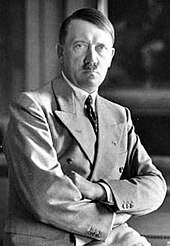
Adolf Hitler
Bundesarchiv, Bild 146-1990-048-29A / CC-BY-SA 3.0 [CC BY-SA 3.0 de (https://creativecommons.org/licenses/by-sa/3.0/de/deed.en)%5D
Heinrich Himmler, a former chicken farmer, remained head of the dreaded, black-uniformed Schutzstaffel, or Protection Squads, known as the SS, from 1929 until his suicide in 1945.
In April, 1934, Himmler was appointed assistant chief of the Gestapo (Secret State Police) in Prussia, and from that position he extended his control over the police forces of the whole Reich.
Hermann Goering, an ace fighter pilot in World War 1, served as Reich commissioner for aviation and head of the newly developed Luftwaffe, the German air force, from 1935 to 1945.
And Albert Speer, Hitler’s favorite architect, held that position from 1933 until 1942, when Hitler appointed him Reich Minister of Armaments and War Production. He held that position until the Third Reich collapsed in April, 1945.
Soviet Premier Joseph Stalin, by contrast, purged his ministers constantly. For example: From 1934 to 1953, Stalin had no fewer than three chiefs of his secret police, then named the NKVD:
- Genrikh Yagoda – (July 10, 1934 – September 26, 1936)
- Nikolai Yezhov (September 26, 1936 – November 25, 1938) and
- Lavrenty Beria (November, 1938 – March, 1953).
Stalin purged Yagoda and Yezhov, with both men executed after their arrest.
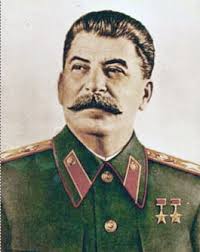
Joseph Stalin
He reportedly wanted to purge Beria, too, but the latter may have acted first. There has been speculation that Beria slipped warfarin, a blood-thinner often used to kill rats, into Stalin’s drink, causing him to die of a cerebral hemorrhage.
Stalin’s record for slaughter far eclipses that of Hitler.
For almost 30 years, through purges and starvation caused by enforced collections of farmers’ crops, Stalin slaughtered 20 to 60 million people.
The 1930s were a frightening and dangerous time to be alive in the Soviet Union. In 1934, Stalin, seeing imaginary enemies everywhere, ordered a series of purges that lasted right up to the German invasion in 1941.
An example of Stalin’s paranoia occurred one day while the dictator walked through the Kremlin corridors with Admiral Ivan Isakov. Officers of the NKVD (the predecessor to the KGB) stood guard at every corner.
“Every time I walk down the corridors,” said Stalin, “I think: Which one of them is it? If it’s this one, he will shoot me in the back. But if I turn the corner, the next one can shoot me in the face.”
Another Russian-installed tyrant who has sought to rule by fear: President Donald J. Trump.
In fact, he admitted as much to journalist Bob Woodward during the 2016 Presidential race: “Real power is—I don’t even want to use the word—fear.”
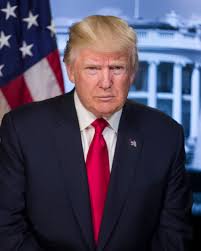
Donald Trump
As a Presidential candidate, Trump repeatedly used Twitter to attack hundreds of real and imagined enemies in politics, journalism, TV and films.
As President, he continued to insult virtually everyone, verbally and on Twitter. His targets included Democrats, Republicans, the media, foreign leaders and even members of his Cabinet.
In Russian, the word for “purge” is “chistka,” for “cleansing.” Among the victims of Trump’s recurring chistkas:
- Sally Yates – Assistant United States Attorney General
- James Comey – FBI Director
- Andrew McCabe – FBI Deputy Director
- Jeff Sessions – United States Attorney General
- Rachel Brand – Associate United States Attorney General
- Randolph “Tex” Alles – Director of the United States Secret Service
- Krisjen Nielsen – Secretary of the Department of Homeland Security
In his infamous political treatise, The Prince, Niccolo Machiavelli, the Florentine statesman, asked: “Is it is better to be loved or feared?”
And he answered it thus:
“The reply is, that one ought to be both feared and loved, but as it is difficult for the two to go together, it is much safer to be feared than loved.
“For it may be said of men in general that they are ungrateful, voluble, dissemblers, anxious to avoid danger and covetous of gain; as long as you benefit them, they are entirely yours….
“And the prince who has relied solely on their words, without making other preparations, is ruined….
“And men have less scruple in offending one who makes himself loved than one who makes himself feared; for love is held by a chain of obligations which, men being selfish, is broken whenever it serves their purpose; but fear is maintained by a dread of punishment which never fails.”
But Machiavelli warned about relying primarily on fear: “Still, a prince should make himself feared in such a way that if he does not gain love, he at any rate avoids hatred, for fear and the absence of hatred may well go together.”
**********
Donald Trump has violated that counsel throughout his life. He not only makes enemies, he revels in doing so—and in the fury he has aroused.
Filled with a poisonous hatred that encompasses almost everyone, Trump, as Presidential candidate and President, repeatedly played to the hatreds of his Right-wing base.
As first-mate Starbuck said of Captain Ahab in Herman Melville’s classic novel, Moby Dick: “He is a champion of darkness.”
2016 PRESIDENTIAL ELECTION, 2020 PRESIDENTIAL ELECTION, ABC NEWS, ABUSE OF POWER, ADOLF HITLER, ALTERNET, AMANDA CHASE, AMERICABLOG, AP, ARMED SERVICES, BABY BOOMER RESISTANCE, BARACK OBAMA, BLOOMBERG, BUZZFEED, CBS NEWS, CHILE, CIA, CLAUS VON STAUFFENBERG, CNN, COVID-19, CROOKS AND LIARS, DAILY KOZ, DONALD TRUMP, DRUDGE RETORT, FBI, FEDERAL GOVERNMENT SHUTDOWN, FIVETHIRTYEIGHT, GENERAL SERVICES ADMINISTRATION, GESTAPO, HARPER’S MAGAZINE, HILLARY CLINTON, IMPEACHMENT ARTICLES, JAMES B. COMEY, JAMES MATTIS, JOHN KASICH, JOHN MCCAIN, JOSEPH BIDEN, KIM JONG-UN, MARK ESPER, MARTIAL LAW, MARTIN NIEMOELLER, MEDIA MATTERS, MICHAEL FLYNN, MOTHER JONES, MOVEON, MSNBC, MUSLIMS, NATIONAL SECURITY AGENCY, NAZI GERMANY, NBC NEWS, NEWSWEEK, NPR, OBSTRUCTION OF CONGRESS, PBS NEWSHOUR, POLITICO, POLITICUSUSA, RAW STORY, REPUBLICANS, REUTERS, SALON, SEATTLE TIMES, SERGEY KISLYAK, SERGEY LAVROV, SLATE, TALKING POINTS MEMO, THE ATLANTIC, THE CHICAGO SUN-TIMES, THE CHICAGO TRIBUNE, THE DAILY BEAST, THE DAILY BLOG, THE GUARDIAN, THE HILL, THE HUFFINGTON POST, THE LOS ANGELES TIMES, THE NATION, THE NEW REPUBLIC, THE NEW YORK TIMES, THE PENTAGON, THE TWILIGHT ZONE, THE VILLAGE VOICE, THE WASHINGTON POST, THINKPROGRESS, THIRD REICH, TIME, TRUTHDIG, TRUTHOUT, TWENTY-FIFTH AMENDMENT, TWITTER, TWO POLITICAL JUNKIES, U.S. NEWS & WORLD REPORT, UNITED STATES CONSTITUTION, UNITED STATES SECRET SERVICE, UPI, USA TODAY, VLADIMIR PUTIN, VOTER FRAUD, WONKETTE, WORLD WAR 11
In Bureaucracy, History, Law, Law Enforcement, Military, Politics, Social commentary on July 5, 2023 at 12:16 am
During his 12-year reign, Adolf Hitler was the target of at least 42 assassination plots. The most famous of these happened on July 20, 1944.
The plotters were officers of the German general staff—who believed the Fuhrer was leading Germany into a war it could not hope to win.
After the war’s outbreak (on September 1, 1939) most of the plotters were motivated by a desire to end the war before Allied—and especially Russian—soldiers reached Germany. But many plotters were motivated by sheer horror at the wholesale slaughters taking place in Poland and Russia.
So far as is known, Donald Trump was not the target of a single plot to overthrow and/or assassinate him.
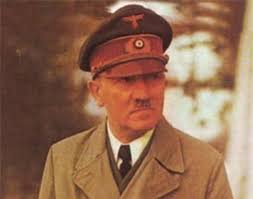
Adolf Hitler
- In Trump’s case, a non-violent method for removal existed in the Twenty-Fifth Amendment to the United States Constitution. This allows the Vice President and a majority of the Cabinet to recommend the removal of the President when he is “unable to discharge the powers and duties of his office.” The Vice President then becomes President.
- No Cabinet members had the courage to invoke this.
- Within the Senate and House of Representatives, Republicans acted as a rubber stamp for his every infamy. When he praised North Korea’s dictator Kim Jong-On or attacked Vietnam POW John McCain, they stayed silent. When he falsely charged massive voter fraud, Republicans stayed silent or loudly parroted his lies.
- Their most notorious example of ambition-fueled cowardice occurred on February 13, 2021. That was when the Republican-dominated Senate—ignoring the overwhelming evidence against him—acquitted Trump of inciting a deadly riot against the United States government so he could illegally remain President after losing the 2020 Presidential election.
- Had they convicted him, he would have been banned from running again for President—and thus protecting America from a potential dictatorship.
- At the Pentagon, American generals stood mute as Trump repeatedly sided with Russian dictator Vladimir Putin against the FBI, CIA and National Security Agency—and even gave classified CIA Intelligence to Russian Foreign Minister Sergey Lavrov and Ambassador Sergey Kislyak.
- And just as high-ranking field marshals in Hitler’s Wehrmacht held their tongues when he insulted them, so, too, did American generals when Trump belittled their intelligence and even patriotism.
- When Trump arbitrarily decided to remove American forces from Syria and Afghanistan, Secretary of Defense James Mattis resigned in protest in 2018. But then he was simply replaced by Mark Esper.
- Similarly, Trump repeatedly attacked the integrity of the men and women of the FBI—even firing its director, James Comey, for daring to investigate Russia’s subversion of the 2016 election. If its agents—steeped in Federal criminal law—built a case for Trump’s indictment and prosecution, it has never come to light.
- Neither did Secret Service agents register any protest, despite his arrogant behavior toward them. He forced them to work without pay during his 35-day government shutdown in 2018. And they had to accompany him to COVID-infected states—both during the Presidential campaign and afterward. Many of them became stricken with this often fatal disease as a result.
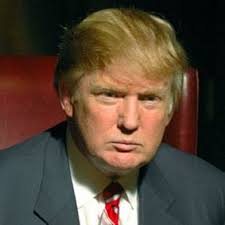
Donald Trump
* * * * *
On November 3, 2020, 81,255,933 Democratic voters elected former Vice President Joseph Biden the 46th President of the United States. Trump, running for a second term, got 74,196,153 votes.
Yet almost two months after the election, Trump refused to concede, insisting that he won—and repeatedly claiming falsely that he was the victim of massive vote fraud.
This toxic lie was feverishly embraced by millions of Right-wingers—and robbed the incoming Biden administration of its deserved legitimacy.
This refusal to acknowledge the outcome initially denied Biden access to the money, information-sharing and machinery traditionally accorded the President-elect. Trump himself was the beneficiary of such assistance in 2016, after his win over Democratic nominee Hillary Clinton.
Only on November 23, 2020, was Biden acknowledged as the winner by the General Services Administration, as the Trump administration finally began the formal transition process.
Meanwhile, the COVID-19 pandemic raged across the country. By the time Trump finally left office—on January 20, 2021—more than 400,000 Americans had died, hospitals were filled to capacity, and millions faced starvation and/or eviction. Yet Trump remained obsessed with his loss, and did nothing to coordinate the Federal response to the pandemic.
Trump’s refusal to accept reality posed an unprecedented danger to democracy: No presidential candidate had ever refused to concede defeat once all the votes were counted and legal challenges resolved.
By refusing to commit to a peaceful transfer of power, Trump took on the classic mantle of of a dictator.
Right-wing Virginia State Senator Amanda Chase urged Trump to declare martial law and allow the military to “oversee” another election. So did disgraced ex-National Security Advisor Michael Flynn, whom Trump pardoned for lying to the FBI about his private talks with a Russian official.
Reports have surfaced that Trump considered doing so. Given his record as a lifelong criminal, there is no reason to doubt he did.
History has recorded an active German resistance movement against Adolf Hitler—and has honored its members, many of whom died heroically for standing firm against a brutal tyrant.
To its eternal shame, the same cannot be said of America during the reign of Donald Trump.
2016 PRESIDENTIAL ELECTION, 2020 PRESIDENTIAL ELECTION, ABC NEWS, ABUSE OF POWER, ADOLF HITLER, ALTERNET, AMANDA CHASE, AMERICABLOG, AP, ARMED SERVICES, BABY BOOMER RESISTANCE, BARACK OBAMA, BLOOMBERG, BUZZFEED, CBS NEWS, CIA, CLAUS VON STAUFFENBERG, CNN, COVID-19, CROOKS AND LIARS, DAILY KOZ, DONALD TRUMP, DRUDGE RETORT, FBI, FEDERAL GOVERNMENT SHUTDOWN, FIVETHIRTYEIGHT, GENERAL SERVICES ADMINISTRATION, GESTAPO, HARPER’S MAGAZINE, HILLARY CLINTON, IMPEACHMENT ARTICLES, JAMES B. COMEY, JAMES MATTIS, JOHN KASICH, JOHN MCCAIN, JOSEPH BIDEN, KIM JONG-UN, MARK ESPER, MARTIAL LAW, MARTIN NIEMOELLER, MEDIA MATTERS, MICHAEL FLYNN, MOTHER JONES, MOVEON, MSNBC, MUSLIMS, NATIONAL SECURITY AGENCY, NAZI GERMANY, NBC NEWS, NEWSWEEK, NPR, OBSTRUCTION OF CONGRESS, PBS NEWSHOUR, POLITICO, POLITICUSUSA, RAW STORY, REPUBLICANS, REUTERS, SALON, SEATTLE TIMES, SERGEY KISLYAK, SERGEY LAVROV, SLATE, TALKING POINTS MEMO, THE ATLANTIC, THE CHICAGO SUN-TIMES, THE CHICAGO TRIBUNE, THE DAILY BEAST, THE DAILY BLOG, THE GUARDIAN, THE HILL, THE HUFFINGTON POST, THE LOS ANGELES TIMES, THE NATION, THE NEW REPUBLIC, THE NEW YORK TIMES, THE PENTAGON, THE TWILIGHT ZONE, THE VILLAGE VOICE, THE WASHINGTON POST, THINKPROGRESS, THIRD REICH, TIME, TRUTHDIG, TRUTHOUT, TWENTY-FIFTH AMENDMENT, TWITTER, TWO POLITICAL JUNKIES, U.S. NEWS & WORLD REPORT, UNITED STATES CONSTITUTION, UNITED STATES SECRET SERVICE, UPI, USA TODAY, VLADIMIR PUTIN, VOTER FRAUD, WONKETTE, WORLD WAR 11
In Bureaucracy, History, Law, Military, Politics, Social commentary on July 4, 2023 at 12:10 am
On July 20, 1944, Colonel Claus Schenk von Stuaffenberg tried to assassinate Adolf Hitler.
He had served with the Wehrmacht in Poland (1939), France (1940) and the Soviet Union (1941).
While serving in Tunisa, he was seriously wounded on April 7, 1943, when Allied fighters strafed his vehicle. He lost his left eye, right hand and two fingers of his left hand after surgery.
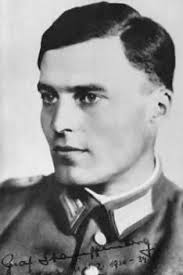
Colonel Claus Schenk von Stauffenberg
Nevertheless, he now acted as the prime mover for the conspiracy among a growing number of German high command officers to arrest or assassinate Germany’s Fuehrer.
For most of these officers, the motive was craven: The “happy time” of German victories was over. Germany was losing the war it had unleashed on the world in 1939—and now they feared the worst.
This was especially true now that the numerically superior forces of the Soviet Union had gone onto the offensive.
For Stauffenberg, there was another reason: His disgust at the horrors he had seen committed by his fellow Wehrmacht soldiers upon defenseless POW’s and civilians in Russia.
Thus, Stauffenberg—more than many Germans—knew firsthand the vengeance his country could expect if the “Thousand-Year Reich” fell.
Something must be done, he believed, to prove to the world that not all Germans—even members of the Wehrmacht—were criminals.
Most of the conspirators wanted to arrest Hitler and surrender to British and American forces—well before the much-feared Russians gained a toehold in Germany.
Stauffenberg didn’t want to arrest Hitler; he wanted to kill him. A live Hitler might eventually be rescued by his Nazi colleagues.
But Hitler was a closely-guarded target. He was surrounded by fanatical bodyguards who were expert marksmen. Hitler himself often wore a bulletproof vest and a cap lined with three pounds of laminated steel.
Adolf Hitler
Bundesarchiv, Bild 146-1990-048-29A / CC-BY-SA 3.0 [CC BY-SA 3.0 de (https://creativecommons.org/licenses/by-sa/3.0/de/deed.en)%5D
But his single greatest protection—he claimed—was an instinct for danger. He would suddenly change his schedule—to drop in where he was least expected. Or suddenly depart an event where he was expected to stay a long time.
That instinct had repeatedly saved his life.
A series of assassination attempts had been made against Hitler. All of them involved time-bombs. And all of the would-be assassins—except one—were members of the German General Staff.
In one case, a bomb secretly stashed aboard Hitler’s plane failed to explode. In another, an officer who had a bomb strapped to himself unexpectedly found his scheduled meeting with Hitler called off. He had to rush into a bathroom to defuse the bomb before it exploded.
Stauffenberg intended to carry his bomb—hidden in a briefcase—into a “Hitler conference” room packed with military officers. Rigged with a time-fuse, it would be left there while he found an excuse to leave.
After the explosion, he would phone one of his fellow conspirators with the news.
Stauffenberg intended to direct the new government that would replace that of the Nazis—and open peace talks with the British and Americans.
With Hitler dead, the coup—“Operation Valkyrie”—would be on.
Anti-Nazi conspirators would seize control of key posts of the government. The British and Americans would then be informed of Germany’s willingness to surrender. Provided, of course, that the vengeance-seeking Russians did not have a say in its postwar future.
The Wehrmacht and Schutzstaffel (SS) had killed millions of Russians. Many had died in combat. Others had been murdered as captives. Still more had been allowed to die by starvation and exposure to the notorious Russian winter.
So the Germans—both Nazi and anti-Nazi—knew what they could expect if soldiers of the Soviet Union reached German soil.
On July 20, 1944, Stauffenberg appeared at Hitler’s well-guarded military headquarters in East Prussia. Like all his other outposts, Hitler had named it—appropriately enough—“Wolf’s Lair.”

“Wolf’s Lair”
Stauffenberg entered the large, concrete building while the conference was in session. He placed his yellow briefcase next to Hitler—who was standing with his generals at a heavy oaken table. Then he excused himself to take an “urgent” phone call.
After Stauffenberg left the room, Colonel Heinz Brandt, standing next to Hitler, found the briefcase blocking his legs. So he moved it—to the other side of the heavy oaken support, partially shielding Hitler from the blast..
At 12:42 p.m. on July 20, 1944, Stauffenberg’s briefcase bomb erupted.
Brandt died, as did two other officers and a stenographer.
Hitler’s hair and trousers were singed and his eardrum was perforated. He was even well enough to keep an appointment with Italian dictator Benito Mussolini that same afternoon.
Hitler not only survived, but the plotters failed to seize the key broadcast facilities of the Reich.
This allowed Hitler to make a late-night speech to the nation, revealing the failed plot and assuring Germans that he was still alive. And he swore to flush out the “traitorous swine” who had tried to kill him.
Mass arrests quickly followed.
Among the first victims discovered and executed was the conspiracy’s leader, Colonel Claus von Stauffenberg. Standing before a makeshift firing squad at midnight, he cried: “Long live our sacred Germany!”
At least 7,000 persons were arrested by the Gestapo. Of these, 4,980 were executed.
2016 PRESIDENTIAL ELECTION, 2020 PRESIDENTIAL ELECTION, ABC NEWS, ABUSE OF POWER, ADOLF HITLER, ALTERNET, AMANDA CHASE, AMERICABLOG, AP, ARMED SERVICES, BABY BOOMER RESISTANCE, BARACK OBAMA, BLOOMBERG, BUZZFEED, CBS NEWS, CIA, CLAUS VON STAUFFENBERG, CNN, COVID-19, CROOKS AND LIARS, DAILY KOZ, DANA ANDREWS, DONALD TRUMP, DRUDGE RETORT, FBI, FEDERAL GOVERNMENT SHUTDOWN, FIVETHIRTYEIGHT, GENERAL SERVICES ADMINISTRATION, GESTAPO, HARPER’S MAGAZINE, HILLARY CLINTON, IMPEACHMENT ARTICLES, JAMES B. COMEY, JAMES MATTIS, JOHN KASICH, JOHN MCCAIN, JOSEPH BIDEN, KIM JONG-UN, MARK ESPER, MARTIAL LAW, MARTIN NIEMOELLER, MEDIA MATTERS, MICHAEL FLYNN, MOTHER JONES, MOVEON, MSNBC, MUSLIMS, NATIONAL SECURITY AGENCY, NAZI GERMANY, NBC NEWS, NEWSWEEK, NPR, OBSTRUCTION OF CONGRESS, PBS NEWSHOUR, POLITICO, POLITICUSUSA, RAW STORY, REPUBLICANS, REUTERS, SALON, SEATTLE TIMES, SERGEY KISLYAK, SERGEY LAVROV, SLATE, TALKING POINTS MEMO, THE ATLANTIC, THE CHICAGO SUN-TIMES, THE CHICAGO TRIBUNE, THE DAILY BEAST, THE DAILY BLOG, THE GUARDIAN, THE HILL, THE HUFFINGTON POST, THE LOS ANGELES TIMES, THE NATION, THE NEW REPUBLIC, THE NEW YORK TIMES, THE PENTAGON, THE TWILIGHT ZONE, THE VILLAGE VOICE, THE WASHINGTON POST, THINKPROGRESS, THIRD REICH, TIME, TRUTHDIG, TRUTHOUT, TWENTY-FIFTH AMENDMENT, TWITTER, TWO POLITICAL JUNKIES, U.S. NEWS & WORLD REPORT, UNITED STATES CONSTITUTION, UNITED STATES SECRET SERVICE, UPI, USA TODAY, VLADIMIR PUTIN, VOTER FRAUD, WONKETTE, WORLD WAR 11
In Bureaucracy, History, Military, Politics, Social commentary on July 3, 2023 at 12:10 am
“When Fascism comes to America, it will be called anti-Fascism.”
—Huey Long, Louisiana Governor/Senator
In the 1963 Twilight Zone episode, “No Time Like the Past,” Paul Driscoll (Dana Andrews), a scientist in early 1960s America, uses a time machine to visit Nazi Germany on the eve of World War II.
He’s rented a motel room overlooking the balcony from where the Fuhrer, Adolf Hitler will soon make a speech. And he’s eager to watch that speech—through the lens of a telescopic-sighted rifle.
Just as he’s about to pull the trigger, there’s a knock at his door–by the maid. Driscoll hustles her out as soon as possible, then once again picks up his rifle. He—and viewers—can once again see Hitler through the cross-hairs of his weapon.
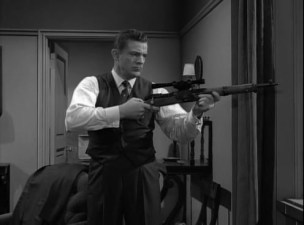
Paul Driscoll prepares to shoot Adolf Hitler
But instead of the anticipated shot, there’s another knock at his door—his time by the black-uniformed secret police, the SS. Driscoll knows the game is up, and disappears into the present just as the thugs break down his door.
And the audience is left to ponder how different the world would have been if Driscoll—or someone in Nazi Germany—had succeeded in assassinating the man whose wars would wipe out the lives of 50 million men, women and children around the globe.
During the 2016 Presidential campaign, one Republican candidate dared to invoke the menace of Nazi Germany in warning of the dangers of a Donald Trump Presidency. And to argue that Americans could prevent that past from returning.
In November, 2015, John Kasich, the governor of Ohio, was peddling a message of creating jobs, balancing the Federal budget and disdain for Washington, D.C.
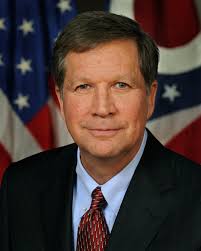
John Kasich
But he remained far behind in the polls, dropping 50% in support in just one month—from September to October. Meanwhile, Trump—appealing to hatred, racism and xenophobia—was being backed by 25% of Republican primary voters.
So, with nothing to lose, Kasich decided to take off the gloves. He invoked the “N” word for Republicans: Nazi.
He authorized the creation of a TV ad that opened with ominous music—and the face of a snarling Donald Trump.
“I would like anyone who is listening to consider some thoughts that I’ve paraphrased from the words of German pastor Martin Niemoeller.”
The voice belonged to Tom Moe, a retired colonel in the U.S. Air Force—and a former Vietnam prisoner-of-war.
“You might not care if Donald Trump says Muslims must register with the government, because you’re not one,” continued Moe.
“And you might not care if Donald Trump says he’s going to round up all the Hispanic immigrants, because you’re not one.
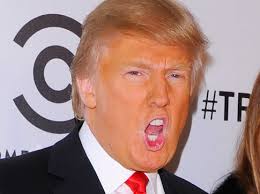
Donald Trump
“And you might not care if Donald Trump says it’s OK to rough up black protesters, because you’re not one.
“And you might not care if Donald Trump wants to suppress journalists, because you’re not one.
“But think about this:
“If he keeps going, and he actually becomes President, he might just get around to you. And you’d better hope that there’s someone left to help you.”
Martin Niemoeller (1892–1984) was a prominent Protestant pastor who had commanded a U-boat during World War 1. He became a bitter public foe of Adolf Hitler.
A staunch anti-Communist, he had initially supported the Nazis as Germany’s only hope of salvation against the Soviet Union.
But when the Nazis made the church subordinate to State authority, Niemoeller created the Pastors’ Emergency League to defend religious freedom.
For his opposition to the Third Reich, Niemoeller spent seven years in concentration camps.
With the collapse of the Reich in 1945, he was freed—and elected President of the Protestant church in Hesse and Nassau in 1947. During the 1960s, he was a president of the World Council of Churches.
He is best remembered for his powerful condemnation of the failure of Germans to protest the increasing oppression of the Nazis:
First they came for the Communists, but I was not a Communist, so I did not speak out.
Then they came for the Socialists, but I was not a Socialist, so I did not speak out.
Then they came for the trade unionists, but I was not a trade unionist, so I did not speak out.
Then they came for the Jews, but I was not a Jew, so I did not speak out.
And when they came for me, there was no one left to speak out for me.
Neither “Adolf Hitler” nor “Nazi Party” was mentioned during the one-minute Kassich video. But a furious Trump threatened to sue Kasich if he could find anything “not truthful” within the ad.
Apparently he couldn’t find anything “not truthful,” because he never sued.
So threatened the man who had called Mexican immigrants “rapists” and falsely accused President Barack Obama of being a Muslim and illegal alien.
The Kasich ad was the darkest attack made against Trump by any candidate—Republican or Democrat. And it raised a disturbing question:
If Donald Trump proved to be America’s Adolf Hitler, would there be an American Claus von Stauffenberg?
Colonel Claus Schenk von Stuaffenberg was the German army officer who, on July 20, 1944, tried to assassinate Adolf Hitler.
ABC NEWS, ACADEMI, AFGHANISTAN, ALTERNET, ANDROID, AP, APPLE IOS, ” 9/11, BARACK OBAMA, BLACKWATER, BOOZ ALLEN HAMILTON, BUZZFEED, CBS NEWS, CENTRAL INTELLIGENCE AGENCY, CNN, COFER BLACK, COLD WAR, CONTRACT EMPLOYEES, CROOKS AND LIARS, DAILY KOZ, DONALD TRUMP, EDWARD SNOWDEN, ENRIQUE PRADO, ERIK PRINCE, GEORGE W. BUSH, GREEN BERETS, IRAQ, LEGACY OF ASHES (BOOK), LOCKHEED MARTIN, MERCENARIES, MICROSOFT WINDOWS, MOTHER JONES, MOVEON, NATIONAL SECURITY AGENCY, NAVY SEALS, NBC NEWS, NEWSWEEK, NICCOLO MACHIAVELLI, NPR, PAUL BREMER, POLITICO, RAW STORY, REUTERS, ROBERT RICHER, SALON, SEATTLE TIMES, SLATE, SMARTPHONES, THE ATLANTIC, THE CHICAGO SUN-TIMES, THE CHICAGO TRIBUNE, THE DAILY BEAST, THE GUARDIAN, THE HILL, THE HUFFINGTON POST, THE LOS ANGELES TIMES, THE NATION, THE NEW YORK TIMES, THE PENTAGON, THE WASHINGTON POST, TIM WEINER, TIME, TORTURE, TOTAL INTELLIGENCE SOLUTIONS, TWITTER, U.S. NEWS & WORLD REPORT, UNITED STATES AIR FORCE, UNITED STATES ARMY, UPI, USA TODAY, WIKILEAKS, XE SERVICES
In Bureaucracy, Business, History, Military, Politics, Social commentary on June 30, 2023 at 12:05 am
The United States had been fighting in Afghanistan for almost 16 years—and between 2001 and 2017 had spent an estimated $714 billion.
Still, there was no end in sight.
Then Erik Prince suggested a remedy: Mercenaries—via his private company, Academi.
For $3.5 billion in taxpayer monies, he claimed that he could vin a victory that had eluded the United States Air Force, Army (including Green Berets) and Navy SEALs.

Erik Prince
By Miller Center [CC BY 2.0 (https://creativecommons.org/licenses/by/2.0)%5D, via Wikimedia Commons
In 1997, Prince created Blackwater, a private security company providing support to military and police agencies.
In August, 2003, Blackwater got the first of a series of Federal contracts to deploy its forces in Iraq. For $21 million, it safeguarded Paul Bremer, America’s proconsul running the occupation.
Ultimately, Blackwater got $1 billion to provide security for American officials and soldiers in Iraq and Afghanistan.
According to human rights organizations, Blackwater abused Iraqis and engaged in torture to obtain information.
In September, 2007, Blackwater guards killed 17 Iraqi civilians and injured 20 more in a Baghdad traffic circle.
Owing to its highly controversial activities in Iraq, Prince renamed the company Xe Services in 2009 and then Academi in 2011.
By 2018, against opposition by the Pentagon, Prince lobbied President Donald Trump to let Academi privatize the war in Afghanistan.
Ultimately, his company did not become the sole American military force in Afghanistan—despite his sister, Betsy Devos, being the Secretary of Education.
Since the end of the Cold War, the American military and Intelligence communities have grown increasingly dependent on private contractors.
In his 2007 bestseller, Legacy of Ashes: The History of the CIA, Tim Weiner writes:
“Patriotism for profit became a $50-billion-a-year business….The [CIA] began contracting out thousands of jobs to fill the perceived void by the budget cuts that began in 1992.
“A CIA officer could file his retirement papers, turn in his blue identification badge, go to work for a much better salary at a military contractor such as Lockheed Martin or Booz Allen Hamilton, then return to the CIA the next day, wearing a green badge….”

Much of the CIA became totally dependent on mercenaries. They appeared to work for the agency, but their loyalty was actually to their private–and higher-paying—companies.
Writes Weiner: “Legions of CIA veterans quit their posts to sell their services to the agency by writing analyses, creating cover for overseas officers, setting up communications networks, and running clandestine operations.”
One such company was Total Intelligence Solutions, founded in 2007 by Cofer Black, who had been the chief of the CIA’s counter-terrorism center on 9/11. His partners were Robert Richer, formerly the associate deputy director of operations at the CIA, and Enrique Prado, who had been Black’s chief of counter-terror operations at the agency.
Future CIA hires followed suit: Serve for five years, win that prized CIA “credential” and sign up with a private security company to enrich yourself.
This situation met with full support from Right-wing “pro-business” members of Congress and President George W. Bush.
They had long championed the private sector as inherently superior to the public one. And they saw no danger that a man dedicated to enriching himself might put greed ahead of safeguarding his country.
But there are dangers to hiring men whose first love is profit. Recent examples include:
- Edward Snowden deliberately joined Booz Allen Hamilton to secure a job as a computer systems administrator at the National Security Agency (NSA). This gave him access to thousands of highly classified documents—which, in 2013, he began publicly leaking to a wide range of news organizations.
- His motive, he claimed, was to warn Americans of the privacy-invading dangers posed by their own Intelligence agencies.
- On March 7, 2017, WikiLeaks published a “data dump” of 8,761 documents codenamed “Vault 7.”
- The documents exposed that the CIA had found security flaws in software operating systems such as Microsoft Windows, Android and Apple iOS. These allowed an intruder—such as the CIA—to seize control of a computer or smartphone. The owner could then be photographed through his iPhone camera and have his text messages intercepted.
- According to anonymous U.S. Intelligence and law enforcement sources, the culprits were CIA contract employees.
But there are others who have offered a timely warning against the use of mercenaries. One of these is Niccolo Machiavelli, the Florentine statesman of the Renaissance.
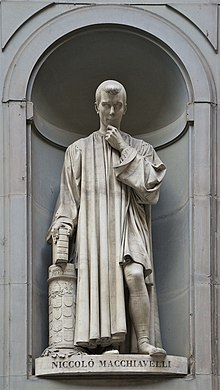
Niccolo Machiavelli
In The Prince, Machiavelli writes:
“Mercenaries…are useless and dangerous. And if a prince holds on to his state by means of mercenary armies, he will never be stable or secure. For they are disunited, ambitious, without discipline, disloyal. They are brave among friends; among enemies they are cowards.
“They have neither the fear of God nor fidelity to man, and destruction is deferred only as the attack is. For in peace one is robbed by them, and in war by the enemy.
“The cause of this is that they have no love or other motive to keep them in the field beyond a trifling wage, which is not enough to make them ready to die for you.”
Centuries after Machiavelli’s warning, Americans are realizing the bitter truth of it firsthand.
ABC NEWS, ADOLF HITLER, ALTERNET, AMERICABLOG, AP, BABY BOOMER RESISTANCE, BATTLE OF OMDURMAN, BLOOMBERG, BONE SPURS, BRITISH ARMY, BUZZFEED, CBS NEWS, CNN, CROOKS AND LIARS, DAILY KOZ, DEMOCRATS, DONALD TRUMP, DRAFT DODGING, DRUDGE RETORT, EGYPT, FIVETHIRTYEIGHT, FOUR QUEEN’S OWN HUSSARS REGIMENT, GEORGE FLOYD, HARPER’S MAGAZINE, IMPEACHMENT, INDIA, JESUS, JOSEPH STALIN, KAYLEIGH MCENANY, KIM JONG-UN, LAFAYETTE PARK, LOS ANGELES, MEDIA MATTERS, MEMES, MOTHER JONES, MOVEON, MSNBC, MURIEL BOWSER, NATIONAL GUARD, NAZI GERMANY, NBC NEWS, NEW YORK CITY, NEWSWEEK, NORTH KOREA, NPR, OSAMA BIN LADEN, PBS NEWSHOUR, POLITICO, POLITICUSUSA, RAW STORY, REPUBLICANS, REUTERS, RUSSIA, SALON, SAN FRANCISCO, SCOTLAND YARD’S SPECIAL BRANCH, SEATTLE TIMES, Secret Service, SLATE, ST. JOHN’S CHURCH, TALKING POINTS MEMO, TEAR GAS, THE ATLANTIC, THE CHICAGO SUN-TIMES, THE CHICAGO TRIBUNE, THE DAILY BEAST, THE DAILY BLOG, THE GUARDIAN, THE HILL, THE HUFFINGTON POST, THE LOS ANGELES TIMES, THE NATION, THE NEW REPUBLIC, THE NEW YORK TIMES, THE VILLAGE VOICE, THE WASHINGTON POST, THINKPROGRESS, TIME, TITAN MINI-SUB, TITANIC, TRUTHDIG, TRUTHOUT, TWENTY-FIRST LANCERS, TWITTER, TWO POLITICAL JUNKIES, U.S. NEWS & WORLD REPORT, U.S. PARK POLICE, UPI, USA TODAY, VIETNAM WAR, VLADIMIR PUTIN, WALTER THOMPSON, WHITE HOUSE, WINSTON CHURCHILL, WONKETTE, WORLD WAR 11
In Bureaucracy, History, Law Enforcement, Military, Politics, Social commentary on June 26, 2023 at 12:14 am
There are literally no limits to which Donald Trump’s fanatical supporters will go to convince others he’s a heroic champion worthy of their reverence.
Today, on Facebook and Twitter, his disciples post images of him that are not only false but laughably so.
One such image was posted by “Nick Adams (Alpha Male)” and showed the jowly, grotesquely overweight, 77-year-old ex-President as a muscular bodybuilder. And it came with the caption: “President Trump is a TITAN!”
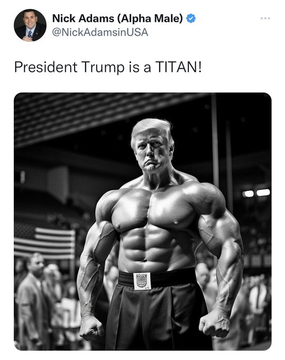
Ironically, the tweet came on the same day—June 22—when news broke of the implosion of the Titan mini-sub and the loss of its five-man crew. The tragedy occurred during a dive to view the wreckage of the Titanic, which sank in 1912.
Other memes have depicted Trump—a notorious draft-dodger who received no fewer than five deferments to escape the Vietnam war—as a military hero, clad in full military gear.
One even claimed he had killed Osama bin Laden—an act that occurred when Barack Obama was President and Trump was safely presiding over the TV show, “The Apprentice.”
Other propagandists for Trump have depicted him as beloved by Jesus. This despite the fact that Trump is a notorious liar, egomaniac, adulterer, thief and materialist.
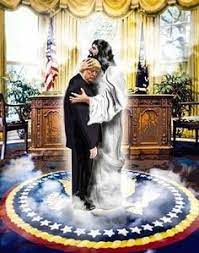
Still others have tried to compare Trump to historical titans—like Winston Churchill.
On May 25, 2020, mass protests erupted across the country following the murder of George Floyd, a black unemployed restaurant security guard, by Derek Chauvin, a white Minneapolis police officer.
Cities such as Los Angeles, San Francisco and New York City saw stores looted, vandalized and/or burned. In response, President Trump called for harsh policing, telling governors in a nationwide conference call that they must “dominate” protesters or be seen as “weak.”

Death of George Floyd
To drive home his point, on June 1, Trump ordered police, Secret Service agents and National Guard troops to violently remove peaceful protesters from Lafayette Square, which borders St. John’s Church near the White House.
The purpose of the removal: So Trump—holding a Bible upside down—could have a photo-op in front of the church.
On June 3, White House Press Secretary Kayleigh McEnany compared Trump’s photo-op in front of St. John’s Episcopal Church to former British Prime Minister Winston Churchill’s visits to bombed British cities during World War II:
“Through all of time, we have seen presidents and leaders across the world who have had leadership moments and very powerful symbols that were important for a nation to see at any given time to show a message of resilience and determination.
“Like Churchill, we saw him inspecting the bombing damage. It sent a powerful message of leadership to the British people.”

Kayleigh McEnany
Comparing Trump to Churchill proved a triumph of imagination on McEnany’s part:
- Churchill was an avowed and relentless opponent of Fascism—and especially its most infamous exponent, German Chancellor Adolf Hitler.
- During the 1930s, as Europe’s democracies ignored or quailed before Nazi threats, Churchill demanded that England arm for the coming war against Nazi Germany.
- Trump, a Fascistic dictator by nature, tried to rule by fiat and identified with dictators—most notably Communist ones, such as Russia’s Vladimir Putin and North Korea’s Kim Jong-Un.
- Throughout World War II, Churchill had only one bodyguard—Inspector Walter Thompson, of Scotland Yard’s Special Branch.

Winston Churchill (testing a submachinegun); Walter Thompson (in black fedora)
- Trump was constantly protected by hundreds of Secret Service agents who were supplemented by platoons of local police.
- During bombing raids, Churchill often climbed atop London buildings to watch the bombardment—or raced to cities he had just learned were under attack.
- During the George Floyd protests, Trump ducked into the White House’s bombproof bunker.
- Trump turned the normally well-protected White House into an armed fortress. Block after block of tall, black reinforced fencing had been erected in recent days. Tan military vehicles rolled along Pennsylvania Avenue and camo-clad troops patrolled the corner where tourists once bought red, white and blue USA sweatshirts.
- As a young man, Churchill had served as a second lieutenant in the Fourth Queen’s Own Hussars regiment of the British Army. He volunteered to campaign against Islamic rebels in the Swat Valley of northwest India. In Egypt, he joined the 21st Lancers and saw action in the Battle of Omdurman.
- Trump had used his father’s influence to win five draft deferments during the Vietnam war—four allowing him to complete college and one for “bone spurs.”
Donald Trump is by no means the first tyrant to be hailed as a hero.
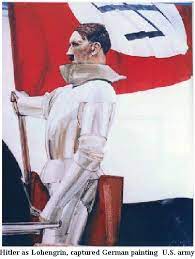
Nazi Germany’s Adolf Hitler—who almost certainly never rode a horse—was depicted as an armor-clad knight holding a swastika banner while astride a spirited steed.
And the Soviet Union’s Joseph Stalin—whose pockmarked face, short stature and widening girth were visible to all who met him—was depicted in posters as handsome, gigantic and trim.
Tyrants pay close attention to how they are depicted. They want to be seen as forever modest, humble, wise and courageous—the embodiment of virtue and patriotism.
To depict them as they usually are—vain, arrogant, stupid, cowardly—they consider a personal affront and a challenge to their absolute rule.
ABC NEWS, AL QAEDA, ALTERNET, AMERICABLOG, AP, BABY BOOMER RESISTANCE, BASHIR AL-ASSAD, BUZZFEED, CBS NEWS, CHARLES GEORGE GORDON, CHARLTON HESTON, CNN, CROOKS AND LIARS, DAILY KOZ, DRUDGE RETORT, FIVETHIRTYEIGHT, GEORGE W. BUSH, GREAT BRITAIN, HARPER’S MAGAZINE, HIZBOLLAH, IRAQ, ISLAM, KHARTOUM, KHARTOUM (MOVIE), LAURENCE OLIVER, MEDIA MATTERS, MOTHER JONES, MOVEON, MSNBC, NBC NEWS, NEOCONS, NEWSWEEK, NPR, PBS NEWSHOUR, POLITICO, POLITICUSUSA, PRESIDENT BARACK OBAMA, RAW STORY, REPUBLICAN PARTY, REUTERS, SALON, SEATTLE TIMES, SHIITE MUSLIMS, SLATE, SUDAN, SUNNI MUSLIMS, SYRIA, TALKING POINTS MEMO, THE ATLANTIC, THE CHICAGO SUN-TIMES, THE CHICAGO TRIBUNE, THE DAILY BEAST, THE DAILY BLOG, THE GUARDIAN, THE HILL, THE HUFFINGTON POST, THE LOS ANGELES TIMES, THE MADHI, THE NATION, THE NEW REPUBLIC, THE NEW YORK TIMES, THE VILLAGE VOICE, THE WALL STREET JOURNAL, THE WASHINGTON POST, THINKPROGRESS, TIME, TRUTHDIG, TRUTHOUT, TWITTER, TWO POLITICAL JUNKIES, U.S. NEWS & WORLD REPORT, UPI, USA TODAY, WILLIAM GLADSTONE, WONKETTE
In Bureaucracy, History, Military, Politics, Social commentary on June 23, 2023 at 12:11 am
January 26, 2020, marked the 138th anniversary of the fall of Khartoum, the Sudanese city that sits on the banks of the White and Blue Nile Rivers.
The siege and fall of Khartoum is one of the truly epic stories of military history.
From March 18, 1884, to January 26, 1885, the charisma and military genius of one man—British General Charles George Gordon—held at bay an army of thousands of fanatical Islamics intent on slaughtering everyone in the city. 

Khartoum in 1888—four years after the siege
At stake were the lives of Khartoum’s 30,000 residents.
By comparison: The defenders of the Alamo—a far better-known battle, in 1836—numbered no more than 250. And the siege of the San Antonio mission lasted only 13 days against an army of about 2,000 Mexicans.
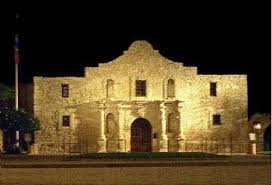
The Alamo
Gordon’s story may seem antiquated. But it resembles the efforts Republicans made to pressure the Obama administration to commit ground forces to “freeing” Syria of its longtime dictator, “President” Bashir al-Assad.
The neocons of the George W. Bush Administration plunged the United States into an unprovoked war against Iraq in 2003. After Baghdad quickly fell, Americans cheered, thinking the war was over and the troops would soon return home.
Suddenly, American soldiers found themselves waging a two-front war in the same country: Fighting an Iraqi insurgency to throw them out, while trying to suppress growing sectarian warfare between Sunni and Shia Muslims.
And then, with Syria, Americans were being urged to plunge headfirst into a conflict they knew nothing about—and in which they had absolutely no stake.
On one side was the Ba’ath regime of Bashir al-Assad, supported by Russia, Iran, Hizbollah and elements in the Iraqi government. Hizbollah is comprised of Shiite Muslims, who form a minority of Islamics.
A sworn enemy of Israel, it has kidnapped scores of Americans suicidal enough to visit Lebanon and truck-bombed the Marine barracks in Beirut in 1983, killing 299 Americans.

Flag of Hizbollah
Al-Qaeda, on the other hand, is made up of Sunni Muslims, who form the majority of that religion.
It is intolerant of non-Sunni Muslims and has instigated violence against them. It denounces them as “takfirs”–heretics—and thus worthy of extermination.

Flag of Al-Qaeda
In short, it’s a Muslim-vs.-Muslim “holy war.
It’s all very reminiscent of events in the 1966 epic film, Khartoum, starring Charlton Heston as British General Charles George Gordon.
In 1884, the British government sends Gordon, a real-life hero of the Victorian era, to evacuate the Sudanese city of Khartoum.
Mohammed Achmed, a previously anonymous Sudanese, has proclaimed himself “The Madhi” (“The Expected One”) and raised the cry of jihad.
The Madhi (played by Lawrence Olivier) intends to drive all foreigners (of which the English are the largest group) out of Sudan and exterminate all those Muslims who do not practice his “pure” version of Islam.

Charlton Heston as Gordon (left); Laurence Oliver as the Madhi (right)
Gordon arrives in Khartoum to find he’s not fighting a rag-tag army of peasants. Instead, the Madhi is a highly intelligent military strategist.
And Gordon, an evangelical Christian, also finds he has underestimated the Madhi’s religious fanaticism: “I seem to have suffered from the delusion that I had a monopoly on God.”
A surprised Gordon finds himself and 30,000 Sudanese trapped in Khartoum when the Madhi’s forces suddenly appear. He sends off messengers and telegrams to the British Government, begging for a military relief force.
But the British Government wants nothing to do with the Sudan. It has sent Gordon there as a sop to British public opinion that “something” had to be done to quell the Madhist uprising.
The siege continues and tightens.
In Britain, the public hails Gordon as a Christian hero and demands that the Government send a relief expedition to save him.
Prime Minister William Gladstone finally sends a token force—which arrives in Khartoum two days after the city has fallen to the Madhi’s forces.
Gordon, standing at the top of a staircase and coolly facing down his dervish enemies, is speared to death.
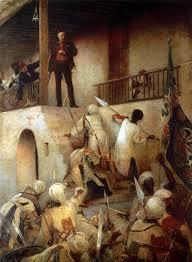
George W. Joy’s famous—and romanticized—painting of “The Death of Gordon”
(Actually, the best historical evidence indicates that Gordon fought to the last with pistol and sword before being overwhelmed by his Islamic enemies.)
When the news reaches England, Britons mourn—and then demand vengeance for the death of their hero.
The Government, which had sought to wash its hands of the poor, military unimportant Sudan, suddenly has to send an army to avenge Gordon.
As the narrator of Khartoum intones at the close of the film: “For 15 years the British paid the price with shame and war.”
There is a blunt lesson for Americans to learn from this episode—and from the 1966 movie Khartoum itself.
Americans have been fighting in the Middle East since 2001—first in Afghanistan to destroy Al-Qaeda, and then in Iraq, to pursue George W. Bush’s vendetta against Saddam Hussein. They continue to fight in Syria against ISIS.
The United States faces a crumbling infrastructure, millions living in poverty and trillions of dollars in debt.
It’s time for Americans to clean up their own house before worrying about the messes in other nations—especially those wholly alien to American values.
ABC NEWS, ADAM SCHIFF, ALAMO, ALTERNET, AMERICABLOG, AP, ARTICLES OF IMPEACHMENT, BABY BOOMER RESISTANCE, BRAD RAFFENSPERGER, BUZZFEED, CBS NEWS, CIA, CNN, CROOKS AND LIARS, DAILY KOZ, DAVID SHAFER, DON MCGHAN, DONALD TRUMP, DONALD TRUMP JUNIOR, DRUDGE RETORT, FBI, FIVETHIRTYEIGHT, GEORGIA, GEORGIA REPUBLICAN PARTY, GEORGIA SECRETARY OF STATE’S OFFICE, HARPER’S MAGAZINE, HILLARY CLINTON, HOUSE INTELLIGENCE COMMITTEE, HOUSE JUDICIARY COMMITTEE, IMPEACHMENT, JARED KUSHNER, JOE BIDEN, MEDIA MATTERS, MOTHER JONES, MOVEON, MSNBC, NATIONAL SECURITY AGENCY, NBC NEWS, NEWSWEEK, NPR, PBS NEWSHOUR, POLITICO, POLITICUSUSA, RAW STORY, REUTERS, RUSSIA, RYAN GERMANY, SALON, SEATTLE TIMES, SLATE, TALKING POINTS MEMO, THE ATLANTIC, THE CHICAGO SUN-TIMES, THE CHICAGO TRIBUNE, THE DAILY BEAST, THE DAILY BLOG, THE GUARDIAN, THE HILL, THE HUFFINGTON POST, THE LOS ANGELES TIMES, THE NATION, THE NEW REPUBLIC, THE NEW YORK TIMES, THE VILLAGE VOICE, THE WASHINGTON POST, THINKPROGRESS, TIME, TRUMP TOWER MEETING, TRUTHDIG, TRUTHOUT, TWITTER, TWO POLITICAL JUNKIES, U.S. NEWS & WORLD REPORT, UPI, USA TODAY, VLADIMIR PUTIN, WONKETTE
In Bureaucracy, History, Law, Law Enforcement, Military, Politics, Social commentary on June 22, 2023 at 12:12 am
On June 21, 2023, the Republican-dominated House of Representatives took revenge on Rep. Adam Schiff (D-CA).
His “crime”: Leading a 2019 investigation into Donald Trump’s collusion with Russian Intelligence to win the 2016 Presidential election.
The resolution falsely accused Schiff of misleading the American people while pursuing the congressional investigation into Russia. The vote was 213-209 along party lines.
On December 10, 2019, Democratic leaders in the House voted to send two Articles of Impeachment to the House Judiciary Committee.
Their purpose: To remove Donald J. Trump from office as the 45th President of the United States.
House Judiciary Committee Chairman Jerry Nadler read the charges:
Article 1: Abuse of Power: For pressuring Ukraine to assist him in his re-election campaign by damaging former Vice President Joe Biden, his possible Democratic rival.
Article 2: Obstruction of Congress: For obstructing Congress by blocking testimony and refusing to provide documents in response to House subpoenas in the impeachment inquiry.
But it was House Intelligence Committee Chairman Adam Schiff who put the reason for impeachment in stark, easily understandable perspective:

Adam Schiff
“Why not just wait until you get the documents that the White House refuses to turn over, and people should understand what that argument really means.
“It has taken us eight months to get a lower court ruling that Don McGahn has no right to defy Congress. If it takes another eight months to get a second court or Supreme Court decision, that is not the end of the process.
“It comes back to us, and we ask questions because he no longer has immunity and he claims something else that his answers are privileged and we have to go to court for another eight or 16 months.
“The argument why don’t you just wait amounts to this: Why don’t you just let him [Trump] cheat in one more election? Why not let him cheat just one more time? Why not let him have foreign help just one more time? That is what that argument amounts to.”
Schiff was alluding to Trump’s infamous efforts during the 2016 Presidential campaign to enlist Russian aid against his rival, Democratic Presidential nominee Hillary Clinton.
Among those efforts:
On July 9, 2016, high-ranking members of his Presidential campaign met at Trump Tower with at least two lobbyists with ties to Russian dictator Vladimir Putin. Trump’s participants included:
- Trump’s son, Donald Trump Jr.;
- His son-in-law, Jared Kushner;
- His then-campaign manager, Paul Manafort.
The purpose of that meeting: To gain access to any “dirt” Russian Intelligence could supply on Clinton.
Donald Trump
On July 22, 2016, during his campaign for President, Trump said at a press conference in Doral, Florida:
“Russia, if you are listening, I hope you are able to find the 33,000 emails that are missing [from Democratic Presidential candidate Hillary Clinton’s computer]. I think you will probably be rewarded mightily by our press.”
Hours later, the Main Intelligence Directorate in Moscow targeted Clinton’s personal office and hit more than 70 other Clinton campaign accounts.
On January 23, 2020, Schiff tweeted a prophecy—and a warning: “Donald Trump must be convicted and removed from office. Because he will always choose his own personal interest over our national interest. Because in America, right matters. Truth matters. If not, no Constitution can protect us. If not, we are lost.”
On February 5, 2020, the Republican-dominated Senate—ignoring the overwhelming evidence against him—acquitted Donald Trump on both impeachment articles: Obstruction of Congress and abuse of power.
On November 3, 2020, Joseph Biden had been elected the nation’s 46th President over Trump.
For weeks Trump had ordered his legions of Right-wing Stormtrumpers to descend on Washington, D.C. on January 6, 2021.
On January 6, Trump appeared at the Ellipse, a 52-acre park south of the White House fence and north of Constitution Avenue and the National Mall in Washington, D.C.
A stage had been set up for him to address tens of thousands of his supporters, who eagerly awaited him.
Trump ordered them to march on the Capitol building to express their anger at the voting process and to intimidate their elected officials to reject the results.
The Stormtrumpers marched to the United States Capitol—and quickly brushed aside Capitol Police, who made little effort to arrest or shoot them.
- One attacker was shot as protesters forced their way toward the House Chamber where members of Congress were sheltering in place.
- Members of the mob attacked police with chemical agents or lead pipes.
- A Capitol Hill police officer was knocked off his feet, dragged into the mob surging toward the building, and beaten with the pole of an American flag.

Stormtrumpers scaling Capitol Building walls
- Several rioters carried plastic handcuffs, possibly intending to take hostages.
- Others carried treasonous Confederate flags.
- Shouts of “Hang Pence!” often rang out.
- Improvised explosive devices were found in several locations in Washington, D.C.
- Many of the lawmakers’ office buildings were occupied and vandalized—including that of House Speaker Nancy Pelosi, a favorite Right-wing target.
More than three hours passed before police—using riot gear, shields and batons—retook control of the Capitol.
Trump’s administration was closing with the same contempt for law and democracy that had characterized it from its outset.
Adam Schiff’s prediction had come true: “[Donald Trump] will always choose his own personal interest over our national interest.”


_b_617.jpg)


2016 PRESIDENTIAL ELECTION, ABC NEWS, ALTERNET, AMERICABLOG, AP, APPLE IOS PRIVACY UPDATE, BABY BOOMER RESISTANCE, BBC, BLOOMBERG NEWS, BUZZFEED, CBS NEWS, CENSORSHIP, CHEATSHEET, CNN, COMMUNICATIONS, COVID-19, CROOKS AND LIARS, DAILY KOS, DAILY KOZ, DONALD TRUMP, FACEBOOK, FACEBOOK JAIL, FAMILY VALUES, FIVETHIRTYEIGHT, FORTUNE, HARPER’S MAGAZINE, HUFFINGTON POST, JOE BARTON, MARK ZUCKERBERG, MEDIA MATTERS, MICHAEL MARTIN, MOTHER JONES, MOVEON, MSNBC, NBC NEWS, NEW REPUBLIC, NEWSDAY, NEWSWEEK, NPR, PBS NEWSHOUR, POLITICO, POLITICUSUSA, RAW STORY, REUTERS, RUSSIAN TROLLS, SALON, SEATTLE TIMES, SLATE, SOCIAL MEDIA WEBSITES, SPAM, TALKING POINTS MEMO, THE ATLANTIC, THE CHICAGO SUN-TIMES, THE CHICAGO TRIBUNE, THE DAILY BEAST, THE DAILY BLOG, THE GUARDIAN, THE HILL, THE HUFFINGTON POST, THE INTERCEPT, THE LOS ANGELES TIMES, THE NATION, THE NEW REPUBLIC, THE NEW YORK TIMES, THE NEW YORKER, THE VILLAGE VOICE, THE WASHINGTON POST, THINKPROGRESS, TIME, TRUTHDIG, TRUTHOUT, TWITTER, U.S. NEWS & WORLD REPORT, UPI, USA TODAY, VLADIMIR PUTIN APPLE
HERE’S A SECRET: SOCIAL MEDIA DOESN’T LOVE YOU
In Bureaucracy, Business, History, Politics, Social commentary on July 10, 2023 at 12:29 amYears ago, Michael Martin, a Los Angeles-based computer repair expert, offered me some advice I have found absolutely essential.
“When you call Technical Support,” he said, “they’re accessing the same information you can get via the computer.
“Most of the time they’re going to have you put the Restore Disk back into the computer and restore it back to default. It wipes out everything on your computer. Technical support costs a lot of money for a company—to hell with your data.
“Be very cautious when you get on the phone with any computer company and they advise you to run the Restore Disk.”
Michael Martin
What Martin said about the unwillingness of computer companies to provide technical support applies just as much to social media websites.
Consider the case of Facebook, the largest social media and networking service. By 2023, it had more than two billion daily active users.
Such a huge audience attracts advertisers. And this, in turn, has armed Facebook with total assets of $184.49 billion as of March 2023. These revenues have given its founder and CEO, Mark Zuckerberg, an estimated net worth of $104.4 billion.
Yet, for all the billions pouring into Facebook’s coffers, the company refuses to provide a way for its users to directly contact Facebook headquarters.
This may not seem important. But the following case will demonstrate why it is.
A short while ago, a friend of mine (whom I’ll call Janet) sent Zuckerberg a letter, which opened:
“Today while chatting with someone on Facebook I found myself bounced from the page. I was instructed to log in again. When I did so, I got the following message:
Hi Janet, we think your computer is infected with malware, and it’s spreading spam through your Facebook account. We’ll walk you through a few steps to explain more and scan your computer for malware.
“Naturally, my first reaction was to contact Facebook to find out what, exactly, was meant by Spam. I quickly found, however, that although Facebook’s customers like me have made you a billionaire, they aren’t considered important enough to be provided with direct support for resolving problems like this.
“All that I could do was put a message on file with your ‘Report a Login Issue’ page. I received no response, so I sent another. This, too, has gone unanswered.
“At the bottom of the ‘Report a Login Issue’ page is this: “Thanks for taking the time to submit a report. While we don’t reply to every report, we’ll let you know if we need more details.”
“In short, even after a customer puts a help-request on file with Facebook, s/he has no guarantee that s/he will even receive the courtesy of a reply, let alone the help needed to resolve the problem.
“Is this really what you are proud to call customer service?
“I think it’s entirely appropriate to ask people I don’t know—and who want to roam freely through my computer—exactly what it is they believe is Spam. Because if it isn’t Spam, there’s no reason for them to be roaming freely through my computer.”
Mark Zuckerberg
Janet never received a reply from Zuckerberg—nor from anyone subordinate to him.
Facebook is still the most popular social platform on the Internet. Yet its future is far from certain.
The 2021 Apple iOS privacy update, App Tracking Transparency, limited the tracking capabilities of digital advertisers and enabled iPhone users to opt-out of data sharing. This has cost Facebook an estimated $10 billion.
And younger audiences are more comfortable telling stories and sharing updates by creating image and video content.
No doubt another major reason for their discontent is the arrogance of Facebook’s censors.
Another friend of mine—Jim—recently landed in “Facebook Jail” after getting this notice:
We removed content you posted
We removed this content because it doesn’t follow the Facebook Community Standards.
The offending post was a news story about Texas Congressman Joe Barton. It described how he had sent a series of smarmy emails to numerous women—while, of course, posing as a paragon of “family values.”
Jim sent a letter to Facebook’s headquarters at 1 Hacker Way, Menlo Park, California 94025:
“If Facebook is going to hold its users to a set of standards, those standards should be clearly and specifically posted. Certainly a legitimate news story—no matter on what the subject—should fall within allowable posting guidelines. But apparently Facebook’s anonymous censors do not agree.
“Facebook functions the way the gods of the ancient Greeks were believed to act: In a totally arbitrary manner, whose decisions, however unwarranted, are beyond appeal.”
One user offended censors by his too-frequent use of the “Like” option. How this violated Facebook’s terms of service was never explained.
During the 2016 Presidential election, Russian trolls used Facebook, Twitter and Google to post misleading articles and comments. These helped put Donald Trump, a would-be protégé of Vladimir Putin, in office.
During the COVID-19 pandemic, Facebook and Twitter were flooded with posts denying the reality of the virus and offering whackjob “cures” or “preventatives.” Untold numbers of Americans died as a result.
The moral: Social media companies have your wallet at heart, not you.
Share this: