Posts Tagged ‘CNN’
ABC NEWS, ADOLF HITLER, AL QAEDA, ANN COULTER, ARIZONA SHOOTINGS, ASSASSINATION, BARACK OBAMA, BILL CLINTON, BILL O'REILLY, BIRTHERS, BOBBY JINDAL, CBS NEWS, CHRISTINA-TAYLOR GREEN, CNN, COMMUNISM, CONFEDERATE FLAG, CRIME, DYLANN ROOF, FACEBOOK, FBI, GABRIELLE GIFFORDS, GEORGE H.W. BUSH, GEORGE W. BUSH, GLENN BECK, HATE GROUPS, HEALTHCARE, JEB BUSH, JOSEPH MCCARTHY, MEIN KAMPF, MICHELLE BACHMANN, NBC NEWS, NEWT GINGRICH, OBAMACARE, RICHARD NIXON, RICK PERRY, RICK SANTORUM, RODNEY KING RIOTS, ROLLING STONE, RUSH LIMBAUGH, Sarah Palin, SEAN HANNITY, Secret Service, SOVIET UNION, SPIRO AGNEW, TEA PARTY, THE CHICAGO SUN-TIMES, THE CHICAGO TRIBUNE, THE LOS ANGELES TIMES, THE NEW YORK TIMES, THE WASHINGTON POST, TWITTER, U.S. DISTRICT JUDGE JOHN ROLL, U.S. MARSHALS SERVICE, WHITE SUPREMACISTS
In Bureaucracy, History, Law, Law Enforcement, Politics, Social commentary on May 16, 2016 at 12:01 am
The electoral success of Senator Joseph McCarthy’s Red-baiting treason slanders proved too alluring for other Republicans to resist.
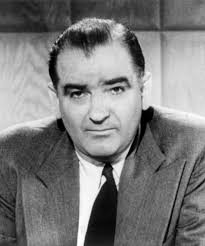
Joseph McCarthy
Among those who have greatly profited from hurling similar charges are:
- President Richard Nixon
- His vice president, Spiro Agnew
- Former Speaker of the House Newt Gingrich
- Former Congressman Dick Armey
- President George W. Bush
- Vice Presidential candidate Sarah Palin
- Congresswoman Michelle Bachmann
- Rush Limbaugh
- Glenn Beck
- Sean Hannity
- Bill O’Reilly.
During the 1992 Presidential campaign, Republicans tried to paint Bill Clinton as a brainwashed “Manchurian candidate” because he had briefly visited the Soviet Union during his college years.
After the Soviet Union collapsed in 1991, Republicans lost their “soft on Communism” slander-line. So they tried to persuade voters that Democrats were “soft on crime.”
When riots flared in 1992 after the acquittal of LAPD officers who had savagely beaten Rodney King, President George H.W. Bush blamed the carnage on the “Great Society” programs of the 1960s.
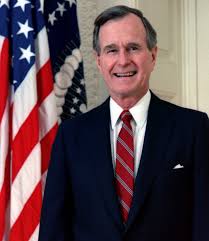
George H.W. Bush
After losing the White House to Clinton at the polls in 1992 and 1996, Republicans tried to oust him another way: By impeaching him over a tryst with a penis-loving intern named Monica Lewinsky.
The Republican-controlled House of Representatives voted to impeach, but the effort was defeated in the Democratically-controlled Senate.
The 2008 election of Barack Obama pushed the Republican “treason chorus” to new heights of infamy.
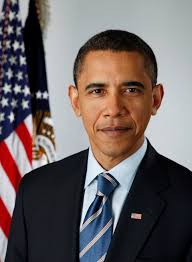
Barack Obama
Almost immediately after Obama took office, he came under attack by an industry of Right-wing book authors such as Sean Hannity, Ann Coulter and Rush Limbaugh.
The following titles vividly reveal the hates, fears and ambitions of their authors–and audience:
- Conservative Victory: Defeating Obama’s Radical Agenda by Sean Hannity
- Obama Zombies: How the Liberal Machine Brainwashed My Generation by Jason Mattera
- How Barack Obama is Bankrupting the U.S. Economy by Stephen Moore
- Let Freedom Ring: Winning the War of Liberty over Liberalism by Sean Hannity
- The Manchurian President: Barack Obama’s Ties to Communists,Socialists and Other Anti-American Extremists by Aaron Klein
- The Blueprint: Obama’s Plan to Subvert the Constitution and Build an Imperial Presidency by Ken Blackwell
- Culture of Corruption: Obama and His Team of Tax Cheats, Crooks, and Cronies by Michelle Malkin
- Why Obama’s Government Takeover of Health Care Will Be a Disaster by David Gratzer
- To Save America: Stopping Obama’s Secular-Socialist Machine by Newt Gingrich
- Obama’s Radical Transformation of America: Year One by Joshua Muravchik
- How the Obama Administration Threatens to Undermine Our Elections by John Fund
- Power Grab: How Obama’s Green Policicies Will Steal Your Freedom and Bankrupt America by Christopher C. Horner
- The Bad Science and Bad Policy of Obama’s Global Warning Agenda by Roy W. Spencer
- America’s March to Socialism: Why We’re One Step Closer to Giant Missile Parades by Glenn Beck
- Obama’s Betrayal of Israel by Michael Ledeen
- The Obama Nation: Leftist Politics and the Cult of Personality by Jerome R. Corsi
- The Case Against Barack Obama: The Unlikely Rise and Unexamined Agenda of the Media’s Favorite Candidate by David Freddoso
- Censorship: The Threat to Silence Talk Radio by Brian Jennings
- The War On Success: How the Obama Agenda Is Shattering the American Dream by Tommy Newberry
- Green Hell: How Environmentalists Plan to Control Your Life and What You Can Do to Stop Them by Steven Milloy
- Liberalism is a Mental Disorder: Savage Solutions by Michael Savage
- Treason: Liberal Treachery from the Cold War to the War on Terrorism by Ann Coulter
- How to Talk to a Liberal (If You Must): The World According to Ann Coulter by Ann Coulter
- Slander: Liberal Lies About the American Right by Ann Coulter
- If Democrats Had Any Brains, They’d Be Republicans by Ann Coulter
- Guilty: Liberal “Victims” and Their Assault on America by Ann Coulter
- Catastrophe: How Obama, Congress and the Special Interests Are Transforming…a Slump into a Crash, Freedom Into Socialism and a Disaster into a Catastrophe….And How to Fight Back by Dick Morris
Consider the vocabulary Right-wingers use to describe their political adversaries:
“Liberals,” “radicals, “bankrupting,” “treason,” subversion,” “slander,” “terrorism,” “betrayal,” “catastrophe,” “shattering the American dream,” “leftists,” “Communists,” “government takeover,” “socialism,” “power grab,” “secularism,” “environmentalism.”
And while the Right lusts to constantly compare Obama to Adolf Hitler, its propaganda campaign draws heavily on the Nazi leader’s own advice.
In Mein Kampf, Hitler laid out his formula for successful propaganda: “All effective propaganda must be confined to a few bare essentials.
“Those must be expressed as far as possible in stereotypical formulas. These slogans should be persistently repeated until the very last individual has come to grasp the idea that has been put forward.”
Among the lies most “persistently repeated” by Republicans about Obama:
Obama isn’t an American citizen. The reason: To “prove” that he is an illegitimate President, and should be removed from office.
Even the President’s releasing of the long-form version of his birth certificate in 2011–showing that he was born in Hawaii, not Kenya–didn’t end these falsehoods.
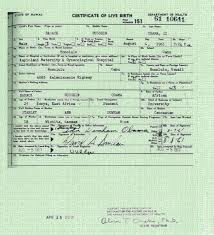
The long-form version of President Obama’s birth certificate
Oaama is a secret Muslim who intends to betray America to his Islamic masters.
In fact, Obama has eliminated far more Al Qaeda leaders than George W. Bush ever did–including the most sought-after one of all: Osama bin Laden.
ABC NEWS, ADOLF HITLER, AL QAEDA, ANN COULTER, ARIZONA SHOOTINGS, ASSASSINATION, BARACK OBAMA, BILL CLINTON, BILL O'REILLY, BIRTHERS, BOBBY JINDAL, CBS NEWS, CHRISTINA-TAYLOR GREEN, CNN, COMMUNISM, CONFEDERATE FLAG, CRIME, DYLANN ROOF, FACEBOOK, FBI, GABRIELLE GIFFORDS, GEORGE H.W. BUSH, GEORGE W. BUSH, GLENN BECK, HATE GROUPS, HEALTHCARE, JEB BUSH, JOSEPH MCCARTHY, MEIN KAMPF, MICHELLE BACHMANN, NBC NEWS, NEWT GINGRICH, OBAMACARE, OSAMA BIN LADEN, REPUBLICAN PARTY, RICHARD NIXON, RODNEY KING RIOTS, ROLLING STONE, RUSH LIMBAUGH, Sarah Palin, SEAN HANNITY, Secret Service, SOVIET UNION, SPIRO AGNEW, TEA PARTY, THE CHICAGO SUN-TIMES, THE CHICAGO TRIBUNE, THE LOS ANGELES TIMES, THE NEW YORK TIMES, THE WASHINGTON POST, TWITTER, U.S. DISTRICT JUDGE JOHN ROLL, U.S. MARSHALS SERVICE, WHITE SUPREMACISTS
In Bureaucracy, History, Law, Law Enforcement, Politics, Social commentary on May 13, 2016 at 12:11 am
“The Republican Party has weaponized its supporters, made violence a virtue and, with almost every pronouncement for 50 years, given them an enemy politicized, racialized and indivisible.”
So wrote Rolling Stone writer in a blistering June 19, 2015 editorial. The touchstone was the slaughter of nine black worshipers by a white supremacist at a South Carolina black church.
But the proof of Republican culpability in political violence goes back much further.
Consider:
Gabrille Giffords, 40, is a moderate Democrat who narrowly wins re-election in November, 2010, against a Republican Tea Party candidate.
Her support of President Obama’s health care reform law has made her a target for violent rhetoric–-especially from former Alaska Governor Sarah Palin.
In March, 2010, Palin releases a map featuring 20 House Democrats that uses cross-hairs images to show their districts. In case her supporters don’t get the message, she later writes on Twitter: “Don’t Retreat, Instead – RELOAD!”

Sarah Palin’s “Crosshairs” Map
As the campaign continues, Giffords finds her Tucson office vandalized after the House passes the healthcare overhaul in March.
Giffords senses that she has become a target for removal–in more than political terms. In an interview after the vandalizing of her office, she refers to the animosity against her by conservatives.
She specifically cites Palin’s decision to list her seat as one of the top “targets” in the midterm elections.
“For example, we’re on Sarah Palin’s targeted list, but the thing is, that the way that she has it depicted has the cross-hairs of a gun sight over our district. When people do that, they have to realize that there are consequences to that action,” Giffords tells MSNBC.
At one of her rallies, her aides call the police after an attendee drops a gun.
Giffords may have seen the spectre of violence closing in on her. In April, 2010, she supported Rep. Raúl Grijalva after he had to close two offices when he and his staff received threats.
He had called for a boycott of Arizona businesses in opposition to the state’s controversial immigration law.
“I am deeply troubled about reports that Congressman Grijalva and members of his staff have been subjected to death threats,” Giffords said.
“This is not how we, as Americans, express our political differences. Intimidation has no place in our representative democracy. Such acts only make it more difficult for us to resolve our differences.”
But intimidation–-and worse–-does have a place among the tactics used by influential Republicans in the pursuit of absolute power.
Increasingly, Republicans have repeatedly aimed violent–-and violence-arousing–-rhetoric at their Democratic opponents. This is not a case of careless language that is simply misinterpreted, with tragic results.
Republicans like Sarah Palin fully understand the constituency they are trying to reach: Those masses of alienated, uneducated Americans who live only for their guns and hardline religious beliefs–and who can be easily manipulated by perceived threats to either.
If a “nutcases” assaults a Democratic politician and misses, then the Republican establishment claims to be shocked–-shocked!–-that such a thing could have happened.
And if the attempt proves successful–-as the January 8, 2011 Tucson shootings did–-then Republicans weep crocodile tears for public consumption.
The difference is that, in this case, they rejoice in knowing that Democratic ranks have been thinned and their opponents are even more on the defensive, for fear of the same happening to them.
Consider the following:
- Rep. Randy Neugebauer (R-Tex.) yelled “baby killer” at Bart Stupak (D-Mich.) on the House floor.
- Florida GOP Congressional candidate Allen West, referring to his Democratic opponent, Rep. Ron Klein, told Tea Party activists: You’ve got to make the fellow scared to come out of his house. That’s the only way that you’re going to win. That’s the only way you’re going to get these people’s attention.”
- Rep. Devin Nunes (R-CA) said Tea Partiers had “every right” to use racist and homophobic slurs against Democrats, justifying it via Democrats’ “totalitarian tactics.”
- Rep. Michelle Bachmann (R-Minn.) said she wanted her constituents “armed and dangerous” against the Obama administration.
- Sarah Palin told her supporters: “Get in their face and argue with them. No matter how tough it gets, never retreat, instead RELOAD!”
- Right-wing pundit Ann Coulter: “My only regret with Timothy McVeigh is he did not go to the New York Times building.”
- Senator Phil Gramm (R-Tex.) “We’re going to keep building the party until we’re hunting Democrats with dogs.”
- Rep. Louisa M. Slauter (D-NY) received a phone message threatening sniper attacks against lawmakers and their families.
Since the end of World War 11, Republicans have regularly hurled the charge of “treason” against anyone who dared to run against them for office or think other than Republican-sponsored thoughts.
Republicans had been locked out of the White House from 1933 to 1952, during the administrations of Franklin D. Roosevelt and Harry S. Truman.
Determined to regain the Presidency by any means, they found that attacking the integrity of their fellow Americans a highly effective tactic.
During the 1950s, Wisconsin Senator Joseph R. McCarthy rode a wave of paranoia to national prominence–by attacking the patriotism of anyone who disagreed with him.
The fact that McCarthy never uncovered one actual case of treason was conveniently overlooked during his lifetiAL me.
ABC NEWS, ADOLF HITLER, AL QAEDA, ANN COULTER, ARIZONA SHOOTINGS, ASSASSINATION, BARACK OBAMA, BILL CLINTON, BILL O'REILLY, BIRTHERS, BOBBY JINDAL, CBS NEWS, CHRISTINA-TAYLOR GREEN, CNN, COMMUNISM, CONFEDERATE FLAG, CRIME, DYLANN ROOF, FACEBOOK, FBI, GABRIELLE GIFFORDS, GEORGE H.W. BUSH, GEORGE W. BUSH, GLENN BECK, HATE GROUPS, HEALTHCARE, JEB BUSH, JOSEPH MCCARTHY, MEIN KEMPF, MICHELLE BACHMANN, NBC NEWS, NEWT GINGRICH, OBAMACARE, OSAMA BIN LADEN, REPUBLICAN PARTY, RICHARD NIXON, RICK PERRY, RICK SANTORUM, RODNEY KING RIOTS, ROLLING STONE, RUSH LIMBAUGH, Sarah Palin, SEAN HANNITY, Secret Service, SOVIET UNION, SPIRO AGNEW, TEA PARTY, THE CHICAGO SUN-TIMES, THE CHICAGO TRIBUNE, THE LOS ANGELES TIMES, THE NEW YORK TIMES, THE WASHINGTON POST, TWITTER, U.S. DISTRICT JUDGE JOHN ROLL, U.S. MARSHALS SERVICE, WHITE SUPREAMACISTS
In Bureaucracy, History, Law, Law Enforcement, Politics, Social commentary on May 12, 2016 at 12:28 am
On June 17, 2015, Dylann Roof, a white high school dropout, gunned down three black men and six black women at Emanuel African Methodist Episcopal Church in Charleston, South Carolina.
At 21, Roof was unemployed, dividing his time between playing video games and taking drugs.
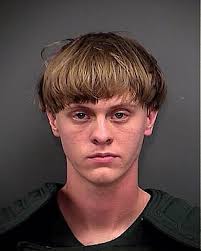
Dylann Roof
The signs of Roof’s malignant racism were evident long before he turned mass murderer:
- He had posed for a photo sitting on the hood of his parents’ car–whose license plate bore a Confederate flag.
- He had posed for pictures wearing a jacket sporting the white supremacist flags of Rhodesia and apartheid South Africa.
- He told a friend that he hoped “to start a civil war” between the black and white races.
- Roof reportedly told friends and neighbors of his plans to kill people.
- In the midst of his massacre of unarmed worshippers, he told one of his victims: “You’ve raped our women, and you are taking over the country.” Then Roof shot him.
The evidence makes clear that Roof’s slaughter was racially motivated. Yet one Republican Presidential candidate after another has refused to acknowledge it.
Jeb Bush, former governor of Florida: “I don’t know what was on the mind or the heart of the man who committed these atrocious crimes.”
Rick Santorum, former United States Senator from Pennsylvania: “You talk about the importance of prayer in this time and we’re now seeing assaults on our religious liberty we’ve never seen before. It’s a time for deeper reflection beyond this horrible situation.”
Bobby Jindal, former governor of Louisiana: “I don’t think we’ll ever know what was going on in his mind.”
But Rolling Stone magazine writer Jeb Lund left no doubt as to what–and who–was ultimately responsible for this crime: Racism and Republicans.
In a June 19, 2015 editorial–published two days after the massacre–Lund noted: “This [crime] is political because American movement conservatism has already made these kinds of killings political.
“The Republican Party has weaponized its supporters, made violence a virtue and, with almost every pronouncement for 50 years, given them an enemy politicized, racialized and indivisible.
“Movement conservatives have fetishized a tendentious and ahistorical reading of the Second Amendment to the point that the Constitution itself somehow paradoxically ‘legitimizes’ an armed insurrection against the government created by it.
“Those leading said insurrection are swaddled by the blanket exculpation of patriotism. At the same time, they have synonymized the Democratic Party with illegitimacy and abuse of the American order.
“This is no longer an argument about whether one party’s beliefs are beneficial or harmful, but an attitude that labels leftism so antithetical to the American idea that empowering it on any level is an act of usurpation.”
Click here: The Charleston Shooter: Racist, Violent, and Yes – Political | Rolling Stone
Lund is absolutely right. And the evidence for this was on display long before Dylann Roof opened fire on “uppity blacks” praying in their own church.
Consider:
On January 8, 2011, Democratic Rep. Gabrielle Giffords was shot in the head while meeting with constituents outside a grocery store in Tucson, Arizona. After a miraculous recovery, she continues to struggle with language and has lost 50% of her vision in both eyes.
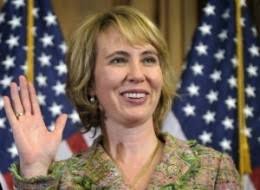
Rep. Gabrielle Giffords
She vowed to return to her former Congressional duties, but was forced to resign for health reasons in 2012.
Giffords was only one victim of a shooting spree that claimed the lives of six people and left 13 others wounded.
Also killed was Arizona’s chief U.S. District judge, John Roll, who had just stopped by to see his friend Giffords after celebrating Mass.
Although the actual shooter, Jared Lee Loughner, was immediately arrested, those who fanned the flames of political violence that consumed 19 people that day have remained unpunished.
Consider the circumstances behind the shootings:
John Roll is Arizona’s chief federal judge. Appointed in 2006, he wins acclaim as a respected jurist and leader who pushes to beef up the court’s strained bench to handle a growing number of border crime-related cases.
In 2009, he becomes a target for threats after allowing a $32 million civil-rights lawsuit by illegal aliens to proceed against a local rancher. The case arouses the fury of local talk radio hosts, who encourage their audiences to threaten Roll’s life.
In one afternoon, Roll logs more than 200 threatening phone calls. Callers threaten the judge and his family. They post personal information about Roll online.
Roll and his wife are placed under fulltime protection by deputy U.S. marshals. Roll finds living under security “unnerving and invasive.”
Authorities identify four men believed responsible for the threats. But Roll declines to press charges on the advice of the Marshals Service.
ABC NEWS, ALTERNET, AMERICABLOG, AP, ATOMIC BOMB, BABY BOOMER RESISTANCE, BARACK OBAMA, BBC, BEIRUT BOMBING, BILL CLINTON, BLOOMBERG, BUZZFEED, CBS NEWS, CHRIS MATTHEWS, CNN, COMMUNISM, CROOKS AND LIARS, CULTS, DAILY KOS, DAILY KOZ, ECONOMICS, FIVETHIRTYEIGHT, GEORGE H.W. BUSH, HARDBALL, HARPER’S MAGAZINE, HUFFINGTON POST, IRAN, IRAN-CONTRA AFFAIR, JOHN F. KENNEDY, JOSEPH STALIN, MEDIA MATTERS, MEET THE PRESS, MOTHER JONES, MOVEON, MSNBC, NBC NEWS, NEW REPUBLIC, NEWSDAY, NEWSWEEK, NPR, PBS NEWSHOUR, POLITICO, POLITICUSUSA, POLLUTION, RAW STORY, REPUBLICAN PARTY, REUTERS, Ronald Reagan, SALON, SEATTLE TIMES, Secret Service, SLATE, SOVIET NUCLEAR PHYSICS, SOVIET UNION, TALKING POINTS MEMO, TAX CUTS, TERRORISM, THE ATLANTIC, THE CHICAGO SUN-TIMES, THE CHICAGO TRIBUNE, THE DAILY BEAST, THE DAILY BLOG, THE GUARDIAN, THE HILL, THE HUFFINGTON POST, THE INTERCEPT, THE LOS ANGELES TIMES, THE NATION, THE NEW REPUBLIC, THE NEW YORK TIMES, THE NEW YORKER, THE VILLAGE VOICE, THE WASHINGTON POST, THINKPROGRESS, THIS WEEK, TIME, TRUTHDIG, TRUTHOUT, TWO POLITICAL JUNKIES, U.S. NEWS & WORLD REPORT, UPI, USA TODAY, Vladimir Lenin, X
In Bureaucracy, Business, History, Military, Politics, Social commentary on May 11, 2016 at 12:01 am
On February 6, 2011, Ronald Reagan, if he had been alive, would have been 100 years old.
Publishers rushed to put out worshipful tributes to his eight years as President. Network political programs such as “This Week” and “Meet the Press” assembled surviving members of his administration to re-live the “glory days” of Reagan’s—and their—time in power.
This is where it all started going wrong for America—a Right-wing legacy of huge Federal deficits, tax-cuts for the rich, bloated military budgets and cutbacks in government programs to aid the poor and middle-class.
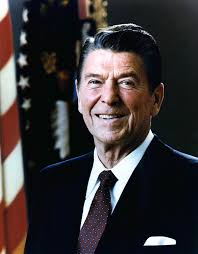
Ronald Reagan
The Republican party, of course, has done the most to create and promote this “cult of Reagan.” And it has done so for the same reason the Communist party of the Soviet Union created and fostered the “cult of Lenin.”
No two men could have been more different than Vladimir Lenin and Ronald Reagan. Lenin created the Soviet Union in 1917 and became its first in a series of absolute dictators. Reagan spent his life fighting Communism, most notably as President.
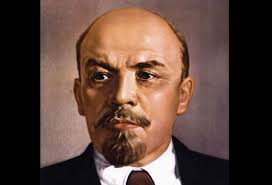
Vladimir Lenin
So it’s ironic that both men, in death, got essentially the same funeral—and for the same reason: To sanctify and legitimize their respective organizations—and the authority of their potential successors.
Lenin died in 1924 and was immediately succeeded by Joseph Stalin. Stalin knew that, despite Communism’s official atheistic stance, most Russians remained loyal to the Russian Orthodox Church.
So in giving Lenin’s funeral oration, Stalin used the language of religion to confer sainthood upon a militant atheist–and upon his successor, Stalin himself.
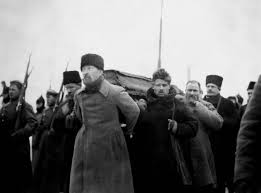
Funeral for Vladimir Lenin
Stalin and his fellow Communists immediately launched the “cult of Lenin,” depicting him as a fatherly, all-wise leader whose genius could only be bestowed upon his closest disciples.
Lenin’s extensive political writings were treated as divine writ, and were used to justify everything Stalin and his own successors wanted to do.
A classic example: Although Lenin died 20 years before the American creation of the atomic bomb, Lenin was hailed by the Soviets as the “father” of “Soviet nuclear physics.”
Similarly, the Republican party wasted no time turning its own former leader, Ronald Reagan, into a modern-day saint of mythical proportions.
They have done so for the same reason that Stalin deliberately forged a cult around the dead Lenin—to create a “holy” figure of whom other Republicans can claim to be true disciples.
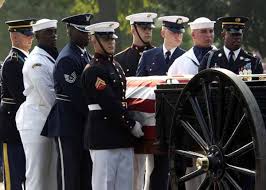
Funeral for Ronald Reagan
These deliberate fictions conveniently ignore a series of ugly truths:
- Reagan was only one of a series of Presidents who held the line against the Soviet Union.
- His budgets were just as stained with red ink as those of all previous Presidents.
- Far from standing up to Iranian terrorists, Reagan sold them our most sophisticated missiles in a weak-kneed exchange for American hostages. Then he went on television and brazenly lied that any such “arms for hostages” deal had ever happened.
- By the end of his term, 138 Reagan administration officials had been investigated, indicted or convicted for official misconduct and/or criminal violations.
- His “trickle-down” Reganomics brought prosperity to only the wealthiest 1% of Americans, proving that “a rising tide lifted some yachts.”
- By drastically shrinking the tax-base, bloating the defense budget and destroying programs to benefit the poor and middle-class, Reagan produced a $1 trillion deficit—which only the Clinton Administration eliminated.
- Reagan believed that government should not help the impoverished. Those who lacked wealth to buy such necessities as housing and medical insurance were written off as unimportant.
- John F. Kennedy had praised government service as an honor. Reagan repeatedly said that “the best and the brightest” could be found only in business.
- This denigration of government service continues among Republicans to this day–defaming the very institutions they lust to control.
- Although he often berated the poor for their “laziness,” Reagan adhered to a “banker’s hours” schedule: During his working hours in the Oval Office, he often had blocks of free time–two to three hours. He would call for his fan mail and answer it.
- Reagan saw no need to protect America’s fragile environment against corporate polluters, eager to enrich themselves at its expense: “Approximately 80% of our air pollution stems from hydrocarbons released by vegetation, so let’s not go overboard in setting and enforcing tough emission standards from man-made sources.”
Reagan famously attacked “welfare queens” and sought to deny government benefits for the poor. But he didn’t hesitate to enrich himself at public expense.
- Before his Presidency ended, 18 wealthy Californians contributed $156,000 apiece to buy him a 7,200 square-foot mansion overlooking Beverly Hills.
- Reagan signed a multi-million dollar deal to write his Presidential memoirs and publish a collection of his speeches.
- He signed an exclusive contract with a Washington lecture bureau, which paid him $50,000 per speech given in the United States and $100,000 overseas. This made him the highest-paid speaker in the country.
- These monies came in addition to his Presidential pension of $99,500 a year for life and his $30,000 annual pension as a former governor of California.
- At a cost to the government of $10 million annually, Reagan—a millionaire who could afford private security—continued to receive lifetime Secret Service protection from 40 fulltime agents.
The “cult of Lenin” died when the Soviet Union collapsed in 1991. The “cult of Reagan” continues to flourish, and will do so for as long as the Republican party finds voters willing to believe in it.
ABC NEWS, ALTERNET, AP, BLACKS, BUZZFEED, CBS NEWS, CNN, CROOKS AND LIARS, DAILY KOZ, DAVID BROOKS, DONALD TRUMP, FACEBOOK, HILLARY CLINTON, JOHN KASICH, JOHN MCCAIN, LATINOS, MOTHER JONES, MOVEON, MSNBC, MUSLIMS, NBC NEWS, NEWSWEEK, NICCOLO MACHIAVELLI, NPR, NUCLEAR TRIAD, PBS NEWSHOUR, POLITICO, PRISONERS OF WAR, RAFAEL CRUZ, RAW STORY, REPUBLICAN PRESIDENTIAL NOMINATION, REUTERS, SALON, SEATTLE TIMES, SLATE, THE ATLANTIC, THE CHICAGO SUN-TIMES, THE CHICAGO TRIBUNE, THE DAILY BEAST, THE DISCOURSES, THE GUARDIAN, THE HILL, THE HUFFINGTON POST, THE LOS ANGELES TIMES, THE NATION, THE NEW YORK TIMES, THE PRINCE, THE WASHINGTON POST, TIME, TWITTER, U.S. NEWS & WORLD REPORT, UPI, USA TODAY, WOMEN
In History, Military, Politics, Social commentary on May 10, 2016 at 12:01 am
Donald Trump is riding high, the almost certain Republican nominee for President when that party holds its convention in Cleveland during the week of July 18.
But Niccolo Machiavelli, the 16th-century Florentine statesmen and father of modern politics, has more than a few timely warnings to offer him–and voters inclined to vote for him.
For openers: Trump has drawn heavy criticism for his angry and brutal attacks on a wide range of persons and organizations–including his fellow Republicans, journalists, news organizations, other countries and even celebrities who have nothing to do with politics.
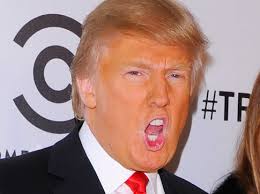
Donald Trump
Now consider Machiavelli’s advice on gratuitously handing out insults and threats:
-
“I hold it to be a proof of great prudence for men to abstain from threats and insulting words towards any one.
-
“For neither the one nor the other in any way diminishes the strength of the enemy–but the one makes him more cautious, and the other increases his hatred of you, and makes him more persevering in his efforts to injure you.”
And Trump’s reaction to the criticism he’s received?
“I can be Presidential, but if I was Presidential I would only have–about 20% of you would be here because it would be boring as hell, I will say,” Trump told supporters at a rally in Superior, Wisconsin.
Trump admitted that his wife, Melania, and daughter, Ivanka, had urged him to be more Presidential. And he promised that he would.
“But I gotta knock off the final two [Republican candidates–Ohio Governor John Kasich and Texas U.S. Senator Rafael Cruz] first, if you don’t mind.”
For those who expect Trump to shed his propensity for constantly picking fights, Machiavelli has a stern warning:
-
“…If it happens that time and circumstances are favorable to one who acts with caution and prudence he will be successful. But if time and circumstances change he will be ruined, because he does not change the mode of his procedure.
-
“No man can be found so prudent as to be able to adopt himself to this, either because he cannot deviate from that to which his nature disposes him, or else because, having always prospered by walking in one path, he cannot persuade himself that it is well to leave it…
-
“For if one could change one’s nature with time and circumstances, fortune would never change.”

Niccolo Machiavelli
Then there is Trump’s approach to consulting advisers:
Asked on MSNBC’s “Morning Joe” who he consults about foreign policy, Trump replied; “I’m speaking with myself, number one, because I have a very good brain and I’ve said a lot of things.”
This totally contrasts the advice given by Machiavelli:
-
“A prudent prince must [choose] for his counsel wise men, and [give] them alone full liberty to speak the truth to him, but only of those things that he asks and of nothing else.
-
“But he must be a great asker about everything and hear their opinions, and afterwards deliberate by himself in his own way, and in these counsels…comport himself so that every one may see that the more freely he speaks, the more he will be acceptable.”
And Machiavelli offers a related warning on the advising of rulers: Unwise princes cannot be wisely advised.
During the fifth GOP debate in the Presidential sweepstakes, host Hugh Hewitt asked Trump this question:
“Mr. Trump, Dr. [Ben] Carson just referenced the single most important job of the president, the command and the care of our nuclear forces. And he mentioned the triad.
“The B-52s are older than I am. The missiles are old. The submarines are aging out. It’s an executive order. It’s a commander-in-chief decision.
“What’s your priority among our nuclear triad?”
[The triad refers to America’s land-, sea- and air-based systems for delivering nuclear missiles and bombs.]

Nuclear missile in silo
Trump’s reply: “Well, first of all, I think we need somebody absolutely that we can trust, who is totally responsible, who really knows what he or she is doing. That is so powerful and so important.”
He then digressed to his having called the Iraq invasion a mistake in 2003 and 2004. Finally he came back on topic:
“But we have to be extremely vigilant and extremely careful when it comes to nuclear.
“Nuclear changes the whole ballgame. The biggest problem we have today is nuclear–nuclear proliferation and having some maniac, having some madman go out and get a nuclear weapon.
“I think to me, nuclear, is just the power, the devastation is very important to me.”
Which brings us back to Machiavelli:
-
“…Some think that a prince who gains the reputation of being prudent [owes this to] the good counselors he has about him; they are undoubtedly deceived.
-
“It is an infallible rule that a prince who is not wise himself cannot be well advised, unless by chance he leaves himself entirely in the hands of one man who rules him in everything, and happens to be a very prudent man. In this case, he may doubtless be well governed, but it would not last long, for the governor would in a short time deprive him of the state.”
All of which would lead Niccolo Machiavelli to warn, if he could witness American politics today: “This bodes ill for your Republic.”
ABC NEWS, ALTERNET, AP, ASIANS, BLACKS, BUZZFEED, CBS NEWS, CNN, CROOKS AND LIARS, DAILY KOZ, DAVID BROOKS, DONALD TRUMP, FACEBOOK, HILLARY CLINTON, JOHN KASICH, JOHN MCCAIN, LATINOS, MOTHER JONES, MOVEON, MSNBC, MUSLIMS, NBC NEWS, NEWSWEEK, NICCOLO MACHIAVELLI, NPR, NUCLEAR TRIAD, PBS NEWSHOUR, POLITICO, PRISONERS OF WAR, RAFAEL CRUZ, RAW STORY, REPUBLICAN PRESIDENTIAL NOMINATION, REUTERS, SALON, SEATTLE TIMES, SLATE, THE ATLANTIC, THE CHICAGO SUN-TIMES, THE CHICAGO TRIBUNE, THE DAILY BEAST, THE DISCOURSES, THE GUARDIAN, THE HILL, THE HUFFINGTON POST, THE LOS ANGELES TIMES, THE NATION, THE NEW YORK TIMES, THE PRINCE, THE WASHINGTON POST, TIME, TWITTER, U.S. NEWS & WORLD REPORT, UPI, USA TODAY, USA TODAY DONALD TRUMP, WOMEN
In History, Military, Politics, Social commentary on May 9, 2016 at 12:37 am
Donald Trump has swept the field of his political rivals. The Republican nomination for President now stands within his reach.
The “Anybody-But-Trump” coalition no longer has a champion. Its last two–Ohio Governor John Kasich and Texas U.S. Senator Rafael Cruz–have bowed out of the race.
On May 3, Trump captured 53.3% of the votes in the Indiana primary, compared to 36.7% for Cruz and 7.5% for Kasich.
That night, Cruz threw in the towel.
“Together we left it all on the field in Indiana,” Cruz told his disappointed supporters in Indianapolis. “We gave it everything we’ve got. But the voters chose another path.”
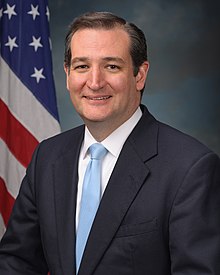
Rafael “Ted” Cruz
The next day–May 4–so did Kasich, the only candidate who had dared compare Trump to Adolf Hitler.
All that Trump need do, from here on, is wait until the Republican convention assembles in Cleveland during the week of July 18.
Even so, Trump gets poor marks as a man and a candidate from many of his fellow conservatives.
One of these is New York Times political columnist David Brooks.

David Brooks
Appearing on the May 25 edition of The PBS Newshour, Brooks offered some highly disturbing assessments about the man who seeks to control the most powerful nation in the world.
- “The odd thing about [Trump’s] whole career and his whole language, his whole world view is there is no room for love in it. You get a sense of a man who has received no love, can give no love, so his relationship with women, it has no love in it. It’s trophy.”
- “And [Trump’s] relationship toward the world is one of competition and beating, and as if he’s going to win by competition what other people get by love.”
- “And so you really are seeing someone who just has an odd psychology unleavened by kindness and charity, but where it’s all winners and losers, beating and being beat. And that’s part of the authoritarian personality….”
An even more damning assessment comes from Niccolo Machiavelli, the 16th-century Florentine statesman whose two great works on politics–The Prince and The Discourses–remain textbooks for successful politicians more than 500 years later.
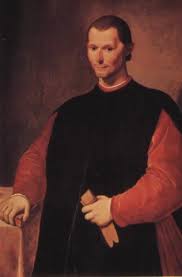
Niccolo Machiavelli
Consider Trump’s notoriety for hurling insults at virtually everyone, including:
- Latinos
- Asians
- Muslims
- Blacks
- The Disabled
- Women
- Prisoners-of-War
These insults delight his white, under-educated followers. But they have alienated millions of other Americans who might have voted for him.
Among those groups–and the insults Trump has leveled at them:
- Mexicans: “They’re bringing drugs. They’re bringing crime. They’re rapists.” He’s also promised to “build a great, great wall on our southern border and I will have Mexico pay for that wall.”
- Prisoners-of-War: Speaking of Arizona U.S. Senator John McCain, a Vietnam POW for seven years: “He’s not a war hero. He’s a war hero because he was captured. I like people that weren’t captured.”
- Blacks: At a Trump rally in Birmingham, Alabama, he was interrupted by black activist Mercutio Southall, who repeatedly shouted: “Black lives matter!” Trump ordered his removal, and several of his supporters beat and kicked Southall. Later, Trump said: “Maybe he should have been roughed up, because it was absolutely disgusting what he was doing.”
- Trump retweeted an image of a masked, dark-skinned man with a handgun and a series of alleged crime statistics, including: “Blacks killed by whites – 2%”; “Whites killed by blacks – 81%.” The image cites the “Crime Statistics Bureau – San Francisco”–an agency that doesn’t exist.
- Muslims: Trump has boasted he would require Muslims to register with the Federal Government. And he would close “some mosques” if he felt they were being used by Islamic terrorists.
- Women: “If Hillary Clinton can’t satisfy her husband, what makes her think she can satisfy America?”
- “Twenty-six thousand unreported sexual assaults in the military–only 238 convictions. What did these geniuses expect when they put men and women together?”
- Asians: “Negotiating with Japan, negotiating with China, when these people walk into the room, they don’t say, ‘Oh hello, how’s the weather? So beautiful outside, isn’t it lovely? How are the Yankees doing? Oh, they are doing wonderful, great.’ They say, ‘We want deal!’”
Machiavelli, on the other hand, advises leaders to refrain from gratuitous insults:
- “It is not necessary for a prince to have all the above-named qualities [mercy, faith, humanity, integrity and religion] but it is very necessary to seem to have them….”
- “A prince must take care that nothing goes out of his mouth which is not full of the above-named five qualities, and he should seem to be all mercy, faith, integrity, humanity and religion.”
- “And nothing is more necessary than to seem to have this last quality, for men in general judge more by the eyes than by the hands, for every one can see, but very few have to feel. Everyone seems what you appear to be, few feel what you are….”
- “…[The Roman Emperor Commodus]…by not maintaining his dignity, by often descending into the theater to fight with gladiators and committing other contemptible actions…became despicable in the eyes of the soldiers. And being hated on the one hand and despised on the other, he was conspired against and killed.”
2016 PRESIDENTIAL CAMPAIGN, ABC NEWS, ADOLF HITLER, CBS NEWS, CLAUS VON STAUFFENBERG, CNN, DAVID BROOKS, DONALD TRUMP, FACEBOOK, HOLOCAUST, JOHN KASICH, MARTIN NIEMOELLER, MSNBC, NAZI GERMANY, NBC NEWS, PBS NEWSHOUR, RAFAEL "TED" CRUZ, ROBERT PAYNE, SOVIET UNION, THE CHICAGO SUN-TIMES, THE CHICAGO TRIBUNE, THE LIFE AND DEATH OF ADOLF HITLER, THE LOS ANGELES TIMES, THE NEW YORK TIMES, TWITTER, WORLD WAR 11
In Bureaucracy, History, Military, Politics, Social commentary on May 6, 2016 at 12:05 am
On July 20, 1944, Colonel Claus Shenk von Stauffenberg appeared at Hitler’s well-guarded military headquarters in East Prussia. Like all his other outposts, Hitler had named it–appropriately enough–“Wolf’s Lair.”

“Wolf’s Lair”
Stauffenberg entered the large, concrete building while the conference was in session. He placed his yellow briefcase next to Hitler–who was standing with his generals at a heavy oaken table.
Then Stauffenberg excused himself to take an “urgent” phone call.
At 12:42 p.m. on July 20, 1944, Stauffenberg’s briefcase bomb erupted.
But the Third Reich didn’t come to an end–because, as if miraculously, Hitler had survived.

Hitler shows off the site of the explosion
What had happened?
First, the conference location had been changed–from a wooden building to a concrete one. The concrete absorbed much of the blast.
Second, owing to the summer’s heat, Hitler had ordered all the windows–about ten–opened to let in a breeze. This allowed much of the force of the blast to be dispersed.
Third, and perhaps most important: Stauffenberg had carefully placed his briefcase near Hitler, who was standing next to a heavy oaken support of the conference table.
But after Stauffenberg left the room, Colonel Heinz Brandt, who stood next to Hitler, found the briefcase blocking his legs. So he moved it–to the other side of the heavy oaken support.
When the bomb exploded, Hitler was partially shielded from its full blast. Brandt died, as did two other officers and a stenographer.
Not only did Hitler survive, but the plotters failed to seize the key broadcast facilities of the Reich.
This allowed Hitler to make a late-night speech to the nation, revealing the failed plot and assuring Germans that he was alive. And he swore to flush out the “traitorous swine” who had tried to kill him.
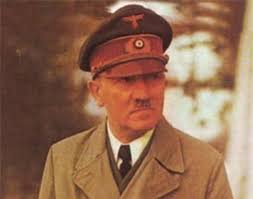
Adolf Hitler
Mass arrests quickly followed. Among the first victims discovered and executed was the conspiracy’s leader, Colonel Claus von Stauffenberg. Standing before a makeshift firing squad at midnight, he cried: “Long live our sacred Germany!”
At least 7,000 persons were arrested by the Gestapo–of which 4,980 were executed.
Had the conspiracy succeeded, history would have turned out differently:
Thus, history can be altered by the appearance or disappearance of a single individual.
Which brings us back to Donald Trump.

Donald Trump
Since declaring his candidacy for the Presidency on June 16, 2015, Trump has been the first choice among the Republican base.
At first, he was dismissed as a bad joke–by Republican Presidential candidates as well as by Democrats.
Surely voters would reject a bombastic, thrice-married “reality show” host who had filed for corporate bankruptcy four times.
Yet from the outset Trump dominated the field–and a series of Republican debates. The other Republican candidates watched him with envy–and tried to out-do his hate-filled rhetoric and agenda.
But none of them succeeded–and, one after another, they dropped out of the race: Marco Rubio, Ben Carson, Jeb Bush, Chris Christie, Rick Santorum, Carly Fiorina, Mike Huckabee, Rand Paul.
Eventually, only two were left to deny Trump the Republican nomination–Texas U.S. Senator Rafael “Ted” Cruz and Ohio Governor John Kasich.
On May 3, 2016, Trump captured 53.3% of the votes in the Indiana primary, compared to 36.7% for Cruz and 7.5% for Kasich.
That night, Cruz bowed out of the race. The next day, so did Kasich–the man who had dared compare Trump to Adolf Hitler.
For conservative columnist David Brooks, a Trump Presidency would be disastrous. On the March 25 edition of the PBS Newshour, he offered this assessment of Trump’s character:
“The odd thing about [Trump’s] whole career and his whole language, his whole world view is there is no room for love in it. You get a sense of a man who received no love, can give no love, so his relationship with women, it has no love in it. It’s trophy.
“And so you really are seeing someone who just has an odd psychology unleavened by kindness and charity, but where it’s all winners and losers, beating and being beat. And that’s part of the authoritarian personality.”
In his bestselling 1973 biography, The Life and Death of Adolf Hitler, British historian Robert Payne harshly condemned the “Army bomb plot” conspirators who failed to kill Hitler:
“The conspirators died heroically, but they were not heroes. They bungled the most necessary assassination of their time when it was within their power to do the job well….They were amateurs when professionals were needed.”
There is a very real danger that Donald Trump will assume the Presidency–and all the awesome power that goes with that office.
If that happens, future historians–if there are any–may similarly condemn those Americans who stood by like “good Germans”–and allowed their country to fall into the hands of a ruthless tyrant.
2016 PRESIDENTIAL CAMPAIGN, ABC NEWS, ADOLF HITLER, CBS NEWS, CLAUS VON STAUFFENBERG, CNN, DAVID BROOKS, DONALD TRUMP, FACEBOOK, HOLOCAUST, JOHN KASICH, MARTIN NIEMOELLER, MSNBC, NAZI GERMANY, NBC NEWS, PBS NEWSHOUR, RAFAEL "TED" CRUZ, ROBERT PAYNE, SOVIET UNION, THE CHICAGO SUN-TIMES, THE CHICAGO TRIBUNE, THE LIFE AND DEATH OF ADOLF HITLER, THE LOS ANGELES TIMES, THE NEW YORK TIMES, THE WALL STREET JOURNAL, TWITTER, WORLD WAR 11
In Bureaucracy, History, Military, Politics, Social commentary on May 5, 2016 at 11:49 am
The ad opened with ominous music–and the face of a snarling Donald Trump.
“I would like anyone who is listening to consider some thoughts that I’ve paraphrased from the words of German pastor Martin Niemoeller.”
The voice belonged to Tom Moe, a retired colonel in the U.S. Air Force–and a former Vietnam prisoner-of-war.
It was a video produced by the 2016 Presidential campaign for John Kasich, the governor of Ohio. He had been peddling a message of creating jobs, balancing the Federal budget and disdain for Washington, D.C.
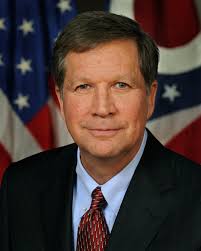
John Kasich
But he remained far behind in the polls. Meanwhile, Trump, the New York billionaire developer, was backed by increasingly large numbers of Republican primary voters.
So, with nothing to lose, Kasich decided to take off the gloves.
“You might not care if Donald Trump says Muslims must register with the government, because you’re not one,” continued Moe.
“And you might not care if Donald Trump says he’s going to round up all the Hispanic immigrants, because you’re not one.
Donald Trump
“And you might not care if Donald Trump says it’s OK to rough up black protesters, because you’re not one.
“And you might not care of Donald Trump wants to suppress journalists, because you’re not one.
“But think about this:
“If he keeps going, and he actually becomes President, he might just get around to you. And you’d better hope that there’s someone left to help you.”
The above is indeed a paraphrase of a famous quote by Martin Niemoeller (1892–1984), a prominent Protestant pastor. Although he had been a U-boat commander during World War 1, he became a bitter public foe of Adolf Hitler.
A staunch anti-Communist, he had initially supported the Nazis as Germany’s only hope of salvation against the Soviet Union. But when the Nazis made the church subordinate to State authority, Niemoeller created the Pastors’ Emergency League to defend religious freedom.
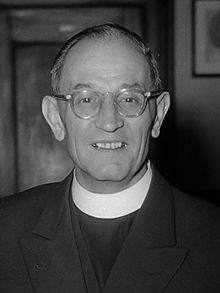
Martin Niemoeller
For his opposition to the Third Reich, Niemoeller spent seven years in concentration camps. With the collapse of the Reich in 1945, he was freed–and elected President of the Protestant church in Hesse and Nassau in 1947.
During the 1960s, he was a president of the World Council of Churches.
He is best remembered for his powerful condemnation of the failure of Germans to protest the increasing oppression of the Nazis:
First they came for the Communists, but I was not a Communist, so I did not speak out.
Then they came for the Socialists, but I was not a Socialist, so I did not speak out.
Then they came for the trade unionists, but I was not a trade unionist, so I did not speak out.
Then they came for the Jews, but I was not a Jew, so I did not speak out.
And when they came for me, there was no one left to speak out for me.
Neither “Adolf Hitler” nor “Nazi Party” was mentioned during the one-minute Kassich video. But it infuriated Trump, who threatened to sue Kasich if he found anything “not truthful” in the ad.
The Kasich ad was the darkest attack made against Trump by any candidate–Republican or Democrat. And it raises a disturbing question:
If Donald Trump is America’s Adolf Hitler, who will be its Claus von Stauffenberg?
Colonel Claus Schenk von Stuaffenberg was the German army officer who, on July 20, 1944, tried to assassinate Adolf Hitler.
He had served with the Wehrmacht in Poland (1939), France (1940) and the Soviet Union (1941).
While serving in Tunisa, he was seriously wounded on April 7, 1943 when Allied fighters strafed his vehicle. He lost his left eye, right hand and two fingers of his left hand after surgery.
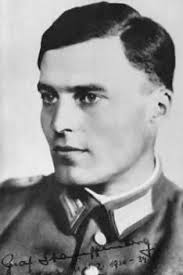
Colonel Claus Schenk von Stuaffenberg
Nevertheless, he now acted as the prime mover for the conspiracy among a growing number of German high command officers to arrest or assassinate Germany’s Fuehrer.
His reason: His disgust at the horrors he had seen committed by his fellow Wehrmacht soldiers upon defenseless POW’s and civilians in Russia.
Something must be done, he believed, to prove to the world that not all Germans–even members of the Wehrmacht–were criminals.
Stauffenberg wanted Hitler dead. A live Fuehrer might eventually be rescued by his Nazi colleagues.
But–how to do it?
Hitler was a closely-guarded target. He was surrounded by fanatical bodyguards who were expert marksmen. He often wore a bulletproof vest and a cap lined with three pounds of laminated steel.
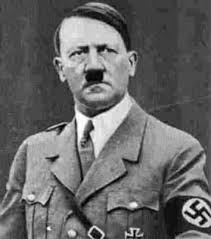
Adolf Hitler
Several attempts had already been made on Hitler’s life–all of them with time-bombs. But one of the bombs–smuggled onto Hitler’s plane–hadn’t exploded. Another bomb had–45 minutes after Hitler left the beer hall where he had been making a speech.
Stauffenberg decided to carry his bomb–hidden in a briefcase–into a “Hitler conference” packed with military officers.
But Stauffenberg didn’t intend to be a suicide bomber. He intended to direct the government that would replace that of the Nazis. He would plant his time-bomb in the conference room–and find an excuse to leave.
Then, the coup–“Operation Valkyrie”–would be on.
Anti-Nazi conspirators would seize control of key posts of the government. The British and Americans would then be informed of Germany’s willingness to surrender.
ABC NEWS, CBS NEWS, CELLPHONE CAMERAS, CNN, DRUG ENFORCEMENT ADMINISTRATION, ENCRYPTION SYSTEMS, FACEBOOK, FBI, JAMES B. COMEY, MAFIA, MIKE BROWN, MSNBC, NBC NEWS, POLICE BRUTALITY, SURVEILLANCE, THE CHICAGO SUN-TIMES, THE CHICAGO TRIBUNE, THE LOS ANGELES TIMES, THE NEW YORK TIMES, THE WASHINGTON POST, TWITTER, UNIVERSITY OF CHICAGO LAW SCHOOL, WALTER SCOTT, YOUTUBE
In Bureaucracy, History, Law, Law Enforcement, Social commentary on May 4, 2016 at 4:09 pm
For decades, Americans have been told by police at local and Federal levels: If you have nothing to hide, you shouldn’t worry about giving up your privacy.
The FBI, for example, has lobbied Congress for an electronic “key” that would allow it to enter a cyber “back door” to eavesdrop on even those emails protected by encryption systems.
Of course, the FBI has long found ways to circumvent the efforts of criminals to remain anonymous.
Decades ago, Mafiosi learned to assume their phones were being wiretapped and their rooms bugged with hidden microphones by agents of the FBI or the Drug Enforcement Administration (DEA).
And law-abiding Americans have grown used to being under camera surveillance every time they enter a bank, a State or Federal agency, a drugstore or supermarket. Or even walking down a street.
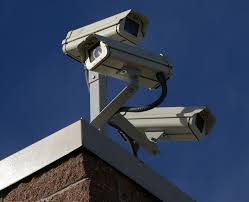
So it must seem ironic–if not downright hypocritical–to such people when police complain that their privacy is being invaded.
And this “invasion” isn’t happening with taps placed on cops’ phones or bugs planted in their police stations or private homes.
No, this “invasion” is happening openly in public–with video cameras and cellphones equipped with cameras.
And it’s happening in direct response to a series of controversial incidents involving the use of deadly force by police.
The most famous of these was the shooting, in August, 2014, of strong-arm grocery store robber Mike Brown in Ferguson, Missouri. Ironically, this was not captured on video.
But a number of other incidents were. Among them:
- The shooting of Walter Scott, a black motorist, on April 4, 2015. Scott was stopped for a non-working third tail light. When North Charleston Police Officer Michael Slager returned to his patrol car, Scott exited his car and fled. Slager gave chase, firing first a Taser and then his pistol. He hit Scott five times–all from behind. Slager later claimed he had “felt threatened.” Unluckily for him, the shooting was caught on a citizen’s cellphone camera. On June 6, a grand jury indicted Slager on a charge or murder.
- On April 9, 2015, San Bernaradino sheriff’s deputies, after an exhaustive chase, kicked Francis Pusok twice–including a kick to the groin–as he lay facedown on the ground with his hands behind his back. About five minutes after Pusok was handcuffed, hobbled and rolled onto his side, another deputy also kicked him. Three deputies have been charged with felony assault. The footage of this came from an NBC News helicopter.
- In February, 2015, Orlando police officer William Escobar was fired after cell phone footage emerged of him punching and kicking a handcuffed man.
Addressing a forum at the University of Chicago Law School on October 23, FBI Director James B. Comey spoke of rising crime rates in America. And he offered a series of possible reasons for it.
Click here: FBI — Law Enforcement and the Communities We Serve: Bending the Lines Toward Safety and Justice
“Maybe it’s the return of violent offenders after serving jail terms. Maybe it’s cheap heroin or synthetic drugs. Maybe after we busted up the large gangs, smaller groups are now fighting for turf.
“Maybe it’s a change in the justice system’s approach to bail or charging or sentencing. Maybe something has changed with respect to the availability of guns….”
Then Comey offered what he thought was the real villain behind the rise in crime: Cellphones aimed at police.

FBI Director James B. Comey
“But I’ve also heard another explanation, in conversations all over the country. Nobody says it on the record, nobody says it in public, but police and elected officials are quietly saying it to themselves. And they’re saying it to me, and I’m going to say it to you….
“In today’s YouTube world, are officers reluctant to get out of their cars and do the work that controls violent crime? Are officers answering 911 calls but avoiding the informal contact that keeps bad guys from standing around, especially with guns?
“I spoke to officers privately in one big city precinct who described being surrounded by young people with mobile phone cameras held high, taunting them the moment they get out of their cars. They told me, ‘We feel like we’re under siege and we don’t feel much like getting out of our cars.’
“I’ve been told about a senior police leader who urged his force to remember that their political leadership has no tolerance for a viral video.
“So the suggestion, the question that has been asked of me, is whether these kinds of things are changing police behavior all over the country.
“And the answer is, I don’t know. I don’t know whether this explains it entirely, but I do have a strong sense that some part of the explanation is a chill wind blowing through American law enforcement over the last year. And that wind is surely changing behavior.”
Apparently, it’s OK for police to aim cameras–openly or concealed–at citizens, whether law-abiding or law-breaking.
But if citizens aim cameras at cops–even without interfering with their making arrests–police feel threatened, to the point of refusing to carry out their duties.
ABC NEWS, AFGHANISTAN, ANCHOR BABIES, BARACK OBAMA, BERLIN AIRLIFT, CBS NEWS, CNN, DEMOCRATIC PARTY, DEPARTMENT OF HOMELAND SECURITY, EGYPT, FACEBOOK, FRANCISCO SANCHEZ, ILLEGAL ALIENS, illegal immigration, IRAQ, MEXICO, NBC NEWS, OPERATION NICKEL GRASS, RACIAL PROFILING, Racketeer Influenced Corrupt Organizations (RICO) Act, REPUBLICAN PARTY, RICHARD NIXON, SAN FRANCISCO, sanctuary cities, SOVIET UNION, SYRIA, THE CHICAGO SUN-TIMES, THE CHICAGO TRIBUNE, THE LOS ANGELES TIMES, THE NEW YORK TIMES, THE OUTER LIMITS, THE WASHINGTON POST, TWITTER, WAL-MART, YOM KIPPUR WAR
In Bureaucracy, Business, History, Law, Law Enforcement, Military, Politics, Social commentary on May 3, 2016 at 12:08 am
Most of America’s 11 to 20 million illegal aliens come from neighboring Hispanic countries. Which means that as soon as they are deported, most of them cross the Mexican border again.
Case in point: Francisco Sanchez, now accused of shooting a woman on a San Francisco pier. With a history of seven felony convictions, he’s been deported to his native Mexico five times, most recently in 2009.
Click here: Report: Most Illegal Immigrants Come From Mexico – US News
More importantly: The governments of those Central and South American countries use the United States as a dumping ground–of those citizens who might demand reforms in their political and economic institutions.

Among the approaches that could strike a meaningful blow against illegal immigration is one that might well be called “The Zanti Option.”
Viewers of the 1960s sci-fi series,The Outer Limits, will vividly recall its classic 1963 episode, “The Zanti Misfits.”
In this, soldiers at an American Army base in a California ghost town nervously await first-contact with an alien race that has landed a space ship nearby.
The soldiers are warned to steer clear of the ship, and they do. But then an escaped convict (Bruce Dern, in an early role) happens upon the scene–-and the ship.
The Zantis, enraged, emerge–and soon the soldiers at the military base find themselves under attack.

A “Zanti”
The soldiers desperately fight back–-with flamethrowers, machineguns or just rifle butts. Finally the soldiers win, wiping out the Zantis.
But now the base–-and probably America–-faces a wholesale invasion from the planet Zanti to avenge the deaths of their comrades.
So the soldiers wait anxiously for their next transmission from Zanti–-which soon arrives.
To their surprise–-and relief–-it’s a message of thanks: “We will not retaliate. We never intended to. We knew that you could not live with such aliens in your midst.
“It was always our intention that you destroy them…We are incapable of executing our own species, but you are not. You are practiced executioners. We thank you.”
A future Republican President could deal with the tsunami of illegal aliens by launching what might be called “Operation Zanti.”
Rather than deport them to nearby countries–from which they would easily sneak back into the United States–-the Federal Government could ship them off to more distant lands.
Like Afghanistan. Or Iraq. Or Syria.
It’s unlikely they will sneak back across the American border from the Middle East.
Such a policy change would:
- Close the Mexican revolving door, which keeps illegal immigration flowing; and
- Send an unmistakably blunt message to other would-be illegals: “The same fate awaits you.”
Although this might seem a far-fetched proposal, it could be easily carried out by the United States Air Force.
According to this agency’s website: “The C-5 Galaxy is one of the largest aircraft in the world and the largest airlifter in the Air Force inventory.
“The C-5 has a greater capacity than any other airlifter. It [can] carry 36 standard pallets and 81 troops simultaneously.

C-5 transport plane
“[It can also carry] any of the Army’s air-transportable combat equipment, including such bulky items as the 74-ton mobile scissors bridge.
“It can also carry outsize and oversize cargo over intercontinental ranges and can take off or land in relatively short distances.”
Click here: C-5 A/B/C Galaxy and C-5M Super Galaxy > U.S. Air Force > Fact Sheet Display
Instead of stuffing these planes with cargo, they could be stuffed wall-to-wall with illegal aliens.
The United States Air Force has a proud history of successfully providing America’s soldiers–-and allies–-with the supplies they need.
From June 24, 1948 to May 12, 1949, only the Berlin Airlift stood between German citizens and starvation.
The Soviet Union had blocked the railway, road, and canal access to the Berlin sectors under allied control. Their goal: Force the western powers to allow the Soviet zone to supply Berlin with food, fuel, and aid.
This would have given the Soviets control over the entire city.
Air forces from the United States, England, Canada, Australia, New Zealand and South Africa flew over 200,000 flights in one year, dropping more than 4,700 tons of necessities daily to the besiged Berliners.
The success of the Berlin Airlift raised American prestige and embarrassed the Soviets, who lifted the blockade.

The Berlin Airlift
A similar triumph came during the Yom Kippur War after Egypt and Syria attacked Israel without warning on October 6, 1973.
A Watergate-embattled President Richard Nixon ordered “Operation Nickel Grass” to deliver urgently-needed weapons and supplies to Israel.
For 32 days, the Air Force shipped 22,325 tons of ammunition, artillery, tanks and other supplies. These proved invaluable in saving Israel from destruction.
So the mass deportation of millions of illegal aliens lies within America’s technological capability. Whether any American President would be willing to give that order is another matter.


.jpg)


 Bureaucracybuster's Blog
ABC NEWS, ADOLF HITLER, AL QAEDA, ANN COULTER, ARIZONA SHOOTINGS, ASSASSINATION, BARACK OBAMA, BILL CLINTON, BILL O'REILLY, BIRTHERS, BOBBY JINDAL, CBS NEWS, CHRISTINA-TAYLOR GREEN, CNN, COMMUNISM, CONFEDERATE FLAG, CRIME, DYLANN ROOF, FACEBOOK, FBI, GABRIELLE GIFFORDS, GEORGE H.W. BUSH, GEORGE W. BUSH, GLENN BECK, HATE GROUPS, HEALTHCARE, JEB BUSH, JOSEPH MCCARTHY, MEIN KAMPF, MICHELLE BACHMANN, NBC NEWS, NEWT GINGRICH, OBAMACARE, RICHARD NIXON, RICK PERRY, RICK SANTORUM, RODNEY KING RIOTS, ROLLING STONE, RUSH LIMBAUGH, Sarah Palin, SEAN HANNITY, Secret Service, SOVIET UNION, SPIRO AGNEW, TEA PARTY, THE CHICAGO SUN-TIMES, THE CHICAGO TRIBUNE, THE LOS ANGELES TIMES, THE NEW YORK TIMES, THE WASHINGTON POST, TWITTER, U.S. DISTRICT JUDGE JOHN ROLL, U.S. MARSHALS SERVICE, WHITE SUPREMACISTS
REPUBLICANS AND WEAPONIZED HATRED: PART THREE (OF FOUR)
In Bureaucracy, History, Law, Law Enforcement, Politics, Social commentary on May 16, 2016 at 12:01 amThe electoral success of Senator Joseph McCarthy’s Red-baiting treason slanders proved too alluring for other Republicans to resist.
Joseph McCarthy
Among those who have greatly profited from hurling similar charges are:
During the 1992 Presidential campaign, Republicans tried to paint Bill Clinton as a brainwashed “Manchurian candidate” because he had briefly visited the Soviet Union during his college years.
After the Soviet Union collapsed in 1991, Republicans lost their “soft on Communism” slander-line. So they tried to persuade voters that Democrats were “soft on crime.”
When riots flared in 1992 after the acquittal of LAPD officers who had savagely beaten Rodney King, President George H.W. Bush blamed the carnage on the “Great Society” programs of the 1960s.
George H.W. Bush
After losing the White House to Clinton at the polls in 1992 and 1996, Republicans tried to oust him another way: By impeaching him over a tryst with a penis-loving intern named Monica Lewinsky.
The Republican-controlled House of Representatives voted to impeach, but the effort was defeated in the Democratically-controlled Senate.
The 2008 election of Barack Obama pushed the Republican “treason chorus” to new heights of infamy.
Barack Obama
Almost immediately after Obama took office, he came under attack by an industry of Right-wing book authors such as Sean Hannity, Ann Coulter and Rush Limbaugh.
The following titles vividly reveal the hates, fears and ambitions of their authors–and audience:
Consider the vocabulary Right-wingers use to describe their political adversaries:
“Liberals,” “radicals, “bankrupting,” “treason,” subversion,” “slander,” “terrorism,” “betrayal,” “catastrophe,” “shattering the American dream,” “leftists,” “Communists,” “government takeover,” “socialism,” “power grab,” “secularism,” “environmentalism.”
And while the Right lusts to constantly compare Obama to Adolf Hitler, its propaganda campaign draws heavily on the Nazi leader’s own advice.
In Mein Kampf, Hitler laid out his formula for successful propaganda: “All effective propaganda must be confined to a few bare essentials.
“Those must be expressed as far as possible in stereotypical formulas. These slogans should be persistently repeated until the very last individual has come to grasp the idea that has been put forward.”
Among the lies most “persistently repeated” by Republicans about Obama:
Obama isn’t an American citizen. The reason: To “prove” that he is an illegitimate President, and should be removed from office.
Even the President’s releasing of the long-form version of his birth certificate in 2011–showing that he was born in Hawaii, not Kenya–didn’t end these falsehoods.
The long-form version of President Obama’s birth certificate
Oaama is a secret Muslim who intends to betray America to his Islamic masters.
In fact, Obama has eliminated far more Al Qaeda leaders than George W. Bush ever did–including the most sought-after one of all: Osama bin Laden.
Share this: