bureaucracybusters

Posts Tagged ‘2016 PRESIDENTIAL CAMPAIGN’

A PLEA FOR CONSCIENCE: PART TWO (END)

In Bureaucracy, History, Military, Politics, Social commentary on May 6, 2016 at 12:05 am

On July 20, 1944, Colonel Claus Shenk von Stauffenberg appeared at Hitler’s well-guarded military headquarters in East Prussia.  Like all his other outposts, Hitler had named it–appropriately enough–“Wolf’s Lair.”

“Wolf’s Lair”

Stauffenberg entered the large, concrete building while the conference was in session.  He placed his yellow briefcase next to Hitler–who was standing with his generals at a heavy oaken table.

Then Stauffenberg excused himself to take an “urgent” phone call.

At 12:42 p.m. on July 20, 1944, Stauffenberg’s briefcase bomb erupted.

But the Third Reich didn’t come to an end–because, as if miraculously, Hitler had survived.

Hitler shows off the site of the explosion

What had happened?

First, the conference location had been changed–from a wooden building to a concrete one.  The concrete absorbed much of the blast.

Second, owing to the summer’s heat, Hitler had ordered all the windows–about ten–opened to let in a breeze.  This allowed much of the force of the blast to be dispersed.

Third, and perhaps most important: Stauffenberg had carefully placed his briefcase near Hitler, who was standing next to a heavy oaken support of the conference table.

But after Stauffenberg left the room, Colonel Heinz Brandt, who stood next to Hitler, found the briefcase blocking his legs.  So he moved it–to the other side of the heavy oaken support.

When the bomb exploded, Hitler was partially shielded from its full blast.  Brandt died, as did two other officers and a stenographer.

Not only did Hitler survive, but the plotters failed to seize the key broadcast facilities of the Reich.

This allowed Hitler to make a late-night speech to the nation, revealing the failed plot and assuring Germans that he was alive. And he swore to flush out the “traitorous swine” who had tried to kill him.

Adolf Hitler

Mass arrests quickly followed.  Among the first victims discovered and executed was the conspiracy’s leader, Colonel Claus von Stauffenberg.  Standing before a makeshift firing squad at midnight, he cried: “Long live our sacred Germany!”

At least 7,000 persons were arrested by the Gestapo–of which 4,980 were executed.

Had the conspiracy succeeded, history would have turned out differently:

  • If Germany had surrendered in July or August, 1944, World War II would have ended eight to nine months earlier.
  • The Russians–who didn’t reach Germany until April, 1945–could not have occupied the Eastern part of the country.
  • This would have prevented many of the future conflicts between the United States and the Soviet Union over access to West Berlin and/or West Germany.
  • Untold numbers of Holocaust victims would have survived because the extermination camps would have been shut down.

Thus, history can be altered by the appearance or disappearance of a single individual.

Which brings us back to Donald Trump.

Donald Trump Pentagon 2017.jpg

Donald Trump

Since declaring his candidacy for the Presidency on June 16, 2015, Trump has been the first choice among the Republican base.

At first, he was dismissed as a bad joke–by Republican Presidential candidates as well as by Democrats.

Surely voters would reject a bombastic, thrice-married “reality show” host who had filed for corporate bankruptcy four times.

Yet from the outset Trump dominated the field–and a series of Republican debates. The other Republican candidates watched him with envy–and tried to out-do his hate-filled rhetoric and agenda.  

But none of them succeeded–and, one after another, they dropped out of the race: Marco Rubio, Ben Carson, Jeb Bush, Chris Christie, Rick Santorum, Carly Fiorina, Mike Huckabee, Rand Paul.  

Eventually, only two were left to deny Trump the Republican nomination–Texas U.S. Senator Rafael “Ted” Cruz and Ohio Governor John Kasich.  

On May 3, 2016, Trump captured 53.3% of the votes in the Indiana primary, compared to 36.7% for Cruz and 7.5% for Kasich.

That night, Cruz bowed out of the race. The next day, so did Kasich–the man who had dared compare Trump to Adolf Hitler.  

For conservative columnist David Brooks, a Trump Presidency would be disastrous. On the March 25 edition of the PBS Newshour, he offered this assessment of Trump’s character: 

“The odd thing about [Trump’s] whole career and his whole language, his whole world view is there is no room for love in it. You get a sense of a man who received no love, can give no love, so his relationship with women, it has no love in it. It’s trophy.  

And so you really are seeing someone who just has an odd psychology unleavened by kindness and charity, but where it’s all winners and losers, beating and being beat. And that’s part of the authoritarian personality.”

In his bestselling 1973 biography, The Life and Death of Adolf Hitler, British historian Robert Payne harshly condemned the “Army bomb plot” conspirators who failed to kill Hitler:  

“The conspirators died heroically, but they were not heroes. They bungled the most necessary assassination of their time when it was within their power to do the job well….They were amateurs when professionals were needed.”

There is a very real danger that Donald Trump will assume the Presidency–and all the awesome power that goes with that office.  

If that happens, future historians–if there are any–may similarly condemn those Americans who stood by like “good Germans”–and allowed their country to fall into the hands of a ruthless tyrant.

A PLEA FOR CONSCIENCE: PART ONE (OF TWO)

In Bureaucracy, History, Military, Politics, Social commentary on May 5, 2016 at 11:49 am

The ad opened with ominous music–and the face of a snarling Donald Trump.

“I would like anyone who is listening to consider some thoughts that I’ve paraphrased from the words of German pastor Martin Niemoeller.”

The voice belonged to Tom Moe, a retired colonel in the U.S. Air Force–and a former Vietnam prisoner-of-war.

It was a video produced by the 2016 Presidential campaign for John Kasich, the governor of Ohio. He had been peddling a message of creating jobs, balancing the Federal budget and disdain for Washington, D.C.

Related image

John Kasich

But he remained far behind in the polls. Meanwhile, Trump, the New York billionaire developer, was backed by increasingly large numbers of Republican primary voters.

So, with nothing to lose, Kasich decided to take off the gloves.

“You might not care if Donald Trump says Muslims must register with the government, because you’re not one,” continued Moe. 

“And you might not care if Donald Trump says he’s going to round up all the Hispanic immigrants, because you’re not one.

Related image

Donald Trump

“And you might not care if Donald Trump says it’s OK to rough up black protesters, because you’re not one.

“And you might not care of Donald Trump wants to suppress journalists, because you’re not one.

“But think about this:

“If he keeps going, and he actually becomes President, he might just get around to you. And you’d better hope that there’s someone left to help you.”

The above is indeed a paraphrase of a famous quote by Martin Niemoeller (1892–1984), a prominent Protestant pastor. Although he had been a U-boat commander during World War 1, he became a bitter public foe of Adolf Hitler.

A staunch anti-Communist, he had initially supported the Nazis as Germany’s only hope of salvation against the Soviet Union. But when the Nazis made the church subordinate to State authority, Niemoeller created the Pastors’ Emergency League to defend religious freedom.

Martin Niemöller (1952).jpg

Martin Niemoeller

For his opposition to the Third Reich, Niemoeller spent seven years in concentration camps. With the collapse of the Reich in 1945, he was freed–and elected President of the Protestant church in Hesse and Nassau in 1947.

During the 1960s, he was a president of the World Council of Churches.

He is best remembered for his powerful condemnation of the failure of Germans to protest the increasing oppression of the Nazis:

First they came for the Communists, but I was not a Communist, so I did not speak out.

Then they came for the Socialists, but I was not a Socialist, so I did not speak out.

Then they came for the trade unionists, but I was not a trade unionist, so I did not speak out.

Then they came for the Jews, but I was not a Jew, so I did not speak out.

And when they came for me, there was no one left to speak out for me.

Neither “Adolf Hitler” nor “Nazi Party” was mentioned during the one-minute Kassich video. But it infuriated Trump, who threatened to sue Kasich if he found anything “not truthful” in the ad.

The Kasich ad was the darkest attack made against Trump by any candidate–Republican or Democrat.  And it raises a disturbing question:

If Donald Trump is America’s Adolf Hitler, who will be its Claus von Stauffenberg?

Colonel Claus Schenk von Stuaffenberg was the German army officer who, on July 20, 1944, tried to assassinate Adolf Hitler.

He had served with the Wehrmacht in Poland (1939), France (1940) and the Soviet Union (1941).

While serving in Tunisa, he was seriously wounded on April 7, 1943 when Allied fighters strafed his vehicle. He lost his left eye, right hand and two fingers of his left hand after surgery.

Colonel Claus Schenk von Stuaffenberg

Nevertheless, he now acted as the prime mover for the conspiracy among a growing number of German high command officers to arrest or assassinate Germany’s Fuehrer.

His reason: His disgust at the horrors he had seen committed by his fellow Wehrmacht soldiers upon defenseless POW’s and civilians in Russia.

Something must be done, he believed, to prove to the world that not all Germans–even members of the Wehrmacht–were criminals.

Stauffenberg wanted Hitler dead. A live Fuehrer might eventually be rescued by his Nazi colleagues. 

But–how to do it?

Hitler was a closely-guarded target. He was surrounded by fanatical bodyguards who were expert marksmen. He often wore a bulletproof vest and a cap lined with three pounds of laminated steel.  

Related image

Adolf Hitler

Several attempts had already been made on Hitler’s life–all of them with time-bombs. But one of the bombs–smuggled onto Hitler’s plane–hadn’t exploded. Another bomb had–45 minutes after Hitler left the beer hall where he had been making a speech.  

Stauffenberg decided to carry his bomb–hidden in a briefcase–into a “Hitler conference” packed with military officers.

But Stauffenberg didn’t intend to be a suicide bomber. He intended to direct the government that would replace that of the Nazis. He would plant his time-bomb in the conference room–and find an excuse to leave.

Then, the coup–“Operation Valkyrie”–would be on.

Anti-Nazi conspirators would seize control of key posts of the government. The British and Americans would then be informed of Germany’s willingness to surrender. 

TRUMP: THE LORD OR THE DEVIL?

In Bureaucracy, History, Politics, Social commentary on February 22, 2016 at 9:48 am

Ironically, Right-wingers, who support many of the same policies of Adolf Hitler, often attack liberals as Nazis–especially President Barack Obama.  

But now a genuine authority on Fascism has come forward to assess the front-runner for the Republican Presidential nomination.

“If Donald Trump become[s] the next president of the US it would be a complete disaster. I think he is acting like another Hitler by inciting racism.”  

So says Eva Schloss, the stepsister of Holocaust victim Anne Frank. As a survivor of Auschwitz, Schloss should know something about Nazis.

Related image

Eva Schloss

Now 86, Schloss met Anne in Amsterdam as a fellow refugee.  Both their families had taken refuge there after fleeing Nazi Germany.

Anne Frank spent four years hiding in an attic and keeping a diary. But in 1944 she was discovered by the Nazis and sent to the Bergen-Belsen concentration camp.  

She was 15 when she died there of typhus in March 1945. After the war, Eva Schloss’ mother, Fritzi, married Otto Frank, Anne’s father.

Image result for Images of Anne Frank

Anne Frank

Eva was detained at the same time as Anne and sent to Auschwitz. She survived when the camp was liberated on January 27,1945.

In a January 27th essay for Newsweek, Schloss warned of dire consequences if Donald Trump became President.

“During his U.S. presidential campaign he has suggested the ‘total and complete shutdown of Muslims entering the United States,’ as well as pledging to build a wall between the U.S. and Mexico to keep illegal immigrants out.”  

She was 11 when her family immigrated to Belgium after Hitler forcibly Annexed Austria in 1938.  

“We were treated as if we had come from the moon. I felt as if I wasn’t wanted and that I was different to everybody. It is even harder for today’s Syrian refugees who have a very different culture….

“I am very upset that today again so many countries are closing their borders,” said Schloss, who lives in London. “Fewer people would have died in the Holocaust if the world had accepted more Jewish refugees.”  

And on February 18, Pope Francis also waded into the 2016 Presidential race with his own assessment of Trump.  

The comment came in answer to a question by one of several reporters who were accompanying the Pope to Rome from a six-day trip to Mexico.  

What, a reporter asked the Pontiff, did he think of Trump’s campaign pledge to build a wall along the entire length of the U.S.-Mexican border and expel millions of illegal aliens now living in the United States?

“A person who only thinks about building walls, wherever they are, and not in building bridges, is not Christian,” replied the Pope. “This is not the gospel.” 

Related image

Pope Francis

Francis said he would “give the benefit of the doubt” to Trump because he had not heard Trump’s border plans independently.

But he added: “I say only that this man is not a Christian if he has said things like that.”

Trump, a Presbyterian, responded minutes later: “For a religious leader to question a person’s faith is disgraceful.”

Trump has repeatedly accused President Barack Obama–a self-described Christian–as a secret Muslim.

Donald Trump

On February 21, for example, he tweeted: “I wonder if President Obama would have attended the funeral of [Supreme Court] Justice [Antonin] Scalia if it were held in a mosque.”  

Obama had paid tribute to Scalia at the Supreme Court on the day prior to the funeral. He declined to attend the service because his heavy security detail might disrupt the ceremony.

“I am proud to be a Christian,” added Trump, “and as president I will not allow Christianity to be consistently attacked and weakened.”  

Nor did he stop there: “If and when the Vatican is attacked by the ISIS, which as everyone knows is ISIS’s ultimate trophy, I can promise you that the pope would have only wished and prayed that Donald Trump would have been president.  

“ISIS would have been eradicated unlike what is happening now with our all talk, no action politicians.”

Trump thus implied that the Pope’s future security depended on the United States generally–and on Donald Trump in particular.  

And he clearly ignored the fact that, since September, 2014, the United States Air Force has been bombing ISIS convoys in Iraq and Syria.

Trump has long been critical of the Pope’s stand on immigration.

As the Pope undertook his trip to Mexico, Trump told Fox Business Network that he didn’t think Francis understood “the danger of the open border we have with Mexico.

“I think Mexico got him to do it because they want to keep the border just the way it is,” he said. “They’re making a fortune, and we’re losing.” 

A Vatican spokesman replied: “The pope always talks about migration problems all around the world, of the duties we have to solve these problems in a humane manner, of hosting those who come from other countries in search of a life of dignity and peace.”  

For millions of Jews and Catholics, the election of 2016 may turn on how they answer the question: Am I serving the Lord–or the devil?

NO SENSE OF DECENCY

In Bureaucracy, History, Social commentary on January 29, 2016 at 12:53 am

“Senator, may we not drop this?…You’ve done enough.  Have you no sense of decency, sir?  At long last, have you left no sense of decency?”

The speaker was Joseph N. Welch, chief counsel for the United States Army–then under investigation by Joseph McCarthy’s Senate Permanent Subcommittee on Investigations for alleged Communist activities.

It was June 9, 1954, the 30th day of the Army-McCarthy hearings.

And it was the pivotal moment that finally destroyed the career of the Wisconsin Senator whose repeated slanders of Communist subversion had bullied and frightened Americans for four years.

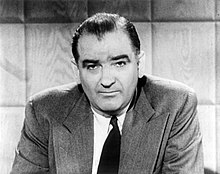
Joseph McCarthy

When the Senate gallery erupted in applause, McCarthy–totally surprised at his sudden reversal of fortune–was finished.

Today, however, other Americans should be asking themselves the question asked by Welch: “At long last, have you left no sense of decency?”

Americans like Rick Santorum, Republican Presidential candidate in 2016.

Rick Santorum

As a United States Senator from Pennsylvania (1997-2005) and a 2012 Presidential candidate, Santorum fervently sought to ban legalized abortion–even in rape cases. Also on his list of banned items: birth control.

Abortion and birth control, said Santorum, were an affront to “the way things ought to be.”  As decided, of course, by Santorum.

But this did not stop him from marrying, in 1990, a woman–Karen Garver–who had spent six years as the unmarried bedmate of an OBGYN-abortionist named Tom Allen, who was 40 years her senior.

Today, as Mrs. Santorum, she has totally reversed her view on abortion and wants to see it banned.

Then there’s 2016 Presidential candidate Ted Cruz.

U.S. Senator Ted Cruz (R-Texas) 

As a Republican United States Senator from Texas, Cruz voted–three times–against providing federal aid for the victims of Hurricane Sandy.

The October, 2012, hurricane killed about 150 people and caused an estimated $75 billion worth of damages across the Northeast.

But when a fertilizer plant exploded in West, McLennan County, Texas, on April 17, 2013, Cruz vowed that he would seek “all available resources” to assist its victims.

The blast killed 13 people, wounded about 200 others, and caused extensive damage to surrounding homes.

It didn’t matter to Cruz that:

  • The facility hadn’t been expected by the Labor Department’s Occupational Safety and Health Administration (OSHA) since 1985, when the company was find $30; and
  • The plant had been storing 1,350 times the amount of ammonium nitrate that would normally trigger safety oversight by the U.S. Department of Homeland Security (DHS.).

Then there’s Donald Trump, the egocentric businessman and “reality star of NBC’s “The Apprentice,” who, likewise, has thrown his hat into the 2016 Presidential race.

Donald Trump

On April 17, 2011, toying with the idea of entering the 2012 Presidential race, Trump said this about Mitt Romney, the former Massachusetts governor and front-runner GOP candidate:

“He’d buy companies, he’d close companies.  He’d get rid of jobs.  I’ve built a great company.  I’m a much bigger businessman and have a much, much bigger net worth.  I mean, my net worth is many, many, many times Mitt Romney.

“Mitt Romney is a basically small-business guy, if you really think about it. He was a hedge fund.  He was a funds guy.  He walked away with some money from a very good company that he didn’t create.  he worked there.  He didn’t create it.”

Trump added that Bain Capital, the hedge fund where Romney made millions of dollars before running for governor, didn’t create any jobs. Whereas Trump claimed that he–Trump–had created “hundreds of thousands of jobs.”

So at least some observers must have been puzzled when Trump announced, on February 2, 2012: “It’s my honor, real honor and privilege, to endorse Mitt Romney” for President.

“Mitt is tough.  He’s smart.  He’s sharp. He’s not going to allow bad things to continue to happen to this country that we all love.  So, Governor Romney, go out and get ’em.  You can do it,” said Trump.

Mitt Romney

And Romney, in turn, had his own swooning-girl moment: “I’m so honored to have his endorsement.  There are some things that you just can’t imagine in your life. This is one of them.”

Clearly, the word “hypocrisy” means nothing to Santorum, Cruz and Trump. But it should mean something to the rest of us.

In samurai Japan, officials who publicly disgraced themselves knew what to do. The samurai code of Bushido told them when they had crossed the line into eternal damnation.

And it gave them a way to redeem their lost honor–seppuku.  With a small “belly-cutting” knife and the help of a trusted assistant who sliced off their head to spare them the agonizing pain of disembowelment.

Seppuku 

In the armies of America and Europe, the method was slightly different: A pistol in a private room.

Considering the ready availability of firearms among Right-wing Republicans, redeeming lost honor shouldn’t be a problem for any of these men.

But of course it will be.  It takes more than a trigger pull to “do the right thing.  It takes insight to recognize that you’ve “done the wrong thing.”  And it takes courage to act on that insight.

In men who live only for their own egos and wallets, such insight and courage will be forever missing.  They are beyond redemption.

Their lives give proof to the warning offered in Matthew 7:17-20:

“Even so every good tree bringeth forth good fruit; but a corrupt tree bringeth forth evil fruit.  A good tree cannot bring forth evil fruit, neither can a corrupt tree bring forth good fruit.

“Every tree that bringeth not forth good fruit is hewn down, and cast into the fire. Wherefore by their fruits ye shall know them.”

IF TRUMP IS OUR HITLER, WHO WILL BE OUR STAUFFENBERG?: PART THREE (END)

In Bureaucracy, History, Military, Politics, Social commentary on December 2, 2015 at 12:17 am

On July 20, 1944, members of the Wehrmacht high command failed to assassinate Adolf Hitler with a bomb hidden in a briefcase.

But two setbacks prevented the conspirators from succeeding.

First, Hitler survived the bomb blast.

Second, the plotters failed to seize the key broadcast facilities of the Reich.

This allowed Hitler to make a late-night speech to the nation, revealing the failed plot and assuring Germans that he was alive. And he swore to flush out the “traitorous swine” who had tried to kill him.

Adolf Hitler

Mass arrests quickly followed.  Among the first victims discovered and executed was the conspiracy’s leader, Colonel Claus von Stauffenberg.  Standing before a makeshift firing squad at midnight, he cried: “Long live our sacred Germany!”

At least 7,000 persons were arrested by the Gestapo. According to records of the Fuehrer Conferences on Naval Affairs, 4,980 were executed.

Had the conspiracy succeeded, history would have turned out differently:

  • If Germany had surrendered in July or August, 1944, World War II would have ended eight to nine months earlier.
  • The Russians–who didn’t reach Germany until April, 1945–could not have occupied the Eastern part of the country.
  • This would have prevented many of the future conflicts between the United States and the Soviet Union over access to West Berlin and/or West Germany.
  • Untold numbers of Holocaust victims would have survived because the extermination camps would have been shut down.

Thus, history can be altered by the appearance or disappearance of a single individual.

Which brings us back to Donald Trump.

Donald Trump

Since declaring his candidacy for the Presidency on June 16, Trump has been the first choice among the Republican base.

At first, he was dismissed as a bad joke–by Republican Presidential candidates as well as Democrats.

Surely voters would reject a bombastic, thrice-married “reality show” host who had filed for corporate bankruptcy four times.

Yet from the outset Trump dominated the field–and a series of Republican debates. The other Republican candidates watched him with envy–and desperately tried to steal some of his limelight.

Making made one inflammatory statement after another, he offended one group of potential voters after another.  Among those groups:

  • Latinos
  • Asians
  • Muslims
  • Blacks
  • The disabled
  • Women
  • Prisoners-of-War

These insults delighted his white, under-educated followers. But they alienated millions of other Americans who might have voted for him.

While some of those offended are unlikely to respond with violence, others have powerful motives–and means–for doing so. Among those groups–and the insults Trump has leveled at them:

  • Mexicans: “They’re bringing drugs.  They’re bringing crime. They’re rapists.” He’s also promised to “build a great, great wall on our southern border and I will have Mexico pay for that wall.”
  • Illegal aliens: Trump has threatened to forcibly deport millions of mostly Mexican and Central American residents.
  • Blacks: At a Trump rally in Birmingham, Alabama, he was interrupted by black activist Mercutio Southall, who repeatedly shouted: “Black lives matter!” Trump ordered his removal, and several of his supporters beat and kicked Southall. Later, Trump said: “Maybe he should have been roughed up, because it was absolutely disgusting what he was doing.”
  • Trump retweeted an image of a masked, dark-skinned man with a handgun and a series of alleged crime statistics, including: “Blacks killed by whites – 2%”; “Whites killed by blacks – 81%.”  The image cites the “Crime Statistics Bureau – San Francisco”–an agency that doesn’t exist.
  • Muslims: Trump has boasted he would revive waterboarding of terrorist suspects. He would require Muslims to register with the Federal Government. And he would close “some mosques” if he felt they were being used by Islamic terrorists.
  • Islamic terrorists: Trump has bragged that he would “bomb the hell” out of oilfields controlled by the Islamic State of Iraq and Syria (ISIS): “I would absolutely cut off their source of wealth, which is the oil.”
  • Joaquin “El Chapo” Guzman:  Referring to the Mexican drug lord in a tweet, Trump wrote: “Trump…would kick his ass!” Trump hurriedly called the FBI after he received a death threat from a Twitter account associated with Guzman.

Niccolo Machiavelli, the father of modern politics, warned against hurling threats and insults: “For neither the one nor the other…diminishes the strength of the enemy.

Niccolo Machiavelli

“[Threats make] him more cautious, and [insults increase] his hatred of you, and [make] him more persevering in his efforts to injure you.”

But Trump revels in insulting anyone who dares to challenge him.

In 1935, Louisiana U.S. Senator Huey Long intended to occupy the White House in 1936 and unseat then-President Franklin D. Roosevelt.  His “Share Our Wealth” program was hugely popular among millions in Depression-era America.

On September 8, 1935, he was shot and fatally wounded by Carl Austin Weiss, an idealistic young doctor.

His motive: Long had gerrymandered Weiss’ father-in-law, a district judge, out of his district and spread vicious rumors about his ancestry.

Writing about Long’s assassination, historian William Manchester noted: “Huey Long was one of the very few men of whom it can be said that, had he lived, American history would have been dramatically different.”

If the same fate removes Donald Trump from the 2016 Presidential race, future historians may write the same about him.

IF TRUMP IS OUR HITLER, WHO WILL BE OUR STAUFFENBERG?: PART TWO (OF THREE)

In Bureaucracy, History, Military, Politics, Social commentary on December 1, 2015 at 12:01 am

On July 20, 1944, a one-eyed, one-armed man tried to assassinate Adolf Hitler

Colonel Claus Schenk von Stuaffenberg had served with the Wehrmacht in Poland (1939), France (1940) and the Soviet Union (1941).  And he had been seriously wounded in its service.

Colonel Claus Schenk von Stuaffenberg

Nevertheless, he now acted as the prime mover for the conspiracy among a growing number of German high command officers to arrest or assassinate Germany’s Fuehrer.

Most of the conspirators wanted to arrest Hitler and surrender to British and American forces–well before the much-feared Russians gained a foothold in Germany.

But Stauffenberg wanted him dead: A live Hitler might eventually be rescued by his Nazi colleagues.

But–how to do it?

Hitler was a closely-guarded target. He was surrounded by fanatical bodyguards who were expert marksmen. He often wore a bulletproof vest and a cap lined with three pounds of laminated steel.

Adolf Hitler

Bundesarchiv, Bild 146-1990-048-29A / CC-BY-SA 3.0 [CC BY-SA 3.0 de (https://creativecommons.org/licenses/by-sa/3.0/de/deed.en)%5D, via Wikimedia Commons

But his single greatest protection–he claimed–was an instinct for danger.  He would often suddenly change his schedule–to drop in  where he was least expected.  Or to suddenly depart an event where he was scheduled to stay a long time.

On November 9, 1939, this instinct saved his life.  He had been set to give a long speech at a Munich beer hall before the “Old Fighters” of his storm troopers.

Sixteen years earlier on that day, in 1923, Hitler had led them in a disastrous attempt to overthrow the Bavarian government.  Police had put down the effort, killing and wounding about a score of storm troopers in the process.

Hitler himself had later been arrested, tried and convicted for treason–and sentenced to a year’s imprisonment.

But instead of proving to be the end of Nazism, the “Beer Hall Putsch” turned Hitler into a national celebrity.  And it launched his career as a legitimate, ultimately successful politician.

So Hitler was expected to speak to his longtime supporters for a long time that evening. Instead, he suddenly cut short his speech and left the beer hall.

Forty-five minutes later, a bomb exploded inside a pillar–before which Hitler had been speaking.

Since then, a series of other assassination attempts had been made against Hitler.  All of them involved time-bombs. And all of the would-be assassins were members of the German General Staff.

In one case, a bomb secretly stashed aboard Hitler’s plane failed to explode.  In another, an officer who had a bomb strapped to himself unexpectedly found his scheduled meeting with Hitler called off.  He had to rush into a bathroom to defuse the bomb before it went off.

So now it was the turn of von Stauffenberg.  He would carry his bomb–hidden in a briefcase–into a “Hitler conference” packed with military officers.

But Stauffenberg didn’t intend to be a suicide bomber. He meant to direct the government that would replace that of the Nazis.

His bomb–also rigged with a time-fuse–would be left in the conference room while he found an excuse to leave. After the explosion, he would phone one of his fellow conspirators with the news.

Then, the coup–“Operation Valkyrie”–would be on.

Anti-Nazi conspirators would seize control of key posts of the government. The British and Americans would then be informed of Germany’s willingness to surrender. Provided, of course, that the Russians did not have a say in its postwar future.

The Wehrmacht and Schutzstaffel (SS) had killed millions of Russians. Many had died in combat. Others had been murdered as captives. Still more had been allowed to die by starvation and exposure to the notorious Russian winter.

So the Germans–both Nazi and anti-Nazi–knew what they could expect if soldiers of the Soviet Union reached German soil.

On July 20, 1944, Stauffenberg appeared at Hitler’s well-guarded military headquarters in East Prussia.  Like all his other outposts, Hitler had named it–appropriately enough–“Wolf’s Lair.”

“Wolf’s Lair”

Stauffenberg entered the large, concrete building while the conference was in session.  He placed his yellow briefcase next to Hitler–who was standing with his generals at a heavy oaken table.

Then Stauffenberg excused himself to take an “urgent” phone call.

At 12:42 p.m. on July 20, 1944, Stauffenberg’s briefcase bomb erupted.

But the Third Reich didn’t come to an end–because, as if miraculously, Hitler had survived.

Hitler shows off the site of the explosion

What had happened?

First, the conference location had been changed–from a wooden building to a concrete one.  The concrete absorbed much of the blast.

Second, owing to the summer’s heat, Hitler had ordered all the windows–about ten–opened to let in a breeze.  This allowed much of the force of the blast to be dispersed.

Third, and perhaps most important: Stauffenberg had carefully placed his briefcase near Hitler, who was standing next to a heavy oaken support of the conference table.

But after Stauffenberg left the room, Colonel Heinz Brandt, who stood next to Hitler, found the briefcase blocking his legs.  So he moved it–to the other side of the heavy oaken support.

When the bomb exploded, Hitler was partially shielded from its full blast.  Brandt died, as did two other officers and a stenographer.

IF TRUMP IS OUR HITLER, WHO WILL BE OUR STAUFFENBERG?: PART ONE (OF THREE)

In Bureaucracy, History, Military, Politics, Social commentary on November 30, 2015 at 12:03 am

The ad opens with ominous music–and the face of a snarling Donald Trump.

“I would like anyone who is listening to consider some thoughts that I’ve paraphrased from the words of German pastor Martin Niemoeller.”

The voice belongs to Tom Moe, a retired colonel in the U.S. Air Force–and a former Vietnam prisoner-of-war.

It’s a video produced by the 2016 Presidential campaign for John Kasich. Kasich, the governor of Ohio, has been peddling a message of creating jobs, balancing the Federal budget and disdain for Washington, D.C.

Related image

John Kasich

But he remains far behind in the polls, dropping 50% in support in just one month–from September to October. Meanwhile, Trump, the New York billionaire developer, is backed by 25% of Republican primary voters.

So, with nothing to lose, Kasich has decided to take off the gloves.  He’s invoked the “N” word for Republicans: Nazi.

“You might not care if Donald Trump says Muslims must register with the government, because you’re not one,” continues Moe.

“And you might not care if Donald Trump says he’s going to round up all the Hispanic immigrants, because you’re not one.

Related image

Donald Trump

“And you might not care if Donald Trump says it’s OK to rough up black protesters, because you’re not one.

“And you might not care of Donald Trump wants to suppress journalists, because you’re not one.

“But think about this:

“If he keeps going, and he actually becomes President, he might just get around to you.  And you’d better hope that there’s someone left to help you.”

Click here: Trump’s Dangerous Rhetoric – YouTube

The above is indeed a paraphrase of a famous quote by Martin Niemoeller (1892–1984), a prominent Protestant pastor. Although he had been a U-boat commander during World War 1, he became a bitter public foe of Adolf Hitler.

A staunch anti-Communist, he had initially supported the Nazis as Germany’s only hope of salvation against the Soviet Union. But when the Nazis made the church subordinate to State authority, Niemoeller created the Pastors’ Emergency League to defend religious freedom.

Martin Niemöller (1952).jpg

Martin Niemoeller

For his opposition to the Third Reich, Niemoeller spent seven years in concentration camps. With the collapse of the Reich in 1945, he was freed–and elected President of the Protestant church in Hesse and Nassau in 1947.

During the 1960s, he was a president of the World Council of Churches.

He is best remembered for his powerful condemnation of the failure of Germans to protest the increasing oppression of the Nazis:

First they came for the Communists, but I was not a Communist, so I did not speak out.

Then they came for the Socialists, but I was not a Socialist, so I did not speak out.

Then they came for the trade unionists, but I was not a trade unionist, so I did not speak out.

Then they came for the Jews, but I was not a Jew, so I did not speak out.

And when they came for me, there was no one left to speak out for me.

Neither “Adolf Hitler” nor “Nazi Party” was mentioned during the one-minute Kassich video. But Trump is furious.

“I will sue him [Kasich] just for fun,” said Trump, if he can find anything “not truthful” within the ad.

So says the man who has called Mexican immigrants “rapists” and accused President Barack Obama of being a Muslim and born outside the United States.

The Kasich ad is by far the darkest attack so far made against Trump by any candidate–Republican or Democrat.  And it raises a disturbing question:

If Donald Trump is America’s Adolf Hitler, who will be its Claus von Stauffenberg?

Colonel Claus Schenk von Stuaffenberg was the German army officer who, on July 20, 1944, tried to assassinate Adolf Hitler.

He had served with the Wehrmacht in Poland (1939), France (1940) and the Soviet Union (1941).

While serving in Tunisa, he was seriously wounded on April 7, 1943 when Allied fighters strafed his vehicle. He lost his left eye, right hand and two fingers of his left hand after surgery.

Colonel Claus Schenk von Stuaffenberg

Nevertheless, he now acted as the prime mover for the conspiracy among a growing number of German high command officers to arrest or assassinate Germany’s Fuehrer.

For most of these officers, the motive was craven: Germany was losing the war it had launched on the world–and they feared the worst.  This was especially true now that the numerically superior forces of the Soviet Union had gone onto the offensive.

For Stauffenberg, there was another reason: His disgust at the horrors he had seen committed by his fellow Wehrmacht soldiers upon defenseless POW’s and civilians in Russia.

Thus, Stauffenberg–more than many Germans–knew firsthand the vengeance his country could expect if the “1,000 year Reich” fell.

Something must be done, he believed, to prove to the world that not all Germans–even members of the Wehrmacht–were criminals.

Most of the conspirators wanted to arrest Hitler and surrender to British and American forces–well before the much-feared Russians gained a toehold in Germany.

For Stauffenberg, arresting Hitler wasn’t enough.

Stauffenberg wanted him dead. A live Hitler might eventually be rescued by his Nazi colleagues.

But–how to do it?

DAVY CROCKETT VS. DONALD TRUMP

In History, Politics, Social commentary on November 26, 2015 at 8:58 am

It’s a scene you couldn’t imagine seeing in John Wayne’s 1960 film, “The Alamo.”  Especially with The Duke playing a hard-drinking, two-fisted Davy Crockett.

John Wayne as Davy Crockett

But it occurs in the novel, Crockett of Tennessee, by Cameron Judd.  And it is no less affecting for its being–so far as we know–entirely fictional.

It’s the last night of life for the Alamo garrison–the night before the 2,000 men of the Mexican Army hurl themselves at the former mission and slaughter its 200 Texian defenders.

The fort’s commander, William Barret Travis, has drawn his “line in the sand” and invited the garrison to choose: To surrender, to try to escape, or to stay and fight to the death.

And the garrison–except for one man–chooses to stay and fight.  That man is Louis “Moses” Rose, a Frenchman who has served in Napoleon’s Grande Armee and survived the frightful retreat from Moscow.

He vaults a low wall of the improvised fort, flees into the moonless desert, and eventually makes his way to the home of a family who give him shelter.

But for the garrison, immortality lies only hours away.  Or does it?

An hour after deciding to stand and die in the Alamo, wrapped in the dark of night, Crockett is seized with paralyzing fear.

“We’re going to die here,” he chokes out to his longtime friend, Persius Tarr.  “You understand that, Persius?  We’re going to die!”

Related image

“I know, Davy.  But there ain’t no news in that,” says Tarr.  “We’re born to die.  Every one of us.  Only difference between us and most everybody else is we know when and where it’s going to be.”

“But I can’t be afraid–not me.  I’m Crockett.  I’m Canebrake Davy.  I’m half-horse, half-alligator.”

“I know you are, Davy,” says Tarr. ”So do all these men here.  That’s why you’re going to get past this.

“You’re going to put that fear behind you and walk back out there and fight like the man you are.  The fear’s come and now it’s gone.  This is our time, Davy.”

“The glory-time,” says Crockett.

“That’s right, David.  The glory-time.”

And then Tarr delivers a sentiment wholly alien to money-obsessed men like Mitt Romney and Donald Trump–who comprise the richest and most privileged 1% of today’s Americans.

“There’s men out there with their eyes on you.  You’re the only thing keeping the fear away from them.  You’re joking and grinning and fiddling-–it gives them courage they wouldn’t have had without you.

Maybe that’s why you’re here, Davy–to make the little men and the scared men into big and brave men.  You’ve always cared about the little men, Davy.  Remember who you are.

“You’re Crockett of Tennessee, and your glory-time has come.  Don’t you miss a bit of it.”

The next morning, the Mexicans assault the Alamo.  Crockett embraces his glory-time-–and becomes a legend for all-time.

David Crockett (center) at the fall of the Alamo

David Crockett (1786-1836) lived–and died–a poor man.  But this did not prevent him from trying to better the lives of his family and fellow citizens–and even his former enemies.

David Crockett

During the War of 1812, he served as a scout under Andrew Jackson.  His foes were the Creek Indians, who had massacred 500 settlers at Fort Mims, Alabama–and threatened to do the same to Crockett’s neighbors in Tennessee.

As a Congressman from Tennessee, he championed the rights of poor whites.  And he opposed then-President Jackson’s efforts to force the same defeated Indians to depart the lands guaranteed them by treaty.

To Crockett, a promise was sacred–whether given by a single man or the United States Government.

And his presence during the 13-day siege of the Alamo did cheer the spirits of the vastly outnumbered defenders.

It’s a matter of historical record that he and a Scotsman named MacGregor often staged musical “duels” to see who could make the most noise.

It was MacGregor with his bagpipes against Crockett and his fiddle.

Contrast this devotion of Crockett to the rights of “the little men,” as Persius Tarr called them, with the attitude of Donald Trump, the currently-favored Republican candidate for President in 2016.

Donald Trump

On June 16, while announcing his candidacy, Trump said:

  • “…I don’t need anybody’s money. It’s nice. I don’t need anybody’s money. I’m using my own money. I’m not using lobbyists, I’m not using donors. I don’t care. I’m really rich.”
  • “I did a lot of great deals and I did them early and young, and now I’m building all over the world….”
  • “So I have a total net worth, and now with the increase, it’ll be well-over $10 billion.”
  • “But here, a total net worth of–net worth, not assets, not–a net worth, after all debt, after all expenses, the greatest assets–Trump Tower, 1290 Avenue of the Americas, Bank of America building in San Francisco, 40 Wall Street, sometimes referred to as the Trump building right opposite the New York–many other places all over the world. So the total is $8,737,540,000.”

Those who give their lives for others are rightly loved as heroes.  Those who dedicate their lives only to their wallets are rightly soon forgotten.

FICTION AS REALITY

In Bureaucracy, History, Military, Politics, Social commentary on September 8, 2015 at 12:15 am

On August 17, Republican Presidential candidate Donald Trump outlined his strategy for defeating the Islamic State of Iraq and Syria (ISIS).

He would order American forces to take over the oil fields that ISIS has seized in Iraq.

Trump outlined his plans for future military operations against ISIS on NBC’s “Meet the Press” with Chuck Todd.

Trump said he never advocated a U.S. war with Iraq, but it happened, and “it was a big mistake” because it “destabilized” the Middle East.

“Now we’re there, and you have ISIS….And ISIS is taking over a lot of the oil in certain areas of Iraq.

“And I said, you take away their wealth. You go and knock the hell out of the oil. Take back the oil. We take over the oil, which we should have done in the first place.”

After taking over the Iraqi oil fields, said Trump, “we’re going to have so much money.

“And what I would do with the money that we make, which would be tremendous, I would take care of the soldiers that were killed, the families of the soldiers that were killed, the soldiers, the wounded warriors that are–see, I love them.”

Actually, Trump’s idea forms the plot of The Profession, a 2011 novel by bestselling author Steven Pressfield.

The Profession

Pressfield made his literary reputation with a series of classic novels about ancient Greece.

In Gates of Fire (1998) he explored the rigors and heroism of Spartan society–and the famous last stand of its 300 picked warriors at Thermopylae.

In The Virtues of War (2004) he entered the mind of Alexander the Great, whose armies swept across the known world, destroying all who dared oppose them.

Finally, in The Afghan Campaign (2006) Pressfield–this time from the viewpoint of a lowly Greek soldier–refought Alexander’s brutal, three-year anti-guerrilla campaign in Afghanistan.

Steven Pressfield Focused Interview

 Steven Pressfield

But in The Profession, Pressfield created a plausible world set into the future of 2032.  The book’s own dust jacket offers the best summary of its plot-line:

“The third Iran-Iraq war is over. The 11/11 dirty bomb attack on the port of Long Beach, California is receding into memory. Saudi Arabia has recently quelled a coup. Russians and Turks are clashing in the Caspian Basin….

“Everywhere military force is for hire.  Oil companies, multi-national corporations and banks employ powerful, cutting-edge mercenary armies to control global chaos and protect their riches.

“Even nation states enlist mercenary forces to suppress internal insurrections, hunt terrorists, and do the black bag jobs necessary to maintain the new New World Order.

“Force Insertion is the world’s merc monopoly. Its leader is the disgraced former United States Marine General James Salter, stripped of his command by the president for nuclear saber-rattling with the Chinese and banished to the Far East.’

Salter appears as a hybrid of World War II General Douglas MacArthur and Iraqi War General Stanley McCrystal.

Like MacArthur, Salter has butted heads with his President–and paid dearly for it.  Now his ambition is no less than to become President himself–by popular acclaim.  And like McCrystal, he is a pure warrior who leads from the front and is revered by his men.

Salter seizes Saudi oil fields, then offers them as a gift to America. By doing so, he makes himself the most popular man in the country–and a guaranteed occupant of the White House.

And in 2032 the United States is a far different nation from the one its Founding Fathers created  in 1776.

“Any time that you have the rise of mercenaries…society has entered a twilight era, a time past the zenith of its arc,” says Salter.

“The United States is an empire…but the American people lack the imperial temperament. We’re not legionaries, we’re mechanics.  In the end the American Dream boils down to what? ‘I’m getting mine and the hell with you.’”

Americans, asserts Salter, have come to like mercenaries: “They’ve had enough of sacrificing their sons and daughters in the name of some illusory world order.  They want someone else’s sons and daughters to bear the burden….

“They want their problems to go away.  They want me to to make them go away.”

And so Salter will “accept whatever crown, of paper or gold, that my country wants to press upon me.”

More than 500 years ago, Niccolo Machiavelli warned of the dangers of relying on mercenaries:

“Mercenaries…are useless and dangerous. And if a prince holds on to his state by means of mercenary armies, he will never be stable or secure; for they are disunited, ambitious, without discipline, disloyal; they are brave among friends; among enemies they are cowards.

 Niccolo Machiavelli

“They have neither the fear of God nor fidelity to men, and destruction is deferred only so long as the attack is. For in peace one is robbed by them, and in war by the enemy.”

Centuries ago, Niccolo Machiavelli issued a warning against relying on men whose first love is their own enrichment.

Steven Pressfield, in a work of fiction, has given us a nightmarish vision of a not-so-distant America where “Name your price” has become the byward for an age.

Both warnings are well worth heeding.

DAVY CROCKETT VS. DONALD TRUMP

In Bureaucracy, Business, History, Politics, Social commentary on August 25, 2015 at 12:06 am

It’s a scene you couldn’t imagine seeing in John Wayne’s 1960 film, “The Alamo.”  Especially with The Duke playing a hard-drinking, two-fisted Davy Crockett.

John Wayne as Davy Crockett

But it occurs in the novel, Crockett of Tennessee, by Cameron Judd.  And it is no less affecting for its being–so far as we know–entirely fictional.

It’s the last night of life for the Alamo garrison–the night before the 2,000 men of the Mexican Army hurl themselves at the former mission and slaughter its 200 Texian defenders.

The fort’s commander, William Barret Travis, has drawn his “line in the sand” and invited the garrison to choose: To surrender, to try to escape, or to stay and fight to the death.

And the garrison–except for one man–chooses to stay and fight.  That man is Louis “Moses” Rose, a Frenchman who has served in Napoleon’s Grande Armee and survived the frightful retreat from Moscow.

He vaults a low wall of the improvised fort, flees into the moonless desert, and eventually makes his way to the home of a family who give him shelter.

But for the garrison, immortality lies only hours away.  Or does it?

An hour after deciding to stand and die in the Alamo, wrapped in the dark of night, Crockett is seized with paralyzing fear.

“We’re going to die here,” he chokes out to his longtime friend, Persius Tarr.  “You understand that, Persius?  We’re going to die!”

Related image

“I know, Davy.  But there ain’t no news in that,” says Tarr.  “We’re born to die.  Every one of us.  Only difference between us and most everybody else is we know when and where it’s going to be.”

“But I can’t be afraid–not me.  I’m Crockett.  I’m Canebrake Davy.  I’m half-horse, half-alligator.”

“I know you are, Davy,” says Tarr. ”So do all these men here.  That’s why you’re going to get past this.

“You’re going to put that fear behind you and walk back out there and fight like the man you are.  The fear’s come and now it’s gone.  This is our time, Davy.”

“The glory-time,” says Crockett.

“That’s right, David.  The glory-time.”

And then Tarr delivers a sentiment wholly alien to money-obsessed men like Mitt Romney and Donald Trump–who comprise the richest and most privileged 1% of today’s Americans.

“There’s men out there with their eyes on you.  You’re the only thing keeping the fear away from them.  You’re joking and grinning and fiddling-–it gives them courage they wouldn’t have had without you.

Maybe that’s why you’re here, Davy–to make the little men and the scared men into big and brave men.  You’ve always cared about the little men, Davy.  Remember who you are.

“You’re Crockett of Tennessee, and your glory-time has come.  Don’t you miss a bit of it.”

The next morning, the Mexicans assault the Alamo.  Crockett embraces his glory-time-–and becomes a legend for all-time.

David Crockett (center) at the fall of the Alamo

David Crockett (1786-1836) lived–and died–a poor man.  But this did not prevent him from trying to better the lives of his family and fellow citizens–and even his former enemies.

David Crockett

During the War of 1812, he served as a scout under Andrew Jackson.  His foes were the Creek Indians, who had massacred 500 settlers at Fort Mims, Alabama–and threatened to do the same to Crockett’s neighbors in Tennessee.

As a Congressman from Tennessee, he championed the rights of poor whites.  And he opposed then-President Jackson’s efforts to force the same defeated Indians to depart the lands guaranteed them by treaty.

To Crockett, a promise was sacred–whether given by a single man or the United States Government.

And his presence during the 13-day siege of the Alamo did cheer the spirits of the vastly outnumbered defenders.

It’s a matter of historical record that he and a Scotsman named MacGregor often staged musical “duels” to see who could make the most noise.

It was MacGregor with his bagpipes against Crockett and his fiddle.

Contrast this devotion of Crockett to the rights of “the little men,” as Persius Tarr called them, with the attitude of Donald Trump, the currently-favored Republican candidate for President in 2016.

Donald Trump

On June 16, while announcing his candidacy, Trump said:

  • “…I don’t need anybody’s money. It’s nice. I don’t need anybody’s money. I’m using my own money. I’m not using lobbyists, I’m not using donors. I don’t care. I’m really rich.”
  • “I did a lot of great deals and I did them early and young, and now I’m building all over the world….”
  • “So I have a total net worth, and now with the increase, it’ll be well-over $10 billion.”
  • “But here, a total net worth of–net worth, not assets, not–a net worth, after all debt, after all expenses, the greatest assets–Trump Tower, 1290 Avenue of the Americas, Bank of America building in San Francisco, 40 Wall Street, sometimes referred to as the Trump building right opposite the New York–many other places all over the world. So the total is $8,737,540,000.”

Those who give their lives for others are rightly loved as heroes.  Those who dedicate their lives only to their wallets are rightly soon forgotten.