Archive for the ‘Law Enforcement’ Category
2016 PRESIDENTIAL ELECTION, 2020 PRESIDENTIAL ELECTION, ABC NEWS, ALTERNET, AMERICABLOG, AP, ASSAULT, BABY BOOMER RESISTANCE, BLACK LIBERATION ARMY, BLACK LIVES MATTER, BLACKS, BLOOMBERG, BURGLARY, BUZZFEED, CBS NEWS, CNN, CRIME, CROOKS AND LIARS, DAILY KOZ, DARREN WILSON, DONALD TRUMP, DRUDGE REPORT, DRUGS, EMERYVILLE, FACEBOOK, FBI, FELONIOUS ASSAULT, FELONY SEX CRIMES, FERGUSON POLICE DEPARTMENT, FIVETHIRTYEIGHT, GEORGE FLOYD, GRAND LARCENY, HARPER’S MAGAZINE, HISPANICS, HUFFINGTON POST, JASON BLAKE, KENOSHA COUNTY, MANSLAUGHTER, MEDIA MATTERS, MICHAEL BROWN, MISDEMEANOR ASSAULT, MISDEMEANOR ASSAULT AND RELATED OFFENSES, MISDEMEANOR SEX CRIMES, MOTHER JONES, MOVEON, MSNBC, MURDER, NBC NEWS, NEW YORK CITY, NEW YORK POLICE DEPARTMENT, NEWSWEEK, NON-NEGLIGENT MANSLAUGHTER, NPR, OAKLAND, PBS NEWSHOUR, PETIT LARCENY, POLITICO, POLITICUSUSA, PROACTIVE PROPERTY CRIMES, RAPE, RAW STORY, RESTRAINING ORDER, REUTERS, ROBBERY, ROBERT DALEY, RUSTEN SHESKEY, SALON, SAN FRANCISCO, SAN JOSE, SEATTLE TIMES, SEX CRIMES, SEXUAL ASSAULT, SHOOTINGS, SLATE, TALKING POINTS MEMO, TARGET BLUE: AN INSIDER'S VIEW OF THE NYPD (BOOK), THE ATLANTIC, THE CHICAGO SUN-TIMES, THE CHICAGO TRIBUNE, THE DAILY BEAST, THE DAILY BLOG, THE GUARDIAN, THE HILL, THE HUFFINGTON POST, THE LOS ANGELES TIMES, THE NATION, THE NEW REPUBLIC, THE NEW YORK TIMES, THE VILLAGE VOICE, THE WALL STREET JOURNAL, THE WASHINGTON POST, THINKPROGRESS, TIME, TRUTHDIG, TRUTHOUT, TWITTER, TWO POLITICAL JUNKIES, U.S. NEWS & WORLD REPORT, UPI, USA TODAY, WALNUT CREEK, WONKETTE
In Bureaucracy, History, Law, Law Enforcement, Politics, Social commentary on September 1, 2020 at 12:02 am
On August 23, Jason S. Blake, a 29-year-old black man, was shot and seriously injured by police in Kenosha, Wisconsin.
The shooting occurred as officers attempted to arrest him. Blake was tasered as he scuffled with police. When he opened the driver’s door to his SUV and leaned in, Officer Rusten Sheskey fired seven shots, striking him four times in the back.
Blake is now paralyzed from the waist down, and may never walk again.
Protests followed. Kenosha County declared a state of emergency overnight on August 24 after police vehicles were damaged, a dump truck set on fire, and the local courthouse vandalized. Police urged 24-hour businesses to close owing to armed robberies and shots being fired. Up to 200 members of the Wisconsin National Guard were deployed to maintain public safety.
Missing from the story—in most news media—has been one crucial fact:
At the time of the shooting, Blake faced a criminal complaint charging him with third-degree sexual assault in connection with domestic abuse on July 6.
The officers had come to arrest Blake for violating a restraining order stemming from that complaint. A 911 call on August 23 alerted them that Blake was at the home of his alleged victim.

A sample restraining order
The restraining order stemmed from a criminal complaint, which accused Blake of breaking into the home of a woman he knew and sexually assaulting her in May. The victim told police she was asleep when Blake broke in at 6 a.m. and said, “I want my shit.”
She told police that Blake used his finger to sexually assault her. She said the incident “caused her pain and humiliation and was done without her consent.”
After Blake left, she realized her keys were missing and “immediately called 911,” the complaint said.
An arrest warrant was issued on July 7.
On August 9, 2014, a similar police/media incident had occurred.
Michael Brown, an 18-year-old black man, was fatally shot by a white police officer named Darren Wilson in Ferguson, Missouri, a suburb of St. Louis.
Brown’s 22-year-old friend, Dorian Johnson claimed that Wilson shot him in the back. Wilson claimed he shot Brown after the latter charged at him.
An FBI investigation found that there was no evidence that Brown had his hands up in surrender or said “don’t shoot” before he was shot. It also found that Brown was struck six times, all in the front of his body.
The shooting ignited nationwide protests.
Yet many of the media “covering” the story refused to note that, shortly before his shooting, a video camera taped Brown robbing a grocery store and manhandling its owner.
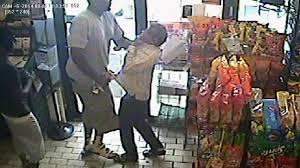
Michael Brown (left) roughing up a store owner
Had this been more widely noted, “Saint Michael” would have been seen as a mere thug who learned that assaulting a cop wasn’t the same as attacking a store owner.
On May 25, George Floyd, a former black security guard, was murdered in Minneapolis, Minnesota. While Floyd was handcuffed and lying face down on a city street during an arrest, Derek Chauvin, a white Minneapolis police officer, kept his knee on the right side of Floyd’s neck for eight minutes and 46 seconds.
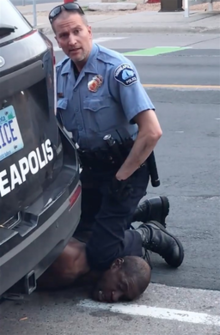
Death of George Floyd
Across the nation, cities were convulsed by protests—including those in the San Francisco Bay Area. Among these: Oakland, San Jose, Emeryville, Walnut Creek and San Francisco itself.
On May 30, an initially peaceful protest march exploded into looting shortly before 9 p.m. as looters broke off and began smashing shop windows and ransacking stores in Union Square and on Market Street.
Among stores looted: A Sak’s Off-Fifth Avenue, an Old Navy clothing store, a Cartier Boutique and a Coach store. Looters especially targeted CVS and Walgreens drugstores. Liquor stores and a BevMo were also hit.
“Thirty businesses were looted or destroyed,” said David Perry, from Union Square Business Improvement District.
Undoubtedly many of victims of those looters and arsonists had been horrified by the Floyd killing. But many of them undoubtedly lost sympathy for the Black Lives Matter movement as they surveyed the wreckage of their stores.
Store owners were infuriated at having to replace stock that had been stolen or destroyed. And employees resented having to clean up the wreckage. Some stores no doubt were forced to close, leaving their former employees suddenly jobless.
And President Donald Trump has quickly moved to capitalize on that resentment. His brand of “divide and rule” politics brought him to the White House in 2016. And he’s determined to play on white fears of further black crime to win a second term.
White fears of black crime are reflected in the crime rate statistics for New York City.
While Blacks make up 24.3% of New York City’s population, they comprise:
- 58.0% of its murder and non-negligent manslaughter arrests;
- 40.7% of its rape arrests;
- 34.6% of its known other felony sex crime arrests;
- 59.4% of its robbery arrests;
- 51.8% of its felonious assault arrests;
- 51.7% of its grand larceny arrests;
- 71.6% of its shooting arrests;
- 45.0% of its drug felony arrests;
- 48.5% of its drug misdemeanor arrests;
- 54.7% of its felony stolen property arrests;
- 45.9% of its misdemeanor stolen property arrests;
- 51.8% of its violent crime suspects;
- 60.0% of its juvenile crime complaint arrests.
This is admittedly unfair to those blacks who are law-abiding citizens. But the fear factor will continue until crime rates among blacks start falling dramatically.
2016 PRESIDENTIAL ELECTION, 2020 PRESIDENTIAL ELECTION, ABC NEWS, ALTERNET, AMERICABLOG, AP, ASSAULT, BABY BOOMER RESISTANCE, BLACK LIBERATION ARMY, BLACK LIVES MATTER, BLACKS, BLOOMBERG, BURGLARY, BUZZFEED, CBS NEWS, CNN, CRIME, CROOKS AND LIARS, DAILY KOZ, DARREN WILSON, DONALD TRUMP, DRUDGE REPORT, DRUGS, EMERYVILLE, FACEBOOK, FBI, FELONIOUS ASSAULT, FELONY SEX CRIMES, FERGUSON POLICE DEPARTMENT, FIVETHIRTYEIGHT, GEORGE FLOYD, GRAND LARCENY, HARPER’S MAGAZINE, HISPANICS, HUFFINGTON POST, JACOB BLAKEOB, JASON BLAKE, KENOSHA COUNTY, MANSLAUGHTER, MEDIA MATTERS, MICHAEL BROWN, MISDEMEANOR ASSAULT, MISDEMEANOR ASSAULT AND RELATED OFFENSES, MISDEMEANOR SEX CRIMES, MOTHER JONES, MOVEON, MSNBC, MURDER, NBC NEWS, NEW YORK CITY, NEW YORK POLICE DEPARTMENT, NEWSWEEK, NON-NEGLIGENT MANSLAUGHTER, NPR, OAKLAND, PBS NEWSHOUR, PETIT LARCENY, POLITICO, POLITICUSUSA, PROACTIVE PROPERTY CRIMES, RAPE, RAW STORY, RESTRAINING ORDER, REUTERS, ROBBERY, ROBERT DALEY, RUSTEN SHESKEY, SALON, SAN FRANCISCO, SAN JOSE, SEATTLE TIMES, SEX CRIMES, SEXUAL ASSAULT, SHOOTINGS, SLATE, TALKING POINTS MEMO, TARGET BLUE: AN INSIDER'S VIEW OF THE NYPD (BOOK), THE ATLANTIC, THE CHICAGO SUN-TIMES, THE CHICAGO TRIBUNE, THE DAILY BEAST, THE DAILY BLOG, THE GUARDIAN, THE HILL, THE HUFFINGTON POST, THE LOS ANGELES TIMES, THE NATION, THE NEW REPUBLIC, THE NEW YORK TIMES, THE VILLAGE VOICE, THE WALL STREET JOURNAL, THE WASHINGTON POST, THINKPROGRESS, TIME, TRUTHDIG, TRUTHOUT, TWITTER, TWO POLITICAL JUNKIES, U.S. NEWS & WORLD REPORT, UPI, USA TODAY, WALNUT CREEK, WONKETTE
In Bureaucracy, History, Law, Law Enforcement, Politics, Social commentary on August 31, 2020 at 12:22 am
Blacks make up 13% of the American population, according to the 2010 census of the United States.
But they committed 52% of homicides between 1980 and 2008, according to the Bureau of Justice Statistics. Only 45% of whites were offenders in such cases.
Blacks were disproportionately likely to commit homicide and to be the victims.
In 2008 blacks were seven times more likely than whites to commit homicide. And they were six times more likely than whites to be homicide victims.
According to the FBI, blacks were responsible for 38% of murders, compared to 31.1% for whites, in 2013.
From 2011 to 2013, 38.5% of people arrested for murder, manslaughter, rape, robbery, and aggravated assault were black.
In 1971, Robert Daley, a reporter for the New York Times, became a deputy police commissioner for the New York Police Department (NYPD).
In that capacity, he saw the NYPD from the highest levels to the lowest—from the ornate, awe-inspiring office of Police Commissioner Patrick Murphy to the gritty, sometimes blood-soaked streets of New York.
He spent one year on the job before resigning—later admitting that when he agreed to take the job, he got more than he bargained for.
It proved to be a tumultuous year in the NYPD’s history: Among those challenges Daley and his fellow NYPD members faced were the murders of several police officers, committed by members of the militant Black Liberation Army.
Two of those murdered officers were Waverly Jones and Joseph Piagentini. Jones was black, Piagentini white; both were partners. Both were shot in the back without a chance to defend themselves.
Writing about these murders in a bestselling 1973 book—Target Blue: An Insider’s View of the N.Y.P.D.—Daley noted:
- Jones and Piagentini were the sixth and seventh policemen—of ten—murdered in 1971.
- About 18 men were involved in these murders. All were black.
- The city’s politicians knew this—and so did Commissioner Murphy. None dared say so publicly.
“But the fact remained,” wrote Daley, “that approximately 65% of the city’s arrested murderers, muggers, armed robbers, proved to be black men; about 15% were of Hispanic origin; and about 20% were white [my Italics].”
The overall racial breakdown of the city was approximately:
- Whites, 63%;
- Blacks, 20%;
- Hispanics 17%.
Stated another way: Blacks, who made up 20% of the city’s population, were responsible for 65% of the city’s major crimes.
Or, as Daley himself put it: “So the dangerous precincts, any cop would tell you, were the black precincts.”
That was 49 years ago.
Now, consider the following statistics released by the NYPD for “Crime and Enforcement Activity in New York City” in 2019. Its introduction states:
“The reports below present statistics on race and ethnicity compiled from the New York City Police Department’s records management system.”

Then follows these statistics:
Murder and Non-Negligent Manslaughter Victims
- Black (56.6%)
- Hispanic (31.2%)
- White (4.9%)
- Asian/Pacific Islander (6.9%)
Murder and Non-Negligent Manslaughter Suspects
- Black (62.4%)
- Hispanic (30.8%)
- White (3.0%)
- Asian/Pacific Islander (3.8%)
Murder and Non-Negligent Manslaughter Arrestees
- Black 58.0%
- Hispanic 35.2%
- White 3.3%
- Asian/Pacific Islander 3.0%
Rape Victims
Rape Suspects
- Black 46.5%)
- Hispanic (34.8%)
- White (10.8%)
- Asian/Pacific Islander (7.3%)
Rape Arrestees
- Black (40.7%)
- Hispanic (45.4%
- )White (6.7%)
- Asian/Pacific Islander (7.0%)
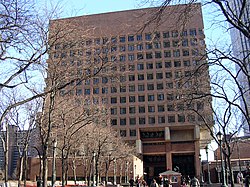
NYPD Headquarters at One Police Plaza
Other Felony Sex Crimes Victims
- Black (33.8%)
- Hispanic (37.3%)
- White (21.3%)
- Asian/Pacific Islander (7.0%)
Other Felony Sex Crime Suspects
- Black (41.6%)
- Hispanic (37.5%)
- White (12.9%)
- Asian/Pacific Islander (7.3%)
Other Felony Sex Crime Arrestees
- Black (34.6%)
- Hispanic (47.4%)
- White (11.3%)
- Asian /Pacific Islander (6.4%)
Robbery Victims
Robbery Suspects
- Black (66.2%
- Hispanic (27.1%)
- White (4.3%)
- Asian/Pacific islander (2.3%)
Robbery Arrestees
- Black (59.4%)
- Hispanic (32.2%)
- White (5.2%)
- Asian/Pacific Islander (3.2%)
Misdemeanor Assault Victims
Misdemeanor Assault Suspects
Misdemeanor Assault Arrestees
Felonious Assault Victims
Felonious Assault Suspects
- Black (53.4%)
- Hispanic (32.6%)
- White (7.9%)
- Asian/Pacific Islanders (5.8%)
Felonious Assault Arrestees
- Black (51. 8%)
- Hispanic (33.1%)
- White (8.3%)
- Asian/Pacific Islanders (6.4%)
Grand Larceny Victims
- Black (24.4%)
- Hispanic (23.0%)
- White (35.9%)
- Asian/Pacific Islanders (15.7%)
Grand Larceny Suspects
- Black (50.5%)
- Hispanic (23.5%)
- White (11.7%)
- Asian/Pacific Islanders (3.9%)
Grand Larceny Arrestees
- Black (51.7%)
- Hispanic (28.5%)
- White (13.7%)
- Asian/Pacific Islanders (6.0%)
Firearm Arrest Population
Shooting Victims
Shooting Suspects
- Black (74.4%)
- Hispanic (22.0%)
- White (2.4%)
- Asian/Pacific Islander (1.1%)
Shooting Arrestees
- Black (71.6%)
- Hispanic (24.1%)
- White (2.7%)
- Asian/Pacific Islander (1.5%)
Drug Felony Arrest Population
- Black (45.0%)
- Hispanic (40.2%)
- White (9.7%)
- Asian Pacific Islanders (4.9%)
Drug Misdemeanor Arrestees
- Black (48.5%)
- Hispanic (35.3%)
- White (12.5%)
- Asian Pacific Islanders (3.6%)
Misdemeanor Sex Crime Victims
- Black (35.5%)
- Hispanic (36.7%)
- White (18.6%)
- Asian/Pacific Islanders (8.6%)
Misdemeanor Sex Crime Suspects
- Black (42.4%)
- Hispanic (34.2%)
- White (14.0%)
- Asian/Pacific Islanders (8.7%)
Misdemeanor Sex Crime Arrestees
- Black (52.5%)
- Hispanic (28.9%)
- White (14.5%)
- Asian/Pacific Islanders (4.0%)
Misdemeanor Stolen Property Arrest Population
- Black (45.9%)
- Hispanic (31.9%)
- White (16.8%)
- Asian/Pacific Islanders (5.1%)
Felony Stolen Property Arrest Population
- Black (54.7%)
- Hispanic (28.6%)
- White (11.5%)
- Asian/Pacific Islanders (5.0%)
Petit Larceny Victims
- Black (31.6%)
- Hispanic (29.9%)
- White (28.8%)
- Asian/Pacific Islanders (12.7%)
Petit Larceny Suspects
- Black (53.8%)
- Hispanic (26.8%)
- White (15.7%)
- Asian/Pacific Islanders (3.3%)
Petit Larceny Arrestees
- Black (44.7%)
- Hispanic (32.5%)
- White (17.9%)
- Asian/Pacific Islanders (3.3%)
Misdemeanor Criminal Mischief Victims
- Black (38.5%)
- Hispanic (29.8%)
- White (19.5%)
- Asian/Pacific Islanders (11.2%)
Misdemeanor Criminal Mischief Suspects
Misdemeanor Criminal Mischief Arrestees
Reported Crime Complaint Juvenile Victims
Juvenile Crime Complaint Suspects
Juvenile Arrest Population
ABC NEWS, ALTERNET, AMERICABLOG, AP, AR-15, ATOMIC BOMB, BABY BOOMER RESISTANCE, BENEATH THE PLANET OF THE APES, BLOOMBERG, BUZZFEED, C-PAC, CBS NEWS, CIA, CNN, CROOKS AND LIARS, DAILY KOZ, DEMOCRATIC PARTY, DONALD TRUMP, DRUDGE REPORT, FACEBOOK, FBI, FIVETHIRTYEIGHT, GUNS, HARPER’S MAGAZINE, MARJORY STONEMAN DOUGLAS HIGH SCHOOL, MEDIA MATTERS, MOTHER JONES, MOVEON, MSNBC, NATIONAL RIFLE ASSOCIATION, NBC NEWS, NEWSWEEK, NPR, NSA, PBS NEWSHOUR, POLITICO, POLITICUSUSA, RAW STORY, REUTERS, RUSSIA, SALON, SANDY HOOK ELEMENTARY SCHOOL, SEATTLE TIMES, SECOND AMENDMENT, SECURITY GUARDS, SLATE, SOCIALISM, TALKING POINTS MEMO, THE ATLANTIC, THE CHICAGO SUN-TIMES, THE CHICAGO TRIBUNE, THE DAILY BEAST, THE DAILY BLOG, THE GUARDIAN, THE HILL, THE HUFFINGTON POST, THE LOS ANGELES TIMES, THE NATION, THE NEW REPUBLIC, THE NEW YORK TIMES, THE VILLAGE VOICE, THE WASHINGTON POST, THINKPROGRESS, TIME, TRUTHDIG, TRUTHOUT, TWITTER, TWO POLITICAL JUNKIES, U.S. NEWS & WORLD REPORT, UPI, USA TODAY, USA TODAY NIKOLAS CRUZ, VLADIMIR PUTIN, WAYNE LAPIERRE, WONKETTE
In Bureaucracy, History, Law, Law Enforcement, Politics, Social commentary on August 26, 2020 at 12:15 am
On February 14, 2018, 19-year-old Nikolas Cruz slaughtered two faculty members and 15 students at Marjory Stoneman Douglas High School in Parkland, Florida.
His weapon of choice: An AR-15 assault rifle, often favored by gun massacre killers.
Eight days later, on February 22, Wayne LaPierre, executive vice president of the National Rifle Association, attacked those he held responsible for the series of massacres plaguing American schools.
And it wasn’t crazed gunmen armed with automatic weapons designed for military use.

Wayne LaPierre
With funerals still being planned for some of the victims, LaPierre blamed “the elites,” “saboteurs” and “new European-style socialists” for this and other gun massacres.
He did so at the Conservative Political Action Conference (C-PAC) in National Harbor, Maryland.
“They hate the NRA, they hate the Second Amendment. They hate individual freedom. In the rush of calls for more government, they have also revealed…their true selves.
“The elites do not care about America’s schoolchildren. If they truly cared, they would protect them. For them, it is not a safety issue. It is a political issue.
“Their goal is to eliminate the Second Amendment and our firearms freedoms, so they can eradicate all individual freedoms.”
His C-PAC congregation gave him a wild ovation.
And he accused the Democratic party of being “infested with saboteurs who do not believe in capitalism, do not believe in the Constitution, do not believe in our freedom, and do not believe in America as we know it.”
These “saboteurs” were “new European-style socialists.”
Which was ironic: In 2016, the NRA spent $30 million to elect Donald Trump—who fiercely defends Russian Communist dictator Vladimir Putin against the FBI, NSA and CIA.
He then outlined his solution for protecting America’s schoolchildren: Turning schools into virtual concentration camps patrolled by heavily-armed security guards.
The highlight of LaPierre’s speech came at its close: “And there is no greater personal, individual freedom than the right to keep and bear arms, the right to protect yourself, and the right to survive.
“It is not bestowed by man, but granted by God to all Americans as our American birthright.”
Anyone who’s seen the 1970 sci-fi movie, Beneath the Planet of the Apes, remembers the final scene: Where seemingly normal underground dwellers strip off their human face masks and reveal themselves to be radiation-scarred mutants.
They wear white robes, and stand silently during a sermon or shout “Amen!” in what is clearly a dark parody of a religious service. It’s immediately clear what they are worshiping: An atomic bomb standing upright.

And they pay tribute to the engine of obliteration that has destroyed human civilization and brought about a world ruled by apes.
Their leader, Mendez, chants:
“Glory be to the Bomb, and to the Holy Fallout. As it was in the beginning, is now, and ever shall be. World without end. Amen.
“His sound has gone out to all lands, and his light unto the end of the world.
“Almighty and everlasting Bomb, who came down among us to make Heaven under Earth. Lighten our darkness. O instrument of God—grant us thy peace!”
Reading Wayne LaPierre’s eulogy to the Gun and his passionate invoking of God, it’s easy to re-imagine his giving a slightly altered version of the sermon offered in Beneath the Planet of the Apes. It’s also easy to imagine this taking place during an NRA convention.
WAYNE LAPIERRE: The heavens declare the Glory of the Gun. And the body-count showeth His handiwork.
NRA CONGREGATION: His sound is gone out to all lands; and his Light unto the end of the world.
LAPIEREE: He descendeth from the outermost part of Heaven; and there is nothing hid from the lead thereof. There is neither speech nor language after His voice is heard among them.
CONGREGATION: Praise Him! Praise Him! My Strength and my Redeemer!
LAPIERRE: Glory be to the Gun, and to the Holy Bodycount! As it was in the Beginning, is now and ever shall be, massacres without end. Amen!
CHORUS: Amen! Amen! Amen! Amen!
LAPIERRE: Almighty and Everlasting Gun, who came down among us to make Heaven unto Earth. Lighten our darkness with your muzzle flashes. O instrument of God, grant us They peace.
CHOIR: Almighty Gun, who destroyed all men—to create corpses! Behold His glory!
LAPIERRE: Behold that Truth that abides in us. To reveal that Truth unto that Maker.
LAPIERRE AND NRA CONGREGATION: I reveal my inmost self unto my God.
CHORUS (singing): Unto my God!
CONGREGATION (singing):
All guns bright and beautiful. All creatures dead with lead.
The good Gun makes us what we are!
He takes out eyes to see with, and lips that might yet speak. How great the Gun Almighty, who has made all things dead. Amen!
WAYNE LAPIERRE: May the Blessing of the Gun Almighty and the fellowship of the Holy Bodycount descend on us all, this night and forevermore!
* * * * * *
Gun Violence Breakdown:
- Every year, 36,000 Americans are killed by guns—about 100 per day.
- Each year, 100,000 Americans are shot and injured .
- One-third of gun deaths are homicides.
- Guns are used in more than 70% of all homicide
- About a fifth are unintentional shootings.
- Gun homicides are concentrated in cities—roughly half of all gun homicides occur in urban areas that contain just a quarter of the total US population.
2008 PRESIDENTIAL CAMPAIGN, 2016 PRESIDENTIAL CAMPAIGN, ABC NEWS, AFFORDABLE CARE ACT, ALTERNET, AMERICABLOG, ANDREW SHAFFER, AP, BABY BOOMER RESISTANCE, BARACK OBAMA, BLOOMBERG, BORDER WALL, BUZZFEED, CBS NEWS, CNN, CROOKS AND LIARS, DAILY KOZ, DON WINSLOW, DONALD TRUMP, DRUDGE REPORT, DRUG ENFORCEMENT ADMINISTRATION, DRUG TRAFFICKING, FACEBOOK, FIVETHIRTYEIGHT, GOODREADS, HARPER’S MAGAZINE, HEROIN, HOPE NEVER DIES (BOOK), JOE BIDEN, JOHN F. KENNEDY, LOS ANGELES TIMES, MEDIA MATTERS, MEXICO, MOTHER JONES, MOVEON, MSNBC, NBC NEWS, NEWSWEEK, NPR, PBS NEWSHOUR, POLITICO, POLITICUSUSA, RAW STORY, REUTERS, RICHARD M. NIXON, ROLLING STONE, SALON, SEATTLE TIMES, SINALOA CARTEL, SLATE, TALKING POINTS MEMO, THE ATLANTIC, THE BORDER (BOOK), THE CHICAGO SUN-TIMES, THE CHICAGO TRIBUNE, THE DAILY BEAST, THE DAILY BLOG, THE GUARDIAN, THE HILL, THE HUFFINGTON POST, THE LOS ANGELES TIMES, THE NATION, THE NEW REPUBLIC, THE NEW YORK TIMES, THE VILLAGE VOICE, THE WASHINGTON POST, THINKPROGRESS, TIME, TRUTHDIG, TRUTHOUT, TWITTER, TWO POLITICAL JUNKIES, U.S. NEWS & WORLD REPORT, UPI, USA TODAY, WAR ON DRUGS, WONKETTE
In Bureaucracy, History, Law Enforcement, Politics, Social commentary on August 21, 2020 at 12:21 am
Presidential legacies live on in unexpected ways.
Right now, the legacies of Barack Obama and Donald Trump are vying for the attention of—fiction readers.
In Hope Never Dies: An Obama-Biden Mystery, author Andrew Shaffer has fashioned a novel that is half-mystery, half-bromance.
Vice President Joe Biden has just left the Obama White House and doesn’t know what he wants to do with the rest of his life. Then Finn Donnelly, his favorite railroad conductor, dies in a suspicious accident, leaving behind an ailing wife and a trail of clues.
To unravel the mystery, “Amtrak Joe” calls on the skills of his former boss: The 44th President of the United States. Together they scour biker bars, cheap motels and other memorable haunts throughout Delaware.![]()
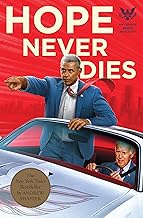
Then Biden unearths a disturbing truth about his longtime—and now dead—friend. This, in turn, leads Biden and Obama to uncover the sinister forces behind America’s opioid epidemic.
The book is pure fantasy fun, as evidenced from this review by Alexandra Alter in The New York Times:
“[Hope Never Dies is] a roughly 300-page work of political fanfiction, an escapist fantasy that will likely appeal to liberals pining for the previous administration, longing for the Obama-Biden team to emerge from political retirement as action heroes. But it’s also at times a surprisingly earnest story about estranged friends who are reunited under strange circumstances.”
A reader named Casey, reviewing the novel for Goodreads, writes: “While Shaffer could have leaned into nostalgia alone, he’s written a solid mystery with the characters fleshed out as more than just cliches.
“The reader really feels Biden’s longing to be helpful and his anguish over seeing 44’s legacy undone so quickly by an individual who shall remain nameless. (The presidential zings in this book are incredible, truly.)
“The tension between the two rings as true as it did when they were in office….By all means, this book shouldn’t work as well as it does. For a few hours, I got to enjoy the company of politicians who behaved like adults (mostly). It sure was nice.”
Contrasting with the relatively lighthearted fictional image of Barack Obama is the immensely darker one of Donald Trump.
Don Winslow offers Trump an extended cameo appearance in The Border, his massive, 736-page novel about America’s war on drugs—and the horrific violence it has spawned in Mexico. It’s the third of a trilogy of novels vividly portraying the violent costs of an unwinnable conflict.
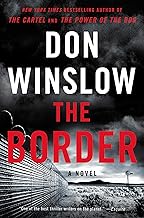
Art Keller is a dedicated agent of the Federal Drug Enforcement Administration (DEA). For over 40 years, he has waged all-out war on Adán Barrera, the godfather of the powerful Sinaloa Cartel.
Appointed director of the DEA, Keller now faces a series of deadly enemies:
- A heroin epidemic surging across America;
- Hitmen who want to kill him;
- Politicians who want to sabotage his agenda; and
- An incoming administration that’s allied with the very drug traffickers he’s trying to destroy.
And heading this administration is John Dennison—Donald Trump in all but name—who:
- Gratuitously insults people on Twitter;
- Fires a Special Counsel;
- Gets blackmailed by a woman he once bedded; and
- Colludes with drug traffickers for a multi-million dollar loan to finance his Presidential campaign.
Whereas the reviews for Hope Never Dies were as upbeat as the book itself, those of The Border reflect the novel’s mercilessly grim take on a war that can’t be won.
Los Angeles Times: “The Border is intricate, mean and swift, a sprawling canvass of characters including narco kingpins, a Guatemalan stowaway, a Staten Island heroin addict, a kinky hit woman, a barely veiled Donald Trump and DEA agent Art Keller, who….has been noble and merciless, a conflicted wanderer who makes America face the transgressions committed in its name.”
Rolling Stone: “Clocking in at over 700 pages, it is his most overtly political installment yet. He takes on the Trump administration directly, creating a fictional candidate, then president, who stokes racist fears of Mexicans, campaigns on ‘building the wall’ and, along with his venal son-in-law, gets caught up in a shady real estate deal involving Cartel money.”
NPR: “The Border becomes a book for our times. Like Shakespeare, it makes a three-act drama of our modern moment. Like Shakespeare’s plays, it shows us a world that is our own, a history that is our own, a burden that is our own, rendered out into the rhythm of scenes and arcs, chapters and parts.”
The signature slogan of Obama’s 2008 Presidential campaign was: “Yes, We Can!” The slogan of Trump’s 2016 effort could have been: “No, You Can’t.”
Obama concentrated the full force of his attention on reforming American healthcare—by making it available to millions whose insurance refused to provide coverage.
Trump’s top priority is to separate the United States from Mexico with an impenetrable wall—and he has even diverted $3.6 billion from Pentagon funding to pay for it.
Like John F. Kennedy, Barack Obama will likely be positively remembered as much for what he tried to do as what he succeeded at doing.
Like Richard M. Nixon, Donald Trump will likely be remembered as a menacing stain on American history.
ABC NEWS, ALTERNET, AMERICABLOG, AP, BABY BOOMER RESISTANCE, BLOOMBERG, BUZZFEED, CBS NEWS, CNN, CONSUMER PROTECTION LAWS, COP KILLER BULLETS, CRIME, CROOKS AND LIARS, DAILY KOZ, DRUDGE REPORT, FACEBOOK, FIVETHIRTYEIGHT, GEORGE ZIMMERMAN, GUN CONTROL, HARPER’S MAGAZINE, LETITIA JAMES, MEDIA MATTERS, MEDICAID, MOTHER JONES, MOVEON, MSNBC, NATIONAL RIFLE ASSOCIATION, NBC NEWS, NEW YORK ATTORNEY GENERAL'S OFFICE, NEWSWEEK, NPR, PBS NEWSHOUR, POLITICO, POLITICUSUSA, PROTECTION OF LAWFUL COMMERCE IN ARMS ACT, RAW STORY, REPUBLICANS, REUTERS, SALON, SEATTLE TIMES, SECOND AMENDMENT, SELF-DEFENSE, SLATE, STAND-YOUR-GROUND LAWS, TALKING POINTS MEMO, TERRORISM, THE ATLANTIC, THE CHICAGO SUN-TIMES, THE CHICAGO TRIBUNE, THE DAILY BEAST, THE DAILY BLOG, THE GUARDIAN, THE HILL, THE HUFFINGTON POST, THE LOS ANGELES TIMES, THE NATION, THE NEW REPUBLIC, THE NEW YORK TIMES, THE VILLAGE VOICE, THE WASHINGTON POST, THINKPROGRESS, TIME, TRUTHDIG, TRUTHOUT, TWITTER, TWO POLITICAL JUNKIES, U.S. CONSTITUTION, U.S. NEWS & WORLD REPORT, UPI, USA TODAY, WAYNE LAPIERRE, WONKETTE, WRONGFUL-DEATH LAWSUITS
In Bureaucracy, History, Law, Law Enforcement, Politics, Social commentary on August 18, 2020 at 1:20 am
On August 6, New York Attorney General Letitia James gave the National Rifle Association (NRA) an unprecedented broadside.
“The NRA’s influence has been so powerful that the organization went unchecked for decades while top executives funneled millions into their own pockets,” James outlined in a news release.
And she assailed the organization’s leadership for creating “a culture of self-dealing mismanagement” benefiting themselves, family, friends and favored vendors.
As a result, the NRA had lost more than $63 million in three years.
James’ office filed the suit on August 6 in New York Supreme Court. In it, she accuses the following NRA leaders of corruption and misuse of funds:
- CEO and Executive Vice President Wayne LaPierre;
- General Counsel and Secretary John Frazer;
- Former Chief Financial Officer Wilson “Woody” Phillips; and
- Former Chief of Staff and Executive Director of General Operations Josh Powell.

Wayne LaPierre
The lawsuit accuses these officials of:
- Violating multiple laws including false reporting of annual filings with the IRS and New York’s charities bureau
- Improperly documenting expenses, improper wage and income tax reporting and
- Excessively paying people for work for which they were not qualified.
The NRA is headquartered in the Northern Virginia suburbs outside Washington, D.C. But it has operated as a New York-registered 501(c)(4) non-profit group since 1871.
As a charitable organization, the NRA faces strict state and federal rules governing spending. The alleged violation of many of those rules gives James’ office legal jurisdiction for bringing the lawsuit.
The NRA has long been one of the nation’s most powerful special interest groups. It has dominated Republican politics for decades. With a reported five million members across the country, it claims as its mission the defense of the Second Amendment right to bear arms.
The NRA claims that its mission stems from the Second Amendment to the United States Constitution, which states: “A well regulated Militia, being necessary to the security of a free State, the right of the people to keep and bear Arms, shall not be infringed.”
NRA members conveniently ignore the first half of that sentence about “a well regulated Militia….” They simply want everyone to own a gun—and contribute to the NRA.
The charges now facing the NRA are not the ones for which it truly deserves indictment.
For decades, the NRA has been the death-dealer of choice to criminals and terrorists. In its wake lie the bullet-torn, bloodstained bodies of countless Americans from coast to coast.
According to the non-profit organization, Brady: United Against Gun Violence:
Every year, 114,328 people are shot. Among those:
- 37,603 people die from gun violence
- 13,380 are murdered
- 76,725 people survive gunshot injuries
- 34,566 are intentionally shot by someone else
- 22,926 died from gun suicide
- 3,554 survive an attempted gun suicide
- 478 are killed unintentionally
- 510 are killed by legal intervention
- 1,376 are shot by legal intervention
- 310 die but the intent was unknown
- 4,471 are shot but the intent is unknown
- 529 women are killed by their husband or male dating partner
Gun Violence is estimated to cost the American economy at least $229 billion every year.
Among the NRA’s “contributions” to this carnage:
- For decades, the NRA has peddled deadly weapons to millions, reaped billions of dollars in profits and refused to admit the carnage those weapons have produced: “Guns don’t kill people. People kill people.” With guns.
- It championed the marketing of Teflon-coated “cop killer” bullets capable of piercing the bulletproof vests worn by police officers and targets of assassination.
- The NRA opposes removing firearms from violent individuals under active restraining orders for domestic abuse.
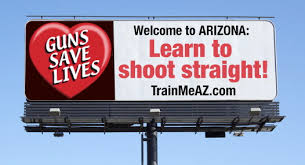
- The NRA has bitterly fought background checks on gun-buyers, in effect granting even criminals and the mentally ill the right to own arsenals of death-dealing weaponry.
- The NRA has spent millions on slick advertising campaigns to win new members and frighten them into buying guns.
- The NRA rammed through a Republican-dominated Congress the Protection of Lawful Commerce in Arms Act, (PLCAA). It was signed into law by President George W. Bush in 2005. This has armed the American firearms industry with immunity against lawsuits by victims of mass shootings and gun violence.
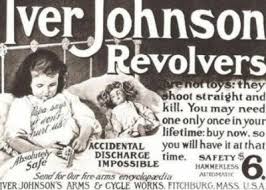
- The NRA has spent millions on political contributions to block gun-control legislation.
- The NRA has spent millions attacking political candidates and elected officials who warned about the dangers of unrestricted access to assault and/or concealed weapons.

- The NRA has spent millions pushing “Stand Your Ground” laws in more than half the states, which potentially give every citizen a “license to kill.”
- In 2012, the NRA rushed to defend accused murderer George Zimmerman, the self-appointed “community watchman” who ignored police orders to stop following 17-year-old Trayvon Martin and ultimately shot him.
- The NRA receives millions of dollars from online sales of ammunition, high-capacity ammunition magazines, and other accessories through its point-of-sale Round-Up Program—thus directly profiting by selling a product that kills about 30,288 people a year.
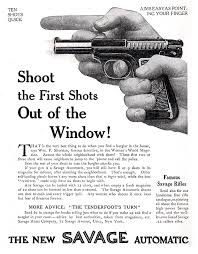
- Anyone–including convicted criminals—can buy the NRA’s “hide-a-gun” sweatshirts, putting both the public and law enforcers at deadly risk.
- Firearms made indiscriminately available through NRA lobbying have filled hospitals with casualties, and have thus badly strained the states’ public healthcare systems.
The NRA’s leaders—past and present—will never be criminally indicted for the carnage their greed and irresponsibility have unleashed.
But the effort by New York Attorney General Letitia James to dissolve the NRA is at least a welcome step in the right direction.
ABC NEWS, ALGIER HISS, ALTERNET, AMERICABLOG, AP, BABY BOOMER RESISTANCE, BARACK OBAMA, BENJAMIN C. BRADLEE, BILL CLINTON, BLOOMBERG, BUZZFEED, CBS NEWS, CBSNEWS, CNN, CROOKS AND LIARS, DAILY KOZ, DANIEL ELLSBURG, DRUDGE REPORT, FACEBOOK, FIVETHIRTYEIGHT, FRENCH LEGION OF HONOR, HARPER’S MAGAZINE, JASON ROBARDS, JOHN F. KENNEDY, JOURNALISM, LYNDON B. JOHNSON, MEDIA MATTERS, MOTHER JONES, MOVEON, MSNBC, NBC NEWS, NEWSWEEK, NPR, PBS NEWSHOUR, PENTAGON PAPERS, POLITICO, POLITICUSUSA, RAW STORY, REPUBLICAN PARTY, REPUBLICANS, REUTERS, RICHARD NIXON, SALON, SEATTLE TIMES, SLATE, TALKING POINTS MEMO, THE ATLANTIC, THE CHICAGO SUN-TIMES, THE CHICAGO TRIBUNE, THE DAILY BEAST, THE DAILY BLOG, THE GUARDIAN, THE HILL, THE HUFFINGTON POST, THE LOS ANGELES TIMES, THE NATION, THE NEW REPUBLIC, THE NEW YORK TIMES, THE PENTAGON PAPERS, THE VILLAGE VOICE, THE WALL STREET JOURNAL, THE WASHINGTON POST, THE WASHINGTONPOST, THINKPROGRESS, TIME, TRUTHDIG, TRUTHOUT, TWITTER, TWO POLITICAL JUNKIES, U.S. NEWS & WORLD REPORT, UPI, USA TODAY, WATERGATE, WONKETTE, WORLD WAR 11
In Bureaucracy, History, Law Enforcement, Politics, Social commentary on August 14, 2020 at 12:11 am
August 9, 2020, marked an anniversary increasingly fewer Americans remember: Forty-six years to the day that Richard Milhous Nixon, 37th President of the United States, resigned in disgrace.
Benjamin Crowninshield Bradlee, the former executive editor of The Washington Post, remains virtually unknown outside the journalism profession. Yet his paper did more than any other to bring Nixon down.
Both Nixon and Bradlee were driven to succeed. And both achieved fame and power in doing so.
Bradlee made his name in journalism.
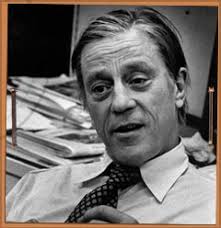
Benjamin C. Bradlee
Nixon made his name in politics.
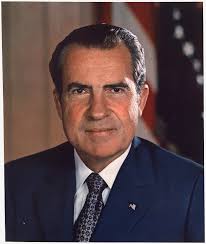
Richard Nixon
Both served in the United States Navy in the Pacific during World War II.
Both had strong connections to John F. Kennedy.
- Bradlee knew him as a friend and reporter during JFK’s years as a Senator and President.
- Nixon—as a Senator and later Vice President—knew Kennedy as a Senatorial colleague and as a political adversary, unsuccessfully contesting him for the Presidency in 1960.
For both, 1948 was a pivotal year.
- Bradlee joined The Washington Post as a reporter.
- Nixon, as a U.S. Representative, accused Algier Hiss, a former State Department official, of having been a Communist spy. Hiss was eventually convicted of perjury and sent to prison.
Both reached their positions of maximum power in 1968:
- Bradlee became executive editor of The Washington Post.
- Nixon became the 37th President of the United States.
But there was a fundamental difference between them:
- Bradlee made it his business to dig up the truth.
- Nixon made it his business to distort the truth—or to conceal it when distortion wasn’t enough.
Nixon and Bradlee had their first major clash in 1971 with the Pentagon Papers, a secret government study of how the United States became enmeshed in the Vietnam war.
- Although the Papers concerned events that had occurred during the Presidencies of John F. Kennedy and Lyndon B. Johnson, Nixon was outraged at their release by a former Defense Department analyst named Daniel Ellsberg.
- Bradlee, as executive editor of The Washington Post, successfully urged his publisher, Katherine Graham, to publish the papers after The New York Times was enjoined from doing so.
- The controversy ended when the Supreme Court ruled, 6–3, that the government failed to meet the burden of proof required for prior restraint of the press.
In 1972, Bradlee and Nixon squared off for their most important battle—a “third-rate burglary” of the Democratic National Committee headquarters at the Watergate Hotel.
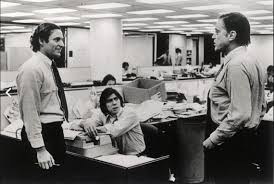
Bob Woodward, Carl Bernstein and Benjamin C. Bradlee
- Bradlee backed two young, aggressive reporters named Bob Woodward and Carl Bernstein, as they probed the burglary.
- This led to their discovering a series of illegal dirty tricks the Nixon re-election campaign had aimed at various Democratic opponents.
- The Post’s revelations led to the formation of the Senate Watergate Committee, the discovery of Nixon’s tape-recordings of his private—and criminal—conversations, and, finally, to Nixon’s own resignation in disgrace on August 9, 1974.
Bradlee became an advocate for education and the study of history.Nixon entered history as the only American President forced to resign from office.
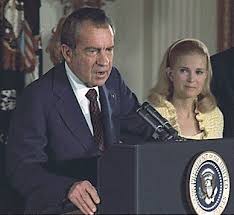
:Richard Nixon saying farewell at the White House
Bradlee became a media celebrity. Nixon became a media target.
- Bradlee was portrayed by Jason Robards in the hit 1976 film, All the President’s Men (for which he won an Academy Award for Best Supporting Actor).
- Nixon was portrayed—in Oliver Stone’s 1995 drama, Nixon—by Anthony Hopkins.
Bradlee and Nixon each published a series of books.
- Bradlee’s: That Special Grace and Conversations With Kennedy focused on his longtime friendship with John F. Kennedy; A Good Life: Newspapering and Other Adventures was Bradlee’s memoirs.
- Nixon’s: Among his 11 titles: Six Crises; RN: The Memoirs of Richard Nixon; The Real War; Leaders; Real Peace; No More Vietnams; Beyond Peace.
After leaving the White House, Nixon worked hard behind-the-scenes to refashion himself into an elder statesman of the Republican Party.
- Throughout the 1980s, he traveled the lecture circuit, wrote books, and met with many foreign leaders, especially those of Third World countries.
- He supported Ronald Reagan for president in 1980, making television appearances portraying himself as the senior statesman above the fray.
- For the rest of his life, he fought ferociously through the courts to prevent the release of most of the infamous “Watergate tapes” that chronicled his crimes as President.
- Only since his death have many of these been made public.
Nixon died on April 22, 1994.
- Eulogists at his funeral included President Bill Clinton and former Presidents Gerald Ford, Ronald Reagan and George H.W. Bush, California Governor Pete Wilson and the Reverend Billy Graham.
- Despite his efforts to portray himself as an elder statesman, Nixon could never erase his infamy as the only President to resign in disgrace.
- To this day, he remains a nonperson within the Republican Party.
Bradlee remained executive editor of The Washington Post until retiring in 1991. But he continued to serve as vice president-at-large until his death on October 21, 2014.
- In 2007, he received the French Legion of Honor, the highest award given by the French government, at a ceremony in Paris.
- In 2013, he was named as a recipient of the Presidential Medal of Freedom by President Barack Obama. He was presented the medal at a White House ceremony on November 20, 2013.
2020 PRESIDENTIAL CAMPAIGN, ABC NEWS, ALTERNET, AMERICABLOG, AP, BABY BOOMER RESISTANCE, BLOOMBERG, BUZZFEED, CALIFORNIA ATTORNEY GENERAL, CBS NEWS, CNN, CROOKS AND LIARS, DAILY KOZ, DEMOCRATS, DISTRICT ATTORNEY OF SAN FRANCISCO, DONALD TRUMP, DRUDGE REPORT, FACEBOOK, FIVETHIRTYEIGHT, GEORGETOWN UNIVERSITY’S INSTITUTE OF POLITICS AND PUBLIC SERVICE, GRETCHEN WHI8TMER, HARPER’S MAGAZINE, ILLEGAL ALIENS, IMMIGRATION LAWS, JOE BIDEN, Kamala Harris, LAW ENFORCEMENT, MEDIA MATTERS, MO ELLEITHEE, MOTHER JONES, MOVEON, MSNBC, NBC NEWS, NEWSWEEK, NPR, PBS NEWSHOUR, POLITICO, POLITICUSUSA, RAW STORY, REPUBLICANS, REUTERS, SALON, SAN FRANCISCO, SEATTLE TIMES, SENATE JUDICIARY COMMITTEE, SLATE, TALKING POINTS MEMO, TAMMY DUCKWORTH, THE ATLANTIC, THE CHICAGO SUN-TIMES, THE CHICAGO TRIBUNE, THE DAILY BEAST, THE DAILY BLOG, THE GUARDIAN, THE HILL, THE HUFFINGTON POST, THE LOS ANGELES TIMES, THE NATION, THE NEW REPUBLIC, THE NEW YORK TIMES, THE TRUTHS WE HOLD (BOOK), THE VILLAGE VOICE, THE WASHINGTON POST, THINKPROGRESS, TIME, TRUTHDIG, TRUTHOUT, TWITTER, TWO POLITICAL JUNKIES, U.S. NEWS & WORLD REPORT, UNITED STATES SENATE, UPI, USA TODAY, VIOLENT CRIME CONTROL AND LAW ENFORCEMENT ACT OF 1994, WONKETTE
In Bureaucracy, History, Law, Law Enforcement, Politics, Social commentary on August 13, 2020 at 12:37 am
On August 11, former Vice President Joe Biden—now the Democratic nominee for President—chose California United States Senator Kamala Harris as his Vice Presidential running mate.
Harris had served as District Attorney of San Francisco (2004 – 2011) and as California Attorney General (2011 – 2017). Then, in 2016, she won election to the United States Senate.
In 2019, she ran for the Presidency of the United States. But after 11 months of failing to win major support among voters, she withdrew from the race on December 3.
To tout her candidacy, she had published her memoirs: The Truths We Hold. In these, she described herself as a “progressive prosecutor.”
But among the truths she holds secret: When she served as District Attorney for San Francisco, she set up a secret unit to keep even convicted illegal alien felons out of prison—and in the United States.

Today, with millions of illegal aliens from Central and Latin America flooding into the United States, the spotlight has shifted from the incarceration of blacks to that of Hispanics.
Illegal immigration—and what to do about it—is now the hottest political issue in the country.
For liberals of the Democratic party, “open borders” appears to be the solution to illegal immigration. Yet the vast majority of Americans support legal immigration—while rejecting illegal immigration.
And Kamala Harris’ record as San Francisco District Attorney is hardly reassuring on this issue.
Secretly, she created a program, called Back on Track, to train convicted illegal aliens for jobs they could not legally hold. This was a flagrant violation of Federal immigration law.
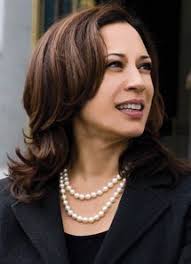
U.S. Senator Kamala Harris
Completion led to the expunging of a felony conviction, making it highly popular among convicted criminals.
One such alumnus was Alexander Izaguirre, an illegal alien who had been arrested twice within eight months—for purse-snatching and selling cocaine.
In July, 2008, four months after pleading guilty to selling cocaine, Izaguirre assaulted Amanda Kiefer, a legal San Francisco resident.
Snatching her purse, he jumped into an SUV, then tried to run Kiefer down. Terrified, she leaped onto the hood and saw Izaguirre and a driver laughing.
The driver slammed on the brakes, sending Kiefer flying onto the pavement and fracturing her skull.
D.A.’s office let illegal immigrants go https://tinyurl.com/yyhp3hb6
Back on Track became a centerpiece of Harris’ campaign for state Attorney General.
Until the the Los Angeles Times questioned her about the Izaguirre case, Harris had never publicly admitted that the program included illegal aliens.
Harris claimed she first learned that illegal aliens were training for jobs only after Izaguirre was arrested for the Kiefer assault.
Harris said it was a “flaw in the design” of the program to let illegal aliens into the program. “I believe we fixed it,” she told the Times.
Harris never released statistics on how many illegal aliens were included since the program started in 2005.
She said that after Izaguirre’s arrest she never asked—or learned—how many illegal aliens were in Back on Track. A strange lapse in curiosity for a prosecutor charged with enforcing the law.
When Harris learned that illegal aliens were enrolled, she allowed those who were following the rules to finish the program and have their criminal records expunged.

It is not the duty of local law enforcement, she said, to enforce Federal immigration laws.
So much for her oath to faithfully defend the Constitution of the United States and that of the state of California “against all enemies, foreign and domestic.”
From 2005 to 2009, 113 admitted drug dealers graduated from Back on Track. Another 99 were kicked off the program for failing to meet the requirements. They were sentenced under their guilty plea, the D.A.’s office claimed.
Harris told the Times that graduates of Back on Track were less likely than other offenders to commit crimes again. But her spokeswoman refused to offer detailed statistics to back this up.
When Harris became San Francisco District Attorney, she vowed she would “never charge the death penalty.”
Amanda Kiefer left California. Interviewed by the Times, she said she could not understand why San Francisco police and prosecutors would allow convicted illegal aliens back onto the streets.
“If they’re committing crimes,” she said, “I think there’s something wrong that they’re not being deported.”
At the outset of his Presidential campaign, Joe Biden pledged to choose a woman for his Vice Presidential running mate. Among those he could have chosen:
- Michigan Governor Gretchen Whitmer, who stood up to Trump-inspired anti-mask protesters threatening violence; and
- Illinois United States Senator Tammy Duckworth, who, as an Army officer, lost both legs in Iraq in 2004 after her helicopter was shot down by Iraqi insurgents.
Either would have lent significant gravitas to Biden’s candidacy. But Whitmer and Duckworth suffered the misfortune of being white—at a time when Uber liberals were demanding that Biden pick a “woman of color.”
By which they meant: Any color other than white.
Illegal immigration is President Donald Trump’s signature issue. And he has already tried to portray Biden as soft on crime and harsh on police.
Harris, with her record of protecting criminal illegal aliens at the expense of law-abiding American citizens, will easily fit both of these descriptions.
1968 PRESIDENTIAL CAMPAIGN, 2020 PRESIDENTIAL CAMPAIGN, ABC NEWS, ALTERNET, AMERICABLOG, AMERICAN INDIANS, AP, BABY BOOMER RESISTANCE, BARBARA GARSON, BLACK LIVES MATTER, BLOOMBERG, BUZZFEED, CBS NEWS, CIVIL RIGHTS, CNN, COMING APART: AMERICA IN THE 1960S (BOOK), CROOKS AND LIARS, DAILY KOZ, DEMOCRATS, DRUDGE REPORT, EUGENE MCCARTHY, FACEBOOK, FIVETHIRTYEIGHT, GEORGE BERNARD SHAW, GROSS NATIONAL PRODUCT, HARPER’S MAGAZINE, JIM SLATTERY, JOHN F. KENNEDY, Kamala Harris, KANSAS STATE UNIVERSITY, LOOK MAGAZINE, LYNDON B. JOHNSON, MCBIRD!, MEDIA MATTERS, MISSISSIPPI, MOTHER JONES, MOVEON, MSNBC, NBC NEWS, NEWSWEEK, NPR, PBS NEWSHOUR, POLITICO, POLITICUSUSA, RAW STORY, REPUBLICANS, REUTERS, ROBERT F. KENNEDY, SALON, SEATTLE TIMES, SIRHAN SIRHAN, SLATE, SOPHOCLES, STANLEY TRETICK, TALKING POINTS MEMO, TET OFFENSIVE, THE ATLANTIC, THE CHICAGO SUN-TIMES, THE CHICAGO TRIBUNE, THE DAILY BEAST, THE DAILY BLOG, THE GUARDIAN, THE HILL, THE HUFFINGTON POST, THE LOS ANGELES TIMES, THE NATION, THE NEW REPUBLIC, THE NEW YORK TIMES, THE VILLAGE VOICE, THE WASHINGTON POST, THINKPROGRESS, TIME, TIME MAGAZINE, TRUTHDIG, TRUTHOUT, TWITTER, TWO POLITICAL JUNKIES, U.S. NEWS & WORLD REPORT, UNIVERSITY OF KANSAS, UPI, USA TODAY, VIETNAM WAR, WILLIAM L. O'NEIL, WONKETTE
In Bureaucracy, History, Law, Law Enforcement, Military, Politics, Social commentary on August 12, 2020 at 1:26 am
On March 18, 1968, Presidential candidate Robert F. Kennedy, speaking at the University of Kansas, called on his fellow citizens to show compassion for those less fortunate and in need of relief through the Federal Government.
“If we believe that we, as Americans, are bound together by a common concern for each other, then an urgent national priority is upon us. We must begin to end the disgrace of this other America.”
Finally, Kennedy did something almost no other politician—in his time or since—has ever done: He dared to attack that holy-of-holies, the Gross Domestic Product (then called the Gross National Product).
“If we believe that we, as Americans, are bound together by a common concern for each other, then an urgent national priority is upon us. We must begin to end the disgrace of this other America.
“Too much and for too long, we seemed to have surrendered personal excellence and community values in the mere accumulation of material things. Our Gross National Product, now, is over $800 billion dollars a year, but that Gross National Product….counts air pollution and cigarette advertising, and ambulances to clear our highways of carnage.
“It counts special locks for our doors and the jails for the people who break them. It counts the destruction of the redwood and the loss of our natural wonder in chaotic sprawl. It counts napalm and counts nuclear warheads and armored cars for the police to fight the riots in our cities. It counts Whitman’s rifle and Speck’s knife, and the television programs which glorify violence in order to sell toys to our children.
“Yet the Gross National Product does not allow for the health of our children, the quality of their education or the joy of their play. It does not include the beauty of our poetry or the strength of our marriages, the intelligence of our public debate or the integrity of our public officials.
“It measures neither our wit nor our courage, neither our wisdom nor our learning, neither our compassion nor our devotion to our country. It measures everything in short, except that which makes life worthwhile. And it can tell us everything about America except why we are proud that we are Americans….

Senator Robert F. Kennedy campaigning for President
“George Bernard Shaw once wrote, ‘Some people see things as they are and say why? I dream things that never were and say, why not?’
“So I come here to Kansas to ask for your help. In the difficult five months ahead, before the convention in Chicago. I ask for your help and for your assistance.
“If you believe that the United States can do better. If you believe that we should change our course of action. If you believe that the United States stands for something here internally as well as elsewhere around the globe, I ask for your help and your assistance and your hand over the period of the next five months.
“And when we win in November….and we begin a new period of time for the United States of America, I want the next generation of Americans to look back upon this period and say as they said of Plato: ‘Joy was in those days, but to live.’ Thank you very much.”
At the end of Kennedy’s wildly popular speech at Kansas State University, photographer Stanley Tretick, of Look magazine, shouted, “This is Kansas, fucking Kansas! He’s going all the fucking way!”
But he didn’t go all the way. On June 5, 1968—82 days after announcing his Presidential candidacy—an assassin’s bullet suddenly halted his short-lived campaign—and his life.

Robert Kennedy’s funeral train
Historian William L. O’Neil delivered a poignant summary of Robert Kennedy’s legacy in his 1971 book, Coming Apart: An Informal History of America in the 1960′s:
“He aimed so high that he must be judged for what he meant to do, and through error and tragic accident, failed at…..He will also be remembered as an extraordinary human being who, though hated by some, was perhaps more deeply loved by his countrymen than any man of his time.
“That, too, must be entered into the final account, and it is no small thing. With his death, something precious vanished from public life.”
As United States Attorney General (1961-1964) Robert F. Kennedy had the courage to wage all-out war on the Mafia. As a United States Senator (1964-1968) he had the compassion to champion aid to impoverished Americans.
Even in his own era—a half-century ago—Robert Kennedy stood out as the only major Presidential candidate who could legitimately make both claims.
Today, most Democrats—battered by decades of Republican charges that they’re “big spenders”—fear supporting big-ticket items to help the poor.
And the Black Lives Matter movement has made any connection to law enforcement a disqualification for higher office—as former California Attorney General Kamala Harris found out as a 2020 Presidential candidate.
America may never again see a Presidential candidate who can combine a strong stand against crime with an equally strong commitment to helping the poor and disadvantaged.
1968 PRESIDENTIAL CAMPAIGN, 2020 PRESIDENTIAL CAMPAIGN, ABC NEWS, ALTERNET, AMERICABLOG, AMERICAN INDIANS, AP, BABY BOOMER RESISTANCE, BARBARA GARSON, BLACK LIVES MATTER, BLOOMBERG, BUZZFEED, CBS NEWS, CIVIL RIGHTS, CNN, COMING APART: AMERICA IN THE 1960S (BOOK), CROOKS AND LIARS, DAILY KOZ, DEMOCRATS, DRUDGE REPORT, EUGENE MCCARTHY, FACEBOOK, FIVETHIRTYEIGHT, GEORGE BERNARD SHAW, GROSS NATIONAL PRODUCT, HARPER’S MAGAZINE, JIM SLATTERY, JOHN F. KENNEDY, Kamala Harris, KANSAS STATE UNIVERSITY, LOOK MAGAZINE, LYNDON B. JOHNSON, MCBIRD!, MEDIA MATTERS, MISSISSIPPI, MOTHER JONES, MOVEON, MSNBC, NBC NEWS, NEWSWEEK, NPR, PBS NEWSHOUR, POLITICO, POLITICUSUSA, RAW STORY, REPUBLICANS, REUTERS, ROBERT F. KENNEDY, SALON, SEATTLE TIMES, SIRHAN SIRHAN, SLATE, SOPHOCLES, STANLEY TRETICK, TALKING POINTS MEMO, TET OFFENSIVE, THE ATLANTIC, THE CHICAGO SUN-TIMES, THE CHICAGO TRIBUNE, THE DAILY BEAST, THE DAILY BLOG, THE GUARDIAN, THE HILL, THE HUFFINGTON POST, THE LOS ANGELES TIMES, THE NATION, THE NEW REPUBLIC, THE NEW YORK TIMES, THE VILLAGE VOICE, THE WASHINGTON POST, THINKPROGRESS, TIME, TIME MAGAZINE, TRUTHDIG, TRUTHOUT, TWITTER, TWO POLITICAL JUNKIES, U.S. NEWS & WORLD REPORT, UNIVERSITY OF KANSAS, UPI, USA TODAY, VIETNAM WAR, WILLIAM L. O'NEIL, WONKETTE
In Bureaucracy, History, Law, Law Enforcement, Military, Politics, Social commentary on August 11, 2020 at 12:07 am
On March 18, 1968, Presidential candidate Robert F. Kennedy did what few politicians have ever done: He accepted public responsibility for a war that had since become a national disaster—the Vietnam war.
Addressing a packed audience of students and faculty at Kansas State University, he said:
“Let me begin this discussion with a note both personal and public. I was involved in many of the early decisions on Vietnam, decisions that helped set us on our present path.
“It may be that the effort was doomed from the start; that it was never really possible to bring all the people of South Vietnam under the rule of the successive governments we supported—governments, one after another, riddled with corruption, inefficiency, and greed; governments which did not and could not successfully capture and energize the national feeling of their people.
“If that is the case, as it well may be, then I am willing to bear my share of the responsibility, before history and before my fellow citizens. But past error is no excuse for its own perpetuation. Tragedy is a tool for the living to gain wisdom, not a guide by which to live.
“Now as ever, we do ourselves best justice when we measure ourselves against ancient tests, as in the Antigone of Sophocles: ‘All men make mistakes, but a good man yields when he knows his course is wrong, and repairs the evil. The only sin is pride.’
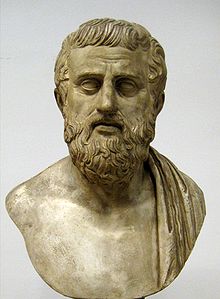
Sophocles
And he dared to attack the war as more than a military and political disaster: He saw it as a stain on America’s moral fiber:
“Can we ordain to ourselves the awful majesty of God—to decide what cities and villages are to be destroyed, who will live and who will die, and who will join the refugees wandering in a desert of our own creation?
“If it is true that we have a commitment to the South Vietnamese people, we must ask, are they being consulted—in Hue, or Ben Tre, or in the villages from which the three million refugees have fled?
“If they believe all the death and destruction are a lesser evil than the Wet Cong, why did they not warn us when the Viet Cong came into Hue, and the dozens of other cities, before the Tet Offensive? Why did they not join the fight?
“Will it be said of us, as Tacitus said of Rome: ‘They made a desert and called it peace?'”
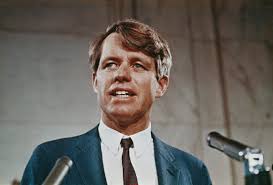
Robert F. Kennedy
The students gave him an ovation worthy of a rock star.
Time correspondent Hays Gorey said the electricity between Kennedy and the K.S.U. students was “real and rare.” “A good part of it is John F. Kennedy’s, of course, but John Kennedy …himself couldn’t be so passionate, and couldn’t set off such sparks.”
Jim Slattery, who would later be elected to Congress from Kansas, reread the K.S.U. speech during the second Iraq war and decided it was so powerful “because Kennedy was talking about what was right!”
As Kennedy started to leave, students rushed the platform where he stood, knocking over chairs and grabbing at him. They stroked his hair and ripped his shirtsleeves.
Later that day, Kennedy addressed another wildly enthusiastic audience—at the University of Kansas, in Lawrence, Kansas.
Then he addressed the glaring disparities between rich and poor Americans—a topic now generally ignored by Democrats and turned into an attack line by Republicans:
“All around us, all around us….men have lost confidence in themselves, in each other. It is confidence which has sustained us so much in the past. Rather than answer the cries of deprivation and despair….hundreds of communities and millions of citizens are looking for their answers, to force and repression and private gun stocks— so that we confront our fellow citizen across impossible barriers of hostility and mistrust.
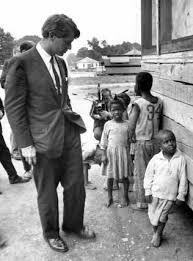
Robert F. Kennedy talking with black children
“And again, I don’t believe that we have to accept that. I don’t believe that it’s necessary in the United States of America. I think that we can work together. I don’t think that we have to shoot at each other, to beat each other, to curse each other and criticize each other, I think that we can do better in this country. And that is why I run for President of the United States….
“I have seen children in Mississippi starving, their bodies so crippled from hunger and their minds have been so destroyed for their whole life that they will have no future. I have seen children in Mississippi—here in the United States—with a gross national product of $800 billion dollars.
“I have seen children in the Delta area of Mississippi with distended stomachs, whose faces are covered with sores from starvation, and we haven’t developed a policy so we can get enough food so that they can live, so that their children, so that their lives are not destroyed, I don’t think that’s acceptable in the United States of America and I think we need a change.”
1968 PRESIDENTIAL CAMPAIGN, 2020 PRESIDENTIAL CAMPAIGN, ABC NEWS, ALTERNET, AMERICABLOG, AMERICAN INDIANS, AP, BABY BOOMER RESISTANCE, BARBARA GARSON, BLACK LIVES MATTER, BLOOMBERG, BUZZFEED, CBS NEWS, CIVIL RIGHTS, CNN, COMING APART: AMERICA IN THE 1960S (BOOK), CROOKS AND LIARS, DAILY KOZ, DEMOCRATS, DRUDGE REPORT, EUGENE MCCARTHY, FACEBOOK, FIVETHIRTYEIGHT, GEORGE BERNARD SHAW, GROSS NATIONAL PRODUCT, HARPER’S MAGAZINE, JIM SLATTERY, JOHN F. KENNEDY, Kamala Harris, KANSAS STATE UNIVERSITY, LOOK MAGAZINE, LYNDON B. JOHNSON, MCBIRD!, MEDIA MATTERS, MISSISSIPPI, MOTHER JONES, MOVEON, MSNBC, NBC NEWS, NEWSWEEK, NPR, PBS NEWSHOUR, POLITICO, POLITICUSUSA, RAW STORY, REPUBLICANS, REUTERS, ROBERT F. KENNEDY, SALON, SEATTLE TIMES, SIRHAN SIRHAN, SLATE, SOPHOCLES, STANLEY TRETICK, TALKING POINTS MEMO, TET OFFENSIVE, THE ATLANTIC, THE CHICAGO SUN-TIMES, THE CHICAGO TRIBUNE, THE DAILY BEAST, THE DAILY BLOG, THE GUARDIAN, THE HILL, THE HUFFINGTON POST, THE LOS ANGELES TIMES, THE NATION, THE NEW REPUBLIC, THE NEW YORK TIMES, THE VILLAGE VOICE, THE WASHINGTON POST, THINKPROGRESS, TIME, TIME MAGAZINE, TRUTHDIG, TRUTHOUT, TWITTER, TWO POLITICAL JUNKIES, U.S. NEWS & WORLD REPORT, UNIVERSITY OF KANSAS, UPI, USA TODAY, VIETNAM WAR, WILLIAM L. O'NEIL, WONKETTE
In Bureaucracy, History, Law, Law Enforcement, Military, Politics, Social commentary, Uncategorized on August 10, 2020 at 1:37 am
He remains forever frozen in time—young, vigorous, with tousled hair and a high-pitched voice calling on Americans to do better for those less fortunate.
It’s been 52 years since his life was brutally cut short—yet he remains forever the age at which he died: 42. Born in 1925, he would turn 95 on November 20 if he were alive today.
And he exuded an idealism which seems totally out of place with today’s “I’ve-got-mine-so-screw-you” politics.
On March 16, 1968, from the Caucus Room of the Old Senate Office building, New York Senator Robert F. Kennedy declared his candidacy for President of the United States.
Eight years earlier, on January 2, 1960, his brother, Massachusetts Senator John F. Kennedy had announced his own candidacy for the Democratic presidential nomination from the same place.
Ten months later, on November 8, that campaign had ended in victory with his election. And that victory, in turn, ended in bitter sorrow with his assassination two years, 10 months and two days later on November 22, 1963.
Robert F. Kennedy’s presidential campaign would not last as long as his late brother’s. Nor would it end in the victory he and his supporters yearned for.
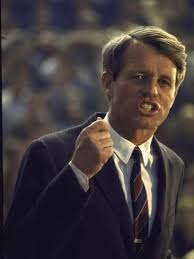
Robert F. Kennedy
Eighty-two days later, he was dead—shot in the back of the head by Sirhan Sirhan, a Palestinian Arab furious at Kennedy’s avowed support for Israel.
For Kennedy, making up his mind to run for the Presidency was no easy task.
Since the assassination of his brother, millions of Americans had assumed—as his admirers or detractors—that he would one day become President.
For his admirers, there was an element of “the once and future king” about this young, intense man with tousled hair and a high-pitched voice.He—they believed—was the man who would somehow avenge his martyred brother by restoring “Camelot” and returning youth, energy and idealism to the White House.
A playwright—Barbara Garson—had even written a 1967 satire depicting then-President Lyndon B. Johnson as the MacBeth-like murderer of John Ken O-Dunc. In the end, he was confronted and killed by Robert Ken O’Dunc.

His detractors saw him as a ruthless upstart who wanted to foist too-liberal policies on the United States. They distrusted his sympathy for the downtrodden—especially blacks and Hispanics. Worse, they saw the Kennedy family as trying to found a dynasty of Presidents that could last until the mid-1980s.
But the real Robert Kennedy was long torn between running against Johnson—whom he had long personally loathed—and letting someone else do so.
Kennedy’s hatred of Johnson—and his irrational belief that LBJ was somehow responsible for his brother’s death—was well-known. And Kennedy feared that if he ran against Johnson, his many enemies would charge he was doing so out of personal animosity.
And there was another reason: Johnson, who had won the Presidency in a landslide in 1964, was certain to seek re-election in 1968. If Kennedy challenged him for the nomination, it might well split the party and result in the election of a Republican that November. And he—Kennedy—would be blamed for it.
Throughout 1966-7, Kennedy was urged to run against Johnson. Still, he dithered.
Then, on March 12, Minnesota United States Senator Eugene McCarthy entered the New Hampshire Democratic primary against Johnson—and won a surprising 42.2% of the vote to Johnson’s 49.4%. Four days later, Robert Kennedy announced his own candidacy.
McCarthy’s supporters were outraged: Their candidate had dared to do what Kennedy had not—directly take on Johnson. And now that he had shown it could be done, the opportunistic Kennedy had jumped in.
On March 18—two days after announcing his candidacy—Kennedy gave his first campaign speech at Kansas State University in Manhattan, Kansas. This was the heart of conservative country, and Kennedy didn’t know how his audience would accept many of his decidedly liberal proposals.
“Do you think they’ll boo him?” his wife, Ethel, asked a friend before the speech. “Will they hate him?”
Arriving at the university, Kennedy ate breakfast at the student union—and told a group of university officials and student leaders: “Some of you may not like what you’re going to hear in a few minutes, but it’s what I believe; and if I’m elected President, it’s what I’m going to do.”

Kansas State University
As events unfolded, he—and Ethel—had no reason to worry.
Kennedy had served as United States Attorney General from 1961 to 1964. Yet he had not limited himself to simply fighting organized crime and enforcing civil rights. He had aggressively urged his brother, the President, to take a hard line on fighting the Communist forces in Vietnam.
But now he did something almost no other politician had—or has—ever done: He publicly accepted responsibly for the disaster the war had become since 1965:
“Let me begin this discussion with a note both personal and public. I was involved in many of the early decisions on Vietnam, decisions that helped set us on our present path.
“It may be that the effort was doomed from the start; that it was never really possible to bring all the people of South Vietnam under the rule of the successive governments we supported.”

.jpeg&imgrefurl=http%3A%2F%2Fwww.whataboutclients.com%2Farchives%2F2014%2F09%2Famerican_authen.html&docid=boFt4L_sotcfWM&tbnid=ouxiHfzJFvsrwM%3A&w=240&h=248&ei=NhtPVKT3GJX6oQSa7YKgDg&ved=0CAIQxiAwAA&iact=c)


2016 PRESIDENTIAL ELECTION, 2020 PRESIDENTIAL ELECTION, ABC NEWS, ALTERNET, AMERICABLOG, AP, ASSAULT, BABY BOOMER RESISTANCE, BLACK LIBERATION ARMY, BLACK LIVES MATTER, BLACKS, BLOOMBERG, BURGLARY, BUZZFEED, CBS NEWS, CNN, CRIME, CROOKS AND LIARS, DAILY KOZ, DARREN WILSON, DONALD TRUMP, DRUDGE REPORT, DRUGS, EMERYVILLE, FACEBOOK, FBI, FELONIOUS ASSAULT, FELONY SEX CRIMES, FERGUSON POLICE DEPARTMENT, FIVETHIRTYEIGHT, GEORGE FLOYD, GRAND LARCENY, HARPER’S MAGAZINE, HISPANICS, HUFFINGTON POST, JASON BLAKE, KENOSHA COUNTY, MANSLAUGHTER, MEDIA MATTERS, MICHAEL BROWN, MISDEMEANOR ASSAULT, MISDEMEANOR ASSAULT AND RELATED OFFENSES, MISDEMEANOR SEX CRIMES, MOTHER JONES, MOVEON, MSNBC, MURDER, NBC NEWS, NEW YORK CITY, NEW YORK POLICE DEPARTMENT, NEWSWEEK, NON-NEGLIGENT MANSLAUGHTER, NPR, OAKLAND, PBS NEWSHOUR, PETIT LARCENY, POLITICO, POLITICUSUSA, PROACTIVE PROPERTY CRIMES, RAPE, RAW STORY, RESTRAINING ORDER, REUTERS, ROBBERY, ROBERT DALEY, RUSTEN SHESKEY, SALON, SAN FRANCISCO, SAN JOSE, SEATTLE TIMES, SEX CRIMES, SEXUAL ASSAULT, SHOOTINGS, SLATE, TALKING POINTS MEMO, TARGET BLUE: AN INSIDER'S VIEW OF THE NYPD (BOOK), THE ATLANTIC, THE CHICAGO SUN-TIMES, THE CHICAGO TRIBUNE, THE DAILY BEAST, THE DAILY BLOG, THE GUARDIAN, THE HILL, THE HUFFINGTON POST, THE LOS ANGELES TIMES, THE NATION, THE NEW REPUBLIC, THE NEW YORK TIMES, THE VILLAGE VOICE, THE WALL STREET JOURNAL, THE WASHINGTON POST, THINKPROGRESS, TIME, TRUTHDIG, TRUTHOUT, TWITTER, TWO POLITICAL JUNKIES, U.S. NEWS & WORLD REPORT, UPI, USA TODAY, WALNUT CREEK, WONKETTE
BLACKS AND CRIME: PART TWO (END)
In Bureaucracy, History, Law, Law Enforcement, Politics, Social commentary on September 1, 2020 at 12:02 amOn August 23, Jason S. Blake, a 29-year-old black man, was shot and seriously injured by police in Kenosha, Wisconsin.
The shooting occurred as officers attempted to arrest him. Blake was tasered as he scuffled with police. When he opened the driver’s door to his SUV and leaned in, Officer Rusten Sheskey fired seven shots, striking him four times in the back.
Blake is now paralyzed from the waist down, and may never walk again.
Protests followed. Kenosha County declared a state of emergency overnight on August 24 after police vehicles were damaged, a dump truck set on fire, and the local courthouse vandalized. Police urged 24-hour businesses to close owing to armed robberies and shots being fired. Up to 200 members of the Wisconsin National Guard were deployed to maintain public safety.
Missing from the story—in most news media—has been one crucial fact:
At the time of the shooting, Blake faced a criminal complaint charging him with third-degree sexual assault in connection with domestic abuse on July 6.
The officers had come to arrest Blake for violating a restraining order stemming from that complaint. A 911 call on August 23 alerted them that Blake was at the home of his alleged victim.
A sample restraining order
The restraining order stemmed from a criminal complaint, which accused Blake of breaking into the home of a woman he knew and sexually assaulting her in May. The victim told police she was asleep when Blake broke in at 6 a.m. and said, “I want my shit.”
She told police that Blake used his finger to sexually assault her. She said the incident “caused her pain and humiliation and was done without her consent.”
After Blake left, she realized her keys were missing and “immediately called 911,” the complaint said.
An arrest warrant was issued on July 7.
On August 9, 2014, a similar police/media incident had occurred.
Michael Brown, an 18-year-old black man, was fatally shot by a white police officer named Darren Wilson in Ferguson, Missouri, a suburb of St. Louis.
Brown’s 22-year-old friend, Dorian Johnson claimed that Wilson shot him in the back. Wilson claimed he shot Brown after the latter charged at him.
An FBI investigation found that there was no evidence that Brown had his hands up in surrender or said “don’t shoot” before he was shot. It also found that Brown was struck six times, all in the front of his body.
The shooting ignited nationwide protests.
Yet many of the media “covering” the story refused to note that, shortly before his shooting, a video camera taped Brown robbing a grocery store and manhandling its owner.
Michael Brown (left) roughing up a store owner
Had this been more widely noted, “Saint Michael” would have been seen as a mere thug who learned that assaulting a cop wasn’t the same as attacking a store owner.
On May 25, George Floyd, a former black security guard, was murdered in Minneapolis, Minnesota. While Floyd was handcuffed and lying face down on a city street during an arrest, Derek Chauvin, a white Minneapolis police officer, kept his knee on the right side of Floyd’s neck for eight minutes and 46 seconds.
Death of George Floyd
Across the nation, cities were convulsed by protests—including those in the San Francisco Bay Area. Among these: Oakland, San Jose, Emeryville, Walnut Creek and San Francisco itself.
On May 30, an initially peaceful protest march exploded into looting shortly before 9 p.m. as looters broke off and began smashing shop windows and ransacking stores in Union Square and on Market Street.
Among stores looted: A Sak’s Off-Fifth Avenue, an Old Navy clothing store, a Cartier Boutique and a Coach store. Looters especially targeted CVS and Walgreens drugstores. Liquor stores and a BevMo were also hit.
“Thirty businesses were looted or destroyed,” said David Perry, from Union Square Business Improvement District.
Undoubtedly many of victims of those looters and arsonists had been horrified by the Floyd killing. But many of them undoubtedly lost sympathy for the Black Lives Matter movement as they surveyed the wreckage of their stores.
Store owners were infuriated at having to replace stock that had been stolen or destroyed. And employees resented having to clean up the wreckage. Some stores no doubt were forced to close, leaving their former employees suddenly jobless.
And President Donald Trump has quickly moved to capitalize on that resentment. His brand of “divide and rule” politics brought him to the White House in 2016. And he’s determined to play on white fears of further black crime to win a second term.
White fears of black crime are reflected in the crime rate statistics for New York City.
While Blacks make up 24.3% of New York City’s population, they comprise:
This is admittedly unfair to those blacks who are law-abiding citizens. But the fear factor will continue until crime rates among blacks start falling dramatically.
Share this: