Archive for the ‘Bureaucracy’ Category
ABC NEWS, AIRLINE PASSENGER RIGHTS, AIRLINES, AIRTRAN, ALTERNET, AMERICAN AIRLINES, AMERICAN CUSTOMER SATISFACTION INDEX, AP, BBC, BUSINESS INSIDER, BUZZFEED, CBS NEWS, CNN, COMPLAINT LETTERS, CONSUMER RIGHTS, DAILY KOS, DAVE CARROLL, DELTA AIRLINES, FACEBOOK, ITUNES, JETBLUE AIRWAYS, KGB, LEISHA HAILEY, MOTHER JONES, MOVEON, NBC NEWS, NEWSWEEK, NICCOLO MACHIAVELLI, NPR, POLITICO, RALPH NADER, RAW STORY, REUTERS, SALON, SEATTLE TIMES, SLATE, SOUTHWEST AIRLINES, THE ATLANTIC, THE CHICAGO SUN-TIMES, THE CHICAGO TRIBUNE, THE DAILY BEAST, THE GUARDIAN, THE HILL, THE HUFFINGTON POST, THE LOS ANGELES TIMES, THE NEW YORK TIMES, THE PRINCE, THE WALL STREET JOURNAL, THE WASHINGTON POST, TIME, TWITTER, U.S. AIRWAYS, U.S. NEWS & WORLD REPORT, UNITED BREAKS GUITARS, UPI, US AIRWAYS, USA TODAY, YOUTUBE
In Bureaucracy, Business, History, Law, Law Enforcement, Politics, Self-Help, Social commentary on April 19, 2017 at 12:05 am
There’s a good chance you won’t be able to resolve your problem with the airline.
In its September 3, 2009 issue, Time magazine warned that calling the airlines’ customer complaint lines would likely prove a waste of time.
The major carriers have, quietly, made it steadily more difficult for customers to reach a person with their complaints. “The airlines don’t want to talk to their customers,” says John Tschohl, a consultant to businesses on customer service.
Even the few airlines that still have customer-service numbers bury them deep within their websites. Finding them is often as much a matter of luck as persistence.
So as advised in Part Four of this series: Don’t waste your time with Customer Service smallfry.
Go directly to the topmost officials of the airline and make it clear that it’s in their best interests to resolve your problem. Then, if you can’t find a workable solution, file your complaint with as many consumer-protection websites as possible.
You can also file complaints with one or more federal agencies that hold jurisdiction over the airlines.
If your complaint is safety related, address it to the Federal Aviation Administration (FAA) at:
Assistant Administrator for System Safety ASY-100
Federal Aviation Administration
800 Independence Ave., S.W.
Washington, D.C. 20591
Phone: 1-866-835-5322
You can also file a complaint with one or more consumer complaint websites.
Below is a partial list of consumer complaint websites. No endorsement is implied by this listing. It’s offered simply to illustrate the variety of such websites available.

http://www.pissedconsumer.com/ – Pissed Consumer (complaints only)
http://www.measuredup.com/ – Measured Up (“Customers Review / Businesses Reply / Everybody Wins”)
http://www.thesqueakywheel.com/ – The Squeaky Wheel (submits your complaint to google)
https://www.ftccomplaintassistant.gov/ – Federal Trade Commission (does not resolve individual consumer complaints)
http://hissingkitty.com/ – Hissing Kitty (posts your complaint on Google, Yahoo, and Bing)
http://www.airlinecomplaints.org/ – Airline Complaints (complaints only)
http://www.airsafe.com/complain/complain.htm – Air Safe (“critical information for the traveling public”)
http://www.consumeraffairs.com/travel/airlines.html – Consumer Affairs (complaints only)
A final option is to sue the airline.
For most people, bringing in a lawyer is like bringing up the heavy artillery. When should you do so?
Christopher Elliott, author, consumer advocate and journalist, outlines “five times when you should consider skipping the complaints process and going straight to court:
- When they’re playing games;
- When they’ve broken a contract;
- When they’re being dishonest;
- When they’re ignoring you;
- When they aren’t listening to reason.
Elliott’s webpage contains a wealth of practical advice for those who are fed up with of airline arrogance. It can be accessed thus:
Click here: See you in court: 5 times when you should just sue ‘em.
Yet another must-read for those wondering if they should file suit:
Click here: Lies the Airlines Tell Us – ABC News
Assuming you decide to sue, there are three ways to do this:
- In small claims court.
- In regular civil court as an individual claimant.
- As part of a class-action lawsuit.
Each approach has its own series of pluses and minuses.

One option is to do so in small claims court.
A plus is you don’t need an attorney. In fact, you’re barred from bringing in an attorney. You represent yourself, which means you don’t have to pay an attorney–either up-front or at the end of the case.
Another plus: It will cost you far less to represent yourself than it will cost the airline to send a representative. If you file in California and the airline is headquartered in New York, it will be expensive for them to send a rep to attend the proceedings.
If the airline fails to send someone as its representative–which is highly unlikely–it loses by default.
A minus is that you may not be the confrontational type. You may also feel intimidated by the legal process–and afraid of looking like an idiot if you lose.
Another minus is that each state sets a different amount you can win in damages.To learn about the rules applying to small claims courts in your state, consult the following link:
Click here: 50 State Overview of Small Claims Rules | Nolo.com.
A second option is to take your case to civil court.
A plus is that the dollar-amount you can obtain at this level is far higher than in small-claims court.
A minus is that you’ll definitely want to retain an attorney.
True, you can legally represent yourself. But aviation law is complex. The airline will definitely have an attorney, so if you don’t, you’re bringing a knife to a gunfight.
Another plus: If you can find an attorney willing to represent you on a contingency fee basis, you don’t have to pay him unless you win. His fee will then come out of your settlement amount.
Another minus: If you can’t find an attorney willing to take your case on this basis, you’ll have to pay him by the hour, after first putting up a retainer fee, which can be quite large.
A third minus is that the courts are clogged with cases, and it can take months or even years before yours will be heard.
ABC NEWS, AIRLINE PASSENGER RIGHTS, AIRLINES, AIRTRAN, ALTERNET, AMERICAN AIRLINES, AMERICAN CUSTOMER SATISFACTION INDEX, AP, BBC, BUSINESS INSIDER, BUZZFEED, CBS NEWS, CNN, COMPLAINT LETTERS, CONSUMER RIGHTS, DAILY KOS, DAVE CARROLL, DELTA AIRLINES, FACEBOOK, ITUNES, JETBLUE AIRWAYS, KGB, LEISHA HAILEY, MOTHER JONES, MOVEON, NBC NEWS, NEWSWEEK, NICCOLO MACHIAVELLI, NPR, POLITICO, RAW STORY, REUTERS, SALON, SEATTLE TIMES, SLATE, SOUTHWEST AIRLINES, THE ATLANTIC, THE CHICAGO SUN-TIMES, THE CHICAGO TRIBUNE, THE DAILY BEAST, THE GUARDIAN, THE HILL, THE HUFFINGTON POST, THE LOS ANGELES TIMES, THE NEW YORK TIMES, THE PRINCE, THE WALL STREET JOURNAL, THE WASHINGTON POST, TIME, TWITTER, U.S. AIRWAYS, U.S. NEWS & WORLD REPORT, UNITED BREAKS GUITARS, UPI, US AIRWAYS, USA TODAY, YOUTUBE
In Bureaucracy, Business, History, Law, Law Enforcement, Politics, Self-Help, Social commentary on April 18, 2017 at 12:54 am
For your complaint to be addressed, it must first be put in writing–whether in a letter and/or an email. Most likely, several letters and/or emails.
If you cringe at writing it yourself, you can ask someone else to write it for you. But if s/he lacks excellent judgment and literary skills, you’ll be no better-off.
At best, the letter will prove ineffective and be ignored. At worst, it could open you to charges of libel and/or extortion.
And even if the person can write an effective letter on your behalf, chances are you’ll have to pay for that service.
If you decide to write the letter yourself, you’ll find highly effective advice in Shocked, Appalled, and Dismayed: How to Write Letters of Complaint That Get Results, by Ellen Phillips.

Click here: Amazon.com: Shocked, Appalled, and Dismayed! How to Write Letters of Complaint That Get Results (9780375701207): E
Among the subjects she covers–in detail–are:
- Who to write to, what to say, what to ask for.
- The names and addresses of over 600 major companies.
- How to draft personal petitions covering everything from tenant-landlord disputes to workman’s compensation.
- What steps to take to avoid litigation.
My own tips for writing a successful complaint letter are:
- Remove any vulgar or profane words.
- Don’t make sweeping accusations: “Your agency is a waste.”
- Stick to facts you know can be proved: The who, what, when, where,how and why of good reporting.
- Don’t attribute motives to people you’ve had problems with. You don’t know why someone did what he did.
- Cite the names and titles of any airline employees who (1) witnessed the reason for your complaint, or (2) were witnesses to it.
- Show how the failure of the official to address your problem reflects badly on the company: “This not the level of service your ads would lead customers to expect.”
- If there is a specific action the airline can take to redress your complaint, be sure to mention it. (You can be so angry when making a complaint that you forget to say what you want the company to do to resolve it.)
- Be reasonable and realistic in what you ask for.
- If you want reimbursement for expenses you had to make (such as hotel lodgings) owing to the airline’s fault, then provide copies of receipts.
- Emphasize your desire to resolve the complaint amicably and privately within the company.
- If necessary, note any regulatory agencies that can make life rough for the company if your complaint isn’t resolved.
- Cite the applicable law(s) under which it can be sued: “According to the Passenger Bill of Rights….” Make certain the airline knows you expect a reply within a certain length of time: “I would appreciate your response within the next 10 business days.”
Of course, your overture(s) may be ignored. Or you might feel the airline has not made a good-faith effort to compensate you.
In either case, you have two more courses of action to pursue.
- Threatening the airlines with bad publicity; and
- Threatening the airlines with a private lawsuit.
Thanks to the Internet, it’s far easier to spread the word about companies that mistreat their customers.
“Fly the Friendly Skies” is no longer n advertising slogan (even at United Airlines, which popularized it). But airlines spend millions of dollars a year on selling just that image of themselves.
So anything that threatens to throw mud on that image is guaranteed to set off alarm-bells at corporate headquarters. Especially if that mud is well-deserved.

An easy way to avenge airline mistreatment is to make full use of a wide array of consumer-opinion websites.
It’s important to check out each website carefully to increase your chances of having your complaint resolved.
- Most websites simply offer a forum to vent your spleen.
- Others promise to take various forms of action on your behalf–such as directing your complaint to the airline or a government agency.
- Others offer to refer your complaint to an attorney..
- Many of these are free.
- Others charge a nominal fee (such as $5) for posting your complaint.
- Some complaint websites are run by the Federal Government–such as those of the Transportation Safety Administration (TSA), the Federal Aviation Association (FAA) and the Federal Trade Commission (FTC).
- Some are run by individual states–such as the Office of the California Attorney General.
- The major airlines provide “file a complaint” pages on their websites.
! ! ! WARNING ! ! !
- What you say online can hurt you.
- Accuse someone of criminal or shameful behavior, and you can be sued for libel.
- Threaten someone with exposure or physical/financial ruin and you can be privately sued and/or criminally prosecuted for extortion.
And once you click on the “Send” button, there’s no recalling your email.
If possible, try to resolve your problem (assuming it can be resolved) with the airline.
Why? Two reasons:
- You may be able to obtain what you want at that level, without having to do anything more.
- If you don’t give the airline a chance to address your grievance, you will be accused of pursuing a vendetta. This will be especially true if you later sue the airline.
But if resolving the problem isn’t possible within the airline, there are two more options available.
ABC NEWS, AIRLINE PASSENGER RIGHTS, AIRLINES, AIRTRAN, ALTERNET, AMERICAN AIRLINES, AMERICAN CUSTOMER SATISFACTION INDEX, AP, BBC, BUSINESS INSIDER, BUZZFEED, CBS NEWS, CNN, COMPLAINT LETTERS, CONSUMER RIGHTS, DAILY KOS, DAVE CARROLL, DELTA AIRLINES, FACEBOOK, ITUNES, JETBLUE AIRWAYS, KGB, LEISHA HAILEY, MOTHER JONES, MOVEON, NBC NEWS, NEWSWEEK, NICCOLO MACHIAVELLI, NPR, POLITICO, RALPH NADER, RAW STORY, REUTERS, SALON, SEATTLE TIMES, SLATE, SOUTHWEST AIRLINES, THE ATLANTIC, THE CHICAGO SUN-TIMES, THE CHICAGO TRIBUNE, THE DAILY BEAST, THE GUARDIAN, THE HILL, THE HUFFINGTON POST, THE LOS ANGELES TIMES, THE NEW YORK TIMES, THE PRINCE, THE WALL STREET JOURNAL, THE WASHINGTON POST, TIME, TWITTER, U.S. AIRWAYS, U.S. NEWS & WORLD REPORT, UNITED BREAKS GUITARS, UPI, US AIRWAYS, USA TODAY, YOUTUBE
In Bureaucracy, Business, History, Law, Law Enforcement, Politics, Self-Help, Social commentary on April 17, 2017 at 1:36 am
If you have a complaint against an airline, don’t waste your time with low-level Customer Service reps.
If you want action, seek out those who are empowered to make it happen.
But who are those people? And how do you track them down?
You start by realizing that every major airline has a website. And that website can usually be counted on to list the top honchos of the company.
Even if it doesn’t, you can usually obtain this information on the Internet. Go to “Google” and type “[Name of airline] board of directors.”
This should arm you with:
- The name of its CEO; Its mailing address;
- Its phone number for reaching its top executives; and
- Its website and/or email address.
Below are listed:
- The names of the CEOs of the major United States airlines;
- Their mailing addresses;
- Their corporate phone numbers and (where given)
- Their email addresses.
Remember: The names provided below will not stay permanent. You must do your own research to ensure you’re reaching the right person.
Send out a letter addressed “To Whom It May Concern” or to the wrong official–and you’ll instantly be branded as a lightweight. This only shows you were too lazy or stupid to find out who holds power in the company.
But a well-written letter addressed to the key decision maker(s) will instantly warn top executives: “Take this person seriously.”
AMERICAN AIRLINES
William Douglas Parker – Chairman, President and Chief Executive Officer, AMR Corporation / American Airlines Group, Inc., Fort Worth, Texas
Robert Isom – President
Mail:
P.O. Box 619616
DFW Airport,
TX 75261-9616
Phone: (817) 963-123
Click here: American Airlines Board of Directors
DELTA AIRLINES
Edward H. Bastian – Chief Executive Officer
Francis S. Blake – Chairman of Delta’s Board of Directors
Click here: Delta Air Lines Newsroom – Leadership
Mail:
Delta Air Lines, Inc.
1030 Delta Blvd.
Atlanta, Georgia 30354
Phone: (404) 715-2600
SPIRIT AIRLINES
Robert Fornaro – President and CEO
John Bendoraitis – Senior Vice President and Chief Operating Officer
Ted Christie – Executive Vice President and Chief Financial Officer
Address:
2800 Executive Way
Miramar, FL 33025
Phone: (954) 447-7920
Email: http://www.spiritair.com
JETBLUE AIRWAYS
Robin Hayes – President and Chief Executive Officer
Mike Elliott – Executive Vice President, People
Steve Preist – Executive Vice President, Chief Financial Officer
JetBlue Airways Corporation Corporate Office | Headquarters
118-29 Queens Blvd.
Forest Hills, NY 11375
Website: http://www.jetblue.com
Phone: (718) 286-7900
Toll Free: (800) 538-2583
UNITED AIRLINES
Oscar Munoz – Chairman, President and Chief Executive Officer, United Continental Holdings, Inc
Gerry Laderman – Senior Vice President, Finance, Procurement and Treasurer
Shareholders and other interested parties may contact the United Continental Holdings, Inc. Board of Directors as a whole, or any individual member, by one of the following means:
- Writing to the Board of Directors, United Continental Holdings, Inc., c/o the Corporate Secretary’s Office, HDQLD, 77 W. Wacker Drive, Chicago, IL 60601; or
- Emailing the Board of Directors at UALBoard@united.com
If neither of these methods seems to work, try these:
Mail:
P.O. Box 66100
Chicago, IL 60666
Email: InvestorRelations@united.com
Phone (general): (800) 864-8331
Phone Investor Relations: (312) 997-8610
United Continental Holdings, Inc. – Investor Relations – Board of Directors
ALASKA AIRLINES
Bradley D. Tilden – Chairman and CEO
Ben Minicucci – President and Chief Operating Officer
Brandon Pederson – Executive Vice President Finance and Chief Financial Officer
Corporate Offices
P.O. Box 68900
Seattle, WA 98168
Phone: (206-433-3200
Click here: Executive Leadership – Alaska Airlines
SOUTHWEST AIRLINES
Gary C. Kelly – Chief Executive Officer and Chairman of the Board at Southwest Airlines, the parent company for AirTran
Thomas Nealon – President
Tammy Romo – Chief Financial Officer, Executive Vice President
Click here: Board of Directors – Southwest Airlines
Southwest Airlines Corporate Headquarters Address:
2702 Love Field Drive
Dallas, Texas 75235
Telephone: (214) 792-4223
AIRTRAN
AirTran Airways is a wholly-owned subsidiary of Southwest Airlines. Thus, complaints against Airtran should be directed to the top executives of Southwest.
FRONTIER AIRLINES
Barry F. Biffle – President and Chief Executive Officer
Ashok Shah – Vice President of Finance
Click here: Frontier Airlines, Inc.: CEO and Executives – Bloomberg
Address:
Frontier Airlines
7001 Tower Road
Denver, CO 80249
Phone: (720) 374-4200
HAWAIIAN AIRLINES
Mark B. Dunkerley – President and Chief Executive Officer
Jeff Helfrick – Vice President Customer Service
Jay Schaefer – President and Treasurer
Click here: Board of Directors | Hawaiian Airlines
Headquarters Address:
Hawaiian Airlines
3375 Koapaka Street, G-350
Honolulu, HI 96819
Telephone: 808-835-3700 (Monday through Friday, 8:30 a.m. – 5:00 p.m. HST)
ALLEGIANT AIR
Maurice J. Gallagher, Jr. – Chairman and Chief Executive Officer
John Redmond – President
D. Scott Sheldon – Executive Vice President and Chief Financial Officer
Click here: Corporate Governance – Board of Directors | Investor Relations | Allegiant Air
Head office:
Allegiant Air Corporate Office
8360 South Durango Drive
Las Vegas, Nevada, 89113
Phone number: +1 702 851 7300
VIRGIN AMERICA
Donald J. Carty – Chairman of the Board
Samuel K. Skinner – Vice Chairman of the Board
Stacy J. Smith – Executive Vice President and Chief Financial Officer
Click here: Virgin America – Corporate Governance
Address:
3555 Airport Blvd.
Burlingame, CA 94010
Phone: (877) 359-8474
Email: http://www.virginamerica.com
Your best bet: Contact the CEO–as the highest-ranking officer, he can’t claim his hands are tied by superiors.
Next best: Contact the Chief Financial Officer–anyone charged with company profits will be instantly concerned about a problem that can cost big money.
For your complaint to be addressed, it must first be put in writing–whether in a letter and/or an email. Most likely, several letters and/or emails.
Even in our video-oriented society, the written word still carries far greater weight than the spoken one. A document can be used as evidence in a civil lawsuit.
ABC NEWS, AIRLINE PASSENGER RIGHTS, AIRLINES, AIRTRAN, ALTERNET, AMERICAN AIRLINES, AMERICAN CUSTOMER SATISFACTION INDEX, AP, BBC, BUSINESS INSIDER, BUZZFEED, CBS NEWS, CNN, COMPLAINT LETTERS, CONSUMER RIGHTS, DAILY KOS, DAVE CARROLL, DELTA AIRLINES, FACEBOOK, ITUNES, JETBLUE AIRWAYS, KGB, LEISHA HAILEY, MOTHER JONES, MOVEON, NBC NEWS, NEWSWEEK, NICCOLO MACHIAVELLI, NPR, POLITICO, RALPH NADER, RAW STORY, REUTERS, SALON, SEATTLE TIMES, SLATE, SOUTHWEST AIRLINES, THE ATLANTIC, THE CHICAGO SUN-TIMES, THE CHICAGO TRIBUNE, THE DAILY BEAST, THE GUARDIAN, THE HILL, THE HUFFINGTON POST, THE LOS ANGELES TIMES, THE NEW YORK TIMES, THE PRINCE, THE WALL STREET JOURNAL, THE WASHINGTON POST, TIME, TWITTER, U.S. AIRWAYS, U.S. NEWS & WORLD REPORT, UNITED BREAKS GUITARS, UPI, US AIRWAYS, USA TODAY, YOUTUBE
In Bureaucracy, Business, History, Law, Law Enforcement, Politics, Self-Help, Social commentary on April 14, 2017 at 1:25 am
Under Federal law, as enforced by the Federal Aviation Administration (FAA) airline passengers have only the following guaranteed rights:
If your flight is delayed (such as by bad weather) and you’re stuck on the tarnac:
- Tarnac delays cannot exceed three hours. You can leave the plane if you choose after that.
- Food and water must be available after the plane has been stuck on the tarnac for two hours.
- The airline must service toilets, keep air conditioning on, and keep trash cans clean.
In addition, the U.S. government mandates these “rights” for air travelers:
- Compensation when you’re bumped due to overbooking–and for no other reason.
- An airline must accept lost/damaged baggage liability up to $3,000 in depreciated value per passenger for a domestic flight (limits on international flights are either about $1,700 or $635, depending on which rule applies).
Beyond those, all you can claim is what’s in each airline’s “contract of carriage.” Those contracts are written by and entirely biased toward airlines–not customers.
Given that the law–and the Congressmen who create it–are still mostly owned by the airlines, you, as a customer, are forced to make do with the weapons at hand.
These essentially boil down to two:
- Threatening the airlines with bad publicity; and
- Threatening the airlines with a private or class-action lawsuit.
In both cases, it’s best to first contact the highest-ranking officials in the airline company.
There are two reasons for this:
- They have the most to lose, and
- They have the power to redress your complaint.
You can try to reach the CEO or one of his assistants during the time of the incident. But, most likely, this will happen afterwards.
If a mini-Hitler of an airline steward decides to eject you because s/he doesn’t like your clothes or request for help, there’s nothing you can do about it.
If you physically resist, you will certainly be arrested and charged with some version of domestic terrorism. You’ll be shipped off to jail and forced to defend yourself against the bogus charge.

Even if the authorities decide to not prosecute, you’ll have to spend at least several hundred dollars on legal representation.
And, of course, the airlines won’t care. They won’t be spending a dime on your prosecution–that will be paid for by the local U.S. Attorney’s (federal prosecutor’s) office.
Niccolo Machiavelli, the father of political science, wisely advised in The Prince:
“A prince…must imitate the fox and the lion, for the lion cannot protect himself from traps, and the fox cannot defend himself from wolves. One must therefore be a fox to avoid traps, and a lion to frighten wolves.”
This is definitely the time to take on the trappings of a fox. However painful it is to swallow the insult at the time it’s given, don’t give the airlines an excuse to have you arrested.
Take your revenge afterward. That’s what musician Dave Carroll did.
Carroll alleged that, in 2008, he and fellow passengers saw United Airlines’ baggage-handling crew throwing guitars on the tarmac in Chicago O’Hare. He arrived at Omaha, Nebraska, his destination to discover that the neck of his $3,500 Taylor guitar had been broken.
Carroll complained to three United employees, but they proved indifferent. He filed a claim with the airline–but was told he was ineligible for compensation.

The reason? He had not filed the claim within the company’s stipulated “standard 24-hour timeframe.” Carroll turned to his musical roots for a remedy.
He wrote a song, “United Breaks Guitars,” and turned it into a music video which he posted on YouTube and iTunes in July, 2009.
Click here: United Breaks Guitars – YouTube
The song went viral, and became a public relations nightmare for the airline.
The Sunday Times reported that, four days after the video’s posting, United Airlines’ stock price fell 10% costing stockholders about $180 million in value.
Most customers, admittedly, aren’t musicians. For them–short of suing–the weapons of choice will be:
- The phone
- Letters
- The Internet
- Consumer protection organizations that can be enlisted
Let’s start with the first: The phone.
Most customers assume the place to take their anger is the airline Customer Service desk. And the airlines encourage people to do just that.
Don’t do it.
Customer Service is staffed by people who may ooze compassion but who aren’t authorized to do anything on your behalf. And of course they’ll be well-versed in the standard airline excuses for why your request is denied.
(Think of Dave Carroll and the excuse United’s reps offered him: You didn’t file your complaint within 24 hours.)
Even if they truly want to help you, they’ll find themselves outranked at every level.
So take your complaint to someone who has the authority to resolve it. This means, preferably, the CEO of the airline, or at least one of his executive colleagues.
This is the single most important lesson in bureaucracy-busting: If you want action, seek out those who are empowered to make it happen.
ABC NEWS, AIRLINE PASSENGER RIGHTS, AIRLINES, AIRTRAN, ALTERNET, AMERICAN AIRLINES, AMERICAN CUSTOMER SATISFACTION INDEX, AP, BBC, BUSINESS INSIDER, BUZZFEED, CBS NEWS, CNN, COMPLAINT LETTERS, CONSUMER RIGHTS, DAILY KOS, DAVE CARROLL, DELTA AIRLINES, FACEBOOK, ITUNES, JETBLUE AIRWAYS, KGB, LEISHA HAILEY, MOTHER JONES, MOVEON, NBC NEWS, NEWSWEEK, NICCOLO MACHIAVELLI, NPR, POLITICO, RALPH NADER, RAW STORY, REUTERS, SALON, SEATTLE TIMES, SLATE, SOUTHWEST AIRLINES, THE ATLANTIC, THE CHICAGO SUN-TIMES, THE CHICAGO TRIBUNE, THE DAILY BEAST, THE GUARDIAN, THE HILL, THE HUFFINGTON POST, THE LOS ANGELES TIMES, THE NEW YORK TIMES, THE PRINCE, THE WALL STREET JOURNAL, THE WASHINGTON POST, TIME, TWITTER, U.S. AIRWAYS, U.S. NEWS & WORLD REPORT, UNITED BREAKS GUITARS, UPI, US AIRWAYS, USA TODAY, YOUTUBE
In Bureaucracy, Business, History, Law, Law Enforcement, Politics, Self-Help, Social commentary on April 13, 2017 at 12:06 am
When Leisha Hailey and her girlfriend kissed aboard a Southwest Airlines flight to Los Angeles, a flight attendant told them that Southwest was “a family airline.” When they argued they were targets of homophobia, the attendant ejected them from the plane.
Naturally, Southwest had its own explanation for what had happened:
“…We received several passenger complaints characterizing the behavior as excessive. Our crew, responsible for the comfort of all Customers on board, approached the passengers based solely on behavior and not gender. The conversation escalated to a level that was better resolved on the ground, as opposed to in flight.”
In short, the situation was “better resolved on the ground” by forcing two unarmed, non-threatening women to leave the plane rather than having the airline honor their high-priced tickets.
Now, a quick question: When does a camera become a dangerous weapon?
When you snap a picture of an especially rude airline employee.
- A Miami photographer was escorted off a US Airways plane and deemed a “security risk” after she did this at Philadelphia International Airport in July, 2011.
Sandy DeWitt believed the employee, Tonialla G., was being rude to several passengers in the boarding area of the flight to Miami.
So DeWitt, a professional photographer, used her iPhone to snap a picture of G.’s nametag. She intended to file a complaint with US Airways and wanted the picture as evidence.

As DeWitt settled into her seat, preparing for take-off, G. entered the plane and confronted her.
She ordered DeWitt to delete the photo.
DeWitt had already turned off her iPhone, as required before take-off. She turned the phone back on to prove that the photo hadn’t come out. Even so, she deleted the too-dark picture.
G. then walked into the cockpit to inform the pilot that DeWitt was a “security risk.”
Suddenly, DeWitt found herself being escorted off the plane by two flight attendants. Her husband followed.
Speaking with Michael Lofton, a US Airways manager at Philadelphia International Airport, she learned that she would not be allowed back on the plane.
The reason: She was a “security risk.”
But that didn’t keep Lofton from directing her to American Airlines for a flight back to Miami.
But that flight had already departed and it was already after 7 p.m. And there were no other flights back to Miami until the following morning.
“We were expecting to spend the night at the airport,” she said.
They eventually boarded a Southwest Airlines flight to Fort Lauderdale at 11 p.m.
Apparently, Southwest didn’t consider her to be a “security risk.”
Naturally, US Airways had a cover-story to explain what had happened.
Todd Lehmacher, a spokesman for US Airways, told msnbc.com that DeWitt was removed for being “disruptive.”
“Once onboard, she was using foul and explicit language,” Lehmacher said. “She was removed at the request of the captain.”
Apparently, “disruptive” means whatever an airline official claims it to mean.
Business Insider ranked US Airways sixth in a list of the 19 Most Hated Companies in America.
The American Customer Satisfaction Index (ACSI) is an economic indicator that measures the satisfaction of consumers across the United States. It is produced by the American Customer Satisfaction Index, a private company based in Ann Arbor, Michigan.
The ACSI interviews about 80,000 Americans annually and asks about their satisfaction with the goods and services they have consumed. And Americans’ most-hated companies include large banks, airlines, power and telecom companies.
David VanAmburg, managing director at ACSI, offered a critical insight into why these companies are so detested.

David VanAmburg
“These are not terribly competitive industries, as the switching barriers for most of them are quite high,” he told Business Insider in June, 2011.
“In other industries, like the food or clothing sector, the competition is huge. They bend over backwards to make customers happy, because they have to.”
That lack of choice certainly applies to the airlines–whose numbers are limited and continue to shrink due to mergers and the rising cost of fuel.
For the airline industry generally, the former slogan of United Airlines–”Fly the Friendly Skies”–has unofficially been replaced with: “We don’t care. We don’t have to.”
So–when you’re facing a would-be KGB agent masquerading as an airline employee–what do you do?
First, you recognize that the concept of “consumer rights” has not yet reached the airline industry.
Then you do what you can to see that it does.
The concept of “consumer rights” has not yet reached the airline industry.
Under Federal law, as enforced by the Federal Aviation Administration, airline passengers have only the following guaranteed rights:
If your flight is delayed (such as by bad weather) and you’re stuck on the tarnac:
- Tarnac delays cannot exceed three hours. You can leave the plane if you choose after that.
- Food and water must be available after the plane has been stuck on the tarnac for two hours.
- The airline must service toilets, keep air conditioning on, and keep trash cans clean.
In addition, the U.S. government mandates these “rights” for air travelers.
More on this in Part Four of this series.
ABC NEWS, AIRLINE PASSENGER RIGHTS, AIRLINES, AIRTRAN, ALTERNET, AMERICAN AIRLINES, AMERICAN CUSTOMER SATISFACTION INDEX, AP, BBC, BUSINESS INSIDER, BUZZFEED, CBS NEWS, CNN, COMPLAINT LETTERS, CONSUMER RIGHTS, DAILY KOS, DAVE CARROLL, DELTA AIRLINES, FACEBOOK, ITUNES, JETBLUE AIRWAYS, KGB, LEISHA HAILEY, MOTHER JONES, MOVEON, NBC NEWS, NEWSWEEK, NICCOLO MACHIAVELLI, NPR, POLITICO, RALPH NADER, RAW STORY, REUTERS, SALON, SEATTLE TIMES, SLATE, SOUTHWEST AIRLINES, THE ATLANTIC, THE CHICAGO SUN-TIMES, THE CHICAGO TRIBUNE, THE DAILY BEAST, THE GUARDIAN, THE HILL, THE HUFFINGTON POST, THE LOS ANGELES TIMES, THE NEW YORK TIMES, THE PRINCE, THE WALL STREET JOURNAL, THE WASHINGTON POST, TIME, TWITTER, U.S. AIRWAYS, U.S. NEWS & WORLD REPORT, UNITED BREAKS GUITARS, UPI, US AIRWAYS, USA TODAY, YOUTUBE
In Bureaucracy, Business, History, Law, Law Enforcement, Politics, Self-Help, Social commentary on April 12, 2017 at 12:16 am
The First Amendment of the American Constitution guarantees freedom of speech.
But some airline employees haven’t gotten the word.
Click here: 3 Easy Ways to Tell If a Business Puts Its Customers First – DailyFinance
Yes, what you say can get you thrown off an airplane–or worse. And it doesn’t have to be anything even remotely like a threat.
- In May, 2011, a US Airways flight was due to depart San Francisco International Airport for Charlotte, North Carolina at 1:20 p.m. But due to bad weather, passengers boarded the plane after 2 p.m.
Once on the plane, a flight attendant told customers over the intercom to hurry up and put their carry-ons in bins so they could take off and make their connecting flight in Charlotte.
One of the passengers, Luke Hazlewood, turned to the person next to him and said it was the airline’s fault they were late, “so don’t get mad at us.”
The flight attendant rushed out of the galley demanding to know who had said that. Once she determined it was Hazlewood, she told him he would have to leave for being disruptive and a threat to the plane.
Sandra Kraus, a former flight attendant, came to Hazlewood’s defense–and the flight attendant told her to get off the plane as well.
Both passengers asked to speak with the captain but he refused to speak with them.
Kraus was put on another flight. Hazlewood and his accompanying girlfriend (who had left the plane with him) found that US Airways wouldn’t compensate them for a hotel room.
The airline refused to answer questions about the matter. Its written statement said “The passengers interfered with the flight crew and in the interest of safety they had to be removed.”
It’s a truism in both journalism and police work: When people refuse to answer questions, it’s nearly always because they know they have something to hide.
And the airline’s response came in the classic voice of the all-powerful dictator: “They refused to treat me like God and so they had to be eliminated.”
Business Insider ranked US Airways #6 on a list of Click here: The 19 Most Hated Companies In America – Business Insider
- In December, 2011, three middle-aged women were thrown off an AirTran flight at Palm Beach International Airport after a steward began roughly handling the luggage of one of them.
Marilyn Miller, a lawyer, was buckled in for takeoff when the attendant mishandled her overhead luggage. “I have breakables in that,” she said.
The attendant ignored her and kept shoving other bags into hers.

Another passenger, Carol Gray, a retired travel agent, asked the same attendant for help, saying that her seat was broken.
“I’m not talking to you,” said the attendant, and poked her in the arm. He then threatened to throw Miller and Gray off the plane.
“You’ve got to be kidding me,” said Miller.
“Well, you’re getting off,” said the attendant.
Two sheriff’s deputies and airline staff arrived to remove them.
A third passenger, a therapist named Karyn Schoor, spoke up in their defense: “This is crazy, they didn’t do anything. Why are you doing this to them?”
“Throw her off too,”’ hissed the attendant.
All three women were marched off the plane and back into the terminal.
The women were offered flights on other airlines paid for by AirTran.
And the official explanation given by AirTran?
“Our employees are responsible for the safety and comfort of everyone onboard a flight. Our goal is always to mitigate any uncomfortable situation prior to departure.”
Uncomfortable for whom–the passenger who doesn’t want her luggage roughly treated? Or the attendant whose ego gets bent out of shape at the slightest objection?
- In July, 2010, Southwest Airlines removed a slender, five-foot-four woman from a plane to accommodate an obese passenger.
The woman was flying standby from Las Vegas to Sacramento. She had paid full fare for the last available seat, boarded and stowed her bags–and was told she must deplane immediately.
The reason: A late-arriving, 14-year-old passenger required two seats because of her girth.
When the woman asked Southwest personnel why she was being removed her from the flight, they berated her for daring to question their decision.
The temporarily stranded passenger managed to catch the next flight out to Sacramento.
- You don’t have to assault someone to be thrown off an airplane. Even kissing your partner will do.
Southwest Airlines kicked Leisha Hailey–who not only plays a lesbian in Showtime’s The L-Word series but is one–and her girlfriend off a flight to Los Angeles.
Their crime? Kissing.
A flight attendant told them that Southwest was “a family airline.” When they argued they were targets of homophobia, the attendant ejected them from the plane.

Leisha Hailey
Hailey–the star of Showtime’s The L-Word (and a lesbian)–posted her experience on Twitter. Calling for a boycott of Southwest, she tweeted:
“I want to know what Southwest Airlines considers as ‘family.’ I know plenty of wonderful same-sex families I would like to introduce them to. Boycott @SouthwestAir if you are gay. They don’t like us.”
ABC NEWS, AIRLINE PASSENGER RIGHTS, AIRLINES, AIRTRAN, ALTERNET, AMERICAN AIRLINES, AMERICAN CUSTOMER SATISFACTION INDEX, AP, BBC, BUSINESS INSIDER, BUZZFEED, CBS NEWS, CNN, COMPLAINT LETTERS, CONSUMER RIGHTS, DAILY KOS, DAVE CARROLL, DELTA AIRLINES, FACEBOOK, ITUNES, JETBLUE AIRWAYS, KGB, LEISHA HAILEY, MOTHER JONES, MOVEON, NBC NEWS, NEWSWEEK, NICCOLO MACHIAVELLI, NPR, POLITICO, RALPH NADER, RAW STORY, REUTERS, SALON, SEATTLE TIMES, SLATE, SOUTHWEST AIRLINES, THE ATLANTIC, THE CHICAGO SUN-TIMES, THE CHICAGO TRIBUNE, THE DAILY BEAST, THE GUARDIAN, THE HILL, THE HUFFINGTON POST, THE LOS ANGELES TIMES, THE NEW YORK TIMES, THE PRINCE, THE WALL STREET JOURNAL, THE WASHINGTON POST, TIME, TWITTER, U.S. AIRWAYS, U.S. NEWS & WORLD REPORT, UNITED BREAKS GUITARS, UPI, US AIRWAYS, USA TODAY, YOUTUBE
In Bureaucracy, Business, History, Law, Law Enforcement, Politics, Self-Help, Social commentary on April 11, 2017 at 12:02 am
With summer vacations fast approaching, tens of thousands of Americans will be traveling across the country to visit with loved ones.
And many of them will become the victims of KGB Airways.

In truth, many airline personnel treat passengers the way KGB agents once treated Soviet citizens–with the arrogance that comes from holding near-absolute power over the lives of others.
Consider the following:
- From the website of American Airlines:
ESSENTIAL NEEDS DURING EXTRAORDINARY DELAYS
In the case of extraordinary events that result in very lengthy onboard delays, American will make every reasonable effort to ensure that essential needs of food (snack bar such as Nutri-Grain®), water, restroom facilities, and basic medical assistance are met.
We are not responsible for any special, incidental or consequential damages if we do not meet this commitment.
Translation: On one hand, American promises that it will try to ensure that “essential needs of food, water, restroom facilities and basic medical assistance are met” during “very lengthy onboard delays.” On the other hand, if they “do not meet this commitment,” that’s just the passengers’ tough luck.
ACCEPTANCE OF PASSENGERS
American may refuse to transport you, or may remove you from your flight at any point, for one or several reasons, including but not limited to the following:
- Compliance with government requisition of space.
- Action necessary or advisable due to weather, or other conditions beyond American’s control.
- Refusal to permit a search of person or property for explosives or for deadly, controlled, or dangerous weapons, articles or substances.
- Refusal to produce positive identification upon request.
- Your physical or mental condition is such that in American’s sole opinion, you are rendered or likely to be rendered incapable of comprehending or complying with safety instructions without the assistance of an attendant.
- Your conduct is disorderly, abusive or violent, or you
- Appear to be intoxicated or under the influence of drugs,
- Attempt to interfere with any member of the flight crew,
- Have a communicable disease that has been determined by a federal public health authority to be transmissible to other persons in the normal course of flight,
- Refuse to obey instructions from any flight crew member,
- Have an offensive odor not caused by a disability or illness,
- Are clothed in a manner that would cause discomfort or offense to other passengers,
- Are barefoot, or
- Engage in any action, voluntary or involuntary, that might jeopardize the safety of the aircraft or any of its occupants.
Translation: “American may refuse to transport you, or may remove you from your flight at any point” for just about any reason it wants to give.
Click here: American Airlines Conditions Of Carriage On AA.com
DELAYS, CANCELLATIONS AND DIVERSIONS
American Airlines will provide customers at the airport and onboard an affected aircraft with timely and frequent updates regarding known delays, cancellations and diversions and will strive to provide the best available information concerning the duration of delays and to the extent available, the flight’s anticipated departure time.
We are not responsible for any special, incidental or consequential damages if we do not meet this commitment.
Translation: On one hand, American promises to give customers “timely and frequent updates regarding known delays, cancellations and diversions.” On the other hand, American absolves itself from any damages “if we do not meet this commitment.”
And how does all this translate into action?
- In late March, 2012, a woman was barred from boarding an American Airlines flight because its staff disliked her choice of clothing. She was wearing a T-shirt bearing the words: “IF I WANTED THE GOVERNMENT IN MY WOMB, I’D F— A SENATOR.”
After taking a seat she was told by a flight attendant that she needed to speak with the captain, who found the T-shirt “offensive.” He said she would have to change before she could re-board the plane.
The passenger claims this interaction caused her to miss her connection: Her luggage was checked and “changing shirts without spending money wasn’t an option.”
Business Insider ranked American Airlines 8th on a list of The 19 Most Hated Companies In America.
- In July, 2011, Malinda Knowles, a 27-year-old financial consultant, was kicked off a JetBlue flight at JFK Airport in New York because of herattire–a baggy blue T-shirt and denim shorts.

A male JetBlue employee walking down the aisle noticed Knowles. He told her he didn’t think she was wearing enough clothing. An argument erupted when the employee put his walkie-talkie between her legs to see if she was wearing shorts underneath. When Knowles objected, the JetBlue worker brought her off the plane and to a hangar.
There she modeled for the employees, showing that she was wearing shorts. She returned to the plane, but the same employee once again approached her and said: “The captain is refusing to fly you today. We need to remove you from the flight.”
After waiting four hours for another flight, she arrived in Florida. Apparently the crew of that plane didn’t have any problem with her attire.
Knowles has since filed a lawsuit against JetBlue.
ABC NEWS, ALTERNET, AMERICABLOG, AP, AYATOLLAH RUHOLLAH KHOMEINI, BABY BOOMER RESISTANCE, BBC, BLOOMBERG NEWS, BUZZFEED, CBS NEWS, CHRISTIAN RIGHT, CNN, COLD WAR, CROOKS AND LIARS, CZECHOSLOVAKIA, DAILY KOS, EGYPT, FACEBOOK, FIVETHIRTYEIGHT, GLOBAL WARMING, HARPER’S MAGAZINE, HUFFINGTON POST, HUNGARIAN UPRISING, HUNGARY, IRAN, IRAQ, ISLAM, ISRAEL, JESUS CHRIST, MEDIA MATTERS, MIDDLE EAST, MOTHER JONES, MOVEON, MSNBC, NBC NEWS, NEW REPUBLIC, NEWSDAY, NEWSWEEK, NPR, Oil, PBS NEWSHOUR, POLITICO, POLITICUSUSA, RAW STORY, REUTERS, SALON, SAND CURTAIN, SEATTLE TIMES, SECOND COMING, SHAH OF IRAN, SHIITE MUSLIMS, SLATE, SOVIET UNION, SUNNI MUSLIMS, TALKING POINTS MEMO, TERRORISM, THE ATLANTIC, THE CHICAGO SUN-TIMES, THE CHICAGO TRIBUNE, THE DAILY BEAST, THE DAILY BLOG, THE GUARDIAN, THE HILL, THE HUFFINGTON POST, THE INTERCEPT, THE LOS ANGELES TIMES, THE NATION, THE NEW REPUBLIC, THE NEW YORK TIMES, THE NEW YORKER, THE VILLAGE VOICE, THE WALL STREET JOURNAL, THE WASHINGTON POST, THINKPROGRESS, TIME, TRUTHDIG, TRUTHOUT, TWITTER, U.S. NEWS & WORLD REPORT, UNITED STATES, UPI, USA TODAY
In Bureaucracy, History, Military, Politics, Social commentary on April 10, 2017 at 12:27 am
There can be peace—for the United States—in the Middle East.
But to achieve this, Western Europe and the United States need to make radical changes in their approach to that part of the world.
First, the United States must embark on a crash program to develop alternatives to oil.
The Islamic world offers only one reason for American concern: oil.
Yet its consumption threatens the future of the world through global warming. And it keeps America tethered to regimes that are fundamentally unstable and hostile to the West.
Second, once the United States weans itself from its dependency on fossil fuels, it can safely end its relationship with such regimes.
That means putting an end to spending billions of dollars every year to prop up regimes like those in Iraq and Egypt. And it also means stopping the supply of big-ticket military hardware (like fighter planes and missiles) to Islamic regimes.
When the Shah of Iran was overthrown in 1979, he was probably the best-armed Islamic leader in the Middle East. His army and air force bristled with sophisticated American weaponry he had bought with billions of dollars in oil revenues.

Shah of Iran
But he had thoroughly alienated his people. Liberals thought him a tyrant, and conservatives thought him a traitor to Islam. So when Ayatollah Ruhollah Khomeini flew to Iran from his self-exile in Paris, no one in the Shah’s army and air force raised a hand in his defense.
Third, the United States should end its “Permanent Bodyguard” relationship with Israel.
Every nation—including Israel—has the absolute right to defend itself from aggression. But no nation—including Israel—should have the right to expect another nation to act as its permanent bodyguard.
Millions of Americans believe they are morally obligated to defend Israel owing to the barbarism of the Holocaust. But America was never a party to this, and has nothing to atone for.
But there is another reason many Americans feel committed to Israel. And it has nothing to do with concern for the fates of Israelis.
It lies in the mythology of the Christian Right: Many fundamentalist Christians believe that, for Jesus Christ to awaken from his 2,000-year slumber, Israel must first re-conquer every inch of territory it supposedly held during the reign of Kings David and Solomon.

Right-wing Christian fantasy: Dead man hovering
After Christ returns, they believe, the Jews will face a choice: Become Christians or go to hell. For evangelical Christians, Jews remain the eternal “Christ killers.”
And if Jews must assume temporary control of the Middle East to bring about the return of a man who died 2,000 years ago, so be it.
This is the view of many Right-wing members of the House of Representatives and Senate. Obviously, people holding such totally irrational views shouldn’t be allowed to hold public office.
Unfortunately, such unbalanced views are shared by millions of equally irrational evangelical Christians.
Fourth, the United States and its European allies should erect a “Sand Curtain” around the Middle East.
For 44 years—1947 to 1991—the United States and the Soviet Union were locked in a Cold War. Essentially, the United States drew a ring around the Soviet Union—including those nations its armies had seized following the defeat of Nazi Germany in 1945.
The United States said, in effect: “We can’t liberate the countries you’re now occupying”—because trying to do so would have triggered a nuclear World War III. “But we won’t allow you to occupy and enslave any other countries. And if you try to do so, it will mean total war.”
Thus, the United States should erect a “sand curtain” around the Middle East. This could be attained by withdrawing all of its forces but keeping a good portion stationed in Europe.

It would then publicly announce: “From now on, you are the masters of your own destinies—so long as what you do affects only those of you living in the Middle East.
“We recognize that barbarism and violence have always been a part of life in the Middle East. And we don’t expect this to change.
“So go ahead and destroy as many of your own citizens as you wish—either because they’re Jewish or Christians, or because Sunni Muslims hate Shiite Muslims and Shiite Muslims hate Sunni Muslims.
“Just don’t do anything that poses a threat to those living outside your barbaric lands. In short: Europe and the United States are strictly off-limits to you.
“And if you aim your aggression at either, we will consider this an act of war and use all the weapons at our disposal—including nuclear ones—to wipe you from the face of the Earth.“
The United States cannot enforce peace between Islamics and Israelis. Nor between Christians and Islamics. Nor between Islamics and Islamics.
But it can impose an embargo to confine such barbarism to only the Middle East.
9/11 ATTACKS, ABC NEWS, ADOLF HITLER, AFGHANISTAN, AL QAEDA, ALTERNET, AP, BARACK OBAMA, BASHAR AL-ASSAD, BBC, BUZZFEED, CARLOS THE JACKAL, CBS NEWS, CHEMICAL WARFARE, CHINA, CNN, CONGRESS, DAILY KOS, DONALD TRUMP, FACEBOOK, GEORGE H.W. BUSH, GEORGE W. BUSH, HARRY S. TRUMAN, HIZBOLLAH, IRAN, IRAQ, ISLAM, ISRAEL, MOTHER JONES, MOVEON, NAZI GERMANY, NBC NEWS, NEWSWEEK, NPR, OSAMA BIN LADEN, POLITICO, RAW STORY, RELIGION, REUTERS, RUSSIA, SADDAM UISSEIN, SALON, SAMUEL P. HUNTINGTON, SEATTLE TIMES, SHIITE MUSLIMS, SLATE, SUNNI MUSLIMS, SYRIA, SYRIAN OBSERVATORY FOR HUMAN RIGHTS, TERRORISM, THE ATLANTIC, THE CHICAGO SUN-TIMES, THE CHICAGO TRIBUNE, THE CLASH OF CIVILIZATIONS, THE DAILY BEAST, THE GUARDIAN, THE HILL, THE HUFFINGTON POST, THE LOS ANGELES TIMES, THE NEW YORK TIMES, THE SYRIAN OBSERVATORY FOR HUMAN RIGHTS, THE WALL STREET JOURNAL, THE WASHINGTON POST, THE WORLD POST, TIME, TWITTER, U.S. NEWS & WORLD REPORT, UPI, USA TODAY, VLADIMIR PUTIN, WORLD WAR 1
In Bureaucracy, History, Law Enforcement, Military, Politics, Social commentary on April 7, 2017 at 12:10 am
Contrary to the propaganda of Republican militarists and Democratic do-gooders, Americans should be thrilled at the mutual destruction of their most dedicated enemies. Such as is now taking place in Syria.
And yet, faced with an unprecedented threat to their security, many Western leaders refuse to publicly acknowledge this fundamental truth.
One man who predicted the ongoing Islamic-vs.-West conflicts with stunning clarity was Samuel P. Huntington.
A political scientist, Huntington taught government at Harvard University (1950-1959, then at Columbia University (1959-1962). He returned to Harvard in 1963, and remained there until his death in 2008.
The author of nine books, in 1996 he published his most influential one: The Clash of Civilizations and the Remaking of World Order.

Its thesis was that, in the post-Cold War world, people’s cultural and religious identities would be the primary sources of conflict.
Huntington warned that the West’s future conflicts with Islamic nations would be rooted in the Islamic religion:
“The fundamental problem for the West is not Islamic fundamentalism. It is Islam, a different civilisation whose people are convinced of the superiority of their culture and are obsessed with the inferiority of their power.”
Among his assertions:
- Western nations should distance themselves from Islamic ones. The more both civilizations interact, the greater tensions between them will be.
- Relations between Muslims and non-Muslims have been marked by Islamic antagonism and violence.
- A fundamental clash of civilizations between Islam and the West is inevitable.
- Even if Arab dictatorships fall, the new regimes won’t modernize along Western lines.
- When the Muslim world conflicts with other civilizations, tensions and wars result.
- Their primary attachment is to their religion, not to their nation-state.
- Islamic civilization do not share the general ideals of the Western world–such as individualism and democracy.
Despite such realities, both Democratic and Republican politicians insist on constantly intervening in Middle East conflicts–such as the one in Syria.
In Part One of this series, five reasons were given for why the United States should not intervene in the Syrian conflict. Here are the remaining five.
Sixth, intervening in Syria could lead to Syrian attacks against Israel.
An accidental or deliberate American military strike on Syrian government forces could lead the country’s dictator, Bashar al-Assad, to attack Israel–perhaps even with chemical weapons.
If that happened, the Islamic world would rally to Syria against the United States, Israel’s chief ally.
Seventh, committing American ground forces to Syria or just continuing to bomb targets there could lead to Islamic terrorism against the United States–at home or abroad.
Terrorists have already targeted Russia–which, on September 30, 2015, began bombing airstrikes on forces trying to overthrow Assad.
On October 31, Airbus A321, a Russian airliner, broke up in mid-air, then crashed in Egypt’s Sinai Peninsula, killing all 224 people on board. In Egypt, a militant group affiliated to the Islamic State of Iraq and Syria (ISIS) claimed it had brought down the plane “in response to Russian airstrikes that killed hundreds of Muslims on Syrian land.”

Airbus A321
The same fate could well befall American civilians and/or soldiers.
Eighth, China and Russia are supporting the Assad dictatorship–and the brutalities it commits against its own citizens.
This reflects badly on them–not the United States. And any move by the United States to directly attack the Assad regime could ignite an all-out war with Russia and/or China.
What happens if a case of “friendly fire” leads Russian and American forces to start trading salvos? Or if Russian President Vladimir Putin orders an attack on America’s ally, Israel, in return for some perceived American slight of Russia’s ally, Syria?
It was exactly that scenario–Great Powers going to war over conflicts between their small-state allies–that triggered World War I.
Ninth, the United States cannot defeat ISIS in Syria through air power alone–thus making commitment of ground troops inevitable.
President Barack Obama authorized airstrikes against ISIS in September, 2014. The United States Air Force has since dropped thousands of bombs on ISIS convoys. This has not destroyed ISIS.
And its failure to do so has only led to demands by hawkish Republicans and Democrats for “boots on the ground.”
Tenth–and most importantly: While Islamic nations like Syria, Iraq and Egypt wage war within their own borders, they will lack the resources–and incentive–to attack the United States.
Every dead Hezbollah and Al-Qaeda and ISIS member makes the United States that much safer. So does the death of every sympathizer of Hezbollah, Al-Qaeda and ISIS.
When Al-Qaeda blows up civilians in Beirut, their relatives will urge Hezbollah to take brutal revenge. And Hezbollah will do so.

Al Qaeda terrorists–taking aim at Hezbollah terrorists
Similarly, when Hezbollah does, those who support Al-Qaeda will demand even more brutal reprisals against Hezbollah.
If the West is lucky, this conflict could easily become the Islamic equivalent of “the Hundred Years War” that raged from 1337 to 1453 between England and France.
When Adolf Hitler invaded the Soviet Union in 1941, then-Senator Harry S. Truman said: “I hope the Russians kill lots of Nazis–and vice versa.”
That should be America’s position whenever its sworn enemies start killing off each other. Americans should welcome such self-slaughters, not become entrapped in them.
2016 PRESIDENTIAL CAMPAIGN, ABC NEWS, ALTERNET, AMERICABLOG, AP, BABY BOOMER RESISTANCE, BARACK OBAMA, BBC, BLOOMBERG NEWS, BUZZFEED, CBS NEWS, CLINTON WATTS, CNN, CROOKS AND LIARS, CYBERWARFARE, DAILY KOS, DAILY KOZ, DEMOCRATIC NATIONAL COMMITTEE, DONALD TRUMP, ESPIONAGE, EUROPEAN UNION (EU), FACEBOOK, FBI, FIVETHIRTYEIGHT, HARPER’S MAGAZINE, HILLARY CLINTON, HUFFINGTON POST, JEFF SESSIONS, JOE SCARBOROUGH, MEDIA MATTERS, MICHAEL T. FLYNN, MIKE PENCE, MOTHER JONES, MOVEON, MSNBC, NBC NEWS, NEW REPUBLIC, NEWSDAY, NEWSWEEK, NORTH ATLANTIC TREATY ORGANIZATION (NATO), NPR, PBS NEWSHOUR, POLITICO, POLITICUSUSA, RAW STORY, REUTERS, REX TILLERSON, RUSSIA, SALLY YATES, SALON, SEATTLE TIMES, SLATE, TALKING POINTS MEMO, THE ATLANTIC, THE CHICAGO SUN-TIMES, THE CHICAGO TRIBUNE, THE DAILY BEAST, THE DAILY BLOG, THE GUARDIAN, THE HILL, THE HUFFINGTON POST, THE INTERCEPT, THE LOS ANGELES TIMES, THE NATION, THE NEW REPUBLIC, THE NEW YORK TIMES, THE NEW YORKER, THE VILLAGE VOICE, THE WALL STREET JOURNAL, THE WASHINGTON POST, THINKPROGRESS, TIME, TRUTHDIG, TRUTHOUT, TWITTER, TWO POLITICAL JUNKIES, U.S. NEWS & WORLD REPORT, U.S. SENATE SELECT COMMITTEE ON INTELLIGENCE, UPI, USA TODAY, VLADIMIR PUTIN, WIKILEAKS
In Bureaucracy, History, Military, Politics, Social commentary on April 5, 2017 at 12:08 am
“We do not need a reckless President who believes she is above the law.”
As chants of “Lock her up!” spread across the floor of the Republican National Convention, Michael T. Flynn voiced his agreement. “Lock her up—that’s right.”
Movie-star handsome, the former United States Army lieutenant general and director of the Defense Intelligence Agency was clearly enjoying his moment as a keynote speaker.
Clapping his hands, he continued: “I’m gonna tell you what. It’s unbelievable—unbelievable.
“I have called on Hillary Clinton to drop out of the race, because she—she—put our nation’s security at extremely high risk for their careless use of a private email server.

Michael Flynn at the Republican convention
“Lock her up–lock her up. You guys [the audience] are good. Damn right—that’s exactly right. There’s nothing wrong with that.
“You know why we’re saying that? We’re saying that because if I—a guy who knows this business—if I did a tenth of what she did, I would be in jail today.”
That was July 18, 2016.
Six months and two days later, he was riding even higher: On January 20—the day Donald J. Trump became President—Flynn took office as the nation’s 25th National Security Adviser.
Two days later, The Wall Street Journal reported that Flynn was under investigation by U.S. counterintelligence agents for his communications with Russian officials.
On February 8, Flynn flatly denied having spoken to Russian ambassador Sergey Kislyak in December, 2016, about removing the sanctions placed on Russia by the outgoing Obama administration.
The sanctions had been placed in retaliation for Russia’s efforts to manipulate the 2016 Presidential election.
On February 13, The Washington Post reported that Acting Attorney General Sally Yates had warned Trump in late January that Flynn had lied about his contacts with Kislyak—and that he could be blackmailed by Russian Intelligence.
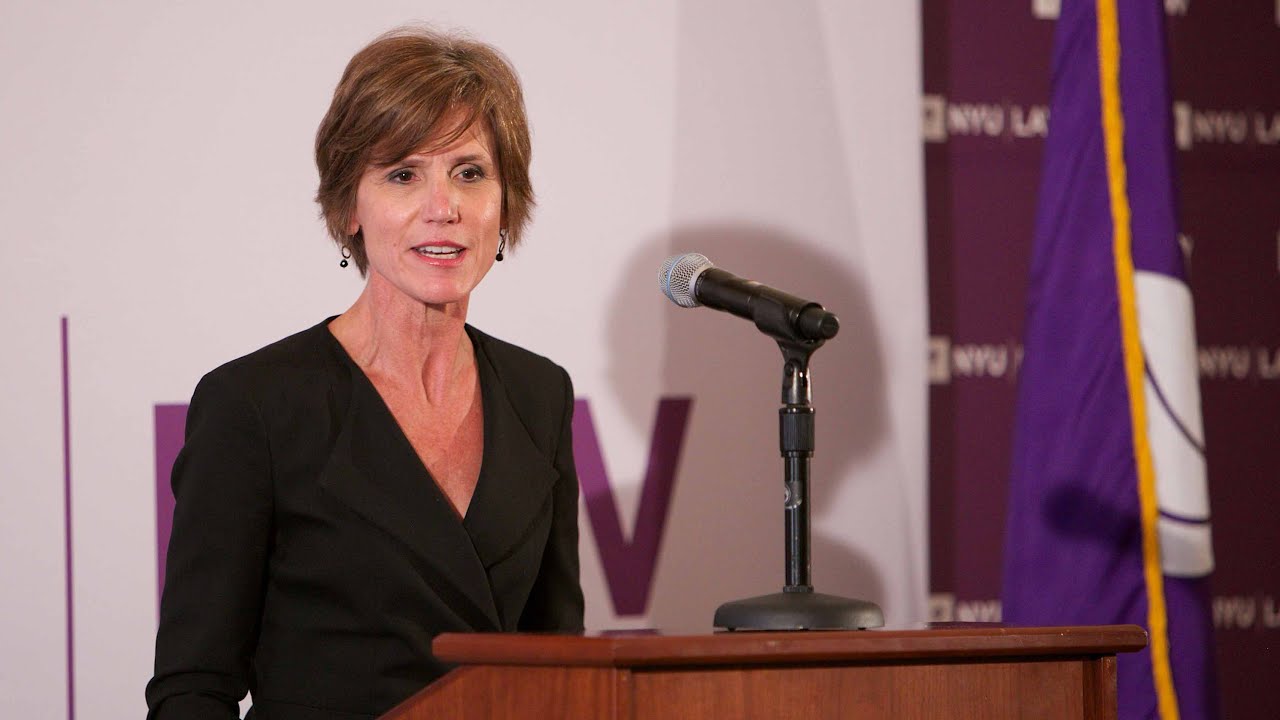
Sally Yates
Flynn was forced to resign that same day–after only 24 days as National Security Adviser.
Officially, the reason given was that he had misled Vice President Mike Pence. But Flynn’s deception had already been known—via the warning to Trump by Yates.
Only after Yates’ warning became known to the media was Flynn forced to resign.
Even worse for Flynn: The same Washington Post story reported that, in December, 2015, he had appeared on Russia Today, the news network that American Intelligence agencies consider “the Kremlin’s principal international propaganda outlet.”
He had also received more than $45,000 as a “speaking fee” from the network for a talk on world affairs. At the gala where Flynn received the fee, he sat next to Vladimir Putin for dinner.
Flynn did not file the required paperwork for the trip. Nor did he report the “fee” to the Pentagon.
On March 30, The Wall Street Journal reported that Flynn had offered to testify to the FBI or the Senate and House Intelligence committees in exchange for immunity from prosecution. So far, neither the FBI nor the Congressional Intelligence committees has agreed to such a deal.
Meanwhile, as a Presidential candidate and President, Donald Trump has steadfastly denied the revelations about collaboration between members of his 2016 Presidential campaign and Russian Intelligence agents.

Donald Trump
He has repeatedly attacked the “fake news” media reporting these revelations. Chief among his targets: CNN, The New York Times and The Washington Post.
He has also derided the Intelligence agencies responsible for America’s security.
On October 7, 2016, the Department of Homeland Security and the Office of the Director of National Intelligence issued a joint statement blaming the Russian government for the hacking of Democratic National Committee emails. Its motive: “To interfere with the US election process.”
Two days later, Trump publicly stated: “But I notice, anytime anything wrong happens, they like to say the Russians are– Maybe there is no hacking. But they always blame Russia.”
On March 4, Trump unleashed a series of tweets accusing former President Barack Obama of tapping his Trump Tower phones prior to the election: “How low has President Obama gone to tapp my phones during the very sacred election process. This is Nixon/Watergate. Bad (or sick) guy!”
One month later, Trump has offered no evidence to support that accusation. Nor have the FBI and Justice Department provided any. Yet Trump has refused to apologize or retract the libel.
Former Obama White House Press Secretary Josh Earnest has his own take on Trump’s motivation. Appearing on the March 5 edition of ABC’s This Week, he said:
“We know exactly why President Trump tweeted what he tweeted.
“Because there is one page in the Trump White House crisis management playbook. And that is simply to tweet or say something outrageous to distract from the scandal, and the bigger the scandal, the more outrageous the tweet.”
In time, the epitaph for the Trump administration may prove to be a bitter parody of The Muppet Movie song, “The Rainbow Connection”:
Why are there so many
Tales about Russians
And Right-wingers taking bribes?
Russians are Commies
And have lots of rubles
For traitors with something to hide.
So I’ve been told
And some choose to believe it.
It’s clear as the old KGB.
Someday we’ll find it
The Russian Connection–
The bribers, the traitors–you’ll see.


.jpg)


ABC NEWS, AIRLINE PASSENGER RIGHTS, AIRLINES, AIRTRAN, ALTERNET, AMERICAN AIRLINES, AMERICAN CUSTOMER SATISFACTION INDEX, AP, BBC, BUSINESS INSIDER, BUZZFEED, CBS NEWS, CNN, COMPLAINT LETTERS, CONSUMER RIGHTS, DAILY KOS, DAVE CARROLL, DELTA AIRLINES, FACEBOOK, ITUNES, JETBLUE AIRWAYS, KGB, LEISHA HAILEY, MOTHER JONES, MOVEON, NBC NEWS, NEWSWEEK, NICCOLO MACHIAVELLI, NPR, POLITICO, RALPH NADER, RAW STORY, REUTERS, SALON, SEATTLE TIMES, SLATE, SOUTHWEST AIRLINES, THE ATLANTIC, THE CHICAGO SUN-TIMES, THE CHICAGO TRIBUNE, THE DAILY BEAST, THE GUARDIAN, THE HILL, THE HUFFINGTON POST, THE LOS ANGELES TIMES, THE NEW YORK TIMES, THE PRINCE, THE WALL STREET JOURNAL, THE WASHINGTON POST, TIME, TWITTER, U.S. AIRWAYS, U.S. NEWS & WORLD REPORT, UNITED BREAKS GUITARS, UPI, US AIRWAYS, USA TODAY, YOUTUBE
TAKING ON KGB AIRWAYS: PART SEVEN (OF EIGHT)
In Bureaucracy, Business, History, Law, Law Enforcement, Politics, Self-Help, Social commentary on April 19, 2017 at 12:05 amThere’s a good chance you won’t be able to resolve your problem with the airline.
In its September 3, 2009 issue, Time magazine warned that calling the airlines’ customer complaint lines would likely prove a waste of time.
The major carriers have, quietly, made it steadily more difficult for customers to reach a person with their complaints. “The airlines don’t want to talk to their customers,” says John Tschohl, a consultant to businesses on customer service.
Even the few airlines that still have customer-service numbers bury them deep within their websites. Finding them is often as much a matter of luck as persistence.
So as advised in Part Four of this series: Don’t waste your time with Customer Service smallfry.
Go directly to the topmost officials of the airline and make it clear that it’s in their best interests to resolve your problem. Then, if you can’t find a workable solution, file your complaint with as many consumer-protection websites as possible.
You can also file complaints with one or more federal agencies that hold jurisdiction over the airlines.
If your complaint is safety related, address it to the Federal Aviation Administration (FAA) at:
Assistant Administrator for System Safety ASY-100
Federal Aviation Administration
800 Independence Ave., S.W.
Washington, D.C. 20591
Phone: 1-866-835-5322
Click here: Contact the Aviation Safety Hotline
If your complaint involves security, contact the Transportation Safety Administration (TSA). They can be reached at (866) 2890-6793 or at their website of Click here: Transportation Security Administration |.
You can also file a complaint with one or more consumer complaint websites.
Below is a partial list of consumer complaint websites. No endorsement is implied by this listing. It’s offered simply to illustrate the variety of such websites available.
http://www.pissedconsumer.com/ – Pissed Consumer (complaints only)
http://www.measuredup.com/ – Measured Up (“Customers Review / Businesses Reply / Everybody Wins”)
http://www.thesqueakywheel.com/ – The Squeaky Wheel (submits your complaint to google)
https://www.ftccomplaintassistant.gov/ – Federal Trade Commission (does not resolve individual consumer complaints)
http://hissingkitty.com/ – Hissing Kitty (posts your complaint on Google, Yahoo, and Bing)
http://www.airlinecomplaints.org/ – Airline Complaints (complaints only)
http://www.airsafe.com/complain/complain.htm – Air Safe (“critical information for the traveling public”)
http://www.consumeraffairs.com/travel/airlines.html – Consumer Affairs (complaints only)
A final option is to sue the airline.
For most people, bringing in a lawyer is like bringing up the heavy artillery. When should you do so?
Christopher Elliott, author, consumer advocate and journalist, outlines “five times when you should consider skipping the complaints process and going straight to court:
Elliott’s webpage contains a wealth of practical advice for those who are fed up with of airline arrogance. It can be accessed thus:
Click here: See you in court: 5 times when you should just sue ‘em.
Yet another must-read for those wondering if they should file suit:
Click here: Lies the Airlines Tell Us – ABC News
Assuming you decide to sue, there are three ways to do this:
Each approach has its own series of pluses and minuses.
One option is to do so in small claims court.
A plus is you don’t need an attorney. In fact, you’re barred from bringing in an attorney. You represent yourself, which means you don’t have to pay an attorney–either up-front or at the end of the case.
Another plus: It will cost you far less to represent yourself than it will cost the airline to send a representative. If you file in California and the airline is headquartered in New York, it will be expensive for them to send a rep to attend the proceedings.
If the airline fails to send someone as its representative–which is highly unlikely–it loses by default.
A minus is that you may not be the confrontational type. You may also feel intimidated by the legal process–and afraid of looking like an idiot if you lose.
Another minus is that each state sets a different amount you can win in damages.To learn about the rules applying to small claims courts in your state, consult the following link:
Click here: 50 State Overview of Small Claims Rules | Nolo.com.
A second option is to take your case to civil court.
A plus is that the dollar-amount you can obtain at this level is far higher than in small-claims court.
A minus is that you’ll definitely want to retain an attorney.
True, you can legally represent yourself. But aviation law is complex. The airline will definitely have an attorney, so if you don’t, you’re bringing a knife to a gunfight.
Another plus: If you can find an attorney willing to represent you on a contingency fee basis, you don’t have to pay him unless you win. His fee will then come out of your settlement amount.
Another minus: If you can’t find an attorney willing to take your case on this basis, you’ll have to pay him by the hour, after first putting up a retainer fee, which can be quite large.
A third minus is that the courts are clogged with cases, and it can take months or even years before yours will be heard.
Share this: