Archive for the ‘Bureaucracy’ Category
2016 PRESIDENTIAL ELECTION, ABC NEWS, ADOLF HITLER, ALTERNET, ANTI-COMMUNISM, AP, BARACK OBAMA, BILL MITCHELL, BIRTH CERTIFICATE, BIRTHERISM, BUZZFEED, CBS NEWS, CHUCK TODD, CNN, COMMUNISM, CROOKS AND LIARS, DAILY KOZ, DEMOCRATIC NATIONAL COMMITTEE, DIRECTOR OF NATIONAL INTELLIGENCE, DONALD TRUMP, FACEBOOK, FBI, HILLARY CLINTON, HOUSE INTELLIGENCE COMMITTEE, JAMES COMEY, JAMES R. CLAPPER, JOSEPH R. MCCARTHY, JOSEPH STALIN, MEET THE PRESS, MOTHER JONES, MOVEON, MSNBC, NAZI GERMANY, NBC NEWS, NEWSWEEK, NORTH ATLANTIC TREATY ORGANIZATION, NPR, POLAND, POLITICO, RAW STORY, REINCE PREIBUS, REPUBLICAN PARTY, REPUBLICANS, REUTERS, RICHARD M. NIXON, ROBERT MUELLER, RUSSIAN BOTS, SALON, SEATTLE TIMES, SENATE INTELLIGENCE COMMITTEE, SLATE, SOVIET UNION, THE APPRENTICE, THE ATLANTIC, THE CHICAGO SUN-TIMES, THE CHICAGO TRIBUNE, THE DAILY BEAST, THE GUARDIAN, THE HILL, THE HUFFINGTON POST, THE LOS ANGELES TIMES, THE NATION, THE NEW YORK TIMES, THE WASHINGTON POST, THIS WEEK, TIME, TREASON, TWITTER, U.S. NEWS & WORLD REPORT, UPI, USA TODAY, VLADIMIR PUTIN, WIKILEAKS, WORLD WAR 11
In Bureaucracy, History, Law, Politics, Social commentary on June 29, 2018 at 12:02 am
Reince Priebus, the incoming White House Chief of Staff for soon-to-be President Donald J. Trump, summed up the essential attitude of the Republican party.
Millions of Americans were questioning whether Trump was legitimately elected. Their suspicions were based on solid evidence: According to the American Intelligence community, that Russian President Vladimir Putin intervened in the 2016 Presidential election to help him defeat Hillary Clinton.
And Priebus believed—or at least claimed to believe—that outgoing President Barack Obama should vouch for Trump’s legitimacy.
“I think President Obama should step up,” Priebus said on January 15, 2017 on ABC’s “This Week.” “We’ve had a great relationship with the White House….I think the administration can do a lot of good by telling folks that are on the Republican side of the aisle, look, we may have lost the election on the Democratic side, but it’s time to come together.”
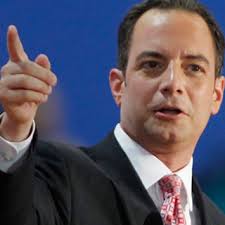
Reince Priebus
“You didn’t have Republicans questioning whether or not Obama legitimately beat John McCain in 2008,” Priebus added.
“This Week” host George Stephanopoulos replied that Trump had questioned Obama’s legitimacy as an American citizen until almost the end of the 2016 Presidential race.
“But look, George, that’s not the point!” Priebus said, visibly agitated. “The point is not where Barack Obama was born! The point is that we’ve got congressmen on the Democratic side of the aisle that are questioning the legitimacy of President-elect Trump.”
In short: Let’s ignore Trump’s five-year slander campaign against the legitimacy of President Obama. What’s important is that people are questioning the legitimacy of a Republican elected with the help of Russian Communists.
In 2011, Trump, then-host of NBC’s “The Apprentice,” was thinking of running for President against Obama.
To gain popularity among America’s Right-wing, Trump almost singlehandedly created the popular fiction that the President was born in Kenya–and was not an American citizen.
His motive: To convince Americans that Obama was an illegitimate President.
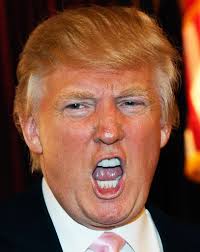
Donald Trump
Among the statements Trump made:
February 10, 2011: “Our current president came out of nowhere. Came out of nowhere. In fact, I’ll go a step further: The people that went to school with him, they never saw him, they don’t know who he is. It’s crazy.”
March 23, 2011: “I want him to show his birth certificate. I want him to show his birth certificate. … There’s something on that birth certificate that he doesn’t like.”
March 28, 2011: “I am really concerned” [that Obama wasn’t born in the United States]. He said that the birth announcement for Obama in a Hawaii newspaper could have been planted “for whatever reason.”
March 30, 2011: “If you are going to be president of the United States you have to be born in this country. And there is a doubt as to whether or not he was. … He doesn’t have a birth certificate. He may have one, but there’s something on that, maybe religion, maybe it says he is a Muslim. I don’t know. Maybe he doesn’t want that. Or he may not have one. But I will tell you this. If he wasn’t born in this country, it’s one of the great scams of all time.”
April 7, 2011: “I have people that have been studying it, and they cannot believe what they’re finding. You are not allowed to be a president if you’re not born in this country. Right now I have real doubts.”
April 25, 2011: “I’ve been told very recently…that the birth certificate is missing. I’ve been told that it’s not there or it doesn’t exist. And if that’s the case, it’s a big problem.”
On April 27, President Obama released his original, long-form Hawiian birth certificate.
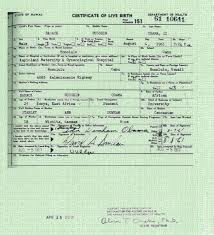
The long-form version of President Obama’s birth certificate
“We do not have time for this kind of silliness,” said Obama at a press conference, speaking as a father might to a roomful of spiteful children. “We have better stuff to do. I have got better stuff to do. We have got big problems to solve.
“We are not going to be able to do it if we are distracted, we are not going to be able to do it if we spend time vilifying each other…if we just make stuff up and pretend that facts are not facts, we are not going to be able to solve our problems if we get distracted by side shows and carnival barkers.”
Trump responded with a series of tweets on Twitter—all of them attacking the legitimacy of the birth certificate that President Obama had released.
For more than a year during his 2016 Presidential campaign, Trump continued his campaign of slander. But as his popularity steadily fell among black voters, even his own campaign strategists urged him to put the “birther” issue behind him.
So, on September 16, 2016—10 days before his scheduled first debate with Democratic Presidential nominee Hillary Clinton—Trump gave his version of a reversal.
“President Barack Obama was born in the United States, period. Now we all want to get back to making America strong and great again.”
His clearly wanted to get it over with as fast as possible. He refused to take questions from reporters covering the event. And he didn’t apologize for his five-year campaign of slander.
ABC NEWS, ALTERNET, AMAZON.COM, BED BATH AND BEYOND, BLOOMINGDALE’S, BURLINGTON COAT FACTORY, BUZZFEED, CAMPAIGN LEGAL CENTER, CBS NEWS, CENTURY 21, CNN, DAILY KOS, DONALD TRUMP, ELIJAH E. CUMMINGS, EMOLUMENTS CLAUSE, FACEBOOK, FOUNDING FATHERS, GRAB YOUR WALLET, IVANKA TRUMP, JASON CHAFFETZ, JOE MCGINNIS, JOHN F. KENNEDY, KELLEYANNE CONWAY, LARRY NOBLE, LIBEL, MACY’S, MARSHALLS, MELANIA TRUMP, MOTHER JONES, MOVEON, NBC NEWS, NEIMAN MARCUS, NEWS ALTERNET, NORDSTROM, NPR, POLITICO, PROSTITUTION, RAW STORY, ROSS, SAKS OFF FIFTH, SALON, SEAN SPICER, SEARS, SELLING OF THE PRESIDENT, SLATE, THE CHICAGO SUN-TIMES, THE CHICAGO TRIBUNE, THE DAILY BEAST, THE DAILY MAIL, THE HUFFINGTON POST, THE LOS ANGELES TIMES, THE NEW YORK TIMES, THE WALL STREET JOURNAL, THE WASHINGTON POST, TIME, TJ MAXX, TWITTER, U.S. NEWS & WORLD REPORT, UNITED STATES CONSTITUTION, USA TODAY, WALMART
In Bureaucracy, History, Law, Politics, Social commentary on June 28, 2018 at 1:21 am
President Donald Trump was furious.
Nordstrom department store had just dared to drop the clothing and accessories lines of his daughter, Ivanka.
So, true to form, on February 8, 2017, he aired his displeasure on Twitter: “My daughter Ivanka has been treated so unfairly by @Nordstrom. She is a great person — always pushing me to do the right thing! Terrible!”
Donald Trump
He used his personal Twitter account—@realDonaldTrump—to send this message. In fact, he sent it 21 minutes into his daily Intelligence briefing.
Still not satisfied, he retweeted his attack on Nordstrom on his official POTUS (President of the United States) Twitter account.
In short, he used a taxpayer-funded account to benefit his daughter.
Not content to attack Nordstrom by himself, Trump enlisted other members of his administration as assailants.
One of these was his then-press secretary, Sean Spicer:
“There’s a targeting of her brand and it’s her name. She’s not directly running the company. It’s still her name on it. There are clearly efforts to undermine that name based on her father’s positions on particular policies that he’s taken. This is a direct attack on his policies and her name. Her because she is being maligned because they have a problem with his policies.”

Sean Spicer
Nordstrom retorted that its decision to drop the Ivanka Trump line was “based on performance.”
“Over the past year, and particularly in the last half of 2016, sales of the brand have steadily declined to the point where it didn’t make good business sense for us to continue with the line for now.
“We’ve had a great relationship with the Ivanka Trump team. We’ve had open conversations with them over the past year to share what we’ve seen and Ivanka was personally informed of our decision in early January.”
But for the Trumpinistas, that wasn’t the end of it.
On Februrary 9, 2017, Kelleyanne Conway, a senior adviser to Trump, became a TV shill for Ivanka.
Kelleyanne Conway
Appearing on the Right-wing Fox News Channel program, “Fox and Friends,” Kelleyanne spoke from no less prestigious a forum than the White House itself:
“Go buy Ivanka’s stuff. I hate shopping and I’m going to go get some myself today. It’s a wonderful line. I own some of it. I’m going to give a free commercial here. Go buy it today, everybody. You can find it online.”
For Democrats and even some Republicans, Conway’s behavior was simply unacceptable.
Maryland Democratic Congressman Elijah E. Cummings, a member of the the House Committee on Oversight and Government Reform, sent a letter to Utah Republican Congressman Jason Chaffetz, who chairs the committee.
In it, he requested a referral to the Office of Government Ethics for possible disciplinary action against Conway.
The office does not have investigative or enforcement authority, but officials there can contact and provide guidance to other enforcement agencies.
Chaffetz told the Associated Press that Conway’s behavior was “wrong, wrong, wrong, clearly over the line, unacceptable.”
Larry Noble, the general counsel of the Campaign Legal Center, a nonpartisan organization of election law experts, said Trump’s tweet was “totally out of line.”
“He should not be promoting his daughter’s line, he should not be attacking a company that has business dealings with his daughter, and it just shows the massive amount of problems we have with his business holdings and his family’s business holdings,” Noble said.
Kathleen Clark, a government ethics expert, said the Nordstrom tweet could make other retailers hesitate to drop the Ivanka Trump brand. They may fear being similarly attacked by the President.
“The implicit threat was that he will use whatever authority he has to retaliate against Nordstrom, or anyone who crosses his interest,” said Clark, a law professor at Washington University in St. Louis.
* * * * *
In 1969, 25-year-old Joe McGinnis became famous overnight with the publication of his first book, The Selling of the President.
At the time, Americans were shocked to learn how Presidential candidate Richard Nixon had been sold to voters like any other product. In fact, the original book jacket featured Nixon’s face on a pack of cigarettes.
Today, Madison Avenue doesn’t simply sell Americans their Presidents. Now—with Donald J. Trump—Americans have a President determined to turn the White House into Trump, Inc.
A single example will serve to illustrate:
On January 27, Trump signed an executive order that:
- Suspends entry of all refugees to the United States for 120 days;
- Bars Syrian refugees indefinitely; and
- Blocks entry into the United States for 90 days for citizens of Iran, Iraq, Libya, Somalia, Sudan, Syria and Yemen.
Three countries not covered by Trump’s travel ban:
- Saudi Arabia
- The United Arab Emirates
- Egypt
- Turkey.
Approximately 3,000 Americans have been killed by immigrants from those countries—most of them during the attacks on the Pentagon and World Trade Center on September 11, 2001.
Saudi Arabia, the United Arab Emirates, Egypt, and Turkey are all countries where President Trump has close business ties. His properties include two luxury towers in Turkey and golf courses in the United Arab Emirates.
The full dimensions of Trump’s holdings throughout the Middle East aren’t known because he has refused to release his tax returns.
ABC NEWS, ALTERNET, AMAZON.COM, BED BATH AND BEYOND, BLOOMINGDALE’S, BURLINGTON COAT FACTORY, BUZZFEED, CAMPAIGN LEGAL CENTER, CBS NEWS, CENTURY 21, CNN, DAILY KOS, DONALD TRUMP, ELIJAH E. CUMMINGS, EMOLUMENTS CLAUSE, FACEBOOK, FOUNDING FATHERS, GRAB YOUR WALLET, IVANKA TRUMP, JASON CHAFFETZ, JOE MCGINNIS, JOHN F. KENNEDY, KELLEYANNE CONWAY, LARRY NOBLE, LIBEL, MACY’S, MARSHALLS, MELANIA TRUMP, MOTHER JONES, MOVEON, NBC NEWS, NEIMAN MARCUS, NEWS ALTERNET, NORDSTROM, NPR, POLITICO, PROSTITUTION, RAW STORY, ROSS, SAKS OFF FIFTH, SALON, SEAN SPICER, SEARS, SELLING OF THE PRESIDENT, SLATE, THE CHICAGO SUN-TIMES, THE CHICAGO TRIBUNE, THE DAILY BEAST, THE DAILY MAIL, THE HUFFINGTON POST, THE LOS ANGELES TIMES, THE NEW YORK TIMES, THE WALL STREET JOURNAL, THE WASHINGTON POST, TIME, TJ MAXX, TWITTER, U.S. NEWS & WORLD REPORT, UNITED STATES CONSTITUTION, USA TODAY, WALMART
In Bureaucracy, History, Law, Politics, Social commentary on June 27, 2018 at 12:11 am
Fifty-six years after John F. Kennedy gave his first and only Inaugural Address, these words remain its single most-quoted sentence: “Ask not what your country can do for you; ask what you can do for your country.”
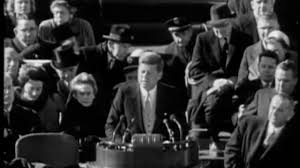
John F. Kennedy Inaugural
So millions of Americans who were alive that day—January 20, 1961—were probably shocked when they learned that Melania Trump had a very different view of government service.
On August 20, 2016, The Daily Mail, a British tabloid, published a story accusing her of having once worked as a prostitute.
The newspaper cited a Slovenian magazine’s report that a modeling agency that she worked with in New York in the 1990s also served as an escort business, linking wealthy clients with women for sexual services.
On September 1, Melania sued The Daily Mail in a state court in Montgomery County, Maryland. In early 2017, the Maryland court dismissed the case, saying it did not have jurisdiction.
On February 6, 2017, Melania filed another libel suit against The Daily Mail in the Manhattan Supreme Court.
Required to prove that she had been harmed in some way, Melania did not cite undeserved shame or how much her family and friends had been hurt.
Instead, she argued that the article had ruined her “once-in-a-lifetime opportunity” to cash in on the Presidency.

Melania Trump
According to the complaint that her attorney filed:
”Plaintiff had the unique, once-in-a-lifetime opportunity, as an extremely famous and well-known person…to launch a broad-based commercial brand in multiple product categories, each of which could have garnered multi-million dollar business relationships for a multi-year term during which plaintiff is one of the most photographed women in the world,” the Manhattan suit says.
“These product categories would have included, among other things, apparel, accessories, shoes, jewelry, cosmetics, hair care, skin care and fragrance.
“The [statements] also constitute defamation per se because they impugned on her fitness to perform her duties as First Lady of the United States,” the suit alleges.
Melania is alleging $150 million in damages.
Enter the Emoluments Clause.
This is a United States government law that specifically forbids any leader from using government services to “enrich” the President and his family.
Among the greatest dangers facing the newly-created American government, feared the Founding Fathers, was foreign interference. And this could be obtained through the use of bribes—money or gifts.

The Constitution of the United States
To prevent this, the Founders inserted the Emoluments Clause into Article I, Section 9 of the United States Constitution:
“No title of nobility shall be granted by the United States: and no person holding any office of profit or trust under them, shall, without the consent of the Congress, accept of any present, emolument, office, or title, of any kind whatever, from any king, prince, or foreign state.”
This illustrates one of the dangers of bringing a libel or slander suit.
(NOTE: Libel is a written defamation; slander is a spoken one)
Whoever brings the suit must open himself to unprecedented privacy-invading questions. And, in answering them, he may unintentionally give away revelations that can prove highly damaging.
Another Trump seeking to find out “what the country can do for you” is the President’s daughter, Ivanka.
Starting in 2016, Shannon Coulter, a brand and digital strategist, started the Grab Your Wallet boycott aimed at more than 30 retailers who carry Ivanka’s line of fashion apparel.

Among the retailers targeted:
- Amazon.com
- Belk
- Bloomingdale’s
- Bed, Bath and Beyond
- Burlington Coat Factory
- Century 21
- DSW
- Macy’s
- Marshalls
- TJ Maxx
- Neiman Marcus
- Nordstrom
- Overstock.com
- Ross
- Saks Off Fifth
- Sears
- Walmart
- Zappos
During the first week of February, 2017, Nordstrom told The Seattle Times that it would no longer carry Ivanka Trump’s line of clothing and accessories.
Nordstrom said the decision to drop Ivanka Trump’s line was based on poor sales performance.
“We’ve got thousands of brands,” said a Nordstrom spokesman. “Each year we cut about 10 percent and refresh our assortment with about the same amount. In this case, based on the brand’s performance we’ve decided not to buy it for this season.”
President Trump had often boasted that he would defend the free enterprise system against an intrusive Federal government.
But for a major department store to drop his daughter’s clothing line was too much.
Turning to Twitter, his favorite weapon of insult, the President tweeted: “My daughter Ivanka has been treated so unfairly by @Nordstrom. She is a great person — always pushing me to do the right thing! Terrible!”
Trump drafted other members of his administration to attack Nordstrom.
One of these was White House Press Secretary Sean Spicer.
Spicer said that the store’s decision to stop carrying Ivanka Trump’s clothing and accessories line was nothing less than an attack on the president’s policies and his daughter.
“”I think this is less about his family’s business and an attack on his daughter. He ran for President, he won, he’s leading this country.
“I think for people to take out their concern about his actions or his executive orders on members of his family, he has every right to stand up for his family and applaud their business activities, their success.”
But even more was to come.
ABC NEWS, ALTERNET, AMERICAN NAZI PARTY, ANONYMOUS, AP, ASSOCIATED PRESS, BUZZFEED, CBS NEWS, CHARLOTTESVILLE, CNN, COINTELPRO, CROOKS AND LIARS, DAILY KOZ, DAVID DUKE, DONALD TRUMP, FACEBOOK, FBI, FERGUSON MISSOURI PROTESTS, J. EDGAR HOOVER, KU KLUX KLAN, MISSISSIPPI BURNING CASE, MOTHER JONES, MOVEON, NBC NEWS, NEWSWEEK, NPR, NYPD, POLITICO, PRESIDENT LYNDON B. JOHNSON, RAW STORY, REUTERS, SALON, SEATTLE TIMES, SLATE, TERRORISM, THE ATLANTIC, THE CHICAGO SUN-TIMES, THE CHICAGO TRIBUNE, THE DAILY BEAST, THE GUARDIAN, THE HILL, THE HUFFINGTON POST, THE LOS ANGELES TIMES, THE NATION, THE NEW YORK TIMES, THE WALL STREET JOURNAL, THE WASHINGTON POST, TIME, TWITTER, U.S. NEWS & WORLD REPORT, UP, UPI, USA TODAY, WILLIAM C. SULLIVAN
In Bureaucracy, History, Law, Law Enforcement, Politics, Social commentary on June 25, 2018 at 1:24 am
On August 11-12, 2017, white supremacists from across the country gathered in Charlottesville, Virginia, for a “Unite the Right” rally. Among the organizations represented:
- The Ku Klux Klan (KKK);
- The Alt-Knights;
- The “Militia Movement”;
- The American Nazi Party;
- The Confederate League of the South;
Like Nazis in 1930s Germany, they marched through the streets carrying flaming torches, screaming racial epithets and frightening the local citizenry.
On August 13, a Nazi sympathizer rammed his car into a group of counter-protesters, killing a woman and injuring 19 other demonstrators.
President Donald Trump stated: “We condemn in the strongest possible terms this egregious display of hatred, bigotry and violence on many sides, on many sides.”
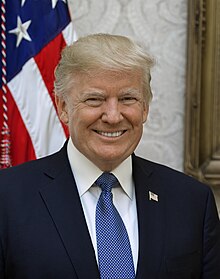
Donald Trump
But he refused to specifically denounce the Fascistic demonstrators.
White supremacists were elated.
“He didn’t attack us. He just said the nation should come together. Nothing specific against us,” wrote Andrew Anglin, founder of the neo-Nazi website, The Daily Stormer.
“No condemnation at all. When asked to condemn, he just walked out of the room. Really, really good. God bless him.”
Another Trump admirer: Former Ku Klux Klan Imperial Wizard David Duke.
“Thank you President Trump for your honesty & courage to tell the truth about #Charlottesville & condemn the leftist terrorists in BLM/Antifa,” Duke tweeted after the news conference.
Fascistic groups make up a pivotal constituency for Trump. Without their support, he might not have become President. He can’t afford to alienate them.
But others who aren’t beholden to the Fascistic Right have taken a stand against its hate-mongering.
On October 30, 2015, the hacker group Anonymous released a prepared statement:
“Ku Klux Klan, We never stopped watching you. We know who you are. We know the dangerous extent to which you will go to cover your asses….
“We will release, to the global public, the identities of up to 1000 klan members, Ghoul Squad affiliates and other close associates of various factions of the Ku Klux Klan.” This included ages, phone numbers, addresses and even credit card numbers.
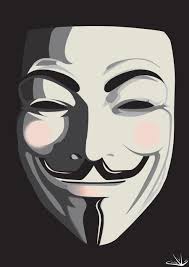
Anonymous mask
By November 5, 2015, Anonymous had released the names of about 1,000 alleged KKK members or sympathizers via a Twitter data dump.
Among those names released by Anonymous:
- U.S. Senator Thom Tillis (R-N.C.);
- U.S. Senator John Cornyn (R-TX.);
- U.S. Senator Dan Coats (R-IN.)
- U.S. Senator Johnny Isakson (R-GA.);
- Mayor Madeline Rogero, Knoxville, TN.;
- Mayor Jim Gray, Lexington, KY.;
- Mayor Paul D. Fraim, Norfolk, VA.;
- Mayor Kent Guinn, Ocala, FL.; and
- Mayor Tom Henry, Fort Wayne, IN.
All of these officials denied any affiliation with the Klan.
“I got the information from several KKK websites when I [hacked] them and was able to dump their database,” Amped Attacks, who released the information, stated online.
This mass leak was easily the worst assault on the KKK since the Justice Department waged an all-out attack on the Klan during the Presidency of Lyndon B. Johnson.
The reason: The murders of three civil rights workers in Philadelphia, Mississippi—Michael “Mickey” Schwerner, Andrew Goodman and James Chaney—-on June 21, 1964.
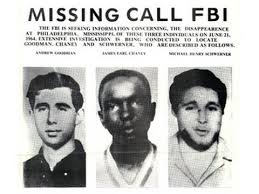
Poster for missing civil rights workers
Johnson ordered the FBI to find the missing activists. After their bodies were found buried near a dam, Johnson gave FBI Director J. Edgar Hoover a direct order: “I want you to have the same kind of intelligence [on the KKK] that you have on the communists.”
So the FBI launched a counterintelligence program—in Bureau-speak, a COINTELPRO—against the Ku Klux Klan.
Klansmen had shot, lynched and bombed their way across the Deep South, especially in Alabama and Mississippi. Many Southern sheriffs and police chiefs were Klan sympathizers, if not outright members and accomplices.

Ku Klux Klansmen in a meeting
The FBI’s covert action program aimed to “expose, disrupt and otherwise neutralize” KKK groups through a wide range of legal and extra-legal methods.
“My father fought the Klan in Massachusetts,” recalled William C. Sullivan, who headed the FBI’s Domestic Intelligence Division in the 1960s. “I always used to be frightened when I was a kid and I saw the fiery crosses burning in the hillside near our farm.

William C. Sullivan
“When the Klan reached 14,000 in the mid-sixties, I asked to take over the investigation of the Klan. When I left the Bureau in 1971, the Klan was down to a completely disorganized 4,300. It was broken.
“They were dirty, rough fellows. And we went after them with rough, tough methods.”
Among those methods:
- Planting electronic surveillance devices in Klan meeting places;
- Carrying out “black bag jobs”—burglaries—to steal Klan membership lists;
- Contacting the news media to publicize arrests and identify Klan leaders;
- Informing the employers of known Klansmen of their employees’ criminal activity, resulting in the firing of untold numbers of them;
- Developing informants within Klans and sewing a climate of distrust and fear among Klansmen;
- Breaking up the marriages of Klansmen by circulating rumors of their infidelity among their wives; and
- Beating and harassing Klansmen who threatened and harassed FBI agents.
The FBI’s counterintelligence war against the Klan ended in 1971.
Today, there are active Klan chapters in 41 states, with between 5,000 and 8,000 active members.
Only when America has a President who’s not beholden to the Fascistic Right can there be another COINTELPRO aimed at white hate groups.
2008 PRESIDENTIAL RACE, ABC NEWS, ABORTION, ADOLF HITLER, ALTERNET, AP, BARACK OBAMA, BILL CLINTON, BLACKLASH, BLACKS, BUZZFEED, CBS NEWS, CNN, COMMUNISM, CROOKS AND LIARS, DAILY KOZ, DEPARTMENT OF HOMELAND SECURITY, DWIGHT D. EISENHOWER, FACEBOOK, FIRST CHURCH OF CANNABIS, GAYS, GEORGE H.W. BUSH, GEORGE W. BUSH, HEALTH CODE VIOLATIONS, HOMOSEXUALITY, illegal immigration, INDIANA, INDIANA LEGISLATURE, IRVING WALLACE, ISLAM, JOSEPH MCCARTHY, JOSEPH STALIN, KIRSTJEN NIELSEN, LEE ATWATER, MAR-A-LAGO, MIKE PENCE, MOTHER JONES, MOVEON, MSNBC, MUSLIMS, NBC NEWS, NEWSWEEK, NPR, POLITICO, RACISM, RAW STORY, RELIGION, RELIGIOUS DISCRIMINATION, RELIGIOUS FREEDOM RESTORATION ACT, REPUBLICAN PARTY, REPUBLICANS, REUTERS, RICHARD NIXON, Ronald Reagan, SALON, SARAH HUCKABEE SANDERS, SEATTLE TIMES, SHARIA, SHINZO ABE, SLATE, SOUTHERN STRATEGY, SOVIET UNION, STEPHANIE WILKINSON, THE ATLANTIC, THE CHICAGO SUN-TIMES, THE CHICAGO TRIBUNE, THE DAILY BEAST, THE GUARDIAN, THE HILL, THE HUFFINGTON POST, THE LOS ANGELES TIMES, THE MAN, THE NATION, THE NEW YORK TIMES, THE RED HEN RESTAURANT, THE WASHINGTON POST, TIME, TRANSGENDERS, TREASON, TWITTER, U.S. NEWS & WORLD REPORT, UPI, USA TODAY, USA TODAY DONALD TRUMP, WILL BUNCH
In Bureaucracy, History, Law, Law Enforcement, Military, Politics, Social commentary on June 24, 2018 at 9:23 pm
On June 19, Kirstjen Nielsen, secretary of the Department of Homeland Security, was heckled by protesters while dining at a Mexican restaurant in Washington, D.C.
The reason: To protest the Trump administration’s separation of illegal alien parents from their children in detention centers.
Then, three nights later, on June 22, the owner of a Lexington, Virginia, restaurant asked White House Press Secretary Sarah Huckabee Sanders to leave.
The reason: To protest the Trump’s discrimination against transgenders’ entering the military.
Those verbally assailing Nielsen shouted:
- “Do you hear the babies crying?”
- “If kids don’t eat in peace, you don’t eat in peace.”
- “Shame! Shame! Shame!”
- “In a Mexican restaurant of all places. The fucking gall.”
- “No borders, no wall, sanctuaries for all.”
On June 23, Sanders tweeted her version of her requested exit: “Last night I was told by the owner of Red Hen in Lexington, VA to leave because I work for @POTUS and I politely left. Her actions say far more about her than about me. I always do my best to treat people, including those I disagree with, respectfully and will continue to do so.”

Sarah Huckabee Sanders
According to The Washington Post, the Red Hen’s co-owner, Stephanie Wilkinson, got a call from her staff, reporting that Sanders was at the restaurant. Several employees are gay and knew Sanders had defended Trump’s efforts to bar transgenders from the military.
She added that her restaurant has “certain standards that I feel it has to uphold, such as honesty, and compassion and cooperation.”
From her statement, Wilkinson clearly believed Sanders was dishonest, inhumane and uncooperative.
On June 25, President Trump tweeted: “The Red Hen Restaurant should focus more on cleaning its filthy canopies, doors and windows (badly needs a paint job) rather than refusing to serve a fine person like Sarah Huckabee Sanders. I always had a rule, if a restaurant is dirty on the outside, it is dirty on the inside!”
Donald Trump
[Trump’s charge that the Red Hen is “dirty on the inside” was—as usual for him—false.
[According to its most recent state health inspection in February, the Red Hen restaurant had zero violations.
[On the other hand: Florida health inspectors cited Trump’s Mar-a-Lago resort in Palm Beach with 15 violations in late January, 2017, days before Trump hosted Japanese Prime Minister Shinzo Abe there for a diplomatic visit.
Nor was this an exception. From 2014-2017, records show the club was cited 78 times for such violations as:
- Chefs handling food without washing their hands
- Dirty cutting boards
- A slicer “soiled with old food debris” and
- The “accumulation of black/green mold-like substance” in the ice machine.]
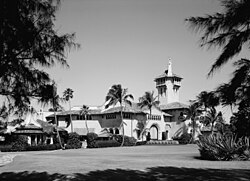
Mar-a-Lago
Ironically, Trump and his followers are responsible for Nielsen’s and Sanders’ evictions. They have pushed legislation allowing businesses to discriminate against anyone they dislike on the basis of “religious freedom.”
On March 26, 2015, Mike Pence, then Governor of Indiana before accepting Trump’s invitation to become his Vice Presidential nominee, signed into law the “Religious Freedom Restoration Act.”
This allows any individual or corporation to cite its religious beliefs as a defense when sued by a private party.
Officially, its intent is to prevent the government from forcing business owners to act in ways contrary to strongly held religious beliefs. Unofficially, its intent is to appease the hatred of gays and lesbians by the religious Right, a key constituency of the Republican party.
In short, a bakery that doesn’t want to make a cake to be used at a gay wedding or a restaurant that doesn’t want to serve lesbian patrons can legally refuse to do so. Or a hospital can legally refuse to treat gay patients.
Although he praised the bill, Pence signed it in a ceremony closed to the public and the press.
On the eve of invading the Soviet Union, Adolf Hitler told an aide: “At the beginning of each campaign, one pushes a door into a dark, unseen room. One can never know what is hiding inside.”
Maybe Pence—like Hitler—sensed that he, too, was about to push open “a door into a dark, unseen room.”
On the day after Pence signed the Act, Bill Levin filed paperwork with the Indiana Secretary of State to register the First Church of Cannabis as a legitimate religious institution. The registration was approved.
By elevating religion above the law, Indiana’s legislators may have enabled Indiana’s Muslims to:
- Claim their right—guaranteed in Islamic religious law—to have as many as four wives.
- Demand a taxpayer-funded “halal” non-pork food shelf at free food pantries for the poor. (As happened among Somali refugees in Minnesota in 2015.)
- Demand that police departments cancel counter-terrorism courses by claiming that their materials are anti-Muslim. (As happened to several police departments in Illinois.)
And it was the Trump administration that supported the Supreme Court’s June 4 ruling 7-2 on behalf of a Colorado baker who refused to make a wedding cake for a gay couple. He had claimed that doing so would violate his religious beliefs against homosexuality.
By championing the rights of businesses to legally discriminate against anyone they dislike—under the guise of “religious freedom”—Trump and his followers have opened a door that they themselves may now be forced to walk through.
ABC NEWS, ALCOHOLISM, ALTERNET, AP, BEGGING, BUMS, BUZZFEED, CBS NEWS, CNN, DAILY KOS, DISEASE, DRUG ADDICTION, FACEBOOK, HEPATITIS B, HEPATITIS C, HILLARY RONEN, HIV, HOMELESS, HOMELESSNESS, MENTAL ILLNESS, MOTHER JONES, MOVEON, NBC NEWS, NEWSWEEK, NPR, PANHANDLING, POLITICO, PUBLIC HEALTH, RAW STORY, REUTERS, ROTAVIRUS, SALON, SAN FRANCISCO, SAN FRANCISCO CHRONICLE, SAN FRANCISCO DEPARTMENT OF PUBLIC WORKS, SEATTLE TIMES, SLATE, THE ATLANTIC, THE CHICAGO SUN-TIMES, THE CHICAGO TRIBUNE, THE DAILY BEAST, THE GUARDIAN, THE HILL, THE HUFFINGTON POST, THE LOS ANGELES TIMES, THE NEW YORK TIMES, THE WALL STREET JOURNAL, THE WASHINGTON POST, TIME, TWITTER, U.S. NEWS & WORLD REPORT, UPI, USA TODAY, WILLIE BROWN
In Bureaucracy, History, Law, Law Enforcement, Medical, Politics, Social commentary on June 22, 2018 at 12:05 am
To capture the true intensity of the “homeless” problem in San Francisco, you must confront its realities at the street level. Imagine:
- You’re elderly, and walking with a cane—and must often try to negotiate your way around big tents that take up most of a sidewalk.
- You’re riding in a wheelchair along a sidewalk until you come to a large mattress lying directly in your path, with a potentially psychotic “homeless” man lying upon it.
- You find a street teeming with rats—eating the food scraps left by “homeless” people.
- You board a local bus and are forced to sit near a man stinking of feces and/or urine. Naturally, the driver doesn’t put him off—giving you the choice of surviving the stench or getting off to catch another bus.
- You walk into an underground Municipal Railway bus station—and find it littered with derelicts passed out or shooting up heroin in plain sight. Naturally, they don’t worry about picking up their used hypodermic needles. They leave those out for others to step on or pick up at their own risk.
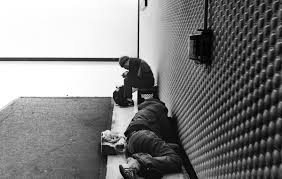
- You’re standing at a bus stop or eating in a restaurant—when a large, filthy, possibly disease-carrying man or woman demands a “handout” from you.
- You can’t use the elevator at the Bay Area Rapid Transit (BART) station because “homeless” derelicts have ruined its mechanism with urine and feces.
In 2010, San Francisco voters passed the “No Sit/No Lie” ordinance, which “makes it unlawful, with certain exceptions, to sit or lie on a public sidewalk, or on an object placed on a public sidewalk, between 7AM and 11PM.”
But walk down almost any street in the downtown part of the city and you’ll find sidewalks crowded with stinking, disease-ridden, lice/bedbug-infested, drug-addicted, alcohol-soaked, often psychotic men and women whom city officials politely refer to as “the homeless.”
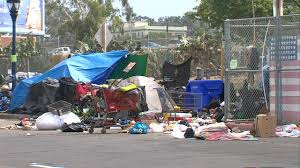
Among the trappings that go with this population:
- Tents
- Mattresses
- Piles of belongings
- Stolen shopping cards
- Trash
- Half-eaten food
- Empty cans/bottles of alcohol
- Feces
- Hypodermic needles
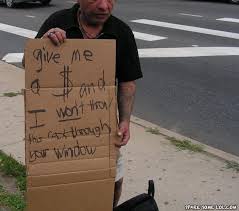
What you’ll almost never see: Police actually enforcing the “No Sit/No Lie” ordinance.
So much for the will of the voters.
San Francisco officials have effectively washed their hands of the problem. If local residents must put up with repeated violations of the most basic sanitation laws, that’s their tough luck.
What matters to the Mayor and Board of Supervisors is this: The “rights” of those whose filth and behavior pose an immediate threat to public health and safety take precedence over those of tax-paying, law-abiding San Franciscans.
San Francisco residents can be fined $25 to $1,000 for feeding pigeons—but not for feeding street bums.
During the Mayorship of Willie Brown (1996 – 2004), Hizzonor proposed what he thought was a brilliant way for residents to “contribute” to “street people.”
Those who were somehow certified as “homeless” would be issued special electronic “cash cards.” When someone wanted to make a “donation,” s/he would swipe a credit card against the one owned by the street bum, for whatever amount s/he wanted to donate.
But before the program started, someone at City Hall realized a blunt truth: Residents—especially women—weren’t likely to whip out their credit cards in front of a ranting, foul-smelling, probably disease-ridden street bum.
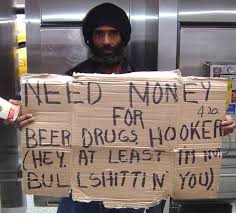
It’s long past time for San Francisco—and other cities—to stop catering to the druggies, alcoholics, mental cases and bums who prey on the guilt or fear of law-abiding, tax-paying citizens.
The same laws that protect citizens against patients with highly communicable diseases like typhoid and cholera should be vigorously applied to those whose filthy habits threaten similar public contagion.
Among such reforms:
- The city should launch a “Please Do Not Feed the Bums” publicity campaign—as it has against feeding pigeons. And it should be backed up with stiff fines for those caught doing so.
- Those living on the street should be given a choice: Go to a local shelter or face arrest and the immediate confiscation of their possessions.
- Bus drivers should have the right to refuse passengers who stink of urine/feces, as they present a potential health-hazard to others.
- The owners of restaurants should likewise be allowed to refuse service on the same basis.
- Those applying for welfare benefits should be required to provide proof of residence. Too many people come to San Francisco because, upon arrival, they can immediately apply for such benefits.
- The city should set up a special unit to deal entirely with removing “street people” and their possessions from city sidewalks. This could be a division of the Sanitation Department, since its personnel are used to removing filth and debris of all types.
San Francisco officials need to:
- Forcefully tell alcoholics and drug addicts: “Your anti-social behavior is not welcome here. Take your self-destructive lifestyles elsewhere. We won’t subsidize them.”
- Take the mentally unstable off the street and place them in institutions where their needs can be met.
- Tell those who are just plain bums: Don’t expect us to support you.
Only then will San Francisco rightly reclaim its former glory as “the city by the Bay.”
ABC NEWS, ALCOHOLISM, ALTERNET, AP, BEGGING, BUMS, BUZZFEED, CBS NEWS, CNN, DAILY KOS, DISEASE, DRUG ADDICTION, FACEBOOK, HEPATITIS B, HEPATITIS C, HILLARY RONEN, HIV, HOMELESS, HOMELESSNESS, MENTAL ILLNESS, MOTHER JONES, MOVEON, NBC NEWS, NEWSWEEK, NPR, PANHANDLING, POLITICO, PUBLIC HEALTH, RAW STORY, REUTERS, ROTAVIRUS, SALON, SAN FRANCISCO, SAN FRANCISCO CHRONICLE, SAN FRANCISCO DEPARTMENT OF PUBLIC WORKS, SEATTLE TIMES, SLATE, THE ATLANTIC, THE CHICAGO SUN-TIMES, THE CHICAGO TRIBUNE, THE DAILY BEAST, THE GUARDIAN, THE HILL, THE HUFFINGTON POST, THE LOS ANGELES TIMES, THE NEW YORK TIMES, THE WALL STREET JOURNAL, THE WASHINGTON POST, TIME, TWITTER, U.S. NEWS & WORLD REPORT, UPI, USA TODAY, WILLIE BROWN
In Bureaucracy, History, Law, Law Enforcement, Medical, Politics, Social commentary on June 21, 2018 at 1:45 am
Imagine that, late one night, you wake up and decide to go to the kitchen for a drink of water. You turn on the light—and suddenly find a virtual army of cockroaches hurriedly scurrying across the floor.
In the morning, you call an exterminator, and a “pest control specialist” soon knocks at your door.
“What you need to do,” he says, “is to put out big packets of sugar for the roaches.”
“Wait a minute—don’t roaches love sugar? How is this going to make them go away?”
“It won’t.”
“Then what’s the point?”
“The point is that roaches are God’s creatures, and they need to eat, too.”
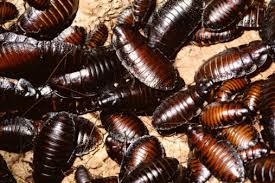
A typical cockroach scene
“But they’ve taken over my kitchen. They’re filthy, they leave droppings everywhere and they contaminate the food I’m supposed to eat.”
“You must learn to have compassion for all of God’s creatures, and learn to get along with them.”
“So if I hire you, you’re not going to get rid of them for me?”
“No.”
“So what are you going to do?”
“Help you to accept that they have a right to be a part of your community.”
If a pest control company actually operated like that, how long would they be in business?
Not long.
Yet, in San Francisco, successive mayors and members of the Board of Supervisors operate in exactly that manner toward succeeding waves of human pestilence. And they remain in office for years.
Huge areas of the city are covered in feces, urine, trash and needles. Hospitals overflow with patients that have fallen ill due to the contamination.
NBC News surveyed 153 blocks of the city—an area more than 20 miles. That area includes popular tourist spots like Union Square and the cable car turnaround. It’s bordered by Van Ness Avenue, Market Street, Post Street and Grant Avenue. And it’s also home to City Hall, schools, playgrounds, and a police station.
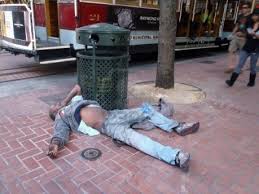
A typical San Francisco scene
Most of the trash found consisted of heaps of garbage, food, and discarded junk—including 100 drug needles and more than 300 piles of feces throughout downtown. If you step on one of these needles, you can get HIV, Hepatitis C, Hepatitis B or a variety of other viral diseases.
But you don’t have to actually get stuck by a needle to become a victim. Once fecal matter dries, it can become airborne and release deadly viruses, such as the rotavirus.
“If you happen to inhale that, it can also go into your intestine,” says Dr. Lee Riley, an infectious disease specialist at the University of California, Berkeley. The results can prove fatal, especially in children.
As the news unit filmed a typical day’s activity in San Francisco, a group of preschool students, enjoying a field trip, walked to City Hall.
Responding to a reporter’s question, Adelita Orellana said: “We see poop, we see pee, we see needles, and we see trash.
“Sometimes they ask what is it, and that’s a conversation that’s a little difficult to have with a two-year old, but we just let them know that those things are full of germs, that they are dangerous, and they should never be touched.”
San Francisco’s political elite see this blight as well as everyone else. They can’t avoid seeing it, since the city covers 47 square miles.
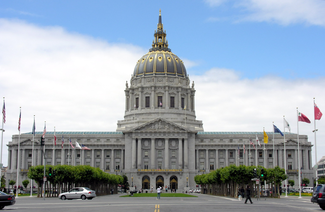
San Francisco City Hall
Cabe6403 at English Wikipedia [CC BY-SA 3.0 (https://creativecommons.org/licenses/by-sa/3.0) or GFDL (http://www.gnu.org/copyleft/fdl.html)%5D, from Wikimedia Commons
One of those who sees the disgrace up-front is Supervisor Hillary Ronen: “Unacceptable. Absolutely unacceptable We’re losing tourists. We’re losing conventions in San Francisco.”
Yet what does she propose as the solution? “We need more temporary beds for street homelessness.”
This is on a par with a “pest control expert” recommending: “We need more sugar to clear up our roach problem.”
Thanks to its mild climate and social programs that dole out cash payments to virtually anyone with no residency requirement, San Francisco is often considered the “homeless capital” of the United States.
According to a 2016 article in the San Francisco Chronicle, there are about 13,000 “homeless” people in San Francisco. Of these, an estimated 3,000 to 5,000 refuse shelter.
In 2016, San Francisco spent $275 million on homelessness—up from $241 million in 2015. Public Works cleanup crews picked up more than 679 tons of trash from homeless tent camps—and collected more than 100,000 used syringes from the camps.
In 2016, San Francisco residents made 22,608 complaints about encampments—a five-fold increase from 2015.
City officials euphemistically call this population “the homeless.” That’s because they don’t want to use words that accurately describe those who comprise the overwhelming majority of this population:
- Druggies
- Drunks
- Mentals
- Bums.
Or, as even many police, social workers and paramedics who wrestle with this population privately refer to them: DDMBs.
Yet the mere citing of statistics—how many “homeless,” how much money is spent on how many people, how much filth they produce—doesn’t capture the true intensity of the problem.
To do that, you must confront its realities at the street level. Which is what we’ll do in Part Two of this series.
ABC NEWS, ALTERNET, ANCHOR BABIES, AP, BARACK OBAMA, BERLIN AIRLIFT, BUZZFEED, CBS NEWS, CNN, CROOKS AND LIARS, DAILY KOZ, DEMOCRATIC PARTY, DEPARTMENT OF HOMELAND SECURITY, EGYPT, FACEBOOK, FAMILY SEPARATION POLICY, FRANCISCO SANCHEZ, ILLEGAL ALIENS, illegal immigration, IMMIGRATION AND CUSTOMS ENFORCEMENT, ISRAEL, KIRSTJEN NIELSEN, MEXICO, MITCH MCCONNELL, MOTHER JONES, MOVEON, MSNBC, NBC NEWS, NEWSWEEK, NPR, OPERATION NICKEL GRASS, OUTER LIMITS "ZANTI MISFITS" EPISODE, POLITICO, RACIAL PROFILING, RAW STORY, REPUBLICAN PARTY, REUTERS, RICHARD NIXON, RICK SANTORUM, SALON, SEATTLE TIMES, SLATE, SOVIET UNION, SYRIA, THE ATLANTIC, THE CHICAGO SUN-TIMES, THE CHICAGO TRIBUNE, THE DAILY BEAST, THE GUARDIAN, THE HILL, THE HUFFINGTON POST, THE LOS ANGELES TIMES, THE NATION, THE NEW YORK TIMES, THE OUTER LIMITS, THE WASHINGTON POST, TIME, TWITTER, U.S. NEWS & WORLD REPORT, UPI, USA TODAY, YOM KIPPUR WAR
In Bureaucracy, History, Law, Law Enforcement, Military, Politics, Social commentary on June 20, 2018 at 12:05 am
On May 7, 2018, United States Attorney General Jeff Sessions announced a “zero-tolerance” policy for illegal entry into the United States: “If you smuggle illegal aliens across our border, then we will prosecute you. If you are smuggling a child, then we will prosecute you and that child will be separated from you as required by law.”
In the past, those arrested while illegally entering the country were held in immigration detention and sent before an immigration judge. The judge decided if they would be deported as unauthorized immigrants. Most first-time offenders didn’t serve time in prison. As long as they pleaded guilty, they were sentenced, within minutes, to time served—and deported.
But illegal aliens referred for criminal prosecution were sent to a Federal jail. Several weeks later, a Federal judge determined if they would be imprisoned. And those in Federal jail cannot be kept with their children.
With the change in policy, all arrested illegal aliens would face criminal prosecution.
On June 15, Homeland Security officials confirmed to reporters that, from April 19 to May 31, 1,995 children were separated from 1,940 adults at the U.S.-Mexico border. These adults were referred for prosecution after illegally crossing the border.
Video images soon emerged of illegal alien children held behind chain-link cages. Photos showed children crying. An audio recording made secretly captured children calling for their mothers and fathers.

Illegal alien families held in cages
Over the weekend of June 16-17, Democrats almost unanimously attacked the “zero-tolerance” policy, while Republicans were divided over it.
What both Republican supporters and opponents of the policy had in common was the fear of being voted out of office—and losing their cushy and powerful positions.
Those who supported President Donald Trump feared he would order his Fascistic base to vote them out of office in the mid-term elections in November. Those who opposed Trump feared being voted out of office by overwhelming numbers of voters enraged by the policy.
Meanwhile, the Trump administration doubled-down. Homeland Security Secretary Kirstjen Nielsen said officials wouldn’t apologize for enforcing immigration laws that result in the separation of children and parents.
And on June 19, Trump tweeted: “Democrats are the problem. They don’t care about crime and want illegal immigrants, no matter how bad they may be, to pour into and infest our Country, like MS-13. They can’t win on their terrible policies, so they view them as potential voters!”
At this time, the fate of the family-separation policy remains uncertain.
If it is overturned, there is an even more drastic step that Trump might well take in his all-out war on illegal immigration.
Rather than deport them to countries in Central America—from which they would easily sneak back into the United States—the Federal Government could ship them off to more distant lands.
Like Afghanistan. Or Iraq. Or Syria.
Such a policy change would:
- Close the Mexican revolving door, which keeps illegal immigration flowing; and
- Send an unmistakably blunt message to other would-be illegals: “The same fate awaits you.”
Although this might seem a far-fetched proposal, it could be easily carried out by the United States Air Force. According to its website: “The C-5 Galaxy is one of the largest aircraft in the world and the largest airlifter in the Air Force inventory.
“The C-5 has a greater capacity than any other airlifter. It [can] carry 36 standard pallets and 81 troops simultaneously.

C-5 transport plane
“[It can also carry] any of the Army’s air-transportable combat equipment, including such bulky items as the 74-ton mobile scissors bridge.
“It can also carry outsize and oversize cargo over intercontinental ranges and can take off or land in relatively short distances.”
The C-5 Galaxy’s maximum cargo weight: 281,001 pounds
Click here: C-5 A/B/C Galaxy and C-5M Super Galaxy > U.S. Air Force > Fact Sheet Display
Instead of being stuffed with cargo, these planes could be stuffed wall-to-wall with illegal aliens.
The United States Air Force has a proud history of successfully providing America’s soldiers—and allies—with the supplies they need.
From June 24, 1948 to May 12, 1949, only the Berlin Airlift stood between German citizens and starvation.
The Soviet Union had blocked the railway, road, and canal access to the Berlin sectors under allied control. Their goal: Force the western powers to allow the Soviet zone to supply Berlin with food, fuel, and aid.
This would have given the Soviets control over the entire city.
Air forces from the United States, England, Canada, Australia, New Zealand and South Africa flew over 200,000 flights in one year, dropping more than 4,700 tons of necessities daily to the besiged Berliners.
The success of the Berlin Airlift raised American prestige and embarrassed the Soviets, who lifted the blockade.

The Berlin Airlift
A similar triumph came during the Yom Kippur War after Egypt and Syria attacked Israel without warning on October 6, 1973.
A Watergate-embattled President Richard Nixon ordered “Operation Nickel Grass” to deliver urgently-needed weapons and supplies to Israel.
For 32 days, the Air Force shipped 22,325 tons of ammunition, artillery, tanks and other supplies. These proved invaluable in saving Israel from destruction.
So the mass deportation of millions of illegal aliens lies within America’s technological capability. The only uncertainty: Is Trump willing to give that order?
ABC NEWS, ADOLF HITLER, ALTERNET, AP, BARACK OBAMA, BILL O'REILLY, BUZZFEED, CBS NEWS, CNN, CONCENTRATION CAMPS, CROOKS AND LIARS, DAILY KOZ, EXECUTIONS, FACEBOOK, FOX NEWS, FRED TRUMP, FREEDOM OF THE PRESS, HILLARY CLINTON, JOE SCARBOROUGH, JOSEPH STALIN, KIM JONG-II, KIM JONG-UN, MORNING JOE, MOTHER JONES, MOVEON, MSNBC, NAZI GERMANY, NBC NEWS, NEWSWEEK, NORTH KOREA, NPR, POLITICO, RAW STORY, REUTERS, RUSSIA, SALON, SEATTLE TIMES, SLATE, SOVIET UNION, THE ATLANTIC, THE CHICAGO SUN-TIMES, THE CHICAGO TRIBUNE, THE DAILY BEAST, THE GUARDIAN, THE HILL, THE HUFFINGTON POST, THE LOS ANGELES TIMES, THE NATION, THE NEW YORK TIMES, THE WASHINGTON POST, TIME, TWITTER, U.S. NEWS & WORLD REPORT, UPI, USA TODAY, VLADIMIR PUTIN
In Bureaucracy, History, Military, Politics, Social commentary on June 19, 2018 at 12:16 am
“And I have to say, I don’t understand Donald [Trump’s] bizarre fascination with dictators and strongmen who have no love for America.”
The speaker was Democratic Presidential candidate Hillary Clinton, addressing an audience in San Diego, California, on June 2, 2016.
“He praised China for the Tiananmen Square massacre; he said it showed strength.
“He said, ‘You’ve got to give Kim Jong Un credit’ for taking over North Korea—something he did by murdering everyone he saw as a threat, including his own uncle, which Donald described gleefully, like he was recapping an action movie.
“And he said if he were grading Vladimir Putin as a leader, he’d give him an A. Now, I’ll leave it to the psychiatrists to explain his affection for tyrants,” said Clinton.
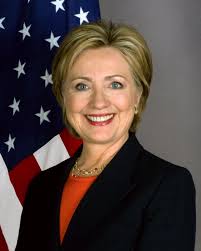
Hillary Clinton
To many people, it’s the ultimate odd-couple: The lifelong Communist and former KGB officer (Putin) walking arm-in-arm with the billionaire, publicity-hungry capitalist.
First Putin:
“He is a bright personality, a talented person, no doubt about it. It is not up to us to appraise his positive sides, it is up to the U.S. voters. but, as we can see, he is an absolute leader in the presidential race.”
Now Trump:
“It is always a great honor to be so nicely complimented by a man so highly respected within his own country and beyond.”
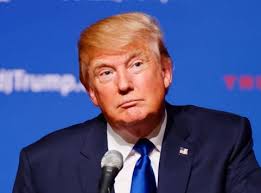
Donald Trump
Actually, it’s not uncommon for dictators to admire one another—as the case of Joseph Stalin and Adolf Hitler nicely illustrates.
After Hitler launched a blood-purge of his own private Stormtroopers army on June 30, 1934, Stalin exclaimed: “Hitler, what a great man! That is the way to deal with your political opponents!”
And Hitler was equally admiring of Stalin’s notorious ruthlessness: “After the victory over Russia,” he told his intimates, “it would be a good idea to get Stalin to run the country, with German oversight, of course. He knows better than anyone how to handle the Russians.”
Appearing on the December 18, 2015 edition of MSNBC’s “Morning Joe,” Trump said: “Sure, when people call you ‘brilliant,’ it’s always good. Especially when the person heads up Russia.”
The host, Joe Scarborough, was upset by Trump’s praise for Putin: “Well, I mean, [he’s] also a person who kills journalists, political opponents, and invades countries. Obviously that would be a concern, would it not?”
TRUMP: He’s running his country, and at least he’s a leader. Unlike what we have in this country.
When Trump praised Putin as a leader—“unlike what we have in this country”—he undoubtedly meant then-President Barack Obama.
And, as President, Trump has continued to worship the ground dictators cover with corpses. Asked by a Fox news anchor why he praised murderous North Korean dictator Kim Jong-Un, Trump replied:
“He’s a tough guy. Hey, when you take over a country, tough country, tough people, and you take it over from your father …if you could do that at 27 years old, I mean, that’s one in 10,000 that could do that.
“Anybody that takes over a situation like he did, at 26 years of age, and is able to run it, and run it tough—I don’t say he was nice or I don’t say anything about it—he ran it.”
In short: Kim must be doing something right because he’s in power. And it doesn’t matter how he came to power—or the price his country is paying because of it.
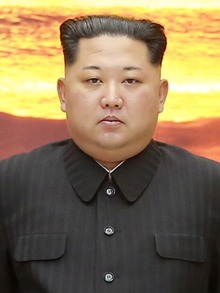
Kim Jong-Un
Blue House (Republic of Korea) [KOGL (http://www.kogl.or.kr/open/info/license_info/by.do)%5D, via Wikimedia Commons
Actually, for all their differences in appearance and nationality, Trump shares at least two similarities with Kim.
First, both of them got a big boost into wealth and power from their fathers.
- Trump’s father, Fred Trump, a real estate mogul, reportedly gave Donald $200 million to enter the real estate business. It was this sum that formed the basis for Trump’s eventual rise to wealth and fame—and the Presidency.
- Kim’s father was Kim Jong-Il, who ruled North Korea as dictator from 1994 to 2011. When his father died in 2011, Kim Jong-Un immediately succeeded him, having been groomed for years to do so.
Second, both Trump and Kim have brutally tried to stamp out any voices that contradict their own.
- Trump has constantly attacked freedom of the press, even labeling it “the enemy of the American people.” He has also slandered his critics on Twitter—which has refused to enforce its “Terms of Service” and revoke his account.
- Kim has attacked his critics with firing squads and prison camps. (Amnesty International estimates that more than 200,000 North Koreans are now suffering in labor camps throughout the country.)
During a February, 2017 interview with Fox News host Bill O’Reilly, Trump defended Russian dictator Vladimir Putin.
Reilly: “But he’s a killer.”
Trump: “There are a lot of killers. You think our country’s so innocent?”
Thus, Trump—-elected to lead the “free world”—believes, like all dictators:
- People are evil everywhere—so who am I to judge who’s better or worse? All that counts is gaining and holding onto power.
- And if you can do that, it doesn’t matter how you do so.
2016 PRESIDENTIAL ELECTION, ABC NEWS, ADOLF HITLER, ALTERNET, AP, BUZZFEED, CBS NEWS, CNN, CROOKS AND LIARS, DAILY KOZ, DAVID BROOKS, DONALD TRUMP, ENABLING ACT, FACEBOOK, FBI, FRANCE, FRANZ HALDER, FRANZ VON PAPEN, GUNTER MEISNER, HERMAN GORING, HERMAN WOUK, JAMES COMEY, MOTHER JONES, MOVEON, NAZI GERMANY, NBC NEWS, NEWSWEEK, NPR, PAUL VON HINDENBURG, PBS NEWSHOUR, POLITICO, RAW STORY, REICHSTAG, REUTERS, ROBERT MUELLER, SALLY YATES, SALON, SEATTLE TIMES, SLATE, THE ATLANTIC, THE CHICAGO SUN-TIMES, THE CHICAGO TRIBUNE, THE DAILY BEAST, THE GUARDIAN, THE HILL, THE HUFFINGTON POST, THE LOS ANGELES TIMES, THE NATION, THE NEW YORK TIMES, THE WASHINGTON POST, THE WINDS OF WAR, TIME, TWITTER, U.S. NEWS & WORLD REPORT, UPI, USA TODAY, VLADIMIR PUTIN, WALTER VON BRAUCHITSCH, WOLFGANG PREISS, WORLD WAR 11
In Bureaucracy, History, Military, Politics, Social commentary on June 18, 2018 at 12:08 am
After Donald Trump won the 2016 election, many people feared he would embark on a radical Right-wing agenda. But others hoped that the Washington bureaucracy would “box him in.”
The same sentiments echoed throughout Germany after Adolf Hitler was appointed Chancellor of Germany on January 30, 1933.
The 1983 TV mini-series, The Winds of War, offered a dramatic example of how honorable men can be overwhelmed by a ruthless dictator.
Based on the bestselling 1971 historical novel by Herman Wouk, the mini-series factually re-created the major historical events of World War II.
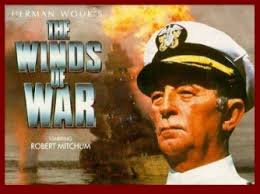
One of those events took place on November 5, 1939.
General Walther von Brauchitsch is summoned to the Chancellery in Berlin to meet with Adolf Hitler. He carries a memorandum signed by all the leaders of the German Wehrmacht asserting that Case Yellow—Hitler’s planned attack against France—is impossible.
Meanwhile, at the German army headquarters at Zossen, in Berlin, the Wehrmacht’s top command wait for word from von Brauchitsch.
CHANCELLERY:
Von Brauchitsch hands the memorandum to Hitler, who reads it.
ZOSSEN:
Brigadier General Armin von Roon: I must confide in you on a very serious matter. I have been approached by certain army personages of the loftiest rank and prestige with a frightening proposal.
Chief of the General Staff Franz Halder: What did you reply?
Von Roon: That they were talking high treason.
CHANCELLERY:
Adolf Hitler (slamming down the memorandum): So—what is new in all this?
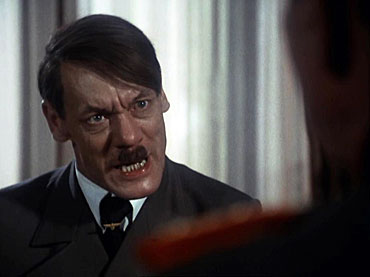
Gunter Meisner as Adolf Hitler in “The Winds of War”
Walther Von Brauchitsch: Fuhrer, it is the army’s final position that Case Yellow cannot proceed.
Hitler: Why not?
Von Brauchitsch: Because of the military fundamentals as stated. The meteorologists predict continuous soaking rains for weeks.
Hitler: It rains on the enemy, too.
ZOSSEN:
Von Roon: The conspiracy has been going on that long—since Czechoslovakia [1938)?
Halder: If the British had not caved in at Munich [where France and Britain sold out their ally, Czechoslovakia]—perhaps. But they did. And ever then, ever since his big triumph, it has been hopeless. Hopeless.
Von Roon: Empty talk, talk, talk. I am staggered.
Halder: A hundred times I myself could have shot the man. I can still at any time. But what would be the result? Chaos. The people are for him. He has unified the country. We must stick to our posts and save him from making military mistakes.
CHANCELLERY:
Von Brauchitsch: Fuhrer, even the supply of artillery shells is totally inadequate.
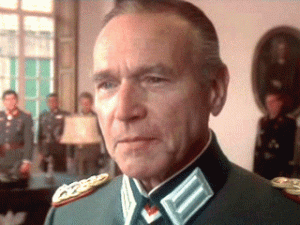
Wolfgang Preiss as Walter von Brauchitsch in “The Winds of War”
Hitler: Who says so?
Von Brauchitsch: General Thomas, my chief of economics and armament.
Hitler: Do you know how many artillery shells of all calibers we have in the staging areas—right this minute?
Von Brauchitsch: No.
Hitler: How many we have in the reserve dumps in the West? What the monthly annual production of shells is? What the projected rise in production of the next six months is, month by month?
Von Brauchitsch: Who keeps such figures in his head?
Hitler: I do! The supply is adequate. I tell you so. And I’m a field soldier who depended on artillery for four years to protect his life. [He hands von Brauchitsch a sheaf of armaments figures.] Check with your staff. if one of those figures is wrong, you can postpone Case Yellow. Otherwise—you march! And next time you come to see me, know what you’re talking about!
Von Brauchitsch: The morale of the army was low, even in the Polish campaign.
Hitler: You question to me—to me—the courage of the German soldier?
Von Brauchitsch: I’m talking facts!
Hitler: What facts? Back up this monstrous assertion! In what units was morale low? What action was taken? How many death sentences were handed out for cowardice? Speak up! I’ll fly to the front and pass the death sentences myself. One specific instance.
Von Brauchitsch: It was common knowledge—
Hitler: Common knowledge? What is common knowledge is that army headquarters at Zossen crawls with cowards. You opposed me in rearming the Rhineland. You opposed me on the [union] with Austria. You opposed me on Czechoslovakia, until the British came crawling to me. You dirtied in your trousers, you heroes at Zossen, at the idea of marching into Poland. Well, have I once been wrong? Have you once been right? Answer me!
Von Brauchitsch: Mein Fuhrer—
Hitler: Tell everyone who signed this insubordinate Zossen rubbish to beware! I will ruthlessly crush everybody up to the rank of a Field Marshal who dares to oppose me. You don’t have to understand. You only have to obey. The German people understand me. I am Germany.
Fast forward 79 years from Adolf Hitler’s stormy confrontation with Walter von Brauchitsch to June 13, 2018.
President Donald Trump has
- Fired FBI Director James Comey
- Tried to fire Independent Counsel Robert Mueller
- Attacked the integrity of the American Intelligence community
- Attacked the free press as “the enemy of the American people”
- Branded America’s longtime ally, Canada, as “a national security threat”
- Praised brutal Communist dictators Vladimir Putin and Kim Jong Un
Like Hitler, he can equally say: I am the destiny of America.


2016 PRESIDENTIAL ELECTION, ABC NEWS, ADOLF HITLER, ALTERNET, ANTI-COMMUNISM, AP, BARACK OBAMA, BILL MITCHELL, BIRTH CERTIFICATE, BIRTHERISM, BUZZFEED, CBS NEWS, CHUCK TODD, CNN, COMMUNISM, CROOKS AND LIARS, DAILY KOZ, DEMOCRATIC NATIONAL COMMITTEE, DIRECTOR OF NATIONAL INTELLIGENCE, DONALD TRUMP, FACEBOOK, FBI, HILLARY CLINTON, HOUSE INTELLIGENCE COMMITTEE, JAMES COMEY, JAMES R. CLAPPER, JOSEPH R. MCCARTHY, JOSEPH STALIN, MEET THE PRESS, MOTHER JONES, MOVEON, MSNBC, NAZI GERMANY, NBC NEWS, NEWSWEEK, NORTH ATLANTIC TREATY ORGANIZATION, NPR, POLAND, POLITICO, RAW STORY, REINCE PREIBUS, REPUBLICAN PARTY, REPUBLICANS, REUTERS, RICHARD M. NIXON, ROBERT MUELLER, RUSSIAN BOTS, SALON, SEATTLE TIMES, SENATE INTELLIGENCE COMMITTEE, SLATE, SOVIET UNION, THE APPRENTICE, THE ATLANTIC, THE CHICAGO SUN-TIMES, THE CHICAGO TRIBUNE, THE DAILY BEAST, THE GUARDIAN, THE HILL, THE HUFFINGTON POST, THE LOS ANGELES TIMES, THE NATION, THE NEW YORK TIMES, THE WASHINGTON POST, THIS WEEK, TIME, TREASON, TWITTER, U.S. NEWS & WORLD REPORT, UPI, USA TODAY, VLADIMIR PUTIN, WIKILEAKS, WORLD WAR 11
REPUBLICANS: “WE ARE THE ONLY LEGITIMATE POLITICAL PARTY”: PART ONE (OF TWO)
In Bureaucracy, History, Law, Politics, Social commentary on June 29, 2018 at 12:02 amReince Priebus, the incoming White House Chief of Staff for soon-to-be President Donald J. Trump, summed up the essential attitude of the Republican party.
Millions of Americans were questioning whether Trump was legitimately elected. Their suspicions were based on solid evidence: According to the American Intelligence community, that Russian President Vladimir Putin intervened in the 2016 Presidential election to help him defeat Hillary Clinton.
And Priebus believed—or at least claimed to believe—that outgoing President Barack Obama should vouch for Trump’s legitimacy.
“I think President Obama should step up,” Priebus said on January 15, 2017 on ABC’s “This Week.” “We’ve had a great relationship with the White House….I think the administration can do a lot of good by telling folks that are on the Republican side of the aisle, look, we may have lost the election on the Democratic side, but it’s time to come together.”
Reince Priebus
“You didn’t have Republicans questioning whether or not Obama legitimately beat John McCain in 2008,” Priebus added.
“This Week” host George Stephanopoulos replied that Trump had questioned Obama’s legitimacy as an American citizen until almost the end of the 2016 Presidential race.
“But look, George, that’s not the point!” Priebus said, visibly agitated. “The point is not where Barack Obama was born! The point is that we’ve got congressmen on the Democratic side of the aisle that are questioning the legitimacy of President-elect Trump.”
In short: Let’s ignore Trump’s five-year slander campaign against the legitimacy of President Obama. What’s important is that people are questioning the legitimacy of a Republican elected with the help of Russian Communists.
In 2011, Trump, then-host of NBC’s “The Apprentice,” was thinking of running for President against Obama.
To gain popularity among America’s Right-wing, Trump almost singlehandedly created the popular fiction that the President was born in Kenya–and was not an American citizen.
His motive: To convince Americans that Obama was an illegitimate President.
Donald Trump
Among the statements Trump made:
February 10, 2011: “Our current president came out of nowhere. Came out of nowhere. In fact, I’ll go a step further: The people that went to school with him, they never saw him, they don’t know who he is. It’s crazy.”
March 23, 2011: “I want him to show his birth certificate. I want him to show his birth certificate. … There’s something on that birth certificate that he doesn’t like.”
March 28, 2011: “I am really concerned” [that Obama wasn’t born in the United States]. He said that the birth announcement for Obama in a Hawaii newspaper could have been planted “for whatever reason.”
March 30, 2011: “If you are going to be president of the United States you have to be born in this country. And there is a doubt as to whether or not he was. … He doesn’t have a birth certificate. He may have one, but there’s something on that, maybe religion, maybe it says he is a Muslim. I don’t know. Maybe he doesn’t want that. Or he may not have one. But I will tell you this. If he wasn’t born in this country, it’s one of the great scams of all time.”
April 7, 2011: “I have people that have been studying it, and they cannot believe what they’re finding. You are not allowed to be a president if you’re not born in this country. Right now I have real doubts.”
April 25, 2011: “I’ve been told very recently…that the birth certificate is missing. I’ve been told that it’s not there or it doesn’t exist. And if that’s the case, it’s a big problem.”
On April 27, President Obama released his original, long-form Hawiian birth certificate.
The long-form version of President Obama’s birth certificate
“We do not have time for this kind of silliness,” said Obama at a press conference, speaking as a father might to a roomful of spiteful children. “We have better stuff to do. I have got better stuff to do. We have got big problems to solve.
“We are not going to be able to do it if we are distracted, we are not going to be able to do it if we spend time vilifying each other…if we just make stuff up and pretend that facts are not facts, we are not going to be able to solve our problems if we get distracted by side shows and carnival barkers.”
Trump responded with a series of tweets on Twitter—all of them attacking the legitimacy of the birth certificate that President Obama had released.
For more than a year during his 2016 Presidential campaign, Trump continued his campaign of slander. But as his popularity steadily fell among black voters, even his own campaign strategists urged him to put the “birther” issue behind him.
So, on September 16, 2016—10 days before his scheduled first debate with Democratic Presidential nominee Hillary Clinton—Trump gave his version of a reversal.
“President Barack Obama was born in the United States, period. Now we all want to get back to making America strong and great again.”
His clearly wanted to get it over with as fast as possible. He refused to take questions from reporters covering the event. And he didn’t apologize for his five-year campaign of slander.
Share this: