Posts Tagged ‘WOMEN’
2012 PRESIDENTIAL RACE, 2016 PRESIDENTIAL RACE, ABC NEWS, ADULTERY, ALTERNET, AP, ATHEISTS, BARACK OBAMA, BIBLE, BILL MAHER, BIRTH CONTROL, BUZZFEED, CATHOLICS, CBS NEWS, CIVIL LIBERTIES, CNN, CROOKS AND LIARS, DAILY KOZ, DONALD TRUMP, ELEANOR ROOSEVELT, FACEBOOK, FRANKLIN GRAHAM, HOMOSEXUALITY, HOMOSEXUALS, ISLAM, JERRY FALWELL JR., JESUS CHRIST, JEWS, LESBIANS, LIBERALS, MIKE PENCE, MITT ROMNEY, MOTHER JONES, MOVEON, MSNBC, MUSLIMS, NBC NEWS, NEWSWEEK, NEWT GINGRICH, NON-CHRISTIANS, NPR, PBS NEWSHOUR, POLITICO, RAW STORY, RELIGION, RELIGIOUS FREEDOM RESTORATION ACT, REPUBLICAN PARTY, REUTERS, RICHARD FEYNMAN, RICK SANTORUM, SALON, SAUDI ARABIA, SCIENCE, SEATTLE TIMES, SLATE, SLAVERY, SPANISH INQUISITION, STORMY DANIELS, SUPREME COURT, TEA PARTY, THE ATLANTIC, THE CHICAGO SUN-TIMES, THE CHICAGO TRIBUNE, THE DAILY BEAST, THE GUARDIAN, THE HILL, THE HUFFINGTON POST, THE LOS ANGELES TIMES, THE NATION, THE NEW YORK TIMES, THE WALL STREET JOURNAL, THE WASHINGTON POST, THEOLOGY, TIME, TOMAS DE TORQUEMADA, TWITTER, U.S. NEWS & WORLD REPORT, UPI, USA TODAY, WAR, WOMEN
In Bureaucracy, History, Law, Law Enforcement, Military, Politics, Social commentary on September 26, 2018 at 12:03 am
Bernardo Gui was the chief inquisitor of the Dominican Order during the Medieval Inquisition (1184 – 1230s).
Gui closely studied the best methods for interrogating “heretics.” He set forth his findings in his most important and famous work, Practica Inquisitionis Heretice Pravitatis. or “Conduct of the Inquisition into Heretical Wickedness.”
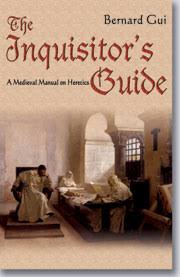
Here’s how such an interrogation might go:
When a heretic is first brought up for examination, he assumes a confident air, as though secure in his innocence. I ask him why he has been brought before me. He replies, smiling and courteous, “Sir, I would be glad to learn the cause from you.”
Interrogator: You are accused as a heretic, and that you believe and teach otherwise than Holy Church believes.
Accused Heretic: (Raising his eyes to heaven, with an air of the greatest faith) Lord, thou knowest that I am innocent of this, and that I never held any faith other than that of true Christianity.
Interrogator: You call your faith Christian, for you consider ours as false and heretical. But I ask whether you have ever believed as true another faith than that which the Roman Church holds to be true?
Accused Heretic: I believe the true faith which the Roman Church believes, and which you openly preach to us.
Interrogator: Perhaps you have some of your sect at Rome whom you call the Roman Church. I, when I preach, say many things, some of which are common to us both, as that God liveth, and you believe some of what I preach. Nevertheless you may be a heretic in not believing other matters which are to be believed.
Accused Heretic: I believe all things that a Christian should believe.
Interrogator: I know your tricks….But we waste time in this fencing. Say simply, Do you believe in one God the Father, and the Son, and the Holy Ghost?
Accused Heretic: I believe.
Interrogator: Do you believe in Christ born of the Virgin, suffered, risen, and ascended to heaven?
Accused Heretic: (Briskly) I believe.
Interrogator: Do you believe the bread and wine in the mass performed by the priests to be changed into the body and blood of Christ by divine virtue?
Accused Heretic: Ought I not to believe this?
Interrogator: I don’t ask if you ought to believe, but if you do believe.
Accused Heretic: I believe whatever you and other good doctors order me to believe.
Inquisitor: Those good doctors are the masters of your sect; if I accord with them you believe with me; if not, not.
Accused Heretic: I willingly believe with you if you teach what is good to me.
Inquisitor: You consider it good to you if I teach what your other masters teach. Say, then, do you believe the body of our Lord, Jesus Christ to be in the altar?
Accused Heretic: (Promptly) I believe that a body is there, and that all bodies are of our Lord.
Interrogator: I ask whether the body there is of the Lord who was born of the Virgin, hung on the cross, arose from the dead, ascended, etc.
Accused Heretic: And you, sir, do you not believe it?
Interrogator: I believe it wholly.
Accused Heretic: I believe likewise.
Men like Bernard Gui—and Franklin Graham—do not seek a golden future. They crave to return to a “golden” past—which includes the power Christians once held to forcibly impose their religious beliefs on others.
Among those slated for forced conversions by the Religious Right:
- Atheists
- Jews
- Women
- Homosexuals
- Lesbians
- Non-Christians
- Liberals
To gain absolute secular power over the lives of their fellow Americans, the Religious Right will support any candidate, no matter how morally despicable.
During the 2016 Presidential race, evangelicals—and their leaders such as Franklin Graham and Jerry Falwell, Jr.—fervently supported Donald Trump, despite:
- His being twice divorced;
- His multiple affairs (including one with porn star Stormy Daniels);
- His documented ties to Russian oligarchs and Mafia chieftains;
- His viciousness, greed, lying and egomania.
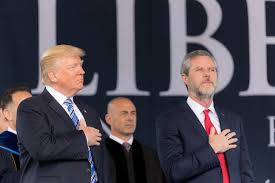
Donald Trump and Jerry Falwell, Jr., at Liberty University
And they continue to fervently support him.
They expect Trump to sponsor legislation that will—-by force of law—make their brand of Christianity supreme above all other religions.
Legislation such as The Religious Freedom Restoration Act.
This was signed into law on March 26, 2015, by Mike Pence, then Governor of Indiana.
This allows any individual or corporation to cite its religious beliefs as a defense when sued by a private party.
Officially, its intent is to prevent the government from forcing business owners to violate their religious beliefs.
Unofficially, its intent is to appease the hatred of gays and lesbians by the religious Right, a key constituency of the Republican party.
Thus, a bakery that doesn’t want to make a cake for a gay wedding or a restaurant that doesn’t want to serve lesbian patrons now has the legal right to refuse to do so.
And a hospital can legally turn away a gay patient if it wants to.
Islamic countries are notorious for their persecution of non-Muslims. Now the Religious Right wants to impose its own version of sharia law on American citizens.
2012 PRESIDENTIAL RACE, 2016 PRESIDENTIAL RACE, ABC NEWS, ADULTERY, ALTERNET, AP, ATHEISTS, BARACK OBAMA, BIBLE, BILL MAHER, BIRTH CONTROL, BUZZFEED, CATHOLICS, CBS NEWS, CIVIL LIBERTIES, CNN, CROOKS AND LIARS, DAILY KOZ, DONALD TRUMP, ELEANOR ROOSEVELT, FACEBOOK, FRANKLIN GRAHAM, HOMOSEXUALITY, HOMOSEXUALS, ISLAM, JERRY FALWELL JR., JESUS CHRIST, JEWS, LESBIANS, LIBERALS, MIKE PENCE, MITT ROMNEY, MOTHER JONES, MOVEON, MSNBC, MUSLIMS, NBC NEWS, NEWSWEEK, NEWT GINGRICH, NON-CHRISTIANS, NPR, PBS NEWSHOUR, POLITICO, RAW STORY, RELIGION, RELIGIOUS FREEDOM RESTORATION ACT, REPUBLICAN PARTY, REUTERS, RICHARD FEYNMAN, RICK SANTORUM, SALON, SAUDI ARABIA, SCIENCE, SEATTLE TIMES, SLATE, SLAVERY, SPANISH INQUISITION, STORMY DANIELS, SUPREME COURT, TEA PARTY, THE ATLANTIC, THE CHICAGO SUN-TIMES, THE CHICAGO TRIBUNE, THE DAILY BEAST, THE GUARDIAN, THE HILL, THE HUFFINGTON POST, THE LOS ANGELES TIMES, THE NATION, THE NEW YORK TIMES, THE WALL STREET JOURNAL, THE WASHINGTON POST, THEOLOGY, TIME, TOMAS DE TORQUEMADA, TWITTER, U.S. NEWS & WORLD REPORT, UPI, USA TODAY, WAR, WOMEN
In Bureaucracy, History, Law, Law Enforcement, Military, Politics, Social commentary on September 25, 2018 at 12:23 am
American Right-wing elements relentlessly claimed that President Barack Obama was waging “a war on religion.”
GOP candidates like Rick Santorum, Newt Gingrich and Mitt Romney intended to make this a major theme of their respective campaigns for President.
Obama supported a woman’s right
- to obtain abortion—including in cases of rape and incest;
- to obtain birth control; and
- to obtain amniocentesis (pre-natal testing).
By promoting women’s rights, Obama was “waging a war against religion”—according to American fascists.”
Since access to such medical procedures as birth control and pre-natal testing has long been entirely legal, what’s all the fuss about?
It’s simple: The Right is not waging a “war for religious liberty.”
It’s waging a bitter struggle to establish a government that uses force or the threat of it to impose reactionary religious beliefs on religionists who do not share such religious beliefs.
And on atheists or agnostics, who share none at all.
These Rightists and their theocratic allies have less in common with Jesus Christ than with Tomas de Torquemada (1420 – 1498), the infamous Grand Inquisitor of the Spanish Inquisition.
Christ never ordered the torture or death of anyone. Torquemada—claiming to act in “defense” of the Roman Catholic Church—presided over the deaths of at least 2,000 “heretics.”

Tomas de Torquemada
Nor did these unfortunate victims of religious fanaticism meet their death quickly or painlessly. They died by perhaps the cruelest means possible—by being burned alive at the stake.
Torquemada didn’t hesitate to pronounce someone a heretic. He “knew” who such people were. They were Jews, Muslims, atheists. They were “lapsed Catholics” who, in his view, failed to show fervent devotion to the religious authorities—like himself—who tyrannically ruled their lives.
For such people, Torquemada believed, the only road to salvation lay in being “cleansed” of their sins. And nothing burns away impurities like fire.
But before the fire-stakes came the fire-mindset: The arrogance of “knowing” who qualified as “saved” and who would be forever “damned.”
Unless, of course, his or her soul had been “purified” by fire.
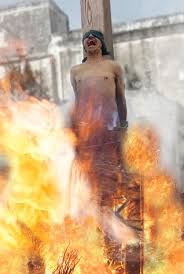
“Heretic” burned at the stake
Fundamentalist Christians can no longer sentence “heretics” to the stake.
But the mindset that ruled the Spanish Inquisition has not disappeared. It has been vividly displayed by no less a religious authority than Franklin Graham, son of America’s most famous preacher, Billy Graham.
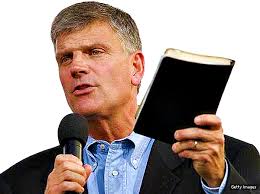
Franklin Graham
Appearing on the MSNBC program, “Morning Joe,” on February 21, 2012, Graham was asked if he thought that Barack Obama, Rick Santorum, Newt Gingrich and Mitt Romney qualified as Christians.
On Obama: “Islam sees him as a son of Islam… I can’t say categorically that [Obama is not Muslim] because Islam has gotten a free pass under Obama.”
On Santorum: “I think so. His values are so clear on moral issues. No question about it… I think he’s a man of faith.”
On Gingrich: “I think Newt Gingrich is a Christian, at least he told me he is.”
On Romney: “Most Christians would not recognize Mormons as part of the Christian faith. They believe in Jesus Christ. They have a lot of other things they believe in too, that we don’t accept, theologically.”
Thus, Graham pronounced as “saved” a notorious multiple-adulterer like Gingrich. He also gave a pass to Santorum, who married a woman who had lived “in sin” with an abortionist for six years.
But he unhesitatingly damned a longtime churchgoer like Obama or a devout Mormon like Romney (whose faith, most evangelicals like Graham believe, is actually a non-Christian cult).
Six years later, in 2018, Graham defended President Donald Trump, a notorious womanizer and multiple-adulterer, against charges that, in 2006, he had slept with porn star Stormy Daniels.
“I believe at 70 years of age the president is a much different person today than he was four years ago, five years ago, 10 years ago. He is not President Perfect.”
This differs greatly from his position on President Bill Clinton’s affair with Monica Lewinsky: “If he will lie to or mislead his wife and daughter, those with whom he is most intimate, what will prevent him from doing the same to the American public?”
It’s easy to imagine Graham transported to the French city of Toulouse in the 14th century. And to imagine him wearing the robes of Bernardo Gui, the chief inquisitor of the Dominican Order during the Medieval Inquisition (1184 – 1230s).

Gui closely studied the best methods for interrogating “heretics.” He set forth his findings in his most important and famous work, Practica Inquisitionis Heretice Pravitatis. or “Conduct of the Inquisition into Heretical Wickedness.”
In this, he offered a vivid example of how such an interrogation might go. The following is taken from that manual:
When a heretic is first brought up for examination, he assumes a confident air, as though secure in his innocence. I ask him why he has been brought before me. He replies, smiling and courteous, “Sir, I would be glad to learn the cause from you.”
This is not a dialogue between equals. The Inquisitor literally holds the power of life or agonizing death over the man or woman he is interrogating.
2012 PRESIDENTIAL RACE, 2016 PRESIDENTIAL RACE, ABC NEWS, ADULTERY, ALTERNET, AP, ATHEISTS, BARACK OBAMA, BIBLE, BILL MAHER, BIRTH CONTROL, BUZZFEED, CATHOLICS, CBS NEWS, CIVIL LIBERTIES, CNN, CROOKS AND LIARS, DAILY KOZ, DONALD TRUMP, ELEANOR ROOSEVELT, FACEBOOK, FRANKLIN GRAHAM, HOMOSEXUALITY, HOMOSEXUALS, ISLAM, JERRY FALWELL JR., JESUS CHRIST, JEWS, LESBIANS, LIBERALS, MIKE PENCE, MITT ROMNEY, MOTHER JONES, MOVEON, MSNBC, MUSLIMS, NBC NEWS, NEWSWEEK, NEWT GINGRICH, NON-CHRISTIANS, NPR, PBS NEWSHOUR, POLITICO, RAW STORY, RELIGION, RELIGIOUS FREEDOM RESTORATION ACT, REPUBLICAN PARTY, REUTERS, RICHARD FEYNMAN, RICK SANTORUM, SALON, SAUDI ARABIA, SCIENCE, SEATTLE TIMES, SLATE, SLAVERY, SPANISH INQUISITION, STORMY DANIELS, SUPREME COURT, TEA PARTY, THE ATLANTIC, THE CHICAGO SUN-TIMES, THE CHICAGO TRIBUNE, THE DAILY BEAST, THE GUARDIAN, THE HILL, THE HUFFINGTON POST, THE LOS ANGELES TIMES, THE NATION, THE NEW YORK TIMES, THE WALL STREET JOURNAL, THE WASHINGTON POST, THEOLOGY, TIME, TOMAS DE TORQUEMADA, TWITTER, U.S. NEWS & WORLD REPORT, UPI, USA TODAY, WAR, WOMEN
In Bureaucracy, History, Law, Law Enforcement, Military, Politics, Social commentary on September 24, 2018 at 12:08 am
Hamza Kashgari, a 23-year-old columnist in Saudi Arabia, decided to celebrate the birthday of the Islamic prophet Muhammed in a truly unique way.

Hamza Kashgar
In early February, 2012, he posted on Twitter a series of mock conversations between himself and Muhammad:
“On your birthday, I will say that I have loved the rebel in you, that you’ve always been a source of inspiration to me, and that I do not like the halos of divinity around you. I shall not pray for you.”
“On your birthday, I find you wherever I turn. I will say that I have loved aspects of you, hated others, and could not understand many more.”
“On your birthday, I shall not bow to you. I shall not kiss your hand. Rather, I shall shake it as equals do, and smile at you as you smile at me. I shall speak to you as a friend, no more.”
“No Saudi women will go to hell, because it’s impossible to go there twice.”
The tweets sparked some 30,000 infuriated responses. Many Islamic clerics demanded that he face execution for blasphemy.
Kashgari posted an apology tweet: “I deleted my previous tweets because…I realized that they may have been offensive to the Prophet and I don’t want anyone to misunderstand.”
Soon afterward, Abdullah bin Abdulaziz Al Saud, then King of Saudi Arabia, ordered his arrest.
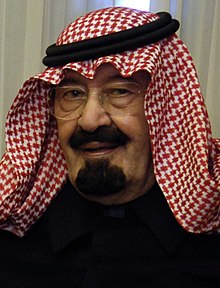
Saudi King King Abdullah
Kashgari fled to Malaysia, another majority-Muslim country. He was quickly arrested by police as he passed through Kuala Lumpur international airport. Three days later, he was deported to Saudi Arabia.
Human rights groups feared that he would be executed for blasphemy, a capitol offense in Saudi Arabia.
After nearly two years in prison, Kashgari was freed on October 29, 2013. Kashgari used Twitter to inform his supporters of his release.
Outrageous? By Western standards, absolutely.
Clearly there is no tolerence in Saudi Arabia for the freedoms of thought and expression that Americans take for granted.
Meanwhile, Right-wing American ayatollahs are working overtime to create just that sort of society—where theocratic despotism rules the most intimate aspects of our lives.
One of these is the former GOP Presidential candidate and U.S. Senator Rick Santorum. In early January, 2012, he said that states should have the right to outlaw birth control without the interference of the Supreme Court.
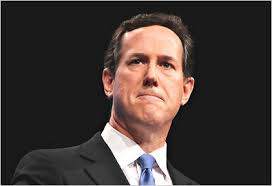
Rick Santorum
In an interview with ABC News, Santorum said he opposed the Supreme Court’s ruling that made birth control legal:
“The state has a right to do that [ban contraception]. I have never questioned that the state has a right to do that. It is not a Constitutional right. The state has the right to pass whatever statutes they have.
“That’s the thing I have said about the activism of the Supreme Court—they are creating rights, and it should be left up to the people to decide.”
In the landmark 1965 decision, Griswold v. Connecticut, the Court struck down a law that made it a crime to sell contraceptives to married couples. The Constitution, ruled the Justices, protected a right to privacy.
Two years later, in Eisenstadt v. Baird, the Court extended Griswold by striking down a law banning the sale of contraceptives to unmarried couples.
Santorum has left no doubt as to where he stands on contraception. On October 19, 2011, he said:
“One of the things I will talk about that no President has talked about before is I think the dangers of contraception in this country, the whole sexual libertine idea. Many in the Christian faith have said, ‘“Well, that’s okay. Contraception’s okay.’
“It’s not okay because it’s a license to do things in the sexual realm that is counter to how things are supposed to be. They’re supposed to be within marriage, they are supposed to be for purposes that are, yes, conjugal, but also…procreative.
“That’s the perfect way that a sexual union should happen. We take any part of that out, we diminish the act….And all of a sudden, it becomes deconstructed to the point where it’s simply pleasure.”
“How things are supposed to be”—according to Right-wing fanatics like Santorum and the evangelicals who support them.
Like the Saudi religious religious zealots who demand the death of a “blasphemer,” they demand that their religious views should govern everyone. That means Jews, Catholics, Islamics, atheists and agnostics.
American Christian fundamentalists and Islamic fundamentalists fervently agree on the following:
- Women should have fewer rights than men.
- Abortion should be illegal.
- There should be no separation between church and state.
- Religion should be taught in school.
- Religious doctrine trumps science.
- Government should be based on religious doctrine.
- Homosexuality should be outlawed.
The important difference—for Americans who value their freedom—is this:
The United States has a Supreme Court that can—and does—overturn laws that threaten civil liberties. Laws that GOP Presidential candidates clearly want to revive and force on those who don’t share their peculiar religious views.
Eleanor Roosevelt once said: “No one can make you feel inferior without your consent.”
The same holds true—in a democracy—for candidates who seek dictatorial power over their fellow citizens. Don’t give them your consent.
ABC NEWS, ABORTION, ALTERNET, ANTIFA, AP, ATHEISTS, BARACK OBAMA, BILL CLINTON, BIRTHERISM, BUDDHISTS, BUZZFEED, CBS NEWS, CNN, CROOKS AND LIARS, DAILY KOZ, DONALD TRUMP, EVANGELICAL PROTESTANTS, EVANGELICALS, FACEBOOK, HINDUS, HOMOSEXUALS, JEWS, LESBIANS, LIBERALS, MIKE PENCE, MONICA LEWINSKY, MORMONS, MOTHER JONES, MOVEON, MSNBC, MUSLIMS, NBC NEWS, NEWSWEEK, NON-CHRISTIANS, NPR, POLITICO, PUBLIC RELIGION RESEARCH INSTITUTE, RAW STORY, RELIGIOUS FREEDOM RESTORATION ACT, RELIGIOUS RIGHT, REPUBLICANS, REUTERS, ROBERT P. JONES, RUSSIAN OLIGARCHS, SALON, SEATTLE TIMES, SEPARATION OF CHURCH AND STATE, SLATE, STORMY DANIELS, THE ATLANTIC, THE CHICAGO SUN-TIMES, THE CHICAGO TRIBUNE, THE DAILY BEAST, THE GUARDIAN, THE HILL, THE HUFFINGTON POST, THE LOS ANGELES TIMES, THE NATION, THE NEW YORK TIMES, THE WASHINGTON POST, TIME, TWITTER, U.S. NEWS & WORLD REPORT, UPI, USA TODAY, WHITE CHRISTIANS, WOMEN
In Bureaucracy, History, Law, Politics, Social commentary on September 3, 2018 at 12:10 am
Republicans and Christian Rightists have something in common: Fear of losing their power to dominate the lives of their fellow Americans.
The most recent proof of this came on August 27, when President Donald J. Trump met with Right-wing Christian leaders at the State Dining Room of the White House.
“This November 6 election is very much a referendum on not only me,” said Trump. “It’s a referendum on your religion, it’s a referendum on free speech and the First Amendment. It’s a referendum on so much.
“It’s not a question of like or dislike, it’s a question that they will overturn everything that we’ve done and they will do it quickly and violently. And violently.
“There is violence. When you look at Antifa—these are violent people. You have tremendous power. You were saying, in this room, you have people who preach to almost 200 million people. Depending on which Sunday we’re talking about.”
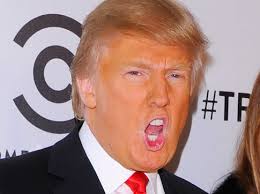
Donald Trump
Antifa is actually short for “Anti-Fascist.” It’s an amalgam of anti-Fascist groups which counter-protest white supremacists and neo-Nazis.
Republicans and Right-wing organizations have long dredged up bogeymen to frighten voters—and convince them that only Republicans can be trusted to protect them.
Antifa has emerged as the most recent of these bogeymen.
“You have to hopefully get out and get people to support us,” Trump told the evangelicals. “If you don’t, that will be the beginning of ending everything that you’ve gotten.”
Evangelicals have solidly supported Trump—despite:
- His being twice divorced;
- His multiple affairs (including one with porn star Stormy Daniels);
- His documented ties to Russian oligarchs and Mafia chieftains;
- His viciousness, greed, lying and egomania.
Donald Trump and Jerry Falwell, Jr., at Liberty University
Yet evangelicals blasted President Bill Clinton for his extramarital dalliance with Monica Lewinsky. And they greedily accepted the fiction that President Barack Obama was a Muslim born in Kenya, even though his birth certificate says Hawaii and he has always attended a Christian church.
So why do evangelicals fervently support Trump?
First, they see their influence eroding.
“Prior to 2008, white evangelical Protestants seemed to be exempt from the waves of demographic change and disaffiliation that were eroding the membership bases of white mainline Protestants and white Catholics,” said Robert P. Jones, CEO of Public Religion Research Institute (PRRI) and author of “The End of White Christian America.”
“We now see that these waves simply crested later for white evangelical Protestants.”
According to a study by PRRI:
- White Christians comprised 81% of the population in 1976. Today only 43% of Americans identify as white Christians, and 30% as white Protestants.
- White Christians are aging. About 1 in 10 white Catholics, evangelicals and mainline Protestants are under 30, compared with one-third of all Hindus and Buddhists.
- Muslims and Mormons are the youngest faith groups in America. Forty-two percent of all Muslims are under 30. So are nearly one-fourth of all Mormons.
“The young are much less likely to believe this is a ‘Christian nation’ or to give preference to Christian identity,” said Jones. “Young people and seniors are basically inhabiting different religious worlds.”
And Trump plays into that sense of victimhood:
“You’re one election away from losing everything that you’ve gotten,” Trump said during his meeting with evangelicals. “Little thing: Merry Christmas, right? You couldn’t say ‘Merry Christmas.'”
Evangelicals lust to control the lives of those they have long hated and despised.
Among these:
- Atheists
- Jews
- Women
- Homosexuals
- Lesbians
- Non-Christians
- Liberals
They expect Trump to sponsor legislation that will—by force of law—make their brand of Christianity supreme above all other religions. And this will give them the status of the Official Religion of the United States.
Such legislation as The Religious Freedom Restoration Act.
This was signed into law on March 26, 2015, by Mike Pence, then Governor of Indiana.
This allows any individual or corporation to cite its religious beliefs as a defense when sued by a private party.
Officially, its intent is to prevent the government from forcing business owners to violate their religious beliefs.
Unofficially, its intent is to appease the hatred of gays and lesbians by the religious Right, a key constituency of the Republican party.
Thus, a bakery that doesn’t want to make a cake for a gay wedding or a restaurant that doesn’t want to serve lesbian patrons now has the legal right to refuse to do so.
And a hospital can legally turn away a gay patient if it wants to.
The bill passed overwhelmingly by both chambers of the Republican-controlled state legislature. And was signed into law by the governor who is now Vice President.
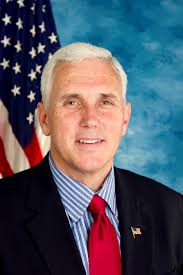
Indiana Governor Mike Pence
Both the leaders of the Republican party and those of evangelical congregations agree:
- Women should have fewer rights than men.
- Abortion should be illegal.
- There should be no separation between church and state.
- Religion should be taught in school.
- Religious doctrine trumps science.
- Government should be based on religious doctrine.
- Homosexuality should be outlawed.
Evangelicals fear they are swiftly losing their once privileged place among American religious groups.
And Republicans fear they might lose control of the House of Representatives, the Senate and, ultimately, the White House to a “blue wave” this fall.
2003 IRAQ WAR, ABC NEWS, ALTERNET, ASIANS, BARACK OBAMA, BIRTH CONTROL, BLACKS, BUZZFEED, CBS NEWS, CNN, DAILY KOS, DISABLED, DONALD TRUMP, ED MARTIN, FACEBOOK, HILLARY CLINTON, HUMAYUN KHAN, KATRINA PIERSON, LATINOS, MARCO GUTIERREZ, MEDICAID, MEDICARE, MOTHER JONES, MOVEON, MSNBC, MUSLIMS, NBC NEWS, NEWSWEEK, NICCOLO MACHIAVELLI, NPR, OBAMACARE, POLITICO, PRISONERS OF WAR, RAW STORY, SALON, SLATE, SOCIAL SECURITY, TEA PARTY, THE CHICAGO SUN-TIMES, THE CHICAGO TRIBUNE, THE DAILY BEAST, THE DISCOURSES, THE HUFFINGTON POST, THE LOS ANGELES TIMES, THE NEW YORK TIMES, THE PRINCE, THE WALL STREET JOURNAL, THE WASHINGTON POST, TIME, TWITTER, U.S. NEWS & WORLD REPORT, USA TODAY, WAYNE ROOT, WOMEN
In Bureaucracy, History, Military, Politics, Social commentary on August 3, 2018 at 12:01 am
Many pundits have sized up Donald Trump—as a Presidential candidate and President.
But how would Niccolo Machiavelli, the 16th-century Florentine statesman, assess Trump?
Machiavelli’s two great works on politics—The Prince and The Discourses—remain textbooks for successful politicians more than 500 years later.
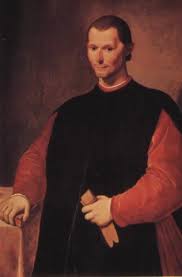

Niccolo Machiavelli
Consider Trump’s notoriety for hurling insults at virtually everyone, including:
- Latinos
- Asians
- Muslims
- Blacks
- The Disabled
- Women
- Prisoners-of-War
These insults delight his white, under-educated followers. But they have alienated millions of other Americans who might have supported him.
And what does Machiavelli have to say about gratuitously handing out insults and threats?
-
“I hold it to be a proof of great prudence for men to abstain from threats and insulting words towards any one.
-
“For neither the one nor the other in any way diminishes the strength of the enemy–but the one makes him more cautious, and the other increases his hatred of you, and makes him more persevering in his efforts to injure you.”
Many of those who supported Trump as a Presidential candidate expected him to stop constantly picking fights if he became President. Machiavelli had a stern warning for them:
-
“…If it happens that time and circumstances are favorable to one who acts with caution and prudence he will be successful. But if time and circumstances change he will be ruined, because he does not change the mode of his procedure.
-
“No man can be found so prudent as to be able to adopt himself to this, either because he cannot deviate from that to which his nature disposes him, or else because, having always prospered by walking in one path, he cannot persuade himself that it is well to leave it…
-
“For if one could change one’s nature with time and circumstances, fortune would never change.”
Then there is Trump’s approach to consulting advisers.
Asked on MSNBC’s “Morning Joe” who he consults about foreign policy, Trump replied; “I’m speaking with myself, number one, because I have a very good brain and I’ve said a lot of things.”

Donald Trump
This totally contrasts the advice given by Machiavelli:
-
“A prudent prince must [choose] for his counsel wise men, and [give] them alone full liberty to speak the truth to him, but only of those things that he asks and of nothing else.
-
“But he must be a great asker about everything and hear their opinions, and afterwards deliberate by himself in his own way, and in these counsels…comport himself so that every one may see that the more freely he speaks, the more he will be acceptable.”
And Machiavelli has potent advice on the selection of advisers:
- “The first impression that one gets of a ruler and his brains is from seeing the men that he has about him.
- “When they are competent and loyal one can always consider him wise, as he has been able to recognize their ability and keep them faithful.
- “But when they are the reverse, one can always form an unfavorable opinion of him, because the first mistake that he makes is in making this choice.”
Consider some of the advisers Trump has relied on in his campaign for President:
- Founder of Latinos for Trump Marco Gutierrez told MSNBC’s Joy Reid: “My culture is a very dominant culture. And it’s imposing, and it’s causing problems. If you don’t do something about it, you’re gonna have taco trucks every corner.”
- At a Tea Party for Trump rally at a Harley-Davidson dealership in Festus, Missouri, former Missouri Republican Party director Ed Martin reassured the crowd that they weren’t racist for hating Mexicans.
From the outset of his Presidential campaign, Trump polled extremely poorly among Hispanic voters. Comments like these didn’t increase his popularity.
- Wayne Root, opening speaker and master of ceremonies at many Trump campaign events, told Virginia radio host Rob Schilling: People on public assistance and women getting birth control through Obamacare should not be allowed to vote.
This proved a big turn-off among the 70% of women who have an unfavorable opinion of him—and anyone who receives Medicaid, Medicare or Social Security.
- Trump’s spokeswoman, Katrina Pierson, claimed that Barack Obama and Hillary Clinton were responsible for the death of Captain Humayun Khan–who was killed by a truck-bomb in Iraq in 2004.
Obama became President in 2009—almost five years after Khan’s death. And Clinton became Secretary of State the same year.
When your spokeswoman becomes a nationwide laughingstock, your own credibility goes down the toilet as well.
Finally, speaking directly to Trump, Machiavelli warns: Unwise princes cannot be wisely advised.
-
“It is an infallible rule that a prince who is not wise himself cannot be well advised, unless by chance he leaves himself entirely in the hands of one man who rules him in everything, and happens to be a very prudent man. In this case, he may doubtless be well governed, but it would not last long, for the governor would in a short time deprive him of the state.”
All of which would lead Niccolo Machiavelli to warn, if he could witness American politics today: “This bodes ill for your Republic.”
ABC NEWS, ALTERNET, AMERICAN CAESAR, AP, ARNOLD SCHWARZENEGGER, ASIANS, BARACK OBAMA, BLACKS, BUZZFEED, CANADA, CBS NEWS, CNN, CRIMEA, CROOKS AND LIARS, DAILY KOZ, DISABLED, DOUGLAS MACARTHUR, EUROPEAN UNION, FACEBOOK, FRANCE, G7 CONFERENCE, GERMANY, HILLARY CLINTON, HISPANICS, ITALY, JAPAN, JOHN OLIVER, JUSTIN TRUDEAU, KIM JONG ON, LARRY KUDLOW, MERYL STREEP, MEXICO, MOTHER JONES, MOVEON, MSNBC, NBC NEWS, NEIL YOUNG, NEWSWEEK, NORTH KOREA, NPR, PETER NAVARRO, POLITICO, PRISONERS OF WAR, RAW STORY, REUTERS, RUSSIA, SALON, SEATTLE TIMES, SINGAPORE, SLATE, TARIFFS, THE ATLANTIC, THE CHICAGO SUN-TIMES, THE CHICAGO TRIBUNE, THE DAILY BEAST, THE GUARDIAN, THE HILL, THE HUFFINGTON POST, THE LOS ANGELES TIMES, THE NATION, THE NEW YORK TIMES, THE WASHINGTON POST, TIME, TWITTER, U.S. NEWS & WORLD REPORT, UNITED KINGDOM, UNITED STATES, UPI, USA TODAY, USA TODAY DONALD TRUMP, VLADIMIR PUTIN, WILLIAM MANCHESTER, WOMEN
In Business, History, Military, Politics, Social commentary, Uncategorized on June 13, 2018 at 1:24 am
“He appeared to need enemies the way other men need friends, and his conduct assured that he would always have plenty of them.”
So wrote William Manchester about General Douglas MacArthur in his monumental 1978 biography, American Caesar. But he could have written this just as accurately about Donald Trump, both as Republican Presidential candidate and President.
As a Presidential candidate, Trump repeatedly used Twitter to attack hundreds of real and imagined enemies in politics, journalism, TV and films.
From June 15, 2015, when he launched his Presidential campaign, until October 24, 2016, Trump fired almost 4,000 angry, insulting tweets at 281 people and institutions that had somehow offended him.
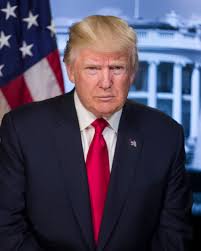
Donald Trump
The New York Times needed two full pages of its print edition to showcase them. Among his targets:
- Hillary Clinton
- President Barack Obama
- Actress Meryl Streep
- Comedian John Oliver
- Singer Neil Young
- Actor Arnold Schwarzenegger
- News organizations
- Beauty pageant contestants
Others he clearly delighted in insulting during the campaign included:
- Women
- Blacks
- Hispanics
- Asians
- The disabled
- Prisoners-of-war
As President, he has continued to insult virtually everyone, verbally and on Twitter. His targets have included Democrats, Republicans, the media, foreign leaders (most notably North Korea’s “Little Rocket Man” Kim Jong On) and even members of his Cabinet.
The one major figure that Trump has never attacked is Russian President Vladimir Putin.
But Trump has no such hesitation about insulting leaders of nations which have been America’s traditional allies—such as Canada.
On June 10, Larry Kudlow, Trump’s chief economic adviser, accused Canadian Prime Minister Justin Trudeau of undermining the US and its allies with comments he made at the G7 economic summit in Quebec.
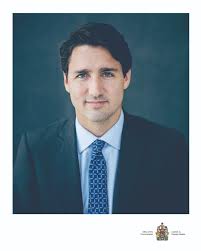
Justin Trudeau
The G7 is comprised of France, Canada, the United Kingdom, Germany, Japan, the United States and Italy.
“It was a betrayal,” Kudlow accused Trudeau on CNN’s “State of the Union.” “He really kind of stabbed us in the back.”
Kudlow said the allies should have been more supportive of Trump because of his scheduled June 12 meeting in Singapore with North Korean dictator Kim Jong On.
“They should have said to him, ‘God speed, you are negotiating with the crazy nuclear tyrant in North Korea, and we are behind you.'”
Larry Kudlow
On June 9, the prime minister had said in a press conference that Canada would “move forward with retaliatory measures” on July 1.
The reason for this: Trump’s decision to impose tariffs on steel and aluminum imports from Canada, the European Union and Mexico.
“I have made it very clear to the President that it is not something we relish doing, but it something that we absolutely will do,” Trudeau said. “Canadians, we’re polite, we’re reasonable, but we also will not be pushed around.”
And Peter Navarro, Trump’s trade adviser, went further: “There’s a special place in hell for any foreign leader that engages in bad faith diplomacy with President Donald J. Trump and then tries to stab him in the back on the way out the door.
“And that’s what bad faith Justin Trudeau did with that stunt press conference. That’s what weak, dishonest Justin Trudeau did, and that comes right from Air Force One.”
Given the sheer brutality of the language, there’s no reason to doubt that Navarro was absolutely reflecting Trump’s own venomous anger.
“He [Trump[ did him [Trudeau] a favor,” Navarro said. “He was even willing to sign that socialist communique.”
On June 10, Trump tweeted: “Based on Justin’s false statements at his news conference, and the fact that Canada is charging massive Tariffs to our U.S. farmers, workers and companies, I have instructed our U.S. Reps not to endorse the Communique as we look at Tariffs on automobiles flooding the U.S. Market!,”
But while Trump has made clear his detestation of socialism, he has no qualms about rewarding the aggression of a hardcore Communist like Vladimir Putin. On June 9, he called for Russia to be readmitted to the G7.
“I think it would be an asset to have Russia back in,” he said during an impromptu press conference at the summit.
“I think it would be good for the world. I think it would be good for Russia. I think it would be good for the United States. I think it would be good for all of the countries of the current G7. I think the G8 would be better.”
Russia was ousted from the group in 2014 after Putin annexed Crimea—the first violation of a European country’s borders since World War II.
“Today crystallizes precisely why Putin was so eager to see Trump elected,” said former Obama National Security Council spokesman Ned Price.
“For Putin, this is return on his investment, and it’s safe to say that his investment has paid off beyond even his wildest dreams,” he said in a statement to CNN.
And, in a turn of events that some might call poetic justice, moments after he arrived in Singapore for his meeting with Kim Jong On, Trump tweeted: “Our Great Larry Kudlow, who has been working so hard on trade and the economy, has just suffered a heart attack. He is now in Walter Reed Medical Center.”
2016 PRESIDENTIAL RACE, ABC NEWS, ALTERNET, AP, BARACK OBAMA, BASKET OF DEPLORABLES SPEECH, BBC, BERNIE SANDERS, BILL CLINTON, BLACKS, BUZZFEED, CBS NEWS, CELINDA LAKE, CLINTON FUNDATION, CNN, COMMUNISM, DAILY KOS, DEBBIE WASSERMAN-SCHULTZ, DEMOCRATIC NATIONAL COMMITTEE, DONALD TRUMP, FACEBOOK, HILLARY CLINTON, HISPANICS, HOUSE OF REPRESENTATIVES, MICHELLE OBAMA, MOTHER JONES, MOVEON, NBC NEWS, NEWSWEEK, NPR, POLITICO, POPULISM, RACISM, RAW STORY, REPUBLICAN NATIONAL COMMITTEE, REUTERS, SALON, SEATTLE TIMES, SLATE, SOCIALISM, SUSAN BORDO, THE ATLANTIC, THE CHICAGO SUN-TIMES, THE CHICAGO TRIBUNE, THE DAILY BEAST, THE DESTRUCTION OF HILLARY CLINTON, THE GUARDIAN, THE HILL, THE HUFFINGTON POST, THE LOS ANGELES TIMES, THE NEW YORK TIMES, THE WALL STREET JOURNAL, THE WASHINGTON POST, TIME, TOM BROKAW, TWITTER, U.S. HOUSE OF REPRESENTATIVES, U.S. NEWS & WORLD REPORT, U.S. SENATE, UPI, USA TODAY, WHITES, WHITEWATER, WIKILEAKS, WOMEN, YOUTH
In History, Law Enforcement, Politics, Social commentary on April 18, 2018 at 12:02 am
May 9 will mark one year since James Comey was fired as FBI director by President Donald Trump.
On April 17, Comey’s memoirs, A Higher Loyalty, appeared in bookstores. The book has generated massive publicity for Comey. And it has also re-ignited the controversial charge that he cost Hillary Clinton the White House during the closing days of the 2016 election.
But is this true?
Actually, there were at least nine reasons for Clinton’s defeat. Part One of this series explored the first five. This part will explore the remaining four.
#6 The coalition that twice elected Barack Obama deserted Hillary Clinton.
Clinton did worse-than-expected among all the groups she was counting on to support her: Blacks, women, youth and Hispanics.
- In 2012, Obama got 93% of the black vote; in 2016, Clinton got 88%.
- In 2012, Obama got 55% of the women’s vote; in 2016, Clinton won 54%.
- In 2012, Obama got 60% of the vote of those under 30; in 2016, Clinton got 54%.
- In 2012, Obama got 71% of the Hispanic vote; in 2016, Clinton got 65%.
Clinton proved less popular even among whites than Obama: In 2012, Obama won 39% of their votes; in 2016, Clinton won 37%.
#7 Trump, adopting the role of a populist, appealed to blue-collar voters. Clinton offered a “love-your-CEO” economic plan—and suffered for it.
Trump visited “Rustbelt” states like Michigan and Pennsylvania and vowed to “bring back” jobs that had been lost to China, such as those in coal mining and manufacturing. Clinton didn’t deign to show up, assuming she had those states “locked up.”
Most economists agree that, in a globalized economy, such jobs are not coming back, no matter who becomes President.
Even so, voters backed the man who came to promise them a better future, and shunned the woman who didn’t come to promise them any future at all.
In May, 2016, Democratic pollster CeLinda Lake had warned Clinton to revamp her economic platform. Clinton ignored the advice.
“Democrats simply have to come up with a more robust economic frame and message,” Lake said after the election. “We’re never going to win those white, blue-collar voters if we’re not better on the economy. And 27 policy papers and a list of positions is not a frame. We can laugh about it all we want, but Trump had one.”
#8 Hillary Clinton gave only one memorable speech during the campaign.
This was the “basket of deplorables” speech, delivered at a New York fundraiser on September 9. It was the only Clinton speech to be widely quoted by Democrats and Republicans.
She divided Donald Trump’s supporters into two groups. The first group were the “deplorables,” for whom she showed open contempt:
“You know, to just be grossly generalistic, you could put half of Trump’s supporters into what I call the basket of deplorables. Right? The racist, sexist, homophobic, xenophobic, Islamaphobic—you name it. And unfortunately there are people like that. And he has lifted them up.
“He has given voice to their websites that used to only have 11,000 people—now 11 million. He tweets and retweets their offensive hateful mean-spirited rhetoric. Now, some of those folks—they are irredeemable, but thankfully they are not America.”
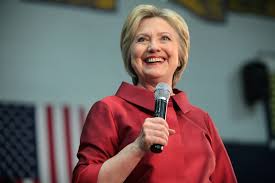
Hillary Clinton (Gage Skidmore photo)
But the second group, she said, consisted of poor, alienated Americans who rightly felt abandoned by their employers and their government:
“But….that other basket of people are people who feel that the government has let them down, the economy has let them down, nobody cares about them, nobody worries about what happens to their lives and their futures, and they’re just desperate for change. It doesn’t really even matter where it comes from.
“They don’t buy everything [Trump] says, but he seems to hold out some hope that their lives will be different. They won’t wake up and see their jobs disappear, lose a kid to heroin, feel like they’re in a dead-end. Those are people we have to understand and empathize with as well.”
#9 After giving this speech, Clinton threw away the good it might well have done her.
First, the day after making the speech, she apologized for it: “Last night I was ‘grossly generalistic,’ and that’s never a good idea. I regret saying ‘half–that was wrong.”
Many of Trump’s followers were racists, sexists and xenophobes—who deserved condemnation, not apologies. By apologizing, she looked weak, indecisive, even cowardly.
Second, having eloquently reached out to many of the men and women who were a prime constituency for Trump, she failed to offer an economic package to quickly and effectively address their vital needs for jobs and medical care.
The reason: She had failed to put one together long ago.
And all she had to offer now was boilerplate rhetoric, such as: “Education is the answer.”
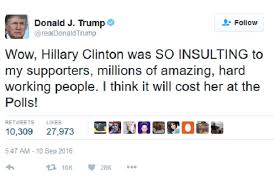
Worst of all, Trump turned her speech against her, tweeting: “Wow, Hillary Clinton was SO INSULTING to my supporters, millions of amazing, hard working people. I think it will cost her at the Polls!”
It did.
Blaming people like James Comey for her defeat only proves that Hillary Clinton has learned nothing from her failed campaigns of 2008 and 2016.
As long as Democrats and their supporters blame everyone else—and refuse to correct their own weaknesses—they will continue to remain a minority political party.
2016 PRESIDENTIAL RACE, ABC NEWS, ALTERNET, AP, BARACK OBAMA, BASKET OF DEPLORABLES SPEECH, BBC, BERNIE SANDERS, BILL CLINTON, BLACKS, BUZZFEED, CBS NEWS, CELINDA LAKE, CLINTON FUNDATION, CNN, COMMUNISM, DAILY KOS, DEBBIE WASSERMAN-SCHULTZ, DEMOCRATIC NATIONAL COMMITTEE, DONALD TRUMP, FACEBOOK, HILLARY CLINTON, HISPANICS, HOUSE OF REPRESENTATIVES, MICHELLE OBAMA, MOTHER JONES, MOVEON, NBC NEWS, NEWSWEEK, NPR, POLITICO, POPULISM, RACISM, RAW STORY, REPUBLICAN NATIONAL COMMITTEE, REUTERS, SALON, SEATTLE TIMES, SLATE, SOCIALISM, SUSAN BORDO, THE ATLANTIC, THE CHICAGO SUN-TIMES, THE CHICAGO TRIBUNE, THE DAILY BEAST, THE DESTRUCTION OF HILLARY CLINTON, THE GUARDIAN, THE HILL, THE HUFFINGTON POST, THE LOS ANGELES TIMES, THE NEW YORK TIMES, THE WALL STREET JOURNAL, THE WASHINGTON POST, TIME, TOM BROKAW, TWITTER, U.S. HOUSE OF REPRESENTATIVES, U.S. NEWS & WORLD REPORT, U.S. SENATE, UPI, USA TODAY, WHITES, WHITEWATER, WIKILEAKS, WOMEN, YOUTH
In History, Law Enforcement, Politics, Social commentary on April 17, 2018 at 12:10 am
“If the election had been on October 27, I would be your president,” Hillary Clinton told CNN in May, 2017.
“I was on the way to winning until a combination of Jim Comey’s letter on October 28 and Russian WikiLeaks raised doubts in the minds of people who were inclined to vote for me and got scared off.”
On October 28, 2016, then-FBI director James Comey announced that the bureau was reopening its investigation into Clinton’s use of a private email server while Secretary of State.
Comey wrote in a letter to Congress that the FBI has learned of the existence of emails that appear to be pertinent to the investigation “in connection with an unrelated case.”

James B. Comey
In national exit polls, Clinton’s use of a private email server troubled 63% of voters. Even so, 24% of those voted for her.
Up until then, Clinton had seemed on her way to winning the election. Even Comey believed she would become the first female President of the United States.
And Clinton did win the popular vote: 65,844,954 (48.2%) to Trump’s 62,979,879 (46.1%), beating him by almost 2.9 million votes.
But Trump emerged the victor in the Electoral College, which actually determines the Presidential winner—with 304 votes compared to Clinton’s 227.
Since November 8, 2016, Clinton and her infuriated allies have blamed Comey more than anyone for her loss. And Comey himself has said that the thought of him swinging the election made him “mildly nauseous.”
If Comey’s action played a role in Clinton’s loss, it was just one of several factors that sent Trump to the White House.
Among these:
#1 Hillary Clinton was an uninspiring candidate. When Barack Obama ran for President in 2008, NBC Anchor Tom Brokaw compared his rallies to Hannah Montana concerts. Audiences were excited by his charisma, eloquence, relative youth (47) and optimism (“Yes We Can!”).
Clinton radiated none of these qualities. She was 67 when she declared her candidacy for President—and looked it. Her speaking voice grated like the proverbial fingernail on a blackboard.
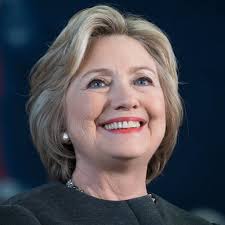
Hillary Clinton
She seemed to have been around forever—as First Lady (1993-2001), as Senator from New York (2001-2009) and as Secretary of State (2009-2013). Those born after 2000 thought of the Clinton Presidency as ancient history. She was offering a resume—and voters wanted an inspiration.
#2 Clinton brought a lot of baggage with her. In contrast to Obama, whose Presidency had been scandal-free, Clinton—rightly or wrongly—has always been dogged by charges of corruption.
During the Clinton Presidency, a failed land deal—Whitewater—while Bill Clinton was Governor of Arkansas triggered a seven-year investigation by a Republican special prosecutor. No criminality was uncovered, and no charge was brought against either Clinton.
After leaving the White House, she and her husband set up the Clinton Foundation, a public charity to bring government, businesses and social groups together to solve problems “faster, better, at lower cost.”
As Secretary of State, more than half of Clinton’s meetings with people outside government were with donors to the Clinton Foundation. If a “pay-to play” system wasn’t at work, one certainly seemed to be.
She cast further suspicion on herself by her unauthorized use of a private email server. This wasn’t revealed until March, 2015–after she was no longer Secretary of State.
She claimed she had used it to avoid carrying two cell-phones. But, as Secretary of State, she traveled with a huge entourage who carried everything she needed. Her critics believed she used a private email system to hide a “pay-for-pay” relationship with Clinton Foundation donors.
#3 As a candidate for President, she “secretly” worked with Debbie Wasserman-Schultz, the chair of the Democratic National Committee, to ensure that she would get the nomination.
As DNC chair, Wasserman-Schultz was expected to be impartial toward all Democratic candidates seeking the prize. This included Vermont U.S. Senator Bernie Sanders, Clinton’s chief competitor.
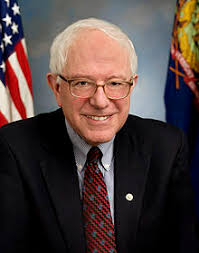
Bernie Sanders
So Sanders and his supporters were outraged when, on July 22, WikiLeaks released 19,252 emails and 8,034 attachments hacked from computers of the highest-ranking officials of the DNC.
The emails revealed a clear bias for Clinton and against Sanders. In one email, Brad Marshall, the chief financial officer of the DNC, suggested that Sanders, who is Jewish, could be portrayed as an atheist.
#4 The Obamas’ support proved a plus/minus for Clinton. Understandably, President Obama wanted to see his legacies continued—and she was the only candidate who could do it.
So he—and his wife, Michelle—stormed the country, giving eloquent, passionate speeches and firing up crowds on Clinton’s behalf.
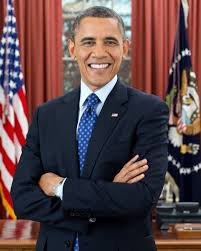
President Barack Obama
So long as either Obama stood before a crowd, the magic lasted. But once the event was over, the excitement vanished. Hillary simply didn’t arouse enough passion to keep it going.
Obama’s supporters found Clinton wanting—in attractiveness, grace, eloquence, trustworthiness and the ability to inspire.
#5 Democrats and liberals fell prey to hubris. They dismissed Donald Trump as a bad joke: Surely voters would reject a bombastic, thrice-married “reality show” host who had filed for corporate bankruptcy four times.
Many liberals believed Clinton would bury him at the polls: Blacks, women, youth and Hispanics will turn out huge for her. Democrats will retake the Senate, and maybe even retake the House.
They didn’t.
2016 PRESIDENTIAL RACE, ABC NEWS, ALTERNET, AP, BOEING, BUZZFEED, CBS NEWS, CNN, CROOKS AND LIARS, DAILY KOZ, DAVID BROOKS, DONALD TRUMP, FACEBOOK, GEORGE C. WALLACE, HILLARY CLINTON, JOHN F. KENNEDY, JOHN MCCAIN, JUSTICE DEPARTMENT, MAFIA, MARTIN LUTHER KING JUNIOR, MOTHER JONES, MOVEON, NBC NEWS, NEWSWEEK, NPR, POLITICO, PRISONERS OF WAR, RAW STORY, REUTERS, ROBERT F. KENNEDY, SALON, SAUDI ARABIA, SEATTLE TIMES, SLATE, STATE DEPARTMENT, THE ATLANTIC, THE CHICAGO SUN-TIMES, THE CHICAGO TRIBUNE, THE DAILY BEAST, THE GUARDIAN, THE HILL, THE HUFFINGTON POST, THE KENNEDYS, THE LOS ANGELES TIMES, THE NATION, THE NEW YORK TIMES, THE WALL STREET JOURNAL, THE WASHINGTON POST, TIME, TWITTER, U.S. NEWS & WORLD REPORT, UPI, USA TODAY, WOMEN
In Bureaucracy, History, Law Enforcement, Military, Politics, Social commentary on April 5, 2018 at 12:09 am
Fifty years ago, the Reverend Martin Luther King was shot to death as he stood on a balcony in Memphis, Tennessee. He had come there to lead a march of striking garbage workers.
New York United States Senator—and now Presidential candidate—Robert Francis Kennedy had been scheduled to give a speech in Indianapolis, Indiana, before a black audience.
Just before he drove into the city to deliver his address, he learned of King’s assassination. There was a real danger that rioting would erupt. Police who had been assigned to protect him said they wouldn’t accompany him into the inner city.
Kennedy drove off anyway, leaving behind his police escort.
Standing on a podium mounted on a flatbed truck, Kennedy spoke for just four minutes and 57 seconds.
His waiting audience hadn’t yet learned of King’s death. Kennedy broke the news to gasps, and then gave an impromptu speech eulogizing the slain civil rights leader.
For the first time since the assassination of his brother, President John F. Kennedy, in 1963, he spoke publicly of that killing. He noted that JFK—like King—had also been killed by a white man.
And he called upon the crowd to “dedicate ourselves to what the Greeks wrote so many years ago: to tame the savageness of man and to make gentle the life of this world.”
Riots erupted in 60 cities following King’s death—but not in Indianapolis.
Fifty years ago, Robert Kennedy aroused passions of an altogether different sort from those aroused by Donald Trump.
Kennedy had been a United States Attorney General (1961-1964) and Senator from New York (1964-1968). But it was his connection to his beloved and assassinated brother, President John F. Kennedy, for which he was best known.
In October, 1962, during the Cuban Missile Crisis, his wise counsel helped steer America from the brink of nuclear war with the Soviet Union. As a U.S Senator he championed civil rights and greater Federal efforts to fight poverty.

Robert F. Kennedy campaigning for President
Millions saw RFK as the only candidate who could make life better for America’s impoverished—while standing firmly against those who threatened the Nation’s safety.
As television correspondent Charles Quinn observed: “I talked to a girl in Hawaii who was for [George] Wallace [the segregationist governor of Alabama]. And I said ‘Really?’ [She said] ‘Yeah, but my real candidate is dead.’
“You know what I think it was? All these whites, all these blue collar people who supported Kennedy…all of these people felt that Kennedy would really do what he thought best for the black people, but, at the same time, would not tolerate lawlessness and violence.
“They were willing to gamble…because they knew in their hearts that the country was not right. They were willing to gamble on this man who would try to keep things within reasonable order; and at the same time do some of the things they knew really should be done.”
Campaigning for the Presidency in 1968, RFK had just won the crucial California primary on June 4—when he was shot in the back of the head.
His killer: Sirhan Sirhan, a young Palestinian furious at Kennedy’s support for Israel.
Kennedy died at 1:44 a.m. on June 6. He was 42.
On June 8, 1,200 men and women boarded a specially-reserved passenger train at New York’s Pennsylvania Station. They were accompanying Kennedy’s body to its final resting place at Arlington National Cemetery.
As the train slowly moved along 225 miles of track, throngs of men, women and children lined the rails to pay their final respects to a man they considered a genuine hero.
Little Leaguers clutched baseball caps across their chests. Uniformed firemen and policemen saluted. Burly men in shirtsleeves held hardhats over their hearts. Black men in overalls waved small American flags. Women from all levels of society stood and cried.

A nation says goodbye to Robert Kennedy
Commenting on RFK’s legacy, historian William L. O’Neil wrote in Coming Apart: An Informal History of America in the 1960′s:
“…He aimed so high that he must be judged for what he meant to do, and, through error and tragic accident, failed at….He will also be remembered as an extraordinary human being who, though hated by some, was perhaps more deeply loved by his countrymen than any man of his time.
“That too must be entered into the final account, and it is no small thing. With his death something precious disappeared from public life.”
America has never again seen a Presidential candidate who combined toughness on crime and compassion for the poor.
Republican candidates have waged war on crime—and the poor. And Democratic candidates have moved to the Right in eliminating anti-poverty programs.
RFK had the courage to fight the Mafia—and the compassion to fight poverty. At a time when Americans long for candidates to give them positive reasons for voting, his kind of politics are sorely missed.
ABC NEWS, ALTERNET, AP, BLACKS, BUZZFEED, CBS NEWS, CNN, CROOKS AND LIARS, DAILY KOZ, DAVID BROOKS, DONALD TRUMP, FACEBOOK, HILLARY CLINTON, JOHN KASICH, JOHN MCCAIN, LATINOS, MOTHER JONES, MOVEON, MUSLIMS, NBC NEWS, NEWSWEEK, NICCOLO MACHIAVELLI, NPR, NUCLEAR TRIAD, PBS NEWSHOUR, POLITICO, PRISONERS OF WAR, RAFAEL CRUZ, RAW STORY, REPUBLICAN PRESIDENTIAL NOMINATION, REUTERS, SALON, SEATTLE TIMES, SLATE, THE ATLANTIC, THE CHICAGO SUN-TIMES, THE CHICAGO TRIBUNE, THE DAILY BEAST, THE DISCOURSES, THE GUARDIAN, THE HILL, THE HUFFINGTON POST, THE LOS ANGELES TIMES, THE NATION, THE NEW YORK TIMES, THE PRINCE, THE WASHINGTON POST, TIME, TWITTER, U.S. NEWS & WORLD REPORT, UPI, USA TODAY, WOMEN
In Bureaucracy, History, Military, Politics, Social commentary on March 29, 2018 at 3:36 pm
As a Presidential candidate, Donald Trump was fiercely attacked by Democrats and his fellow Republicans. But one of his sharpest critics lived more than 500 years ago
He was Niccolo Machiavelli, the 16th-century Florentine statesmen and father of modern politics.
For openers: Trump had drawn heavy criticism for his angry and brutal attacks on a wide range of persons and organizations—including his fellow Republicans, journalists, news organizations, other countries and even celebrities who have nothing to do with politics.
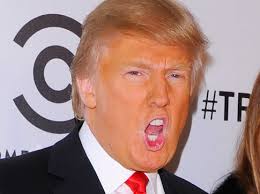
Donald Trump
Now consider Machiavelli’s advice on gratuitously handing out insults and threats:
- “I hold it to be a proof of great prudence for men to abstain from threats and insulting words towards any one.”
- “For neither the one nor the other in any way diminishes the strength of the enemy–but the one makes him more cautious, and the other increases his hatred of you, and makes him more persevering in his efforts to injure you.”
Trump, in turn, casually dismissed the criticism he had received:
“I can be Presidential, but if I was Presidential I would only have–about 20% of you would be here because it would be boring as hell, I will say,” Trump told supporters at a rally in Superior, Wisconsin.
Trump admitted that his wife, Melania, and daughter, Ivanka, had urged him to be more Presidential. And he promised that he would.
“But I gotta knock off the final two [Republican candidates—Ohio Governor John Kasich and Texas U.S. Senator Rafael Cruz] first, if you don’t mind.”
For those who expected Trump to shed his propensity for constantly picking fights, Machiavelli offered a stern warning:
- “…If it happens that time and circumstances are favorable to one who acts with caution and prudence he will be successful. But if time and circumstances change he will be ruined, because he does not change the mode of his procedure.”
- “No man can be found so prudent as to be able to adopt himself to this, either because he cannot deviate from that to which his nature disposes him, or else because, having always prospered by walking in one path, he cannot persuade himself that it is well to leave it…”
- “For if one could change one’s nature with time and circumstances, fortune would never change.”

Niccolo Machiavelli
Then there was Trump’s approach to consulting advisers:
Asked on MSNBC’s “Morning Joe” who he consults about foreign policy, Trump replied; “I’m speaking with myself, number one, because I have a very good brain and I’ve said a lot of things.”
This totally contrasted with the advice given by Machiavelli:
- “A prudent prince must [choose] for his counsel wise men, and [give] them alone full liberty to speak the truth to him, but only of those things that he asks and of nothing else.”
- “But he must be a great asker about everything and hear their opinions, and afterwards deliberate by himself in his own way, and in these counsels…comport himself so that every one may see that the more freely he speaks, the more he will be acceptable.”
And Machiavelli gave a related warning on the advising of rulers: Unwise princes cannot be wisely advised.
During the fifth GOP debate in the Presidential sweepstakes, host Hugh Hewitt asked Trump this question:
“Mr. Trump, Dr. [Ben] Carson just referenced the single most important job of the president, the command and the care of our nuclear forces. And he mentioned the triad.
“The B-52s are older than I am. The missiles are old. The submarines are aging out. It’s an executive order. It’s a commander-in-chief decision.
“What’s your priority among our nuclear triad?”
[The triad refers to America’s land-, sea- and air-based systems for delivering nuclear missiles and bombs.]

Nuclear missile in silo
Trump’s reply: “Well, first of all, I think we need somebody absolutely that we can trust, who is totally responsible, who really knows what he or she is doing. That is so powerful and so important.”
He then digressed to his having called the Iraq invasion a mistake in 2003 and 2004. Finally he came back on topic:
“But we have to be extremely vigilant and extremely careful when it comes to nuclear.
“Nuclear changes the whole ballgame. The biggest problem we have today is nuclear–nuclear proliferation and having some maniac, having some madman go out and get a nuclear weapon.
“I think to me, nuclear, is just the power, the devastation is very important to me.”
Which brings us back to Machiavelli:
- “…Some think that a prince who gains the reputation of being prudent [owes this to] the good counselors he has about him; they are undoubtedly deceived.”
- “It is an infallible rule that a prince who is not wise himself cannot be well advised, unless by chance he leaves himself entirely in the hands of one man who rules him in everything, and happens to be a very prudent man. In this case, he may doubtless be well governed, but it would not last long, for the governor would in a short time deprive him of the state.”
All of which led Niccolo Machiavelli to warn: “This bodes ill for your Republic.”


2012 PRESIDENTIAL RACE, 2016 PRESIDENTIAL RACE, ABC NEWS, ADULTERY, ALTERNET, AP, ATHEISTS, BARACK OBAMA, BIBLE, BILL MAHER, BIRTH CONTROL, BUZZFEED, CATHOLICS, CBS NEWS, CIVIL LIBERTIES, CNN, CROOKS AND LIARS, DAILY KOZ, DONALD TRUMP, ELEANOR ROOSEVELT, FACEBOOK, FRANKLIN GRAHAM, HOMOSEXUALITY, HOMOSEXUALS, ISLAM, JERRY FALWELL JR., JESUS CHRIST, JEWS, LESBIANS, LIBERALS, MIKE PENCE, MITT ROMNEY, MOTHER JONES, MOVEON, MSNBC, MUSLIMS, NBC NEWS, NEWSWEEK, NEWT GINGRICH, NON-CHRISTIANS, NPR, PBS NEWSHOUR, POLITICO, RAW STORY, RELIGION, RELIGIOUS FREEDOM RESTORATION ACT, REPUBLICAN PARTY, REUTERS, RICHARD FEYNMAN, RICK SANTORUM, SALON, SAUDI ARABIA, SCIENCE, SEATTLE TIMES, SLATE, SLAVERY, SPANISH INQUISITION, STORMY DANIELS, SUPREME COURT, TEA PARTY, THE ATLANTIC, THE CHICAGO SUN-TIMES, THE CHICAGO TRIBUNE, THE DAILY BEAST, THE GUARDIAN, THE HILL, THE HUFFINGTON POST, THE LOS ANGELES TIMES, THE NATION, THE NEW YORK TIMES, THE WALL STREET JOURNAL, THE WASHINGTON POST, THEOLOGY, TIME, TOMAS DE TORQUEMADA, TWITTER, U.S. NEWS & WORLD REPORT, UPI, USA TODAY, WAR, WOMEN
THE AMERICAN AYATOLLAHS: PART THREE (OF FOUR)
In Bureaucracy, History, Law, Law Enforcement, Military, Politics, Social commentary on September 26, 2018 at 12:03 amBernardo Gui was the chief inquisitor of the Dominican Order during the Medieval Inquisition (1184 – 1230s).
Gui closely studied the best methods for interrogating “heretics.” He set forth his findings in his most important and famous work, Practica Inquisitionis Heretice Pravitatis. or “Conduct of the Inquisition into Heretical Wickedness.”
Here’s how such an interrogation might go:
When a heretic is first brought up for examination, he assumes a confident air, as though secure in his innocence. I ask him why he has been brought before me. He replies, smiling and courteous, “Sir, I would be glad to learn the cause from you.”
Interrogator: You are accused as a heretic, and that you believe and teach otherwise than Holy Church believes.
Accused Heretic: (Raising his eyes to heaven, with an air of the greatest faith) Lord, thou knowest that I am innocent of this, and that I never held any faith other than that of true Christianity.
Interrogator: You call your faith Christian, for you consider ours as false and heretical. But I ask whether you have ever believed as true another faith than that which the Roman Church holds to be true?
Accused Heretic: I believe the true faith which the Roman Church believes, and which you openly preach to us.
Interrogator: Perhaps you have some of your sect at Rome whom you call the Roman Church. I, when I preach, say many things, some of which are common to us both, as that God liveth, and you believe some of what I preach. Nevertheless you may be a heretic in not believing other matters which are to be believed.
Accused Heretic: I believe all things that a Christian should believe.
Interrogator: I know your tricks….But we waste time in this fencing. Say simply, Do you believe in one God the Father, and the Son, and the Holy Ghost?
Accused Heretic: I believe.
Interrogator: Do you believe in Christ born of the Virgin, suffered, risen, and ascended to heaven?
Accused Heretic: (Briskly) I believe.
Interrogator: Do you believe the bread and wine in the mass performed by the priests to be changed into the body and blood of Christ by divine virtue?
Accused Heretic: Ought I not to believe this?
Interrogator: I don’t ask if you ought to believe, but if you do believe.
Accused Heretic: I believe whatever you and other good doctors order me to believe.
Inquisitor: Those good doctors are the masters of your sect; if I accord with them you believe with me; if not, not.
Accused Heretic: I willingly believe with you if you teach what is good to me.
Inquisitor: You consider it good to you if I teach what your other masters teach. Say, then, do you believe the body of our Lord, Jesus Christ to be in the altar?
Accused Heretic: (Promptly) I believe that a body is there, and that all bodies are of our Lord.
Interrogator: I ask whether the body there is of the Lord who was born of the Virgin, hung on the cross, arose from the dead, ascended, etc.
Accused Heretic: And you, sir, do you not believe it?
Interrogator: I believe it wholly.
Accused Heretic: I believe likewise.
Men like Bernard Gui—and Franklin Graham—do not seek a golden future. They crave to return to a “golden” past—which includes the power Christians once held to forcibly impose their religious beliefs on others.
Among those slated for forced conversions by the Religious Right:
To gain absolute secular power over the lives of their fellow Americans, the Religious Right will support any candidate, no matter how morally despicable.
During the 2016 Presidential race, evangelicals—and their leaders such as Franklin Graham and Jerry Falwell, Jr.—fervently supported Donald Trump, despite:
Donald Trump and Jerry Falwell, Jr., at Liberty University
And they continue to fervently support him.
They expect Trump to sponsor legislation that will—-by force of law—make their brand of Christianity supreme above all other religions.
Legislation such as The Religious Freedom Restoration Act.
This was signed into law on March 26, 2015, by Mike Pence, then Governor of Indiana.
This allows any individual or corporation to cite its religious beliefs as a defense when sued by a private party.
Officially, its intent is to prevent the government from forcing business owners to violate their religious beliefs.
Unofficially, its intent is to appease the hatred of gays and lesbians by the religious Right, a key constituency of the Republican party.
Thus, a bakery that doesn’t want to make a cake for a gay wedding or a restaurant that doesn’t want to serve lesbian patrons now has the legal right to refuse to do so.
And a hospital can legally turn away a gay patient if it wants to.
Islamic countries are notorious for their persecution of non-Muslims. Now the Religious Right wants to impose its own version of sharia law on American citizens.
Share this: