Posts Tagged ‘WHITE HOUSE CORRESPONDENTS DINNER’
ABC NEWS, ALTERNET, AP, BARACK OBAMA, BLACKS, BUZZFEED, C-SPAN, CBS NEWS, CNN, CROOKS AND LIARS, DAILY KOZ, DONALD TRUMP, FACEBOOK, FOX NETWORK, FOX NEWS, HILLARY CLINTON, MEDIA, MEGYN KELLY, MEXICANS, MICHELLE WOLF, MIKE TYSON, MOTHER JONES, MOVEON, MSNBC, NBC NEWS, NEWSPAPERS, NEWSWEEK, NPR, PLANNED PARENTHOOD, POLITICO, RAW STORY, REPUBLICAN PARTY, REUTERS, RICK WILSON, RUSSIA, SALON, SARAH HUCKABEE SANDERS, SEAN HANNITY, SEATTLE TIMES, SLATE, THE ATLANTIC, THE CHICAGO SUN-TIMES, THE CHICAGO TRIBUNE, THE DAILY BEAST, THE GUARDIAN, THE HILL, THE HUFFINGTON POST, THE LOS ANGELES TIMES, THE NATION, THE NEW YORK TIMES, THE WASHINGTON POST, TIME, TWITTER, U.S. NEWS & WORLD REPORT, UPI, USA TODAY, USA TODAY DONALD TRUMP, USA TODAY SARAH HUCKABEE SANDERS, WHITE HOUSE CORRESPONDENTS DINNER
In History, Politics, Social commentary, Uncategorized on May 7, 2018 at 12:25 am
On April 28, comedian Michelle Wolf skewered high-ranking Trump administration officials and members of the nation’s elite media.
She did so as the host of the annual White House Correspondents Dinner in Washington, D.C.
As a result, she has been furiously attacked by Right-wing defenders of the Trump administration and some of the nation’s most prominent media.
Almost all of their attention has focused on the Trump officials she ridiculed—especially Press Secretary Sarah Huckabee Sanders.

Michelle Wolf
But Wolf threw a series of sharp-edged zingers at some of the Nation’s most prominent media. And these comments have gone largely ignored.
They are, however, well worth examining—for the uncomfortable truths they reveal about much of the news being served up under the guise of fearless objectivity.
On little-watched C-SPAN: This is on C-SPAN; no one watches that. Trump is president; it’s not ideal.
On liberal media’s obsession with “Russiagate”: I know there’s a lot of people that want me to talk about Russia and Putin and collusion, but I’m not going to do that because there’s also a lot of liberal media here. And I’ve never really wanted to know what any of you look like when you orgasm.
On CNN—where “news” now consists of a series of “talking heads” pontificating about stories that other journalists have dug up: We’ve got our friends at CNN here. You guys love breaking news, and you did it. You broke it. Good work. The most useful information on CNN is when Anthony Bourdain tells me where to eat noodles.
On Fox News’ sexual harassment scandals involving such prominent (and former) members as CEO Roger Ailes and commentator Bill O’Reilly: Fox News is here. So, you know what that means, ladies: Cover your drinks. Seriously.
On Fox News’ actual role as the propaganda organ of the Republican party: People want me to make fun of [Fox News commentator] Sean Hannity tonight, but I cannot do that; this dinner is for journalists.
On weak-rated MSNBC, which is the liberal version of Fox News: We’ve got MSNBC here. MSNBC’s news slogan is, “This is who we are.” Guys, it’s not a good slogan. “This is who we are” is what your mom thinks the sad show on NBC is called. “Did you watch ‘This Is Who We Are’ this week? Someone left on a Crockpot, and everyone died.”
On Megyn Kelly, who rose to fame and fortune as a Right-wing propaganda shill on Fox News: And, of course, Megyn Kelly. What would I do without Megyn Kelly? You know, probably be more proud of women.
And, by the way, Megyn, Santa’s black. The weird old guy going through your chimney was Bill O’Reilly. You might want to put a flue on it or something.
[This last jibe centered on Kelly’s infamous December 11, 2013 Fox broadcast where she claimed: “I kind of laughed and said this is so ridiculous. Yet another person claiming it’s racist to have a white Santa. For all you kids watching at home, Santa just is white….Just because it makes you uncomfortable doesn’t mean it has to change. Jesus was a white man too.”]
On the continuing demise of newspapers—on which TV “news reporters” depend for their information: There’s a lot of print media here. There’s a ton of you guys, but I’m not going to go after print media tonight because it’s illegal to attack an endangered species. Buy newspapers.
On the media’s—especially the television media’s—morbid obsession with Donald Trump: There’s a ton of news right now; a lot is going on, and we have all these 24-hour news networks, and we could be covering everything. But, instead, we’re covering like three topics. Every hour, it’s Trump, Russia, Hillary and a panel of four people who remind you why you don’t go home for Thanksgiving.
On the media’s responsibility for the rise of a President they now detest: You guys are obsessed with Trump. Did you used to date him? Because you pretend like you hate him, but I think you love him. I think what no one in this room wants to admit is that Trump has helped all of you. He couldn’t sell steaks or vodka or water or college or ties or Eric, but he has helped you.
He’s helped you sell your papers and your books and your TV. You helped create this monster, and now you’re profiting off of him. And if you’re gonna profit off of Trump, you should at least give him some money because he doesn’t have any.
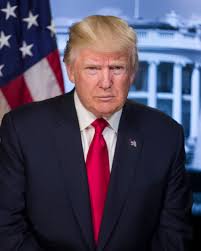
Donald Trump
[This last joke was probably the most painful the assembled media bigwigs had to endure. Because it’s undeniably true.
Trump’s campaign was saved from spending millions on TV advertising because the major TV news networks covered his every word. This was especially true when he was attacking women, blacks, Mexicans, Hillary Clinton, Barack Obama—and even beauty pageant contestants.
For the media, Trump was “good for ratings”—in the same way that Mike Tyson was “good for boxing.” Both were seen as freaks—and thus guaranteed to lure viewers eager to find out: “What outrageous thing has he done now?”]
ABC NEWS, ALTERNET, ANTHONY BOURDAIN, AP, BUZZFEED, CBS NEWS, CNN, COLLEGE OF WILLIAM & MARY, COMEDY CELLAR, CROOKS AND LIARS, DAILY KOZ, DONALD TRUMP, ENVIRONMENTAL PROTECTION AGENCY, FACEBOOK, HARVEY WEINSTEIN, HBO, JIMMY KIMMEL, LATE NIGHT WITH SETH MEYERS, MICHELLE WOLF, MIKE PENCE, MOTHER JONES, MOVEON, NBC NEWS, NEWSWEEK, NPR, POLITICO, RAW STORY, REUTERS, SALON, SARAH HUCKABEE SANDERS, SCOTT PRUITT, SEAN HANNITY, SEATTLE TIMES, SLATE, THE ATLANTIC, THE CHICAGO SUN-TIMES, THE CHICAGO TRIBUNE, THE DAILY BEAST, THE DAILY SHOW WITH TREVOR NOAH, THE GUARDIAN, THE HILL, THE HUFFINGTON POST, THE LOS ANGELES TIMES, THE NATION, THE NEW YORK TIMES, THE WASHINGTON POST, TIME, TWITTER, U.S. NEWS & WORLD REPORT, UPI, USA TODAY, USA TODAY JOSEPH STALIN, WHITE HOUSE CORRESPONDENTS DINNER
In Bureaucracy, Entertainment, History, Humor, Politics, Social commentary on May 3, 2018 at 12:09 am
Call it a case of dueling offensives.
One took place at the White House Correspondents Dinner at the Washington Hilton Hotel in Washington, D.C.
The other occurred in a political rally at Washington Township, in Washington, Michigan.
One starred a female comedian known for obscenity-laced humor.
The other starred a President known for brutal, coarse speech.
What both events had in common: Both featured speakers guaranteed to arouse highly partisan emotions.
The comedian, Michelle Wolf, cracked a joke: “Of course, Trump isn’t here, if you haven’t noticed. And I know, I would drag him here myself. But it turns out the president of the United States is the one pussy you’re not allowed to grab. He said it first. Yeah, he did. Do you remember? Good.”
Michelle Wolf
The President, Donald Trump, had previously made a similar remark: “You know I’m automatically attracted to beautiful—I just start kissing them. It’s like a magnet. Just kiss. I don’t even wait. And when you’re a star they let you do it. You can do anything. Grab them by the pussy. You can do anything.”
Michelle Wolf: “Now, I know people really want me to go after Trump tonight, but I think we should give the president credit when he deserves it. Like, he pulled out the Paris agreement, and I think he should get credit for that because he said he was going to pull out and then he did. And that’s a refreshing quality in a man.”
Donald Trump: “The Democrats don’t care about our military. They don’t. They don’t care about our borders or crime.”
[This is patently untrue. Democrats routinely vote for increasing the military budget.]
Donald Trump
Wolf: “Trump is racist, though. He loves white nationalists, which is a weird term for a Nazi. Calling a Nazi a white nationalist is like calling a pedophile a kid friend or Harvey Weinstein a ladies’ man.”
Trump: “They were saying, ‘What you think President Trump had to do with it?’ I will do you what. How about, everything?”
[Trump is claiming he deserved credit for making possible the April 27 meeting between the leaders of North and South Korea. His only “contribution”: Threatening North Korea with the “fire and fury of nuclear war.]
Wolf: “Mike Pence is the kind of guy that brushes his teeth and then drinks orange juice and thinks, ‘Mmm.’ Mike Pence is also very anti-choice. He thinks abortion is murder, which, first of all, don’t knock it till you try it. And when you do try it, really knock it. You know, you got to get that baby out of there.”
Trump: “I know things about the senator I can say, too. If I said them, he would never be elected again.”
[Trump is insinuating he has “dirt” on Montana United States Senator Jon Tester, who opposed the nomination of White House physician Ronny Jackson as Secretary of Veterans Affairs.
[For the record: Trump also claimed to have proof that President Barack Obama was not a United States citizen—a claim he was forced to retract. He also claimed that Obama had illegally wiretapped him during the 2016 Presidential campaign—another charge for which he offered no proof.]
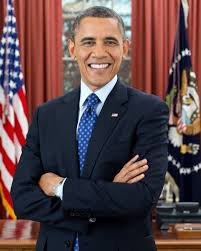
Barack Obama
Wolf: “And, yes, sure, you can groan all you want. I know a lot of you are very antiabortion. You know, unless it’s the one you got for your secret mistress. It’s fun how values can waiver. But good for you.”
Trump: “A woman lawyer, she said, ‘I know nothing.’ Now, she supposedly — you know why? Putin and the group said, ‘Trump is killing us. Why don’t you say you are involved with government so that we can go and make their life in the United States even more chaotic?'”
[Trump is making light of a documented meeting in Trump Tower in June, 2016, starring his son, Donald, Jr., his son-in-law, Jared Kushner, and his campaign manager, Paul Manafort—and several Russian Intelligence agents who offered to provide “dirt” on Hillary Clinton, in exchange for—what?]
Wolf: “Which, of course, brings me to the Me Too movement; it’s probably the reason I’m here. They were like, ‘A woman’s probably not going to jerk off in front of anyone, right?’ And to that, I say, ”Don’t count your chickens.'”
Trump: “The only collusion is the Democrats colluding with the Russians, the Democrats colluding with lots of other people.”
[Ties between Russian Intelligence agents and members of the Trump Presidential campaign have been well-documented. Special Counsel Robert Mueller is now investigating those contacts. To date, there has not been one documented instance of collusion between any Democrat and Russian Intelligence.]
* * * * *
So take your choice.
Right-wingers have universally branded Michelle Wolf as thoroughly disgusting. They profess to be especially upset by jokes she made about White Hose Press Secretary Sarah Huckabee Sanders.
Liberals have chosen Donald Trump as the more repulsively obscene—for his attacks on women, the media, the judiciary, the FBI and Justice Department and the Intelligence community.
The winner of the title Mr./Miss Obscene depends on what you hold most sacred: Words or actions?
ABC NEWS, ABORTION, ALTERNET, AP, BEN BAGDIKIAN, BUZZFEED, CARLY FIORINA, CBS NEWS, CNN, CONTRACEPTION, CROOKS AND LIARS, DAILY KOZ, DEAN OBEIDALLAH, FACEBOOK, FOX & FRIENDS, FOX NETWORK, HILLARY CLINTON, HULU, MAGGIE HABERMAN, MEGYN KELLY, MERCEDES SCHLAPP, MICHELLE WOLF, MOTHER JONES, MOVEON, MSNBC, NBC NEWS, NELL SCOVELL, NEWSWEEK, NPR, PENTAGON PAPERS CASE, PETER BAKER, PJ MEDIA, PLANNED PARENTHOOD, POLITICO, RAW STORY, REUTERS, RICK WILSON, SALON, SARAH HUCKABEE SANDERS, SEATTLE TIMES, SLATE, THE ATLANTIC, THE CHICAGO SUN-TIMES, THE CHICAGO TRIBUNE, THE DAILY BEAST, THE GUARDIAN, THE HANDMAID’S TALE, THE HILL, THE HUFFINGTON POST, THE LOS ANGELES TIMES, THE NATION, THE NEW YORK TIMES, THE WASHINGTON POST, TIME, TWITTER, TYLER O’NEIL, U.S. NEWS & WORLD REPORT, UPI, USA TODAY, USA TODAY DONALD TRUMP, WHITE HOUSE CORRESPONDENTS DINNER
In Bureaucracy, Entertainment, History, Humor, Politics, Social commentary on May 2, 2018 at 12:10 am
On April 28, comedian Michelle Wolf skewered high-ranking Trump administration officials and members of the nation’s elite media.
She did so as the host of the annual White House Correspondents Dinner in Washington, D.C.
Traditionally, it’s been an occasion where Washington’s political and media elites enjoy dinner and trade barbed quips at one another.
But President Donald Trump chose to skip the dinner in 2017 and 2018. Trump—who repeatedly insults others—is too thin-skinned to accept even harmless jokes aimed at him.
That, however, didn’t deter Wolf. And she served up a series of barbed jokes aimed at the greed, deceit and hypocrisy of high-ranking Trump administration officials.
Michelle Wolf
For which, she has herself been attacked by defenders of the Right-wing Trump administration and some of the nation’s most prominent media.
Tyler O’Neil, a Right-wing commentator for PJ Media, was outraged at Wolf’s comparing White House Press Secretary Sarah Huckabee Sanders to Aunt Lydia in the Hulu series, The Handmaid’s Tale.
“The premise of The Handmaid’s Tale, and the suggestion that Trump or anyone associated with him would ever countenance such a hateful submission of women, is bad enough,” wrote O’Neil, “but Wolf arguably compared Sarah Huckabee Sanders to the worst character in the novel and show.
“Aunt Lydia, played excellently by Ann Dowd, is not just part of the oppressive regime – she is the enforcer. She patrols the quarters of the ‘handmaids’ to ensure silence, she assigns handmaids to watch one another, and she leads the handmaids to carry out brutal punishments to anyone who steps out of line.”
The Trump administration has mercilessly attacked Planned Parenthood and championed rules allowing employers to not cover birth control on their insurance plans. Trump himself has said “there has to be some form of punishment” for women who get abortions.
“Unfortunately, I don’t think we advanced the cause of journalism tonight,” said Peter Baker, an MSNBC analyst and chief White House correspondent for The New York Times.
As Ben Bagdikian, a Pulitzer Prize-winning Washington Post reporter, said in arguing for the Post to publish the Pentagon Papers in 1971: “The only way to assert the right to publish is to publish.” Freedom of the press is not advanced by sucking up to those who—like Sarah Huckabee Sanders—routinely lie to reporters.
Much of the criticism aimed at Wolf centered on her joke about Sanders: “I actually really like [Press Secretary] Sarah [Huckabee Sanders]. I think she’s very resourceful. She burns facts and then she uses that ash to create a perfect smoky eye. Like maybe she’s born with it, maybe it’s lies. It’s probably lies.”
“That [Sanders] sat and absorbed intense criticism of her physical appearance, her job performance, and so forth, instead of walking out, on national television, was impressive,” the New York Times‘s Maggie Haberman tweeted.

Sarah Huckabee Sanders
Trump himself has repeatedly attacked women, often for their physical appearance. Among these:
- Hillary Clinton: “If Hillary Clinton can’t satisfy her husband what makes her think she can satisfy the country?”
- Carly Fiorina:” Look at that face! Would anyone vote for that? Can you imagine that, the face of our next president?!”
- Megyn Kelly: “You could see there was blood coming out of her eyes. Blood coming out of her wherever.”
And Sanders has blatantly lied countless times on behalf of Trump. Among these:
- “Everybody acts like President Trump is the one that came up with this idea. …There are multiple news outlets that have reported former President Barack Obama ordered wiretapping on Trump.” [In fact, Trump started this issue with his specific and libelous tweet.]
- “I can definitely say the president is not a liar. It’s frankly insulting that question would be asked.” [In fact, by January 10, 2018, the Washington Post reported: “Since taking office, President Trump has made 2,436 false or misleading claims and flip-flops.”]
“The reason [Sanders] does that is because her job is contingent upon her being a serial congenital liar in defense of Donald Trump’s latest outrages,” said GOP strategist Rick Wilson in November, 2017.
“She goes out and she tries to bury people in an avalanche of horseshit everyday, because this is her job.”

Rick Wilson
Mercedes Schlapp, a White House senior communications adviser, took to the Fox Network—the unofficial propaganda arm of the Republican party—to voice her outrage at Wolf.
Schlapp and her husband had stormed out of the correspondents dinner in protest. She told “Fox & Friends” that Wolf’s jokes were “so incredibly disrespectful.”
Dean Obeidallah, a columnist for The Daily Beast, responded: “The way I see it, a person in the Trump administration saying something was ‘disrespectful’ while defending a man who bragged on the ‘Access Hollywood’ tape about grabbing women by the pu**y, has demonized Muslims and Mexicans and mocked a disabled reporter is truly hilarious.”
And as comedy writer Nell Scovell put it: Comedians are stepping up in a way that journalists aren’t—as in Wolfe’s jokes about Sanders’ lying.
“If the job of journalism is to get at the truth,” said Scovell, “they need to do a better job.”
ABC NEWS, ALTERNET, ANTHONY BOURDAIN, AP, BORIS PASTERNAK, BUZZFEED, CBS NEWS, CNN, COLLEGE OF WILLIAM & MARY, COMEDY CELLAR, CROOKS AND LIARS, DAILY KOZ, DIMITRI SHOSTAKOVICH, DONALD TRUMP, ENVIRONMENTAL PROTECTION AGENCY, FACEBOOK, HARVEY WEINSTEIN, HBO, JIMMY KIMMEL, JOSEPH STALIN, LATE NIGHT WITH SETH MEYERS, MARIA YUDINA, MICHELLE WOLF, MIKE PENCE, MOTHER JONES, MOVEON, NBC NEWS, NEWSWEEK, NPR, POLITICO, RAW STORY, REUTERS, SALON, SARAH HUCKABEE SANDERS, SCOTT PRUITT, SEAN HANNITY, SEATTLE TIMES, SLATE, THE ATLANTIC, THE CHICAGO SUN-TIMES, THE CHICAGO TRIBUNE, THE DAILY BEAST, THE DAILY SHOW WITH TREVOR NOAH, THE GUARDIAN, THE HILL, THE HUFFINGTON POST, THE LOS ANGELES TIMES, THE NATION, THE NEW YORK TIMES, THE WASHINGTON POST, TIME, TWITTER, U.S. NEWS & WORLD REPORT, UPI, USA TODAY, USA TODAY JOSEPH STALIN, WHITE HOUSE CORRESPONDENTS DINNER
In Bureaucracy, History, Humor, Politics, Social commentary on May 1, 2018 at 12:04 am
Speaking truth to tyrants is always risky. But those who do—and survive—can find consolation in knowing they have done something few others have dared to do.
Two women—one Russian, the other American—have had this experience.
Maria Veniaminovna Yudina (1899 – 1970) was a gifted pianist who joined the piano faculty of the Moscow Conservatory in 1936, where she taught until 1951.
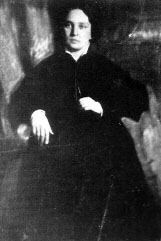
Maria Yudina
From 1944 to 1960, Yudina taught chamber ensemble and vocal class at the Gnessin Institute. In 1960, she was fired from the Institute because of her religious beliefs and championing of modern Western music.
She continued to perform in public, but her recitals were forbidden to be recorded. At one of her recitals in Leningrad, she read Boris Pasternak’s poetry from the stage as an encore.
For that, Yudina was banned from performing for five years. In 1966, when the ban was lifted, she gave a cycle of lectures on Romanticism at the Moscow Conservatory.
Although born into a Jewish family, she joined and remained a devout member of the Russian Orthodox Church.
Perhaps her most courageous act occurred during the last years of the reign of Joseph Stalin. The Soviet dictator was responsible for the deaths of 20 to 25 million people—through execution, famine, torture, imprisonment and deportations.
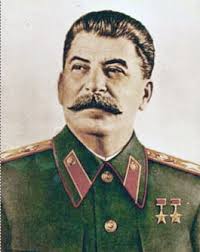
Joseph Stalin
One night in 1944, Stalin, listening to the radio, heard a performance of Mozart’s Piano Concerto No. 23. Yudina had played the piano, backed up by a full orchestra.
Stalin, impressed, ordered that an envelope containing 20,000 rubles be sent to Yudina.
According to Russian composer and pianist Dimitri Shostakovich, Yudina then did the unthinkable.
In his posthumously-published memoirs, Testimony, Shostakovich writes that Yudina sent Stalin a letter almost certain to result in her arrest.
The gist of the letter: “I thank you, Iosif Vissarionovich, for your aid.
“I will pray for you day and night and ask the Lord to forgive your great sins before the people and the country. The Lord is merciful and He will forgive you. I gave the money to the church that I attend.”
Stalin read the letter to his inner circle. Although he could have destroyed Yudina as easily as killing a fly, he set aside the letter and did nothing.
Yudina’s recording of Mozart’s Piano Concerto No. 23 was on Stalin’s record player when he collapsed with a cerebral hemorrhage on March 1, 1953. It was the last music he had listened to.
Shostakovich believed that Stalin was superstitious—and it was this that saved Yudina.
Throughout her life, Yudina remained an uncompromising critic of the Soviet regime. She died in Moscow in 1970.
Seventy-four years later, another woman—Michelle Wolf—dared speak truth to a tyrant in a different way.
Wolf (1985 – ) is an American comedian and writer. In 2007, she graduated from the College of William & Mary, a public research university in Williamsburg, Virginia. Her major: Kinesiology (the scientific study of human or non-human body movement.
She decided to enter the comedy world and made her first appearance on late-night television in 2014, on Late Night with Seth Meyers. She made repeated appearances on the show, A regular at the Comedy Cellar in New York City, she joined The Daily Show with Trevor Noah in 2016
Michelle Wolf
In 2017, she made her HBO stand-up debut, Michelle Wolf: Nice Lady.
On April 28, she hosted the annual White House Correspondents Dinner.
Traditionally, it’s been an occasion where Washington’s political and media elites enjoy dinner and trade barbed quips at one another.
But President Donald Trump chose to skip the dinner in 2017 and 2018. Trump—who repeatedly insults others—is too thin-skinned to accept even harmless jokes aimed at him.
That, however, didn’t deter Wolf. And she served up a series of barbed jokes aimed at the greed, deceit and hypocrisy of high-ranking Trump administration officials. Among these:
- [Trump] loves white nationalists, which is a weird term for a Nazi. Calling a Nazi a white nationalist is like calling a pedophile a kid friend or Harvey Weinstein a ladies’ man.
- [Vice President] Mike Pence is a weirdo, though. He’s a weird little guy. He won’t meet with other women without his wife present. When people first heard this, they were like, “That’s crazy.” But now, in this current climate, they’re like, “That’s a good witness.”
- A tree falls in the woods is [Environmental Protection Agency director] Scott Pruitt’s definition of porn. Yeah, we all have our kinks.
But Wolf also had plenty of jabs for assembled media bigwigs.
- The most useful information on CNN is when Anthony Bourdain tells me where to eat noodles.
- People want me to make fun of [Fox News host] Sean Hannity tonight, but I cannot do that; this dinner is for journalists.
Wolf’s jokes—especially those about White Hose Press Secretary Sarah Huckabee-Sanders—triggered harsh attacks in turn from Trump officials and media critics.
But Jimmy Kimmel—who has also performed at the correspondents dinner—tweeted:
“Michelle did exactly what she should do, which was [to] upset everybody. That’s the role of a commentator and a bomb thrower and a comedian. Your job is not to make people comfortable and your job is definitely not to stay within the line. Your job is to say the things that make people uncomfortable and upset.”
ABC NEWS, ALTERNET, AP, BARACK OBAMA, BUZZFEED, CBS NEWS, CNN, CROOKS AND LIARS, DAILY KOZ, DEMOCRATIC PARTY, EUROPEAN UNION, FACEBOOK, FBI, FOX NEWS, IMMIGRANTS, IVANKA TRUMP, JAMES COMEY, KELLEYANNE CONWAY, MAGGIE HABERMAN, MICHAEL AVENATTI, MICHAEL COHEN, MICHELLE WOLF, MOTHER JONES, MOVEON, NBC NEWS, NEWS MEDIA, NEWSWEEK, NPR, POLITICO, RAW STORY, REUTERS, SALON, SARAH HUCKABEE SANDERS, SEAN SPICER, SEATTLE TIMES, SLATE, STORMY DANIELS, THE ATLANTIC, THE CHICAGO SUN-TIMES, THE CHICAGO TRIBUNE, THE DAILY BEAST, THE GUARDIAN, THE HILL, THE HUFFINGTON POST, THE LOS ANGELES TIMES, THE NATION, THE NEW YORK TIMES, THE WASHINGTON POST, TIME, TWITTER, U.S. NEWS & WORLD REPORT, UPI, USA TODAY, USA TODAY DONALD TRUMP, WHITE HOUSE CORRESPONDENTS DINNER
In History, Humor, Politics, Social commentary on April 30, 2018 at 12:06 am
It was the second annual White House Correspondents dinner of the Donald Trump administration.
Traditionally, it’s been an occasion where Washington’s political and media elites enjoy dinner and trade barbed quips at one another.
Barack Obama—President for eight years—never missed one of these occasions. And with his comedic timing—and help from sharp-witted speechwriters—he starred in them.
But Donald Trump has chosen to skip not only one but two such dinners so far. And he’s likely to skip the rest of those given during his term as President.
Why?
Because Trump—who delights in insulting others—has too delicate a skin to put up with having even harmless jokes aimed at him.
Donald Trump
As both a Presidential candidate and President, he has repeatedly used Twitter to attack hundreds of real and imagined enemies in politics, journalism, TV and films.
From June 15, 2015, when he launched his Presidential campaign, until October 24, 2016, Trump fired almost 4,000 angry, insulting tweets at 281 people and institutions that had somehow offended him.
The New York Times needed two full pages of its print edition to showcase them.
But Trump skipped the White House Correspondents dinner to attend a “campaign rally” of fanatical followers in 2017. And skipping the dinner this year, he attended another Nuremberg-like rally in Washington, Michigan.
His speech featured attacks on immigrants, former FBI director James Comey, the European Union, Democratic members of Congress—and the news media.
Trump complained that the media hadn’t given him deserved credit for making possible the April 27 meeting between the leaders of North and South Korea. He claimed he had “everything” to do with it.
He attacked the media as composed of “very, very dishonest people” who put out “fake news.”
Meanwhile, at the correspondents dinner, comedian Michelle Wolf was on a roll. Among the barbs she aimed at the Trump administration:
- “I actually really like [Press Secretary] Sarah [Huckabee Sanders]. I think she’s very resourceful. She burns facts and then she uses that ash to create a perfect smoky eye. Like maybe she’s born with it, maybe it’s lies. It’s probably lies.”
- “If you don’t give [White House spokeswoman Kelleyanne Conway] a platform, she has nowhere to lie. It’s like that old saying, if a tree falls in the woods, how do we get Kellyanne under that tree?”
- “There’s also, of course, Ivanka [Trump].. She was supposed to be an advocate for women, but it turns out she’s about as helpful to women as an empty box of tampons. She’s done nothing to satisfy women. So, I guess like father, like daughter.”
- “It’s 2018 and I’m a woman, so you cannot shut me up. Unless you have Michael Cohen wire me $130,000.”
Michelle Wolf
This was an all-too-accurate reference to the payment of $130,000 to porn actress Stormy Daniels by Trump’s lawyer/fixer, Michael Cohen, to prevent her from talking about her 2006 tryst with the future President.
Taking a shot at Fox News—which functions as a propaganda arm of the Republican party—Wolf cracked: “Fox News is here. So you know what that means, ladies. Cover your drinks”—a reference to men who spike women’s drinks with “roofies.”
Wolf couldn’t resist noting that the man who would otherwise star at the dinner—President Trump—had refused to attend: “Of course, Trump isn’t here, if you haven’t noticed. He’s not here. And I know, I know, I would drag him here myself, but it turns out the president of the United States is the one pussy you’re not allowed to grab.”
Once again, a painful reference (for Trump supporters) to Trump’s infamous remark that, when you’re a celebrity, “you can do anything” with women: “Grab them by the pussy. You can do anything.”
But Wolf had sharp words for Democrats, too:
“Democrats are harder to make fun of because you guys don’t do anything. People think you might flip the House and Senate this November, but you guys always find a way to mess it up. You’re somehow going to lose by 12 points to a guy named Jeff Pedophile Nazi Doctor.”
Those who weren’t Trump fans enjoyed Wolf’s routine. Among these:
Michael Avenatti, Stormy Daniels’ attorney, said he thought Wolf was “really funny.” And actor Rob Reiner said that although Wolf’s routine wasn’t going over well but that he believed “she spoke the truth.”
But Trump devotees had a different reaction.
Former White House press secretary Sean Spicer called the event “a disgrace.”
New York Times White House Correspondent Maggie Haberman reacted on Twitter:
“That @PressSec sat and absorbed intense criticism of her physical appearance, her job performance, and so forth, instead of walking out, on national television, was impressive.”
To which Wolf tweeted in reply: “Hey mags! All these jokes were about her despicable behavior. Sounds like you have some thoughts about her looks though?”
According to the Fox News website: “Apparently offended by many of the comedian’s jabs at President Donald Trump and members of his administration, many attendees sat in silence, or simply got up and walked out.”
All of which amounted to a Right-wing chorus: “Legitimacy—and humor—are for us. Not for you.”
ABC NEWS, ALTERNET, AP, BBC, BILL MAULDIN, BUZZFEED, CBS NEWS, CNN, DAILY KOS, DONALD TRUMP, FACEBOOK, GENERAL LUCIAN K. TRUSCOTT, GEORGE W. BUSH, IRAQ WAR, JEB BUSH, MEMORIAL DAY, MOTHER JONES, MOVEON, NATIONAL CONSERVATIVE POLITICAL ACTION CONFERENCE (CPAC), NBC NEWS, NEWSWEEK, NPR, OLD GLORY, POLITICO, RAW STORY, REUTERS, SADDAM HUSSEIN, SALON, SAVING PRIVATE RYAN, SCOTT WALKER, SEATTLE TIMES, SLATE, STEVEN SPIELBERG, THE ATLANTIC, THE CHICAGO SUN-TIMES, THE CHICAGO TRIBUNE, THE DAILY BEAST, THE GUARDIAN, THE HILL, THE HUFFINGTON POST, THE LOS ANGELES TIMES, THE NEW YORK TIMES, THE WALL STREET JOURNAL, THE WASHINGTON POST, TIME, TWITTER, U.S. NEWS & WORLD REPORT, UPI, USA TODAY, WEAPONS OF MASS DESTRUCTION, WHITE HOUSE CORRESPONDENTS DINNER, WORLD WAR ii
In Bureaucracy, History, Military, Politics, Social commentary on May 30, 2017 at 12:23 am
Donald Trump repeatedly boasted that, if elected President, he would “make America great again.”
He would do well to re-watch Saving Private Ryan, Steven Spielberg’s 1998 World War II epic.
This opens with a scene of an American flag snapping in the wind. Except that the brilliant colors of Old Glory have been washed out, leaving only black-and-white stripes and black stars.
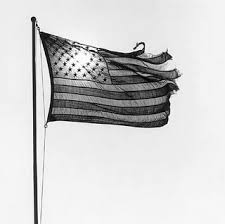
And then the movie opens–not during World war II but the present day.
Did Spielberg know something that his audience could only sense? Such as that the United States, for all its military power, has become a pale shadow of its former glory?
May 30, 1945, marked the first Memorial Day after World War II ended in Europe. On that day, the Sicily-Rome American Cemetery, near the town of Nettuno, held about 20,000 graves.
Most were soldiers who had died in Sicily, at Salerno, or at Anzio. One of the speakers at the ceremony was Lieutenant General Lucian K. Truscott, Jr., the U.S. Fifth Army Commander.
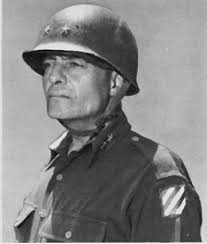
Lieutenant General Lucian K. Truscott, Jr.
Unlike many other generals, Truscott had shared in the dangers of combat, pouring over maps on the hood of his jeep with company commanders as bullets or shells whizzed about him.
When it came his turn to speak, Truscott moved to the podium. Then he turned his back on the assembled visitors–which included several Congressmen.
The audience he now faced were the graves of his fellow soldiers.
Among those who heard Truscott’s speech was Bill Mauldin, the famous cartoonist for the Army newspaper, Stars and Stripes. Mauldin had created Willie and Joe, the unshaven, slovenly-looking “dogfaces” who came to symbolize the GI.
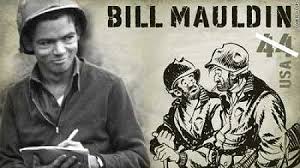
Bill Mauldin and “Willie and Joe,” the characters he made famous
It’s from Mauldin that we have the fullest account of Truscott’s speech that day.
“He apologized to the dead men for their presence there. He said that everybody tells leaders that it is not their fault that men get killed in war, but that every leader knows in his heart that this is not altogether true.
“He said he hoped anybody here through any mistake of his would forgive him, but he realized that he was asking a hell of a lot under the circumstances….
“Truscott said he would not speak of the ‘glorious’ dead because he didn’t see much glory in getting killed in your teens or early twenties.
“He promised that if in the future he ran into anybody, especially old men, who thought death in battle was glorious, he would straighten them out. He said he thought it was the least he could do.
“It was the most moving gesture I ever saw,” wrote Mauldin.
Then Truscott walked away, without acknowledging his audience of celebrities.
Fast forward 61 years later–to March 24, 2004.
At a White House Correspondents dinner in Washington, D.C., President George W. Bush joked publicly about the absence of Weapons of Mass Destruction (WMDs) in Iraq.
One year earlier, he had ordered the invasion of Iraq, claiming that its dictator, Saddam Hussein, possessed WMDs he intended to use against the United States.
To Bush, the non-existent WMDs were simply the butt of a joke that night. While an overhead projector displayed photos of a puzzled-looking Bush searching around the Oval Office, Bush recited a comedy routine.
“Those Weapons of Mass Destruction have gotta be here somewhere,” Bush laughed, while a photo showed him poking around the corners of the Oval Office.
“Nope–no weapons over there! Maybe there’s under here,” he said, as a photo showed him looking under a desk.
In a scene that could have occurred under the Roman emperor Nero, an assembly of wealthy, pampered men and women–the elite of America’s media and political classes–laughed heartily during Bush’s performance.
Only later did the criticism come, from Democrats and Iraqi war veterans–especially those veterans who had lost comrades or suffered horrific wounds to protect America from a threat that had never existed.
Then fast forward another 11 years–to February 27, 2015.
The Republican party’s leading Presidential contenders for 2016 gathered at the Conservative Political Action Conference (CPAC) in National Harbor, Maryland.
Although each candidate tried to stake his own claim to the Oval Office, all of them agreed on two points:
First, President Barack Obama had been dangerously timid in his conduct of foreign policy; and
Second, they would pursue aggressive military action in the Middle East.
Neither Bush nor Walker had seen fit to enter the ranks of the military he wished to plunge into further combat. And Donald Trump, who would win the Republican nomination and the Presidency, was a five-time draft dodger while the Vietnam war raged.
Bush, Walker and Trump are typical of those who make up the United States Congress:
Of those members elected to the House and Senate in November, 2016, only 102–less than 19%–have served in the U.S. military.
Small wonder then, that, for many people, Old Glory has taken on a darker, washed-out appearance, in real-life as in film.
ABC NEWS, BILL MAULDIN, CBS NEWS, CNN, DONALD TRUMP, FACEBOOK, GENERAL LUCIAN K. TRUSCOTT, GEORGE W. BUSH, IRAQ WAR, JEB BUSH, MEMORIAL DAY, NATIONAL CONSERVATIVE POLITICAL ACTION CONFERENCE (CPAC), NBC NEWS, OLD GLORY, SADDAM HUSSEIN, SAVING PRIVATE RYAN, SCOTT WALKER, STEVEN SPIELBERG, THE CHICAGO SUN-TIMES, THE CHICAGO TRIBUNE, THE LOS ANGELES TIMES, THE NEW YORK TIMES, THE WASHINGTON POST, TWITTER, WEAPONS OF MASS DESTRUCTION, WHITE HOUSE CORRESPONDENTS DINNER, WORLD WAR ii
In Bureaucracy, History, MSNBC, Politics, Social commentary, Uncategorized on February 2, 2016 at 12:01 am
Donald Trump has repeatedly boasted that, if elected President, he will “make America great again.”
He would do well to re-watch Saving Private Ryan, Steven Spielberg’s 1998 World War II epic.
This opens with a scene of an American flag snapping in the wind. Except that the brilliant colors of Old Glory have been washed out, leaving only black-and-white stripes and black stars.
And then the movie opens–not during World war II but the present day.
Did Spielberg know something that his audience could only sense? Such as that the united States, for all its military power, has become a pale shadow of its former glory?
May 30, 1945, marked the first Memorial Day after World War II ended in Europe. On that day, the Sicily-Rome American Cemetery, near the town of Nettuno, held about 20,000 graves.
Most were soldiers who died in Sicily, at Salerno, or at Anzio. One of the speakers at the ceremony was Lieutenant General Lucian K. Truscott, Jr., the U.S. Fifth Army Commander.
Lieutenant General Lucian K. Truscott, Jr.
Unlike many other generals, Truscott had shared in the dangers of combat, pouring over maps on the hood of his jeep with company commanders as bullets or shells whizzed about him.
When it came his turn to speak, Truscott moved to the podium. Then he turned his back on the assembled visitors–which included several Congressmen.
The audience he now faced were the graves of his fellow soldiers.
Among those who heard Truscott’s speech was Bill Mauldin, the famous cartoonist for the Army newspaper, Stars and Stripes. Mauldin had created Willie and Joe, the unshaved, slovenly-looking “dogfaces” who came to symbolize the GI.
Bill Mauldin and “Willie and Joe,” the characters he made famous
It’s from Mauldin that we have the fullest account of Truscott’s speech that day.
“He apologized to the dead men for their presence there. He said that everybody tells leaders that it is not their fault that men get killed in war, but that every leader knows in his heart that this is not altogether true.
“He said he hoped anybody here through any mistake of his would forgive him, but he realized that he was asking a hell of a lot under the circumstances….
“Truscott said he would not speak of the ‘glorious’ dead because he didn’t see much glory in getting killed in your teens or early twenties.
“He promised that if in the future he ran into anybody, especially old men, who thought death in battle was glorious, he would straighten them out. He said he thought it was the least he could do.
“It was the most moving gesture I ever saw,” wrote Mauldin.
Then Truscott walked away, without acknowledging his audience of celebrities.
Fast forward 61 years later–to March 24, 2004.
At a White House Correspondents dinner in Washington, D.C., President George W. Bush joked publicly about the absence of Weapons of Mass Destruction (WMDs) in Iraq.
One year earlier, he had ordered the invasion of Iraq on the premise that its dictator, Saddam Hussein, possessed WMDs he intended to use against the United States.
To Bush, the non-existent WMDs were nothing more than the butt of a joke that night. While an overhead projector displayed photos of a puzzled-looking Bush searching around the Oval Office, Bush recited a comedy routine.
“Those Weapons of Mass Destruction have gotta be here somewhere,” Bush laughed, while a photo showed him poking around the corners of the Oval Office.
“Nope–no weapons over there! Maybe there’s under here,” he said, as a photo showed him looking under a desk.
In a scene that could have occurred under the Roman emperor Nero, an assembly of wealthy, pampered men and women–the elite of America’s media and political classes–laughed heartily during Bush’s performance.
Only later did the criticism come, from Democrats and Iraqi war veterans–especially those veterans who had lost comrades or suffered horrific wounds to protect America from a threat that had never existed.
Then fast forward another 11 years–to February 27, 2015.
The Republican party’s leading Presidential contenders for 2016 gathered at the Conservative Political Action Conference (CPAC) in National Harbor, Maryland.
Although each candidate tried to stake his own claim to the Oval Office, all of them agreed on two points:
First, President Barack Obama had been dangerously timid in his conduct of foreign policy; and
Second, they would pursue aggressive military action in the Middle East.
“Our position needs to be to re-engage with a strong military and a strong presence,” said Jeb Bush, the former governor of Florida. And Bush added that he would consider sending ground forces to fight ISIS.
Scott Walker, the current governor of Florida, equated opposing labor unions to fighting terrorists: “If I could take on 100,000 protesters (in Wisconsin) I can do the same across the world.”
Neither Bush nor Walker had seen fit to enter the ranks of the military he wished to plunge into further combat. And Bush and Walker are typical of those who make up the United States Congress:
Of those members elected or re-elected to the House and Senate in November, 2014, only 97–less than 18%–have served in the U.S. military.
Small wonder then, that, for many people, Old Glory has taken on a darker, washed-out appearance, in real-life as in film.
2003 IRAQ WAR, 2016 REPUBLICAN PRESIDENTIAL CANDIDATES, ABC NEWS, ADOLF HITLER, AL QAEDA, ALBERT SPEER, BARACK OBAMA, CBS NEWS, CHRIS CHRISTIE, CNN, DICK CHENEY, DONALD RUMSFELD, FACEBOOK, GEORGE W. BUSH, GERMAN ARMY, INSIDE THE THIRD REICH, INVASION OF POLAND, ISLAMIC STATE OF IRAQ AND SYRIA, JEB BUSH, NAZI GERMANY, NBC NEWS, OSAMA BIN LADEN, PROPAGANDA, SADDAM HUSSEIN, TED CRUZ, THE CHICAGO TRIBUNE, THE LOS ANGELES TIMES, THE NEW YORK TIMES, THE WASHINGTON POST, TWITTER, WHITE HOUSE CORRESPONDENTS DINNER, WMDS, WORLD WAR 11
In Bureaucracy, History, Military, Politics, Social commentary on July 17, 2015 at 1:27 am
Naturally the common people don’t want war, neither in Russia nor in England nor in America, nor for that matter in Germany. That is understood.
But, after all, it’s the leaders of the country who determine the policy, and it’s always a simple matter to drag the people along….
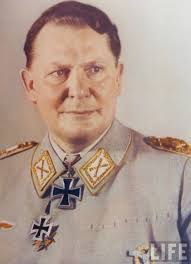
All you have to do is tell them that they are being attacked, and denounce the pacifists for lack of patriotism and exposing the country to greater danger. It works the same way in any country.
–Rcichsmarshall Hermann Goering
Much of the moral basis for American leadership was destroyed by the dark parallels between Adolf Hitler’s invasion of Poland in 1939 and George W. Bush’s invasion of Iraq in 2003.
Among these:
ADOLF HITLER
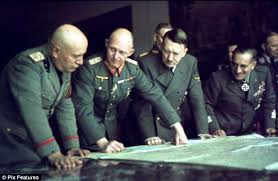
Adolf Hitler (third from left) with his generals
In 1970, Albert Speer, Adolf Hitler’s former architect and Minister of Aramaments, published his bestselling postwar memoirs, Inside the Third Reich. In a striking passage, he revealed how the Fuehrer really felt about German soldiers who were suffering and dying in a war he had provoked.
One evening during the middle of the war, Speer was traveling with Hitler on the Fuehrer’s private train. Late at night, they enjoyed a lavish dinner in the elegant rosewood-paneled dining car.
As they ate, Hitler’s train slowed down and passed a freight train halted on a side track.
From their open cattle car, recalled Speer, wounded German soldiers from the Russian Front–starved, their uniforms in rags–stared across the few yards to their Fuehrer’s dining-car window.
Hitler recoiled at seeing these injured men intently watching him–and he sharply ordered an adjutant to lower the window shades.
Hitler had served as a frontline soldier in World War 1 and had won the Iron Cross for bravery as a dispatch runner.
As Fuehrer, he often boasted of his affinity with the average German soldier. He claimed that “my whole life has been one long struggle for Germany.”
Yet throughout the six years of World War II, he refused to visit German cities ravaged by British and American bombs.
Hitler’s Minister of Propaganda, Joseph Goebbels, despaired at this.
Winston Churchill, prime minister of Great Britain, often visited cities hit by German bombers, and Goebbels knew these visits greatly boosted British morale.
Goebbels urged Hitler to make similar visits to bombed-out German cities, but theFuehrer refused.
Albert Speer believed that Hitler couldn’t bear to see the carnage wrought by his decision to provoke a needless war.

George W. Bush “looking” for WMDs in the White House
GEORGE W. BUSH
Similarly, Bush showed his contempt for the soldiers suffering and dying in his own unprovoked war.
On March 24, 2004, at a White House Correspondents dinner, he joked publicly about the absence of Weapons of Mass Destruction (WMDs).
To Bush, the non-existent WMDs were nothing more than the butt of a joke that night. While an overhead projector displayed photos of a puzzled-looking Bush searching around the Oval Office, Bush recited a comedy routine.
“Those weapons of mass destruction have gotta be somewhere,” Bush laughed, while a photo showed him poking around the corners in the Oval Office.
“Nope-–no weapons over there! Maybe they’re under here,” he said, as a photo showed him looking under a desk.
In a scene that could have occurred under the Roman emperor Nero, an assembly of wealthy, pampered men and women–-the elite of America’s media and political classes–-laughed heartily during Bush’s performance.
Only later did the criticism come, from Democrats and Iraqi war veterans–especially those veterans who had suffered grievous wounds to protect America from WMDs.
Click here: Bush laughs at no WMD in Iraq – YouTube
In his Presidential memoirs, Decision Points, Bush failed to mention his joking about the “missing WMDs” at the correspondents dinner.
In writing about discovering insights into the human character, the ancient historian, Plutarch, said it best:
“And the most glorious exploits do not always furnish us with the clearest discoveries of virtue or vice in men.
“Sometimes a matter of less moment, an expression or a jest, informs us better of their characters and inclinations, than the most famous sieges, the greatest armaments, or the bloodiest battles whatsoever.”
* * * * *
So add it all up:
- Two all-powerful leaders.
- Two nations lied into unprovoked wars.
- Adolf Hitler’s war costs the lives of 4.5 million German soldiers.
- George W. Bush’s war costs the lives of 4,484 Americans.
- Germany’s war results in the deaths of millions of Europeans and Russians.
- America’s war results in the deaths of an estimated 655,000 Iraqis, according to a 2006 study in the Lancet medical journal.
- America’s foray into Iraq costs its treasury at least $2 trillion.
- Hitler is literally driven underground by his enemies and commits suicide to avoid capture, trial and certain execution for war crimes.
- Bush retires from office with a lavish pension and full Secret Service protection. He writes his memoirs and is paid $7 million for the first 1.5 million copies.
No world leader publicly claims to model himself upon Adolf Hitler.
How many Republicans look to George W. Bush as their ideal in Presidential leadership?
2003 IRAQ WAR, ABC NEWS, ADOLF HITLER, AL QAEDA, ALBERT SPEER, BARACK OBAMA, CBS NEWS, CHRIS CHRISTIE, CNN, DICK CHENEY, DONALD RUMSFELD, FACEBOOK, GEORGE W. BUSH, GERMAN ARMY, INSIDE THE THIRD REICH, INVASION OF POLAND, ISLAMIC STATE OF IRAQ AND SYRIA, JEB BUSH, MARCO RUBIO, NAZI GERMANY, NBC NEWS, OSAMA BIN LADEN, PROPAGANDA, SADDAM HUSSEIN, TED CRUZ, THE CHICAGO TRIBUNE, THE LOS ANGELES TIMES, THE NEW YORK TIMES, THE WASHINGTON POST, TWITTER, WHITE HOUSE CORRESPONDENTS DINNER, WMDS, WORLD WAR 11
In Bureaucracy, History, Military, Politics, Social commentary on July 16, 2015 at 1:22 am
In late April, 1975, Vietnam veterans stared in horror at their TVs as the army of North Vietnam swept toward Saigon. The “peace with honor” that former President Richard M. Nixon had claimed to fashion had lasted no more than two years.
American news media captured the appalling sight of United States military and Intelligence personnel being frantically airlifted by helicopter from the roof of the American embassy.
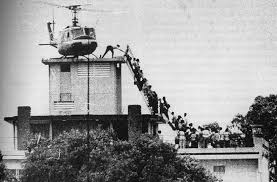
Americans’ scrambling to evacuate Vietnam
The eight-year war had cost $600 billion and the lives of more than 58,000 U.S. servicemen. Suddenly, before the eyes of American TV viewers, the longest and most divisive war in United States history was ending in shame.
And now, it’s deja vu all over again.
From 2003 to 2011, the war in Iraq cost the United States $2 trillion and the lives of 4,484 servicemen.
And now, as a horde of Republicans compete for the Presidency in 2016, the Iraq war has resurfaced to haunt them with a vengeance.
And most candidates have claimed that, if they had been able to foresee the future, they wouldn’t have invaded Iraq, as President George W. Bush did on March 19, 2003.
But there is far more to the United States’ tortured intervention in Iraq than most Americans know. Or than Republicans want to admit.
There is, in fact, a dark historical parallel to the events leading up to the Iraq war. A parallel that has its roots in Nazi Germany.
ADOLF HITLER
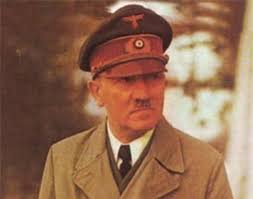
When Germany’s Fuehrer, Adolf Hitler, decided to invade Poland in 1939, he refused to consider any efforts to avert a conflict: “I want war. I am the one who will wage war.”
Despite frantic efforts by the French and British governments to resolve the crisis that Hitler had deliberately provoked, he refused all offers of compromise.
“I am only afraid,” Hitler told his generals at a military conference on August 22, 1939, “that some Schweinehund [pig dog] will make a proposal for mediation.”
GEORGE W. BUSH
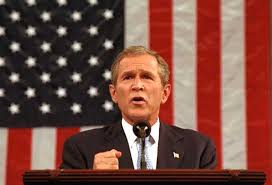
Similarly, Bush made it clear to his closest aides that he sought a pretext for invading Iraq.
On the evening after the September 11 attacks, Bush held a private meeting with Richard Clarke, the counter-terrorism advisor to the National Security Council.
“I want you, as soon as you can, to go back over everything,” said Bush. “See if Saddam did this. See if he’s linked in any way.”
Clarke was stunned: “But, Mr. President, Al Qaeda did this.”
“I know, I know,” said Bush. “But see if Saddam was involved. I want to know.”
On September 12, 2001, Bush attended a meeting of the National Security Council.
“Why shouldn’t we go against Iraq, not just Al Qaeda?” demanded Donald Rumsfeld, the Secretary of Defense.
Vice President Dick Cheney enthusiastically agreed.
Secretary of State Colin Powell then pointed out there was absolutely no evidence that Iraq had had anything to do with 9/11 or Al Qaeda. And he added: “The American people want us to do something about Al-Qaeda”-–not Iraq.
On September 22, 2001, Bush received a classified President’s Daily Brief intelligence report, which stated that there was no evidence linking Saddam Hussein to 9/11.
The report added that there was scant credible evidence that Iraq had any significant collaborative ties with Al Qaeda.
Yet on November 21, 2001, only 10 weeks after 9/11, Bush told Rumsfeld: It’s time to turn to Iraq.
ADOLF HITLER
Adolf Hitler knew that Poland’s government could never accept his demands for the Polish city of Danzig.
GEORGE W. BUSH
So, too, did George W. Bush make a demand he knew could never be accepted. On the eve of launching war on Iraq, Bush issued a humiliating ultimatum to Saddam Hussein:
“Saddam Hussein and his sons must leave Iraq within 48 hours. Their refusal to do so will result in military conflict, commenced at a time of our choosing.”
ADOLF HITLER
Hitler never regretted his decision to invade Poland. Only hours before committing suicide in his Berlin bunker on April 30, 1945, he asserted in his “final political testatment”: “It is untrue that I or anyone else in Germany wanted war in 1939.”
GEORGE W. BUSH
Similarly, Bush never regretted his decision to invade Iraq, which occurred on March 19, 2003. In his 2010 memoirs, Decision Points, he wrote:
“For all the difficulties that followed, America is safer without a homicidal dictator pursuing WMD and supporting terror at the heart of the Middle East.”
And in an interview with NBC’s Matt Lauer on November 8, 2010, Bush again sought to justify his decision to go to war:
LAUER: Was there ever any consideration of apologizing to the American people?
BUSH: I mean, apologizing would basically say the decision was a wrong decision, and I don’t believe it was a wrong decision.
ADOLF HITLER
On September 1, 1939, Adolf Hitler announced his attack on Poland before Germany’s rubber-stamp parliament, the Reichstag.
Hitler–a decorated World War I veteran–said: “I am from now on just first soldier of the German Reich. I have once more put on that coat that was the most sacred and dear to me.”

GEORGE W. BUSH
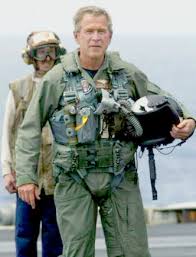
On May 1, 2003, Bush–who hid out the Vietnam war in the Texas Air National Guard-–donned a flight suit and landed a Navy jet aboard the USS Abraham Lincoln.
A banner titled “Mission Accomplished” was displayed on the aircraft carrier as Bush announced–wrongly–that the war was over.
The effect–and intent–was to portray Bush as the triumphant warrior-chieftan he never was.
2003 IRAQ WAR, 2016 REPUBLICAN PRESIDENTIAL CANDIDATES, ABC NEWS, ADOLF HITLER, AL QAEDA, ALBERT SPEER, BARACK OBAMA, CBS NEWS, CHRIS CHRISTIE, CNN, DICK CHENEY, DONALD RUMSFELD, FACEBOOK, GEORGE W. BUSH, GERMAN ARMY, INSIDE THE THIRD REICH, INVASION OF POLAND, ISLAMIC STATE OF IRAQ AND SYRIA, JEB BUSH, NAZI GERMANY, NBC NEWS, OSAMA BIN LADEN, PROPAGANDA, SADDAM HUSSEIN, TED CRUZ, THE CHICAGO TRIBUNE, THE LOS ANGELES TIMES, THE NEW YORK TIMES, THE WASHINGTON POST, TWITTER, WHITE HOUSE CORRESPONDENTS DINNER, WMDS, WORLD WAR 11
In Bureaucracy, History, Military, Politics, Social commentary on July 15, 2015 at 9:07 am
It’s the question feared by every Republican seeking to become President in 2016: “Would you have invaded Iraq in 2003 if you had known then what we know now?”
And when Republican Presidential candidates haven’t dodged the question, they’ve responded defensively–or argumentatively:
- Florida United States Senator Marco Rubio: Invading Iraq was “not a mistake because the president was presented with intelligence that said that Iraq had weapons of mass destruction.”
- Former Florida Governor Jeb Bush: “In retrospect the intelligence that everybody saw, that the world saw, not just the United States, was faulty. Once we invaded and took out Saddam Hussein, we didn’t focus on security first.”
- New Jersey Governor Chris Christie: “If we knew then what we know now and I were the president of the United States, I wouldn’t have gone to war. But you don’t get to replay history.”
- United States Senator Ted Cruz of Texas: “Of course not. The entire predicate of the war against Iraq was the intelligence that showed they had weapons of mass destruction and that there was a real risk they would use them.”
Admittedly, the answers to many of life’s questions lie in the future–and can only be revealed over time.
As the philosopher Soren Kierkegaard observed: “Life can only be understood backwards, but it must be lived forwards.”
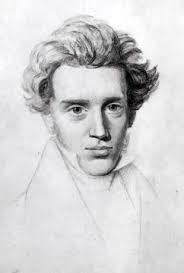
Soren Kierkegaard
Thus, it is pointless to hold anyone–including past Presidents–accountable for not knowing truths that would emerge only years later.
Instead, the question reporters should be asking Republican Presidential candidates is: “How do you feel about a President who provoked a needless, bloody and financially ruinous war in Iraq?”
Or: “How do you feel about a President who starts a war claiming that a ‘madman’ will attack America with WMDs–and then, when they aren’t found, publicly jokes about it?”
There is actually a dark historical parallel to the events leading up to the Iraq war. A parallel in how Adolf Hitler launched his invasion of Poland.
ADOLF HITLER
When Germany’s Fuehrer, Adolf Hitler, wanted to invade Poland in 1939, he mounted a sustained propaganda campaign to “justify” his ambitions.
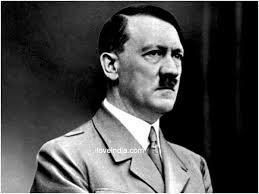
Adolf Hitler
German “newspapers”-–produced by Joseph Goebbels, the club-footed Minister of Propaganda–-carried fictitious stories of how brutal Poles were assaulting and even murdering their helpless German citizens.
In theaters, German audiences saw phony newsreels showing Poles attacking and raping German women living in Poland.
For a time, Hitler not only deceived the Germans but the world. Just before German tanks and troops invaded Poland on September 1, 1939, members of Hitler’s dreaded SS secret police rounded up a number of prisoners from German concentration camps.
The inmates were dressed in Polish Army uniforms and driven to a German radio station at Gleiwitz, on the German/Polish border.
There they were shot by SS men. Then Polish-speaking SS men “seized” the station and broadcast to Germany that a Polish invasion of Germany was now under way.
Hitler, addressing Germany’s rubber-stamp parliament, the Reichstag, dramatically asserted: “This night for the first time Polish regular soldiers fired on our territory. Since 5.45 a.m. we have been returning the fire, and from now on bombs will be met by bombs.”
Leaders of Britain and France were taken in by this ruse. They had pledged to go to war if Hitler attacked Poland. But they didn’t want to take on Germany if Poland had been the aggressor.
By the time the truth became known, Poland was securely in German hands.
On August 22, 1939, Hitler had outlined his strategy to a group of high-ranking military officers:
“I shall give a propagandist cause for starting the war. Never mind whether it is plausible or not. The victor will not be asked, later on, whether he told the truth or not. In starting and waging a war, it is not Right that matters, but Victory.”
GEORGE W. BUSH
American President George W. Bush followed a similar strategy while he prepared to invade Iraq: He ordered the topmost members of his administration to convince the American people of the war’s necessity.
Among those members: National Security Advisor Condoleeza Rice; Vice President Dick Cheney; Secretary of Defense Donald Rumsfeld; and Secretary of State Colin Powell.

Condaleeza Rice, Dick Cheney, George W. Bush and Donald Rumsfeld
Among their arguments-–all eventually revealed as lies-–were:
- Iraq’s dictator, Saddam Hussein, had worked hand-in-glove with Osama Bin Laden to plan 9/11.
- Saddam was harboring and supporting Al Qaeda throughout Iraq.
- Saddam, with help from Al Qaeda, was scheming to build a nuclear bomb.
- Iraq possessed huge quantities of chemical/biological weapons, in violation of UN resolutions.
- Saddam was preparing to use those weapons against the United States.
- American Intelligence agencies had determined the precise locations where those weapons were stored.
- The war would be self-financing via the oil revenues that would come from Iraq.
- Invading American forces would be welcomed as liberators.
ADOLF HITLER
Hitler intended Poland to be only his first conquest on what became known as “the Eastern Front.” Conquering Poland would place his powerful Wehrmacht on the border of the country that was his ultimate target: The Soviet Union.
GEORGE W. BUSH
Similarly, Vice President Dick Cheney–the “power-behind-the-throne” of the Bush Presidency–had his own ambitions for conquering Iraq.
According to former Bush speechwriter David Frum: Cheney longed for war in Iraq to gain reliable control of that nation’s vital oil resources. A successful occupation of Iraq would also allow the United States to threaten such bordering Islamic nations as Syria, Iran and even Saudi Arabia.


 Bureaucracybuster's Blog
ABC NEWS, ALTERNET, AP, BARACK OBAMA, BLACKS, BUZZFEED, C-SPAN, CBS NEWS, CNN, CROOKS AND LIARS, DAILY KOZ, DONALD TRUMP, FACEBOOK, FOX NETWORK, FOX NEWS, HILLARY CLINTON, MEDIA, MEGYN KELLY, MEXICANS, MICHELLE WOLF, MIKE TYSON, MOTHER JONES, MOVEON, MSNBC, NBC NEWS, NEWSPAPERS, NEWSWEEK, NPR, PLANNED PARENTHOOD, POLITICO, RAW STORY, REPUBLICAN PARTY, REUTERS, RICK WILSON, RUSSIA, SALON, SARAH HUCKABEE SANDERS, SEAN HANNITY, SEATTLE TIMES, SLATE, THE ATLANTIC, THE CHICAGO SUN-TIMES, THE CHICAGO TRIBUNE, THE DAILY BEAST, THE GUARDIAN, THE HILL, THE HUFFINGTON POST, THE LOS ANGELES TIMES, THE NATION, THE NEW YORK TIMES, THE WASHINGTON POST, TIME, TWITTER, U.S. NEWS & WORLD REPORT, UPI, USA TODAY, USA TODAY DONALD TRUMP, USA TODAY SARAH HUCKABEE SANDERS, WHITE HOUSE CORRESPONDENTS DINNER
NEWS MEDIA: HEAL THYSELF!
In History, Politics, Social commentary, Uncategorized on May 7, 2018 at 12:25 amOn April 28, comedian Michelle Wolf skewered high-ranking Trump administration officials and members of the nation’s elite media.
She did so as the host of the annual White House Correspondents Dinner in Washington, D.C.
As a result, she has been furiously attacked by Right-wing defenders of the Trump administration and some of the nation’s most prominent media.
Almost all of their attention has focused on the Trump officials she ridiculed—especially Press Secretary Sarah Huckabee Sanders.
Michelle Wolf
But Wolf threw a series of sharp-edged zingers at some of the Nation’s most prominent media. And these comments have gone largely ignored.
They are, however, well worth examining—for the uncomfortable truths they reveal about much of the news being served up under the guise of fearless objectivity.
On little-watched C-SPAN: This is on C-SPAN; no one watches that. Trump is president; it’s not ideal.
On liberal media’s obsession with “Russiagate”: I know there’s a lot of people that want me to talk about Russia and Putin and collusion, but I’m not going to do that because there’s also a lot of liberal media here. And I’ve never really wanted to know what any of you look like when you orgasm.
On CNN—where “news” now consists of a series of “talking heads” pontificating about stories that other journalists have dug up: We’ve got our friends at CNN here. You guys love breaking news, and you did it. You broke it. Good work. The most useful information on CNN is when Anthony Bourdain tells me where to eat noodles.
On Fox News’ sexual harassment scandals involving such prominent (and former) members as CEO Roger Ailes and commentator Bill O’Reilly: Fox News is here. So, you know what that means, ladies: Cover your drinks. Seriously.
On Fox News’ actual role as the propaganda organ of the Republican party: People want me to make fun of [Fox News commentator] Sean Hannity tonight, but I cannot do that; this dinner is for journalists.
On weak-rated MSNBC, which is the liberal version of Fox News: We’ve got MSNBC here. MSNBC’s news slogan is, “This is who we are.” Guys, it’s not a good slogan. “This is who we are” is what your mom thinks the sad show on NBC is called. “Did you watch ‘This Is Who We Are’ this week? Someone left on a Crockpot, and everyone died.”
On Megyn Kelly, who rose to fame and fortune as a Right-wing propaganda shill on Fox News: And, of course, Megyn Kelly. What would I do without Megyn Kelly? You know, probably be more proud of women.
And, by the way, Megyn, Santa’s black. The weird old guy going through your chimney was Bill O’Reilly. You might want to put a flue on it or something.
[This last jibe centered on Kelly’s infamous December 11, 2013 Fox broadcast where she claimed: “I kind of laughed and said this is so ridiculous. Yet another person claiming it’s racist to have a white Santa. For all you kids watching at home, Santa just is white….Just because it makes you uncomfortable doesn’t mean it has to change. Jesus was a white man too.”]
On the continuing demise of newspapers—on which TV “news reporters” depend for their information: There’s a lot of print media here. There’s a ton of you guys, but I’m not going to go after print media tonight because it’s illegal to attack an endangered species. Buy newspapers.
On the media’s—especially the television media’s—morbid obsession with Donald Trump: There’s a ton of news right now; a lot is going on, and we have all these 24-hour news networks, and we could be covering everything. But, instead, we’re covering like three topics. Every hour, it’s Trump, Russia, Hillary and a panel of four people who remind you why you don’t go home for Thanksgiving.
On the media’s responsibility for the rise of a President they now detest: You guys are obsessed with Trump. Did you used to date him? Because you pretend like you hate him, but I think you love him. I think what no one in this room wants to admit is that Trump has helped all of you. He couldn’t sell steaks or vodka or water or college or ties or Eric, but he has helped you.
He’s helped you sell your papers and your books and your TV. You helped create this monster, and now you’re profiting off of him. And if you’re gonna profit off of Trump, you should at least give him some money because he doesn’t have any.
Donald Trump
[This last joke was probably the most painful the assembled media bigwigs had to endure. Because it’s undeniably true.
Trump’s campaign was saved from spending millions on TV advertising because the major TV news networks covered his every word. This was especially true when he was attacking women, blacks, Mexicans, Hillary Clinton, Barack Obama—and even beauty pageant contestants.
For the media, Trump was “good for ratings”—in the same way that Mike Tyson was “good for boxing.” Both were seen as freaks—and thus guaranteed to lure viewers eager to find out: “What outrageous thing has he done now?”]
Share this: