Posts Tagged ‘THE PRINCE’
ADOLF HITLER, BARACK OBAMA, BILL CLINTON, CHRIS MATTHEWS, CNN'S "STARTING POINT", CZECHOSLAVAKIA, DARRELL ISSA, DEBT CEILING, EXECUTIVE ORDERS, EXTORTION, FACEBOOK, GEORGE W. BUSH, HOUSE SPEAKER JOHN BOEHNER, immigration reform, JIMMY CARTER, MSNBC'S "HARDBALL", NAZI GERMANY, NEGOTIATING, NEVILLE CHAMBERLAIN, NEWT GINGRICH, NICCOLO MACHIAVELLI, PAP SMEARS, PLANNED PARENTHOOD, POLAND, R.I.CO. ACT, REPUBLICAN PARTY, REPUBLICANS, Ronald Reagan, THE PRINCE, TITLE X, TWITTER, WARREN BUFFET, WINSTON CHURCHILL, WORLD WAR 11
In Bureaucracy, History, Law, Law Enforcement, Politics on July 8, 2014 at 12:22 am
In 2011, Republicans threatened to destroy the Nation’s credit rating unless their budgetary demands were met.
As Ernst Casier, chairman of philosophy at Hamburg University once warned:
“Those who are willing to risk everything, even death and destruction, to attain their ends will prevail over more responsible and prudent men who have more to lose and are rational, not suicidal.”
Yet President Barack Obama could have ended that threat via the Racketeer Influenced Corrupt Organizations (RICO) Act.
Passed by Congress in 1970, as Title 18, United States Code, Sections 1961-1968, its goal was to destroy the Mafia.
Originally, RICO was aimed at the Mafia and other organized crime syndicates. But in United States v. Turkette, 452 U.S. 576 (1981), the Supreme Court held that RICO applied as well to legitimate enterprises being operated in a criminal manner.
After Turkette, RICO could also be used against corporations, political protest groups, labor unions and loosely knit-groups of people.
RICO opens with a series of definitions of “racketeering activity” which can be prosecuted by Justice Department attorneys. Among those crimes: Extortion.

Extortion is defined as “a criminal offense which occurs when a person unlawfully obtains either money, property or services from a person(s), entity, or institution, through coercion.”
The RICO Act defines “a pattern of racketeering activity” as “at least two acts of racketeering activity, one of which occurred after the effective date of this chapter and the last of which occurred within ten years…after the commission of a prior act of racketeering activity.”
And if President Obama had believed that RICO was not sufficient to deal with Republicans’ extortion attempts, he could have relied on the USA Patriot Act of 2001, passed in the wake of 9/11.
In Section 802, the Act defines domestic terrorism. Among the behavior that is defined as criminal:
“Activities that…appear to be intended…to influence the policy of a government by intimidation or coercion [and]…occur primarily within the territorial jurisdiction of the United States.”
The remedies for punishing such criminal behavior were now legally in place. President Obama needed only to direct the Justice Department to apply them.
- President Obama could have directed Attorney General Eric Holder to investigate whether actions by Republican Congressman—and their Tea Party cohorts—broke Federal anti-racketeering and/or anti-terrorism laws.
- Holder, in turn, could have ordered the FBI to conduct that investigation.
- If the FBI found sufficient evidence that these laws had been violated, Holder could have empaneled criminal grand juries to indict those violators.
Criminally investigating and possibly indicting members of Congress would not violate the separation-of-powers principle. Congressmen have in the past been investigated, indicted and convicted for various criminal offenses.
Such indictments and prosecutions–and especially convictions–would have served notice on current and future members of Congress: The lives and fortunes of American citizens may not be held hostage to gain leverage in a political settlement.
In short: Obama could have replaced the law of fear with the rule of law.
But Obama could have stood up to Republican extortionists in another way: By urging his fellow Americans to rally to him in a moment of supreme national danger.
President John F. Kennedy did just that–successfully–during the most dangerous crisis of his administration.
Addressing the Nation on October 22, 1962, Kennedy shocked his fellow citizens by revealing that the Soviet Union had installed offensive nuclear missiles in Cuba.

John F. Kennedy
Kennedy outlined a series of steps he had taken to end the crisis–most notably, a blockade of Cuba. Then he sought to reassure and inspire his audience:
“The cost of freedom is always high, but Americans have always paid it. And one path we shall never choose, and that is the path of surrender or submission.”
President Obama could have sent that same message to the extortionists of the Republican Party–by explaining to the American people:
- Republicans have adopted the same my-way-or-else “negotiating” stance as Adolf Hitler.
- Like the Nazis, they are determined to gain absolute power–or destroy the Nation they claim to love.
- They raised the debt ceiling seven times during the eight-year Presidency of George W. Bush.
- But now that a Democrat holds the White House, raising the debt ceiling is unacceptable.
- Despite Republican lies, we cannot revitalize the economy by slashing taxes on the wealthy and on cash-hoarding corporations while cutting benefits for millions of average Americans.
- We will need both tax increases and sensible entitlement cuts to regain our economic strength.
And he could have ended his speech with a direct call for action by the American people:
“We stand on the edge of economic disaster. Therefore, I am asking each of you to stand up for America tonight–by demanding the recall of the entire membership of the Republican Party.
“This is the moment when each of us must decide–whether we will survive as a Republic, or allow ruthless political fanatics to destroy what has lasted and thrived for more than 200 years.”
To paraphrase Winston Churchill: President Obama had to choose between timidity and confrontation.
He chose timidity.
He would get contempt and obstruction at every turn.
ADOLF HITLER, BARACK OBAMA, BILL CLINTON, CHRIS MATTHEWS, CNN'S "STARTING POINT", CZECHOSLAVAKIA, DARRELL ISSA, DEBT CEILING, EXECUTIVE ORDERS, EXTORTION, FACEBOOK, GEORGE W. BUSH, HOUSE SPEAKER JOHN BOEHNER, immigration reform, JIMMY CARTER, MSNBC'S "HARDBALL", NAZI GERMANY, NEGOTIATING, NEVILLE CHAMBERLAIN, NEWT GINGRICH, NICCOLO MACHIAVELLI, PAP SMEARS, PLANNED PARENTHOOD, POLAND, R.I.CO. ACT, REPUBLICAN PARTY, REPUBLICANS, Ronald Reagan, THE PRINCE, TITLE X, TWITTER, WARREN BUFFET, WINSTON CHURCHILL, WORLD WAR 11
In Bureaucracy, History, Law, Law Enforcement, Politics on July 7, 2014 at 9:21 am
In November, 1995, Newt Gingrich, then Speaker of the House of Representatives, carried out his threat to shut down the government.
Then he unwisely admitted that he did so because President Bill Clinton had put him in the back of Air Force One during a recent trip to Israel.

Newt Gingrich
The shutdown proved a disaster for Republicans. Clinton was handily re-elected in 1996 and Gingrich suddenly resigned from Congress in 1998.
Still, the Republicans continued their policy of my-way-or-else.
In April, 2011, the United States government almost shut down over Republican demands about subsidized pap smears.
During a late-night White House meeting with President Barack Obama and key Congressional leaders, Republican House Speaker John Boehner made this threat:
His conference would not approve funding for the government if any money were allowed to flow to Planned Parenthood through Title X legislation.
Facing an April 8 deadline, negotiators worked day and night to strike a compromise–and finally reached one.
Three months later–on July 9–Republican extortionists again threatened the Nation with financial ruin and international disgrace unless their demands were met.

President Obama had offered to make historic cuts in the federal government and the social safety net–on which millions of Americans depend for their most basic needs.
But House Speaker John Boehner rejected that offer. He could not agree to the tax increases that Democrats wanted to impose on the wealthiest 1% as part of the bargain.

John Boehner
As the calendar moved ever closer to the fateful date of August 2, Republican leaders continued to insist: Any deal that includes taxes “can’t pass the House.”
One senior Republican said talks would go right up to–and maybe beyond–the brink of default.
“I think we’ll be here in August,” said Republican Representative Pete Sessions, of Texas. “We are not going to leave town until a proper deal gets done.”
President Obama had previously insisted on extending the debt ceiling through 2012. But in mid-July, he simply asked congressional leaders to review three options with their members:
- The “Grand Bargain” choice—favored by Obama–would cut deficits by about $4 trillion, including spending cuts and new tax revenues.
- A medium-range plan would aim to reduce the deficit by about $2 trillion.
- The smallest option would cut between $1 trillion and $1.5 trillion, without increased tax revenue or any Medicare and Medicaid cuts.
And the Republican response?
Said Rep. Darrell Issa, chairman of the Oversight and Government Reform Committee:“Quite frankly, [Republican] members of Congress are getting tired of what the president won’t do and what the president wants.”
Noted political analyst Chris Matthews summed up the sheer criminality of what happened within the House of Representatives.
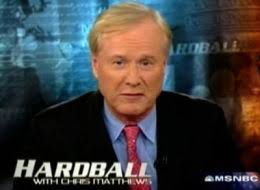
Chris Matthews
Speaking on MSNBC’s “Hardball,” on July 28–five days before Congress reached its August 2 deadline to raise the debt-ceiling–Matthews noted:
“The first people to bow to the demands of those threatening to blow up the economy were the Republicans in the House, the leaders. The leaders did what the followers told them to do: meet the demands, hold up the country to get their way.
“Those followers didn’t win the Senate, or the Presidency, just the House.
“But by using the House they were able to hold up the entire United States government. They threatened to blow things up economically and it worked.
“They said they were willing to do that–just to get their way–not by persuasion, not by politics, not by democratic government, but by threatening the destruction of the country’s finances.
“Right. So what’s next? The power grid? Will they next time threaten to close down the country’s electricity and communications systems?”
With the United States teetering on the brink of national bankruptcy, President Obama faced three choices:
- Prosecute Republican extortionists under the Racketeer Influenced Corrupt Oganizations Act;
- Seek to rally the American people against a criminal threat to the financial security of the Nation;
- Cave in to Republican demands.
Unfortunately for Obama and the Nation, he chose Number Three.
A graduate of Columbia University and Harvard Law School, Obama is easily one of the most academically gifted Presidents in United States history.
But for all this, he failed–from the onset of his Presidency–to grasp and apply this fundamental lesson taught by Niccolo Machiavelli, the father of modern political science.
In his classic work on politics, The Prince, Machiavelli warns:
From this arises the question whether it is better to be loved than feared, or feared more than loved.
The reply is, that one ought to be both feared and loved, but as it is difficult for the two to go together, it is much safer to be feared than loved….
Men have less scruple in offending one who makes himself loved than one who makes himself feared. For love is held by a chain of obligations which, men being selfish, is broken whenever it serves their purpose. But fear is maintained by a dread of punishment which never fails.
Obama has failed to heed this advice. And, predictably, his sworn enemies–which is what Republicans consider themselves to be–have felt free to demonize and obstruct him at every turn.
ADOLF HITLER, BARACK OBAMA, CHRIS MATTHEWS, CNN'S "STARTING POINT", CZECHOSLAVAKIA, DEBT CEILING, EXECUTIVE ORDERS, EXTORTION, FACEBOOK, GEORGE W. BUSH, GOVERNMENT SHUTDOWN, HOUSE SPEAKER JOHN BOEHNER, immigration reform, JIMMY CARTER, MSNBC'S "HARDBALL", NAZI GERMANY, NEGOTIATING, NEVILLE CHAMBERLAIN, NEWT GINGRICH, NICCOLO MACHIAVELLI, PAP SMEARS, PLANNED PARENTHOOD, POLAND, R.I.CO. ACT, REPUBLICAN PARTY, REPUBLICANS, Ronald Reagan, THE PRINCE, TWITTER, WARREN BUFFET, WINSTON CHURCHILL, WORLD WAR 11
In Bureaucracy, History, Law, Law Enforcement, Politics on July 4, 2014 at 3:05 pm
After winning the bloodless conquest of Czechoslavakia by threatening France and Britain with war, Adolf Hitler turned his attention to Poland.
When his generals balked, warning that an invasion would trigger a war with France and Britain, Hitler quickly brushed aside their fears: “Our enemies are little worms. I saw them at Munich.”
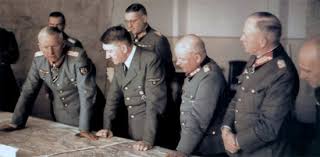
Adolf Hitler and his generals
Hitler ordered the invasion of Poland on September 1, 1939–unintentionally triggering World War II.
In time, historians and statesmen would regard Munich as an object lesson in the futility—and danger—in appeasing evil and aggression.
But for the postwar Republican party, Hitler’s my-way-or-else “negotiating” methods would become standard operating procedure.
During the summer of 2011, Republicans refused to raise the debt ceiling unless Democrats agreed to massively cut social programs for the elderly, poor and disabled.
And while Republicans demanded that the disadvantaged tighten their belts, they rejected any raising of taxes on their foremost constituency–the wealthiest 1%.
To raise taxes on the wealthy, they insisted, would be a “jobs-killer.” It would “discourage” corporate CEOs from creating tens of thousands of jobs they “want” to create.
If Congress failed to raise the borrowing limit of the federal government by August 2, 2011, the date when the U.S. reached the limit of its borrowing abilities, America would begin defaulting on its loans.
As Warren Buffett, CEO of Berkshire Hathaway, explained the looming economic catastrophe:
“If you don’t send out Social Security checks, I would hate to think about the credit meeting at S&P and Moody’s the next morning.
“If you’re not paying millions and millions and millions of people that range in age from 65 on up, money you promised them, you’re not a AAA,” said Buffett.
A triple-A credit rating is the highest possible rating that can be received.
Republicans knew this argument is a lie. And so did the editors of Time. The difference is, the editors of Time were willing to reveal the truth.
In its June 20, 2011 cover-story on “What U.S. Economic Recovery? Five Destructive Myths,” Rana Foroohar, the magazine’s assistant managing editor in charge of economics and business, delivered this warning:
Profit-seeking corporations can’t be relied on to ”make it all better.”
American companies “are doing quite well,” but most American workers “are earning a lower hourly wage now than they did during the recession.”
Corporations, in short, are doing extremely well. But they don’t spend their profits on American workers.
“There may be $2 trillion sitting on the balance sheets of American corporations globally, but firms show no signs of wanting to spend it in order to hire workers at home.”
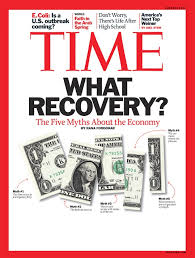
In short: Giving even greater tax breaks to mega-corporations–the standard Republican mantra–has not persuaded them to stop “outsourcing” jobs. Nor has it convinced them to start hiring Americans.
Many American companies prefer opening factories in Brazil, China or India to doing so in the United States–and thus creating jobs for American workers.
While embarrassingly overpaid CEOs squander corporate wealth on themselves, millions of Americans can’t afford medical care or must depend on charity to feed their families.
Yet there is also a disconnect between the truth of this situation and the willingness of Americans to face up to that truth.
The reason, writes Foroohar:
Republicans have convinced most Americans they can revitalize the economy by slashing “taxes on the wealthy and on cash-hoarding corporations while cutting benefits for millions of Americans.”
And she concludes: To restore prosperity America needs both tax increases and cuts in entitlement programs.
Click here: What U.S. Economic Recovery? Five Destructive Myths – TIME
According to Mein Kampf-–”My Struggle”–-Hitler’s autobiography and political treatise:
- Most people are ruled by sentiment, not reason.
- This sentiment is simple and consistent. It is rooted in notions of love and hatred, right and wrong, truth and falsehood.
- Propaganda isn’t based on objective truth but must present only that partof the truth that makes its own side look good.
- People are not intelligent, and quickly forget.
- Confine propaganda to a few bare essentials and express these in easily-remembered in stereotyped images.
- Persistently repeat these slogans until the very last individual has come to grasp the idea that has been put forward.
Following these principles, Republicans have proved hugely successful at persuading millions that truth is whatever their party claims it to be at any given moment.
“Fascism,” said author Ernest Hemingway, “is a lie told by bullies.” Thus, when Republicans couldn’t attain their goals by lying, they sought to do so by force–or at least the threat of it.
Republicans have repeatedly threatened to shut down the government unless their constantly escalating demands were met.
In November, 1995, Newt Gingrich, then Speaker of the House of Representatives, carried out his threat. Gingrich unwisely admitted that he did so because President Bill Clinton had put him in the back of Air Force One during a recent trip to Israel.
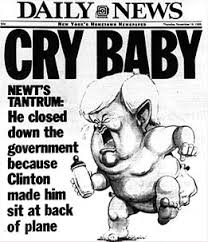
The shutdown proved a disaster for Republicans. Clinton was handily re-elected in 1996 and Gingrich suddenly resigned from Congress in 1998.
ADOLF HITLER, BARACK OBAMA, CHRIS MATTHEWS, CNN'S "STARTING POINT", CZECHOSLAVAKIA, DEBT CEILING, EXECUTIVE ORDERS, EXTORTION, FACEBOOK, GEORGE W. BUSH, GOVERNMENT SHUTDOWN, HOUSE SPEAKER JOHN BOEHNER, immigration reform, JIMMY CARTER, MSNBC'S "HARDBALL", NAZI GERMANY, NEGOTIATING, NEVILLE CHAMBERLAIN, NEWT GINGRICH, NICCOLO MACHIAVELLI, PAP SMEARS, PLANNED PARENTHOOD, POLAND, R.I.CO. ACT, REPUBLICAN PARTY, REPUBLICANS, Ronald Reagan, THE PRINCE, TWITTER, WARREN BUFFET, WINSTON CHURCHILL, WORLD WAR 11
In Bureaucracy, History, Law, Law Enforcement, Politics on July 3, 2014 at 9:50 am
On February 12, 1938, two Chancellors—Adolf Hitler of Germany, and Kurt von Schuschnigg of Austria—met at Hitler’s retreat at Obersalzberg, Germany. At stake lay the future independence of Austria.
That meeting ended with Hitler’s bullying Schnuschigg into submission. Austria became a vassal-state of Nazi Germany.
Seven months later, in September, 1938, Hitler gave another exhibition of his “negotiating” methods. This time, the target of his rage and aggression was Czechoslovakia.
Once again, he opened “negotiations” with a lie: The Czechoslovak government was trying to exterminate 3.5 million Germans living in the “Sudetenland.”
This consisted of the northern, southwest and western regions of Czechoslovakia, inhabited mostly by ethnic Germans.
Then he followed this up with the threat of war: Germany would protect its citizens and halt such “oppression.”
For British Prime Minister Neville Chamberlain, the thought of another European war erupting less than 20 years after the end of World War I was simply unthinkable.

The Cenotaph, in London, honoring the unknown British dead of World War 1
Something had to be done to prevent it. And he believed himself to be just the man to do it.
He quickly sent Hitler a telegram, offering to help resolve the crisis: “I could come to you by air and am ready to leave tomorrow. Please inform me of earliest time you can receive me, and tell me the place of the meeting. I should be grateful for a very early reply.”
Once again, another head-of-state was prepared to meet Hitler on his home ground. Again, Hitler took this concession as a sign of weakness. And Chamberlain’s use of such words as “please” and “grateful” only further convinced Hitler of another impending triumph.
Chamberlain was determined to grant his every demand–so long as this meant avoiding a second world war.
The two European leaders met in Berchtesgaden, Germany, on September 15, 1938.
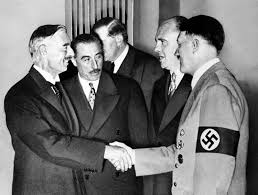
Neville Chamberlain and Adolf Hitler
During their talks, Chamberlain said he had come to discuss German grievances. But, he added, it was necessary in all circumstances to exclude the use of force.
Hitler appeared to be shocked that he could be accused of such intentions: “Force? Who speaks of force?“
Then, without warning, he switched to an aggressive mode. He accused the Czechs of having mobilized their army in May. They had mobilized—in response to the mobilization of the German army.
“I shall not put up with this any longer,” shouted Hitler. “I shall settle this question in one way or another. I shall take matters in my own hands!”
Suddenly, Chamberlain seemed alarmed—and possibly angry: “If I understood you right, you are determined to proceed against Czechoslovakia in any case. If this is so, why did you let me come to Berchtesgaden?
“In the circumstances, it is best for me to return at once. Anything else now seems pointless.”
Hitler was taken aback by the unexpected show of defiance. He realized he was about to lose his chance to bully the British into accepting his latest demands.
So he softened his tone and said they should consider the Sudetenland according to the principle of self-determination.
Chamberlain said he must immediately return to England to consult with his colleagues. Hitler appeared uneasy. But then the German translator finished the sentence: “…and then meet you again.” Hitler realized he still had a chance to attain victory without going to war.
Chamberlain agreed to the cession of the Sudetenland. Three days later, French Prime Minister Edouard Daladier did the same. No Czechoslovak representative was invited to these discussions.
Chamberlain met Hitler again in Godesberg, Germany, on September 22 to confirm the agreements. But Hitler aimed to use the crisis as a pretext for war.
He now demanded not only the annexation of the Sudetenland but the immediate military occupation of the territories. This would give the Czechoslovak army no time to adapt their defense measures to the new borders.
To achieve a solution, Italian dictator Benito Mussolini suggested a conference of the major powers in Munich.
On September 29, Hitler, Daladier and Chamberlain met and agreed to Mussolini’s proposal. They signed the Munich Agreement, which accepted the immediate occupation of the Sudetenland.
The Czechoslovak government had not been a party to the talks. Nevertheless, it promised to abide by the agreement on September 30.
It actually had no choice. It faced the threat of an immediate German invasion after being deserted by its pledged allies: Britain, France and the Soviet Union.
Chamberlain returned to England a hero. Holding aloft a copy of the worthless agreement he had signed with Hitler, he told cheering crowds in London: “I believe it is peace for our time.”
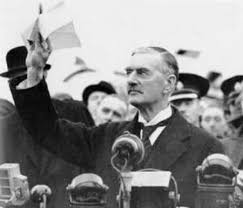
Neville Chamberlain
Winston Churchill knew better, predicting: “Britain and France had to choose between war and dishonor. They chose dishonor. They will have war.”
Hitler—still planning more conquests—also knew better. In March, 1939, the German army occupied the rest of Czechoslovakia.
Chamberlain would soon be seen as a naive weakling–even before bombs started falling on London.
Hitler next turned his attention–and demands–to Poland.
ADOLF HITLER, BARACK OBAMA, CHRIS MATTHEWS, CNN'S "STARTING POINT", CZECHOSLAVAKIA, DEBT CEILING, EXECUTIVE ORDERS, EXTORTION, FACEBOOK, GEORGE W. BUSH, GOVERNMENT SHUTDOWN, HOUSE SPEAKER JOHN BOEHNER, immigration reform, JIMMY CARTER, MSNBC'S "HARDBALL", NAZI GERMANY, NEGOTIATING, NEVILLE CHAMBERLAIN, NEWT GINGRICH, NICCOLO MACHIAVELLI, PAP SMEARS, PLANNED PARENTHOOD, POLAND, R.I.CO. ACT, REPUBLICAN PARTY, REPUBLICANS, Ronald Reagan, THE PRINCE, TWITTER, WARREN BUFFET, WINSTON CHURCHILL, WORLD WAR 11, WORLD WAR ii
In Bureaucracy, History, Law, Law Enforcement, Politics on July 2, 2014 at 12:52 pm
Robert Payne, author of the bestselling biography, The Life and Death of Adolf Hitler (1973), described Hitler’s “negotiating” style thusly:

“Although Hitler prized his own talents as a negotiator, a man always capable of striking a good bargain, he was totally lacking in finesse.
“He was incapable of bargaining. He was like a man who goes up to a fruit peddler and threatens to blow his brains out if he does not sell his applies at the lowest possible price.”
By studying Hitler’s mindset and “negotiating” methods, we can learn much about the mindset and “negotiating” style of today’s Republican party.
A classic example of Hitler’s “bargaining style” came in 1938, when he invited Austrian Chancellor Kurt von Schuschnigg to his mountaintop retreat in Obersalzberg, Germany. Hitler, an Austrian by birth, intended to annex his native land to Germany.
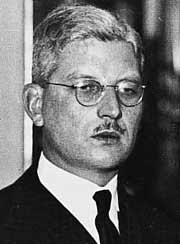
Kurt von Schuschnigg
Schuschnigg was aware of Hitler’s desire, but nevertheless felt secure in accepting the invitation. He had been assured that the question of Austrian sovereignty would not arise.
The meeting occurred on February 12, 1938.
Shuschnigg opened the discussion with a friendly compliment. Walking over to a large window, he admired the breathtaking view of the mountains.
HITLER: We haven’t come here to talk about the lovely view or the weather!
Austria has anyway never done anything which was of help to the German Reich….I am resolutely determined to make an end to all this business. The German Reich is a great power. Nobody can and nobody will interfere if it restores order on its frontiers.
SCHUSCHNIGG: I am aware of your attitude toward the Austrian question and toward Austrian history….As we Austrians see it, the whole of our history is a very essential and valuable part of German history….And Austria’s contribution is a considerable one.
HITLER: It is absolutely zero—that I can assure you! Every national impulse has been trampled underfoot by Austria….
I could call myself an Austrian with just the same right—indeed with even more right—than you, Herr Schuschnigg. Why don’t you once try a plebiscite in Austria in which you and I run against each other? Then you would see!
SCHUSCHNIGG: Well, yes, if that were possible. But your know yourself, Herr Reich Chancellor, that it just isn’t possible. We simply have to go on living alongside one another, the little state next to the big one. We have no other choice.
And that is why I ask you to tell me what your concrete complaints are. We will do all in our power to sort things out and establish a friendly relationship, as far as it is possible to do so.
HITLER: That’s what you say, Herr Schuschnigg. And I am telling you that I intend to clear up the whole of the so-called Austrian question–one way or another. Do you think I don’t know that you are fortifying Austria’s border with the Reich?
SCHUSCHNIGG: There can be no suggestion at all of that—
HITLER: Ridiculous explosive chambers are being built under bridges and roads—
This was a lie, and Hitler knew it was a lie. But no matter. It gave him an excuse to threaten to destroy Austria—as he was to destroy so many other nations during the next seven years.
HITLER: I have only to give one command and all this comic stuff on the border will be blown to pieces overnight. You don’t seriously think you could hold me up, even for half an hour, do you?
Who knows—perhaps you will find me one morning in Vienna like a spring storm. Then you will go through something! I’d like to spare the Austrians that.
The S.A. [Hitler’s private army of Stormtroopers] and the [Condor] Legion [which had bombed much of Spain into rubble during the three-year Spanish Civil War] would come in after the troops and nobody–not even I–could stop them from wreaking vengeance.
* * * * *
Schnuschigg made a cardinal mistake in dealing with Hitler: He showed fear. And this was precisely what the Nazi dictator looked for in an opponent.
Contrary to popular belief, Hitler did not constantly rage at everyone. On the contrary: he could, when he desired, be charming, especially to women. He used rage as a weapon, knowing that most people feel intimidated by it.
In the case of Schuschnigg, he opened with insults and threats at the outset of their discussion. Then there was a period of calm, to convince the Austrian chancellor the worst was over.
Finally, he once again attacked–this time with so much fury that Schuschnigg was terrified into submission.
With one stroke of a pen, Austria became a vassal-state to Nazi Germany.
Republicans used precisely the same “negotiating” style during the summer of 2011 to threaten the United States with financial ruin unless they got their way in budget negotiations.
And they threatened to do the same again that fall.
ADOLF HITLER, BARACK OBAMA, CHRIS MATTHEWS, CNN'S "STARTING POINT", CZECHOSLAVAKIA, DEBT CEILING, EXECUTIVE ORDERS, EXTORTION, FACEBOOK, GEORGE W. BUSH, GOVERNMENT SHUTDOWN, HOUSE SPEAKER JOHN BOEHNER, immigration reform, JIMMY CARTER, MSNBC'S "HARDBALL", NAZI GERMANY, NEGOTIATING, NEVILLE CHAMBERLAIN, NEWT GINGRICH, NICCOLO MACHIAVELLI, PAP SMEARS, PLANNED PARENTHOOD, POLAND, R.I.CO. ACT, REPUBLICAN PARTY, REPUBLICANS, Ronald Reagan, THE PRINCE, TWITTER, WARREN BUFFET, WINSTON CHURCHILL, WORLD WAR 11
In Bureaucracy, History, Law, Law Enforcement, Politics on July 1, 2014 at 11:19 am
Adolf Hitler, Germany Fuehrer for 12 years, had a favorite phrase: “So oder so.”
It meant: “One way or the other.”
That might sound harmless. But, in Hitler’s case, it carried a sinister tone–as did almost everything else about the dictator who ruled Germany from 1933 to 1945.
When Hitler faced what he considered a problem, he said he would solve it “one way or the other.” Which meant that if he couldn’t get his way, he would apply whatever means it took until he did.

Adolf Hitler
John Boehner, Speaker of the Republican-dominated House of Representatives, seems to be channeling the spirit of the late Nazi dictator.
He has threatened to sue President Barack Obama for issuing executive orders to implement policies whose legislation could not pass the Republican-controlled House.
On June 25, Boehner said he would introduce legislation to authorize the House general counsel to sue the Obama administration. He claimed that Obama has “not faithfully executed the laws” by issuing executive orders.
“We elected a president, Americans note. We didn’t elect a monarch or a king,” Boehner wrote in a memo to his colleagues. But Boehner did not state which specific actions by Obama have been illegal.
Such a lawsuit would be a precursor to a Republican effort to impeach Obama. This would allow the Right to gain through coercion what it could not win at the polls: His removal as President.
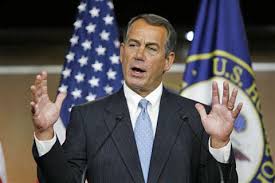
John Boehner
And President Obama’s response: “They don’t do anything except block me and call me names. If you’re mad at me for helping people on my own, why don’t you join me and we’ll do it together.
“You’re going to squawk if I try to fix some parts of it administratively that are within my authority while you’re not doing anything?
“I’m not going to apologize for trying to do something while they’re doing nothing.
“What I’ve told Speaker Boehner directly is, ‘If you’re really concerned about me taking too many executive orders, why don’t you try getting something done through Congress?'”

Barack Obama
Obama has actually issued fewer executve orders than his predecessors–about one every 11 days, according to the Brookings Institute.
Contrast this with the records of such Presidents as:
Of course, Bush and Reagan were Republicans–and white. And Carter was turned out of office after only four years by Reagan, whom Republicans still idolize.
But Obama is a Democrat–and black. Moreover, he has committed the ultimate crime of twice defeating Republican candidates for the Presidency.
On June 30, President Obama addressed a press conference in the White House Rose Garden.
During this, he outlined the pattern of Republican obstruction he has faced in winning passage of his immigration reform program.
“One year ago this month, Senators of both parties–with support from the business community, labor, law enforcement, faith communities–came together to pass a commonsense immigration bill.
“Independent experts said the bill would strengthen our borders, grow our economy, shrink our deficits.
“As we speak, there are enough Republicans and Democrats in the House to pass an immigration bill today. I would sign it into law today, and Washington would solve a problem in a bipartisan way.
“But for more than a year, Republicans in the House of Representatives have refused to allow an up-or-down vote on that Senate bill or any legislation to fix our broken immigration system.
“And I held off on pressuring them for a long time to give Speaker [John] Boehner the space he needed to get his fellow Republicans on board….
“I believe Speaker Boehner when he says he wants to pass an immigration bill. I think he genuinely wants to get something done.
“But last week, he informed the Republicans will continue to block a vote on immigration reform at least for the remainder of this year.
“Some of the House Republican caucus are using the situation with unaccompanied children as their newest excuse to do nothing. Now I want everybody to think about that.
“Their argument seems to be that because the system’s broken, we shouldn’t make an effort to fix it. It makes no sense. It’s not on the level. It’s just politics, plain and simple.
“Now thare are others in the Republican caucus in the House who are arguing that they can’t act because they’re mad at me about using my executive authority too broadly. This also makes no sense.
“I don’t prfer taking administrative action. I’d rather see permanent fixes to the issue we face.”
But since taking office as President on January 20, 2009, Obama has faced a torrent of Republican contempt and obstruction.
ABC NEWS, ADOLF HITLER, ANWAR AL-AWALAKI, BARACK OBAMA, CBS NEWS, CNN, D-DAY, DAVID BARRON, DEMOCRATIC PARTY, FACEBOOK, GEORGE S. PATTON, HEINZ GUERIAN, JUSTICE DEPARTMENT, LIBERALS, NAZI GERMANY, NBC NEWS, NOCCOLO MACHIAVELLI, RAND PAUL, REPUBLICAN PARTY, STALINGRAD, TERRORISM, THE PRINCE, TWITTER, WAFFEN-SS
In Bureaucracy, History, Military, Politics, Social commentary on May 12, 2014 at 12:00 am
Most Americans believe Nazi Germany was defeated because “we were the Good Guys and they were the Bad Guys.”
Not so.
The United States–and its allies, Great Britain and the Soviet Union–won the war for reasons that had nothing to do with the rightness of their cause. These included:
- Nazi Germany–i.e., its Fuehrer, Adolf Hitler–made a series of disastrous decisions. Chief among these: Attacking its ally, the Soviet Union and declaring war on the United States;
- The greater material resources of the Soviet Union and the United States; and
- The Allies waged war as brutally as the Germans.
On this last point:
- From D-Day to the fall of Berlin, captured Waffen-SS soldiers were often shot out of hand.
- When American troops came under fire in the German city of Aachen, Lt. Col. Derrill Daniel brought in a self-propelled 155mm artillery piece and opened up on a theater housing German soldiers. After the city surrendered, a German colonel labeled the use of the 155 “barbarous” and demanded that it be outlawed.
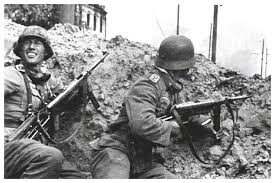
German soldiers at Stalingrad
- During the battle of Stalingrad in 1942, Wilhelm Hoffman, a young German soldier and diarist, was appalled that the Russians refused to surrender. He wrote: “You don’t see them at all, they have established themselves in houses and cellars and are firing on all sides, including from our rear–barbarians, they use gangster methods….”
In short: The Allies won because they dared to meet the brutality of a Heinz Guderian with that of a George S. Patton.
This is a lesson that has been totally lost on the liberals of the Democratic Party. Which explains why they lost most of the Presidential elections of the 20th century.
It also explains why President Barack Obama has found most of his legislative agenda stymied by Right-wing Republicans.
Consider this latest example: Senator Rand Paul (R-Ky.) has warned Senate Majority Leader Harry Reid (D-Nev.) that he will place a hold on one of President Obama’s appellate court nominees.
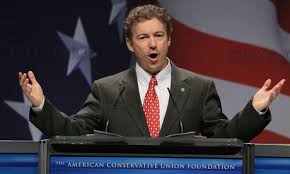
Rand Paul
David Barron has been nominated to the 1st Circuit Court of Appeals. And Paul objects to this because Barron authored memos justifying the killing of an American citizen by a drone in Yemen.
The September 30, 2011 drone strike killed Anwar al-Awlaki, a radical Muslim cleric notorious on the Internet for encouraging Muslims to attack the United States.
So President Obama authorized a drone stroke against him, thus removing that danger. Paul is demanding that the Justice Department release the memos Barron crafted justifying the drone policy.
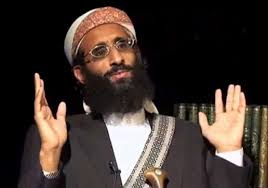
Anwar al-Awlaki
Imagine how Republicans would depict Paul–or a Democratic Senator–if he behaved in a similar manner with a Republican President: “Rand Paul: A traitor who supports terrorists. He sides with America’s enemies against its own lawfully elected President.”
To Bepublicans, “lawfully elected” applies only to Republican Presidents. A Democrat who runs against a Republican is automatically considered a traitor.
And a Democrat who defeats a Republican is automatically considered a usurper, and thus deserves to be slandered and obstructed, if not impeached.
Unable to defeat Bill Clinton in 1992 and 1996, Republicans tried in 1998 to impeach him for getting oral sex in the White House.
Similarly, 2012 Presidential candidate Herman Cain, asked in a conference call with bloggers why Republicans couldn’t just impeach President Obama, replied: “That’s a great question and it is a great–it would be a great thing to do but because the Senate is controlled by Democrats we would never be able to get the Senate first to take up that action.”
In Renegade: The Making of a President, Richard Wolffe chronicled Obama’s successful 2008 bid for the White House. Among his revelations:
Obama, a believer in rationality and decency, felt more comfortable in responding to attacks on his character than in making them on the character of his enemies.
A graduate of Columbia University and Harvard Law School, Obama is easily one of the most academically gifted Presidents in United States history.
But for all this, he failed–from the onset of his Presidency–to grasp and apply this fundamental lesson taught by Niccolo Machiavelli, the father of modern political science. In The Prince Machiavelli warns:
From this arises the question whether it is better to be loved than feared, or feared more than loved.
The reply is, that one ought to be both feared and loved, but as it is difficult for the two to go together, it is much safer to be feared than loved….
And men have less scruple in offending one who makes himself loved than one who makes himself feared; for love is held by a chain of obligations which, men being selfish, is broken whenever it serves their purpose; but fear is maintained by a dread of punishment which never fails.
Because Obama has failed to heed this advice, his enemies–which is what Republicans consider themselves to be–have felt free to demonize and obstruct him at every turn.
Nor is Obama alone in failing to learn Machiavelli’s lesson. For Democrats to win elective victories and enact their agenda, they must find theiir own George Patton to take on the Waffen-SS generals among Republican ranks.
ABC NEWS, ALEX JONES, ALTERNET, AMERICABLOG, AP, BABY BOOMER RESISTANCE, BARACK OBAMA, BBC, BLOOMBERG NEWS, BUREAU OF LAND MANAGEMENT, BUZZFEED, CBS NEWS, CIVIL WAR, CLIVEN BUNDY, CNN, CROOKS AND LIARS, DAILY KOS, FBI, FIVETHIRTYEIGHT, HARPER’S MAGAZINE, HUFFINGTON POST, MEDIA MATTERS, MILITIA GROUPS, MOTHER JONES, MOVEON, MSNBC, NBC NEWS, NEVADA, NEW REPUBLIC, NEWSDAY, NEWSWEEK, NICCOLO MACHIAVELLI, NPR, PBS NEWSHOUR, POLITICO, POLITICUSUSA, RAW STORY, REUTERS, SALON, SEATTLE TIMES, SLATE, SWAT TEAMS, TALKING POINTS MEMO, THE ATLANTIC, THE CHICAGO SUN-TIMES, THE CHICAGO TRIBUNE, THE DAILY BEAST, THE DAILY BLOG, THE DISCOURSES, THE GUARDIAN, THE HILL, THE HUFFINGTON POST, THE INTERCEPT, THE LOS ANGELES TIMES, THE NATION, THE NEW REPUBLIC, THE NEW YORK TIMES, THE NEW YORKER, THE PRINCE, THE VILLAGE VOICE, THE WASHINGTON POST, THINKPROGRESS, TIME, TRUTHDIG, TRUTHOUT, TWITTER, U.S. MARSHALS SERVICE, U.S. NEWS & WORLD REPORT, ULYSSES S. GRANT, UPI, WILLIAM T. SHERMAN
In Bureaucracy, History, Law, Law Enforcement, Politics, Social commentary on April 23, 2014 at 1:00 am
President Barack Obama–or at least Neil Kornze, the director of the Federal Bureau of Land Management (BLM)–has some serious lessons to learn about the uses of power.
For more than 20 years, Cliven Bundy, a Nevada cattle rancher, has refused to pay fees for grazing cattle on public lands, some 80 miles north of Las Vegas.
BLM says Bundy now owes close to $1 million. He says his family has used the land since the 1870s and doesn’t recognize the federal government’s jurisdiction.
In 2013, a federal judge ordered Bundy to remove his livestock. He ignored the order, and in early April, 2014, BLM agents rounded up more than 400 of his cattle.
Over the weekend of April 12-13, armed militia members and states’ right protesters showed up to challenge the move.

Bureau of Land Management logo
Rather than risk violence, the BLM did an about-face and released the cattle.
Right-wing bloggers and commentators have portrayed the incident as a victory over Federal tyranny.
According to Alex Jones’ Infowars.com: “Historic! Feds Forced to Surrender to American Citizens.”
Right-wingers have depicted Bundy as a put-upon Everyman being “squeeaed” by the dictatorial Federal government.
They have deliberately ignored a number of inconvenient truths–such as:
- He claims that his grazing rights were established in 1880 when his ancestors settled the land where his ranch sits.
- But the Nevada constitution–adopted in 1864 as a condition of statehood–contradicts Bundy’s right to operate as a law unto himself.
- The constitution says: “The people inhabiting said territory do agree and declare, that they forever disclaim all right and title to the unappropriated public lands lying within said territory, and that the same shall be and remain at the sole and entire disposition of the United States.”
- In 1934, the Taylor Grazing Act gave existing ranchers permits allowing them to run their herds on federal land.
- In turn, ranchers paid user fees, which were lower than what most private landowners would have charged.
- In 1993, the Federal government launched an effort to protect the endangered desert tortoise.
- Certain grasslands were placed off-limits for grazing, and the government bought out the permits of some ranchers.
- Among others, Bundy refused to sell and kept grazing his cattle on restricted federal land without a permit.
- Amidst mounting fees and fines, Bundy repeatedly slugged it out in court against government lawyers. He lost.
- In 1998, a federal judge permanently barred him from letting his cattle graze on protected federal land.
- In early April, 2014, BLM agents–charged with overseeing grazing rights–began rounding up Bundy’s cattle to remove them from federal property.
Bundy’s family and other ranchers–backed up by a motley assortment of self-declared militiamen armed with rifles and pistols–confronted the agents.
Fearing another Waco–regarded by Right-wing Americans as a second Alamo–the BLM agents backed down and released Bundy’s cattle. And then retreated.
While Right-wingers hail this as a victory for “states’ rights,” the truth is considerably different.
Bundy’s refusal to recognize the federal government’s jurisdiction amounts to: “I will recognize–and obey–only those laws that I happen to agree with.”
And the BLM’s performance offers a texbook lesson on how not to promote respect for the law–or for those who enforce it.
As Niccolo Machiavelli, the father of modern political science warned more than 500 years ago in The Prince:
[A ruler] is rendered despicable by being thought changeable, frivolous, effeminate, timid and irresolute—which [he] must guard against as a rock of danger….
[He] must contrive that his actions show grandeur, spirit, gravity and fortitude.
As to the government of his subjects, let his sentence be irrevocable, and let him adhere to his decisions so that no one may think of deceiving or cozening him.

Niccolo Machiavelli
In his master-work, The Discouorses, he outlines the consequences of allowing lawbreakers to go unpunished:
...Having established rewards for good actions and penalties for evil ones, and having rewarded a citizen for conduct who afterwards commits a wrong, he should be chastised for that without regard to his previous merits….
For if a citizen who has rendered some eminent service to the state should add to the reputation and influence which he has thereby acquired the confident audacity of being able to commit any wrong without fear of punishment, he will in a little while become so insolent and overbearing as to put an end to all power of the law.
The conduct of the agents of BLM has violated that sage counsel on all counts.
BLM agents should have expected trouble from Right-wing militia groups–and come fully prepared to deal with it.
The FBI and the U.S. Marshals Service, for example, have created SWAT teams to deal with those who threaten violence against the Federal Government.
Civil War General William Tecumseh Sherman had a formula for dealing with domestic terrorists of his own time.
Writing to his commander, Ulysses S. Grant, about the best way to treat Confederate guerrillas, he advised:
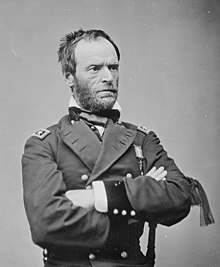
General Willilam Tecumseh Sherman
“They cannot be made to love us, but they may be made to fear us. We cannot change the hearts of those people of the South.
“But we can make war so terrible that they will realize the fact that . . . they are still mortal and should exhaust all peaceful remedies before they fly to war.”
ABC NEWS, AIRLINE PASSENGER RIGHTS, AIRLINES, AIRTRAN, AMERICAN AIRLINES, AMERICAN CUSTOMER SATISFACTION INDEX, BUSINESS INSIDER, CBS NEWS, CNN, COMPLAINT LETTERS, CONSUMER RIGHTS, DAVE CARROLL, DELTA AIRLINES, FACEBOOK, ITUNES, JETBLUE AIRWAYS, KGB, LEISHA HAILEY, NBC NEWS, NICCOLO MACHIAVELLI, SOUTHWEST AIRLINES, THE LOS ANGELES, THE NEW YORK TIMES, THE PRINCE, THE WASHINGTON POST, TWITTER, UNITED BREAKS GUITARS, US AIRWAYS, YOUTUBE
In Bureaucracy, Business, Law, Self-Help on December 16, 2013 at 12:18 am
So you’ve decided to sue the airline you believe wronged you.
One option is to do so in small claims court.
A plus is you don’t need an attorney. In fact, you’re barred from bringing in an attorney. You represent yourself, which means you don’t have to pay an attorney–either up-front or at the end of the case.
Another plus: It will cost you far less to represent yourself than it will cost the airline to send a representative.
If you file in California and the airline is headquartered in New York, it will be expensive for them to send a rep to attend the proceedings. If the airline fails to send someone as its representative–which is highly unlikely–it loses by default.
A minus is that you may not be the confrontational type. You may also feel intimidated by the legal process–and afraid of looking like an idiot if you lose.
Another minus is that each state sets a different amount you can win in damages.
To learn about the rules applying to small claims courts in your state, consult the following link: Click here: 50 State Overview of Small Claims Rules | Nolo.com.
A second option is to take your case to civil court.
A plus is that the dollar-amount you can obtain at this level is far higher than in small-claims court.
A minus is that you’ll definitely want to retain an attorney.
True, you can legally represent yourself. But aviation law is complex. The airline will definitely have an attorney, so if you don’t, you’re bringing a knife to a gunfight.
If you can find an attorney willing to represent you on a contingency fee basis, you don’t have to pay him unless you win. His fee will then come out of your settlement amount.
Another minus: If you can’t find an attorney willing to take your case on this basis, you’ll have to pay him by the hour, after first putting up a retainer fee, which can be quite large.
A third minus is that the courts are clogged with cases, and it can take months or even years before yours will be heard.
And remember: The vast majority of cases–civil and criminal–are settled outside of court. In civil cases especially, judges strongly urge both sides to reach a compromise rather than duke it out in court.
And both sides are usually willing to do this, since there’s no telling how a jury might rule.
Finally, there’s the option of filing a class-action lawsuit.
A plus to this is that you’re not alone in your charge against the airline. Other passengers who have been similarly wronged are seeking damages, and so the spotlight is not on any one plaintiff.
A minus is that such cases are extremely complex and must be handled by experienced attorneys.
Typically, federal courts are thought to be more favorable for defendants, and state courts more favorable for plaintiffs. Many class actions are filed initially in state court. The defendant will frequently try to remove the case to federal court.
Another minus: If your side prevails, the amount of money each plaintiff receives will be far smaller than if the award were to be divided between a single plaintiff and his attorney(s).
Finally, even if you win, you can be certain the airline will appeal the verdict. Such appeals can go on for literally years.
On a more far-reaching basis, you can demand that your Congressional representatives support passenger rights through legislation.
Protections are especially needed when a single airline official–such as a steward–kicks a passenger off an airplane for reasons that have nothing to do with security.
(Examples:
- Two women kissing;
- a steward demanding whether a woman is wearing underwear;
- another steward taking offense at a passenger’s request for help.)
During the administration of President George H.W. Bush, Congress overrode only one of his 44 vetoes. In that case, Congress put a cap on the rates cable TV companies could charge.
They did so because their constituents had made clear their rage about high-priced fees.
Members of the Senate and House of Representatives will respond to constituent demands:
- If enough voters make their specific demands known; and
- If those voters make clear that ignoring their demands will guarantee defeat at the next election.
There are consumer rights organizations now pressing for vitally-needed passenger protections. These organizations need support–both in terms of members and money.
Only then can they counter the legalized bribes (known as “campaign contributions) the airlines offer to members of Congress.
An example is Flyers Rights, which can be reached at: FlyersRights.ORG – Largest Non-Profit Airline Consumer Organization.
Above all, remember: Airlines are run by corporations.
Their foremost concern is not your comfort or even safety as a passenger. It’s with further enriching their key executives.
You must be willing to stand up for your own rights–because the airline couldn’t care less about them.
ABC NEWS, AIRLINE PASSENGER RIGHTS, AIRLINES, AIRTRAN, AMERICAN AIRLINES, AMERICAN CUSTOMER SATISFACTION INDEX, BUSINESS INSIDER, CBS NEWS, CNN, COMPLAINT LETTERS, CONSUMER RIGHTS, DAVE CARROLL, DELTA AIRLINES, FACEBOOK, ITUNES, JETBLUE AIRWAYS, KGB, LEISHA HAILEY, NBC NEWS, NICCOLO MACHIAVELLI, SOUTHWEST AIRLINES, THE LOS ANGELES, THE NEW YORK TIMES, THE PRINCE, THE WASHINGTON POST, TWITTER, UNITED BREAKS GUITARS, US AIRWAYS, YOUTUBE
In Bureaucracy, Business, Self-Help, Social commentary on December 13, 2013 at 12:31 am
You can’t get the airline to take your complaint seriously but you don’t want to file a lawsuit.
So now what do you do?
You could file a complaint with one or more consumer complaint websites. Just remember:
- What you say online can hurt you.
- Accuse someone of criminal or shameful behavior, and you can be sued for libel.
- Threaten someone with exposure or financial ruin aunless he pays you money and you can be privately sued and/or criminally prosecuted for extortion.
- And once you click on the “Send” button, there’s no recalling your email.
Review the guidelines offered in Part Six of this series on how to safely craft your letter/email.
Below is a partial list of consumer complaint websites. No endorsement is implied by this listing. It’s offered simply to illustrate the variety of such websites available.

http://www.pissedconsumer.com/ – Pissed Consumer (complaints only)
http://www.measuredup.com/ – Measured Up (“Customers Review / Businesses Reply / Everybody Wins”)
http://www.complaints.com/ – Complaints (post and research consumer complaints)
http://www.thesqueakywheel.com/ – The Squeaky Wheel (submits your complaint to google)
http://www.consumercomplaintagency.org/ – Consumer Complaint Agency (“Take [unspecified] action on your behalf”)
https://www.ftccomplaintassistant.gov/ – Federal Trade Commission (does not resolve individual consumer complaints)
http://www.complaintnow.com/ – Complaint Now (complaints only)
http://hissingkitty.com/ – Hissing Kitty (posts your complaint on Google, Yahoo, and Bing)
http://www.airlinecomplaints.org/ – Airline Complaints (complaints only)
http://airconsumer.ost.dot.gov/problems.htm – Aviation Consumer Protection and Enforcement (U.S. Department of Transportation) (complaints)
http://www.airsafe.com/complain/complain.htm – Air Safe (“critical information for the traveling public”)
http://www.consumeraffairs.com/travel/airlines.html – Consumer Affairs (complaints only)
Your first impulse will probably be to immediately file your complaint with a website like one of these.
Don’t do it.
Instead, try to resolve your problem (assuming it can be resolved) with the airline.
Why? Two reasons:
- You may be able to obtain what you want at that level, without having to do anything more.
- If you don’t give the airline the chance to address your grievance, you will be accused of pursuing a vendetta. This will be especially true if you later sue the airline.
Use websites like these as a fallback option–in case you’re unable to can’t resolve your problem with the airlines.
And, frankly, there’s a good chance you won’t.
In its September 3, 2009 issue, Time magazine warned that calling the airlines’ customer complaint lines would likely prove a waste of time.
The major carriers have, quietly, made it steadily more difficult for customers to reach a person with their complaints. “The airlines don’t want to talk to their customers,” says John Tschohl, a consultant to businesses on customer service.
Even the few airlines that still have customer-service numbers bury them deep within their websites. Finding them is often as much a matter of luck as persistence.
So as advised in Part Five of this series: Don’t waste your time with the Customer Service line. Go directly to the topmost official(s) of the airline and make it clear why it’s in their best interests to resolve your problem.
Then, if you can’t find a workable solution, file your complaint with as many consumer-protection websites as possible.
You can also file complaints with one or more federal agencies that hold jurisdiction over the airlines.
If your complaint is safety related, address it to the Federal Aviation Administration (FAA) at:
Assistant Administrator for System Safety ASY-100
Federal Aviation Administration
800 Independence Ave., S.W.
Washington, D.C. 20591
1-866-835-5322
Click here: Contact the Aviation Safety Hotline
If your complaint involves security, direct it to the Transportation Security Administration (TSA). You can reach this by phone at 866-289-9673 or by e-mail at tsa-contactcenter@dhs.gov.
A final option is to sue the airline.
For most people, bringing in a lawyer is like bringing up the heavy artillery. When should you do so?
Christopher Elliott, author, consumer advocate and journalist, outlines “five times when you should consider skipping the complaints process and going straight to court:
- When they’re playing games.
- When they’ve broken a contract.
- When they’re being dishonest.
- When they’re ignoring you.
- When they aren’t listening to reason.
Elliott’s webpage contains a wealth of practical advice for those who’ve had their fill of airline arrogance. It can be accessed thus: Click here: See you in court: 5 times when you should just sue ‘em.
Yet another must-read for those wondering if they should file suit: Click here: Lies the Airlines Tell Us – ABC News
Assuming you decide to sue, there are three ways to do this:
- In small claims court.
- In regular civil court as an individual claimant.
- As part of a class-action lawsuit.
Each approach has its own series of pluses and minuses. I’ll explore these in my next column.


ABC NEWS, ADOLF HITLER, ANWAR AL-AWALAKI, BARACK OBAMA, CBS NEWS, CNN, D-DAY, DAVID BARRON, DEMOCRATIC PARTY, FACEBOOK, GEORGE S. PATTON, HEINZ GUERIAN, JUSTICE DEPARTMENT, LIBERALS, NAZI GERMANY, NBC NEWS, NOCCOLO MACHIAVELLI, RAND PAUL, REPUBLICAN PARTY, STALINGRAD, TERRORISM, THE PRINCE, TWITTER, WAFFEN-SS
WHY THE RIGHT WINS AND THE LEFT LOSES
In Bureaucracy, History, Military, Politics, Social commentary on May 12, 2014 at 12:00 amMost Americans believe Nazi Germany was defeated because “we were the Good Guys and they were the Bad Guys.”
Not so.
The United States–and its allies, Great Britain and the Soviet Union–won the war for reasons that had nothing to do with the rightness of their cause. These included:
On this last point:
German soldiers at Stalingrad
In short: The Allies won because they dared to meet the brutality of a Heinz Guderian with that of a George S. Patton.
This is a lesson that has been totally lost on the liberals of the Democratic Party. Which explains why they lost most of the Presidential elections of the 20th century.
It also explains why President Barack Obama has found most of his legislative agenda stymied by Right-wing Republicans.
Consider this latest example: Senator Rand Paul (R-Ky.) has warned Senate Majority Leader Harry Reid (D-Nev.) that he will place a hold on one of President Obama’s appellate court nominees.
Rand Paul
David Barron has been nominated to the 1st Circuit Court of Appeals. And Paul objects to this because Barron authored memos justifying the killing of an American citizen by a drone in Yemen.
The September 30, 2011 drone strike killed Anwar al-Awlaki, a radical Muslim cleric notorious on the Internet for encouraging Muslims to attack the United States.
So President Obama authorized a drone stroke against him, thus removing that danger. Paul is demanding that the Justice Department release the memos Barron crafted justifying the drone policy.
Anwar al-Awlaki
Imagine how Republicans would depict Paul–or a Democratic Senator–if he behaved in a similar manner with a Republican President: “Rand Paul: A traitor who supports terrorists. He sides with America’s enemies against its own lawfully elected President.”
To Bepublicans, “lawfully elected” applies only to Republican Presidents. A Democrat who runs against a Republican is automatically considered a traitor.
And a Democrat who defeats a Republican is automatically considered a usurper, and thus deserves to be slandered and obstructed, if not impeached.
Unable to defeat Bill Clinton in 1992 and 1996, Republicans tried in 1998 to impeach him for getting oral sex in the White House.
Similarly, 2012 Presidential candidate Herman Cain, asked in a conference call with bloggers why Republicans couldn’t just impeach President Obama, replied: “That’s a great question and it is a great–it would be a great thing to do but because the Senate is controlled by Democrats we would never be able to get the Senate first to take up that action.”
In Renegade: The Making of a President, Richard Wolffe chronicled Obama’s successful 2008 bid for the White House. Among his revelations:
Obama, a believer in rationality and decency, felt more comfortable in responding to attacks on his character than in making them on the character of his enemies.
A graduate of Columbia University and Harvard Law School, Obama is easily one of the most academically gifted Presidents in United States history.
But for all this, he failed–from the onset of his Presidency–to grasp and apply this fundamental lesson taught by Niccolo Machiavelli, the father of modern political science. In The Prince Machiavelli warns:
From this arises the question whether it is better to be loved than feared, or feared more than loved.
The reply is, that one ought to be both feared and loved, but as it is difficult for the two to go together, it is much safer to be feared than loved….
And men have less scruple in offending one who makes himself loved than one who makes himself feared; for love is held by a chain of obligations which, men being selfish, is broken whenever it serves their purpose; but fear is maintained by a dread of punishment which never fails.
Because Obama has failed to heed this advice, his enemies–which is what Republicans consider themselves to be–have felt free to demonize and obstruct him at every turn.
Nor is Obama alone in failing to learn Machiavelli’s lesson. For Democrats to win elective victories and enact their agenda, they must find theiir own George Patton to take on the Waffen-SS generals among Republican ranks.
Share this: