Posts Tagged ‘SOCIAL SECURITY’
2003 IRAQ WAR, ABC NEWS, ALTERNET, ASIANS, BARACK OBAMA, BIRTH CONTROL, BLACKS, BUZZFEED, CBS NEWS, CNN, DAILY KOS, DISABLED, DONALD TRUMP, ED MARTIN, FACEBOOK, HILLARY CLINTON, HUMAYUN KHAN, KATRINA PIERSON, LATINOS, MARCO GUTIERREZ, MEDICAID, MEDICARE, MOTHER JONES, MOVEON, MSNBC, MUSLIMS, NBC NEWS, NEWSWEEK, NICCOLO MACHIAVELLI, NPR, OBAMACARE, POLITICO, PRISONERS OF WAR, RAW STORY, SALON, SLATE, SOCIAL SECURITY, TEA PARTY, THE CHICAGO SUN-TIMES, THE CHICAGO TRIBUNE, THE DAILY BEAST, THE DISCOURSES, THE HUFFINGTON POST, THE LOS ANGELES TIMES, THE NEW YORK TIMES, THE PRINCE, THE WALL STREET JOURNAL, THE WASHINGTON POST, TIME, TWITTER, U.S. NEWS & WORLD REPORT, USA TODAY, WAYNE ROOT, WOMEN
In Bureaucracy, History, Military, Politics, Social commentary on August 3, 2018 at 12:01 am
Many pundits have sized up Donald Trump—as a Presidential candidate and President.
But how would Niccolo Machiavelli, the 16th-century Florentine statesman, assess Trump?
Machiavelli’s two great works on politics—The Prince and The Discourses—remain textbooks for successful politicians more than 500 years later.
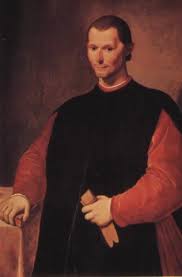

Niccolo Machiavelli
Consider Trump’s notoriety for hurling insults at virtually everyone, including:
- Latinos
- Asians
- Muslims
- Blacks
- The Disabled
- Women
- Prisoners-of-War
These insults delight his white, under-educated followers. But they have alienated millions of other Americans who might have supported him.
And what does Machiavelli have to say about gratuitously handing out insults and threats?
-
“I hold it to be a proof of great prudence for men to abstain from threats and insulting words towards any one.
-
“For neither the one nor the other in any way diminishes the strength of the enemy–but the one makes him more cautious, and the other increases his hatred of you, and makes him more persevering in his efforts to injure you.”
Many of those who supported Trump as a Presidential candidate expected him to stop constantly picking fights if he became President. Machiavelli had a stern warning for them:
-
“…If it happens that time and circumstances are favorable to one who acts with caution and prudence he will be successful. But if time and circumstances change he will be ruined, because he does not change the mode of his procedure.
-
“No man can be found so prudent as to be able to adopt himself to this, either because he cannot deviate from that to which his nature disposes him, or else because, having always prospered by walking in one path, he cannot persuade himself that it is well to leave it…
-
“For if one could change one’s nature with time and circumstances, fortune would never change.”
Then there is Trump’s approach to consulting advisers.
Asked on MSNBC’s “Morning Joe” who he consults about foreign policy, Trump replied; “I’m speaking with myself, number one, because I have a very good brain and I’ve said a lot of things.”
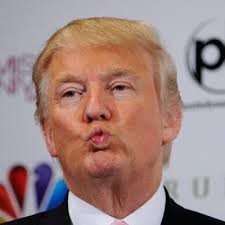
Donald Trump
This totally contrasts the advice given by Machiavelli:
-
“A prudent prince must [choose] for his counsel wise men, and [give] them alone full liberty to speak the truth to him, but only of those things that he asks and of nothing else.
-
“But he must be a great asker about everything and hear their opinions, and afterwards deliberate by himself in his own way, and in these counsels…comport himself so that every one may see that the more freely he speaks, the more he will be acceptable.”
And Machiavelli has potent advice on the selection of advisers:
- “The first impression that one gets of a ruler and his brains is from seeing the men that he has about him.
- “When they are competent and loyal one can always consider him wise, as he has been able to recognize their ability and keep them faithful.
- “But when they are the reverse, one can always form an unfavorable opinion of him, because the first mistake that he makes is in making this choice.”
Consider some of the advisers Trump has relied on in his campaign for President:
- Founder of Latinos for Trump Marco Gutierrez told MSNBC’s Joy Reid: “My culture is a very dominant culture. And it’s imposing, and it’s causing problems. If you don’t do something about it, you’re gonna have taco trucks every corner.”
- At a Tea Party for Trump rally at a Harley-Davidson dealership in Festus, Missouri, former Missouri Republican Party director Ed Martin reassured the crowd that they weren’t racist for hating Mexicans.
From the outset of his Presidential campaign, Trump polled extremely poorly among Hispanic voters. Comments like these didn’t increase his popularity.
- Wayne Root, opening speaker and master of ceremonies at many Trump campaign events, told Virginia radio host Rob Schilling: People on public assistance and women getting birth control through Obamacare should not be allowed to vote.
This proved a big turn-off among the 70% of women who have an unfavorable opinion of him—and anyone who receives Medicaid, Medicare or Social Security.
- Trump’s spokeswoman, Katrina Pierson, claimed that Barack Obama and Hillary Clinton were responsible for the death of Captain Humayun Khan–who was killed by a truck-bomb in Iraq in 2004.
Obama became President in 2009—almost five years after Khan’s death. And Clinton became Secretary of State the same year.
When your spokeswoman becomes a nationwide laughingstock, your own credibility goes down the toilet as well.
Finally, speaking directly to Trump, Machiavelli warns: Unwise princes cannot be wisely advised.
-
“It is an infallible rule that a prince who is not wise himself cannot be well advised, unless by chance he leaves himself entirely in the hands of one man who rules him in everything, and happens to be a very prudent man. In this case, he may doubtless be well governed, but it would not last long, for the governor would in a short time deprive him of the state.”
All of which would lead Niccolo Machiavelli to warn, if he could witness American politics today: “This bodes ill for your Republic.”
ABC NEWS, AIRLINES, ALTERNET, AMERICABLOG, ANTHEM INC., AP, BABY BOOMER RESISTANCE, BBC, BLOOMBERG, BUSINESS, BUZZFEED, CBS NEWS, CHINA, CNN, COMPUTER SECURITY, CREDIT CARDS, CREDIT REPORTING AGENCIES, CROOKS AND LIARS, CYBERSECURITY, DAILY KOS, DAILY KOZ, DAIRY QUEEN, EQUIFAX, FIVETHIRTYEIGHT, HACKING, HARPER’S MAGAZINE, HUFFINGTON POST, JOHN HERING, JPMORGAN/CHASE, LILY TOMLIN, LOOKOUT, LUGGAGE THEFTS, MA BELL, MEDIA MATTERS, MOTHER JONES, MOVEON, MSNBC, NBC NEWS, NEW REPUBLIC, NEWSDAY, NEWSWEEK, NPR, PBS NEWSHOUR, POLITICO, POLITICUSUSA, RAW STORY, REUTERS, ROWAN & MARTIN'S LAUGH-IN, SALON, SEATTLE TIMES, SLATE, SOCIAL SECURITY, STAPLES, TALKING POINTS MEMO, TARGET, THE ATLANTIC, THE CHICAGO SUN-TIMES, THE CHICAGO TRIBUNE, THE DAILY BEAST, THE DAILY BLOG, THE GUARDIAN, THE HILL, THE HUFFINGTON POST, THE INTERCEPT, THE LOS ANGELES TIMES, THE NATION, THE NEW REPUBLIC, THE NEW YORK TIMES, THE NEW YORKER, THE VILLAGE VOICE, THE WALL STREET JOURNAL, THE WASHINGTON POST, THINKPROGRESS, TIME, TRUTHDIG, TRUTHOUT, TWITTER, TWO POLITICAL JUNKIES, U.S. NEWS & WORLD REPORT, UP, UPI, USA TODAY, X
In Bureaucracy, Business, History, Law, Politics, Self-Help, Social commentary on September 12, 2017 at 12:01 am
Comedian Lily Tomlin rose to fame on the 1960s comedy hit, Rowan & Martin’s Laugh-In, as Ernestine, the rude, sarcastic switchboard operator for Ma Bell.
She would tap into customers’ calls, interrupt them, make snide remarks about their personal lives. And her victims included celebrities as much as run-of-the-mill customers.

Lily Tomlin as Ernestine
She introduced herself as working for “the phone company, serving everyone from presidents and kings to the scum of the earth.”
But perhaps the line for which her character is best remembered was: “We don’t care. We don’t have to. We’re the phone company.”
Clearly, too many companies take the same attitude as Ernestine: “We don’t care. We don’t have to.”
This is especially true for companies that are supposed to safeguard their customers’ most sensitive information.
Companies like:
- Kmart
- Staples
- Dairy Queen
- Target Home Depot
- JPMorgan/Chase
- Anthem Insurance
All these corporations suffered data breeches that exposed tens of millions of individuals’ private information–such as:
- Names
- Birthdates
- Credit card numbers
- Social Security numbers
- Member ID numbers
- Addresses
- Email addresses
- Employment Information
- Phone numbers
And now hackers have compromised Equifax, the consumer credit reporting agency.

One out of every two Americans stands to be a victim. Some 143 million consumers’ sensitive data is potentially compromised.
From mid-May to July, 2017, there was a flaw in Equifax’s website software. This allowed hackers to access 143 million Americans’ supposedly private information. Only after this massive robbery had occurred did the company discover the breach and close the loophole.
On September 8, PBS Newshour correspondent William Brangham outlined the dimensions of this catastrophe:
“It’s everything that would be in your credit report. So, it’s Social Security number. It’s your name, it’s your address, it’s your driver’s license information, it’s your employers, it’s your payment history, it’s what bank accounts you have….
“The thing that a thief could do with this information is, one, they could hack into your existing accounts once they have all that information. They could also set up new ones pretending to be John Yang or William Brangham and set up new accounts and then rack up big charges on those.
“So, the great irony here is that Equifax is a company that actually sells identity theft protection, and here it is they have theoretically allowed a huge breach that could trigger a ton of identity theft.“
According to Brangham, the two most outrageous aspects of this catastrophe are:
“[Equifax] found out about this on July 29, and we only found out about this breach on—this week. So, you’re supposed to, in these kinds of cases, immediately jump to do something about it. And it seems like they didn’t give consumers much time.
“And, secondly, several executives at the company, after they found out about the breach, sold about $18.8 million worth of stock in their company before this news got out, the implication being they didn’t want their stock to tank and their stock to lose value.”
Asked, “What are we supposed to do?” Brangham replied:
- Freeze your credit account—thus blocking anyone from setting up a new bank account, loan or mortgage in your name without you being alerted to it.
- Alert credit reporting companies Equifax, Transunion and Experian.
- Monitor your bank and credit cards for suspicious activity.
An October 22, 2014 “commentary” published in Forbes magazine raised the highly disturbing question: “Cybersecurity: Does Corporate America Really Care?”
And the answer is clearly: No.
Its author is John Hering, co-founder and executive director of Lookout, which bills itself as “the world leader in mobile security for consumers and enterprises alike.”
Click here: Cybersecurity: Does corporate America really care?
“One thing is clear,” writes Hering. “CEOs need to put security on their strategic agendas alongside revenue growth and other issues given priority in boardrooms.”
Hering warns that “CEOs don’t seem to be making security a priority.” And he offers several reasons for this:
- The sheer number of data compromises;
- Relatively little consumer outcry;
- Almost no impact on the companies’ standing on Wall Street;
- Executives may consider such breaches part of the cost of doing business.
“There’s a short-term mindset and denial of convenience in board rooms,” writes Hering. “Top executives don’t realize their systems are vulnerable and don’t understand the risks. Sales figures and new products are top of mind; shoring up IT systems aren’t.”
There are three ways corporations can be forced to start behaving responsibly on this issue.
- Smart attorneys need to start filing class-action lawsuits against companies that refuse to take steps to protect their customers’ private information. There is a name for such behavior: Criminal negligence. And there are laws carrying serious penalties for it.
- There must be Federal legislation to ensure that multi-million-dollar fines are levied against such companies—and especially their CEOs—when such data breaches occur.
- Congress should enact legislation allowing for the prosecution of CEOs whose companies’ negligence leads to such massive data breaches. They should be considered as accessories to crime, and, if convicted, sentenced to lengthy prison terms.
Only then will the CEO mindset of “We don’t care, we don’t have to” be replaced with: “We care, because we’ll lose our money and/or freedom if we don’t.”
ABC NEWS, AIRLINES, ALTERNET, ANTHEM INC., AP, BUSINESS, BUZZFEED, CBS NEWS, CHINA, CNN, COMPUTER SECURITY, CREDIT CARDS, CROOKS AND LIARS, CYBERSECURITY, DAILY KOZ, DAIRY QUEEN, FACEBOOK, HACKING, JOHN HERING, JPMORGAN/CHASE, LILY TOMLIN, LOOKOUT, LUGGAGE THEFTS, MA BELL, MOTHER JONES, MOVEON, NBC NEWS, NEWSWEEK, NPR, POLITICO, RAW STORY, REUTERS, ROWAN & MARTIN'S LAUGH-IN, SALON, SEATTLE TIMES, SLATE, SOCIAL SECURITY, STAPLES, TARGET, THE ATLANTIC, THE CHICAGO SUN-TIMES, THE CHICAGO TRIBUNE, THE DAILY BEAST, THE GUARDIAN, THE HILL, THE HUFFINGTON POST, THE LOS ANGELES TIMES, THE NATION, THE NEW YORK TIMES, THE WALL STREET JOURNAL, THE WASHINGTON POST, TIME, TWITTER, U.S. NEWS & WORLD REPORT, UP, UPI, USA TODAY
In Bureaucracy, Business, History, Law, Law Enforcement, Politics, Social commentary on July 14, 2017 at 1:15 am
Comedian Lily Tomlin rose to fame on the 1960s comedy hit, Rowan & Martin’s Laugh-In, as Ernestine, the rude, sarcastic switchboard operator for Ma Bell.
She would tap into customers’ calls, interrupt them, make snide remarks about their personal lives. And her victims included celebrities as much as run-of-the-mill customers.
Lily Tomlin as Ernestine
She introduced herself as working for “the phone company, serving everyone from presidents and kings to the scum of the earth.”
But perhaps the line for which her character is best remembered was: “We don’t care. We don’t have to. We’re the phone company.”
Watching Ernestine on Laugh-In was a blast for millions of TV viewers. But facing such corporate arrogance in real-life is no laughing matter.
Clearly, too many companies take the same attitude as Ernestine: “We don’t care. We don’t have to.”
This is especially true for companies that are supposed to safeguard their customers’ most sensitive information—such as their credit card numbers, addresses, emails and phone numbers.
An October 22, 2014 “commentary” published in Forbes magazine raised the highly disturbing question: “Cybersecurity: Does Corporate America Really Care?”
And the answer is clearly: No.
Its author is John Hering, co-founder and executive director of Lookout, which bills itself as “the world leader in mobile security for consumers and enterprises alike.”
Click here: Cybersecurity: Does corporate America really care?
October, 2014 proved a bad month for credit card-using customers of Kmart, Staples and Dairy Queen.
All these corporations reported data breeches involving the theft of credit card numbers of countless numbers of customers.
Earlier breaches had hit Target, Home Depot and JPMorgan/Chase.
And on February 5, 2015, health insurance giant Anthem Inc. announced that hackers had breached its computer system and accessed the medical records of tens of millions of its customers and employees.

Anthem, the nation’s second-largest health insurer, said the infiltrated database held records on up to 80 million people.
Among the customers’ information accessed:
- Names
- Birthdates
- Social Security numbers
- Member ID numbers
- Addresses
- Phone numbers
- Email addresses and
- Employment information.
Some of the customer data may also include details on their income.
Click here: Anthem hack exposes data on 80 million; experts warn of identity theft – LA Times
Bad as that news was, worse was to come.
A February 5 story by the Wall Street Journal revealed that Anthem stored the Social Security numbers of 80 million customers without encrypting them.
The company believes that hackers used a stolen employee password to access the database
Anthem’s alleged reason for refusing to encrypt such sensitive data: Doing so would have made it harder for the company’s employees to track health care trends or share data with state and Federal health providers.
Anthem spokeswoman Kristin Binns blamed the data breach on employers and government agencies who “require us to maintain a member’s Social Security number in our systems so that their systems can uniquely identify their members.”
She said that Anthem encrypts personal data when it moves in or out of its database–but not where it is stored.
This is a commonplace practice in the healthcare industry.
The FBI launched an investigation into the hack.
According to an anonymous source, the hackers used malware that has been used almost exclusively by Chinese cyberspies.
Naturally, China has denied any wrongdoing. With a completely straight face, Chinese Foreign Ministry spokesman Hong Lei said:
“We maintain a cooperative, open and secure cyberspace, and we hope that countries around the world will make concerted efforts to that end.”
He also said that the charge that the hackers were Chinese was “groundless.”
Click here: Health Insurer Anthem Didn’t Encrypt Stolen Data – WSJ
Meanwhile, John Hering’s complaints remain as valid today as they did last October.
“One thing is clear,” writes Hering. “CEOs need to put security on their strategic agendas alongside revenue growth and other issues given priority in boardrooms.”
Hering warns that “CEOs don’t seem to be making security a priority.” And he offers several reasons for this:
- The sheer number of data compromises;
- Relatively little consumer outcry;
- Almost no impact on the companies’ standing on Wall Street;
- Executives may consider such breaches part of the cost of doing business.
“There’s a short-term mindset and denial of convenience in board rooms,” writes Hering.
“Top executives don’t realize their systems are vulnerable and don’t understand the risks. Sales figures and new products are top of mind; shoring up IT systems aren’t.”
There are three ways corporations can be forced to start behaving responsibly on this issue.
- Smart attorneys need to start filing class-action lawsuits against companies that refuse to take steps to protect their customers’ private information. There is a name for such behavior: Criminal negligence. And there are laws carrying serious penalties for it.
- There must be Federal legislation to ensure that multi-million-dollar fines are levied against such companies—and especially their CEOs—when such data breaches occur.
- Congress should enact legislation allowing for the prosecution of CEOs whose companies’ negligence leads to such massive data breaches. They should be considered as accessories to crime, and, if convicted, sentenced to lengthy prison terms.
Only then will the CEO mindset of “We don’t care, we don’t have to” be replaced with: “We care, because we’ll lose our money and/or freedom if we don’t.”
2003 IRAQ WAR, ABC NEWS, ALTERNET, ASIANS, BARACK OBAMA, BIRTH CONTROL, BLACKS, BUZZFEED, CBS NEWS, CNN, DAILY KOS, DISABLED, DONALD TRUMP, ED MARTIN, FACEBOOK, HILLARY CLINTON, HUMAYUN KHAN, KATRINA PIERSON, LATINOS, MARCO GUTIERREZ, MEDICAID, MEDICARE, MOTHER JONES, MOVEON, MSNBC, MUSLIMS, NBC NEWS, NEWSWEEK, NICCOLO MACHIAVELLI, NPR, OBAMACARE, POLITICO, PRISONERS OF WAR, RAW STORY, SALON, SLATE, SOCIAL SECURITY, TEA PARTY, THE CHICAGO SUN-TIMES, THE CHICAGO TRIBUNE, THE DAILY BEAST, THE DISCOURSES, THE HUFFINGTON POST, THE LOS ANGELES TIMES, THE NEW YORK TIMES, THE PRINCE, THE WALL STREET JOURNAL, THE WASHINGTON POST, TIME, TWITTER, U.S. NEWS & WORLD REPORT, USA TODAY, WAYNE ROOT, WOMEN
In Bureaucracy, History, Military, Politics, Social commentary on March 27, 2017 at 12:28 am
No shortage of pundits have sized up Donald Trump–first as a Presidential candidate, and now as the nation’s 45th President.
But how does Trump measure up in the estimate of Niccolo Machiavelli, the 16th-century Florentine statesman?
It is Machiavelli whose two great works on politics–The Prince and The Discourses–remain textbooks for successful politicians more than 500 years later.
Niccolo Machiavelli
Let’s start with Trump’s notoriety for hurling insults at virtually everyone, including:
- Latinos
- Asians
- Muslims
- Blacks
- The Disabled
- Women
- Prisoners-of-War
These insults delight his white, under-educated followers. But they have alienated millions of other Americans who might have voted for him.
Now consider Machiavelli’s advice on gratuitously handing out insults and threats:
-
“I hold it to be a proof of great prudence for men to abstain from threats and insulting words towards any one.
-
“For neither the one nor the other in any way diminishes the strength of the enemy–but the one makes him more cautious, and the other increases his hatred of you, and makes him more persevering in his efforts to injure you.”
For those who expect Trump to shed his propensity for constantly picking fights, Machiavelli has a stern warning:
-
“…If it happens that time and circumstances are favorable to one who acts with caution and prudence he will be successful. But if time and circumstances change he will be ruined, because he does not change the mode of his procedure.
-
“No man can be found so prudent as to be able to adopt himself to this, either because he cannot deviate from that to which his nature disposes him, or else because, having always prospered by walking in one path, he cannot persuade himself that it is well to leave it…
-
“For if one could change one’s nature with time and circumstances, fortune would never change.”
Then there is Trump’s approach to consulting advisers:
Asked on MSNBC’s “Morning Joe” who he consults about foreign policy, Trump replied; “I’m speaking with myself, number one, because I have a very good brain and I’ve said a lot of things.”
Donald Trump
This totally contrasts the advice given by Machiavelli:
-
“A prudent prince must [choose] for his counsel wise men, and [give] them alone full liberty to speak the truth to him, but only of those things that he asks and of nothing else.
-
“But he must be a great asker about everything and hear their opinions, and afterwards deliberate by himself in his own way, and in these counsels…comport himself so that every one may see that the more freely he speaks, the more he will be acceptable.”
And Machiavelli has potent advice on the selection of advisers:
- “The first impression that one gets of a ruler and his brains is from seeing the men that he has about him.
- “When they are competent and loyal one can always consider him wise, as he has been able to recognize their ability and keep them faithful.
- “But when they are the reverse, one can always form an unfavorable opinion of him, because the first mistake that he makes is in making this choice.”
Consider some of the advisers Trump has relied on in his campaign for President:
- Founder of Latinos for Trump Marco Gutierrez told MSNBC’s Joy Reid: “My culture is a very dominant culture. And it’s imposing, and it’s causing problems. If you don’t do something about it, you’re gonna have taco trucks every corner.”
- At a Tea Party for Trump rally at a Harley-Davidson dealership in Festus, Missouri, former Missouri Republican Party director Ed Martin reassured the crowd that they weren’t racist for hating Mexicans.
From the outset of his Presidential campaign, Trump polled extremely poorly among Hispanic voters. Comments like these didn’t increase his popularity.
- Wayne Root, opening speaker and master of ceremonies at many Trump campaign events, told Virginia radio host Rob Schilling: People on public assistance and women getting birth control through Obamacare should not be allowed to vote.
Comments like this are a big turn-off among the 70% of women who have an unfavorable opinion of him–and anyone who receives Medicaid, Medicare or Social Security.
- Trump’s spokeswoman, Katrina Pierson, claimed that Barack Obama and Hillary Clinton were responsible for the death of Captain Humayun Khan–who was killed by a truck-bomb in Iraq in 2004.
Obama became President in 2009–almost five years after Khan’s death. And Clinton became Secretary of State the same year.
When your spokeswoman becomes a nationwide laughingstock, your own credibility goes down the toilet as well.
Finally, Machiavelli offers a related warning that especially applies to Trump: Unwise princes cannot be wisely advised.
-
“It is an infallible rule that a prince who is not wise himself cannot be well advised, unless by chance he leaves himself entirely in the hands of one man who rules him in everything, and happens to be a very prudent man. In this case, he may doubtless be well governed, but it would not last long, for the governor would in a short time deprive him of the state.”
All of which would lead Niccolo Machiavelli to warn, if he could witness American politics today: “This bodes ill for your Republic.”
2003 IRAQ WAR, ABC NEWS, ASIANS, BARACK OBAMA, BIRTH CONTROL, BLACKS, CBS NEWS, CNN, DISABLED, DONALD TRUMP, ED MARTIN, FACEBOOK, HILLARY CLINTON, HUMAYUN KHAN, KATRINA PIERSON, LATINOS, MARCO GUTIERREZ, MEDICAID, MEDICARE, MSNBC, MUSLIMS, NBC NEWS, NICCOLO MACHIAVELLI, OBAMACARE, PRISONERS OF WAR, SOCIAL SECURITY, TEA PARTY, THE CHICAGO SUN-TIMES, THE CHICAGO TRIBUNE, THE DISCOURSES, THE LOS ANGELES TIMES, THE NEW YORK TIMES, THE PRINCE, THE WASHINGTON POST, TWITTER, WAYNE ROOT, WOMEN
In Bureaucracy, History, Military, Politics, Social commentary on November 8, 2016 at 9:41 am
No shortage of pundits have sized up Donald Trump as a man and Presidential candidate.
But how does Trump measure up in the estimate of Niccolo Machiavelli, the 16th-century Florentine statesman?
It is Machiavelli whose two great works on politics–The Prince and The Discourses–remain textbooks for successful politicians more than 500 years later.
Niccolo Machiavelli
Let’s start with Trump’s notoriety for hurling insults at virtually everyone, including:
- Latinos
- Asians
- Muslims
- Blacks
- The Disabled
- Women
- Prisoners-of-War
These insults delight his white, under-educated followers. But they have alienated millions of other Americans who might have voted for him.
Now consider Machiavelli’s advice on gratuitously handing out insults and threats:
-
“I hold it to be a proof of great prudence for men to abstain from threats and insulting words towards any one.
-
“For neither the one nor the other in any way diminishes the strength of the enemy–but the one makes him more cautious, and the other increases his hatred of you, and makes him more persevering in his efforts to injure you.”
For those who expect Trump to shed his propensity for constantly picking fights, Machiavelli has a stern warning:
-
“…If it happens that time and circumstances are favorable to one who acts with caution and prudence he will be successful. But if time and circumstances change he will be ruined, because he does not change the mode of his procedure.
-
“No man can be found so prudent as to be able to adopt himself to this, either because he cannot deviate from that to which his nature disposes him, or else because, having always prospered by walking in one path, he cannot persuade himself that it is well to leave it…
-
“For if one could change one’s nature with time and circumstances, fortune would never change.”
Then there is Trump’s approach to consulting advisers:
Asked on MSNBC’s “Morning Joe” who he consults about foreign policy, Trump replied; “I’m speaking with myself, number one, because I have a very good brain and I’ve said a lot of things.”
Donald Trump
This totally contrasts the advice given by Machiavelli:
-
“A prudent prince must [choose] for his counsel wise men, and [give] them alone full liberty to speak the truth to him, but only of those things that he asks and of nothing else.
-
“But he must be a great asker about everything and hear their opinions, and afterwards deliberate by himself in his own way, and in these counsels…comport himself so that every one may see that the more freely he speaks, the more he will be acceptable.”
And Machiavelli has potent advice on the selection of advisers:
- “The first impression that one gets of a ruler and his brains is from seeing the men that he has about him.
- “When they are competent and loyal one can always consider him wise, as he has been able to recognize their ability and keep them faithful.
- “But when they are the reverse, one can always form an unfavorable opinion of him, because the first mistake that he makes is in making this choice.”
Consider some of the advisers Trump has relied on in his campaign for President:
- Founder of Latinos for Trump Marco Gutierrez told MSNBC’s Joy Reid: “My culture is a very dominant culture. And it’s imposing, and it’s causing problems. If you don’t do something about it, you’re gonna have taco trucks every corner.”
- At a Tea Party for Trump rally at a Harley-Davidson dealership in Festus, Missouri, former Missouri Republican Party director Ed Martin reassured the crowd that they’re not racist for hating Mexicans.
From the outset of his Presidential campaign, Trump has polled extremely poorly among Hispanic voters. Comments such as these guaranteed his poll figures wouldn’t improve.
- Wayne Root, opening speaker and master of ceremonies at many Trump events, told Virginia radio host Rob Schilling that people on public assistance and women who get their birth control through Obamacare should not be allowed to vote.
Comments like this didn’t increase Trump’s popularity with the the 70% of women who have an unfavorable opinion of him. Nor with anyone who receives Medicaid, Medicare or Social Security.
- Trump’s spokeswoman, Katrina Pierson, claimed that Barack Obama and Hillary Clinton were responsible for the death of Captain Humayun Khan–who was killed by a truck-bomb in Iraq in 2004.
Obama became President in 2009–almost five years after Khan’s death. And Clinton became Secretary of State the same year.
When your spokeswoman becomes a nationwide laughingstock, your own credibility goes down the toilet as well.
Finally, Machiavelli offers a related warning that especially applies to Trump: Unwise princes cannot be wisely advised.
-
“It is an infallible rule that a prince who is not wise himself cannot be well advised, unless by chance he leaves himself entirely in the hands of one man who rules him in everything, and happens to be a very prudent man. In this case, he may doubtless be well governed, but it would not last long, for the governor would in a short time deprive him of the state.”
All of which would lead Niccolo Machiavelli to warn, if he could witness American politics today: “This bodes ill for your Republic.”
ABC NEWS, ALTERNET, AMERICABLOG, AMERICAN NZAI PARTY, AP, BABY BOOMER RESISTANCE, BARACK OBAMA, BBC, BLOOMBERG NEWS, BUZZFEED, CBS NEWS, CHRIS MATHEWS, CIVIL WAR, CNN, CROOKS AND LIARS, DAILY KOZ, DONALD TRUMP, FACEBOOK, FIVETHIRTYEIGHT, FOOD STAMPS, HARPER’S MAGAZINE, HUFFINGTON POST, KU KLUX KLAN, MEDIA MATTERS, MEDICARE, MOTHER JONES, MOVEON, MSNBC, NBC NEWS, NEW REPUBLIC, NEWSDAY, NEWSWEEK, NPR, PBS NEWSHOUR, POLITICO, POLITICUSUSA, PROPAGANDA, RACISM, RAW STORY, REPUBLICAN PARTY, REPUBLICANS, REUTERS, Ronald Reagan, SALON, SEATTLE TIMES, SLATE, SOCIAL SECURITY, TALKING POINTS MEMO, THE ATLANTIC, THE CHICAGO SUN-TIMES, THE CHICAGO TRIBUNE, THE DAILY BEAST, THE DAILY BLOG, THE GUARDIAN, THE HILL, THE HUFFINGTON POST, THE INTERCEPT, THE LOS ANGELES TIMES, THE NATION, THE NEW REPUBLIC, THE NEW YORK TIMES, THE NEW YORKER, THE VILLAGE VOICE, THE WALL STREET JOURNAL, THE WASHINGTON POST, THINKPROGRESS, TIME, TIME MAGAZINE, TRUTHDIG, TRUTHOUT, TWITTER, TWO POLITICAL JUNKIES, U.S. NEWS & WORLD REPORT, UPI, USA TODAY, WILLIAM TECUMSEH SHERMAN
In Bureaucracy, History, Politics, Social commentary on September 26, 2016 at 12:10 am
Republicans have long tried to prevent or eliminate programs that aid the poor and middle-class, including:
- Social Security (since it began in 1935)
- Medicare
- National health insurance
- Food stamps
- WIC (Women, Infants, Children).
So why are so many poor Americans now flocking to this party’s banner?
Two reasons: Racism and greed. There are historical parallels for both.
First, race:
In 1999, historian Victor Davis Hanson noted the huge gap in wealth between the aristocratic, slave-owning minority of the pre-Civil War South and the vast majority of poor white Southerners.
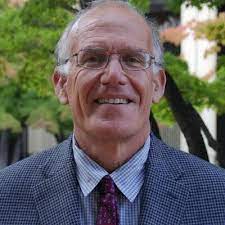
Victor Davis Hanson
“Before the war in the counties Sherman would later ruin, the top 10% of the landowners controlled 40% of the assessed wealth.”
In contrast, “more than half of those who were lucky enough to own any property at all still possessed less than 15% of the area’s valuation.”
So Hanson asked: “Why did the millions of poor whites of the Confederacy fight at all?”
He supplied the answer in his brilliant work on military history, The Soul of Battle: From Ancient Times to the Present Day, How Three Great Liberators Vanquished Tyranny.
One of those liberators was General William Tecumseh Sherman, who led 62,000 Union troops in a victorious “March to the Sea” through the Confederacy in 1864.
So why did so many poor Southern whites literally lay down their lives for the wealthy planter class, which despised them?
According to Hanson: “Behind the entire social fabric of the South lay slavery.
“If slavery eroded the economic position of the poor free citizens, if slavery encouraged a society of haves and have-nots…then it alone offered one promise to the free white man–poor, ignorant and dispirited–that he was at least not black and not a slave.”
And the planter class and its allies in government easily fobbed off their poor white countrymen with cheap flattery. Said Georgia Governor Joseph Brown:
“Among us the poor white laborer is respected as an equal. His family is treated with kindness, consideration, and respect. He does not belong to the menial class. The negro is in no sense his equal. He belongs to the only true aristocracy, the race of white men.”

Arlington House and plantation, former home of Robert E. Lee
Similarly, poor whites now flock to the Republican Party–which holds them in equal contempt– in large part to protest the 2008 election of the first black President of the United States.
According to a Pew Research Center study released on July 22, 2011: “Notably, the GOP gains have occurred only among white voters; a 2-point Republican edge among whites in 2008 (46% to 44%) has widened to a 13-point lead today (52% to 39%).”
Since the 1960s, Republicans have pursued a campaign policy of “divide and rule”–divide the nation along racial lines and reap the benefits at election time.
- Republicans opposed the Civil Rights Act of 1964.
- Republicans opposed the Voting Rights Act of 1965.
- Republicans, with Richard Nixon as their Presidential candidate in 1968 and 1972, pursued what they called a “Southern strategy”: Use “code language” to stoke fear and hatred of blacks among whites.
- Republicans have falsely identified welfare programs exclusively with non-whites. (Of the six million Americans receiving food stamps, about 42% are white, 32% are black, and 22% are Latino–with the growth fastest among whites during the recession.)
Thus, in voting Republican, many of these poor whites believe they are “striking a blow for the white race.”
And they can do so in a more socially acceptable way than joining a certified hate group such as the American Nazi Party or Ku Klux Klan.
Since 2015, openly racist groups such as the Klan and the American Nazi Party have flocked to the banner of Presidential candidate mogul Donald Trump. By enthusiastically courting their support, the real estate mogul has made it possible for Republican candidates to openly display their own racism.
Now greed:
In the hit play, 1776, on the creation and signing of the Declaration of Independence, there is a telling exchange between John Dickinson and John Hancock. It comes during the song, “Cool, Cool, Considerate Men.”
Dickinson, the delegate from Pennsylvania, urges Hancock, president of the Second Continental Congress, “to join us in our minuet.”
By “us” he means his fellow conservatives who fear losing their property and exalted status by supporting American independence from Great Britain.
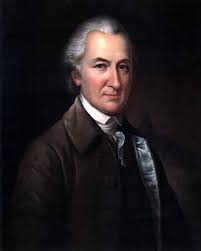
John Dickinson
Hancock declines, saying: “Fortunately, there are not enough men of property in America to dictate policy.”
To which Dickinson replies: “Perhaps not. But don’t forget that most men with nothing would rather protect the possibility of becoming rich than face the reality of being poor. And that is why they will follow us.”
Today, poor whites generally identify with the CEOs of powerful corporations. They believe the Republican gospel that they can attain such wealth–if only the government will “get out of my way.”
They forget–or ignore–the truth that government, for all its imperfections, is sometimes all that stands between them and a wide range of predators.
In return, the CEOs despise them as the privileged have always despised their social and economic “inferiors.”
Unless the Democratic Party can find ways to directly address these bitter, Politically Incorrect truths, it will continue its decline into insignificance.
ABC NEWS, ALTERNET, AMERICABLOG, AP, BABY BOOMER RESISTANCE, BARACK OBAMA, BBC, BLOOMBERG NEWS, BUZZFEED, CBS NEWS, CHRIS MATHEWS, CIVIL WAR, CNN, CROOKS AND LIARS, DAILY KOZ, FACEBOOK, FIVETHIRTYEIGHT, FOOD STAMPS, HARPER’S MAGAZINE, HUFFINGTON POST, MEDIA MATTERS, MEDICARE, MOTHER JONES, MOVEON, MSNBC, NBC NEWS, NEW REPUBLIC, NEWSDAY, NEWSWEEK, NPR, PBS NEWSHOUR, POLITICO, POLITICUSUSA, PROPAGANDA, RAW STORY, REPUBLICAN PARTY, REPUBLICANS, REUTERS, Ronald Reagan, SALON, SEATTLE TIMES, SLATE, SOCIAL SECURITY, TALKING POINTS MEMO, THE ATLANTIC, THE CHICAGO SUN-TIMES, THE CHICAGO TRIBUNE, THE DAILY BEAST, THE DAILY BLOG, THE GUARDIAN, THE HILL, THE HUFFINGTON POST, THE INTERCEPT, THE LOS ANGELES TIMES, THE NATION, THE NEW REPUBLIC, THE NEW YORK TIMES, THE NEW YORKER, THE VILLAGE VOICE, THE WALL STREET JOURNAL, THE WASHINGTON POST, THINKPROGRESS, TIME, TIME MAGAZINE, TRUTHDIG, TRUTHOUT, TWITTER, TWO POLITICAL JUNKIES, U.S. NEWS & WORLD REPORT, UPI, USA TODAY, WILLIAM TECUMSEH SHERMAN
In Bureaucracy, History, Politics, Social commentary on September 23, 2016 at 8:12 am
On July 22, 2011, ABC News carried the following story:
The Pew Foundation, analyzing voter identification, found “the electorate’s partisan affiliations have shifted significantly” since Barack Obama won office in 2008.
The GOP had gained strength among white voters, most specifically “the young and poor.”
A seven-point Democratic advantage among whites under age 30 three years ago had turned into an 11-point GOP advantage. And a 15-point Democratic advantage among whites earning less than $30,000 annually had swung to a slim four-point Republican edge by 2011.

In addition:
- The GOP gains had occurred only among white voters.
- Republicans had made sizable gains among white voters since 2008. Fifty-two percent of white voters called themselves Republicans or leaned to the GOP, compared with 39% who affiliated with the Democratic Party or leaned Democratic.
- Democrats had lost their edge among lower income white voters.
- In 2008, Democrats had a 15 point lead among white voters with family incomes less than $30,000. By 2011, Republicans had a four-point edge among this group.
- The GOP’s lead among middle income white voters had grown since 2008, and Republicans held a substantial advantage with higher income white voters.
- Republicans have made gains among whites with a high school education or less. The GOP’s advantage over Democrats had grown from one point in 2008 to 17 points in 2011 among less educated whites.
- Republicans had made smaller gains among whites voters who had college degrees.
What is fascinating about these findings is this: The Republicans have, since 1980, pursued a policy of gutting programs aimed at helping the poor–while repeatedly creating tax-breaks for the wealthiest 1% of the population.
For Republicans, the patron saint of this “love-the-rich-screw-the-poor” ideology remains Ronald Reagan–two-time governor of California and twice-elected President of the United States (1981-1989)
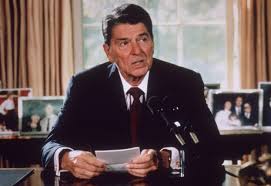
Ronald Reagan, who taught Americans to worship the wealthy
Among those charting Reagan’s legacy as President was former CBS Correspondent David Shoenbrum.
In his bestselling autobiography, America Inside Out: At Home and Abroad from Roosevelt to Reagan, he noted:

- On January 28, 1981, keeping a pledge to his financial backers in the oil industry, Reagan abolished Federal controls on the price of oil.
- Within a week, Exxon, Texaco and Shell raised gasoline prices and prices of home heating oil.
- Reagan saw it as his duty to put a floor under prices, not a ceiling above them.

- Reagan believed that when government helped business it wasn’t interfering. Loaning money to bail out a financially incompetent Chrysler was “supporting the free enterprise system.”
- But putting a high-profits tax on price-gouging corporations or filing anti-trust suits against them was “Communistic” and therefore intolerable.
- Tax-breaks for wealthy businesses meant helping America become stronger.
- But welfare for the poor or the victims of a predatory marketplace economy weakened America by sapping its morale.
“In short, welfare for the rich is good for America. But welfare for the poor is bad for America, even for the poor themselves, for it encourages them to be shiftless and lazy.
“Somehow, loans to the inefficient management of American corporations would not similarly encourage them in their inefficient methods,” wrote Shoenbrun.
Republicans have sought to dismantle Social Security ever since that program began in 1935. And Republicans have furiously opposed other programs aiding the poor and middle-class—such as Medicare, food stamps and WIC (Women, Infants, Children).
In short, this is not a political party with a history of rushing to the defense of those most in need.
So the question remains: Why are so many poor Americans flocking to its banner?
The answer lies in the history of the American South–and slavery.
9/11 ATTACKS, ABC NEWS, AFGHANISTAN, AMERICAN NAZI PARTY, ANTI-SEMITISM, ARCHER SCHOOL FOR GIRLS, BARACK OBAMA, BARRY GOLDWATER, BIRTH CONTROL, BLACK LIVES MATTER, CBS NEWS, CIVIL RIGHTS ACT OF 1964, CNN, DONALD TRUMP, ED MARTIN, FACEBOOK, FLORIDA, FOX BUSINESS, FOX NEWS, GEORGE W. BUSH, GRETCHEN CARLSON, HILLARY CLINTON, HUMAYUN KHAN, IRAQ WAR, JOHN MCCAIN, KATRINA PIERSON, KU KLUX KLAN, LATINOS, LYNDON B. JOHNSON, MARCO GUTIERREZ, MEDICAID, MEDICARE, MEXICO, MICHELE BACHMANN, MITT ROMNEY, MSNBC, NBC NEWS, NEW YORK, NICCOLO MACHIAVELLI, OBAMACARE, OMAROSA MANIGAULT, PAUL MANAFORT, PRINCESS DIANA, ROGER AILES, SOCIAL SECURITY, STEPHEN BANNON, TEA PARTY, THE APPRENTICE, THE CHICAGO SUN-TIMES, THE CHICAGO TRIBUNE, THE NEW NEW YORK TIMES, THE PRINCE, THE WASHINGTON POST, TWITTER, VLADIMIR PUTIN, VOTER ID LAWS, VOTING, WAYNE ROOT, WELFARE
In Bureaucracy, History, Law, Politics, Social commentary on September 8, 2016 at 1:21 am
In late July, Donald Trump’s new spokeswoman, Katrina Pierson, accepted an impossible mission that even Jim Phelps would have turned down:
Convince Americans that Barack Obama and Hillary Clinton were responsible for the death of Captain Humayun Khan, who was killed by a truck-bomb in Iraq in 2004.
Appearing on CNN’s The Situation Room with Wolf Blitzer on August 2, Pierson said: “It was under Barack Obama and Hillary Clinton that changed the rules of engagements that probably cost his life.”
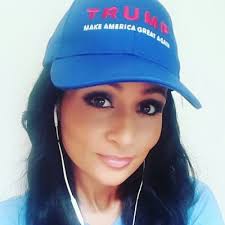
Katrina Pierson
Totally ignored in that scenario:
- President George W. Bush lied the nation into a needless war that cost the lives of 4,486 Americans and wounded another 33,226.
- The war began in 2003–and Khan was killed in 2004.
- Barack Obama became President in 2009–almost five years after Khan’s death.
- Hillary Clinton became Secretary of State the same year.
- Obama, elected Illinois U.S. Senator in 2004, vigorously opposed the Iraq war throughout his term.
Pierson’s attempt to rewrite history touched off a frenzy on Twitter, leading to the creation of the hashtag #KatrinaPiersonHistory. Its purpose: To mock Pierson’s revisionist take on history.
Among the tweets offered:
- Hillary Clinton slashed funding for security at the Ford Theater, leading to Lincoln’s assassination.
- Obama gave Amelia Earhart directions to Kenya.
- Remember the Alamo? Obama and Hillary let it happen.
- Obama and Clinton kidnapped the Lindbergh baby.
Not content with blaming President Obama for the death of a man he never sent into combat, Pierson claimed that Obama started the Afghanistan war.
Appearing again on CNN, Pierson said the Afghan war began “after 2007,” when Al Qaeda “was in ashes” following the American troop surge in Iraq.
“Remember, we weren’t even in Afghanistan by this time,” Pierson said. “Barack Obama went into Afghanistan, creating another problem.”
In fact, President George W. Bush ordered the invasion of Afghanistan following the terrorist attacks of September 11, 2001.
Millions of Americans who lived through 9/11 remember that.
When your spokeswoman becomes a nationwide laughingstock, your own credibility goes down the toilet as well.
In July an Associated Press/GfK poll found that half of Americans saw Donald Trump as “racist”–and only 7% of blacks viewed him favorably.
There are numerous reasons for this:
- His enthusiastic support by racist white supremacist organizations such as the Ku Klux Klan and the American Nazi Party.
- His “birther” attacks on President Obama as a non-citizen from Kenya–and thus ineligible to hold the Presidency.
- His attacks on the Black Lives Matter movement and calling on his supporters at rallies to rough up minority protesters.
Since 1964, blacks have overwhelmingly voted for Democratic Presidential candidates. President Lyndon B. Johnson’s won their loyalty with his support for and passage of the Civil Rights Act of 1964.
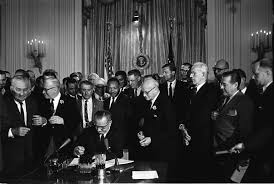
President Johnson signing the 1964 Civil Rights Act
Republican Presidential candidate Barry Goldwater opposed it–as did the majority of his party.
Since 1964, fewer than six percent of blacks have voted for Republican Presidential candidates. Whites have not only remained the majority of Republican voters but have become the single most important voting bloc among them.
John McCain received four percent of black votes in 2008 and Mitt Romney received six percent in 2012. When a Republican collapses into single digits among blacks and other minorities, it reduces the number of white votes a Democrat needs to win the presidency.
To counter this, Donald Trump has turned to his Director of African-American Outreach: Omarosa Manigault.
Trump made the appointment just hours before the first night of the Republican National Convention.
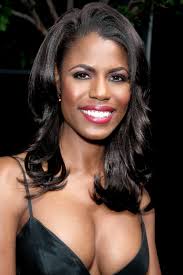
Omarosa Manigault
Manigault is best known as the villain of Trump’s reality-TV show, “The Apprentice”–where she was fired on three different seasons. Her credentials include a Ph.D. in communications, a preacher’s license, and topping TV Guide’s list of greatest reality TV villains in 2008.
During the Clinton administration she held four jobs in two years, and was thoroughly disliked in all of them.
“She was asked to leave [her last job] as quickly as possible, she was so disruptive,” said Cheryl Shavers, the former Under Secretary for Technology at the Commerce Department. “One woman wanted to slug her.”
In her role as Trump’s ambassador to blacks, Omarosa has inspired others to want to slug her. Appearing on Fox Business, she ignored Fox panelist Tamera Holder’s question on why blacks should support Trump,and then mocked her “big boobs.”
Manigault isn’t bothered that blacks regard Trump so poorly in polls: “My reality is that I’m surrounded by people who want to see Donald Trump as the next president of the United States who are African-American.”
Appointing as your public relations director a woman who gratuitously insults and infuriates people is not the move of a smart administrator. Nor the move of a smart Presidential candidate.
If Donald Trump becomes President, he will inherit the authority to appoint thousands of officials to domestic and foreign agencies. Voters have a right to judge him on the quality of the appointments he has already made to his own campaign.
A review of those named within this series gives serious cause for concern.
9/11 ATTACKS, ABC NEWS, AFGHANISTAN, AMERICAN NAZI PARTY, ANTI-SEMITISM, ARCHER SCHOOL FOR GIRLS, BARACK OBAMA, BARRY GOLDWATER, BIRTH CONTROL, BLACK LIVES MATTER, CBS NEWS, CIVIL RIGHTS ACT OF 1964, CNN, DONALD TRUMP, ED MARTIN, FACEBOOK, FLORIDA, FOX BUSINESS, FOX NEWS, GEORGE W. BUSH, GRETCHEN CARLSON, HILLARY CLINTON, HUMAYUN KHAN, IRAQ WAR, JOHN MCCAIN, KATRINA PIERSON, KU KLUX KLAN, LATINOS, LYNDON B. JOHNSON, MARCO GUTIERREZ, MEDICAID, MEDICARE, MEXICO, MICHELE BACHMANN, MITT ROMNEY, MSNBC, NBC NEWS, NEW YORK, NICCOLO MACHIAVELLI, OBAMACARE, OMAROSA MANIGAULT, PAUL MANAFORT, PRINCESS DIANA, ROGER AILES, SOCIAL SECURITY, STEPHEN BANNON, TEA PARTY, THE APPRENTICE, THE CHICAGO SUN-TIMES, THE CHICAGO TRIBUNE, THE NEW NEW YORK TIMES, THE PRINCE, THE WASHINGTON POST, TWITTER, VLADIMIR PUTIN, VOTER ID LAWS, VOTING, WAYNE ROOT, WELFARE
In Bureaucracy, History, Law, Politics, Social commentary on September 7, 2016 at 12:18 am
Even the Secret Service can’t protect Donald Trump from the notoriety of his supporters.
The current manager of Trump’s Presidential campaign is Stephen Bannon, who’s under fire for anti-Semitic remarks and having been registered to vote at a vacant house in Florida.
But before Bannon signed on, his predecessor was Paul Manafort, whom Trump hired to add stability to his often scattershot campaign.
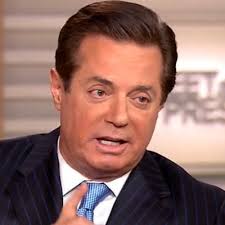
Paul Manafort
For Trump, Manafort came with a dangerous liability: His longstanding ties to pro-Russian politicians in Ukraine–which inevitably led to Vladimir Putin.
For years, Manafort worked for Viktor Yanukovych, a Putin protege who was deposed as Ukraine’s president in 2014 amid widespread demonstrations.
In August, the New York Times unearthed handwritten ledgers that listed $12.7 million in cash payments to Manafort from Yanukovych’s political party between 2007 and 2012.
Trump’s own ties to Putin were already facing increasing scrutiny for a number of reasons:
- Trump’s and Putin’s public expressions of admiration for each other’s toughness.
- The removal from the Republican party platform, written at the convention in Cleveland in July, of references to arming Ukraine in its fight against pro-Russian rebels who have been armed by the Kremlin.
- In July, high-ranking Democratic officials–including presumptive Presidential nominee Hillary Clinton–were embarrassed by a hack of thousands of Democratic National Committee emails. This was quickly traced to Russian hackers allegedly working on behalf of the Kremlin. Their alleged motive: To tip the election in favor of Trump.
- Trump drew more suspicion upon himself by inviting Russia to find 30,000 emails deleted from the private server used by Clinton while she was Secretary of State in the Obama administration: “I think you will probably be mightily rewarded by our press.”
Added to Manafort’s embarrassing ties to Russia was another minus: He and Trump didn’t get along. Trump had begun calling him “low energy”–a term he once aimed at his former GOP rival, Jeb Bush.
Manafort wanted Trump to bring more self-discipline to the campaign and concentrate his fire solely on his Presidential rival, Hillary Clinton. Instead, in late July, Trump ignited a days-long feud with members of a Gold Star family, costing him support within the veterans community.
Manafort also wanted Trump to establish a conventional chain-of-command organization typical of a Presidential campaign. But Trump resisted, preferring to improvise and rely on his instincts and the counsel of his family.
In late August, Trump fired him.
Foreign policy nearly always plays a major role in Presidential elections. Yet Trump has shown a surprising lack of respect for a detailed knowledge of it.
Asked on MSNBC’s “Morning Joe” who he consults about foreign policy, Trump replied; “I’m speaking with myself, number one, because I have a very good brain and I’ve said a lot of things.”
In late August, former Republican Congresswoman (2007-2015) Michele Bachmann claimed that she was now advising Trump on foreign policy.
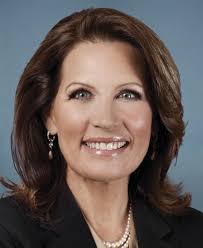
Michele Bachmann
A member of the Right-wing Tea Party, Bachmann has said that diplomacy “is our option” in dealing with Iran–but wouldn’t rule out a nuclear strike.
Among the statements she’s made:
- “I don’t know how much God has to do to get the attention of the politicians. We’ve had an earthquake; we’ve had a hurricane. He said, ‘Are you going to start listening to me here?'”
- “Carbon dioxide is portrayed as harmful. But there isn’t even one study that can be produced that shows that carbon dioxide is a harmful gas.”
- “President Obama waived a ban on arming terrorists in order to allow weapons to go to the Syrian opposition….U.S. taxpayers are now paying to give arms to terrorists, including Al-Qaeda.”
- “I’m a believer in Jesus Christ. As I look at the End Times scripture, this says to me that the leaf is on the fig tree and we are to understand the signs of the times, which is your ministry, we are to understand where we are in God’s end time history.”
A woman who believes that God causes earthquakes and hurricanes, and that mankind has arrived at “End Times,” can hardly be a comfort to rational voters.
Another Trump adviser is former Fox News CEO Roger Ailes. His assignment: Prepare Trump for the upcoming fall debates with Clinton.
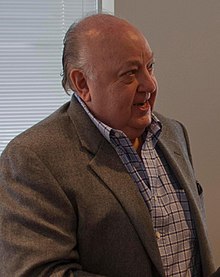
But Ailes comes with huge notoriety: In July he was fired from Fox News on multiple charges of sexual harassment.
At first, only Fox News anchor Gretchen Carlson dared accuse him. But then more than two dozen women came forward to accuse Ailes of sexual harassment.
On September 6, Carlson reached an out-of-court settlement with the parent company of Fox News for a reported $20 million.
At least two other women have settled with Fox, an anonymous source told the New York Times. And others may be planning to file lawsuits.
All of which makes Ailes the poster boy for sexual harassment.
Trump has been married three times and has often boasted of his sexual conquests–including ones he believes he could have had.
(Shortly after the 1997 death of Princess Diana, he told a radio interviewer he could have “nailed” her if he had wanted to.)
In a mid-March CNN/ORC poll, 73% of female voters voiced a negative view of Trump. Associating with a notorious sexual harasser like Roger Ailes can only do even more damage to his candidacy.
9/11 ATTACKS, ABC NEWS, AFGHANISTAN, AMERICAN NAZI PARTY, ANTI-SEMITISM, ARCHER SCHOOL FOR GIRLS, BARACK OBAMA, BARRY GOLDWATER, BIRTH CONTROL, BLACK LIVES MATTER, CBS NEWS, CIVIL RIGHTS ACT OF 1964, CNN, DONALD TRUMP, ED MARTIN, FACEBOOK, FLORIDA, FOX BUSINESS, FOX NEWS, GEORGE W. BUSH, GRETCHEN CARLSON, HILLARY CLINTON, HUMAYUN KHAN, IRAQ WAR, JOHN MCCAIN, KATRINA PIERSON, KU KLUX KLAN, LATINOS, LYNDON B. JOHNSON, MARCO GUTIERREZ, MEDICAID, MEDICARE, MEXICO, MICHELE BACHMANN, MITT ROMNEY, MSNBC, NBC NEWS, NEW YORK, NICCOLO MACHIAVELLI, OBAMACARE, OMAROSA MANIGAULT, PAUL MANAFORT, PRINCESS DIANA, ROGER AILES, SOCIAL SECURITY, STEPHEN BANNON, TEA PARTY, THE APPRENTICE, THE CHICAGO SUN-TIMES, THE CHICAGO TRIBUNE, THE NEW NEW YORK TIMES, THE PRINCE, THE WASHINGTON POST, TWITTER, VLADIMIR PUTIN, VOTER ID LAWS, VOTING, WAYNE ROOT, WELFARE
In Bureaucracy, History, Law, Politics, Social commentary on September 6, 2016 at 12:08 am
“The first impression that one gets of a ruler and his brains is from seeing the men that he has about him.
“When they are competent and loyal one can always consider him wise, as he has been able to recognize their ability and keep them faithful.
“But when they are the reverse, one can always form an unfavorable opinion of him, because the first mistake that he makes is in making this choice.”
So wrote the Italian statesman Niccolo Machiavelli more than 500 years ago in his famous treatise on politics, The Prince.
And his words remain as true in our day as they were in his.
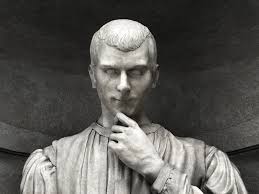
Niccolo Machiavelli
They are especially important to remember when evaluating Donald Trump’s talents as an administrator.
In pursuing the Presidency, he is seeking the most powerful office in the world, one that would give him authority to appoint thousands of officials to domestic and foreign agencies.
Consider some of those he has placed around him in his campaign for President:
Founder of Latinos for Trump Marco Gutierrez told MSNBC’s Joy Reid: “My culture is a very dominant culture. And it’s imposing, and it’s causing problems. If you don’t do something about it, you’re gonna have taco trucks every corner.”
At a Tea Party for Trump rally at a Harley-Davidson dealership in Festus, Missouri, former Missouri Republican Party director Ed Martin reassured the crowd that they’re not racist for hating Mexicans: “Donald Trump is for Americans first.
“He’s for us first. It is not selfish to support, or to be for, your neighbor, as opposed to someone from another nation. And Mexico, Mexicans, that’s not a race. You’re not racist if you don’t like Mexicans. They’re from a nation.”
From the outset of his Presidential campaign, Trump has polled extremely poorly among Hispanic voters. This is perfectly understandable, given his comments about Mexicans as:
“When Mexico sends its people, they’re not sending their best. They’re sending people that have lots of problems, and they’re bringing those problems with us. They’re bringing drugs. They’re bringing crime. They’re rapists.”
Trump has also promised to “build a great, great wall on our southern border and I will have Mexico pay for that wall.”
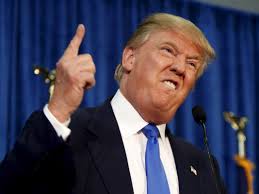
Donald Trump
These comments made Trump the winner of the Republican primaries, where voters always nominate the most extreme Rightist candidate.
But the general election phrase requires Republican and Democratic candidates to appeal to both their base and beyond it. As a result, Trump is now desperate to attract the votes of Hispanics.
Comments such as those by Marco Gutierrez and Ed Martin guarantee this won’t happen.
Wayne Root, opening speaker and master of ceremonies at many Trump events, told Virginia radio host Rob Schilling that people on public assistance and women who get their birth control through Obamacare should not be allowed to vote:
“If the people who paid the taxes were the only ones allowed to vote, we’d [Republicans] have landslide victories. But you’re allowing people to vote. This explains everything! People with conflict of interest shouldn’t be allowed to vote. If you collect welfare, you have no right to vote.
“The day you get off welfare, you get your voting rights back. The reality is, why are you allowed to have this conflict of interest that you vote for the politician who wants to keep your welfare checks coming and your food stamps and your aid to dependent children and your free health care and your Medicaid, your Medicare and your Social Security and everything else?”
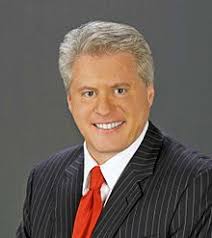
Wayne Root
According to a March Gallup poll, 70% of women–or seven in 10–have an unfavorable opinion of Trump.
Such comments as Root’s aren’t going to increase Trump’s popularity with them. Nor with anyone who receives Medicaid, Medicare or Social Security.
Donald Trump’s new campaign manager, Stephen Bannon, was charged with misdemeanor domestic violence, battery, and dissuading a witness in 1996, after an altercation with his then-wife, Mary Louise Piccard, in Santa Monica, California.
Picard also said in a 2007 court declaration that Bannon didn’t want their twin daughters attending the Archer School for Girls in Los Angeles because many Jewish students were enrolled there.
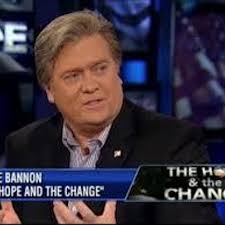
Stephen Bannon
Not only is this certain to lose Trump votes among women, it will make him unpopular among Jews. A campaign manager charged with anti-Semitism could cost Trump heavily Jewish states like New York and Florida.
In addition: Bannon and another ex-wife, Diane Clohesy, were registered to vote at a vacant house in Florida, a possible violation of election laws in a key swing state.
Republicans have vigorously denied voting rights to tens of thousands on the pretext of “voter fraud.” More than a dozen states still have voting restrictions in place since 2012.
A Washington Post investigation found just 31 credible cases of voter fraud from 2000 to 2014, out of an estimated 1 billion ballots cast in the U.S. during that period.
Meanwhile, voting rights groups have been fighting back–and winning.
“Voter ID” laws in Texas, Wisconsin and North Carolina have been found discriminatory against minorities–who traditionally vote Democratic.
With evidence of Republican fraud like that supplied by Trump’s own campaign manager, victories against “Voter ID” laws may well increase.


 Bureaucracybuster's Blog
2003 IRAQ WAR, ABC NEWS, ALTERNET, ASIANS, BARACK OBAMA, BIRTH CONTROL, BLACKS, BUZZFEED, CBS NEWS, CNN, DAILY KOS, DISABLED, DONALD TRUMP, ED MARTIN, FACEBOOK, HILLARY CLINTON, HUMAYUN KHAN, KATRINA PIERSON, LATINOS, MARCO GUTIERREZ, MEDICAID, MEDICARE, MOTHER JONES, MOVEON, MSNBC, MUSLIMS, NBC NEWS, NEWSWEEK, NICCOLO MACHIAVELLI, NPR, OBAMACARE, POLITICO, PRISONERS OF WAR, RAW STORY, SALON, SLATE, SOCIAL SECURITY, TEA PARTY, THE CHICAGO SUN-TIMES, THE CHICAGO TRIBUNE, THE DAILY BEAST, THE DISCOURSES, THE HUFFINGTON POST, THE LOS ANGELES TIMES, THE NEW YORK TIMES, THE PRINCE, THE WALL STREET JOURNAL, THE WASHINGTON POST, TIME, TWITTER, U.S. NEWS & WORLD REPORT, USA TODAY, WAYNE ROOT, WOMEN
THE TOAD WHO NEVER BECAME A PRINCE
In Bureaucracy, History, Military, Politics, Social commentary on August 3, 2018 at 12:01 amMany pundits have sized up Donald Trump—as a Presidential candidate and President.
But how would Niccolo Machiavelli, the 16th-century Florentine statesman, assess Trump?
Machiavelli’s two great works on politics—The Prince and The Discourses—remain textbooks for successful politicians more than 500 years later.
Niccolo Machiavelli
Consider Trump’s notoriety for hurling insults at virtually everyone, including:
These insults delight his white, under-educated followers. But they have alienated millions of other Americans who might have supported him.
And what does Machiavelli have to say about gratuitously handing out insults and threats?
Many of those who supported Trump as a Presidential candidate expected him to stop constantly picking fights if he became President. Machiavelli had a stern warning for them:
Then there is Trump’s approach to consulting advisers.
Asked on MSNBC’s “Morning Joe” who he consults about foreign policy, Trump replied; “I’m speaking with myself, number one, because I have a very good brain and I’ve said a lot of things.”
Donald Trump
This totally contrasts the advice given by Machiavelli:
And Machiavelli has potent advice on the selection of advisers:
Consider some of the advisers Trump has relied on in his campaign for President:
From the outset of his Presidential campaign, Trump polled extremely poorly among Hispanic voters. Comments like these didn’t increase his popularity.
This proved a big turn-off among the 70% of women who have an unfavorable opinion of him—and anyone who receives Medicaid, Medicare or Social Security.
Obama became President in 2009—almost five years after Khan’s death. And Clinton became Secretary of State the same year.
When your spokeswoman becomes a nationwide laughingstock, your own credibility goes down the toilet as well.
Finally, speaking directly to Trump, Machiavelli warns: Unwise princes cannot be wisely advised.
All of which would lead Niccolo Machiavelli to warn, if he could witness American politics today: “This bodes ill for your Republic.”
Share this: