Posts Tagged ‘Secret Service’
ABC NEWS, ALTERNET, AMERICABLOG, AP, ATOMIC BOMB, BABY BOOMER RESISTANCE, BARACK OBAMA, BBC, BEIRUT BOMBING, BILL CLINTON, BLOOMBERG, BUZZFEED, CBS NEWS, CHRIS MATTHEWS, CNN, COMMUNISM, CROOKS AND LIARS, CULTS, DAILY KOS, DAILY KOZ, ECONOMICS, FIVETHIRTYEIGHT, GEORGE H.W. BUSH, HARDBALL, HARPER’S MAGAZINE, HUFFINGTON POST, IRAN, IRAN-CONTRA AFFAIR, JOHN F. KENNEDY, JOSEPH STALIN, MEDIA MATTERS, MEET THE PRESS, MOTHER JONES, MOVEON, MSNBC, NBC NEWS, NEW REPUBLIC, NEWSDAY, NEWSWEEK, NPR, PBS NEWSHOUR, POLITICO, POLITICUSUSA, POLLUTION, RAW STORY, REPUBLICAN PARTY, REUTERS, Ronald Reagan, SALON, SEATTLE TIMES, Secret Service, SLATE, SOVIET NUCLEAR PHYSICS, SOVIET UNION, TALKING POINTS MEMO, TAX CUTS, TERRORISM, THE ATLANTIC, THE CHICAGO SUN-TIMES, THE CHICAGO TRIBUNE, THE DAILY BEAST, THE DAILY BLOG, THE GUARDIAN, THE HILL, THE HUFFINGTON POST, THE INTERCEPT, THE LOS ANGELES TIMES, THE NATION, THE NEW REPUBLIC, THE NEW YORK TIMES, THE NEW YORKER, THE VILLAGE VOICE, THE WASHINGTON POST, THINKPROGRESS, THIS WEEK, TIME, TRUTHDIG, TRUTHOUT, TWO POLITICAL JUNKIES, U.S. NEWS & WORLD REPORT, UPI, USA TODAY, Vladimir Lenin, X
In Bureaucracy, Business, History, Military, Politics, Social commentary on May 11, 2016 at 12:01 am
On February 6, 2011, Ronald Reagan, if he had been alive, would have been 100 years old.
Publishers rushed to put out worshipful tributes to his eight years as President. Network political programs such as “This Week” and “Meet the Press” assembled surviving members of his administration to re-live the “glory days” of Reagan’s—and their—time in power.
This is where it all started going wrong for America—a Right-wing legacy of huge Federal deficits, tax-cuts for the rich, bloated military budgets and cutbacks in government programs to aid the poor and middle-class.
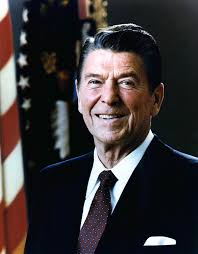
Ronald Reagan
The Republican party, of course, has done the most to create and promote this “cult of Reagan.” And it has done so for the same reason the Communist party of the Soviet Union created and fostered the “cult of Lenin.”
No two men could have been more different than Vladimir Lenin and Ronald Reagan. Lenin created the Soviet Union in 1917 and became its first in a series of absolute dictators. Reagan spent his life fighting Communism, most notably as President.
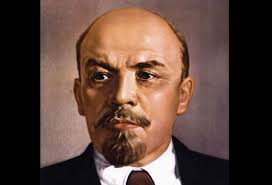
Vladimir Lenin
So it’s ironic that both men, in death, got essentially the same funeral—and for the same reason: To sanctify and legitimize their respective organizations—and the authority of their potential successors.
Lenin died in 1924 and was immediately succeeded by Joseph Stalin. Stalin knew that, despite Communism’s official atheistic stance, most Russians remained loyal to the Russian Orthodox Church.
So in giving Lenin’s funeral oration, Stalin used the language of religion to confer sainthood upon a militant atheist–and upon his successor, Stalin himself.
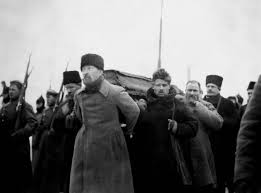
Funeral for Vladimir Lenin
Stalin and his fellow Communists immediately launched the “cult of Lenin,” depicting him as a fatherly, all-wise leader whose genius could only be bestowed upon his closest disciples.
Lenin’s extensive political writings were treated as divine writ, and were used to justify everything Stalin and his own successors wanted to do.
A classic example: Although Lenin died 20 years before the American creation of the atomic bomb, Lenin was hailed by the Soviets as the “father” of “Soviet nuclear physics.”
Similarly, the Republican party wasted no time turning its own former leader, Ronald Reagan, into a modern-day saint of mythical proportions.
They have done so for the same reason that Stalin deliberately forged a cult around the dead Lenin—to create a “holy” figure of whom other Republicans can claim to be true disciples.
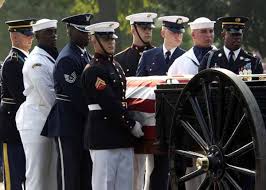
Funeral for Ronald Reagan
These deliberate fictions conveniently ignore a series of ugly truths:
- Reagan was only one of a series of Presidents who held the line against the Soviet Union.
- His budgets were just as stained with red ink as those of all previous Presidents.
- Far from standing up to Iranian terrorists, Reagan sold them our most sophisticated missiles in a weak-kneed exchange for American hostages. Then he went on television and brazenly lied that any such “arms for hostages” deal had ever happened.
- By the end of his term, 138 Reagan administration officials had been investigated, indicted or convicted for official misconduct and/or criminal violations.
- His “trickle-down” Reganomics brought prosperity to only the wealthiest 1% of Americans, proving that “a rising tide lifted some yachts.”
- By drastically shrinking the tax-base, bloating the defense budget and destroying programs to benefit the poor and middle-class, Reagan produced a $1 trillion deficit—which only the Clinton Administration eliminated.
- Reagan believed that government should not help the impoverished. Those who lacked wealth to buy such necessities as housing and medical insurance were written off as unimportant.
- John F. Kennedy had praised government service as an honor. Reagan repeatedly said that “the best and the brightest” could be found only in business.
- This denigration of government service continues among Republicans to this day–defaming the very institutions they lust to control.
- Although he often berated the poor for their “laziness,” Reagan adhered to a “banker’s hours” schedule: During his working hours in the Oval Office, he often had blocks of free time–two to three hours. He would call for his fan mail and answer it.
- Reagan saw no need to protect America’s fragile environment against corporate polluters, eager to enrich themselves at its expense: “Approximately 80% of our air pollution stems from hydrocarbons released by vegetation, so let’s not go overboard in setting and enforcing tough emission standards from man-made sources.”
Reagan famously attacked “welfare queens” and sought to deny government benefits for the poor. But he didn’t hesitate to enrich himself at public expense.
- Before his Presidency ended, 18 wealthy Californians contributed $156,000 apiece to buy him a 7,200 square-foot mansion overlooking Beverly Hills.
- Reagan signed a multi-million dollar deal to write his Presidential memoirs and publish a collection of his speeches.
- He signed an exclusive contract with a Washington lecture bureau, which paid him $50,000 per speech given in the United States and $100,000 overseas. This made him the highest-paid speaker in the country.
- These monies came in addition to his Presidential pension of $99,500 a year for life and his $30,000 annual pension as a former governor of California.
- At a cost to the government of $10 million annually, Reagan—a millionaire who could afford private security—continued to receive lifetime Secret Service protection from 40 fulltime agents.
The “cult of Lenin” died when the Soviet Union collapsed in 1991. The “cult of Reagan” continues to flourish, and will do so for as long as the Republican party finds voters willing to believe in it.
2016 PRESIDENTIAL RACE, ABC NEWS, ALTERNET, AMERICABLOG, AP, BABY BOOMER RESISTANCE, BBC, BERNIE SANDERS, BLOOD FEUD, BLOOMBERG NEWS, BROTHERS: THE HIDDEN HISTORY OF THE KENNEDY YEARS, BUZZFEED, CARLOS MARCELLO, CBS NEWS, CIA, CNN, COTTER SMITH, CROOKS AND LIARS, CUBA, DAILY KOS, DAVID TALBOT, DONALD TRUMP, ERNEST BORGNINE, FBI, FIDEL CASTRO, FIVETHIRTYEIGHT, GUS RUSSO, HARPER’S MAGAZINE, HILLARY CLINTON, HUFFINGTON POST, INTERNATIONAL BROTHERHOOD OF TEAMSTERS, J. EDGAR HOOVER, JAMES R. HOFFA, JUSTICE DEPARTMENT, LIVE BY THE SWORD: THE SECRET WAR AGAINST CASTRO AND THE DEATH OF JFK, MAFIA, MEDIA MATTERS, MOTHER JONES, MOVEON, MSNBC, NBC NEWS, NEW REPUBLIC, NEWSDAY, NEWSWEEK, NPR, PBS NEWSHOUR, POLITICO, POLITICUSUSA, RAFAEL EDWARD CRUZ, RAW STORY, REUTERS, ROBERT BLAKE, ROBERT F. KENNEDY, SALON, SAM GROOM, SEATTLE TIMES, Secret Service, SENATE LABOR RACKETS COMMITTEE, SLATE, TALKING POINTS MEMO, THE ATLANTIC, THE CHICAGO SUN-TIMES, THE CHICAGO TRIBUNE, THE DAILY BEAST, THE DAILY BLOG, THE GUARDIAN, THE HILL, THE HUFFINGTON POST, THE INTERCEPT, THE LOS ANGELES TIMES, THE NATION, THE NEW REPUBLIC, THE NEW YORK TIMES, THE NEW YORKER, THE VILLAGE VOICE, THE WALL STREET JOURNAL, THE WASHINGTON POST, THINKPROGRESS, TIME, TRUTHDIG, TRUTHOUT, TWITTER, U.S. NEWS & WORLD REPORT, UPI
In Bureaucracy, History, Law, Law Enforcement, Politics, Social commentary on April 25, 2016 at 12:10 am
The 1983 TV mini-series, Blood Feud, chronicles the decade-long struggle between Robert F. Kennedy (Cotter Smith) and James R. Hoffa (Robert Blake), president of the International Brotherhood of Teamsters Union.
With Kennedy as Attorney General and facing relentless pressure from the Justice Department, the Mafia despairs of a solution. At a swanky restaurant, several high-ranking Mafiosi agree that “something” must be done.
On November 22, 1963, President John F. Kennedy is assassinated in Dallas, Texas.
Blood Feud clearly implies that the Mafia was responsible.
[The House Assassinations Committee investigated this possibility in 1978, and determined that Carlos Marcello, the Mafia boss of New Orleans, had the means, motive and opportunity to kill JFK. But it could not find any conclusive evidence of his involvement.]
Even with the President dead, RFK’s Justice Department continues to pursue Hoffa. In 1964, he is finally convicted of jury tampering and sentenced to 13 years’ imprisonment.
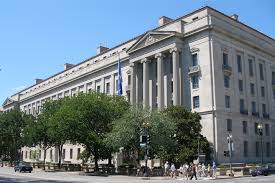
U.S. Department of Justice
Hoping to avoid prison, Hoffa phones Robert Kennedy, offering future Teamsters support if RFK runs for President. To prove he can deliver, he tells Kennedy that the Teamsters have even penetrated the FBI.
[In March, 1964, Kennedy met with Hoffa on an airfield at Dulles International Airport in Washington, D.C. He was accompanied by two Secret Service agents from the detail assigned to ex-First Lady Jacqueline Kennedy.
[FBI Director J. Edgar Hoover, no longer afraid to cross RFK, had withdrawn the agents previously assigned to guard Kennedy.
[Accompanying Hoffa were two muscular bodyguards–at least one of whom was packing two pistols in shoulder holsters.
[While the Secret Service agents watched from a respectful distance, Kennedy spoke quietly with Hoffa. The Attorney General showed a document to Hoffa, and the Teamsters leader at times nodded or shook his head.
[The agents drove Kennedy back to Washington. During the ride, he said nothing about the reason for the meeting.
[David Talbot, in his book, Brothers: The Hidden History of the Kennedy Years, speculates that it could have been to discuss Hoffa’s conviction for jury tampering.
[But Gus Russo–author of Live By the Sword: The Secret War Against Castro and the Death of JFK–writes that the reason might have been Dallas.
[Perhaps, he speculates, RFK had wanted to look into Hoffa’s eyes while asking him: Did you have anything to do with the assassination? RFK had, in fact, done this with CIA Director John McCone almost immediately after his brother’s death.]
In Blood Feud, Kennedy confronts J. Edgar Hoover (Ernest Borgnine) and accuses him of illegally planting wiretaps in Mob hangouts all over the country.
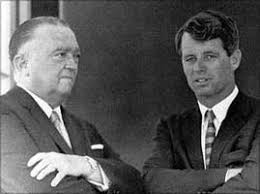
J. Edgar Hoover and Robert F. Kennedy
Hoover retorts that this had been the only way to obtain the prosecution-worthy intelligence Kennedy had demanded: “You loved that flow of information. You didn’t want it to stop.”
Kennedy: Why did you keep the FBI out of the fight against the Mob for decades?
Hoover: “Every agency that came to grips with them got corrupted by their money.”
[So far as is known, Hoover never made any such confession. Historians continue to guess his reason for leaving the Mob alone for decades.]
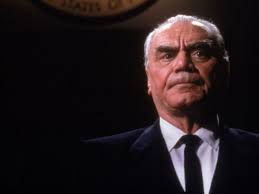

Ernest Borgnine as J. Edgar Hoover
RFK then mentions the CIA’s plots to employ the Mob to assassinate Cuban dictator Fidel Castro
[The agency had wanted to please President Kennedy, and the Mafia had wanted to regain its casinos lost to the Cuban Revolution. The role the Kennedy brothers played in the CIA’s assassination plots remains murky, and has been the subject of endless speculation.]
“The CIA, doing business with the Mob,” says Kennedy. “The FBI, leaking information to its enemies [the Teamsters].” Then, sadly: “I guess it’s true–everyone does business with everyone.”
[So far as is known, the FBI did not pass on secrets to the Teamsters. But during the 1970s, the Mafia penetrated the Cleveland FBI office through bribes to a secretary. Several FBI Mob informants were “clipped” as a result.]
In 1967, Hoffa goes to prison. He stays there until, in 1971, President Richard Nixon commutes his sentence in hopes of gaining Teamsters’ support for his 1972 re-election.
Kennedy leaves the Justice Department in 1964 and is elected U.S. Senator from New York. In 1968 he runs for President. On June 5, after winning the California primary, he’s assassinated.
In Blood Feud, just before his assassination, RFK asks: “How will I ever really know if the Mob killed Jack because of my anti-Mob crusade?”
Hoffa schemes to return to the presidency of the Teamsters–a post now held by his successor, Frank Fitzsimmons. He runs the union in a more relaxed style than Hoffa, thus giving the Mob greater control over its pension fund.
And the Mafia likes it that way.
On July 30, 1975, Hoffa disappears from the parking lot of the Machus Red Fox Restaurant near Detroit. He had gone there to meet with two Mafia leaders.
Almost 41 years after the death of James R. Hoffa, and almost 48 years after that of Robert F. Kennedy:
- Labor unions are a shadow of their former power.
- The threat they once represented to national prosperity has been replaced by that of predatory corporations like Enron and AIG.
- The war RFK began on the Mafia has continued, sending countless mobsters to prison.
- Millions of Americans who once expected the Federal Government to protect them from crime now believe the Government is their biggest threat.
- The idealism that fueled RFK’s life has virtually disappeared from politics.
2016 PRESIDENTIAL RACE, ABC NEWS, ABCNEWS, ALTERNET, AMERICABLOG, AP, BABY BOOMER RESISTANCE, BBC, BERNIE SANDERS, BLOOD FEUD, BLOOMBERG NEWS, BROTHERS: THE HIDDEN HISTORY OF THE KENNEDY YEARS, BUZZFEED, CARLOS MARCELLO, CBS NEWS, CIA, CNN, COTTER SMITH, CROOKS AND LIARS, CUBA, DAILY KOS, DAVID TALBOT, DONALD TRUMP, ERNEST BORGNINE, FBI, FIDEL CASTRO, FIVETHIRTYEIGHT, GUS RUSSO, HARPER’S MAGAZINE, HILLARY CLINTON, HUFFINGTON POST, INTERNATIONAL BROTHERHOOD OF TEAMSTERS, J. EDGAR HOOVER, JAMES R. HOFFA, JOHN F. KENNEDY, JUSTICE DEPARTMENT, LIVE BY THE SWORD: THE SECRET WAR AGAINST CASTRO AND THE DEATH OF JFK, MAFIA, MEDIA MATTERS, MOTHER JONES, MOVEON, MSNBC, NBC NEWS, NEW REPUBLIC, NEWSDAY, NEWSWEEK, NPR, PBS NEWSHOUR, POLITICO, POLITICUSUSA, RAFAEL EDWARD CRUZ, RAW STORY, REUTERS, ROBERT BLAKE, ROBERT F. KENNEDY, SALON, SAM GROOM, SEATTLE TIMES, Secret Service, SENATE LABOR RACKETS COMMITTEE, SLATE, TALKING POINTS MEMO, THE ATLANTIC, THE CHICAGO SUN-TIMES, THE CHICAGO TRIBUNE, THE DAILY BEAST, THE DAILY BLOG, THE GUARDIAN, THE HILL, THE HUFFINGTON POST, THE INTERCEPT, THE LOS ANGELES TIMES, THE NATION, THE NEW REPUBLIC, THE NEW YORK TIMES, THE NEW YORKER, THE VILLAGE VOICE, THE WALL STREET JOURNAL, THE WASHINGTON POST, THINKPROGRESS, TIME, TRUTHDIG, TRUTHOUT, TWITTER, U.S. NEWS & WORLD REPORT, UPI
In Bureaucracy, History, Law, Law Enforcement, Politics, Social commentary on April 22, 2016 at 12:10 am
The 1983 TV mini-series, Blood Feud, chronicles the decade-long struggle between Robert F. Kennedy and James R. Hoffa.
Having “helped” Kennedy (Cotter Smith) to oust corrupt Teamsters President Dave Beck, Hoffa (Robert Blake) believes that Kennedy should now be satisfied: “He’s got his scalp. Now he can move on to other things while I run the union.”
But Hoffa has guessed wrong–with fatal results. Realizing that he’s been “played” by Hoffa, a furious Kennedy strikes back.
He orders increased surveillance of Hoffa and his topmost associates. He subpoenas union records and members of both the Teamsters and the Mafia to appear before his committee in public hearings.
And he tries to enlist the aid of legendary FBI Director J. Edgar Hoover (Ernest Borgnine). But Hoover wants no part of a war against organized crime, whose existence he refuses to admit.

Meanwhile, Kennedy’s confrontations with Hoffa grow increasingly fierce. In open hearings, Kennedy accuses Hoffa of receiving kickbacks in the name of his wife. Hoffa damns him for “dirtying my wife’s name.”
Kennedy secures an indictment against Hoffa for hiring a spy to infiltrate the Senate Labor Rackets Committee. He’s so certain of a conviction that he tells the press he’ll “jump off the Capitol building” if Hoffa beats the rap.
But Hoffa’s lawyer, Edward Bennett Williams (Jose Ferrer) puts Kennedy himself on the witness stand. There he portrays Kennedy as a spoiled rich man who’s waging a vendetta against Hoffa.
Hoffa beats the rap, and offers to send Kennedy a parachute. But he jokingly warns reporters: “Hey, Bobby, you better have it checked. I don’t trust myself!”
By 1959, Robert Kennedy’s work as chief counsel for the Senate Labor Rackets Committee is over. But not his determination to send Teamsters President James Hoffa to prison.
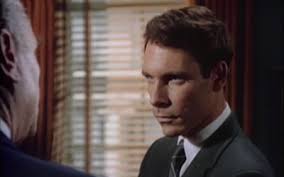
Cotter Smith as Robert Kennedy
Throughout 1960, he manages the Presidential campaign for his brother, John F. Kennedy (Sam Groom). By a margin of only 100,000 votes, JFK wins the election.
Hoffa thinks that his troubles are over, that “Bobby” will move on to other pursuits and forget about the Teamsters.
Hoffa is partly right: Kennedy moves on to another job. But it’s the office of United States Attorney General.
JFK, needing someone in the Cabinet he can trust completely, browbeats Robert into becoming the the nation’s top cop.
For Hoffa, it’s a nightmare come true.
As Attorney General, Kennedy no longer has to beg J. Edgar Hoover to attack organized crime. He can–and does–order him to do so.
Throughout the country, the Mafia feels a new heat as FBI agents plant illegal electronic microphones (“bugs”) in their innermost sanctums. Agents openly tail mobsters–and send them to prison in large numbers.
And Kennedy sets up a special unit, composed of topflight prosecutors and investigators, to go after just one man: James Riddle Hoffa. The press comes to call it the “Get Hoffa” squad.
Hoffa continues to beat federal prosecutors in court. But he believes he’s under constant surveillance by the FBI, and his nerves are starting to crack.
Convinced that the FBI has bugged his office, he literally tears apart the room, hoping to find the bug. But he fails to do so.
What he doesn’t know is he’s facing a more personal danger–from one of his closest associates.
He tells a trusted colleague, Edward Grady Partin (Brian Dennehy) how easy it would be to assassinate Kennedy with a rifle or bomb.
Later, Partin gets into a legal jam–and is abandoned by the Teamsters. Hoping to cut a deal, he relays word to the Justice Department of Hoffa’s threats against the Attorney General.
Now working for the Justice Department, Partin sends in reports on Hoffa’s juror-bribing efforts in yet another trial. Hoffa again beats the rap–but now Kennedy has the insider’s proof he needs to put him away for years.
Meanwhile, the Mafia despairs of the increasing pressure of the Justice Department. At a swanky restaurant, several high-ranking members agree that “something” must be done.
[Although this scene is fictional, it’s clearly based on an infamous outburst of Carlos Marcello, the longtime Mafia boss of New Orleans.
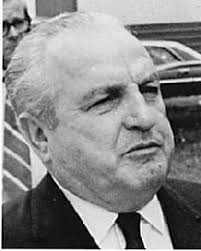
Carlos Marcello
[In 1961, Marcello was deported to his native Guatemala on orders by RFK. After illegally re-entering the country, he swore vengeance against the Attorney General.
[In September, 1962, during a meeting with several mob colleagues, he flew into a rage when someone mentioned Kennedy.
“Take the stone out of my shoe!” he shouted, echoing a Sicilian curse. “Don’t you worry about that little Bobby sonofabitch. He’s going to be taken care of!”
[When one of his colleagues warned that murdering RFK would trigger the wrath of his brother, President John F.Kennedy, Marcello replied: “In Sicily they say if you want to kill a dog you don’t cut off the tail. You go for the head.”
[Marcello believed that the death of President Kennedy would render the Attorney General powerless. And he added that he planned to use a “nut” to do the job.]
On November 22, 1963, President John F. Kennedy is assassinated in Dallas, Texas.
Blood Feud clearly implies that the Mafia was responsible.
2016 PRESIDENTIAL RACE, ABC NEWS, ALTERNET, AMERICABLOG, AP, BABY BOOMER RESISTANCE, BBC, BERNIE SANDERS, BLOOD FEUD, BLOOMBERG NEWS, BROTHERS: THE HIDDEN HISTORY OF THE KENNEDY YEARS, BUZZFEED, CARLOS MARCELLO, CBS NEWS, CIA, CNN, COTTER SMITH, CROOKS AND LIARS, CUBA, DAILY KOS, DAVID TALBOT, DONALD TRUMP, ERNEST BORGNINE, FBI, FIDEL CASTRO, FIVETHIRTYEIGHT, GUS RUSSO, HARPER’S MAGAZINE, HILLARY CLINTON, HUFFINGTON POST, INTERNATIONAL BROTHERHOOD OF TEAMSTERS, J. EDGAR HOOVER, JAMES R. HOFFA, JOHN F. KENNEDY, JUSTICE DEPARTMENT, LIVE BY THE SWORD: THE SECRET WAR AGAINST CASTRO AND THE DEATH OF JFK, MAFIA, MEDIA MATTERS, MOTHER JONES, MOVEON, MSNBC, NBC NEWS, NEW REPUBLIC, NEWSDAY, NEWSWEEK, NPR, PBS NEWSHOUR, POLITICO, POLITICUSUSA, RAFAEL EDWARD CRUZ, RAW STORY, REUTERS, ROBERT BLAKE, ROBERT F. KENNEDY, SALON, SAM GROOM, SEATTLE TIMES, Secret Service, SENATE LABOR RACKETS COMMITTEE, SLATE, TALKING POINTS MEMO, THE ATLANTIC, THE CHICAGO SUN-TIMES, THE CHICAGO TRIBUNE, THE DAILY BEAST, THE DAILY BLOG, THE GUARDIAN, THE HILL, THE HUFFINGTON POST, THE INTERCEPT, THE LOS ANGELES TIMES, THE NATION, THE NEW REPUBLIC, THE NEW YORK TIMES, THE NEW YORKER, THE VILLAGE VOICE, THE WALL STREET JOURNAL, THE WASHINGTON POST, THINKPROGRESS, TIME, TRUTHDIG, TRUTHOUT, TWITTER, U.S. NEWS & WORLD REPORT, UPI
In Bureaucracy, History, Law, Law Enforcement, Politics, Social commentary on April 21, 2016 at 12:37 pm
Today, America has four major candidates running for President: Donald Trump, Rafael Edward Cruz, Hillary Clinton and Bernie Sanders.
Trump is a billionaire businessman; Cruz is a U.S. Senator from Texas; Clinton is a former First Lady, U.S. Senator and Secretary of State; and Sanders is a U.S. Senator from Vermont.
Despite the great differences in their backgrounds, they all share one thing in common: Extremely high negatives among voters.
But 48 years ago, Senator Robert Francis Kennedy aroused passions of an altogether different sort.
Kennedy had been a United States Attorney General (1961-1964) and Senator (1964-1968). But it was his connection to his beloved and assassinated brother, President John F. Kennedy, for which he was best known.

Robert F. Kennedy campaigning for President
Millions saw RFK as the only candidate who could make life better for America’s impoverished–while standing firmly against those who threatened the Nation’s safety.
As television correspondent Charles Quinn observed: “I talked to a girl in Hawaii who was for [George] Wallace [the segregationist governor of Alabama]. And I said ‘Really?’ [She said] ‘Yeah, but my real candidate is dead.’
“You know what I think it was? All these whites, all these blue collar people who supported Kennedy…all of these people felt that Kennedy would really do what he thought best for the black people, but, at the same time, would not tolerate lawlessness and violence.
“They were willing to gamble…because they knew in their hearts that the country was not right. They were willing to gamble on this man who would try to keep things within reasonable order; and at the same time do some of the things they knew really should be done.”
Campaigning for the Presidency in 1968, RFK had just won the crucial California primary on June 4–when he was shot in the back of the head. His killer: Sirhan Sirhan, a young Palestinian furious at Kennedy’s support for Israel.
On June 8, 1,200 men and women boarded a specially-reserved passenger train at New York’s Pennsylvania Station. They were accompanying Kennedy’s body to its final resting place at Arlington National Cemetery.
As the train slowly moved along 225 miles of track, throngs of men, women and children lined the rails to pay their final respects to a man they considered a genuine hero.
Little Leaguers clutched their baseball caps across their chests. Uniformed firemen and policemen saluted. Burly men in shirtsleeves held hardhats over their hearts. Black men in overalls waved small American flags. Women from all levels of society stood and cried.

A nation says goodbye to Robert Kennedy
Commenting on RFK’s legacy, historian William L. O’Neil wrote in Coming Apart: An Informal History of America in the 1960′s:
“…He aimed so high that he must be judged for what he meant to do, and, through error and tragic accident, failed at….He will also be remembered as an extraordinary human being who, though hated by some, was perhaps more deeply loved by his countrymen than any man of his time.
“That too must be entered into the final account, and it is no small thing. With his death something precious disappeared from public life.”
Eleven years earlier, as a young, idealistic attorney, Kennedy had declared war on James Riddle Hoffa, the president of the Mafia-dominated International Brotherhood of Teamsters Union.
As chief counsel for the Senate Labor Rackets Committee, Kennedy was appalled at the corruption he discovered among high-ranking Teamster officials. As he saw it, under Hoffa’s leadership, the union was nothing less than “a conspiracy of evil.”
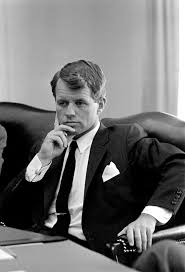
Robert Francis Kennedy as Chief Counsel, Senate Labor Rackets Committee
Hoffa, in turn, held an equally unflattering view of Kennedy. “A rich punk,” said Hoffa, who didn’t know or care about “the average workingman.”
In 1983, Blood Feud, a two-part TV mini-series, depicted the 11-year animosity between Kennedy and Hoffa. Although it took some dramatic liberties, its portrayal of the major events of that period remains essentially accurate.
Today, labor unions are a rapidly-vanishing species, commanding far less political influence than they did 50 years ago. As a result, young viewers of this series may find it hard to believe that labor ever held such sway, or that the Teamsters posed such a threat.
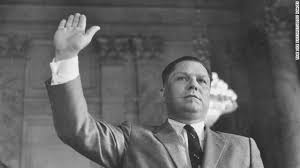
James Riddle Hoffa testifying before the Senate Labor Rackets Committee
And in an age when millions see “Big Government” as the enemy, they may feel strong reservations about the all-out war that Robert F. Kennedy waged against Hoffa.
Blood Feud opens in 1957, when Hoffa (Robert Blake) is a rising figure within the Teamsters. Kennedy (Cotter Smith) is chief counsel for the Senate Labor Rackets Committee.
At first, Hoffa tries to ingratiate himself with Kennedy, telling him: “I know everybody who can help me and anybody who can hurt me.”
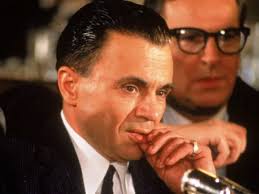
Robert Blake as James R. Hoffa
A wily Hoffa decides to parley Kennedy’s anti-corruption zeal into a path to power for himself. Via his attorney, Eddie Cheyfitz, he feeds Kennedy incriminating evidence against Dave Beck, president of the Teamsters.
Confronted with a Senate subpoena, Beck flees the country–paving the way for Hoffa to assume the top position in the union. Hoffa believes he has solved two problems at once.
ABC NEWS, ANWAR SADAT, ARTHUR BREMER, ASSASSINATION, CBS NEWS, CHARLES L. COTTON, CIA, CNN, DYLANN ROOF, EMANUEL AFRICAN METHODIST CHURCH, FACEBOOK, GEORGE C. WALLACE, GUN CONTROL, HATE CRIMES, NATIONAL RIFLE ASSOCIATION, NBC NEWS, RAFAEL CRUZ, REPUBLICAN PARTY, REPUBLICANS, Secret Service, THE CHICAGO SUN-TIMES, THE CHICAGO TRIBUNE, THE LOS ANGELES TIMES, THE NEW YORK TIMES, THE SECOND AMENDMENT, THE WASHINGTON POST, TWITTER
In Bureaucracy, History, Law, Law Enforcement, Politics, Social commentary on March 11, 2016 at 12:24 am
“You know the great thing about the state of Iowa is, I’m pretty sure you all define gun control the same way we do in Texas–hitting what you aim at.
“My wife, Heidi, who is a petite, 5’2 California blonde, she was standing at the tripod unloading the full machine gun with a pink baseball cap that said ‘armed and fabulous.’”
Yes, it was United States Senator Rafael Cruz (R-Texas) on the prowl for laughs–and votes–at a town hall meeting in Iowa. Normally, Cruz would do his vote-hunting in Texas.
But now Cruz has a bigger prize on his mind than simply being re-elected a United States Senator. Cruz wants to be President in 2016.
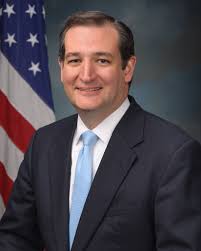
U.S. Senator Rafael Cruz
And Iowa held its precinct causes on February 1-2, 2016.
Cruz’ jokes about gun control came on June 19, 2015, only two days after Dylann Roof, a white high school dropout, gunned down three black men and six black women at Emanuel African Methodist Episcopal Church in Charleston, South Carolina.
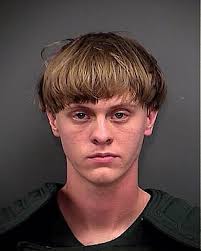
Dylann Roof
Following his remarks, Cruz headed to a shooting range, where he fired off rounds on a semiautomatic .223-caliber Smith and Wesson M&P 15.
Cruz’ remarks no doubt appeared insensitive to the latest victims of gun violence and those who now mourned for them. But the comments of Charles L. Cotton took insulting the dead to a whole new level.
Cotton is a National Rifle Association (NRA) board member who also runs TexasCHLForum.com, an online discussion forum about guns and gun owners’ rights in Texas and beyond.
In a discussion thread on June 18, 2015–one day after the church slaughter–a board member noted that Clementa C. Pinckney, one of the nine people slain, was a pastor and a state legislator in South Carolina.
Cotton responded: “And he voted against concealed-carry. Eight of his church members who might be alive if he had expressly allowed members to carry handguns in church are dead. Innocent people died because of his position on a political issue.”

That discussion thread has since been deleted.
During a subsequent phone interview, Cotton emphasized that he had been speaking as a private citizen–and not as an NRA board member:
“It was a discussion we were having about so called gun-free zones. It’s my opinion that there should not be any gun-free zones in schools or churches or anywhere else. If we look at mass shootings that occur, most happen in gun-free zones.”
If private citizens were allowed to carry guns everywhere, Cotton says, there will be fewer mass shootings because “if armed citizens are in there, they have a chance to defend themselves and other citizens.”
Cotton’s position–“there should not be any gun-free zones”–is exactly that of the NRA itself.
Under such circumstances, America will become a nation where anyplace, anytime, can be turned into the O.K. Corral.
Another point that Cotton didn’t mention: Dylann Roof did believe in concealed-carry–and it cost the lives of nine innocent men and women.
Finally, there is this: Even highly-trained shooters–such as those assigned to the United States Secret Service–don’t always respond as expected.
On May 15, 1972, Alabama Governor George Wallace was campaigning for President in Laurel, Maryland. He gave a speech behind a bulletproof podium at the Laurel Shopping Center. Then he moved from it to mingle with the crowd.
Since the 1968 assassination of Senator Robert F. Kennedy, all those campaigning for President have been assigned Secret Service bodyguards. And Wallace was surrounded by them as he shook hands with his eager supporters.
Suddenly, Arthur Bremer, a fame-seeking failure in life and romance, pushed his way forward, aimed a .38 revolver at Wallace’s abdomen and opened fire. Before he could be subdued, he hit Wallace four times, leaving him paralyzed for the rest of his life.

Arthur Bremer shoots George Wallace
Nor was he Bremer’s only victim. Three other people present were wounded unintentionally:
- Alabama State Trooper Captain E C Dothard, Wallace’s personal bodyguard, who was shot in the stomach;
- Dora Thompson, a campaign volunteer, who was shot in the leg; and
- Nick Zarvos, a Secret Service agent, who was shot in the neck, severely impairing his speech.
None of Wallace’s bodyguards got off a shot at Bremer–before or after he pulled the trigger.
On October 6, 1981, Egyptian President Anwar Sadat was reviewing a military parade in Cairo when a truck apparently broke down directly across from where he was seated.
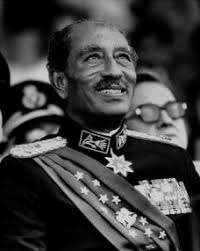
Anwar Sadat, moments before his assassination
Suddenly, soldiers bolted from the rear of the vehicle, throwing hand grenades and firing assault rifles. They rushed straight at Sadat–who died instantly under a hail of bullets.
Meanwhile, Sadat’s bodyguards–who had been trained by the CIA– panicked and fled.
Sadat had been assassinated by army officers who believed he had betrayed Islam by making peace with Israel in 1977.
The ultimate test of the NRA’s mantra that “there should not be any gun-free zones…anywhere” will come only when one or more heavily-armed gunmen target an NRA convention.
It will then be interesting to see if the surviving NRA members are as quick to blame themselves for being victims as they are the victims of other mass slaughters.
9/11, ABC NEWS, ALASKA AIRLINES, ALDRICH AMES, AMERICAN AIRLINES, CBS NEWS, CIA, CNN, DELTA AIRLINES, FACEBOOK, FBI, JETBLUE AIRLINES, JODIE FOSTER, JOHN W. HINCKLEY, LYNETTE "SQUEAKY" FROMME, NBC NEWS, PRE-CHECK PROGRAM, PRESIDENT GERALD FORD, PRESIDENT RONALD REAGAN, RALPH NADER, ROBERT HANSSEN, SARAH JANE MOORE, Secret Service, SECURITY, SOUTHWEST AIRLINES, TERRORISM, THE CHICAGO SUN-TIMES, THE CHICAGO TRIBUNE, THE LOS ANGELES TIMES, THE NEW YORK TIMES, THE WALL STREET JOURNAL, THE WASHINGTON POST, TRANSPORTATION SAFETY ADMINISTRATION, TWITTER, UNITED AIRLINES, USAIRWAYS, VIRGIN AMERICAN AIRLINES, WEALTH GAP
In Bureaucracy, Business, History, Law Enforcement, Military, Social commentary on January 26, 2016 at 12:06 am
All security systems–including those considered the best–are manned by humans. And humans are and will always be imperfect creatures.
So there will inevitably be times when security agents miss the assassin or terrorist intent on mayhem. For example:
- In September, 1975, two women–Lynette “Squeaky” Fromme and Sara Jane Moore–tried to assassinate President Gerald R. Ford on two separate occasions.
- Fromme was tackled by a Secret Service agent. Moore’s aim was deflected by Oliver Sipple, a Marine and Vietnam veteran, thus saving Ford’s life.
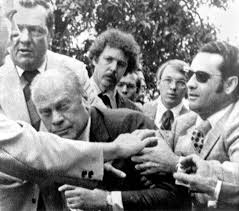
Gerald Ford being hustled from danger by Secret Service agents
Until these incidents, the Secret Service profile of a potential assassin didn’t include a woman.
- On March 30, 1981, John W. Hinckley, a psychotic obsessed with actress Jodie Foster, gained access to a line of reporters waiting to throw questions at President Ronald Reagan.
- As Reagan got into his bulletproof Presidential limousine, Hinckley drew a pistol and opened fire. Wounded, Reagan escaped death by inches.
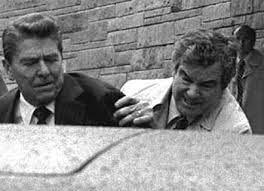
The Reagan assassination attempt
The Secret Service Service had failed to prevent the attack because no one–until that moment–had attacked a President from the section reserved for reporters.
- On September 11, 2001, Islamic terrorists armed with boxcutters highjacked four American jetliners and turned them into fuel-bombs.
- Two of the airliners struck the North and South towers of the World Trade Center, destroying both structures.
- A third hit the Pentagon.
- The fourth–United Airlines Flight 93–crashed when it was diverted from its intended target (the White House or Congress) by passengers who resolved to fight back.
- Three thousand Americans died that day–in New York City, Washington, D., and Shanksville, Pennsylvania.
Until this day of catastrophe, no highjacker had turned a jumbo-jet into a fuel-bomb. Passengers had been advised to cooperate with highjackers, not resist them.
So how will the next 9/11 happen? In all likelihood, like this:
A terrorist–or, more likely, several terrorists–will sign up for one or more airline “VIP screening” programs.
They will be completely clean–no arrests, no convictions. They may well be respectable citizens in their communities.
They will probably have amassed enough “frequent flier miles” to ingratiate themselves with the airlines and convince the Transportation Safety Administration (TSA) of their integrity.
Then, one day, they will breeze through their selected airports
- Without removing their belts and shoes;
- Without undergoing pat-down searches;
- Without being required to remove laptops and other electronic devices from their carry-ons;
- Without exposing their electronic devices to X-ray technology.
Then they will board planes–either as part of an individual terrorist effort or a coordinated one, a la 9/11.
And then it will be too late.
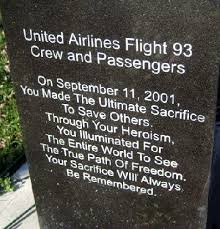
Memorial to the passengers and crew of United Flight 93
The TSA/airlines’ VIP programs are based on the assumption that someone who has completed a security check in the past need not be re-checked in the future.
This assumption has proven false for American Intelligence agencies such as the FBI and CIA.
- FBI agent Robert Hanssen spied for Soviet and Russian Intelligence services for 22 years (1979-2001). He’s now serving a life sentence in Florence, Colorado.
- CIA agent Aldrich Ames betrayed American secrets–including those Russians who had shared them–to Soviet and Russian espionage agencies from 1985 to 1994. He is likewise serving a life sentence.
Even requiring an agent to undergo repeated security checks is no guarantee of trustworthiness.
When asked about how he repeatedly passed CIA polygraph tests, Ames said:
“There’s no special magic. Confidence is what does it. Confidence and a friendly relationship with the examiner. Rapport, where you smile and make him think that you like him.”
Thus, as William Shakespeare warned in Hamlet, “one may smile and smile and be a villain”–or a highjacker.
The TSA introduced its Pre-Check program during the fall of 2011. By May, 2012, more than 820,000 travlers had received “expedited security” since the start of the program.
In early September, 2013, TSA announced that it would more than double its “expedited screening” program, Pre-Check, from 40 to 100 airports by the end of the year.
Nor is TSA the only organization giving big-spending fliers special treatment at potential risk to their country. For example:
- Delta Air Lines offers Sky Priority, described as providing “privileged access through security checkpoints” at select airports.
- Another private security program, Clear, collects several pieces of biometric data on well-heeled passengers. Once verified by a kiosk local to the security checkpoint, the passengers are allowed to skirt the security barriers that poor and middle-class folks must pass through.
- Priority Access, set up by TSA and the airlines, provides “expedited service” to first-class and business passengers. To qualify, you need only possess certain credit cards–such as the United Mileage Plus Club Card.
Some critics blast this two-tier passenger check-in system as an affront to democratic principles.
“It’s stratifying consumers by class and wealth, because the people who travel a lot usually have higher incomes,” said Ralph Nader, consumer advocate and frequent business traveler.
But there is an even more important reason to immediately disband these programs and require everyone–rich and middle-class alike–to undergo the same level of security screening:
The 3,000 men and women who died horrifically on September 11, 2001, at the hands of airline passengers whom authorities thought could be trusted to board a plane.

Tribute to the vanished World Trade Center
9/11, ABC NEWS, ALASKA AIRLINES, ALDRICH AMES, AMERICAN AIRLINES, CBS NEWS, CIA, CNN, DELTA AIRLINES, FACEBOOK, FBI, JETBLUE AIRLINES, JOHN W. HINCKLEY, LYNETTE "SQUEAKY" FROMME, NBC NEWS, PRESIDENT GERALD FORD, PRESIDENT RONALD REAGAN, RALPH NADER, ROBERT HANSSEN, SARAH JANE MOORE, Secret Service, SECURITY, SOUTHWEST AIRLINES, TERRORISM, THE CHICAGO SUN-TIMES, THE CHICAGO TRIBUNE, THE NEW YORK TIMES, THE WASHINGTON POST, TRANSPORTATION SECURITY ADMINISTRATION, TWITTER, UNITED AIRLINES, USAIRWAYS, VIRGIN AMERICAN AIRLINES, WEALTH GAP
In Bureaucracy, Business, History, Law Enforcement, Military, Social commentary on January 25, 2016 at 12:07 am
Fourteen years after 9/11, America is now selling its Islamic enemies access to the very weapons–jet-fueled airplanes–they need to wage jihad against its citizens.
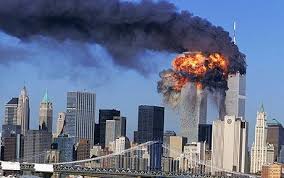
World Trade Center on September 11, 2001
This is happening thanks to the greed of American airline corporations and the Transportation Security Administration (TSA).
Essentially, it comes down to this: Wealthy, self-entitled Americans hate waiting in long airport security lines.
But wealthy Americans–unlike poor and middle-class ones–have plenty of money to spend.
So they’re willing to shell out a good portion of it to the airlines and TSA so they won’t have to stand in line with the unworthy peasants.
And the airlines and TSA are happy to scoop up all that money in return for giving these self-important Richie-Riches preferential treatment.
Even if this comes at the risk of the nation they claim to love.
Consider the following:
TSA. offers Pre-Check, a program from the Department of Homeland Security. It’s available to frequent fliers on many airlines.

According to the TSA’s website, here’s how it works:
- An applicant must be a U.S. citizen Penn or Lawful Permanent Resident (LPR) and cannot have been convicted of certain crimes. If an applicant has a record of any of the crimes identified in the eligibility requirements, they may choose not to apply, as the application fee is nonrefundable.
- Interested applicants must visit an application center to provide biographic information that requires name, date of birth and address. An applicant will be fingerprinted and will be required to provide valid required identity and citizenship/immigration documentation. An applicant also has the option to pre-enroll online to provide basic information and make an appointment before visiting an application center. There is a nonrefundable application processing fee of $85.
- After completing enrollment, successful applicants will receive a Known Traveler Number (KTN) via U.S. mail approximately 2-3 weeks following the visit to the application center. An applicant also may check status online by visiting Universal Enrollment Services (UES) and clicking on “Service Status.” The Known Traveler’s Number is valid for five years.
- Once approved as eligible for TSA Pre✓™, the enrollee must enter the provided KTN in the “Known Traveler Number” field when booking travel reservations on any participating airlines. The KTN can also be added when booking reservations online via a participating airline website, via phone call to the airline reservation center, or with the travel management company making reservations. Additionally, the KTN can be entered in participating airline frequent flyer profiles, where it will be storedfor future reservations.
Click here: TSA Pre?™ Application Program | Transportation Security Administration
The website further notes: “TSA is accepting applications at more than 300 locations nationwide, including 26 airports.”
And what does a Pre-Check passenger get in return for his $85 registration fee?
- S/he is allowed to go through a special line at security with reduced screening.
- Shoes, jackets and belts need not be removed.
- Many electronics (including laptops) can be left in their carry-on cases.
- Magnetometers (metal detecting scanners) are used instead of advanced imaging technology.
Here’s the difference between a scan by a magnetometer and one using advanced imaging technology:
If you’re trying to carry a metallic firearm aboard a plane, the magnetometer will likely pick it up. But if you’ve filled your computer with plastic explosive, the magnetometer won’t pick it up.

Advanced imaging technology
Or maybe you want to be a more successful shoe-bomber than Richard Reid, who tried to blow up an American Airlines flight in 2001.
Being allowed to skip the requirement to remove your shoes will certainly take you a long way toward reaching your goal.
Of course, TSA isn’t alone in wanting to make money from deep-pockets airline passengers. The airlines have also been quick to get in on the act.
Most airlines make it possible for frequent-flier passengers to acquire elite status–for a price.
Passengers having any one of the following status memberships are eligible for this benefit:
Delta: Gold Medallion, Platinum Medallion and Diamond Medallion members
United: Premier Silver, Premier Gold, Premier Platinum, Premier 1K members
American: AAdvantage Gold, AAdvantage Platinum, and AAdvantage Executive Platinum members
USAirways: Silver Preferred, Gold Preferred, Platinum Preferred, and Chairman’s Preferred members
Southwest: A-List and A-List Preferred members
Alaska: MVP, MVP Gold, and MVP Gold 75 members
Jetblue: TrueBlue Mosaic members and those seated in Even More Space seats
Virgin America: Elevate Silver and Elevate Gold members
Click here: Travel Tuesday Top 10: Ways To Get Through Airport Security Faster in the US | The Points Guy
Yes, the greed of corporations and government agencies is partly responsible for this disgraceful–and highly dangerous–situation.
And so is the belief among the wealthy that they are the elect, and thus deserve special consideration.
But there is another factor at work here: The Calvinistic belief–shared by most Americans–that wealth is a sign of God’s favor, and thus proof that its holder is worthy of deference, if not awe.
In combination, they are steadily moving this nation closer to the day of the next 9/11 disaster.
How this will happen will be explained in Part Two of this series.
9/11, 9/11 ATTACKS, ABC NEWS, ABRAHAM LINCOLN, ASSASSINATION, BARACK OBAMA, BUREAUCRACY, CBS NEWS, CNN, FACEBOOK, GEORGE W. BUSH, HOUSE OVERSIGHT AND GOVERNMENT REFORM COMMITTEE, IRAQ WAR, ISIS, JOHN F. KENNEDY, MSNBC, NBC NEWS, PENTAGON, PRESIDENTIAL PROTECTION, REP. JASON CHAFFETZ, REP. PETER KING, RICHARD NIXON, ROBERT F. KENNEDY, RONALD KESSLER, Secret Service, SECURITY, TERRORISM, THE CHICAGO SUN-TIMES, THE CHICAGO TRIBUNE, THE LOS ANGELES TIMES, THE NEW YORK TIMES, THE WASHINGTON POST, TWITTER, WORLD TRADE CENTER
In Bureaucracy, History, Law Enforcement, Politics on December 29, 2015 at 12:19 am
On the night of September 19, 2014, an Iraq war veteran, Omar Gonzales, jumped the White House fence, ran more than 70 yards across the north lawn, and sprinted just past the north portico White House doors.
Only then was he apprehended by Secret Service agents.
Gonzalez’ short-lived trespass onto White House grounds was one of 143 security breaches–or attempted breaches–at facilities protected by the United States Secret Service (USSS) during during the last 10 years.
Then, less than 24 hours after Gonzalez’s arrest, a second man was apprehended after he drove up to a White House gate and refused to leave. This triggered a search of his vehicle by bomb technicians in full gear. Other agents shut down nearby streets. No bombs were found.
Asked for Obama’s reaction, White House spokesman Frank Benenati gave this boilerplate reply: “The president has full confidence in the Secret Service and is grateful to the men and women who day in and day out protect himself, his family and the White House.”
Yet not all is well in Presidential security.
A newly-released report by the House Oversight and Government Reform Committee found the Secret Service to be “in crisis.”
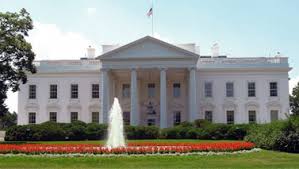
The White House
“Morale is down, attrition is up, misconduct continues and security breaches persist,” Rep. Jason Chaffetz, (R-Utah) publicly stated.
“Strong leadership from the top is required to fix the systematic mismanagement within the agency, and to restore it to its former prestige.”
But the blunt truth is that many of the problems now plaguing the USSS were on full display as early as 2009.
That was when well-known investigative reporter Ronald Kessler published his then-latest book, In the President’s Secret Service.
Kessler had previously pubilshed books outlining the inner workings of the White House, the CIA and the FBI.

Kessler praised the courage and integrity of Secret Service agents as a whole. But he warned that the agency was risking the safety of many of its protectees, including President Obama.
He was particularly critical of SS management for such practices as:
- Shutting off weapon-scanning magnetometers at rallies for Presidential candidates–and even for Presidents George W. Bush and Obama.
- During a speech Bush gave at Tbilisi, Georgia in 2005, an assailant threw a live hand grenade–which failed to explode–at him.
- Despite 9/11, Secret Service agents are still being trained to expect an attempt by a lone gunman—rather than a professional squad of terrorist assassins.
- The Service’s Counter Assault Teams (CATs) have generally been cut back from five or six agents to two, rendering them useless if a real attack occurred.
- Salaries paid to USSS agents have not kept pace with reality. Veteran USSS men and women are now being offered up to four times their salary for moving to the private sector, and many are leaving the agency for that reason.
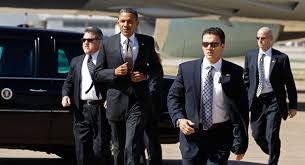
Secret Service agents protecting President Barack Obama
- While Congress has greatly expanded the duties of this agency, Secret Service management has not asked for equivalent increases in funding and agents.
- Many agents are leaving out of frustration that it takes “juice” or connections with top management to advance one’s career.
- USSS agents are being trained with weapons that are outdated (such as the MP5, developed in the 1960s) compared to those used by other law enforcement agencies and the potential assassins they face (such as the M4–with greater range and armor-piercing capabilities).
- The Service refuses to ask for help from other agencies to meet its manpower needs. Thus, a visiting head of state at the U.N. General Assembly will usually be assigned only three agents as protection.
- The agency tells agents to grade themselves on their physical training test forms.
- Agents are supposed to be evaluated on their marksmanship skills every three months. But some agents have gone more than a year without being tested.
- Some agents are so overweight they can’t meet the rigorous demands of the job. As a result, they pose a danger to the people they’re supposed to be guarding.
- The Secret Service inflates its own arrest statistics by claiming credit for arrests made by local police.
- Congressional members who visit the agency’s Rowley Training Center in Laurel, Maryland, are treated to rehearsed scenarios of how the agency would deal with attacks. If agents were allowed to perform these exercises without rehearsals, Congressional members would see they make mistakes like anyone else.
Kessler closes his book with the warning: “Without….changes, an assassination of Barack Obama or a future president is likely.
“If that happens, a new Warren Commission will be appointed to study the tragedy. It will find that the Secret Service was shockingly derelict in its duty to the American people and to its own elite corps of brave and dedicated agents.”
And the effects will be not only momentary but long-term. As Kessler writes:
“By definition, an assassination threatens democracy.
“If Abraham Lincoln had not been assassinated, Andrew Johnson, his successor, would not have been able to undermine Lincoln’s efforts to reunite the nation and give more rights to blacks during the Reconstruction period.
“If John F. Kennedy had not been assassinated, Lyndon Johnson likely never would have become President. If Robert F. Kennedy had not been killed and had won the presidency, Richard Nixon might never have been elected.”
9/11, 9/11 ATTACKS, ABC NEWS, ABRAHAM LINCOLN, ASSASSINATION, BARACK OBAMA, BUREAUCRACY, CBS NEWS, CNN, FACEBOOK, GEORGE W. BUSH, HOUSE OVERSIGHT AND GOVERNMENT REFORM COMMITTEE, IRAQ WAR, ISIS, JOHN F. KENNEDY, MSNBC, NBC NEWS, PENTAGON, PRESIDENTIAL PROTECTION, REP. JASON CHAFFETZ, REP. PETER KING, RICHARD NIXON, ROBERT F. KENNEDY, RONALD KESSLER, Secret Service, SECURITY, TERRORISM, THE CHICAGO SUN-TIMES, THE CHICAGO TRIBUNE, THE LOS ANGELES TIMES, THE NEW YORK TIMES, THE WASHINGTON POST, TWITTER, WORLD TRADE CENTER
In Bureaucracy, History, Law Enforcement, Politics on December 28, 2015 at 2:37 am
The United States Secret Service (USSS) is “in crisis”–a crisis that threatens President Barack Obama and his successors as President of the United States.
That’s the verdict of a review of the House Oversight and Government Reform Committee.
Since April, 2012, the agency has faced scandal–and scrutiny by the press and Committee. That was when reports first surfaced of agents buying the favors of prostitutes in Columbia.
Even more embarrassing for the USSS were a series of security breaches that potentially exposed President Barack Obama to danger.
As a result, during the last three years, three directors have headed the Secret Service. Numerous agents–including senior officials–have been disciplined, transferred or fired.
For decades, the Secret Service was seen by the press, public and other law enforcement agencies as an elite agency. And the Presidential Protection Detail (PPD) was seen as the most elite part of the agency.
No longer.

Secret Service agents guarding President Obama
Among the findings of the 438-page report:
- The agency is understaffed and overworked.
- Its staffing crisis started in 2011 owing to government-wide budget cuts demanded by Republicans.
- The Secret Service has fewer employees today than it did in 2014, despite recommendations from an independent panel that staffing be increased.
- There have been a number of undisclosed security breaches–such as in October, 2014, when an unauthorized woman gained access to a Congressional Hispanic Caucus event that Obama attended.
- In February, two people gained access to the outer security perimeter of the White House.
- There have been 143 security breaches–or attempted breaches–during the last 10 years at facilities protected by the agency.
“This report reveals that the Secret Service is in crisis,” Rep. Jason Chaffetz, (R-Utah) publicly stated. “Morale is down, attrition is up, misconduct continues and security breaches persist.
“Strong leadership from the top is required to fix the systematic mismanagement within the agency, and to restore it to its former prestige.”
But the truth is that many of the problems now plaguing the U.S. Secret Service were on display long before the House issued its report.
On September 11, 2001, Secret Service agents literally grabbed Vice President Dick Cheney and hauled him from the White House to a secure facility beneath the Executive Mansion.
As for everyone else who worked in the White House, agents simply threw open the White House doors and ordered: “Run!”
“Women, take off your shoes!” agents shouted–so they could run faster. Frightened Presidential aides were told to remove their White House badges–just in case snipers were lurking nearby.
That was it.
With the World Trade Center and Pentagon in flames, and the White House seemingly next in line as a target, this was the sum total of protection offered White House staffers by the agency considered the elite in Federal law enforcement.

White House staffers fleeing on 9/11
Not knowing what to do, some aides walked home in a daze.
Click here: Amazon.com: Days of Fire: Bush and Cheney in the White House (9780385525190): Peter Baker: Books
(President George W. Bush was not in the White House at the time. He was reading The Pet Goat to a group of children at Emma E. Booker Elementary School in Sarasota, Florida.)
Three days later, on September 14, Andy Card, Bush’s chief of staff, addressed White House staffers in Room 450 of the Eisenhower Executive Office Building, next to the West Wing.
Card said he understood that “this is not what any of you signed up for when you joined the White House staff.” And he offered them the chance to resign without anyone–himself or the President–thinking any less of them.
When no one offered to leave, Card let a Secret Service agent offer security advice:
- Vary your routines to and from work.
- Watch out for any cars that might be following you.
- Go to different restaurants for lunch.
At least one member of the audience, Bradford Berenson, an associate White House counsel, knew he wouldn’t be taking that advice.
Like most of the others at the meeting, his name was listed in the local phone book. A terrorist wanting to kill him need only lurk outside Berenson’s home and open fire when he appeared.
Click here: 500 Days: Secrets and Lies in the Terror Wars: Kurt Eichenwald: 9781451669398: Amazon.com: Books
And that was it, as far as the Secret Service was concerned.
No offers of even temporary escorts by Secret Service agents. No offers to install “panic buttons” in their homes in case of emergency.
In essence: “We’re really glad you’ve decided to serve your country. But don’t expect us to protect you. You’re on your own.”

Fast forward 13 years later.
On the night of September 19, 2014, an Iraq war veteran, Omar Gonzales, jumped the White House fence, ran more than 70 yards across the north lawn, and sprinted just past the north portico White House doors.
Gonzalez appeared unarmed as he ran across the lawn–possibly one reason why Secret Service agents didn’t shoot him or release their service dogs to detain him. But he had a small folding knife with a three-and-one-half-inch serrated blade when he was apprehended.
According to a criminal complaint, when he was arrested he told Secret Service agents he was “concerned that the atmosphere was collapsing” and needed to contact the President “so he could get word out to the people.”
ABC NEWS, ANWAR SADAT, ARTHUR BREMER, ASSASSINATION, CBS NEWS, CIA, CLEMENTA P. PINCKNEY, CNN, DYLANN ROOF, EMANUAL AFRICAN METHODIST EPISCOPAL CHURCH, FACEBOOK, GEORGE WALLACE, GUN CONTROL, HATE CRIMES, NATIONAL RIFLE ASSOCIATION, NBC NEWS, REPUBLICAN PARTY, REPUBLICANS, Secret Service, TED CRUZ, THE CHICAGO SUN-TIMES, THE CHICAGO TRIBUNE, THE LOS ANGELES TIMES, THE NEW YORK TIMES, THE SECOND AMENDMENT, THE WASHINGTON POST, TWITTER, USA TODAY
In Bureaucracy, History, Law, Law Enforcement, Politics, Social commentary on June 30, 2015 at 9:57 am
“You know the great thing about the state of Iowa is, I’m pretty sure you all define gun control the same way we do in Texas–hitting what you aim at.”
“My wife, Heidi, who is a petite, 5’2 California blonde, she was standing at the tripod unloading the full machine gun with a pink baseball cap that said ‘armed and fabulous.'”
Yes, it was United States Senator Ted Cruz (R-Texas) on the prowl for laughs–and votes–at a town hall meeting in Iowa.
U.S. Senator Ted Cruz (R-Texas)
Normally, Cruz would do his vote-hunting in Texas. But now Cruz has a bigger prize on his mind than simply being re-elected a United States Senator.
Cruz wants to be President in 2016. And Iowa holds its precinct causes on February 1-2, 2016.
Cruz’ jokes about gun control came on June 19, only two days after Dylann Roof, a white high school dropout, gunned down three black men and six black women at Emanuel African Methodist Episcopal Church in Charleston, South Carolina.
Dylann Roof
Following his remarks, Cruz headed to a shooting range, where he fired off rounds on a semiautomatic .223-caliber Smith and Wesson M&P15.
Cruz’ remarks no doubt appeared insensitive to the latest victims of gun violence and those who now mourned for them. But the comments of Charles L. Cotton took insulting the dead to a whole new level.
Cotton is a National Rifle Association (NRA) board member who also runs TexasCHLForum.com, an online discussion forum about guns and gun owners’ rights in Texas and beyond.
In a discussion thread on June 18–one day after the church slaughter–a commenter noted that Clementa C. Pinckney, one of the nine people slain, was a pastor and a state legislator in South Carolina.
Cotton responded:
“And he voted against concealed-carry. Eight of his church members who might be alive if he had expressly allowed members to carry handguns in church are dead. Innocent people died because of his position on a political issue.”
That discussion thread has since been deleted.
During a subsequent phone interview, Cotton emphasized that he had been speaking as a private citizen–and not as an NRA board member:
“It was a discussion we were having about so called gun-free zones. It’s my opinion that there should not be any gun-free zones in schools or churches or anywhere else. If we look at mass shootings that occur, most happen in gun-free zones.”
If private citizens were allowed to carry guns everywhere, Cotton says, there will be fewer mass shootings because “if armed citizens are in there, they have a chance to defend themselves and other citizens.”
Of course, Cotton’s position–“there should not be any gun-free zones”–is exactly that of the NRA itself.
Under such circumstances, America will become a nation where anyplace, anytime, can be turned into the O.K. Corral.
Another point that Cotton didn’t mention: Dylann Roof did believe in concealed-carry–and it cost the lives of nine innocent men and women.
Finally, there is this: Even highly-trained shooters–such as those assigned to the United States Secret Service–don’t always respond as expected.
On May 15, 1972, Alabama Governor George Wallace was campaigning for President in Laurel, Maryland. He gave a speech behind a bulletproof podium at the Laurel Shopping Center.
Then he moved from it to mingle with the crowd.
Since the 1968 assassination of Senator Robert F. Kennedy, all those campaigning for President have been assigned Secret Service bodyguards. And Wallace was surrounded by them as he shook hands with his eager supporters.
Suddenly, Arthur Bremer, a fame-seeking failure in life and romance, pushed his way forward, aimed a .38 revolver at Wallace’s abdomen and opened fire. Before he could be subdued, he hit Wallace four times, leaving him paralyzed for the rest of his life.
Arthur Bremer shoots George Wallace
Nor was he Bremer’s only victim.
Three other people present were wounded unintentionally:
- Alabama State Trooper Captain E C Dothard, Wallace’s personal bodyguard, who was shot in the stomach;
- Dora Thompson, a campaign volunteer, who was shot in the leg; and
- Nick Zarvos, a Secret Service agent, who was shot in the neck, severely impairing his speech.
None of Wallace’s bodyguards got off a shot at Bremer–before or after he pulled the trigger.
On October 6, 1981, Egyptian President Anwar Sadat was reviewing a military parade in Cairo when a truck apparently broke down directly across from where he was seated.
Anwar Sadat, moments before his assassination
Suddenly, soldiers bolted from the rear of the vehicle, throwing hand grenades and firing assault rifles. They rushed straight at Sadat–who died instantly under a hail of bullets.
Meanwhile, Sadat’s bodyguards–who had been trained by the CIA–panicked and fled.
Sadat had been assassinated by army officers who believed he had betrayed Islam by making peace with Israel in 1977.
The ultimate test of the NRA’s mantra that “there should not be any gun-free zones… anywhere” will come only when one or more heavily-armed gunmen target an NRA convention.
It will then be interesting to see if the surviving NRA members are as quick to blame themselves for being victims as they are the victims of other mass slaughters.


-33510-W&docid=hCd9k6PuglvZAM&tbnid=CAo7BRzGtBWa3M%3A&w=500&h=375&bih=469&biw=819&ved=0ahUKEwiissafvJ_MAhUGKWMKHTZZA_MQxiAIAg&iact=c&ictx=1)


&docid=SiluTuHYHtjaZM&tbnid=uLB-PLYDVdkkVM%3A&w=455&h=341&ei=zeN_VI_hKYHjoATGs4Bo&ved=0CAIQxiAwAA&iact=c)


.jpg&imgrefurl=http%3A%2F%2Fwww.nbcnews.com%2Fnews%2Fother%2Farchive-lynette-squeaky-frommes-attempted-assassination-gerald-ford-f8C11011024&docid=J177meOGr7eR9M&tbnid=Lp2ODK8CN4s5GM%3A&w=1500&h=1324&ei=D4YXVL_xBanHigKxtIG4Bg&ved=0CAIQxiAwAA&iact=c)


 Bureaucracybuster's Blog
ABC NEWS, ALTERNET, AMERICABLOG, AP, ATOMIC BOMB, BABY BOOMER RESISTANCE, BARACK OBAMA, BBC, BEIRUT BOMBING, BILL CLINTON, BLOOMBERG, BUZZFEED, CBS NEWS, CHRIS MATTHEWS, CNN, COMMUNISM, CROOKS AND LIARS, CULTS, DAILY KOS, DAILY KOZ, ECONOMICS, FIVETHIRTYEIGHT, GEORGE H.W. BUSH, HARDBALL, HARPER’S MAGAZINE, HUFFINGTON POST, IRAN, IRAN-CONTRA AFFAIR, JOHN F. KENNEDY, JOSEPH STALIN, MEDIA MATTERS, MEET THE PRESS, MOTHER JONES, MOVEON, MSNBC, NBC NEWS, NEW REPUBLIC, NEWSDAY, NEWSWEEK, NPR, PBS NEWSHOUR, POLITICO, POLITICUSUSA, POLLUTION, RAW STORY, REPUBLICAN PARTY, REUTERS, Ronald Reagan, SALON, SEATTLE TIMES, Secret Service, SLATE, SOVIET NUCLEAR PHYSICS, SOVIET UNION, TALKING POINTS MEMO, TAX CUTS, TERRORISM, THE ATLANTIC, THE CHICAGO SUN-TIMES, THE CHICAGO TRIBUNE, THE DAILY BEAST, THE DAILY BLOG, THE GUARDIAN, THE HILL, THE HUFFINGTON POST, THE INTERCEPT, THE LOS ANGELES TIMES, THE NATION, THE NEW REPUBLIC, THE NEW YORK TIMES, THE NEW YORKER, THE VILLAGE VOICE, THE WASHINGTON POST, THINKPROGRESS, THIS WEEK, TIME, TRUTHDIG, TRUTHOUT, TWO POLITICAL JUNKIES, U.S. NEWS & WORLD REPORT, UPI, USA TODAY, Vladimir Lenin, X
REAGAN GETS LENIN’S FUNERAL
In Bureaucracy, Business, History, Military, Politics, Social commentary on May 11, 2016 at 12:01 amOn February 6, 2011, Ronald Reagan, if he had been alive, would have been 100 years old.
Publishers rushed to put out worshipful tributes to his eight years as President. Network political programs such as “This Week” and “Meet the Press” assembled surviving members of his administration to re-live the “glory days” of Reagan’s—and their—time in power.
This is where it all started going wrong for America—a Right-wing legacy of huge Federal deficits, tax-cuts for the rich, bloated military budgets and cutbacks in government programs to aid the poor and middle-class.
Ronald Reagan
The Republican party, of course, has done the most to create and promote this “cult of Reagan.” And it has done so for the same reason the Communist party of the Soviet Union created and fostered the “cult of Lenin.”
No two men could have been more different than Vladimir Lenin and Ronald Reagan. Lenin created the Soviet Union in 1917 and became its first in a series of absolute dictators. Reagan spent his life fighting Communism, most notably as President.
Vladimir Lenin
So it’s ironic that both men, in death, got essentially the same funeral—and for the same reason: To sanctify and legitimize their respective organizations—and the authority of their potential successors.
Lenin died in 1924 and was immediately succeeded by Joseph Stalin. Stalin knew that, despite Communism’s official atheistic stance, most Russians remained loyal to the Russian Orthodox Church.
So in giving Lenin’s funeral oration, Stalin used the language of religion to confer sainthood upon a militant atheist–and upon his successor, Stalin himself.
Funeral for Vladimir Lenin
Stalin and his fellow Communists immediately launched the “cult of Lenin,” depicting him as a fatherly, all-wise leader whose genius could only be bestowed upon his closest disciples.
Lenin’s extensive political writings were treated as divine writ, and were used to justify everything Stalin and his own successors wanted to do.
A classic example: Although Lenin died 20 years before the American creation of the atomic bomb, Lenin was hailed by the Soviets as the “father” of “Soviet nuclear physics.”
Similarly, the Republican party wasted no time turning its own former leader, Ronald Reagan, into a modern-day saint of mythical proportions.
They have done so for the same reason that Stalin deliberately forged a cult around the dead Lenin—to create a “holy” figure of whom other Republicans can claim to be true disciples.
Funeral for Ronald Reagan
These deliberate fictions conveniently ignore a series of ugly truths:
Reagan famously attacked “welfare queens” and sought to deny government benefits for the poor. But he didn’t hesitate to enrich himself at public expense.
The “cult of Lenin” died when the Soviet Union collapsed in 1991. The “cult of Reagan” continues to flourish, and will do so for as long as the Republican party finds voters willing to believe in it.
Share this: