Posts Tagged ‘Ronald Reagan’
ABC NEWS, AFFORDABLE CARE ACT, AIR TRAFFIC CONTROLLERS STRIKE, BARACK OBAMA, CBS NEWS, CNN, COLUMBIA UNIVERSITY, EXTORTION, FACEBOOK, FBI, GEORGE W. BUSH, HARVARD LAW SCHOOL, HENRY J. KAISER FAMILY FOUNDATION, JOBS, JON STEWART, JONATHAN ALTER, JUSTICE DEPARTMENT, NBC NEWS, NICCOLO MACHIAVELLI, OBAMACARE, PATRIOT ACT, public relations, RACKETEER INFLUENCED AND CORRUPT ORGANIZATIONS ACT, REFORM, RICHARD WOLFFE, Ronald Reagan, TERRORISM, THE DAILY SHOW, THE LOS ANGELES TIMES, THE NEW YORK TIMES, THE PRINCE, THE WASHINGTON POST, TWITTER, UNEMPLOYMENT
In Bureaucracy, Business, History, Law, Politics, Social commentary on August 8, 2014 at 2:45 pm
President Obama claims to be a serious student of Realpolitick. If this were so, he would have predicted that most businesses would seek to avoid compliance with his Affordable Care Act (ACA).
And the remedy would have been simple: Require all employers to provide insurance coverage for all of their employees, regardless of their fulltime or part-time status.
This, in turn, would have produced two substantial benefits:
- All employees would have been able to obtain medical coverage; and
- Employers would have been encouraged to provide fulltime positions rather than part-time ones.
The reason: Employers would feel: “Since I’m paying for fulltime insurance coverage, I should be getting fulltime work in return.”
If the President ever considered the merits of this, he apparently decided against pressing for such a requirement.
Obama is one of the most rational and educated men to occupy the White House. So what accounts for this failure to expect the worst in people–especially his self-declared enemies–and prepare to counter it?
Niccolo Machiavelli’s brilliant assessments have repeatedly proven invaluable to understanding the failures of the Obama Presidency. Once again, he provides a shrewd insight into what may be the central reason for all of them.
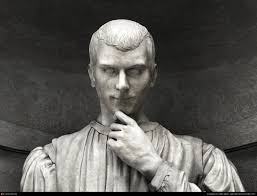
Niccolo Machiavelli
Writing in The Prince, his classic work on the realities of politics, Machiavelli states:
I also believe that he is happy whose mode of procedure accords with the needs of the times, and similarly, he is unfortunate whose mode of procedure is opposed to the times….
On this depend also the changes in prosperity, for if it happens that time and circumstances are favorable to one who acts with caution and prudence he will be successful. But if time and circumstances change he will be ruined, because he does not change the mode of his procedure.
No man can be found so prudent as to be able to adopt himself to this, either because he cannot deviate from that to which his nature disposes him, or else because having always prospered by walking in one path, he cannot persuade himself that it is well to leave it.
And therefore the cautious man, when it is time to act suddenly, does not know how to do so and is consequently ruined. For if one could change one’s nature with time and circumstances, fortune would never change.
Obama is by nature a supreme rationalist and conciliator–not a confronter nor an attacker. And his career before reaching the White House greatly strengthened this predisposition.
From 1985 to 1988, Obama worked as a community organizer–setting up a job training program, a college preparatory tutoring program, and a tenants’ rights organization. Such activity demands skills in building consensus, not confrontation.
He then taught at the University of Chicago Law School for 12 years—as a Lecturer from 1992 to 1996, and as a Senior Lecturer from 1996 to 2004, teaching constitutional law.

University of Chicago Law School
Law professors spend their time in clean, civil classrooms–far removed from the rough-and-tumble of criminal defense/prosecution.
If Obama had accused President George W. Bush of conspiring with Al Qaeda–as Republicans have repeatedly accused Obama–retribution would have been swift and brutal.
In short: Obama–who believes in reason and conciliation–is paying the price for allowing his sworn enemies to insult and obstruct him
Obama Mistake No. 6: Failing to closely study his proposed legislation.
Throughout his campaign to win support for the ACA, Obama had repeatedly promised: “If you like your health insurance plan, you can keep your plan. Period. If you like your doctor, you can keep your doctor. Period.”
But, hidden in the 906 pages of the law, was a fatal catch for the President’s own credibility.
The law stated that those who already had medical insurance could keep their plans–so long as those plans met the requirements of the new healthcare law.
If their plans didn’t meet those requirements, they would have to obtain coverage that did.
It soon turned out that a great many Americans wanted to keep their current plan–even if it did not provide the fullest possible coverage.
Suddenly, the President found himself facing a PR nightmare: Charged and ridiculed as a liar.
Even Jon Stewart, who on “The Daily Show” had supported the implementation of “Obamacare,” ran footage of Obama’s “you can keep your doctor” promise.
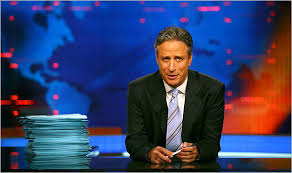
Jon Stewart
The implication: You said we could keep our plan/doctor; since we can’t, you must be a liar.
As a result, the President now finds his reputation for integrity–long his greatest asset–shattered.
All of which takes us to the final warning offered by Niccolo Machiavelli:
Whence it may be seen that hatred is gained as much by good works as by evil….
ABC NEWS, AFFORDABLE CARE ACT, AIR TRAFFIC CONTROLLERS STRIKE, BARACK OBAMA, CBS NEWS, CNN, COLUMBIA UNIVERSITY, EXTORTION, FACEBOOK, FBI, GEORGE W. BUSH, HARVARD LAW SCHOOL, HENRY J. KAISER FAMILY FOUNDATION, JOBS, JON STEWART, JONATHAN ALTER, JUSTICE DEPARTMENT, NBC NEWS, NICCOLO MACHIAVELLI, OBAMACARE, PATRIOT ACT, public relations, RACKETEER INFLUENCED AND CORRUPT ORGANIZATIONS ACT, REFORM, RICHARD WOLFFE, Ronald Reagan, TERRORISM, THE DAILY SHOW, THE LOS ANGELES TIMES, THE NEW YORK TIMES, THE PRINCE, THE WASHINGTON POST, TWITTER, UNEMPLOYMENT
In Bureaucracy, Business, History, Law, Politics, Social commentary on August 7, 2014 at 12:42 pm
Barack Obama is one of the most highly educated Presidents to occupy the White House.
When he took office, he intended to make healthcare available to all Americans–and not just the wealthiest 1%.
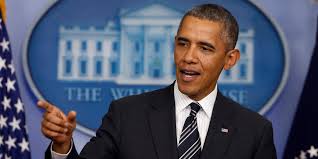
President Barack Obama
But he made a series of deadly mistakes:
- In crafting the Affordable Care Act (better known as Obamacare);
- In building public support for it;
- In underestimating the venom and opposition of his Republican enemies;
- In failing to effectively counter that Right-wing venom and opposition; and
- In underestimating the opposition of the business community to complying with the law.
Three of those mistakes have already been outlined. Here are the remaining three.
Obama Mistake No. 4: He allowed himself to be cowed by his enemies.
In The Prince, Machiavelli laid out the qualities that a successful ruler must possess. There were some to be cultivated, and others to be avoided at all costs. For example:
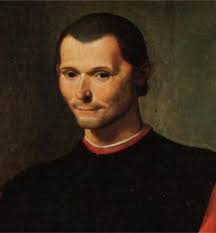
Niccolo Machiavelli
He is rendered despicable by being thought changeable, frivolous, effeminate, timid and irresolute—which a prince must guard against as a rock of danger….
[He] must contrive that his actions show grandeur, spirit, gravity and fortitude. As to the government of his subjects, let his sentence be irrevocable, and let him adhere to his decisions so that no one may think of deceiving or cozening him.
So how has Obama fared by this standard?
On July 2, 2013, the Treasury Department issued a press release about a major change in the applicability of the Affordable Care Act:
“Over the past several months, the Administration has been engaging in a dialogue with businesses – many of which already provide health coverage for their workers – about the new employer and insurer reporting requirements under the Affordable Care Act (ACA).
“We have heard concerns about the complexity of the requirements and the need for more time to implement them effectively….We have listened to your feedback. And we are taking action.
“The Administration is announcing that it will provide an additional year before the ACA mandatory employer and insurer reporting requirements begin.”
[Boldface in the original document.]
In short: The administration is delaying until 2015 the law’s requirement that medium and large companies provide coverage for their workers or face fines.
And how did Obama’s self-declared enemies react to this announcement?
On July 30, House Republicans voted to proceed with a lawsuit against the President, claiming that he had failed to enforce the Affordable Care Act.
“In 2013, the president changed the health care law without a vote of Congress, effectively creating his own law by literally waiving the employer mandate and the penalties for failing to comply with it,” House Speaker John A. Boehner said in a statement.
“That’s not the way our system of government was designed to work. No president should have the power to make laws on his or her own.”
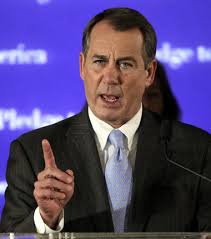
John Boehner
Thus, Boehner intends to sue the President to enforce the law that the House has voted 54 times to repeal, delay or change.
Obama Mistake Nol 5: Believing that public and private comployers would universally comply with the law.
The Affordable Care Act requires employers to provide insurance for part-time employees who work more than 30 hours per week.
Yet many government employers claim they can’t afford it–and plan to limit worker hours to 29 per week instead. Among those states affected:
- “Our choice was to cut the hours or give them health care, and we could not afford the latter,” Dennis Hanwell, the Republican mayor of Medina, Ohio, said in an interview with the New York Times.
- Lawrence County, in western Pennsylvania, reduced the limit for part-time employees to 28 hours a week, from 32.
- In Virginia, part-time state employees are generally not allowed to work more than 29 hours a week on average over a 12-month period.
President Obama and those who helped craft the Act may be surprised at what has happened. But they shouldn’t be.
Greed-addicted officials will always seek ways to avoid complying with the law–or achieve minimum compliance with it.
And what goes for public employers goes for private ones, too.
A company isn’t penalized for failing to provide health insurance coverage for part-time employees who work fewer than 30 hours.
The result was predictable. And its consequences are daily becoming more clear.
Increasing numbers of employers are moving fulltime workers into part-time positions–and thus avoiding
- providing their employees with medical insurance and
- a fine for non-compliance with the law.
Some employers have openly shown their contempt for President Obama–and the idea that employers actually have an obligation to those who make their profits a reality.
One of these is John Schnatter, CEO of Papa John’s Pizza, who has been quoted as saying:
- The prices of his pizzas will go up–by eleven to fourteen cents price increase per pizza, or fifteen to twenty cents per order; and
- He will pass along these costs to his customers.
“If Obamacare is in fact not repealed,” Schnatter told Politico, “we will find tactics to shallow out any Obamacare costs and core strategies to pass that cost onto consumers in order to protect our shareholders’ best interests.”
After all, why should a multi-million-dollar company show any concern for those who make its profits a reality?
ABC NEWS, AFFORDABLE CARE ACT, AIR TRAFFIC CONTROLLERS STRIKE, BARACK OBAMA, CBS NEWS, CNN, COLUMBIA UNIVERSITY, EXTORTION, FACEBOOK, FBI, GEORGE W. BUSH, HARVARD LAW SCHOOL, HENRY J. KAISER FAMILY FOUNDATION, JOBS, JON STEWART, JONATHAN ALTER, JUSTICE DEPARTMENT, NBC NEWS, NICCOLO MACHIAVELLI, OBAMACARE, PATRIOT ACT, public relations, RACKETEER INFLUENCED AND CORRUPT ORGANIZATIONS ACT, REFORM, RICHARD WOLFFE, Ronald Reagan, TERRORISM, THE DAILY SHOW, THE LOS ANGELES TIMES, THE NEW YORK TIMES, THE PRINCE, THE WASHINGTON POST, TWITTER, UNEMPLOYMENT
In Bureaucracy, Business, History, Law, Politics, Social commentary on August 6, 2014 at 11:44 am
In The Prince, his classic treatise on Realpolitick, Niccolo Machiavelli, the Florentine statesman, warned:
“There is nothing more difficult to carry out, nor more doubtful of success, nor more dangerous to handle, than to initiate a new order of things.”
This proved exactly the case with the proposed Affordable Care Act (ACA). Its supporters–even when they comprised a majority of the Congress–have always shown far less fervor than its opponents.
This was true before the Act became effective on March 23, 2010. And it has remained true since, with House Republicans voting 54 times to repeal, delay or revise the law.
So before President Barack Obama launched his signature effort to reform the American medical system, he should have taken this truism into account.
Obama Mistake No. 3: Failing to consider–and punish–the venom of his political enemies.
The ancient Greeks used to say: “A man’s character is his fate.” It is Obama’s character–and our fate–that he is by nature a conciliator, not a confronter.
Richard Wolffe chronicled Obama’s winning of the White House in his book Renegade: The Making of a President. He noted that Obama was always more comfortable when responding to Republican attacks on his character than he was in making attacks on his enemies.
Obama came into office determined to find common ground with Republicans. But they quickly made it clear to him that they only wanted his political destruction.
At that point, he should have put aside his hopes for a “Kumbaya moment” and re-read what Niccolo Machiavelli famously said in The Prince on the matter of love versus fear:

From this arises the question whether it is better to be loved than feared, or feared more than loved. The reply is, that one ought to be both feared and loved, but as it is difficult for the two to go together, it is much safer to be feared than loved.
For it may be said of men in general that they are ungrateful, voluble, dissemblers, anxious to avoid danger and covetous of gain.
As long as you benefit them, they are entirely yours: they offer you their blood, their goods, their life and their children, when the necessity is remote. But when it approaches, they revolt….
And men have less scruple in offending one who makes himself loved than one who makes himself feared; for love is held by a chain of obligations which, men being selfish, is broken whenever it serves their purpose; but fear is maintained by a dread of punishment which never fails.
Moreover, Machiavelli warns that even a well-intentioned leader can unintentionally bring on catastrophe. This usually happens when, hoping to avoid conflict, he allows a threat to go unchecked. Thus:
A man who who wishes to make a profession of goodness in everything must inevitably come to grief among so many who are not good.
And therefore it is necessary, for a prince, who wishes to maintain himself, to learn how not to be good, and to use this knowledge and not use it, according to the necessity of the case.
For President Obama, such a moment came in October, 2013, when House Republicans shut down the government to force Obama to scrap Obamacare.
Obama, a former attorney, heatedly denounced House Republicans for “extortion” and “blackmail.”
Unless he was exaggerating, both of these are felony offenses that are punishable under the 2001 Patriot Act and the Racketeer Influenced Corrupt Organizations (RICO) Act of 1970.
All that he needed do was to order his Attorney General, Eric Holder, to ask the FBI to investigate whether either or both of these laws have been violated.
If violations had been discovered, indictments could have quickly followed– and then prosecutions.
The results of such action can be easily predicted.
- Facing lengthy prison terms, those indicted Republicans would first have to lawyer-up. That in itself would have been no small thing, since good criminal lawyers cost big bucks.
- Obsessed with their own personal survival, they would have found little time for engaging in more of the same thuggish behavior that got them indicted. In fact, doing so would have only made their conviction more likely.
- Those Republicans who hadn’t (yet) been indicted would have realized: “I could be next.” This would have produced a chilling effect on their willingness to engage in further acts of subversion and extortion.
- The effect on Right-wing Republicans would have been the same as that of President Ronald Reagan’s firing of striking air traffic controllers: “You cross me and threaten the security of this nation at your own peril.”
It would no doubt be a long time before Republicans dared to engage in such behavior–if they ever so dared again.
So: Why didn’t the President act to punish such criminal conduct?
ABC NEWS, AFFORDABLE CARE ACT, AIR TRAFFIC CONTROLLERS STRIKE, BARACK OBAMA, CBS NEWS, CNN, COLUMBIA UNIVERSITY, EXTORTION, FACEBOOK, FBI, GEORGE W. BUSH, HARVARD LAW SCHOOL, HENRY J. KAISER FAMILY FOUNDATION, JOBS, JON STEWART, JONATHAN ALTER, JUSTICE DEPARTMENT, NBC NEWS, NICCOLO MACHIAVELLI, OBAMACARE, PATRIOT ACT, public relations, RACKETEER INFLUENCED AND CORRUPT ORGANIZATIONS ACT, REFORM, RICHARD WOLFFE, Ronald Reagan, TEA PARTY, TERRORISM, THE DAILY SHOW, THE LOS ANGELES TIMES, THE NEW YORK TIMES, THE PRINCE, THE WASHINGTON POST, TWITTER, UNEMPLOYMENT
In Bureaucracy, Business, History, Law, Politics, Social commentary on August 5, 2014 at 8:56 am
A majority of Americans–53%–disapprove of the Affordable Care Act (ACA), better known as Obamacare.
So says a July healthcare tracking poll of the Henry J. Kaiser Family Foundation, a non-profit organization focusing on national health issues
This is clearly a plus/minus situation for President Barack Obama.
On the positive side: According to the Department of Health and Human Services, Obamacare enrollment has cut the number of uninsured people in the nation by 10 million.
On the negative side: Obamacare has always had weak support among the American public. Among the reasons for this:
- Constant Republican attacks labeling the law as “socialistic” (by which they mean “communistic”).
- Public opposition to the individual mandate that almost everyone obtain coverage.
- Many Americans think they can’t afford the insurance sold on the Obamacare exchanges–and don’t know that financial aid is available.
Among the poll’s findings:
- Sixty percent of the public wants Congress to improve the Affordable Care Act, not repeal and replace it.
- Thirty-eight percent were unaware that the Act offers consumers a choice among private health plans.
- Less than half of those polled–47%–say they have discussed the law with friends or family.
- Of that 47%, a majority–27%–say they’ve heard more bad than good about the law in these conversations.
- Healthcare isn’t a top priority for Americans right now–except for medical care for veterans (71%).
Among those issues the public does rate as highly important:
- Economy and jobs (70%)
- Federal budget deficit (68%)
- Education (66%)
- Social Security (65%)
- Illegal imigration (61%)
Click here: Kaiser Health Tracking Poll: July 2014 | The Henry J. Kaiser Family Foundation
Barack Obama is easily one of the most highly educated Presidents in United States history.
He is a graduate of Columbia University (B.A. in political science in 1983).
In 1988, he entered Harvard Law School, graduating magna cum laude–“with great honor”–in 1991. He was selected as an editor of the Harvard Law Review at the end of his first year, and president of the journal in his second year.
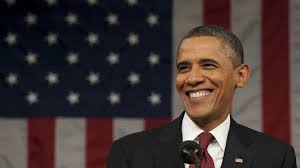
President Barack Obama
He then taught constitutional law at the University of Chicago Law School for 12 years—as a Lecturer from 1992 to 1996, and as a Senior Lecturer from 1996 to 2004.
So where did he go so wrong? Several ways:
Obama Mistake No. 1: Putting off what people wanted while concentrating on what they didn’t.
Obama started off well when he took office. Americans had high expectations of him.
This was partly due to his being the first black elected President. And it was partly due to the disastrous legacies of needless war and financial catastrophe left by his predecessor, George W. Bush.
Obama entered office intending to reform the American healthcare system, to make medical care available to all citizens, and not just the richest.
But that was not what the vast majority of Americans wanted him to concentrate his energies on. With the loss of 2.6 million jobs in 2008, Americans wanted Obama to find new ways to create jobs.
This was especially true for the 11.1 million unemployed, or those employed only part-time.
Jonathan Alter, who writes sympathetically about the President in The Center Holds: Obama and His Enemies, candidly states this.
But Obama chose to spend most of his first year as President pushing the Affordable Care Act (ACA)–which soon became known as Obamacare–through Congress.
The results were:
- Those desperately seeking employment felt the President didn’t care about them.
- The reform effort became a lightning rod for Right-wing groups like the Tea Party.
- In 2010, a massive Rightist turnout cost the Democrats the House of Representatives, and threatened Democratic control of the Senate.
Obama Mistake No. 2: He underestimated the amount of opposition he would face to the ACA.
For all of Obama’s academic brilliance and supposed ruthlessness as a “Chicago politician,” he has displayed an incredible naivety in dealing with his political opposition.
Niccolo Machiavelli (4169-1527), the Florentine statesman and father of modern politics, could have warned him of the consequences of this–through the pages of his famous treatise on the realities of politics: The Prince.

Niccolo Machiavelli
And either Obama skipped those chapters or ignored their timeless advice for political leaders.
He should have started with Chapter Six: “Of New Dominions Which Have Been Acquired By One’s Own Arms and Ability”:
…There is nothing more difficult to carry out, nor more doubtful of success, nor more dangerous to handle, than to initiate a new order of things.
For the reformer has enemies in all those who profit by the old order, and only lukewarm defenders in all those who would profit by the new order, this lukewarmness arising partly from fear of their adversaries, who have the laws in their favor, and partly from the incredulity of mankind, who do not truly believe in anything new until they have had actual experience of it.
2012 PRESIDENTIAL RACE, ABC NEWS, AFFORDABLE CARE ACT, BARACK OBAMA, CBS NEWS, CIA, CNN, FACEBOOK, FRANKLIN D. ROOSEVELT, FUNDRAISING, JOHN SCHNATTER, MITT ROMNEY, NBC NEWS, NEW DEAL, OBAMACARE, PAPA JOHN'S PIZZA, Ronald Reagan, THE LOS ANGELES TIMES, THE NEW YORK TIMES, THE WASHINGTON POST, TWITTER, WHITE CASTLE HAMBURGER CHAIN, WILLIAM J. CASEY
In Bureaucracy, Business, History, Law, Politics on August 4, 2014 at 10:17 am
When William J. Casey–the future director of the Central Intelligence Agency– was a young attorney, he learned an important lesson.
During the Great Depression, jobs were hard to come by. So Casey thought himself lucky to land one at the Tax Research Institute of America in New York.
His task was to closely read New Deal legislation and write reports explaining it to corporate chieftains.
He quickly learned that businessmen neither understood nor welcomed Franklin D. Roosevelt’s efforts to reform American capitalism.
Businessmen didn’t want legal commentary. Instead, they wanted to know: “What’s the minimum we have to do to comply with the law?”
In short: How do we get by FDR’s new programs?
Fifty years later, Casey would bring a similar mindset to his duties as director of the Central Intelligence Agency for President Ronald Reagan.
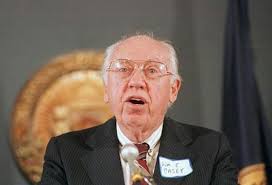
William J. Casey
He was presiding over the CIA when it repeatedly violated Congress’ ban on funding the “Contras,” the right-wing death squads of Nicaragua. The resulting scandal almost destroyed the CIA
But the “Casey Doctrine” of minimum compliance didn’t die with Casey (who expired of a brain tumor in 1987).
It’s very much alive among the American business community as President Barack Obama seeks to give medical coverage to all Americans, and not simply the ultra-wealthy.
The single most important provision of the Affordable Care Act (ACA)–better known as Obamacare–requires large businesses to provide insurance to full-time employees who work more than 30 hours a week.
For part-time employees, who work fewer than 30 hours, a company isn’t penalized for failing to provide health insurance coverage.
Obama prides himself on being a tough-minded practitioner of “Chicago politics.” So it’s easy to assume that he took the “Casey Doctrine” into account when he shepherded the ACA through Congress.
But he didn’t.
The result was predictable. And its consequences are daily becoming more clear.
Employers feel motivated to move fulltime workers into part-time positions–and thus avoid
- providing their employees with medical insurance and
- a fine for non-compliance with the law.
Some employers have openly shown their contempt for President Obama–and the idea that employers actually have an obligation to those who make their profits a reality.
The White Castle hamburger chain is considering hiring only part-time workers in the future to escape its obligations under Obamacare.
No less than Jamie Richardson, its vice president, has admitted this in an interview.
“If we were to keep our health insurance program exactly like it is with no changes, every forecast we’ve looked at has indicated our costs will go up 24%.”
Richardson claimed the profit per employee in restaurants is only $750 per year. So, as he sees it, giving health insurance to all employees over 30 hours isn’t feasible.
Nor is Richardson the only corporate executive determined to shirk his responsibility to his employees.
John Schnatter, CEO of Papa John’s Pizza, has been quoted as saying:
- The prices of his pizzas will go up–by eleven to fourteen cents price increase per pizza, or fifteen to twenty cents per order; and
- He will pass along these costs to his customers.
“If Obamacare is in fact not repealed,” Schnatter told Politico, “we will find tactics to shallow out any Obamacare costs and core strategies to pass that cost onto consumers in order to protect our shareholders’ best interests.”
After all, why should a multi-million-dollar company show any concern for those who make its profits a reality?
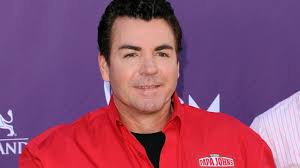
John Schnatter
Consider:
- Papa John’s is the third-largest pizza takeout and delivery chain in the United States.
- Its 2012 revenues were $318.6 million, an 8.5 percent increase from 2011 revenues of $293.5 million.
- Its 2012 net income was $14.8 million, compared to its 2012 net income of $12.1 million.
In May, 2012, Schnatter hosted a fundraising event for Republican Presidential candidate Mitt Romney at his own Louisville, Kentucky mansion.
“What a home this is,” gushed Romney. “What grounds these are, the pool, the golf course.
“You know, if a Democrat were here he’d look around and say no one should live like this. Republicans come here and say everyone should live like this.”
Of course, Romney conveniently ignored a brutally ugly fact:
For the vast majority of Papa John’s minimum-wage-earning employees-–many of them working only part-time-–the odds of their owning a comparable estate are non-existent.
Had Obama been the serious student of Realpolitick that he claims to be, he would have predicted that most businesses would seek to avoid compliance with his law.
And had he been the ruthless practitioner of “Chicago politics,” as his enemies claim, he would have required all employers to provide insurance coverage for all of their employees—regardless of their fulltime or part-time status.
This, in turn, would have provided two substantial benefits:
- All employees would have been able to obtain medical coverage; and
- Employers would have been encouraged to provide fulltime positions rather than part-time ones, since they would feel: “Since I’m paying for fulltime insurance coverage, I should be getting fulltime work in return.”
The “Casey Doctrine” needs to be kept constantly in mind when reformers try to protect Americans from predatory employers.
ABC NEWS, AMERICA INSIDE OUT: AT HOME AND ABROAD, BARACK OBAMA, CBS NEWS, CHRIS MATHEWS, CIVIL WAR, CNN, DAVID SHOEMBRUN, DEMOCRATIC PARTY, FACEBOOK, FOOD STAMPS, MEDICARE, MSNBC, NBC NEWS, PROPAGANDA, REPUBLICAN PARTY, REPUBLICANS, Ronald Reagan, SOCIAL SECURITY, THE HUFFINGTON POST, THE LOS ANGELES TIMES, THE NEW YORK TIMES, THE SOUL OF BATTLE, THE WALL STREET JOURNAL, THE WASHINGTON POST, TIME MAGAZINE, TWITTER, VICTOR DAVIS HANSON, WILLIAM TECUMSEH SHERMAN
In Bureaucracy, History, Law, Politics, Social commentary on August 1, 2014 at 10:53 am
Republicans have long tried to prevent or eliminate programs that aid the poor and middle-class, including:
- Social Security – since it began in 1935
- Medicare – since it began in 1965
- Food stamps – since it began in 1964
- WIC (Women, Infants, Children) – since 1972
- The Affordable Care Act (Obamacare) – since 2010
So why are so many poor Americans now flocking to this party’s banner?
Two reasons: Racism and greed. There are historical parallels for both.
Racism:
In 1999, historian Victor Davis Hanson noted the huge gap in wealth between the aristocratic, slave-owning minority of the pre-Civil War South and the vast majority of poor white Southerners.
“Before the war in the counties Sherman would later ruin, the top 10% of the landowners controlled 40% of the assessed wealth.”
In contrast, “more than half of those who were lucky enough to own any property at all still possessed less than 15% of the area’s valuation.”
So Hanson asked: “Why did the millions of poor whites of the Confederacy fight at all?”
He supplied the answer in his brilliant work on military history, The Soul of Battle: From Ancient Times to the Present Day, How Three Great Liberators Vanquished Tyranny.

One of those liberators was General William Tecumseh Sherman, who led 62,000 Union troops in a victorious “March to the Sea” through the Confederacy in 1864.
So why did so many poor Southern whites literally lay down their lives for the wealthy planter class, which despised them?
According to Hanson: “Behind the entire social fabric of the South lay slavery.
“If slavery eroded the economic position of the poor free citizens, if slavery encouraged a society of haves and have-nots…then it alone offered one promise to the free white man–poor, ignorant and dispirited–that he was at least not black and not a slave.”
And the planter class and its allies in government easily fobbed off their poor white countrymen with cheap flattery. Said Georgia Governor Joseph Brown:
“Among us the poor white laborer is respected as an equal. His family is treated with kindness, consideration, and respect. He does not belong to the menial class. The negro is in no sense his equal. He belongs to the only true aristocracy, the race of white men.”
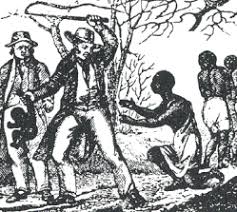
The reality of slavery
Similarly, poor whites now flock to the Republican Party–which holds them in equal contempt– in large part to protest the 2008 election of the first black President of the United States.
According to a Pew Research Center study released on July 22, 2011: “Notably, the GOP gains have occurred only among white voters; a 2-point Republican edge among whites in 2008 (46% to 44%) has widened to a 13-point lead today (52% to 39%).”
GOP Makes Big Gains among White Voters | Pew Research Center for the People and the Press
Since the 1960s, Republicans have pursued a campaign policy of “divide and rule”–divide the nation along racial lines and reap the benefits at election time.
- Republicans opposed the Civil Rights Act of 1964.
- Republicans opposed the Voting Rights Act of 1965.
- Republicans, with Richard Nixon as their Presidential candidate in 1968 and 1972, pursued what they called a “Southern strategy”: Use “code language” to stoke fear and hatred of blacks among whites.
- Republicans have falsely identified welfare programs exclusively with non-whites. (Of the six million Americans receiving food stamps, about 42 percent are white, 32 percent are black, and 22 percent are Latino—with the growth fastest among whites during the recession.)
Thus, in voting Republican, many of these poor whites believe they are “striking a blow for the white race.”
And they can do so in a more socially acceptable way than joining a certified hate group such as the American Nazi Party or Ku Klux Klan.
Greed:
In the hit play, 1776, on the creation and signing of the Declaration of Independence, there is a telling exchange between John Dickinson and John Hancock. It comes during the song, “Cool, Cool, Considerate Men.”

Dickinson, the delegate from Pennsylvania, urges Hancock, president of the Second Continental Congress, “to join us in our minuet.”
By “us” he means his fellow conservatives who fear losing their property and exalted status by supporting American independence from Great Britain.
Hancock declines, saying: “Fortunately, there are not enough men of property in America to dictate policy.”
To which Dickinson replies: “Perhaps not. But don’t forget that most men with nothing would rather protect the possibility of becoming rich than face the reality of being poor. And that is why they will follow us.”
Today, poor whites generally identify with the CEOs of powerful corporations. They believe the Republican gospel that they can attain such wealth–if only the government will “get out of my way.”
They forget–or ignore–the brutal truth that government, for all its imperfections, is sometimes all that stands between them and a wide range of predators.
In return, the CEOs despise them as the privileged have always despised their social and economic “inferiors.”
Unless the Democratic Party can find ways to directly address these bitter, Politically Incorrect truths, it will continue its decline into insignificance.
ABC NEWS, AMERICA INSIDE OUT: AT HOME AND ABROAD, BARACK OBAMA, CBS NEWS, CHRIS MATHEWS, CIVIL WAR, CNN, DAVID SHOEMBRUN, DEMOCRATIC PARTY, FACEBOOK, FOOD STAMPS, MEDICARE, MSNBC, NBC NEWS, PROPAGANDA, REPUBLICAN PARTY, REPUBLICANS, Ronald Reagan, SOCIAL SECURITY, THE HUFFINGTON POST, THE LOS ANGELES TIMES, THE NEW YORK TIMES, THE SOUL OF BATTLE, THE WALL STREET JOURNAL, THE WASHINGTON POST, TIME MAGAZINE, TWITTER, VICTOR DAVIS HANSON, WILLIAM TECUMSEH SHERMAN
In Bureaucracy, History, Law, Politics, Social commentary on July 31, 2014 at 3:44 pm
On July 22, 2011, the Pew Foundation, analyzing voter identification, found that the GOP had gained strength among white voters, most specifically “the young and poor.”
A seven-point Democratic advantage among whites under age 30 three years earlier had turned into an 11-point GOP advantage.
And a 15-point Democratic advantage among whites earning less than $30,000 annually had swung to a slim four-point Republican edge.
In addition:
- The GOP gains have occurred only among white voters.
- Republicans have made sizable gains among white voters since 2008.
- Fifty-two percent of white voters now call themselves Republicans or lean to the GOP, compared with 39% who affiliate with the Democratic Party or lean Democratic.
- Democrats have lost their edge among lower income white voters.
- In 2008, Democrats had a 15 point lead among white voters with family incomes less than $30,000. Republicans now have a four-point edge among this group.
- The GOP’s lead among middle income white voters also has grown since 2008, and Republicans hold a substantial advantage with higher income white voters.
- Republicans have made gains among whites with a high school education or less.
- The GOP’s advantage over Democrats grew from one point in 2008 to 17 points in 2011 among less educated whites.
- Republicans have made smaller gains among whites voters who have college degrees.
What is fascinating about these findings is this: The Republicans have, since 1980, pursued a policy of gutting programs aimed at helping the poor–while repeatedly creating tax-breaks for the wealthiest 1% of the population.
For Republicans, the patron saint of this “love-the-rich-screw-the-poor” ideology remains Ronald Reagan. Reagan served as governor of California (1967-1974) and President of the United States (1981-1989).
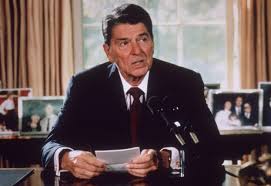
Ronald Reagan
Among those charting Reagan’s legacy as President was former CBS Correspondent David Schoenbrun In his bestselling autobiography, America Inside Out: At Home and Abroad from Roosevelt to Reagan, he noted:
- On January 28, 1981, keeping a pledge to his financial backers in the oil industry, Reagan abolished Federal controls on the price of oil.
- Within a week, Exxon, Texaco and Shell raised gasoline prices and prices of home heating oil.
- Reagan saw it as his duty to put a floor under prices, not a ceiling above them.
- Reagan believed that when government helped business it wasn’t interfering. Loaning money to bail out a financially incompetent Chrysler was “supporting the free enterprise system.”
- But putting a high-profits tax on price-gouging corporations or filing anti-trust suits against them was “Communistic” and therefore intolerable.
- Tax-breaks for wealthy businesses meant helping America become stronger.
- But welfare for the poor or the victims of a predatory marketplace economy weakened America by sapping its morale.
“In short,” wrote Schoenbrun,”welfare for the rich is good for America. But welfare for the poor is bad for America, even for the poor themselves, for it encourages them to be shiftless and lazy.
“Somehow, loans to the inefficient management of American corporations would not similarly encourage them in their inefficient methods.”
Republicans have sought to dismantle Social Security ever since that program began in 1935. And Republicans have furiously opposed other programs aiding the poor and middle-class–such as Medicare, food stamps and WIC (Women, Infants, Children).
In short, this is not a political party with a history of rushing to the defense of those most in need.
So the question remains: Why are so many poor Americans now flocking to its banner?
Two reasons: Racism and greed. There are historical parallels for both.
Racism:
In 1999, historian Victor Davis Hanson noted the huge gap in wealth between the aristocratic, slave-owning minority of the pre-Civil War South and the vast majority of poor white Southerners.
“Before the war in the counties Sherman would later ruin, the top 10% of the landowners controlled 40% of the assessed wealth.”
In contrast, “more than half of those who were lucky enough to own any property at all still possessed less than 15% of the area’s valuation.”
So Hanson asked: “Why did the millions of poor whites of the Confederacy fight at all?”
He supplied the answer in his brilliant work on military history, The Soul of Battle: From Ancient Times to the Present Day, How Three Great Liberators Vanquished Tyranny.
One of those liberators was General William Tecumseh Sherman, who led 62,000 Union troops in a victorious “March to the Sea” through the Confederacy in 1864.
So why did so many poor Southern whites literally lay down their lives for the wealthy planter class, which despised them?
ADOLF HITLER, BARACK OBAMA, BILL CLINTON, CHRIS MATTHEWS, CNN'S "STARTING POINT", CZECHOSLAVAKIA, DARRELL ISSA, DEBT CEILING, EXECUTIVE ORDERS, EXTORTION, FACEBOOK, GEORGE W. BUSH, HOUSE SPEAKER JOHN BOEHNER, immigration reform, JIMMY CARTER, MSNBC'S "HARDBALL", NAZI GERMANY, NEGOTIATING, NEVILLE CHAMBERLAIN, NEWT GINGRICH, NICCOLO MACHIAVELLI, PAP SMEARS, PLANNED PARENTHOOD, POLAND, R.I.CO. ACT, REPUBLICAN PARTY, REPUBLICANS, Ronald Reagan, THE PRINCE, TITLE X, TWITTER, WARREN BUFFET, WINSTON CHURCHILL, WORLD WAR 11
In Bureaucracy, History, Law, Law Enforcement, Politics on July 8, 2014 at 12:22 am
In 2011, Republicans threatened to destroy the Nation’s credit rating unless their budgetary demands were met.
As Ernst Casier, chairman of philosophy at Hamburg University once warned:
“Those who are willing to risk everything, even death and destruction, to attain their ends will prevail over more responsible and prudent men who have more to lose and are rational, not suicidal.”
Yet President Barack Obama could have ended that threat via the Racketeer Influenced Corrupt Organizations (RICO) Act.
Passed by Congress in 1970, as Title 18, United States Code, Sections 1961-1968, its goal was to destroy the Mafia.
Originally, RICO was aimed at the Mafia and other organized crime syndicates. But in United States v. Turkette, 452 U.S. 576 (1981), the Supreme Court held that RICO applied as well to legitimate enterprises being operated in a criminal manner.
After Turkette, RICO could also be used against corporations, political protest groups, labor unions and loosely knit-groups of people.
RICO opens with a series of definitions of “racketeering activity” which can be prosecuted by Justice Department attorneys. Among those crimes: Extortion.

Extortion is defined as “a criminal offense which occurs when a person unlawfully obtains either money, property or services from a person(s), entity, or institution, through coercion.”
The RICO Act defines “a pattern of racketeering activity” as “at least two acts of racketeering activity, one of which occurred after the effective date of this chapter and the last of which occurred within ten years…after the commission of a prior act of racketeering activity.”
And if President Obama had believed that RICO was not sufficient to deal with Republicans’ extortion attempts, he could have relied on the USA Patriot Act of 2001, passed in the wake of 9/11.
In Section 802, the Act defines domestic terrorism. Among the behavior that is defined as criminal:
“Activities that…appear to be intended…to influence the policy of a government by intimidation or coercion [and]…occur primarily within the territorial jurisdiction of the United States.”
The remedies for punishing such criminal behavior were now legally in place. President Obama needed only to direct the Justice Department to apply them.
- President Obama could have directed Attorney General Eric Holder to investigate whether actions by Republican Congressman—and their Tea Party cohorts—broke Federal anti-racketeering and/or anti-terrorism laws.
- Holder, in turn, could have ordered the FBI to conduct that investigation.
- If the FBI found sufficient evidence that these laws had been violated, Holder could have empaneled criminal grand juries to indict those violators.
Criminally investigating and possibly indicting members of Congress would not violate the separation-of-powers principle. Congressmen have in the past been investigated, indicted and convicted for various criminal offenses.
Such indictments and prosecutions–and especially convictions–would have served notice on current and future members of Congress: The lives and fortunes of American citizens may not be held hostage to gain leverage in a political settlement.
In short: Obama could have replaced the law of fear with the rule of law.
But Obama could have stood up to Republican extortionists in another way: By urging his fellow Americans to rally to him in a moment of supreme national danger.
President John F. Kennedy did just that–successfully–during the most dangerous crisis of his administration.
Addressing the Nation on October 22, 1962, Kennedy shocked his fellow citizens by revealing that the Soviet Union had installed offensive nuclear missiles in Cuba.

John F. Kennedy
Kennedy outlined a series of steps he had taken to end the crisis–most notably, a blockade of Cuba. Then he sought to reassure and inspire his audience:
“The cost of freedom is always high, but Americans have always paid it. And one path we shall never choose, and that is the path of surrender or submission.”
President Obama could have sent that same message to the extortionists of the Republican Party–by explaining to the American people:
- Republicans have adopted the same my-way-or-else “negotiating” stance as Adolf Hitler.
- Like the Nazis, they are determined to gain absolute power–or destroy the Nation they claim to love.
- They raised the debt ceiling seven times during the eight-year Presidency of George W. Bush.
- But now that a Democrat holds the White House, raising the debt ceiling is unacceptable.
- Despite Republican lies, we cannot revitalize the economy by slashing taxes on the wealthy and on cash-hoarding corporations while cutting benefits for millions of average Americans.
- We will need both tax increases and sensible entitlement cuts to regain our economic strength.
And he could have ended his speech with a direct call for action by the American people:
“We stand on the edge of economic disaster. Therefore, I am asking each of you to stand up for America tonight–by demanding the recall of the entire membership of the Republican Party.
“This is the moment when each of us must decide–whether we will survive as a Republic, or allow ruthless political fanatics to destroy what has lasted and thrived for more than 200 years.”
To paraphrase Winston Churchill: President Obama had to choose between timidity and confrontation.
He chose timidity.
He would get contempt and obstruction at every turn.
ADOLF HITLER, BARACK OBAMA, BILL CLINTON, CHRIS MATTHEWS, CNN'S "STARTING POINT", CZECHOSLAVAKIA, DARRELL ISSA, DEBT CEILING, EXECUTIVE ORDERS, EXTORTION, FACEBOOK, GEORGE W. BUSH, HOUSE SPEAKER JOHN BOEHNER, immigration reform, JIMMY CARTER, MSNBC'S "HARDBALL", NAZI GERMANY, NEGOTIATING, NEVILLE CHAMBERLAIN, NEWT GINGRICH, NICCOLO MACHIAVELLI, PAP SMEARS, PLANNED PARENTHOOD, POLAND, R.I.CO. ACT, REPUBLICAN PARTY, REPUBLICANS, Ronald Reagan, THE PRINCE, TITLE X, TWITTER, WARREN BUFFET, WINSTON CHURCHILL, WORLD WAR 11
In Bureaucracy, History, Law, Law Enforcement, Politics on July 7, 2014 at 9:21 am
In November, 1995, Newt Gingrich, then Speaker of the House of Representatives, carried out his threat to shut down the government.
Then he unwisely admitted that he did so because President Bill Clinton had put him in the back of Air Force One during a recent trip to Israel.

Newt Gingrich
The shutdown proved a disaster for Republicans. Clinton was handily re-elected in 1996 and Gingrich suddenly resigned from Congress in 1998.
Still, the Republicans continued their policy of my-way-or-else.
In April, 2011, the United States government almost shut down over Republican demands about subsidized pap smears.
During a late-night White House meeting with President Barack Obama and key Congressional leaders, Republican House Speaker John Boehner made this threat:
His conference would not approve funding for the government if any money were allowed to flow to Planned Parenthood through Title X legislation.
Facing an April 8 deadline, negotiators worked day and night to strike a compromise–and finally reached one.
Three months later–on July 9–Republican extortionists again threatened the Nation with financial ruin and international disgrace unless their demands were met.

President Obama had offered to make historic cuts in the federal government and the social safety net–on which millions of Americans depend for their most basic needs.
But House Speaker John Boehner rejected that offer. He could not agree to the tax increases that Democrats wanted to impose on the wealthiest 1% as part of the bargain.

John Boehner
As the calendar moved ever closer to the fateful date of August 2, Republican leaders continued to insist: Any deal that includes taxes “can’t pass the House.”
One senior Republican said talks would go right up to–and maybe beyond–the brink of default.
“I think we’ll be here in August,” said Republican Representative Pete Sessions, of Texas. “We are not going to leave town until a proper deal gets done.”
President Obama had previously insisted on extending the debt ceiling through 2012. But in mid-July, he simply asked congressional leaders to review three options with their members:
- The “Grand Bargain” choice—favored by Obama–would cut deficits by about $4 trillion, including spending cuts and new tax revenues.
- A medium-range plan would aim to reduce the deficit by about $2 trillion.
- The smallest option would cut between $1 trillion and $1.5 trillion, without increased tax revenue or any Medicare and Medicaid cuts.
And the Republican response?
Said Rep. Darrell Issa, chairman of the Oversight and Government Reform Committee:“Quite frankly, [Republican] members of Congress are getting tired of what the president won’t do and what the president wants.”
Noted political analyst Chris Matthews summed up the sheer criminality of what happened within the House of Representatives.
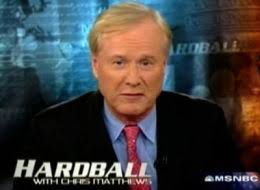
Chris Matthews
Speaking on MSNBC’s “Hardball,” on July 28–five days before Congress reached its August 2 deadline to raise the debt-ceiling–Matthews noted:
“The first people to bow to the demands of those threatening to blow up the economy were the Republicans in the House, the leaders. The leaders did what the followers told them to do: meet the demands, hold up the country to get their way.
“Those followers didn’t win the Senate, or the Presidency, just the House.
“But by using the House they were able to hold up the entire United States government. They threatened to blow things up economically and it worked.
“They said they were willing to do that–just to get their way–not by persuasion, not by politics, not by democratic government, but by threatening the destruction of the country’s finances.
“Right. So what’s next? The power grid? Will they next time threaten to close down the country’s electricity and communications systems?”
With the United States teetering on the brink of national bankruptcy, President Obama faced three choices:
- Prosecute Republican extortionists under the Racketeer Influenced Corrupt Oganizations Act;
- Seek to rally the American people against a criminal threat to the financial security of the Nation;
- Cave in to Republican demands.
Unfortunately for Obama and the Nation, he chose Number Three.
A graduate of Columbia University and Harvard Law School, Obama is easily one of the most academically gifted Presidents in United States history.
But for all this, he failed–from the onset of his Presidency–to grasp and apply this fundamental lesson taught by Niccolo Machiavelli, the father of modern political science.
In his classic work on politics, The Prince, Machiavelli warns:
From this arises the question whether it is better to be loved than feared, or feared more than loved.
The reply is, that one ought to be both feared and loved, but as it is difficult for the two to go together, it is much safer to be feared than loved….
Men have less scruple in offending one who makes himself loved than one who makes himself feared. For love is held by a chain of obligations which, men being selfish, is broken whenever it serves their purpose. But fear is maintained by a dread of punishment which never fails.
Obama has failed to heed this advice. And, predictably, his sworn enemies–which is what Republicans consider themselves to be–have felt free to demonize and obstruct him at every turn.
ADOLF HITLER, BARACK OBAMA, CHRIS MATTHEWS, CNN'S "STARTING POINT", CZECHOSLAVAKIA, DEBT CEILING, EXECUTIVE ORDERS, EXTORTION, FACEBOOK, GEORGE W. BUSH, GOVERNMENT SHUTDOWN, HOUSE SPEAKER JOHN BOEHNER, immigration reform, JIMMY CARTER, MSNBC'S "HARDBALL", NAZI GERMANY, NEGOTIATING, NEVILLE CHAMBERLAIN, NEWT GINGRICH, NICCOLO MACHIAVELLI, PAP SMEARS, PLANNED PARENTHOOD, POLAND, R.I.CO. ACT, REPUBLICAN PARTY, REPUBLICANS, Ronald Reagan, THE PRINCE, TWITTER, WARREN BUFFET, WINSTON CHURCHILL, WORLD WAR 11
In Bureaucracy, History, Law, Law Enforcement, Politics on July 4, 2014 at 3:05 pm
After winning the bloodless conquest of Czechoslavakia by threatening France and Britain with war, Adolf Hitler turned his attention to Poland.
When his generals balked, warning that an invasion would trigger a war with France and Britain, Hitler quickly brushed aside their fears: “Our enemies are little worms. I saw them at Munich.”
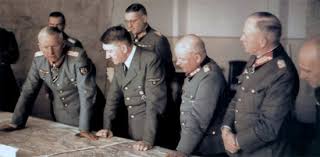
Adolf Hitler and his generals
Hitler ordered the invasion of Poland on September 1, 1939–unintentionally triggering World War II.
In time, historians and statesmen would regard Munich as an object lesson in the futility—and danger—in appeasing evil and aggression.
But for the postwar Republican party, Hitler’s my-way-or-else “negotiating” methods would become standard operating procedure.
During the summer of 2011, Republicans refused to raise the debt ceiling unless Democrats agreed to massively cut social programs for the elderly, poor and disabled.
And while Republicans demanded that the disadvantaged tighten their belts, they rejected any raising of taxes on their foremost constituency–the wealthiest 1%.
To raise taxes on the wealthy, they insisted, would be a “jobs-killer.” It would “discourage” corporate CEOs from creating tens of thousands of jobs they “want” to create.
If Congress failed to raise the borrowing limit of the federal government by August 2, 2011, the date when the U.S. reached the limit of its borrowing abilities, America would begin defaulting on its loans.
As Warren Buffett, CEO of Berkshire Hathaway, explained the looming economic catastrophe:
“If you don’t send out Social Security checks, I would hate to think about the credit meeting at S&P and Moody’s the next morning.
“If you’re not paying millions and millions and millions of people that range in age from 65 on up, money you promised them, you’re not a AAA,” said Buffett.
A triple-A credit rating is the highest possible rating that can be received.
Republicans knew this argument is a lie. And so did the editors of Time. The difference is, the editors of Time were willing to reveal the truth.
In its June 20, 2011 cover-story on “What U.S. Economic Recovery? Five Destructive Myths,” Rana Foroohar, the magazine’s assistant managing editor in charge of economics and business, delivered this warning:
Profit-seeking corporations can’t be relied on to ”make it all better.”
American companies “are doing quite well,” but most American workers “are earning a lower hourly wage now than they did during the recession.”
Corporations, in short, are doing extremely well. But they don’t spend their profits on American workers.
“There may be $2 trillion sitting on the balance sheets of American corporations globally, but firms show no signs of wanting to spend it in order to hire workers at home.”
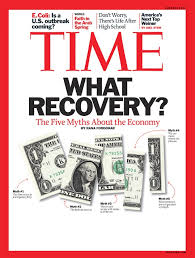
In short: Giving even greater tax breaks to mega-corporations–the standard Republican mantra–has not persuaded them to stop “outsourcing” jobs. Nor has it convinced them to start hiring Americans.
Many American companies prefer opening factories in Brazil, China or India to doing so in the United States–and thus creating jobs for American workers.
While embarrassingly overpaid CEOs squander corporate wealth on themselves, millions of Americans can’t afford medical care or must depend on charity to feed their families.
Yet there is also a disconnect between the truth of this situation and the willingness of Americans to face up to that truth.
The reason, writes Foroohar:
Republicans have convinced most Americans they can revitalize the economy by slashing “taxes on the wealthy and on cash-hoarding corporations while cutting benefits for millions of Americans.”
And she concludes: To restore prosperity America needs both tax increases and cuts in entitlement programs.
Click here: What U.S. Economic Recovery? Five Destructive Myths – TIME
According to Mein Kampf-–”My Struggle”–-Hitler’s autobiography and political treatise:
- Most people are ruled by sentiment, not reason.
- This sentiment is simple and consistent. It is rooted in notions of love and hatred, right and wrong, truth and falsehood.
- Propaganda isn’t based on objective truth but must present only that partof the truth that makes its own side look good.
- People are not intelligent, and quickly forget.
- Confine propaganda to a few bare essentials and express these in easily-remembered in stereotyped images.
- Persistently repeat these slogans until the very last individual has come to grasp the idea that has been put forward.
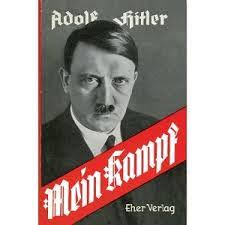
Following these principles, Republicans have proved hugely successful at persuading millions that truth is whatever their party claims it to be at any given moment.
“Fascism,” said author Ernest Hemingway, “is a lie told by bullies.” Thus, when Republicans couldn’t attain their goals by lying, they sought to do so by force–or at least the threat of it.
Republicans have repeatedly threatened to shut down the government unless their constantly escalating demands were met.
In November, 1995, Newt Gingrich, then Speaker of the House of Representatives, carried out his threat. Gingrich unwisely admitted that he did so because President Bill Clinton had put him in the back of Air Force One during a recent trip to Israel.
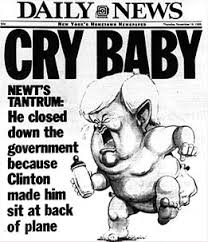
The shutdown proved a disaster for Republicans. Clinton was handily re-elected in 1996 and Gingrich suddenly resigned from Congress in 1998.
 Bureaucracybuster's Blog
ABC NEWS, AFFORDABLE CARE ACT, AIR TRAFFIC CONTROLLERS STRIKE, BARACK OBAMA, CBS NEWS, CNN, COLUMBIA UNIVERSITY, EXTORTION, FACEBOOK, FBI, GEORGE W. BUSH, HARVARD LAW SCHOOL, HENRY J. KAISER FAMILY FOUNDATION, JOBS, JON STEWART, JONATHAN ALTER, JUSTICE DEPARTMENT, NBC NEWS, NICCOLO MACHIAVELLI, OBAMACARE, PATRIOT ACT, public relations, RACKETEER INFLUENCED AND CORRUPT ORGANIZATIONS ACT, REFORM, RICHARD WOLFFE, Ronald Reagan, TERRORISM, THE DAILY SHOW, THE LOS ANGELES TIMES, THE NEW YORK TIMES, THE PRINCE, THE WASHINGTON POST, TWITTER, UNEMPLOYMENT
OBAMA’S SIX “OBAMACARE” MISTAKES: PART FOUR (END)
In Bureaucracy, Business, History, Law, Politics, Social commentary on August 8, 2014 at 2:45 pmPresident Obama claims to be a serious student of Realpolitick. If this were so, he would have predicted that most businesses would seek to avoid compliance with his Affordable Care Act (ACA).
And the remedy would have been simple: Require all employers to provide insurance coverage for all of their employees, regardless of their fulltime or part-time status.
This, in turn, would have produced two substantial benefits:
The reason: Employers would feel: “Since I’m paying for fulltime insurance coverage, I should be getting fulltime work in return.”
If the President ever considered the merits of this, he apparently decided against pressing for such a requirement.
Obama is one of the most rational and educated men to occupy the White House. So what accounts for this failure to expect the worst in people–especially his self-declared enemies–and prepare to counter it?
Niccolo Machiavelli’s brilliant assessments have repeatedly proven invaluable to understanding the failures of the Obama Presidency. Once again, he provides a shrewd insight into what may be the central reason for all of them.
Niccolo Machiavelli
Writing in The Prince, his classic work on the realities of politics, Machiavelli states:
I also believe that he is happy whose mode of procedure accords with the needs of the times, and similarly, he is unfortunate whose mode of procedure is opposed to the times….
On this depend also the changes in prosperity, for if it happens that time and circumstances are favorable to one who acts with caution and prudence he will be successful. But if time and circumstances change he will be ruined, because he does not change the mode of his procedure.
No man can be found so prudent as to be able to adopt himself to this, either because he cannot deviate from that to which his nature disposes him, or else because having always prospered by walking in one path, he cannot persuade himself that it is well to leave it.
And therefore the cautious man, when it is time to act suddenly, does not know how to do so and is consequently ruined. For if one could change one’s nature with time and circumstances, fortune would never change.
Obama is by nature a supreme rationalist and conciliator–not a confronter nor an attacker. And his career before reaching the White House greatly strengthened this predisposition.
From 1985 to 1988, Obama worked as a community organizer–setting up a job training program, a college preparatory tutoring program, and a tenants’ rights organization. Such activity demands skills in building consensus, not confrontation.
He then taught at the University of Chicago Law School for 12 years—as a Lecturer from 1992 to 1996, and as a Senior Lecturer from 1996 to 2004, teaching constitutional law.
University of Chicago Law School
Law professors spend their time in clean, civil classrooms–far removed from the rough-and-tumble of criminal defense/prosecution.
If Obama had accused President George W. Bush of conspiring with Al Qaeda–as Republicans have repeatedly accused Obama–retribution would have been swift and brutal.
In short: Obama–who believes in reason and conciliation–is paying the price for allowing his sworn enemies to insult and obstruct him
Obama Mistake No. 6: Failing to closely study his proposed legislation.
Throughout his campaign to win support for the ACA, Obama had repeatedly promised: “If you like your health insurance plan, you can keep your plan. Period. If you like your doctor, you can keep your doctor. Period.”
But, hidden in the 906 pages of the law, was a fatal catch for the President’s own credibility.
The law stated that those who already had medical insurance could keep their plans–so long as those plans met the requirements of the new healthcare law.
If their plans didn’t meet those requirements, they would have to obtain coverage that did.
It soon turned out that a great many Americans wanted to keep their current plan–even if it did not provide the fullest possible coverage.
Suddenly, the President found himself facing a PR nightmare: Charged and ridiculed as a liar.
Even Jon Stewart, who on “The Daily Show” had supported the implementation of “Obamacare,” ran footage of Obama’s “you can keep your doctor” promise.
Jon Stewart
The implication: You said we could keep our plan/doctor; since we can’t, you must be a liar.
As a result, the President now finds his reputation for integrity–long his greatest asset–shattered.
All of which takes us to the final warning offered by Niccolo Machiavelli:
Whence it may be seen that hatred is gained as much by good works as by evil….
Share this: