bureaucracybusters

Posts Tagged ‘ROBERT PAYNE’

PRE-EMPTING DISASTER: PART THREE (END)

In Bureaucracy, History, Military, Politics, Social commentary on March 2, 2016 at 12:02 am

On July 20, 1944, Colonel  Claus Schenk von Stuaffenberg failed to assassinate Adolf Hitler with a bomb hidden in a briefcase.  

He had carefully placed his briefcase near Hitler, who was standing next to a heavy oaken support of the conference table. 

But after Stauffenberg left the room, Colonel Heinz Brandt, who stood next to Hitler, found the briefcase blocking his legs. 

Austria: Hitler's birthplace to become a police station – DW – 10/01/2023

Hitler shows off the site of the explosion

So he moved it–to the other side of the heavy oaken support. When the bomb exploded, Hitler was partially shielded from its full blast. Brandt died, as did two other officers and a stenographer.  

Not only did Hitler survive, but the plotters failed to seize the key broadcast facilities of the Reich.  

This allowed Hitler to make a late-night speech to the nation, revealing the failed plot and assuring Germans that he was alive. And he swore to flush out the “traitorous swine” who had tried to kill him. 

Among the first victims was the conspiracy’s leader, Colonel Claus von Stauffenberg. Standing before a makeshift firing squad at midnight, he cried: “Long live our sacred Germany!”

At least 7,000 persons were arrested by the Gestapo. According to records of the Fuehrer Conferences on Naval Affairs, 4,980 were executed.

If the conspiracy had succeeded and Germany had surrendered in July or August, 1944, World War II would have ended eight to nine months earlier. This would have meant:  

  • The Russians–who didn’t reach Germany until April, 1945–could not have occupied the Eastern part of the country.
  • Millions of East Germans would have been spared the misery of living under Communist rule for 44 years.
  • Many of the future conflicts between the United States and the Soviet Union over access to West Berlin and/or West Germany would have been prevented.
  • Untold numbers of Holocaust victims would have survived because the concentration camps would have been shut down far earlier.

Thus, history can be altered by the appearance–or disappearance–of a single individual.  

Which brings us back to Donald Trump. 

Head shot of a smiling Trump in front of an American flag. He is wearing a dark blue suit jacket, white shirt, light blue necktie, and American flag lapel pin.

Donald Trump

Since declaring his candidacy for the Presidency on June 16, 2015, Trump has been the first choice among the Republican base.

At first, he was dismissed as a bad joke–by Republican Presidential candidates as well as Democrats. Surely voters would reject an egotistical, thrice-married, “reality show” host who had filed for corporate bankruptcy four times.

Yet from the outset Trump dominated the field–and a series of Republican debates. His fellow Republican candidates enviously watched him–and desperately tried to steal some of his limelight.

Making made one inflammatory statement after another, he offended one group of potential voters after another: 

  • Mexicans: “They’re bringing drugs. They’re bringing crime. They’re rapists.” He’s also promised to “build a great, great wall on our southern border and I will have Mexico pay for that wall.”
  • Blacks: Trump retweeted an image of a masked, dark-skinned man with a handgun and a series of alleged crime statistics, including: “Blacks killed by whites – 2%”; “Whites killed by blacks – 81%.” The image cites the “Crime Statistics Bureau – San Francisco”–an agency that doesn’t exist.
  • Illegal Aliens: Trump has threatened to forcibly deport millions of mostly Mexican and Central American residents.
  • Muslims: Trump has boasted he would ban them from entering the United States–and revive waterboarding of terrorist suspects. He would require Muslims to register with the Federal Government. And he would close “some mosques” if he felt they were being used by Islamic terrorists.
  • POWs: Speaking of Arizona U.S. Senator John McCain: “He’s a war hero because he was captured. I like people who weren’t captured.”

Niccolo Machiavelli, the father of modern politics, warned against hurling threats and insults: “For neither the one nor the other diminishes the strength of the enemy.  

Portrait of Niccolò Machiavelli by Santi di Tito.jpg

Niccolo Machiavelli

“[Threats make] him more cautious, and [insults increase] his hatred of you, and [make] him more persevering in his efforts to injure you.” 

But Trump revels in insulting anyone who dares to challenge him.  He gleefully warns of the damage he will soon inflict on those who dare to oppose–or even criticize–him.

At the same time, he publicly exposes himself to a potential assassin virtually every day. And the mere presence of bodyguards is no guarantee against assassination.  

Presidential candidate George C. Wallace was shot and paralyzed by a gunman while mingling with supporters in a Maryland shopping center in 1972. And President Ronald Reagan was shot and almost killed in 1981 while walking to his bulletproof limousine in Washington, D.C.  

Both men were under protection by the U.S. Secret Service at the time.  

* * * * *

In his bestselling 1973 biography, The Life and Death of Adolf Hitler, British historian Robert Payne harshly condemned the German people for the rise of the Nazi dictator:

“[They] allowed themselves to be seduced by him and came to enjoy the experience….[They] followed him with joy and enthusiasm because he gave them license to pillage and murder to their hearts’ content.” 

There is a very real danger that millions of ignorant, hate-filled, Right-wing Americans will catapult Donald Trump–a man with an “odd psychology unleavened by kindness and charity”–into the Presidency.

And that this man–“who received no love, can give no love”–will assume all the awesome power that goes with that office.

If that happens, future historians–if there are any–may similarly condemn those Americans who stood by like “good Germans” and allowed their country to fall into the hands of a ruthless tyrant.

PRE-EMPTING DISASTER: PART TWO (OF THREE)

In Bureaucracy, History, Military, Politics, Social commentary on March 1, 2016 at 12:15 am

On July 20, 1944, Colonel Claus Schenk von Stuaffenberg tried to assassinate Adolf Hitler.

He had served with the Wehrmacht in Poland (1939), France (1940) and the Soviet Union (1941).

While serving in Tunisa, he was seriously wounded on April 7, 1943, when Allied fighters strafed his vehicle. He lost his left eye, right hand and two fingers of his left hand after surgery.  

Colonel Claus Schenk von Stuaffenberg

Nevertheless, he now acted as the prime mover for the conspiracy among a growing number of German high command officers to arrest or assassinate Germany’s Fuehrer.

For most of these officers, the motive was craven: The “happy time’ of German victories was over. Germany was losing the war it had launched on the world in 1939–and now they feared the worst. 

This was especially true now that the numerically superior forces of the Soviet Union had gone onto the offensive.

For Stauffenberg, there was another reason: His disgust at the horrors he had seen committed by his fellow Wehrmacht soldiers upon defenseless POW’s and civilians in Russia.

Thus, Stauffenberg–more than many Germans–knew firsthand the vengeance his country could expect if the “Thousand-Year Reich” fell.

Something must be done, he believed, to prove to the world that not all Germans–even members of the Wehrmacht–were criminals.

Most of the conspirators wanted to arrest Hitler and surrender to British and American forces–well before the much-feared Russians gained a toehold in Germany.

Stauffenberg didn’t want to arrest Hitler; he wanted to kill him. A live Hitler might eventually be rescued by his Nazi colleagues.

But Hitler was a closely-guarded target. He was surrounded by fanatical bodyguards who were expert marksmen. He often wore a bulletproof vest and a cap lined with three pounds of laminated steel. 
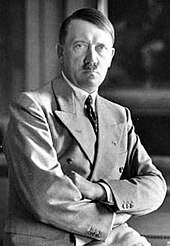
Adolf Hitler

Bundesarchiv, Bild 146-1990-048-29A / CC-BY-SA 3.0 [CC BY-SA 3.0 de (https://creativecommons.org/licenses/by-sa/3.0/de/deed.en)%5D

But his single greatest protection–he claimed–was an instinct for danger. He would suddenly change his schedule–to drop in where he was least expected. Or suddenly depart an event where he was expected to stay a long time.

On November 9, 1939, this instinct saved his life. 

He had been set to give a long speech at a Munich beer hall before the “Old Fighters” of his storm troopers.

Sixteen years earlier on that day, in 1923, Hitler had led them in a disastrous attempt to overthrow the Bavarian government. Police had put down the effort, killing and wounding about a score of storm troopers in the process.

Hitler himself had later been arrested, tried and convicted for treason–and sentenced to a year’s imprisonment.

But instead of proving to be the end of Nazism, the “Beer Hall Putsch” turned Hitler into a national celebrity.  And it launched his career as a legitimate, ultimately successful politician.

So Hitler was expected to speak to his longtime supporters for a long time that evening. Instead, he suddenly cut short his speech and left the beer hall. Forty-five minutes later, a bomb exploded inside a pillar–before which Hitler had been speaking.

Since then, a series of other assassination attempts had been made against Hitler. All of them involved time-bombs. And all of the would-be assassins were members of the German General Staff.

In one case, a bomb secretly stashed aboard Hitler’s plane failed to explode. In another, an officer who had a bomb strapped to himself unexpectedly found his scheduled meeting with Hitler called off. He had to rush into a bathroom to defuse the bomb before it went off.

So now it was the turn of von Stauffenberg.  He would carry his bomb–hidden in a briefcase–into a “Hitler conference” packed with military officers.

But Stauffenberg didn’t intend to be a suicide bomber. He meant to direct the government that would replace that of the Nazis.

His bomb–also rigged with a time-fuse–would be left in the conference room while he found an excuse to leave. After the explosion, he would phone one of his fellow conspirators with the news.

Then, the coup–“Operation Valkyrie”–would be on.

Anti-Nazi conspirators would seize control of key posts of the government. The British and Americans would then be informed of Germany’s willingness to surrender. Provided, of course, that the vengeance-seeking Russians did not have a say in its postwar future.

The Wehrmacht and Schutzstaffel (SS) had killed millions of Russians. Many had died in combat. Others had been murdered as captives. Still more had been allowed to die by starvation and exposure to the notorious Russian winter.

So the Germans–both Nazi and anti-Nazi–knew what they could expect if soldiers of the Soviet Union reached German soil.

On July 20, 1944, Stauffenberg appeared at Hitler’s well-guarded military headquarters in East Prussia.  Like all his other outposts, Hitler had named it–appropriately enough–“Wolf’s Lair.” 

“Wolf’s Lair”

Stauffenberg entered the large, concrete building while the conference was in session.  He placed his yellow briefcase next to Hitler–who was standing with his generals at a heavy oaken table. Then he excused himself to take an “urgent” phone call.

At 12:42 p.m. on July 20, 1944, Stauffenberg’s briefcase bomb erupted.  

But, as if by a miracle, Hitler–and the Third Reich–survived. 
PRE-EMPTING DISASTER: PART ONE (OF THREE)

In Bureaucracy, History, Military, Politics, Social commentary on February 29, 2016 at 10:31 am

“When Fascism comes to America, it will be called anti-Fascism.”
–Huey Long, Louisiana Governor/Senator

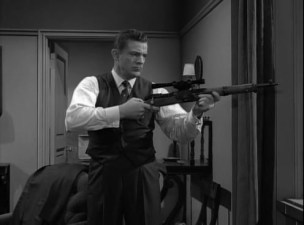
In the “Twilight Zone” episode, “No Time Like the Past,” Paul Driscoll (Dana Andrews), a scientist in early 1960s America, uses a time machine to visit Nazi Germany on the eve of World War II. 

He’s rented a motel room overlooking the balcony from where the Fuehrer, Adolf Hitler will soon make a speech. And he’s eager to watch that speech–through the lens of a telescopic-sighted rifle.  

Just as he’s about to pull the trigger, there’s a knock at his door–by the maid. Driscoll hustles her out as soon as possible, then once again picks up his rifle. He–and viewers–can once again see Hitler through the cross-hairs of his weapon.  

Paul Driscoll prepares to shoot Adolf Hitler

But instead of the anticipated shot, there’s another knock at his door–this time by the black-uniformed secret police, the SS. Driscoll knows the game is over, and disappears into the present just as the thugs break down his door.  

And the audience is left to ponder how different the world would have been if Driscoll–or someone in Nazi Germany–had succeeded in assassinating the man whose wars would wipe out the lives of 50 million men, women and children around the globe.  

At least one Republican candidate for President has dared to invoke the past of Nazi Germany in warning of the dangers of a Donald Trump Presidency. And to argue that Americans have a chance to prevent that past from returning.  

In November, 2015, John Kasich, the governor of Ohio, was peddling a message of creating jobs, balancing the Federal budget and disdain for Washington, D.C.  

Related image

John Kasich

But he remained far behind in the polls, dropping 50% in support in just one month–from September to October. Meanwhile, Trump, the New York billionaire developer, was being backed by 25% of Republican primary voters.  

So, with nothing to lose, Kasich decided to take off the gloves. He invoked the “N” word for Republicans: Nazi.  

He authorized the creation of a TV ad that opened with ominous music–and the face of a snarling Donald Trump.

“I would like anyone who is listening to consider some thoughts that I’ve paraphrased from the words of German pastor Martin Niemoeller.” 

The voice belonged to Tom Moe, a retired colonel in the U.S. Air Force–and a former Vietnam prisoner-of-war.

“You might not care if Donald Trump says Muslims must register with the government, because you’re not one,” continued Moe. 

“And you might not care if Donald Trump says he’s going to round up all the Hispanic immigrants, because you’re not one. 

Related image

Donald Trump

“And you might not care if Donald Trump says it’s OK to rough up black protesters, because you’re not one. 

“And you might not care of Donald Trump wants to suppress journalists, because you’re not one.

“But think about this: 

“If he keeps going, and he actually becomes President, he might just get around to you. And you’d better hope that there’s someone left to help you.”  

Martin Niemoeller (1892–1984) was a prominent Protestant pastor who had commanded a U-boat during World War 1. He became a bitter public foe of Adolf Hitler.

A staunch anti-Communist, he had initially supported the Nazis as Germany’s only hope of salvation against the Soviet Union.

But when the Nazis made the church subordinate to State authority, Niemoeller created the Pastors’ Emergency League to defend religious freedom. 

For his opposition to the Third Reich,  Niemoeller spent seven years in concentration camps.

With the collapse of the Reich in 1945, he was freed–and elected President of the Protestant church in Hesse and Nassau in 1947. During the 1960s, he was a president of the World Council of Churches.

He is best remembered for his powerful condemnation of the failure of Germans to protest the increasing oppression of the Nazis:

First they came for the Communists, but I was not a Communist, so I did not speak out.

Then they came for the Socialists, but I was not a Socialist, so I did not speak out.

Then they came for the trade unionists, but I was not a trade unionist, so I did not speak out.

Then they came for the Jews, but I was not a Jew, so I did not speak out.

And when they came for me, there was no one left to speak out for me.

Neither “Adolf Hitler” nor “Nazi Party” was mentioned during the one-minute Kassich video. But a furious Trump threatened to sue Kasich if he could find find anything “not truthful” within the ad.

So said the man who has called Mexican immigrants “rapists” and accused President Barack Obama of being a Muslim and an illegal alien.

The Kasich ad is by far the darkest attack so far made against Trump by any candidate–Republican or Democrat. And it raises a disturbing question:

If Donald Trump is America’s Adolf Hitler, who will be its Claus von Stauffenberg? 

Colonel Claus Schenk von Stuaffenberg was the German army officer who, on July 20, 1944, tried to assassinate Adolf Hitler. 

WHY KIM JONG-UN SHOULD BE AFRAID

In Bureaucracy, Entertainment, History, Military, Politics on December 30, 2014 at 12:02 am

According to an October 29 story on National Public Radio, at least 10 North Korean officials have been executed for watching South Korean soap operas.

If true, this brings to 50 the number of people murdered by North Korean dictator Kim Jong-Un for committing this “crime”.

Kim Jong-Un and his generals

Kim inherited control of the country after his father, Kim Jong-Il, died in 2011.  Since then, he has ruthlessly eliminated all possible opposition.

“Kim Jong-Un is trying to establish absolute power and strengthen his regime with public punishments,” Yang Moo Jin, a professor at the University of North Korean Studies in Seoul, told Bloomberg News. “However, frequent purges can create side effects.”

Niccolo Machiavelli, the father of political science, couldn’t have said it better.

Niccolo Machiavelli

In fact, Machiavelli did say it–in Chapter Eight of The Prince, his famous work on the realities of politics, he warned:

“…In taking a state, the conqueror must arrange to commit all his cruelties at once, so as not to have to recur to them very day, and so as to be able, by not making fresh changes, to reassure people and win them over by benefiting them.  

Whoever acts otherwise, either through timidity or bad counsels, is always obliged to stand with knife in hand, and can never depend on his subjects, because they, owing to continually fresh injuries, are unable to depend upon him.”

Another Communist dictator–Joseph Stalin–may have paid the price for violating this counsel.

Joseph Stalin

Throughout his 30-year reign over the Soviet Union, Stalin was responsible for the deaths of at least 20 million men, women and children.

These deaths resulted from executions, a man-made famine through the forced collectivation of harvests, deportations and imprisonment in Gulag camps.

Robert Payne, the British historian, vividly portrayed the crimes of this murderous tyrant in his brilliant 1965 biography, The Rise and Fall of Stalin.

According to Payne, Stalin–who died on March 5, 1953–was planning yet another purge during the last weeks of his life.  This would be “a holocaust greater than any he had planned before.

“The chistka [purge] had become a ritual like a ceremonial cleansing of a temple performed every three or four years according to ancient laws.

“The first chistka had taken place during the early months of the [Russian] revolution.  It had proved so salutory that periodical bloodbaths were incorporated in the unwritten laws of the state.

“This time there would be a chistka to end all chistkas, a purging of the entire body of the state from top to bottom.  No one, not even the highest officials, was to be spared.

“…The men who had been his closest companions and most willing executioners, would be the first to fall, followed by the leaders of the second rank, then of the third and fourth…until there was no one in the entire country who had not felt the touch of the healing knife.”

Then, on January 13, 1953, the Soviet Union’s two government-controlled newspapers–Pravda (“Truth”) and Izvestiya (“News”)–announced that a sinister plot by Jewish doctors had been uncovered.

Its alleged object: No less than the murder of Joseph Stalin himself.

Nine doctors, said Pravda, had so far been arrested.

Stalin’s closest associates–veteran observers of past purges–quickly realized that another was about to descend.  And there could be no doubt who its chief victims would be.

Yet Stalin did nothing to calm their fears. He often summoned his “comrades” to the Kremlin for late-night drinking bouts, where he freely humiliated them.

“What would you do without Stalin?” he asked one night.  “You’d be like blind kittens.”

Then, on March 4, 1953, Moscow Radio announced “the misfortune which has overtaken our Party and the people–the serious illness of Comrade J.V. Stalin.

“During the night of March 1-2, while in his Moscow apartment, Comrade Stalin suffered a cerebral hemorrhage affecting vital areas of the brain.”

Death came to Stalin on March 5.

Officially, the cause was ruled a cerebral hemorrhage.  Stalin was 73 and in poor health from a lifetime of smoking and little exercise.

So it’s possible he died of natural causes.  But it’s equally possible that he died of unnatural ones.

In the 2004 book, Stalin’s Last Crime, Vladimir P. Naumov, a Russian historian, and Jonathan Brent, a Yale University Soviet scholar, assert that he might have been poisoned.

If this happened, the occasion was during a final dinner with four members of the Politburo:

  • Lavrenti P. Beria, chief of the secret police, then known as the MGB (Ministry for State Security);
  • Georgi M. Malenkov, Stalin’s immediate successor;
  • Nikita S. Khrushchev, who eventually rose to the top spot;
  • and Nikolai Bulganin, then Minister of Defense.

The authors believe that, if Stalin was poisoned, the most likely suspect was Beria. And the method: Slipping warfarin, a tasteless and colorless blood thinner also used as a rat killer, into his glass of wine.

Lavrenti P. Peria

In Khrushchev’s 1970 memoirs, he quotes Beria as telling Vyacheslav M. Molotov, another Polituro member, two months after Stalin’s death: “I did him in! I saved all of you.”

Kim Jong-Un had better hope that Communist history doesn’t repeat itself.

ADVICE FOR A DICTATOR

In Bureaucracy, History, Politics on October 30, 2014 at 3:18 pm

According to an October 29 story on National Public Radio, at least 10 North Korean officials have been executed for watching South Korean soap operas.

If true, this brings to 50 the number of people murdered by North Korean dictator Kim Jong-Un for committing this “crime”.

Kim Jong-Un and his generals

Sources for Bloomberg News speculated they were likely purged for having close ties to his uncle, Jang Song Thae, who was executed in 2013.

Kim inherited control of the country after his father, Kim Jong-Il, died in 2011.  Since then, he has ruthlessly eliminated all possible opposition.

“Kim Jong Un is trying to establish absolute power and strengthen his regime with public punishments,” Yang Moo Jin, a professor at the University of North Korean Studies in Seoul, told Bloomberg. “However, frequent purges can create side effects.”

Niccolo Machiavelli, the father of political science, couldn’t have said it better.

Niccolo Machiavelli

In fact, Machiavelli did say it–in Chapter Eight of The Prince, his famous work on the realities of politics, he tackled the subject: “Of Those Who Have Attained the Position of Prince by Villany.”

“…In taking a state, the conqueror must arrange to commit all his cruelties at once, so as not to have to recur to them very day, and so as to be able, by not making fresh changes, to reassure people and win them over by benefiting them.  

Whoever acts otherwise, either through timidity or bad counsels, is always obliged to stand with knife in hand, and can never depend on his subjects, because they, owing to continually fresh injuries, are unable to depend upon him.”

Another Communist dictator–Joseph Stalin–may have paid the price for violating this counsel.

Joseph Stalin

Throughout his 30-year reign over the Soviet Union, Stalin was responsible for the deaths of at least 20 million men, women and children.

These deaths resulted from executions, a man-made famine through the forced collectivation of harvests,  deportations and imprisonment in Gulag camps.

Robert Payne, the British historian, vividly portrayed the crimes of this murderous tyrant in his brilliant 1965 biography, The Rise and Fall of Stalin.

According to Payne, Stalin–who died on March 5, 1953–was planning yet another purge during the last weeks of his life.  This would be “a holocaust greater than any he had planned before.

“The chistka [purge] had become a ritual like a ceremonial cleansing of a temple performed every three or four years according to ancient laws.

“The first chistka had taken place during the early months of the [Russian] revolution.  It had proved so salutory that periodical bloodbaths were incorporated in the unwritten laws of the state.

“This time there would be a chistka to end all chistkas, a purging of the entire body of the state from top to bottom.  No one, not even the highest officials, was to be spared.

“…The men who had been his closest companions and most willing executioners, would be the first to fall, followed by the leaders of the second rank, then of the third and fourth…until there was no one in the entire country who had not felt the touch of the healing knife.”

Then, on January 13, 1953, the Soviet Union’s two government-controlled newspapers–Pravda (“Truth”) and Izvestiya (“News”)–announced that a siniser plot by Jewish doctors had been uncovered.

Its alleged object: No less than the murder of Joseph Stalin himself.

Nine doctors, said Pravda, had so far been arrested.

Stalin’s closest associates–veteran observers of past purges–quickly realized that another was about to descend.  And there could be no doubt who its chief victims would be.

Yet Stalin did nothing to calm their fears. He often summoned his “comrades” to the Kremlin for late-night drinking bouts, where he freely humiliated them.

“What would you do without Stalin?” he asked one night.  “You’d be like blind kittens.”

Then, on March 4, 1953, Moscow Radio announced “the misfortune which has overtaken our Party and the people–the serious illness of Comrade J.V. Stalin.

“During the night of March 1-2, while in his Moscow apartment, Comrade Stalin suffered a cerebral hemorrhage affecting vital areas of the brain.”

Death came to Stalin on March 5. Officially, the cause was ruled a cerebral hemorrhage.  Stalin was 73 and in poor health from a lifetime of smoking and little exercise.

So it’s possible he died of natural causes.

But it’s equally possible that he died of unnatural ones.

In the 2004 book, Stalin’s Last Crime, Vladimir P. Naumov, a Russian historian, and Jonathan Brent, a Yale University Soviet scholar, assert that he might have been poisoned.

If this happened, the occasion was during a final dinner with four members of the Politburo:  Lavrenti P. Beria, chief of the secret police; Georgi M. Malenkov, Stalin’s immediate successor; Nikita S. Khrushchev, who eventually rose to the top spot; and Nikolai Bulganin.

The authors believe that, if Stalin was poisoned, the most likely suspect was Beria. And the method: Slipping warfarin, a tasteless and colorless blood thinner also used as a rat killer, into his glass of wine.

Lavrenti P. Peria

In Khrushchev’s 1970 memoirs, he quotes Beria as telling Vyacheslav M. Molotov, another Polituro member, two months after Stalin’s death: “I did him in! I saved all of you.”

Kim Jong Un had better hope that Communist history doesn’t repeat itself.