Posts Tagged ‘ROBERT F. KENNEDY’
2016 PRESIDENTIAL RACE, ABC NEWS, ALTERNET, AMERICABLOG, AP, BABY BOOMER RESISTANCE, BBC, BERNIE SANDERS, BLOOD FEUD, BLOOMBERG NEWS, BROTHERS: THE HIDDEN HISTORY OF THE KENNEDY YEARS, BUZZFEED, CARLOS MARCELLO, CBS NEWS, CIA, CNN, COTTER SMITH, CROOKS AND LIARS, CUBA, DAILY KOS, DAVID TALBOT, DONALD TRUMP, ERNEST BORGNINE, FBI, FIDEL CASTRO, FIVETHIRTYEIGHT, GUS RUSSO, HARPER’S MAGAZINE, HILLARY CLINTON, HUFFINGTON POST, INTERNATIONAL BROTHERHOOD OF TEAMSTERS, J. EDGAR HOOVER, JAMES R. HOFFA, JUSTICE DEPARTMENT, LIVE BY THE SWORD: THE SECRET WAR AGAINST CASTRO AND THE DEATH OF JFK, MAFIA, MEDIA MATTERS, MOTHER JONES, MOVEON, MSNBC, NBC NEWS, NEW REPUBLIC, NEWSDAY, NEWSWEEK, NPR, PBS NEWSHOUR, POLITICO, POLITICUSUSA, RAFAEL EDWARD CRUZ, RAW STORY, REUTERS, ROBERT BLAKE, ROBERT F. KENNEDY, SALON, SAM GROOM, SEATTLE TIMES, Secret Service, SENATE LABOR RACKETS COMMITTEE, SLATE, TALKING POINTS MEMO, THE ATLANTIC, THE CHICAGO SUN-TIMES, THE CHICAGO TRIBUNE, THE DAILY BEAST, THE DAILY BLOG, THE GUARDIAN, THE HILL, THE HUFFINGTON POST, THE INTERCEPT, THE LOS ANGELES TIMES, THE NATION, THE NEW REPUBLIC, THE NEW YORK TIMES, THE NEW YORKER, THE VILLAGE VOICE, THE WALL STREET JOURNAL, THE WASHINGTON POST, THINKPROGRESS, TIME, TRUTHDIG, TRUTHOUT, TWITTER, U.S. NEWS & WORLD REPORT, UPI
In Bureaucracy, History, Law, Law Enforcement, Politics, Social commentary on April 25, 2016 at 12:10 am
The 1983 TV mini-series, Blood Feud, chronicles the decade-long struggle between Robert F. Kennedy (Cotter Smith) and James R. Hoffa (Robert Blake), president of the International Brotherhood of Teamsters Union.
With Kennedy as Attorney General and facing relentless pressure from the Justice Department, the Mafia despairs of a solution. At a swanky restaurant, several high-ranking Mafiosi agree that “something” must be done.
On November 22, 1963, President John F. Kennedy is assassinated in Dallas, Texas.
Blood Feud clearly implies that the Mafia was responsible.
[The House Assassinations Committee investigated this possibility in 1978, and determined that Carlos Marcello, the Mafia boss of New Orleans, had the means, motive and opportunity to kill JFK. But it could not find any conclusive evidence of his involvement.]
Even with the President dead, RFK’s Justice Department continues to pursue Hoffa. In 1964, he is finally convicted of jury tampering and sentenced to 13 years’ imprisonment.
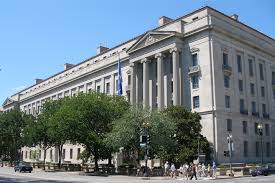
U.S. Department of Justice
Hoping to avoid prison, Hoffa phones Robert Kennedy, offering future Teamsters support if RFK runs for President. To prove he can deliver, he tells Kennedy that the Teamsters have even penetrated the FBI.
[In March, 1964, Kennedy met with Hoffa on an airfield at Dulles International Airport in Washington, D.C. He was accompanied by two Secret Service agents from the detail assigned to ex-First Lady Jacqueline Kennedy.
[FBI Director J. Edgar Hoover, no longer afraid to cross RFK, had withdrawn the agents previously assigned to guard Kennedy.
[Accompanying Hoffa were two muscular bodyguards–at least one of whom was packing two pistols in shoulder holsters.
[While the Secret Service agents watched from a respectful distance, Kennedy spoke quietly with Hoffa. The Attorney General showed a document to Hoffa, and the Teamsters leader at times nodded or shook his head.
[The agents drove Kennedy back to Washington. During the ride, he said nothing about the reason for the meeting.
[David Talbot, in his book, Brothers: The Hidden History of the Kennedy Years, speculates that it could have been to discuss Hoffa’s conviction for jury tampering.
[But Gus Russo–author of Live By the Sword: The Secret War Against Castro and the Death of JFK–writes that the reason might have been Dallas.
[Perhaps, he speculates, RFK had wanted to look into Hoffa’s eyes while asking him: Did you have anything to do with the assassination? RFK had, in fact, done this with CIA Director John McCone almost immediately after his brother’s death.]
In Blood Feud, Kennedy confronts J. Edgar Hoover (Ernest Borgnine) and accuses him of illegally planting wiretaps in Mob hangouts all over the country.
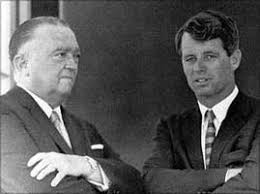
J. Edgar Hoover and Robert F. Kennedy
Hoover retorts that this had been the only way to obtain the prosecution-worthy intelligence Kennedy had demanded: “You loved that flow of information. You didn’t want it to stop.”
Kennedy: Why did you keep the FBI out of the fight against the Mob for decades?
Hoover: “Every agency that came to grips with them got corrupted by their money.”
[So far as is known, Hoover never made any such confession. Historians continue to guess his reason for leaving the Mob alone for decades.]
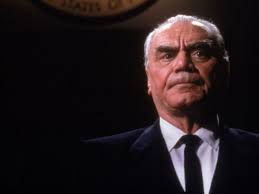

Ernest Borgnine as J. Edgar Hoover
RFK then mentions the CIA’s plots to employ the Mob to assassinate Cuban dictator Fidel Castro
[The agency had wanted to please President Kennedy, and the Mafia had wanted to regain its casinos lost to the Cuban Revolution. The role the Kennedy brothers played in the CIA’s assassination plots remains murky, and has been the subject of endless speculation.]
“The CIA, doing business with the Mob,” says Kennedy. “The FBI, leaking information to its enemies [the Teamsters].” Then, sadly: “I guess it’s true–everyone does business with everyone.”
[So far as is known, the FBI did not pass on secrets to the Teamsters. But during the 1970s, the Mafia penetrated the Cleveland FBI office through bribes to a secretary. Several FBI Mob informants were “clipped” as a result.]
In 1967, Hoffa goes to prison. He stays there until, in 1971, President Richard Nixon commutes his sentence in hopes of gaining Teamsters’ support for his 1972 re-election.
Kennedy leaves the Justice Department in 1964 and is elected U.S. Senator from New York. In 1968 he runs for President. On June 5, after winning the California primary, he’s assassinated.
In Blood Feud, just before his assassination, RFK asks: “How will I ever really know if the Mob killed Jack because of my anti-Mob crusade?”
Hoffa schemes to return to the presidency of the Teamsters–a post now held by his successor, Frank Fitzsimmons. He runs the union in a more relaxed style than Hoffa, thus giving the Mob greater control over its pension fund.
And the Mafia likes it that way.
On July 30, 1975, Hoffa disappears from the parking lot of the Machus Red Fox Restaurant near Detroit. He had gone there to meet with two Mafia leaders.
Almost 41 years after the death of James R. Hoffa, and almost 48 years after that of Robert F. Kennedy:
- Labor unions are a shadow of their former power.
- The threat they once represented to national prosperity has been replaced by that of predatory corporations like Enron and AIG.
- The war RFK began on the Mafia has continued, sending countless mobsters to prison.
- Millions of Americans who once expected the Federal Government to protect them from crime now believe the Government is their biggest threat.
- The idealism that fueled RFK’s life has virtually disappeared from politics.
2016 PRESIDENTIAL RACE, ABC NEWS, ABCNEWS, ALTERNET, AMERICABLOG, AP, BABY BOOMER RESISTANCE, BBC, BERNIE SANDERS, BLOOD FEUD, BLOOMBERG NEWS, BROTHERS: THE HIDDEN HISTORY OF THE KENNEDY YEARS, BUZZFEED, CARLOS MARCELLO, CBS NEWS, CIA, CNN, COTTER SMITH, CROOKS AND LIARS, CUBA, DAILY KOS, DAVID TALBOT, DONALD TRUMP, ERNEST BORGNINE, FBI, FIDEL CASTRO, FIVETHIRTYEIGHT, GUS RUSSO, HARPER’S MAGAZINE, HILLARY CLINTON, HUFFINGTON POST, INTERNATIONAL BROTHERHOOD OF TEAMSTERS, J. EDGAR HOOVER, JAMES R. HOFFA, JOHN F. KENNEDY, JUSTICE DEPARTMENT, LIVE BY THE SWORD: THE SECRET WAR AGAINST CASTRO AND THE DEATH OF JFK, MAFIA, MEDIA MATTERS, MOTHER JONES, MOVEON, MSNBC, NBC NEWS, NEW REPUBLIC, NEWSDAY, NEWSWEEK, NPR, PBS NEWSHOUR, POLITICO, POLITICUSUSA, RAFAEL EDWARD CRUZ, RAW STORY, REUTERS, ROBERT BLAKE, ROBERT F. KENNEDY, SALON, SAM GROOM, SEATTLE TIMES, Secret Service, SENATE LABOR RACKETS COMMITTEE, SLATE, TALKING POINTS MEMO, THE ATLANTIC, THE CHICAGO SUN-TIMES, THE CHICAGO TRIBUNE, THE DAILY BEAST, THE DAILY BLOG, THE GUARDIAN, THE HILL, THE HUFFINGTON POST, THE INTERCEPT, THE LOS ANGELES TIMES, THE NATION, THE NEW REPUBLIC, THE NEW YORK TIMES, THE NEW YORKER, THE VILLAGE VOICE, THE WALL STREET JOURNAL, THE WASHINGTON POST, THINKPROGRESS, TIME, TRUTHDIG, TRUTHOUT, TWITTER, U.S. NEWS & WORLD REPORT, UPI
In Bureaucracy, History, Law, Law Enforcement, Politics, Social commentary on April 22, 2016 at 12:10 am
The 1983 TV mini-series, Blood Feud, chronicles the decade-long struggle between Robert F. Kennedy and James R. Hoffa.
Having “helped” Kennedy (Cotter Smith) to oust corrupt Teamsters President Dave Beck, Hoffa (Robert Blake) believes that Kennedy should now be satisfied: “He’s got his scalp. Now he can move on to other things while I run the union.”
But Hoffa has guessed wrong–with fatal results. Realizing that he’s been “played” by Hoffa, a furious Kennedy strikes back.
He orders increased surveillance of Hoffa and his topmost associates. He subpoenas union records and members of both the Teamsters and the Mafia to appear before his committee in public hearings.
And he tries to enlist the aid of legendary FBI Director J. Edgar Hoover (Ernest Borgnine). But Hoover wants no part of a war against organized crime, whose existence he refuses to admit.

Meanwhile, Kennedy’s confrontations with Hoffa grow increasingly fierce. In open hearings, Kennedy accuses Hoffa of receiving kickbacks in the name of his wife. Hoffa damns him for “dirtying my wife’s name.”
Kennedy secures an indictment against Hoffa for hiring a spy to infiltrate the Senate Labor Rackets Committee. He’s so certain of a conviction that he tells the press he’ll “jump off the Capitol building” if Hoffa beats the rap.
But Hoffa’s lawyer, Edward Bennett Williams (Jose Ferrer) puts Kennedy himself on the witness stand. There he portrays Kennedy as a spoiled rich man who’s waging a vendetta against Hoffa.
Hoffa beats the rap, and offers to send Kennedy a parachute. But he jokingly warns reporters: “Hey, Bobby, you better have it checked. I don’t trust myself!”
By 1959, Robert Kennedy’s work as chief counsel for the Senate Labor Rackets Committee is over. But not his determination to send Teamsters President James Hoffa to prison.
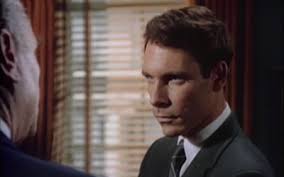
Cotter Smith as Robert Kennedy
Throughout 1960, he manages the Presidential campaign for his brother, John F. Kennedy (Sam Groom). By a margin of only 100,000 votes, JFK wins the election.
Hoffa thinks that his troubles are over, that “Bobby” will move on to other pursuits and forget about the Teamsters.
Hoffa is partly right: Kennedy moves on to another job. But it’s the office of United States Attorney General.
JFK, needing someone in the Cabinet he can trust completely, browbeats Robert into becoming the the nation’s top cop.
For Hoffa, it’s a nightmare come true.
As Attorney General, Kennedy no longer has to beg J. Edgar Hoover to attack organized crime. He can–and does–order him to do so.
Throughout the country, the Mafia feels a new heat as FBI agents plant illegal electronic microphones (“bugs”) in their innermost sanctums. Agents openly tail mobsters–and send them to prison in large numbers.
And Kennedy sets up a special unit, composed of topflight prosecutors and investigators, to go after just one man: James Riddle Hoffa. The press comes to call it the “Get Hoffa” squad.
Hoffa continues to beat federal prosecutors in court. But he believes he’s under constant surveillance by the FBI, and his nerves are starting to crack.
Convinced that the FBI has bugged his office, he literally tears apart the room, hoping to find the bug. But he fails to do so.
What he doesn’t know is he’s facing a more personal danger–from one of his closest associates.
He tells a trusted colleague, Edward Grady Partin (Brian Dennehy) how easy it would be to assassinate Kennedy with a rifle or bomb.
Later, Partin gets into a legal jam–and is abandoned by the Teamsters. Hoping to cut a deal, he relays word to the Justice Department of Hoffa’s threats against the Attorney General.
Now working for the Justice Department, Partin sends in reports on Hoffa’s juror-bribing efforts in yet another trial. Hoffa again beats the rap–but now Kennedy has the insider’s proof he needs to put him away for years.
Meanwhile, the Mafia despairs of the increasing pressure of the Justice Department. At a swanky restaurant, several high-ranking members agree that “something” must be done.
[Although this scene is fictional, it’s clearly based on an infamous outburst of Carlos Marcello, the longtime Mafia boss of New Orleans.
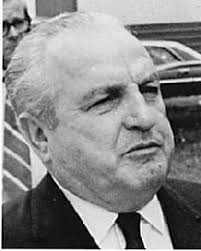
Carlos Marcello
[In 1961, Marcello was deported to his native Guatemala on orders by RFK. After illegally re-entering the country, he swore vengeance against the Attorney General.
[In September, 1962, during a meeting with several mob colleagues, he flew into a rage when someone mentioned Kennedy.
“Take the stone out of my shoe!” he shouted, echoing a Sicilian curse. “Don’t you worry about that little Bobby sonofabitch. He’s going to be taken care of!”
[When one of his colleagues warned that murdering RFK would trigger the wrath of his brother, President John F.Kennedy, Marcello replied: “In Sicily they say if you want to kill a dog you don’t cut off the tail. You go for the head.”
[Marcello believed that the death of President Kennedy would render the Attorney General powerless. And he added that he planned to use a “nut” to do the job.]
On November 22, 1963, President John F. Kennedy is assassinated in Dallas, Texas.
Blood Feud clearly implies that the Mafia was responsible.
2016 PRESIDENTIAL RACE, ABC NEWS, ALTERNET, AMERICABLOG, AP, BABY BOOMER RESISTANCE, BBC, BERNIE SANDERS, BLOOD FEUD, BLOOMBERG NEWS, BROTHERS: THE HIDDEN HISTORY OF THE KENNEDY YEARS, BUZZFEED, CARLOS MARCELLO, CBS NEWS, CIA, CNN, COTTER SMITH, CROOKS AND LIARS, CUBA, DAILY KOS, DAVID TALBOT, DONALD TRUMP, ERNEST BORGNINE, FBI, FIDEL CASTRO, FIVETHIRTYEIGHT, GUS RUSSO, HARPER’S MAGAZINE, HILLARY CLINTON, HUFFINGTON POST, INTERNATIONAL BROTHERHOOD OF TEAMSTERS, J. EDGAR HOOVER, JAMES R. HOFFA, JOHN F. KENNEDY, JUSTICE DEPARTMENT, LIVE BY THE SWORD: THE SECRET WAR AGAINST CASTRO AND THE DEATH OF JFK, MAFIA, MEDIA MATTERS, MOTHER JONES, MOVEON, MSNBC, NBC NEWS, NEW REPUBLIC, NEWSDAY, NEWSWEEK, NPR, PBS NEWSHOUR, POLITICO, POLITICUSUSA, RAFAEL EDWARD CRUZ, RAW STORY, REUTERS, ROBERT BLAKE, ROBERT F. KENNEDY, SALON, SAM GROOM, SEATTLE TIMES, Secret Service, SENATE LABOR RACKETS COMMITTEE, SLATE, TALKING POINTS MEMO, THE ATLANTIC, THE CHICAGO SUN-TIMES, THE CHICAGO TRIBUNE, THE DAILY BEAST, THE DAILY BLOG, THE GUARDIAN, THE HILL, THE HUFFINGTON POST, THE INTERCEPT, THE LOS ANGELES TIMES, THE NATION, THE NEW REPUBLIC, THE NEW YORK TIMES, THE NEW YORKER, THE VILLAGE VOICE, THE WALL STREET JOURNAL, THE WASHINGTON POST, THINKPROGRESS, TIME, TRUTHDIG, TRUTHOUT, TWITTER, U.S. NEWS & WORLD REPORT, UPI
In Bureaucracy, History, Law, Law Enforcement, Politics, Social commentary on April 21, 2016 at 12:37 pm
Today, America has four major candidates running for President: Donald Trump, Rafael Edward Cruz, Hillary Clinton and Bernie Sanders.
Trump is a billionaire businessman; Cruz is a U.S. Senator from Texas; Clinton is a former First Lady, U.S. Senator and Secretary of State; and Sanders is a U.S. Senator from Vermont.
Despite the great differences in their backgrounds, they all share one thing in common: Extremely high negatives among voters.
But 48 years ago, Senator Robert Francis Kennedy aroused passions of an altogether different sort.
Kennedy had been a United States Attorney General (1961-1964) and Senator (1964-1968). But it was his connection to his beloved and assassinated brother, President John F. Kennedy, for which he was best known.

Robert F. Kennedy campaigning for President
Millions saw RFK as the only candidate who could make life better for America’s impoverished–while standing firmly against those who threatened the Nation’s safety.
As television correspondent Charles Quinn observed: “I talked to a girl in Hawaii who was for [George] Wallace [the segregationist governor of Alabama]. And I said ‘Really?’ [She said] ‘Yeah, but my real candidate is dead.’
“You know what I think it was? All these whites, all these blue collar people who supported Kennedy…all of these people felt that Kennedy would really do what he thought best for the black people, but, at the same time, would not tolerate lawlessness and violence.
“They were willing to gamble…because they knew in their hearts that the country was not right. They were willing to gamble on this man who would try to keep things within reasonable order; and at the same time do some of the things they knew really should be done.”
Campaigning for the Presidency in 1968, RFK had just won the crucial California primary on June 4–when he was shot in the back of the head. His killer: Sirhan Sirhan, a young Palestinian furious at Kennedy’s support for Israel.
On June 8, 1,200 men and women boarded a specially-reserved passenger train at New York’s Pennsylvania Station. They were accompanying Kennedy’s body to its final resting place at Arlington National Cemetery.
As the train slowly moved along 225 miles of track, throngs of men, women and children lined the rails to pay their final respects to a man they considered a genuine hero.
Little Leaguers clutched their baseball caps across their chests. Uniformed firemen and policemen saluted. Burly men in shirtsleeves held hardhats over their hearts. Black men in overalls waved small American flags. Women from all levels of society stood and cried.

A nation says goodbye to Robert Kennedy
Commenting on RFK’s legacy, historian William L. O’Neil wrote in Coming Apart: An Informal History of America in the 1960′s:
“…He aimed so high that he must be judged for what he meant to do, and, through error and tragic accident, failed at….He will also be remembered as an extraordinary human being who, though hated by some, was perhaps more deeply loved by his countrymen than any man of his time.
“That too must be entered into the final account, and it is no small thing. With his death something precious disappeared from public life.”
Eleven years earlier, as a young, idealistic attorney, Kennedy had declared war on James Riddle Hoffa, the president of the Mafia-dominated International Brotherhood of Teamsters Union.
As chief counsel for the Senate Labor Rackets Committee, Kennedy was appalled at the corruption he discovered among high-ranking Teamster officials. As he saw it, under Hoffa’s leadership, the union was nothing less than “a conspiracy of evil.”
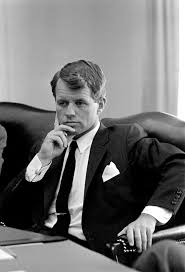
Robert Francis Kennedy as Chief Counsel, Senate Labor Rackets Committee
Hoffa, in turn, held an equally unflattering view of Kennedy. “A rich punk,” said Hoffa, who didn’t know or care about “the average workingman.”
In 1983, Blood Feud, a two-part TV mini-series, depicted the 11-year animosity between Kennedy and Hoffa. Although it took some dramatic liberties, its portrayal of the major events of that period remains essentially accurate.
Today, labor unions are a rapidly-vanishing species, commanding far less political influence than they did 50 years ago. As a result, young viewers of this series may find it hard to believe that labor ever held such sway, or that the Teamsters posed such a threat.
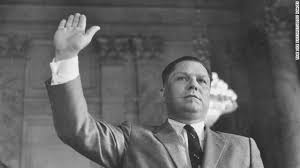
James Riddle Hoffa testifying before the Senate Labor Rackets Committee
And in an age when millions see “Big Government” as the enemy, they may feel strong reservations about the all-out war that Robert F. Kennedy waged against Hoffa.
Blood Feud opens in 1957, when Hoffa (Robert Blake) is a rising figure within the Teamsters. Kennedy (Cotter Smith) is chief counsel for the Senate Labor Rackets Committee.
At first, Hoffa tries to ingratiate himself with Kennedy, telling him: “I know everybody who can help me and anybody who can hurt me.”
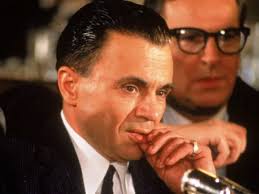
Robert Blake as James R. Hoffa
A wily Hoffa decides to parley Kennedy’s anti-corruption zeal into a path to power for himself. Via his attorney, Eddie Cheyfitz, he feeds Kennedy incriminating evidence against Dave Beck, president of the Teamsters.
Confronted with a Senate subpoena, Beck flees the country–paving the way for Hoffa to assume the top position in the union. Hoffa believes he has solved two problems at once.
ABC NEWS, BENJAMIN C. BRADLEE, BLACKMAIL, CBS NEWS, CNN, DENNIS HASTERT, DUKE OF WELLINGTON, FACEBOOK, FBI, J. EDGAR HOOVER, JOHN F. KENNEDY, JUDITH CAMPBELL, MAFIA, NAPOLEON BONAPARTE, NBC NEWS, REPUBLICANS, ROBERT F. KENNEDY, SAM GIANCANA, THE CHICAGO SUN-TIMES, THE CHICAGO TRIBUNE, THE LOS ANGELES TIMES, THE NEW YORK TIMES, THE WALL STREET JOURNAL, THE WASHINGTON POST, TWITTER, WATERLOO, WILLIAM C. SULLIVAN
In Bureaucracy, History, Law, Law Enforcement, Military, Politics, Social commentary on April 18, 2016 at 12:06 am
On May 28, 2015, Hastert, the former Republican Speaker of the House of Representatives (1999-2007) was indicted for violating Federal banking laws and lying to the FBI.
He had tried to conceal $3.5 million he had paid since 2010 to a man whom he had molested as a high school student. The student had been on the wrestling team that Hastert had coached.
The relationship had occurred while Hastert was a teacher and wrestling coach at Yorkville High School in Yorkville, Ill.
Later, in 1981, Hastert entered Congress.
On October 28, 2015, Hastert pleaded guilty to structuring money transactions in a way to avoid requirements to report where the money was going.

Dennis Hastert
“I felt a special bond with our wrestlers,” Hastert wrote in his 2004 memoirs, Speaker: Lessons From Forty Years of Coaching and Politics. “And I think they felt one with me.”
Apparently that “special bond” extended to activities outside the ring.
In the pre-sentence report, Justice Department prosecutors charged that Hastert had abused four young boys when he was their wrestling coach. One was only 14 years old.
Hastert had claimed that a coach should never strip away another person’s dignity.
But, said federal prosecutors, “that is exactly what defendant did to his victims. He made them feel alone, ashamed, guilty, and devoid of dignity.”
Hastert’s sentencing, delayed because of health problems, is now scheduled for April 27.
Thus, irony: By giving in to blackmail, Hastert:
- Lost $3.5 million;
- Unintentionally engineered his arrest and indictment; and
- Ensured that his darkest secret would be revealed.
There is a lesson to be learned here–one that longtime FBI Director J. Edgar Hoover well understood: Giving in to blackmail only empowers the blackmailer even more.
As William C. Sullivan, the onetime director of the FBI’s Domestic Intelligence Divison, revealed after Hoover’s death in 1972:
“The moment [Hoover] would get something on a senator, he’d send one of the errand boys up and advise the senator that ‘we’re in the course of an investigation, and we by chance happened to come up with this data on your daughter.
“‘But we wanted you to know this. We realize you’d want to know it.’ Well, Jesus, what does that tell the senator? From that time on, the senator’s right in his pocket.”
“Boy, the dirt he [Hoover] has on those Senators!” John F. Kennedy–a former Senator now President–gushed to his journalist-friend, Benjamin C. Bradlee.
Kennedy soon came to know that even Presidents could be targeted for blackmail.
In May, 1962, Hoover privately informed Kennedy that the FBI had learned that Judith Campbell, the mistress of Chicago Mafia boss Sam Giancana, had another bedmate: JFK himself.

John F. Kennedy, J. Edgar Hoover and Robert F. Kennedy
Hoover had feared being retired by the President’s brother, Attorney General Robert F. Kennedy. It had been RFK who had ordered Hoover to attack the Mafia as he had long attacked the Communist Party USA.
Now, as a result of that anti-Mob effort, the FBI had picked up evidence linking the President with the mistress of a top Mafia boss.
Hoover’s tenure as FBI director was thus assured–until his death on May 2, 1972, of a heart attack.
Narcotics agents have their own methods of blackmail in dealing with informants.
When a drug-abuser and/or dealer is coerced into becoming a “snitch,” the narcotics agent orders him to call another user/dealer he knows.
The agent then tapes the call–and makes sure his new informant knows it. From that moment, the “snitch” knows there’s no way out except cooperating with his new master.
The only effective way of handling blackmail was demonstrated by Arthur Wellesley, known to history as the Duke of Wellington.
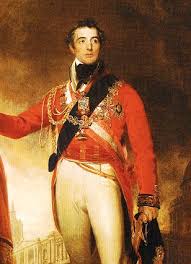
The Duke of Wellington
In 1815, he had defeated Napoleon at the battle of Waterloo, ending France’s longstanding threat to England. With that victory came the honors of a grateful nation.
Then, in December, 1824, Wellington found himself the target of blackmail by Joseph Stockdale, a pornographer and scandal-monger.
“My Lord Duke,” Stockdale write in a letter, “In Harriette Wilson’s memoirs, which I am about to publish, are various anecdotes of Your Grace which it would be most desirable to withhold….
“I have stopped the Press for the moment, but as the publication will take place next week, little delay can necessarily take place.”
Wilson was a famous London courtesan past her prime, then living in exile in Paris. She was asking Wellington to pay money to be left out of her memoirs.
From Wellington came the now-famous reply: “Publish and be damned!”
Wilson’s memoirs appeared in installments, naming half the British aristocracy and scandalizing London society.
And, true to her threat, she named Wellington as one of her lovers–and a not very satisfying one at that.
Wellington was a national hero, husband and father. Even so, his reputation did not suffer, and he went on to become prime minister.
Click here: Rear Window: When Wellington said publish and be damned: The Field Marshal and the Scarlet Woman – Voices
Dennis Hastert, former Speaker of the House, might now wish he had followed the example of the Duke of Wellington.
His reputation might have been trashed, but he wouldn’t now be facing prosecution.
ABC NEWS, APALACHIN RAID, BUSINESS, CBS NEWS, CEO, CLYDE TOLSON, CNN, ELECTRONIC SURVEILLANCE, FACEBOOK, FBI, FEDERAL BUREAU OF NARCOTICS, HARRY ANSLINGER, ILLEGAL ALILENS, IMMIGRATION AND CUSTOMS ENFORCEMENT (ICE), IRAN-CONTRA, J. EDGAR HOOVER, MAFIA, MEYER LANSKY, NBC NEWS, OLIVER NORTH, ROBERT F. KENNEDY, Ronald Reagan, THE CHICAGO SUN-TIMES, THE CHICAGO TRIBUNE, THE LOS ANGELES TIMES, THE NEW YORK TIMES, THE WASHINGTON POST, TOP HOODLUM PROGRAM, TWITTER, WAL-MART, WILLIAM E. ROEMER, WIRETAPPING, WIRETAPS
In Bureaucracy, Business, History, Law, Law Enforcement, Politics, Social commentary on April 11, 2016 at 12:04 am
In 1959, J. Edgar Hoover, the legendary director of the FBI, declared war on the Mafia.
He set up a Top Hoodlum Program and encouraged his agents to use wiretapping and electronic surveillance (“bugging”) to make up for lost time and Intelligence.
But Hoover also imposed a series of restrictions that could destroy an agent’s professional and personal life.
William E. Roemer, Jr., assigned to the FBI’s Chicago field office, was one of the first agents to volunteer for such duty.
In his memoirs, Man Against the Mob, published in 1989, Roemer laid out the dangers that went with such work:
- If confronted by police or mobsters, agents were to try to escape without being identified.
- If caught by police, agents were not to identify themselves as FBI employees.
- They were to carry no badges, credentials or guns–or anything else connecting themselves with the FBI.
- If they were arrested by police and the truth emerged about their FBI employment, the Bureau would claim they were “rogue agents” acting on their own.
- Such agents were not to refute the FBI’s portrayal of them as “rogues.”

If he had been arrested by the Chicago Police Department and identified as an FBI agent, Roemer would have:
- Definitely been fired from his position as an FBI agent.
- Almost certainly been convicted for at least breaking and entering.
- Disbarred from the legal profession (Roemer was an attorney).
- Perhaps served a prison sentence.
- Been disgraced as a convicted felon.
- Been unable to serve in his chosen profession of law enforcement.
Given the huge risks involved, many agents, unsurprisingly, wanted nothing to do with “black bag jobs.”

The agents who took them on were so committed to penetrating the Mob that they willingly accepted Hoover’s dictates.
In 1989, Roemer speculated that former Marine Lieutenant Colonel Oliver North had fallen victim to such a “Mission: Impossible” scenario: “The secretary will disavow any knowledge of your actions….”
In 1986, Ronald Reagan’s “arms-for-hostages” deal known as Iran-Contra had been exposed.
To retrieve seven Americans taken hostage in Beirut, Lebanon, Reagan had secretly agreed to sell some of America’s most sophisticated missiles to Iran.
During this operation, several Reagan officials–including North–diverted proceeds from the sale of those missiles to fund Reagan’s illegal war against the Sandinistas in Nicaragua.
In Roemer’s view: North had followed orders from his superiors without question. But when the time came for those superiors to step forward and protect him, they didn’t.
They let him take the fall.
Roemer speculated that North had been led to believe he would be rescued from criminal prosecution. Instead, in 1989, he was convicted for
- accepting an illegal gratuity;
- aiding and abetting in the obstruction of a congressional inquiry; and
- ordering the destruction of documents via his secretary, Fawn Hall.
That is how many employers expect their employees to act: To carry out whatever assignments they are given and take the blame if anything goes wrong.
Take the case of Wal-Mart Stores, Inc., the world’s biggest retailer.
In March, 2005, Wal-Mart escaped criminal charges when it agreed to pay $11 million to end a federal probe into its use of illegal aliens as janitors.
Agents from Immigration and Customs Enforcement (ICE) raided 60 Wal-Mart stores across 21 states in October, 2003. The raids led to the arrest of 245 illegal aliens.

Federal authorities had uncovered the cases of an estimated 345 illegal aliens contracted as janitors at Wal-Mart stores.
Many of the workers worked seven days or nights a week without overtime pay or injury compensation. Those who worked nights were often locked in the store until the morning.
According to Federal officials, court-authorized wiretaps revealed that Wal-Mart executives knew their subcontractors hired illegal aliens.
Once the raids began, Federal agents invaded the company’s headquarters in Bentonville, Ark., seizing boxes of records from the office of a mid-level executive.
Click here: Wal-Mart Settles Illegal Immigrant Case for $11M | Fox News
Of course, Wal-Mart admitted no wrongdoing in the case. Instead, it blamed its subcontractors for hiring illegal aliens and claiming that Wal-Mart hadn’t been aware of this.
Which, of course, is nonsense.
Just as the FBI would have had no compunctions about letting its agents take the fall for following orders right from the pen of J. Edgar Hoover, Wal-Mart meant to sacrifice its subcontractors for doing precisely what the company’s executives wanted them to do.
The only reason Wal-Mart couldn’t make this work: The Feds had, for once, treated corporate executives like Mafia leaders and had tapped their phones.
Click here: Wal-Mart to review workers – Business – EVTNow
Which holds a lesson for how Federal law enforcement agencies should treat future corporate executives when their companies are found violating the law.
Instead of seeing CEOs as “captains of industry,” a far more realistic approach would be giving this term a new meaning: Corrupt Egotistical Oligarchs.
A smart investigator/prosecutor should always remember:
Widespread illegal and corrupt behavior cannot happen among the employees of a major government agency or private corporation unless:
- Those at the top have ordered it and are profiting from it; or
- Those at the top don’t want to know about it and have taken no steps to prevent or punish it.
That’s something to remember the next time a scandal hits a major corporation or government agency.
ABC NEWS, APALACHIN RAID, BUSINESS, CBS NEWS, CEO, CLYDE TOLSON, CNN, ELECTRONIC SURVEILLANCE, FACEBOOK, FBI, FEDERAL BUREAU OF NARCOTICS, HARRY ANSLINGER, ILLEGAL ALIENS, IMMIGRATION AND CUSTOMS ENFORCEMENT (ICE), IRAN-CONTRA, J. EDGAR HOOVER, MAFIA, MEYER LANSKY, NBC NEWS, OLIVER NORTH, ROBERT F. KENNEDY, Ronald Reagan, THE CHICAGO SUN-TIMES, THE CHICAGO TRIBUNE, THE LOS ANGELES TIMES, THE NEW YORK TIMES, THE WASHINGTON POST, TOP HOODLUM PROGRAM, TWITTER, WAL-MART, WILLIAM E. ROEMHER, WIRETAPS
In Bureaucracy, Business, History, Law, Law Enforcement, Politics, Social commentary on April 8, 2016 at 12:41 am
Recruiters for corporate America routinely claim they’re looking for “a team player.”
This sounds great–as though the corporation is seeking people who will get along with their colleagues and work to achieve a worthwhile objective.
And, at times, that is precisely what is being sought in a potential employee.
But, altogether too often, what the corporation means by “a team player” is what the Mafia means by “a real standup guy.”
That is: Someone willing to commit any crime for the organization–and take the fall for its leaders if anything goes wrong.

FBI Chart of Mafia Families during the 1960s
Consider this classic example from the files of America’s premier law enforcement agency, the Federal Bureau of Investigation (FBI).
On November 14, 1957, 70 top Mafia leaders from across the country gathered at the estate of a fellow gangster, Joseph Barbara, in Apalachin, a small village in upstate New York.
The presence of so many cars with out-of-state license plates converging on an isolated mansion caught the attention of Edgar Crosswell, a sergeant in the New York State Police.
Crosswell assembled as many troopers as he could find, set up roadblocks, and swooped down on the estate.
The mobsters, panicked, fled in all directions–many of them into the surrounding woods. Even so, more than 60 underworld bosses were arrested and indicted following the raid.
Perhaps the most significant result of the raid was the effect it had on J. Edgar Hoover, the legendary director of the FBI.
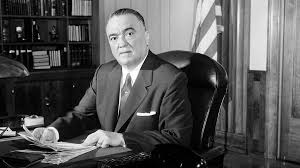
J. Edgar Hoover
Up to that point, Hoover had vigorously and vocally denied the existence of a nationwide Mafia. He had been happy to leave pursuit of international narcotics traffickers to his hated rival, Harry Anslinger, director of the Federal Bureau of Narcotics (FBN).
But he had been careful to keep his own agency well out of the war on organized crime.
Several theories have been advanced as to why.
- Hoover feared that his agents–long renowned for their incorruptibility–would fall prey to the bribes of well-heeled mobsters.
- Hoover feared that his allegedly homosexual relationship with his longtime associate director, Clyde Tolson, would be exposed by the Mob. Rumors still persist that mobster Meyer Lansky came into possession of a compromising photo of Hoover and Tolson engaged in flagrante delicto.
- Hoover knew of the ties between moneyed mobsters and their political allies in Congress. Hoover feared losing the goodwill of Congress for future–and ever-larger–appropriations for the FBI.
- Hoover preferred flashy, easily-solved cases to those requiring huge investments of manpower and money.
Whatever the reason, Hoover had, from the time he assumed directorship of the FBI in 1924, kept his agents far from the frontlines of the war against organized crime.
Suddenly, however, that was no longer possible.
The arrests of more than 60 known members of the underworld–in what the news media called “a conclave of crime”–deeply embarrassed Hoover.

It was all the more embarrassing that while the FBI had virtually nothing in its files on the leading lights of the Mafia, the Federal Bureau of Narcotics had opened its voluminous files to the Senate Labor Rackets Committee.
Heading that committee as chief legal counsel was Robert F. Kennedy–a fierce opponent of organized crime who, in 1961, would become Attorney General of the United States.
So Hoover created the Top Hoodlum Program (THP) to identify and target selected Mafiosi across the country.
Since the FBI had no networks of informants operating within the Mafia, Hoover fell back on a technique that had worked wonders against the Communist Party U.S.A.
He would wiretap the mobsters’ phones and plant electronic microphones (“bugs”) in their meeting places.
The information gained from these techniques would arm the Bureau with evidence that could be used to strongarm mobsters into “rolling over” on their colleagues in exchange for leniency.
Hoover believed he had authority to install wiretaps because more than one Attorney General had authorized their use.
But no Attorney General had given permission to install bugs–which involved breaking into the places where they were to be placed. Such assignments were referred to within the Bureau as “black bag jobs.”
So, in making clear to his agent-force that he wanted an unprecedented war against organized crime, Hoover also made clear the following:
Before agents could install electronic surveillance (an ELSUR, in FBI-speak) devices in Mob hangouts, agents had to first request authority for a survey. This would have to establish:
- That this was truly a strategic location;
- That the agents had a plan of attack that the Bureau could see was logical and potentially successful; and, most importantly of all
- That it could be done without any “embarrassment to the Bureau.”
According to former FBI agent William E. Roemer, Jr., who carried out many of these “black bag” assignments:
“The [last requirement] was always Mr. Hoover’s greatest concern: ‘Do the job, by God, but don’t ever let anything happen that might embarrass the Bureau.”
ABC NEWS, CBS NEWS, CNN, DEAN MARTIN, DRUG WAR, FACEBOOK, FBI, JOAQUIN "EL CHAPO" GUZMAN, JOHN F. KENNEDY, JOHN GOTTI, JOSEPH P. KENNEDY, MAFIA, MICKEY COHEN, MSNBC, NBC NEWS, ROBERT F. KENNEDY, ROLLING STONE, SAM GIANCANA, SAMMY "THE BULL" GRAVANO, SEAN PENN, THE CHICAGO SUN-TIMES, THE CHICAGO TRIBUNE, THE NEW YORK TIMES, THE WASHINGTON POST, TWITTER, WITNESS SECURITY PROGRAM
In Bureaucracy, Entertainment, History, Law Enforcement, Social commentary, Uncategorized on January 21, 2016 at 12:01 am
Sean Penn is not the first celebrity to “get close to” a gangster.
Singer Frank Sinatra set the standard as far back as the 1940s when he was often seen in the company of notorious Mafiosi such as Charles “Lucky” Luciano and Willie Moretti.
(It was Moretti who is rumored to have freed Sinatra from his financially-limiting contract with bandleader Tommy Dorsey in the early 1940s.
His alleged method of persuasion: Jamming a pistol down Dorsey’s throat and threatening to kill him. Dorsey eventually sold the contract to Sinatra for one dollar.
But the mobster whom Sinatra was most-often linked with–by gossip and FBI reports–was Sam “Mooney” Giancana.
Giancana started out as a “wheelman” and enforcer for the teenage “42 Gang,” then joined the Chicago mob in the late 1930s. By 1957 he had been appointed its boss.
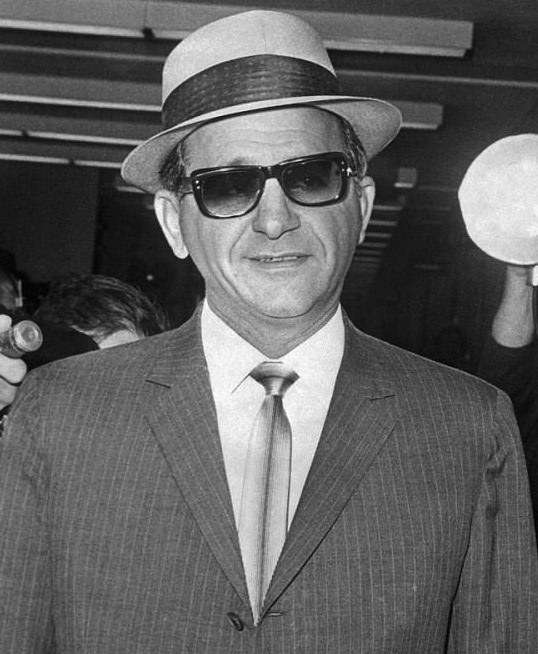
Sam Giancana
Sinatra often partied with Giancana, both in nightclubs and at his own residence in Palm Springs, California.
In December, 1959, financier Joseph P. Kennedy summoned Sinatra to the family compound in Hyannis Port, Massachusetts. His son, Senator John F. Kennedy, was planning to run for President in 1960. And the elder Kennedy wanted Sinatra’s help.
Sinatra and the Senator were by now well-acquainted. They shared a taste for gossip, nightclubs and beautiful women.
According to Sinatra’s daughter, Tina, the Kennedy patriarch said: “I think that you can help [the campaign] in [the] West Virginia [primary] and Illinois [in the general election] with our friends.
“You understand, Frank, I can’t go. They’re my friends, too, but I can’t approach them. But you can.”

Frank Sinatra
By “our friends,” Kennedy meant the Mafia. Joseph P. Kennedy had done business with the mob as a bootlegger during Prohibition.
Now he wanted the Mafia to pressure local union members into voting for JFK–and making contributions to the Kennedy Presidential campaign.
Sinatra went to his friend, Sam Giancana, and asked for the mob’s support. And Giancana promised to deliver it.
In return, Giancana–and other mobsters–expected to win an ally in the White House. He was later overheard on an FBI wiretap saying he had been promised by Sinatra that “if I even got a traffic ticket, none of those fuckers [the FBI] would know me.”
Since 1959, Giancana and other “Top Hoodlum” mobsters had been under increasingly heavy FBI surveillance. Giancana wanted it stopped.
And Sinatra had assured him that, under a Kennedy Presidency, it would stop.
On Election Night, 1960, John F. Kennedy carried Illinois–and won the White House by a mere 120,000 votes nationwide.
Then, to the horror of the Mafia, JFK installed his brother, Robert Francis Kennedy, as Attorney General. From 1957 to 1959, RFK had pursued gangsters as chief counsel for the Senate Rackets Committee.
Now he declared all-out war on organized crime. Convictions against organized crime figures rose 800% during his four years in office.
Robert F. Kennedy
Sinatra tried to deliver for Giancana. He sent Peter Lawford–his Rat Pack pal and brother-in-law to the President–to talk with Robert Kennedy about laying off on the Mafia don.
Kennedy told Lawford to mind his own business.
Giancana came under even greater pressure. FBI agents put a 24-hour “lockstep” surveillance on him, following him even into church and restrooms.
“I was on the road with this broad,” Giancana raged to his murderous associate, Johnny Formosa. “There must have been 20 guys [FBI agents]. They were next door, upstairs, downstairs, surrounded all the way around!
“Get in a car, somebody picks you up I lose that tail–boom!–I get picked up someplace else! Four or five cars, back and forth, back and forth.”
In another exchange with Formosa, Giancana’s anger at Sinatra boiled over:
“The last time I talked to [Sinatra] was at the hotel in Florida. And he said, ‘Don’t worry about it. If I can’t talk to the old man [Joseph P. Kennedy] I’m going to talk to the man [President Kennedy].’
“One minute he says he’s talked to Robert, and the next minute he says he hasn’t talked to him. So he never did talk to him.”
Formosa suggested a remedy: “Let’s show ’em. Let’s show those fuckin’ Hollywood fruitcakes that they can’t get away with it as if nothin’s happened.
“Let’s hit Sinatra. Or I could whack out a couple of those other guys, Lawford and that [Dean] Martin. And I could take the nigger [Sammy Davis, Jr.] and put his other eye out.”
Giancana refused to issue the contract. But he seriously considered doing so, as he confessed to a Chicago associate named Tommy DiBella:
“One night I’m fucking Phyllis [McGuire, a member of the famous McGuire sisters trio], playing Sinatra songs in the background, and the whole time I’m thinking to myself, ‘Christ, how can I silence that voice?’
“It’s the most beautiful voice in the world. Frank’s lucky he’s got it. It saved his life.”
Sinatra’s Rat Pack “pally,” Dean Martin, summed it up: “Only Frank could get away with the shit he’s got away with. Only Frank. Anybody else would’ve been dead.”
Sinatra survived the murderous anger of a mob boss. It remains to be seen if Sean Penn can do the same.
ABC NEWS, ALTERNET, AMERICABLOG, AP, BABY BOOMER RESISTANCE, BBC, BLOOMBERG NEWS, BUZZFEED, CBS NEWS, CNN, CROOKS AND LIARS, DAILY KOZ, DRUDGE REPORT, DRUG WAR, FACEBOOK, FBI, FIVETHIRTYEIGHT, FRANK SINATRA, HARPER’S MAGAZINE, HUFFINGTON POST, JOAQUIN "EL CHAPO" GUZMAN, JOHN F. KENNEDY, JOHN GOTTI, JOSEPH P. KENNEDY, MAFIA, MEDIA MATTERS, MICKEY COHEN, MOTHER JONES, MOVEON, MSNBC, NBC NEWS, NEW REPUBLIC, NEWSDAY, NEWSWEEK, NPR, PBS NEWSHOUR, POLITICO, POLITICUSUSA, RAW STORY, REUTERS, ROBERT F. KENNEDY, ROLLING STONE, SALON, SAM GIANCANA, SAMMY "THE BULL" GRAVANO, SEAN PENN, SEATTLE TIMES, SLATE, TALKING POINTS MEMO, THE ATLANTIC, THE CHICAGO SUN-TIMES, THE CHICAGO TRIBUNE, THE DAILY BEAST, THE DAILY BLOG, THE GUARDIAN, THE HILL, THE HUFFINGTON POST, THE LOS ANGELES TIMES, THE NATION, THE NEW REPUBLIC, THE NEW YORK TIMES, THE NEW YORKER, THE VILLAGE VOICE, THE WASHINGTON POST, THINKPROGRESS, TIME, TRUTHDIG, TRUTHOUT, TWITTER, TWO POLITICAL JUNKIES, U.S. NEWS & WORLD REPORT, UPI, USA TODAY, WITNESS SECURITY PROGRAM, WONKETTE
In Bureaucracy, Entertainment, History, Law Enforcement on January 20, 2016 at 12:02 am
Actor Sean Penn believes the Mexican Government wants to put him at risk by convincing Joaquin “El Chapo” (“Shorty”) Guzman that Penn played a role—deliberately or negligently—in his capture.
“We know the Mexican government, they clearly were humiliated by the notion that someone found him before they did,” Penn told interviewer Charlie Rose.
“Nobody found him before they did. We are not smarter than the DEA, or Mexican Intelligence. We had a contact upon which we were able to facilitate an invitation.”
By “we” Penn meant himself and Mexican actress Kate del Castillo, who had actually arranged the meeting.

Actress Kate del Castillo
“They wanted to encourage the cartel to put you in their crosshairs?” Rose asked.
“Yes,” Penn answered.
This is entirely possible. Guzman’s escape from a “maximum security” prison in July, 2015, had proved internationally embarrassing for the Mexican Government
Even more embarrassing: He escaped through a mile-long tunnel that literally led to his cell. Almost certainly this happened with the collusion of some prison guards.
Penn–and del Castillo–could face dangers from at least three groups.
Danger #1: El Chapo
Already there is evidence that “El Chapo” regrets having given an interview to Penn and del Castillo in the Mexican jungle on October 2, 2015.
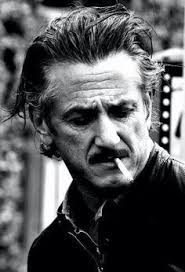
Sean Penn
Published in Rolling Stone on January 9, the article contained such Guzman boasts as:
“I supply more heroin, methamphetamine, cocaine and marijuana than anyone else in the world. I have a fleet of submarines, airplanes, trucks and boats.”
Juan Pablo Badillo, one of Guzman’s attorneys, has since claimed that the article contains falsehoods:
“It’s a lie, absurd speculation from Mr. Penn. Mr. Penn should be called to testify to respond about the stupidities he has said.
“He [Guzman] could not have made these claims. Mr. Guzman is a very serious man, very intelligent.”
This could spell danger for Penn and del Castillo. Guzman is responsible for the deaths of thousands of rivals, journalists and police.

Among the witnesses to the drug cartels’ savagery is Michael Levine, a 25-year veteran of the Drug Enforcement Administration and the author of Deep Cover: Mexican Government Drug Corruption From the Inside.
“Depending on what the cartels and/or the many corrupt Mexican cops and Mexican government officials believe El Chapo divulged during the interview, Penn, and whomever else was present, may be in more physical danger than he could ever imagine,” said Levine.
An anonymous law enforcement official said that not only could Penn be in danger, but so could his entire family.
“It won’t happen now. They [the cartels] wait. Him or people close to him are in danger. They don’t single out the one person. They go for the person’s family.
“He poked his head into a nest of vipers with an amazing global reach. He was a fool. As public as Penn is, he will be a sitting duck.”
Danger #2: Guzman’s Competitors in the Drug Trade
“The problem with dealing with someone like Guzman on this personal basis, where one is perceived as a ‘friend’ or an aide or a business partner of sorts to Chapo, is that you have to be prepared to inherit all his enemies, and there are many,” warned Michael Levine.
“These are some very kill-crazy people. The notoriety gained by killing someone like Penn or even del Castillo will actually turn these bastards on.
“It’s a step into the dark world of the kill crazies. Believe me it is there, and unwittingly these two may have stepped into a world where there is an actual competition to kill them,” said Levine, who has dealt face-to-face with Latin American drug lords.
Danger #3: Wannabe Cartel Members
Countless men–in Mexico and the United States–would love to “do El Chapo a favor” by gunning down Penn and/or del Castillo.
This could happen even if Guzman harbors no ill will toward either. It would be enough for someone to simply believe that he did.
An additional motive: The fame–or infamy–that the assassin of a “big celebrity” like Penn would receive. John Lennon died at the hands of such a fame-obsessed, psychotic gunman.
This means that literally anyone could be a potential assassin–making it that much harder to defend against.
When clients enter the Justice Department’s Witness Security Program, they are quickly asked: “Who do you think poses the biggest threat to you?”
Deputy U.S. marshals, who operate the program, assume that a witness is the best judge of who poses the greatest danger to him.

Witness Security Program protection detail
This works well when a witness is unknown and testifying against someone who is equally unknown to the public.
But when a witness is notorious–such as Sammy “The Bull” Gravano–and the defendant is equally infamous–such as John Gotti–all bets are off.
Of course, Federally-protected witnesses have two advantages going for them that Penn and del Castillo do not:
First, they are protected by the U.S. Marshals Service, which has an excellent track record in protecting its charges; and
Second, they are expected to assume a low profile, which serves as their best protection.
Sean Penn and Kate del Castillo aren’t Federally-protected witnesses. And they’re unlikely to assume a low profile by going into hiding.
ABC NEWS, ALTERNET, AMERICABLOG, AP, BABY BOOMER RESISTANCE, BBC, BLOOMBERG NEWS, BUZZFEED, CBS NEWS, CNN, CROOKS AND LIARS, DAILY KOZ, DRUDGE REPORT, DRUG WAR, FACEBOOK, FBI, FIVETHIRTYEIGHT, FRANK SINATRA, HARPER’S MAGAZINE, HUFFINGTON POST, JOAQUIN "EL CHAPO" GUZMAN, JOHN F. KENNEDY, JOHN GOTTI, JOSEPH P. KENNEDY, MAFIA, MEDIA MATTERS, MICKEY COHEN, MOTHER JONES, MOVEON, MSNBC, NBC NEWS, NEW REPUBLIC, NEWSDAY, NEWSWEEK, NPR, PBS NEWSHOUR, POLITICO, POLITICUSUSA, RAW STORY, REUTERS, ROBERT F. KENNEDY, ROLLING STONE, SALON, SAM GIANCANA, SAMMY "THE BULL" GRAVANO, SEAN PENN, SEATTLE TIMES, SLATE, TALKING POINTS MEMO, THE ATLANTIC, THE CHICAGO SUN-TIMES, THE CHICAGO TRIBUNE, THE DAILY BEAST, THE DAILY BLOG, THE GUARDIAN, THE HILL, THE HUFFINGTON POST, THE LOS ANGELES TIMES, THE NATION, THE NEW REPUBLIC, THE NEW YORK TIMES, THE NEW YORKER, THE VILLAGE VOICE, THE WASHINGTON POST, THINKPROGRESS, TIME, TRUTHDIG, TRUTHOUT, TWITTER, TWO POLITICAL JUNKIES, U.S. NEWS & WORLD REPORT, UPI, USA TODAY, WITNESS SECURITY PROGRAM, WONKETTE
In Bureaucracy, Entertainment, History, Law Enforcement on January 19, 2016 at 1:25 am
Actor Sean Penn is used to being a tough guy–onscreen.
In 2006, he played real-life mobster Mickey Cohen (1913 – 1976) in Gangster Squad. And in 2013, he played Willie Stark, a corrupt, Huey Long-type Southern governor in a remake of All the King’s Men.
As Cohen, Penn put out contracts on his enemies and even went mano-o-mano in a long-running (and fictional) fistfight with an LAPD detective.
And as Stark, he clawed his way to power and bullied both his enemies and his supporters.
Perhaps Penn should have paid more attention to the way those movies ended.

Sean Penn
Mickey Cohen goes to prison, where he is brutally waylaid by other inmates.
And Willie Stark, at the height of his power, is shot by a longtime enemy.
Had he thought about it, he might have decided it could be a mistake to meet with Joaquin “El Chapo” (“Shorty”) Guzman, the notorious Mexican drug lord.
On October 2, 2015, Penn met with Guzman in an undisclosed location in the Mexican jungle. He was there to interview him on behalf of Rolling Stone magazine.
Guzman wanted a movie made about him. So he had reached out to Mexican actress Kate del Castillo, asking her to meet with him to discuss such a project. She, in turn, referred him to Penn, whom Guzman said could come along for the meeting.
Penn had his own agenda: To write an article for Rolling Stone whose “purpose [would] contribute to this conversation on the war on drugs.”
Three months later, on January 8, 2016, Mexican Marines and Federal Police launched an early-morning raid on a house in Los Mochis, in northern Sinaloa, where Guzman’s drug cartel operated.
The Marines expected to find Guzman there, and they did–ending his almost six-month flight after escaping from prison in July.
One day after Guzman’s capture, Rolling Stone published Penn’s 10,000-word article.
Penn had not been allowed to bring a tape recorder or even take notes with pen and paper. So he had been forced to memorize as much of Guzman’s tale as he could.
Penn seemed to be enraptured by Guzman:
“There is no doubt this is the real deal. He’s wearing a casual patterned silk shirt, pressed black pants, and he appears remarkably well-groomed and healthy for a man on the run.
“He opens [actress Kate del Castillo’s] [car} doorand greets her like a daughter returning from college.
“It seems important to him to express the warm affection in person that, until now, he’d only had occasion to communicate from afar.”
Even so, Penn quoted Guzman as bragging: “I supply more heroin, methamphetamine, cocaine and marijuana than anybody else in the world. I have a fleet of submarines, airplanes, trucks and boats.”
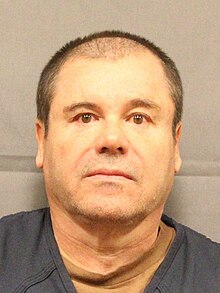
Joaquin “El Chapo” Guzman
After the interview’s publication, Penn came under fire for having allowed Guzman to approve the article. He claimed that, despite this, Guzman had not asked for any changes.
He also drew sharp criticism for having used his status as a movie star to play the part of a reporter.
But worse was to come.
Shortly after the capture of “El Chapo,” Mexico’s Attorney General Arely Gomez “credited” Penn with having played a vital role in the capture of the drug kingpin.
The meeting between Penn, Castillo and Guzman “was an essential element, because we were following [Guzman’s] lawyer, and the lawyer took us to these people and to this meeting.”
Suddenly, American experts on Mexican organized crime cartels began seeing Sean Penn in a new light–that of a movie star with a big target on his chest and back.
Suppose Guzman began suspecting that Penn had deliberately led Mexican authorities to him? Or that he had done so even accidentally, through negligence in how he had traveled?
“These cartels are very violent, they do not forgive any transgression and they will respond in a most violent manner,” said Mike Vigil, a former chief of international operations with the U.S. Drug Enforcement Administration.
“These are people who have been dismembered, who have decapitated individuals. So killing Sean Penn and del Castillo means absolutely nothing to them.”
Vigil believed it was careless for the Mexican Government to publicize any ties between the Penn meeting and Guzman’s arrest:
“If Chapo Guzman perceives that they cooperated with authorities in his capture, [the cartel] will go after them.”
He argued that the risk is likely likely for del Castillo because she was the one in contact with Guzman.
She was the one whom Guzman’s associates supplied with a Blackberry–the phone they believed most secure. And it was her and Guzman’s flirtatious exchanges that led to the meeting in the jungle with Sean Pean.
“Apart from that, [del Castillo] is originally from Mexico, she has all of her family in Mexico. One of the traditional violent methods [the cartels] use is if they can’t get to the target, they’ll go after their family members.
“If I were Kate del Castillo, I would run like the wind.”
9-1-1-, ABC NEWS, CBS NEWS, CNN, EMERGENCIES, FACEBOOK, NBC NEWS, POLICE DISPATCHING, ROBERT F. KENNEDY, SAN FRANCISCO, SAN FRANCISCO DEPARTMENT OF EMERGENCY MANAGEMENT, SAN FRANCISCO GIANTS, SAN FRANCISCO POLICE DEPARTMENT, THE CHICAGO SUN-TIMES, THE CHICIAGO TRIBUNE, THE LOS ANGELES TIMES, THE NEW YORK TIMES, THE SAN FRANCISCO FIRE DEPARTMENT, THE WASHINGTON POST, TWITTER
In Bureaucracy, History, Law Enforcement, Politics, Social commentary on January 5, 2016 at 12:01 am
The quickest way of opening the eyes of the people is to find the means of making them descend to particulars, seeing that to look at things only in a general way deceives them.…
–-Niccolo Machiavelli, The Discourses
One morning at about 8:10, a friend of mine named Robert heard a helicopter repeatedly buzzing the San Francisco Tenderloin area, where he lived.
Thinking that a fire or police action might be in the works, he called the non-emergency number of the San Francisco Police Department (SFPD): (415) 553-0123.

And he got a recorded message.
This told him–in English–what he already knew: He had reached the San Francisco Police Department.
Then it told him this again in Spanish. Then again in Cantonese. Then came a series of high–pitched squeals–presumably for those who are hard-of-hearing.
Then the line went dead, and another recorded voice told Robert: “If you’d like to make a call, please hang up and try again.”
At that point, Robert decided to waste no more time trying to learn if there was an emergency going on in his area. Or, to put it more accurately, he decided to waste no more time trying to learn this from the SFPD.
Instead, Robert turned on his TV and checked all the local news channels. When he didn’t see anyone reporting a raging fire or police sealing off an area, he decided there probably wasn’t anything to worry about.
But later on he decided to call the SFPD once again–to complain at a level he believed would attain results.
That level was the office of its chief, Greg Suhr.
Robert didn’t expect to reach the chief himself. But he didn’t have to: Reaching Suhr’s secretary should serve the same purpose.
The secretary he reached turned out to be a sworn officer of the agency. She patiently heard out Robert’s complaint. And she totally agreed with it.
She also agreed that this was a longstanding problem with the SFPD–citizens not being able to get through for help because of an ineffective communications system.
Finally, she agreed with Robert that the situation counted as a major PR disaster for her agency. People who become disgusted and/or disillusioned with a police department’s phone system aren’t likely to trust that agency with their cooperation–or their lives.
Then she had a surprise for Robert: Like him, she had at times been unable to reach a live dispatcher–even when calling 9-1-1.
She added that the police department did not handle its own dispatch work. This had been farmed out long ago to the San Francisco Department of Emergency Management (SFDEM).
She said that the SFPD didn’t have any control–or even influence–over SFDEM, which operated as an independent agency.
Robert suggested that it was definitely in the best interests of the SFPD for someone at its highest level to contact SFDEM and demand major reforms. Or to find another agency that would take its dispatcher responsibilities seriously.
The chief’s secretary said she would pass along Robert’s comments to the proper authority.
Will anything change? Not likely, barring a miracle.
There are few events more frightening and frustrating than having to call the police, fire department or paramedics during an emergency–and get a recorded message.
Whether intended or not, the message this sends the caller can only be: “Your call is simply not important to us–and neither are you. We’ll get to you when we feel like it.”

When people call the police or fire department, they’re usually frightened–for themselves or others. They know that, in a fire or crime or medical emergency, literally every second counts.
It’s going to take the police or fire or paramedics several minutes to arrive–assuming they don’t get caught up in a traffic snarl.
And it’s going to take them even longer to arrive if it takes the caller several minutes to reach them with a request for help.
This is the sort of bread-and-butter issue that local authorities–who operate police and fire departments–should take most seriously.
Mayors and council members should not expect to be treated with respect when their constituents are treated so disrespectfully in a time of crisis.
And citizens aren’t stupid. They can easily tell lies from truths.
Lies such as: “We’d like to put in a new communications system, but we can’t afford it due to budget cuts.”
And truths such as: While San Francisco faced a $229 million deficit for the fiscal year, 2012, it nevertheless found
- Monies to tap after the San Francisco Giants won the 2011-12 World Series, 4-0.
- Monies to decorate various San Francisco buildings (such as the airport) with the orange-and-black colors of the Giants.
- Or with the Giants logo.
- Monies to throw a day-long party for the victorious Giants on October 31–Halloween.

San Francisco Airport–decked out with San Francisco Giants colors
So, in the end, it all comes down to a matter of priority–for both citizens and their elected leaders.
As Robert F. Kennedy once said: “Every nation gets the kind of government it deserves–and the kind of law enforcement it insists in.”


&docid=SiluTuHYHtjaZM&tbnid=uLB-PLYDVdkkVM%3A&w=455&h=341&ei=zeN_VI_hKYHjoATGs4Bo&ved=0CAIQxiAwAA&iact=c)


.jpg)


2016 PRESIDENTIAL RACE, ABC NEWS, ALTERNET, AMERICABLOG, AP, BABY BOOMER RESISTANCE, BBC, BERNIE SANDERS, BLOOD FEUD, BLOOMBERG NEWS, BROTHERS: THE HIDDEN HISTORY OF THE KENNEDY YEARS, BUZZFEED, CARLOS MARCELLO, CBS NEWS, CIA, CNN, COTTER SMITH, CROOKS AND LIARS, CUBA, DAILY KOS, DAVID TALBOT, DONALD TRUMP, ERNEST BORGNINE, FBI, FIDEL CASTRO, FIVETHIRTYEIGHT, GUS RUSSO, HARPER’S MAGAZINE, HILLARY CLINTON, HUFFINGTON POST, INTERNATIONAL BROTHERHOOD OF TEAMSTERS, J. EDGAR HOOVER, JAMES R. HOFFA, JUSTICE DEPARTMENT, LIVE BY THE SWORD: THE SECRET WAR AGAINST CASTRO AND THE DEATH OF JFK, MAFIA, MEDIA MATTERS, MOTHER JONES, MOVEON, MSNBC, NBC NEWS, NEW REPUBLIC, NEWSDAY, NEWSWEEK, NPR, PBS NEWSHOUR, POLITICO, POLITICUSUSA, RAFAEL EDWARD CRUZ, RAW STORY, REUTERS, ROBERT BLAKE, ROBERT F. KENNEDY, SALON, SAM GROOM, SEATTLE TIMES, Secret Service, SENATE LABOR RACKETS COMMITTEE, SLATE, TALKING POINTS MEMO, THE ATLANTIC, THE CHICAGO SUN-TIMES, THE CHICAGO TRIBUNE, THE DAILY BEAST, THE DAILY BLOG, THE GUARDIAN, THE HILL, THE HUFFINGTON POST, THE INTERCEPT, THE LOS ANGELES TIMES, THE NATION, THE NEW REPUBLIC, THE NEW YORK TIMES, THE NEW YORKER, THE VILLAGE VOICE, THE WALL STREET JOURNAL, THE WASHINGTON POST, THINKPROGRESS, TIME, TRUTHDIG, TRUTHOUT, TWITTER, U.S. NEWS & WORLD REPORT, UPI
A CLASH OF TITANS: PART THREE (END)
In Bureaucracy, History, Law, Law Enforcement, Politics, Social commentary on April 25, 2016 at 12:10 amThe 1983 TV mini-series, Blood Feud, chronicles the decade-long struggle between Robert F. Kennedy (Cotter Smith) and James R. Hoffa (Robert Blake), president of the International Brotherhood of Teamsters Union.
With Kennedy as Attorney General and facing relentless pressure from the Justice Department, the Mafia despairs of a solution. At a swanky restaurant, several high-ranking Mafiosi agree that “something” must be done.
On November 22, 1963, President John F. Kennedy is assassinated in Dallas, Texas.
Blood Feud clearly implies that the Mafia was responsible.
[The House Assassinations Committee investigated this possibility in 1978, and determined that Carlos Marcello, the Mafia boss of New Orleans, had the means, motive and opportunity to kill JFK. But it could not find any conclusive evidence of his involvement.]
Even with the President dead, RFK’s Justice Department continues to pursue Hoffa. In 1964, he is finally convicted of jury tampering and sentenced to 13 years’ imprisonment.
U.S. Department of Justice
Hoping to avoid prison, Hoffa phones Robert Kennedy, offering future Teamsters support if RFK runs for President. To prove he can deliver, he tells Kennedy that the Teamsters have even penetrated the FBI.
[In March, 1964, Kennedy met with Hoffa on an airfield at Dulles International Airport in Washington, D.C. He was accompanied by two Secret Service agents from the detail assigned to ex-First Lady Jacqueline Kennedy.
[FBI Director J. Edgar Hoover, no longer afraid to cross RFK, had withdrawn the agents previously assigned to guard Kennedy.
[Accompanying Hoffa were two muscular bodyguards–at least one of whom was packing two pistols in shoulder holsters.
[While the Secret Service agents watched from a respectful distance, Kennedy spoke quietly with Hoffa. The Attorney General showed a document to Hoffa, and the Teamsters leader at times nodded or shook his head.
[The agents drove Kennedy back to Washington. During the ride, he said nothing about the reason for the meeting.
[David Talbot, in his book, Brothers: The Hidden History of the Kennedy Years, speculates that it could have been to discuss Hoffa’s conviction for jury tampering.
[But Gus Russo–author of Live By the Sword: The Secret War Against Castro and the Death of JFK–writes that the reason might have been Dallas.
[Perhaps, he speculates, RFK had wanted to look into Hoffa’s eyes while asking him: Did you have anything to do with the assassination? RFK had, in fact, done this with CIA Director John McCone almost immediately after his brother’s death.]
In Blood Feud, Kennedy confronts J. Edgar Hoover (Ernest Borgnine) and accuses him of illegally planting wiretaps in Mob hangouts all over the country.
J. Edgar Hoover and Robert F. Kennedy
Hoover retorts that this had been the only way to obtain the prosecution-worthy intelligence Kennedy had demanded: “You loved that flow of information. You didn’t want it to stop.”
Kennedy: Why did you keep the FBI out of the fight against the Mob for decades?
Hoover: “Every agency that came to grips with them got corrupted by their money.”
[So far as is known, Hoover never made any such confession. Historians continue to guess his reason for leaving the Mob alone for decades.]
Ernest Borgnine as J. Edgar Hoover
RFK then mentions the CIA’s plots to employ the Mob to assassinate Cuban dictator Fidel Castro
[The agency had wanted to please President Kennedy, and the Mafia had wanted to regain its casinos lost to the Cuban Revolution. The role the Kennedy brothers played in the CIA’s assassination plots remains murky, and has been the subject of endless speculation.]
“The CIA, doing business with the Mob,” says Kennedy. “The FBI, leaking information to its enemies [the Teamsters].” Then, sadly: “I guess it’s true–everyone does business with everyone.”
[So far as is known, the FBI did not pass on secrets to the Teamsters. But during the 1970s, the Mafia penetrated the Cleveland FBI office through bribes to a secretary. Several FBI Mob informants were “clipped” as a result.]
In 1967, Hoffa goes to prison. He stays there until, in 1971, President Richard Nixon commutes his sentence in hopes of gaining Teamsters’ support for his 1972 re-election.
Kennedy leaves the Justice Department in 1964 and is elected U.S. Senator from New York. In 1968 he runs for President. On June 5, after winning the California primary, he’s assassinated.
In Blood Feud, just before his assassination, RFK asks: “How will I ever really know if the Mob killed Jack because of my anti-Mob crusade?”
Hoffa schemes to return to the presidency of the Teamsters–a post now held by his successor, Frank Fitzsimmons. He runs the union in a more relaxed style than Hoffa, thus giving the Mob greater control over its pension fund.
And the Mafia likes it that way.
On July 30, 1975, Hoffa disappears from the parking lot of the Machus Red Fox Restaurant near Detroit. He had gone there to meet with two Mafia leaders.
Almost 41 years after the death of James R. Hoffa, and almost 48 years after that of Robert F. Kennedy:
Share this: