Posts Tagged ‘NEWSWEEK’
ABC NEWS, ADULTERY, ALTERNET, AMERICABLOG, AP, BABY BOOMER RESISTANCE, BARACK OBAMA, BBC, BIBLE, BILLY GRAHAM, BLOOMBERG NEWS, BUZZFEED, CBS NEWS, CNN, CROOKS AND LIARS, DAILY KOZ, FACEBOOK, FIVETHIRTYEIGHT, FRANKLIN GRAHAM, HARPER’S MAGAZINE, HOMOSEXUALITY, HUFFINGTON POST, I USA TODAY, MEDIA MATTERS, MITT ROMNEY, MOTHER JONES, MOVEON, MSNBC, NBC NEWS, NEW REPUBLIC, NEWSDAY, NEWSWEEK, NEWT GINGRICH, NPR, PBS NEWSHOUR, POLITICO, POLITICUSUSA, RAW STORY, REUTERS, RICK SANTORUM, SALON, SCIENCE, SEATTLE TIMES, SLATE, SLAVERY, SPANISH INQUISITION, TALKING POINTS MEMO, TEA PARTY, THE ATLANTIC, THE CHICAGO SUN-TIMES, THE CHICAGO TRIBUNE, THE DAILY BEAST, THE DAILY BLOG, THE GUARDIAN, THE HILL, THE HUFFINGTON POST, THE INTERCEPT, THE LOS ANGELES TIMES, THE NATION, THE NEW REPUBLIC, THE NEW YORK TIMES, THE NEW YORKER, THE VILLAGE VOICE, THE WASHINGTON POST, THEOLOGY, THINKPROGRESS, TIME, TRUTHDIG, TRUTHOUT, TWITTER, TWO POLITICAL JUNKIES, U.S. NEWS & WORLD REPORT, UP, UPI, USA TODAY, WAR, WOMEN
In Bureaucracy, History, Law, Law Enforcement, Military, Politics, Social commentary on July 11, 2017 at 12:03 am
Franklin Graham, son of Billy Graham, America’s most famous preacher, spends a lot of time deciding who qualifies as a Christian—and who doesn’t.
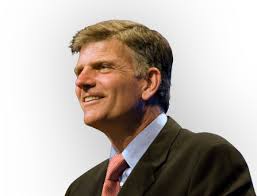
Franklin Graham
He said just that on the February 21, 2012 edition of the MSNBC show, “Morning Joe.”
First, however, he offered his views on the relative Christian dedication of the major contenders for the Presidency in 2012:
President Barack Obama: “Islam sees him as a son of Islam….I can’t say categorically that [Obama is not Muslim] because Islam has gotten a free pass under Obama.”
Former Speaker of the House Newt Gingrich:“Newt’s been married several times… but he could make a good candidate. I think Newt is a Christian. At least he told me he is.”
Former Pennsylvania U.S. Senator Rick Santorum: “His values are so clear on moral issues. No question about it. I think he is, no question, a man of faith.”
Former Massachusetts Governor Mitt Romney: “I’m just saying most Christians would not recognize Mormonism. Of course they believe in Jesus Christ, but they have a lot of other things that they believe in, too, that we don’t accept theologically.”
Thus, Graham had no problem in pronouncing as “saved” a notorious multiple-adulterer like Gingrich, or a rights-denying religious zealot like Santorum.
But he clearly refused to pronounce as “saved” a longtime church-goer like Obama or a Mormon like Romney (whose faith, most evangelicals like Graham believe, is actually a non-Christian cult).
Toward the end of the program, Mike Barnicle, one of the panelists interviewing Graham, said: “You must spend a big part of the day checking out what you conceive to be people’s depth of faith, in terms of measuring.”
“This is my business,” replied Graham. “You guys go through newspapers every day. I look at a person’s political interest, but more importantly I look at their spiritual interests….
“You have to go by what a person says, and how they live their lives…Are they faithful church goers? Or do they just go when the cameras are on them?”
Another man who dedicated his life to judging the religious commitment of others was Bernard Gui, the chief inquisitor at Toulouse from 1308 to 1322.
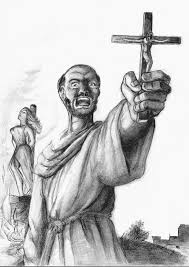
Bernard Gui
His inquisition of those suspected or accused of heresy led to over 900 guilty verdicts. Of those convicted during examination by Gui, 42 were executed—by being burned at the stake.
Gui closely studied the best methods for interrogating “heretics.” He set forth his findings in his most important and famous work, Practica Inquisitionis Heretice Pravitatis. or “Conduct of the Inquisition into Heretical Wickedness.”
In this, he offered a vivid example of how such interrogations might go. The following is taken from that manual:
Interrogator: You call your faith Christian, for you consider ours as false and heretical. But I ask whether you have ever believed as true another faith than that which the Roman Church holds to be true?
Accused Heretic: I believe the true faith which the Roman Church believes, and which you openly preach to us.
Interrogator: Perhaps you have some of your sect at Rome whom you call the Roman Church. I, when I preach, say many things, some of which are common to us both, as that God liveth, and you believe some of what I preach. Nevertheless you may be a heretic in not believing other matters which are to be believed.

“Heretic” being burned at the stake
Accused Heretic: I believe all things that a Christian should believe.
Interrogator: I know your tricks. What the members of your sect believe you hold to be that which a Christian should believe. But we waste time in this fencing. Say simply, Do you believe in one God the Father, and the Son, and the Holy Ghost?
Accused Heretic: I believe.
Interrogator: Do you believe in Christ born of the Virgin, suffered, risen, and ascended to heaven?
Accused Heretic: (Briskly) I believe.
Interrogator: Do you believe the bread and wine in the mass performed by the priests to be changed into the body and blood of Christ by divine virtue?
Accused Heretic: Ought I not to believe this?
Interrogator: I don’t ask if you ought to believe, but if you do believe.
Accused Heretic: I believe whatever you and other good doctors order me to believe.
Inquisitor: Those good doctors are the masters of your sect; if I accord with them you believe with me; if not, not.
Accused Heretic: I willingly believe with you if you teach what is good to me.
Inquisitor: You consider it good to you if I teach what your other masters teach. Say, then, do you believe the body of our Lord, Jesus Christ to be in the altar?
Accused Heretic: (Promptly) I believe that a body is there, and that all bodies are of our Lord.
Interrogator: I ask whether the body there is of the Lord who was born of the Virgin, hung on the cross, arose from the dead, ascended, etc.
Accused Heretic: And you, sir, do you not believe it?
Interrogator: I believe it wholly.
Accused Heretic: I believe likewise.
ABC NEWS, ABCNEWS, ABILENE, ALTERNET, AP, BBC, BUFFALO BILL, BUZZFEED, CBS NEWS, CNN, DAILY KOS, FACEBOOK, GUNFIGHTERS, JACK MCCALL, MOTHER JONES, MOVEON, NATIONAL RIFLE ASSOCIATION, NBC NEWS, NEWSWEEK, NPR, POLITICO, RAW STORY, REUTERS, SALON, SEATTLE TIMES, SLATE, THE ATLANTIC, THE CHICAGO SUN-TIMES, THE CHICAGO TRIBUNE, THE DAILY BEAST, THE GUARDIAN, THE HILL, THE HUFFINGTON POST, THE LOS ANGELES TIMES, THE NEW YORK TIMES, THE WALL STREET JOURNAL, THE WASHINGTON POST, TIME, TWITTER, U.S. NEWS & WORLD REPORT, UPI, USA TODAY, WILD BILL HICKOK
In History, Law, Law Enforcement, Politics, Social commentary on July 7, 2017 at 12:16 am
After being fired as town marshal of Abilene, Kansas, James Butler “Wild Bill” Hickok lived another five years. But they weren’t good ones.
Unlike William F. Cody, Hickok couldn’t adjust to the changing West.
It was becoming less wild. His scouting days were over—the Indian wars were rapidly coming to an end.
(In June, 1876, barely two months before his own death, the Sioux and Cheyenne would wipe out the other famous “Long Hair” of the plains–George Armstrong Custer—at the battle of Little Bighorn.)
And most towns, like Abilene, increasingly had little use for lead-slinging lawmen like Hickok.
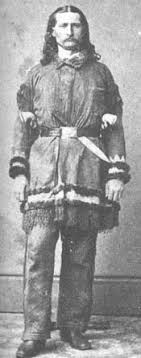
James Butler “Wild Bill” Hickok
Worst of all, he was going blind—either from a venereal disease he had contracted or from the glare of too many prairie sunrises.
In 1873, Hickok tried his hand as an actor in Buffalo Bill’s Wild West Show. But he was a terrible performer—and knew it.
The fault, however, did not lie entirely with him. Even Laurence Oliver would have rebelled at spouting lines like: “Fear not, fair maiden, for you are ever safe with Will Bill, who has sworn to defend to the death your maidenly virtue.”
Not that the audiences cared. They had come to see legendary plainsmen—such as Hickok and Cody—in the flesh, not great theater.
Hickok asked Cody to release him from his contract. Cody refused. So Hickok once again turned to his guns for a solution.
In this case, it meant shooting blanks into the legs and buttocks of “dead” Indians who suddenly sprang to life and rushed off the stage. And one night, Hickok put a real bullet through a stage light that was hurting his already sensitive eyes.
That, finally, convinced Cody that Hickok’s acting days were over.
In March, 1876, he married Agnes Lake Thatcher, a circus acrobat several years his senior.
In April, he told Agnes he was heading for the gold rush country of Deadwood, South Dakota. After he made his fortune, he would send for her.
But she never saw him again.
Deadwood was the sort of town the National Rifle Association wants to see replicated across modern-day America. Everyone wore a gun, and there was no town ordinance against doing so. Nor were there any law-enforcers like Hickok to protect the public from the kill-crazy antics of liquored-up gunmen.

Grave of “Wild Bill” Hickok
Worse for Hickok, he had two strikes against him: His reputation as a matchless gunfighter had preceded him—and his failing vision put him at a disadvantage in backing it up.
Arriving in Deadwood, he quickly decided that the strenuous life of a gold-miner was not for him. Instead, he would seek his fortune as he often had—in saloons as a gambler.
And, as he had so often, he spent more of his time losing money than making it.
On August 2, 1876, his long trail of bad luck finally ran out.
He had always sat with his back to a wall, as a precaution against ambush. On this afternoon, he found his preferred seat taken by another gambler named Charles Rich. Hickok asked Rich to trade places with him, but when the latter refused, Hickok didn’t press the matter.
It was a sign that Hickok’s reputation had sharply fallen. Ten years earlier, had he made such a request, the other gambler would have rushed to swap chairs.
Hickok paid no attention as a whiskey bum named Jack McCall walked around to the corner of the saloon to where the ex-lawman was playing.

Jack McCall
The previous night, Hickok had won considerable money from McCall in a poker game—and had generously given him back enough to buy something to eat.
(The 1995 movie, Wild Bill, depicted McCall as Hickok’s illegitimate son seeking vengeance on the father who had abandoned him. But this was completely false, as the two were completely unrelated. The one saving grace to this otherwise absurd film was Jeff Bridges’ gritty performance as Hickok.)
Suddenly, McCall pulled a double-action .45 from under his coat, shouted “Take that!” and shot Hickok in the back of the head.
Hickok died instantly. He was 39.
As he slid from the table, he dropped the cards he had been holding—a pair of eights and another pair of Aces, which has ever since been known as “the dead man’s hand.”
McCall was “tried” by a mining court. He claimed that Hickok had murdered his brother and he had sought revenge. He was acquitted.
He headed for Wyoming, where he incessantly bragged that he had killed the famous “Wild Bill” Hickok.
McCall was arrested in Laramie and charged with murder. The trial in Deadwood was found to have been invalid—owing to the town’s being in Indian territory and outside the reach of United States law.
Once again forced to stand trial, McCall found himself convicted. On March 1, 1877, he was hanged. Later, it was discovered that McCall had never had a brother.
ABC NEWS, ABCNEWS, ABILENE, ALTERNET, AP, BBC, BUFFALO BILL, BUZZFEED, CBS NEWS, CNN, DAILY KOS, FACEBOOK, GUNFIGHTERS, JACK MCCALL, MOTHER JONES, MOVEON, NATIONAL RIFLE ASSOCIATION, NBC NEWS, NEWSWEEK, NPR, POLITICO, RAW STORY, REUTERS, SALON, SEATTLE TIMES, SLATE, THE ATLANTIC, THE CHICAGO SUN-TIMES, THE CHICAGO TRIBUNE, THE DAILY BEAST, THE GUARDIAN, THE HILL, THE HUFFINGTON POST, THE LOS ANGELES TIMES, THE NEW YORK TIMES, THE WALL STREET JOURNAL, THE WASHINGTON POST, TIME, TWITTER, U.S. NEWS & WORLD REPORT, UPI, USA TODAY, WILD BILL HICKOK
In History, Law, Law Enforcement, Politics, Social commentary on July 6, 2017 at 12:33 am
Almost everyone has heard of “Wild Bill” Hickok—the legendary Western scout, Indian fighter, two-gun lawman and crack shot.
And the legend, not the man, is often invoked–inaccurately—by “gun rights” advocates who seek to reduce the entire Constitution to a single amendment: The Second Amendment.
But there is a vast difference between Hickok the legend–and Hickok the actual man.
For one thing, his real name wasn’t “Bill”—or even “William.” It was James Butler Hickok.
He supposedly got the name “Wild Bill” after thwarting an attempted lynching—and a woman applauded his bravery with: “Good for you, Wild Bill!”
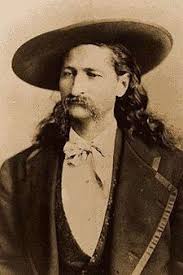
James Butler “Wild Bill” Hickok
For another, Hickok didn’t spend most of his life as a town marshal. His gunslinging days as a lawman lasted just two years—1869 to 1871.
And they ended badly. His first stint as a lawman came at Hays City, Kansas. As sheriff, he shot and killed at least two men.
According to legend, one of these shootings occurred when Hickok, looking in a bar mirror, saw a ruffian named Strawhan pull a pistol to shoot him in the back.
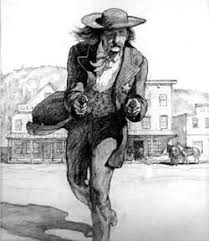
Hickok, looking into the mirror, threw a “trick shot” over his shoulder–and nailed Strawhan dead.
Then Hickok’s luck ran out. On July 17, 1870, several members of the 7th U.S. Cavalry attacked him in Drum’s Saloon. Knocked to the floor and repeatedly kicked, Hickok had reason to fear death.
Drawing his pistols, he killed one private and wounded another. Although he had acted in self-defense and the shootings were entirely justifiable, Hickok now faced even greater danger from other, enraged members of the same regiment.
He decided to leave Hays before they could take their revenge.
His next posting as town marshal came in Abilene, Kansas. This stint lasted from April to December, 1871.
And, like his last one as a “town-tamer,” it ended with a deadly shootout.
A major portion of his duties lay in enforcing the “no firearms worn or used in town” edict.
Abilene was a cattle town, the end of the line for many outfits seeking a major railhead where their hundreds of beeves could be dropped off and shipped eastward.
When cowboys—most of them in their teens or early 20s—reached Abilene, they wanted to celebrate. Their long drive was over, and now they could finally get paid. And there were plenty of bars and whores waiting to pick up their newly-issued monies.
This combination of randy men and ready supplies of alcohol and women often led to trouble. One cowboy might make a pass at another’s “lady” for the night. Or an argument might erupt over a card game.
It was Hickok’s duty to make sure that such arguments were settled only with fists. And that meant demanding that all cowboys’ guns be checked at the marshal’s office until the “boys” were ready to leave Abilene.

Replica of Hickok’s 1851 Navy Colt
This, of course, contradicts the “open carry” demands of the National Rifle Association. And most of its members—if transported to the Old West—would find themselves on the wrong side of Hickok.
And that wasn’t a good place to be—as Texas gambler Phil Coe learned to his dismay. Coe and Hickok had clashed before.
As co-owner of the Bull’s head Saloon, Coe had advertised its wares with a sign depicting a bull with oversized sexual organs. A number of citizens raged that this was obscene and demanded that the animal’s sexuality be greatly reduced.
The city fathers agreed. Hickok stood nearby with a shotgun while a painter made the necessary deletions.
On October 5, cowboys were flooding into Abilene, looking for a good time. Coe, feeling in high spirits, decided to celebrate by firing his pistol into the air several times.
The shots quickly brought Hickok to the scene.
“Did you fire that shot?” Hickok demanded.
Coe supposedly replied: “I shot at a dog—and I’ll shoot at another.”
Coe threw a shot at Hickok—which missed.
Hickok whipped out his two revolvers and put two bullets into Coe’s stomach, mortally wounding the Texan, who died three days later.
With Coe’s Texas buddies surrounding him, Hickok suddenly heard someone rushing at him from behind. Hickok whirled and fired twice more—into the chest of his own deputy, Mike Williams, who had been running to his aid.
Hickok, aghast at his mistake, gently carried Williams into a saloon and placed his body onto a billiard table. Then he raged through Abilene, ordering an end to the festivities and knocking down any cowboys foolish enough to resist.
Owing to this latest explosion in violence, the city fathers quickly reached two decision: First, they put an end to Abilene’s years as a major cattle shipping point. From now on, cattlemen were no longer welcome there.
And then they fired Hickok as city marshal in December, 1871.
ABC NEWS, ALTERNET, AP, BBC, BUZZFEED, CBS NEWS, CHICAGO SUN-TIMES, CNN, DAILY KOS, FACEBOOK, INTERROGATION, MIRANDA VS. ARIZONA, MOTHER JONES, MOVEON, NBC NEWS, NEWSWEEK, NPR, POLICE, POLITICO, RAW STORY, REUTERS, SALON, SEATTLE TIMES, SLATE, THE ATLANTIC, THE CHICAGO SUN-TIMES, THE CHICAGO TRIBUNE, THE DAILY BEAST, THE DENVER POST, THE GUARDIAN, THE HILL, THE HUFFINGTON POST, THE LOS ANGELES TIMES, THE NEW YORK TIMES, THE WALL STREET JOURNAL, THE WASHINGTON POST, TIME, TWITTER, U.S. NEWS & WORLD REPORT, UPI, USA TODAY
In Bureaucracy, History, Law, Law Enforcement, Politics, Social commentary on July 5, 2017 at 12:18 am
Ever heard of “polygraph by copier”?
If you haven’t, here’s how it works:
A detective loads three sheets of paper into a Xerox machine.
“Truth” has been typed onto the first sheet.
“Truth” has been typed onto the second sheet.
“Lie” has been typed onto the third sheet.
Then a criminal suspect is led into the room and told to put his hand against the side of the machine.
 “What is your name?” asks the detective.
The suspect gives it.
The detective hits the copy button, and a page comes out: “Truth.”
“Where do you live?” asks the detective.
The suspect gives an address, the detective again hits the copy button, and a second page appears: “Truth.”
Then comes the bonus question: “Did you or did you not kill Big Jim Tate on the evening of….?”
The suspect answers. The detective presses the copy button one last time, and the sheet appears: “Lie.”
“Well, well, well, you lying little bastard,” says the detective.
Convinced that the police have found some mysterious way to peer into the darkest recesses of his criminality, the suspect “gives it up” and makes a full confession.
Yes, contrary to what many believe, police can legally use deceit to obtain a confession.
In 1973, the Supreme Court ruled, in United States v. Russell: “Nor will the mere fact of deceit defeat a prosecution, for there are circumstances when the use of deceit is the only practicable law enforcement technique available.”
In that case, the Court narrowly upheld a conviction for methamphetamine production even though the defendant had argued entrapment.
So what types of interrogative deceit might a police officer use to develop admissible evidence of a suspect’s guilt?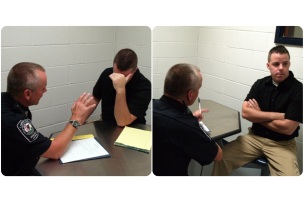
Police interrogation
The general rule is that deception can be used so long as it’s not likely to cause an innocent person to commit a crime or confess to a crime that s/he didn’t commit.
Click here: The Lawful Use of Deception – Article – POLICE Magazine
Consider the following examples:
- A detective is interviewing a suspect in a rape case. “Oh, that girl,” he says, thus implying that the victim was a slut and had it coming. The suspect, thinking he’s dealing with a sympathetic listener, starts bragging about his latest conquest—only to learn, too late, that his listener isn’t so simpatico after all.
- “We found your prints on the gun—or on any number of other surfaces. Actually, there are few good places on a pistol to leave prints. And those that are left can be smeared. The same goes for other surfaces. But if a suspect can be led to believe the cops have his prints, a confession is often forthcoming.
- A police officer is interrogating a suspect in a murder case. “He came at you, didn’t he?” asks the cop. The suspect, who murdered the victim in cold blood, thinks he has an escape route. “Yeah, he came at me”—this confirming that, yes, he did kill the deceased.
- “Your partner just gave you up” is a favorite police stratagen when there is more than one suspect involved. If one suspect can be made to “flip—turn–against the other, the case is essentially wrapped up.
- Interrogating a bank robbery suspect, a cop might say: “We know you didn’t do the shooting, that you were only the wheelman.” This implies that the penalty for driving the getaway car is far less than that for killing someone during a robbery. In fact, criminal law allows every member of the conspiracy to be charged as a principal.
- “I don’t give a damn what you did,” says the detective. “Just tell me why you did it.” For some suspects, this offers a cathartic release, a chance to justify their guilt.
- The “good cop/bad cop” routine is known to everyone who has ever seen a police drama. Yet it continues to yield results so often it continues to be routinely used. “Look, I believe you,” says the “good” cop, “but my partner’s a real asshole. Just tell me what happened so we can clear this up and you can go.”
- “So,” says the detective, “why do you think the police believe you did it?” “I have no idea,” says the suspect, confident that he isn’t giving up anything that might come back to haunt him. “Well,” says the cop, “I guess you’ll just have to make something up.” Make something up sounds easy, but is actually a trap. The suspect may end up giving away details that could incriminate him—or lying so brazenly that his lies can be used against him.
So is there a best way for a suspect to deal with an invitation to waive his Miranda right to remain silent?
Yes, there is. It’s to refuse to say anything and to ask for permission to call a lawyer.
That’s the preferred method for Mafia hitmen—and accused police officers.
Any cop who finds himself under investigation by his department’s Internal Affairs unit automatically shuts up—and calls his lawyer.
Any other respons—no matter how well-intentioned—may well result in a lengthy prison sentence.
ABC NEWS, ALTERNET, AP, BBC, BUZZFEED, CBS NEWS, CNN, COMMODUS, DAILY KOS, DONALD TRUMP, FACEBOOK, MIKA BRZEZINSKI, MORNING JOE, MOTHER JONES, MOVEON, NBC NEWS, NEWSWEEK, NICCOLO MACHIAVELLI, NPR, POLITICO, QATER, RAW STORY, REPORTERS COMMITTEE FOR FREEDOM OF THE PRESS, REUTERS, REX TILLERSON, SALON, SARAH HUCKABEE SANDERS, SAUDI ARABIA, SEATTLE TIMES, SLATE, THE ATLANTIC, THE CHICAGO SUN-TIMES, THE CHICAGO TRIBUNE, THE DAILY BEAST, THE GUARDIAN, THE HILL, THE HUFFINGTON POST, THE LOS ANGELES TIMES, THE NEW YORK TIMES, THE PRINCE, THE WALL STREET JOURNAL, THE WASHINGTON POST, TIME, TWITTER, U.S. NEWS & WORLD REPORT, UPI, USA TODAY
In Bureaucracy, History, Politics, Social commentary on July 4, 2017 at 12:30 am
If Donald Trump ever read The Prince, by Niccolo Machiavelli, the Florentine statesman, he’s decided he doesn’t need it. And his ever-falling popularity among Americans clearly proves his mistake.
First published in 1532, The Prince lays bare the qualities needed by a successful political leader. At the top of this list must be creating and preserving a sense of his own dignity. Thus, he must appear to be a combination of mercy, faith, integrity, humanity and religion.
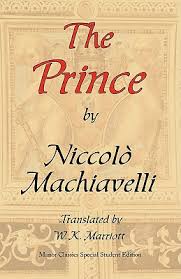
As Machiavelli puts it:
A prince must take great care that nothing goes out of his mouth which is not full of the above-named five qualities, and he should seem to be all mercy, faith, integrity, humanity and religion.
Since taking office on January 20, Trump has violated Machiavelli’s injunction on integrity with a vengeance. He has been caught in repeated falsehoods–so many, in fact, that the New York Times gave over its June 23 front page to a story headlined: “Trump’s Lies.”
According to the Times, Trump “told public falsehoods or lies every day for his first 40 days.”
“There is simply no precedent,” went the Times‘ opinion piece, “for an American president to spend so much time telling untruths. Every president has shaded the truth or told occasional whoppers.
“No other president—of either party—has behaved as Trump is behaving. He is trying to create an atmosphere in which reality is irrelevant.”

Donald Trump
Machiavelli also advises:
[He] must contrive that his actions show grandeur, spirit, gravity and fortitude….
It’s hard to convey those qualities in a series of 140-character rants on Twitter. Yet, from the start of his Presidency, Trump has put his ambitions, excuses and rants on social media.
As CNN Political Analyst Julian Zelizer outlined in a July 3 article:
“Putting aside the specific content of the recent blasts from the Oval smart phone, the President’s ongoing Twitter storms make all leaders uneasy. The heads of government in most nations prefer a certain amount of predictability and decorum from other heads of state.
“To have one of the most powerful people in the room being someone who is willing to send out explosive and controversial statements through social media, including nasty personal attacks or an edited video of him physically assaulting the media, does not make others….feel very confident about how he will handle deliberations with them.”
Trump’s apologists have fiercely defended his tweetstorms, claiming they allow him to bypass the media and “communicate directly with the American people.”
On June 29, Trump attacked the physical appearance of Mika Brzezinski, a frequent journalistic critic on MSNBC’s “Morning Joe.”
Sarah Huckabee-Sanders, his deputy press secretary, excused it: “The president has been attacked mercilessly on personal accounts by members on that program. And I think he’s been very clear that when he gets attacked he’s going to hit back.”
On July 2, Trump tweeted a video showing him punching a wrestler–with a CNN logo imposed over his face.
The tweet brought Trump widespread criticism. Bruce Brown, executive director of the Reporters Committee for Freedom of the Press, said the video was a “threat of physical violence against journalists” and “beneath the office of the presidency.”
Trump’s mania for tweeting has often led him to contradict statements by his administration’s highest officials.
In early June, Saudi Arabia cut off diplomatic ties with Qater because of its alleged support for terrorism in the Persian Gulf. Secretary of State Rex Tillerson publicly said that the United States hoped to mediate an end to the dispute.
But the next day, Trump tweeted: “During my recent trip to the Middle East, I stated that there can no longer be funding of Radical Ideology. Leaders pointed to Qatar—look!”
Machiavelli urged rulers to safeguard their reputations:
…A prince must show himself a lover of merit, give preferment to the able, and honor those who excel in every art.
Besides this, he ought, at convenient seasons of the year, to keep the people occupied with festivals and shows….mingle with them from time to time, and give them an example of his humanity and munificence, always upholding, however, the majesty of his dignity, which must never be allowed to fail in anything whatever.
Rulers who disregard this advice do so at their peril:
A prince need trouble little about conspiracies when the people are well disposed. But when they are hostile and hold him in hatred, then he must fear everything and everybody….
…[The Roman Emperor Commodus], being of a cruel and bestial disposition, in order to…exercise his rapacity on the people, he sought to favor the soldiers and render them licentious.
On the other hand, by not maintaining his dignity, by often descending into the theater to fight with gladiators and committing other contemptible actions…he became despicable in the eyes of the soldiers. And being hated on the one hand and despised on the other, he was conspired against and killed.
Donald Trump has repeatedly violated these lessons. It remains to be seen if he will pay a price for doing so.
AP, BBC, BLACKMAIL, BUZZFEED, CBS NEWS, CNN, DAILY KOS, DONALD TRUMP, EDWARD M. KENNEDY, FACEBOOK, J. EDGAR HOOVER, JARED KUSHNER, JOE SCARBOROUGH, JOHN F. KENNEDY, MIKA BRZEZINSKI, MORNING JOE, MOTHER JONES, MOVEON, NATIONAL ENQUIRER, NBC NEWS, NEWSWEEK, NPR, POLITICO, RAW STORY, REUTERS, RICHARD NIXON, SALON, SEATTLE TIMES, SLATE, THE ATLANTIC, THE CHICAGO SUN-TIMES, THE CHICAGO TRIBUNE, THE DAILY BEAST, THE GUARDIAN, THE HILL, THE HUFFINGTON POST, THE LOS ANGELES TIMES, THE NEW YORK TIMES, THE WALL STREET JOURNAL, THE WASHINGTON POST, TIME, TWITTER, U.S. NEWS & WORLD REPORT, UPI, USA TODAY, WILLIAM L. SULLIVAN
In Bureaucracy, History, Law, Law Enforcement, Politics, Social commentary on July 3, 2017 at 12:10 am
J. Edgar Hoover, the legendary FBI director, was notorious in his own lifetime as a blackmailer.
“Boy, the dirt he has on those Senators,” President John F. Kennedy told his friend, Benjamin C. Bradlee, who was then head of Newsweek’s Washington bureau.
As President, Kennedy could call on Hoover to give him limited access to the private files the FBI director kept on real and potential enemies. But Kennedy had known about Hoover’s incriminating dossiers long before he reached the White House.

J. Edgar Hoover
During 1941-42, he had enjoyed a delicious affair with Inga Arvad, a Danish journalist and notorious fan of Germany’s Fuhrer, Adolf Hitler.
Suspected of being a Nazi spy, “Inga Binga,” as JFK jokingly referred to her, came under heavy FBI surveillance—including phone taps and room bugs. These picked up Kennedy’s trysts with her.
When the Kennedy patriarch, Joseph P., learned of the affair, he demanded that his son break it off. He had political ambitious for all his sons, and he didn’t want them spoiled by Jack’s owing to an uncontrollable libido.
Richard Nixon—Kennedy’s future rival for the White House—felt the same way about Hoover: “He’s got files on everybody.”
And this was virtually true—even if those files didn’t hold secretly-obtained information. Nixon learned this as President when he wanted “dirt” on Senator Edward M. Kennedy. In this case, the “file” turned out to be nothing more than newspaper clippings.
As William C. Sullivan, the onetime director of the FBI’s Domestic Intelligence Division, revealed after Hoover’s death in 1972:
“The moment [Hoover] would get something on a senator, he’d send one of the errand boys up and advise the senator that ‘we’re in the course of an investigation, and we by chance happened to come up with this data on your daughter.
“‘But we wanted you to know this. We realize you’d want to know it.’ Well, Jesus, what does that tell the senator? From that time on, the senator’s right in his pocket.”
There is a lesson to be learned here: Giving in to blackmail only empowers the blackmailer even more.
The only effective way to handle blackmail was demonstrated by Joe Scarborough and Mika Brzezinski, hosts of MSNBC’s “Morning Joe,” a weekday news and talk show.

Mika Brzezinski
Both have been highly critical of President Donald Trump since he took office on January 20. And Trump—through his friendship with David Pecker, the publisher of the tabloid, The National Enquirer—thought he had the ideal way of shutting them up.

Joe Scarborough
On the June 30 edition of “Morning Joe,” Scarborough and Brezezinski offered their version of events.
Scarborough: “We got a call: ‘Hey, the National Enquirer is going to run a negative story against you guys, and Donald is friends with …the president is friends with the guy that runs National Enquirer.’ And they said: ‘If you call the president up and you apologize for your coverage, then he will pick up the phone and basically spike the story.’
“I had, I will just say, three people at the very top of the administration calling me. The calls kept coming, and kept coming, and they were like: ‘Come on, Joe, just pick up the phone and call him.’”

Donald Trump
One of the callers was reportedly Jared Kushner, Trump’s son-in-law.
In short: Grovel before the dictator and he will bestow clemency on you.
Trump denied being a party to blackmail, but he confirmed that there had been calls between the TV journalists and members of his staff. In a June 30 tweet, Trump wrote: “He called me to stop a National Enquirer article. I said no! Bad show”.
Scarborough and Brzezinski provided further details in a June 30 Washington Post column: “This year, top White House staff members warned that the National Enquirer was planning to publish a negative article about us unless we begged the president to have the story spiked. We ignored their desperate pleas.”
The story, which appeared on June 5, alleged that the two, previously married, had cheated on their former spouses. The story was entitled: “Joe & Mika: TV Couple’s Sleazy Cheating Scandal: ‘Morning’ lovebirds vow to make it legal. THE ENQUIRER asks questions!”
By rejecting Trump’s blackmail threat, Scarborough and Brzezinski accomplished what they could not have by groveling:
First, they put Trump on notice that they can’t be cowed. This can only encourage future targets of such blackmail to stand up against abuse.
Second, they deprived him of a potent weapon. Had they caved in to his demand for an unearned apology, they would have made themselves targets for future blackmail.
Third, they turned the tables by making Trump the target of ugly publicity. Blackmailers are universally reviled, and branding Trump as one detracts from his dignity and influence as President.
Fourth, they forced Trump and the Enquirer on the defensive—with both denying that they ever tried to blackmail Scarborough and Brzezinski.
Considering Trump’s well-earned reputation for lying and vindictiveness, Scarborough and Brzezinski are certain to be more widely believed than the President.
ABC NEWS, ADOLF HITLER, ALTERNET, AP, BARACK OBAMA, BBC, BUZZFEED, CBS NEWS, CIA, CNN, CZECHOSLOVAKIA, DAILY KOS, DEBT CEILING, DONALD TRUMP, EDUARD DELADIER, EXTORTION, FACEBOOK, FBI, HOUSE SPEAKER JOHN BOEHNER, JAY PARINI, MOTHER JONES, MOVEON, MUNICH CONFERENCE, NATIONAL SECURITY AGENCY, NBC NEWS, NEGOTIATING, NEVILLE CHAMBERLAIN, NEWSWEEK, NICCOLO MACHIAVELLI, NPR, POLITICO, RAW STORY, REPUBLICAN PARTY, REPUBLICANS, REUTERS, RICO ACT, RUSSIA, SALON, SEATTLE TIMES, SLATE, THE ATLANTIC, THE CHICAGO SUN-TIMES, THE CHICAGO TRIBUNE, THE DAILY BEAST, THE GUARDIAN, THE HILL, THE HUFFINGTON POST, THE LOS ANGELES TIMES, THE NEW YORK TIMES, THE WALL STREET JOURNAL, THE WASHINGTON POST, TIME, TWITTER, U.S. NEWS & WORLD REPORT, UPI, USA PATRIOT ACT, USA TODAY, WINSTON CHURCHILL
In Bureaucracy, History, Law, Law Enforcement, Military, Politics, Social commentary on June 30, 2017 at 12:03 am
During the summer of 2011, Republicans threatened to destroy the Nation’s credit rating unless Democrats agreed to massively cut social programs for the elderly, poor and disabled.
President Barack Obama could have countered this extortion through the Racketeer Influenced Corrupt Organization (RICO) Act.
RICO opens with a series of definitions of “racketeering activity” which can be prosecuted by Justice Department attorneys. Among those crimes: Extortion.
Extortion is defined as “a criminal offense which occurs when a person unlawfully obtains either money, property or services from a person(s), entity, or institution, through coercion.”
The RICO Act defines “a pattern of racketeering activity” as “at least two acts of racketeering activity, one of which occurred after the effective date of this chapter and the last of which occurred within ten years…after the commission of a prior act of racketeering activity.”
And if President Obama had believed that RICO was not sufficient to counter Republicans’ extortion attempts, he could have relied on the USA Patriot Act of 2001, passed in the wake of 9’11.
In Section 802, the Act defines domestic terrorism. Among the behavior so defined: “Activities that…appear to be intended…to influence the policy of a government by intimidation or coercion [and]…occur primarily within the territorial jurisdiction of the United States.”
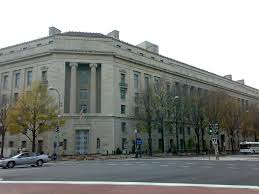
U.S. Department of Justice
The remedies for punishing such criminal behavior were now legally in place. President Obama needed only to direct the Justice Department to apply them.
Criminally investigating and possibly indicting members of Congress would not violate the separation-of-powers principle. Congressmen have in the past been investigated, indicted and convicted for various criminal offenses.
The indictment of large numbers of Republican extortionists would have substantially changed the course of American history while Obama held office.
Instead of raising huge sums of money for re-election battles, those Representatives and Senators would have been forced to raise monies for their legal defense. And while some might have been convicted, others almost certainly would have been.
This would have substantially depleted the ranks of Obama’s sworn enemies—and given him far greater opportunities to enact his legislative agenda.
Such indictments and prosecutions—and especially convictions—would have served notice on current and future members of Congress: The lives and fortunes of American citizens may not be held hostage to gain leverage in a political settlement.
A Cuban Missile Crisis Speech
But Obama could have stood up to Republican extortionists in another way: By urging his fellow Americans to rally to him in a moment of supreme national danger.
President John F. Kennedy did just that—successfully—during the most dangerous crisis of his administration. Addressing the Nation on October 22, 1962, Kennedy shocked his fellow citizens by revealing that the Soviet Union had installed offensive nuclear missiles in Cuba.

John F. Kennedy
Kennedy outlined a series of steps he had taken to end the crisis—most notably, a blockade of Cuba.
Then he sought to reassure and inspire his audience: “The cost of freedom is always high, but Americans have always paid it. And one path we shall never choose, and that is the path of surrender or submission.”
President Obama could have sent that same message to the extortionists of the Republican Party—by explaining to the American people:
- Republicans have adopted the same my-way-or-else “negotiating” stance as Adolf Hitler.
- Like the Nazis, they are determined to gain absolute power—or destroy the Nation they claim to love.
- They raised the debt ceiling seven times during the eight-year Presidency of George W. Bush.
- But now that a Democrat holds the White House, raising the debt ceiling is unacceptable.
- Despite Republican lies, we cannot revitalize the economy by slashing taxes on the wealthy and on cash-hoarding corporations while cutting benefits for millions of average Americans.
- We will need both tax increases and sensible entitlement cuts to regain our economic strength.
And he could have ended his speech with a direct call to action by the American people:

President Barack Obama addressing the Nation
“We stand on the edge of economic disaster. Therefore, I am asking each of you to stand up for America tonight–by demanding the recall of the entire membership of the Republican Party.
“This is the moment when each of us must decide—whether we will survive as a Republic, or allow ruthless political fanatics to destroy what has lasted and thrived for more than 200 years.”
Instead, Obama caved in to Republican extortion demands.
In September, 1939, British Prime Minister Neville Chamberlain and French Prime Minister Edouard Daladier sold out their ally, Czechoslovakia, to Adolf Hitler at the infamous Munich Conference.
As Winston Churchill aptly predicted: “Britain and France had to choose between war and dishonor. They chose dishonor. They will have war.”
To paraphrase Churchill: President Obama had to choose between confrontation and timidity. He chose timidity. He got contempt and obstruction in return.
Five years later, the FBI, CIA and National Security Agency informed Obama that Russian Intelligence agents were actively working to ensure Donald Trump’s election as President.
Obama did not publicly release this information–nor indict Trump campaign staffers who were colluding with those agents.
Thus, Trump won the election–and gained the power to destroy Obama’s Presidential legacy.
ABC NEWS, ADOLF HITLER, ALTERNET, AP, BARACK OBAMA, BBC, BUZZFEED, CBS NEWS, CIA, CNN, CZECHOSLOVAKIA, DAILY KOS, DEBT CEILING, DONALD TRUMP, EDOUARD DELADIER, EXTORTION, FACEBOOK, FBI, HOUSE SPEAKER JOHN BOEHNER, JAY PARINI, MOTHER JONES, MOVEON, MUNICH CONFERENCE, NATIONAL SECURITY AGENCY, NBC NEWS, NEGOTIATING, NEVILLE CHAMBERLAIN, NEWSWEEK, NPR, POLITICO, RAW STORY, REPUBLICAN PARTY, REPUBLICANS, REUTERS, RICO ACT, RUSSIA, SALON, SEATTLE TIMES, SLATE, THE ATLANTIC, THE CHICAGO SUN-TIMES, THE CHICAGO TRIBUNE, THE DAILY BEAST, THE GUARDIAN, THE HILL, THE HUFFINGTON POST, THE LOS ANGELES TIMES, THE NEW YORK TIMES, THE WALL STREET JOURNAL, THE WASHINGTON POST, TIME, TWITTER, U.S. NEWS & WORLD REPORT, UPI, USA PATRIOT ACT, USA TODAY, WINSTON CHURCHILL
In Bureaucracy, History, Law, Law Enforcement, Military, Politics, Social commentary on June 29, 2017 at 11:40 am
“[Barack] Obama needs to find his voice now in ways that, during his time in the Oval Office, he was too often reluctant to do, perhaps fearing the immense power of the bully pulpit.
“But now there is a real bully in the pulpit, and Obama–like the rest of us–has no choice but to speak, and to act.”
So writes noted author and poet Jay Parini in an Op-Ed piece for CNN.
“[President Donald] Trump has, in fact, gone out of his way to attack Obama, as in his recent nonsensical reversal wherein he attacked Obama for his lack of response to Russian meddling in the 2016 election: ‘Obama did NOTHING,’ Trump tweeted. He went on to accuse Obama of colluding with the Russians!”
Parini believes that Obama should have warned the American public that Russia was trying to sway the 2016 election for Trump: “There can be no sound reason for not alerting the people of this country to a major attack on their most cherished right, the right to vote.”
But Obama didn’t issue any such warning. The findings of the FBI, CIA and National Security Agency were kept strictly confidential until after Trump won the campaign.
Parini also believes that Obama should now forcefully respond to Trump’s attacks on him and his signature legislative achievement: The Affordable Care Act, also known as “Obamacare.”
But Obama has long refused to respond forcefully to Republican attacks. As a result, Republicans now dominate both houses of Congress–and the White House.
During the summer of 2011, Republicans threatened to destroy the Nation’s credit rating unless their budgetary demands were met. They refused to raise the debt ceiling unless Democrats agreed to massively cut social programs for the elderly, poor and disabled.

Sign of the Mafia “Black Hand”
If Congress failed to raise the borrowing limit of the federal government by August 2, the date when the U.S. reached the limit of its borrowing abilities, it would have begun defaulting on its loans.
As Warren Buffett, CEO of Berkshire Hathaway, explained the looming economic catastrophe: “If you don’t send out Social Security checks, I would hate to think about the credit meeting at S&P and Moody’s the next morning.
“If you’re not paying millions and millions and millions of people that range in age from 65 on up, money you promised them, you’re not a AAA,” said Buffett.
A triple-A credit rating is the highest possible rating that can be received.
President Obama offered to make historic cuts in the federal government and the social safety net–on which millions of Americans depend for their most basic needs.
But House Speaker John Boehner rejected that offer. He would not agree to the tax increases that Democrats wanted to impose on the wealthiest 1% as part of the bargain.

John Boehner
To raise taxes on the wealthy, Republicans insisted, would be a “jobs-killer.” It would “discourage” corporate CEOs from creating tens of thousands of jobs they allegedly “wanted” to create.
As the calendar moved ever closer to the fateful date of August 2, Republican leaders continued to insist: Any deal that includes taxes “can’t pass the House.”
One senior Republican said talks would go right up to—and maybe beyond—the brink of default.
“I think we’ll be here in August,” said Republican Representative Pete Sessions, of Texas. “We are not going to leave town until a proper deal gets done.”
President Obama had previously insisted on extending the debt ceiling through 2012. But in mid-July, he simply asked congressional leaders to review three options with their members:
- The “Grand Bargain” choice—favored by Obama–would cut deficits by about $4 trillion, including spending cuts and new tax revenues.
- A medium-range plan would aim to reduce the deficit by about $2 trillion.
- The smallest option would cut between $1 trillion and $1.5 trillion, without increased tax revenues or any medicare and Medicaid cuts.
And the Republican response?
Said Rep. Darrell Issa, chairman of the Oversight and Government Reform Committee: “Quite frankly, [Republican] members of Congress are getting tired of what the president won’t do and what the president wants.”
With the United States teetering on the brink of national bankruptcy, President Obama faced three choices:
- Counter Republican extortion attempts via RICO—the Racketeer Influenced Corrupt Organization Act.
- Make a “Cuban Missile Crisis”-style address to the American people, seeking to rally them against a criminal threat to the fiscal security of the Nation.
- Cave in to Republican demands.
Unfortunately for Obama and the Nation, he chose Number Three.
Here is how he could have applied the other two options.
Racketeer Influenced Corrupt Organizations (RICO) Act
In 1970, Congress passed the Racketeer Influenced and Corrupt Organizations (RICO) Act, Title 18, United States Code, Sections 1961-1968.
Congress’ goal was to eliminate the stranglehold of organized crime on the nation’s economy. To put it bluntly, RICO was intended to destroy the Mafia.

But in United States v. Turkette, 452 U.S. 576 (1981), the Supreme Court held that RICO applied as well to legitimate enterprises being operated in a criminal manner.
After Turkette, RICO could also be used against corporations, political protest groups, labor unions and loosely knit-groups of people.
In short, the stage was set to hold even Congressional extortionists accountable.
ABC NEWS, ADOLF HITLER, ALBERT SPEER, ALTERNET, AP, BARACK OBAMA, BBC, BUZZFEED, CBS NEWS, CNN, DAILY KOS, DEPARTMENT OF HOMELAND SECURITY, EXTORTION, FACEBOOK, FASCISM, MITCH MCCONNELL, MOTHER JONES, MOVEON, NAZI GERMANY, NBC NEWS, NEGOTIATING, NEWSWEEK, NPR, POLITICO, RAW STORY, REPUBLICAN PARTY, REPUBLICANS, REUTERS, SALON, SEATTLE TIMES, SLATE, THE ATLANTIC, THE CHICAGO SUN-TIMES, THE CHICAGO TRIBUNE, THE DAILY BEAST, THE GUARDIAN, THE HILL, THE HUFFINGTON POST, THE LOS ANGELES TIMES, THE NEW YORK TIMES, THE WALL STREET JOURNAL, THE WASHINGTON POST, TIME, TRICKLE-DOWN ECONOMICS, TWITTER, U.S. NEWS & WORLD REPORT, UPI, USA TODAY, WORLD WAR 11
In Bureaucracy, History, Law, Law Enforcement, Military, Politics, Social commentary on June 28, 2017 at 9:17 am
On December 13, 2014, the U.S. Senate passed a $1.1 trillion spending bill to fund almost the entire government through the September 30 end of the fiscal year.
But one Federal agency was pointedly exempted from full funding: The Department of Homeland Security (DHS). Its funding would expire on February 27.
With their newfound majorities in both houses of Congress, Republicans intended to hold the security of the United States as a hostage.
Their goal: To force President Barack Obama to rescind the changes he had made in American immigration policy.
With more than 240,000 employees, the DHS is the third largest Cabinet department, after the Departments of Defense and Veterans Affairs.
The Defense Department is charged with military actions abroad.
DHS is responsible for protecting the United States inside and outside its borders. Its goal is to prepare for, prevent and—if prevention fails—respond to man-made accidents, natural disasters and terrorism.

Among the agencies now operating under its mandate:
- U.S. Citizenship and Immigration Services
- U.S. Customs and Border Protection
- U.S. Coast Guard
- Federal Emergency Management Agency (FEMA)
- Federal Law Enforcement Training Center
- U.S. Immigration and Customs Enforcement (ICE)
- Transportation and Safety Administration (TSA)
- U.S. Secret Service
- Science and Technology Directorate
- Domestic Nuclear Detection Office
- Office of Intelligence and Analysis
- Office of Operations Coordination and Planning
Yet each of these agencies has a vital role to play in protecting the nation. A nation whose security Republicans were willing to threaten to get their way on a matter of domestic policy.
Right-wing Republicans argued that even if DHS’s funding were stopped, most of its employees would stay on the job. That’s because they perform work considered necessary to protect human life and property.
But while those employees were safeguarding the country, they wouldn’t be paid until the shutdown ended.
It’s hard to give your full attention to protecting the lives of others when you have to worry about paying a mortgage or feeding your family.
Of course, the Republicans responsible for this shutdown would have continued to receive their hefty paychecks.
Republicans chose to act as Mafia extortionists at a time when the United States appeared to be in the crosshairs of North Korean terrorism.
On November 14, 2014, Sony Pictures came under relentless attack by cyberterrorists, whom the FBI linked to North Korea.
The reason? Sony’s production of “The Interview,” a comedy depicting the assassination of North Korean dictator Kim Jong Un.
Calling themselves “Guardians of Peace,” or GOP, they shut down the company’s computer system and revealed employees’ personal information such as salaries, addresses, and Social Security numbers.
(Ironically, “Guardians of Peace” appropriated the same abbreviation–GOP–used by the Republicans for “Grand Old Party.”)
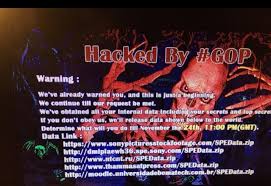
Warning issued by “Guardians of Peace” (GOP)
On December 17, 2014, Sony Pictures cancelled the Christmas Day premier of “The Interview” after the nation’s five largest movie chains refused to show the movie, following a terror threat posted online.
And then on February 5, 2015, Anthem Insurance announced that its database had been hacked–and sensitive medical information on up to 80 million customers and employees accessed.
According to an anonymous source, the hackers used malware that’s been used almost exclusively by Chinese cyberspies.
* * * * *
As the Third Reich came to its fiery end, Adolf Hitler sought to punish the German people for being “unworthy” of his “genius” and losing the war he had started.
His attitude was: “If I can’t rule Germany, then there won’t be a Germany.”
In his infamous “Nero Order,” he decreed the destruction of everything still remaining–industries, ships, harbors, communications, roads, mines, bridges, stores, utility plants, food stuffs.
Fortunately for Germany, one man—Albert Speer, the Minister of Armaments—finally broke ranks with his Fuhrer.
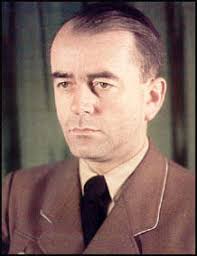
Albert Speer
Risking death, he refused to carry out Hitler’s “scorched earth” order. Even more important, he mounted a successful effort to block such destruction or persuade influential military and civilian leaders to disobey the order as well.
As a result, those targets slated for destruction were spared.
After the election of America’s first black President, Republicans waged a similar “scorched earth” campaign. Their avowed goal—as stated openly by Kentucky’s U.S. Senator Mitch McConnell—was “to make Barack Obama a one-term President.”
Literally during his first Inauguration, Republicans, in a secret meeting, agreed to block every effort he made to repair the economy.
Acting as extortionists, they repeatedly threatened to shut down the government if they didn’t get their way in legislative matters.
And just as repeatedly, they blocked legislation that would have helped the poor, unemployed, women, elderly, disabled or middle-class.
At the center of their fury lay the Affordable Care Act, providing medical care to all citizens.
Even after Congress passed it and the Supreme Court affirmed it, House Republicans shut down the government in October, 2013.
By doing so, they hoped to pressure Obama into killing his signature piece of legislation. The effort failed.
Like Adolf Hitler, their attitude has been: “If I can’t rule America, there won’t be an America.”
It remains to be seen whether a Republican Albert Speer will step forward to save America from the self-destructive excesses of this Nation’s own fanatics.
2016 PRESIDENTIAL RACE, ABC NEWS, ADOLF HITLER, ALTERNET, AP, ASSASSINATION, BBC, BUZZFEED, CBS NEWS, CILLIAN MURPHY, CNN, CZECHOSLOVAKIA, DAILY KOS, DONALD TRUMP, ERIC TRUMP, FACEBOOK, FINAL SOLUTION, FOX NEWS NETWORK, HANNITY, HILLARY CLINTON, JAMIE DORNAN, JEB BUSH, JOHNNY DEPP, LARA TRUMP, MICHAEL HAYDEN, MOTHER JONES, MOVEON, MOVIES, NATIONAL SECURITY AGENCY, NAZI GERMANY, NBC NEWS, NEWSWEEK, NPR, OPERATION ANTHROPOID, POLITICO, RAW STORY, REINHARD HEYDRICH, REUTERS, SALON, SARAH HUCKABEE SANDERS, SEAN HANNITY, SEATTLE TIMES, SLATE, SS, THE ATLANTIC, THE CHICAGO SUN-TIMES, THE CHICAGO TRIBUNE, THE DAILY BEAST, THE GUARDIAN, THE HILL, THE HUFFINGTON POST, THE LOS ANGELES TIMES, THE NEW YORK TIMES, THE WALL STREET JOURNAL, THE WASHINGTON POST, TIME, TWITTER, U.S. NEWS & WORLD REPORT, UPI, USA TODAY, WANNSEE CONFERENCE
In Bureaucracy, History, Law, Law Enforcement, Politics, Social commentary on June 27, 2017 at 9:25 am
Johnny Depp is an acclaimed actor. But his skills as a comic have sparked a backlash.
“When was the last time an actor assassinated the President?” he asked while speaking at the Glatonbury Festival on June 22.
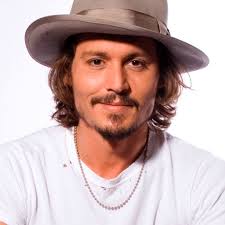
Johnny Depp
The Glastonbury Festival is an annual, five-day celebration of contemporary performing arts that takes place near Pilton, Somerset (England).
Perhaps Depp sensed that he was making himself a target for the Secret Service, for he quickly added that he was not referring to himself: “I want to clarify, I am not an actor. I lie for a living. However, it has been a while and maybe it is time.”
Predictably, Donald Trump’s family did not find the joke funny.
The next day, Lara Trump, wife of the President’s son, Eric, called Depp’s comments “really, really sad—as a family member and as an American.”

Eric and Lara Trump
Max Goldberg from USA, CC BY 2.0 <https://creativecommons.org/licenses/by/2.0>, via Wikimedia Commons
Appearing on Right-wing Fox Network’s “Hannity,” she told its host, Sean Hannity: “It’s happening to Donald Trump because he is Donald Trump. Their candidate failed, because they have nothing else to say. They have no platform; they have no real leader; they have no message.
“So the only thing they can do is pile on the President. Unfortunately it is to the detriment of the country.
“It’s really sick, Sean. The Republican Party is becoming the only party of tolerance here in the United States.”
On Twitter, Donald Trump Jr. called for Disney to dump the star of the “Pirates of the Caribbean” franchise.
“President Trump has condemned violence in all forms, and it’s sad that others like Johnny Depp have not followed his lead,” said deputy White House press secretary Sarah Huckabee Sanders.
Apparently these Trump enthusiasts forgot Trump’s series of threats against his Republican and Democratic opponents throughout the 2016 campaign:
- On March 16, he warned Republicans that if he didn’t win the GOP nomination in July, his supporters would literally riot: “I think you’d have riots. I think you would see problems like you’ve never seen before. I think bad things would happen. I really do. I wouldn’t lead it, but I think bad things would happen.”
- That Republicans clearly saw this as a threat is undeniable. Paul Ryan, their Speaker of the House, said on March 17: “Nobody should say such things in my opinion because to even address or hint to violence is unacceptable.
- On August 9, Trump told a rally in Wilmington, North Carolina: “Hillary [Clinton] wants to abolish, essentially abolish, the Second Amendment. If she gets to pick her [Supreme Court] judges, nothing you can do folks. Although the Second Amendment people–maybe there is, I don’t know.”
Clinton’s camp instantly responded with fury.
“Don’t treat this as a political misstep,” Senator Christopher S. Murphy of Connecticut, who has called for stiffer gun laws, wrote on Twitter. “It’s an assassination threat, seriously upping the possibility of a national tragedy & crisis.”
“Well, let me say if someone else said that outside of the hall, he’d be in the back of a police wagon now, with the Secret Service questioning him,” said Michael Hayden, former head of the CIA and National Security Agency (NSA).
The Trump campaign issued a statement denying that he had meant any such thing.
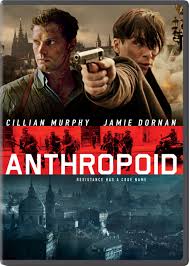
Three days after Trump’s Hillary remarks, Operation Antrhopoid, a UK-French-Czech historical film, appeared in theaters. Its subject: The 1942 assassination of SS Obergruppenführer (General) Reinhard Heydrich.
A tall, blond-haired formal naval officer, he was both a champion fencer and talented violinist. Heydrich joined the Schutzstaffel, or Protective Squads, better known as the SS, in 1931, and quickly became head of its counterintelligence service.
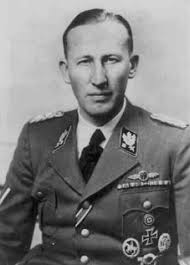
Reinhard Heydrich
In September, 1941, Heydrich was appointed “Reich Protector” of Czechoslovakia, which had fallen prey to Germany in 1938 but whose citizens were growing restless under Nazi rule.
Heydrich immediately ordered a purge, executing 92 people within the first three days of his arrival in Prague. By February, 1942, 4,000-5,000 people had been arrested.
In January, 1942, Heydrich convened a meeting of high-ranking political and military leaders to streamline “the Final Solution to the Jewish Question.”
An estimated six million Jews were thus slaughtered.
Returning to Prague, Heydrich continued a policy of carrot-and-stick with the Czechs—improving the social security system and requisitioning luxury hotels for middle-class workers—alternating with arrests and executions.
The Czech government-in-exile, headquartered in London, feared that Heydrich’s incentives might lead the Czechs to passively accept domination. They decided to assassinate him.
Two British-trained Czech commandos—Jan Kubis and Joseph Gabcik—parachuted into Prague.
On May 27, 1942, the assassins waited at a hairpin turn in the road always taken by Heydrich. When Heydrich’s Mercedes slowed down, Kubis lobbed a hand grenade at the car. The explosion ruptured Heydrich’s diaphragm, spleen and lung.
On June 4, Heydrich died of his injuries.
For Donald Trump, movies and jokes about assassination carry supreme—if unnoticed—irony.
It is Trump who repeatedly raised the issue of using violence and assassination to attain political ends. The last thing he needs are reminders—like Depp and Anthropoid—that Right-wingers can also be targets for death.


ABC NEWS, ADULTERY, ALTERNET, AMERICABLOG, AP, BABY BOOMER RESISTANCE, BARACK OBAMA, BBC, BIBLE, BILLY GRAHAM, BLOOMBERG NEWS, BUZZFEED, CBS NEWS, CNN, CROOKS AND LIARS, DAILY KOZ, FACEBOOK, FIVETHIRTYEIGHT, FRANKLIN GRAHAM, HARPER’S MAGAZINE, HOMOSEXUALITY, HUFFINGTON POST, I USA TODAY, MEDIA MATTERS, MITT ROMNEY, MOTHER JONES, MOVEON, MSNBC, NBC NEWS, NEW REPUBLIC, NEWSDAY, NEWSWEEK, NEWT GINGRICH, NPR, PBS NEWSHOUR, POLITICO, POLITICUSUSA, RAW STORY, REUTERS, RICK SANTORUM, SALON, SCIENCE, SEATTLE TIMES, SLATE, SLAVERY, SPANISH INQUISITION, TALKING POINTS MEMO, TEA PARTY, THE ATLANTIC, THE CHICAGO SUN-TIMES, THE CHICAGO TRIBUNE, THE DAILY BEAST, THE DAILY BLOG, THE GUARDIAN, THE HILL, THE HUFFINGTON POST, THE INTERCEPT, THE LOS ANGELES TIMES, THE NATION, THE NEW REPUBLIC, THE NEW YORK TIMES, THE NEW YORKER, THE VILLAGE VOICE, THE WASHINGTON POST, THEOLOGY, THINKPROGRESS, TIME, TRUTHDIG, TRUTHOUT, TWITTER, TWO POLITICAL JUNKIES, U.S. NEWS & WORLD REPORT, UP, UPI, USA TODAY, WAR, WOMEN
AMERICA UNDER BIBLICAL RULE–A DESCENT INTO HELL: PART ONE (OF TWO)
In Bureaucracy, History, Law, Law Enforcement, Military, Politics, Social commentary on July 11, 2017 at 12:03 amFranklin Graham, son of Billy Graham, America’s most famous preacher, spends a lot of time deciding who qualifies as a Christian—and who doesn’t.
Franklin Graham
He said just that on the February 21, 2012 edition of the MSNBC show, “Morning Joe.”
First, however, he offered his views on the relative Christian dedication of the major contenders for the Presidency in 2012:
President Barack Obama: “Islam sees him as a son of Islam….I can’t say categorically that [Obama is not Muslim] because Islam has gotten a free pass under Obama.”
Former Speaker of the House Newt Gingrich:“Newt’s been married several times… but he could make a good candidate. I think Newt is a Christian. At least he told me he is.”
Former Pennsylvania U.S. Senator Rick Santorum: “His values are so clear on moral issues. No question about it. I think he is, no question, a man of faith.”
Former Massachusetts Governor Mitt Romney: “I’m just saying most Christians would not recognize Mormonism. Of course they believe in Jesus Christ, but they have a lot of other things that they believe in, too, that we don’t accept theologically.”
Thus, Graham had no problem in pronouncing as “saved” a notorious multiple-adulterer like Gingrich, or a rights-denying religious zealot like Santorum.
But he clearly refused to pronounce as “saved” a longtime church-goer like Obama or a Mormon like Romney (whose faith, most evangelicals like Graham believe, is actually a non-Christian cult).
Toward the end of the program, Mike Barnicle, one of the panelists interviewing Graham, said: “You must spend a big part of the day checking out what you conceive to be people’s depth of faith, in terms of measuring.”
“This is my business,” replied Graham. “You guys go through newspapers every day. I look at a person’s political interest, but more importantly I look at their spiritual interests….
“You have to go by what a person says, and how they live their lives…Are they faithful church goers? Or do they just go when the cameras are on them?”
Another man who dedicated his life to judging the religious commitment of others was Bernard Gui, the chief inquisitor at Toulouse from 1308 to 1322.
Bernard Gui
His inquisition of those suspected or accused of heresy led to over 900 guilty verdicts. Of those convicted during examination by Gui, 42 were executed—by being burned at the stake.
Gui closely studied the best methods for interrogating “heretics.” He set forth his findings in his most important and famous work, Practica Inquisitionis Heretice Pravitatis. or “Conduct of the Inquisition into Heretical Wickedness.”
In this, he offered a vivid example of how such interrogations might go. The following is taken from that manual:
Interrogator: You call your faith Christian, for you consider ours as false and heretical. But I ask whether you have ever believed as true another faith than that which the Roman Church holds to be true?
Accused Heretic: I believe the true faith which the Roman Church believes, and which you openly preach to us.
Interrogator: Perhaps you have some of your sect at Rome whom you call the Roman Church. I, when I preach, say many things, some of which are common to us both, as that God liveth, and you believe some of what I preach. Nevertheless you may be a heretic in not believing other matters which are to be believed.
“Heretic” being burned at the stake
Accused Heretic: I believe all things that a Christian should believe.
Interrogator: I know your tricks. What the members of your sect believe you hold to be that which a Christian should believe. But we waste time in this fencing. Say simply, Do you believe in one God the Father, and the Son, and the Holy Ghost?
Accused Heretic: I believe.
Interrogator: Do you believe in Christ born of the Virgin, suffered, risen, and ascended to heaven?
Accused Heretic: (Briskly) I believe.
Interrogator: Do you believe the bread and wine in the mass performed by the priests to be changed into the body and blood of Christ by divine virtue?
Accused Heretic: Ought I not to believe this?
Interrogator: I don’t ask if you ought to believe, but if you do believe.
Accused Heretic: I believe whatever you and other good doctors order me to believe.
Inquisitor: Those good doctors are the masters of your sect; if I accord with them you believe with me; if not, not.
Accused Heretic: I willingly believe with you if you teach what is good to me.
Inquisitor: You consider it good to you if I teach what your other masters teach. Say, then, do you believe the body of our Lord, Jesus Christ to be in the altar?
Accused Heretic: (Promptly) I believe that a body is there, and that all bodies are of our Lord.
Interrogator: I ask whether the body there is of the Lord who was born of the Virgin, hung on the cross, arose from the dead, ascended, etc.
Accused Heretic: And you, sir, do you not believe it?
Interrogator: I believe it wholly.
Accused Heretic: I believe likewise.
Share this: