Posts Tagged ‘NAZI PARTY’
2012 PRESIDENTIAL CAMPAIGN, 2016 PRESIDENTIAL CAMPAIGN, ABC NEWS, ABORTION, ADOLF HITLER, BIRTH CONTROL, BROWNSHIRTS, CBS NEWS, CNN, ERNST ROHM, FACEBOOK, HEINRICH HIMMLER, HERMAN GORING, JEWS, KAREN SANTORUM, MARCO RUBIO, MITT ROMNEY, MSNBC, NAZI GERMANY, NAZI PARTY, NBC NEWS, PLANNED PARENTHOOD, REINHARD HEYDRICH, REPUBLICAN PARTY, RICK SANTORUM, S.A., SAME-SEX MARRIAGE, SS, THE CHICAGO SUN-TIMES, THE CHICAGO TRIBUNE, THE HUFFINGTON POST, THE LOS ANGELES TIMES, THE NEW YORK TIMES, THE WALL STREET JOURNAL, THE WASHINGTON POST, TWITTER, USA TODAY
In Bureaucracy, History, Law, Politics, Social commentary, Uncategorized on March 26, 2018 at 12:03 am
“All revolutions,” said Ernst Rohm, leader of Adolf Hitler’s brown-shirted thugs, the S.A., “devour their own children.”
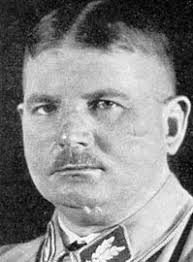
Ernst Rohm
Fittingly, he said this as he sat inside a prison cell awaiting his own execution.
On June 30, 1934, Hitler had ordered a massive purge of his private army, the S.A., or Stormtroopers. The purge was carried out by Hitler’s elite army-within-an-army, the Schutzstaffel, or Protective Squads, better known as the SS.
The S.A. Brownshirts had been instrumental in securing Hitler’s rise to Chancellor of Germany on January 30, 1933. They had intimidated political opponents and organized mass rallies for the Nazi Party.
But after Hitler reached the pinnacle of power, they became a liability.
Ernst Rohm, their commander, urged Hitler to disband the regular German army, the Reichswehr, and replace it with his own legions as the nation’s defense force.
Frightened by Rohm’s ambitions, the generals of the Reichswehr gave Hitler an ultimatum: Get rid of Rohm—or they would get rid of him.
So Rohm died in a hail of SS bullets—as did several hundred of his longtime S.A. cronies.
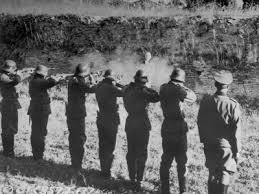
SS firing squad
Among the SS commanders supervising those executions was Reinhard Heydrich—a tall, blond-haired formal naval officer who was both a champion fencer and talented violinist.
Ultimately, he would become the personification of the Nazi ideal—”the man with the iron heart,” as Hitler eulogized at Heydrich’s funeral just eight years later.
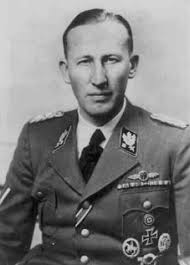
Reinhard Heydrich
Even so, Heydrich had a problem: He could never escape vicious rumors that his family tree contained a Jewish ancestor.
His paternal grandmother had married Reinhold Heydrich, and then Gustav Robert Suss. For unknown reasons, she decided to call herself Suss-Heydrich.
Since “Suss” was widely believed in Germany to indicate Jewish origin, the “stigma” of Jewish heritage attached itself to the Heydrich family.
Heydrich joined the SS in 1931 and quickly became head of its counterintelligence service. But his arrogance and overweening ambition created a great many enemies.
Only a year later, he became the target of an urgent investigation by the SS itself. The charge: That he was part-Jewish, the ultimate sin in Hitler’s “racially pure” Nazi Germany.
The investigation cleared Heydrich, but the rumor of his “tainted” origins persisted, clearly tormenting the second most powerful man in the SS. Even his superior, Heinrich Himmler, the Reichsfuhrer-SS, believed it.
When Heydrich was assassinated in 1942 by Czech commandos in Prague, Himmler attended his funeral. He paid tribute to his former subordinate at the service: ”You, Reinhard Heydrich, were a truly good SS-man.”
But he could not resist saying in private: “He was an unhappy man, completely divided against himself, as often happened with those of mixed race.”
Those who dare to harshly judge others usually find themselves assailed just as harshly.
A modern-day example is Rick Santorum, the former United States Senator from Pennsylvania (1995 – 2007) and a Republican candidate for President in 2012 and 2016.
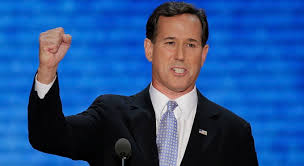
Rick Santorum
From his entry into politics, Santorum has been a fierce opponent of legalized abortion and even birth control. Among his comments on these issues:
- On why abortion should be illegal even in rape cases: “I believe and I think the right approach is to accept this horribly created—in the sense of rape—but nevertheless a gift in a very broken way, the gift of human life, and accept what God has given to you.”
- On criminal penalties for doctors who perform abortion: “I believe that, that any doctor who performs an abortion—that—I would advocate that any doctor that performs an abortion should be criminally charged for doing so.”
- On de-funding Planned Parenthood: “I can’t imagine any other organization with its roots as poisonous as the roots of Planned Parenthood getting federal funding of any kind. This is an organization that was founded on the eugenics movement, founded on racism.”
- On opposing birth control: “One of the things I will talk about [if elected President in 2012] that no President has talked about before is I think the dangers of contraception in this country, the whole sexual libertine idea. Many in the Christian faith have said, ‘Well, that’s okay. Contraception’s okay.’ It’s not okay, because it’s a license to do things in the sexual realm that is counter to how things are supposed to be.”
Like the Nazis, Republicans are eager to lecture their fellow citizens on “how things are supposed to be.” And to enforce their beliefs on “how things are supposed to be” with draconian laws.
So it no doubt shocked Santorum—and his anti-abortion supporters—when he found himself accused of being “soft” on abortion.
The attack came in the form of pink fliers appearing on car windshields at many South Carolina political events in January, 2012.
They were the work of Elizabeth Leichert, an anti-abortion activist.
Dated January 18, 2012, the flier read:
“Like many Christians I know, I was originally very attracted to Rick Santorum’s positions – especially on the Right to Life issue.
“But that was before I began digging into his record….
“Did you know Rick Santorum’s wife, Karen, had a six-year affair with an abortionist named Tom Allen?”
ABC NEWS, ADOLF HITLER, ALTERNET, AP, BORIS YELTSIN, BUZZFEED, CBS NEWS, CNN, CROOKS AND LIARS, DAILY KOZ, DICTATORS, DONALD TRUMP, FACEBOOK, GEORGE W. BUSH, HILLARY CLINTON, JOE SCARBOROUGH, JOSEPH STALIN, KGB, KIM JONG-UN, MISS TEEN USA, MISS UNIVERSE, MISS USA, MORNING JOE, MOTHER JONES, MOVEON, MSNBC, NAZI GERMANY, NAZI PARTY, NBC NEWS, NEWSWEEK, NPR, POLITICO, RAW STORY, RED ARMY, REPUBLICAN PARTY, REUTERS, SALON, SEATTLE TIMES, SLATE, SOVIET UNION, THE ATLANTIC, THE CHICAGO SUN-TIMES, THE CHICAGO TRIBUNE, THE DAILY BEAST, THE GUARDIAN, THE HILL, THE HUFFINGTON POST, THE LOS ANGELES TIMES, THE NATION, THE NEW YORK TIMES, THE WASHINGTON POST, TIME, TWITTER, U.S. NEWS & WORLD REPORT, UPI, USA TODAY, USA TODAY ABC NEWS, VLADIMIR PUTIN, WEHRMACHT, WORLD WAR ii
In Bureaucracy, History, Military, Politics, Social commentary on March 9, 2018 at 12:10 am
“And I have to say, I don’t understand Donald [Trump’s] bizarre fascination with dictators and strongmen who have no love for America.”
The speaker was Democratic Presidential candidate Hillary Clinton, addressing an audience in San Diego, California, on June 2, 2016.
“He praised China for the Tiananmen Square massacre; he said it showed strength.
“He said, ‘You’ve got to give Kim Jong Un credit’ for taking over North Korea—something he did by murdering everyone he saw as a threat, including his own uncle, which Donald described gleefully, like he was recapping an action movie.
“And he said if he were grading Vladimir Putin as a leader, he’d give him an A. Now, I’ll leave it to the psychiatrists to explain his affection for tyrants,” said Clinton.
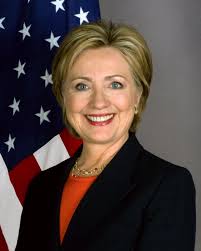
Hillary Clinton
To many people, it’s the ultimate odd-couple: The lifelong Communist and former KGB officer (Putin) walking arm-in-arm with the billionaire, publicity-hungry capitalist.
First Putin:
“He is a bright personality, a talented person, no doubt about it. It is not up to us to appraise his positive sides, it is up to the U.S. voters. but, as we can see, he is an absolute leader in the presidential race.”
Now Trump:
“It is always a great honor to be so nicely complimented by a man so highly respected within his own country and beyond.”
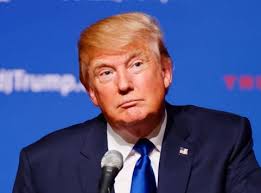
Donald Trump
Actually, it’s not uncommon for dictators to admire one another—as the case of Joseph Stalin and Adolf Hitler nicely illustrates.
After Hitler launched a blood-purge of his own private Stormtroopers army on June 30, 1934, Stalin exclaimed: “Hitler, what a great man! That is the way to deal with your political opponents!”
And Hitler was equally admiring of Stalin’s notorious ruthlessness: “After the victory over Russia,” he told his intimates, “it would be a good idea to get Stalin to run the country, with German oversight, of course. He knows better than anyone how to handle the Russians.”
Appearing on the December 18, 2015 edition of MSNBC’s “Morning Joe,” Trump said: “Sure, when people call you ‘brilliant,’ it’s always good. Especially when the person heads up Russia.”
The host, Joe Scarborough, was upset by Trump’s praise for Putin: “Well, I mean, [he’s] also a person who kills journalists, political opponents, and invades countries. obviously that would be a concern, would it not?”
TRUMP: He’s running his country, and at least he’s a leader. Unlike what we have in this country.
When Trump praised Putin as a leader—“unlike what we have in this country”—he undoubtedly meant then-President Barack Obama.
Ironically, it was Obama—not Trump—who was repeatedly named in Gallup polls as the most admired man in America in each of the last seven years, from 2008, the year he was elected president, to 2016, his last year in office.
Although Trump didn’t mention former President George W. Bush, it was he, not Obama, who was taken in by Putin.
In June 2001, Bush and Putin met in Slovenia. During the meeting this exchange occurred.
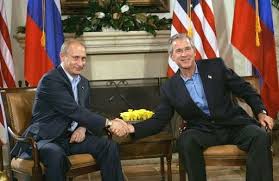
Vladimir Putin and George W. Bush
Putin, a former KGB Intelligence officer, had clearly done his homework on Bush. When he mentioned that one of the sports Bush had played was rugby, Bush was highly impressed.
“I did play rugby,” said Bush. “Very good briefing.”
Bush knew that Putin had worked for Soviet intelligence. So he should not have been surprised that the KGB had amassed a lengthy dossier on him.
But more was to come.
BUSH: Let me say something about what caught my attention, Mr. President, was that your mother gave you a cross which you had blessed in Israel, the Holy Land.
PUTIN: It’s true.
BUSH: That amazes me, that here you were a Communist, KGB operative, and yet you were willing to wear a cross. That speaks volumes to me, Mr. President. May I call you Vladimir?
Putin instantly sensed that Bush judged others—even world leaders—through the lens of his own fundamentalist Christian theology.
Falling back on his KGB training, Putin seized on this point of commonality to build a bond. He told Bush that his dacha had once burned to the ground, and the only item that had been saved was that cross.
“Well, that’s the story of the cross as far as I’m concerned,” said Bush. “Things are meant to be.”
Afterward, Bush and Putin gave an outdoor news conference.
“Is this a man that Americans can trust?” a reporter asked Bush.
“Yes,” said Bush. “I looked the man in the eye. I found him to be very straightforward and trustworthy. We had a very good dialogue.
“I was able to get a sense of his soul, a man deeply committed to his country and the best interests of his country. I wouldn’t have invited him to my ranch if I didn’t trust him.”
No Right-wingers—including Trump—criticized Bush then. Nor do they now recall such embarrassing words.
It’s politically profitable for Rightists to pretend that America’s tensions with Russia began with the election of Barack Obama.
And that those tensions have vanished now that another Rightist—and white—President occupies the White House.
2016 PRESIDENTIAL ELECTION, 9/11, ABC NEWS, ADOLF HITLER, AFGHANISTAN, ALTERNET, AP, ASIANS, BARACK OBAMA, BLACKS, BULLYING, BUZZFEED, CBS NEWS, CNN, COMMUNISM, CROOKS AND LIARS, DAILY KOZ, DONALD TRUMP, FACEBOOK, FASCISM, GEORGE W. BUSH, GREAT DEPRESSION, HILLARY CLINTON, HISPANICS, IRAQ, JEWS, MOTHER JONES, MOVEON, MUSLIMS, NAZI GERMANY, NAZI PARTY, NBC NEWS, NEWSWEEK, NPR, PAUL VON HINDENBURG, POLITICO, RACISM, RAW STORY, REPUBLICANS, REUTERS, ROBERT PAYNE, Ronald Reagan, SALON, SEATTLE TIMES, SLATE, THE ATLANTIC, THE CHICAGO SUN-TIMES, THE CHICAGO TRIBUNE, THE DAILY BEAST, THE GUARDIAN, THE HILL, THE HUFFINGTON POST, THE LIFE AND DEATH OF ADOLF HITLER, THE LOS ANGELES TIMES, THE LOS ANGELS TIMES, THE NATION, THE NEW YORK TIMES, THE WASHINGTON POST, TIME, TRUMP EFFECT, TWITTER, U.S. NEWS & WORLD REPORT, UP, UPI, USA TODAY, WORLD WAR 11
In Bureaucracy, History, Politics, Social commentary on November 10, 2017 at 12:22 am
In his bestselling 1973 biography, The Life and Death of Adolf Hitler, British historian Robert Payne harshly condemned the German people for the rise of the Nazi dictator.
“Ultimately the responsibility for the rise of Hitler lies with the German people, who allowed themselves to be seduced by him and came to enjoy the experience….[They] followed him with joy and enthusiasm because he gave them license to pillage and murder to their hearts’ content.
“They were his servile accomplices, his willing victims: Germany will rule the world; our enemies will be our slaves….
“If he answered their suppressed desires, it was not because he shared them, but because he could make use of them. He despised the German people, for they were merely the instruments of his will.”
So much for the truth of Nazi Germany–from 1933 to 1945.
On November 8, 2016, Americans proved they could embrace Fascism, too.
That was when millions of ignorant, greedy, hate-filled, Right-wing Americans turned their backs on democracy and fervently embraced Fascism.
They elected Donald Trump—a man reflecting their own hate, greed and ignorance—to the Presidency.
But Americans had far fewer excuses for turning to a Fascistic style of government than the Germans did.
The conditions existing in pre-Hitler Germany and pre-Trump America could not have been more different.
Adolf Hitler joined the National Socialist German Workers (Nazi) Party in 1919—the year after World War 1 ended.
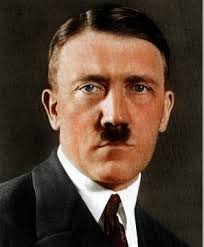
Adolf Hitler
In 1923, he staged a coup attempt in Bavaria—which was quickly and brutally put down by police. He was arrested and sentenced to less than a year in prison.
After that, Hitler decided that winning power through violence was no longer an option. He must win it through election—or appointment.
He repeatedly ran for the highest office in Germany—President—but never got a clear majority in a free election.
When the 1929 Depression struck Germany, the fortunes of Hitler’s Nazi party rose as the life savings of ordinary Germans fell. Streets echoed with bloody clashes between members of Hitler’s Nazi Stormtroopers and those of the German Communist Party.
Germany seemed on the verge of collapsing.Germans desperately looked for a leader—a Fuhrer—who could somehow deliver them from the threat of financial ruin and Communist takeover.
In early 1933, members of his own cabinet persuaded aging German president, Paul von Hindenburg, that only Hitler’s appointment as Chancellor (the equivalent of Attorney General) could do this.
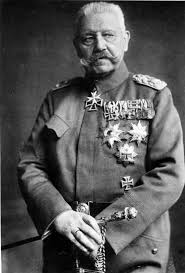
Paul von Hindenburg
Hindenburg was reluctant to do so. He considered Hitler a dangerous radical. But he allowed himself to be convinced that, by putting Hitler in the Cabinet, he could be “boxed in” and thus controlled.
So, on January 30, 1933, he appointed Adolf Hitler Chancellor of Germany.
On August 2, 1934, Hindenberg died, and Hitler immediately assumed the titles–and duties—of the offices of Chancellor and President. His rise to total power was now complete.
It had taken him 14 years to do so.
In 2015, when Donald Trump declared his candidacy for President.
- The United States was technically at war in the Middle East—but its fate was not truly threatened, as it had been during the Civil War.
- There was no draft; if you didn’t know someone in the military, you didn’t care about the mounting casualty list.
- Nor were these conflicts—in Iraq and Afghanistan–imposing domestic shortages on Americans, as World War II had.
- Thanks to government loans from President Barack Obama, American capitalism had been saved from its own excesses during the George W. Bush administration.
- Employment was up. CEOs’ profits were at record levels.
- In contrast to the corruption that had plagued the administration of Ronald Reagan, whom Republicans idolize, no such scandals had rocked the Obama Presidency.
- There had not been any large-scale terrorist attacks on American soil—such as on 9/11 under President George W. Bush.
Yet—not 17 months after announcing his candidacy for President—enough Americans fervently embraced Donald Trump to give him the most powerful position in the country and the world.

Donald Trump
The message of Barack Obama’s 2008 campaign had been one of hope: “Yes, We Can!”
For everyone who was not an avid Trump supporter, the message of Trump’s campaign was: “No, You Can’t!”
Whites comprised the overwhelming majority of the audiences at Trump rallies. Not all were racists, but many who were advertised it on T-shirts: “MAKE AMERICA WHITE AGAIN.”
They knew that demographics were steadily working against them. Birthrates among non-whites were rising. By 2045, whites would make up less than 50 percent of the American population.
The 2008 re-election of the first black President had shocked many whites. His 2012 re-election had deprived them of the hope that 2008 had been an accident.
Then came 2016—and the possibility that a black President might actually be followed by a woman: Hillary Clinton. And the idea of a woman dictating to men was strictly too much to bear.
Since Trump’s election, educators have reported a surge in bullying among students of all ages, from elementary- to high-school. Those doing the bullying are mostly whites, and the victims are mostly blacks, Muslims, Jews, Hispanics, Asians.
It even has a name: “The Trump Effect.”
All of this should be remembered the next time an American blames Germans for their embrace of Adolf Hitler
2016 PRESIDENTIAL ELECTION, 9/11, ABC NEWS, ADOLF HITLER, AFGHANISTAN, ALTERNET, AP, ASIANS, BARACK OBAMA, BLACKS, BULLYING, BUZZFEED, CBS NEWS, CNN, COMMUNISM, CROOKS AND LIARS, DAILY KOZ, DONALD TRUMP, FACEBOOK, FASCISM, GEORGE W. BUSH, GREAT DEPRESSION, HILLARY CLINTON, HISPANICS, IRAQ, JEWS, MOTHER JONES, MOVEON, MUSLIMS, NAZI GERMANY, NAZI PARTY, NBC NEWS, NEWSWEEK, NPR, PAUL VON HINDENBURG, POLITICO, RACISM, RAW STORY, REPUBLICANS, REUTERS, ROBERT PAYNE, Ronald Reagan, SALON, SEATTLE TIMES, SLATE, THE ATLANTIC, THE CHICAGO SUN-TIMES, THE CHICAGO TRIBUNE, THE DAILY BEAST, THE GUARDIAN, THE HILL, THE HUFFINGTON POST, THE LIFE AND DEATH OF ADOLF HITLER, THE LOS ANGELES TIMES, THE LOS ANGELS TIMES, THE NATION, THE NEW YORK TIMES, THE WASHINGTON POST, TIME, TRUMP EFFECT, TWITTER, U.S. NEWS & WORLD REPORT, UP, UPI, USA TODAY, WORLD WAR 11
In Bureaucracy, History, Politics, Social commentary on September 7, 2017 at 12:30 am
In his bestselling 1973 biography, The Life and Death of Adolf Hitler, British historian Robert Payne harshly condemned the German people for the rise of the Nazi dictator.
“Ultimately the responsibility for the rise of Hitler lies with the German people, who allowed themselves to be seduced by him and came to enjoy the experience….[They] followed him with joy and enthusiasm because he gave them license to pillage and murder to their hearts’ content.
“They were his servile accomplices, his willing victims: Germany will rule the world; our enemies will be our slaves….
“If he answered their suppressed desires, it was not because he shared them, but because he could make use of them. He despised the German people, for they were merely the instruments of his will.”
On November 8, millions of ignorant, hate-filled, Right-wing Americans elected Donald Trump—a man reflecting their own hate and ignorance—to the Presidency.
Yet, in some ways, Americans had fewer excuses for turning to a Fascistic style of government than the Germans did.
Adolf Hitler joined the National Socialist German Workers (Nazi) Party in 1919—the year after World War 1 ended.
Adolf Hitler
It took him 14 years to win appointment to Chancellor (the equivalent of Attorney General) of Germany in 1933.
In 1923, he staged a coup attempt in Bavaria—which was quickly and brutally put down by police. He was arrested and sentenced to less than a year in prison.
After that, Hitler decided that winning power through violence was no longer an option. He must win it through election—or appointment.
He repeatedly ran for the highest office in Germany—President—but never got a clear majority in a free election.
When the 1929 Depression struck Germany, the fortunes of Hitler’s Nazi party rose as the life savings of ordinary Germans fell. Streets echoed with bloody clashes between members of Hitler’s Nazi Stormtroopers and those of the German Communist Party.
Germany seemed on the verge of collapsing.Germans desperately looked for a leader—a Fuhrer—who could somehow deliver them from the threat of financial ruin and Communist takeover.
In early 1933, members of his own cabinet persuaded aging German president, Paul von Hindenburg, that only Hitler’s appointment as Chancellor could do this.
Paul von Hindenburg
Hindenburg was reluctant to do so. He considered Hitler a dangerous radical. But he allowed himself to be convinced that, by putting Hitler in the Cabinet, he could be “boxed in” and thus controlled.
So, on January 30, 1933, he appointed Adolf Hitler Chancellor of Germany.
On August 2, 1934, Hindenberg died, and Hitler immediately assumed the titles–and duties—of the offices of Chancellor and President. His rise to total power was now complete.
It had taken him 14 years to do so.
In 2015, Donald Trump declared his candidacy for President.Now, consider this:
- The United States was technically at war in the Middle East—but the fate of the United States was not truly threatened, as it had been during the Civil War.
- There was no draft; if you didn’t know someone in the military, you didn’t care about the casualties taking place.
- Nor were these conflicts—in Iraq and Afghanistan–imposing domestic shortages on Americans, as World War II had.
- Thanks to government loans from President Barack Obama, American capitalism had been saved from its own excesses during the George W. Bush administration.
- Employment was up. CEOs were doing extremely well.
- In contrast to the corruption that had plagued the administration of Ronald Reagan, whom Republicans idolize, there had been no such scandals during the Obama Presidency.
- Nor had there been any large-scale terrorist attacks on American soil—as there had on 9/11 under President George W. Bush.
- Yet—not 17 months after announcing his candidacy for President–enough Americans fervently embraced Donald Trump to give him the most powerful position in the country and the world.
Donald Trump
The message of Barack Obama’s 2008 campaign had been one of hope—“Yes, We Can!”
That of Donald Trump’s campaign was one of hatred toward everyone who was not an avid Trump supporter: “No, You Can’t!”
Whites comprised the overwhelming majority of the audiences at Trump rallies. Not all were racists, but many of those who were advertised it on T-shirts: “MAKE AMERICA WHITE AGAIN.”
They knew that demographics were steadily working against them. Birthrates among non-whites were rising. By 2045, whites would make up less than 50 percent of the American population.
The 2008 election of the first black President had shocked whites. His 2012 re-election had deprived them of the hope that 2008 had been an accident.
Then came 2016—and the possibility that a black President might actually be followed by a woman: Hillary Clinton. And the idea of a woman dictating to men was strictly too much to bear.
Since Trump’s election, educators have reported a surge in bullying among students of all ages, from elementary- to high-school. Those doing the bullying are mostly whites, and the victims are mostly blacks, Muslims, Jews, Hispanics, Asians.
It even has a name: “The Trump Effect.”
All of this should be remembered the next time an American blames Germans for their embrace of Adolf Hitler.
9/11, ABC NEWS, ADOLF HITLER, ALTERNET, AMERICANS FOR TAX REFORM, ANDERSON COOPER, ANTI-COMMUNISM, AP, ARTHUR MILLER, BILL CLINTON, BUZZFEED, CBS NEWS, CENTER FOR SECURITY POLICY, CHINA, CHRIS MATTHEWS, CNN, CROOKS AND LIARS, DAILY KOZ, DICK CHENEY, DWIGHT D. EISENHOWER, EDWARD R. MURROW, FACEBOOK, GEORGE H.W. BUSH, HARRY S. TRUMAN, HEINRICH HIMMLER, HERMAN CAIN, HERMAN GORING, HILLARY CLINTON, HUMA ABEDIN, JEWS, JIMMY CARTER, JOHN BIRCH SOCIETY, JOHN BOEHNER, JOHN F. KENNEDY, JOHN MCCAIN, JOHN STEINBECK, JOSEPH GOEBBELS, JOSEPH MCCARTHY, JOSEPH STALIN, KGB, LIZ CHENEY, LUCILLE BALL, LYNDON B. JOHNSON, MARY CHENEY, MICHELLE BACHMANN, MIKE HUCKABEE, MITT ROMNEY, MOTHER JONES, MOVEON, MSNBC, MUSLIM BROTHERHOOD, MUSLIMS, NAZI GERMANY, NAZI PARTY, NBC NEWS, NEWSWEEK, NEWT GINGRICH, NPR, PETE SEEGER, POLITICO, RAW STORY, RED SCARE, REINHARD HEYDRICH, REPUBLICAN PARTY, REUTERS, RICHARD NIXON, RICK SANTORUM, Ronald Reagan, SALON, SAME-SEX MARRIAGE, SEATTLE TIMES, SENATOR MIKE ENZI, SLATE, SOVIET UNION, SS, THE AMERICAN CENTER FOR SECURITY POLICY, THE ATLANTIC, THE CHICAGO SUN-TIMES, THE CHICAGO TRIBUNE, THE DAILY BEAST, THE GUARDIAN, THE HILL, THE HUFFINGTON POST, THE LOS ANGELES TIMES, THE NATION, THE NEW YORK TIMES, THE WALL STREET JOURNAL, THE WASHINGTON POST, TIME, TWITTER, U.S. NEWS & WORLD REPORT, UP, UPI, USA TODAY, WYOMING
In Bureaucracy, History, Politics, Social commentary on August 24, 2017 at 12:09 am
With the Soviet Union collapsed in 1991, the Republican Party went into a tailspin of dismay.
For almost 50 years, Republicans had conjured up The Red Bogeyman to scare voters into sending them to Congress and the White House.
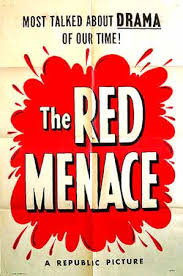
But now that the “workers’ paradise” had disappeared, Americans seemed to lose interest in the Communist Menace.
True, the People’s Republic of China remained, and its increasing economic clout would challenge the United States well into the 21st century. But Americans didn’t seem to fear the Red Chinese as they had the Red Russians.
What was the Republican Party to do to lure voters?
On September 11, 2001, the answer arrived—in two highjacked jetliners that slammed into the World Trade Center in New York and one that struck the Pentagon in Washington, D.C.
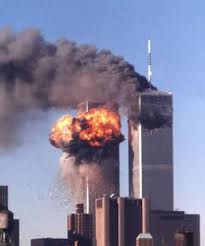
Exit The Red Bogeyman. Enter The Maniacal Muslim.
Consider:
- Mike Huckabee – “If the purpose of a church is to push forward the gospel of Jesus Christ, and then you have a Muslim group that says that Jesus Christ and all the people that follow him are a bunch of infidels who should be essentially obliterated, I have a hard time understanding that.”
- Herman Cain – ”I would not” appoint a Muslim in his administration.
- Newt Gingrich – “I am convinced that if we do not decisively win the struggle over the nature of America, by the time they [his grandchildren] are my age they will be in a secular atheist country, potentially one dominated by radical Islamists. …”
- Rick Santorum – On supporting the racial profiling of Muslims: “Obviously, Muslims would be someone you look at, absolutely.”
- Mitt Romney – “Based on the numbers of American Muslims in our population, I cannot see that a Cabinet position [for a Muslim] would be justified.”
And on July 13, 2012, Rep. Michelle Bachmann (R-Minn.) sent letters to the Inspectors General of the Departments of
- Defense;
- State;
- Justice; and
- Homeland Security.
“The purpose of these letters,” wrote Bachmann, was to “request a multi-department investigation into potential Muslim Brotherhood infiltration into the United States Government.”

Michelle Bachmann
Bachmann further asserted in her letter to the State Department that Huma Abedin, deputy chief of staff to Secretary of State Hillary Clinton, had ties to the Muslim Brotherhood.
In response, Arizona’s United State Senator John McCain said: “These attacks have no logic, no basis, and no merit and they need to stop. They need to stop now.”
“I don’t know Huma,” said House Speaker John Boehner, “but from everything that I do know of her she has a sterling character.”
And the evidence for these attacks?
The Center for Security Policy’s claim that Abedin’s father (who died when she was a teenager), mother and brother are “connected” to the organization.
And what is the Center of Security Policy? A private organization subsidized by donors to Right-wing causes.
In a separate letter, Bachmann demanded to know how Abedin received her security clearance.
Among the co-signers of Bachmann’s letter to the Inspectors General were:
- Rep. Trent Franks of Arizona, who has said abortion has done more harm to blacks than slavery;
- Rep. Lynn Westmoreland of Georgia, who called presidential candidate Barack Obama and his wife, Michelle, ”uppity”; and
- Rep. Louie Gohmert of Texas, who claims that terrorist organizations send pregnant women into the U.S. so that their children will be American citizens–who can enter and leave the country at will as they are trained to be terrorists abroad.
When pressed for their evidence of “a vast Muslim conspiracy,” right-wing accusers usually refuse to provide any.
An example of this occurred during an August 13, 2010 interview between Gohmert and CNN’s Anderson Cooper:
COOPER: What research? Can you tell us about the research?
GOHMERT: You are attacking the messenger, Anderson, you are better than this. You used to be good. You used to find that there was a problem and you would go after it.
COOPER: Sir, I am asking you for evidence of something that you said on the floor of the House.
GOHMERT: I did, and you listen, this is a problem. If you would spend as much time looking into the problem as you would have been trying to come after me and belittle me this week –
COOPER: Sir, do you want to offer any evidence? I’m giving you an opportunity to say what research and evidence you have. You’ve offered none, other than yelling.
Nor did Gohmert offer any evidence that evening.
Of course, the ultimate Republican Muslim slander is that President Barack Obama—a longtime Christian—is himself a Muslim.
No doubt Republicans feel totally safe in making these attacks, since Muslims comprise only 1% of the American population.
This has long been a hallmark of right-wing attacks—to go after a minority that cannot effectively defend itself.
Thus, Adolf Hitler attacked the Jews of Germany.
And Republicans have successively attacked blacks, Hispanics and gays—until each group became politically influential enough to defeat Republican candidates.
Today, most right-wing politicians at least grudgingly court all of these groups.
When Muslims become a significant political force in their own right, the Right will court them, too. And then move on to yet another helpless scapegoat to blame for America’s troubles.
9/11, ABC NEWS, ADOLF HITLER, ALTERNET, AMERICANS FOR TAX REFORM, ANDERSON COOPER, ANTI-COMMUNISM, AP, ARTHUR MILLER, BILL CLINTON, BUZZFEED, CBS NEWS, CENTER FOR SECURITY POLICY, CHINA, CHRIS MATTHEWS, CNN, CROOKS AND LIARS, DAILY KOZ, DICK CHENEY, DWIGHT D. EISENHOWER, EDWARD R. MURROW, FACEBOOK, GEORGE H.W. BUSH, HARRY S. TRUMAN, HEINRICH HIMMLER, HERMAN CAIN, HERMAN GORING, HILLARY CLINTON, HUMA ABEDIN, JEWS, JIMMY CARTER, JOHN BIRCH SOCIETY, JOHN BOENER, JOHN F. KENNEDY, JOHN MCCAIN, JOHN STEINBECK, JOSEPH GOEBBELS, JOSEPH MCCARTHY, JOSEPH STALIN, KGB, LIZ CHENEY, LUCILLE BALL, LYNDON B. JOHNSON, MARY CHENEY, MICHELLE BACHMANN, MIKE HUCKABEE, MITT ROMNEY, MOTHER JONES, MOVEON, MSNBC, MUSLIM BROTHERHOOD, MUSLIMS, NAZI GERMANY, NAZI PARTY, NBC NEWS, NEWSWEEK, NEWT GINGRICH, NPR, PETE SEEGER, POLITICO, RAW STORY, RED SCARE, REINHARD HEYDRICH, REPUBLICAN PARTY, REUTERS, RICHARD NIXON, RICK SANTORUM, Ronald Reagan, SALON, SAME-SEX MARRIAGE, SEATTLE TIMES, SENATOR MIKE ENZI, SLATE, SOVIET UNION, SS, THE AMERICAN CENTER FOR SECURITY POLICY, THE ATLANTIC, THE CHICAGO SUN-TIMES, THE CHICAGO TRIBUNE, THE DAILY BEAST, THE GUARDIAN, THE HILL, THE HUFFINGTON POST, THE LOS ANGELES TIMES, THE NATION, THE NEW YORK TIMES, THE WALL STREET JOURNAL, THE WASHINGTON POST, TIME, TWITTER, U.S. NEWS & WORLD REPORT, UP, UPI, USA TODAY, WYOMING
In Bureaucracy, History, Politics, Social commentary on August 23, 2017 at 12:06 am
“Judge not, that you not be judged. For with what judgment you judged, you shall be judged, and with what measure you mete, it shall be measured to you again.”
So warns the Gospel of St. Matthew, 7:1-2. It’s advice that Right-wingers Joseph McCarthy, Robert Welch and George H.W. Bush would have done well to heed.
Joseph McCarthy, Wisconsin’s gift to the United States Senate, became infamous as the demagogue whose Red-baiting accusations terrified America from 1950 to 1954.
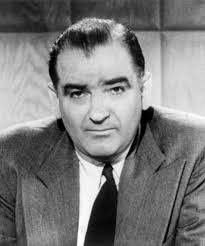
Joseph McCarthy
Elected to the Senate in 1946, he rose to national prominence on February 9, 1950, after giving a fiery speech in Wheeling, West Virginia:
“The State Department is infested with communists. I have here in my hand a list of 205—a list of names that were made known to the Secretary of State as being members of the Communist Party and who nevertheless are still working and shaping policy in the State Department.”
Americans were already growing increasingly fearful of Communism:
- Soviet dictator Joseph Stalin had not withdrawn the Red Army from the countries it had occupied in Eastern Europe during World War II.
- In 1948, the Soviet Union developed–and demonstrated–its own atomic bomb, an achievement U.S. scientists had claimed would not happen for at least a decade.
- In 1949, China fell to the triumphant armies of Mao Tse Tung.
But anti-communism as a lever to political advancement sharply accelerated following McCarthy’s speech. Republicans–resentful at being denied the White House since 1932–seized upon anti-communism as their passport to power.
No American–no matter how prominent–was safe from the accusation of being a Communist or a Communist sympathizer–”a Comsymp” or “fellow traveler” in the style of the era.
Among those accused:
- Secretary of State George C. Marshall, who had overseen America’s strategy for defeating Nazi Germany and Imperial Japan
- President Harry S. Truman
- Playwright Lillian Hellman and Arthur Miller
- Actors Charlie Chaplin, Zero Mostel, Lloyd Bridges, Howard Da Silva, Edward G. Robinson and John Garfield
- Composers Arron Copland and Elmer Bernstein
- Physicist J. Robert Oppenheimer, who presided over the creation of America’s atomic bomb
- Actressses Lee Grant, Delores del Rio, Ruth Gordon and Lucille Ball
- Journalists Edward R. Murrow and William L. Shirer, who had chronicled the rise of Nazi Germany
- Folksinger Pete Seeger
- Writers Irwin Shaw, Howard Fast, John Steinbeck and Dashiell Hammett
Even “untouchable” Republicans became targets for such slander.
The most prominent of these was President Dwight D. Eisenhower–labeled ”a conscious, dedicated agent of the Communist Conspiracy” by Robert Welch, who founded the John Birth Society in 1958.

Robert Welch
Welch, an independently wealthy businessman, used his money to publicize the Society and its views. Welch saw even hardline anti-Communists like Vice President Richard Nixon and actor Ronald Reagan as dangerously liberal.
Meanwhile, McCarthy finally overstepped himself. In 1953, he attacked the leadership of the United States Army as “a hotbed of traitors” and convened an inquiry through the Senate Permanent Subcommittee on Investigations.
But the hearings backfired, exposing McCarthy as the bullying demagogue he was. A Senate committee voted to condemn his behavior, charging that he had “acted contrary to senatorial ethics and tended to bring the Senate into dishonor and disrepute.”
Although McCarthy remained in the Senate another two and a half years, his political influence had ended.
Journalists who had raced to cover his latest slander now avoided him. So did his Republican colleagues–many of whom had once sought his help at election time.
Yet even without McCarthy, Republicans rode the issue of anti-Communism to victory from 1948 to 1960.
After holding the White House for eight years under Eisenhower, they lost it in 1960 to John F. Kennedy and again in 1964 to Lyndon Johnson.
By 1968, with the nation mired in Vietnam and convulsed by antiwar demonstrations, Americans turned once more to those who preyed upon their fears and hates. They elected Richard Nison–and re-elected him in 1972.
After Jimmy Carter won the Presidency in 1976 and lost it in 1980, Republicans held the White House until 1992. Throughout that time, they continued to accuse their opponents of being devious agents–or at least unwitting pawns–of “the Communist conspiracy.”
Even as late as 1992, President George H.W. Bush and the Republican establishment charged that Arkansas Governor Bill Clinton might be a KGB plant.
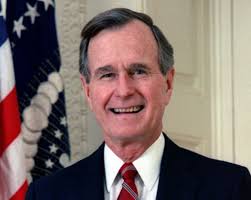
George H.W. Bush
Their evidence: During his tenure at Oxford University in 1969-70, Clinton had briefly visited Moscow.
Thus, the Republican charged that he might have been “programmed” as a real-life “Manchrian candidate” to become, first, Governor of Arkansas–one of America’s poorest states–and then President.
What made this charge all the more absurd: The Soviet Union had officially dissolved in December, 1991.
Although Republicans continued to hurl “Communist!” and “treason!” at their opponents, these charges no longer carried the weight they had while the Soviet Union existed.
Right-wingers had to settle for attacking their opponents as “liberals” and “soft on crime.”
Then, on September 11, 2001, Republicans–and their right-wing supporters–at last found a suitable replacement for the Red Menace.
9/11, ABC NEWS, ADOLF HITLER, ALTERNET, AMERICANS FOR TAX REFORM, ANDERSON COOPER, ANTI-COMMUNISM, AP, ARTHUR MILLER, BILL CLINTON, BUZZFEED, CBS NEWS, CENTER FOR SECURITY POLICY, CHINA, CHRIS MATTHEWS, CNN, CROOKS AND LIARS, DAILY KOZ, DICK CHENEY, DWIGHT D. EISENHOWER, EDWARD R. MURROW, FACEBOOK, GEORGE H.W. BUSH, HARRY S. TRUMAN, HEINRICH HIMMLER, HERMAN CAIN, HERMAN GORING, HILLARY CLINTON, HUMA ABEDIN, JEWS, JIMMY CARTER, JOHN BIRCH SOCIETY, JOHN BOENER, JOHN F. KENNEDY, JOHN MCCAIN, JOHN STEINBECK, JOSEPH GOEBBELS, JOSEPH MCCARTHY, JOSEPH STALIN, KGB, LIZ CHENEY, LUCILLE BALL, LYNDON B. JOHNSON, MARY CHENEY, MICHELLE BACHMANN, MIKE HUCKABEE, MITT ROMNEY, MOTHER JONES, MOVEON, MSNBC, MUSLIM BROTHERHOOD, MUSLIMS, NAZI GERMANY, NAZI PARTY, NBC NEWS, NEWSWEEK, NEWT GINGRICH, NPR, PETE SEEGER, POLITICO, RAW STORY, RED SCARE, REINHARD HEYDRICH, REPUBLICAN PARTY, REUTERS, RICHARD NIXON, RICK SANTORUM, Ronald Reagan, SALON, SAME-SEX MARRIAGE, SEATTLE TIMES, SENATOR MIKE ENZI, SLATE, SOVIET UNION, SS, THE AMERICAN CENTER FOR SECURITY POLICY, THE ATLANTIC, THE CHICAGO SUN-TIMES, THE CHICAGO TRIBUNE, THE DAILY BEAST, THE GUARDIAN, THE HILL, THE HUFFINGTON POST, THE LOS ANGELES TIMES, THE NATION, THE NEW YORK TIMES, THE WALL STREET JOURNAL, THE WASHINGTON POST, TIME, TWITTER, U.S. NEWS & WORLD REPORT, UP, UPI, USA TODAY, WYOMING
In Bureaucracy, History, Politics, Social commentary on August 22, 2017 at 12:02 am
“All revolutions,” said Ernst Rohem, leader of Adolf Hitler’s brown-shirted thugs, the S.A., “devour their own children.”
Ernst Rohem
Fittingly, he said this as he sat inside a prison cell awaiting his own execution.
On June 30, 1934, Hitler had ordered a massive purge of his private army, the S.A., or Stormtroopers. The purge was carried out by Hitler’s elite army-within-an-army, the black-uniformed Schutzstaffel, or Protective Squads, better known as the SS.
The S.A. Brownshirts had been instrumental in securing Hitler’s rise to Chancellor of Germany on January 30, 1933. They had intimidated political opponents and organized mass rallies for the Nazi Party.
But after Hitler reached the pinnacle of power, they became a liability.
Ernst Rohem, their commander, urged Hitler to disband the regular German army, the Reichswehr, and replace it with his own legions as the nation’s defense force.
Frightened by Rohem’s ambitions, the generals of the Reichswehr gave Hitler an ultimatum: Get rid of Rohem–-or they would get rid of the Fuhrer.
So Rohem died in a hail of SS bullets-–as did several hundred of his longtime S.A. cronies.
SS firing squad
Among the SS commanders supervising those executions was Reinhard Heydrich—a tall, blond-haired formal naval officer who was both a champion fencer and talented violinist.
Ultimately, he would become the personification of the Nazi ideal—”the man with the iron heart,” as Hitler eulogized at Heydrich’s funeral just eight years later.
Reinhard Heydrich
Even so, Heydrich had a problem: He could never escape vicious rumors that his family tree held a Jewish ancestor.
His paternal grandmother had married Reinhold Heydrich, and then Gustav Robert Suss. For unknown reasons, she decided to call herself Suss-Heydrich.
Since “Suss” was widely believed in Germany to indicate Jewish origin, the “stigma” of Jewish heritage attached itself to the Heydrich family.
Heydrich joined the SS in 1931 and quickly became head of its counterintelligence service. But his arrogance and overweening ambition created a great many enemies.
Only a year later, he became the target of an urgent investigation by the SS itself. The charge: That he was part-Jewish, the ultimate sin in Hitler’s “racially pure” Nazi Germany.
The investigation cleared Heydrich, but the rumor of his “tainted” origins persisted, clearly tormenting the second most powerful man in the SS. Even his superior, Heinrich Himmler, the Reichsfuhrer-SS, believed it.
When Heydrich was assassinated in 1942 by Czech assassins in Prague, Himmler attended his funeral. He paid tribute to his former subordinate at the service: ”You, Reinhard Heydrich, were a truly good SS-man.”
But he could not resist saying in private: “He was an unhappy man, completely divided against himself, as often happened with those of mixed race.”
Those who dare to harshly judge others usually find themselves assailed just as harshly.
A modern-day example is Liz Cheney, daughter of former Vice President Dick Cheney and a 2014 candidate for U.S. Senator from Wyoming.
Liz tried to position herself as far more right-wing than her opponent, Republican U.S. Senator Michael Bradley “Mike” Enzi.
She found her work cut out for her: In March, 2007, Enzi was ranked by National Journal as the sixth-most conservative U.S. Senator. Among his legislative priorities:
- Supporting partial privatization of Social Security
- Consistently voting against expanding Medicare.
- Voting against enrolling more children or the poor in public healthcare.

Mike Enzi
And Liz had a problem Enzi did not: Her sister, Mary, was not only a lesbian but legally married to another woman: Heather Poe. This led many Wyoming voters to wonder if Liz Cheney was far-Right enough to merit their support.
So Liz went all-out to assure them that even though her sister led a degenerate lifestyle, she, Liz, stood foursquare against legalizing gay marriage: “I do believe it’s an issue that’s got to be left up to states. I do believe in the traditional definition of marriage.”

Liz Cheney
And, in another statement: “I am strongly pro-life and I am not pro-gay marriage.
“I believe the issue of marriage must be decided by the states, and by the people in the states, not by judges and not even by legislators, but by the people themselves.”
This stance led to a heated rift between her and Mary. “For the record, I love my sister, but she is dead wrong on the issue of marriage,” Mary Cheney wrote in a Facebook post in September, 2013.
“Freedom means freedom for everyone,” she continued. “That means that all families—regardless of how they look or how they are made—all families are entitled to the same rights, privileges and protections as every other.”
Adding to the complications: Their father, Dick Cheney—often ridiculed as “Darth Vader” for his own extreme Right-wing views—endorsed same-sex marriage in 2009.
(After a brief run, Cheney, on January 6, 2014, Cheney withdrew from the race.)
But, as was true for officials in Nazi Germany, so is it true for Right-wing Republicans: It’s impossible to be too radical a Right-winger.
In the 1930s and 40s, it was politically—and personally—dangerous to be labeled “pro-Jewish” or “pro-Communist” in Hitler’s Germany.
And today it is equally dangerous—at least politically—to be labeled “pro-liberal” or “pro-gay” in the Republican Party.
ABC NEWS, ADOLF HITLER, ALTERNET, AP, BAVARIA, BBC, BEER HALL PUTSCH, BREITBART NEWS, BUZZFEED, CBS NEWS, CHRISTOPHER S. MURPHY, CIA, CNN, DAILY KOS, DEMOCRATIC NATIONAL COMMITTEE, DEMOCRATIC PARTY, DONALD TRUMP, EDMUND BURKE, EXTORTION, FACE THE NATION, FACEBOOK, FERGUS CULLEN, FOX NEWS SUNDAY, GREG ABBOTT, HACKING, HILLARY CLINTON, HITLER: ASCENT, IRS, JAMES B. COMEY, JAMES R. CLAPPER, JEWS, JOHN KASICH, JUSTICE DEPARTMENT, KEN PAXTON, LEON PANETTA, MEIN KAMPF, MICHAEL ROGERS, MIKE PENCE, MOTHER JONES, MOVEON, MUNICH, NATIONAL SECURITY AGENCY, NAZI PARTY, NBC NEWS, NEW HAMPSHIRE REPUBLICAN PARTY, NEWSWEEK, NPR, PAM BONDI, PAUL RYAN, PHILIP KLEIN, POLITICO, Racketeer Influenced Corrupt Organizations (RICO) Act, RAW STORY, REPUBLICAN NATIONAL COMMITTEE, REPUBLICAN NATIONAL CONVENTION, REPUBLICAN PARTY, REUTERS, ROGER STONE, SALON, SEATTLE TIMES, SLATE, SOVIET UNION, THE ATLANTIC, THE CHICAGO SUN-TIMES, THE CHICAGO TRIBUNE, THE DAILY BEAST, THE GUARDIAN, THE HILL, THE HUFFINGTON POST, THE LOS ANGELES TIMES, THE NEW YORK TIMES, THE WALL STREET JOURNAL, THE WASHINGTON EXAMINER, THE WASHINGTON POST, THREATS, TIME, TREASON, TRUMP UNIVERSITY, TWITTER, U.S. NEWS & WORLD REPORT, U.S. SECRET SERVICE, UPI, USA PATRIOT ACT, USA TODAY, VLADIMIR PUTIN, VOLKER ULLRICH, WEIMAR REPUBLIC
In Bureaucracy, History, Law, Law Enforcement, Politics, Social commentary on May 29, 2017 at 12:01 am
Future historians may one day write that it’s what didn’t happen that played at least as great a role in electing Donald Trump President as what actually did.
There were at least four instances where intervention by Federal law enforcement authorities could have utterly changed the outcome of the 2016 election.
Two of these dealt with purely domestic issues–the Trump University scandal and Trump’s repeated threats of violence against Republican and Democratic opponents.
The third and fourth ones dealt with events directly affecting the security of the United States.
It is unprecedented for an American Presidential candidate to repeatedly bestow fulsome praise on the leader of a foreign power hostile to the United States. And to receive equally fawning compliments in return from that leader.
Yet that is precisely what has happened between Donald Trump and Vladimir Putin.
Thus Putin on Trump: “He is a bright personality, a talented person, no doubt about it. It is not up to us to appraise his positive sides, it is up to the U.S. voters. but, as we can see, he is an absolute leader in the presidential race.”

Vladimir Putin
And Trump on Putin: “It is always a great honor to be so nicely complimented by a man so highly respected within his own country and beyond. He’s running his country, and at least he’s a leader. Unlike what we have in this country”–a clear attack on President Barack Obama.
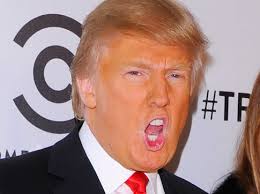
Donald Trump
Case #3: The Justice Department did not invalidate the results of the 2016 election, despite overwhelming evidence that Russia intervened to elect Trump as Vladimir Putin’s chosen candidate.
- Admiral Michael Rogers, director of the National Security Agency (NSA) and US Cyber Command, said in mid-November that Russia made “a conscious effort” to sway the results of the Presidential election by the hacking of 20,000 emails from the Democratic National Committee.
- “There shouldn’t be any doubt in anybody’s mind,” said Rogers. “This was not something that was done casually. This was not something that was done by chance. This was not a target that was selected purely arbitrarily. This was a conscious effort by a nation-state to attempt to achieve a specific effect.”

- The Russians hacked the Democratic committee’s servers–but not those of the Republican National Committee.
- On December 16, FBI Director James B. Comey and Director of National Intelligence James R. Clapper Jr. agreed with a CIA assessment that Russia intervened in the 2016 election in part to help Donald Trump win the White House.

Trump, however, has steadfastly denied any such role by Russia: “I think it’s ridiculous,” he told “Fox News Sunday.” “I think it’s just another excuse. I don’t believe it. No, I don’t believe it at all.”
Case #4: The Justice Department did not prosecute Trump for treason, even though he solicited aid from Russia, a nation hostile to the United States. And no major official of the government–including President Obama–publicly condemned him as a traitor.
At a news conference in Doral, Florida, on July 27, 2016, Trump publicly exhorted “Russia”–i.e., Vladimir Putin–to hack Hillary Clinton’s emails: “I will tell you this, Russia: If you’re listening, I hope you’re able to find the 30,000 emails that are missing. I think you will probably be rewarded mightily by our press.”
This was essentially treason–calling on a hostile foreign power to interfere directly in an American Presidential election. And it was seen as such by both Democrats and even some Republicans.
- “This has to be the first time that a major presidential candidate has actively encouraged a foreign power to conduct espionage against his political opponent,” Hillary for America policy adviser Jake Sullivan said in a statement. “That’s not hyperbole, those are just the facts. This has gone from being a matter of curiosity, and a matter of politics, to being a national security issue.”
- “I find those kinds of statements to be totally outrageous because you’ve got now a presidential candidate who is, in fact, asking the Russians to engage in American politics,” said former CIA Director Leon Panetta, a Clinton surrogate. “I just think that’s beyond the pale.”
- Brendan Buck, a spokesman for House Speaker Paul Ryan, said: “Russia is a global menace led by a devious thug. Putin should stay out of this election.”
- Trump’s Vice Presidential running mate, Mike Pence, said: “If it is Russia and they are interfering in our elections, I can assure you both parties and the United States government will ensure there are serious consequences.”
FBI Director James Comey believed that Hillary Clinton’s emails on a private server were so dangerous to national security that he announced–11 days before the election–that he was re-opening an investigation he had closed.
That announcement erased widespread outrage over Trump’s unintended admissions of predatory behavior toward women–“Grab them by the pussy”–and reversed Clinton’s growing lead in the polls.
Yet the Bureau did not issue any such statements about the continuing reports of close ties between Trump and Putin, and Trump’s possible investments in Russia.
To their shame, the federal agencies charged with safeguarding America failed to take action against these abuses. And, to their shame, the news media, to date, has failed to indict them for their negligence.
ABC NEWS, ADOLF HITLER, ALTERNET, AP, BAVARIA, BBC, BEER HALL PUTSCH, BREITBART NEWS, BUZZFEED, CBS NEWS, CHRISTOPHER S. MURPHY, CIA, CNN, DAILY KOS, DEMOCRATIC NATIONAL COMMITTEE, DEMOCRATIC PARTY, DONALD TRUMP, EDMUND BURKE, EXTORTION, FACE THE NATION, FACEBOOK, FERGUS CULLEN, FOX NEWS SUNDAY, GREG ABBOTT, HACKING, HILLARY CLINTON, HITLER: ASCENT, IRS, JAMES B. COMEY, JAMES R. CLAPPER, JEWS, JOHN KASICH, JUSTICE DEPARTMENT, KEN PAXTON, LEON PANETTA, MEIN KAMPF, MICHAEL ROGERS, MIKE PENCE, MOTHER JONES, MOVEON, MUNICH, NATIONAL SECURITY AGENCY, NAZI PARTY, NBC NEWS, NEW HAMPSHIRE REPUBLICAN PARTY, NEWSWEEK, NPR, PAM BONDI, PAUL RYAN, PHILIP KLEIN, POLITICO, Racketeer Influenced Corrupt Organizations (RICO) Act, RAW STORY, REPUBLICAN NATIONAL COMMITTEE, REPUBLICAN NATIONAL CONVENTION, REPUBLICAN PARTY, REUTERS, ROGER STONE, SALON, SEATTLE TIMES, SLATE, SOVIET UNION, THE ATLANTIC, THE CHICAGO SUN-TIMES, THE CHICAGO TRIBUNE, THE DAILY BEAST, THE GUARDIAN, THE HILL, THE HUFFINGTON POST, THE LOS ANGELES TIMES, THE NEW YORK TIMES, THE WALL STREET JOURNAL, THE WASHINGTON EXAMINER, THE WASHINGTON POST, THREATS, TIME, TREASON, TRUMP UNIVERSITY, TWITTER, U.S. NEWS & WORLD REPORT, U.S. SECRET SERVICE, UPI, USA PATRIOT ACT, USA TODAY, VLADIMIR PUTIN, VOLKER ULLRICH, WEIMAR REPUBLIC
In Bureaucracy, History, Law, Law Enforcement, Politics, Social commentary on May 26, 2017 at 12:36 am
Threatening his Republican and Democratic opponents with violence played a major role in Donald Trump’s campaign for President.
No other candidate–Republican or Democrat–had ever made such repeated and brutal use of threats of physical assault in pursuing the Presidency.
- Philip Klein, the managing editor of the Washington Examiner, wrote on the eve of the Republican National Convention in July: “Political commentators now routinely talk about the riots that would break out in Cleveland if Trump were denied the nomination, about how his supporters have guns and all hell could break loose, that they would burn everything to the ground. It works to Trump’s advantage to not try too hard to dispel these notions.”
- On August 9, Trump told a rally in Wilmington, North Carolina: “Hillary [Clinton] wants to abolish, essentially abolish, the Second Amendment. If she gets to pick her [Supreme Court] judges, nothing you can do folks. Although the Second Amendment people, maybe there is, I don’t know.”
- “Don’t treat this as a political misstep,” Senator Christopher S. Murphy of Connecticut, who has called for stiffer gun laws, wrote on Twitter. “It’s an assassination threat, seriously upping the possibility of a national tragedy & crisis.”
- “Well, let me say if someone else said that outside of the hall, he’d be in the back of a police wagon now, with the Secret Service questioning him,” said Michael Hayden, former head of the CIA and National Security Agency (NSA).
Making threats against anyone under protection by the U.S. Secret Service is a felony. Yet Donald Trump was never held legally accountable by the Justice Department.

Michael Hayden
Threats of this type continued to be made by Trump supporters right up to the day of the election.
- On July 29, Roger Stone, a notorious Right-wing political consultant acting as a Trump strategist, told Breitbart News: “The first thing Trump needs to do is begin talking about [voter fraud] constantly. If there’s voter fraud, this election will be illegitimate, the election of the winner will be illegitimate, we will have a constitutional crisis, widespread civil disobedience, and the government will no longer be the government.”
- At a town hall meeting where Trump’s Vice Presidential nominee Mike Pence appeared, a woman named Rhonda said: “For me personally, if Hillary Clinton gets in, I myself am ready for a revolution.”
- In Cincinnati, a Trump supporter threatened to forcibly remove Clinton from the White House if she won the race: “If she’s in office, I hope we can start a coup. She should be in prison or shot. That’s how I feel about it,” Dan Bowman, a 50-year-old contractor, said of Hillary Clinton, the Democratic nominee. “We’re going to have a revolution and take them out of office if that’s what it takes. There’s going to be a lot of bloodshed. But that’s what it’s going to take….I would do whatever I can for my country.”
Even Fergus Cullen, former chairman of the New Hampshire GOP, expressed fear of what might happen if Trump lost the election:

Fergus Cullen
“That’s really scary,” Cullen said, recounting the violence at Trump rallies around the country leading up to the Republican National Convention. “In this country, we’ve always had recriminations after one side loses. But we haven’t had riots. We haven’t had mobs that act out with violence against supporters of the other side.
“There’s no telling what his supporters would be willing to do at the slightest encouragement from their candidate,” he said.
Trump even began encouraging his mostly white supporters to sign up online to be “election observers” to stop “Crooked Hillary from rigging this election.” He urged them to act as poll watchers in “other” [non-white] communities to ensure that things are “on the up and up.”
Many of his supporters promised to do so.
“Trump said to watch your precincts. I’m going to go, for sure,” said Steve Webb, a 61-year-old carpenter from Fairfield, Ohio.
“I’ll look for…well, it’s called racial profiling. Mexicans. Syrians. People who can’t speak American,” he said. “I’m going to go right up behind them. I’ll do everything legally. I want to see if they are accountable. I’m not going to do anything illegal. I’m going to make them a little bit nervous.”
Knowing that large numbers of angry–and possibly armed–Right-wingers planned to descend on polling places could only have had a chilling effect on untold numbers of Democratic voters. And this would have been especially true in heavily conservative states.
Both the USA Patriot Act and the Racketeer Influenced Corrupt Organizations (RICO) Act have statutes dealing with making terrorist threats against government institutions to influence their members.
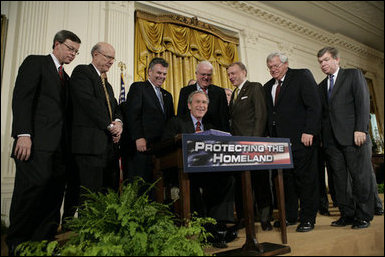
President George W. Bush signing the USA Patriot Reauthorization Act of 2005
Thus, the Justice Department could have cited the Patriot Act in indicting Trump and/or any number of his followers for “activities that…appear to be intended…to influence the policy of a government by intimidation or coercion [and]…occur primarily within the territorial jurisdiction of the United States.”
The Justice Department could have also demanded that the results of the election be invalidated on the basis that widespread voter and candidate intimidation played a massive role in it.
But of course this did not happen.
ABC NEWS, ADOLF HITLER, ALTERNET, AP, BAVARIA, BBC, BEER HALL PUTSCH, BREITBART NEWS, BUZZFEED, CBS NEWS, CHRISTOPHER S. MURPHY, CIA, CNN, DAILY KOS, DEMOCRATIC NATIONAL COMMITTEE, DEMOCRATIC PARTY, DONALD TRUMP, EDMUNC BURKE, EXTORTION, FACE THE NATION, FACEBOOK, FERGUS CULLEN, FOX NEWS SUNDAY, GREG ABBOTT, HACKING, HILLARY CLINTON, HITLER: ASCENT, IRS, JAMES B. COMEY, JAMES R. CLAPPER, JEWS, JOHN KASICH, JUSTICE DEPARTMENT, KEN PAXTON, LEON PANETTA, MEIN KAMPF, MICHAEL ROGERS, MIKE PENCE, MOTHER JONES, MOVEON, MUNICH, NATIONAL SECURITY AGENCY, NAZI PARTY, NBC NEWS, NEW HAMPSHIRE REPUBLICAN PARTY, NEWSWEEK, NPR, PAM BONDI, PAUL RYAN, PHILIP KLEIN, POLITICO, Racketeer Influenced Corrupt Organizations (RICO) Act, RAW STORY, REPUBLICAN NATIONAL COMMITTEE, REPUBLICAN NATIONAL CONVENTION, REPUBLICAN PARTY, REUTERS, ROGER STONE, SALON, SEATTLE TIMES, SLATE, SOVIET UNION, THE ATLANTIC, THE CHICAGO SUN-TIMES, THE CHICAGO TRIBUNE, THE DAILY BEAST, THE GUARDIAN, THE HILL, THE HUFFINGTON POST, THE LOS ANGELES TIMES, THE NEW YORK TIMES, THE WALL STREET JOURNAL, THE WASHINGTON EXAMINER, THE WASHINGTON POST, THREATS, TIME, TREASON, TRUMP UNIVERSITY, TWITTER, U.S. NEWS & WORLD REPORT, U.S. SECRET SERVICE, UPI, USA PATRIOT ACT, USA TODAY, VLADIMIR PUTIN, VOLKER ULLRICH, WEIMAR REPUBLIC
In Bureaucracy, History, Law, Law Enforcement, Politics, Social commentary on May 25, 2017 at 12:06 am
“The only thing necessary for the triumph of evil is for good men to do nothing.”
So wrote Edmund Burke (1729-1797) the Irish statesman, author, orator, political theorist and philosopher. And history has repeatedly proved him right.
One such example was the rise of Adolf Hitler as Germany’s Fuhrer.
Writes historian Volker Ullrich, in his monumental new biography, Hitler: Ascent 1889–1939: “Historians have perennially tried to answer the question of whether Hitler’s rise to power could have been halted….
“There were repeated opportunities to end Hitler’s run of triumphs. The most obvious one was after the failed Putsch of November 1923. Had the Munich rabble-rouser been forced to serve his full five-year term of imprisonment in Landsberg, it is extremely unlikely that he would have been able to restart his political career.”
But that didn’t happen.

Tried for and convicted of treason, he was sentenced to five years’ imprisonment.
At Landsberg Prison, in Bavaria. he was given a huge cell, allowed to receive unlimited visitors and gifts, and treated with deference by guards and inmates.
Nine months later, he was released on parole–by authorities loyal to the authoritarian Right instead of the newly-created Weimar Republic.
Hitler immediately began rebuilding the shattered Nazi party–and deciding on a new strategy to gain power. Disdaining armed force, he would win office by election–or intrigue.
On January 30, 1933, those intrigues bore fruit: Adolf Hitler was appointed Chancellor of Germany.
A second example: The ascent of Donald Trump to the Presidency of the United States.
Future historians may one day write that what didn’t happen played at least as great a role in electing Donald Trump President as what actually did.
There were at least four instances where intervention by Federal law enforcement authorities could have utterly changed the outcome of the 2016 election. Yet, for reasons still unknown, they chose to do nothing.
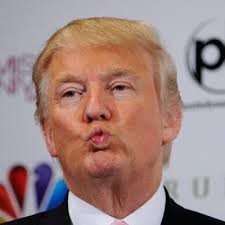
Donald Trump
Case #1: The Justice Department did not indict Trump and/or the Attorney Generals of Texas and/or Florida for their roles in the Trump University scandal.
- Florida Attorney General Pam Bondi personally solicited a political contribution from Donald Trump around the same time her office deliberated joining an investigation of alleged fraud at Trump University and its affiliates.
- After Bondi dropped the Trump University case against Trump, he wrote her a check $25,000 for her re-election campaign. The money came from the Donald J. Trump Foundation.
- Republican Texas Attorney General Ken Paxton moved to muzzle a former state regulator who says he was ordered in 2010 to drop a fraud investigation into Trump University for political reasons.
- Paxton’s office issued a cease and desist letter to former Deputy Chief of Consumer Protection John Owens after he made public copies of a 14-page internal summary of the state’s case against Donald Trump for scamming millions from students of his now-defunct real estate seminar.
- After the Texas case was dropped, Trump cut a $35,000 check to the gubernatorial campaign of then attorney general and now Texas Governor Greg Abbott.
One attorney general who refused to accept money from Trump was New York’s Eric Schneiderman. His decision to press fraud claims against Trump forced the real estate mogul to settle the case out of court for $25 million.
“Today’s $25 million settlement agreement is a stunning reversal by Donald Trump,” said Schneiderman on November 18, “and a major victory for the over 6,000 victims of his fraudulent university.”
There have been no press reports that the Justice Department investigated these cases to determine if Trump violated the Racketeer Influenced Corrupt Organizations (RICO) Act statutes.

If the Justice Department did not investigate these cases, it should have. And if he did violate the RICO statutes, he should have been indicted, even as a Presidential candidate or President-elect.
Even if an indictment had not produced a conviction, the mere bringing of one would have cast an unprecedented cloud over his candidacy–let alone his being sworn in as President.
Case #2: The Justice Department did not indict Trump for his series of threats he made–directly or indirectly–against his Republican and Democratic opponents throughout the 2016 campaign.
- On March 16, he warned Republicans that if he didn’t win the GOP nomination in July, his supporters would literally riot: “I think you’d have riots. I think you would see problems like you’ve never seen before. I think bad things would happen. I really do. I wouldn’t lead it, but I think bad things would happen.”
- An NBC reporter summed it up as: “The message to Republicans was clear on [March 16]: ‘Nice convention you got there, shame if something happened to it.’”
- That Republicans clearly saw this as a threat is undeniable. Paul Ryan, their Speaker of the House, said on March 17: “Nobody should say such things in my opinion because to even address or hint to violence is unacceptable.”
- And Ohio governor and Republican presidential candidate John Kasich chinned in. “Leaders don’t imply violence,” Kasich told “Face the Nation” on March 20. “When he says that there could be riots, that’s inappropriate. I think you understand that, okay? Secondly, while we have our differences and disagreements, we’re Americans. Americans don’t say, ‘Let’s take to the streets and have violence.’”


2012 PRESIDENTIAL CAMPAIGN, 2016 PRESIDENTIAL CAMPAIGN, ABC NEWS, ABORTION, ADOLF HITLER, BIRTH CONTROL, BROWNSHIRTS, CBS NEWS, CNN, ERNST ROHM, FACEBOOK, HEINRICH HIMMLER, HERMAN GORING, JEWS, KAREN SANTORUM, MARCO RUBIO, MITT ROMNEY, MSNBC, NAZI GERMANY, NAZI PARTY, NBC NEWS, PLANNED PARENTHOOD, REINHARD HEYDRICH, REPUBLICAN PARTY, RICK SANTORUM, S.A., SAME-SEX MARRIAGE, SS, THE CHICAGO SUN-TIMES, THE CHICAGO TRIBUNE, THE HUFFINGTON POST, THE LOS ANGELES TIMES, THE NEW YORK TIMES, THE WALL STREET JOURNAL, THE WASHINGTON POST, TWITTER, USA TODAY
THE PERILS OF SCAPEGOATING: PART ONE (OF TWO)
In Bureaucracy, History, Law, Politics, Social commentary, Uncategorized on March 26, 2018 at 12:03 am“All revolutions,” said Ernst Rohm, leader of Adolf Hitler’s brown-shirted thugs, the S.A., “devour their own children.”
Ernst Rohm
Fittingly, he said this as he sat inside a prison cell awaiting his own execution.
On June 30, 1934, Hitler had ordered a massive purge of his private army, the S.A., or Stormtroopers. The purge was carried out by Hitler’s elite army-within-an-army, the Schutzstaffel, or Protective Squads, better known as the SS.
The S.A. Brownshirts had been instrumental in securing Hitler’s rise to Chancellor of Germany on January 30, 1933. They had intimidated political opponents and organized mass rallies for the Nazi Party.
But after Hitler reached the pinnacle of power, they became a liability.
Ernst Rohm, their commander, urged Hitler to disband the regular German army, the Reichswehr, and replace it with his own legions as the nation’s defense force.
Frightened by Rohm’s ambitions, the generals of the Reichswehr gave Hitler an ultimatum: Get rid of Rohm—or they would get rid of him.
So Rohm died in a hail of SS bullets—as did several hundred of his longtime S.A. cronies.
SS firing squad
Among the SS commanders supervising those executions was Reinhard Heydrich—a tall, blond-haired formal naval officer who was both a champion fencer and talented violinist.
Ultimately, he would become the personification of the Nazi ideal—”the man with the iron heart,” as Hitler eulogized at Heydrich’s funeral just eight years later.
Reinhard Heydrich
Even so, Heydrich had a problem: He could never escape vicious rumors that his family tree contained a Jewish ancestor.
His paternal grandmother had married Reinhold Heydrich, and then Gustav Robert Suss. For unknown reasons, she decided to call herself Suss-Heydrich.
Since “Suss” was widely believed in Germany to indicate Jewish origin, the “stigma” of Jewish heritage attached itself to the Heydrich family.
Heydrich joined the SS in 1931 and quickly became head of its counterintelligence service. But his arrogance and overweening ambition created a great many enemies.
Only a year later, he became the target of an urgent investigation by the SS itself. The charge: That he was part-Jewish, the ultimate sin in Hitler’s “racially pure” Nazi Germany.
The investigation cleared Heydrich, but the rumor of his “tainted” origins persisted, clearly tormenting the second most powerful man in the SS. Even his superior, Heinrich Himmler, the Reichsfuhrer-SS, believed it.
When Heydrich was assassinated in 1942 by Czech commandos in Prague, Himmler attended his funeral. He paid tribute to his former subordinate at the service: ”You, Reinhard Heydrich, were a truly good SS-man.”
But he could not resist saying in private: “He was an unhappy man, completely divided against himself, as often happened with those of mixed race.”
Those who dare to harshly judge others usually find themselves assailed just as harshly.
A modern-day example is Rick Santorum, the former United States Senator from Pennsylvania (1995 – 2007) and a Republican candidate for President in 2012 and 2016.
Rick Santorum
From his entry into politics, Santorum has been a fierce opponent of legalized abortion and even birth control. Among his comments on these issues:
Like the Nazis, Republicans are eager to lecture their fellow citizens on “how things are supposed to be.” And to enforce their beliefs on “how things are supposed to be” with draconian laws.
So it no doubt shocked Santorum—and his anti-abortion supporters—when he found himself accused of being “soft” on abortion.
The attack came in the form of pink fliers appearing on car windshields at many South Carolina political events in January, 2012.
They were the work of Elizabeth Leichert, an anti-abortion activist.
Dated January 18, 2012, the flier read:
“Like many Christians I know, I was originally very attracted to Rick Santorum’s positions – especially on the Right to Life issue.
“But that was before I began digging into his record….
“Did you know Rick Santorum’s wife, Karen, had a six-year affair with an abortionist named Tom Allen?”
Share this: