Posts Tagged ‘NAZI GERMANY’
2016 PRESIDENTIAL ELECTION, ABC NEWS, ALTERNET, AP, ARCHIBALD COX, ARRON COPELAND, ARTHUR MILLER, BUZZFEED, CBS NEWS, CHARLIE CHAPLAN, CNN, CROOKS AND LIARS, DAILY KOZ, DASHIELL HAMMETT, DELORES DEL RIO, DONALD TRUMP, DWIGHT D. EISENHOWER, EDWARD G. ROBINSON, EDWARD R. MURROW, ELMER BERNSTEIN, FACEBOOK, FBI, FOX NEWS, GEORGE C. MARSHALL, HARRY S. TRUMAN, HOWARD DA SILVA, HOWARD FAST, IRWIN SHAW, J. ROBER OPPENHEIMER, JAMES COMEY, JOHN BIRCH SOCIETY, JOHN GARFIELD, JOHN STEINBECK, JOSEPH R. MCCARTHY, LEE GRANT, LILLIAN HELLMAN, LLOYD BRIDGES, LUCILLE BALL, MOTHER JONES, MOVEON, NAZI GERMANY, NBC NEWS, NEWSWEEK, NPR, PETE SEEGER, POLITICO, RAW STORY, REUTERS, RICHARD M. NIXON, ROBERT MUELLER, ROBERT WELCH, ROD ROSENSTEIN, RUSSIAN INTELLIGENCE, RUTH GORDON, SALON, SEATTLE TIMES, SLATE, SOVIET UNION, STATE DEPARTMENT, SUBVERSION, THE ATLANTIC, THE CHICAGO SUN-TIMES, THE CHICAGO TRIBUNE, THE DAILY BEAST, THE GUARDIAN, THE HILL, THE HUFFINGTON POST, THE LOS ANGELES TIMES, THE NATION, THE NEW YORK TIMES, THE WASHINGTON POST, TIME, TWITTER, U.S. DEPARTMENT OF JUSTICE, U.S. NEWS & WORLD REPORT, UPI, USA TODAY, USA TODAY EDWARD R. MURROW, WILLIAM L. SHIRER, ZERO MOSTEL
In Bureaucracy, History, Law, Politics, Social commentary on March 21, 2018 at 12:23 am
On March 9, 1954, Edward R. Murrow, the most respected broadcast journalist in America, outlined the career and demagogic tactics of Wisconsin United States Senator Joseph R. McCarthy.
He did so on his CBS news show, “See It Now,” at the height of the “Red Scare” hysteria that McCarthy had whipped up four years earlier.
Virtually any American could find himself accused of being a Communist, or a “Comsymp,” or a “fellow traveler. Such an act could rob him/her of friends, career—or even liberty on the flimsiest of evidence.
Meanwhile, Republicans cowered before McCarthy’s attacks on the press, the military, the judiciary and law enforcement—or joined hid chorus. Protecting the nation’s social and political institutions took a distant second place to attacking Democrats as Communist traitors.
Today, 64 years later, another demagogue—Donald Trump—casts an even darker shadow across the land. As the President of the United States, he commands far more power than McCarthy ever did.
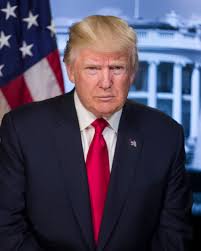
Donald Trump
- He freely slanders anyone—famous or anonymous, athlete or disabled, politician or philosopher—who dares contradict him. Or for whom he simply takes a disliking to.
- He fired FBI Director James Comey for refusing to pledge his personal loyalty—the way Joseph Stalin expected his secret police chiefs to operate.
- He hounded Assistant FBI Director Andrew McCabe into resigning, and then fired him 24 hours before he was to receive his pension after 21 years of sterling service.
- He fired his Secretary of State, Rex Tillerson—by tweet—while Tillerson was still on an official visit to Africa.
- He has, in short, forced most Americans to re-think their longtime assumption that a dictatorship can’t happen here.
Today, only those Republicans who have decided to retire from Congress dare to criticize Trump. The rest fear he will aim a nasty tweet at them—and cost them Fascistic voters, perhaps even their offices.
Meanwhile, Robert Mueller—a career prosecutor with the highest reputation for integrity—struggles to discover the truth about Russian electoral subversion and the Trump campaign’s collusion in it.
Every day he faces the danger of being fired by the very man whose criminal associates he’s investigating. And yet Republicans refuse to enact a law that would protect him against such abuse of power.
At this time, Murrow’s warnings about Joseph McCarthy need to be seriously reconsidered. Just substitute “President” for “Junior Senator” and “Trump” for “McCarthy,” and Murrow’s text could have been written yesterday.
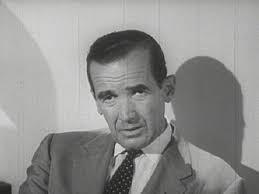
Edward R. Murrow
On one thing the [President] has been consistent. Often operating as a one-man committee, he has traveled far, [defamed] many, terrorized some, accused civilian and military leaders of the past administration of a great conspiracy to turn over the country to [terrorism], [slamdered] and substantially demoralized the present State Department….
He has [slandered] a varied assortment of what he calls [“the enemy of the American people.”]
Republican Senator Flanders of Vermont said of [Trump] today: “He dons war paint; he goes into his war dance; he emits his war whoops; he goes forth to battle and proudly returns with the scalp of a pink army dentist.”
It is necessary to investigate before legislating, but the line between investigating and persecuting is a very fine one and the [President of the United States] has stepped over it repeatedly. His primary achievement has been in confusing the public mind, as between the internal and the external threats of [terrorism].
We must not confuse dissent with disloyalty. We must remember always that accusation is not proof and that conviction depends upon evidence and due process of law. We will not walk in fear, one of another.
We will not be driven by fear into an age of unreason, if we dig deep in our history and our doctrine, and remember that we are not descended from fearful men—not from men who feared to write, to speak, to associate and to defend causes that were, for the moment, unpopular.
This is no time for men who oppose [President Trump’s] methods to keep silent, or for those who approve. We can deny our heritage and our history, but we cannot escape responsibility for the result.
There is no way for a citizen of a republic to abdicate his responsibilities. As a nation we have come into our full inheritance at a tender age. We proclaim ourselves, as indeed we are, the defenders of freedom, wherever it continues to exist in the world, but we cannot defend freedom abroad by deserting it at home.
The actions of the [President of the United States] have caused alarm and dismay amongst our allies abroad, and given considerable comfort to our enemies. And whose fault is that? Not really his.
He didn’t create this situation of fear; he merely exploited it—and rather successfully. Cassius was right. “The fault, dear Brutus, is not in our stars, but in ourselves.”
2016 PRESIDENTIAL ELECTION, ABC NEWS, ALTERNET, AP, ARCHIBALD COX, ARRON COPELAND, ARTHUR MILLER, BUZZFEED, CBS NEWS, CHARLIE CHAPLAN, CNN, CROOKS AND LIARS, DAILY KOZ, DASHIELL HAMMETT, DELORES DEL RIO, DONALD TRUMP, DWIGHT D. EISENHOWER, EDWARD G. ROBINSON, EDWARD R. MURROW, ELMER BERNSTEIN, FACEBOOK, FBI, FOX NEWS, GEORGE C. MARSHALL, HARRY S. TRUMAN, HOWARD DA SILVA, HOWARD FAST, IRWIN SHAW, J. ROBER OPPENHEIMER, JAMES COMEY, JOHN BIRCH SOCIETY, JOHN GARFIELD, JOHN STEINBECK, JOSEPH R. MCCARTHY, LEE GRANT, LILLIAN HELLMAN, LLOYD BRIDGES, LUCILLE BALL, MOTHER JONES, MOVEON, NAZI GERMANY, NBC NEWS, NEWSWEEK, NPR, PETE SEEGER, POLITICO, RAW STORY, REUTERS, RICHARD M. NIXON, ROBERT MUELLER, ROBERT WELCH, ROD ROSENSTEIN, RUSSIAN INTELLIGENCE, RUTH GORDON, SALON, SEATTLE TIMES, SLATE, SOVIET UNION, STATE DEPARTMENT, SUBVERSION, THE ATLANTIC, THE CHICAGO SUN-TIMES, THE CHICAGO TRIBUNE, THE DAILY BEAST, THE GUARDIAN, THE HILL, THE HUFFINGTON POST, THE LOS ANGELES TIMES, THE NATION, THE NEW YORK TIMES, THE WASHINGTON POST, TIME, TWITTER, U.S. DEPARTMENT OF JUSTICE, U.S. NEWS & WORLD REPORT, UPI, USA TODAY, USA TODAY EDWARD R. MURROW, WILLIAM L. SHIRER, ZERO MOSTEL
In Bureaucracy, History, Law, Law Enforcement, Politics, Social commentary on March 20, 2018 at 12:04 am
During the 1950s, Wisconsin United States Senator Joseph R. McCarthy rode a wave of paranoia to national prominence–by attacking the patriotism of anyone who disagreed with him.
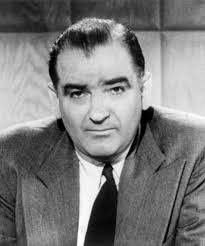
Joseph McCarthy
Elected to the Senate in 1946, he rose to national prominence on February 9, 1950, after giving a fiery speech in Wheeling, West Virginia:
“The State Department is infested with communists. I have here in my hand a list of 205—a list of names that were made known to the Secretary of State as being members of the Communist Party and who nevertheless are still working and shaping policy in the State Department.”
No American—no matter how prominent—was safe from the accusation of being a Communist or a Communist sympathizer—”a Comsymp” or “fellow traveler” in the style of the era.
Among those accused:
- Secretary of State George C. Marshall, who had overseen America’s strategy for defeating Nazi Germany and Imperial Japan;
- President Harry S. Truman;
- Playwrights Lillian Hellman and Arthur Miller;
- Actors Charlie Chaplin, Zero Mostel, Lloyd Bridges, Howard Da Silva, Edward G. Robinson and John Garfield;
- Composers Arron Copland and Elmer Bernstein;
- Physicist J. Robert Oppenheimer, who presided over the creation of America’s atomic bomb;
- Actresses Lee Grant, Delores del Rio, Ruth Gordon and Lucille Ball;
- Journalists Edward R. Murrow and William L. Shirer, who had chronicled the rise of Nazi Germany;
- Folksinger Pete Seeger;
- Writers Irwin Shaw, Howard Fast, John Steinbeck and Dashiell Hammett.
Even “untouchable” Republicans became targets for such slander.
The most prominent of these was President Dwight D. Eisenhower–labeled ”a conscious, dedicated agent of the Communist Conspiracy” by Robert Welch, who founded the John Birch Society in 1958.
On March 9, 1954, at the height of the McCarthy hysteria, Edward R. Murrow, the most respected broadcast journalist in America, delivered a powerful blow against the Senator’s dictatorial tactics and agenda. He did so on his high-rated CBS program, “See It Now.”
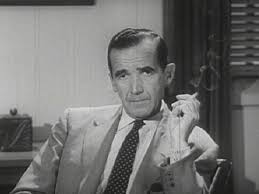
Edward R. Murrow
Today, 64 years later, Murrow’s eloquent appeal for moral courage in the face of tyranny still stands, and is still worth remembering.
This is especially true since the United States finds itself once again endangered by a fearful demagogue. But this one is even more dangerous than McCarthy.
For, unlike McCarthy, he commands the Justice Department to bludgeon his “enemies” at home and the Defense Department to literally destroy any country he dislikes abroad.
He is the President of the United States: Donald J. Trump.
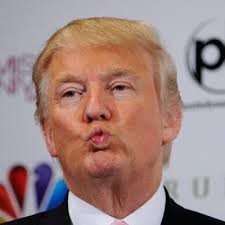
Donald Trump
Even before taking office on January 20, 2017, he was dogged by charges that Russian Intelligence agents had aided his 2016 Presidential campaign. And that members of his campaign had actively colluded with them.
The FBI, headed by James Comey, was then investigating that alleged collusion. Then, on May 8, 2017, Trump abruptly fired Comey from his position as FBI director.
A national firestorm erupted—unprecedented since President Richard M. Nixon had fired Watergate Special Prosecutor Archibald Cox on October 20, 1973.
To squelch it, Deputy Attorney General Rod Rosenstein moved quickly.
On May 17, 2017, he appointed Robert Mueller to serve as Special Counsel for the United States Department of Justice.
Mueller had dedicated almost his entire adult life to serving the Justice Department:
- United States Attorney for Massachusetts (1986–1987);
- United States Assistant Attorney General for the Criminal Division (1990–1993);
- United States Attorney for the Northern District of California (1998–2001);
- United States Deputy Attorney General (January 20, 2001 – May 10, 2001) and
- Director of the Federal Bureau of Investigation (2001-2013);
Mueller had amassed a solid reputation for integrity and efficiency. So highly respected was he that when he planned to retire after serving out the mandatory 10-year term as FBI director, both Democrats and Republicans prevailed on him to stay on until President Barack Obama could find a suitable replacement for him.
That replacement turned out to be James Comey, Mueller’s former deputy director at the FBI.
Rosenstein now charged Mueller to investigate “any links and/or coordination between the Russian government and individuals associated with the campaign of President Donald Trump, and any matters that arose or may arise directly from the investigation.”
Trump has claimed from the outset that there was “no collusion” between him and members of Russia’s Intelligence community.
But he has acted like a guilty man desperate to stop the investigation before it uncovers the full extent of his criminality.
Since May, Trump, his shills in Congress and Right-wing Fox News have relentlessly attacked Mueller’s integrity and investigative methods.
From the outset of that investigation, there have been widespread fears that Trump would fire Mueller, just as he did Comey.
Those fears increased over the weekend of Marcy 17-18, when Trump spewed a series of angry tweets on Twitter:
“The Mueller probe should never have been started in that there was no collusion and there was no crime. It was based on fraudulent activities and a Fake Dossier paid for by Crooked Hillary and the DNC, and improperly used in FISA COURT for surveillance of my campaign. WITCH HUNT!”
“Why does the Mueller team have 13 hardened Democrats, some big Crooked Hillary supporters, and Zero Republicans? Another Dem recently added…does anyone think this is fair? And yet, there is NO COLLUSION!”
“A total WITCH HUNT with massive conflicts of interest!”
ABC NEWS, ADOLF HITLER, ALTERNET, AP, BBC, BUZZFEED, CBS NEWS, CNN, DAILY KOS, DAVID BROOKS, DONALD TRUMP, FACEBOOK, FBI, GEORGE C. SCOTT, GEORGE S. PATTON, GESTAPO, HOGAN’S HEROES, IMPEACHMENT, JAMES COMEY, JIMMY CARTER, MEL BROOKS, MIKE FLYNN, MOTHER JONES, MOVEON, NAZI GERMANY, NBC NEWS, NEWSWEEK, NPR, PAUL RYAN, PBS NEWSHOUR, POLITICO, RAW STORY, REPUBLICAN PARTY, REUTERS, RICHARD GRUNBERGER, RICHARD NIXON, ROBERT MEULLER, SALON, SEATTLE TIMES, SLATE, SOVIET UNION, THE 12-YEAR REICH, THE ATLANTIC, THE CHICAGO SUN-TIMES, THE CHICAGO TRIBUNE, THE DAILY BEAST, THE GUARDIAN, THE HILL, THE HUFFINGTON POST, THE LOS ANGELES TIMES, THE NEW YORK TIMES, THE WALL STREET JOURNAL, THE WASHINGTON POST, TIME, TWITTER, U.S. NEWS & WORLD REPORT, UPI, USA TODAY
In Bureaucracy, History, Law, Politics, Social commentary on March 19, 2018 at 1:18 am
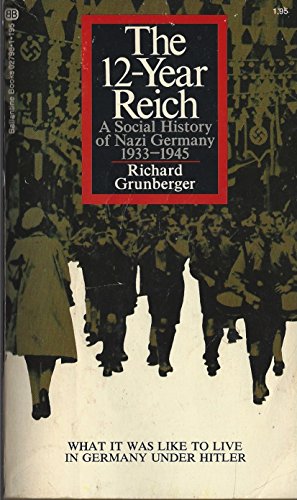
While Adolf Hitler ruled Germany from 1933 to 1945, “the persuasive influence of the Nazi regime reached into every corner of everyday life in Germany.”
So reads the paperback cover of Richard Grunberger’s classic 1971 book, The 12-Year Reich.
“Censorship prevailed, education was undermined, family life was idealized, but children were encouraged to turn in disloyal parents.
“‘Volk’ festivals, party rallies, awards, uniforms, pageantry all played a part in the massive effort to shape the mind of a nation.”
And yet, after the Reich surrendered unconditionally to the Allies on May 8, 1945, a strange thing happened: Virtually no one in Germany admitted to having been a Nazi—or having even known one.
As for who was responsible for losing the war itself: As far as most Germans were concerned, that blame fell entirely on the man they had once worshiped as Der Fuhrer. If he had just let his brilliant generals run operations, Germany would have triumphed.
In short: Adolf Hitler had lost the war he started—making him a loser nobody wanted to be identified with.
In the decades since, the “loser” tag has continued to stick with those who once served the Third Reich. Mel Brooks has repeatedly turned German soldiers—once the pride of the battlefield—into idiotic comic foils.
Even the fearsome Gestapo was spoofed for laughs on the long-running TV comedy, “Hogan’s Heroes.”

“Hogan’s Heroes”
“Americans love a winner,” George C. Scott as George S. Patton says at the outset of the classic 1970 movie. “And will not tolerate a loser.”
And that is why Republicans have stuck so closely with President Donald J. Trump.
A typical example of this occurred on June 8, 2017, after former FBI director James Comey testified before the United States Senate Select Committee on Intelligence.
Comey revealed that, on February 14, Trump had ordered everyone but Comey to leave a crowded meeting in the Oval Office.
“I want to talk about Mike Flynn,” said Trump.
Flynn had resigned the previous day from his position as National Security Adviser. The FBI was investigating him for his previously undisclosed ties to Russia.
“I hope you can see your way clear to letting this go, to letting Flynn go,” said Trump. “He is a good guy. I hope you can let this go.”
This was clearly an attempt by Trump to obstruct the FBI’s investigation.
Yet Republican House Speaker Paul Ryan rushed to excuse his clearly illegal behavior: “He’s new at government, so therefore I think he’s learning as he goes.”
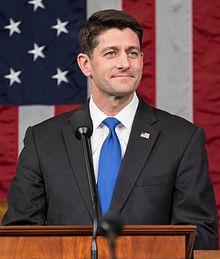
Paul Ryan
Republicans don’t fear that Trump will trash the institutions that Americans have cherished for more than 200 years. Institutions like an independent judiciary, a free press, and an incorruptible Justice Department.
He has already attacked all of these—and Republicans have either said nothing or rushed to his defense.
And despite Trump’s repeated threats to fire Special Counsel Robert Mueller, Republicans have refused to enact any safeguards to prevent this. In fact, if Trump did so, it’s doubtful that most Republicans would vote to impeach and convict him.
The reason: They fear losing the support of his fanatical base—even if it constitutes only 36% of all registered voters.
At the same time, Republicans fear that Trump will finally cross one line too many. And that the national outrage following this will force them to launch impeachment proceedings against him.
But it isn’t even Trump they fear will be destroyed.
What they most fear losing is their own hold on nearly absolute power in Congress and the White House.
If Trump is impeached and possibly indicted, he will become a man no one any longer fears. He will be a figure held up to ridicule and condemnation.
Like Adolf Hitler. Like Richard Nixon.
And his Congressional supporters will be branded as losers along with him.
Republicans vividly remember what happened after Nixon was forced to resign on August 9, 1974: Democrats, riding a wave of reform fever, swept Republicans out of the House and Senate—and Jimmy Carter into the White House.
Thus, Americans who are fed up with the chaos and cruelties of the Trump administration must find a way to separate Trump from his knee-jerk supporters in Congress.
And here it is:
American voters need not wait until the fall elections to “send a message” to Republicans in the House and Senate. Instead, they can immediately launch recall campaigns against all Republicans in both houses of Congress.
That would have a far greater impact on Republicans than sending mere letters of outrage. Or even rejecting individual Republican candidates, such as Roy Moore in Alabama and Rick Saccone in Pennsylvania.
And this is where the Democratic party must finally show some backbone.
Democrats must launch an unceasing advertising campaign to persuade voters to force a nationwide recall of all Republicans.
Republicans must be forced to realize they will lose their privileged positions for supporting a vicious, unstable President who sells out the Nation to a hostile foreign power—Russia.
Only then will they sweep him out of the White House like a dead rat on the kitchen floor.
ABC NEWS, ADOLF HITLER, ALTERNET, AP, BORIS YELTSIN, BUZZFEED, CBS NEWS, CNN, CROOKS AND LIARS, DAILY KOZ, DICTATORS, DONALD TRUMP, FACEBOOK, GEORGE W. BUSH, HILLARY CLINTON, JOE SCARBOROUGH, JOSEPH STALIN, KGB, KIM JONG-UN, MISS TEEN USA, MISS UNIVERSE, MISS USA, MORNING JOE, MOTHER JONES, MOVEON, MSNBC, NAZI GERMANY, NAZI PARTY, NBC NEWS, NEWSWEEK, NPR, POLITICO, RAW STORY, RED ARMY, REPUBLICAN PARTY, REUTERS, SALON, SEATTLE TIMES, SLATE, SOVIET UNION, THE ATLANTIC, THE CHICAGO SUN-TIMES, THE CHICAGO TRIBUNE, THE DAILY BEAST, THE GUARDIAN, THE HILL, THE HUFFINGTON POST, THE LOS ANGELES TIMES, THE NATION, THE NEW YORK TIMES, THE WASHINGTON POST, TIME, TWITTER, U.S. NEWS & WORLD REPORT, UPI, USA TODAY, USA TODAY ABC NEWS, VLADIMIR PUTIN, WEHRMACHT, WORLD WAR ii
In Bureaucracy, History, Military, Politics, Social commentary on March 9, 2018 at 12:10 am
“And I have to say, I don’t understand Donald [Trump’s] bizarre fascination with dictators and strongmen who have no love for America.”
The speaker was Democratic Presidential candidate Hillary Clinton, addressing an audience in San Diego, California, on June 2, 2016.
“He praised China for the Tiananmen Square massacre; he said it showed strength.
“He said, ‘You’ve got to give Kim Jong Un credit’ for taking over North Korea—something he did by murdering everyone he saw as a threat, including his own uncle, which Donald described gleefully, like he was recapping an action movie.
“And he said if he were grading Vladimir Putin as a leader, he’d give him an A. Now, I’ll leave it to the psychiatrists to explain his affection for tyrants,” said Clinton.
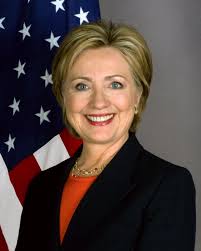
Hillary Clinton
To many people, it’s the ultimate odd-couple: The lifelong Communist and former KGB officer (Putin) walking arm-in-arm with the billionaire, publicity-hungry capitalist.
First Putin:
“He is a bright personality, a talented person, no doubt about it. It is not up to us to appraise his positive sides, it is up to the U.S. voters. but, as we can see, he is an absolute leader in the presidential race.”
Now Trump:
“It is always a great honor to be so nicely complimented by a man so highly respected within his own country and beyond.”
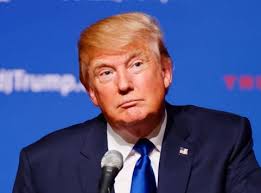
Donald Trump
Actually, it’s not uncommon for dictators to admire one another—as the case of Joseph Stalin and Adolf Hitler nicely illustrates.
After Hitler launched a blood-purge of his own private Stormtroopers army on June 30, 1934, Stalin exclaimed: “Hitler, what a great man! That is the way to deal with your political opponents!”
And Hitler was equally admiring of Stalin’s notorious ruthlessness: “After the victory over Russia,” he told his intimates, “it would be a good idea to get Stalin to run the country, with German oversight, of course. He knows better than anyone how to handle the Russians.”
Appearing on the December 18, 2015 edition of MSNBC’s “Morning Joe,” Trump said: “Sure, when people call you ‘brilliant,’ it’s always good. Especially when the person heads up Russia.”
The host, Joe Scarborough, was upset by Trump’s praise for Putin: “Well, I mean, [he’s] also a person who kills journalists, political opponents, and invades countries. obviously that would be a concern, would it not?”
TRUMP: He’s running his country, and at least he’s a leader. Unlike what we have in this country.
When Trump praised Putin as a leader—“unlike what we have in this country”—he undoubtedly meant then-President Barack Obama.
Ironically, it was Obama—not Trump—who was repeatedly named in Gallup polls as the most admired man in America in each of the last seven years, from 2008, the year he was elected president, to 2016, his last year in office.
Although Trump didn’t mention former President George W. Bush, it was he, not Obama, who was taken in by Putin.
In June 2001, Bush and Putin met in Slovenia. During the meeting this exchange occurred.
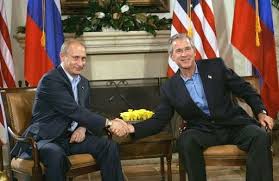
Vladimir Putin and George W. Bush
Putin, a former KGB Intelligence officer, had clearly done his homework on Bush. When he mentioned that one of the sports Bush had played was rugby, Bush was highly impressed.
“I did play rugby,” said Bush. “Very good briefing.”
Bush knew that Putin had worked for Soviet intelligence. So he should not have been surprised that the KGB had amassed a lengthy dossier on him.
But more was to come.
BUSH: Let me say something about what caught my attention, Mr. President, was that your mother gave you a cross which you had blessed in Israel, the Holy Land.
PUTIN: It’s true.
BUSH: That amazes me, that here you were a Communist, KGB operative, and yet you were willing to wear a cross. That speaks volumes to me, Mr. President. May I call you Vladimir?
Putin instantly sensed that Bush judged others—even world leaders—through the lens of his own fundamentalist Christian theology.
Falling back on his KGB training, Putin seized on this point of commonality to build a bond. He told Bush that his dacha had once burned to the ground, and the only item that had been saved was that cross.
“Well, that’s the story of the cross as far as I’m concerned,” said Bush. “Things are meant to be.”
Afterward, Bush and Putin gave an outdoor news conference.
“Is this a man that Americans can trust?” a reporter asked Bush.
“Yes,” said Bush. “I looked the man in the eye. I found him to be very straightforward and trustworthy. We had a very good dialogue.
“I was able to get a sense of his soul, a man deeply committed to his country and the best interests of his country. I wouldn’t have invited him to my ranch if I didn’t trust him.”
No Right-wingers—including Trump—criticized Bush then. Nor do they now recall such embarrassing words.
It’s politically profitable for Rightists to pretend that America’s tensions with Russia began with the election of Barack Obama.
And that those tensions have vanished now that another Rightist—and white—President occupies the White House.
2016 PRESIDENTIAL ELECTION, ABC NEWS, ADOLF HITLER, ALTERNET, ANTI-COMMUNISM, AP, BILL MITCHELL, BUZZFEED, CBS NEWS, CNN, COMMUNISM, CROOKS AND LIARS, DAILY KOZ, DEMOCRATIC NATIONAL COMMITTEE, DIRECTOR OF NATIONAL INTELLIGENCE, DONALD TRUMP, FACEBOOK, FBI, HOUSE INTELLIGENCE COMMITTEE, JAMES COMEY, JAMES R. CLAPPER, JOSEPH R. MCCARTHY, JOSEPH STALIN, MOTHER JONES, MOVEON, NAZI GERMANY, NBC NEWS, NEWSWEEK, NORTH ATLANTIC TREATY ORGANIZATION, NPR, POLAND, POLITICO, RAW STORY, REPUBLICANS, REUTERS, RICHARD M. NIXON, ROBERT MUELLER, RUSSIAN BOTS, SALON, SEATTLE TIMES, SENATE INTELLIGENCE COMMITTEE, SLATE, SOVIET UNION, THE ATLANTIC, THE CHICAGO SUN-TIMES, THE CHICAGO TRIBUNE, THE DAILY BEAST, THE GUARDIAN, THE HILL, THE HUFFINGTON POST, THE LOS ANGELES TIMES, THE NATION, THE NEW YORK TIMES, THE WASHINGTON POST, TIME, TREASON, TWITTER, U.S. NEWS & WORLD REPORT, UPI, USA TODAY, USA TODAY VLADIMIR PUTIN, WIKILEAKS, WORLD WAR 11
In Bureaucracy, History, Military, Politics, Social commentary on March 1, 2018 at 12:08 am
There was a time when Republicans saw—and portrayed themselves—as America’s foremost defenders against Communism.
This was particularly true during the early 1950s. Case in point: Wisconsin United States Senator Joseph R. McCarthy.
Elected to the Senate in 1946, he rose to national prominence on February 9, 1950, after giving a fiery speech in Wheeling, West Virginia:
“The State Department is infested with communists. I have here in my hand a list of 205—a list of names that were made known to the Secretary of State as being members of the Communist Party and who nevertheless are still working and shaping policy in the State Department.”
Joseph McCarthy
No American—no matter how prominent—was safe from the accusation of being a Communist or a Communist sympathizer—”a Comsymp” or “fellow traveler” in the style of the era.
So Red-baiting Republicans like McCarthy and then-Vice President Richard M. Nixon would feel dumbfounded at the following news:
On February 20, a purge of Russian “bots” by Twitter sparked outrage by—yes!—Right-wingers.
Bots are fake accounts used to spread propaganda or advertising campaigns. Investigations by the House and Senate Intelligence Committees have uncovered massive efforts by Russia to throw the 2016 Presidential election to Donald Trump.
Their weapon of choice: Swamping “social media” sites like Facebook, Google and Twitter with genuinely fake news.
The Twitter purge came a week after Special Counsel Robert Mueller indicted 13 Russians and three Russian companies for interfering in that election. The indictments detailed an elaborate plot to wage “information warfare” against the United States.
Right-wingers suddenly found thousands of their Russian bot followers had disappeared—and accused Twitter of secretly deleting like-minded accounts.
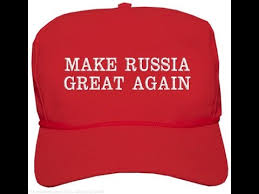
“Twitter is currently purging the followers on conservative accounts only. I just lost 3000 followers in one minute,” tweeted Candace Owens, director of urban engagement for Turning Point USA. This is a student organization promoting limited government and free markets.
Bill Mitchell, a Right-winger known for his controversial tweets defending President Donald Trump, claimed that he lost roughly 4,000 followers overnight.
“This is a damn joke,” tweeted Mike Zollo. “Twitter is absolutely censoring conservative and right wing speech for no damn reason other than their disagreement with it. But, liberals can write vile comments and threaten us with no punishment.”
From the end of World War II to the collapse of the Soviet Union in 1991, it would have been unthinkable for a Republican Presidential candidate to find common cause with a Soviet dictator.
But that utterly changed when Donald Trump won, first, the Republican Presidential nomination and, then, the White House. Trump lavishly praised Russian President Vladimir Putin—and even called on him to directly interfere in the 2016 Presidential race.
On July 22, 2016, Wikileaks released 19,252 emails and 8,034 attachments hacked from computers of the highest-ranking officials of the Democratic National Committee (DNC). Early reports traced the leak to Russian hackers.
“Russia, if you are listening,” Trump said at a press conference in Doral, Florida, “I hope you are able to find the 33,000 emails that are missing—I think you will probably be rewarded mightily by our press.”
This was nothing less than treason—calling upon a foreign power, hostile to the United States, to interfere in its Presidential election.
On December 16, 2016, then-FBI Director James B. Comey and Director of National Intelligence James R. Clapper Jr. agreed with a CIA assessment that Russia intervened in the 2016 election in part to help Donald Trump win the White House.

Trump, however, has steadfastly denied any such role by Russia: “I think it’s ridiculous,” he told “Fox News Sunday.” “I think it’s just another excuse. I don’t believe it….No, I don’t believe it at all.”
The last time dictator-worshiping Fascists found common cause with dictator-worshiping Communists was in August, 1939.
Germany’s Fuhrer Adolf Hitler and the Soviet Union’s Joseph Stalin agreed to end—at least temporarily—their years of violent rivalry and personal slander.
The reason: Hitler planned to invade Poland, and feared he would have to fight its allies, France and England, if he did. He didn’t want to have to fight the Soviet Union, too.
And Stalin saw Hitler’s warlike ambitions as useful to his own dreams of conquest: He wanted—and got—the eastern half of Poland, while Hitler’s legions occupied the western half.
So why would Donald Trump—the arch capitalist—find common cause with Vladimir Putin, the arch Communist?
Simple: Each had something the other wanted.
First, Putin: He wanted a President who would withdraw the United States from the North Atlantic Treaty Organization (NATO)—which would instantly render that alliance kaput. And give Russia a free hand to attack Europe.
And Trump had repeatedly said the United States was paying an unfairly large portion of the monies needed to maintain that alliance.
Then, Trump: He wanted to be President—to enrich himself and his family, to become the center of the world’s attention, and to destroy anyone who dared confront or contradict him.
And in supporting his dictatorial agenda, his millions of Right-wing followers have found common cause with the followers of a Communist dictator’s agenda.
2016 PRESIDENTIAL ELECTION, ABC NEWS, ADOLF HITLER, ALTERNET, AP, ARTICLE 48, BARACK OBAMA, BUZZFEED, CBS NEWS, CNN, CROOKS AND LIARS, DAILY KOZ, DAVID BROOKS, DONALD TRUMP, ENABLING ACT, FACEBOOK, FBI, FRANCE, FRANZ HALDER, FRANZ VON PAPEN, GUNTER MEISNER, HERMAN GORING, HERMAN WOUK, JAMES COMEY, MARK SHIELDS, MICHAEL FLYNN, MOTHER JONES, MOVEON, NAZI GERMANY, NBC NEWS, NEWSWEEK, NPR, PAUL VON HINDENBURG, PBS NEWSHOUR, POLITICO, PRUSSIA, RAW STORY, REICHSTAG, REUTERS, ROBERT MUELLER, RUSSIA, SALLY YATES, SALON, SEATTLE TIMES, SHIELDS AND BROOKS, SLATE, THE ATLANTIC, THE CHICAGO SUN-TIMES, THE CHICAGO TRIBUNE, THE DAILY BEAST, THE GUARDIAN, THE HILL, THE HUFFINGTON POST, THE LOS ANGELES TIMES, THE NATION, THE NEW YORK TIMES, THE WASHINGTON POST, THE WINDS OF WAR, TIME, TWITTER, U.S. NEWS & WORLD REPORT, UPI, USA TODAY, USA TODAY ADOLF HITLERR, VLADIMIR PUTIN, WALTER VON BRAUCHITSCH, WOLFGANG PREISS, WORLD WAR 11
In Bureaucracy, History, Law, Law Enforcement, Politics, Social commentary on February 1, 2018 at 12:03 am
When German President Paul von Hindenburg appointed Adolf Hitler Chancellor of Germany on January 30, 1933, not all Germans rejoiced.
Millions of them, in fact, hoped that the radical Fascist would be “boxed in” by “the establishment.”
President Hindenburg was known to despise Hitler. And a Hindenburg ally, Franz von Papen, was Vice Chancellor.
Yet it was Von Papen who was largely responsible for Hitler’s coming to power.
He believed that the longtime agitator could be controlled once he was in the government. The cabinet, after all, was not under Nazi domination. And so he convinced Hindenburg to appoint Hitler as Chancellor.
Almost immediately, Hitler began to outmaneuver those who sought to restrain him.
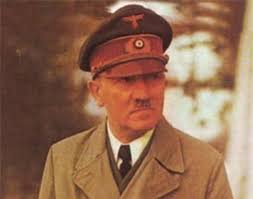
Adolf Hitler
As part of his deal with Papan, Hitler appointed his longtime supporter, Herman Goring, interior minister of Prussia—thus arming the Nazis with the largest police force in Germany.
On February 1, 1933, Hitler presented Article 48 to the cabinet. This allowed the police to take people into “protective custody” without charges. Hindenburg signed it into law on February 4 as the “Decree for the Protection of the German People.”
In March, the Reichstag (parliament) passed the Enabling Act, which allowed Hitler to rule by decree without interference from legislators. Germany, it was claimed, needed “an iron hand” because it was supposedly threatened by a Communist revolution.
The Enabling Act was authorized to last only four years. But it was renewed in 1937 and, in 1941, extended for the rest of Hitler’s lifetime.
On August 2, the aged Hindenburg died. Hitler immediately consolidated the positions of President and Chancellor—and ordered the German Armed Forces to swear an oath of personal loyalty to him.
Hitler’s mastery of Germany was now complete.
Fast forward 84 years from Adolf Hitler’s gaining total power in Germany to January 30, 2018.
President Donald Trump can say—as truthfully as Adolf Hitler: I am the destiny of America.
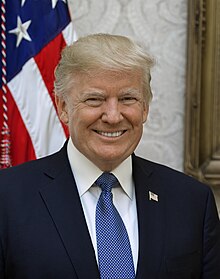
Donald Trump
Among his tumultuous actions during his first year as President, Trump:
- Fired Acting Attorney General Sally Yates after she notified him that National-Security Adviser Michael Flynn had misled the FBI.
- Fired FBI Director James Comey for investigating the Trump Presidential campaign’s links to the Kremlin.
- Attacked the integrity of the American Intelligence community—while praising Russian President Vladimir Putin.
- Falsely claimed that former President Barack Obama had illegally wiretapped him during the 2016 Presidential campaign.
- Tried to fire Independent Counsel Robert Mueller, but was talked out of it.
Syndicated columnist Mark Shields and New York Times columnist David Brooks appear every Friday on the PBS Newshour to review the week’s major political events.
On January 26, Brooks—a conservative, and Shields, a liberal—reached similar conclusions about the recent news that President Trump had tried to fire Independent Counsel Robert Mueller during the summer of 2017.
After Comey’s firing, Mueller had been assigned to oversee the previously-confirmed FBI investigation of Russian government efforts to influence the 2016 presidential election.
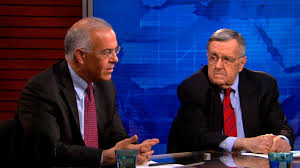
David Brooks and Mark Shields
DAVID BROOKS: “First, it should be pointed out that White House staff has repeatedly said there was no effort to fire Mueller, when they clearly have been lying for months about that….
“I was in Dayton, Ohio, this morning. And a friend said, in this presidency, I’m just stunned every day. I’m stunned every hour. And at some point, you get out of stunned. There’s no more stun.
“And I found this when I saw our story. If I had seen that story seven or eight months ago, I would have been, ‘Oh, I can’t believe this is happening.’ Now I’m inured. I’m used to it. I have been numbed.
“And I came to think, even if he fired Mueller, maybe we’re all just—we’re like, we have been numbed to the things that happen and nobody gets upset anymore. I think people would get upset if he actually did try to fire Mueller, but we have defined deviancy down and gotten used to a set of behavior that would have been shocking to us a year ago.”
MARK SHIELDS: “I think there would be a firestorm at this point [if Trump fired Mueller]….
“How long and how intense, I don’t know, because I remain just perplexed at the limit of the finite limits of our outrage, or our sense of outrage….
“But I think it really comes down to, who’s going to stand with [Mueller]? And I look at the Republicans on the Hill and, you know, the lack, the tower of Jell-O that is the speaker of the House….”
JUDY WOODRUFF: “…Could this campaign…by some Republicans in the House and with support from the White House to undermine the FBI…have a long-lasting effect on the Justice Department in the end?”
DAVID BROOKS: “Yes, I think so.
“And the FBI is filled with honest brokers….There are a lot of agencies that are filled with honest brokers, and the idea that everybody in this city is a politician is just not true.
“It’s always amazing to me that a lot of people in government, they are not actually that political. They believe in the public service and they try to do their jobs, but they’re not sort of super political people.”
2016 PRESIDENTIAL ELECTION, ABC NEWS, ADOLF HITLER, ALTERNET, AP, ARTICLE 48, BARACK OBAMA, BUZZFEED, CBS NEWS, CNN, CROOKS AND LIARS, DAILY KOZ, DAVID BROOKS, DONALD TRUMP, ENABLING ACT, FACEBOOK, FBI, FRANCE, FRANZ HALDER, FRANZ VON PAPEN, GUNTER MEISNER, HERMAN GORING, HERMAN WOUK, JAMES COMEY, MARK SHIELDS, MICHAEL FLYNN, MOTHER JONES, MOVEON, NAZI GERMANY, NBC NEWS, NEWSWEEK, NPR, PAUL VON HINDENBURG, PBS NEWSHOUR, POLITICO, PRUSSIA, RAW STORY, REICHSTAG, REUTERS, ROBERT MUELLER, RUSSIA, SALLY YATES, SALON, SEATTLE TIMES, SHIELDS AND BROOKS, SLATE, THE ATLANTIC, THE CHICAGO SUN-TIMES, THE CHICAGO TRIBUNE, THE DAILY BEAST, THE GUARDIAN, THE HILL, THE HUFFINGTON POST, THE LOS ANGELES TIMES, THE NATION, THE NEW YORK TIMES, THE WASHINGTON POST, THE WINDS OF WAR, TIME, TWITTER, U.S. NEWS & WORLD REPORT, UPI, USA TODAY, USA TODAY ADOLF HITLERR, VLADIMIR PUTIN, WALTER VON BRAUCHITSCH, WOLFGANG PREISS, WORLD WAR 11, WORLD WAR ii
In Bureaucracy, History, Law, Law Enforcement, Military, Politics, Social commentary on January 31, 2018 at 12:06 am
After Donald Trump won the 2016 election, many people feared he would embark on a radical Right-wing agenda. But others hoped that the Washington bureaucracy would “box him in.”
The same sentiments echoed throughout Germany after Adolf Hitler was appointed Chancellor of Germany on January 30, 1933.
The 1983 TV mini-series, The Winds of War, offered a dramatic example of how honorable men can be overwhelmed by a ruthless dictator.
Based on the bestselling 1971 historical novel by Herman Wouk, the mini-series factually re-created the major historical events of World War II.
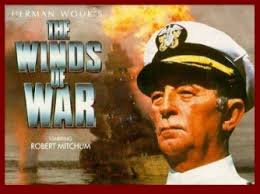
One of those events took place on November 5, 1939.
General Walther von Brauchitsch is summoned to the Chancellery in Berlin to meet with Adolf Hitler. He carries a memorandum signed by all the leaders of the German Wehrmacht asserting that Case Yellow—Hitler’s planned attack against France—is impossible.
Meanwhile, at the German army headquarters at Zossen, in Berlin, the Wehrmacht’s top command wait for word from von Brauchitsch.
CHANCELLERY:
Von Brauchitsch hands the memorandum to Hitler, who reads it.
ZOSSEN:
Brigadier General Armin von Roon: I must confide in you on a very serious matter. I have been approached by certain army personages of the loftiest rank and prestige with a frightening proposal.
Chief of the General Staff Franz Halder: What did you reply?
Von Roon: That they were talking high treason.
CHANCELLERY:
Adolf Hitler (slamming down the memorandum): So—what is new in all this?
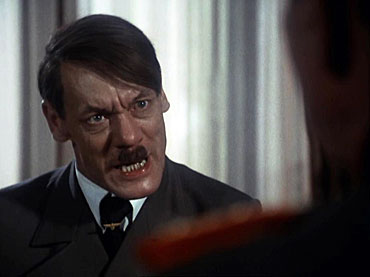
Gunter Meisner as Adolf Hitler in “The Winds of War”
Walther Von Brauchitsch: Fuhrer, it is the army’s final position that Case Yellow cannot proceed.
Hitler: Why not?
Von Brauchitsch: Because of the military fundamentals as stated.
Hitler: Such as?
Von Brauchitsch: The meteorologists predict continuous soaking rains for weeks.
Hitler: It rains on the enemy, too.
ZOSSEN:
Von Roon: The conspiracy has been going on that long—since Czechoslovakia [1938)?
Halder: If the British had not caved in at Munich [where France and Britain sold out their ally, Czechoslovakia]—perhaps. But they did. And ever then, ever since his big triumph, it has been hopeless. Hopeless.
Von Roon: Empty talk, talk, talk. I am staggered.
Halder: A hundred times I myself could have shot the man. I can still at any time. But what would be the result? Chaos. The people are for him. He has unified the country. We must stick to our posts and save him from making military mistakes.
Halder: But we really cannot proceed with Case Yellow.
Von Roon: Brauchitsch will get a postponement.
Halder: And if he does not?
CHANCELLERY:
Von Brauchitsch: Fuhrer, even the supply of artillery shells is totally inadequate.
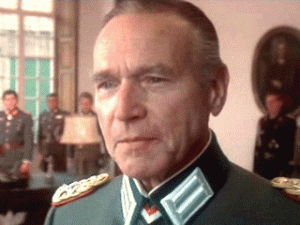
Wolfgang Preiss as Walter von Brauchitsch in “The Winds of War”
Hitler: Who says so?
Von Brauchitsch: General Thomas, my chief of economics and armament.
Hitler: Do you know how many artillery shells of all calibers we have in the staging areas—right this minute?
Von Brauchitsch: No.
Hitler: How many we have in the reserve dumps in the West?
Von Brauchitsch: No, it’s up to my staff—
Hitler: What the monthly annual production of shells is? What the projected rise in production of the next six months is, month by month?
Von Brauchitsch: Who keeps such figures in his head?
Hitler: I do! The supply is adequate. I tell you so. And I’m a field soldier who depended on artillery for four years to protect his life. [He hands von Brauchitsch a sheaf of armaments figures.] Check with your staff. if one of those figures is wrong, you can postpone Case Yellow. Otherwise—you march! And next time you come to see me, know what you’re talking about!
Von Brauchitsch: If we march unprepared as we are, defeatism will run rampant. It will destroy the Wehrmacht and the Fatherland. The morale of the army was low, even in the Polish campaign.
Hitler: You question to me—to me—the courage of the German soldier?
Von Brauchitsch: I’m talking facts!
Hitler: What facts? Back up this monstrous assertion! In what units was morale low? What action was taken? How many death sentences were handed out for cowardice? Speak up! I’ll fly to the front and pass the death sentences myself. One specific instance.
Von Brauchitsch: It was common knowledge—
Hitler: Common knowledge? What is common knowledge is that army headquarters at Zossen crawls with cowards. You opposed me in rearming the Rhineland. You opposed me on the [union] with Austria. You opposed me on Czechoslovakia, until the British came crawling to me. You dirtied in your trousers, you heroes at Zossen, at the idea of marching into Poland. Well, have I once been wrong? Have you once been right? Answer me!
Von Brauchitsch: Mein Fuhrer—
Hitler: Tell everyone who signed this insubordinate Zossen rubbish to beware! I will ruthlessly crush everybody up to the rank of a Field Marshal who dares to oppose me. You don’t have to understand. You only have to obey. The German people understand me. I am Germany.
Fast forward 79 years from Adolf Hitler’s stormy confrontation with Walter von Brauchitsch to January 26, 2018.
President Donald Trump—having fired FBI Director James Comey, attacked the integrity of the American Intelligence community and tried to fire Independent Counsel Robert Mueller—can equally say: I am the destiny of America.
ABC NEWS, ADOLF HITLER, ALTERNET, AP, BBC, BUZZFEED, CBS NEWS, CNN, DAILY KOS, DAVID BROOKS, DONALD TRUMP, FACEBOOK, FBI, GEORGE C. SCOTT, GEORGE S. PATTON, GESTAPO, HOGAN’S HEROES, JAMES COMEY, JIMMY CARTER, MEL BROOKS, MIKE FLYNN, MOTHER JONES, MOVEON, NAZI GERMANY, NBC NEWS, NEWSWEEK, NPR, PAUL RYAN, PBS NEWSHOUR, POLITICO, RAW STORY, REPUBLICAN PARTY, REUTERS, RICHARD GRUNBERGER, RICHARD NIXON, ROBERT MEULLER, Ronald Reagan, SALON, SEATTLE TIMES, SLATE, SOVIET UNION, THE 12-YEAR REICH, THE ATLANTIC, THE CHICAGO SUN-TIMES, THE CHICAGO TRIBUNE, THE DAILY BEAST, THE GUARDIAN, THE HILL, THE HUFFINGTON POST, THE LOS ANGELES TIMES, THE NEW YORK TIMES, THE WALL STREET JOURNAL, THE WASHINGTON POST, TIME, TWITTER, U.S. NEWS & WORLD REPORT, UPI, USA TODAY, WAFFEN-SS, WEHRMACHT
In Bureaucracy, History, Law, Law Enforcement, Politics, Social commentary on December 27, 2017 at 2:10 am
While the Nazi Party ruled Germany from 1933 to 1945, its influence over all aspects of Germans’ lives was suffocating.
“The persuasive influence of the Nazi regime reached into every corner of everyday life in Germany,” reads the back cover of Richard Grunberger’s classic 1971 book, The 12-Year Reich.
“Censorship prevailed, education was undermined, family life was idealized, but children were encouraged to turn in disloyal parents.
“‘Volk’ festivals, party rallies, awards, uniforms, pageantry all played a part in the massive effort to shape the mind of a nation.”
And yet, after the Reich surrendered unconditionally to the Allies on May 8, 1945, a strange thing happened: Virtually no one in Germany admitted to having been a Nazi—or having even known one.
American and British soldiers couldn’t find any German veterans willing to admit they had ever fought against Western, democratic nations. All the once-proud legionaries of the Wehrmacht and Waffen-SS swore they had been fighting “the real enemy”—the Russians—on the Eastern front.
And then there were all the stories of Germans who, at great risk to themselves, had hidden Jews in their attics. Which left unanswered the question: If so many “good Germans” had saved so many Jews, how had six million Jews died horrifically before the Reich fell?
In short: Adolf Hitler had lost the war he started—making him a loser nobody wanted to be identified with.
In the decades since, the “loser” tag has continued to stick with those who once served the Third Reich. Mel Brooks has repeatedly turned German soldiers—once the pride of the battlefield—into idiotic comic foils.
Even the fearsome Gestapo was spoofed for laughs on the long-running TV comedy, “Hogan’s Heroes.”
“Hogan’s Heroes”
“Americans love a winner,” George C. Scott as George S. Patton says at the outset of the classic 1970 movie. “And will not tolerate a loser.”
And that is why Republicans have stuck so closely with President Donald J. Trump.
A typical example of this occurred on June 8 after former FBI director James Comey testified before the United States Senate Select Committee on Intelligence.
Comey revealed that, on February 14, Trump had ordered everyone but Comey to leave a crowded meeting in the Oval Office.
“I want to talk about Mike Flynn,” said Trump.
Flynn had resigned the previous day from his position as National Security Adviser. The FBI was investigating him for his previously undisclosed ties to Russia.
“I hope you can see your way clear to letting this go, to letting Flynn go,” said Trump. “He is a good guy. I hope you can let this go.”
This was clearly an attempt by Trump to obstruct the FBI’s investigation.
Yet Republican House Speaker Paul Ryan rushed to excuse his clearly illegal behavior: “He’s new at government, so therefore I think he’s learning as he goes.”
Paul Ryan
David Brooks, the conservative New York Times columnist, offered a more accurate explanation of Trump’s motives. Speaking on The PBS Newshour, Brooks said:
“We are a nation of laws. Donald Trump lives in an entirely different cultural universe. He is more clannist, believing in clan, believing in family, believing in loyalty, not recognizing objective law, not recognizing the procedures that is really how modern government operates….
“It’s not only that he doesn’t know the rules, but at all along and throughout his presidency, he has sort of trampled on the rules almost as a matter of policy, as a matter of character, because he doesn’t believe in that kind of relationships. It’s all personal loyalty, not about laws and norms and standards.”
Republicans don’t fear that Trump will trash the institutions that Americans have cherished for more than 200 years. Institutions like an independent judiciary, a free press, and an incorruptible Justice Department.
He has already attacked all of these—and Republicans have either said nothing or rushed to his defense.
What Republicans truly fear about Donald Trump is that he will finally cross one line too many—like firing Special Counsel Robert Meuller. And that the national outrage following this will force them to launch impeachment proceedings against him.
But it isn’t even Trump they fear will be destroyed.
What they most fear losing is their own hold on nearly absolute power in Congress and the White House.
If Trump is impeached and possibly indicted, he will become a man no one any longer fears. He will be a figure held up to ridicule and condemnation.
Like Adolf Hitler. Like Richard Nixon.
And his Congressional supporters will be branded as losers along with him.
Republicans vividly remember what happened after Nixon was forced to resign on August 9, 1974: Democrats, riding a wave of reform fever, swept Republicans out of the House and Senate—and Jimmy Carter into the White House.
What Ronald Reagan once said about the leadership of the Soviet Union now literally applies to that of the Republican Party:
“They…have openly and publicly declared that the only morality they recognize is what will further their cause, meaning they reserve unto themselves the right to commit any crime, to lie, to cheat, in order to attain that.”
ABC NEWS, ADOLF HITLER, ALBERT SPEER, ALTERNET, ANDY BIGGS, AP, BUZZFEED, CBS NEWS, CNN, CROOKS AND LIARS, DAILY KOZ, DONALD TRUMP, FACEBOOK, FBI, FOX NEWS NETWORK, GEORGE PAPADOPOULOS, GEORGE W. BUSH, JASON CHAFFETZ, JIM JORDAN, JUSTICE DEPARTMENT, LOUIS GOHMERT, MATTHEW GAETS, MICHAEL FLYNN, MOTHER JONES, MOVEON, NAZI GERMANY, NBC NEWS, NEWSWEEK, NPR, ORIN HATCH, PAUL MANAFORT, PAUL RYAN, POLITICO, RAW STORY, REPUBLICANS, REUTERS, RICK GATES, ROBERT MUELLER, SALON, SEAN HANNITY, SEATTLE TIMES, SERGEY KISLYAK, SERGEY LAVROV, SLATE, THE ATLANTIC, THE CHICAGO SUN-TIMES, THE CHICAGO TRIBUNE, THE DAILY BEAST, THE GUARDIAN, THE HILL, THE HUFFINGTON POST, THE LOS ANGELES TIMES, THE NATION, THE NEW YORK TIMES, THE WASHINGTON POST, TIME, TWITTER, U.S. NEWS & WORLD REPORT, UPI, USA TODAY, USA TODAY JAMES COMEY, WORLD WAR 11
In Bureaucracy, History, Law Enforcement, Politics, Social commentary on December 26, 2017 at 3:26 pm
On March 19, 1945, facing certain defeat, German Fuhrer Adolf Hitler ordered a massive “scorched-earth” campaign throughout Germany.
Albert Speer, Minister of Armaments for the Third Reich, was appalled. All German agriculture, industry, ships, communications, roads, food stuffs, mines, bridges, stores and utility plants were to be destroyed.
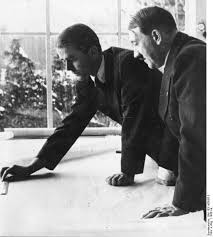
Albert Speer and Adolf Hitler pouring over architectural plans
If implemented, it would deprive the entire German population of even the barest necessities after the war.
Now living in a bunker 50 feet below bomb-shattered Berlin, Hitler gave full vent to his most destructive impulses.
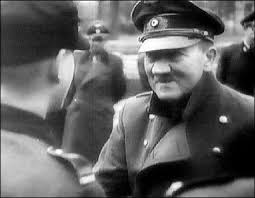
Adolf Hitler addressing boy soldiers as the Third Reich crumbles
“If the war is lost,” Hitler told Speer, “the nation will also perish. This fate is inevitable. There is no necessity to take into consideration the basis which the people will need to continue even a most primitive existence.
“On the contrary, it will be better to destroy these things ourselves, because this nation will have proved to be the weaker one and the future will belong solely to the stronger eastern nation.
“Besides, those who will remain after the battle are only the inferior ones, for the good ones have all been killed.”
Republicans have adopted the same “my-way-or-else” stance as Hitler. Like him, they are determined to gain and hold absolute power—or destroy the Nation they claim to love.
Take their current attitude toward—and attacks on—the U.S.Department of Justice and its chief investigative agency, the FBI.
On May 9, 2017, President Donald Trump fired FBI Director James Comey. Comey had been leading an investigation into alleged collusion between Trump advisers and Russian officials when he was fired.
At first, Trump claimed that he fired Comey for mishandling the FBI’s investigation into Hillary Clinton’s use of a private email server.
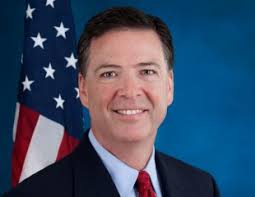
James Comey
But, during a May 10 meeting at the White House, Trump admitted to Russian Foreign Minister Sergey Lavrov and Russian Ambassador Sergey Kislyak: “I faced great pressure because of Russia. That’s taken off.”
Following the uproar over Comey’s firing, on May 17, the Justice Department appointed former FBI director Robert Mueller as Special Counsel to investigate any links the between Russian government and Trump campaign members.
Congressional Republicans joined Democrats in praising the appointment.
- House Oversight and Government Reform Chairman Jason Chaffetz, R-Utah, who had relentlessly pursued Hillary Clinton, said: “Mueller is a great selection. Impeccable credentials. Should be widely accepted.”
- “I commend (Department of Justice) for bringing in an independent voice to help bring clarity to this situation,” said Senator Orrin Hatch, R-Utah, a senior member of the Senate Judiciary Committee.
- House Speaker Paul Ryan, R-Wis., said, “My priority has been to ensure thorough and independent investigations are allowed to follow the facts wherever they may lead. That is what we’ve been doing here in the House. The addition of Robert Mueller as special counsel is consistent with this goal, and I welcome his role at the Department of Justice.”
Yet, since May, Trump, his shills in Congress and Right-wing Fox News have relentlessly attacked Mueller’s integrity and investigative methods. This despite the fact that Mueller was appointed by Republican President George W. Bush and served with an impeccable reputation for 12 years as FBI director (2001-2013).
The attacks grew increasingly vicious as Mueller uncovered evidence linking former high-ranking members of the Trump Presidential campaign to Russian Intelligence officials:
- Former national security adviser Michael Flynn pleaded guilty in December to lying to the FBI about his private conversations with Russian ambassador Kislyak. He is now cooperating with Mueller’s office.
- Trump’s former campaign chairman Paul Manafort and his deputy Rick Gates were indicted in October. They have pleaded not guilty and ordered under house arrest.
- George Papadopoulos, the former Trump campaign foreign policy adviser, pleaded guilty in October to lying to the FBI about his dealings with two Russians who had ties to the Russian government.
And the Republican response?
- “A witch hunt continues against the president with tremendous bias, no purpose and no end in sight,” charged Rep. Matthew Gaets (R-Florida).
- Gaetz joined Rep. Andy Biggs (R-Arizona) and Louie Gohmert (R-Texas) in demanding that Mueller resign because he was the FBI director in 2010 when Federal agencies approved the sale of Uranium One, a Canadian energy company, to a Russian nuclear-energy firm.
- “I think the public trust in this whole thing is gone,” said Rep. Jim Jordan (R-Ohio), a founder of the Right-wing Freedom Caucus.
- “Let’s start off with the head of the snake,” said Sean Hannity, the Fascistic commentator on Right-wing Fox News. “Mueller’s credibility is in the gutter tonight with these new discoveries, his conflicts of interests, his clear bias, the corruption are on full display. Mueller is frankly a disgrace to the American justice system and has put the country now on the brink of becoming a banana republic.”
There are three reasons for these attacks:
First, Republicans fear that Trump’s followers—the hard-core Fascists who turn out in mid-term elections—will reject them if they reject Trump.
Second, they fear that if Mueller’s investigation leads to Trump’s impeachment, they will be turned out of Congress—as many were after Richard Nixon resigned in disgrace.
Third, reports have circulated that many Congressional Republicans have received financial (and possibly intelligence) support from the Kremlin.
ABC NEWS, ADOLF HITLER, ALBANIA, ALTERNET, ANDREI CHERNY, AP, BERLIN AIRLIFT, BULGARIA, BUZZFEED, CAMILLUS, CBS NEWS, CNN, CONTAINMENT, CROOKS AND LIARS, CZECHOSLOVAKIA, DAILY KOZ, EAST GERMANY, FACEBOOK, FALISCIA, FRANCE, FRANKLIN D. ROOSEVELT, GAIL “HAL” HALVORSEN, GREAT BRITAIN, HARRY S. TRUMAN, HUNGARY, IRON CURTAIN, JOSEPH STALIN, MOTHER JONES, MOVEON, NAZI GERMANY, NBC NEWS, NEWSWEEK, NICCOLO MACHIAVELLI, NPR, POLAND, POLITICO, RAW STORY, REUTERS, ROMANIA, ROME, SALON, SEATTLE TIMES, SLATE, SOVIET UNION, THE ATLANTIC, THE CANDY BOMBERS, THE CHICAGO SUN-TIMES, THE CHICAGO TRIBUNE, THE DAILY BEAST, THE DISCOURSES, THE GUARDIAN, THE HILL, THE HUFFINGTON POST, THE LOS ANGELES TIMES, THE NATION, THE NEW YORK TIMES, THE WASHINGTON POST, TIME, TWITTER, U.S. NEWS & WORLD REPORT, UNITED STATES, UPI, USA TODAY, WEST BERLIN, WILLIE "THE WHIP" TUNNER, WORLD WAR 11, YUGOSLAVIA
In Bureaucracy, History, Military, Politics, Social commentary on December 21, 2017 at 3:12 am
In June, 1948, Soviet dictator Joseph Stalin was determined to drive the Western occupying powers out of Berlin—and of West Germany.
On June 19, the Soviet Union blocked the Western Allies’ railway, road, and canal access to the sectors of Berlin under Western control.
At that time, West Berlin had only 36 days’ worth of food and 45 days’ worth of coal. And the United States had only 8,973 Americans stationed in Berlin. British forces totaled 7,606, and French forces 6,100.
Russian forces in Berlin and East Germany outnumbered them 62 to 1.
The United States seemed to face a choice between all-out war with the Soviet Union—or appeasing its growing aggression in Eastern Europe.
Fortunately, a third choice was found. It became known as the Berlin Airlift.
This was carried out primarily by the United States and Great Britain. Other Western powers taking part in this operation included France, Australia, Canada, New Zealand and South Africa.
Starting on June 24, 1948, the Berlin Airlift aimed to supply the city’s two and a half million residents with food and energy supplies.
There was no guarantee that such an operation could succeed–at least, not in the long run. Since 1903, airplanes had been used to carry out surveillance, engage in dogfights or bomb cities. But airlifts—flying supplies to stranded people—had proven dismal failures.
At first, the Berlin Airlift worked haphazardly. Pilots flew themselves to exhaustion to meet the needs of those they had relentlessly bombed just three years ago.
Then Major General William “Willie the Whip” Tunner took charge—and brought a totally mechanized approach to the drops:
- Pilots must fly strictly by instruments, even when visibility was excellent.
- Planes could no longer circle over Berlin. Each plane would have only one chance to land in Berlin—or must return to its base if it missed its approach.
- Every 90 seconds, a plane was to take off or land.
Just keeping Berliners alive demanded 4,000 tons of supplies each day. Each plane was thus overloaded by 10 tons. Pilots flew literally round the clock. When fog rolled in that winter, visibility was reduced to zero. Twenty-eight Americans died in crashes.
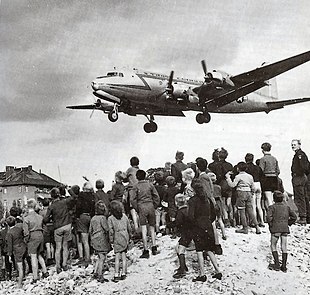
A Douglas C-54 Skymaster lands at Berlin’s Templehof Airport
Germans were impressed with American efficiency, but knew that, in the eyes of most of their American occupiers, they were pariahs. They had waged an aggressive war and exterminated millions of helpless men, women and children in concentration camps.
They were glad the Allies were keeping them alive, but felt they were pawns in a global chess game between the United States and the Soviet Union.
Then fate took a hand.
An Army Air Force pilot named Gail “Hal” Halvorsen impulsively decided to drop a series of small, hand-made parachutes of candies to Berlin’s children.
When General Tunner learned of this, he instantly realized its worth as a morale booster to Berliners. He ordered Halvorsen to continue the drops.

Gail “Hal” Halvorsen
Other pilots followed Halvorsen’s example. Soon Berlin’s children were lining up by the thousands, hoping to grab one of the candy-filled parachutes made from handkerchiefs or strips of clothing.
When the press learned of the drops, the story became a worldwide sensation. Back in the United States, Americans mailed literally tons of candy to Germany for distribution to Berlin’s children.
“The candy bombers” became the most beloved Americans in Berlin. And Halvorsen became the most beloved of them all. On October 3, 1948, when his plane landed in Berlin during a pouring storm, 700 children greeted him on the tarmac for “Lieutenant Gail Halvorsen Day.”
Among the letters he received from Berlin’s children:
Dear Uncle Wiggly Wings,
When yesterday I came from school, I had the happiness to get one of your sweet gifts….You cannot think how big the joy was….My brother and parents stood about me when I opened the strings and fetched out all the chocolate.
Dear Candy Bomber,
…How lucky I was last Sunday. I played at a ruin with some friends of mine opposite our house. Suddenly we saw about ten white parachutes coming out of the sky! One of them set down on the roof of our house. There were three stripes chocolate in the parachute….I want to thank you for your love to the German kids….
From 10-year-old Helma Lurch came this tribute:
Take care of yourself, and remember us children and we will remember you our whole life.
Adults as well as children responded emotionally to the candy drops—and “the candy bombers” responsible for them. When a plane crashed, killing two American lieutenants, residents of the neighborhood memorialized them with a plaque: “Once we were enemies yet you now gave your lives for us. We are doubly in your debt.”
The Airlift ended on May 12, 1949, when Stalin finally accepted defeat and ended the blockade.
“As [Halvorsen] came to represent the Airlift and America to the Berliners,” writes Andrei Cherney in his definitive book, The Candy Bombers, “through him America became a country that cared enough about the defeated Germans to…deliver candy to children, an act without any…ulterior motive, a gift of plain compassion.”
In 1948, that act forged a solid bond—which still exists—between Germany and the United States.

.jpg)


 Bureaucracybuster's Blog
2016 PRESIDENTIAL ELECTION, ABC NEWS, ALTERNET, AP, ARCHIBALD COX, ARRON COPELAND, ARTHUR MILLER, BUZZFEED, CBS NEWS, CHARLIE CHAPLAN, CNN, CROOKS AND LIARS, DAILY KOZ, DASHIELL HAMMETT, DELORES DEL RIO, DONALD TRUMP, DWIGHT D. EISENHOWER, EDWARD G. ROBINSON, EDWARD R. MURROW, ELMER BERNSTEIN, FACEBOOK, FBI, FOX NEWS, GEORGE C. MARSHALL, HARRY S. TRUMAN, HOWARD DA SILVA, HOWARD FAST, IRWIN SHAW, J. ROBER OPPENHEIMER, JAMES COMEY, JOHN BIRCH SOCIETY, JOHN GARFIELD, JOHN STEINBECK, JOSEPH R. MCCARTHY, LEE GRANT, LILLIAN HELLMAN, LLOYD BRIDGES, LUCILLE BALL, MOTHER JONES, MOVEON, NAZI GERMANY, NBC NEWS, NEWSWEEK, NPR, PETE SEEGER, POLITICO, RAW STORY, REUTERS, RICHARD M. NIXON, ROBERT MUELLER, ROBERT WELCH, ROD ROSENSTEIN, RUSSIAN INTELLIGENCE, RUTH GORDON, SALON, SEATTLE TIMES, SLATE, SOVIET UNION, STATE DEPARTMENT, SUBVERSION, THE ATLANTIC, THE CHICAGO SUN-TIMES, THE CHICAGO TRIBUNE, THE DAILY BEAST, THE GUARDIAN, THE HILL, THE HUFFINGTON POST, THE LOS ANGELES TIMES, THE NATION, THE NEW YORK TIMES, THE WASHINGTON POST, TIME, TWITTER, U.S. DEPARTMENT OF JUSTICE, U.S. NEWS & WORLD REPORT, UPI, USA TODAY, USA TODAY EDWARD R. MURROW, WILLIAM L. SHIRER, ZERO MOSTEL
UPDATING MURROW FOR OUR TIME: PART TWO (END)
In Bureaucracy, History, Law, Politics, Social commentary on March 21, 2018 at 12:23 amOn March 9, 1954, Edward R. Murrow, the most respected broadcast journalist in America, outlined the career and demagogic tactics of Wisconsin United States Senator Joseph R. McCarthy.
He did so on his CBS news show, “See It Now,” at the height of the “Red Scare” hysteria that McCarthy had whipped up four years earlier.
Virtually any American could find himself accused of being a Communist, or a “Comsymp,” or a “fellow traveler. Such an act could rob him/her of friends, career—or even liberty on the flimsiest of evidence.
Meanwhile, Republicans cowered before McCarthy’s attacks on the press, the military, the judiciary and law enforcement—or joined hid chorus. Protecting the nation’s social and political institutions took a distant second place to attacking Democrats as Communist traitors.
Today, 64 years later, another demagogue—Donald Trump—casts an even darker shadow across the land. As the President of the United States, he commands far more power than McCarthy ever did.
Donald Trump
Today, only those Republicans who have decided to retire from Congress dare to criticize Trump. The rest fear he will aim a nasty tweet at them—and cost them Fascistic voters, perhaps even their offices.
Meanwhile, Robert Mueller—a career prosecutor with the highest reputation for integrity—struggles to discover the truth about Russian electoral subversion and the Trump campaign’s collusion in it.
Every day he faces the danger of being fired by the very man whose criminal associates he’s investigating. And yet Republicans refuse to enact a law that would protect him against such abuse of power.
At this time, Murrow’s warnings about Joseph McCarthy need to be seriously reconsidered. Just substitute “President” for “Junior Senator” and “Trump” for “McCarthy,” and Murrow’s text could have been written yesterday.
Edward R. Murrow
On one thing the [President] has been consistent. Often operating as a one-man committee, he has traveled far, [defamed] many, terrorized some, accused civilian and military leaders of the past administration of a great conspiracy to turn over the country to [terrorism], [slamdered] and substantially demoralized the present State Department….
He has [slandered] a varied assortment of what he calls [“the enemy of the American people.”]
Republican Senator Flanders of Vermont said of [Trump] today: “He dons war paint; he goes into his war dance; he emits his war whoops; he goes forth to battle and proudly returns with the scalp of a pink army dentist.”
It is necessary to investigate before legislating, but the line between investigating and persecuting is a very fine one and the [President of the United States] has stepped over it repeatedly. His primary achievement has been in confusing the public mind, as between the internal and the external threats of [terrorism].
We must not confuse dissent with disloyalty. We must remember always that accusation is not proof and that conviction depends upon evidence and due process of law. We will not walk in fear, one of another.
We will not be driven by fear into an age of unreason, if we dig deep in our history and our doctrine, and remember that we are not descended from fearful men—not from men who feared to write, to speak, to associate and to defend causes that were, for the moment, unpopular.
This is no time for men who oppose [President Trump’s] methods to keep silent, or for those who approve. We can deny our heritage and our history, but we cannot escape responsibility for the result.
There is no way for a citizen of a republic to abdicate his responsibilities. As a nation we have come into our full inheritance at a tender age. We proclaim ourselves, as indeed we are, the defenders of freedom, wherever it continues to exist in the world, but we cannot defend freedom abroad by deserting it at home.
The actions of the [President of the United States] have caused alarm and dismay amongst our allies abroad, and given considerable comfort to our enemies. And whose fault is that? Not really his.
He didn’t create this situation of fear; he merely exploited it—and rather successfully. Cassius was right. “The fault, dear Brutus, is not in our stars, but in ourselves.”
Share this: