bureaucracybusters

Posts Tagged ‘JOSEPH STALIN’

REWRITING HISTORY: IT’S NOT JUST FOR RUSSIANS ANYMORE

In Bureaucracy, History, Military, Politics on February 17, 2016 at 12:01 am

At one time, Americans believed that the wholesale rewriting of history happened only in the Soviet Union.

“The problem with writing about history in the Soviet Union,” went the joke, “is that you never know what’s going to happen yesterday.”  

A classic example of this occurred in the Great Soviet Encyclopedia.  

Lavrenti Beria had been head of the NKVD, the dreaded secret police, from 1938 to 1953. In 1953, following the death of Soviet dictator Joseph Stalin, Beria was arrested and executed on orders of his fellow Communist Party leaders, who feared they were targets of a coming purge.  

Lavrenti Beria

But the Great Soviet Encyclopedia had just gone to press with a long article singing Beria’s praises.  

What to do?  

The editors of the Encyclopedia wrote an equally long article about “the Bering Straits,” which was to be pasted over the article about Beria, and sent this off to its subscribers. An unknown number of them decided it was safer to paste accordingly. 

Today, the Republican party is furiously rewriting history in a desperate attempt to win the 2016 Presidential election. 

Specifically, its members are now trying to convince Americans that:

  1. President George W. Bush “kept us safe” (excluding, of course, the terror attacks of September 11, 2001, which snuffed out the lives of 3,000 Americans); and/or
  2. President Bush isn’t to blame for 9/11–it’s his predecessor, Bill Clinton (who left office more than a year and a half before 9/11). 

Joseph Stalin was depicted in Soviet “history” texts as the architect of Russia’s victory over Nazi Germany during World War II.  

No “historian” dared mention that Stalin’s wholesale purges of the Red Army in the 1930s had made the country vulnerable to the German attack in 1941. As had Stalin’s “nonaggression” pact with Germany in 1939, where he and Hitler aggressively divided Poland between them. 

Related image

Joseph Stalin

Recently, Jeb Bush has entered the “Rewriting History for Americans” sweepstakes.

On October 16, 2015, during an interview on Bloomberg TV, Donald Trump, the leading Republican candidate for President in 2016, dared speak (for Republicans) the unspeakable:

“When you talk about George Bush, I mean, say what you want, the World Trade Center came down during his time. He was President, OK?  Blame him, or don’t blame him, but he was President. The World Trade Center came down during his reign.” 

Jeb Bush was quick to respond on Twitter: “How pathetic for @realdonaldtrump criticize the president for 9/11. We were attacked & my brother kept us safe.”   

Jeb Bush

Not one to let Bush–or anyone else–have the last word, Trump blasted more Tweets: 

“At the debate you said your brother kept us safe–I wanted to be nice & did not mention the WTC came down during his watch, 9/11.”

And: “No @JebBush, you’re pathetic for saying nothing happened during your brother’s term when the World Trade Center was attacked and came down.” 

Now another Republican Presidential candidate has taken to rewriting 9/11: Florida United States Senator Marco Rubio. 

This came during the Republican Presidential debate in Greenville, South Carolina, on February 13. 

According to Rubio: “The World Trade Center came down because Bill Clinton didn’t kill Osama bin Laden when he had the chance to kill him.” 

And on the following day, on NBC’s “Meet the Press,” he again made the charge: “If you’re going to ascribe blame, don’t blame George W. Bush, blame a decision that was made years earlier, not to take out bin Laden when the opportunity presented itself.”  

All of which ignores such embarrassing truths as: 

  • During the first eight months of the Bush Presidency, Richard Clarke, the counter-terrorism adviser on the National Security Council, was not permitted to brief President Bush, despite mounting evidence of plans for a new Al-Qaeda outrage.  
  • From January 20 to September 11, 2001, Bush was on vacation, according to the Washington Post, 42% of the time.
  • National Security Adviser Condoleeza Rice initially refused to hold a cabinet-level meeting on the subject of terrorism. Then she insisted that the matter be handled only by a more junior Deputy Principals meeting.  
  • Paul Wolfowitz, the number-two man at the Department of Defense, said: “I don’t understand why we are beginning by talking about this one man, bin Laden.” 
  • Even after Clarke outlined the threat posed by Al-Qaeda, Wolfowitz–whose real target was Saddam Hussein–said: “You give bin Laden too much credit.” 
  • Finally, at a meeting with Rice on September 4, 2001, Clarke challenged her to “picture yourself at a moment when in the very near future Al-Qaeda has killed hundreds of Americans, and imagine asking yourself what you wish then that you had already done.” 
  • Seven days later, Al-Qaeda struck, and 3,000 Americans died horrifically–and needlessly. 
  • Neither Bush, Vice President Dick Cheney, Rice, Secretary of Defense Donald Rumsfeld nor Wolowitz ever admitted their negligence. Nor has any of them been brought to account.

People who say the Republicans are “batshit crazy” for denying responsibility for 9/11 clearly haven’t read–or understood–George Orwell’s novel, 1984.  

The unnamed Party’s slogan is: “He who controls the past controls the future. He who controls the present controls the past.”

The same holds true for Republicans: They hope to rewrite the past, as Joseph Stalin did, to wash away their crimes and errors–and pin these on their self-declared enemies.

And thus gain–and retain–absolute power over 300 million Americans.

A WARNING FOR TRUMP–AND AMERICA

In Bureaucracy, Business, History, Military, Politics, Social commentary on February 3, 2016 at 12:01 am

“We will have so much winning if I get elected [President] that you may get bored with winning.”

It was vintage Donald Trump, speaking at a September, 2015 Capitol Hill rally to protest President Barack Obama’s nuclear deal with Iran.

(That was before February 1, 2016, when Trump learned he had been beaten by Texas U.S. Senator Eduardo Cruz in the Iowa caucuses for the Republican Presidential nomination.   

(The man who had boasted, “No one remembers who came in second” found himself in exactly that place. And tens of thousands of Twitter users gleefully retweeted the quote to celebrate a defeat that Trump had said was impossible.)

“Believe me, I agree, you’ll never get bored with winning. We never get bored. We are going to turn this country around. We are going to start winning big on trade.

“Militarily, we’re going to build up our military. We’re going to have such a strong military that nobody, nobody is going to mess with us. We’re not going to have to use it.”

Related image

Donald Trump

Trump’s boast reflected he mindset–if not the words–of an earlier CEO whose ego carried him–and his country–to ruin.  

Ever since Adolf Hitler shot himself in his underground Berlin Bunker on April 30, 1945, historians have fiercely debated: Was der Fuehrer a military genius or a disastrous imbecile?  

Literally thousands of books have been written on Hitler’s six-year stint as a field commander. But for an overall view of Hitler’s generalship, an excellent choice is How Hitler Could have Won World War II by Bevin Alexander.

How Hitler Could Have Won World War II

Among the fatal errors that led to the defeat of the defeat of the Third Reich:

  • Wasting hundreds of  Luftwaffe [air force] pilots, fighters and bombers in a halfhearted attempt to conquer England.
  • Ignoring the pleas of generals like Erwin Rommel to conquer Syria, Iraq and Saudi Arabia, thus giving Germany control of most of the world’s oil.
  • Attacking his ally, the Soviet Union, while still at war with Great Britain.
  • Turning millions of Russians into enemies rather than allies by his brutal and murderous policies
  • Needlessly declaring war on the United States after the Japanese attacked Pearl harbor. (Had he not done so, Americans would have focused all their attention on defeating Japan.)
  • Refusing to negotiate a separate peace with Soviet dictator Joseph Stalin–thus granting Germany a large portion of captured Russian territory in exchange for letting Stalin remain in power.
  • Insisting on a “not-one-step-back” military “strategy” that led to the needless surrounding, capture and/or deaths of hundreds of thousands of German servicemen.

As the war turned increasingly against him, Hitler became ever more rigid in his thinking. He demanded absolute control over the smallest details of his forces.  

This, in turn, led to astonishing and unnecessary losses among their ranks.  

One such incident was immortalized in the 1962 movie, The Longest Day, about the Allied invasion of France known as D-Day.  

On June 6, 1944, General Erwin Rommel ordered the panzer tanks to drive the Allies from the Normandy beaches. But these could not be released except on direct orders of the Fuehrer.
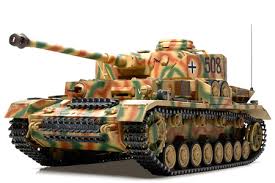
As Hitler’s chief of staff, General Alfred Jodl, informed Rommel: The Fuehrer was asleep–and was not to be awakened. By the time Hitler awoke and issued the order, it was too late.  

Nor could Hitler accept responsibility for the policies that were leading Germany to certain defeat.  

He blamed his generals, accused them of cowardice, and relieved many of the best ones from command.  

Among those sacked was Heinz Guderian, creator of the German panzer corps–and responsible for the blitzkreig victory against France in 1940.

Another was Erich von Manstein, designer of the strategy that defeated France in six weeks–which Germany had failed to do during four years of World War 1.

Finally, on April 29, 1945–with the Russians only blocks from his underground Berlin bunker–Hitler dictated his “Last Political Testament.”  

Once again, he refused to accept responsibility for unleashing a war that would ultimately consume 50 million lives: 

“It is untrue that I or anyone else in Germany wanted war in 1939.  It was desired and instigated exclusively by those international statesmen who either were of Jewish origin or worked for Jewish interests.” 

Hitler had launched the invasion of Poland–and World War II–with a lie: That Poland had attacked Germany. Fittingly, he closed the war–and his life–with a final lie.   

Joachim C. Fest, author of Hitler (1973), writes of the surprise that awaited Allied soldiers occupying Nazi Germany in 1945:  

“Almost without exception, virtually from one moment to the next, Nazism vanished after the death of Hitler and the surrender.  

“It was as if National Socialism had been nothing but the motion, the state of intoxication and the catastrophe it had caused….

“Once again it became plain that National Socialism, like Fascism in general, was dependent to the core on superior force, arrogance, triumph, and by its nature had no resources in the moment of defeat.”

The ancient Greeks believed “A man’s character is his destiny.”  For Adolf Hitler–and the nations he ravaged–that proved fatally true.  

It’s to be seen whether the same will prove true for Donald Trump–and the United States.

LEADERS AND THOSE WHO GET LED

In Bureaucracy, History, Politics, Social commentary, Uncategorized on December 22, 2015 at 12:06 am

Vladimir Putin admires Donald Trump. And Donald Trump admires Vladimir Putin.

To many people, it’s the ultimate odd-couple: The lifelong Communist and former KGB officer (Putin) walking arm-in-arm with the billionaire, publicity-hungry capitalist.

What could be going on here?

First Putin:

“He is a bright personality, a talented person, no doubt about it.  It is not up to us to appraise his positive sides, it is up to the U.S. voters. but, as we can see, he is an absolute leader in the presidential race.

“He is saying that he wants to move to a different level of relations with Russia, to a closer, deeper one. How can we not welcome that?  Of course, we welcome that.”

Now Trump:

“It is always a great honor to be so nicely complimented by a man so highly respected within his own country and beyond.”

Related image

Donald Trump

Appearing on MSNBC’s “Morning Joe,” Trump said: “Sure, when people call you ‘brilliant,’ it’s always good.  Especially when the person heads up Russia.”

The host, Joe Scarborough, was upset by Trump’s praise for Putin: “Well, I mean, [he’s] also a person who kills journalists, political opponents, and invades countries. obviously that would be a concern, would it not?”

TRUMP: He’s running his country, and at least he’s a leader.  Unlike what we have in this country.

SCARBOROUGH:  But again: He kills journalists that don’t agree with him.

TRUMP:  I think our country does plenty of killing, also, Joe, so, you know.  There’s a lot of stupidity going on in the world right now, Joe. A lot of killing going on. A lot of stupidity. And that’s the way it is.

SCARBOROUGH: I’m confused.  So I mean, you obviously condemn Vladimir Putin killing journalists and political opponents, right?

TRUMP: “Oh sure, absolutely.

When Trump praised Putin as a leader–“unlike what we have in this country”–he no doubt meant President Barack Obama.

Ironically, it is Obama–not Trump–who has repeatedly been named in Gallup polls as the most admired man in America in each of the last seven years, beginning with 2008, the year he was elected president.

Although Trump didn’t mention former President George W. Bush, his insult applies–unintentionally but accurately–to Obama’s predecessor.

In June 2001, Bush and Vladimir Putin met in Slovenia. During the meeting a truly startling exchange occurred.

Vladimir Putin and George W. Bush

Putin, a former KGB Intelligence officer, had clearly done his homework on Bush.  When he mentioned that one of the sports Bush had played was rugby, Bush was highly impressed.

“I did play rugby,” said Bush.  “Very good briefing.”

Bush knew that Putin had worked for Soviet intelligence.  So he should not have been surprised that the KGB had amassed a lengthy dossier on him.

But more was to come.

BUSH:  Let me say something about what caught my attention, Mr. President, was that your mother gave you a cross which you had blessed in Israel, the Holy Land.

PUTIN:  It’s true.

BUSH:  That amazes me, that here you were a Communist, KGB operative, and yet you were willing to wear a cross.  That speaks volumes to me, Mr. President.  May I call you Vladimir?

Putin instantly sensed that Bush judged others–even world leaders–through the lens of his own fundamentalist Christian theology.

Falling back on his KGB training, Putin seized on this apparent point of commonality to build a bond.  He told Bush that his dacha had once burned to the ground, and the only item that had been saved was that cross.

“Well, that’s the story of the cross as far as I’m concerned,” said Bush, clearly impressed.  “Things are meant to be.”

Afterward, Bush and Putin gave an outdoor news conference.

“Is this a man that Americans can trust?” Associated Press correspondent Ron Fournier asked Bush.

“Yes,” said Bush. “I looked the man in the eye. I found him to be very straightforward and trustworthy. We had a very good dialogue.

“I was able to get a sense of his soul, a man deeply committed to his country and the best interests of his country.  I wouldn’t have invited him to my ranch if I didn’t trust him.”

Of course, no one from the Right–including Trump–is now recalling such embarrasing words.

It’s far more politically profitable to pretend that all of America’s tensions with Russia began with the election of Barack Obama.

And that those tensions will vanish once another Rightist–and non-black–President enters the White House.

DICTATORS AND THEIR ADMIRERS

In Bureaucracy, Business, History, Military, Politics, Social commentary on December 21, 2015 at 12:21 am

Donald Trump and Vladimir Putin have been getting a lot of publicity lately–for how much they admire each other.

On the surface, this might seem surprising.  Putin spent most of his adult life as a fervent member of the Communist Party, which swore eternal warfare against capitalism.

After joining the KGB in 1975, he served as one of its officers for 16 years, eventually rising to the level of Lieutenant Colonel. In 1991, he retired to enter politics in his native St. Petersburg (formerly Leningrad).

Vladimir Putin

This, in turn, brought him to the attention of Russian President Boris Yeltsin, who groomed Putin as his successor.  When Yeltsin unexpectedly resigned on December 31, 1999, Putin became Acting President.

In 2000, he was elected President in his own right, despite widespread accusations of vote-rigging.  He won re-election in 2004, but could not run for a third term in 2008 because of constitutionally-mandated term limits.

So Putin ran his handpicked successor, Dimitry Medvedev, as president.  When Medvedev won, he appointed Putin as prime minister.  In 2012, Putin again ran for president and won.

Trump, on the other hand, is the personification of capitalistic excess.  He has been an author, investor, real estate mogul and television personality as former host of NBC’s “The Apprentice.”

The Trump Organization sponsors the Miss Universe, Miss USA and Miss Teen USA pageants.

Related image

Donald Trump

He is notorious for stamping “Trump” on everything he acquires, most notably Trump Tower, a 58-story skyscraper at 725 Fifth Avenue in New York City.

On June 16, he declared himself a candidate for the Presidency in the 2016 election. Since July, he has consistently been the front-runner in public opinion polls for the Republican Party nomination.

So it came as a surprise to many in the United States when, on December 17, Putin described Trump as “a bright and talented person without any doubt,” adding that Trump is “an outstanding and talented personality.”

And he called Trump “the absolute leader of the presidential race.”

Trump, in turn, was quick to respond: “It is always a great honor to be so nicely complimented by a man so highly respected within his own country and beyond.”

Two months earlier, in October, Trump had said of Putin: “I think that I would probably get along with him very well.”

Appearing on MSNBC’s “Morning Joe,” Trump said: “Sure, when people call you ‘brilliant’ it’s always good. Especially when the person heads up Russia.”

The host, Joe Scarborough, was upset by Trump’s praise for Putin: “Well, I mean, it’s also a person who kills journalists, political opponents, and invades countries. Obviously that would be a concern, would it not?”

Trump: “He’s running his country, and at least he’s a leader. Unlike what we have in this country.”

Scarborough: “But again: He kills journalists that don’t agree with him.”

Trump: “Well, I think our country does plenty of killing also, Joe. You know. there’s a lot of stuff going on in the world right now, Joe. A lot of killing going on and a lot of stupidity…”

Absolute dictators like Vladimir Putin and would-be dictators like Donald Trump often gravitate toward each other.  At least temporarily.

On January 30, 1933, anti-Communist Adolf Hitler became Chancellor of Germany.  For the next six years, the Nazi press hurled insults at the Soviet Union.

Adolf Hitler

And the Soviet press hurled insults at Nazi Germany.

Then, on August 23, 1939, Hitler’s foreign minister, Joachim von Ribbentrop, signed the Treaty of Non-aggression between Nazi Germany and the Union of Soviet Socialist Republics (U.S.S.R). Signing for the Soviet Union was its own foreign minister, Vyachelsav Molotov.

The reason: Hitler planned to invade Poland on September 1. He needed to neutralize the military might of the U.S.S.R.  And only Soviet dictator Joseph Stalin could do that.

Democratic nations like France, Great Britain and the United States were stunned.  But there had long been a grudging respect between the two brutal dictators.

On June 30, 1934, Hitler had ordered a bloody purge throughout Germany.  Privately, Stalin offered praise: “Hitler, what a great man! This is the way to deal with your political opponents.”

Joseph Stalin

Hitler was–privately–equally admiring of the series of purges Stalin inflicted on the Soviet Union.  Even after he broke the non-aggression pact by invading the U.S.S.R. on June 22, 1941, he said:

“After the victory over Russia, it would be a good idea to get Stalin to run the country, with German oversight, of course.  He knows better than anyone how to handle the Russians.”

In April, 1945, as he waited for victorious Russian armies to reach his underground bunker, Hitler confided to Joseph Goebbels, his propaganda minister, his major regret:

He should have brutally purged the officer corps of the Wehrmacht, as Stalin had that of the Red Army. Stalin’s purges had cleaned “deadwood” from the Russian ranks, and a purge of the German army would have done the same.

For Adolf Hitler, the lesson was clear: “Afterward, you rue the fact that you’ve been so kind.”

It’s the sort of sentiment that both Vladimir Putin and Donald Trump can appreciate.

REWRITING HISTORY: BUSH AND STALIN

In Bureaucracy, History, Politics, Social commentary on August 18, 2015 at 12:54 am

At one time, Americans believed that wholesale rewriting of history could happen only in the Soviet Union.

“The problem with writing about history in the Soviet Union,” went the joke, “is that you never know what’s going to happen yesterday.”

A classic example of this occurred within the Great Soviet Encyclopedia.

Lavrenti Beria had been head of the NKVD, the dreaded secret police, from 1938 to 1953. In 1953, following the death of Soviet dictator Joseph Stalin, Beria was arrested and executed on orders of his fellow Communist Party leaders.

Lavrenti Beria

But the Great Soviet Encyclopedia had just gone to press with a long article singing Beria’s praises.

What to do?

The editors of the Encyclopedia wrote an equally long article about “the Berring Straits,” which was to be pasted over the article about Beria, and sent this off to its subscribers.  An unknown number of them decided it was safer to paste accordingly.

In the 1981 film, “Excalibur,” Merlin warns the newly-minted knights of the Round Table: “For it is the doom of men that they forget.”

Forgetting our past is dangerous, but so is “understanding” it incorrectly.

In Texas, state-mandated “history” textbooks omit selected events and persons from the historical record–such as Thomas Jefferson and Martin Luther King.

This can be as lethal to the truth as outright lying.

Joseph Stalin, for example, ordered that school textbooks omit all references to the major role played by Leon Trotsky, his arch-rival for power, during the Russian Revolution.

Similarly, in Texas students are required to study Confederate President Jefferson Davis’ inaugural address alongside President Lincoln’s Gettysburg Address.

Such “teaching” should be seen for what it is: A thinly-veiled attempt to legitimize the most massive case of treason in United States history.

(The Civil War started on April 12, 1861, when Confederate artillery opened fire on Fort Sumter, a United States fort in Charleston Harbor. Fort Sumter surrendered 34 hours later.

(At least 800,000 Southerners took up arms against the legally elected government of the United States.)

The late broadcast journalist, Edward R. Murrow, would have referred to this practice as “giving Jesus and Judas equal time.”

Recently, Jeb Bush has entered the “Rewriting History for Americans” contest.

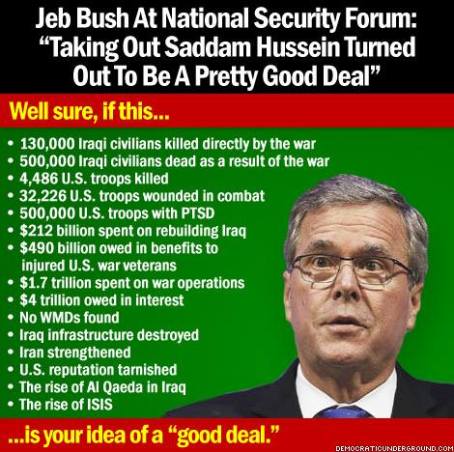
On August 13, speaking at a national security forum in Davenport, Iowa, he defended the unprovoked 2003 invasion of Iraq by his brother, President George W. Bush:

“I’ll tell you though, that taking out Saddam Hussein turned out to be a pretty good deal.”

And he went on to defend the 2007 troop “surge”, calling it “a great success that made Iraq safer.

“I’ve been critical and I think people have every right to be critical of decisions that were made.  In 2009, Iraq was fragile but secure. It was–its mission was accomplished in a way that there was security there.”

(Ironically, the phrase, “its mission was accomplished” proved an embarrassing reminder for the Bush family.

(A banner titled “Mission Accomplished” was displayed on the aircraft carrier USS Abraham Lincoln as George W. Bush announced–wrongly–that the war was over on May 1, 2003.)

Jeb Bush claimed that President Barack Obama had prematurely withdrawn troops from Iraq during his first term, thus allowing ISIS to “fill the void.”

One dissenter to Jeb Bush’s effort to rewrite his brother’s history is David Corn, Washington bureau chief for Mother Jones magazine.

Addressing Bush’s claims on the August 15 edition of The PBS Newshour, he said:

“I mean, I have to laugh a little bit, because I think he was setting a record for chutzpah.

“…It wasn’t until after his brother’s invasion of Iraq that you had something called al-Qaida in Iraq. And that was the group that morphed into ISIS.

“So ISIS is a direct result of the war in Iraq right there. And so he’s wrong on the history.

“But then he said what happened was that Obama and Hillary Clinton orchestrated this quick withdrawal after everything was secure.  Nothing was really secure in 2009-2010.

“…But it was George W. Bush in December 2008 who created the agreement with [Iraqi] Prime Minister [Nouri] [al-]Maliki that said that U.S. troops had to be out by 2011.

“And then Obama didn’t renegotiate that. And there is a lot of question as to whether he could even have, given the political situation in Baghdad itself.

“So Bush is totally–Jeb Bush is totally rewriting this.”

Click here: Brooks and Corn on Cuba as campaign issue

This is no small matter.  George W. Bush’s needless and unprovoked war on Iraq:

  • Cost the lives of 4,486 American soldiers.
  • Wounded another 32,226 troops.
  • Resulted in the deaths of an estimated 655,000 Iraqis.
  • Cost the American treasury at least $2 trillion.
  • Turned up no Weapons of Mass Destruction–Bush’s pretext for going to war.
  • Led to the rise of Al-Qaeda–and later ISIS–in Iraq.
  • Strengthened theocratic Iran by removing its major secularist opponent.

All of which simply proves, once again, that the past is never truly dead. It simply waits to be re-interpreted by each new generation–with some interpretations winding up closer to the truth than others.

Or, in this case, each new Presidential candidate of the Bush family.

REPUBLICANS AND “CHI-COMS” HATE THE SAME MAN: OBAMA

In Bureaucracy, History, Military, Politics, Social commentary on June 11, 2015 at 12:02 am

Psssst!  The Republicans and Chinese Communists (“Chi-Coms”) have something in common.

They both much preferred the foreign policy of George W. Bush to that of Barack Obama.

It’s one of the many fascinating revelations offered in Confront and Conceal: Obama’s Secret Wars and Surprising Uses of American Power.

Confront and Conceal: Obama's Secret Wars and Surprising Use of American Power

The author is David E. Sanger, the chief Washington correspondent for The New York Times.

Early in 2011, Sanger had lunch at the Central Party School outside Beijing.  This is where the party’s leadership debates questions that are thought too controversial to air in public.

A retired general in the People’s Liberation Army sat down next to Sanger and, in a relaxed moment of candor, said:

“I sat through many meetings of the People’s Liberation Army in the 80s and 90s where we tried to imagine what your military forces would look like in 10 to 20 years.

“But frankly, we never thought that you would spend trillions of dollars and so much time tied down in Afghanistan and the Middle East. We never imagined that as a choice you would make.”

Chinese military parade 

And, writes Sanger: “Not so secretly, the Chinese were delighted by the Bush-era wars.  The longer the United States was bogged down trying to build democracies in foreign lands, the less capable it was of competing in China’s backyard.

“But now that America was emerging from a lost decade in the Middle East, the Chinese began to ask: How should China respond?  With cooperation, confrontation, or something in-between?”

And the Chinese were equally thrilled that the United States had squandered so much of its treasury during the eight-year Bush Presidency.

In the decade following 9/11, the Pentagon went on an unprecedented spending binge.  The defense budget grew by 67%, to levels 50% higher than it had been per average year during the Cold War.

According to Sanger: “An estimate [the New York Times] put together for the tenth anniversary of the [9/11] attacks suggested that the United States had spent at least $3.3 trillion.”

These monies had gone on

  • securing the country;
  • invading and trying to rebuild Afghanistan and Iraq; and
  • caring for wounded American soldiers.

“Put another way,” writes Sanger, “for every dollar al-Qaeda spent destroying the World Trade Center and attacking the Pentagon, America had spent $6.6 million in response.

“The annual Pentagon budget of $700 billion was equivalent to the combined spending of the next twenty largest military powers….

“The world had come to expect that America would underwrite global security, regardless of the cost.  Obama was determined to change that mind-set.”

In short, America became financially and militarily vulnerable during the Presidency of George W. Bush.

And this flatly contradicts the standard Republican line: Obama is a weak President–and is betraying us to the (pick one or both) Muslims/Communists.

It also speaks volumes that the two most important members of the George W. Bush administration declined to attend the 2012 Republican National Convention.

That, of course, meant former President Bush and Vice President Dick Cheney.

George W. Bush and Dick Cheney

And why was that?  Perhaps it’s because polls show that a majority of Americans continue

  • To blame Bush for lying the country into a needless, bloody and expensive war with Iraq.
  • To blame him for presiding over the 2008 Wall Street meltdown.
  • To see Dick Cheney as the Dr. Strangelovian manipulator of George W. Bush.

Even former President George H.W. Bush said he wouldn’t attend the convention.

It’s possible that Bush, Sr., didn’t want to serve as a reminder that his son left the White House with the lowest popularity rating of any modern President.

And that was just fine with those planning to attend the convention–especially its nominee-to-be, Mitt Romney.

They wanted to do with George W. Bush what Nikita Khrushchev and his fellow Communists did with the embarrassing Joseph Stalin: Bury him far from public view.

He didn’t want the viewing audience to be reminded that the United States sharply declined in wealth and prestige during the eight-year reign of George W. Bush and a Republican Congress.

Romney and his fellow conventioneers also didn’t want to remind the country of something else: That Obama has spent most of his own Presidency trying to undo the harm his predecessor did, in both foreign and domestic policy.

Thus, now approaching the 2016 election, the Republican party finds itself torn.

On one hand, its leaders want to claim that Barack Obama is the worst President in the history of the Republic.

On the other hand, they know that most Americans continue to view the last Republican President in just that way.

PC COMES TO “GENOCIDE”: PART TWO (END)

In Bureaucracy, History, Law Enforcement, Politics, Social commentary on April 28, 2015 at 12:04 am

Everybody, it seems, hates genocide.  But not everybody owns up to it.

FBI Director James Comey recently found this out firsthand.

On April 16, he published an Opinion piece in the Washington Post: “Why I Require FBI Agents to Visit the Holocaust Museum.”

It was the following paragraphs that touched off an international uproar:

“In their minds, the murderers and accomplices of Germany, and Poland, and Hungary, and so many, many other places didn’t do something evil.

“They convinced themselves it was the right thing to do, the thing they had to do. That’s what people do. And that should truly frighten us.”

On April 19–three days after the editorial appeared–Poland’s Foreign Ministry urgently summoned Stephen Mull, the U.S. Ambassador to Warsaw, to “protest and demand an apology.”

The reason: The FBI director had dared to say that Poles were accomplices in the Holocaust!

Poland’s ambassador to the United States said in a statement the remarks were “unacceptable.”

And he added that he had sent a letter to Comey “protesting the falsification of history, especially…accusing Poles of perpetuating crimes which not only they did not commit, but which they themselves were victims of.”

But at least one Polish citizen was not offended by Comey’s editorial.

Jan Grabowski  50, is a graduate of Warsaw University and is currently a history professor at University of Ottawa.  He is also the son of a Holocaust survivor.

Jan Grabowski

He has suffered death threats, is boycotted in the Canadian Polish community where he lives today, and is not always welcome even in his homeland.

But he will not be intimidated from speaking and writing the truth about those in Poland who enthusiastically collaborated with Nazis to slaughter Jews during World War II.

Over the years, he has published several books on this subject.  And his latest one is certain to outrage many of his countrymen.

His new book, Hunt for the Jews: Betrayal and Murder in German-Occupied Poland, was published in October, 2014.

“I tried to understand how only very few of those Jews who decided to hide were able to stay alive until 1945,” said Grabowski in an interview with The Times of Israel.

“The purpose of my research was to discover the condition of the Jews who managed to avoid being sent to death camps and chose to live in hiding. My research brought me to the level of individual cases of people who chose to hide.

It took Grabowski more than three years to research and write his book.  He interviewed Holocaust survivors and local residents, primarily in Poland, Israel and Germany.

“It is more complicated than just blaming the Poles for betraying their Jewish neighbors,” Grabowski.

“On the one hand there were extraordinarily brave Poles who risked their lives to save Jews, and on the other hand there was no great love between Poles and Jews before World War II.

“During the war these relationships became even more hostile. A large segment of the Polish population was displeased with their neighbors’ help to the Jews during the war, and for many it seemed even as an unpatriotic step.

“Therefore, some segments of the Polish population took an active part in the hunt for the Jews, and that is what the new book deals with.”

Click here: Hunt for the Jews: Betrayal and Murder in German-Occupied Poland: Jan Grabowski: 9780253010742: Amazon.com: Books

Ironically, even as many Poles aided the Germans in shipping Jews to extermination camps, the Nazis were turning Poland into a graveyard for non-Jewish Poles.

According to the Jewish Virtual Library:

“Of the 11 million people killed during the Holocaust, six million were Polish citizens. Three million were Polish Jews and another three million were Polish Christians.”

Many Poles still refuse to face up to the ugly truth about the collaboration of so many of their countrymen with the perpetrators of the Holocaust.

It’s a role often played by nations that don’t want to acknowledge their past criminality.

During the Nuremberg war crimes trials, Russian judges representing the Soviet Union successfully lobbied to conceal a vital historical truth.

While they readily charged Nazi Germany with aggressively invading Poland on September 1, 1939, they balked at admitting the role the Soviet Union had played in this.

In late August, 1939, Soviet dictator Joseph Stalin had negotiated a “non-aggression pact” with Adolf Hitler.

But a secret protocol of that agreement dictated that Germany could conquer only the western half of Poland. The eastern half of that country would be occupied by the Red Army.

Similarly, the Katyn massacre remained–until recently–one of the great mysteries of World War II.

The Nazis announced the discovery of mass graves in the Katyn Forest of Poland in 1943.  The number of victims is estimated at about 22,000.

Of these, about 8,000 were officers taken prisoner after the Soviet invasion.  Another 6,000 were police officers, and the rest were members of the intelligentsia.

NKVD secret police

The USSR blamed the Nazis, and denied responsibility for the massacres until 1990.

The executioners belonged to the NKVD, the Soviet secret police (later renamed the KGB).

Its chief, Lavrenty Beria, urged the execution of all captive members of the Polish Officer Corps.  And Stalin had approved.

As long as politicians’ fragile egos are at stake, genocide will continue to be a matter of state policy–and a disowned one.

PC COMES TO “GENOCIDE”: PART ONE (OF TWO)

In Bureaucracy, History, Law Enforcement, Politics, Social commentary on April 27, 2015 at 6:57 am

“Genocide” is defined by the Merriman-Webster Dictionary as “the deliberate killing of people who belong to a particular racial, political, or cultural group.”

And the Oxford Advanced Learner’s Dictionary defines it as “the deliberate killing of a large group of people, especially those of a particular ethnic group or nation.”

While dictionaries have no trouble agreeing on what “genocide” means, nations do.

Consider these two examples:

Example 1:  Turkey

One hundred years ago, in what’s been called the first genocide of modern times, up to 1.5 million Armenians died at Turkish hands in massacres and deportations.

But don’t tell that to the Turks.

Turkey has long insisted that the wartime killings were not genocide.

According to the Turks, those killed–mostly Christian Armenians and Muslim Turks–were victims of civil war and unrest as the Ottoman Empire collapsed during World War I.

“The Armenian claims on the 1915 events, and especially the numbers put forward, are all baseless and groundless,” President Recep Tayyip Erdogan said. “Our ancestors did not persecute.”

Naturally, Armenians see it differently, viewing Turkey’s denial as an affront to their national identity.

“There is a question of political recognition of the genocide, but ultimately, it’s about the Armenian story and history being incorporated into the collective memory of the countries where we live,” said Nicolas Tavitian, director of the Armenian General Benevolent Union.

Armenians protesting Turkish genocide

The United States has long recognized the genocide of the Holocaust–and even opened a U.S. Holocaust Museum in Washington, D.C.  But its position on the Armenian slaughter remains one of–silence.

As a U.S. senator, Barack Obama pledged to use the term “genocide” to describe the mass killings of Armenians. As president, he’s avoided the word.

Why?

Because Turkey remains a member of NATO–and one of America’s few reliable allies in the Islamic world.

Both the Pentagon and State Department have argued that Turkey plays a vital role in fighting the Islamic State group in Syria and Iraq.  And the safety of American diplomats and troops in Turkey would be compromised.

Example 2:  Poland

On April 16, the Washington Post published an Opinion piece by James Comey, director of the FBI, entitled: “Why I Require FBI agents to Visit the Holocaust Museum.”

FBI Director James Comey

Click here: Why I require FBI agents to visit the Holocaust Museum – The Washington Post

Comey wants them to see the horrors that result when those who are entrusted with using the law to protect instead turn it into an instrument of evil.

U.S. Holocaust Memorial Museum

And he wants agents to “see humanity and what we are capable of.”

“Good people helped murder millions.

“And that’s the most frightening lesson of all–that our very humanity made us capable of, even susceptible to, surrendering our individual moral authority to the group, where it can be hijacked by evil.

“Of being so cowed by those in power. Of convincing ourselves of nearly anything.

“In their minds, the murderers and accomplices of Germany, and Poland, and Hungary, and so many, many other places didn’t do something evil.

“They convinced themselves it was the right thing to do, the thing they had to do. That’s what people do. And that should truly frighten us.”

It was these paragraphs that landed Comey in diplomatic hot water.

On April 19–three days after the editorial appeared–Poland’s Foreign Ministry urgently summoned Stephen Mull, the U.S. Ambassador to Warsaw, to “protest and demand an apology.”

The reason: The FBI director had dared to say that Poles were accomplices in the Holocaust!

Poland’s ambassador to the United States said in a statement the remarks were “unacceptable.”

And he added that he had sent a letter to Comey “protesting the falsification of history, especially … accusing Poles of perpetuating crimes which not only they did not commit, but which they themselves were victims of.”

Shortly after Poland’s announcement, Stephen Mull, the U.S. Ambassador in Warsaw,  told reporters he would contact the FBI about the situation.

“Suggestions that Poland, or any other country apart from the Nazi Germany was responsible for the Holocaust are wrong, harmful and offensive,” he said, speaking in Polish.

And he emphasized that Comey’s remarks didn’t reflect the views of the Obama administration.

In fact, Comey’s remarks were dead-on accurate.  And Mull’s were a craven act of Political Correctness.

But at least one Polish citizen was not offended by Comey’s editorial.

Jan Grabowski  50, is a graduate of Warsaw University and is currently a history professor at University of Ottawa.  He is also the son of a Holocaust survivor.

He has suffered death threats, is boycotted in the Canadian Polish community where he lives today, and is not always welcome even in his homeland.

But he will not be intimidated from speaking and writing the truth about those in Poland who enthusiastically collaborated with Nazis to slaughter Jews during World War II.

IS THERE A HITLER IN YOUR CEO?

In Bureaucracy, Business, History, Military, Politics, Social commentary on March 27, 2015 at 4:19 pm

Would-be CEOs and Fuehrers, listen up: Character is destiny.

Case in point: The ultimate Fuehrer and CEO, Adolf Hitler.

Ever since he shot himself in his underground Berlin bunker on April 30, 1945, historians have fiercely debated: Was der Fuehrer a military genius or an imbecile?

With literally thousands of titles to choose, the average reader may feel overwhelmed.  But if you’re looking for an understandable, overall view of Hitler’s generalship, an excellent choice would be How Hitler Could Have Won World War II by Bevin Alexander.

Among “the fatal errors that led to Nazi defeat” (as proclaimed on the book jacket) were:

  • Wasting hundreds of Luftwaffe pilots, fighters and bombers in a half-hearted attempt to conquer England.
  • Ignoring the pleas of generals like Erwin Rommel to conquer Syria, Iraq and Saudi Arabia–thus giving Germany control of most of the world’s oil.
  • Attacking his ally, the Soviet Union, while still at war with Great Britain.
  • Needlessly turning millions of Russians into enemies rather than allies by his brutal and murderous policies.
  • Declaring war on the United States after the Japanese attacked Pearl Harbor.  (Had he not done so, Americans would have focused all their attention on conquering Japan.)
  • Refusing to negotiate a separate peace with Soviet dictator Joseph Stalin–thus granting Germany a large portion of captured Russian territory in exchange for letting Stalin remain in power.
  • Insisting on a “not one step back” military “strategy” that led to the unnecessary surrounding, capture and/or deaths of hundreds of thousands of German servicemen.

As the war turned increasingly against him, Hitler became ever more rigid in his thinking.

He demanded absolute control over the smallest details of his forces.  This, in turn, led to astounding and needless losses in German soldiers.

One such incident was immortalized in the 1962 movie, The Longest Day, about the Allied invasion of France known as D-Day.

On June 6, 1944, Rommel ordered the panzer tanks to drive the Allies from the Normandy beaches.  But these could not be released except on direct order of theFuehrer.  As Hitler’s chief of staff, General Alfred Jodl, informed Rommel: The Fuehrer was asleep–and, no, he, Jodl, would not wake him. By the time Hitler awoke and issued the order, it was too late.

Nor could he accept responsibility for the policies that were clearly leading Germany to certain defeat.  Hitler blamed his generals, accused them of cowardice, and relieved many of the best ones from command.

Among those sacked was Heinz Guderian, creator of the German panzer corps–and thus responsible for its highly effective “blitzkrieg” campaign against France in 1940.

Heinz Guderian

Another was Erich von Manstein, designer of the strategy that defeated France in six weeks–something Germany couldn’t do during the four years of World War 1.

Erich von Manstein

Finally, on April 29, 1945–with the Russians only blocks from his underground bunker in Berlin–Hitler dictated his “Last Political Testament.”

Once again, he refused to accept responsibility for unleashing a war that would ultimately consume 50 million lives:

“It is untrue that I or anyone else in Germany wanted war in 1939.  It was desired and instigated exclusively by those international statesmen who either were of Jewish origin or worked for Jewish interests.”

Hitler had launched the war with a lie–that Poland had attacked Germany, rather than vice versa.  And he closed the war–and his life–with a final lie.

All of which brings us to Niccolo Machiavelli, the father of political science.

In his classic book, The Discourses, he wrote at length on the best ways to maintain liberty within a republic.

In Book Three, Chapter 31, Machiavelli declares: “Great Men and Powerful Republics Preserve an Equal Dignity and Courage in Prosperity and Adversity.”

It is a chapter that Adolf Hitler would have done well to read.

“…A truly great man is ever the same under all circumstances.  And if his fortune varies, exalting him at one moment and oppressing him at another, he himself never varies, but always preserves a firm courage, which is so closely interwoven with his character that everyone can readily see that the fickleness of fortune has no power over him.

“The conduct of weak men is very different.  Made vain and intoxicated by good fortune, they attribute their success to merits which they do not possess, and this makes them odious and insupportable to all around them. 

And when they have afterwards to meet a reverse of fortune, they quickly fall into the other extreme, and become abject and vile.  

“Thence it comes that princes of this character think more of flying in adversity than of defending themselves, like men who, having made a bad use of prosperity, are wholly unprepared for any defense against reverses.”

Stay alert to signs of such character flaws among your own business colleagues–and especially your superiors.  They are the warning signs of a future catastrophe.

BARBARISM ISN’T GOOD P.R.

In History, Military, Politics on February 17, 2015 at 6:30 pm

The Islamic State of Iraq and Syria (ISIS) has been in the news a great deal lately–and for reasons most organizations try to avoid.  Or at least cover up. It has been designated as a terrorist organization by

  • Russia
  • the United States
  • Canada
  • the European Union
  • Australia
  • Turkey
  • the United Nations
  • Indonesia
  • the United Kingdom
  • Saudi Arabia
  • the United Arab Emerites
  • Egypt
  • India and
  • Malaysia

It been condemned by such well-known human rights organizations as Amnesty International.  And a major reason for this is the evidence of its brutalities that ISIS has proudly supplied. Among this evidence are its own Internet videos of

  • the beheadings of soldiers, civilians, journalists, and aid workers;
  • the burning of a captured Jordanian fighter pilot;
  • demands for extortionate ransoms for kidnapped Japanese and American captives;
  • the wholesale shooting of captured Iraqi soldiers; and
  • the selling of captured children.

The release on February 3 of a video showing the barbaric “execution” of a captured Jordanian fighter pilot, Lt. Muath al-Kasaesbeh, underscored ISIS reputation for cruelty

Al Kasaesbeh, locked in a steel cage like an animal, could only watch stoically as an ISIS member ignited a trail of flammable liquid leading directly to him.  The pilot stood upright throughout the ordeal until the flames at last consumed him.

Image result for Images of burning to death of Jordanian pilot

ISIS burning of captured Jordanian fighter pilot Muath al-Kasaesbeh 

Terrorism experts believe that the elaborately-staged video was meant to weaken the morale of Jordan and other Sunni Arab members of the U.S.-led coalition against ISIS.

But it violated a fundamental rule of public relations: If you commit atrocities, do it secretly so you can deny it if the truth ever comes out.

That’s how the members of Soviet dictator Joseph Stalin’s dreaded secret police–the N.K.V.D.–the predecsssors to the later-named KGB–operated throughout their brutal history.

In 1939, when the Soviet Union seized the eastern half of Poland, the N.K.V.D. executed 22,000 Polish army officers in the dense Katyn forest.

N.K.V.D. executioner

The government of Nazi Germany announced the discovery of mass graves in the forest in 1943.  The Soviet Union furiously denied responsibility, claiming the victims had been executed by the Germans.

The Soviets continued to deny responsibility for the massacres until 1990, when the government finally admitted its guilt.

ISIS has turned out videos of its brutalities which film experts have declared are almost up to the quality of Hollywood spectaculars.  But ISIS leaders have apparently forgotten–if they ever knew–the truth of the saying: “You can make a throne of bayonets, but you can’t sit on it.”

Niccolo Machiavelli, in his classic work, The Discourses, offered a telling example of how magnanimity can triumph over brutality.

Camillus was besieging the city of the Faliscians, and had surrounded it….A teacher charged with the education of the children of some of the noblest families of that city [to ingratiate himself] with Camillus and the Romans, led these children…into the Roman camp.

And presenting them to Camillus [the teacher] said to him, “By means of these children as hostages, you will be able to compel the city to surrender.”

Camillus not only declined the offer but had the teacher stripped and his hands tied behind his back….[Then Camillus] had a rod put into the hands of each of the children…[and] directed them to whip [the teacher] all the way back to the city.

Upon learning this fact, the citizens of Faliscia were so much touched by the humanity and integrity of Camillus, that they surrendered the place to him without any further defense.

This example shows that an act of humanity and benevolence will at all times have more influence over the minds of men than violence and ferocity. It also proves that provinces and cities which no armies…could conquer, have yielded to an act of humanity, benevolence, chastity or generosity.

What Machiavelli doesn’t say–but what history offers plenty of examples to substantiate–is this: The brutality of aggressors will be met–and sometimes overcome–with brutality by their past or intended victims.

Nowhere was this better proved than during the German invasion of the Soviet Union.

Without warning, three million German soldiers–backed up by overwhelming air and tank support–attacked their “ally” on June 22, 1941.

The Wehrmacht blitzed its way across Russia–to the gates of Moscow and as far south as Stalingrad on the Volga River. In its path it left devastated cities and at least 20 million dead Russians.

German soldiers moving into a burning Russian village

Russian women were gang-raped, then shot, or blown up with hand grenades. Tens of thousands of captured Russian soldiers were allowed to die of hunger, sickness and freezing cold behind barbed wire.  Other captured POWs were brutally beaten, tortured and/or shot.

But then the tide of war turned and the Russians launched their own offensives in 1943.  And they kept going–all the way to Berlin.

Russians raped tens of thousands of German women–and nailed others to barn doors.  Cossacks cut off the raised hands of Germans trying to surrender.  Tanks crushed retreating German soldiers and civilians unlucky enough to be in their path.

Thus do those who practice barbarism often find themselves being repaid with it–usually ten-fold.