Republicans have a long and shameful history of excusing Donald Trump’s vicious slanders and law-breaking.
On June 9, they gave yet another example of their cravenness.
That was when President Trump charged that a 75-year-old man who was seriously injured by police officers in Buffalo, New York, was part of a radical leftist “set up.”
The victim, Martin Gugino, is described as a peace activist associated with the Catholic Worker Movement.
On June 4, during nationwide protests over the police murder of black security guard George Floyd, a curfew was imposed on Buffalo, New York. As police swept through Niagara Square, Gugino walked directly into their path as if attempting to speak with them.
Two officers pushed him and he fell backwards, hitting the back of his head on the pavement and losing consciousness. The line of officers walked past Gugino as he lay on the ground with blood pooling around his head. One officer tried to check on him, but another patrolman told him to move on, and he did.
Martin Gugino falls backward
Enter Trump, who had been severely criticized for sending police and National Guardsmen to remove peaceful protesters from Lafayette Square so he could stage a photo-op at nearby St. John’s Church.
On June 9 he tweeted: “Buffalo protester shoved by Police could be an ANTIFA provocateur. 75 year old Martin Gugino was pushed away after appearing to scan police communications in order to black out the equipment. @OANN I watched, he fell harder than was pushed. Was aiming scanner. Could be a set up?”
As usual, Trump offered no evidence to back up his slander. And, as usual, Republicans refused to condemn him for his latest outrage.
Among those competing for “Most Cowardly Sycophant of the Year”:
Senate Majority Leader Mitch McConnell (KY) refused to say whether Trump’s tweet was appropriate.
Texas Senator John Cornynclaimed he had missed it, adding: “A lot of this stuff just goes over my head.”
Georgia Senator Kelly Loefflerrefused to answer a question about the President’s tweet as she hopped on an elevator along with an aide in the Capitol.
Texas Senator Ted Cruz:“I don’t comment on the tweets.”
Florida Senator Marco Rubio:“I didn’t see it. You’re telling me about it. I don’t read Twitter. I only write on it.”
Alaska Senator Dan Sullivan said he hadn’t seen it, and then said: “I don’t want to comment right now. I’m on my way to a meeting. I’ll see it when I see it.”
North Dakota Senator Kevin Cramer:“I’ll say this: I worry more about the country itself than I do about what President Trump tweets.”
Wisconsin Senator Ron Johnsonsaid he hadn’t seen the tweet—and didn’t want it read to him: “I would rather not hear it.”
Tennessee Senator Lamar Alexander: “Voters can evaluate that. I’m not going to give a running commentary on the President’s tweets.”
Montana Senator Steve Daines refused to say whether Trump should have tweeted about the Buffalo incident.
So much for Republican profiles in courage.
On December 18, 2019, the House of Representatives approved two Articles of Impeachment against President Donald Trump for:
Article 1: Abuse of Power: For pressuring the president of Ukraine to assist his re-election campaign by smearing a potential rival for the White House.
Article 2: Obstruction of Congress: For obstructing Congress by blocking testimony of subpoenaed witnesses and refusing to provide documents in response to House subpoenas in the impeachment inquiry.
On July 25, 2019, Trump had “asked” Ukraine President Volodymir Zelensky to do him a “favor”: Find embarrassing “dirt” on former Vice President Joseph Biden and his son, Hunter.
Hunter had had business dealings in Ukraine. And Joseph Biden might be Trump’s Democratic opponent for the White House in 2020.
To underline the seriousness of his “request,” earlier in July Trump had told Mick Mulvaney, his White House chief of staff, to withhold $400 million in military aid Congress had approved for Ukraine, which is facing an increasingly aggressive Russia
But then a CIA whistleblower filed a complaint about the extortion attempt—and the media and Congress soon learned of it. And ever since, the evidence linking Trump to impeachable offenses had mushroomed.
On January 16, 2020, the Government Accountability Office (GAO) announced that the Trump administration broke the law when it withheld security aid to Ukraine.
Joseph Biden with Barack Obama
As Senate trial proceedings unfolded, the 53-majority Republican Senators:
Refused to hear from eyewitnesses who could prove that Trump had committed impeachable offenses,
Refused to provide evidence on Trump’s behalf—but attacked witnesses who had testified against him in the House.
Attacked Joseph Biden and his son, Hunter, as if they were on trial—instead of having been the targets of Trump’s smear-attempt.
On February 5, the Republican-dominated Senate—as expected—absolved President Donald Trump from trying to extort Ukraine into smearing a possible rival for the White House. Only one Republican—Utah Senator Mitt Romney—had the moral courage to vote for conviction.
But this was not the first time Republicans sought to excuse Trump’s litany of crimes. Those efforts go back to the 2016 Presidential election.
As both a Presidential candidate and President, Donald Trump has repeatedly used Twitter to attack hundreds of real and imagined enemies in politics, journalism, TV and films.
From June 15, 2015, when he launched his Presidential campaign, until October 24, 2016, Trump fired almost 4,000 angry, insulting tweets at 281 people and institutions that had somehow offended him.
Donald Trump
The New York Times needed two full pages of its print edition to showcase them.
Among his targets:
Former Secretary of State and Presidential candidate Hillary Clinton
President Barack Obama
Actress Meryl Streep
Singer Neil Young
Actor Arnold Schwarzenegger
Comedian John Oliver
News organizations
The State of New Jersey
Beauty pageant contestants
Others he clearly delighted in insulting during the campaign included:
Women
Blacks
Hispanics
Asians
Muslims
The disabled
Prisoners-of-war
As a Presidential candidate and President, he has shown outright hatred for President Barack Obama. For five years, he slandered Obama as a Kenyan-born alien who had no right to hold the Presidency.
Barack Obama
Only on the eve of the first Presidential debate with Hillary Clinton—in September, 2016—did he finally admit that Obama had been born in the United States after all.
Then, on March 4, 2017, in a series of unhinged tweets, Trump accused Obama of illegally tapping his Trump Tower phones prior to the election:
“Terrible! Just found out that Obama had my ‘wires tapped’ in Trump Tower just before the victory. Nothing found. This is McCarthyism!”
Thus, without offering a shred of evidence to back it up, Trump accused his predecessor of committing an impeachable offense.
Both the FBI and Justice Department vigorously refuted this slander.
Trump’s all-out effort to destroy the Affordable Care Act—nicknamed “Obamacare”—has been driven by his mania to erase every vestige of the Obama Presidency.
Even attending a Boy Scout jamboree became, for Trump, a way to attack the former President.
“By the way, just a question. Did President Obama ever come to a jamboree?” Trump asked the crowd of 40,000, encouraging them to boo Obama. And many of them did.
As President, he has bullied and insulted even his own handpicked Cabinet officers and White House officials.
His press secretary, Sean Spicer, quit on July 21, 2017. The reason: He believed—correctly—that his loyalty to Trump had become a one-way street. Trump kept him in the dark about events Spicer needed to know—such as an interview that Trump arranged with the New York Times—and which ended disastrously for Trump.
Trump waged a Twitter-laced feud against Jeff Sessions, his Attorney General. Sessions’ “crime”? Recusing himself from any decisions involving investigations into well-established ties between Russian Intelligence agents and members of Trump’s Presidential campaign. A day after Republicans lost the House of Representatives in November, 2018, Trump fired him.
Trump repeatedly humiliated his chief of staff, Reince Priebus—at one point ordering him to kill a fly that was buzzing about. On July 28, 2017, Priebus resigned.
**********
Americans have watched Trump’s behavior with morbid fascination, many of them asking: “What makes him do the things he does?”
It’s a question asked—and answered—in the 1993 Western, Tombstone. And the answer given in that movie may just hold the key to the question so many Americans are now asking about Trump.
Tombstone recounts the legendary blood feud between the Ike Clanton outlaw gang and the Earp brothers—Wyatt, Morgan and Virgil—in the famous gold-mining town in 1880s Arizona.
Wyatt Earp has been challenged to a gunfight by quick-trigger gunman Johnny Ringo. Although he impulsively accepted the challenge, Wyatt now realizes he’s certain to be killed. Then follows this exchange with his longtime friend, the pistol-packing dentist, John H. “Doc” Holliday:
WYATT EARP: What makes a man like Ringo, Doc? What makes him do the things he does?
JOHN H. “DOC” HOLLIDAY: A man like Ringo….got a great empty hole right through the middle of him. He can never kill enough or steal enough….or inflict enough pain to ever fill it.
EARP: What does he need?
HOLLIDAY: Revenge.
EARP: For what?
HOLLIDAY: Bein’ born.
Donald Trump was born into a world of wealth and privilege. His father gave him $200 million, which he channeled into a real estate empire. He has claimed to be worth a billion dollars.
He has been linked—often by his own boasts—to some of the most beautiful women in the world. He has been a major force on TV through his “reality show,” The Apprentice. He has literally stamped his name on hundreds of buildings.
And now he holds the Presidency of the United States, the most powerful office in the Western world.
Yet he remains filled with a poisonous hatred that encompasses almost everyone. Since taking office, he has offered nothing positive in his agenda.
Instead, he has focused his efforts on what he can take from others. At the top of his list: The Affordable Health Act, which provides access to medical care for millions who previously could not obtain it.
As first-mate Starbuck says of Captain Ahab in Herman Melville’s classic novel, Moby Dick: “He is a champion of darkness.”
Fifty-two years ago, the Reverend Martin Luther King was shot to death as he stood on a balcony in Memphis, Tennessee. He had come there to lead a march of striking garbage workers.
New York United States Senator—and now Presidential candidate—Robert Francis Kennedy had been scheduled to give a speech in Indianapolis, Indiana, before a black audience.
Just before he drove into the city to deliver his address, he learned of King’s assassination. There was a real danger that rioting would erupt. Police who had been assigned to protect him said they wouldn’t accompany him into the inner city.
Kennedy drove off anyway, leaving behind his police escort.
Standing on a podium mounted on a flatbed truck, Kennedy spoke for just four minutes and 57 seconds.
His waiting audience hadn’t yet learned of King’s death. Kennedy broke the news to gasps, and then gave an impromptu speech eulogizing the slain civil rights leader.
For the first time since the assassination of his brother, President John F. Kennedy, in 1963, he spoke publicly of that killing. He noted that JFK—like King—had also been killed by a white man.
And he called upon the crowd to “dedicate ourselves to what the Greeks wrote so many years ago: to tame the savageness of man and to make gentle the life of this world.”
Riots erupted in 60 cities following King’s death—but not in Indianapolis.
During the mid- and late 1960s, Robert Kennedy aroused passions of an altogether different sort from those aroused by Donald Trump.
Kennedy had been a United States Attorney General (1961-1964) and Senator from New York (1964-1968). But it was his connection to his beloved and assassinated brother, President John F. Kennedy, for which he was best known.
In October, 1962, during the Cuban Missile Crisis, his wise counsel helped steer America from the brink of nuclear war with the Soviet Union. As a U.S Senator he championed civil rights and greater Federal efforts to fight poverty.
Robert F. Kennedy campaigning for President
Millions saw RFK as the only candidate who could make life better for America’s impoverished—while standing firmly against those who threatened the Nation’s safety.
As television correspondent Charles Quinn observed: “I talked to a girl in Hawaii who was for [George] Wallace [the segregationist governor of Alabama]. And I said ‘Really?’ [She said] ‘Yeah, but my real candidate is dead.’
“You know what I think it was? All these whites, all these blue collar people who supported Kennedy…all of these people felt that Kennedy would really do what he thought best for the black people, but, at the same time, would not tolerate lawlessness and violence.
“They were willing to gamble…because they knew in their hearts that the country was not right. They were willing to gamble on this man who would try to keep things within reasonable order; and at the same time do some of the things they knew really should be done.”
Campaigning for the Presidency in 1968, RFK had just won the crucial California primary on June 4—when he was shot in the back of the head.
His killer: Sirhan Sirhan, a young Palestinian furious at Kennedy’s support for Israel.
Kennedy died at 1:44 a.m. on June 6. He was 42.
On June 8, 1,200 men and women boarded a specially-reserved passenger train at New York’s Pennsylvania Station. They were accompanying Kennedy’s body to its final resting place at Arlington National Cemetery.
As the train slowly moved along 225 miles of track, throngs of men, women and children lined the rails to pay their final respects to a man they considered a genuine hero.
Little Leaguers clutched baseball caps across their chests. Uniformed firemen and policemen saluted. Burly men in shirtsleeves held hardhats over their hearts. Black men in overalls waved small American flags. Women from all levels of society stood and cried.
A nation says goodbye to Robert Kennedy
Commenting on RFK’s legacy, historian William L. O’Neil wrote in Coming Apart: An Informal History of America in the 1960′s:
“…He aimed so high that he must be judged for what he meant to do, and, through error and tragic accident, failed at….He will also be remembered as an extraordinary human being who, though hated by some, was perhaps more deeply loved by his countrymen than any man of his time.
“That too must be entered into the final account, and it is no small thing. With his death something precious disappeared from public life.”
America has never again seen a Presidential candidate who combined toughness on crime and compassion for the poor.
Republican candidates have waged war on crime—and the poor. And Democratic candidates have moved to the Right in eliminating anti-poverty programs.
RFK had the courage to fight the Mafia—and the compassion to fight poverty. At a time when Americans long for candidates to give them positive reasons for voting, his kind of politics are sorely missed.
From October 10 to 12, 2019, attendees of the American Priority Conference at the Trump National Doral Miami resort got a treat that was supposed to be kept secret.
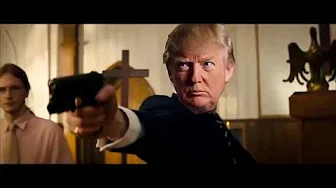
They got to watch a series of Right-wing videos featuring graphic acts of violence against those President Donald Trump hates. One of these, “The Trumpsman,” featured a digitized Trump shooting, stabbing and setting fire to such liberals as:
Former President Bill Clinton
Former Vice President Joe Biden
Former Democratic Presidential candidate Hillary Clinton
Democratic Speaker of the House Nancy Pelosi
Former President Barack Obama
Vermont United States Senator Bernie Sanders
Even Republicans who have dared to disagree with Trump—such as Utah Senator Mitt Romney and the late Arizona Senator John McCain—met a brutal end.
Legitimate news media—such as CBS, BBC, ABC, CNN, The New York Times and The Washington Post—were also depicted as among Trump’s victims.
The New York Times broke the news of the video’s showing. Since then, the American Priority Conference has rushed to disavow it—and the firestorm of outrage it set off.
So has the Trump White House.
And America’s major news media have demanded that Trump strongly condemn the video.
If Donald Trump had a history of truthfulness and humanity, his denouncing the video would prove highly believable. But he has neither.
He is a serial liar—TheWashington Post noted on August 12, 2019 that, since taking office on January 20, 2017, Trump had made more than 12,000 false or misleading claims.
As for his reputation as a humanitarian:
As a Presidential candidate, Trump repeatedly used Twitter to attack hundreds of real and imagined enemies in politics, journalism, TV and films.
From June 15, 2015, when he launched his Presidential campaign, until October 24, 2016, Trump fired almost 4,000 angry, insulting tweets at 281 people and institutions that had somehow offended him.
And he has continued to do so. Since taking office on January 20, 2017, Trump had insulted hundreds of people (including private citizens), places, and institutions on Twitter, ranging from politicians to journalists and news outlets to entire countries.
Donald Trump
Summing up Trump’s legacy of hatred, longtime Republican Presidential adviser David Gergen said:
“Trump unleashed the dogs of hatred in this country from the day he declared he was running for president, and they’ve been snarling and barking at each other ever since. It’s just inevitable there are going to be acts of violence that grow out of that.”
So any Trump statement claiming that he strongly condemns the video should rightly be discounted as mere propaganda.
The video was first uploaded on YouTube in 2018 by a account named TheGeekzTeam. The GeekzTeam is a frequent contributor to MemeWorld, a pro-Trump website. Its creator was prominent Twitter user Carpe Donktum.
MemeWorld, embarrassed that its Right-wing porn has become a national scandal, now claims:
“The Kingsman video is CLEARLY satirical and the violence depicted is metaphoric. No reasonable person would believe that this video was a call to action or an endorsement of violence towards the media. The only person that could potentially be ‘incited’ by this video is Donald Trump himself, as the main character of the video is him. THERE IS NO CALL TO ACTION.”
Of course, that was not how the Right reacted in 2017 when comedian Kathy Griffin posed for a photograph holding up what was meant to look like Trump’s bloody, severed head.
A furious Right-wing backlash cost her gigs as a comedian and made her the target of a Secret Service investigation into whether she was a credible threat. She even had to buy metal detectors to post at her appearances at comedy clubs: “There were all kinds of incidents. A guy came at me with a knife in Houston.”
Cindy McCain, widow of Senator John McCain, wasn’t buying the Right’s disavowals, tweeting: “Reports describing a violent video played at a Trump Campaign event in which images of reporters & @John McCain are being slain by Pres Trump violate every norm our society expects from its leaders & the institutions that bare their names. I stand w/ @whca in registering my outrage”.
Nor was Democratic Presidential candidate Beto O’Rourke: “This video isn’t funny. It will get people killed.”
* * * * *
The video was produced by Rightists who believed it reflected what Donald Trump would do to his enemies if only he could get away with it. And given his near-constant calls for violence against his critics, they were absolutely correct.
But the video’s critics are wrong to call for its suppression.
On the contrary—it should be seen for what it is: The Mein Kampf of Donald Trump and his fanatical followers, in and outside the Republican party.
Like Adolf Hitler’s autobiography, it depicts the future America can expect if the Right gains the power to live out its murderous fantasies.
And the fantasy Right-wingers prize most: The brutal extermination of everyone who refuses to submit to their Fascistic tyranny.
The hour is late and the clock is ticking as the Right conspires to give Trump this power as “President-for-Life.”
It now remains to be seen if enough Americans are willing to stand fast against the brutal intentions of these specialists in evil.
And the most glorious episodes do not always furnish us with the clearest discoveries of virtue or vice in men.Sometimes a matter of less moment, an expression or a jest, informs us better of their characters and inclinations than the most famous sieges, the greatest armaments, or the bloodiest battles.”
—Plutarch, Alexander the Great
It’s in “The Church of Fake News” that President Donald Trump finally revenges himself upon his many enemies.
He walks down an aisle, reaches into his suit jacket pocket, pulls out a .45 automatic—which seems to have an endless magazine—and opens fire on:
Democratic Representative Adam Schiff, chairman of the House Intelligence Committee
Former President Bill Clinton
Democratic Representative Maxine Waters
Utah United States Senator Mitt Romney
Black Lives Matter
Former Vice President Joe Biden
Liberal activist George Soros
Former Democratic Presidential Nominee Hillary Clinton
Democratic Speaker of the House Nancy Pelosi and
Former President Barack Obama.
Nor does he spare his longtime “enemies” in the legitimate news media, such as:
CNN
The Washington Post
BBC
ABC
MSNBC Anchor Rachel Maddow
The New York Times
PBS
NBC
and Politico
Trump has, after all, slandered journalists as “the enemy of the American people.” And he has called news stories documenting his crimes and follies “fake news.”
Nor in the video is he limited to using a firearm.
He lights the head of Vermont United States Senator Bernie Sanders on fire.
He stabs to death the late Arizona Senator John McCain.
He stabs TV personality Rosie O’Connell in the face.
The clip ends with Trump driving a stake into the head of someone whose face bears the CNN logo. Then he stands and smiles as he looks around.
This video carnage was made possible by TheGeekzTeam, which digitally placed Trump’s head over the main character (played by Colin Firth) in the 2015 spy thriller The Kingsman: The Secret Service as he shoots his way through a crowd of possessed churchgoers.
“The Trumpsman” was shown along with other videos at the Trump National Doral Miami resort as part of the American Priority Conference, held from October 10-12, 2019.
It’s part of a growing genre of pro-Trump memes that routinely earn thousands of views on sites like YouTube and Twitter. Many superimpose the faces of Trump and his chief supporters slaughtering Democrats, liberal celebrities and/or members of the media.
Once The New York Times broke the story, the event’s organizer, Alex Phillips, sought to avoid responsibility for the showing. He hurriedly claimed that the “unauthorized video” was shown “in a side room.”
“Content was submitted by third parties and was not associated with or endorsed by the conference in any official capacity,” Phillips told the Times.
“American Priority rejects all political violence and aims to promote a healthy dialogue about the preservation of free speech. This matter is under review.”
The organization issued a statement calling it “shocking” that the Times didn’t cover any of the sanctioned events at the conference.
In other words, public relations events that were meant to be seen by the press, as opposed to events that were not meant to be seen.
Yet this was only one of several Right-wing videos screened at the event. C.J. Ciaramella, a journalist for Reason magazine, filmed a room where these were being screened.
Among the speakers at the conference:
Republican Representative Matt Gaetz
Donald Trump, Jr.
Former Trump campaign manager Corey Lewandowski
Professional Right-wing dirty-trickster Roger Stone
Former White House Press Secretary Sarah Huckabee Sanders
NRA spokeswoman Dana Loesch
Reaction from the legitimate news media was immediate.
CNN: “The president and his family, the White House, and the Trump campaign need to denounce it immediately in the strongest possible terms. Anything less equates to a tacit endorsement of violence and should not be tolerated by anyone.”
White House Correspondents Association:“All Americans should condemn this depiction of violence directed toward journalists and the President’s political opponents. We have previously told the President his rhetoric could incite violence. Now we call on him and everybody associated with this conference to denounce this video and affirm that violence has no place in our society.””
CBS News: “This video, and the rhetoric increasingly used against the media, puts journalists in danger, prevents open and honest debate about the issues, and undermines democracy.”
If Donald Trump had a history of truthfulness and humanity, his denouncing the video would prove highly believable.
But Trump has neither.
An August 12, 2019 Washington Post story noted that, since taking office on January 20, 2017, Trump had made more than 12,000 false or misleading claims.
Among his lies: Accusing former President Barack Obama of illegally wiretapping him—without offering a shred of evidence to back up that accusation.
Even worse: On July 25, 2019, Trump tried to coerce the president of Ukraine to manufacture “evidence” to discredit former Vice President Joe Biden, his Democratic rival for the Presidency in 2020. And shortly after that revelation became public, he publicly invited China to “investigate the Bidens”—Biden and his son, Hunter, for the same reason.
So much for his trustworthiness.
We’ll examine his reputation as a humanitarian in Part Two.
On December 12, 2017, President Donald Trump used Twitter to attack New York United States Senator Kirsten Gillibrand.
Gillibrand was among six Democratic Senators who called for Trump’s resignation after sexual harassment allegations forced three Republican and Democratic members of Congress to resign.
Trump tweeted: “Lightweight Senator Kirsten Gillibrand, a total flunky for Chuck Schumer and someone who would come to my office ‘begging’ for campaign contributions not so long ago (and would do anything for them), is now in the ring fighting against Trump. Very disloyal to Bill & Crooked-USED!”
Kirsten Gillibrand
“I see it as a sexist smear. I mean that’s what it is,” Gillibrand replied in a press conference. “It’s part of the President’s efforts of name calling and it’s not going to silence me, it’s not going to silence me. It’s intended to silence me.”
So how does this behavior apply to “The Twitter Rules”?
Abuse/harassment:You may not engage in the targeted harassment of someone, or incite other people to do so. This includes wishing or hoping that someone experiences physical harm.
On February 17, 2017, Trump tweeted: “The FAKE NEWS media (failing @nytimes, @NBCNews, @ABC, @CBS, @CNN) is not my enemy, it is the enemy of the American People!”
On July 2, 2017, Trump tweeted a video showing him punching a man with the CNN logo superimposed on his head during a WWE wrestling match.
And on August 15, 2017, the President retweeted a cartoon photo of a “Trump Train” running over a CNN reporter.
Yet Twitter’s Terms of Service state:
Violence:You may not threaten violence against an individual or a group of people. We also prohibit the glorification of violence.
In May, 2020, Trump tweeted six times about a decades-old conspiracy theory about MSNBC’s Joe Scarborough. Scarborough has been highly critical of Trump’s actions as President—such as his pushing “scam solutions” to Coronavirus instead of relying on scientific experts.
Trump’s smears about Scarborough center on the 2001 death of Lori Klausutis, who worked in his Florida office when he served in Congress. Scarborough’s opponents and a bevy of internet trolls have tried to blame him for her death, even though he was in Washington at the time.
Trump tweeted that Comcast—which owns MSNBC—“should open up a long overdue Florida Cold Case against Psycho Joe Scarborough.” Since then, he has essentially accused Scarborough of murder.
On May 21, Timothy Klausutis, Lori’s widowed husband, wrote Jack Dorsey, Twitter’s CEO, asking him to delete Trump’s tweets,
Jack Dorsey
“Nearly 19 years ago, my wife, who had an undiagnosed heart condition, fell and hit her head on her desk at work. She was found dead the next morning,” wrote Klausutis. “Her passing is the single most painful thing that I have ever had to deal with in my 52 years and continues to haunt her parents and sister.
“The President’s tweet that suggests that Lori was murdered—without evidence (and contrary to the official autopsy)—is a violation of Twitter’s community rules and terms of service.”
Twitter has refused to delete the tweets.
CNN Business asked Twitter if Trump’s “cold case” tweets violated its rules and if any action would be taken. Twitter refused to comment.
So how do Twitter’s top executives justify allowing these repeated violations of “Twitter Rules”?
On September 25, 2018, the company tweeted:
“We hold all accounts to the same Rules, and consider a number of factors when assessing whether Tweets violate our Rules.
“Among the considerations is ‘newsworthiness’ and whether a Tweet is of public interest. This has long been internal policy and we’ll soon update our public-facing rules to reflect it. We need to do better on this, and will.”
Twitter has never acknowledged publicly that Trump has violated any of its guidelines. It rarely even acknowledges Trump’s tweets.
So what gives?
Money.
Trump’s apologists have fiercely defended his tweetstorms, claiming they allow him to bypass the media and “communicate directly with the American people.”
One of those apologists is Twitter CEO Jack Dorsey, who said: “I believe it’s really important to have these conversations out in the open, rather than have them behind closed doors.”
In April, 2017, Twitter announced that it had added 9,000,000 new users, its largest quarterly jump in two years.
“We believe Twitter is the best at showing you what’s happening in the world and what’s being talked about,” said Anthony Noto, Twitter’s chief financial officer.
“Having political leaders of the world as well as news agencies participating and driving that is an important element to reinforcing what we’re the best at.”
In short: Trump is good at attracting more Twitter users. and if the company needs to overlook his blatant and repeated violations of its “Twitter Rules,” so be it.
Twitter has been so plagued by trolling that potential investors like the Walt Disney Company refused to taint their own reputations by partnering with it.
But high-ranking Twitter executives refuse to end their Faustian pact with the biggest Twitter troll of all.
And, as all devotees of the Faust legend know, there comes a time when the Devil wins the bargain.
According to “The Twitter Rules,” posted on the Twitter website:
“Twitter’s purpose is to serve the public conversation. Violence, harassment and other similar types of behavior discourage people from expressing themselves, and ultimately diminish the value of global public conversation. Our rules are to ensure all people can participate in the public conversation freely and safely.”
Among these:
Violence: You may not threaten violence against an individual or a group of people. We also prohibit the glorification of violence.
Terrorism/violent extremism: You may not threaten or promote terrorism or violent extremism.
Abuse/harassment: You may not engage in the targeted harassment of someone, or incite other people to do so. This includes wishing or hoping that someone experiences physical harm.
Hateful conduct: You may not promote violence against, threaten, or harass other people on the basis of race, ethnicity, national origin, caste, sexual orientation, gender, gender identity, religious affiliation, age, disability, or serious disease.
That’s the official version of what Twitter users can expect from those charged with policing Twitter.
So why hasn’t Twitter policed—and purged—the single greatest abuser of its “Twitter Rules”: Donald Trump?
Consider:
Donald Trump’s tweet-first-and-never-mind-the-consequences approach to life has been thoroughly documented.
From June 15, 2015, when he launched his Presidential campaign, until October 24, 2016, he fired nearly 4,000 angry, insulting tweets at 281 people and institutions. The New York Times needed two full pages of its print edition to showcase them.
Donald Trump
Among these targets were:
His Democratic rival, Hillary Clinton
His fellow Republican Presidential candidates
Actress Meryl Streep
News organizations
President Barack Obama
Comedian John Oliver
Obamacare
Singer Neil Young
The state of New Jersey
Actor Arnold Schwarzenegger.
His Twitter assaults have often dominated entire news cycles for days on end.
As President-elect, he continued these assaults—such as the one on November 18, 2016.
On that evening, Vice President-elect Mike Pence attended a Broadway performance of the hit musical “Hamilton.”
After the curtain call, the actor Brandon Victor Dixon—who played Aaron Burr—respectfully addressed Pence:
“We are the diverse America who are alarmed and anxious that your new administration will not protect us, our friends, our children, our parents, or defend us and uphold our inalienable rights. But we truly hope that this show has inspired you to uphold our American values and to work on behalf of all of us.”
Dixon—who is black—was rightly alarmed.
Trump had received the open and enthusiastic support of the Ku Klux Klan, American Nazi Party and other white supremacist groups. Since his election, white thugs had assaulted blacks and other non-whites across the country.
Trump’s reaction to Dixon’s plea came in two Twitter rants:
“Our wonderful future V.P. Mike Pence was harassed last night at the theater by the cast of Hamilton, cameras blazing. This should not happen!”
And: “The Theater must always be a safe and special place. The cast of Hamilton was very rude last night to a very good man, Mike Pence. Apologize!”
And during his first two weeks as President, Trump attacked 22 people, places and things on his @realDonaldTrump account.
Then, on March 4, 2017, in a series of unhinged tweets, Trump accused former President Barack Obama of tapping his Trump Tower phones prior to the election.
President Barack Obama
“Terrible! Just found out that Obama had my ‘wires tapped’ in Trump Tower just before the victory. Nothing found. This is McCarthyism!”
“Is it legal for a sitting President to be ‘wire tapping’ a race for president prior to an election? Turned down by court earlier. A NEW LOW!”
“I’d bet a good lawyer could make a great case out of the fact that President Obama was tapping my phones in October, just prior to Election!”
“How low has President Obama gone to tapp my phones during the very sacred election process. This is Nixon/Watergate. Bad (or sick) guy!”
Thus, without offering a shred of evidence to back it up, Trump accused his predecessor—on Twitter—of committing an impeachable offense.
On May 9, 2017, Trump abruptly fired FBI Director James Comey.
Reports soon surfaced that his reason for doing so was that Comey had refused to pledge his personal loyalty to Trump.
James B. Comey
Just 72 hours after firing Comey, Trump issued a threat to him via Twitter: “James Comey better hope that there are no ‘tapes’ of our conversations before he starts leaking to the press!”
And Twitter’s reaction to such a blatant threat? Silence.
From the start of his Presidency, Trump has put his ambitions, excuses and rants on social media. And this has unnerved foreign leaders as well as Trump’s fellow Americans.As CNN Political Analyst Julian Zelizer outlined in a July 3, 2018 article:
“…The President’s ongoing Twitter storms make all leaders uneasy. The heads of government in most nations prefer a certain amount of predictability and decorum from other heads of state.
“To have one of the most powerful people in the room being someone who is willing to send out explosive and controversial statements through social media, including nasty personal attacks or an edited video of him physically assaulting the media, does not make others….feel very confident about how he will handle deliberations with them.”
Donald Trump’s appearance at the Conservative Political Action Conference on March 2, 2019 was an occasion for rejoicing among his supporters.
But for those who prize rationality and decency in a President, it was a dismaying and frightening experience.
For two hours, Trump gave free reign to his anger and egomania.
Among his unhinged commentaries:
“We have people in Congress that hate our country.”
If you don’t agree 100% with Trump on everything, you’re a traitor.
“He called me up. He said, ‘You’re a great President. You’re doing a great job.’ He said, ‘I just want to tell you you’re a great President and you’re one of the smartest people I’ve ever met.'”
Trump attributed these remarks to California’s liberal governor, Gavin Newsom. On February 11, 2019, Newsom had announced he was withdrawing several hundred National Guardsmen from the state’s southern border with Mexico—defying Trump’s request for support from border states.
Donald Trump at CPAC
“You know if you remember my first major speech—you know the dishonest media they’ll say, ‘He didn’t get a standing ovation.’ You know why? Because everybody stood and nobody sat. They are the worst. They leave that out.”
Once again, he’s the persecuted victim of an unfair and totally unappreciative news media.
“And I love the First Amendment; nobody loves it better than me. Nobody. I mean, who use its more than I do? But the First Amendment gives all of us—it gives it to me, it gives it to you, it gives it to all Americans, the right to speak our minds freely. It gives you the right and me the right to criticize fake news and criticize it strongly.”
Trump has repeatedly called the nation’s free press “the enemy of the people”—a slander popularized by Soviet dictator Joseph Stalin. And while Trump brags about his usage of the First Amendment, he’s used Non-Disclosure agreements and threats of lawsuits to deny that right to others.
“For too long, we’ve traded away our jobs to other countries. So terrible.”
While this remark got rousing applause, he failed to mention that his own products are made overseas:
Ties:Made in China
Suits: Made in Indonesia
Trump Vodka: Made in the Netherlands, and later in Germany
Crystal glasses, decanters: Made in Slovenia
And the clothing and accessories line of his daughter, Ivanka, is produced entirely in factories in Bangladesh, Indonesia and China.
“By the way, you folks are in here—this place is packed, there are lines that go back six blocks and I tell you that because you won’t read about it, OK.”
He’s obsessed with fear that the media won’t make him look popular.
“So we’re all part of this very historic movement, a movement the likes of which, actually, the world has never seen before. There’s never been anything like this. There’s been some movements, but there’s never been anything like this.”
Trump sees himself as the single greatest figure in history. So anything he’s involved with must be unprecedented.
“But I always say, Obamacare doesn’t work. And these same people two years ago and a year ago were complaining about Obamacare.”
In 2010, 48 million Americans lacked health insurance. By 2016, that number had been reduced to 28.6 million. So 20 million Americans now have access to medical care they previously couldn’t get.
“But we’re taking a firm, bold and decisive measure, we have to, to turn things around [with North Korea]. The era of empty talk is over, it’s over.”
Trump has boasted that he and North Korean dictator Kim Jong-Un “fell in love.” Then he met with Kim in Vietnam—and got stiffed on a deal for North Korea to give up its nuclear weapons.
On July 16, 2018, Trump attended a press conference in Helsinki, Finland, with Russian President Vladimir Putin. There he blamed American Intelligence agencies—such as the FBI, CIA—instead of Putin for Russia’s subversion of the 2016 Presidential election.
“I’ll tell you what they [agents of Immigration and Customs Enforcement] do, they came and endorsed me, ICE came and endorsed me. They never endorsed a presidential candidate before, they might not even be allowed to.”
Trump can’t stop boasting about how popular he is.
“These are hard-working, great, great Americans. These are unbelievable people who have not been treated fairly. Hillary called them deplorable. They’re not deplorable.”
On the contrary: “Deplorable” is exactly the word for those who vote their racism, ignorance, superstition and hatred of their fellow citizens.
A FINAL NOTE: Trump held himself up for adoration just three days after Michael Cohen, his longtime fixer:
Damned him as a racist, a conman and a cheat.
Revealed that Trump had cheated on his taxes and bought the silence of a porn “star” to prevent her revealing a 2006 tryst before the 2016 election.
Estimated he had stiffed, on Trump’s behalf, hundreds of workers Trump owed money to.
And, only two days earlier, Trump had returned from a much-ballyhooed meeting in Vietnam with North Korean dictator Kim Jong-Un. Trump hoped to get a Nobel Peace Prize by persuading Kim to give up his nuclear arsenal.
Instead, Trump got stiffed—and returned empty-handed.
“Is this man simply crazy, or is he crazy like a fox?”
That was the question that Bandy X. Lee, an assistant clinical psychiatry professor at the Yale School of Medicine, wanted to answer.
And she tried to do so as the editor of The Dangerous Case of Donald Trump: 27 Psychiatrists and Mental Health Experts Assess a President.
“It doesn’t take a psychiatrist to notice that our president is mentally compromised,” she and colleague Judith Lewis Herman asserted in the book’s prologue.
According to Dr. Craig Malkin, a Lecturer in Psychology for Harvard Medical School and a licensed psychologist, Trump is a pathological narcissist:
“Pathological narcissism begins,” Malkin writes, “when people become so addicted to feeling special that, just like with any drug, they’ll do anything to get their ‘high,’ including lie, steal, cheat, betray and even hurt those closest to them.
“When they can’t let go of their need to be admired or recognized, they have to bend or invent a reality in which they remain special despite all messages to the contrary. In point of fact, they become dangerously psychotic. It’s just not always obvious until it’s too late.”
Lance Dodes, a retired psychiatry professor at Harvard Medical School, believes that Trump is a sociopath: “The failure of normal empathy is central to sociopathy, which is marked by an absence of guilt, intentional manipulation and controlling or even sadistically harming others for personal power or gratification.”
But an observer didn’t need to be a psychiatrist to feel frightened by Trump’s behavior at the Conservative Political Action Conference (CPAC) on March 2, 2019.
For two hours, in National Harbor, Maryland, Trump delivered the longest address (so far) of his Presidency—and of any American President.
“You know, I’m totally off script right now,” Trump said early on. “This is how I got elected, by being off script.”
And from the moment he embraced an American flag as though he wanted to hump it, it was clear: He was “totally off script.”
“How many times did you hear, for months and months, ‘There is no way to 270?’ You know what that means, right? ‘There is no way to 270.'”
Once again, Trump reveals his obsession with his win in 2016—as if no one else had ever been elected President.
“If you tell a joke, if you’re sarcastic, if you’re having fun with the audience, if you’re on live television with millions of people and 25,000 people in an arena, and if you say something like, ‘Russia, please, if you can, get us Hillary Clinton’s emails. Please, Russia, please.'”
Here he’s trying to “spin” his infamous invitation to hackers in Vladimir Putin’s Russia to intervene in an American Presidential election by obtaining the emails of his campaign rival. Which they did that same day.
“So now we’re waiting for a report, and we’ll find out whether or not, and who we’re dealing with. We’re waiting for a report by people that weren’t elected.”
It doesn’t matter to Trump that America’s foremost enemy—Russia—tried to influence a Presidential election. What matters to him is that the report might end his Presidency.
“Those red hats—and white ones. The key is in the color. The key is what it says. ‘Make America Great Again’ is what it says. Right? Right?”
Color matters. Words, ideas don’t.
“Now, Robert Mueller never received a vote, and neither did the person that appointed him. And as you know, the attorney general says, ‘I’m going to recuse myself.'”
Special Counsel Robert S. Mueller and Assistant Attorney General Rod Rosenstein were career Justice Department officials. They weren’t voted into office.
“Number one, I’m in love, and you’re in love. We’re all in love together. There’s so much love in this room, it’s easy to talk. You can talk your heart out. You really could. There’s love in this room. You can talk your heart out. It’s easy. It’s easy. It’s easy.”
Trump apparently finds it easy to fall in love—with Right-wing audiences and Communist dictators such as Kim Jong-Un.
“And from the day we came down the escalator, I really don’t believe we’ve had an empty seat at any arena, at any stadium. They did the same thing at our big inauguration speech. You take a look at those crowds.”
Once again, he must brag about how popular he is and how many people want to listen to him.
“A few days ago I called the fake news the enemy of the people. And they are. They are the enemy of the people. Because they have no sources, they just make ’em up when there are none.”
By January 20, 2020, The Washington Post found that Trump had made “16,241 ‘false or misleading claims” in his first three years in office. He is in no position to talk about integrity.
“But we’re going to have regulation. It’s going to be really strong and really good and we’re going to protect our environment and we’re going to protect the safety of our people and our workers, OK?”
To “protect our environment,” Trump appointed Andrew R. Wheeler, a former coal company lobbyist, to head the Environmental Protection Agency.
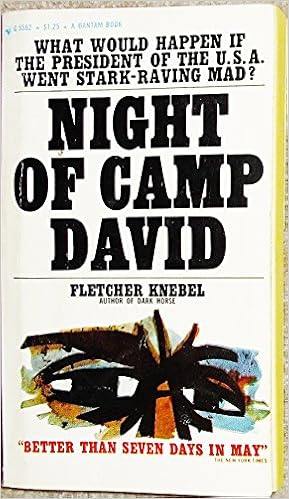
“One man in the free world has the power to launch a nuclear war that might destroy civilization: the President of the United States. What if that man were mentally unbalanced?”
That is the premise of the 1965 novel, Night at Camp David, by Fletcher Knebel.
At the time of its release, its plot was considered so over-the-top as to be worthy of science fiction:
Iowa Democratic Senator Jim MacVeagh is summoned to Camp David, the Presidential retreat, by President Mark Hollenbach. MacVeagh is expected to become Hollenbach’s next Vice President. But he becomes alarmed that Hollenbach is clearly suffering from intense paranoia.
He wants to develop a closer relationship between the United States and Russia—while cutting ties with American allies in Europe. Moreover, Hollenbach believes the American news media are conspiring against him with his political enemies.
Only one person possesses evidence that Hollenbach is losing his grip on sanity—his mistress, Rita. Desperate to retain his power, Hollenbach orders the FBI to investigate both MacVeagh and Rita.
So why was a 53-year-old novel released in 2018? The answer lies in two words: Donald Trump.
In a November 30, 2018 review of Night at Camp David, Tom McCarthy, national affairs correspondent for the British newspaper, The Guardian, writes:
“The current president has seen crowds where none exist, deployed troops to answer no threat, attacked national institutions – the military, the justice department, the judiciary, the vote, the rule of law, the press – tried to prosecute his political enemies, elevated bigots, oppressed minorities, praised despots while insulting global allies and wreaked diplomatic havoc from North Korea to Canada.
“He stays up half the night watching TV and tweeting about it, then wakes up early to tweet some more, in what must be the most remarkable public diary of insecurity, petty vindictiveness, duplicity and scattershot focus by a major head of state in history.”
From the beginning of his Presidency, Trump aroused fear—based not only of what he might do, but that he might be mentally unbalanced. Consider:
On March 4, 2017, in a series of unhinged tweets, he accused former President Barack Obama of tapping his Trump Tower phones prior to the election:
“Terrible! Just found out that Obama had my ‘wires tapped’ in Trump Tower just before the victory. Nothing found. This is McCarthyism!”
“Is it legal for a sitting President to be ‘wire tapping’ a race for president prior to an election? Turned down by court earlier. A NEW LOW!”
“I’d bet a good lawyer could make a great case out of the fact that President Obama was tapping my phones in October, just prior to Election!”
“How low has President Obama gone to tapp my phones during the very sacred election process. This is Nixon/Watergate. Bad (or sick) guy!”
A subsequent investigation by the Justice Department turned up no evidence to substantiate Trump’s foray into Presidential libel.
Donald Trump
Trump’s shoot-first-and-never-mind-the-consequences approach to life has been thoroughly documented.
From June 15, 2015, when he launched his Presidential campaign, until October 24, 2016, he fired nearly 4,000 angry, insulting tweets at 281 people and institutions. TheNew York Times needed two full pages of its print edition to showcase them.
Among these targets were:
His Democratic rival, Hillary Clinton
His fellow Republican Presidential candidates
Actress Meryl Streep
News organizations
President Barack Obama
Comedian John Oliver
The Affordable Care Act (Obamacare)
Singer Neil Young
The state of New Jersey
Actor Arnold Schwarzenegger.
And during his first two weeks as President, Trump attacked 22 people, places and things on his @realDonaldTrump Twitter account.
Trump’s vindictiveness, his narcissism, his compulsive aggression, his complaints that his “enemies” in government and the press are trying to destroy him, have caused many to ask: Could the President of the United States be suffering from mental illness?
One who has dared to answer this question is John D. Gartner, a practicing psychotherapist.
John D. Gartner
Gartner graduated magna cum laude from Princeton University, received his Ph.D in clinical psychology from the University of Massachusetts, and served as a part-time assistant professor of psychiatry at Johns Hopkins University Medical School for 28 years.
During an interview by U.S. News & World Report (published on January 27, 2017), Gartner said: “Donald Trump is dangerously mentally ill and temperamentally incapable of being president.”
Gartner said that Trump suffers from “malignant narcissism,” whose symptoms include:
anti-social behavior
sadism
aggressiveness
paranoia
and grandiosity.
“We’ve seen enough public behavior by Donald Trump now that we can make this diagnosis indisputably,” says Gartner, who admits he has not personally examined Trump.
More of that behavior was on full display on March 2, 2019 at the annual Conservative Political Action Conference (CPAC), held at the Gaylord National Resort & Convention Center, National Harbor, Maryland.
For more than two hours, Trump delivered the longest speech (so far) of his Presidency to his fanatically Right-wing audience.
Facing a hostile Democratic House of Representatives and a potentially explosive report by Special Counsel Robert Mueller, Trump threw down the gauntlet.
Steffen White’s Email: Sparta480@aol.com Former reporter, legal investigator and troubleshooter. Columnist at Bureaucracybuster.com. Fighting political and bureaucratic arrogance, incompetence and/or indifference.
When making complaints in writing, carefully review your email or letter before sending it. Remove any words that are vulgar or profane. Don't make sweeping accusations: "Your agency is a waste."
Don't attribute motives to people you've had problems with, such as: "The postal clerk refused to help me because he's a drunk." If the person actually appeared to be drunk, then be precise in your description: "As he leaned over the counter I could smell beer on his breath. Behind him, in a waste basket, I saw an empty bottle of Coors beer."
Show how the failure of the official to address your problem reflects badly on the company or agency: "This is not the level of service your ads would lead potential customers to expect."
If necessary, note any regulatory agencies that can make life rough for the company or agency if your complaint isn't resolved. For the phone company, for example, cite the FCC or the PUC. But do this only after you have stated you hope your complaint can be settled amicably and privately within the company.






 Bureaucracybuster's Blog
2016 PRESIDENTIAL CAMPAIGN, 2020 PRESIDENTIAL CAMPAIGN, ABC NEWS, ADAM SCHIFF, ADOLF HITLER, ALTERNET, AMERICABLOG, AP, ARTICLES OF IMPEACHMENT, BABY BOOMER RESISTANCE, BORDER WALL, BUZZFEED, CBS NEWS, CHARLES DE GAULLE, CHINA, CHRISTI GRIMM, CHRISTOPHER S. MURPHY, CIA, CNN, CONSERVATIVE POLITICAL ACTION CONFERENCE, CONVERSATION WITH AN AMERICAN WRITER (POEM), CORONAVIRUS RELIEF MONIES, COVID-19, CROOKS AND LIARS, CUBAN MISSILE CRISIS, DAILY KOZ, DAN BOWMAN, DAN SULLIVAN, DAVID BROOKS, DEMOCRATS, DEPARTMENT OF HEALTH AND HUMAN SERVICES, DONALD TRUMP, DONALD TRUMP JUNIOR, DRUDGE RETORT, EXTORTION, FACEBOOK, FBI, FIRST AMENDMENT, FIVETHIRTYEIGHT, GENN FINE, GEORGE FLOYD, GEORGE W. BUSH, GOVERNMENT ACCOUNTABILITY OFFICE, GOVERNMENT SHUTDOWN, HARPER’S MAGAZINE, HILLARY CLINTON, HOUSE FOREIGN AFFAIRS COMMITTEE, HOUSE INTELLIGENCE COMMITTEE, HOUSE OVERSIGHT AND REFORM COMMITTEE, HUNTER BIDEN, IMPEACHMENT, IMPOUNDMENT CONTROL ACT, INSPECTORS GENERAL, INTELLIGENCE COMMUNITY, JAKE SULLIVAN, JAKE TAPPER, JAMAL KHASHOGGI, JAMES COMEY, JAMES ROBART, JARED KUSHNER, JEFF SESSIONS, JOHN CORNYN, JOHN F. KENNEDY, JOHN ROBERTS, JON S. TIGAR, JOSEPH BIDEN, KELLY LOEFFER, KEVIN CRAMER, LAFAYETTE SQUARE, LAMAR ALEXANDER, LEON PANETTA, LINDSEY GRAHAM, MARCO RUBIO, MARTIN GUGINO, MEDIA MATTERS, MEXICO, MICHAEL FLYNN, MICHAEL HAYDEN, MICHAEL K. ATKINSON, MICK MULVANEY, MIKE PENCE, MITCH MCCONNELL, MOHAMMED BIN SALMAN, MOTHER JONES, MOVEON, MSNBC, NANCY PELOSI, NATALIA VESELNITSKAYA, NATIONAL SECURITY AGENCY, NBC NEWS, NEWSWEEK, NPR, PAUL MANAFORT, PBS NEWSHOUR, POLITICO, POLITICUSUSA, RAW STORY, REPUBLICANS, REUTERS, RINAT AKHMETSHIN, ROBERT MUELLER, ROBERT PAYNE, ROD ROSENSTEIN, ROGER STONE, RON JOHNSON, RUSSIA, SALON, SEATTLE TIMES, SERGEY KISLYAK, SERGEY LAVROV, SLATE, ST. JOHN’S CHURCH, STEVE DAINES, TALKING POINTS MEMO, TED CRUZ, THE ATLANTIC, THE CHICAGO SUN-TIMES, THE CHICAGO TRIBUNE, THE DAILY BEAST, THE DAILY BLOG, THE GUARDIAN, THE HILL, THE HUFFINGTON POST, THE JUDICIARY, THE LIFE AND DEATH OF ADOLF HITLER (BOOI), THE LIFE AND DEATH OF ADOLF HITLER (BOOK), THE LOS ANGELES TIMES, THE NATION, THE NEW REPUBLIC, THE NEW YORK TIMES, THE PRESS, THE VILLAGE VOICE, THE WASHINGTON POST, THINKPROGRESS, TIME, TREASON, TRUMP TOWER MEETING, TRUTHDIG, TRUTHOUT, TWITTER, TWO POLITICAL JUNKIES, U.S. NEWS & WORLD REPORT, UKRAINE, UNITED STATES HOUSE OF REPRESENTATIVES, UNITED STATES SENATE, UPI, USA TODAY, VLADIMIR PUTIN, VOLODYMYR ZELENSKY, WHISTLEBLOWER, WHITE HOUSE BUDGET OFFICE, WONKETTE, YEVGENEY YEVTUSHENKO
REPUBLICANS: PROFILES WITHOUT COURAGE–PART ONE (OF FIVE)
In Bureaucracy, History, Law, Law Enforcement, Politics, Social commentary on June 15, 2020 at 12:16 amRepublicans have a long and shameful history of excusing Donald Trump’s vicious slanders and law-breaking.
On June 9, they gave yet another example of their cravenness.
That was when President Trump charged that a 75-year-old man who was seriously injured by police officers in Buffalo, New York, was part of a radical leftist “set up.”
The victim, Martin Gugino, is described as a peace activist associated with the Catholic Worker Movement.
On June 4, during nationwide protests over the police murder of black security guard George Floyd, a curfew was imposed on Buffalo, New York. As police swept through Niagara Square, Gugino walked directly into their path as if attempting to speak with them.
Two officers pushed him and he fell backwards, hitting the back of his head on the pavement and losing consciousness. The line of officers walked past Gugino as he lay on the ground with blood pooling around his head. One officer tried to check on him, but another patrolman told him to move on, and he did.
Martin Gugino falls backward
Enter Trump, who had been severely criticized for sending police and National Guardsmen to remove peaceful protesters from Lafayette Square so he could stage a photo-op at nearby St. John’s Church.
On June 9 he tweeted: “Buffalo protester shoved by Police could be an ANTIFA provocateur. 75 year old Martin Gugino was pushed away after appearing to scan police communications in order to black out the equipment. @OANN I watched, he fell harder than was pushed. Was aiming scanner. Could be a set up?”
As usual, Trump offered no evidence to back up his slander. And, as usual, Republicans refused to condemn him for his latest outrage.
Among those competing for “Most Cowardly Sycophant of the Year”:
So much for Republican profiles in courage.
On December 18, 2019, the House of Representatives approved two Articles of Impeachment against President Donald Trump for:
Article 1: Abuse of Power: For pressuring the president of Ukraine to assist his re-election campaign by smearing a potential rival for the White House.
Article 2: Obstruction of Congress: For obstructing Congress by blocking testimony of subpoenaed witnesses and refusing to provide documents in response to House subpoenas in the impeachment inquiry.
On July 25, 2019, Trump had “asked” Ukraine President Volodymir Zelensky to do him a “favor”: Find embarrassing “dirt” on former Vice President Joseph Biden and his son, Hunter.
Hunter had had business dealings in Ukraine. And Joseph Biden might be Trump’s Democratic opponent for the White House in 2020.
To underline the seriousness of his “request,” earlier in July Trump had told Mick Mulvaney, his White House chief of staff, to withhold $400 million in military aid Congress had approved for Ukraine, which is facing an increasingly aggressive Russia
But then a CIA whistleblower filed a complaint about the extortion attempt—and the media and Congress soon learned of it. And ever since, the evidence linking Trump to impeachable offenses had mushroomed.
On January 16, 2020, the Government Accountability Office (GAO) announced that the Trump administration broke the law when it withheld security aid to Ukraine.
Joseph Biden with Barack Obama
As Senate trial proceedings unfolded, the 53-majority Republican Senators:
On February 5, the Republican-dominated Senate—as expected—absolved President Donald Trump from trying to extort Ukraine into smearing a possible rival for the White House. Only one Republican—Utah Senator Mitt Romney—had the moral courage to vote for conviction.
But this was not the first time Republicans sought to excuse Trump’s litany of crimes. Those efforts go back to the 2016 Presidential election.
Share this: