Posts Tagged ‘FBI’
ABC NEWS, ADOLF HITLER, AL QAEDA, ANN COULTER, ARIZONA SHOOTINGS, ASSASSINATION, BARACK OBAMA, BILL CLINTON, BILL O'REILLY, BIRTHERS, BOBBY JINDAL, CBS NEWS, CHRISTINA-TAYLOR GREEN, CNN, COMMUNISM, CONFEDERATE FLAB, CRIME, DYLANN ROOF, FACEBOOK, FBI, GABRIELLE GIFFORDS, GEORGE H.W. BUSH, GEORGE W. BUSH, GLENN BECK, HATE GROUPS, HEALTHCARE, JBE BUSH, JOSEPH MCCARTHY, MEIN KAMPF, MICHELLE BACHMANN, NBC NEWS, NEWT GINGRICH, OBAMACARE, OSAMA BIN LADEN, RICHARD NIXON, RICK PERRY, RICK SANTORUM, RODNEY KING RIOTS, ROLLING STONE, RUSH LIMBAUGH, Sarah Palin, SEAN HANNITY, Secret Service, SOVIET UNION, SPIRO AGNEW, TEA PARTY, THE CHICAGO SUN-TIMES, THE CHICAGO TRIBUNE, THE LOS ANGELES TIMES, THE NEW YORK TIMES, THE WASHINGTON POST, TWITTER, U.S. DISTRICT JUDGE JOHN ROLL, U.S. MARSHALS SERVICE, WHITE SUPREMACISTS
In Bureaucracy, History, Law, Law Enforcement, Politics, Social commentary on May 17, 2016 at 12:05 am
When President Barack Obama set out to provide healthcare for all Americans–-and not simply the wealthiest 1%–-Republicans tried to frighten voters with lies.
The most infamous of these was that healthcare reform would lead to wholesale murder by government “death panels,” as Sarah Palin put it.
Despite being the party of the extreme Right, Republicans delight in portraying Obama as the ultimate Fascist: Adolf Hitler.
At their rallies they brandish doctored photos of Obama sporting a Hitler forelock and toothbrush mustache.
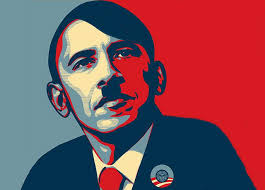
And they claim he plans to set up concentration camps for those who disagree with him.
They also claim he intends to “take away our guns–just like Hitler.”
In fact:
- Rather than disarming Germans, Adolf Hitler armed his fellow citizens and created the mightiest war machine Western Europe had ever seen; and;
- Rather than confiscating Americans’ firearms, Obama has signed legislation allowing guns to be brought onto Amtrak and into national marks.
Even more ominously, heavily-armed Right-wingers have showed up at places where Obama was scheduled to speak.
In August, 2009, about a dozen people carrying guns, including one with a military-style rifle, milled among protesters outside a Phoenix convention center where President Obama was giving a speech.
A week earlier, during Obama’s healthcare town hall in New Hampshire, a man carrying a sign reading “It is time to water the tree of liberty” stood outside with a pistol strapped to his leg.
On August 28, 2010, an armed Obama protester was arrested by police at the Alaska State Fair, where the President was scheduled to speak.
According to the Secret Service, Obama is the target of more than 30 death threats a day and is the most threatened President in history. The heightened danger he faces is stretching the Secret Service to its limits.

Secret Service agents guarding President Obama
Since Obama took office in 2009, the rate of threats against him has increased 400%.
Fred Solop, a Northern Arizona University political scientist, said the incidents in New Hampshire and Arizona could signal the beginning of a disturbing trend.
“When you start to bring guns to political rallies, it does layer on another level of concern and significance,” Solop said. “It actually becomes quite scary for many people. It creates a chilling effect in the ability of our society to carry on honest communication.”
The way to prevent such tragedies in the future is to hold fully accountable not just the shooters but those who deliberately point them toward their targets and repeatedly scream: “Kill the traitors!”
Americans must shed their naive belief that “America is exempt from the political corruption of other countries.” And they must see the Republicans’ lust for absolute power at any price as the danger it presents to the future of the Republic.
Among the steps that need to be taken:
First, the families and friends of the Tucson massacre victims should file civil lawsuits against Sarah Palin and every other Republican who created the firestorm of hate that consumed 19 victims.
And survivors of the massacre at Emanuel African Methodist Episcopal Church should do likewise against those Right-wing groups that influenced Dylann Roof to snuff out nine innocent lives because they were black.
A legal precedent for such lawsuits emerged 20 years ago, and still remains viable.
On November 13, 1988 in Portland, Oregon, three white supremacist members of East Side White Pride and White Aryan Resistance (WAR) beat to death Mulugeta Seraw, an Ethiopian man who came to the United States to attend college.
Morris Dees and the Southern Poverty Law Center filed a civil suit (Berhanu v. Metzger) against Tom Metzger, founder of WAR. They argued that WAR influenced Seraw’s killers by encouraging their group, East Side White Pride, to commit violence.
Tom and John Metzger were found civilly liable under the doctrine of vicarious liability, in which one can be liable for a tort committed by a subordinate or by another person who is taking instructions.
In October 1990, the jury returned the largest civil verdict in Oregon history at the time—$12.5 million—against Metzger and WAR. The Metzgers’ house was seized, and most of WAR’s profits went to paying off the judgment.
Second, the FBI and Justice Department should launch an all-out investigation into not simply right-wing hate groups but those political leaders who openly or secretly encourage and support their activities.
Those who are found doing so should be indicted and prosecuted under the Patriot Act and the Racketeer Influenced Corrupt Organizations Act.
Third, the Secret Service should immediately adopt the policy that no one but sworn law enforcement officers will be allowed to carry firearms within the immediate vicinity of the President. And it should enforce that policy through its elite countersniper teams.
Finally, President Obama should do what President Clinton failed to do at the time of the 1995 Right-wing truck-bombing of the Oklahoma City Federal Building: He should publicly condemn those Republicans who give “aid and comfort” to the right-wing extremists whose support they openly court.
Unless such steps are taken, outrages such as the Tucson slaughter will continue to remain a needless “mystery.” And those outrages will continue until a Republican version of the swastika permanently flies over the capitol dome and the White House.
ABC NEWS, ADOLF HITLER, AL QAEDA, ANN COULTER, ARIZONA SHOOTINGS, ASSASSINATION, BARACK OBAMA, BILL CLINTON, BILL O'REILLY, BIRTHERS, BOBBY JINDAL, CBS NEWS, CHRISTINA-TAYLOR GREEN, CNN, COMMUNISM, CONFEDERATE FLAG, CRIME, DYLANN ROOF, FACEBOOK, FBI, GABRIELLE GIFFORDS, GEORGE H.W. BUSH, GEORGE W. BUSH, GLENN BECK, HATE GROUPS, HEALTHCARE, JEB BUSH, JOSEPH MCCARTHY, MEIN KAMPF, MICHELLE BACHMANN, NBC NEWS, NEWT GINGRICH, OBAMACARE, RICHARD NIXON, RICK PERRY, RICK SANTORUM, RODNEY KING RIOTS, ROLLING STONE, RUSH LIMBAUGH, Sarah Palin, SEAN HANNITY, Secret Service, SOVIET UNION, SPIRO AGNEW, TEA PARTY, THE CHICAGO SUN-TIMES, THE CHICAGO TRIBUNE, THE LOS ANGELES TIMES, THE NEW YORK TIMES, THE WASHINGTON POST, TWITTER, U.S. DISTRICT JUDGE JOHN ROLL, U.S. MARSHALS SERVICE, WHITE SUPREMACISTS
In Bureaucracy, History, Law, Law Enforcement, Politics, Social commentary on May 16, 2016 at 12:01 am
The electoral success of Senator Joseph McCarthy’s Red-baiting treason slanders proved too alluring for other Republicans to resist.
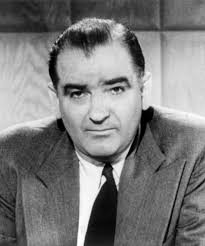
Joseph McCarthy
Among those who have greatly profited from hurling similar charges are:
- President Richard Nixon
- His vice president, Spiro Agnew
- Former Speaker of the House Newt Gingrich
- Former Congressman Dick Armey
- President George W. Bush
- Vice Presidential candidate Sarah Palin
- Congresswoman Michelle Bachmann
- Rush Limbaugh
- Glenn Beck
- Sean Hannity
- Bill O’Reilly.
During the 1992 Presidential campaign, Republicans tried to paint Bill Clinton as a brainwashed “Manchurian candidate” because he had briefly visited the Soviet Union during his college years.
After the Soviet Union collapsed in 1991, Republicans lost their “soft on Communism” slander-line. So they tried to persuade voters that Democrats were “soft on crime.”
When riots flared in 1992 after the acquittal of LAPD officers who had savagely beaten Rodney King, President George H.W. Bush blamed the carnage on the “Great Society” programs of the 1960s.
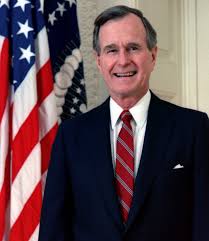
George H.W. Bush
After losing the White House to Clinton at the polls in 1992 and 1996, Republicans tried to oust him another way: By impeaching him over a tryst with a penis-loving intern named Monica Lewinsky.
The Republican-controlled House of Representatives voted to impeach, but the effort was defeated in the Democratically-controlled Senate.
The 2008 election of Barack Obama pushed the Republican “treason chorus” to new heights of infamy.
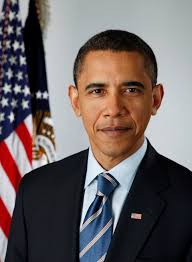
Barack Obama
Almost immediately after Obama took office, he came under attack by an industry of Right-wing book authors such as Sean Hannity, Ann Coulter and Rush Limbaugh.
The following titles vividly reveal the hates, fears and ambitions of their authors–and audience:
- Conservative Victory: Defeating Obama’s Radical Agenda by Sean Hannity
- Obama Zombies: How the Liberal Machine Brainwashed My Generation by Jason Mattera
- How Barack Obama is Bankrupting the U.S. Economy by Stephen Moore
- Let Freedom Ring: Winning the War of Liberty over Liberalism by Sean Hannity
- The Manchurian President: Barack Obama’s Ties to Communists,Socialists and Other Anti-American Extremists by Aaron Klein
- The Blueprint: Obama’s Plan to Subvert the Constitution and Build an Imperial Presidency by Ken Blackwell
- Culture of Corruption: Obama and His Team of Tax Cheats, Crooks, and Cronies by Michelle Malkin
- Why Obama’s Government Takeover of Health Care Will Be a Disaster by David Gratzer
- To Save America: Stopping Obama’s Secular-Socialist Machine by Newt Gingrich
- Obama’s Radical Transformation of America: Year One by Joshua Muravchik
- How the Obama Administration Threatens to Undermine Our Elections by John Fund
- Power Grab: How Obama’s Green Policicies Will Steal Your Freedom and Bankrupt America by Christopher C. Horner
- The Bad Science and Bad Policy of Obama’s Global Warning Agenda by Roy W. Spencer
- America’s March to Socialism: Why We’re One Step Closer to Giant Missile Parades by Glenn Beck
- Obama’s Betrayal of Israel by Michael Ledeen
- The Obama Nation: Leftist Politics and the Cult of Personality by Jerome R. Corsi
- The Case Against Barack Obama: The Unlikely Rise and Unexamined Agenda of the Media’s Favorite Candidate by David Freddoso
- Censorship: The Threat to Silence Talk Radio by Brian Jennings
- The War On Success: How the Obama Agenda Is Shattering the American Dream by Tommy Newberry
- Green Hell: How Environmentalists Plan to Control Your Life and What You Can Do to Stop Them by Steven Milloy
- Liberalism is a Mental Disorder: Savage Solutions by Michael Savage
- Treason: Liberal Treachery from the Cold War to the War on Terrorism by Ann Coulter
- How to Talk to a Liberal (If You Must): The World According to Ann Coulter by Ann Coulter
- Slander: Liberal Lies About the American Right by Ann Coulter
- If Democrats Had Any Brains, They’d Be Republicans by Ann Coulter
- Guilty: Liberal “Victims” and Their Assault on America by Ann Coulter
- Catastrophe: How Obama, Congress and the Special Interests Are Transforming…a Slump into a Crash, Freedom Into Socialism and a Disaster into a Catastrophe….And How to Fight Back by Dick Morris
Consider the vocabulary Right-wingers use to describe their political adversaries:
“Liberals,” “radicals, “bankrupting,” “treason,” subversion,” “slander,” “terrorism,” “betrayal,” “catastrophe,” “shattering the American dream,” “leftists,” “Communists,” “government takeover,” “socialism,” “power grab,” “secularism,” “environmentalism.”
And while the Right lusts to constantly compare Obama to Adolf Hitler, its propaganda campaign draws heavily on the Nazi leader’s own advice.
In Mein Kampf, Hitler laid out his formula for successful propaganda: “All effective propaganda must be confined to a few bare essentials.
“Those must be expressed as far as possible in stereotypical formulas. These slogans should be persistently repeated until the very last individual has come to grasp the idea that has been put forward.”
Among the lies most “persistently repeated” by Republicans about Obama:
Obama isn’t an American citizen. The reason: To “prove” that he is an illegitimate President, and should be removed from office.
Even the President’s releasing of the long-form version of his birth certificate in 2011–showing that he was born in Hawaii, not Kenya–didn’t end these falsehoods.
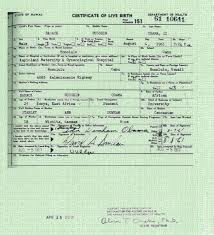
The long-form version of President Obama’s birth certificate
Oaama is a secret Muslim who intends to betray America to his Islamic masters.
In fact, Obama has eliminated far more Al Qaeda leaders than George W. Bush ever did–including the most sought-after one of all: Osama bin Laden.
ABC NEWS, ADOLF HITLER, AL QAEDA, ANN COULTER, ARIZONA SHOOTINGS, ASSASSINATION, BARACK OBAMA, BILL CLINTON, BILL O'REILLY, BIRTHERS, BOBBY JINDAL, CBS NEWS, CHRISTINA-TAYLOR GREEN, CNN, COMMUNISM, CONFEDERATE FLAG, CRIME, DYLANN ROOF, FACEBOOK, FBI, GABRIELLE GIFFORDS, GEORGE H.W. BUSH, GEORGE W. BUSH, GLENN BECK, HATE GROUPS, HEALTHCARE, JEB BUSH, JOSEPH MCCARTHY, MEIN KAMPF, MICHELLE BACHMANN, NBC NEWS, NEWT GINGRICH, OBAMACARE, OSAMA BIN LADEN, REPUBLICAN PARTY, RICHARD NIXON, RODNEY KING RIOTS, ROLLING STONE, RUSH LIMBAUGH, Sarah Palin, SEAN HANNITY, Secret Service, SOVIET UNION, SPIRO AGNEW, TEA PARTY, THE CHICAGO SUN-TIMES, THE CHICAGO TRIBUNE, THE LOS ANGELES TIMES, THE NEW YORK TIMES, THE WASHINGTON POST, TWITTER, U.S. DISTRICT JUDGE JOHN ROLL, U.S. MARSHALS SERVICE, WHITE SUPREMACISTS
In Bureaucracy, History, Law, Law Enforcement, Politics, Social commentary on May 13, 2016 at 12:11 am
“The Republican Party has weaponized its supporters, made violence a virtue and, with almost every pronouncement for 50 years, given them an enemy politicized, racialized and indivisible.”
So wrote Rolling Stone writer in a blistering June 19, 2015 editorial. The touchstone was the slaughter of nine black worshipers by a white supremacist at a South Carolina black church.
But the proof of Republican culpability in political violence goes back much further.
Consider:
Gabrille Giffords, 40, is a moderate Democrat who narrowly wins re-election in November, 2010, against a Republican Tea Party candidate.
Her support of President Obama’s health care reform law has made her a target for violent rhetoric–-especially from former Alaska Governor Sarah Palin.
In March, 2010, Palin releases a map featuring 20 House Democrats that uses cross-hairs images to show their districts. In case her supporters don’t get the message, she later writes on Twitter: “Don’t Retreat, Instead – RELOAD!”

Sarah Palin’s “Crosshairs” Map
As the campaign continues, Giffords finds her Tucson office vandalized after the House passes the healthcare overhaul in March.
Giffords senses that she has become a target for removal–in more than political terms. In an interview after the vandalizing of her office, she refers to the animosity against her by conservatives.
She specifically cites Palin’s decision to list her seat as one of the top “targets” in the midterm elections.
“For example, we’re on Sarah Palin’s targeted list, but the thing is, that the way that she has it depicted has the cross-hairs of a gun sight over our district. When people do that, they have to realize that there are consequences to that action,” Giffords tells MSNBC.
At one of her rallies, her aides call the police after an attendee drops a gun.
Giffords may have seen the spectre of violence closing in on her. In April, 2010, she supported Rep. Raúl Grijalva after he had to close two offices when he and his staff received threats.
He had called for a boycott of Arizona businesses in opposition to the state’s controversial immigration law.
“I am deeply troubled about reports that Congressman Grijalva and members of his staff have been subjected to death threats,” Giffords said.
“This is not how we, as Americans, express our political differences. Intimidation has no place in our representative democracy. Such acts only make it more difficult for us to resolve our differences.”
But intimidation–-and worse–-does have a place among the tactics used by influential Republicans in the pursuit of absolute power.
Increasingly, Republicans have repeatedly aimed violent–-and violence-arousing–-rhetoric at their Democratic opponents. This is not a case of careless language that is simply misinterpreted, with tragic results.
Republicans like Sarah Palin fully understand the constituency they are trying to reach: Those masses of alienated, uneducated Americans who live only for their guns and hardline religious beliefs–and who can be easily manipulated by perceived threats to either.
If a “nutcases” assaults a Democratic politician and misses, then the Republican establishment claims to be shocked–-shocked!–-that such a thing could have happened.
And if the attempt proves successful–-as the January 8, 2011 Tucson shootings did–-then Republicans weep crocodile tears for public consumption.
The difference is that, in this case, they rejoice in knowing that Democratic ranks have been thinned and their opponents are even more on the defensive, for fear of the same happening to them.
Consider the following:
- Rep. Randy Neugebauer (R-Tex.) yelled “baby killer” at Bart Stupak (D-Mich.) on the House floor.
- Florida GOP Congressional candidate Allen West, referring to his Democratic opponent, Rep. Ron Klein, told Tea Party activists: You’ve got to make the fellow scared to come out of his house. That’s the only way that you’re going to win. That’s the only way you’re going to get these people’s attention.”
- Rep. Devin Nunes (R-CA) said Tea Partiers had “every right” to use racist and homophobic slurs against Democrats, justifying it via Democrats’ “totalitarian tactics.”
- Rep. Michelle Bachmann (R-Minn.) said she wanted her constituents “armed and dangerous” against the Obama administration.
- Sarah Palin told her supporters: “Get in their face and argue with them. No matter how tough it gets, never retreat, instead RELOAD!”
- Right-wing pundit Ann Coulter: “My only regret with Timothy McVeigh is he did not go to the New York Times building.”
- Senator Phil Gramm (R-Tex.) “We’re going to keep building the party until we’re hunting Democrats with dogs.”
- Rep. Louisa M. Slauter (D-NY) received a phone message threatening sniper attacks against lawmakers and their families.
Since the end of World War 11, Republicans have regularly hurled the charge of “treason” against anyone who dared to run against them for office or think other than Republican-sponsored thoughts.
Republicans had been locked out of the White House from 1933 to 1952, during the administrations of Franklin D. Roosevelt and Harry S. Truman.
Determined to regain the Presidency by any means, they found that attacking the integrity of their fellow Americans a highly effective tactic.
During the 1950s, Wisconsin Senator Joseph R. McCarthy rode a wave of paranoia to national prominence–by attacking the patriotism of anyone who disagreed with him.
The fact that McCarthy never uncovered one actual case of treason was conveniently overlooked during his lifetiAL me.
ABC NEWS, ADOLF HITLER, AL QAEDA, ANN COULTER, ARIZONA SHOOTINGS, ASSASSINATION, BARACK OBAMA, BILL CLINTON, BILL O'REILLY, BIRTHERS, BOBBY JINDAL, CBS NEWS, CHRISTINA-TAYLOR GREEN, CNN, COMMUNISM, CONFEDERATE FLAG, CRIME, DYLANN ROOF, FACEBOOK, FBI, GABRIELLE GIFFORDS, GEORGE H.W. BUSH, GEORGE W. BUSH, GLENN BECK, HATE GROUPS, HEALTHCARE, JEB BUSH, JOSEPH MCCARTHY, MEIN KEMPF, MICHELLE BACHMANN, NBC NEWS, NEWT GINGRICH, OBAMACARE, OSAMA BIN LADEN, REPUBLICAN PARTY, RICHARD NIXON, RICK PERRY, RICK SANTORUM, RODNEY KING RIOTS, ROLLING STONE, RUSH LIMBAUGH, Sarah Palin, SEAN HANNITY, Secret Service, SOVIET UNION, SPIRO AGNEW, TEA PARTY, THE CHICAGO SUN-TIMES, THE CHICAGO TRIBUNE, THE LOS ANGELES TIMES, THE NEW YORK TIMES, THE WASHINGTON POST, TWITTER, U.S. DISTRICT JUDGE JOHN ROLL, U.S. MARSHALS SERVICE, WHITE SUPREAMACISTS
In Bureaucracy, History, Law, Law Enforcement, Politics, Social commentary on May 12, 2016 at 12:28 am
On June 17, 2015, Dylann Roof, a white high school dropout, gunned down three black men and six black women at Emanuel African Methodist Episcopal Church in Charleston, South Carolina.
At 21, Roof was unemployed, dividing his time between playing video games and taking drugs.
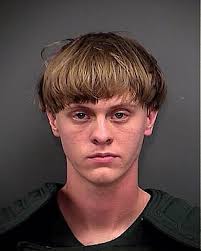
Dylann Roof
The signs of Roof’s malignant racism were evident long before he turned mass murderer:
- He had posed for a photo sitting on the hood of his parents’ car–whose license plate bore a Confederate flag.
- He had posed for pictures wearing a jacket sporting the white supremacist flags of Rhodesia and apartheid South Africa.
- He told a friend that he hoped “to start a civil war” between the black and white races.
- Roof reportedly told friends and neighbors of his plans to kill people.
- In the midst of his massacre of unarmed worshippers, he told one of his victims: “You’ve raped our women, and you are taking over the country.” Then Roof shot him.
The evidence makes clear that Roof’s slaughter was racially motivated. Yet one Republican Presidential candidate after another has refused to acknowledge it.
Jeb Bush, former governor of Florida: “I don’t know what was on the mind or the heart of the man who committed these atrocious crimes.”
Rick Santorum, former United States Senator from Pennsylvania: “You talk about the importance of prayer in this time and we’re now seeing assaults on our religious liberty we’ve never seen before. It’s a time for deeper reflection beyond this horrible situation.”
Bobby Jindal, former governor of Louisiana: “I don’t think we’ll ever know what was going on in his mind.”
But Rolling Stone magazine writer Jeb Lund left no doubt as to what–and who–was ultimately responsible for this crime: Racism and Republicans.
In a June 19, 2015 editorial–published two days after the massacre–Lund noted: “This [crime] is political because American movement conservatism has already made these kinds of killings political.
“The Republican Party has weaponized its supporters, made violence a virtue and, with almost every pronouncement for 50 years, given them an enemy politicized, racialized and indivisible.
“Movement conservatives have fetishized a tendentious and ahistorical reading of the Second Amendment to the point that the Constitution itself somehow paradoxically ‘legitimizes’ an armed insurrection against the government created by it.
“Those leading said insurrection are swaddled by the blanket exculpation of patriotism. At the same time, they have synonymized the Democratic Party with illegitimacy and abuse of the American order.
“This is no longer an argument about whether one party’s beliefs are beneficial or harmful, but an attitude that labels leftism so antithetical to the American idea that empowering it on any level is an act of usurpation.”
Click here: The Charleston Shooter: Racist, Violent, and Yes – Political | Rolling Stone
Lund is absolutely right. And the evidence for this was on display long before Dylann Roof opened fire on “uppity blacks” praying in their own church.
Consider:
On January 8, 2011, Democratic Rep. Gabrielle Giffords was shot in the head while meeting with constituents outside a grocery store in Tucson, Arizona. After a miraculous recovery, she continues to struggle with language and has lost 50% of her vision in both eyes.
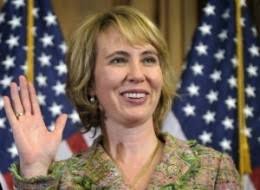
Rep. Gabrielle Giffords
She vowed to return to her former Congressional duties, but was forced to resign for health reasons in 2012.
Giffords was only one victim of a shooting spree that claimed the lives of six people and left 13 others wounded.
Also killed was Arizona’s chief U.S. District judge, John Roll, who had just stopped by to see his friend Giffords after celebrating Mass.
Although the actual shooter, Jared Lee Loughner, was immediately arrested, those who fanned the flames of political violence that consumed 19 people that day have remained unpunished.
Consider the circumstances behind the shootings:
John Roll is Arizona’s chief federal judge. Appointed in 2006, he wins acclaim as a respected jurist and leader who pushes to beef up the court’s strained bench to handle a growing number of border crime-related cases.
In 2009, he becomes a target for threats after allowing a $32 million civil-rights lawsuit by illegal aliens to proceed against a local rancher. The case arouses the fury of local talk radio hosts, who encourage their audiences to threaten Roll’s life.
In one afternoon, Roll logs more than 200 threatening phone calls. Callers threaten the judge and his family. They post personal information about Roll online.
Roll and his wife are placed under fulltime protection by deputy U.S. marshals. Roll finds living under security “unnerving and invasive.”
Authorities identify four men believed responsible for the threats. But Roll declines to press charges on the advice of the Marshals Service.
ABC NEWS, CBS NEWS, CELLPHONE CAMERAS, CNN, DRUG ENFORCEMENT ADMINISTRATION, ENCRYPTION SYSTEMS, FACEBOOK, FBI, JAMES B. COMEY, MAFIA, MIKE BROWN, MSNBC, NBC NEWS, POLICE BRUTALITY, SURVEILLANCE, THE CHICAGO SUN-TIMES, THE CHICAGO TRIBUNE, THE LOS ANGELES TIMES, THE NEW YORK TIMES, THE WASHINGTON POST, TWITTER, UNIVERSITY OF CHICAGO LAW SCHOOL, WALTER SCOTT, YOUTUBE
In Bureaucracy, History, Law, Law Enforcement, Social commentary on May 4, 2016 at 4:09 pm
For decades, Americans have been told by police at local and Federal levels: If you have nothing to hide, you shouldn’t worry about giving up your privacy.
The FBI, for example, has lobbied Congress for an electronic “key” that would allow it to enter a cyber “back door” to eavesdrop on even those emails protected by encryption systems.
Of course, the FBI has long found ways to circumvent the efforts of criminals to remain anonymous.
Decades ago, Mafiosi learned to assume their phones were being wiretapped and their rooms bugged with hidden microphones by agents of the FBI or the Drug Enforcement Administration (DEA).
And law-abiding Americans have grown used to being under camera surveillance every time they enter a bank, a State or Federal agency, a drugstore or supermarket. Or even walking down a street.
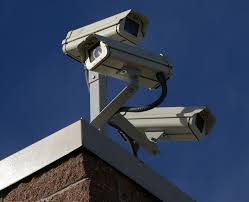
So it must seem ironic–if not downright hypocritical–to such people when police complain that their privacy is being invaded.
And this “invasion” isn’t happening with taps placed on cops’ phones or bugs planted in their police stations or private homes.
No, this “invasion” is happening openly in public–with video cameras and cellphones equipped with cameras.
And it’s happening in direct response to a series of controversial incidents involving the use of deadly force by police.
The most famous of these was the shooting, in August, 2014, of strong-arm grocery store robber Mike Brown in Ferguson, Missouri. Ironically, this was not captured on video.
But a number of other incidents were. Among them:
- The shooting of Walter Scott, a black motorist, on April 4, 2015. Scott was stopped for a non-working third tail light. When North Charleston Police Officer Michael Slager returned to his patrol car, Scott exited his car and fled. Slager gave chase, firing first a Taser and then his pistol. He hit Scott five times–all from behind. Slager later claimed he had “felt threatened.” Unluckily for him, the shooting was caught on a citizen’s cellphone camera. On June 6, a grand jury indicted Slager on a charge or murder.
- On April 9, 2015, San Bernaradino sheriff’s deputies, after an exhaustive chase, kicked Francis Pusok twice–including a kick to the groin–as he lay facedown on the ground with his hands behind his back. About five minutes after Pusok was handcuffed, hobbled and rolled onto his side, another deputy also kicked him. Three deputies have been charged with felony assault. The footage of this came from an NBC News helicopter.
- In February, 2015, Orlando police officer William Escobar was fired after cell phone footage emerged of him punching and kicking a handcuffed man.
Addressing a forum at the University of Chicago Law School on October 23, FBI Director James B. Comey spoke of rising crime rates in America. And he offered a series of possible reasons for it.
Click here: FBI — Law Enforcement and the Communities We Serve: Bending the Lines Toward Safety and Justice
“Maybe it’s the return of violent offenders after serving jail terms. Maybe it’s cheap heroin or synthetic drugs. Maybe after we busted up the large gangs, smaller groups are now fighting for turf.
“Maybe it’s a change in the justice system’s approach to bail or charging or sentencing. Maybe something has changed with respect to the availability of guns….”
Then Comey offered what he thought was the real villain behind the rise in crime: Cellphones aimed at police.

FBI Director James B. Comey
“But I’ve also heard another explanation, in conversations all over the country. Nobody says it on the record, nobody says it in public, but police and elected officials are quietly saying it to themselves. And they’re saying it to me, and I’m going to say it to you….
“In today’s YouTube world, are officers reluctant to get out of their cars and do the work that controls violent crime? Are officers answering 911 calls but avoiding the informal contact that keeps bad guys from standing around, especially with guns?
“I spoke to officers privately in one big city precinct who described being surrounded by young people with mobile phone cameras held high, taunting them the moment they get out of their cars. They told me, ‘We feel like we’re under siege and we don’t feel much like getting out of our cars.’
“I’ve been told about a senior police leader who urged his force to remember that their political leadership has no tolerance for a viral video.
“So the suggestion, the question that has been asked of me, is whether these kinds of things are changing police behavior all over the country.
“And the answer is, I don’t know. I don’t know whether this explains it entirely, but I do have a strong sense that some part of the explanation is a chill wind blowing through American law enforcement over the last year. And that wind is surely changing behavior.”
Apparently, it’s OK for police to aim cameras–openly or concealed–at citizens, whether law-abiding or law-breaking.
But if citizens aim cameras at cops–even without interfering with their making arrests–police feel threatened, to the point of refusing to carry out their duties.
9/11 ATTACKS, ABC NEWS, ARTHUR M. CUMMINGS, BOSTON GLOBE, BOSTON MARATHON, BOSTON MARATHON BOMBING, BOSTON PATCH, BRUSSELS BOMBINGS, CBS NEWS, CNN, FACEBOOK, FBI, FIRST AMENDMENT, FRANKLIN D. ROOSEVELT, ISIS, ISLAM, ISLAMIC TERRORISM, JIHADIST, NAZI GERMANY, NBC NEWS, PARIS TERRORIST ATTACKS, POLITICAL CORRECTNESS, RADICAL ISLAM, SAMUEL P. HUNTINGTON, SAN BERNARDINO MASSACRE, SECURITY, STEVEN EMERSON, THE CHICAGO SUN-TIMES, THE CHICAGO TRIBUNE, THE CLASH OF CIVILIZATIONS AND THE REMAKING OF WORLD ORDER, THE LOS ANGELES TIMES, THE NEW YORK TIMES, THE WASHINGTON POST, TWITTER, US NEWS, USA TODAY, WORLD WAR 11
In Bureaucracy, Entertainment, History, Law Enforcement, Military, Politics, Social commentary on April 27, 2016 at 1:25 am
Since October, 2015, local, State and Federal law enforcement agencies had been planning security for the 2016 Boston Marathon.
With the event scheduled for April 18, authorities wanted to assure the public that the Marathon would be as safe as more than 5,000 law enforcement officers could make it.
Yet, many of the articles written about security for this upcoming event refused to identify the enemy responsible for spending millions of dollars and stationing thousands of local, State and Federal law enforcement officers to protect 30,800 runners and one million spectators.
That enemy: Islamic terrorism.
On April 18, Massive.com carried a story on “Boston Marathon: 2016 security: A look inside the MEMA bunker in Framingham.”
The article noted that on the day of the Marathon–April 18–more than 200 members of 60 Federal, State and local law enforcement agencies gathered at the Massachusetts Emergency Management Agency (MEMA)

Among the agencies represented: The State police, the FBI, the Secret Service and the Bureau of Alcohol, Tobacco, Firearms and Explosives.
Their task: “Keeping 30,800 runners and one million spectators safe.”
But–safe from what? Or who?
The article noted that, owing to the 2013 attack:
-
More ambulances and wheelchairs were positioned near the finish line.
-
Medical tents were also positioned closer to the finish line.
-
Communications were improved with trauma centers and operating rooms.
-
Each community had safe havens where runners could take shelter in an emergency–and could be picked up by buses.
So there could be no doubt that a huge effort–and expense–had been undertaken to protect tens of thousands of people attending this event.
Yet there was absolutely no mention as to what enemy could justify going to such huge expense in effort and money.
Could it be…Islamic terrorists?
During the Cold War, the Government had never hesitated to name the Soviet Union as America’s foremost enemy.
The United States has been the target of Islamic attacks since the 1970s.
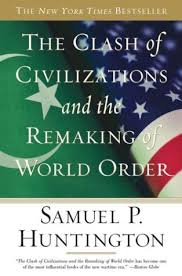
In his groundbreaking work, The Clash of Civilizations and the Remaking of World Order, Harvard political scientist Samuel P. Huntington wrote in 1996:
“During the 15 years between 1980 and 1995…the United States engaged in 17 military operations in the Middle East, all of them directed against Muslims. No comparable pattern of U.S. military operations occurred against the people of any other civilization.

Samuel P. Huntington
On September 11, 2001, Islamics turned four passenger jetliners into flying bombs and slaughtered 3,000 Americans in New York, Washington, D.C. and Pennsylvania.
Since 9/11, the United States has been actively engaged in military operations in Afghanistan, Iraq, Yemen and Syria.
The war that Huntington warned was coming has erupted into fullscale conflict, with no end in sight.
Yet the most important officials in Washington, D.C. refuse to name the enemy they are spending billions of dollars to fight–and protect American citizens against.
As a result, those officials who dare to name that enemy stand out as beacons of honesty and courage.
One of these is Arthur M. Cummings, the FBI’s executive assistant director for national security.
Cummings has no use for such Politically Correct terms as “man-caused disasters” in referring to terrorism. Nor does he shrink from terms such as “jihadists” or “Islamists.”
“Of course Islamists dominate the terrorism of today,” he says bluntly.
“I had this discussion with the director of a very prominent Muslim organization here [Washington, D.C.]. And he said ‘Why are you guys always looking at the Muslim community?’
“I can name the homegrown cells, all of whom are Muslim, all of whom are seeking to kill Americans,” replied Cummings. “It’s not the Irish. It’s not the French. It’s not the Catholics. It’s not the Protestants. It’s the Muslims.”
In May, 2014, Steven Emerson, a nationally recognized expert on terrorism, posted an ad in The New York Times, warning about the dangers of PC-imposed censorship:
“Or nation’s security and its cherished value of free speech has been endangered by the bullying campaigns of radical Islamic groups, masquerading as ‘civil rights’ organizations, to remove any reference to the Islamist motivation behind Islamic terrorist acts.
“These groups have pressured or otherwise colluded with Hollywood, the news media, museums, book publishers, law enforcement and the Obama Administration in censoring the words ‘Islamist,’ ‘Islamic terrorism,’ ‘radical Islam’ and ‘jihad’ in discussing or referencing the threat and danger of Islamic terrorism.
“This is the new form of the jihadist threat we face. It’s an attack on one of our most sacred freedoms–free speech–and it endangers our very national identity.
“How can we win the war against radical Islam if we can’t even name the enemy?”
Emerson has a point–of utmost relevance.
Imagine the United States fighting World War II–and President Franklin D. Roosevelt banning the use of “Fascist” in referring to Nazi Germany or “Imperialist” in describing Imperial Japan.
Imagine CNN-like coverage of the Nazi extermination camps, with their piles of rotting corpses and smoking gas ovens, while a commentator reminds us that “Nazism is an ideology of peace.”
Then try to imagine how the United States could have won that life-and-death struggle under such unrealistic and self-defeating restrictions.
It couldn’t have done so then. And it can’t do so now.
9/11 ATTACKS, ABC NEWS, ARTHUR M. CUMMINGS, BOSTON GLOBE, BOSTON MARATHON, BOSTON MARATHON BOMBING, BOSTON PATCH, BRUSSELS BOMBINGS, CBS NEWS, CNN, FACEBOOK, FBI, FIRST AMENDMENT, FRANKLIN D. ROOSEVELT, ISIS, ISLAM, ISLAMIC TERRORISM, JIHADIST, NAZI GERMANY, NBC NEWS, PARIS TERRORIST ATTACKS, POLITICAL CORRECTNESS, RADICAL ISLAM, SAMUEL P. HUNTINGTON, SAN BERNARDINO MASSACRE, SECURITY, STEVEN EMERSON, THE CHICAGO SUN-TIMES, THE CHICAGO TRIBUNE, THE CLASH OF CIVILIZATIONS AND THE REMAKING OF WORLD ORDER, THE LOS ANGELES TIMES, THE NEW YORK TIMES, THE WASHINGTON POST, TWITTER, US NEWS, USA TODAY, WORLD WAR ii
In Bureaucracy, Entertainment, History, Law Enforcement, Military, Politics, Social commentary on April 26, 2016 at 12:05 am
The 2016 Boston Marathon was scheduled for April 18.
And local, State and Federal law enforcement authorities had been planning security for the event since October, 2015.
So it was only natural that these agencies wanted the public to know the Marathon would be as safe as more than 5,000 law enforcement officers could make it.

The Boston Marathon
“‘Leave the worrying to us’: Security Ramped Up for Boston Marathon,” read the headline of the April 16 issue of USA Today.
And it gave the reason for this: Three years earlier, on April 15, 2013, two bombers had wreaked havoc at the finish line of the race.
It also named the bombers–brothers Dzhokhar and Tamerlan Tsarnaev–whose terrorist act killed three people and injured about 264 others.

Tamerlan and Dzhokhar Tsarnaev
It further noted that Tamerlan had died in a shootout with police three days after the marathon–and police had captured Dzhohkar several hours later. (He was convicted by a jury and sentenced to death.)
The story said nothing, however, about their citing Islam as the reason for their murderous rampage.
Click here: ‘Leave the worrying to us’: Security ramped up for Boston Marathon
The April 16 edition of The Boston Patch carried this headline: “Boston Marathon 2016: Security Changes You Can’t See All Around You.”
The article stated that most of these precautions couldn’t be revealed. Then it added that even though law enforcement officials hadn’t identified a credible threat to this year’s Boston Marathon, “recent events make the world feel less safe today than in 2013.”
But the article said nothing about those “recent events,” such as:
-
In 2013, two Muslims butchered and beheaded a British soldier on a busy London street.
-
In 2014, an axe-wielding Muslim slashed two New York police officers, before being shot by other cops.
-
In 2015, Muslims slaughtered 12 people at a Paris satirical magazine for publishing cartoons about the Prophet Mohammed.
-
In 2015, more than 100 people were murdered in ISIS attacks across Paris.
-
In 2016, a series of Islamic terrorist bombing attacks in Brussels killed 31 and injured more than 300.
Nor did the story say that all of these “recent events” were carried out by followers of the Islamic religion.
Click here: Brussels attacks add urgency to Boston Marathon security | US News
On April 6, The Boston Globe announced: “Tight security planned for upcoming Boston Marathon.”
The story noted that, in drawing up their security arrangements, “authorities analyzed terrorist attacks in Paris, San Bernardino, Calif., and Brussels in recent months.”
The San Bernardino attack had occurred on December 2, 2015.
The story said that Syed Rizwan Farook and Tashfeen Malik, had slaughtered 14 people and wounded 22 at a Department of Public Health training event and birthday party.
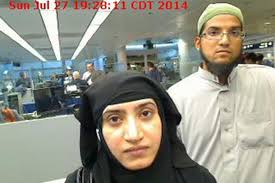
Tashfeen Malik and Syed Rizwan Farook
But the article did not inform readers that Farook and Malik were Muslims acting in the name of Islam.
The story quoted Harold Shaw, special agent in charge of the FBI’s Boston Field Office, as saying: “San Bernardino taught us something very significant. They [the killers] were not on the radar.”
But the article omitted “something very significant”: Farook and Malik had melded perfectly into American society before their outrage. Thus, the only factor that could have put them “on the radar” as potential terrorists was their being Muslims.
And in an America driven by Political Correctness, noting that would have been verboten.
Click here: Tight security planned for upcoming Boston Marathon – The Boston Globe
NBC News carried a story on “How the Boston Marathon is Using Security Technology.”
The story then described how police used a high-tech partner, Esri, to track, in real-time, the progress of the morning’s race.
“When you look [at] security, there’s three legs to the stool: People, process and technology,” said Arnette Heintze, CEO and co-founder of Hillard Heintze, an investigation and security risk management company.
Click here: How the Boston Marathon is Using Security Technology – NBC News
Yet for all the gushing kudos leveled at the new uses of sophisticated technology for keeping people safe, one thing was conspicuously ignored.
The opening paragraph, “Three years after a deadly bombing at the Boston Marathon….” left unnamed those had made the use of this technology necessary–Tamerlan and Dzhokhar Tsarnaev.
Nor did it mention that Dzhokhar had laid out, in a note, his reason for attacking innocent men and women: “We Muslims are one body, you hurt one you hurt us all.
“Well at least that’s how Muhammed wanted it to be forever. The ummah [Islamic community] is beginning to rise.
“Know you are righting men who look into the barrel of your gun and see heaven, how how can you compete with that. We are promised victory and will surely get it.”
Click here: Text from Dzhokhar Tsarnaev’s note left in Watertown boat – The Boston Globe
2016 PRESIDENTIAL RACE, ABC NEWS, ALTERNET, AMERICABLOG, AP, BABY BOOMER RESISTANCE, BBC, BERNIE SANDERS, BLOOD FEUD, BLOOMBERG NEWS, BROTHERS: THE HIDDEN HISTORY OF THE KENNEDY YEARS, BUZZFEED, CARLOS MARCELLO, CBS NEWS, CIA, CNN, COTTER SMITH, CROOKS AND LIARS, CUBA, DAILY KOS, DAVID TALBOT, DONALD TRUMP, ERNEST BORGNINE, FBI, FIDEL CASTRO, FIVETHIRTYEIGHT, GUS RUSSO, HARPER’S MAGAZINE, HILLARY CLINTON, HUFFINGTON POST, INTERNATIONAL BROTHERHOOD OF TEAMSTERS, J. EDGAR HOOVER, JAMES R. HOFFA, JUSTICE DEPARTMENT, LIVE BY THE SWORD: THE SECRET WAR AGAINST CASTRO AND THE DEATH OF JFK, MAFIA, MEDIA MATTERS, MOTHER JONES, MOVEON, MSNBC, NBC NEWS, NEW REPUBLIC, NEWSDAY, NEWSWEEK, NPR, PBS NEWSHOUR, POLITICO, POLITICUSUSA, RAFAEL EDWARD CRUZ, RAW STORY, REUTERS, ROBERT BLAKE, ROBERT F. KENNEDY, SALON, SAM GROOM, SEATTLE TIMES, Secret Service, SENATE LABOR RACKETS COMMITTEE, SLATE, TALKING POINTS MEMO, THE ATLANTIC, THE CHICAGO SUN-TIMES, THE CHICAGO TRIBUNE, THE DAILY BEAST, THE DAILY BLOG, THE GUARDIAN, THE HILL, THE HUFFINGTON POST, THE INTERCEPT, THE LOS ANGELES TIMES, THE NATION, THE NEW REPUBLIC, THE NEW YORK TIMES, THE NEW YORKER, THE VILLAGE VOICE, THE WALL STREET JOURNAL, THE WASHINGTON POST, THINKPROGRESS, TIME, TRUTHDIG, TRUTHOUT, TWITTER, U.S. NEWS & WORLD REPORT, UPI
In Bureaucracy, History, Law, Law Enforcement, Politics, Social commentary on April 25, 2016 at 12:10 am
The 1983 TV mini-series, Blood Feud, chronicles the decade-long struggle between Robert F. Kennedy (Cotter Smith) and James R. Hoffa (Robert Blake), president of the International Brotherhood of Teamsters Union.
With Kennedy as Attorney General and facing relentless pressure from the Justice Department, the Mafia despairs of a solution. At a swanky restaurant, several high-ranking Mafiosi agree that “something” must be done.
On November 22, 1963, President John F. Kennedy is assassinated in Dallas, Texas.
Blood Feud clearly implies that the Mafia was responsible.
[The House Assassinations Committee investigated this possibility in 1978, and determined that Carlos Marcello, the Mafia boss of New Orleans, had the means, motive and opportunity to kill JFK. But it could not find any conclusive evidence of his involvement.]
Even with the President dead, RFK’s Justice Department continues to pursue Hoffa. In 1964, he is finally convicted of jury tampering and sentenced to 13 years’ imprisonment.
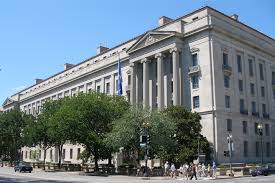
U.S. Department of Justice
Hoping to avoid prison, Hoffa phones Robert Kennedy, offering future Teamsters support if RFK runs for President. To prove he can deliver, he tells Kennedy that the Teamsters have even penetrated the FBI.
[In March, 1964, Kennedy met with Hoffa on an airfield at Dulles International Airport in Washington, D.C. He was accompanied by two Secret Service agents from the detail assigned to ex-First Lady Jacqueline Kennedy.
[FBI Director J. Edgar Hoover, no longer afraid to cross RFK, had withdrawn the agents previously assigned to guard Kennedy.
[Accompanying Hoffa were two muscular bodyguards–at least one of whom was packing two pistols in shoulder holsters.
[While the Secret Service agents watched from a respectful distance, Kennedy spoke quietly with Hoffa. The Attorney General showed a document to Hoffa, and the Teamsters leader at times nodded or shook his head.
[The agents drove Kennedy back to Washington. During the ride, he said nothing about the reason for the meeting.
[David Talbot, in his book, Brothers: The Hidden History of the Kennedy Years, speculates that it could have been to discuss Hoffa’s conviction for jury tampering.
[But Gus Russo–author of Live By the Sword: The Secret War Against Castro and the Death of JFK–writes that the reason might have been Dallas.
[Perhaps, he speculates, RFK had wanted to look into Hoffa’s eyes while asking him: Did you have anything to do with the assassination? RFK had, in fact, done this with CIA Director John McCone almost immediately after his brother’s death.]
In Blood Feud, Kennedy confronts J. Edgar Hoover (Ernest Borgnine) and accuses him of illegally planting wiretaps in Mob hangouts all over the country.
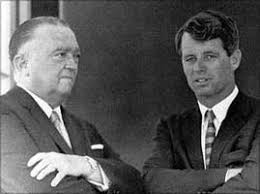
J. Edgar Hoover and Robert F. Kennedy
Hoover retorts that this had been the only way to obtain the prosecution-worthy intelligence Kennedy had demanded: “You loved that flow of information. You didn’t want it to stop.”
Kennedy: Why did you keep the FBI out of the fight against the Mob for decades?
Hoover: “Every agency that came to grips with them got corrupted by their money.”
[So far as is known, Hoover never made any such confession. Historians continue to guess his reason for leaving the Mob alone for decades.]
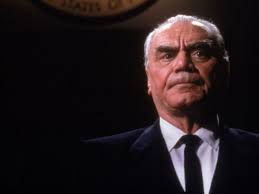

Ernest Borgnine as J. Edgar Hoover
RFK then mentions the CIA’s plots to employ the Mob to assassinate Cuban dictator Fidel Castro
[The agency had wanted to please President Kennedy, and the Mafia had wanted to regain its casinos lost to the Cuban Revolution. The role the Kennedy brothers played in the CIA’s assassination plots remains murky, and has been the subject of endless speculation.]
“The CIA, doing business with the Mob,” says Kennedy. “The FBI, leaking information to its enemies [the Teamsters].” Then, sadly: “I guess it’s true–everyone does business with everyone.”
[So far as is known, the FBI did not pass on secrets to the Teamsters. But during the 1970s, the Mafia penetrated the Cleveland FBI office through bribes to a secretary. Several FBI Mob informants were “clipped” as a result.]
In 1967, Hoffa goes to prison. He stays there until, in 1971, President Richard Nixon commutes his sentence in hopes of gaining Teamsters’ support for his 1972 re-election.
Kennedy leaves the Justice Department in 1964 and is elected U.S. Senator from New York. In 1968 he runs for President. On June 5, after winning the California primary, he’s assassinated.
In Blood Feud, just before his assassination, RFK asks: “How will I ever really know if the Mob killed Jack because of my anti-Mob crusade?”
Hoffa schemes to return to the presidency of the Teamsters–a post now held by his successor, Frank Fitzsimmons. He runs the union in a more relaxed style than Hoffa, thus giving the Mob greater control over its pension fund.
And the Mafia likes it that way.
On July 30, 1975, Hoffa disappears from the parking lot of the Machus Red Fox Restaurant near Detroit. He had gone there to meet with two Mafia leaders.
Almost 41 years after the death of James R. Hoffa, and almost 48 years after that of Robert F. Kennedy:
- Labor unions are a shadow of their former power.
- The threat they once represented to national prosperity has been replaced by that of predatory corporations like Enron and AIG.
- The war RFK began on the Mafia has continued, sending countless mobsters to prison.
- Millions of Americans who once expected the Federal Government to protect them from crime now believe the Government is their biggest threat.
- The idealism that fueled RFK’s life has virtually disappeared from politics.
2016 PRESIDENTIAL RACE, ABC NEWS, ABCNEWS, ALTERNET, AMERICABLOG, AP, BABY BOOMER RESISTANCE, BBC, BERNIE SANDERS, BLOOD FEUD, BLOOMBERG NEWS, BROTHERS: THE HIDDEN HISTORY OF THE KENNEDY YEARS, BUZZFEED, CARLOS MARCELLO, CBS NEWS, CIA, CNN, COTTER SMITH, CROOKS AND LIARS, CUBA, DAILY KOS, DAVID TALBOT, DONALD TRUMP, ERNEST BORGNINE, FBI, FIDEL CASTRO, FIVETHIRTYEIGHT, GUS RUSSO, HARPER’S MAGAZINE, HILLARY CLINTON, HUFFINGTON POST, INTERNATIONAL BROTHERHOOD OF TEAMSTERS, J. EDGAR HOOVER, JAMES R. HOFFA, JOHN F. KENNEDY, JUSTICE DEPARTMENT, LIVE BY THE SWORD: THE SECRET WAR AGAINST CASTRO AND THE DEATH OF JFK, MAFIA, MEDIA MATTERS, MOTHER JONES, MOVEON, MSNBC, NBC NEWS, NEW REPUBLIC, NEWSDAY, NEWSWEEK, NPR, PBS NEWSHOUR, POLITICO, POLITICUSUSA, RAFAEL EDWARD CRUZ, RAW STORY, REUTERS, ROBERT BLAKE, ROBERT F. KENNEDY, SALON, SAM GROOM, SEATTLE TIMES, Secret Service, SENATE LABOR RACKETS COMMITTEE, SLATE, TALKING POINTS MEMO, THE ATLANTIC, THE CHICAGO SUN-TIMES, THE CHICAGO TRIBUNE, THE DAILY BEAST, THE DAILY BLOG, THE GUARDIAN, THE HILL, THE HUFFINGTON POST, THE INTERCEPT, THE LOS ANGELES TIMES, THE NATION, THE NEW REPUBLIC, THE NEW YORK TIMES, THE NEW YORKER, THE VILLAGE VOICE, THE WALL STREET JOURNAL, THE WASHINGTON POST, THINKPROGRESS, TIME, TRUTHDIG, TRUTHOUT, TWITTER, U.S. NEWS & WORLD REPORT, UPI
In Bureaucracy, History, Law, Law Enforcement, Politics, Social commentary on April 22, 2016 at 12:10 am
The 1983 TV mini-series, Blood Feud, chronicles the decade-long struggle between Robert F. Kennedy and James R. Hoffa.
Having “helped” Kennedy (Cotter Smith) to oust corrupt Teamsters President Dave Beck, Hoffa (Robert Blake) believes that Kennedy should now be satisfied: “He’s got his scalp. Now he can move on to other things while I run the union.”
But Hoffa has guessed wrong–with fatal results. Realizing that he’s been “played” by Hoffa, a furious Kennedy strikes back.
He orders increased surveillance of Hoffa and his topmost associates. He subpoenas union records and members of both the Teamsters and the Mafia to appear before his committee in public hearings.
And he tries to enlist the aid of legendary FBI Director J. Edgar Hoover (Ernest Borgnine). But Hoover wants no part of a war against organized crime, whose existence he refuses to admit.

Meanwhile, Kennedy’s confrontations with Hoffa grow increasingly fierce. In open hearings, Kennedy accuses Hoffa of receiving kickbacks in the name of his wife. Hoffa damns him for “dirtying my wife’s name.”
Kennedy secures an indictment against Hoffa for hiring a spy to infiltrate the Senate Labor Rackets Committee. He’s so certain of a conviction that he tells the press he’ll “jump off the Capitol building” if Hoffa beats the rap.
But Hoffa’s lawyer, Edward Bennett Williams (Jose Ferrer) puts Kennedy himself on the witness stand. There he portrays Kennedy as a spoiled rich man who’s waging a vendetta against Hoffa.
Hoffa beats the rap, and offers to send Kennedy a parachute. But he jokingly warns reporters: “Hey, Bobby, you better have it checked. I don’t trust myself!”
By 1959, Robert Kennedy’s work as chief counsel for the Senate Labor Rackets Committee is over. But not his determination to send Teamsters President James Hoffa to prison.
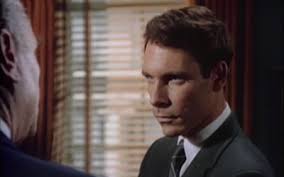
Cotter Smith as Robert Kennedy
Throughout 1960, he manages the Presidential campaign for his brother, John F. Kennedy (Sam Groom). By a margin of only 100,000 votes, JFK wins the election.
Hoffa thinks that his troubles are over, that “Bobby” will move on to other pursuits and forget about the Teamsters.
Hoffa is partly right: Kennedy moves on to another job. But it’s the office of United States Attorney General.
JFK, needing someone in the Cabinet he can trust completely, browbeats Robert into becoming the the nation’s top cop.
For Hoffa, it’s a nightmare come true.
As Attorney General, Kennedy no longer has to beg J. Edgar Hoover to attack organized crime. He can–and does–order him to do so.
Throughout the country, the Mafia feels a new heat as FBI agents plant illegal electronic microphones (“bugs”) in their innermost sanctums. Agents openly tail mobsters–and send them to prison in large numbers.
And Kennedy sets up a special unit, composed of topflight prosecutors and investigators, to go after just one man: James Riddle Hoffa. The press comes to call it the “Get Hoffa” squad.
Hoffa continues to beat federal prosecutors in court. But he believes he’s under constant surveillance by the FBI, and his nerves are starting to crack.
Convinced that the FBI has bugged his office, he literally tears apart the room, hoping to find the bug. But he fails to do so.
What he doesn’t know is he’s facing a more personal danger–from one of his closest associates.
He tells a trusted colleague, Edward Grady Partin (Brian Dennehy) how easy it would be to assassinate Kennedy with a rifle or bomb.
Later, Partin gets into a legal jam–and is abandoned by the Teamsters. Hoping to cut a deal, he relays word to the Justice Department of Hoffa’s threats against the Attorney General.
Now working for the Justice Department, Partin sends in reports on Hoffa’s juror-bribing efforts in yet another trial. Hoffa again beats the rap–but now Kennedy has the insider’s proof he needs to put him away for years.
Meanwhile, the Mafia despairs of the increasing pressure of the Justice Department. At a swanky restaurant, several high-ranking members agree that “something” must be done.
[Although this scene is fictional, it’s clearly based on an infamous outburst of Carlos Marcello, the longtime Mafia boss of New Orleans.
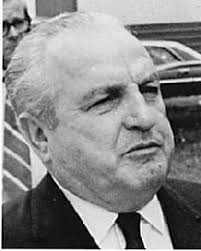
Carlos Marcello
[In 1961, Marcello was deported to his native Guatemala on orders by RFK. After illegally re-entering the country, he swore vengeance against the Attorney General.
[In September, 1962, during a meeting with several mob colleagues, he flew into a rage when someone mentioned Kennedy.
“Take the stone out of my shoe!” he shouted, echoing a Sicilian curse. “Don’t you worry about that little Bobby sonofabitch. He’s going to be taken care of!”
[When one of his colleagues warned that murdering RFK would trigger the wrath of his brother, President John F.Kennedy, Marcello replied: “In Sicily they say if you want to kill a dog you don’t cut off the tail. You go for the head.”
[Marcello believed that the death of President Kennedy would render the Attorney General powerless. And he added that he planned to use a “nut” to do the job.]
On November 22, 1963, President John F. Kennedy is assassinated in Dallas, Texas.
Blood Feud clearly implies that the Mafia was responsible.
2016 PRESIDENTIAL RACE, ABC NEWS, ALTERNET, AMERICABLOG, AP, BABY BOOMER RESISTANCE, BBC, BERNIE SANDERS, BLOOD FEUD, BLOOMBERG NEWS, BROTHERS: THE HIDDEN HISTORY OF THE KENNEDY YEARS, BUZZFEED, CARLOS MARCELLO, CBS NEWS, CIA, CNN, COTTER SMITH, CROOKS AND LIARS, CUBA, DAILY KOS, DAVID TALBOT, DONALD TRUMP, ERNEST BORGNINE, FBI, FIDEL CASTRO, FIVETHIRTYEIGHT, GUS RUSSO, HARPER’S MAGAZINE, HILLARY CLINTON, HUFFINGTON POST, INTERNATIONAL BROTHERHOOD OF TEAMSTERS, J. EDGAR HOOVER, JAMES R. HOFFA, JOHN F. KENNEDY, JUSTICE DEPARTMENT, LIVE BY THE SWORD: THE SECRET WAR AGAINST CASTRO AND THE DEATH OF JFK, MAFIA, MEDIA MATTERS, MOTHER JONES, MOVEON, MSNBC, NBC NEWS, NEW REPUBLIC, NEWSDAY, NEWSWEEK, NPR, PBS NEWSHOUR, POLITICO, POLITICUSUSA, RAFAEL EDWARD CRUZ, RAW STORY, REUTERS, ROBERT BLAKE, ROBERT F. KENNEDY, SALON, SAM GROOM, SEATTLE TIMES, Secret Service, SENATE LABOR RACKETS COMMITTEE, SLATE, TALKING POINTS MEMO, THE ATLANTIC, THE CHICAGO SUN-TIMES, THE CHICAGO TRIBUNE, THE DAILY BEAST, THE DAILY BLOG, THE GUARDIAN, THE HILL, THE HUFFINGTON POST, THE INTERCEPT, THE LOS ANGELES TIMES, THE NATION, THE NEW REPUBLIC, THE NEW YORK TIMES, THE NEW YORKER, THE VILLAGE VOICE, THE WALL STREET JOURNAL, THE WASHINGTON POST, THINKPROGRESS, TIME, TRUTHDIG, TRUTHOUT, TWITTER, U.S. NEWS & WORLD REPORT, UPI
In Bureaucracy, History, Law, Law Enforcement, Politics, Social commentary on April 21, 2016 at 12:37 pm
Today, America has four major candidates running for President: Donald Trump, Rafael Edward Cruz, Hillary Clinton and Bernie Sanders.
Trump is a billionaire businessman; Cruz is a U.S. Senator from Texas; Clinton is a former First Lady, U.S. Senator and Secretary of State; and Sanders is a U.S. Senator from Vermont.
Despite the great differences in their backgrounds, they all share one thing in common: Extremely high negatives among voters.
But 48 years ago, Senator Robert Francis Kennedy aroused passions of an altogether different sort.
Kennedy had been a United States Attorney General (1961-1964) and Senator (1964-1968). But it was his connection to his beloved and assassinated brother, President John F. Kennedy, for which he was best known.

Robert F. Kennedy campaigning for President
Millions saw RFK as the only candidate who could make life better for America’s impoverished–while standing firmly against those who threatened the Nation’s safety.
As television correspondent Charles Quinn observed: “I talked to a girl in Hawaii who was for [George] Wallace [the segregationist governor of Alabama]. And I said ‘Really?’ [She said] ‘Yeah, but my real candidate is dead.’
“You know what I think it was? All these whites, all these blue collar people who supported Kennedy…all of these people felt that Kennedy would really do what he thought best for the black people, but, at the same time, would not tolerate lawlessness and violence.
“They were willing to gamble…because they knew in their hearts that the country was not right. They were willing to gamble on this man who would try to keep things within reasonable order; and at the same time do some of the things they knew really should be done.”
Campaigning for the Presidency in 1968, RFK had just won the crucial California primary on June 4–when he was shot in the back of the head. His killer: Sirhan Sirhan, a young Palestinian furious at Kennedy’s support for Israel.
On June 8, 1,200 men and women boarded a specially-reserved passenger train at New York’s Pennsylvania Station. They were accompanying Kennedy’s body to its final resting place at Arlington National Cemetery.
As the train slowly moved along 225 miles of track, throngs of men, women and children lined the rails to pay their final respects to a man they considered a genuine hero.
Little Leaguers clutched their baseball caps across their chests. Uniformed firemen and policemen saluted. Burly men in shirtsleeves held hardhats over their hearts. Black men in overalls waved small American flags. Women from all levels of society stood and cried.

A nation says goodbye to Robert Kennedy
Commenting on RFK’s legacy, historian William L. O’Neil wrote in Coming Apart: An Informal History of America in the 1960′s:
“…He aimed so high that he must be judged for what he meant to do, and, through error and tragic accident, failed at….He will also be remembered as an extraordinary human being who, though hated by some, was perhaps more deeply loved by his countrymen than any man of his time.
“That too must be entered into the final account, and it is no small thing. With his death something precious disappeared from public life.”
Eleven years earlier, as a young, idealistic attorney, Kennedy had declared war on James Riddle Hoffa, the president of the Mafia-dominated International Brotherhood of Teamsters Union.
As chief counsel for the Senate Labor Rackets Committee, Kennedy was appalled at the corruption he discovered among high-ranking Teamster officials. As he saw it, under Hoffa’s leadership, the union was nothing less than “a conspiracy of evil.”
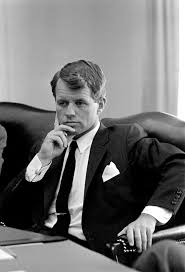
Robert Francis Kennedy as Chief Counsel, Senate Labor Rackets Committee
Hoffa, in turn, held an equally unflattering view of Kennedy. “A rich punk,” said Hoffa, who didn’t know or care about “the average workingman.”
In 1983, Blood Feud, a two-part TV mini-series, depicted the 11-year animosity between Kennedy and Hoffa. Although it took some dramatic liberties, its portrayal of the major events of that period remains essentially accurate.
Today, labor unions are a rapidly-vanishing species, commanding far less political influence than they did 50 years ago. As a result, young viewers of this series may find it hard to believe that labor ever held such sway, or that the Teamsters posed such a threat.
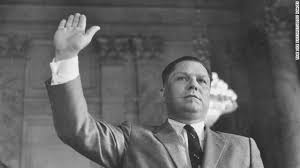
James Riddle Hoffa testifying before the Senate Labor Rackets Committee
And in an age when millions see “Big Government” as the enemy, they may feel strong reservations about the all-out war that Robert F. Kennedy waged against Hoffa.
Blood Feud opens in 1957, when Hoffa (Robert Blake) is a rising figure within the Teamsters. Kennedy (Cotter Smith) is chief counsel for the Senate Labor Rackets Committee.
At first, Hoffa tries to ingratiate himself with Kennedy, telling him: “I know everybody who can help me and anybody who can hurt me.”
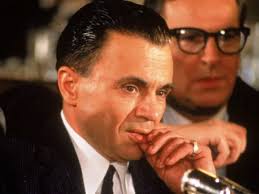
Robert Blake as James R. Hoffa
A wily Hoffa decides to parley Kennedy’s anti-corruption zeal into a path to power for himself. Via his attorney, Eddie Cheyfitz, he feeds Kennedy incriminating evidence against Dave Beck, president of the Teamsters.
Confronted with a Senate subpoena, Beck flees the country–paving the way for Hoffa to assume the top position in the union. Hoffa believes he has solved two problems at once.


.jpg)


-33510-W&docid=hCd9k6PuglvZAM&tbnid=CAo7BRzGtBWa3M%3A&w=500&h=375&bih=469&biw=819&ved=0ahUKEwiissafvJ_MAhUGKWMKHTZZA_MQxiAIAg&iact=c&ictx=1)


&docid=SiluTuHYHtjaZM&tbnid=uLB-PLYDVdkkVM%3A&w=455&h=341&ei=zeN_VI_hKYHjoATGs4Bo&ved=0CAIQxiAwAA&iact=c)


ABC NEWS, ADOLF HITLER, AL QAEDA, ANN COULTER, ARIZONA SHOOTINGS, ASSASSINATION, BARACK OBAMA, BILL CLINTON, BILL O'REILLY, BIRTHERS, BOBBY JINDAL, CBS NEWS, CHRISTINA-TAYLOR GREEN, CNN, COMMUNISM, CONFEDERATE FLAB, CRIME, DYLANN ROOF, FACEBOOK, FBI, GABRIELLE GIFFORDS, GEORGE H.W. BUSH, GEORGE W. BUSH, GLENN BECK, HATE GROUPS, HEALTHCARE, JBE BUSH, JOSEPH MCCARTHY, MEIN KAMPF, MICHELLE BACHMANN, NBC NEWS, NEWT GINGRICH, OBAMACARE, OSAMA BIN LADEN, RICHARD NIXON, RICK PERRY, RICK SANTORUM, RODNEY KING RIOTS, ROLLING STONE, RUSH LIMBAUGH, Sarah Palin, SEAN HANNITY, Secret Service, SOVIET UNION, SPIRO AGNEW, TEA PARTY, THE CHICAGO SUN-TIMES, THE CHICAGO TRIBUNE, THE LOS ANGELES TIMES, THE NEW YORK TIMES, THE WASHINGTON POST, TWITTER, U.S. DISTRICT JUDGE JOHN ROLL, U.S. MARSHALS SERVICE, WHITE SUPREMACISTS
REPUBLICANS AND WEAPONIZED HATRED: PART FOUR (END)
In Bureaucracy, History, Law, Law Enforcement, Politics, Social commentary on May 17, 2016 at 12:05 amWhen President Barack Obama set out to provide healthcare for all Americans–-and not simply the wealthiest 1%–-Republicans tried to frighten voters with lies.
The most infamous of these was that healthcare reform would lead to wholesale murder by government “death panels,” as Sarah Palin put it.
Despite being the party of the extreme Right, Republicans delight in portraying Obama as the ultimate Fascist: Adolf Hitler.
At their rallies they brandish doctored photos of Obama sporting a Hitler forelock and toothbrush mustache.
And they claim he plans to set up concentration camps for those who disagree with him.
They also claim he intends to “take away our guns–just like Hitler.”
In fact:
Even more ominously, heavily-armed Right-wingers have showed up at places where Obama was scheduled to speak.
In August, 2009, about a dozen people carrying guns, including one with a military-style rifle, milled among protesters outside a Phoenix convention center where President Obama was giving a speech.
A week earlier, during Obama’s healthcare town hall in New Hampshire, a man carrying a sign reading “It is time to water the tree of liberty” stood outside with a pistol strapped to his leg.
On August 28, 2010, an armed Obama protester was arrested by police at the Alaska State Fair, where the President was scheduled to speak.
According to the Secret Service, Obama is the target of more than 30 death threats a day and is the most threatened President in history. The heightened danger he faces is stretching the Secret Service to its limits.
Secret Service agents guarding President Obama
Since Obama took office in 2009, the rate of threats against him has increased 400%.
Fred Solop, a Northern Arizona University political scientist, said the incidents in New Hampshire and Arizona could signal the beginning of a disturbing trend.
“When you start to bring guns to political rallies, it does layer on another level of concern and significance,” Solop said. “It actually becomes quite scary for many people. It creates a chilling effect in the ability of our society to carry on honest communication.”
The way to prevent such tragedies in the future is to hold fully accountable not just the shooters but those who deliberately point them toward their targets and repeatedly scream: “Kill the traitors!”
Americans must shed their naive belief that “America is exempt from the political corruption of other countries.” And they must see the Republicans’ lust for absolute power at any price as the danger it presents to the future of the Republic.
Among the steps that need to be taken:
First, the families and friends of the Tucson massacre victims should file civil lawsuits against Sarah Palin and every other Republican who created the firestorm of hate that consumed 19 victims.
And survivors of the massacre at Emanuel African Methodist Episcopal Church should do likewise against those Right-wing groups that influenced Dylann Roof to snuff out nine innocent lives because they were black.
A legal precedent for such lawsuits emerged 20 years ago, and still remains viable.
On November 13, 1988 in Portland, Oregon, three white supremacist members of East Side White Pride and White Aryan Resistance (WAR) beat to death Mulugeta Seraw, an Ethiopian man who came to the United States to attend college.
Morris Dees and the Southern Poverty Law Center filed a civil suit (Berhanu v. Metzger) against Tom Metzger, founder of WAR. They argued that WAR influenced Seraw’s killers by encouraging their group, East Side White Pride, to commit violence.
Tom and John Metzger were found civilly liable under the doctrine of vicarious liability, in which one can be liable for a tort committed by a subordinate or by another person who is taking instructions.
In October 1990, the jury returned the largest civil verdict in Oregon history at the time—$12.5 million—against Metzger and WAR. The Metzgers’ house was seized, and most of WAR’s profits went to paying off the judgment.
Second, the FBI and Justice Department should launch an all-out investigation into not simply right-wing hate groups but those political leaders who openly or secretly encourage and support their activities.
Those who are found doing so should be indicted and prosecuted under the Patriot Act and the Racketeer Influenced Corrupt Organizations Act.
Third, the Secret Service should immediately adopt the policy that no one but sworn law enforcement officers will be allowed to carry firearms within the immediate vicinity of the President. And it should enforce that policy through its elite countersniper teams.
Finally, President Obama should do what President Clinton failed to do at the time of the 1995 Right-wing truck-bombing of the Oklahoma City Federal Building: He should publicly condemn those Republicans who give “aid and comfort” to the right-wing extremists whose support they openly court.
Unless such steps are taken, outrages such as the Tucson slaughter will continue to remain a needless “mystery.” And those outrages will continue until a Republican version of the swastika permanently flies over the capitol dome and the White House.
Share this: