bureaucracybusters

Posts Tagged ‘DWIGHT D. EISENHOWER’

“BRIDGE OF SPIES” TELLS UGLY TRUTHS ABOUT GOVERNMENT: PART ONE (OF TWO)

In Bureaucracy, Entertainment, History, Law, Law Enforcement, Military, Politics, Social commentary on March 18, 2016 at 12:01 am

Steven Spielberg’s new movie, “Bridge of Spies,” is that rarity among films: An intelligent mixture of history and drama, stripped of gratuitous sex and violence.

It’s also a film that accurately reveals unsettling truths about how government intelligence agencies really operate.

Truth #1: Appearance counts for more than reality.

The movie opens with the FBI’s arrest of KGB spy Rudolph Abel (Mark Rylance). The evidence against him is overwhelming. This–plus the “Red Scare” climate of 1957–will guarantee his conviction.

But the Eisenhower administration doesn’t want the upcoming trial to be seen as a hangman’s court. It must have the appearance of a fair proceeding.

So the Justice Department (through the Brooklyn Bar Association) asks a New York insurance attorney named James B. Donovan (Tom Hanks) to take on Abel’s defense. He’s expected to make a reasonably competent effort but not go all out on behalf of his client.

Truth #2: Individual conscience can wreck the best-laid plans of government.

Donovan has never handled a spy case before. And he has no delusions that Abel isn’t the spy he’s charged with being. But he’s determined to give Abel the same committed defense he would give to any other client.

Rudolph Abel (Mark Rylance) and James Donovan (Tom Hanks) in court

This comes as a shock to the prosecutors, the judge, his law firm and even his family.

A CIA agent approaches Donovan in a nearly deserted restaurant and asks him to reveal any secrets that might help win Abel’s conviction.

Donovan replies: “This conversation isn’t happening.”

“No, of course not,” replies the CIA agent, assuming Donovan is agreeing to keep the overture secret.

“No, I mean this conversation isn’t happening,” angrily says Donovan, who leaves the agent fuming.

Donovan becomes a pariah; his mailbox is stuffed with hate mail and one night a would-be drive-by killer riddles his house with bullets.

Abel is convicted and sentenced to 45 years’ imprisonment. But Donovan–again shocking everyone he knows–pursues an appeal up to the Supreme Court.

He argues that the evidence against Abel is tainted by an invalid search warrant. No American citizen could be convicted under such circumstances. And the Constitutional protections that hold true for Americans should hold equally true for non-Americans charged with crimes in American courts.

Donovan’s arguments will be heard a half-century later, when al-Qaeda suspects are hauled before American courts.

He puts on an impressive case on Abel’s behalf, but loses 5-4 at the Supreme Court.

That seems to be the end of Donovan’s relationship with Abel. But events soon dictate otherwise.

Before the judge could pronounce a death sentence on Abel, Donovan had argued that this might be a mistake. The day might come, he told the judge, when an American spy might fall into Soviet hands.

And then the United States would need to swap Abel to secure the release of its own agent.

The judge, moved by that argument, had given Abel a lengthy prison term instead.  

That day comes sooner than anyone in the Pentagon expects.

On May 1, 1960, Francis Gary Powers, a former Air Force pilot, is flying a high-altitude U-2 plane above the Soviet Union for the CIA. The plane is equipped with state-of-the-art cameras, and Powers intends to photograph military sites and other important complexes.

Suddenly, a surface-to-air missile slams into the plane. Powers ejects before it crashes, but fails to commit suicide with a poison pin concealed in a phony silver dollar. He’s captured by the KGB and brutally interrogated, but maintains his silence.

At about the same time, Frederic Pryor, an American economics graduate student living in West Germany, visits his German girlfriend living in Soviet-dominated East Germany.

The Soviets are starting to build their infamous Berlin Wall, which will stop the flow of refugees from East to West. Pryor tries to bring his girlfriend and her father into West Berlin, but he’s stopped and arrested by agents of Stasi, the East German police, who accuse him of being a spy.

Meanwhile, the Soviet Union wants its spy, Abel, returned, before he can spell its secrets. In turn, the new Kennedy administration wants Powers returned, before he can be made to spill American secrets.

Truth #3: High-ranking government officials will ask citizens to take risks they themselves refuse to take.

In 1961, Donovan is once again sought out by the American government–this time by no less than CIA Director Allen Dulles.

And he’s asked to go where no official American representative can go–East Germany. His new assignment: Negotiate the exchange of Powers for Abel.

The CIA wants its spy back. And it’s willing to send Donovan into East Germany to negotiate his release. But it’s not willing to back him up if he’s arrested by Stasi, the notorious East German secret police.  

The fiction must be maintained that Donovan is acting strictly on his own behalf, not that of the United States.

In such a case, Donovan could spend the rest of his life in a Communist prison cell.


“BRIDGE OF SPIES” TELLS UNPLEASANT TRUTHS ABOUT GOVERNMENT: PART TWO (END)

In Bureaucracy, History, Law, Military, Politics, Social commentary on October 27, 2015 at 12:01 am

“Bridge of Spies” vividly recaptures a now-forgotten time in American history.

It was the time of “the Cold War.”  A time when:

  • America was almost universally seen as “The Good Guy,” in contrast to “The Bad Guy” of the Soviet Union;
  • The United States and the Soviet Union held each other at bay with arsenals of nuclear weapons;
  • Wisconsin Senator Joseph R. McCarthy terrorized the nation, accusing anyone who disagreed with him of being a Communist–and leaving ruined lives in his wake;
  • American TVs blared commercials warning that Soviet Premier Nikita Khrushchev had boasted: “We will bury you”; and
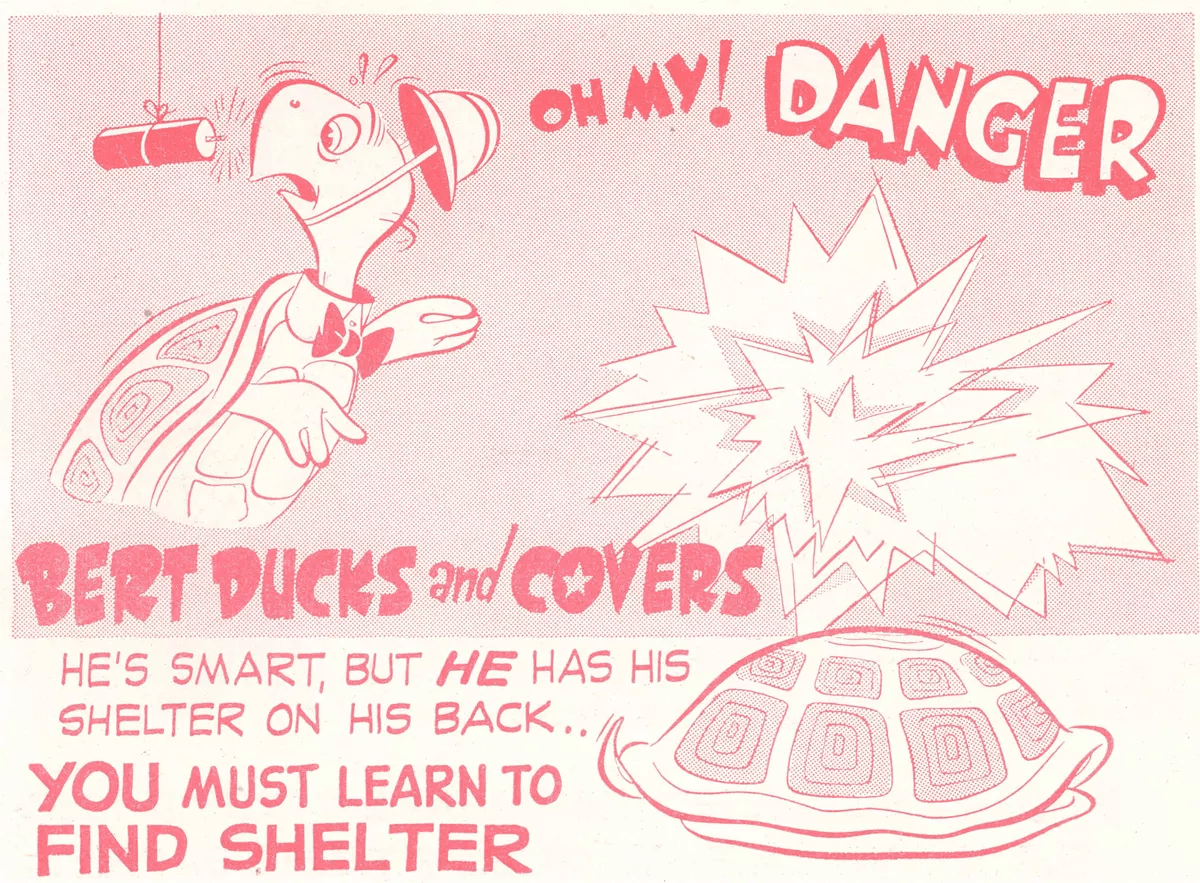
  • Children and teenagers were taught in school that they could survive a nuclear attack through “duck and cover” drills. They were instructed to keep their bathtubs filled with water for safe drinking, in the event of a Soviet nuclear strike.
Bert2.png (300×232)

Bert the Turtle teaches schoolchildren to “Duck and Cover”

Yet even in this poisonous atmosphere of fear and denunciation, some men stood out as heroes–simply by holding fast to their consciences.

One of these was a New York insurance attorney named James B. Donovan (played by Tom Hanks). Asked by the Justice Department to defend arrested Soviet spy Rudolph Abel (Mark Rylance) Donovan did what no one expected.

He gave Abel a truly vigorous defense, arguing that the evidence used to convict him was the legally-tainted product of an invalid search warrant.

Upon Abel’s conviction and sentencing to 45 years’ imprisonment, Donovan again shocked the political and legal communities by appealing the case to the Supreme Court.

Donovan argued that Constitutional protections should apply to everyone–including non-Americans–tried in American courts.  To do less made a mockery of the very freedoms we claimed to champion.

He lost by a vote of 5-4.  But the arguments he made would resurface 50 years later when al-Qaeda suspects were hauled into American courts.

James B. Donovan

In 1961, Donovan was again called upon to render service by a Federal agency–this time the CIA.  It wanted his help in negotiating the release of its spy, Francis Gary Powers, shot down over the Soviet Union in 1960 while flying a high-altitude U-2 spy plane.

Throughout “Bridge of Spies,” audiences learn some unsettling truths about how the American government–and governments generally–actually operate.

The first three of these were outlined in Part one of this series:

Truth #1: Appearance counts for more than reality.

Truth #2: Individual conscience can wreck the best-laid plans of government.

Truth #3: High-ranking government officials will ask citizens to take risks they themselves refuse to take.

Now for the remaining truths revealed in this movie.

Truth #4: Appeals to fear often prevail when appeals to humanity are ignored.

After crossing into East Germany, Donovan enters into negotiations with Wolfgang Vogel, a lawyer representing the East German government.

Vogel offers to exchange Frederic Pryor, an American economics graduate student seized by the East German secret police, for Abel. Donovan replies this is a deal-breaker; the United States (which is never mentioned during the negotiations) wants Powers, not Pryor.

Nevertheless, Donovan is equally concerned for Pryor, and adds him to the list of hostages to be released in return for Abel.

Then a new complication arises: The East German government that holds Pryor threatens to pull out. claiming to be insulted because Donovan did not inform them that the USSR was a party to the negotiation.

His reasoned, legal arguments having failed, Donovan resorts to a threat. He conveys a warning to the president of East Germany:

Abel has not yet revealed any Soviet secrets. But if this deal fails, he may well do so to earn favors from the United States government. And, in that case, the Soviets will blame you–Erich Honecker, the  president of East Germany–for the resulting damage.

Where arguments based on humanity have failed, this one–based on fear–works.  A prisoner-exchange is arranged.

Truth #5: Personal loyalty can supersede bureaucratic inventions.

On February 10, 1962, Donovan, Abel and several CIA agents arrive at the Glienicke Bridge, which connects East and West Germany. The Soviets have Powers, but not Pryor–who is to be released at Checkpoint Charlie, a crossing point between East and West Berlin.

    Glienicke Bridge, the “Bridge of Spies” 

The CIA agent in charge of the American delegation tells Abel he can cross into East Germany, even though Pryor has not been released.

But Abel has learned that Donovan has negotiated the release of not only Powers but Pryor. Out of loyalty to the man who has vigorously defended him, he waits on his side of the bridge until word arrives that Pryor has been released.

Then Abel crosses into East Germany while Powers crosses into the Western sector.

Donovan returns home. Before flying off to West Germany, he had told his wife he was going on a fishing trip in Scotland.

His wife and children learn the truth about the risks he ran and the success he attained only when a television newscast breaks the news:

Francis Gary Powers has been returned to the United States. And the man responsible is James Donovan, once the most reviled man in America for having defended a notorious Soviet spy.

“BRIDGE OF SPIES” TELLS UNPLEASANT TRUTHS ABOUT GOVERNMENT: PART ONE (OF TWO)

In Bureaucracy, History, Law, Military, Politics, Social commentary on October 26, 2015 at 12:27 am

Steven Spielberg’s new movie, “Bridge of Spies,” is that rarity among films: An intelligent mixture of history and drama, stripped of gratuitous sex and violence.

It’s also a film that accurately reveals unsettling truths about how government agencies really operate.

Truth #1: Appearance counts for more than reality.

The movie opens with the FBI’s arrest of KGB spy Rudolph Abel (Mark Rylance). The evidence against him is overwhelming. This–plus the “Red Scare” climate of 1957–will guarantee his conviction.

But the Eisenhower administration doesn’t want the upcoming trial to be seen as a hangman’s court.  It must have at least the appearance of a fair proceeding.

So the Justice Department (through the Brooklyn Bar Association) asks a New York insurance attorney named James B. Donovan (Tom Hanks) to take on Abel’s defense. He’s expected to make a reasonably competent effort but not go all out on behalf of his client.

Truth #2: Individual conscience can wreck the best-laid plans of government.

Donovan has never handled a spy case before. And he has no delusions that Abel isn’t the spy he’s charged with being. But he’s determined to give Abel the same committed defense he would give to any other client.

Rudolph Abel (Mark Rylance) and James Donovan (Tom Hanks) in court

This comes as a shock to the prosecutors, the judge, his law firm and even his family.

A CIA agent approaches Donovan in a nearly deserted restaurant and asks him to reveal any secrets that might help win Abel’s conviction.

Donovan replies: “This conversation isn’t happening.”

“No, of course not,” replies the CIA agent, assuming Donovan is agreeing to keep the overture secret.

“No, I mean this conversation isn’t happening,” angrily says Donovan, who leaves the agent fuming.

Donovan becomes a pariah; his mailbox is stuffed with hate mail and one night a would-be drive-by killer riddles his house with bullets.

Abel is convicted and sentenced to 45 years’ imprisonment. But Donovan–again shocking everyone he knows–pursues an appeal up to the Supreme Court.

He argues that the evidence against Abel is tainted by an invalid search warrant. No American citizen could be convicted under such circumstances; and the Constitutional protections that hold true for Americans should hold equally true for non-Americans charged with crimes in American courts.

Donovan’s arguments will be heard a half-century later, when al-Qaeda suspects are hauled before American courts.

He puts on an impressive case on Abel’s behalf, but loses 5-4 at the Supreme Court.

That seems to be the end of Donovan’s relationship with Abel.  But events soon dictate otherwise.

Before the judge could pronounce a death sentence on Abel, Donovan had argued that this might be a mistake. The day might come, he told the judge, when an American spy might fall into Soviet hands.

And then the United States would need to swap Abel to secure the release of its own agent.

The judge, moved by that argument, had given Abel a lengthy prison term instead.

On May 1, 1960, Francis Gary Powers, a former Air Force pilot, is flying a high-altitude U-2 plane above the Soviet Union for the CIA. The plane is equipped with state-of-the-art cameras, and Powers intends to photograph military sites and other important complexes.

Suddenly, a surface-to-air missile slams into the plane. Powers ejects before it crashes, but fails to commit suicide with a poison pin concealed in a phony silver dollar.  He’s captured by the KGB and brutally interrogated, but maintains his silence.

At about the same time, Frederic Pryor, an American economics graduate student living in West Germany, visits his German girlfriend living in Soviet-dominated East Germany.

The Soviets are starting to build their infamous Berlin Wall, which will stop the flow of refugees from East to West.  Pryor tries to bring his girlfriend and her father into West Berlin, but he’s stopped and arrested by agents of Stasi, the East German police, who accuse him of being a spy.

Meanwhile, the Soviet Union wants its spy, Abel, returned, before he can spell its secrets. In turn, the new Kennedy administration wants Powers returned, before he can be made to spill American secrets.

Truth #3: High-ranking government officials will ask citizens to take risks they themselves refuse to take.

In 1961, Donovan is once again sought out by the American government–this time by no less than CIA Director Allen Dulles.

And he’s asked to go where no official American representative can go–East Germany. His new assignment: Negotiate the exchange of Powers for Abel.

The CIA wants its spy back. And it’s willing to send Donovan into East Germany to negotiate his release. But it’s not willing to back him up if he’s arrested by Stasi, the notorious East German secret police.

In such a case, Donovan could spend the rest of his life in a Communist prison cell.

JUNE 6: ONE DAY, TWO ANNIVERSARIES

In History, Military, Politics, Social commentary on June 5, 2015 at 12:38 am

“For it is the doom of men that they forget.”
–Merlin, in “Excalibur”

June 6–a day of glory and tragedy.

The glory came  71 years ago–-on Tuesday, June 6, 1944.

On that morning, Americans awoke to learn–-from radio and newspapers–-that their soldiers had landed on the French coast of Normandy.

In Supreme Command of the Allied Expeditionary Force was American General Dwight D. Eisenhower. Overall command of ground forces was given to British General Bernard Montgomery.

Operation Overlord, the Allied invasion to liberate France from Nazi Germany, proved one of the pivotal actions of World War II.

It opened shortly after midnight, with an airborne assault of 24,000 American, British, Canadian and Free French troops.

This was followed at 6:30 a.m. by an amphibious landing of Allied infantry and armored divisions on the French coast.

Field Marshal Erwin Rommel–-the legendary “Desert Fox”–-commanded the German forces.  For him, the first 24 hours of the battle would be decisive.

“For the Allies as well as the Germans,” he warned his staff, “it will be the longest day.”

The operation was the largest amphibious invasion in history.  More than 160,000 troops landed–-73,000 Americans, 61,715 British and 21,400 Canadians.

Initially, the Allied assault seemed likely to be stopped at the water’s edge–-where Rommel had always insisted it must be.

He had warned that if the Allies established a beachhead, their overwhelming advantages in numbers and airpower would eventually prove irresistible.

German machine-gunners and mortarmen wreaked a fearful toll on Allied soldiers.  But commanders like U.S. General Norman Cota led their men to victory through a storm of bullets and shells.

Coming upon a group of U.S. Army Rangers taking cover behind sand dunes, Cota demanded: “What outfit is this?”

“Rangers!” yelled one of the soldiers.

“Well, Goddamnit, then, Rangers, lead the way!” shouted Cota, inspiring the soldiers to rise and charge into the enemy.

The command also gave the Rangers the motto they carry to this day.

The allied casualty figures for D-Day have been estimated at 10,000, including 4,414 dead. By nationality, the D-Day casualty figures are about 2,700 British, 946 Canadians and 6,603 Americans.

The total number of German casualties on D-Day isn’t known, but is estimated at 4,000 to 9,000.

Allied and German armies continued to clash throughout France, Belgium and Germany until May 7, 1945, when Germany finally surrendered.

But those Americans who had taken part in D-Day could be proud of having dealt a fatal blow to the evil ambitions of Adolf Hitler’s Third Reich.

So much for the glory of June 6.  Now for the tragedy–-which occurred 47 years ago, on Thursday, June 6, 1968.

Twenty-four years after D-Day, Americans awoke to learn–-mostly from TV–-that New York Senator Robert F. Kennedy had died at 1:44 a.m. of an assassin’s bullet.

He had been campaigning for the Democratic Presidential nomination, and had just won the California primary on June 4.

This had been a make-or-break event for Kennedy, a fierce critic of the seemingly endless Vietnam war.

He had won the Democratic primaries in Indiana and Nebraska, but had lost the Oregon primary to Minnesota Senator Eugene McCarthy.

If he could defeat McCarthy in California, Kennedy could force his rival to quit the race.  That would lead to a showdown between him and Vice President Hubert Humphery for the nomination.

(President Lyndon B. Johnson had withdrawn from the race on March 31–-just 15 days after Kennedy announced his candidacy on March 16.)

After winning the California and South Dakota primaries, Kennedy gave a magnaminous victory speech in the ballroom of the Ambassador Hotel in Los Angeles:

“I think we can end the divisions within the United States….We are a great country, an unselfish country, and a compassionate country.

“And I intend to make that my basis for running over the period of the next few months.”

Then he entered the hotel kitchen–-where Sirhan Sirhan, a 24-year-old Palestinian from Jordan, opened fire with a .22 revolver.

Kennedy was hit three times–once fatally in the back of the head.  Five other people were also wounded.

Kennedy’s last-known words were: “Is everybody all right?” and “Jack, Jack”–-the latter clearly a reference to his beloved older brother, John Fitzgerald Kennedy.

Almost five years earlier, that brother–-then President of the United States–-had been assassinated in Dalas on November 22, 1963.

Then Robert Kennedy lost consciousness–-forever, dying in a hospital bed 24 hours later.

Kennedy had been a U.S. Attorney General (1961-1964) and Senator (1964-1968).  But it was his connection to  President Kennedy for which he was best-known.

His assassination–-coming so soon after that of JFK–-convinced many Americans there was something “sick” about the nation’s culture.

One of the best summaries of Robert Kennedy’s legacy was given in Coming Apart: An Informal History of America in the 1960′s, by historian William L. O’Neil:

“…He aimed so high that he must be judged for what he meant to do, and, through error and tragic accident, failed at….

“He will also be remembered as an extraordinary human being who, though hated by some, was perhaps more deeply loved by his countrymen than any man of his time.

“That too must be entered into the final account, and it is no small thing.  With his death something precious disappeared from public life.”

THE POLITICS OF SCAPETOATING: PART THREE (END)

In Bureaucracy, History, Law, Politics, Social commentary on February 6, 2015 at 12:15 am

With the Soviet Union collapsed in 1991, the Republican Party went into a tailspin of dismay.

For almost 50 years, Republicans had conjured up The Red Bogeyman to scare voters into sending them to Congress and the White House.

But now that the “workers’ paradise” had disappeared, Americans seemed to lose interest in the Communist Menace.

True, the People’s Republic of China remained, and its increasing economic clout would challenge the United States well into the 21st century.  But Americans didn’t seem to fear the Red Chinese as they had the Red Russians.

What was the Republican Party to do to lure voters?

On September 11, 2001, the answer arrived–in two highjacked jetliners that crashed into the World Trade Center in New York and one that struck the Pentagon in Washington, D.C.

Exit The Red Bogeyman.  Enter The Maniacal Muslim.

Consider:

  • Mike Huckabee – “If the purpose of a church is to push forward the gospel of Jesus Christ, and then you have a Muslim group that says that Jesus Christ and all the people that follow him are a bunch of infidels who should be essentially obliterated, I have a hard time understanding that.”
  • Herman Cain – ”I would not” appoint a Muslim in his administration.
  • Newt Gingrich – “I am convinced that if we do not decisively win the struggle over the nature of America, by the time they [his grandchildren] are my age they will be in a secular atheist country, potentially one dominated by radical Islamists. …”
  • Rick Santorum – On supporting the racial profiling of Muslims: “Obviously, Muslims would be someone you look at, absolutely.”
  • Mitt Romney – “Based on the numbers of American Muslims in our population, I cannot see that a Cabinet position [for a Muslim] would be justified.”

And on July 13, Rep. Michelle Bachmann (R-Minn.) sent letters to the Inspectors General of the Departments of

  • Defense;
  • State;
  • Justice; and
  • Homeland Security.

“The purpose of these letters,” wrote Bachmann, was to “request a multi-department investigation into potential Muslim Brotherhood infiltration into the United States Government.”

Michelle Bachmann

Bachmann further asserted in her letter to the State Department that Huma Abedin, deputy chief of staff to Secretary of State Hillary Clinton, had ties to the Muslim Brotherhood.

And the evidence for this?

The Center for Security Policy’s claim that Abedin’s father (who died when she was a teenager), mother and brother are “connected” to the organization.

And what is the Center of Security Policy?  A private organization subsidized by donors to neo-conservative causes.

In a separate letter, Bachmann demanded to know how Abedin received her security clearance.

Among the co-signers of Bachmann’s letter to the Inspectors General were:

  • Rep. Trent Franks of Arizona, who has said abortion has done more harm to blacks than slavery;
  • Rep. Lynn Westmoreland of Georgia, who called presidential candidate Barack Obama and his wife, Michelle, ”uppity”; and
  • Rep. Louie Gohmert of Texas, who claims that terrorist organizations send pregnant women into the U.S. so that their children will be American citizens–who can enter and leave the country at will as they are trained to be terrorists abroad.

When pressed for their evidence of “a vast Muslim conspiracy,” right-wing accusers usually refuse to provide any.

An example of this occurred during an August 13, 2010 interview between Gohmert and CNN’s Anderson Cooper:

COOPER: What research? Can you tell us about the research?

GOHMERT: You are attacking the messenger, Anderson, you are better than this. You used to be good. You used to find that there was a problem and you would go after it.

COOPER: Sir, I am asking you for evidence of something that you said on the floor of the House.

GOHMERT: I did, and you listen, this is a problem. If you would spend as much time looking into the problem as you would have been trying to come after me and belittle me this week –

COOPER: Sir, do you want to offer any evidence? I’m giving you an opportunity to say what research and evidence you have. You’ve offered none, other than yelling.

Nor did Gohmert offer any evidence that evening.

Of course, the ultimate Republican Muslim slander is that President Barack Obama–a longtime Christian–is himself a Muslim.

No doubt Republicans feel totally safe in making these attacks, since Muslims comprise only 1% of the American population.

This has long been a hallmark of right-wing attacks–to go after a minority that cannot effectively defend itself.

Thus, Adolf Hitler attacked the Jews of Germany.

And Republicans have successively attacked blacks, Hispanics and gays–until each group became politically influential enough to defeat Republican candidates.

Today, most right-wing politicians at least grudgingly court all of these groups.

When Muslims become a significant political force in their own right, the Right will court them, too.  And then move on to yet another helpless scapegoat to blame for America’s troubles.

THE POLITICS OF SCAPEGOATING: PART TWO (OF THREE

In Bureaucracy, History, Law, Politics, Social commentary on February 5, 2015 at 12:08 am

“Judge not, that you not be judged.  For with what judgment you judged, you shall be judged, and with what measure you mete, it shall be measured to you again.”

So warns the Gospel of St. Matthew, 7:1-2.  It’s advice that Right-wingers Joseph McCarthy, Robert Welch and George H.W. Bush would have done well to heed.

Joseph McCarthy, Wisconsin’s gift to the United States Senate, became infamous as the demagogue whose Red-baiting accusations terrified America from 1950 to 1954.

Joseph McCarthy

Elected to the Senate in 1946, he rose to national prominence on February 9, 1950, after giving a fiery speech in Wheeling, West Virginia:

“The State Department is infested with communists. I have here in my hand a list of 205—a list of names that were made known to the Secretary of State as being members of the Communist Party and who nevertheless are still working and shaping policy in the State Department.”

Americans were already growing increasingly fearful of Communism:

  • Soviet dictator Joseph Stalin had not withdrawn the Red Army from the countries it had occupied in Eastern Europe during World War II.
  • In 1948, the Soviet Union developed–and demonstrated–its own atomic bomb, an achievement U.S. scientists had claimed would not happen for at least a decade.
  • In 1949, China fell to the triumphant armies of Mao Tse Tung.

But anti-communism as a lever to political advancement sharply accelerated following McCarthy’s speech.  Republicans–resentful at being denied the White House since 1932–seized upon anti-communism as their passport to power.

No American–no matter how prominent–was safe from the accusation of being a Communist or a Communist sympathizer–”a Comsymp” or “fellow traveler” in the style of the era.

Among those accused:

  • Secretary of State George C. Marshall, who had overseen America’s strategy for defeating Nazi Germany and Imperial Japan
  • President Harry S. Truman
  • Playwright Lillian Hellman and Arthur Miller
  • Actors Charlie Chaplin, Zero Mostel, Lloyd Bridges, Howard Da Silva, Edward G. Robinson and John Garfield
  • Composers Arron Copland and Elmer Bernstein
  • Physicist J. Robert Oppenheimer, who presided over the creation of America’s atomic bomb
  • Actressses Lee Grant, Delores del Rio, Ruth Gordon and Lucille Ball
  • Journalists Edward R. Murrow and William L. Shirer, who had chronicled the rise of Nazi Germany
  • Folksinger Pete Seeger
  • Writers Irwin Shaw, Howard Fast, John Steinbeck and Dashiell Hammett

Even “untouchable” Republicans became targets for such slander.

The most prominent of these was President Dwight D. Eisenhower–labeled ”a conscious, dedicated agent of the Communist Conspiracy” by Robert Welch, who founded the John Birth Society in 1958.

Robert Welch

Welch, an independently wealthy businessman, used his money to publicize the Society and its views.  Welch saw even hardline anti-Communists like Vice President Richard Nixon and actor Ronald Reagan as dangerously liberal.

Meanwhile, McCarthy finally overstepped himself.  In 1953, he attacked the leadership of the United States Army as “a hotbed of traitors” and convened an inquiry through the Senate Permanent Subcommittee on Investigations.

But the hearings backfired, exposing McCarthy as the bullying demagogue he was.  A Senate committee voted to condemn his behavior, charging that he had “acted contrary to senatorial ethics and tended to bring the Senate into dishonor and disrepute.”

Although McCarthy remained in the Senate another two and a half years, his political influence had ended.

Journalists who had raced to cover his latest slander now avoided him.  So did his Republican colleagues–many of whom had once sought his help at election time.

Yet even without McCarthy, Republicans rode the issue of anti-Communism to victory from 1948 to 1960.

After holding the White House for eight years under Eisenhower, they lost it in 1960 to John F. Kennedy and again in 1964 to Lyndon Johnson.

By 1968, with the nation mired in Vietnam and convulsed by antiwar demonstrations, Americans turned once more to those who preyed upon their fears and hates.  They elected Richard Nison–and re-elected him in 1972.

After Jimmy Carter won the Presidency in 1976 and lost it in 1980, Republicans held the White House until 1992.  Throughout that time, they continued to accuse their opponents of being devious agents–or at least unwitting pawns–of “the Communist conspiracy.”

Even as late as 1992, President George H.W. Bush and the Republican establishment charged that Arkansas Governor Bill Clinton might be a KGB plant.

George H.W. Bush

Their evidence: During his tenure at Oxford University in 1969-70, Clinton had briefly visited Moscow.

Thus, the Republican charged that he might have been “programmed” as a real-life “Manchrian candidate” to become, first, Governor of Arkansas–one of America’s poorest states–and then President.

What made this charge all the more absurd: The Soviet Union had officially dissolved in December, 1991.

Although Republicans continued to hurl “Communist!” and “treason!” at their opponents, these charges no longer carried the weight they had while the Soviet Union existed.

Right-wingers had to settle for attacking their opponents as “liberals” and “soft on crime.”

Then, on September 11, 2001, Republicans–and their right-wing supporters–at last found a suitable replacement for the Red Menace.

THE POLITICS OF SCAPEGOATING: PART ONE (OF THREE)

In Bureaucracy, History, Law, Politics, Social commentary on February 4, 2015 at 12:02 am

All revolutions,” said Ernst Rohem, leader of Adolf Hitler’s brown-shirted thugs, the S.A., “devour their own children.”

Ernst Rohem

Fittingly, he said this as he sat inside a prison cell awaiting his own execution.

On June 30, 1934, Hitler had ordered a massive purge of his private army, the S.A., or Stormtroopers.  The purge was carried out by Hitler’s elite army-within-an-army, the Schutzstaffel, or Protective Squads, better known as the SS.

The S.A. Brownshirts had been instrumental in securing Hitler’s rise to Chancellor of Germany on January 30, 1933.  They had intimidated political opponents and organized mass rallies for the Nazi Party.

But after Hitler reached the pinnacle of power, they became a liability.

Ernst Rohem, their commander, urged Hitler to disband the regular German army, theReichswehr, and replace it with his own legions as the nation’s defense force.

Frightened by Rohem’s ambitions, the generals of the Reichswehr gave Hitler an ultimatum: Get rid of Rohem–or they would get rid of him.

So Rohem died in a hail of SS bullets–as did several hundred of his longtime S.A. cronies.

SS firing squad

Among the SS commanders supervising those executions was Reinhard Heydrich–a tall, blond-haired formal naval officer who was both a champion fencer and talented violinist.

Ultimately, he would become the personification of the Nazi ideal–”the man with the iron heart,” as Hitler eulogized at Heydrich’s funeral just eight years later.

Reinhard Heydrich

Even so, Heydrich had a problem: He could never escape vicious rumors that his family tree contained a Jewish ancestor.

His paternal grandmother had married Reinhold Heydrich, and then Gustav Robert Suss.  For unknown reasons, she decided to call herself Suss-Heydrich.

Since “Suss” was widely believed in Germany to indicate Jewish origin, the “stigma” of Jewish heritage attached itself to the Heydrich family.

Heydrich joined the SS in 1931 and quickly became head of its counterintelligence service.  But his arrogance and overweening ambition created a great many enemies.

Only a year later, he became the target of an urgent investigation by the SS itself. The charge: That he was part-Jewish, the ultimate sin in Hitler’s “racially pure” Nazi Germany.

The investigation cleared Heydrich, but the rumor of his “tainted” origins persisted, clearly tormenting the second most powerful man in the SS. Even his superior, Heinrich Himmler, the Reichsfuhrer-SS, believed it.

When Heydrich was assassinated in 1942 by Czech assassins in Prague, Himmler attended his funeral. He paid tribute to his former subordinate at the service: ”You, Reinhard Heydrich, were a truly good SS-man.”

But he could not resist saying in private: “He was an unhappy man, completely divided against himself, as often happened with those of mixed race.”

Those who dare to harshly judge others usually find themselves assailed just as harshly.

A modern-day example is Liz Cheney, daughter of former Vice President Dick Cheney and a 2014 candidate for U.S. Senator from Wyoming.

Liz tried to position herself as far more right-wing than her opponent, Republican U.S. Senator Michael Bradley “Mike” Enzi. She found her work cut out for her: In March, 2007, Enzi was ranked by National Journal as the sixth-most conservative U.S. Senator. Among his legislative priorities:

  • Supporting partial privatization of Social Security
  • Consistently voting against expanding Medicare.
  • Voting against enrolling more children or the poor in public healthcare.

       Mike Enzi

And Liz had a problem Enzi did not: Her sister, Mary, was not only a lesbian but legally married to another woman: Heather Poe.  This led many Wyoming voters to wonder if Liz Cheney was far-Right enough to merit their support.

So Liz went all-out to assure them that even though her sister led a degenerate lifestyle, she, Liz, stood foursquare against legalizing gay marriage: “I do believe it’s an issue that’s got to be left up to states. I do believe in the traditional definition of marriage.”

Liz Cheney

And, in another statement: “I am strongly pro-life and I am not pro-gay marriage.

“I believe the issue of marriage must be decided by the states, and by the people in the states, not by judges and not even by legislators, but by the people themselves.”

This stance led to a heated rift between her and Mary. “For the record, I love my sister, but she is dead wrong on the issue of marriage,” Mary Cheney wrote in a Facebook post in September, 2013.

“Freedom means freedom for everyone,” she continued. “That means that all families–regardless of how they look or how they are made–all families are entitled to the same rights, privileges and protections as every other.”

Adding to the complications: Their father, Dick Cheney—often ridiculed as “Darth Vader” for his own extreme Right-wing views—endorsed same-sex marriage in 2009.

(After a brief run, Cheney, on January 6, 2014, Cheney withdrew from the race.)

But, as was true for officials in Nazi Germany, so is it true for Right-wing Republicans: It’s impossible to be too radical a Right-winger.

In the 1930s and 40s, it was politically—and personally—dangerous to be labeled “pro-Jewish” or “pro-Communist” in Hitler’s Germany.

And today it is equally dangerous—at least politically—to be labeled “pro-liberal” or “pro-gay” in the Republican Party.

HEROES: REAL AND FICTIONAL

In History, Military, Politics, Social commentary on August 22, 2014 at 8:01 pm

Steven Pressfield is the bestselling author of several novels on ancient Greece.

Steven Pressfield Focused Interview

 Steven Pressfield

In Gates of Fire (1998) he celebrated the immortal battle of Thermopylae, where 300 Spartans held at bay a vastly superior Persian army for three days.

In Tides of War (2000) he re-fought the ancient world’s 25-year version of the Cold War between the Greek city-states of Athens and Sparta.

In The Virtues of War (2004) he chronicled the military career of Alexander the Great–through the eyes of the conqueror himself.

And in The Afghan Campaign (2006) he accompanied Alexander’s army as it waged a vicious, three-year counterinsurgency war against native Afghans.

Besides being an amateur historian of armed conflict, Pressfield is a former Marine.  His novel, Gates of Fire, has been adopted by the Marine Corps as required reading.

So Pressfield knows something about the art–and horrors–of war.  And about the decline of heroism in the modern age.

Consider the events of November 9, 2012.

On that date, General David Petraeus suddenly resigned his position as director of the Central Intelligence Agency.  He had held this just slightly more than a year.

The reason: The revelation of–and his admission to–an extramarital affair with Paula Broadwell, the woman who had written an admiring biography of him called All In.

Ironically, this happened to be the same day that “Skyfall”–the latest James Bond film–opened nationwide.

Since Bond made his first onscreen appearance in 1962’s “Dr. No,” England’s most famous spy has bedded countless women.  And has become internationally famous as the ultimate ladykiller.

It seems that real-life doesn’t quite work the same way.

What is permitted–and even celebrated–in a fictional spy is not treated the same way in the real world of espionage.

Prior to this, Petraeus had been the golde            n boy of the American Army–the best-known and most revered general since Dwight D. Eisenhower.

David  Petraeus

The man who

  • had given 37 years of his life to protecting the nation;
  • had rewritten the book on how to fight counterinsurgency wars;
  • had turned around the stagnated war in Iraq;
  • had presided over the winding down of the war in Afghanistan.

As President Barack Obama put it:

“General Petraeus had an extraordinary career.  He served this country with great distinction in Iraq, in Afghanistan and as head of the CIA.

“I want to emphasize that from my perspective, at least, he has provided this country an extraordinary service.  We are safer because of the work that Dave Petraeus has done.

“And my main hope right now is that he and his family are able to move on and that this ends up being a single side note on what has otherwise been an extraordinary career.”

It’s why Pressfield candidly admits he prefers the ancient world to the present:

“If I’m pressed to really think about the question, I would answer that what appeals to me about the ancient world as opposed to the modern is that the ancient world was pre-Christian, pre-Freudian, pre-Marxist, pre-consumerist, pre-reductivist.

“It was grander, it was nobler, it was simpler. You didn’t have the notion of turn-the-other-cheek. You had Oedipus but you didn’t have the Oedipus complex. It was political but it was not politically correct.”

To illustrate what he meant, Pressfield cited this passage from Thucydides’ The Peloponnesian War, on how ancient-world politics took on its own tone of McCarthyism:

To fit in with the change of events, words, too, had to change their usual meanings. What used to be described as a thoughtless act of aggression was now regarded as the courage one would expect to find in a party member.

To think of the future and wait was merely another way of saying one was a coward. Any idea of moderation was just an attempt to disguise one’s unmanly character.

Ability to understand a question from all sides meant that one was totally unfitted for action.

As if speaking on the ongoing scandal involving David Petraeus, Pressfield states:

“Our age has been denatured. The heroic has been bled out of it.

“The callings of the past–the profession of arms, the priesthood, the medical and legal professions, politics, the arts, journalism, education, even motherhood and fatherhood–every one has been sullied and degraded by scandal after scandal.

“We’re hard up for heroes these days, and even harder up for conceiving ourselves in that light. That’s why I’m drawn to the ancient world. It’s truer, in my view, to how we really are.

“The ancient world has not been reductified and deconstructed as ours has; it has not been robbed of all dignity. They had heroes then. There was such a thing, truly, as the Heroic Age. Men like Achilles and Leonidas really did exist.

“There was such a thing, truly, as heroic leadership. Alexander the Great did not command via satellite or remote control; he rode into battle at the head of his Companion cavalry; he was the first to strike the foe.”

Today, generals stationed thousands of miles from the front command armies.  Andthey face more danger from heart attacks than from dying in the heat of battle.

ONE DAY, TWO ANNIVERSARIES

In History, Military, Politics, Social commentary on June 6, 2014 at 12:01 am

“For it is the doom of men that they forget.”
–Merlin, in “Excalibur”

June 6–a day of glory and tragedy.

The glory came  70 years ago–on Tuesday, June 6, 1944.

On that morning, Americans awoke to learn–from radio and newspapers–that their soldiers had landed on the French coast of Normandy.

In Supreme Command of the Allied Expeditionary Force was American General Dwight D. Eisenhower.  Overall command of ground forces was given to British General Bernard Montgomery.

Operation Overlord, the Allied invasion to liberate France from Nazi Germany, proved one of the pivotal actions of World War II.

It opened shortly after midnight, with an airborne assault of 24,000 American, British, Canadian and Free French troops.  This was followed at 6:30 a.m. by an amphibious landing of Allied infantry and armored divisions on the French coast.

Field Marshal Erwin Rommel–the legendary “Desert Fox”–commanded the German forces.  For him, the first 24 hours of the battle would be decisive.

“For the Allies as well as the Germans,” he warned his staff, “it will be the longest day.”

The operation was the largest amphibious invasion in history.  More than 160,000 troops landed–73,000 Americans, 61,715 British and 21,400 Canadians.

Initially, the Allied assault seemed likely to be stopped at the water’s edge–where Rommel had always insisted it must be.  He had warned that if the Allies established a beachhead, their overwhelming advantages in numbers and airpower would eventually prove irresistible.

German machine-gunners and mortarmen wreaked a fearful toll on Allied soldiers.  But commanders like U.S. General Norman Cota led their men to victory through a storm of bullets and shells.

Coming upon a group of U.S. Army Rangers taking cover behind sand dunes, Cota demanded: “What outfit is this?”

“Rangers!” yelled one of the soldiers.

“Well, Goddamnit, then, Rangers, lead the way!” shouted Cota, inspiring the soldiers to rise and charge into the enemy.

The command also gave the Rangers the motto they carry to this day.

The allied casualty figures for D-Day have been estimated at 10,000, including 4,414 dead.  By nationality, the D-Day casualty figures are about 2,700 British, 946 Canadians and 6,603 Americans.

The total number of German casualties on D-Day isn’t known, but is estimated at 4,000 to 9,000.

Allied and German armies continued to clash throughout France, Belgium and Germany until May 7, 1945, when Germany finally surrendered.

But those Americans who had taken part in D-Day could be proud of having dealt a fatal blow to the evil ambitions of Adolf Hitler’s Third Reich.

So much for the glory of June 6.  Now for the tragedy–which occurred 46 years ago, on Thursday, June 6, 1968.

Twenty-four years after D-Day, Americans awoke to learn–mostly from TV–that New York Senator Robert F. Kennedy had died at 1:44 a.m. of an assassin’s bullet.

He had been campaigning for the Democratic Presidential nomination, and had just won the California primary on June 4.

This had been a make-or-break event for Kennedy, a fierce critic of the seemingly endless Vietnam war.

He had won the Democratic primaries in Indiana and Nebraska, but had lost the Oregon primary to Minnesota Senator Eugene McCarthy.

If he could defeat McCarthy in California, Kennedy could force his rival to quit the race.  That would lead to a showdown between him and Vice President Hubert Humphery for the nomination.

(President Lyndon B. Johnson had withdrawn from the race on March 31–just 15 days after Kennedy announced his candidacy on March 16.)

After winning the California and South Dakota primaries, Kennedy gave a magnaminous victory speech in the ballroom of the Ambassador Hotel in Los Angeles:

“I think we can end the divisions within the United States….We are a great country, an unselfish country, and a compassionate country.  And I intend to make that my basis for running over the period of the next few months.”

Then he entered the hotel kitchen–where Sirhan Sirhan, a 24-year-old Palestinian from Jordan, opened fire with a .22 revolver.

Kennedy was hit three times–once fatally in the back of the head.  Five other people were also wounded.

Kennedy’s last-known words were: “Is everybody all right?” and “Jack, Jack”–the latter clearly a reference to his beloved older brother, John Fitzgerald Kennedy.

Almost five years earlier, that brother–then President of the United States–had been assassinated in Dalas on November 22, 1963.

Then Robert Kennedy lost consciousness–forever, dying in a hospital bed 24 hours later.

Kennedy had been a U.S. Attorney General (1961-1964) and Senator (1964-1968).  But it was his connection to  President Kennedy for which he was best-known.

His assassination–coming so soon after that of JFK–convinced many Americans there was something “sick” about the nation’s culture.

One of the best summaries of Robert Kennedy’s legacy was given in Coming Apart: An Informal History of America in the 1960′s, by historian William L. O’Neil:

“…He aimed so high that he must be judged for what he meant to do, and, through error and tragic accident, failed at….He will also be remembered as an extraordinary human being who, though hated by some, was perhaps more deeply loved by his countrymen than any man of his time.

“That too must be entered into the final account, and it is no small thing.  With his death something precious disappeared from public life.”

GOVERNMENT AS IT REALLY WORKS: PART TWO (END)

In Bureaucracy, History, Law, Law Enforcement, Military, Politics, Social commentary on April 22, 2014 at 12:40 am

In 1972, 41 years before Edward Snowden revealed that the National Security Agency was spying on the Internet, David Halberstam issued a warning about government secrecy.

As a young reporter for the New York Times covering the early years of the Vietnam war, Halberstam had repeatedly confronted government duplicity and obstruction.

David Halberstam (on left)

Halberstam arrived in South Vietnam in 1962.  Almost at once he realized that the war was not going well for the United States Army and its supposed South Vietnamese allies.

The South Vietnamese Army (ARVN) was ill-trained and staffed with incompetent officers who sought to avoid military action.

Reports to military superiors were filled with career-boosting lies about “progress” being made against Viet Cong guerrillas and North Vietnamese soldiers.

“Screw up and move up” was the way Americans described the ARVN promotion system.

Halberstam soon learned that the phrase applied just as much to the American Army as well–for reasons of the same incompetence and duplicity.

Returning from Vietnam and resigning from the Times, Halberstam set to work on his landmark history of how the United States had become entangled in a militarily and economically unimportant country.

He would call it The Best and the Brightest, and the title would become a sarcastic reference to those men in the Kennedy and Johnson administrations whose arrogance and deceit plunged the United States into disaster.

Halberstam outlined how the culture of secrecy and unchecked power led American policymakers to play God with the lives of other nations.

Out of this grew a willingness to use covert operations.  And this meant keeping these secret from Americans generally and Congress in particular.

This ignorance allowed citizens to believe that America was a different country.  One that didn’t engage in the same brutalities and corruptions of other nations.

Thus, President Lyndon B. Johnson claimed to be the peace candidate during the 1964 election.  Meanwhile, he was secretly sending U.S. Navy ships to attack coastal cities in North Vietnam.

When North Vietnam responded militarily, Johnson feigned outrage and vowed that the United States would vigorously resist “Communist aggression.”

The history of covert operations has had its own in- and -out-of seasons:

  • During the Eisenhower Administration, the Central Intelligence Agency overthrew the governments of Iran (1953) and Guatemala (1954).
  • During the Kennedy Administration, the CIA repeatedly tried to assassinate Cuba’s “Maximum Leader,” Fidel Castro.
  • During the Nixon Adminisdtration, the CIA plotted with right-wing army leaders to successfully overthrow Salvador Allende, the Leftist, legally-elected President of Chile (1973).
  • In 1975, the CIA’s history of assassination attempts became public through an expose by New York Times Investigative Reporter Seymour Hersh.
  • Following nationwide outrage, President Gerald Ford signed an executive order banning the agency from assassinating foreign leaders.

After 9/11, President George W. Bush and Vice President Dick Cheney decided to “take off the gloves.”

The CIA drew up an ever-expanding list of targets and used killer drones and Special Operations troops (such as SEALs and Green Berets) to hunt them down.

Predator drone firing Hellfire missile

And when these weren’t enough, the CIA called on expensive mercenaries (such as Blackwater), untrustworthy foreign Intelligence services, proxy armies and mercurial dictators.

In his 2013 book, The Way of the Knife, New York Times national security correspondent Mark Mazzetti traces the origins of this high-tech, “surgical” approach to warfare.

Within the course of a decade, the CIA has moved largely from being an intelligence-gathering agency to being a “find-and-kill” one.

And this newfound lethality came at a price: The CIA would no longer be able to provide the crucial Intelligence Presidents need to make wise decisions in a dangerous world.

While the CIA sought to become a more discreet version of the Pentagon, the Pentagon began setting up its own Intelligence network in out-of-the-way Third World outposts.

And, ready to service America’s military and Intelligence agencies at a mercenary’s prices, are a host of private security and Intelligence companies.

Jeffrey Smith, a former CIA general counsel, warns of the potential for trouble: “There is an inevitable tension as to where the contractor’s loyalties lie.  Do they lie with the flag?  Or do they lie with the bottom line?”

Mazzetti warns of the dark side of these new developments. On one hand, this high-tech approach to war has been embraced by Washington as a low-risk, low-cost alternative to huge troop commitments and quagmire occupations.

On the other hand, it’s created new enemies, fomented resentments among allies and fueled regional instability.  It has also created new weapons unbound by the normal rules of accountability in wartime.

Finally, it’s raised new and troubling ethical questions, such as:

  • What is the moral difference between blowing apart a man at a remote distance with a drone-fired missile and shooting him in the back of the head at close range?
  • Why is the first considered a legitimate act of war–and the second considered an illegal assassination?

In time, there will be answers to many of the uncertainties this new era of push-button and hired-soldier warfare  has unleashed.  And at least some of those answers may come at a high price.