bureaucracybusters

Posts Tagged ‘CIVIL WAR’

THE FAULT LIES IN US

In Bureaucracy, History, Politics, Self-Help, Social commentary on September 25, 2015 at 12:01 am

During a GOP primary debate on June 13, 2011, CNN moderator John King noted that FEMA–the Federal Emergency Management Agency–was about to run out of money.

And so he asked Republican Presidential candidate Mitt Romney:

“There are some people who say do it on a case-by-case basis and some people who say, you know, maybe we’re learning a lesson here that the states should take on more of this role.

“How do you deal with something like that?”

“Absolutely,” Romney replied. “Every time you have an occasion to take something from the federal government and send it back to the states, that’s the right direction.

“And if you can go even further, and send it back to the private sector, that’s even better.

“Instead of thinking in the federal budget, what we should cut–we should ask ourselves the opposite question: What should we keep?

“We should take all of what we’re doing at the federal level and say, what are the things we’re doing that we don’t have to do?

“And those things we’ve got to stop doing, because we’re borrowing $1.6 trillion more this year than we’re taking in.”

FLIP!

Mitt Romney vs. FEMA

On October 30, 2012, one day after Hurricane Sandy lashed the densely-populated East Coast of the United States, reporters wanted to know if Romney still wanted to eliminate FEMA.

And, as he had on so many other issues, Mitt Romney once again refused to answer questions.

“Governor, are you going to eliminate FEMA?” a pool eporter shouted to Romney.

Hurricane Sandy

Romney refused to answer.

The reporter asked Romney at least five times: “If you’re elected President, would you eliminate FEMA?” and “What would you do with FEMA?”

No reply.

Another reporter asked: “Governor, are you going to see some storm damage?”

Again, no answer.

“Governor,. has Chris Christie invited you to come survey storm damage?”

No answer.

“Governor, you’ve been asked 14 times, why are you refusing to answer the question?”

Again, Romney refused to reply.

Finally, under mounting public pressure, he gave this reply:

FLOP!

Mitt Romney pro-FEMA

“I believe that FEMA plays a key role in working with states and localities to prepare for and respond to natural disasters.

“As president, I will ensure FEMA has the funding it needs to fulfill its mission, while directing maximum resources to the first responders who work tirelessly to help those in need.”

In a court of law, a defendant has the right to refuse to take the witness stand and answer questions.  And jurors are told by the judge they should not assume the defendant is guilty for doing so.

Courtrooms are often places for a game of let’s-pretend:

  • Let’s pretend that a man who’s accused of rape or murder is innocent–even if he refuses to answer legitimate questions; and
  • Let’s pretend that a truly innocent man wouldn’t want to clear himself from a totally false charge

But this is the real world.

And, in it, unlike a courtroom, experience teaches that:

  • People who are honest want to testify to that truth; and
  • People who refuse to answer legitimate questions usually do have something to hide.

Think of Richard Nixon refusing to answer questions about Watergate.

Think of Ronald Reagan refusing to take questions about Iran-Contra.

Think of George W. Bush refusing to take questions about why he ignored months of terrorism warnings before 9/11.

And think of Mitt Romney refusing to answer questions on any number of subjects.

So it’s natural to distrust those who refuse to give specific answers to specific questions–especially when those questions apply to matters that direclty affect people’s lives.

For millions of Americans who profess to be deeply religious, Jesus’ words in Matthew 7:7-8 should have been instructive:

Ask, and it shall be given you.  Seek, and ye shall find.  Knock, and it shall be opened unto you.

For every one that asketh receiveth.  And he that seeketh findeth. And to him that knocketh it shall be opened.

In a democracy, those words are a call to citizen action:

Ask.

Seek.

Knock.

In the Soviet Union, the truth about the workings of government and the realities of everyday life was carefully guarded.

Only those who gained special access to the Kremlin’s hidden archives could learn at least some of that truth.

Everyone else had to settle for the official, self-serving, lie-filled pronouncements of the Soviet leadership.

But Americans have no such excuse.

They do have access to a wide range of news from differing sources–ranging from the far left to the far right.  At least 1,382 daily newspapers–both domestic and foreign– provide information on a wide range of national and international issues.

More than 20 nationwide broadcasting networks exist.  Among these: ABC, CBS, CNN, Fox, NBC, PBS, Telemundo, The CW.

Nevertheless, millions of Americans remain ignorant of the well-revealed truth about the issues that most affect their lives.

As a result, Cassius’ words to Brutus in William Shakespeare’s Julius Caesar apply to them:

“The fault, dear Brutus, is not in our stars but in ourselves that we are underlings.”

REWRITING HISTORY: BUSH AND STALIN

In Bureaucracy, History, Politics, Social commentary on August 18, 2015 at 12:54 am

At one time, Americans believed that wholesale rewriting of history could happen only in the Soviet Union.

“The problem with writing about history in the Soviet Union,” went the joke, “is that you never know what’s going to happen yesterday.”

A classic example of this occurred within the Great Soviet Encyclopedia.

Lavrenti Beria had been head of the NKVD, the dreaded secret police, from 1938 to 1953. In 1953, following the death of Soviet dictator Joseph Stalin, Beria was arrested and executed on orders of his fellow Communist Party leaders.

Lavrenti Beria

But the Great Soviet Encyclopedia had just gone to press with a long article singing Beria’s praises.

What to do?

The editors of the Encyclopedia wrote an equally long article about “the Berring Straits,” which was to be pasted over the article about Beria, and sent this off to its subscribers.  An unknown number of them decided it was safer to paste accordingly.

In the 1981 film, “Excalibur,” Merlin warns the newly-minted knights of the Round Table: “For it is the doom of men that they forget.”

Forgetting our past is dangerous, but so is “understanding” it incorrectly.

In Texas, state-mandated “history” textbooks omit selected events and persons from the historical record–such as Thomas Jefferson and Martin Luther King.

This can be as lethal to the truth as outright lying.

Joseph Stalin, for example, ordered that school textbooks omit all references to the major role played by Leon Trotsky, his arch-rival for power, during the Russian Revolution.

Similarly, in Texas students are required to study Confederate President Jefferson Davis’ inaugural address alongside President Lincoln’s Gettysburg Address.

Such “teaching” should be seen for what it is: A thinly-veiled attempt to legitimize the most massive case of treason in United States history.

(The Civil War started on April 12, 1861, when Confederate artillery opened fire on Fort Sumter, a United States fort in Charleston Harbor. Fort Sumter surrendered 34 hours later.

(At least 800,000 Southerners took up arms against the legally elected government of the United States.)

The late broadcast journalist, Edward R. Murrow, would have referred to this practice as “giving Jesus and Judas equal time.”

Recently, Jeb Bush has entered the “Rewriting History for Americans” contest.

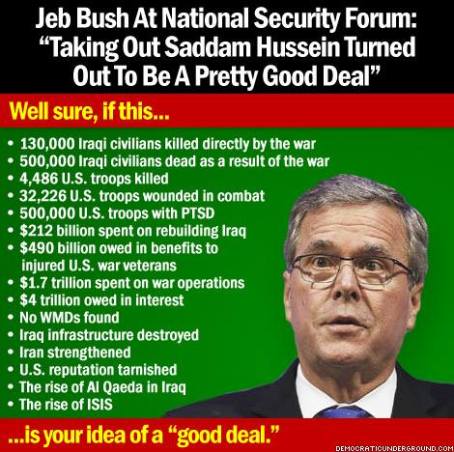
On August 13, speaking at a national security forum in Davenport, Iowa, he defended the unprovoked 2003 invasion of Iraq by his brother, President George W. Bush:

“I’ll tell you though, that taking out Saddam Hussein turned out to be a pretty good deal.”

And he went on to defend the 2007 troop “surge”, calling it “a great success that made Iraq safer.
“I’ve been critical and I think people have every right to be critical of decisions that were made.  In 2009, Iraq was fragile but secure. It was–its mission was accomplished in a way that there was security there.”

(Ironically, the phrase, “its mission was accomplished” proved an embarrassing reminder for the Bush family.

(A banner titled “Mission Accomplished” was displayed on the aircraft carrier USS Abraham Lincoln as George W. Bush announced–wrongly–that the war was over on May 1, 2003.)

Jeb Bush claimed that President Barack Obama had prematurely withdrawn troops from Iraq during his first term, thus allowing ISIS to “fill the void.”

One dissenter to Jeb Bush’s effort to rewrite his brother’s history is David Corn, Washington bureau chief for Mother Jones magazine.

Addressing Bush’s claims on the August 15 edition of The PBS Newshour, he said:

“I mean, I have to laugh a little bit, because I think he was setting a record for chutzpah.

“…It wasn’t until after his brother’s invasion of Iraq that you had something called al-Qaida in Iraq. And that was the group that morphed into ISIS.

“So ISIS is a direct result of the war in Iraq right there. And so he’s wrong on the history.

“But then he said what happened was that Obama and Hillary Clinton orchestrated this quick withdrawal after everything was secure.  Nothing was really secure in 2009-2010.

“…But it was George W. Bush in December 2008 who created the agreement with [Iraqi] Prime Minister [Nouri] [al-]Maliki that said that U.S. troops had to be out by 2011.

“And then Obama didn’t renegotiate that. And there is a lot of question as to whether he could even have, given the political situation in Baghdad itself.

“So Bush is totally–Jeb Bush is totally rewriting this.”

Click here: Brooks and Corn on Cuba as campaign issue

This is no small matter.  George W. Bush’s needless and unprovoked war on Iraq:

  • Cost the lives of 4,486 American soldiers.
  • Wounded another 32,226 troops.
  • Resulted in the deaths of an estimated 655,000 Iraqis.
  • Cost the American treasury at least $2 trillion.
  • Turned up no Weapons of Mass Destruction–Bush’s pretext for going to war.
  • Led to the rise of Al-Qaeda–and later ISIS–in Iraq.
  • Strengthened theocratic Iran by removing its major secularist opponent.

All of which simply proves, once again, that the past is never truly dead. It simply waits to be re-interpreted by each new generation–with some interpretations winding up closer to the truth than others.

Or, in this case, each new Presidential candidate of the Bush family.

FREEDOM OF SPEECH ISN’T FREE

In Bureaucracy, History, Politics, Social commentary on April 7, 2015 at 1:56 am

WARNING: Believing that the First Amendment gives you the legal right to express your opinion may be hazardous to your career.

The First Amendment to the United States Constitution states:

“Congress shall make no law respecting an establishment of religion, or prohibiting the free exercise thereof; or abridging the freedom of speech, or of the press; or the right of the people peaceably to assemble, and to petition the Government for a redress of grievances.”

The First Amendment

Of course, that refers only to Congress.

It says nothing about employers–and especially those self-appointed pseudo-gods who set themselves up as judges of virtue and infallibility.

If you doubt it, just ask Scott Lees, who until March had worked for four years as boys head lacrosse coach at Fryeburg Academy.

Fryeburg Academy

His crime?  Posting to his personal Facebook page an open letter to President Barack Obama that one of his friends had emailed him.

Lees posted the letter on March 17.  Two days later, he was ordered to resign from his four-year position as the academy’s lacrosse coach.

The letter had been written in response to a speech Obama gave in Cairo in 2009.  In this, Obama said, “I know, too, that Islam has always been a part of America’s history.”

Among the issues the letter raised:

Were those Muslims that were in America when the Pilgrims first landed? Funny, I thought they were Native American Indians.

“Were those Muslims that celebrated the first Thanksgiving day? Sorry again, those were Pilgrims and Native American Indians.

“Can you show me one Muslim signature on the United States Constitution? Declaration of Independence? Bill of Rights? Didn’t think so.

“Did Muslims fight for this country’s freedom from England? No. “Did Muslims fight during the Civil War to free the slaves in America? No, they did not. In fact, Muslims to this day are still the largest traffickers in human slavery.

“Your own half-brother, a devout Muslim, still advocates slavery himself, even though Muslims of Arabic descent refer to black Muslims as ‘pug nosed slaves.’ Says a lot of what the Muslim world really thinks of your family’s “rich Islamic heritage,” doesn’t it Mr. Obama?

Where were Muslims during the Civil Rights era of this country? Not present. There are no pictures or media accounts of Muslims walking side by side with Martin Luther King, Jr. or helping to advance the cause of Civil Rights.”

(The most prominent Muslim group in America at the time of the civil rights movement was the Nation of Islam.  Its onetime spokesman, Malcom X, preached a gospel of separation of the races–and condemned whites as “blue-eyed devils.”)

“Where were Muslims during this country’s Woman’s Suffrage era? Again, not present. In fact, devout Muslims demand that women are subservient to men in the Islamic culture.

“So much so, that often they are beaten for not wearing the ‘hajib’ or for talking to a man who is not a direct family member or their husband. Yep, the Muslims are all for women’s rights, aren’t they?

Click here: Women’s Rights Under Sharia

Where were Muslims during World War II? They were aligned with Adolf Hitler. The Muslim grand mufti himself met with Adolf Hitler, reviewed the troops and accepted support from the Nazis in killing Jews.

Click here: Amazon.com: Icon of Evil: Hitler’s Mufti and the Rise of Radical Islam (9781400066537): David G. Dalin, John F. Ro

“Finally, Mr. Obama, where were Muslims on Sept. 11th, 2001? If they weren’t flying planes into the World Trade Center, the Pentagon or a field in Pennsylvania killing nearly 3,000 people on our own soil, they were rejoicing in the Middle East….

And THAT, Mr. Obama, is the “rich heritage” Muslims have here in America…”

Interviewed by Top Right News, Lees, 48, said he had never before been fired and had been coaching since 1992.

Click here: Just Two Days After Sharing an ‘Open Letter’ to Obama on Facebook, This Veteran Coach Was Forced to Resign | Top R

Fryeburg Academy is a private school in Fryeburg, Maine.

Lees said that he was supposed to meet with Head of Schools Erin Mayo and Dean Charlie Tryder on March 19.  But Athletic Director Sue Thurston told him a decision to fire him had already been made.

Mayo told Top Right News that “Scott Lees did post a message on Facebook regarding Muslim people last week that was negative and, of course, public in nature.”

Mayo was right on two counts about the Facebook post: It was negative and public.

What she didn’t say was: It was also entirely historically accurate. It did not urge its readers to violate the law.  It did not defame anyone (unless telling the truth about a group’s documented activities counts as defamation).

This is similar to the policies–and atmosphere–of the Joseph McCarthy “smear and fear” era of the 1950s.  You didn’t have to actually be proven an actual Communist, or even a Communist sympathizer.

All that was needed to condemn you to permanent unemployment was to become “controversial.”  That way, the employer didn’t have to actually prove the employee’s unfitness.

An employee’s right to out-of-work speech should be fully protected unless it crosses the legal line–such as committing libel or urging others to violate the law.

And employers who fire him for embracing his First Amendment right should be criminally prosecuted.

Until this happens, the workplace will continue to resemble George Orwell’s vision of 1984–a world where anyone can become a “non-person” for the most trivial of reasons.

ILLEGAL ALIENS = UNRELIABLE ALLIES

In Bureaucracy, History, Law, Law Enforcement, Politics, Social commentary on February 26, 2015 at 3:07 pm

Some Republicans–like Rep. Jason Chaffetz, R-Utah–want their new majorities in the House and Senate to make “producing legislation” a top priority.

But others will soon make the impeachment of President Barack Obama their top priority.

Here’s how it will happen.

“We now have the votes and we have the ability to call the agenda, so stop name-calling and let’s actually produce some legislation that helps jobs and the economy and moves our country forward,” Chaffetz said in an interview after Republicans captured the U.S. Senate on November 4, 2014.

https://www.google.com/imgres?imgurl=http://www.quotessays.com/images/jason-chaffetz-1.jpg&imgrefurl=http://www.quotessays.com/bio/jason-chaffetz.html&docid=3MJFI0cdmEdHuM&tbnid=eN2CsKEX89mpoM:&w=570&h=757&ei=UM5bVLnzIdLdoASoloLgCQ&ved=0CAIQxiAwAA&iact=c

Rep. Jason Chaffetz

“I think the country has figured that out, and they’ve given us the mandate to do it, and we better produce, or they’ll kick us out too.”

Obama has vowed to act unilaterally before year’s end to reduce the number of deportations and grant work permits to millions of illegal aliens living in the United States.

After promising to take executive action on immigration by the end of the summer of 2014, Obama delayed his plans until after the elections.  Democrats–especially Senators from conservative states–had warned him that such administrative moves could threaten their reelection.

https://www.google.com/imgres?imgurl=http://grumpyelder.com/wp-content/uploads/2012/01/illegal-immigrants.jpg&imgrefurl=http://grumpyelder.com/2012/01/the-we-cant-deport-all-12-million-illegal-aliens-scam/&docid=N4ERI9jdeY2G8M&tbnid=P-CXa1aFoyJcLM:&w=500&h=329&ei=BM9bVJrKD4jpoATqmIDwDA&ved=0CAIQxiAwAA&iact=c

Illegal aliens crossing American borders by the millions

But on November 4, most of those Democrats lost anyway, leaving immigration advocates–and their millions of illegal alien constituents–feeling that the delay was needless.

“What I’m not going to do is just wait,” the president said as immigration legislation that the Senate passed in June 2013 remained stalled in the House.

Kentucky’s U.S. Senator Mitch McConnell–who became Senate Majority Leader in January–warned that this would be an in-your-face affront to the new majority GOP:

https://www.google.com/imgres?imgurl=http://s3.amazonaws.com/dk-production/images/14762/large/a302bc9bea18eca2b87cd656e05105cb.jpg?1357627906&imgrefurl=http://kentuckysportsradio.com/main/mitch-mcconnell-is-about-to-come-on-ksr/&docid=UuX87ufrXGUUhM&tbnid=mIFfN17UeL3g3M:&w=512&h=393&ei=yNBbVLzJJsu5ogSEroDQCg&ved=0CAIQxiAwAA&iact=c

Mitch McConnell

“I think the president choosing to do a lot of things unilaterally on immigration would be a big mistake,” McConnell said. “It’s an issue that most of my members want to address legislatively and it’s like waving a red flag in front of a bull to say, ‘If you guys don’t do what I want, I’m going to do it on my own.’ …

“I hope he won’t do that because I do think it poisons the well for the opportunity to address a very important domestic issue.”

To which Obama responded: “I have no doubt that there will be some Republicans who are angered or frustrated by any executive action that I may take.

“Those are folks, I just have to say, who are also deeply opposed to immigration reform in any form and blocked the House from being able to pass a bipartisan bill.”

https://www.google.com/imgres?imgurl=http://a.abcnews.com/images/Politics/abc_obama_specreport_121114_wg.jpg&imgrefurl=http://abcnews.go.com/Politics/OTUS/transcript-obama-press-conference/story?id=17719993&docid=aHyTmgZZkmFu3M&tbnid=d6eKt5qgtY_TPM:&w=640&h=360&ei=ANJbVLDlGIG2oQTWpoGABQ&ved=0CAIQxiAwAA&iact=c

Barack Obama

Republicans could use spending bills to restrict or stop such executive action, by cutting appropriations to those agencies that would be tasked with carrying out Obama’s directives on immigration.

Several Republicans hold the deep-seated view that Obama already has been abusing his constitutional authority.

“Abuse of power” is an impeachable offense under the United States Constitution.  So making this assertion would provide Republicans with the weapon they’ve long sought to drive Obama from the White House.

Republicans, in fact, have a tainted history of using impeachment to remove a President who dared to thwart their agenda.

After the assassination of President Abraham Lincoln, in 1865, Republican President Andrew Johnson tried to carry out Lincoln’s humane policies to reunify the nation after the Civil War.

He issued a series of proclamations directing the former Confederate states to hold conventions and elections to re-form their civil governments. In response, Southern states returned many of their old leaders, and passed Black Codes to deprive freed slaves of many civil liberties.

https://www.google.com/imgres?imgurl=http://www.usnews.com/cmsmedia/48/6360399039911f92c124ef13176dcc/10467FS_DA_090409_worst-johnson.jpg&imgrefurl=http://www.usnews.com/news/history/articles/2007/02/16/worst-presidents-andrew-johnson&docid=SpfOJ2azMoXRhM&tbnid=Zbb7WgUNRBLe8M:&w=300&h=300&ei=XdJbVJDOIoH9oATYjYL4DA&ved=0CAIQxiAwAA&iact=c

Andrew Johnson

Congress refused to seat legislators from those states and advanced legislation to overrule the Southern actions.  Johnson vetoed their bills, and Congress overrode him, setting a pattern until he left the White House in 1869.

As the conflict grew between the executive and legislative branches of government, Congress passed the Tenure of Office Act, restricting Johnson in firing Cabinet officials.  Johnson then tried to fire Secretary of War Edwin Stanton–with whom he had an antagonistic relationship.

An enraged Congress impeached Johnson in the House of Representatives.  He avoided conviction and removal from office in the Senate–by one vote.

If President Obama tries to end-run Congress on immigration policy, history will likely repeat itself with another round of impeachment hearings.

It was Mitch McConnell who infamously vowed–immediately after Obama’s election in 2008–to make him “a one-term President.”

Moreover, there is actually no reason for Obama to risk his Presidency by granting the privileges of American citizenship to millions of illegal aliens.

Democrats–and especially Obama–had counted on millions of illegal aliens to retain Democratic control of the Senate.  But those masses of Hispanic voters never showed up at the polls, thus giving Republicans control of both houses of Congress.

If Obama practiced ruthless “Chicago politics” as charged by his enemies, his response would be: “You [illegal aliens] didn’t live up to your end.  Therefore, I have no further responsibility to you.”

Unfortunately for the President, he seems unable to break with his past of backing unpopular causes for little in return.

MORE LESSONS FROM “LINCOLN”

In Bureaucracy, History, Politics, Social commentary on December 5, 2014 at 12:00 am

Steven Spielberg’s 2012 movie Lincoln serves up a timely reminder that has long been obscured by past and current Southern lies.

Abraham Lincoln (Daniel Day-Lewis) tours a Civil War battlefield

From first to last, the cause of the Civil War was slavery.

According to The Destructive War, by Charles Royster, arguments over “states’ rights” or economic conflict between North and South didn’t lead 13 Southern states to withdraw from the Union in 1860-61.

It was their demand for “respect” of their “peculiar institution”–i.e., slavery.

“The respect Southerners demanded did not consist simply of the states’ sovereignty or of the equal rights of Northern and Southern citizens, including slaveholders’ right to take their chattels into Northern territory.

“It entailed, too, respect for their assertion of the moral superiority of slaveholding society over free society,” writes Royster.

It was not enough for Southerners to claim equal standing with Northerners; Northerners must acknowledge it.

But this was something that the North was increasingly unwilling to do.  Finally, its citizens dared to elect Abraham Lincoln as President in 1860.

Lincoln and his new Republican party damned slavery-–and slaveholders-–as morally evil, obsolete and ultimately doomed. And they were determined to prevent slavery from spreading any further throughout the country.

Southerners found all of this intolerable.

The British author, Anthony Trollope, explained to his readers:

“It is no light thing to be told daily, by our fellow citizens…that you are guilty of the one damning sin that cannot be forgiven.

“All this [Southerners] could partly moderate, partly rebuke and partly bear as long as political power remained in their hands.”

It is to Spielberg’s credit that he forces his audience to look directly at the real cause of the bloodiest conflict on the North American continent.

At the heart of Spielberg’s film: Abraham Lincoln (Daniel Day-Lewis) wants to win ratification of what will be the Thirteenth Amendment to the United States Constitution.  An amendment that will forever ban slavery.

But, almost four years into the war, slavery still has powerful friends–in both the North and South.

Many of those friends belong to the House of Representatives, which must ratify the amendment for it to become law.

Some are hostile to Lincoln personally.  One of them dubs him a dictator: “Abraham Africanus.”  Another accuses him of shifting his positions for the sake of expediency.

Other members–white men all–are hostile to the idea of “equality between the races.”

To them, ending slavery means opening the door to interracial marriage–especially marriage between black men and white women.  Perhaps even worse, it means possibly giving blacks–or women–the right to vote.

Members of Lincoln’s own Cabinet–such as Secretary of State William Seward–warn him: You can negotiate the end of the war immediately–if you’ll just let Southerners keep their slaves.

After the amendment wins ratification, Lincoln agrees to meet with a “peace delegation” from the Confederate States of America.

At the top of their list of concerns: If they persude the seceded states to return to the Union, will those states be allowed to nullify the amdnement?

No, says Lincoln.  He’s willing to make peace with the South, and on highly generous terms.  But not at the cost of allowing slavery to live on.

Too many men–North and South–have died in a conflict whose root cause is slavery.  Those lives must count for more than simply reuniting the Union.

For the Southern “peace commissioners,” this is totally unacceptable.

The South has lost thousands of men (260,000 is the generally accepted figure for its total casualties) and the war is clearly lost.  But for its die-hard leaders, parting with slavery is simply unthinkable.

Like Nazi Germany 80 years into the future, the high command of the South won’t surrender until their armies are too beaten down to fight any more.

The major difference between the defeated South of 1865 and the defeated Germany of 1945, is this: The South was allowed to build a beautiful myth of a glorious “Lost Cause,” epitomized by Margaret Mitchell’s 1936 novel, Gone With the Wind.

In that telling, dutiful slaves were well-treated by kindly masters.  Southern aristocrats wore white suits and their slender-waisted ladies wore long dresses, carried parisols and said “fiddle-dee-dee” to young, handsome suitors.

One million people attended the premier of the movie version in Atlanta on December 15, 1939.

The celebration featured stars from the film, receptions, thousands of Confederate flags, false antebellum fronts on stores and homes, and a costume ball.

In keeping with Southern racist tradition, Hattie McDaniel and the other black actors from the film were barred from attending the premiere.  Upon learning this, an enraged Clark Gable threatened to boycott the event. McDaniel convinced him to attend.

When today’s Southerners fly Confederate flags and speak of “preserving our traditions,” they are actually celebrating their long-banned “peculiar institution.”

By contrast, post-World War II Germany outlawed symbols from the Nazi-era, such as the swastika and the “Heil Hitler” salute, and made Holocaust denial punishable by imprisonment.

America’s Southern states have refused to confront their own shameful past so directly.

But Americans can be grateful that Steven Spielberg has had the courage to serve up a long-overdue and much needed lesson in past–and still current–history.

“LINCOLN”: ISSUES PAST AND PRESENT

In Bureaucracy, History, Military, Politics, Social commentary on December 3, 2014 at 11:26 pm

Steven Spielberg’s Lincoln is more than a mesmerizing history lesson.

It’s a timely reminder that racism and repression are not confined to any one period or political party.

At the heart of the film: Abraham Lincoln (Daniel Day-Lewis) wants to win ratification of what will be the Thirteenth Amendment to the United States Constitution.

An amendment that will forever ban slavery.

True, Lincoln, in 1862, had issued the Emancipation Proclamation. This–in theory–freed slaves held in the Confederate states that were in rebellion against the United States Government.

(In reality, Confederate states had no intention of complying with any procolmation issued by Lincoln.)

But Lincoln regards this as a temporary wartime measure.

He fears that, once the war is over, the Supreme Court may rule the Proclamation unconstitutional.  This might allow Southerners to  continue practicing slavery, even after losing the war.

To prevent this, Congress must pass an anti-slavery amendment.

But winning Congressional passage of such an amendment won’t be easy.

The Senate had ratified its passage in 1864.  But the amendment must secure approval from the House of Representatives to become law.

And the House is filled with men–there are no women menmbers during the 19th century–who seethe with hostility.

Some are hostile to Lincoln personally.  One of them dubs him a Negroid dictator: “Abraham Africanus.”  Another accuses him of shifting his positions for the sake of expediency.

Other members–white men all–are hostile to the idea of “equality between the races.”

To them, ending slavery means opening the door to interracial marriage–especially marriage between black men and white women.  Perhaps even worse, it means possibly giving blacks–or women–the right to vote.

In fact, the possibility that blacks might win voting rights arises early in the movie.  Lincoln is speaking to a couple of black Union soldiers, and one of them is unafraid to voice his discontent.

He’s upset that black soldiers are paid less than white ones–and that they’re led only by white officers.

He says that, in time, maybe this will change.  Maybe, in 100 years, he guesses, blacks will get the right to vote.

(To the shame of all Americans, that’s how long it will eventually take.  Not until the passage of the Voting Rights Act of 1965 will blacks be guaranteed legal protection against discriminatory voting practices.)

To understand the Congressional debate over the Thirteenth Amendment, it’s necessary to remember this:  In Lincoln’s time, the Republicans were the party ofprogressives.

The party was founded on an anti-slavery platform.  Its members were thus reviled as “Black Republicans.”

And until the 1960s, the South was solidly DemocraticDemocrats were the ones defending the status quo–slavery–and opposing freed blacks in the South of Reconstruction and long afterward.

In short, in the 18th century, Democrats in the South acted as Republicans do now.

The South went Republican only after a Democratic President–Lyndon B. Johnson–rammed the Civil Rights Act of 1964 through Congress.

Watching this re-enactment of the 1865 debate in Lincoln is like watching a rerun of the 2012 Presidential campaign.  The same mentalities are at work:

  • Those (in this case, slave-owners) who already have a great deal want to gain even more at the expense of others.
  • Those (slaves and freed blacks) who have little strive to gain more or at least hang onto what they still have.
  • Those who defend the privileged wealthy refuse to allow their “social inferiors” to enjoy similar privileges (such as the right to vote).

During the 2012 Presidential race, the Republicans tried to bar those likely to vote for President Barack Obama from getting into the voting booth.  But their bogus “voter ID” restrictions were struck down in courts across the nation.

Listening to those opposing the amendment, one is reminded of Mitt Romney’s infamous comments about the “47%: “

“Well, there are 47% of the people who will vote for the president no matter what….

“Who are dependent upon government, who believe that–-that they are victims, who believe that government has a responsibility to care for them, who believe that they’re entitled to healthcare, to food, to housing, to you name it.

“But that’s-–it’s an entitlement. And the government should give it to them.”

In the end, however, it is Abraham Lincoln who has the final word.  Through diplomacy and backroom dealings (trading political offices for votes) he wins passage of the anti-slavery amendment.

The movie closes with a historically-correct tribute to Lincoln’s generosity toward those who opposed him–in Congress and on the battlefield.

It occurs during Lincoln’s Second Inaugural Address: “With malice toward none, with charity for all….To bind up the nation’s wounds.  To care for him who shall have bourne the battle and for his widow and his orphan….”

This ending presents a vivid philosophical contrast with Romney’s sore-loser comments: “The president’s campaign, if you will, focused on giving targeted groups a big gift.”

Watching Lincoln, you realize how incredibly lucky we were as a nation to have had such leadership when it was most needed.  And how desperately we need it now.

BE FEARED, NOT DESPISED

In Bureaucracy, History, Politics, Social commentary on November 26, 2014 at 12:02 am

Screaming “Allah akbar!”–the Islamic battlecry, “God is Great!”–two Palestinians wielding meat cleavers and a gun slaughtered five worshippers in a Jerusalem synagogue.

Three of the dead were Americans holding Israeli citizenship.  Four of them were rabbis.

Eight people were injured—and one later died—before the attackers were killed in a shootout with police.

Aftermath of the attack on unarmed rabbis in a Jerusalem synagogue

The attack—launched on November 18—was the deadliest in Israel’s capital since 2008, when a Palestinian gunman shot eight people in a religious seminary school.

And how did Palestinians react to the grisly murders of five unarmed worshippers?

They celebrated:

  • Revelers in the Gazan city of Rafah handed out candy and brandished axes and posters of the suspects in praise of the deadly attack.
  • Hamas-affiliated social media circulated violent and anti-Semitic cartoons hailing the killings.
  • Students in Bethlehem joined in the festivities by sharing candy.

Why Hamas and Israel reached this moment now — and what comes next | WBUR

Palestinians celebrating the attack 

  • The parents of the two terrorists joyfully declared: “They are both Shahids (martyrs) and heroes.”
  • A resident of the terrorists’ neighborhood stated: “We have many more youngsters and nothing to lose. They are willing to harm Jews, anything for al-Aqsa.”
  • Another resident said: “People here won’t sit quietly, they will continue to respond. We will make the lives of the Jews difficult everywhere.”

And how have Israelis responded to this latest atrocity?

Israeli Prime Minister Benjamin Netanyahu ordered the demolitions of the homes of the attackers.

The blunt truth is that Palestinians have no interest in preventing such attacks on Israeli citizens—because Israel hasn’t given them any.

Blowing up houses only takes out anger on lifeless buildings.  Those who lived there are still alive—and able to seek revenge in the future.

As Niccolo Machiavelli once warned:  But above all [a ruler] must abstain from taking the property of others, for men forget more easily the death of their father than the loss of their inheritance.

But there is an alternative which Israelis must almost certainly be considering at this time.

Its purpose: To instill a sense of civic responsibility—however begrudgingly—in their Islamic citizens.

Every time such an atrocity occurs, Israel could deport at least 10,000 Arabs from its territory.

Suddenly, Arabs living in Israel would have real incentive for preventing such attacks against Israelis.  Or at least for reporting to police the intentions of those they knew were planning such attacks.

“Hey,” they would think, “if Abdul blows up that police station like he said he wants to, I could get sent to a refugee camp.”

The odds are there would be s sudden influx of Arab informants to Israeli police stations.

Machiavelli, the 15th century Florentine statesmen, carefully studied both war and politics.  In his most famous—or infamous—work, The Prince, he advises:

Niccolo Machiavelli

From this arises the question whether it is better to be loved than feared, or feared more than loved.  The reply is, that one ought to be both feared and loved, but as it is difficult for the two to go together, it is much safer to be feared than loved. 

For it may be said of men in general that they are ungrateful, voluble, dissemblers, anxious to avoid danger and covetous of gain; as long as you benefit them, they are entirely yours: they offer you their blood, their goods, their life and their children, when the necessity is remote, but when it approaches, they revolt.

And the prince who has relied solely on their words, without making other preparations, is ruined; for the friendship which is gained by purchase and not through grandeur and nobility of spirit is bought but not secured, and at a pinch is not to be expended in your service. 

And men have less scruple in offending one who makes himself loved than one who makes himself feared; for love is held by a chain of obligations which, men being selfish, is broken whenever it serves their purpose; but fear is maintained by a dread of punishment which never fails.

Machiavelli knew–and warned–that while it was useful to avoid hatred, it was fatal to be despised.  And he also warned that humility toward insolent enemies  only encourages their hatred.

Accompanying this is the advice of perhaps the greatest general of the American Civil War: William Tecumseh Sherman.

Sherman, whose army cut a swath of destruction through the South in 1864, said it best.  Speaking of the Southern Confederacy, he advised: “They cannot be made to love us, but they may be made to fear us.”

Israelis will never be able to make its sworn Islamic enemies love them.  But they can instill such a healthy fear in most of them that such atrocities as the recent synagogue butchery will become a rarity.

THE COMING IMPEACHMENT

In Bureaucracy, History, Law, Politics, Social commentary on November 11, 2014 at 12:48 am

Some Republicans–like Rep. Jason Chaffetz, R-Utah–want their new majorities in the House and Senate to make “producing legislation” a top priority.

But others will soon make the impeachment of President Barack Obama their top priority.

Here’s how it will happen.

“We now have the votes and we have the ability to call the agenda, so stop name-calling and let’s actually produce some legislation that helps jobs and the economy and moves our country forward,” Chaffetz said in an interview after Republicans captured the U.S. Senate on November 4.

https://www.google.com/imgres?imgurl=http://www.quotessays.com/images/jason-chaffetz-1.jpg&imgrefurl=http://www.quotessays.com/bio/jason-chaffetz.html&docid=3MJFI0cdmEdHuM&tbnid=eN2CsKEX89mpoM:&w=570&h=757&ei=UM5bVLnzIdLdoASoloLgCQ&ved=0CAIQxiAwAA&iact=c

Rep. Jason Chaffetz

“I think the country has figured that out, and they’ve given us the mandate to do it, and we better produce, or they’ll kick us out too.”

Obama has vowed to act unilaterally before year’s end to reduce the number of deportations and grant work permits to millions of illegal aliens living in the United States.

After promising to take executive action on immigration by the end of the summer, Obama delayed his plans until after the elections.  Democrats–especially Senators from conservative states–had warned him that such administrative moves could threaten their reelection.

https://www.google.com/imgres?imgurl=http://grumpyelder.com/wp-content/uploads/2012/01/illegal-immigrants.jpg&imgrefurl=http://grumpyelder.com/2012/01/the-we-cant-deport-all-12-million-illegal-aliens-scam/&docid=N4ERI9jdeY2G8M&tbnid=P-CXa1aFoyJcLM:&w=500&h=329&ei=BM9bVJrKD4jpoATqmIDwDA&ved=0CAIQxiAwAA&iact=c

Illegal aliens crossing American borders by the millions

But on November 4, most of those Democrats lost anyway, leaving immigration advocates–and their millions of illegal alien constituents–feeling that the delay was needless.

“What I’m not going to do is just wait,” the president said as immigration legislation that the Senate passed in June 2013 remained stalled in the House.

Kentucky’s U.S. Senator Mitch McConnell–who will become Senate Majority Leader in January–has warned that this would be an in-your-face affront to the new majority GOP:

https://www.google.com/imgres?imgurl=http://s3.amazonaws.com/dk-production/images/14762/large/a302bc9bea18eca2b87cd656e05105cb.jpg?1357627906&imgrefurl=http://kentuckysportsradio.com/main/mitch-mcconnell-is-about-to-come-on-ksr/&docid=UuX87ufrXGUUhM&tbnid=mIFfN17UeL3g3M:&w=512&h=393&ei=yNBbVLzJJsu5ogSEroDQCg&ved=0CAIQxiAwAA&iact=c

Mitch McConnell

“I think the president choosing to do a lot of things unilaterally on immigration would be a big mistake,” McConnell said. “It’s an issue that most of my members want to address legislatively and it’s like waving a red flag in front of a bull to say, ‘If you guys don’t do what I want, I’m going to do it on my own.’ …

“I hope he won’t do that because I do think it poisons the well for the opportunity to address a very important domestic issue.”

To which Obama responded: “I have no doubt that there will be some Republicans who are angered or frustrated by any executive action that I may take.

“Those are folks, I just have to say, who are also deeply opposed to immigration reform in any form and blocked the House from being able to pass a bipartisan bill.”

https://www.google.com/imgres?imgurl=http://a.abcnews.com/images/Politics/abc_obama_specreport_121114_wg.jpg&imgrefurl=http://abcnews.go.com/Politics/OTUS/transcript-obama-press-conference/story?id=17719993&docid=aHyTmgZZkmFu3M&tbnid=d6eKt5qgtY_TPM:&w=640&h=360&ei=ANJbVLDlGIG2oQTWpoGABQ&ved=0CAIQxiAwAA&iact=c

Barack Obama

Republicans could use spending bills to restrict or stop such executive action, by cutting appropriations to those agencies that would be tasked with carrying out Obama’s directives on immigration.

Several Republicans hold the deep-seated view that Obama already has been abusing his constitutional authority.

“Abuse of power” is an impeachable offense under the United States Constitution.  So making this assertion would provide Republicans with the weapon they’ve long sought to drive Obama from the White House.

Republicans, in fact, have a tainted history of using impeachment to remove a President who dared to thwart their agenda.

After the assassination of President Abraham Lincoln, in 1865, Republican President Andrew Johnson tried to carry out Lincoln’s humane policies to reunify the nation after the Civil War.

He issued a series of proclamations directing the former Confederate states to hold conventions and elections to re-form their civil governments. In response, Southern states returned many of their old leaders, and passed Black Codes to deprive freed slaves of many civil liberties.

https://www.google.com/imgres?imgurl=http://www.usnews.com/cmsmedia/48/6360399039911f92c124ef13176dcc/10467FS_DA_090409_worst-johnson.jpg&imgrefurl=http://www.usnews.com/news/history/articles/2007/02/16/worst-presidents-andrew-johnson&docid=SpfOJ2azMoXRhM&tbnid=Zbb7WgUNRBLe8M:&w=300&h=300&ei=XdJbVJDOIoH9oATYjYL4DA&ved=0CAIQxiAwAA&iact=c

Andrew Johnson

Congress refused to seat legislators from those states and advanced legislation to overrule the Southern actions.  Johnson vetoed their bills, and Congress overrode him, setting a pattern until he left the White House in 1869.

As the conflict grew between the executive and legislative branches of government, Congress passed the Tenure of Office Act, restricting Johnson in firing Cabinet officials.  Johnson then tried to fire Secretary of War Edwin Stanton–with whom he had an antagonistic relationship.

An enraged Congress impeached Johnson in the House of Representatives.  He avoided conviction and removal from office in the Senate–by one vote.

If President Obama tries to end-run Congress on immigration policy, history will likely repeat itself with another round of impeachment hearings.

It was Mitch McConnell who infamously vowed–immediately after Obama’s election in 2008–to make him “a one-term President.”

Moreover, there is actually no reason for Obama to risk his Presidency by granting the privileges of American citizenship to millions of illegal aliens.

Democrats–and especially Obama–had counted on millions of illegal aliens to retain Democratic control of the Senate.  But those masses of Hispanic voters never showed up at the polls, thus giving Republicans control of both houses of Congress.

If Obama practiced ruthless “Chicago politics” as charged by his enemies, his response would be: “You [illegal aliens] didn’t live up to your end.  Therefore, I have no further responsibility to you.”

Unfortunately for the President, he seems unable to break with his past of backing unpopular causes for little in return.


MENTALITIES, NOT PARTIES, MAKE HISTORY

In History, Politics, Social commentary on September 30, 2014 at 1:46 am

Steven Spielberg’s Lincoln is more than a mesmerizing history lesson.

It’s a timely reminder that racism and repression are not confined to any one period or political party.

At the heart of the film: Abraham Lincoln (Daniel Day-Lewis) wants to win ratification of what will be the Thirteenth Amendment to the United States Constitution.  An amendment that will forever ban slavery.

True, Lincoln, in 1862, had issued the Emancipation Proclamation.  This–in theory–freed slaves held in the Confederate states that were in rebellion against the United States Government.

But Lincoln regards this as a temporary wartime measure.

He fears that, once the war is over, the Supreme Court may rule the Proclamation unconstitutional.  This might allow Southerners to  continue practicing slavery, even after losing the war.

To prevent this, Congress must pass an anti-slavery amendment.

But winning Congressional passage of such an amendment won’t be easy.

The Senate had ratified its passage in 1864.  But the amendment must secure approval from the House of Representatives to become law.

And the House is filled with men–there are no women menmbers during the 19th century–who seethe with hostility.

Some are hostile to Lincoln personally.  One of them dubs him a Negroid dictator: “Abraham Africanus.”  Another accuses him of shifting his positions for the sake of expediency.

Other members–white men all–are hostile to the idea of “equality between the races.”

To them, ending slavery means opening the door to interracial marriage–especially marriage between black men and white women.  Perhaps even worse, it means possibly giving blacks–or women–the right to vote.

In fact, the possibility that blacks might win voting rights arises early in the movie.  Lincoln is speaking to a couple of black Union soldiers, and one of them is unafraid to voice his discontent.

He’s upset that black soldiers are paid less than white ones–and that they’re led only by white officers.

He says that, in time, maybe this will change.  Maybe, in 100 years, he guesses, blacks will get the right to vote.

(To the shame of all Americans, that’s how long it will eventually take.  Not until the passage of the Voting Rights Act of 1965 will blacks be guaranteed legal protection against discriminatory voting practices.)

To understand the Congressional debate over the Thirteenth Amendment, it’s necessary to remember this:  In Lincoln’s time, the Republicans were the party of progressives.

The party was founded on an anti-slavery platform.  Its members were reviled by slavery supporters as “Black Republicans.”

And until the 1960s, the South was solidly DemocraticDemocrats were the ones defending the status quo–slavery–and opposing freed blacks in the South of Reconstruction and long afterward.

In short, in the 18th century, Democrats in the South acted as Republicans do now.

The South went Republican only after a Democratic President–Lyndon B. Johnson–rammed the Civil Rights Act of 1964 through Congress.

Watching this re-enactment of the 1865 debate in Lincoln is like watching a rerun of the 2012 Presidential campaign.  The same mentalities are at work:

  • Those (slave-owners) who already have a great deal want to gain even more at the expense of others.
  • Those (slaves and freed blacks) who have little strive to gain more or at least hang onto what they still have.
  • Those who defend the privileged wealthy refuse to allow their “social inferiors” to enjoy similar privileges (such as the right to vote).

During the 2012 Presidential race, the Republicans tried to bar those likely to vote for President Barack Obama from getting into the voting booth.  But their bogus “voter ID” restrictions were struck down in courts across the nation.

Listening to those opposing the Thirteenth Amendment, one is reminded of Mitt Romney’s infamous comments about the “47%: “

If slavery is outlawed, they argue, then black men will no longer “know their place” and even dare to marry white women.

Romney, in turn, showed the same contempt for those he clearly regarded as his social inferiors:

“Well, there are 47% of the people who will vote for the president no matter what….

“Who are dependent upon government, who believe that–-that they are victims, who believe that government has a responsibility to care for them, who believe that they’re entitled to healthcare, to food, to housing, to you name it.

“But that’s-–it’s an entitlement. And the government should give it to them.”

But by the end of the movie, it is Abraham Lincoln who has the final word.  Through diplomacy and backroom dealings (trading political offices for votes) he wins passage of the anti-slavery amendment.

The movie closes with a historically-correct tribute to Lincoln’s generosity toward those who opposed him–in Congress and on the battlefield.

It occurs during Lincoln’s Second Inaugural Address: “With malice toward none, with charity for all….To bind up the nation’s wounds.  To care for him who shall have bourne the battle and for his widow and his orphan….”

This ending presents a vivid philosophical contrast with the sore-loser comments Romney made after the campaign: “The president’s campaign, if you will, focused on giving targeted groups a big gift.”

Watching Lincoln, you realize it is not political parties that make history.  It is the mentalities of men and women who follow their hearts to bringing liberty–or slavery–to others.


A REMEDY FOR TREASON: PART TWO (END)

In Bureaucracy, History, Law, Politics, Social commentary on September 26, 2014 at 12:11 am

In 1845, Andrew Jackson, seventh President of the United States from 1829 to 1837, lay close to death.

“What act of my administration will be most severely condemned by future Americans?” he asked his doctor.

“Perhaps the removal of the bank deposits,” said the doctor–referring to Jackson’s withdrawal of U.S. Government monies from the first Bank of the United States.

That act had destroyed the bank, which Jackson had believed a source of political corruption.

“Oh, no!” said Jackson.

“Then maybe the specie circular,” said the doctor. He was referring to an 1836 executive order Jackson had issued, requiring payment for government land to be in gold and silver.

“Not at all!” said Jackson.

Then, his eyes blazing, Jackson raged: “I can tell you. Posterity will condemn me more because I was persuaded not to hang John C. Calhoun as a traitor than for any other act in my life!”

John C. Calhoun had once been Vice President under Jackson and later a United States Senator from South Carolina.

John C. Calhoun

His fiery rhetoric and radical theories of “nullification” played a major part in bringing on the Civil War (1861-1865).

Calhoun was an outspoken supporter of slavery, which he declared to be a “positive good” rather than a “necessary evil.”  He supported states’ rights and nullification–by which states could declare null and void any federal laws they disliked and deemed unconstitutional.    

Historians have not condemned Jackson for failing to hang the senator.  But perhaps he was right-–and perhaps he should have hanged Calhoun.

It might have prevented the Civil War-–or at least delayed its coming.

Over time, Southern states’ threats of “nullification” turned to threats of “secession” from the Union.

Jackson died in 1845-–16 years before the Civil War erupted.

The resulting carnage destroyed as many as 620,000 lives. More Americans died in that war than have been killed in all the major wars fought by the United States since.

When it ended, America was reinvented as a new, unified nation–-and one where slavery was now banned by the 13th Amendment to the United States Constitution.

Equally important, the Federal Government had now set a precedent for using overwhelming military power to force states to remain in the Union.

But within days of Barack Obama’s decisive winning of another four years as President, residents across the country have raised the call of treason.

They have done so by filing secession petitions to the Obama administration’s “We the People” program, which is featured on the White House website.

And how has the Obama administration responded?

By backing down when agents of the Federal Bureau of Land Management (BLM) were threatened by armed militia members and states’ right protesters.

For more than 20 years, Cliven Bundy, a Nevada cattle rancher, has refused to pay fees for grazing cattle on public lands, some 80 miles north of Las Vegas.

BLM says Bundy now owes close to $1 million. He says his family has used the land since the 1870s and doesn’t recognize the federal government’s jurisdiction.

In 2013, a federal judge ordered Bundy to remove his livestock. He ignored the order, and in early April, 2014, BLM agents rounded up more than 400 of his cattle.

Over the weekend of April 12-13, armed militia members and states’ right protesters showed up to challenge the move.

BLM agents vs. armed militia members

Fearing another Waco–regarded by Right-wing Americans as a second Alamo–the BLM agents backed down and released Bundy’s cattle.  And then retreated.

Right-wing bloggers and commentators have portrayed the incident as a victory over Federal tyranny.

Abraham Lincoln dedicated his Presidency–and sacrificed his life–to ensure the preservation of a truly United States.

And Robert E. Lee—the defeated South’s greatest general—spent the last five years of his life trying to put the Civil War behind him and persuade his fellow Southerners to accept their place in the Union.

But today avowed racists, fascists and other champions of treason are working hard to destroy that union–and unleash a second Civil War.

President Obama could have chosen a different approach to dealing with armed militia groups–before treasonous talk become treasonous acts.

That of Andrew Jackson, Abraham Lincoln–and William Tecumseh Sherman.

Sherman, whose army cut a swath of destruction through the South in 1864, said it best.  Speaking of the Southern Confederacy, he advised: “They cannot be made to love us, but they may be made to fear us.

William T. Sherman “Marching Through Georgia” with his army, 1864

“We cannot change the hearts of those people of the South.  But we can make war so terrible that they will realize the fact that ….they are still mortal and should exhaust all peaceful remedies before they fly to war.”

And Obama could have similarly warned these 21st-century traitors that he was prepared to meet treason with the full force of the United States Army, Navy, Air Force and Marines.

By failing to do so, he has almost certainly encouraged Right-wing secessionists to even greater acts of treason and violence.