Posts Tagged ‘BLACKS’
1984 NOVEL, 2020 PRESIDENTIAL ELECTION, ABC NEWS, ADOLF HITLER, AFFORDABLE HEALTHCARE ACT, ALTERNET, ALVIN BRAGG, AMERICABLOG, ANDREW CLYDE, ANN COULTER, AP, ARIZONA, ARIZONA SHOOTINGS, ASHLI BABBITT, ASSASSINATION, BABY BOOMER RESISTANCE, BARACK OBAMA, BARRON TRUMP, BBC, BILL CLINTON, BIRTHERS, BLACKS, BLOOMBERG NEWS, BUZZFEED, CBS NEWS, CHILD MOLESTERS, CHRISTINA-TAYLOR GREEN, CLASSIFIED DOCUMENTS, CNN, CONFEDERATE FLAG, CROOKS AND LIARS, CVS, DAILY KOS, DEMOCRATIC PARTY, DEMOCRATS, DENNIS HASTERT, DEVIN NUNES, DICK ARMEY, DICK MORRIS, DONALD TRUMP, FAMILY RESEARCH COUNCIL, FANNI WILLIS, FBI, FIVETHIRTYEIGHT, FRANKLIN D. ROOSEVELT, GABRIELLE GIFFORDS, GAYS, GEORGE H.W. BUSH, GEORGE ORWELL, GEORGE W. BUSH, GLENN BECK, HARPER’S MAGAZINE, HARRY S. TRUMAN, HATE CRIMES, HEALTHCARE, HISPANICS, HOUSE OVERSIGHT COMMITTEE, HUFFINGTON POST, JACK SMITH, JAN BREWER, JANUARY 6 COUP ATTEMPT, JGB BUSH, JIM JORDAN, JOSEPH MCCARTHY, JOSEPH R. BIDEN, JOSEPH STALIN, JOSH DUGGAR, KANSAS, LAUREN BOEBERT, LESBIANS, MARJORIE TAYLOR GREEN, MATT GAETZ, MEDIA MATTERS, MEIN KAMPF, MELANIA TRUMP, MICHAEL COHEN, MICHAEL SAVAGE, MICHELE BACHMANN, MIKE HUCKABEE, MIKE PENCE, MOTHER JONES, MOVEON, MSNBC, MUSLIMS, NBC NEWS, NEW REPUBLIC, NEWSDAY, NEWSWEEK, NEWT GINGRICH, NPR, ORACLE, PBS NEWSHOUR, PHIL GRAMM, POLITICO, POLITICUSUSA, PROPAGANDA, RAFAEL "TED" CRUZ, RAW STORY, RELIGIOUS FREEDOM RESTORATION ACT, REP. GABRIELLE GIFFORDS, REPUBLICAN PARTY, REPUBLICANS, REUTERS, RICHARD NIXON, RICK PERRY, RODNEY KING RIOTS, ROLLING STONE MAGAZINE, RUSH LIMBAUGH, SALON, Sarah Palin, SEAN HANNITY, SEATTLE TIMES, SHARIA LAW, SLATE, SOUTH DAKOTA, SOVIET UNION, SPIRO AGNEW, STEVE BANNON, STORMY DANIELS, TALKING POINTS MEMO, TEA PARTY, TERRORISM, THE ATLANTIC, THE CHICAGO SUN-TIMES, THE CHICAGO TRIBUNE, THE DAILY BEAST, THE DAILY BLOG, THE GUARDIAN, THE HILL, THE HUFFINGTON POST, THE INTERCEPT, THE LOS ANGELES TIMES, THE NATION, THE NEW REPUBLIC, THE NEW YORK TIMES, THE NEW YORKER, THE VILLAGE VOICE, THE WASHINGTON POST, THINKPROGRESS, TIME, TRUTHDIG, TRUTHOUT, U.S. DISTRICT JUDGE JOHN ROLL, U.S. MARSHALS SERVICE, U.S. NEWS & WORLD REPORT, UNITED STATES HOUSE OF REPRESENTATIVES, UNITED STATES SENATE, UPI, USA TODAY, WOMEN, WORLD WAR 11, X
In Bureaucracy, History, Law, Law Enforcement, Politics, Social commentary on July 15, 2024 at 12:22 am
“We mock you. We mock your fear. We want your fear. It’s going to be accountability. We are taking apart the administrative state. We’re going to destroy the deep state, and we’re going to hold everybody responsible that put this republic in the situation its in today.
“Accountability, responsibility. And that will come with authority. The authority of Donald J. Trump as the 47th president of the United States.”
The speaker was Steve Bannon, former Trump campaign manager and White House advisor. And he was issuing a warning to everyone who didn’t enthusiastically accept Donald Trump as his Once and Future Fuhrer.
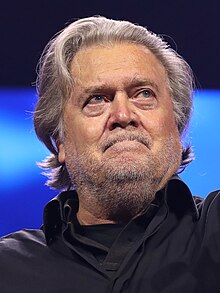
Steve Rannon
Gage Skidmore, CC BY-SA 2.0 <https://creativecommons.org/licenses/by-sa/2.0>, via Wikimedia Commons
Threats of violence have become common among Republicans since 2015, when Trump first ran for President. And they continue to cast a shadow over the 2024 Presidential campaign.
On March 16, 2016, Trump warned Republicans that if he didn’t win the GOP nomination in July, his supporters would literally riot: “I think you’d have riots. I think you would see problems like you’ve never seen before. I think bad things would happen. I really do. I wouldn’t lead it, but I think bad things would happen.”
An NBC reporter summed it up as: “The message to Republicans was clear: ‘Nice convention you got there, shame if something happened to it.’”
Eight years later, on March 16, 2024, Trump made a similar threat: “Now if I don’t get elected, it’s going to be a bloodbath for the whole—that’s gonna be the least of it….If this election isn’t won, I’m not sure that you’ll ever have another election in this country.”
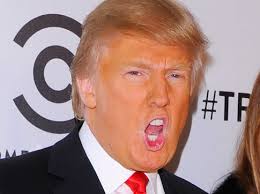
Donald Trump
On August 9, 2016, Trump told a rally in Wilmington, North Carolina: “Hillary [Clinton] wants to abolish, essentially abolish, the Second Amendment. If she gets to pick her [Supreme Court] judges, nothing you can do folks. Although the Second Amendment people, maybe there is, I don’t know.”
This was Trump’s “dog-whistle” attempt to incite the assassination of Hillary Clinton—and it was so seen by responsible authorities: “Well, let me say if someone else said that outside of the hall, he’d be in the back of a police wagon now, with the Secret Service questioning him,” said Michael Hayden, former head of the CIA and National Security Agency (NSA).
In Cincinnati, a Trump supporter threatened to forcibly remove Clinton from the White House if she won the race: “If she’s in office, I hope we can start a coup. She should be in prison or shot. That’s how I feel about it,”
Dan Bowman, a 50-year-old contractor, said of Hillary Clinton, the Democratic nominee. “We’re going to have a revolution and take them out of office if that’s what it takes. There’s going to be a lot of bloodshed. But that’s what it’s going to take….I would do whatever I can for my country.”
In a June 19, 2015 editorial, Rolling Stone writer Jeb Lund had noted:
“The Republican Party has weaponized its supporters, made violence a virtue and, with almost every pronouncement for 50 years, given them an enemy politicized, racialized and indivisible.
“Movement conservatives have fetishized a tendentious and ahistorical reading of the Second Amendment to the point that the Constitution itself somehow paradoxically ‘legitimizes’ an armed insurrection against the government created by it.
“This is no longer an argument about whether one party’s beliefs are beneficial or harmful, but an attitude that labels leftism so antithetical to the American idea that empowering it on any level is an act of usurpation.”
Consider:
On January 8, 2011, Democratic Rep. Gabrielle Giffords was shot in the head while meeting with constituents outside a grocery store in Tucson, Arizona. After a miraculous recovery, she continues to struggle with language and has lost 50% of her vision in both eyes.
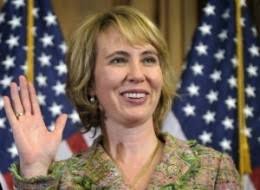
Rep. Gabrielle Giffords
She vowed to return to her former Congressional duties, but was forced to resign for health reasons in 2012.
Giffords was only one victim of a shooting spree that claimed the lives of six people and left 13 others wounded.
Also killed was Arizona’s chief U.S. District judge, John Roll, who had just stopped by to see his friend Giffords after celebrating Mass.
Although the actual shooter, Jared Lee Loughner, was immediately arrested, those who fanned the flames of political violence that consumed 19 people that day have remained unpunished.
Consider the circumstances behind the shootings:
John Roll is Arizona’s chief federal judge. Appointed in 2006, he wins acclaim as a respected jurist and leader who pushes to beef up the court’s strained bench to handle a growing number of border crime-related cases.
In 2009, he becomes a target for threats after allowing a $32 million civil-rights lawsuit by illegal aliens to proceed against a local rancher. The case arouses the fury of local talk radio hosts, who encourage their audiences to threaten Roll’s life.
In one afternoon, Roll logs more than 200 threatening phone calls. Callers threaten the judge and his family. They post personal information about Roll online.
Roll and his wife are placed under fulltime protection by deputy U.S. marshals. Roll finds living under security “unnerving and invasive.”
Authorities identify four men believed responsible for the threats. But Roll declines to press charges on the advice of the Marshals Service.
1912 PRESIDENTIAL ELECTION, 2016 PRESIDENTIAL ELECTION, 2020 PRESIDENTIAL ELECTION, 2024 PRESIDENTIAL ELECTION, ABC NEWS, ADOLF HITLER, ALBERT SPEER, ALTERNET, AMERICABLOG, AP, BABY BOOMER RESISTANCE, BBC, BLACKS, BLOOMBERG NEWS, BORDER WALL, BUZZFEED, CASEY DESANTIS, CBS NEWS, CIA, CNN, COVID-19, CROOKS AND LIARS, DAILY KOS, DEMOCRATS, DONALD TRUMP, ELECTORAL COLLEGE, FBI, FIVETHIRTYEIGHT, FOX NEWS, GAYS, GOVERNMENT SHUTDOWN, HARPER’S MAGAZINE, HARRY S. TRUMAN, HUFFINGTON POST, ILLEGAL ALIENS, JAMES COMEY, JANUARY 6 COUP ATTEMPT, JOE BIDEN, JOSEPH STALIN, MAGGIE HABERMAN, MASKS, MEDIA MATTERS, MOTHER JONES, MOVEON, MSNBC, NATIONAL SECURITY AGENCY, NAZI GERMANY, NBC NEWS, NEW REPUBLIC, NEW YORK POST, NEWSDAY, NEWSWEEK, NICHOLE HEMMER, NPR, PBS NEWSHOUR, POLITICO, POLITICUSUSA, PROTESTERS, PUBLIC HEALTH WORKERS, RACISM, RAW STORY, REPUBLICANS, REUTERS, ROGER STONE, RON DESANTIS, SALON, SCHOOLS, SEATTLE TIMES, SERGEY KISLYAK, SERGEY LAVROV, SEXUALITY, SLATE, SOVIET UNION, TALKING POINTS MEMO, THE ATLANTIC, THE CHICAGO SUN-TIMES, THE CHICAGO TRIBUNE, THE DAILY BEAST, THE DAILY BLOG, THE GUARDIAN, THE HILL, THE HUFFINGTON POST, THE INTERCEPT, THE LOS ANGELES TIMES, THE NATION, THE NEW REPUBLIC, THE NEW YORK TIMES, THE NEW YORKER, THE PRESS, THE VILLAGE VOICE, THE WASHINGTON POST, THEODORE ROOSEVELT, THINKPROGRESS, TIME, TRUTH SOCIAL, TRUTHDIG, TRUTHOUT, TWITTER, U.S. NEWS & WORLD REPORT, UKRAINE, UPI, USA TODAY, VACCINATIONS, VANDERBILT UNIVERSITY, VLADIMIR PUTIN, VOLODYMYR ZELENSKY, WALL STREET JOURNAL, WALT DISNEY CORPORATION, WILLIMAM HOWWARD TAFT, WOODROW WILSON
In Bureaucracy, History, Law, Law Enforcement, Politics, Social commentary, Uncategorized on December 8, 2023 at 12:07 am
In his ongoing war against Florida Governor Ron DeSantis, Donald Trump may have the last word.
The former President has warned that if he can’t be the Republican Presidential nominee in 2024, “he’s willing to burn it all down.”
New York Times reporter Maggie Haberman, who has intimately covered Trump for years, has tweeted:
“Yes, Trump is more vulnerable than he’s been in a long time. But that has happened before and he’s survived.”

Maggie Haberman
Andrew Lih, CC BY-SA 4.0 <https://creativecommons.org/licenses/by-sa/4.0>, via Wikimedia Commons
“Trump has extremely few major donors who want to do anything for him right now and a number of them are having active conversations about the best way to stop him. But. Again….sound familiar?
“Trump has made clear he’s willing to burn it all down if he doesn’t get what he wants, which is maintaining his grip on the product line he’s been developing for six years: the Republican party. So a lot of electeds will have to make a choice they’ve not had to before.”
There is precedent for this. After serving two terms in the White House (1901-1909) Theodore Roosevelt became increasingly disillusioned with his handpicked successor: William Howard Taft.
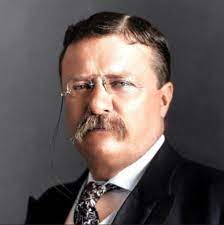
Theodore Roosevelt
By 1912, he decided to run for a third term as a third-party candidate. His candidacy split the Republican vote—and enabled Democrats to elect Woodrow Wilson President.
No doubt many Democrats are now salivating at the possibility of the same occurring in 2024.
And even more of them are looking forward to seeing two would-be tyrants—Donald Trump and Ron DeSantis—trading lethal blows for most of the Presidential year.
Their reaction would be similar to that expressed by then-Senator Harry S. Truman when Nazi Germany invaded the Soviet Union on June 22, 1941: “If we see that Germany is winning the war, we ought to help Russia; and if that Russia is winning, we ought to help Germany, and in that way let them kill as many as possible.”
* * * * *
As the Third Reich came to its fiery end, its dictator, Adolf Hitler, sought to punish the German people for being “unworthy” of his “genius” and losing the war he had started.
His attitude was: “If I can’t rule Germany, then there won’t be a Germany.”
In his infamous “Nero Order,” he decreed the destruction of everything still remaining–industries, ships, harbors, communications, roads, mines, bridges, stores, utility plants, food stuffs.
Fortunately for Germany, one man–Albert Speer–finally broke ranks with his Fuhrer.

Albert Speer
Risking death, he refused to carry out Hitler’s “scorched earth” order. Even more important, he mounted a successful effort to block such destruction and persuade influential military and civilian leaders to disobey the order as well.
As a result, those targets slated for destruction were spared.
Throughout his four years in office, President Donald Trump made it clear that America faced a stark choice: It could remain a constitutional democracy—or allow him to become an all-powerful “President-for-Life.”
Among his outrages:
- Repeatedly attacking the nation’s free press for daring to report his growing list of crimes and disasters, calling it “the enemy of the American people.”
- Siding with Russian dictator Vladimir Putin against the FBI, CIA and National Security Agency which unanimously agreed that Russia had subverted the 2016 Presidential election.
- Firing FBI Director James Comey for investigating that subversion.
- Giving Russian Foreign Minister Sergey Lavrov and Russian Ambassador Sergey Kislyak highly classified CIA Intelligence about an Islamic State plot to turn laptops into concealable bombs.
- Shutting down the Federal Government for 35 days in 2018-19 because Democrats refused to fund his ineffective “border wall” between the United States and Mexico.
- An estimated 380,000 government employees were furloughed and another 420,000 were ordered to work without pay. The shutdown ended due to public outrage—without Trump getting the funding amount he had demanded.
- Trying to coerce Ukrainian President Volodymyr Zelensky to smear former Vice President Joe Biden, who was likely to be his Democratic opponent in the 2020 Presidential election.
- Repeatedly lying about the dangers posed by the COVID-19 virus, and thus enabling it to ravage the country and ultimately kill 400,000 by the time Trump left office.
- Attacking medical experts and governors who urged Americans to wear masks and socially distance to protect themselves from COVID-19.
Trump’s ultimate act of criminality and treason came on January 6, 2021, when he incited his followers to violently attack the United States Capitol Building. Their goal: To prevent Republicans and Democrats from counting the Electoral Votes cast in the 2020 Presidential election.
Trump fully understood that an accurate count of those votes would reveal his loss to Joe Biden: 306 votes for Biden, compared with 232 for Trump.
Fortunately for American democracy, there were enough patriots determined to prevent Trump from becoming the absolute dictator he clearly intended to be.
Like Adolf Hitler, Donald Trump’s attitude was: “If I can’t rule America, there won’t be an America.”
Deprived of his chance to destroy the country he claimed to love, Trump now threatens to destroy the political party that brought him to near-absolute power in 2016.
And Ron DeSantis stands ready to establish himself as an equally Trumpian dictator.
Their party is still waiting for a Republican Albert Speer to step forward and save America from the self-destructive brutalities of its own Right-wing fanatics.
1912 PRESIDENTIAL ELECTION, 2016 PRESIDENTIAL ELECTION, 2020 PRESIDENTIAL ELECTION, 2024 PRESIDENTIAL ELECTION, ABC NEWS, ADOLF HITLER, ALBERT SPEER, ALTERNET, AMERICABLOG, AP, BABY BOOMER RESISTANCE, BBC, BLACKS, BLOOMBERG NEWS, BORDER WALL, BUZZFEED, CASEY DESANTIS, CBS NEWS, CIA, CNN, COVID-19, CROOKS AND LIARS, DAILY KOS, DEMOCRATS, DONALD TRUMP, ELECTORAL COLLEGE, FBI, FIVETHIRTYEIGHT, FOX NEWS, GAYS, GOVERNMENT SHUTDOWN, HARPER’S MAGAZINE, HARRY S. TRUMAN, HUFFINGTON POST, ILLEGAL ALIENS, JAMES COMEY, JANUARY 6 COUP ATTEMPT, JOE BIDEN, JOSEPH STALIN, MAGGIE HABERMAN, MASKS, MEDIA MATTERS, MOTHER JONES, MOVEON, MSNBC, NATIONAL SECURITY AGENCY, NAZI GERMANY, NBC NEWS, NEW REPUBLIC, NEW YORK POST, NEWSDAY, NEWSWEEK, NICHOLE HEMMER, NPR, PBS NEWSHOUR, POLITICO, POLITICUSUSA, PROTESTERS, PUBLIC HEALTH WORKERS, RACISM, RAW STORY, REPUBLICANS, REUTERS, ROGER STONE, RON DESANTIS, SALON, SCHOOLS, SEATTLE TIMES, SERGEY KISLYAK, SERGEY LAVROV, SEXUALITY, SLATE, SOVIET UNION, TALKING POINTS MEMO, THE ATLANTIC, THE CHICAGO SUN-TIMES, THE CHICAGO TRIBUNE, THE DAILY BEAST, THE DAILY BLOG, THE GUARDIAN, THE HILL, THE HUFFINGTON POST, THE INTERCEPT, THE LOS ANGELES TIMES, THE NATION, THE NEW REPUBLIC, THE NEW YORK TIMES, THE NEW YORKER, THE PRESS, THE VILLAGE VOICE, THE WASHINGTON POST, THEODORE ROOSEVELT, THINKPROGRESS, TIME, TRUTH SOCIAL, TRUTHDIG, TRUTHOUT, TWITTER, U.S. NEWS & WORLD REPORT, UKRAINE, UPI, USA TODAY, VACCINATIONS, VANDERBILT UNIVERSITY, VLADIMIR PUTIN, VOLODYMYR ZELENSKY, WALL STREET JOURNAL, WALT DISNEY CORPORATION, WILLIMAM HOWWARD TAFT, WOODROW WILSON
In Bureaucracy, History, Law, Law Enforcement, Politics, Social commentary on December 7, 2023 at 12:25 am
Having been defeated in 2020 for a second term by former Vice President Joe Biden, Donald Trump has convinced himself—and millions of his fanatical followers—that he was cheated by voter fraud.
He is convinced that the 2024 GOP Presidential nomination rightfully belongs to him. And that anyone who stands in his way must be mercilessly crushed.
Florida Governor Ron DeSantis, on the other hand, is equally convinced that it’s now the turn of a younger, more vigorous and equally ruthless man to hold the White House.
Not only does Trump believe DeSantis owes him absolute loyalty, but so do many of his supporters.
“Sadly, everything President Trump says is true. Ron DeSantis owes his governorship to Donald Trump and challenging him in 2024 would be a treacherous act of disloyalty,” said Roger Stone, a long-time Trump adviser.
Donald Trump
Moreover, Trump has never allowed a sense of loyalty to stand in the way of his ambitions—in business or politics.
In DeSantis, Trump faces an opponent every bit as ruthless as himself—and endowed with several built-in advantages. Even so, Trump remains the odds-on favorite to win the 2024 Republican nomination for President.
On November 11, 2022, the CNN website carried an opinion piece by Nichole Hemmer, an associate professor of history at Vanderbilt University.
Entitled “Even the DeSantis bubble may burst,” it noted:
“On paper, DeSantis looks like Trump’s natural heir. Since winning the governorship by a whisper-thin margin in 2018, he has consciously molded himself after Trump, picking up everything from Trump’s hand gestures and speech cadence to his media-bashing and calculated viciousness….
“He has married that political style with a strongman persona. As governor, he has targeted protesters, universities, public health workers and corporations for opposing his policies.
“He has sent police to round up voters with felony convictions who, confused by the state’s efforts to strip their voting rights after voters reinstated them a few years ago, mistakenly voted in recent elections.
“He has bent the Florida legislature to his will, whipping up support for anti-gay laws, a new redistricting map and punitive legislation targeting Disney after the company criticized the state’s infamous ‘don’t say gay” bill.'”

Nichole Hemmer
Thus, in DeSantis, Trump faces an opponent every bit as ruthless as himself—and endowed with several built-in advantages.
First, DeSantis, at 45, is 32 years younger than the 77-year-old Trump.
Second, DeSantis, unlike Trump, has an existing power-base: The Governorship of a pivotal swing state: Florida.
Trump, an ex-President, lives at his Mar-a-Lago estate in Palm Beach, Florida.
Third, DeSantis doesn’t carry the baggage of scandals and notoriety that Trump has acquired as a businessman and President.
Fourth, DeSantis can reach far greater numbers of people through his Twitter account than Trump has been able to do through his failing website, Truth Social.
Trump’s Twitter account was closed—by Twitter—after he incited a mob of his followers to attack the United States Capitol Building on January 6, 2021.
It has since been restored by Elon Musk since he acquired Twitter (now X) in 2022. But Trump prefers to use his subscriber-based website, Truth Social.

Ron DeSantis
Fifth, many Republicans are blaming Trump for their failure to sweep Democrats from state and Federal offices in a widely heralded “Red wave” in the 2022 midterm elections.
“Trump Is the Republican Party’s Biggest Loser,” read the Wall Street Journal Editorial Board’s headline. Fox News and right-wing podcasts and radio shows repeated the charge in the days after the elections.
Sixth, DeSantis has gained huge popularity within Florida by molding himself after Trump by tapping into the politics of resentment. Among the targets of his attacks:
Protesters: DeSantis enacted a 2021 “anti-riot” bill that:
- Grants civil legal immunity to people who drive through protesters blocking a road;
- Creates a broad category for misdemeanor arrest during protests;
- Anyone charged will be denied bail until their first court appearance;
- Creates a new felony crime of “aggravated rioting” that carries a sentence of up to 15 years in prison and a new crime of “mob intimidation.”
Schools:
- Installed GOP allies in top university posts;
- Successfully pushed legislation that could change tenure and limit how university professors can teach lessons on race.
Blacks: Pushed through the legislature a new congressional map that will dilute the voting power of black Floridians.
COVID-19: Attacked wearing masks and getting vaccinated as threats to “American freedom”—to support a family, attend school, run a business.
Gays: Signed legislation prohibiting classroom discussions about sexual orientation and gender identity with younger students—a measure critics dubbed the “Don’t Say Gay” law.
Walt Disney Corporation: Disney CEO Bob Chapek criticized DeSantis’ “don’t say gay” bill. DeSantis rammed through the legislature a bill eliminating the decades-long status Disney had held to operate as an independent government around its Orlando-area theme parks.
Asylum-seekers: Sent two planeloads of illegal aliens—at Florida’s expense—to the island of Martha’s Vineyard as a pre-election publicity stunt.
Nor has DeSantis neglected to make himself appear as a true “man of the people.”
A month before the election, he declared a gas tax holiday. He also suspended campaigning and focused on effective hurricane relief after Hurricane Ian.
1912 PRESIDENTIAL ELECTION, 2016 PRESIDENTIAL ELECTION, 2020 PRESIDENTIAL ELECTION, 2024 PRESIDENTIAL ELECTION, ABC NEWS, ADOLF HITLER, ALBERT SPEER, ALTERNET, AMERICABLOG, AP, BABY BOOMER RESISTANCE, BBC, BLACKS, BLOOMBERG NEWS, BORDER WALL, BUZZFEED, CASEY DESANTIS, CBS NEWS, CIA, CNN, COVID-19, CROOKS AND LIARS, DAILY KOS, DEMOCRATS, DONALD TRUMP, ELECTORAL COLLEGE, FBI, FIVETHIRTYEIGHT, FOX NEWS, GAYS, GOVERNMENT SHUTDOWN, HARPER’S MAGAZINE, HARRY S. TRUMAN, HUFFINGTON POST, ILLEGAL ALIENS, JAMES COMEY, JANUARY 6 COUP ATTEMPT, JOE BIDEN, JOSEPH STALIN, MAGGIE HABERMAN, MASKS, MEDIA MATTERS, MOTHER JONES, MOVEON, MSNBC, NATIONAL SECURITY AGENCY, NAZI GERMANY, NBC NEWS, NEW REPUBLIC, NEW YORK POST, NEWSDAY, NEWSWEEK, NICHOLE HEMMER, NPR, PBS NEWSHOUR, POLITICO, POLITICUSUSA, PROTESTERS, RACISM, RAW STORY, REPUBLICANS, REUTERS, ROGER STONE, RON DESANTIS, SALON, SCHOOLS, SEATTLE TIMES, SERGEY KISLYAK, SERGEY LAVROV, SEXUALITY, SLATE, SOVIET UNION, TALKING POINTS MEMO, THE ATLANTIC, THE CHICAGO SUN-TIMES, THE CHICAGO TRIBUNE, THE DAILY BEAST, THE DAILY BLOG, THE GUARDIAN, THE HILL, THE HUFFINGTON POST, THE INTERCEPT, THE LOS ANGELES TIMES, THE NATION, THE NEW REPUBLIC, THE NEW YORK TIMES, THE NEW YORKER, THE PRESS, THE VILLAGE VOICE, THE WASHINGTON POST, THEODORE ROOSEVELT, THINKPROGRESS, TIME, TRUTH SOCIAL, TRUTHDIG, TRUTHOUT, TWITTER, U.S. NEWS & WORLD REPORT, UKRAINE, UPI, USA TODAY, VACCINATIONS, VANDERBILT UNIVERSITY, VLADIMIR PUTIN, VOLODYMYR ZELENSKY, WALL STREET JOURNAL, WALT DISNEY CORPORATION, WILLIMAM HOWWARD TAFT, WOODROW WILSON
In Bureaucracy, History, Law, Law Enforcement, Politics, Social commentary on December 6, 2023 at 12:14 am
For Americans, the 2024 Presidential election may prove the equivalent of the deathmatch between German Fuhrer Adolf Hitler and Soviet Premier Joseph Stalin from 1941 to 1945.
At the very least, it promises to be the Right-wing heavyweight championship of the decade, if not the century: An all-out slugfest between former President Donald J. Trump and Florida Governor Ron D. DeSantis.
On November 10, 2022, Trump publicly attacked DeSantis as “Ron DeSanctimonious” and took credit for DeSantis’ success after endorsing him in 2018.
This was only two days after DeSantis was soundly re-elected Governor—and the much-hyped “Red wave” failed to sweep Democrats out of state and federal offices in the 2022 midterm elections.
On his website, Truth Social, Trump posted that DeSantis had been a political lightweight who had come to him “in desperate shape” when running for his first term in office in 2017.
Donald Trump
“Ron had low approval, bad polls, and no money, but he said that if I would Endorse [sic] him, he could win. also fixed his campaign, which had completely fallen apart.”
For Trump, DeSantis’ worst sin was refusing to say whether he would run for President in 2024.
Having been defeated for a second term by Joe Biden in 2020, Trump believes he has an absolute right to regain that office in 2024.
“Ron DeSanctimonious is playing games! The Fake News asks him if he’s going to run if President Trump runs, and he says, ‘I’m only focused on the Governor’s race, I’m not looking into the future.’ Well, in terms of loyalty and class, that’s really not the right answer.”
By “loyalty” Trump meant: Loyalty to himself.
For Trump, there was only one “right” answer DeSantis could have given: “I will not be a candidate for President in 2024 and I will totally support President Trump for that office.”
And that was not the response that DeSantis gave.
Even worse for Trump: Several of his loudly-supported candidates across the country lost their electoral bids.
To add to his rage and sense of betrayal: Conservative media sided with DeSantis—such as Fox News and the New York Post, which ran a front page headline calling DeSantis “DeFuture” the day after the election.

New York Post, Public domain, via Wikimedia Commons
Responded Trump: “NewsCorp, which is Fox, the Wall Street Journal, and the no longer great New York Post, is all in for Governor Ron DeSanctimonious.”
A Trump advisor, speaking off-the-record, told Politico: “Obviously he is escalating. It is total shots fired. It is not what I would have done if it were totally up to me, but you can’t argue with Donald Trump’s tactics. They work. He is savage but effective. He was never going to stay restrained for long.”
“He is obviously threatened by a DeSantis presidential run,” said a longtime Florida Republican consultant speaking of Trump. “And by doing this, I think he will lose a lot of his base support.”
This, however, hasn’t happened—and Trump comfortably leads DeSantis in Republican polls.
Trump’s advisors tried to persuade him to soften his image. They feared that his angry and divisive rhetoric is turning off many voters who like his policies but desire some normalcy.
They also tried to persuade Trump to focus less on his 2020 election loss and offer solutions to voters’ problems.
At the DeSantis victory rally, chants resounded: “Two more years!”—meaning that his supporters want him to run for President in 2024.
For months, DeSantis refused to respond to the attacks Trump has made on him.
Two Florida Republicans close to DeSantis told Yahoo News that the governor would be wary of attacking Trump. He wanted to focus on policy issues and Florida’s recovery from Hurricane Ian.
By doing so, they said, DeSantis would highlight how his governing style differed from Trump’s more combative and less policy-focused approach.
It also would prevent him from getting sucked into an endless tit-for-tat war of insults with the insult-happy ex-President.
The Donald Trump-Ron DeSantis relationship wasn’t always so hostile.
Trump’s endorsement played a huge role in DeSantis’ winning the 2018 GOP primary against former Florida Agriculture Commissioner Adam Putnam, who was an early favorite.
And DeSantis quickly showed his gratitude with a campaign video that was a naked Valentine to Trump’s ego—and the base that worshiped him.
Released on July 30, 2018, the ad was narrated by DeSantis’ wife, Casey.
CASEY DESANTIS: Everyone knows my husband, Ron DeSantis, is endorsed by President Trump. But he’s also an amazing dad. Ron loves playing with the kids.
DESANTIS: “Build the wall” [as his son uses colored plastic bricks to build a wall. This was a line right out of Trump’s repeated demands for a wall separating the United States from Mexico.]

CASEY: He reads stories.
DESANTIS: “Then Mr. Trump said ‘You’re fired.’ I love that part'” [as he reads a book to his son].
CASEY: He’s teaching Madison to talk.
DESANTIS: “Make America great again” [as he holds up a “Trump” sign that says exactly that].
CASEY: People say Ron’s all Trump, but he’s so much more.
DESANTIS: “Bigly. So good” [as he’s looking at his son in a crib].
CASEY: I just thought you should know.
2016 PRESIDENTIAL ELECTION, ABC NEWS, ADOLF HITLER, AFGHANISTAN, ALTERNET, AP, ASIANS, ” 9/11, BARACK OBAMA, BLACKS, BULLYING, BUZZFEED, CBS NEWS, CNN, COMMUNISM, CROOKS AND LIARS, DAILY KOZ, DONALD TRUMP, FACEBOOK, FASCISM, GEORGE W. BUSH, GREAT DEPRESSION, HILLARY CLINTON, HISPANICS, IRAQ, JEWS, MOTHER JONES, MOVEON, MUSLIMS, NAZI GERMANY, NAZI PARTY, NBC NEWS, NEWSWEEK, NPR, PAUL VON HINDENBURG, POLITICO, RACISM, RAW STORY, REPUBLICANS, REUTERS, ROBERT PAYNE, Ronald Reagan, SALON, SEATTLE TIMES, SLATE, THE ATLANTIC, THE CHICAGO SUN-TIMES, THE CHICAGO TRIBUNE, THE DAILY BEAST, THE GUARDIAN, THE HILL, THE HUFFINGTON POST, THE LIFE AND DEATH OF ADOLF HITLER, THE LOS ANGELES TIMES, THE LOS ANGELS TIMES, THE NATION, THE NEW YORK TIMES, THE WASHINGTON POST, TIME, TRUMP EFFECT, TWITTER, U.S. NEWS & WORLD REPORT, UP, UPI, USA TODAY, WORLD WAR 1, WORLD WAR 11
In Bureaucracy, History, Politics, Social commentary on November 23, 2023 at 1:15 am
In his bestselling 1973 biography, The Life and Death of Adolf Hitler, British historian Robert Payne harshly condemned the German people for the rise of the Nazi dictator.
“[They] allowed themselves to be seduced by him and came to enjoy the experience….[They] followed him with joy and enthusiasm because he gave them license to pillage and murder to their hearts’ content. They were his servile accomplices, his willing victims….
“If he answered their suppressed desires, it was not because he shared them, but because he could make use of them. He despised the German people, for they were merely the instruments of his will.”
On November 8, millions of ignorant, hate-filled, Right-wing Americans elected Donald Trump—a man reflecting their own hate and ignorance—to the Presidency.
And as the 2024 Presidential election swiftly approaches, millions of these same voters are prepared to do so again.
Yet, in some ways, Americans have fewer excuses for turning to a Fascistic style of government than the Germans did.
Adolf Hitler, joined the National Socialist German Workers (Nazi) Party in 1919—the year after World War 1 ended.
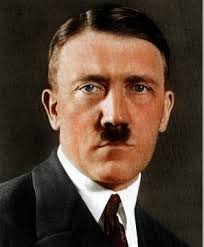
Adolf Hitler
In 1923, he staged a coup attempt in Bavaria—which was quickly and brutally put down by police. He was arrested and sentenced to less than a year in prison.
After that, Hitler decided that winning power through violence was no longer an option. He must win it through election—or appointment.
He repeatedly ran for the highest office in Germany—President—but never got a clear majority in a free election.
When the 1929 Depression struck Germany, the fortunes of Hitler’s Nazi party rose as the life savings of ordinary Germans fell. Streets echoed with bloody clashes between members of Hitler’s Nazi Stormtroopers and those of the German Communist Party.
Germany seemed on the verge of collapsing.
Germans desperately looked for a leader—a Fuhrer—who could somehow deliver them from the threat of financial ruin and Communist takeover.
In early 1933, members of his own cabinet persuaded aging German president, Paul von Hindenburg, that only Hitler’s appointment as Chancellor could do this.
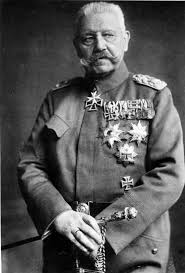
Paul von Hindenburg
Hindenburg considered Hitler a dangerous radical: “That man for Chancellor? Why, I’ll make him a postmaster, and he can lick my backside—on stamps!”
But he allowed himself to be convinced that, by putting Hitler in the Cabinet, he could be “boxed in” and thus controlled.
So, on January 30, 1933, he reluctantly appointed Adolf Hitler Chancellor—the equivalent of Attorney General—of Germany.
On August 2, 1934, Hindenburg died, and Hitler immediately assumed the titles—and duties—of the offices of Chancellor and President. His rise to total power was now complete.
It had taken him 14 years to do so.
In 2015, Donald Trump declared his candidacy for President.
At that time:
- America was at war in Iraq and Afghanistan—but its fate wasn’t threatened, as it had been during the Cold War.
- If you didn’t know someone in the military, you didn’t care about the casualties happening.
- Nor were these conflicts imposing shortages on Americans, as World War II had.
- Government loans from President Barack Obama had saved American capitalism from its own excesses during the George W. Bush administration.
- The Obama administration had been free of corruption—in contrast to that of George W. Bush.
- Nor had there been any large-scale terrorist attacks on America—as there had been on 9/11 under Bush.
Yet—not 17 months after announcing his candidacy for President—enough Americans fervently embraced Donald Trump to give him the most powerful position in the country and the world.
.jpg/220px-Donald_Trump_August_19,_2015_(cropped).jpg)
Donald Trump
The message of Barack Obama’s 2008 campaign had been one of hope—“Yes, We Can!”
That of Donald Trump’s campaign was one of hatred toward everyone who was not an avid Trump supporter: “No, You Can’t!”
Whites comprised the overwhelming majority of the audiences at Trump rallies. Not all were racists, but many of those who were advertised it on T-shirts: “MAKE AMERICA WHITE AGAIN.”
They knew that demographics were steadily working against them. Birthrates among non-whites were rising. By 2045, whites would make up less than 50 percent of the American population.
The 2008 election of the first black President had shocked whites. His 2012 re-election had deprived them of the hope that 2008 had been an accident.
Then came 2016—and the possibility that a black President might actually be followed by a woman: Hillary Clinton.
And the idea of a woman dictating to men was strictly too much to bear.
Even though Russian dictator Vladimir Putin was publicly backing Trump, almost 63 million Americans enthusiastically sent him to the White House.
Today, Trump is once again running for the Presidency—and making it clear that if he’s re-elected, he will purge everyone he blames for his 2020 defeat. Not to mention the judges and prosecutors who are now daring to hold him accountable for his litany of crimes.
And this is where matters stand little more than a year until Americans choose again the current President—Joseph Biden—or the end of democracy with Trump.
All of this should be remembered the next time an American blames Germans for their embrace of Adolf Hitler.
2016 PRESIDENTIAL CAMPAIGN, ABC NEWS, ACCESS HOLLYWOOD, ADRIANNE ZUCKER, ALABAMA SUPREME COURT, ALTERNET, ANDERSON COOPER, AP, ATHEISTS, BARACK OBAMA, BILL CLILNTON, BILLY BUSH, BLACKS, BRETT KAVANAUGH, BUZZFEED, CARL PALADINIO, CBS NEWS, CHARLES MANSON, CHICAGO TRIBUNE, CNN, COREY LEWANDOWSKI, COREY LEWENDOWSKI, CROOKS AND LIARS, DAILY KOZ, DAYS OF OUR LIVES, DONALD TRUMP, E. JEAN CARROLL, FOX NEWS, HISPANICS, HOMOSEXUALS, HOUSE OF REPRESENTATIVES, INFIDELITY, IVANA TRUMP, JERRY FALWELL JR., JESSICA LEEDS, JEWS, KEVIN MCCARTHY, LEIGH CORFMAN, LESBIANS, LIBERALS, MARCO RUBIO, MARLA MAPLES TRUMP, MELANIA TRUMP, MICHAEL GERSON, MICHELLE BACHMANN, MINDY MCGILLIVRAY, MINDY MCGILLLIVRAY, MOTHER JONES, MOVEON, NATASHA STOYNOFF, NBC NEWS, NEWSWEEK, NON-CHRISTIANS, NPR, PALM BEACH POST, PEOPLE, PEOPLE MAGAZINE, POLITICO, RALPH REED, RAPE, RAW STORY, RELIGIOUS RIGHT, REPUBLICAN PARTY, REPUBLICANS, REUTERS, ROY MOORE, SALON, SEAN HANNITY, SEATTLE TIMES, SEXUAL HARASSMENT, SEXUALLY TRANSMITTED DISEASES, SLATE, STEVE BANNON, STORMY DANIELS, TED SLOWIK, THE ATLANTIC, THE CHICAGO SUN-TIMES, THE CHICAGO TRIBUNE, THE DAILY BEAST, THE GUARDIAN, THE HILL, THE HUFFINGTON POST, THE LOS ANGELES TIMES, THE NATION, THE NEW YORK TIMES, THE PALM BEACH POST, THE WASHINGTON POST, THOM TILLIS, TIME, TWITTER, U.S. NEWS & WORLD REPORT, UPI, USA TODAY, WOMEN
In Bureaucracy, History, Politics, Social commentary, Uncategorized on November 2, 2023 at 12:13 am
On October 12, 2016, The Palm Beach Post, The New York Times and People all published stories of women claiming they had been sexually assaulted by Donald Trump.
Trump’s reaction: “Every woman lied when they came forward to hurt my campaign. Total fabrication. The events never happened. Never.”
For “proof,” he attacked their physical appearance.
Of one accuser, Natasha Stoynoff, he said: “Take a look. You take a look. Look at her. Look at her words. You tell me what you think. I don’t think so. I don’t think so.”
Of another accuser, Jessica Leeds, Trump said: “Believe me, she would not be my first choice, that I can tell you. Whoever she is, wherever she comes from, the stories are total fiction. They’re 100% made up. They never happened.”
In short: They were too ugly for Trump to consider them worth sexually harassing.
And he threatened: “All of these liars will be sued after the election is over.”
To date, Trump has not filed a single lawsuit for defamation. No doubt he realizes:
- He would have to take the witness stand and testify under oath; and
- There is simply too much evidence stacked against him.
By October 14, 2016, at least 12 women had publicly accused Trump of sexually inappropriate behavior.
Trump—who’s been married three times and often boasted of his sexual prowess—asked why President Barack Obama hadn’t had similar claims leveled against him.
The answer: Because there has never been the slightest hint of scandal about Obama as a faithful husband.
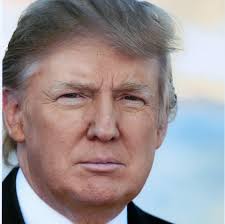
Donald Trump
Many Right-wingers defended Trump’s misogynist comments as mere “frat boy” talk. Said Corey Lewandowski, a former Trump campaign manager and now CNN commentator: “We are electing a leader to the free world. We’re not electing a Sunday school teacher.”
And Fox News host Sean Hannity went Biblical to excuse Trump: “King David had 500 concubines for crying out loud!”
But Washington Post Columnist Micheal Gerson took a darker—and more accurate—view of Trump’s comments.
Appearing on the PBS Newshour on October 7, Gerson said: “Well, I think the problem here is not just bad language, but predatory language, abusive language, demeaning language. That indicates something about someone’s character that is disturbing, frankly, disturbing in a case like this.”
By April, 2019, the total number of women accusing Trump of making improper advances had risen to 23.
And, in June, yet another woman came forward to accuse Trump of sexual assault: E. Jean Carroll, an advice columnist for Elle magazine.
E. Jean Carroll
Carroll alleges that Trump attacked her in the fall of 1995 or the spring of 1996 at the Bergdorf Goodman department store in New York.
She claims claims that, while gift shopping, Trump pressured her to try on lingerie and grabbed her arm to pull her toward the dressing room.
“The moment the dressing-room door is closed, he lunges at me, pushes me against the wall, hitting my head quite badly, and puts his mouth against my lips.
“I am so shocked I shove him back and start laughing again. He seizes both my arms and pushes me up against the wall a second time, and, as I become aware of how large he is, he holds me against the wall with his shoulder and jams his hand under my coat dress and pulls down my tights.
“The next moment, still wearing correct business attire, shirt, tie, suit jacket, overcoat, he opens the overcoat, unzips his pants, and, forcing his fingers around my private area, thrusts his penis halfway —or completely, I’m not certain—inside me.”
True to form, Trump responded by exonerating himself on the basis of the woman’s appearance: “I’ll say it with great respect: Number one, she’s not my type.”
Then he accused the accuser: “Shame on those who make up false stories of assault to try to get publicity for themselves, or sell a book, or carry out a political agenda….
“It’s just as bad for people to believe it, particularly when there is zero evidence. Worse still for a dying publication to try to prop itself up by peddling fake news—it’s an epidemic.”
Also, predictably, he portrayed himself as the innocent victim of yet another vast conspiracy: “If anyone has information that the Democratic Party is working with Ms. Carroll or New York Magazine, please notify us as soon as possible.”
And, just as predictably, Republicans rallied around the President.
“Quite honestly, as somebody who had a front-row seat to the Kavanaugh hearings, we’ve seen allegations that were false,” said Sen. Thom Tillis (R-N.C.). “We’ll let the facts go where they are, but I take [Trump’s] statement at face value.”
“Yes, I believe the president.” said House Minority Leader Kevin McCarthy when pressed on whether he believed Trump.
There’s an old saying: “If one person tells you you’re drunk, and you feel fine, ignore him. If ten people tell you you’re drunk, you need to lie down.”
More than a score of women have come forward to say that Donald Trump—the former President of the United States—is a sexual predator.
Yet no one in the Republican party is willing to acknowledge it.
ABC NEWS, ADOLF HITLER, ALTERNET, AMERICABLOG, AP, ARAB SHEIKS, “DROOPERS”, BABY BOOMER RESISTANCE, BBC, BLACKS, BLOOMBERG NEWS, BUMS, BUZZFEED, CAITLYN JENNER, CBS NEWS, CNN, COSTUMES, CRAZED KILLERS, CROOKS AND LIARS, DAILY KOS, DONALD TRUMP, ESCAPED MENTAL PATIENTS, FAT PERSONS, FIVETHIRTYEIGHT, GEISHAS, HALLOWEEN, HANDMAID’S TALE, HARPER’S MAGAZINE, HOMOSEXUALS, HUFFINGTON POST, ILLEGAL ALIENS, INDIAN PRINCESS, INDIAN SNAKE CHARMERS, MEDIA MATTERS, MEXICANS, MOTHER JONES, MOVEON, MSNBC, NAUGHTY PRIESTS, NBC NEWS, NEW REPUBLIC, NEWSDAY, NEWSWEEK, NPR, NURSES, PBS NEWSHOUR, PIMPS, POLITICAL CORRECTNESS, POLITICO, POLITICUSUSA, PRIESTS, PRISONERS, RAW STORY, REUTERS, ROBERT E. LEE, SALON, SAN FRANCISCO CASTRO DISTRICT, SEATTLE TIMES, SEXY CONVICTS, SEXY HAREM SLAVES, SEXY PRISON GUARDS, SLATE, TALKING POINTS MEMO, TERRORISTS, THE ATLANTIC, THE CHICAGO SUN-TIMES, THE CHICAGO TRIBUNE, THE DAILY BEAST, THE DAILY BLOG, THE GUARDIAN, THE HILL, THE HUFFINGTON POST, THE INTERCEPT, THE LOS ANGELES TIMES, THE NATION, THE NEW REPUBLIC, THE NEW YORK TIMES, THE NEW YORKER, THE VILLAGE VOICE, THE WALL, THE WASHINGTON POST, THINKPROGRESS, TIME, TRANSEXUALS, TRUTHDIG, TRUTHOUT, TWITTER, U.S. NEWS & WORLD REPORT, UP, UPI, USA TODAY
In Business, History, Politics, Social commentary on October 30, 2023 at 12:24 am
Halloween isn’t just for kids anymore.
In 2023, about 70% of Americans will participate in Halloween, and will spend an estimated $12.2 billion. Yes, that’s with a “b”. This will surpass last year’s $10.6 billion.
The average American will spend $31.93 on candy, $19.42 on Halloween décor and $36.84 on costumes.

Those putting out this avalanche of money will, of course, be adults. And a lot of those costumes will be worn by adults at parties across the nation.
This will be especially true in San Francisco.
In 1979, Halloween in its Castro District shifted from being a children’s event to a celebration among homosexuals and lesbians.
In 2002, 500,000 people celebrated Halloween in the Castro and four people were stabbed.
It continued to grow into a massive annual street party until 2006, when a shooting wounded nine people and prompted the city to call off the event.
In 2007, 600 police were deployed in the Castro on Halloween. By 2010, San Francisco had banned the event in the Castro, directing celebrants to various balls and parties elsewhere.
Yet in 2023 Halloween will return to the Castro after The Civic Joy Fund pledged over $100,000 to reimburse merchants for hosting events, like parties and tarot readings.
But there’s another force working to suppress Halloween joy among its participants: Political Correctness.
Articles now highlight a series of costumes it’s Politically Incorrect to wear on Halloween. So it’s now virtually impossible to enjoy this occasion without fearing that you’ll hurt the sensitivities of almost every group imaginable.
For example:
Adolf Hitler: It’s offensive to Jews and Holocaust survivors. And it could remind liberals of the Republicans’ agenda.
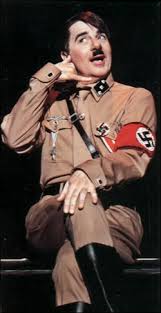
Homeless: Such costumes will hurt the feelings of bums who won’t be attending Halloween parties anyway. 
Illegal alien: It’s not nice to spotlight people who constantly violate the immigration laws of the United States.

Terrorist: You might upset Islamics, who make up the vast majority of the world’s terrorists.

Others on the list of groups that uber-liberals believes it’s Politically Incorrect to dress up as include:
- Blacks: If you’re white.
- Naughty Priests: It’s offensive to mock religious hypocrites who violate the bodies of children.
- “Tranny Granny”: It’s cruel to make fun of men who have sophisticated surgery to make themselves look like women.
- Mexicans: (such as a woman wearing a mariachi outfit or a man sporting a sombrero, serape and drooping moustache).
- Pimp: It’s offensive to blacks—especially those who make their living through the sale of women’s bodies.
- Handmaid’s Tale: Because it’s cruel to remind people that Republicans are trying to eliminate rights for women.
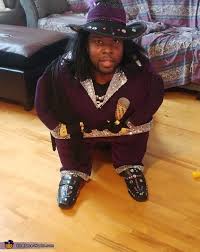
- Sexy nurse: Nursing is a serious profession—and everybody knows that nurses never have romances with doctors.
- Indian Princess: If you’re not an American Indian. Indians could be offended by your “cultural appropriation.”
- Fat costumes: It will hurt the feelings of people who can barely fit into an airplane seat—many of them because they simply eat too much.
- Crazed Killer: Because it’s not fair to make fun of psychopathic murderers who prey on innocent men, women and children.
- Prisoner: It’s not nice to make fun of people who are serving time for victimizing others.
- The Wall: Wearing an imitation brick wall reminds people that millions of Hispanics have illegally violated America’s immigration laws—and millions more intend to.
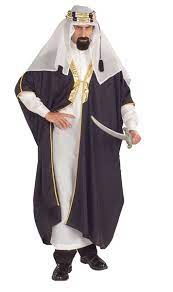
- Arab Sheik: It’s not nice to dress like an OPEC board member in a long flowing robe and headdress. Especially when they’re jacking up oil prices.
- Sexy Harem Slave: Consider this the flip side of “Arab Sheik.” It’s uncool to remind people that women throughout the Islamic world are treated like chattel.
- “Droopers”: An obvious parody of the “Hooters” outfit, this features a fake pair of drooping breasts, thus winning it dual charges of “ageism” and “sexism.”
- Geisha: You could be accused of “cultural appropriation.”
- Robert E. Lee: Once a Southern icon of the Civil War, he is now damned as a racist defender of slavery.
- Escaped Mental Patient: Wearing an imitation straitjacket makes fun of real-life whackjobs who need to be restrained—for their own safety and that of others.
- Indian Snake Charmer: This costume supposedly appropriates Middle Eastern culture and has “disturbing sexual undertones”—if you equate snakes with penises.
- Donald Trump: It’s not nice to remind people of the man who tried to overturn the 2020 election and intends to overturn the 2024 one.
If you follow the guidelines of these articles, you might as well skip Halloween altogether.
Yet no one objects to children—or adults—dressing up as pirates like Blackbeard, who once terrorized the oceans as modern-day terrorists menace the world.
No one objects to those who dress up
- Like skeletons, symbolic of Death—when almost everyone has had a friend or family member who died.
- As witches—who have been associated with evil for hundreds of years. Countless innocent women were sentenced to burning as a result.
- As Satan—the literal personification of evil for millions of Christians, Jews and Muslims.
The whole idea of Halloween is to momentarily step into a character that’s utterly different from you.
So if you are a terrorist, try dressing up at Halloween as Dr. Albert Schweitzer or Florence Nightingale.
2003 IRAQ WAR; ABU GHRAIB PRISON, ABC NEWS, ABORTION, ALTERNET, AMERICABLOG, ANIMAL RIGHTS, AP, “GREASE”, BABY BOOMER RESISTANCE, BARACK OBAMA, BBC, BILLBOARD HOT 100, BIRTH CONTROL, BLACKS, BLOOMBERG NEWS, BREAST CANCER, BUZZFEED, CBS NEWS, CEDARS-SINAI MEDICAL CENTER, CLIMATE CHANGE, CNN, CROOKS AND LIARS, DAILY KOZ, DEMOCRATS, DONALD TRUMP, EURIPIDES, FIVETHIRTYEIGHT, GAYS, GRAMMY AWARDS, HARPER’S MAGAZINE, HUFFINGTON POST, JOHN TRAVOLTA, LARRY KING, LESBIANS, LUNG CANCER, MEDIA MATTERS, MOTHER JONES, MOVEON, MSNBC, NBC NEWS, NEW REPUBLIC, NEWSDAY, NEWSWEEK, NPR, OLIVIA NEWTON-JOHN, PBS NEWSHOUR, POLITICO, POLITICUSUSA, RAW STORY, RED CROSS, REPUBLICANS, REUTERS, RUSH LIMBAUGH, SALON, SANDRA FLUKE, SEATTLE TIMES, SLATE, SMOKING, TALKING POINTS MEMO, THE ATLANTIC, THE CHICAGO SUN-TIMES, THE CHICAGO TRIBUNE, THE DAILY BEAST, THE DAILY BLOG, THE GUARDIAN, THE HILL, THE HUFFINGTON POST, THE INTERCEPT, THE LOS ANGELES TIMES, THE NATION, THE NEW REPUBLIC, THE NEW YORK TIMES, THE NEW YORKER, THE RUSH LIMBAUGH SHOW, THE VILLAGE VOICE, THE WASHINGTON POST, THINKPROGRESS, TIME, TRAGEDY, TRUTHDIG, TRUTHOUT, TWITTER, TWO POLITICAL JUNKIES, U.S. NEWS & WORLD REPORT, UPI, USA TODAY, VANITY FAIR, WONKETTE
In Entertainment, History, Medical, Politics, Social commentary on October 27, 2023 at 12:10 am
Two deaths. Two entirely different legacies.
The first—of Rush Limbaugh—came on February 17, 2021.
The second—of Olivia Newton-John—came on August 10, 2022.
Limbaugh hosted The Rush Limbaugh Show, which was nationally syndicated on AM and FM radio stations from 1988 until his death in 2021.
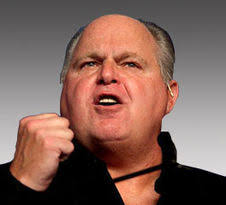
Rush Limbaugh
With 15.5 million listeners, Limbaugh’s radio show was the most popular one in the United States. He became one of the most prominent Right wing voices in the country during the 1990s.
Among his targets: Blacks; liberals; Democrats; gays; lesbians; feminists (whom he called “feminazis”); consent in sexual relations; environmentalism; climate change; abortion rights; Barack Obama; the need for masking and vaccinations against COVID-19.
Among the personalities and causes he championed: The 2003 Iraq war; torture at the infamous Abu Ghraib prison; eliminating taxes on the wealthy; smoking; Donald Trump;
His attack on Sandra Fluke, a third-year Georgetown University law student who testified before Congress on February 23, 2012, was typical Limbaugh.
Fluke said that insurance companies should cover the costs of birth control. As a student at a Jesuit campus that refuses to provide insurance coverage for contraception, birth control costs can be as high as $3,000 during the three years a woman attends law school.
Limbaugh’s response: “So Ms. Fluke and the rest of you Feminazis, here’s the deal: If we are going to pay for your contraceptives and thus pay for you to have sex, we want something for it. And I’ll tell you what it is. We want you to post the videos online so we can all watch.”
Sandra Fluke was among the millions who didn’t mourn when Limbaugh died at 70 on February 17, 2021, of lung cancer caused by a lifetime of cigar smoking.
If the legacy of Rush Limbaugh was darkness personified, the legacy of Olivia Newton-John was one of sunshine and joy.

Olivia Newton-John
Larry D. Moore, CC BY-SA 3.0 <https://creativecommons.org/licenses/by-sa/3.0>, via Wikimedia Commons
She dominated the pop charts of the 1970s and ’80s with mega hits “Hopelessly Devoted to You,” “I Honestly Love You,” “Have You Never Been Mellow?” “Magic,” and “Physical.”
Vanity Fair described her thus: “Her angelic beam matched with a clear, sweet-yet-supple soprano was vocal satin, giving her a versatile edge in singing feel-good numbers across genres and styles.”
But her biggest splash came in “Grease,” the top-grossing movie for 1978, where she co-starred with John Travolta. Her role as Sandy, an Australian exchange student, brought her international acclaim and further propelled her musical career. The movie’s soundtrack remains one of the world’s best-selling albums.
“I don’t think anyone could have imagined a movie would go on almost 40 years and would still be popular and people would still be talking to me about it all the time and loving it,” Newton-John said in 2017.
She won four Grammy awards and racked up five number-one hits and another 10 top-10 hits on the Billboard Hot 100 and two number-one albums on the Billboard 200. Eleven of her singles and 14 of her albums have been certified Gold by the Recording Industry Association of America.
Having sold more than 100 million records, Newton-John is one of the most popular singers of the 20th and 21st centuries.
“I love to sing, it’s all I know how to do,” she told CNN in 2017. “That’s all I’ve ever done since I was 15, so it’s my life. I feel very grateful that I can still do it and people still come to see me.”
An animal-rights advocate, she cancelled a 1978 concert tour of Japan to protest the slaughter of dolphins caught in tuna fishing nets.
Among the charities and foundations she supported: Cure Breast Cancer, Red Cross, Healthy Child Healthy World, Cedars-Sinai Medical Center. She was a performer on the 1979 Music for UNICEF Concert for the UN’s International Year of the Child, televised worldwide.
Behind her bright smile and sunny disposition lay the shadow of tragedy. In 2005 Newton-John’s then-boyfriend, Patrick McDermott, disappeared at sea while on a fishing trip off the coast of California.
“It’s very hard to live with that,” she told CNN’s Larry King in 2006. “It’s probably the hardest thing I’ve ever experienced, and I’ve been through a lot of things.”
In 1992, she was diagnosed with breast cancer. She recovered, but for more than 40 years she lived under the constant threat of its return.
“I draw strength from the millions of women who have faced this challenge successfully,” she said in a statement. “This has been detected early because I’ve had regular examinations, so I encourage other women to do the same.”
Then, in May 2017, she announced that the cancer had returned and metastasized to her lower back.
Asked during a February 2021 interview if she had contemplated her own death, she replied, “I have quite a few times,” adding it was “sooner than I would have wanted. I mean—we all know we are going to die. I think we spend our lives probably much in denial of it.”
The title of her 2019 autobiography, Don’t Stop Believin’, summed up her attitude toward life.
On August 8, 2022, Olivia Newton-John died from cancer at her home in the Santa Ynez Valley of California. She was 73.
Euripides, the Greek tragedian, was right: “When good men die, their goodness does not perish, but lives though they are gone. As for the bad, all that was theirs dies and is buried with them.”
2016 PRESIDENTIAL ELECTION, 2020 PRESIDENTIAL ELECTION, ABC NEWS, ALTERNET, AMERICABLOG, AP, ASSAULT, BABY BOOMER RESISTANCE, BLACK LIBERATION ARMY, BLACK LIVES MATTER, BLACKS, BLOOMBERG, BURGLARY, BUZZFEED, CBS NEWS, CNN, CRIME, CROOKS AND LIARS, DAILY KOZ, DARREN WILSON, DONALD TRUMP, DRUDGE REPORT, DRUGS, EMERYVILLE, FBI, FELONIOUS ASSAULT, FELONY SEX CRIMES, FERGUSON POLICE DEPARTMENT, FIVETHIRTYEIGHT, GEORGE FLOYD, GRAND LARCENY, HARPER’S MAGAZINE, HISPANICS, HUFFINGTON POST, JASON BLAKE, JESSE JACKSON, KENOSHA COUNTY, MANSLAUGHTER, MARTIN LUTHER KING, MEDIA MATTERS, MICHAEL BROWN, MISDEMEANOR ASSAULT, MISDEMEANOR ASSAULT AND RELATED OFFENSES, MISDEMEANOR SEX CRIMES, MOTHER JONES, MOVEON, MSNBC, MURDER, NBC NEWS, NEW YORK CITY, NEW YORK POLICE DEPARTMENT, NEWSWEEK, NON-NEGLIGENT MANSLAUGHTER, NPR, OAKLAND, PBS NEWSHOUR, PETIT LARCENY, POLITICO, POLITICUSUSA, PROACTIVE PROPERTY CRIMES, RAPE, RAW STORY, RESTRAINING ORDER, REUTERS, ROBBERY, ROBERT DALEY, RUSTEN SHESKEY, SALON, SAN FRANCISCO, SAN JOSE, SEATTLE TIMES, SEX CRIMES, SEXUAL ASSAULT, SHOOTINGS, SLATE, TALKING POINTS MEMO, TARGET BLUE: AN INSIDER'S VIEW OF THE NYPD (BOOK), THE ATLANTIC, THE CHICAGO SUN-TIMES, THE CHICAGO TRIBUNE, THE DAILY BEAST, THE DAILY BLOG, THE GUARDIAN, THE HILL, THE HUFFINGTON POST, THE LOS ANGELES TIMES, THE NATION, THE NEW REPUBLIC, THE NEW YORK TIMES, THE VILLAGE VOICE, THE WALL STREET JOURNAL, THE WASHINGTON POST, THINKPROGRESS, TIME, TRUTHDIG, TRUTHOUT, TWITTER, TWO POLITICAL JUNKIES, U.S. NEWS & WORLD REPORT, UPI, USA TODAY, WALNUT CREEK, WONKETTE
In Bureaucracy, History, Law, Law Enforcement, Politics, Social commentary on October 12, 2023 at 12:10 am
On August 23, 2021, Jacob S. Blake, a 29-year-old black man, was shot and seriously injured by police in Kenosha, Wisconsin.
The shooting occurred as officers attempted to arrest him. Blake was tasered as he scuffled with police. When he opened the driver’s door to his SUV and leaned in, Officer Rusten Sheskey fired seven shots, striking him four times in the back.
Blake is now paralyzed from the waist down, and may never walk again.
Protests followed.
Kenosha County declared a state of emergency overnight on August 24 after police vehicles were damaged, a dump truck set on fire, and the local courthouse vandalized. Police urged 24-hour businesses to close owing to armed robberies and shots being fired. Up to 200 members of the Wisconsin National Guard were deployed to maintain public safety.
At the time of the shooting, Blake faced a criminal complaint charging him with third-degree sexual assault in connection with domestic abuse on July 6.
The officers had come to arrest Blake for violating a restraining order stemming from that complaint. A 911 call on August 23 alerted them that Blake was at the home of his alleged victim.

A sample restraining order
The restraining order stemmed from a criminal complaint, which accused Blake of breaking into the home of a woman he knew and sexually assaulting her in May. The victim told police she was asleep when Blake broke in at 6 a.m. and said, “I want my shit.”
After Blake left, she realized her keys were missing and “immediately called 911,” the complaint said.
An arrest warrant was issued on July 7.
On August 9, 2014, a similar police/media incident had occurred.
Michael Brown, an 18-year-old black man, was fatally shot by a white police officer named Darren Wilson in Ferguson, Missouri, a suburb of St. Louis.
Brown’s 22-year-old friend, Dorian Johnson claimed that Wilson shot him in the back. Wilson claimed he shot Brown after the latter charged at him.
An FBI investigation found that there was no evidence that Brown had his hands up in surrender or said “don’t shoot” before he was shot. It also found that Brown was struck six times, all in the front of his body.
The shooting ignited nationwide protests.
Yet many of the media “covering” the story refused to note that, shortly before his shooting, a video camera taped Brown robbing a grocery store and manhandling its owner.
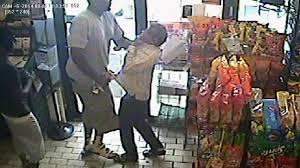
Michael Brown (left) roughing up a store owner
Had this been more widely noted, “Saint Michael” would have been seen as a mere thug who learned that assaulting an armed cop wasn’t the same as attacking an unarmed store owner.
On May 25, 2020, George Floyd, a former black security guard, was murdered in Minneapolis, Minnesota. While Floyd was handcuffed and lying face down on a city street during an arrest, Derek Chauvin, a white Minneapolis police officer, kept his knee on the right side of Floyd’s neck for eight minutes and 46 seconds.
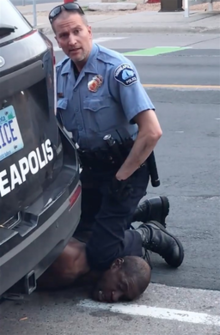
Death of George Floyd
Across the nation, cities were convulsed by protests—including those in the San Francisco Bay Area. Among these: Oakland, San Jose, Emeryville, Walnut Creek and San Francisco itself.
On May 30, an initially peaceful protest march exploded into looting shortly before 9 p.m. as looters broke off and began smashing shop windows and ransacking stores in Union Square and on Market Street.
Among the stores looted: A Sak’s Off-Fifth Avenue, an Old Navy clothing store, a Cartier Boutique and a Coach store. Looters especially targeted CVS and Walgreens drugstores. Liquor stores and a BevMo were also hit.
“Thirty businesses were looted or destroyed,” said David Perry, from the Union Square Business Improvement District.
Undoubtedly many of victims of those looters and arsonists had been horrified by the Floyd killing. But many of them undoubtedly lost sympathy for the Black Lives Matter movement as they surveyed the wreckage of their stores.
Store owners were infuriated at having to replace stock that had been stolen or destroyed. And employees resented having to clean up the wreckage. Some stores no doubt were forced to close, leaving their former employees suddenly jobless.
And President Donald Trump quickly moved to capitalize on that resentment. His brand of “divide and rule” politics had brought him to the White House in 2016. And he was determined to play on white fears of further black crime to win a second term.
White fears of black crime are reflected in the crime rate statistics for New York City.
While Blacks make up 14.2% of New York City’s population, they comprise:
- 57.8% of its murder and non-negligent manslaughter arrests;
- 40.5% of its rape arrests;
- 38.2% of its known other felony sex crime arrests;
- 65.5% of its robbery arrests;
- 52.3% of its felonious assault arrests;
- 50.9% of its grand larceny arrests;
- 67.1% of its shooting arrests;
- 50.7% of its drug felony arrests;
- 42.2% of its drug misdemeanor arrests;
- 46.2% of its felony stolen property arrests;
- 52.9% of its misdemeanor stolen property arrests;
- 58.6% of its violent crime suspects;
- 59.8% of its juvenile crime complaint arrests.
This is admittedly unfair to those blacks who are law-abiding citizens. But the fear factor will continue until crime rates among blacks start falling dramatically.
2016 PRESIDENTIAL ELECTION, 2020 PRESIDENTIAL ELECTION, ABC NEWS, ALTERNET, AMERICABLOG, AP, ASSAULT, BABY BOOMER RESISTANCE, BLACK LIBERATION ARMY, BLACK LIVES MATTER, BLACKS, BLOOMBERG, BURGLARY, BUZZFEED, CBS NEWS, CNN, CRIME, CROOKS AND LIARS, DAILY KOZ, DARREN WILSON, DONALD TRUMP, DRUDGE REPORT, DRUGS, EMERYVILLE, FACEBOOK, FBI, FELONIOUS ASSAULT, FELONY SEX CRIMES, FERGUSON POLICE DEPARTMENT, FIVETHIRTYEIGHT, GEORGE FLOYD, GRAND LARCENY, HARPER’S MAGAZINE, HISPANICS, HUFFINGTON POST, JACOB BLAKEOB, JASON BLAKE, JESSE JACKSON, KENOSHA COUNTY, MANSLAUGHTER, MARTIN LUTHER KING, MEDIA MATTERS, MICHAEL BROWN, MISDEMEANOR ASSAULT, MISDEMEANOR ASSAULT AND RELATED OFFENSES, MISDEMEANOR SEX CRIMES, MOTHER JONES, MOVEON, MSNBC, MURDER, NBC NEWS, NEW YORK CITY, NEW YORK POLICE DEPARTMENT, NEWSWEEK, NON-NEGLIGENT MANSLAUGHTER, NPR, OAKLAND, PBS NEWSHOUR, PETIT LARCENY, POLITICO, POLITICUSUSA, PROACTIVE PROPERTY CRIMES, RAPE, RAW STORY, RESTRAINING ORDER, REUTERS, ROBBERY, ROBERT DALEY, RUSTEN SHESKEY, SALON, SAN FRANCISCO, SAN JOSE, SEATTLE TIMES, SEX CRIMES, SEXUAL ASSAULT, SHOOTINGS, SLATE, TALKING POINTS MEMO, TARGET BLUE: AN INSIDER'S VIEW OF THE NYPD (BOOK), THE ATLANTIC, THE CHICAGO SUN-TIMES, THE CHICAGO TRIBUNE, THE DAILY BEAST, THE DAILY BLOG, THE GUARDIAN, THE HILL, THE HUFFINGTON POST, THE LOS ANGELES TIMES, THE NATION, THE NEW REPUBLIC, THE NEW YORK TIMES, THE VILLAGE VOICE, THE WALL STREET JOURNAL, THE WASHINGTON POST, THINKPROGRESS, TIME, TRUTHDIG, TRUTHOUT, TWITTER, TWO POLITICAL JUNKIES, U.S. NEWS & WORLD REPORT, UPI, USA TODAY, WALNUT CREEK, WONKETTE
In Bureaucracy, History, Law, Law Enforcement, Politics, Social commentary on October 11, 2023 at 12:10 am
On May 16, 2022, a white supremacist shot and murdered 10 people and wounded three others at the Tops Supermarket in Buffalo, New York.
Eleven victims were black; two were white.
The mass shooting once again ignited calls for gun control and a national dialogue on race.
Undoubtedly the motivation for the killings was race. But the sensationalistic publicity given this crime obscured a brutal truth ignored by liberals—and blacks:
Blacks kill far more blacks than whites do. And blacks are responsible for a disproportionate portion of crimes.
In 1993, this was publicly acknowledged by no less than Jesse Jackson, the famous civil rights activist, Baptist minister and former disciple of Martin Luther King, Jr.:
“There is nothing more painful to me at this stage in my life than to walk down the street and hear footsteps and start thinking about robbery, then look around and see somebody white and feel relieved.”
Blacks make up 14.2% of the American population in 2023, according to the Pew Research Center.
But they committed 52% of homicides between 1980 and 2008, according to the Justice Department’s Bureau of Justice Statistics. Only 45% of whites were offenders in such cases.
Blacks were disproportionately likely to commit homicide and to be the victims.
In 2008 blacks were seven times more likely than whites to commit homicide. And they were six times more likely than whites to be homicide victims.
According to the FBI, blacks were responsible for 38% of murders, compared to 31.1% for whites, in 2013.
From 2011 to 2013, 38.5% of people arrested for murder, manslaughter, rape, robbery, and aggravated assault were black.
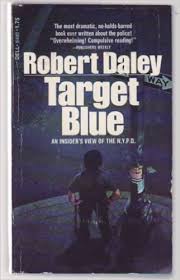
In 1971, Robert Daley, a reporter for the New York Times, became a deputy police commissioner for the New York Police Department (NYPD).
In that capacity, he saw the NYPD from the highest levels to the lowest—from the ornate, awe-inspiring office of Police Commissioner Patrick Murphy to the gritty, sometimes blood-soaked streets of New York.
He spent one year on the job before resigning—later admitting that when he agreed to take the job, he got more than he bargained for.
For the NYPD, 1972 proved to be a tumultuous year. Among those challenges faced were the murders of several police officers, committed by members of the militant Black Liberation Army.
Two of those murdered officers were Waverly Jones and Joseph Piagentini. Jones was black, Piagentini white; both were partners. Both were shot in the back without a chance to defend themselves.
Writing about these murders in a bestselling 1973 book—Target Blue: An Insider’s View of the N.Y.P.D.—Daley noted:
- Jones and Piagentini were the sixth and seventh policemen—of ten—murdered in 1971.
- About 18 men were involved in these murders. All were black.
- The city’s politicians knew this—and so did Commissioner Murphy. None dared say so publicly.
“But the fact remained,” wrote Daley, “that approximately 65% of the city’s arrested murderers, muggers, armed robbers, proved to be black men; about 15% were of Hispanic origin; and about 20% were white [my Italics].”
The overall racial breakdown of the city was approximately:
- Whites 63%
- Blacks 20%
- Hispanics 17%
Stated another way: Blacks, who made up 20% of the city’s population, were responsible for 65% of the city’s major crimes.
Or, as Daley himself put it: “So the dangerous precincts, any cop would tell you, were the black precincts.”
That was 50 years ago.
In 2018, the Bureau of Justice Statistics of the U.S. Department of Justice found:
- Blacks were disproportionately represented among homicide victims and offenders.
- Whites committed 8% of the reported murders of blacks.
- Whites murdered other whites in 80.7% of the cases.
- Blacks were responsible for 15.5% of white murders.
- Blacks were responsible for 88.9% of the murders of blacks.
- Half of all robbery offenders were black.
- Blacks were responsible for a third of aggravated assaults.
- More than a fifth of blacks were responsible for simple assaults.
- Blacks made up 22% of those arrested for rape or sexual assault.
Now, consider the following statistics released by the NYPD for “Crime and Enforcement Activity in New York City” in 2022:

Murder and Non-Negligent Manslaughter Victims
Murder and Non-Negligent Manslaughter Suspects
Murder and Non-Negligent Manslaughter Arrestees
Rape Victims
Rape Suspects
Rape Arrestees
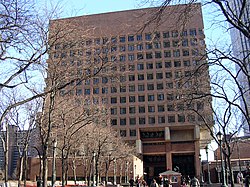
NYPD Headquarters at One Police Plaza
Other Felony Sex Crimes Victims
Other Felony Sex Crime Suspects
Other Felony Sex Crime Arrestees
Robbery Victims
Robbery Suspects
Robbery Arrestees
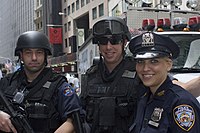
NYPD officers
Nick.Allen, CC BY 2.0 <https://creativecommons.org/licenses/by/2.0>, via Wikimedia Commons
Misdemeanor Assault Victims
Misdemeanor Assault Suspects
Misdemeanor Assault Arrestees
Felonious Assault Victims
Felonious Assault Suspects
Felonious Assault Arrestees
Grand Larceny Victims
Grand Larceny Suspects
Grand Larceny Arrestees
Firearm Arrest Population
Shooting Victims
Shooting Suspects
Shooting Arrestees
Drug Felony Arrest Population
Drug Misdemeanor Arrestees
Misdemeanor Sex Crime Victims
Misdemeanor Sex Crime Suspects
Misdemeanor Sex Crime Arrestees
Misdemeanor Stolen Property Arrest Population
Felony Stolen Property Arrest Population
Petit Larceny Victims
Petit Larceny Suspects
Petit Larceny Arrestees
Misdemeanor Criminal Mischief Victims
Misdemeanor Criminal Mischief Suspects
Misdemeanor Criminal Mischief Arrestees
Reported Crime Complaint Juvenile Victims
Juvenile Crime Complaint Suspects
Juvenile Arrest Population
Violent Crime


 Bureaucracybuster's Blog
1984 NOVEL, 2020 PRESIDENTIAL ELECTION, ABC NEWS, ADOLF HITLER, AFFORDABLE HEALTHCARE ACT, ALTERNET, ALVIN BRAGG, AMERICABLOG, ANDREW CLYDE, ANN COULTER, AP, ARIZONA, ARIZONA SHOOTINGS, ASHLI BABBITT, ASSASSINATION, BABY BOOMER RESISTANCE, BARACK OBAMA, BARRON TRUMP, BBC, BILL CLINTON, BIRTHERS, BLACKS, BLOOMBERG NEWS, BUZZFEED, CBS NEWS, CHILD MOLESTERS, CHRISTINA-TAYLOR GREEN, CLASSIFIED DOCUMENTS, CNN, CONFEDERATE FLAG, CROOKS AND LIARS, CVS, DAILY KOS, DEMOCRATIC PARTY, DEMOCRATS, DENNIS HASTERT, DEVIN NUNES, DICK ARMEY, DICK MORRIS, DONALD TRUMP, FAMILY RESEARCH COUNCIL, FANNI WILLIS, FBI, FIVETHIRTYEIGHT, FRANKLIN D. ROOSEVELT, GABRIELLE GIFFORDS, GAYS, GEORGE H.W. BUSH, GEORGE ORWELL, GEORGE W. BUSH, GLENN BECK, HARPER’S MAGAZINE, HARRY S. TRUMAN, HATE CRIMES, HEALTHCARE, HISPANICS, HOUSE OVERSIGHT COMMITTEE, HUFFINGTON POST, JACK SMITH, JAN BREWER, JANUARY 6 COUP ATTEMPT, JGB BUSH, JIM JORDAN, JOSEPH MCCARTHY, JOSEPH R. BIDEN, JOSEPH STALIN, JOSH DUGGAR, KANSAS, LAUREN BOEBERT, LESBIANS, MARJORIE TAYLOR GREEN, MATT GAETZ, MEDIA MATTERS, MEIN KAMPF, MELANIA TRUMP, MICHAEL COHEN, MICHAEL SAVAGE, MICHELE BACHMANN, MIKE HUCKABEE, MIKE PENCE, MOTHER JONES, MOVEON, MSNBC, MUSLIMS, NBC NEWS, NEW REPUBLIC, NEWSDAY, NEWSWEEK, NEWT GINGRICH, NPR, ORACLE, PBS NEWSHOUR, PHIL GRAMM, POLITICO, POLITICUSUSA, PROPAGANDA, RAFAEL "TED" CRUZ, RAW STORY, RELIGIOUS FREEDOM RESTORATION ACT, REP. GABRIELLE GIFFORDS, REPUBLICAN PARTY, REPUBLICANS, REUTERS, RICHARD NIXON, RICK PERRY, RODNEY KING RIOTS, ROLLING STONE MAGAZINE, RUSH LIMBAUGH, SALON, Sarah Palin, SEAN HANNITY, SEATTLE TIMES, SHARIA LAW, SLATE, SOUTH DAKOTA, SOVIET UNION, SPIRO AGNEW, STEVE BANNON, STORMY DANIELS, TALKING POINTS MEMO, TEA PARTY, TERRORISM, THE ATLANTIC, THE CHICAGO SUN-TIMES, THE CHICAGO TRIBUNE, THE DAILY BEAST, THE DAILY BLOG, THE GUARDIAN, THE HILL, THE HUFFINGTON POST, THE INTERCEPT, THE LOS ANGELES TIMES, THE NATION, THE NEW REPUBLIC, THE NEW YORK TIMES, THE NEW YORKER, THE VILLAGE VOICE, THE WASHINGTON POST, THINKPROGRESS, TIME, TRUTHDIG, TRUTHOUT, U.S. DISTRICT JUDGE JOHN ROLL, U.S. MARSHALS SERVICE, U.S. NEWS & WORLD REPORT, UNITED STATES HOUSE OF REPRESENTATIVES, UNITED STATES SENATE, UPI, USA TODAY, WOMEN, WORLD WAR 11, X
REPUBLICANS: PREDATORS, NOT PACIFISTS: PART ONE (OF FIVE)
In Bureaucracy, History, Law, Law Enforcement, Politics, Social commentary on July 15, 2024 at 12:22 am“We mock you. We mock your fear. We want your fear. It’s going to be accountability. We are taking apart the administrative state. We’re going to destroy the deep state, and we’re going to hold everybody responsible that put this republic in the situation its in today.
“Accountability, responsibility. And that will come with authority. The authority of Donald J. Trump as the 47th president of the United States.”
The speaker was Steve Bannon, former Trump campaign manager and White House advisor. And he was issuing a warning to everyone who didn’t enthusiastically accept Donald Trump as his Once and Future Fuhrer.
Steve Rannon
Gage Skidmore, CC BY-SA 2.0 <https://creativecommons.org/licenses/by-sa/2.0>, via Wikimedia Commons
Threats of violence have become common among Republicans since 2015, when Trump first ran for President. And they continue to cast a shadow over the 2024 Presidential campaign.
On March 16, 2016, Trump warned Republicans that if he didn’t win the GOP nomination in July, his supporters would literally riot: “I think you’d have riots. I think you would see problems like you’ve never seen before. I think bad things would happen. I really do. I wouldn’t lead it, but I think bad things would happen.”
An NBC reporter summed it up as: “The message to Republicans was clear: ‘Nice convention you got there, shame if something happened to it.’”
Eight years later, on March 16, 2024, Trump made a similar threat: “Now if I don’t get elected, it’s going to be a bloodbath for the whole—that’s gonna be the least of it….If this election isn’t won, I’m not sure that you’ll ever have another election in this country.”
Donald Trump
On August 9, 2016, Trump told a rally in Wilmington, North Carolina: “Hillary [Clinton] wants to abolish, essentially abolish, the Second Amendment. If she gets to pick her [Supreme Court] judges, nothing you can do folks. Although the Second Amendment people, maybe there is, I don’t know.”
This was Trump’s “dog-whistle” attempt to incite the assassination of Hillary Clinton—and it was so seen by responsible authorities: “Well, let me say if someone else said that outside of the hall, he’d be in the back of a police wagon now, with the Secret Service questioning him,” said Michael Hayden, former head of the CIA and National Security Agency (NSA).
In Cincinnati, a Trump supporter threatened to forcibly remove Clinton from the White House if she won the race: “If she’s in office, I hope we can start a coup. She should be in prison or shot. That’s how I feel about it,”
Dan Bowman, a 50-year-old contractor, said of Hillary Clinton, the Democratic nominee. “We’re going to have a revolution and take them out of office if that’s what it takes. There’s going to be a lot of bloodshed. But that’s what it’s going to take….I would do whatever I can for my country.”
In a June 19, 2015 editorial, Rolling Stone writer Jeb Lund had noted:
“The Republican Party has weaponized its supporters, made violence a virtue and, with almost every pronouncement for 50 years, given them an enemy politicized, racialized and indivisible.
“Movement conservatives have fetishized a tendentious and ahistorical reading of the Second Amendment to the point that the Constitution itself somehow paradoxically ‘legitimizes’ an armed insurrection against the government created by it.
“This is no longer an argument about whether one party’s beliefs are beneficial or harmful, but an attitude that labels leftism so antithetical to the American idea that empowering it on any level is an act of usurpation.”
Consider:
On January 8, 2011, Democratic Rep. Gabrielle Giffords was shot in the head while meeting with constituents outside a grocery store in Tucson, Arizona. After a miraculous recovery, she continues to struggle with language and has lost 50% of her vision in both eyes.
Rep. Gabrielle Giffords
She vowed to return to her former Congressional duties, but was forced to resign for health reasons in 2012.
Giffords was only one victim of a shooting spree that claimed the lives of six people and left 13 others wounded.
Also killed was Arizona’s chief U.S. District judge, John Roll, who had just stopped by to see his friend Giffords after celebrating Mass.
Although the actual shooter, Jared Lee Loughner, was immediately arrested, those who fanned the flames of political violence that consumed 19 people that day have remained unpunished.
Consider the circumstances behind the shootings:
John Roll is Arizona’s chief federal judge. Appointed in 2006, he wins acclaim as a respected jurist and leader who pushes to beef up the court’s strained bench to handle a growing number of border crime-related cases.
In 2009, he becomes a target for threats after allowing a $32 million civil-rights lawsuit by illegal aliens to proceed against a local rancher. The case arouses the fury of local talk radio hosts, who encourage their audiences to threaten Roll’s life.
In one afternoon, Roll logs more than 200 threatening phone calls. Callers threaten the judge and his family. They post personal information about Roll online.
Roll and his wife are placed under fulltime protection by deputy U.S. marshals. Roll finds living under security “unnerving and invasive.”
Authorities identify four men believed responsible for the threats. But Roll declines to press charges on the advice of the Marshals Service.
Share this: