Posts Tagged ‘BERNIE SANDERS’
2016 PRESIDENTIAL CAMPAIGN, ABC NEWS, ANTHEM INC., ASHLEY MADISON, BERNIE SANDERS, CBS NEWS, CNN, CYBERSECURITY, DAIRY QUEEN, DEBBIE WASSERMAN-SCHULTZ, DEMOCRATIC NATIONAL COMMITTEE, DEMOCRATIC PARTY, DONALD TRUMP, FACEBOOK, HACKING, HILLARY CLINTON, HOME DEPOT, JPMORGAN/CHASE, KMART, NAPOLEON BONAPARTE, NATIONAL LEGAL AND POLICY CENTER, NBC NEWS, NICCOLO MACHIAVELLI, REPUBLICAN PARTY, SONY PICTURES, STAPLES, TARGET, THE DISCOURSES, THE LOS ANGELES TIMES, THE NEW YORK TIMES, THE OFFICE OF PERSONNEL MANAGEMENT, THE PENTAGON, THE PRINCE, THE U.S. DEPARTMENT OF STATE, THE WASHINGTON POST, TWITTER, WIKILEAKS
In Bureaucracy, History, Military, Politics, Social commentary on July 26, 2016 at 12:15 am
On July 22, Wikileaks released 19,252 emails and 8,034 attachments hacked from computers of the highest-ranking officials of the Democratic National Committee (DNC).
The emails were exchanged from January 2015 through May 2016.
These clearly reveal a bias for Hillary Clinton and against her lone challenger, Vermont U.S. Senator Bernie Sanders.
One email revealed that Brad Marshall, the chief financial officer of the DNC, suggested that Sanders, who is Jewish, could be portrayed as an atheist.
Sanders’ supporters have long charged that the DNC and its chair, Debbie Wasserman-Schultz, were plotting to undercut his campaign. Now thousands of them are expected to descend on the Democratic convention as furious protesters.
The leak could not have come at a worse time for Hillary Clinton, the former First Lady, U.S. Senator from New York and Secretary of State under President Barack Obama.
About to receive the Democratic nomination for President, she finds herself charged with undermining the electoral process.
Wasserman-Schultz has proven the first casualty of the leak, resigning from her position as chair of the DNC and saying she would not open the Democratic convention as previously scheduled.
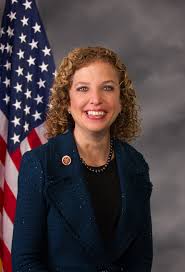
Debbie Wasserman-Schultz
As for Clinton: Her campaign manager, Bobby Mook, blamed the Russians for the leak. Their alleged motive: To help Republican Presidential nominee Donald Trump.
Cyber-security experts believe the hackers originated from Russia–and that Russian President Vladimir Putin may have authorized it.
His alleged motive: Trump has repeatedly attacked United States’ membership in the North Atlantic Treaty Organization (NATO).
He believes the United States is paying an unfairly large portion of the monies needed to maintain this alliance–and he wants other members to contribute far more. Otherwise, if he is elected President, they would be on their own if attacked by Russia.
Trump took to twitter to offer his take on the release: “How much BAD JUDGEMENT was on display by the people in DNC in writing those really dumb e-mails, using even religion, against Bernie!”
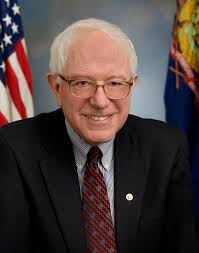
Bernie Sanders
Which brings up the obvious question: Why was such sensitive information entrusted to computers that could be hacked?
This is not the first time a major corporation or government agency has fallen prey to hackers.
Name-brand companies, trusted by millions, have been hit with massive data breaches that compromised their customers’ and/or employees’ most sensitive financial and personal information.
Among those companies and agencies:
- Target
- Kmart
- Home Depot
- JPMorgan/Chase
- Staples
- Dairy Queen
- Anthem, Inc.
- Sony Pictures
- The U.S. State Department
- The Pentagon
- The Office of Personnel Management
Perhaps the most notorious target so far hacked is Ashley Madison, the website for cheating wives and husbands. Launched in 2001, its catchy slogan is: “Life is short. Have an affair.”

On July 15, 2015, its more than 37 million members learned that highly embarrassing secrets they had entrusted to Ashley Madison had been compromised.
This included their sexual fantasies, matching credit card transactions, real names and addresses, and employee documents and emails.
A website offering cheating services to those wealthy enough to afford high-priced fees is an obvious target for hackers. After all, its database is a blackmailer’s dream-come-true.
And the same is true for computers of one of the two major political parties of the United States.
Among the secrets unearthed in the WikiLeaks document-dump: Plans by Democratic party officials to reward large donors and prominent fundraisers with lucrative appointments to federal boards and commissions.
Most of the donors listed gave to Clinton’s campaign. None gave to Sanders.
According to Ken Boehm, chairman of the National Legal and Policy Center, a government watchdog group:
“The disclosed DNC emails sure look like the potential Clinton Administration has intertwined the appointments to federal government boards and commissions with the political and fund raising operations of the Democratic Party. That is unethical, if not illegal.”
Centuries before the invention of computers–and the machinery needed to hack into them–Niccolo Machiavelli offered cautionary advice to those thinking of entering into a conspiracy. He did so in his masterwork on politics, The Discourses.

Niccolo Machiavelli
Unlike his better-known work, The Prince, which deals with how to secure power, The Discourses lays out rules for preserving liberty within a republic.
In Book Three, Chapter Six (“Of Conspiracies”) he writes:
“I have heard many wise men say that you may talk freely with any one man about everything, for unless you have committed yourself in writing, the ‘Yes’ of one man is worth as much as the ‘No’ of another.
“And therefore one should guard most carefully against writing, as against a dangerous rock, for nothing will convict you quicker than your own handwriting.”
In 1804, Napoleon Bonaparte, then First Consul of France, ordered the execution of the popular Louis Antoine de Bourbon, Duke of Enghien, claiming that he had aided Britain and plotted against France.
The aristocracy of Europe, still recalling the slaughters of the French Revolution, was shocked.
Asked for his opinion on the execution, Napoleon’s chief of police, Joseph Fouche, said: “It was worse than a crime; it was a blunder.”
This may prove to be history’s verdict on the storing of so many incriminating computer files by the DNC.
2016 PRESIDENTIAL CAMPAIGN, ABC NEWS, ADOLF HITLER, ALTERNET, AMERICABLOG, AP, BABY BOOMER RESISTANCE, BARACK OBAMA, BBC, BERNIE SANDERS, BLOOMBERG NEWS, BUZZFEED, CBS NEWS, CNN, CROOKS AND LIARS, D-DAY, DAILY KOZ, DAVID BROOKS, DEMOCRATIC PARTY, DONALD TRUMP, ELIZABETH WARREN, FACEBOOK, FIVETHIRTYEIGHT, GEORGE S. PATTON, HARPER’S MAGAZINE, HEINZ GUERIAN, HILLARY CLINTON, HUFFINGTON POST, JOSEPH MCCARTHY, LIBERALS, MARCO RUBIO, MARK SHIELDS, MEDIA MATTERS, MOTHER JONES, MOVEON, MSNBC, NAZI GERMANY, NBC NEWS, NEW REPUBLIC, NEWSDAY, NEWSWEEK, NEWT GINGRICH, NOCCOLO MACHIAVELLI, NPR, PBS NEWSHOUR, POLITICO, POLITICUSUSA, RAW STORY, REPUBLICAN PARTY, REPUBLICANS, REUTERS, SALON, SEATTLE TIMES, SLANDER, SLATE, STALINGRAD, TALKING POINTS MEMO, TED CRUZ, THE ATLANTIC, THE CHICAGO SUN-TIMES, THE CHICAGO TRIBUNE, THE DAILY BEAST, THE DAILY BLOG, THE GUARDIAN, THE HILL, THE HUFFINGTON POST, THE LOS ANGELES TIMES, THE NATION, THE NEW REPUBLIC, THE NEW YORK TIMES, THE NEW YORKER, THE PRINCE, THE VILLAGE VOICE, THE WASHINGTON POST, THINKPROGRESS, TIME, TRUTHDIG, TRUTHOUT, TWITTER, TWO POLITICAL JUNKIES, U.S. NEWS & WORLD REPORT, UPI, USA TODAY, WAFFEN-SS
In Bureaucracy, History, Politics, Social commentary on June 2, 2016 at 12:13 am
Massachusetts U.S. Senator Elizabeth Warren seems to know something that most of her fellow Democrats don’t–or choose to ignore.
Nazi Germany wasn’t defeated because “we were the Good Guys and they were the Bad Guys.”
On the contrary: It was defeated because the Allies waged war as brutally as the Germans.
For example:
- From D-Day to the fall of Berlin, captured Waffen-SS soldiers were often shot out of hand.
- When American troops came under fire in the German city of Aachen, Lt. Col. Derrill Daniel brought in a self-propelled 155mm artillery piece and opened up on a theater housing German soldiers. After the city surrendered, a German colonel labeled the use of the 155 “barbarous” and demanded that it be outlawed.
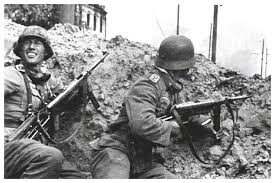
German soldiers at Stalingrad
- The United States and Great Britain carpet-bombed about 150 German cities by day and night, killing 305,000 to 600,000 civilians.
- During the battle of Stalingrad in 1942, Wilhelm Hoffman, a young German soldier and diarist, was appalled that the Russians refused to surrender. He wrote: “You don’t see them at all, they have established themselves in houses and cellars and are firing on all sides, including from our rear! Barbarians! They use gangster methods….”
In short: The Allies won because they dared to meet the brutality of a Heinz Guderian with that of a George S. Patton.
This is a lesson that has been totally lost on the liberals of the Democratic Party. Which explains why they lost most of the Presidential elections of the 20th century.
To Republicans, “lawfully elected” applies only to Republican Presidents. A Democrat who runs against a Republican is automatically considered a traitor.
And a Democrat who defeats a Republican is automatically considered a usurper, and thus deserves to be slandered and obstructed, if not impeached.
Unable to defeat Bill Clinton in 1992 and 1996, Republicans tried in 1998 to impeach him for getting oral sex in the White House.
Similarly, 2012 Presidential candidate Herman Cain, asked in a conference call with bloggers why Republicans couldn’t just impeach President Barack Obama, replied:
“That’s a great question and it is a great–it would be a great thing to do but because the Senate is controlled by Democrats we would never be able to get the Senate first to take up that action.”
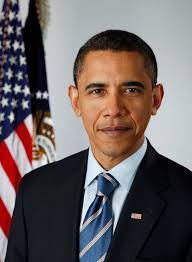
Barack Obama
In Renegade: The Making of a President, Richard Wolffe chronicled Obama’s successful 2008 bid for the White House. Among his revelations:
Obama, a believer in rationality and decency, felt more comfortable in responding to attacks on his character than in making them on the character of his enemies.
A graduate of Columbia University and Harvard Law School, Obama is easily one of the most academically gifted Presidents in United States history.
But for all this, he failed–from the onset of his Presidency–to grasp and apply this fundamental lesson taught by Niccolo Machiavelli, the father of modern political science.
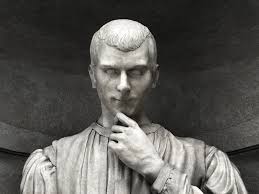
Niccolo Machiavelli
In The Prince, Machiavelli warns:
From this arises the question whether it is better to be more loved than feared, or feared more than loved.
The reply is, that one ought to be both feared and loved, but as it is difficult for the two to go together, it is much safer to be feared than loved….
And men have less scruple in offending one who makes himself loved than one who makes himself feared; for love is held by a chain of obligations which, men being selfish, is broken whenever it serves their purpose; but fear is maintained by a dread of punishment which never fails.
Just as they have blithely disregarded the lessons of history, liberals have ignored the Realpolitik of Machiavelli–with catastrophic results.
On Facebook and Twitter, liberals are already celebrating the “certain” Presidency of Vermont U.S. Senator Bernie Sanders or former First Lady Hillary Clinton in 2017.
They forget–or ignore–that liberals couldn’t believe America would elect, respectively, Richard Nixon (1968 and 1972), Ronald Reagan (1980 and 1984), George H.W. Bush (1988) and George W. Bush (2000 and 2004).
But Elizabeth Warren clearly hasn’t forgotten those Republican victories. Nor does she take for granted that Republican Presidential nominee Donald Trump is certain to lose in November.
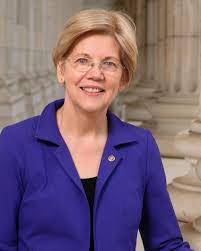
Elizabeth Warren
Instead, Warren has dared to do what no other Democrat–or Republican–has: Attack Trump head-on, with the kind of blunt, insulting language he has lavished on his opponents.
On March 31, she appeared on The Late Show, with Stephen Colbert. Her take on the egotistical billionaire:
“Donald Trump is looking out for exactly one guy, and that guy’s name is Donald Trump. He smells that there’s change in the air and what he wants to do is make sure that that change works really, really well for Donald Trump.
“The truth is, he inherited a fortune from his father, he kept it going by cheating and defrauding people, and then he takes his creditors through Chapter 11.”
When Colbert said that Trump had never broken the law, Warren replied that he had never broken the law “and been caught.”
For Democrats to win elective victories and enact their agenda, they must find their own George Patton to take on the Waffen-SS generals among Republican ranks.
Only Elizabeth Warren has so far grasped this truth. And only she seems determined to act on it.
2016 PRESIDENTIAL CAMPAIGN, ABC NEWS, ADOLF HITLER, ALTERNET, AMERICABLOG, AP, BABY BOOMER RESISTANCE, BARACK OBAMA, BBC, BERNIE SANDERS, BLOOMBERG NEWS, BUZZFEED, CBS NEWS, CNN, CROOKS AND LIARS, D-DAY, DAILY KOZ, DAVID BROOKS, DEMOCRATIC PARTY, DONALD TRUMP, ELIZABETH WARREN, FACEBOOK, FIVETHIRTYEIGHT, GEORGE S. PATTON, HARPER’S MAGAZINE, HEINZ GUERIAN, HILLARY CLINTON, HUFFINGTON POST, JOSEPH MCCARTHY, LIBERALS, MARCO RUBIO, MARK SHIELDS, MEDIA MATTERS, MOTHER JONES, MOVEON, MSNBC, NAZI GERMANY, NBC NEWS, NEW REPUBLIC, NEWSDAY, NEWSWEEK, NEWT GINGRICH, NOCCOLO MACHIAVELLI, NPR, PBS NEWSHOUR, POLITICO, POLITICUSUSA, RAND PAUL, RAW STORY, REPUBLICAN PARTY, REPUBLICANS, REUTERS, SALON, SEATTLE TIMES, SLANDER, SLATE, STALINGRAD, TALKING POINTS MEMO, TED CRUZ, THE ATLANTIC, THE CHICAGO SUN-TIMES, THE CHICAGO TRIBUNE, THE DAILY BEAST, THE DAILY BLOG, THE GUARDIAN, THE HILL, THE HUFFINGTON POST, THE LOS ANGELES TIMES, THE NATION, THE NEW REPUBLIC, THE NEW YORK TIMES, THE NEW YORKER, THE PRINCE, THE VILLAGE VOICE, THE WASHINGTON POST, THINKPROGRESS, TIME, TRUTHDIG, TRUTHOUT, TWITTER, TWO POLITICAL JUNKIES, U.S. NEWS & WORLD REPORT, UPI, USA TODAY, WAFFEN-SS
In Bureaucracy, History, Politics, Social commentary on June 1, 2016 at 12:04 am
Donald Trump, “for all his moral flaws, is a marketing genius.”
So stated New York Times columnist David Brooks on the May 27 edition of the PBS Newshour.
“And you look at what he does. He just picks a word and he attaches it to a person. Little Marco {Rubio], Lyin’ Ted [Cruz], Crooked Hillary [Clinton].

Donald Trump
“And that’s a word. And that’s how marketing works. It’s a simple, blunt message, but it gets under. It sticks, and it diminishes. And so it has been super effective for him, because he knows how to do that. And [Hillary] just comes with ‘Oh, he’s divisive.’
“These are words that are not exciting people. And her campaign style has gotten, if anything…a little more stagnant and more flat.”
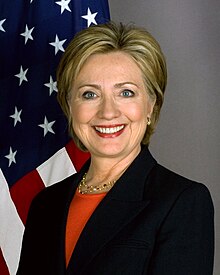
Hillary Clinton
Hillary Clinton isn’t the only Presidential candidate who has proven unable to cope with Trump’s gifts for insult. His targets–and insults–have included:
-
Former Texas Governor Rick Perry: “Wears glasses to seem smart.”
-
Former Florida Governor Jeb Bush: “Low Energy Jeb.”
-
Vermont U.S. Senator Bernie Sanders: “Crazy Bernie.”
-
Ohio Governor John Kasich: “Mathematically dead and totally desperate.”
So far, only one opponent has managed to stand up to Trump: Massachusetts U.S. Senator Elizabeth Warren, whom Trump has called “goofy.”
Florida U.S. Senator Marco Rubio tried to out-insult Trump at the Republican Presidential candidates’ debate on March 3.
“I call him Little Marco. Little Marco. Hello, Marco,” said Trump.
And so Rubio retaliated with “Big Donald.” Since Americans generally believe that “bigger is better,” this was a poor choice of insult.
On the May 27 edition of the PBS Newshour, syndicated columnist Mark Shields noted the ability of Elizabeth Warren to rattle Trump:
“Elizabeth Warren gets under Donald Trunp’s skin. And I think she’s been the most effective adversary. I think she’s done more to unite the Democratic party than either Hillary Clinton or Bernie Sanders.
“I mean, she obviously–he can’t stay away from her. He is tweeting about her.”
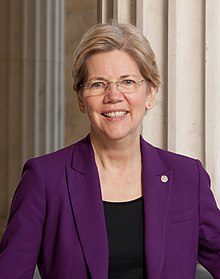
Elizabeth Warren
JUDY WOODRUFF (moderator): “But whether it’s Elizabeth Warren or not, doesn’t Hillary Clinton need to come up with some approach that works, that is as effective comeback?”
DAVID BROOKS: “Yes. Well, I think she does, not that anybody else has managed to do this….
“And so the tactics…is either you do what Elizabeth Warren has done, like full-bore negativity, that kind of [get] under the skin, or try to ridicule him and use humor. Humor is not Hillary Clinton’s strongest point.”
But sharp-edged humor clearly works for Warren.
A May 12 story on CNN–“Elizabeth Warren Gives Trump a Dose of His Own Medicine on Twitter”–notes:
“In the past week the Massachusetts Democrat has refined an aggressive anti-Trump message through a series of so-called tweetstorms.
“Whenever Trump criticizes her, Warren fires right back at him, sometimes twice as hard.”
Warren’s tweets, according to the article, appear to have two goals:
- Challenge Trump on social media, which he has so far dominated; and
- Use attention-catching words like “bully” and “loser.”
Among her tweets:
- “But here’s the thing. You can beat a bully–not by tucking tail and running, but by holding your ground.”
- When Trump boasted “I’m driving her nuts” Warren tweeted: “No, @realDonaldTrump – your racism, sexism & xenophobia doesn’t drive me nuts. It makes me sick. And I’m not alone.”
- “You care so much about struggling American workers, @realDonaldTrump, that you want to abolish the federal minimum wage?”
- “@realDonaldTrump: Your policies are dangerous. Your words are reckless. Your record is embarrassing. And your free ride is over.”
Nor has Warren restricted herself to battling Trump on Twitter.
On May 24, Warren unleashed perhaps her most devastating attack on Trump at an event hosted by the Center for Popular Democracy:
“Just yesterday, it came out that Donald Trump had said back in 2007 that he was ‘excited’ for the real estate market to crash because, quote, ‘I’ve always made more money in bad markets than in good markets.’
“That’s right. The rest of us were horrified by the 2008 financial crisis, by what happened to the millions of families…that were forced out of their homes.
“But Donald Trump was drooling over the idea of a housing meltdown–because it meant he could buy up a bunch more property on the cheap.
“What kind of a man does that? Root for people to get thrown out on the street? Root for people to lose their jobs? Root for people to lose their pensions?
“What kind of a man does that? I’ll tell you exactly what kind—a man who cares about no one but himself. A small, insecure moneygrubber who doesn’t care who gets hurt, so long as he makes some money off it….
“Sometimes Trump claims he is tough on Wall Street–tough on the guys who cheated people….. But now he’s singing a very different song.
“Last week, he said that the new Dodd-Frank financial regulations have…’made it impossible for bankers to function’ and he will put out a new plan soon that ‘will be close to dismantling Dodd-Frank.’
“Donald Trump is worried about helping poor little Wall Street? Let me find the world’s smallest violin to play a sad, sad song.”
2016 PRESIDENTIAL CAMPAIGN, ABC NEWS, ADOLF HITLER, ALTERNET, AMERICABLOG, AP, BABY BOOMER RESISTANCE, BARACK OBAMA, BBC, BERNIE SANDERS, BLOOMBERG NEWS, BUZZFEED, CBS NEWS, CNN, CROOKS AND LIARS, D-DAY, DAILY KOZ, DAVID BROOKS, DEMOCRATIC PARTY, DONALD TRUMP, ELIZABETH WARREN, FACEBOOK, FIVETHIRTYEIGHT, GEORGE S. PATTON, HARPER’S MAGAZINE, HEINZ GUERIAN, HILLARY CLINTON, HUFFINGTON POST, JOSEPH MCCARTHY, LIBERALS, MARCO RUBIO, MARK SHIELDS, MEDIA MATTERS, MOTHER JONES, MOVEON, MSNBC, NAZI GERMANY, NBC NEWS, NEW REPUBLIC, NEWSDAY, NEWSWEEK, NEWT GINGRICH, NOCCOLO MACHIAVELLI, NPR, PBS NEWSHOUR, POLITICO, POLITICUSUSA, RAND PAUL, RAW STORY, REPUBLICAN PARTY, REPUBLICANS, REUTERS, SALON, SEATTLE TIMES, SLANDER, SLATE, STALINGRAD, TALKING POINTS MEMO, TED CRUZ, THE ATLANTIC, THE CHICAGO SUN-TIMES, THE CHICAGO TRIBUNE, THE DAILY BEAST, THE DAILY BLOG, THE GUARDIAN, THE HILL, THE HUFFINGTON POST, THE LOS ANGELES TIMES, THE NATION, THE NEW REPUBLIC, THE NEW YORK TIMES, THE NEW YORKER, THE PRINCE, THE VILLAGE VOICE, THE WASHINGTON POST, THINKPROGRESS, TIME, TRUTHDIG, TRUTHOUT, TWITTER, TWO POLITICAL JUNKIES, U.S. NEWS & WORLD REPORT, UPI, USA TODAY, WAFFEN-SS
In Bureaucracy, History, Politics, Social commentary on May 31, 2016 at 12:05 am
Syndicated columnist Mark Shields and New York Times columnist David Brooks appear every Friday on the PBS Newshour to review the week’s major political events.
On May 27, Shields–a liberal, and Brooks, a conservative–came to some disturbingly similar conclusions about the character of Republican Presidential front-runner Donald Trump.
With the business magnate having won the 2016 Republican Presidential nomination, both columnists appeared increasingly dismayed.
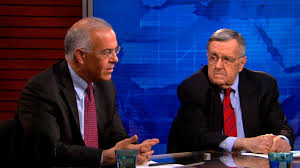
David Brooks and Mark Shields
MARK SHIELDS: “Donald Trump gratuitously slandered Ted Cruz’s wife. He libeled Ted Cruz’s father for being potentially part of Lee Harvey Oswald’s assassination of the president of the United States, suggesting that he was somehow a fellow traveler in that.
“This is a libel. You don’t get over it….
“I cannot figure out any possible advantage to Donald Trump when he’s got a problem with Latinos and with women to go into New Mexico, where the nation’s only Latina woman Republican governor sits, who has not said anything negative about him, who endorsed one of his opponents, but has not been an attack dog on Donald Trump, and absolutely goes after her and is abusive to her.
“And I’m just saying to myself, what is the advantage to this?
“…I think this man may be addicted to the roar of the grease paint and the sound of the crowd, or however it goes, smell of the crowd.
“And those rallies bring out something in him, and he just feels that he has to–and it’s all personal….I mean, it’s not a philosophical difference. It’s not a political difference. It’s all personal.”
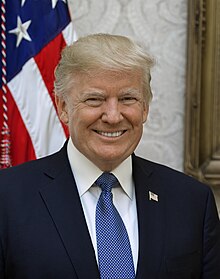
Donald Trump
Ironically, Rand Paul, Republican U.S. Senator from Kentucky, has reached a similar conclusion about Trump:
“I think there is a sophomore quality that is entertaining with Mr. Trump, but I am worried. I’m very concerned of having him in charge of his nuclear weapons because his visceral response to attack people on their appearance–short, tall, fat, ugly–my goodness that happened in junior high.”
DAVID BROOKS: “Trump, for all his moral flaws, is a marketing genius. And you look at what he does. He just picks a word and he attaches it to a person. Little Marco [Rubio], Lyin’ Ted [Cruz], Crooked Hillary [Clinton].
“And that’s a word. And that’s how marketing works. It’s a simple, blunt message, but it gets under.
“It sticks, and it diminishes. And so it has been super effective for him, because he knows how to do that. And she [Hillary Clinton] just comes with, ‘Oh, he’s divisive.’
“These are words that are not exciting people. And her campaign style has gotten, if anything…a little more stagnant and more flat.”
How did American politics reach this state of affairs?
In 1996, Newt Gingrich, then Republican Speaker of the House of Representatives, wrote a memo that encouraged Republicans to “speak like Newt.”
Entitled “Language: A Key Mechanism of Control,” it urged Republicans to attack Democrats with such words as “corrupt,” “selfish,” “destructive,” “hypocrisy,” “liberal,” “sick,” and “traitors.”
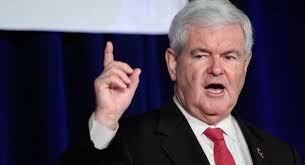
Newt Gingrich
Even worse, Gingrich encouraged the news media to disseminate such accusations. Among his suggestions:
- “Fights make news.”
- Create a “shield issue” to deflect criticism: “A shield issue is, just, you know, your opponent is going to attack you as lacking compassion. You better…show up in the local paper holding a baby in the neonatal center.”
In the memo, Gingrich advised:
“….In the video “We are a Majority,” Language is listed as a key mechanism of control used by a majority party, along with Agenda, Rules, Attitude and Learning.
As the tapes have been used in training sessions across the country and mailed to candidates we have heard a plaintive plea: ‘I wish I could speak like Newt.’
“That takes years of practice. But, we believe that you could have a significant impact on your campaign and the way you communicate if we help a little. That is why we have created this list of words and phrases….
“This list is prepared so that you might have a directory of words to use in writing literature and mail, in preparing speeches, and in producing electronic media.
“The words and phrases are powerful. Read them. Memorize as many as possible. And remember that like any tool, these words will not help if they are not used.”
Here is the list of words Gingrich urged his followers to use in describing “the opponent, their record, proposals and their party”:
- abuse of power
- anti- (issue): flag, family, child, jobs
- betray
- bizarre
- bosses
- bureaucracy
- cheat
- coercion
- “compassion” is not enough
- collapse(ing)
- consequences
- corrupt
- corruption
- criminal rights
- crisis
- cynicism
- decay
- deeper
- destroy
- destructive
- devour
- disgrace
- endanger
- excuses
- failure (fail)
- greed
- hypocrisy
- ideological
- impose
- incompetent
- insecure
- insensitive
|
- intolerant
- liberal
- lie
- limit(s)
- machine
- mandate(s)
- obsolete
- pathetic
- patronage
- permissive attitude
- pessimistic
- punish (poor …)
- radical
- red tape
- self-serving
- selfish
- sensationalists
- shallow
- shame
- sick
- spend(ing)
- stagnation
- status quo
- steal
- taxes
- they/them
- threaten
- traitors
- unionized
- urgent (cy)
- waste
- welfare
|
Yes, speaking like Newt–or Adolf Hitler or Joseph McCarthy–“takes years of practice.”
And to the dismay of both Republicans and Democrats, Donald Trump has learned his lessons well.
ABC NEWS, ADOLF HITLER, ALTERNET, ANWAR AL-AWLAKI, AP, BARACK OBAMA, BERNIE SANDERS, BILL CLINTON, BUZZFEED, CBS NEWS, CNN, CROOKS AND LIARS, D-DAY, DAILY KOZ, FACEBOOK, GEORGE H.W. BUSH, GEORGE S. PATTON, GEORGE W. BUSH, GREAT BRITAIN, HEINZ GUDERIAN, HERMAN CAIN, HILLARY CLINTON, ISLAM, MOTHER JONES, MOVEON, NAZI GERMANY, NBC NEWS, NEWSWEEK, NICCOLO MACHIAVELLI, NPR, POLITICO, PREDATOR DRONES, RAND PAUL, RAW STORY, RENEGADE: THE MAKING OF A PRESIDENT, REPUBLICANS, REUTERS, RICHARD NIXON, RICHARD WOLFFE, Ronald Reagan, SALON, SEATTLE TIMES, SENATOR RAND PAUL, SLATE, SOVIET UNION, STALINGRAD, TERRORISM, THE ATLANTIC, THE CHICAGO SUN-TIMES, THE CHICAGO TRIBUNE, THE DAILY BEAST, THE GUARDIAN, THE HILL, THE HUFFINGTON POST, THE LOS ANGELES TIMES, THE NATION, THE NEW YORK TIMES, THE PRINCE, THE WASHINGTON POST, TIME, TWITTER, U.S. NEWS & WORLD REPORT, UPI, USA TODAY, WAFFEN-SS, WORLD WAR ii
In Bureaucracy, History, Law, Military, Politics, Social commentary on April 28, 2016 at 12:01 am
Most Americans believe that Nazi Germany was defeated because “we were the Good Guys and they were the Bad Guys.”
Not so.
The United States–and its allies, Great Britain and the Soviet Union–won the war for reasons that had nothing to do with the righteousness of their cause. These included:
- Nazi Germany–i.e, its Fuehrer, Adolf Hitler–made a series of disastrous decisions. Chief among these: Attacking its ally, the Soviet Union, and declaring war on the United States;
- The greater material resources of the Soviet Union and the United States; and
- The Allies waged war as brutally as the Germans.
On this last point:
- From D-Day to the fall of Berlin, captured Waffen-SS soldiers were often shot out of hand.
- When American troops came under fire in the German city of Aachen, Lt. Col. Derrill Daniel brought in a self-propelled 155mm artillery piece and opened up on a theater housing German soldiers. After the city surrendered, a German colonel labeled the use of the 155 “barbarous” and demanded that it be outlawed.
German soldiers at Stalingrad
- During the battle of Stalingrad in 1942, Wilhelm Hoffman, a young German soldier and diarist, was appalled that the Russians refused to surrender. He wrote: “You don’t see them at all, they have established themselves in houses and cellars and are firing on all sides, including from our rear–barbarians, they used gangster methods….”
In short: The Allies won because they dared to meet the brutality of a Heinz Guderian with that of a George S. Patton.
This is a lesson that has been totally lost on the liberals of the Democratic Party.
Which explains why they lost most of the Presidential elections of the 20th century.
It also explains why President Barack Obama has found most of his legislative agenda stymied by Right-wing Republicans.
Consider this example: In 2014, Senator Rand Paul (R-Ky.) warned then-Senate Majority Leader Harry Reid (D-Nev.) that he would place a hold on one of President Obama’s appellate court nominees.
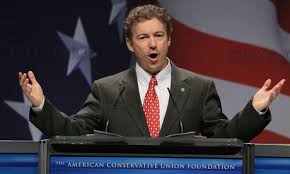
Rand Paul
David Barron had been nominated to the First Circuit Court of Appeals. And Paul objected to this because Barron authored memos justifying the killing of an American citizen by a drone in Yemen.
The September 30, 2011 drone strike killed Anwar al-Awlaki, a radical Muslim cleric notorious on the Internet for encouraging Muslims to attack the United States.
So President Obama authorized a Predator drone stroke against him, thus removing that danger. Paul demanded that the Justice Department release the memos Barron crafted justifying the drone policy.
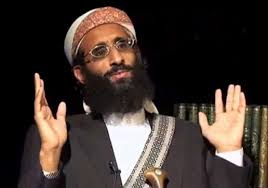
Anwar al-Awlaki
Imagine how Republicans would depict Paul–or a Democratic Senator–if he behaved in a similar manner with a Republican President: “Rand Paul: A traitor who supports terrorists. he sides with America’s sworn enemies against its own lawfully elected President.”
On May 22, 2014, the Senate voted 53–45 to confirm Barron to the First Circuit Court of Appeals.
To Republicans, “lawfully elected” applies only to Republican Presidents. A Democrat who runs against a Republican is automatically considered a traitor.
And a Democrat who defeats a Republican is automatically considered a usurper, and thus deserves to be slandered and obstructed, if not impeached.
Unable to defeat Bill Clinton in 1992 and 1996, Republicans tried in 1998 to impeach him for getting oral sex in the White House.
Similarly, 2012 Presidential candidate Herman Cain, asked in a conference call with bloggers why Republicans couldn’t just impeach President Obama, replied:
“That’s a great question and it is a great–it would be a great thing to do but because the Senate is controlled by Democrats we would never be able to get the Senate first to take up that action.”
In Renegade: The Making of a President, Richard Wolffe chronicled Obama’s successful 2008 bid for the White House. Among his revelations:
Obama, a believer in rationality and decency, felt more comfortable in responding to attacks on his character than in making them on the character of his enemies.
A graduate of Columbia University and Harvard Law School, Obama is easily one of the most academically gifted Presidents in United States history.
But for all this, he failed–from the onset of his Presidency–to grasp and apply this fundamental lesson taught by Niccolo Machiavelli, the father of modern political science.
In The Prince, Machiavelli warns:
From this arises the question whether it is better to be loved than feared, or feared more than loved.
The reply is, that one ought to be both feared and loved, but as it is difficult for the two to go together, it is much safer to be feared than loved….
And men have less scruple in offending one who makes himself loved than one who makes himself feared; for love is held by a chain of obligations which, men being selfish, is broken whenever it serves their purpose; but fear is maintained by a dread of punishment which never fails.
On Facebook and Twitter, liberals are already celebrating the “certain” Presidency of Vermont U.S. Senator Bernie Sanders or former First Lady Hillary Clinton in 2016.
They forget that, in 1968, 1980, 1988 and 2000, liberals couldn’t believe America would elect, respectively, Richard Nixon, Ronald Reagan, George H.W. Bush and George W. Bush.
For Democrats to win elective victories and enact their agenda, they must find their own George Patton to take on the Waffen-SS generals among Republican ranks.
2016 PRESIDENTIAL RACE, ABC NEWS, ALTERNET, AMERICABLOG, AP, BABY BOOMER RESISTANCE, BBC, BERNIE SANDERS, BLOOD FEUD, BLOOMBERG NEWS, BROTHERS: THE HIDDEN HISTORY OF THE KENNEDY YEARS, BUZZFEED, CARLOS MARCELLO, CBS NEWS, CIA, CNN, COTTER SMITH, CROOKS AND LIARS, CUBA, DAILY KOS, DAVID TALBOT, DONALD TRUMP, ERNEST BORGNINE, FBI, FIDEL CASTRO, FIVETHIRTYEIGHT, GUS RUSSO, HARPER’S MAGAZINE, HILLARY CLINTON, HUFFINGTON POST, INTERNATIONAL BROTHERHOOD OF TEAMSTERS, J. EDGAR HOOVER, JAMES R. HOFFA, JUSTICE DEPARTMENT, LIVE BY THE SWORD: THE SECRET WAR AGAINST CASTRO AND THE DEATH OF JFK, MAFIA, MEDIA MATTERS, MOTHER JONES, MOVEON, MSNBC, NBC NEWS, NEW REPUBLIC, NEWSDAY, NEWSWEEK, NPR, PBS NEWSHOUR, POLITICO, POLITICUSUSA, RAFAEL EDWARD CRUZ, RAW STORY, REUTERS, ROBERT BLAKE, ROBERT F. KENNEDY, SALON, SAM GROOM, SEATTLE TIMES, Secret Service, SENATE LABOR RACKETS COMMITTEE, SLATE, TALKING POINTS MEMO, THE ATLANTIC, THE CHICAGO SUN-TIMES, THE CHICAGO TRIBUNE, THE DAILY BEAST, THE DAILY BLOG, THE GUARDIAN, THE HILL, THE HUFFINGTON POST, THE INTERCEPT, THE LOS ANGELES TIMES, THE NATION, THE NEW REPUBLIC, THE NEW YORK TIMES, THE NEW YORKER, THE VILLAGE VOICE, THE WALL STREET JOURNAL, THE WASHINGTON POST, THINKPROGRESS, TIME, TRUTHDIG, TRUTHOUT, TWITTER, U.S. NEWS & WORLD REPORT, UPI
In Bureaucracy, History, Law, Law Enforcement, Politics, Social commentary on April 25, 2016 at 12:10 am
The 1983 TV mini-series, Blood Feud, chronicles the decade-long struggle between Robert F. Kennedy (Cotter Smith) and James R. Hoffa (Robert Blake), president of the International Brotherhood of Teamsters Union.
With Kennedy as Attorney General and facing relentless pressure from the Justice Department, the Mafia despairs of a solution. At a swanky restaurant, several high-ranking Mafiosi agree that “something” must be done.
On November 22, 1963, President John F. Kennedy is assassinated in Dallas, Texas.
Blood Feud clearly implies that the Mafia was responsible.
[The House Assassinations Committee investigated this possibility in 1978, and determined that Carlos Marcello, the Mafia boss of New Orleans, had the means, motive and opportunity to kill JFK. But it could not find any conclusive evidence of his involvement.]
Even with the President dead, RFK’s Justice Department continues to pursue Hoffa. In 1964, he is finally convicted of jury tampering and sentenced to 13 years’ imprisonment.
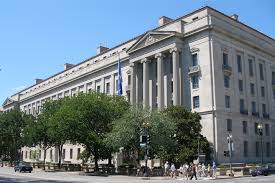
U.S. Department of Justice
Hoping to avoid prison, Hoffa phones Robert Kennedy, offering future Teamsters support if RFK runs for President. To prove he can deliver, he tells Kennedy that the Teamsters have even penetrated the FBI.
[In March, 1964, Kennedy met with Hoffa on an airfield at Dulles International Airport in Washington, D.C. He was accompanied by two Secret Service agents from the detail assigned to ex-First Lady Jacqueline Kennedy.
[FBI Director J. Edgar Hoover, no longer afraid to cross RFK, had withdrawn the agents previously assigned to guard Kennedy.
[Accompanying Hoffa were two muscular bodyguards–at least one of whom was packing two pistols in shoulder holsters.
[While the Secret Service agents watched from a respectful distance, Kennedy spoke quietly with Hoffa. The Attorney General showed a document to Hoffa, and the Teamsters leader at times nodded or shook his head.
[The agents drove Kennedy back to Washington. During the ride, he said nothing about the reason for the meeting.
[David Talbot, in his book, Brothers: The Hidden History of the Kennedy Years, speculates that it could have been to discuss Hoffa’s conviction for jury tampering.
[But Gus Russo–author of Live By the Sword: The Secret War Against Castro and the Death of JFK–writes that the reason might have been Dallas.
[Perhaps, he speculates, RFK had wanted to look into Hoffa’s eyes while asking him: Did you have anything to do with the assassination? RFK had, in fact, done this with CIA Director John McCone almost immediately after his brother’s death.]
In Blood Feud, Kennedy confronts J. Edgar Hoover (Ernest Borgnine) and accuses him of illegally planting wiretaps in Mob hangouts all over the country.
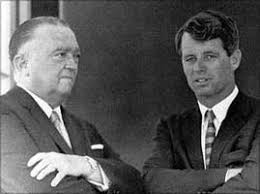
J. Edgar Hoover and Robert F. Kennedy
Hoover retorts that this had been the only way to obtain the prosecution-worthy intelligence Kennedy had demanded: “You loved that flow of information. You didn’t want it to stop.”
Kennedy: Why did you keep the FBI out of the fight against the Mob for decades?
Hoover: “Every agency that came to grips with them got corrupted by their money.”
[So far as is known, Hoover never made any such confession. Historians continue to guess his reason for leaving the Mob alone for decades.]
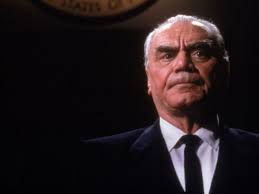

Ernest Borgnine as J. Edgar Hoover
RFK then mentions the CIA’s plots to employ the Mob to assassinate Cuban dictator Fidel Castro
[The agency had wanted to please President Kennedy, and the Mafia had wanted to regain its casinos lost to the Cuban Revolution. The role the Kennedy brothers played in the CIA’s assassination plots remains murky, and has been the subject of endless speculation.]
“The CIA, doing business with the Mob,” says Kennedy. “The FBI, leaking information to its enemies [the Teamsters].” Then, sadly: “I guess it’s true–everyone does business with everyone.”
[So far as is known, the FBI did not pass on secrets to the Teamsters. But during the 1970s, the Mafia penetrated the Cleveland FBI office through bribes to a secretary. Several FBI Mob informants were “clipped” as a result.]
In 1967, Hoffa goes to prison. He stays there until, in 1971, President Richard Nixon commutes his sentence in hopes of gaining Teamsters’ support for his 1972 re-election.
Kennedy leaves the Justice Department in 1964 and is elected U.S. Senator from New York. In 1968 he runs for President. On June 5, after winning the California primary, he’s assassinated.
In Blood Feud, just before his assassination, RFK asks: “How will I ever really know if the Mob killed Jack because of my anti-Mob crusade?”
Hoffa schemes to return to the presidency of the Teamsters–a post now held by his successor, Frank Fitzsimmons. He runs the union in a more relaxed style than Hoffa, thus giving the Mob greater control over its pension fund.
And the Mafia likes it that way.
On July 30, 1975, Hoffa disappears from the parking lot of the Machus Red Fox Restaurant near Detroit. He had gone there to meet with two Mafia leaders.
Almost 41 years after the death of James R. Hoffa, and almost 48 years after that of Robert F. Kennedy:
- Labor unions are a shadow of their former power.
- The threat they once represented to national prosperity has been replaced by that of predatory corporations like Enron and AIG.
- The war RFK began on the Mafia has continued, sending countless mobsters to prison.
- Millions of Americans who once expected the Federal Government to protect them from crime now believe the Government is their biggest threat.
- The idealism that fueled RFK’s life has virtually disappeared from politics.
2016 PRESIDENTIAL RACE, ABC NEWS, ABCNEWS, ALTERNET, AMERICABLOG, AP, BABY BOOMER RESISTANCE, BBC, BERNIE SANDERS, BLOOD FEUD, BLOOMBERG NEWS, BROTHERS: THE HIDDEN HISTORY OF THE KENNEDY YEARS, BUZZFEED, CARLOS MARCELLO, CBS NEWS, CIA, CNN, COTTER SMITH, CROOKS AND LIARS, CUBA, DAILY KOS, DAVID TALBOT, DONALD TRUMP, ERNEST BORGNINE, FBI, FIDEL CASTRO, FIVETHIRTYEIGHT, GUS RUSSO, HARPER’S MAGAZINE, HILLARY CLINTON, HUFFINGTON POST, INTERNATIONAL BROTHERHOOD OF TEAMSTERS, J. EDGAR HOOVER, JAMES R. HOFFA, JOHN F. KENNEDY, JUSTICE DEPARTMENT, LIVE BY THE SWORD: THE SECRET WAR AGAINST CASTRO AND THE DEATH OF JFK, MAFIA, MEDIA MATTERS, MOTHER JONES, MOVEON, MSNBC, NBC NEWS, NEW REPUBLIC, NEWSDAY, NEWSWEEK, NPR, PBS NEWSHOUR, POLITICO, POLITICUSUSA, RAFAEL EDWARD CRUZ, RAW STORY, REUTERS, ROBERT BLAKE, ROBERT F. KENNEDY, SALON, SAM GROOM, SEATTLE TIMES, Secret Service, SENATE LABOR RACKETS COMMITTEE, SLATE, TALKING POINTS MEMO, THE ATLANTIC, THE CHICAGO SUN-TIMES, THE CHICAGO TRIBUNE, THE DAILY BEAST, THE DAILY BLOG, THE GUARDIAN, THE HILL, THE HUFFINGTON POST, THE INTERCEPT, THE LOS ANGELES TIMES, THE NATION, THE NEW REPUBLIC, THE NEW YORK TIMES, THE NEW YORKER, THE VILLAGE VOICE, THE WALL STREET JOURNAL, THE WASHINGTON POST, THINKPROGRESS, TIME, TRUTHDIG, TRUTHOUT, TWITTER, U.S. NEWS & WORLD REPORT, UPI
In Bureaucracy, History, Law, Law Enforcement, Politics, Social commentary on April 22, 2016 at 12:10 am
The 1983 TV mini-series, Blood Feud, chronicles the decade-long struggle between Robert F. Kennedy and James R. Hoffa.
Having “helped” Kennedy (Cotter Smith) to oust corrupt Teamsters President Dave Beck, Hoffa (Robert Blake) believes that Kennedy should now be satisfied: “He’s got his scalp. Now he can move on to other things while I run the union.”
But Hoffa has guessed wrong–with fatal results. Realizing that he’s been “played” by Hoffa, a furious Kennedy strikes back.
He orders increased surveillance of Hoffa and his topmost associates. He subpoenas union records and members of both the Teamsters and the Mafia to appear before his committee in public hearings.
And he tries to enlist the aid of legendary FBI Director J. Edgar Hoover (Ernest Borgnine). But Hoover wants no part of a war against organized crime, whose existence he refuses to admit.

Meanwhile, Kennedy’s confrontations with Hoffa grow increasingly fierce. In open hearings, Kennedy accuses Hoffa of receiving kickbacks in the name of his wife. Hoffa damns him for “dirtying my wife’s name.”
Kennedy secures an indictment against Hoffa for hiring a spy to infiltrate the Senate Labor Rackets Committee. He’s so certain of a conviction that he tells the press he’ll “jump off the Capitol building” if Hoffa beats the rap.
But Hoffa’s lawyer, Edward Bennett Williams (Jose Ferrer) puts Kennedy himself on the witness stand. There he portrays Kennedy as a spoiled rich man who’s waging a vendetta against Hoffa.
Hoffa beats the rap, and offers to send Kennedy a parachute. But he jokingly warns reporters: “Hey, Bobby, you better have it checked. I don’t trust myself!”
By 1959, Robert Kennedy’s work as chief counsel for the Senate Labor Rackets Committee is over. But not his determination to send Teamsters President James Hoffa to prison.
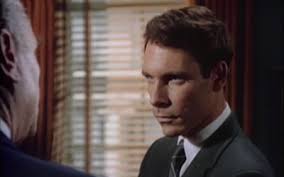
Cotter Smith as Robert Kennedy
Throughout 1960, he manages the Presidential campaign for his brother, John F. Kennedy (Sam Groom). By a margin of only 100,000 votes, JFK wins the election.
Hoffa thinks that his troubles are over, that “Bobby” will move on to other pursuits and forget about the Teamsters.
Hoffa is partly right: Kennedy moves on to another job. But it’s the office of United States Attorney General.
JFK, needing someone in the Cabinet he can trust completely, browbeats Robert into becoming the the nation’s top cop.
For Hoffa, it’s a nightmare come true.
As Attorney General, Kennedy no longer has to beg J. Edgar Hoover to attack organized crime. He can–and does–order him to do so.
Throughout the country, the Mafia feels a new heat as FBI agents plant illegal electronic microphones (“bugs”) in their innermost sanctums. Agents openly tail mobsters–and send them to prison in large numbers.
And Kennedy sets up a special unit, composed of topflight prosecutors and investigators, to go after just one man: James Riddle Hoffa. The press comes to call it the “Get Hoffa” squad.
Hoffa continues to beat federal prosecutors in court. But he believes he’s under constant surveillance by the FBI, and his nerves are starting to crack.
Convinced that the FBI has bugged his office, he literally tears apart the room, hoping to find the bug. But he fails to do so.
What he doesn’t know is he’s facing a more personal danger–from one of his closest associates.
He tells a trusted colleague, Edward Grady Partin (Brian Dennehy) how easy it would be to assassinate Kennedy with a rifle or bomb.
Later, Partin gets into a legal jam–and is abandoned by the Teamsters. Hoping to cut a deal, he relays word to the Justice Department of Hoffa’s threats against the Attorney General.
Now working for the Justice Department, Partin sends in reports on Hoffa’s juror-bribing efforts in yet another trial. Hoffa again beats the rap–but now Kennedy has the insider’s proof he needs to put him away for years.
Meanwhile, the Mafia despairs of the increasing pressure of the Justice Department. At a swanky restaurant, several high-ranking members agree that “something” must be done.
[Although this scene is fictional, it’s clearly based on an infamous outburst of Carlos Marcello, the longtime Mafia boss of New Orleans.
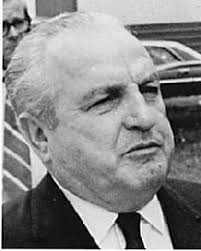
Carlos Marcello
[In 1961, Marcello was deported to his native Guatemala on orders by RFK. After illegally re-entering the country, he swore vengeance against the Attorney General.
[In September, 1962, during a meeting with several mob colleagues, he flew into a rage when someone mentioned Kennedy.
“Take the stone out of my shoe!” he shouted, echoing a Sicilian curse. “Don’t you worry about that little Bobby sonofabitch. He’s going to be taken care of!”
[When one of his colleagues warned that murdering RFK would trigger the wrath of his brother, President John F.Kennedy, Marcello replied: “In Sicily they say if you want to kill a dog you don’t cut off the tail. You go for the head.”
[Marcello believed that the death of President Kennedy would render the Attorney General powerless. And he added that he planned to use a “nut” to do the job.]
On November 22, 1963, President John F. Kennedy is assassinated in Dallas, Texas.
Blood Feud clearly implies that the Mafia was responsible.
2016 PRESIDENTIAL RACE, ABC NEWS, ALTERNET, AMERICABLOG, AP, BABY BOOMER RESISTANCE, BBC, BERNIE SANDERS, BLOOD FEUD, BLOOMBERG NEWS, BROTHERS: THE HIDDEN HISTORY OF THE KENNEDY YEARS, BUZZFEED, CARLOS MARCELLO, CBS NEWS, CIA, CNN, COTTER SMITH, CROOKS AND LIARS, CUBA, DAILY KOS, DAVID TALBOT, DONALD TRUMP, ERNEST BORGNINE, FBI, FIDEL CASTRO, FIVETHIRTYEIGHT, GUS RUSSO, HARPER’S MAGAZINE, HILLARY CLINTON, HUFFINGTON POST, INTERNATIONAL BROTHERHOOD OF TEAMSTERS, J. EDGAR HOOVER, JAMES R. HOFFA, JOHN F. KENNEDY, JUSTICE DEPARTMENT, LIVE BY THE SWORD: THE SECRET WAR AGAINST CASTRO AND THE DEATH OF JFK, MAFIA, MEDIA MATTERS, MOTHER JONES, MOVEON, MSNBC, NBC NEWS, NEW REPUBLIC, NEWSDAY, NEWSWEEK, NPR, PBS NEWSHOUR, POLITICO, POLITICUSUSA, RAFAEL EDWARD CRUZ, RAW STORY, REUTERS, ROBERT BLAKE, ROBERT F. KENNEDY, SALON, SAM GROOM, SEATTLE TIMES, Secret Service, SENATE LABOR RACKETS COMMITTEE, SLATE, TALKING POINTS MEMO, THE ATLANTIC, THE CHICAGO SUN-TIMES, THE CHICAGO TRIBUNE, THE DAILY BEAST, THE DAILY BLOG, THE GUARDIAN, THE HILL, THE HUFFINGTON POST, THE INTERCEPT, THE LOS ANGELES TIMES, THE NATION, THE NEW REPUBLIC, THE NEW YORK TIMES, THE NEW YORKER, THE VILLAGE VOICE, THE WALL STREET JOURNAL, THE WASHINGTON POST, THINKPROGRESS, TIME, TRUTHDIG, TRUTHOUT, TWITTER, U.S. NEWS & WORLD REPORT, UPI
In Bureaucracy, History, Law, Law Enforcement, Politics, Social commentary on April 21, 2016 at 12:37 pm
Today, America has four major candidates running for President: Donald Trump, Rafael Edward Cruz, Hillary Clinton and Bernie Sanders.
Trump is a billionaire businessman; Cruz is a U.S. Senator from Texas; Clinton is a former First Lady, U.S. Senator and Secretary of State; and Sanders is a U.S. Senator from Vermont.
Despite the great differences in their backgrounds, they all share one thing in common: Extremely high negatives among voters.
But 48 years ago, Senator Robert Francis Kennedy aroused passions of an altogether different sort.
Kennedy had been a United States Attorney General (1961-1964) and Senator (1964-1968). But it was his connection to his beloved and assassinated brother, President John F. Kennedy, for which he was best known.

Robert F. Kennedy campaigning for President
Millions saw RFK as the only candidate who could make life better for America’s impoverished–while standing firmly against those who threatened the Nation’s safety.
As television correspondent Charles Quinn observed: “I talked to a girl in Hawaii who was for [George] Wallace [the segregationist governor of Alabama]. And I said ‘Really?’ [She said] ‘Yeah, but my real candidate is dead.’
“You know what I think it was? All these whites, all these blue collar people who supported Kennedy…all of these people felt that Kennedy would really do what he thought best for the black people, but, at the same time, would not tolerate lawlessness and violence.
“They were willing to gamble…because they knew in their hearts that the country was not right. They were willing to gamble on this man who would try to keep things within reasonable order; and at the same time do some of the things they knew really should be done.”
Campaigning for the Presidency in 1968, RFK had just won the crucial California primary on June 4–when he was shot in the back of the head. His killer: Sirhan Sirhan, a young Palestinian furious at Kennedy’s support for Israel.
On June 8, 1,200 men and women boarded a specially-reserved passenger train at New York’s Pennsylvania Station. They were accompanying Kennedy’s body to its final resting place at Arlington National Cemetery.
As the train slowly moved along 225 miles of track, throngs of men, women and children lined the rails to pay their final respects to a man they considered a genuine hero.
Little Leaguers clutched their baseball caps across their chests. Uniformed firemen and policemen saluted. Burly men in shirtsleeves held hardhats over their hearts. Black men in overalls waved small American flags. Women from all levels of society stood and cried.

A nation says goodbye to Robert Kennedy
Commenting on RFK’s legacy, historian William L. O’Neil wrote in Coming Apart: An Informal History of America in the 1960′s:
“…He aimed so high that he must be judged for what he meant to do, and, through error and tragic accident, failed at….He will also be remembered as an extraordinary human being who, though hated by some, was perhaps more deeply loved by his countrymen than any man of his time.
“That too must be entered into the final account, and it is no small thing. With his death something precious disappeared from public life.”
Eleven years earlier, as a young, idealistic attorney, Kennedy had declared war on James Riddle Hoffa, the president of the Mafia-dominated International Brotherhood of Teamsters Union.
As chief counsel for the Senate Labor Rackets Committee, Kennedy was appalled at the corruption he discovered among high-ranking Teamster officials. As he saw it, under Hoffa’s leadership, the union was nothing less than “a conspiracy of evil.”
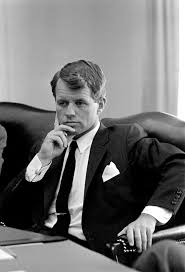
Robert Francis Kennedy as Chief Counsel, Senate Labor Rackets Committee
Hoffa, in turn, held an equally unflattering view of Kennedy. “A rich punk,” said Hoffa, who didn’t know or care about “the average workingman.”
In 1983, Blood Feud, a two-part TV mini-series, depicted the 11-year animosity between Kennedy and Hoffa. Although it took some dramatic liberties, its portrayal of the major events of that period remains essentially accurate.
Today, labor unions are a rapidly-vanishing species, commanding far less political influence than they did 50 years ago. As a result, young viewers of this series may find it hard to believe that labor ever held such sway, or that the Teamsters posed such a threat.
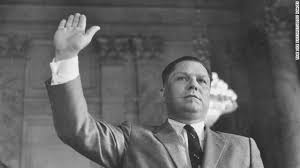
James Riddle Hoffa testifying before the Senate Labor Rackets Committee
And in an age when millions see “Big Government” as the enemy, they may feel strong reservations about the all-out war that Robert F. Kennedy waged against Hoffa.
Blood Feud opens in 1957, when Hoffa (Robert Blake) is a rising figure within the Teamsters. Kennedy (Cotter Smith) is chief counsel for the Senate Labor Rackets Committee.
At first, Hoffa tries to ingratiate himself with Kennedy, telling him: “I know everybody who can help me and anybody who can hurt me.”
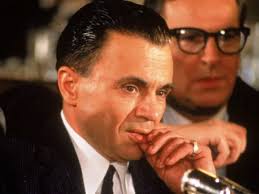
Robert Blake as James R. Hoffa
A wily Hoffa decides to parley Kennedy’s anti-corruption zeal into a path to power for himself. Via his attorney, Eddie Cheyfitz, he feeds Kennedy incriminating evidence against Dave Beck, president of the Teamsters.
Confronted with a Senate subpoena, Beck flees the country–paving the way for Hoffa to assume the top position in the union. Hoffa believes he has solved two problems at once.
ABC NEWS, AFFORDABLE CARE ACT, AIR TRAFFIC CONTROLLERS STRIKE, BARACK OBAMA, BERNIE SANDERS, CBS NEWS, CNN, COLUMBIA UNIVERSITY, DIXIE CHICKS, EXTORTION, FACEBOOK, FBI, GEORGE W. BUSH, HARVARD LAW SCHOOL, HENRY J. KAISER FOUNDATION, HILLARY CLINTON, IRAQ WAR, JOHN BOEHNER, JOHN SCHNATTER, JON STEWART, JONATHAN ALTER, JUSTICE DEPARTMENT, KOCH BROTHERS, Medical, MEDICAL CARE, NBC NEWS, NICCOLO MACHIAVELLI, OBAMACARE, PAPA JOHN'S PIZZA, PATRIOT ACT, public relations, RACKETEER INFLUENCED CORRUPT ORGANIZATIONS ACT, REFORM, REPUBLICAN PARTY, RICHARD WOLFFE, Ronald Reagan, TEA PARTY, TERRORISM, THE CHICAGO SUN-TIMES, THE CHICAGO TRIBUNE, THE DAILY SHOW, THE LOS ANGELES TIMES, THE NEW YORK TIMES, THE PRINCE, THE WASHINGTON POST, TWITTER, UNEMPLOYMENT
In Bureaucracy, Business, History, Law, Medical, Politics, Social commentary on February 9, 2016 at 12:04 am
Barack Obama is one of one of the most highly educated Presidents to occupy the White House.
When he took office, he intended to make healthcare available to all Americans–and not just the wealthiest 1%.
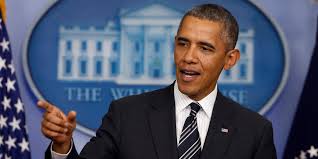
President Barack Obama
But he made a series of deadly mistakes:
- In crafting the Affordable Care Act (better known as Obamacare);
- In building public support for it; In underestimating the venom and opposition of his Right-wing enemies;
- In underestimating the opposition of the business community in complying with the law; and
- In allowing himself to be cowed by his political enemies.
Obama is by nature a supreme rationalist and conciliator–not a rough-and-tumble street fighter.
And his career before becoming President in 2008–or even the United States Senator from Illinois in 2004–greatly strengthened this predisposition.
From 1985 to 1988, Obama worked as a community organizer, setting up a job-training program, a college preparatory tutoring program and a tenants’ rights organization.
Such activities demand skills in building consensus, not confrontation.
He then taught at the University of Chicago Law School for 12 years–as a Lecturer from 1992 to 1996, and as a Senior Lecturer from 1996 to 2004, teaching Constitutional law.

University of Chicago Law School
Law professors spend their time in clean, civil classrooms–far removed from the rough-and tumble of criminal defense/prosecution.
If Obama had accused President George W. Bush of conspiring with Al Qaeda–as Republicans have repeatedly accused Obama–retribution would have been swift and brutal.
(On March 10, 2003, nine days before Bush ordered the unprovoked invasion of Iraq, Natalie Maines, the lead singer of the country music band, the Dixie Chicks, told a London concert audience: “We don’t want this war, this violence, and we’re ashamed that the President of the United States is from Texas.”
(A Republican-approved boycott of Dixie Chicks music followed, as well as death threats DJs refused to play their music, and President Bush refused to criticize the KGB-like tactics of his Right-wing supporters.)

Natalie Maines, left, of the Dixie Chicks
But Obama could not–or would not–bring himself to attack his sworn enemies by attacking their own patriotism or invoking Federal criminal statutes against their extortionate and terrorist threats.
In short: Obama–who believes in reason and conciliation–paid the price for allowing his sworn enemies to insult and obstruct him.
Obama Mistake No. 6: Failing to closely study his proposed legislation.
Throughout his campaign to win support for the Affordable Care Act (ACA) Obama had repeatedly promised: “If you like your health insurance plan, you can keep your plan. If you like your doctor, you can keep your doctor. Period.”
But, hidden in the 906 pages of the law, was a fatal catch for the President’s own credibility.
The law stated that those who already had medical insurance could keep their plans–so long as those plans met the requirements of the new healthcare law.
If their plans didn’t meet those requirements, they would have to obtain coverage that did.
It soon soon turned out that many Americans wanted to keep their current plan–even if it did not provide the fullest possible coverage.
Suddenly, the President found himself facing a PR nightmare–charged and ridiculed as a liar. Even Jon Stewart, who on “The Daily Show,” had supported the implementation of “Obamacare,” ran footage of Obama’s “you can keep your doctor” promise.
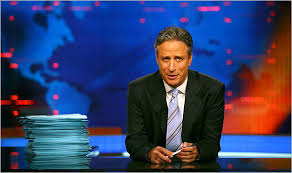
Jon Stewart
The implication: You said we could keep our plan/doctor; since we can’t, you must be a liar.
As a result, the President found his reputation for integrity–long his greatest asset–shattered.
All of which points to a final warning offered by Niccolo Machiavelli:
Whence it may be seen that hatred is gained as much by good works as by evil….
Former Secretary of State Hillary Clinton says that, if she’s elected President, she will push for incremental changes in the ACA.
Vermont United States Senator Bernie Sanders, on the other hand, has called for the implementation of a single-payer plan. This, in effect, would accomplish what Republicans have spent the last seven years trying to do: Repeal “Obamacare.”
A single-payer plan would prove simpler and more comprehensive than the ACA. But the chances of its passing a Republican-dominated Congress are absolutely zero.
The passage of the ACA was–as the Duke of Wellington said of Waterloo–“a damned, close-run thing.”
Right-wingers like former Alaska Governor Sarah Palin flat-out lied that the ACA would create “death panels.” And millions of reactionaries, furious that a black man now occupied the Oval Office, eagerly believed it.
When Democratic politicians organized town meetings for public discussion of the Act, Rightist hooligans often used violence to break them up.
Republicans remained silent while President George W. Bush lied the nation into a bloody, budget-busting war in Iraq. But they have repeatedly damned the ACA as a lethal drain on the American taxpayer.
Thus, any changes to come in the ACA will have to come as Hillary Clinton proposes, on an incremental basis.
The only thing that can be said with certainty about the ACA is this:
If any Republican wins the Presidency in 2016, the Republican-dominated House and Senate will send him legislation decreeing the death of affordable healthcare for all Americans. And he will of course sign it.
ABC NEWS, AFFORDABLE CARE ACT, AIR TRAFFIC CONTROLLERS STRIKE, BARACK OBAMA, BERNIE SANDERS, CBS NEWS, CNN, COLUMBIA UNIVERSITY, DIXIE CHICKS, EXTORTION, FACEBOOK, FBI, GEORGE W. BUSH, HARVARD LAW SCHOOL, HENRY J. KAISER FOUNDATION, HILLARY CLINTON, IRAQ WAR, JOHN BOEHNER, JOHN SCHNATTER, JOHN STEWART, JONATHAN ALTER, JUSTICE DEPARTMENT, KOCH BROTHERS, MEDICAL CARE, NBC NEWS, NICCOLO MACHIAVELLI, OBAMACARE, PAPA JOHN'S PIZZA, PATRIOT ACT, public relations, RACKETEER INFLUENCED CORRUPT ORGANIZATIONS ACT, REFORM, REPUBLICAN PARTY, RICHARD WOLLFE, Ronald Reagan, TEA PARTY, TERRORISM, THE CHICAGO SUN-TIMES, THE CHICAGO TRIBUNE, THE DAILY SHOW, THE LOS ANGELES TIMES, THE NEW YORK TIMES, THE PRINCE, THE WASHINGTON POST, TWITTER, UNEMPLOYMENT
In Bureaucracy, Business, History, Law, Law Enforcement, Medical, Politics on February 8, 2016 at 12:15 am
On July 2, 2013, the Treasury Department announced a major change in the application of the Affordable Care Act (ACA), more popularly known as “Obamacare”:
“We have heard concerns about the complexity of the requirements and the need for more time to implement them effectively…We have listened to your feedback. And we are taking action.
“The Administration is announcing that it will provide an additional year before the ACA mandatory employer and insurer reporting requirements begin.”
[Boldface in the original document.]
In short: The administration allowed employers an additional year to refuse providing healthcare to their employees–or to face fines for not doing so.
And how did Obama’s self-declared enemies react to this effort at compromise?
On July 30, 2013, House Republicans voted to proceed with a lawsuit against the President–for failing to enforce the Affordable Care Act.
“In 2013, the president changed the health care law without a vote of Congress, effectively creating his own law by literally waiving the employer mandate and the penalties for failing to comply with it,” House Speaker John A. Boehner said in a statement.
“That’s not the way our system of government was designed to work. No president should have the power to make laws on his or her own.”
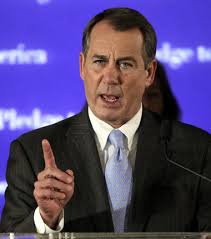
John Boehner
Thus, Boehner intended to sue the President to enforce the law that the House had voted 54 times to repeal, delay or change.
Obama Mistake No. 5: Believing that public and private employers would voluntarily comply with the law.
The ACA requires employers to provide insurance for part-time employees who work more than 30 hours per week. Yet many government employers claim they can’t afford it–and have thus limited part-time workers’ hours to 29 per week instead.
Among those states affected:
- “Our choice was to cut the hours or give [employees] health care, and we could not afford the latter,” Dennis Hanwell, the Republican mayor of Medina, Ohio, said in an interview with The New York Times.
- Lawrence County, in western Pennsylvania, reduced the limit for part-time employees to 28 hours a week, from 32.
- In Virginia, part-time state employees are generally not allowed to work more than 29 hours a week on average over a 12-month period.
President Obama and those who crafted the Act may have been surprised at what happened. But they shouldn’t have been.
Greed-addicted officials will always seek ways to avoid complying with the law–or achieve minimum compliance with it. And what goes for public employers goes for private ones, too.
The Act doesn’t penalize a company for failing to provide health insurance coverage for part-time employees who work fewer than 30 hours.
The result was predictable. And its consequences are daily becoming more clear:
- Increasing numbers of employers are moving fulltime workers into part-time positions;
- Refusing to provide their employees with medical insurance; and
- Avoiding fines for non-compliance with the law.
Some employers have openly shown their contempt for President Obama–and the idea that employers have an obligation to those who make their profits a reality.
One of these is John Schnatter, CEO of Papa John’s Pizza, who has been quoted as saying:
- The prices of his pizzas will go up–by 11 to 14 cents per pizza, or 15 to 20 cents per order; and
- He will pass along these costs to his customers.
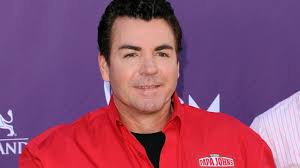
John Schnatter
“If Obamacare is in fact not repealed,” he told Politico, “we will find tactics to shallow out any Obamacare costs and core strategies to pass that cost onto consumers in order to protect our shareholders’ best interests.”
If President Obama were truly a student of Realpolitick, he would have predicted that most businesses would try to avoid compliance with the ACA.
And the remedy would have been simple: Require all employers to provide insurance coverage for all of their employees, regardless of their fulltime or part-time status.
This, in turn, would have produced two substantial benefits:
- All employees would have been able to obtain medical coverage; and
- Employers would have been encouraged to provide fulltime positions rather than part-time ones.
The reason: Employers would feel: “Since I’m paying for fulltime insurance coverage, I should be getting fulltime work in return.”
If the President ever considered the merits of this, he decided against pressing for such a requirement.
Obama is one of the most rational and educated men to occupy the White House. So why did he fail to expect the worst in people–especially his self-declared enemies–and arrange to counter it?
Niccolo Machiavelli provides a shrewd insight into the repeated failures of the Obama Presidency.
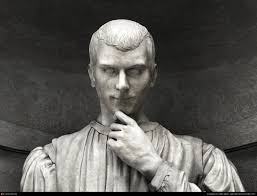
Niccolo Machiavelli
Writing in The Prince, his classic work on the realities of politics, Machiavelli states:
…He is happy whose mode of procedure accords with the needs of the times, and similarly, he is unfortunate whose mode of procedure is opposed to the times….
If it happens that time and circumstances are favorable to one who acts with caution and prudence he will be successful But if time and circumstances change he will be ruined, because he does not change the mode of this procedure.
Put another way: A conciliator will prosper so long as he works with others willing to compromise. But facing uncompromising fanatics, he will be defeated–unless he can exchange conciliation for confrontation.


-33510-W&docid=hCd9k6PuglvZAM&tbnid=CAo7BRzGtBWa3M%3A&w=500&h=375&bih=469&biw=819&ved=0ahUKEwiissafvJ_MAhUGKWMKHTZZA_MQxiAIAg&iact=c&ictx=1)


&docid=SiluTuHYHtjaZM&tbnid=uLB-PLYDVdkkVM%3A&w=455&h=341&ei=zeN_VI_hKYHjoATGs4Bo&ved=0CAIQxiAwAA&iact=c)


 Bureaucracybuster's Blog
2016 PRESIDENTIAL CAMPAIGN, ABC NEWS, ANTHEM INC., ASHLEY MADISON, BERNIE SANDERS, CBS NEWS, CNN, CYBERSECURITY, DAIRY QUEEN, DEBBIE WASSERMAN-SCHULTZ, DEMOCRATIC NATIONAL COMMITTEE, DEMOCRATIC PARTY, DONALD TRUMP, FACEBOOK, HACKING, HILLARY CLINTON, HOME DEPOT, JPMORGAN/CHASE, KMART, NAPOLEON BONAPARTE, NATIONAL LEGAL AND POLICY CENTER, NBC NEWS, NICCOLO MACHIAVELLI, REPUBLICAN PARTY, SONY PICTURES, STAPLES, TARGET, THE DISCOURSES, THE LOS ANGELES TIMES, THE NEW YORK TIMES, THE OFFICE OF PERSONNEL MANAGEMENT, THE PENTAGON, THE PRINCE, THE U.S. DEPARTMENT OF STATE, THE WASHINGTON POST, TWITTER, WIKILEAKS
THE FIRST RULE OF CONSPIRACIES–AND COMPUTERS
In Bureaucracy, History, Military, Politics, Social commentary on July 26, 2016 at 12:15 amOn July 22, Wikileaks released 19,252 emails and 8,034 attachments hacked from computers of the highest-ranking officials of the Democratic National Committee (DNC).
The emails were exchanged from January 2015 through May 2016.
These clearly reveal a bias for Hillary Clinton and against her lone challenger, Vermont U.S. Senator Bernie Sanders.
One email revealed that Brad Marshall, the chief financial officer of the DNC, suggested that Sanders, who is Jewish, could be portrayed as an atheist.
Sanders’ supporters have long charged that the DNC and its chair, Debbie Wasserman-Schultz, were plotting to undercut his campaign. Now thousands of them are expected to descend on the Democratic convention as furious protesters.
The leak could not have come at a worse time for Hillary Clinton, the former First Lady, U.S. Senator from New York and Secretary of State under President Barack Obama.
About to receive the Democratic nomination for President, she finds herself charged with undermining the electoral process.
Wasserman-Schultz has proven the first casualty of the leak, resigning from her position as chair of the DNC and saying she would not open the Democratic convention as previously scheduled.
Debbie Wasserman-Schultz
As for Clinton: Her campaign manager, Bobby Mook, blamed the Russians for the leak. Their alleged motive: To help Republican Presidential nominee Donald Trump.
Cyber-security experts believe the hackers originated from Russia–and that Russian President Vladimir Putin may have authorized it.
His alleged motive: Trump has repeatedly attacked United States’ membership in the North Atlantic Treaty Organization (NATO).
He believes the United States is paying an unfairly large portion of the monies needed to maintain this alliance–and he wants other members to contribute far more. Otherwise, if he is elected President, they would be on their own if attacked by Russia.
Trump took to twitter to offer his take on the release: “How much BAD JUDGEMENT was on display by the people in DNC in writing those really dumb e-mails, using even religion, against Bernie!”
Bernie Sanders
Which brings up the obvious question: Why was such sensitive information entrusted to computers that could be hacked?
This is not the first time a major corporation or government agency has fallen prey to hackers.
Name-brand companies, trusted by millions, have been hit with massive data breaches that compromised their customers’ and/or employees’ most sensitive financial and personal information.
Among those companies and agencies:
Perhaps the most notorious target so far hacked is Ashley Madison, the website for cheating wives and husbands. Launched in 2001, its catchy slogan is: “Life is short. Have an affair.”
On July 15, 2015, its more than 37 million members learned that highly embarrassing secrets they had entrusted to Ashley Madison had been compromised.
This included their sexual fantasies, matching credit card transactions, real names and addresses, and employee documents and emails.
A website offering cheating services to those wealthy enough to afford high-priced fees is an obvious target for hackers. After all, its database is a blackmailer’s dream-come-true.
And the same is true for computers of one of the two major political parties of the United States.
Among the secrets unearthed in the WikiLeaks document-dump: Plans by Democratic party officials to reward large donors and prominent fundraisers with lucrative appointments to federal boards and commissions.
Most of the donors listed gave to Clinton’s campaign. None gave to Sanders.
According to Ken Boehm, chairman of the National Legal and Policy Center, a government watchdog group:
“The disclosed DNC emails sure look like the potential Clinton Administration has intertwined the appointments to federal government boards and commissions with the political and fund raising operations of the Democratic Party. That is unethical, if not illegal.”
Centuries before the invention of computers–and the machinery needed to hack into them–Niccolo Machiavelli offered cautionary advice to those thinking of entering into a conspiracy. He did so in his masterwork on politics, The Discourses.
Niccolo Machiavelli
Unlike his better-known work, The Prince, which deals with how to secure power, The Discourses lays out rules for preserving liberty within a republic.
In Book Three, Chapter Six (“Of Conspiracies”) he writes:
“I have heard many wise men say that you may talk freely with any one man about everything, for unless you have committed yourself in writing, the ‘Yes’ of one man is worth as much as the ‘No’ of another.
“And therefore one should guard most carefully against writing, as against a dangerous rock, for nothing will convict you quicker than your own handwriting.”
In 1804, Napoleon Bonaparte, then First Consul of France, ordered the execution of the popular Louis Antoine de Bourbon, Duke of Enghien, claiming that he had aided Britain and plotted against France.
The aristocracy of Europe, still recalling the slaughters of the French Revolution, was shocked.
Asked for his opinion on the execution, Napoleon’s chief of police, Joseph Fouche, said: “It was worse than a crime; it was a blunder.”
This may prove to be history’s verdict on the storing of so many incriminating computer files by the DNC.
Share this: