bureaucracybusters

Posts Tagged ‘BARACK OBAMA’

LINCOLN WEEPS

In Bureaucracy, History, Law, Politics, Social commentary on May 5, 2014 at 12:02 am

In 1845, Andrew Jackson, seventh President of the United States from 1829 to 1837, lay dying at The Hermitage in Nashville, Tennessee.

Jackson had spent his adult life defending the infant United States.  He had fought the Indians and British during the War of 1812, capping his career as a general with his triumph at the Battle of New Orleans in 1815.

As President, he had faced down would-be “nullifiers”–those Southern politicians who claimed states had the right to ignore federal laws they disliked.

 Andrew Jackson

But now his worn, disease-racked body was fast reaching the limits of its endurance.  Knowing that death was closing in, Jackson often took stock of his lifetime of achievements–and failures.

One day, he asked one of his doctors what act of his administration would be most severely condemned by future generations.

“Perhaps the removal of the bank deposits,” said the doctor–referring to Jackson’s withdrawal of U.S. Government monies from the first Bank of the United States.

That act had destroyed the bank, which Jackson had believed was a source of political corruption.

“Oh, no!” said Jackson.

“Then maybe the specie circular,” said the doctor.  He was referring to an 1836 executive order Jackson had issued, requiring payment for government land to be in gold and silver.

“Not at all!” said Jackson.

Then, his eyes blazing, Jackson raged: “I can tell you.  Posterity will condemn me more because I was persuaded not to hang John C. Calhoun as a traitor than for any other act in my life!”

Historians have not condemned Jackson for this.  But perhaps he was right-–and perhaps he should have hanged Calhoun.

It might have prevented the Civil War-–or at least delayed its coming.

John C. Calhoun had once been Vice President under Jackson and later a United  States Senator from South Carolina.   His fiery rhetoric and radical theories of “nullification” played a major part in bringing on the Civil War (1861-1865).

Calhoun was an outspoken proponent of slavery, which he declared to be  a “positive good” rather than a “necessary evil.”  He supported states’ rights and nullification–under which states could declare null and void federal laws which they deemed unconstitutional.

Over time, Southern states’ threats of “nullification” turned to those of “secession” from the Union.

Jackson died in 1845-–16 years before the Civil War erupted.  The resulting carnage destroyed as many as 620,000 lives.  More Americans died in the war than have been killed in all the major wars fought by the United States since.

When it ended, America was reinvented as a new, unified nation–-and one where slavery was now banned by the 13th Amendment to the United States Constitution.

Equally important, the Federal Government had now set a precedent for using overwhelming military power to force states to remain in the Union.

Except for die-hard secessionists, Americans overwhelmingly agreed, from 1865 on, that the Union was sacred and unbreakable.  Until, that is, the 2009 inauguration of Barack Obama–the country’s first black President.

Then, suddenly, secession–treason–became fashionable again, not only among many Southerners but even among so-called “mainstream” Republicans.

To date, sovereignty resolutions have been introduced in 58 state legislatures, and have passed in nine–Alaska, Arizona, Idaho, Kansas, North Dakota, South Dakota, Oaklahoma, Louisiana and Tennessee.

“Sovereignty” means supreme, independent authority over a territory–authority heretofore accepted as residing with the federal government.

For more than 20 years, Cliven Bundy, a Nevada cattle rancher, has refused to pay fees for grazing cattle on public lands, some 80 miles north of Las Vegas.

The Federal Bureau of Land Management (BLM) says Bundy now owes close to $1 million. He says his family has used the land since the 1870s and doesn’t recognize the federal government’s jurisdiction.

In 2013, a federal judge ordered Bundy to remove his livestock.

Bundy ignored the order, and was in fact even quoted as saying; “I don’t recognize the United States government as even existing.”

In early April, 2014, BLM agents rounded up more than 400 of his cattle.

Over the weekend of April 12-13, armed militia members and states’ right protesters showed up to challenge the move.

Rather than risk violence, the BLM did an about-face and released the cattle.

While Right-wingers hail this as a victory for “states’ rights,” the truth is considerably different.

Bundy’s refusal to recognize the federal government’s jurisdiction amounts to: “I will recognize–and obey–only those laws that I happen to agree with.”

Abraham Lincoln dedicated his Presidency–and sacrificed his life–to ensure the preservation of a truly United States.

And Robert E. Lee—the defeated South’s greatest general—spent the last five years of his life trying to put the Civil War behind him and persuade his fellow Southerners to accept their place in the Union.

But Cliven Bundy and other Right-wing champions of treason are working hard to destroy that union–and unleash a second Civil War.

FASCISTS FOREVER, JUDGES NO MORE: PART TWO (END)

In History, Law, Politics, Social commentary on May 2, 2014 at 12:00 am

If Newt Gingrich becomes President, he has big plans for the American federal judiciary: To arrest and remove all those judges who do not follow his right-wing agenda.

Adolf Hitler laid out his plans for remaking Germany and the world in his book, Mein Kampf (My Struggle).

And would-be Fuehrer Gingrich has openly proclaimed his own dictatorial intentions.

In a December 18, 21011 appearance on “Face the Nation,” Gingrich spoke candidly with host Bob Schieffer about his hatred for much of the American federal judiciary.

Schieffer: Mr. Speaker, the old saying in legal circles is that the Supreme Court is not last because it’s right, it’s right because it’s last.

There comes a point where you have to accept things as the law of the land. How do you decide, how does the President decide what’s a good law and I’m going to obey the Supreme Court or what’s a bad law and I’m just going to ignore it?

Gingrich: I think it depends on the severity of the case. I’m not suggesting that the Congress and the President review every decision.

I’m suggesting that when there are decisions….in which they’re literally risking putting civil liberty rules in battlefields, it’s utterly irrational for the Supreme Court to take on its shoulders the defense of the United States. It’s a violation of the Constitution.

* * * * *

Schieffer: …. Next year the Supreme Court is going to take up Obama’s healthcare proposal. What if they throw it out? Can President Obama then say I’m sorry boys, I’m just going to go ahead and implement it. Could he do that?

Gingrich: The key question is, what would the Congress then do? Because there are three branches….

Schieffer: But could he do that?

Gingrich: He could try to do that. And the Congress would then cut him off. Here’s the key — it’s always two out of three.

If the President and the Congress say the court is wrong, in the end the court would lose. If the Congress and the court say the President is wrong, in the end the President would lose.

And if the President and the court agreed, the Congress loses. The founding fathers designed the Constitution very specifically in a Montesquieu spirit of the laws to have a balance of power, not to have a dictatorship by any one of the three branches.

Schieffer: ….And a number of conservatives, including two of George Bush’s attorneys general, Alberto Gonzales and Michael Mulcasey, both said and I’m going to just quote what Mr. Mulcasey said.

….He told Fox News, he said “Mr. Gingrich’s proposal is dangerous, ridiculous, totally irresponsible, outrageous, off the wall, and would reduce the entire judicial system to a spectacle.”

Now that’s a conservative judge or a conservative attorney general. How do you respond to that?

Gingrich: I think many lawyers will find this a very frightening idea. They’ve had this run of 50 years of pretending judges are supreme, that they can’t be challenged. The lawyer class defines America.

We’ve had rulings that outlawed school prayer, we’ve had ruling that outlawed the cross, we’ve had rulings the outlawed the 10 Commandments, we’ve had a steady secular drive to radicalize this country away from all of its core beliefs.

I mean what got me into this was the 9th Circuit saying that one nation under God is unconstitutional.

* * * * *

On June 30, 1934, Hitler ordered his private army, the SS (Schutzstaffel, or Protective Squad) to purge his other private army, the S.A., or Brown Shirts.

At least 200 men and women were murdered throughout Germany.

Some died by firing squad. Others were executed in prison. Still others were shot down in their homes.

Afterward, Hitler appeared before the German parliament, the Reichstag, to justify his actions:

“If someone asks me why we did not use the regular courts, I would reply: At that moment I was responsible for the German nation. It was I, alone, who, during those 24 hours, was the Supreme Court of Justice of the German people.”

It took a six-year war that cost the lives of 50 million men, women and children to finally oust this “Supreme Court of Justice for the German People.”

Apparently Newt Gingrich believes it’s a title well worth resurrecting–here in America.

FASCISTS FOREVER, JUDGES NO MORE: PART ONE (OF TWO)

In History, Law, Politics, Social commentary on May 1, 2014 at 12:08 am

Republicans have a love/hate relationship with Adolf Hitler.

On one hand, they repeatedly accuse President Barack Obama of being another Hitler. They decorate his poster with the toothbrush mustache worn by Germany’s Fuehrer. They dismiss Obama’s eloquence with: “Hitler also gave good speeches.”

Adolf Hitler

On the other hand, they run candidates whose power-lust and ruthlessness match that of Hitler or any of his henchmen.

Among these in the past have been such notorious figures as Senator Joseph “Tail Gunner Joe” McCarthy, House Majority Leader Tom DeLay, President Richard M. Nixon and House Speaker Newt Gingrich.

And now a figure from that past is once again planning a last, desperate grasp for absolute power in 2016: Newt Gingrich.

Newt Gingrich

In a half-hour phone call with reporters on December 17, 2011, Gingrich said that, as President, he would abolish whole courts to be rid of judges whose decisions he feels are out of step with the country.

“Are we forced for a lifetime to keep someone on the bench who is so radically anti-American that they are a threat to the fabric of the country?” Gingrich asked.

“What kind of judge says you’ll go to jail if the word ‘invocation’ is used? If this isn’t a speech dictatorship, I’d like you to show me what one looks like.”

And appearing on CBS’ “Face the Nation,” Gingrich said the President could send federal law enforcement authorities to arrest judges who make controversial rulings in order to compel them to justify their decisions before congressional hearings.

When host Bob Schieffer asked how he would force federal judges to comply with congressional subpoenas, there occurred this telling exchange:

Schieffer: Let me just ask you this. You talk about enforcing it because one of things you say is if you don’t like what a court has done, the congress should subpoena the judge and bring him before congress and hold a congressional hearing.

Some people say that’s unconstitutional but I’ll let that go for a minute. I just want to ask you from a practical standpoint, how would you enforce that? Would you send the Capitol police down to arrest him?

Gingrich: If you had to or you’d instruct the Justice Department to send a U.S. Marshal. Let’s take the case of Judge Biery. I think he should be asked to explain a position that radical.

How could he say he’s going to jail the superintendent over the word benediction and invocation?

Because before…because then I would encourage impeachment. But before you move to impeachment, you’d like to know why he said it. Now clearly since the congress has the power.

Schieffer: What if he didn’t come? What if he said, no thank you, I’m not coming?

Gingrich: Well that is what happens in impeachment cases. In an impeachment case, the House studies whether or not, the House brings them in, the House subpoenas them. And as a general rule they show up.

I mean, but you’re raising the core question, are judges above the rest of the constitution? Or are judges one of the three co-equal branches?

* * * * *

The politicizing of the judiciary was one of the major hallmarks of Hitler’s Germany. Those judges who refused to hand out the types of verdicts Hitler desired were quickly removed.

They were replaced by judges like the infamous Roland Freisler, who chaired the First Senate of the People’s Court, and acted as judge, jury and prosecutor.

Roland Freisler

About 90% of all defendants appearing before him were sentenced to death or life imprisonment. The sentences had often been determined before trial.

Between 1942 and 1945, more than 5,000 death sentences were handed out. Of these, 2,600 were issued by the court’s First Senate, which Freisler headed.

Freisler was infamous for humiliating defendants. Several defendants in the July 20, 1944 bomb plot against Hitler appeared before him. One of these was Ulrich-Wilhelm Graf Schwerin von Schwanenfeld.

Schwerin, brought to court without a belt and tie, tried to preserve his dignity by holding up his pants. Freisler mocked him as a pervert for “playing” with his trousers.

When Schwerin said that he had come to oppose Hitler because of “the many murders in Germany and abroad” he was furiously interrupted by Freisler, who finally shouted him down.

On September 8, 1944, Schwerin was hanged in prison in Berlin.

On 3 February 1945, Freisler was conducting a Saturday session of the People’s Court, when American bombers attacked Berlin.   A hit on the courthouse unloosed a heavy beam that crushed his skull, instantly killing him.

Adolf Hitler laid out his plans for remaking Germany and the world in his book, Mein Kampf (My Struggle). Newt Gingrich has openly proclaimed his own dictatorial intentions.

Hitler published Mein Kampf in 1925–eight years before he became Germany’s Fuehrer in 1933.

Five years before the 2016 election, Gingrich has given warning of his own dictatorial plans for remaking the United States in his own image.

Most Germans who detested Hitler refused to take him seriously–until it was too late.

History will judge whether Americans act more responsibly than their German counterparts.

END OF PART ONE

THE DANGERS OF TIMIDITY

In Bureaucracy, History, Law, Law Enforcement, Politics, Social commentary on April 23, 2014 at 1:00 am

President Barack Obama–or at least Neil Kornze, the director of the Federal Bureau of Land Management (BLM)–has some serious lessons to learn about the uses of power.

For more than 20 years, Cliven Bundy, a Nevada cattle rancher, has refused to pay fees for grazing cattle on public lands, some 80 miles north of Las Vegas.

BLM says Bundy now owes close to $1 million. He says his family has used the land since the 1870s and doesn’t recognize the federal government’s jurisdiction.

In 2013, a federal judge ordered Bundy to remove his livestock. He ignored the order, and in early April, 2014, BLM agents rounded up more than 400 of his cattle.

Over the weekend of April 12-13, armed militia members and states’ right protesters showed up to challenge the move.

US Bureau of Land Management (BLM) | Tethys

Bureau of Land Management logo 

Rather than risk violence, the BLM did an about-face and released the cattle.

Right-wing bloggers and commentators have portrayed the incident as a victory over Federal tyranny.

According to Alex Jones’ Infowars.com: “Historic!  Feds Forced to Surrender to American Citizens.”

Right-wingers have depicted Bundy as a put-upon Everyman being “squeeaed” by the dictatorial Federal government.

They have deliberately ignored a number of inconvenient truths–such as:

  • He claims that his grazing rights were established in 1880 when his ancestors settled the land where his ranch sits.
  • But the Nevada constitution–adopted in 1864 as a condition of statehood–contradicts Bundy’s right to operate as a law unto himself.
  • The constitution says: “The people inhabiting said territory do agree and declare, that they forever disclaim all right and title to the unappropriated public lands lying within said territory, and that the same shall be and remain at the sole and entire disposition of the United States.”
  • In 1934,  the Taylor Grazing Act gave existing ranchers permits allowing them to run their herds on federal land.
  • In turn, ranchers paid user fees, which were lower than what most private landowners would have charged.
  • In 1993, the Federal government launched an effort to protect the endangered desert tortoise.
  • Certain grasslands were placed off-limits for grazing, and the government bought out the permits of some ranchers.
  • Among others, Bundy refused to sell and kept grazing his cattle on restricted federal land without a permit.
  • Amidst mounting fees and fines, Bundy repeatedly slugged it out in court against government lawyers.  He lost.
  • In 1998, a federal judge permanently barred him from letting his cattle graze on protected federal land.
  • In early April, 2014, BLM agents–charged with overseeing grazing rights–began rounding up Bundy’s cattle to remove them from federal property.

Bundy’s family and other ranchers–backed up by a motley assortment of self-declared militiamen armed with rifles and pistols–confronted the agents.

Fearing another Waco–regarded by Right-wing Americans as a second Alamo–the BLM agents backed down and released Bundy’s cattle.  And then retreated.

While Right-wingers hail this as a victory for “states’ rights,” the truth is considerably different.

Bundy’s refusal to recognize the federal government’s jurisdiction amounts to: “I will recognize–and obey–only those laws that I happen to agree with.”

And the BLM’s performance offers a texbook lesson on how not to promote respect for the law–or for those who enforce it.

As Niccolo Machiavelli, the father of modern political science warned more than 500 years ago in The Prince:

[A ruler] is rendered despicable by being thought changeable, frivolous, effeminate, timid and irresolute—which [he] must guard against as a rock of danger…. 

[He] must contrive that his actions show grandeur, spirit, gravity and fortitude. 

As to the government of his subjects, let his sentence be irrevocable, and let him adhere to his decisions so that no one may think of deceiving or cozening him.

Niccolo Machiavelli

In his master-work, The Discouorses, he outlines the consequences of allowing lawbreakers to go unpunished:

...Having established rewards for good actions and penalties for evil ones, and having rewarded a citizen for conduct who afterwards commits a wrong, he should be chastised for that without regard to his previous merits….

For if a citizen who has rendered some eminent service to the state should add to the reputation and influence which he has thereby acquired the confident audacity of being able to commit any wrong without fear of punishment, he will in a little while become so insolent and overbearing as to put an end to all power of the law.

The conduct of the agents of BLM has violated that sage counsel on all counts.

BLM agents should have expected trouble from Right-wing militia groups–and come fully prepared to deal with it.

The FBI and the U.S. Marshals Service, for example, have created SWAT teams to deal with those who threaten  violence against the Federal Government.

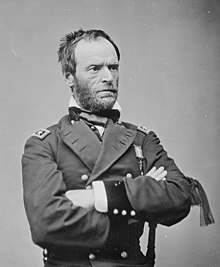
Civil War General William Tecumseh Sherman had a formula for dealing with domestic terrorists of his own time.

Writing to his commander, Ulysses S. Grant, about the best way to treat Confederate guerrillas, he advised:

Black-and-white photograph of Sherman in uniform with his arms folded in front of him

General Willilam Tecumseh Sherman

“They cannot be made to love us, but they may be made to fear us.  We cannot change the hearts of those people of the South.

“But we can make war so terrible that they will realize the fact that . . . they are still mortal and should exhaust all peaceful remedies before they fly to war.”

DEMOCRACY BECOMES A THUGOCRACY

In Bureaucracy, History, Politics, Social commentary on April 7, 2014 at 12:07 am

And the most glorious exploits do not always furnish us with the clearest discoveries of virtue or vice in men; sometimes a matter of less moment, an expression or a jest, informs us better of their characters and inclinations, than the most famous sieges, the greatest armaments, or the bloodiest battles whatsoever.

–Plutarch, Life of Alexander

In 1994, Newt Gingrich, then Speaker of the House of Representatives, shut down the Federal Government.

Officially, the reason was a budget impasse with President Bill Clinton.  Unofficially–and in reality–the reason was altogether different.

Clinton had forced him to sit in the back of Air Force One on a trip to Israel for the funeral of former prime minister Yitzhak Rabinl.

“This is petty,” Gingrich confessed to startled reporters. “I’m going to say up front it’s petty, But I think it’s human.

“When you land at Andrews [Air Force Base, in Washington, D.C.] and you’ve been on the plane for 25 hours and nobody has talked to you and they ask you to get off by the back ramp….

“You just wonder, where is their sense of manners, where is their sense of courtesy?”

Gingrich’s childish verbal tirade was a public relations disaster for the Republicans. “Cry Baby,” screamed the New York Daily News, next to a picture of Gingrich in a diaper.

When House Democrats brought a poster-sized image of the cartoon onto the floor, the Republican majority forced them to remove it.

But the damage was done, and Republicans paid a fearful price for the shutdown and Gingrich’s candor about the reason for it.

Fast forward 19 years later, and, once again, the public–and, most especially, federal employees–faced the hardships of another Republican-led government shutdown.

The official reason given by Republicans was: They wanted to save the country from the dangers of providing healthcare insurance to all Americans, not simply the wealthiest 1%.

To hear Republicans tell it, Obamacare–actually, the Affordable Care Act–would “destroy the medical system as we know it.”

The Act aims to:

  • Increase the quality and affordability of health insurance;
  • Lower the uninsured rate by expanding public and private insurance coverage;
  • Reduce the costs of healthcare for individuals and the government;
  • Forbid insurance companies the right to deny coverage for “pre-existing conditions”; and
  • Require employers with more than 50 employees to offer health insurance to their fulltime workers–or pay a large penalty.

Republicans also claimed that it would bankrupt the country–although the Congressional Budget Office stated that the ACA would lower future deficits and Medicare spending.

After passing the House and Senate, the ACA was signed into law by President Barack Obama on March 23, 2010.

On June 28, 2012, the United States Supreme Court–whose Chief Justice, John Roberts, is a Republican–upheld the constitutionality of the ACA,

Yet House Republicans continued searching for a way to stop the law from taking effect.  By September, 2013, they had voted 42 times to repeal “Obamacare.”

But their efforts achieved nothing, since the Democratic-led Senate refused to go along with such legislation.

Finally, unable to legally overturn the Act or to legislatively repeal it, House Republicans fell back on something much simpler.

Threats and fear.

Threats–of voting to shut down salaries paid to most Federal employees.

Most employees, because they themselves would continue to draw hefty salaries while they were denying them to FBI agents, air traffic controllers and members of the military, among others.

And fear–that would be generated throughout the Federal government, the United States and America’s international allies.

It was the my-way-or-else “negotiating” style of Adolf Hitler:  Do-as-I-say-or-I-will-destroy-you.

When Obama and Senate Democrats refused to knuckle under to yet another Republican extortion effort, House Republicans made good on their threat.

They shut down the government.

Republicans claimed that Obama and Senate Democrats were the ones who refused to see reason and negotiate.

By “negotiate,” they meant: Agree to Republican demands to de-fund “Obamacare.”

But then the unthinkable happened: A Republican gave away the real reason for the shutdown.

“We’re not going to be disrespected,” Rep. Marlin Stutzman (R-Ind.) told the Washington Examiner. “We have to get something out of this.  And I don’t know what that even is.”

Marlin Stutzman

With Newt Gingrich, the real reason for the government shutdown was his petty ego.

A subsidiary reason was to bully President Clinton into gutting Republican-despised Federal programs to help the poor and middle-class.

Nineteen years later, Republicans–as admitted by Martlin Stutzman–were out to get “respect.”

And they were out to get it the same way a thuggish gang leader gets it: By demanding: “Do what I say or I’ll kill you.”

At the end of World War II, Americans tried to cleanse West Germany of its former Nazi leaders and their supporters.

Such thuggishness will continue unless, somehow, Americans cleanse their own government of those who “negotiate” Nazi-Republican style.

SPHERES OF INFLUENCE: OURS AND THEIRS

In History, Military, Politics on March 25, 2014 at 1:04 am

It didn’t take much for American Right-wingers to start salivating–and celebrating.

All it took was for Russia to move troops into its neighboring territories of Ukraine and Crimea.

Ever since the collapse of the Soviet Union in 1991, the American Right has felt dejected.  Accusing Democrats of being “terrorist-lovers” just hasn’t been as profitable as accusing them of being “Communists.”

The torch had barely gone out at the much-ballyhooed Sochi Olympics when Russian President Vladimir Putin began menacing the Ukraine.

Even while the Olympics played out on television, Ukrainians had rioted in Kiev and evicted their corrupt, luxury-loving president, Victor Yanukovych.

And this, of course, didn’t sit well with his “sponsor”–Putin.

Yanukovych had rejected a pending European Union association agreement.  He had chosen instead to pursue a Russian loan bailout and closer ties with Russia.

And that had sat well with Putin.

Since the breakup of the Soviet Union in 1991, Putin had yearned for a reestablishment of the same.  He had called that breakup “the greatest geopolitical tragedy of the 20th century.”

So it was almost a certainty that, when his chosen puppet, Yanukovych, was sent packing, Putin would find some way to retaliate.

And since late February, he has done so, gradually moving Russian troops into Ukraine and its autonomous republic, Crimea.

By late March, it was clear that Russia had sufficient forces in both Ukraine and Crimea to wreak any amount of destruction Putin may wish to inflict.

And where there is activity by Russians, there are American Rightists eager–in Shakespeare’s words–to “cry havoc and let slip the dogs of war.”

Or at least to use such events to their own political advantage.

Right-wingers such as Mitt Romney, the former governor of Massachussetts who lost the 2012 Presidential election by a wide margin to Barack Obama.

“There’s no question but that the president’s naiveté with regards to Russia,” said Romney on March 23.

“And unfortunately, not having anticipated Russia’s intentions, the president wasn’t able to shape the kinds of events that may have been able to prevent the kinds of circumstances that you’re seeing in the Ukraine, as well as the things that you’re seeing in Syria.”

All of which overlooks a number of brutal political truths.

First, all great powers have spheres of interest–and jealously guard them.

For the United States, it’s Latin and Central America, as established by the Monroe Doctrine.

And just what is the Monroe Doctrine?

It’s a statement made by President James Monroe in his 1823 annual message to Congress, which warned European powers not to interfere in the affairs of the Western Hemisphere.

It has no other legitimacy than the willingness of the United States to use armed force to back it up.  When the United States no longer has the will or resources to enforce the Doctrine, it will cease to have meaning.

For the Soviet Union, its spheres of influence include the Ukraine.  Long known as “the breadbasket of Russia,” in 2011, it was the world’s third-largest grain exporter.

Russia will no more give up access to that breadbasket than the United States would part with the rich farming states of the Midwest.

Second, spheres of influence often prove disastrous to those smaller countries affected.

Throughout Latin and Central America, the United States remains highly unpopular for its brutal use of “gunboat diplomacy” during the 20th century.

Among those countries invaded or controlled by America: Mexico, Cuba, Guatemala, Nicaragua, Columbia, Panama and the Dominican Republic.

The resulting anger has led many Latin and Central Americans to support Communist Cuba, even though its political oppression and economic failure are universally apparent.

Similarly, the Union of Soviet Socialist Republics (U.S.S.R.) forced many nations–such as Poland, Hungary and Czechoslavakia–to submit to the will of Moscow.

The alternative?  The threat of Soviet invasion–as occurred in Hungary in 1956 and Czechoslavakia in 1968.

Third, even “great powers” are not all-powerful.

In 1949, after a long civil war, the forces of Mao Tse-tung defeated the Nationalist armies of Chaing Kai-Shek, who withdrew to Taiwan.

China had never been a territory of the United States.  Nor could the United States have prevented Mao from defeating the corrupt, ineptly-led Nationalist forces.

Even so, Republican Senators and Representatives such as Richard Nixon and Joseph McCarthy eagerly blamed President Harry S. Truman and the Democrats for “losing China.”

The fear of being accused of “losing” another country led Presidents John F. Kennedy, Lyndon B. Johnson and Richard M. Nixon to tragically commit the United States to “roll back” Communism in Cuba and Vietnam.

Now Republicans–who claim the United States can’t afford to provide healthcare for its poorest citizens–want to turn the national budget over to the Pentagon.

They want the United States to “intervene” in Syria–even though this civil war pits Al Qaeda and Hezbollah, two of America’s greatest enemies, against each other.

They want the United States to “intervene” in Ukraine–even though this would mean going to war with the only nuclear power capable of turning America into an atomic graveyard.

Before plunging into conflicts that don’t concern us and where there is absolutely nothing to “win,” Americans would do well to remember the above-stated lessons of history.  And to learn from them.

ENDING UNEMPLOYMENT: PART FOUR (END)

In Bureaucracy, Business, History, Law, Politics, Social commentary on March 13, 2014 at 12:05 am

An Employers Responsibility Act would simultaneously address a series of evils for which employers are directly responsible.  Among its remaining provisions:

(9) Employers refusing to hire would be required to pay an additional “crime tax.”

Sociologists and criminologists agree that “the best cure for crime is a job.” Thus, employers who refuse to hire contribute to a growing crime rate in this Nation. Such non-hiring employers would be required to pay an additional tax, which would be earmarked for agencies of the criminal justice system at State and Federal levels.

(10)  The seeking of “economic incentives” by companies in return for moving to or remaining in cities/states would be strictly forbidden.

Such “economic incentives” usually:

  1. allow employers to ignore existing laws protecting employees from unsafe working conditions;
  2. allow employers to ignore existing laws protecting the environment;
  3. allow employers to pay their employees the lowest acceptable wages, in return for the “privilege” of working at these companies; and/or
  4. allow employers to pay little or no business taxes, at the expense of communities who are required to make up for lost tax revenues.

 (11)   Employers who continue to make such overtures would be prosecuted for attempted bribery or extortion:

  1. Bribery, if they offered to move to a city/state in return for “economic incentives,” or
  2. Extortion, if they threatened to move their companies from a city/state if they did not receive such “economic incentives.”

This would protect employees against artificially-depressed wages and unsafe working conditions; protect the environment in which these employees live; and protect cities/states from being pitted against one another at the expense of their economic prosperity.

(12)   The U.S. Departments of Justice and Labor would regularly monitor the extent of employer compliance with the provisions of this Act.  

Among these measures: Sending  undercover  agents, posing as highly-qualified job-seekers, to apply at companies—and then vigorously prosecuting those employers who  blatantly refused to hire despite their proven economic ability to do so.

This would be comparable to the long-time and legally-validated practice of using undercover agents to determine compliance with fair-housing laws.

(13)   The Justice Department and/or the Labor Department would be required to maintain a publicly-accessible database on those companies that had been cited, sued and/or convicted for such offenses as

  • discrimination,
  • harassment,
  • health and/or safety violations or
  • violating immigration laws. 

Employers would be legally required to regularly provide such information to these agencies, so that it would remain accurate and up-to-date. 

Such information would arm job applicants with vital information about the employers they were approaching.  They could thus decide in advance if an employer is deserving of their skills and dedication.

As matters now stand, employers can legally demand to learn even the most private details of an applicant’s life without having to disclose even the most basic information about themselves and their history of treating employees.

(14)   CEOs whose companies employ illegal aliens would be held directly accountable for the actions of their subordinates.  Upon conviction, the CEO would be sentenced to a mandatory prison term of at least ten years.

This would prove a more effective remedy for controlling illegal immigration than stationing tens of thousands of soldiers on the U.S./ Mexican border. With CEOs forced to account for their subordinates’ actions, they would take drastic steps to ensure their companies complied with Federal immigration laws.

Without employers eager to hire illegal aliens at a fraction of the money paid to American workers, the invasions of illegal job-seekers would quickly come to an end.

(15)   A portion of employers’ existing Federal taxes would be set aside to create a national clearinghouse for placing unemployed but qualified job-seekers.

* * * * *

For thousands of years, otherwise highly intelligent men and women believed that kings ruled by divine right.  That kings held absolute power, levied extortionate taxes and sent countless millions of men off to war–all because God wanted it that way.

That lunacy was dealt a deadly blow in 1776 when American Revolutionaries threw off the despotic rule of King George III of England.

But today, millions of Americans remain imprisoned by an equally outrageous and dangerous theory: The Theory of the Divine Right of Employers.

America can no longer afford such a dangerous fallacy as the Theory of the Divine Right of Employers.

The solution lies in remembering that the powerful never voluntarily surrender their privileges.

Americans did not win their freedom from Great Britain–-and its enslaving doctrine of “the divine right of kings”-–by begging for their rights.

And Americans will not win their freedom from their corporate masters–-and the equally enslaving doctrine of “the divine right of employers”––by begging for the right to work and support themselves and their families.

And they will most certainly never win such freedom by supporting right-wing political candidates whose first and only allegiance is to the corporate interests who bankroll their campaigns.

Corporations can–and do–spend millions of dollars on TV ads, selling lies–lies such as the “skills gap,” and how if the wealthy are forced to pay their fair share of taxes, jobs will inevitably disappear.

But Americans can choose to reject those lies–and demand that employers behave like patriots instead of predators.

ENDING UNEMPLOYMENT: PART THREE (OF FOUR)

In Bureaucracy, Business, History, Law, Politics, Social commentary on March 12, 2014 at 12:02 am

An Employers Responsibility Act would simultaneously address the following evils for which employers are directly responsible:

  • The loss of jobs within the United States owing to companies’ moving their operations abroad—solely to pay substandard wages to their new employees.
  • The mass firings of employees which usually accompany corporate mergers or acquisitions.
  • The widespread victimization of part-time employees, who are not legally protected against such threats as racial discrimination, sexual harassment and unsafe working conditions.

  • The refusal of many employers to create better than menial, low-wage jobs.
  • The widespread employer practice of extorting “economic incentives” from cities or states in return for moving to or remaining in those areas. Such “incentives” usually absolve employers from complying with laws protecting the environment and/or workers’ rights.
  • The refusal of many employers to provide medical and pension benefits—nearly always in the case of part-time employees, and, increasingly, for full-time, permanent ones as well.
  • Rising crime rates, due to rising unemployment.

Among its provisions:

(1) American companies that close plants in the United States and open others abroad would be forbidden to sell products made in those foreign plants within the United States.

This would protect both American and foreign workers from employers seeking to profit at their expense. American workers would be ensured of continued employment. And foreign laborers would be protected against substandard wages and working conditions.

Companies found violating this provision would be subject to Federal criminal prosecution. Guilty verdicts would result in heavy fines and lengthy imprisonment for their owners and top managers.

(2) Large companies (those employing more than 100 persons) would be required to create entry-level training programs for new, future employees.

These would be modeled on programs now existing for public employees, such as firefighters, police officers and members of the armed services. Such programs would remove the employer excuse, “I’m sorry, but we can’t hire you because you’ve never had any experience in this line of work.” After all, the Air Force has never rejected an applicant because, “I’m sorry, but you’ve never flown a plane before.”

This Nation has greatly benefited from the humane and professional efforts of the men and women who have graduated from public-sector training programs. There is no reason for the private sector to shun programs that have succeeded so brilliantly for the public sector.

(3) Employers would receive tax credits for creating professional, well-paying, full-time jobs.

This would encourage the creation of better than the menial, dead-end, low-paying and often part-time jobs which exist in the service industry. Employers found using such tax credits for any other purpose would be prosecuted for tax fraud.

(4)  A company that acquired another—through a merger or buyout—would be forbidden to fire en masse the career employees of that acquired company.

This would be comparable to the protection existing for career civil service employees. Such a ban would prevent a return to the predatory “corporate raiding” practices of the 1980s, which left so much human and economic wreckage in their wake.

The wholesale firing of employees would trigger the prosecution of the company’s new owners. Employees could still be fired, but only for provable just cause, and only on a case-by-case basis.

(5)  Employers would be required to provide full medical and pension benefits for all employees, regardless of their full-time or part-time status.

Increasingly, employers are replacing full-time workers with part-time ones—solely to avoid paying medical and pension benefits. Requiring employers to act humanely and responsibly toward all their employees would encourage them to provide full-time positions—and hasten the death of this greed-based practice.

(6) Employers of part-time workers would be required to comply with all federal labor laws.

Under current law, part-time employees are not protected against such abuses as discrimination, sexual harassment and unsafe working conditions. Closing this loophole would immediately create two positive results:

  • Untold numbers of currently-exploited workers would be protected from the abuses of predatory employers; and
  • Even predatorily-inclined employers would be encouraged to offer permanent, fulltime jobs rather than only part-time ones—since a major incentive for offering part-time jobs would now be eliminated.

(7) Employers would be encouraged to hire to their widest possible limits, through a combination of financial incentives and legal sanctions. Among those incentives: Employers demonstrating a willingness to hire would receive substantial Federal tax credits, based on the number of new, permanent employees hired per year.

Employers claiming eligibility for such credits would be required to make their financial records available to Federal investigators. Employers found making false claims would be prosecuted for perjury and tax fraud, and face heavy fines and imprisonment if convicted.

(8) Among those sanctions: Employers refusing to hire could be required to prove, in court:

  • Their economic inability to hire further employees, and/or
  • The unfitness of the specific, rejected applicant.

Companies found guilty of unjustifiably refusing to hire would face the same penalties as now applying in cases of discrimination on the basis of age, race, sex and disability.

Employers would thus fund it easier to hire than to refuse to do so. Job-seekers would no longer be prevented from even being considered for employment because of arbitrary and interminable “hiring freezes.”

ENDING UNEMPLOYMENT: PART TWO (OF FOUR)

In Bureaucracy, Business, History, Law, Politics on March 11, 2014 at 12:06 am

Why do millions of willing-to-work Americans remain unemployed?

Or remain trapped in part-time, no-benefits jobs far below their levels of education and experience?

A major reason: The refusal of Congressional Republicans to create job opportunities for their fellow Americans.

U.S. Senator Bernie Sanders (I, Vermont) made just that argument to guest host Ezra Klein on the June 12, 2012 edition of “The Rachel Maddow Show.”

SANDERS: Everybody knows you have to invest in infrastructure. We can create millions of decent paying jobs in the long term and I speak as a former mayor, you obviously save money because you don’t have to do constant repairs as we’ve just seen.

The simple reason is I’m afraid that you have a Republican mindset that says, “Hmm, let`s see, we can repair the infrastructure, save money long time, create millions of jobs, bad idea. Barack Obama will look good.  And we’ve got to do everything that we can to make Barack Obama look bad.”

Another reason for America’s unemployment miseries: Many employers have designed “hiring” systems that simply don’t work.

So says Peter Cappelli, the George W. Taylor professor of management at the Wharton School at the University of Pennsylvania.  He is also the author of  Why Good People Can’t Get Jobs: The Skills Gap and What Companies Can Do About It.

Amazon.com: Why Good People Can’t Get Jobs: The Skills Gap and What Companies Can Do About It

Why Good People Can't Get Jobs: The Skills Gap and What Companies Can Do About It

Employers often whine that they can’t find the talent they need.  Today’s applicants, they claim, lack skills, education and even a willingness to work.

The truth is altogether different.  According to Cappelli, the fault lies with employers, not job-seekers:

  • Hiring managers create wildly inflated descriptions of the talents and skills needed for openings: “They ask for the moon.”
  • Computer technology eliminates many qualified people for consideration when their resumés don’t match the inflated qualifications demanded by employers.
  • Employers aren’t willing to pay for the education and skills they demand: “What they really want is someone young, cheap and experienced.”
  • Online applicants are often told to name a salary expectation.  Anyone who names a salary higher than what the company is willing to pay is automatically rejected.  There’s no chance to negotiate the matter.
  • About 10% of employers admit that the problem is that their desired candidates refuse to accept the positions at the wage level being offered.
  • Employers are not looking to hire entry-level applicants right out of school. They want experienced candidates who can contribute immediately with no training or start-up time.
  • Employers demand that a single employee perform the work of several highly skilled employees. One company wanted an employee to be an expert in (1) human resources, (2) marketing, (3) publishing, (4) project management, (5) accounting and (6) finance.
  • When employers can’t find the “perfect candidate” they leave positions open for months. But if they were willing to offer some training, they might easily hire someone who could quickly take on the job.
  • Companies have stopped hiring new college graduates and grooming them for management ranks. They no longer have their own training and development departments.  Without systems for developing people, companies must recruit outsiders.
  • Employers’ unrealistic expectations are fueled partly by their own arrogance.  With more than three jobless people for every opening, employers believe they should be able to find these “perfect people.”

According to Cappelli, the hiring system desperately needs serious reform:

  • Review job descriptions.  If they’re inflated, bring them down-to earth.
  • Don’t expect to get something for nothing–or next to it.  Offer competitive salaries.
  • Scrutinize the hiring process.  Make sure that the automated systems aren’t screening out qualified candidates simply because they don’t have all the brass buttons in a row.
  • Beef up the Human Resources section.

A 1996 cartoon by Ted Rall, the no-holds-barred cartoonist, entitled “Something for Nothing,” brilliantly sums up how most corporate “job creators” actually regard and treat their employees and applicants:

Cappelli worries that the complaints about a labor shortage caused by an unwilling, unskilled workforce will be repeated enough that they will be accepted as truth:

“It’s a loud story … that could become pernicious if it persists.  It does have a blame-the-victim feeling to it.  It makes people feel better. You don’t have to feel so bad about people suffering if you think they are choosing it somehow.”

But America can end this national disaster–and disgrace.

A policy based only on concessions–such as endless tax breaks for hugely profitable corporations–is a policy of appeasement.

And appeasement only whets the appetite of those appeased for even greater concessions.

It is past time to hold wealthy and powerful corporations accountable for their socially and financially irresponsible acts.

This solution can be summed up in three words: Employers Responsibility Act (ERA).

If passed by Congress and vigorously enforced by the U.S. Departments of Justice and Labor, an ERA would ensure full-time, permanent and productive employment for millions of capable, job-seeking Americans.

And it would achieve this without raising taxes or creating controversial government “make work” programs.

Such legislation would legally require employers to demonstrate as much initiative for hiring as job-seekers are now expected to show in searching for work.

ENDING UNEMPLOYMENT: PART ONE (OF FOUR)

In Bureaucracy, Business, History, Law, Politics, Social commentary on March 10, 2014 at 12:01 am

Americans now consider unemployment the country’s Number 1 problem.

The finding comes in a Gallup poll conducted February 6-9.

Twenty-three percent now consider unemployment the greatest challenge facing the nation, while only 16% said the same in January.

Only 63% of working-age Americans are now employed or seeking work–the lowest share of the population making up the labor force since 1978.

Among the proposals offered for creating jobs:

  • Steering more students into technical schools.
  • Improving efforts to guide students into fields where the jobs are.
  • Helping small busineses find foreign customers.
  • Welcoming more immigrants.
  • Creating a national jobs database.
  • Rewarding companies that hire the long-term unemployed.

Yet none of these proposed solutions addresses the single greatest reason for America’s continuing unemployment problem: The refusal of American employers to hire American job-seekers.

An article in the March, 2011 issue of Reader’s Digest gives the lie to the excuses so many employers use for refusing to hire.

Entitled “22 Secrets HR Won’t Tell You About Getting a Job,” it lays bare many of the reasons why America needs to legally force employers to demonstrate as much responsibility for hiring as job-seekers are expected to show toward searching for work.

Click here: 22 Secrets HR Won’t Tell You About Getting a Job | HT Staffing

Among the truths it reveals:

  1. Once you’re unemployed more than six months, you’re considered unemployable.
  2. It’s not what but who you know that counts.
  3. Try to avoid HR and seek out someone in the company you know. If you don’t know anyone, go straight to the hiring manager.
  4. Don’t assume that someone will read your cover letter. Many of them go straight into the garbage can.
  5. You will be judged on the basis of your email address–especially if it’s something like “Igetwasted@aol.com.”
  6. If you’re in your 50s or 60s, protect yourself against age discrimination by leaving your year of graduation off your resume.
  7. Many managers don’t want to hire people with children, and will go to illegal lengths to find out their parental status–like checking an applicant’s car for child safety seats.
  8. It’s harder to get a job if you’re fat. Hiring managers make quick judgments based on stereotypes.
  9. Many managers will assume you’re a loser if you give them a weak handshake.
  10. Encourage the interviewer to talk–especially about himself. Ego-driven interviewers love hearing the sound of their own voices and will assume you’re better-qualified than someone who doesn’t want to listen to them prattle.

Millions of Americans continue to blame President Barack Obama for the nation’s high unemployment rate. But no President can hope to turn unemployment around until employers are forced to start living up to their responsibilities.

And those responsibilities should encompass more than simply fattening their own pocketbooks and/or egos at the expense of their fellow Americans.  Such behavior used to be called treason.

It’s time to recognize that a country can be betrayed for other than political reasons.  It can be sold out for economic ones, to

Employers who enrich themselves by weakening their country—by throwing millions of qualified workers into the street and moving their plants to other countries—are traitors.

Employers who set up offshore accounts to claim their American companies are foreign-owned—and thus exempt from taxes—are traitors.

Employers who systematically violate Federal immigration laws–to hire illegal aliens instead of willing-to-work Americans–-are traitors.

In its June 8, 2011 cover-story on “What U.S. Economic Recovery?  Five Destructive Myths,” Time magazine warned that profit-seeking corporations can’t be relied on to ”make it all better.”

Click here: What U.S. Economic Recovery? Five Destructive Myths – TIME

Wrote Rana Foroohar, Time‘s assistant managing editor in charge of economics and business:

“There is a fundamental disconnect between the fortunes of American companies, which are doing quite well, and American workers, most of whom are earning a lower hourly wage now than they did during the recession.

“The thing is, companies make plenty of money; they just don’t spend it on workers here.

“There may be $2 trillion sitting on the balance sheets of American corporations globally, but firms show no signs of wanting to spend it in order to hire workers at home.”

In short:  Giving even greater tax breaks to mega-corporations–the standard Republican mantra–has not persuaded them to stop “outsourcing” jobs. Nor has it convinced them to start hiring Americans.

While embarrassingly overpaid CEOs squander corporate wealth on themselves, millions of Americans can’t afford medical care or must depend on charity to feed their families.

Yet there is also a disconnect between the truth of this situation and the willingness of Americans to face up to that truth.

The reason:

“The Republicans have pulled off a major (some would say cynical) miracle,” writes Foroohar.

They have convinced “the majority of Americans that the way to jump-start the economy is to slash taxes on the wealthy and on cash-hoarding corporations while cutting benefits for millions of Americans.

“It’s fun-house math that can’t work.  We’ll need both tax increases and sensible entitlement cuts to get back on track.”