In the 1981 police drama, “Prince of the City,” both cops and criminals use plenty of four-letter words.
But the word both groups consider the most obscene is spelled is spelled with three letters: R-a-t.
The movie is based on the true-life story of former NYPD detective Robert Leuci (“Danny Ciello” in the film, and played by Treat Williams). It’s based on the best-selling nonfiction book, Prince of the City, by Robert Daley, a former deputy commissioner with NYPD.
Leuci/Ciello volunteers to work undercover against massive corruption among lawyers, bail bondsmen and even his fellow narcotics agents.
Along the way, the movie gives viewers numerous insights into not only how real-world cops work but how they see the world–and their role in it.

Robert Leuci (“Danny Ciello” in “Prince of the City”)
In its first scenes, “Prince” shows members of the elite Special Investigating Unit (SIU) preparing for a major raid on an apartment of Columbian drug-dealers.
Ciello, sitting in a restaurant, gets a tip on the Columbians from one of his informants. He then phones it in to his fellow officers. Together, they raid the apartment, assault the dealers, and confiscate their drugs and money.
The film makes it clear that even an elite detective squad can’t operate effectively without informants. And in narcotics cases, these are either addicts willing to sell out their suppliers or other drug-dealers willing to sell out their competitors.
For the cops, the payoff is information that leads to arrests. In the case of the SIU, that means big, headline-grabbing arrests.

Drug raid
With their superiors happy, the stree-level detectives are largely unsupervised–which is how they like it. Because most of them are doing a brisk business shaking down drug-dealers for their cash.
For their informants, the payoffs come in several forms, including:
- Allowing addicts to continue using illegal drugs.
- Supplying addicts with drugs, such as heroin.
- Allowing drug-dealers to continue doing business.
- Supplying drug-dealers with information about upcoming police raids on their locations.
All of these activities are strictly against the law. But to the men charged with enforcing anti-narcotics laws, this is the price to be paid for effective policing.
But not all police informants are criminals. Many of them work in highly technical industries–such as phone companies.
A “connection” such as this is truly prized. With it, a detective can illegally eavesdrop on the conversations of those he’s targeting.
He doesn’t have to go through the hassles of getting a court-approved wiretap. Assuming he has enough evidence to convince a judge to grant such a wiretap.
A top priority for any cop–especially a narcotics cop–is protecting the identities of his informants.
At the very least, exposing such identities could lead to embarrassment, unemployment, arrest and imprisonment. At worst, it could lead to the murder of those informants by enraged criminals.
But there is another reason for protecting the identity of informants: The cop who amasses a roster of prized informants is seen as someone special within the police department, by colleagues and superiors alike.
He knows “something” they do not. And that “something” allows him to make a lot of arrests–which, in turn, reflects well on the police department.
If those arrests end in convictions, his status within the department is further enhanced.
But while a cop is always on the lookout for informants against potential targets, that doesn’t prevent him from generally holding such people in contempt.
“Rats,” “finks,” “stool pigeons,” “canaries,” “informers”–these are among the more printable terms (for most media) cops use to describe those who betray the trust of others.
Such terms are never used by cops when speaking to their informants.
For cops, the most feared- and -hated part of every police department is its Internal Affairs Division (IAD). This is the unit charged with investigating allegations of illegal behavior by police.
For most cops, IAD represents the devil incarnate. Any officer who would be willing to “lock up” a “brother officer” is considered a traitor to the police brotherhood.
Even if that “brother officer” is engaging in behavior that completely violates his sworn oath “to protect and serve.”
In “Prince of the City,” Danny Ciello gives voice to just these feelings.
He’s preparing to betray the trust of his fellow narcotics officers by exposing the massive corruption among them. Yet he fiercely rejects the idea that he is a “rat.”
“A rat is when they catch you and make you an informer,” he tells his wife. “This is my game.”
Ciello has volunteered to obtain evidence of corruption; he’s not under some prosecutor’s thumb. That, to him, makes him different from a “rat.”
Of course, once Ciello’s cover is blown and his fellow cops learn what he has done, they will forever brand him a “rat,” the worst sort of turncoat.
The movie ends with Ciello now teaching surveillance classes at the NYPD Academy. A student asks: “Are you the Detective Ciello?”
“I’m Detective Ciello.”
“I don’t think I have anything to learn from you.”
For viewers seeking to learn the workings–and mindsets–of real-world police agencies, “Prince of the City” has a great many lessons to teach.


ABC NEWS, ALEXANDRA, ASTROLOGY, CBS NEWS, CHICAGO SUN-TIMES, CHICAGO TRIBUNE, CNN, FACEBOOK, GERALD FORD, GRIGORI RASPUTIN, IRAQ WAR, JIMMY CARTER, JOAN QUIGLEY, JODIE FOSTER, JOHN HINCKLEY, MERV GRIFFIN, MIKHAIL GORBACHEV, NANCY REAGAN, NBC NEWS, NICHOLAS 11, Ronald Reagan, SOVIET UNION, STAR WARS, THE LOS ANGELES TIMES, THE NEW YORK TIMES, THE WALL STREET JOURNAL, THE WASHINGTON POST, TWITTER, USA TODAY
REAGAN’S RASPUTIN
In Bureaucracy, History, Politics, Social commentary on December 2, 2014 at 12:00 amThe Presidency of Ronald W. Reagan consumed eight years of American history: 1981 – 1989. But its greed-fueled legacies continue to haunt us.
On October 21, the woman responsible for one of those legacies–government by astrologer–passed away at age 87.
Yes, Joan Quigley is dead.
For those unfamiliar with that name: Quigley was the court astrologer to Ronald and Nancy Reagan.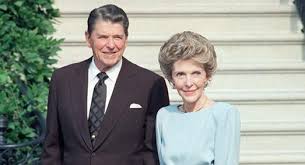
Ronald and Nancy Reagan in the White House
Nancy Reagan met Quigley on “The Merv Griffin Show” in 1973.
Quigley gave Nancy–and through her, Reagan himself–astrological advice during the latter’s campaign for the Republican Presidential nomination in 1976.
That effort failed to unseat President Gerald Ford–who was defeated that November by Jimmy Carter.
Four years later, in 1980, Reagan defeated Carter to become the 40th President of the United States.
On March 30, 1981, a mentally-disturbed loner named John W. Hinckley shot and critically wounded Reagan. Fixiated on actress Jodie Foster, he believed that by shooting the President he could gain her affection.
For Nancy, the assassination attempt proved a watershed.
Shortly after the shooting, Merv Griffin told her that Quigley had told him: If Nancy had called her on that fateful day, she–Quigley–could have warned that the President’s astrological charts had foretold a bad day.
From that moment on, Nancy made sure to regularly consult Quigley on virtually everything that she and the President intended to do.
When Reagan learned of Nancy’s consultations with Quigley, he warned her: Be careful, because it might look odd if it came out.
Click here: The President’s Astrologers – Joan Quigley, Nancy Reagan, Politicians and Their Families, Ronald Reagan : People.c
Many–if not most–of these calls from the White House to Quigley’s office in San Francisco were made on non-secure phone lines.
Joan Quigley
This meant that foreign powers–most notably the Soviet Union and Communist China–could have been privy to Reagan’s most secret intentions.
Nancy passed on Quigley’s suggestions as commands to Donald Regan, chief of the White House staff.
As a result, Regan kept a color-coded calendar on his desk to remember when the astrological signs were good for the President to speak, travel, or negotiate with foreign leaders.
Green ink highlighted “good” days; red ink “bad” days; yellow ink “iffy” days.
A list provided by Quigley to Nancy made the following recommendations–which Nancy, in turn, made into commands:
Late Dec thru March bad
Jan 16 – 23 very bad
Jan 20 nothing outside WH–possible attempt
Feb 20 – 26 be careful
March 7 – 14 bad period
March 10 – 14 no outside activity!
March 16 very bad
March 21 no
March 27 no
March 12 – 19 no trips exposure
March 19 – 25 no public exposure
April 3 careful
April 11 careful
April 17 careful
April 21 – 28 stay home
Donald Regan, no fan of Nancy’s, chafed under such restrictions: “Obviously, this list of dangerous or forbidden dates left very little lattitude for scheduling,” he later wrote.
Forced out of the White House in 1987 by Nancy, Regan struck back in a 1988 tell-all memoir: For the Record: From Wall Street to Washington.
In 1988, after her secret role in the Reagan White House was revealed, Quigley told the Associated Press that she was a “serious, scientific astrologer.”
The book revealed, for the first time, how Ronald Reagan had actually made his Presidential decisions.
All–including decisions to risk nuclear war with the Soviet Union–were based on a court astrologer’s horoscopes. Rationality and the best military intelligence available played a lesser, secondary role.
The last time major world leader to turn to the supernatural for advice had been Russian Czar Nicholas 11. His advisor had been Grigori Rasputin, a Siberian peasant whom Empress Alexandra believed was the only man who could save her hemophilic son–and heir to the throne.
In 1990, Quigley confirmed the allegations an autobiography, What Does Joan Say?: My Seven Years As White House Astrologer to Nancy and Ronald Reagan.
Click here: What Does Joan Say?: My Seven Years As White House Astrologer to Nancy and Ronald Reagan: Joan Quigley
The title came from the question that Ronald Reagan asked Nancy before making important decisions–including those that could risk the destruction of the United States.
Among the success Quigley took credit for:
Thirty-three years after he became President, Ronald Reagan remains the most popular figure among Republicans.
His name is constantly invoked by Right-wing candidates, while his deliberately-crafted myth is held up as the example of Presidential greatness.
A number of precedents of the Reagan administration–like government by astrologer–might lend themselves to easy abuse. Thus, voters should consider this carefully before elevating “another Reagan” to the Presidency.
Share this: