Posts Tagged ‘2012 PRESIDENTIAL RACE’
2012 PRESIDENTIAL RACE, 2016 PRESIDENTIAL RACE, ABC NEWS, ADULTERY, ALTERNET, AMERICABLOG, AP, ATHEISTS, BABY BOOMER RESISTANCE, BARACK OBAMA, BBC, BIBLE, BILL MAHER, BIRTH CONTROL, BLOOMBERG NEWS, BUZZFEED, CATHOLICS, CBS NEWS, CIVIL LIBERTIES, CNN, CROOKS AND LIARS, DAILY KOS, DONALD TRUMP, ELEANOR ROOSEVELT, FIVETHIRTYEIGHT, FRANKLIN GRAHAM, HARPER’S MAGAZINE, HOMOSEXUALITY, HOMOSEXUALS, HUFFINGTON POST, ISLAM, JERRY FALWELL JR., JESUS CHRIST, JEWS, LESBIANS, LIBERALS, MEDIA MATTERS, MIKE PENCE, MITT ROMNEY, MOTHER JONES, MOVEON, MSNBC, MUSLIMS, NBC NEWS, NEW REPUBLIC, NEWSDAY, NEWSWEEK, NEWT GINGRICH, NON-CHRISTIANS, NPR, PBS NEWSHOUR, POLITICO, POLITICUSUSA, RAW STORY, RELIGION, RELIGIOUS FREEDOM RESTORATION ACT, REPUBLICAN PARTY, REUTERS, RICHARD FEYNMAN, RICK SANTORUM, SALON, SAUDI ARABIA, SCIENCE, SEATTLE TIMES, SLATE, SLAVERY, SPANISH INQUISITION, STORMY DANIELS, SUPREME COURT, TALKING POINTS MEMO, TEA PARTY, THE ATLANTIC, THE CHICAGO SUN-TIMES, THE CHICAGO TRIBUNE, THE DAILY BEAST, THE DAILY BLOG, THE GUARDIAN, THE HILL, THE HUFFINGTON POST, THE LOS ANGELES TIMES, THE NATION, THE NEW REPUBLIC, THE NEW YORK TIMES, THE NEW YORKER, THE VILLAGE VOICE, THE WALL STREET JOURNAL, THE WASHINGTON POST, THEOLOGY, THINKPROGRESS, TIME, TOMAS DE TORQUEMADA, TRUTHDIG, TRUTHOUT, TWO POLITICAL JUNKIES, U.S. NEWS & WORLD REPORT, UPI, USA TODAY, WAR, WOMEN, WONKETTE, X
In Bureaucracy, History, Law, Law Enforcement, Military, Politics, RELIGION, Social commentary on February 25, 2026 at 12:10 am
Bernardo Gui was the chief inquisitor of the Dominican Order during the Medieval Inquisition (1184 – 1230s).
Gui closely studied the best methods for interrogating “heretics.” He set forth his findings in his most important and famous work, Practica Inquisitionis Heretice Pravitatis. or “Conduct of the Inquisition into Heretical Wickedness.”
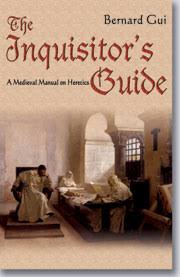
Here’s how such an interrogation might go:
When a heretic is first brought up for examination, he assumes a confident air, as though secure in his innocence. I ask him why he has been brought before me. He replies, smiling and courteous, “Sir, I would be glad to learn the cause from you.”
Interrogator: You are accused as a heretic, and that you believe and teach otherwise than Holy Church believes.
Accused Heretic: (Raising his eyes to heaven, with an air of the greatest faith) Lord, thou knowest that I am innocent of this, and that I never held any faith other than that of true Christianity.
Interrogator: You call your faith Christian, for you consider ours as false and heretical. But I ask whether you have ever believed as true another faith than that which the Roman Church holds to be true?
Accused Heretic: I believe the true faith which the Roman Church believes, and which you openly preach to us.
Interrogator: Perhaps you have some of your sect at Rome whom you call the Roman Church. I, when I preach, say many things, some of which are common to us both, as that God liveth, and you believe some of what I preach. Nevertheless you may be a heretic in not believing other matters which are to be believed.
Accused Heretic: I believe all things that a Christian should believe.
Interrogator: I know your tricks….But we waste time in this fencing. Say simply, Do you believe in one God the Father, and the Son, and the Holy Ghost?
Accused Heretic: I believe.
Interrogator: Do you believe in Christ born of the Virgin, suffered, risen, and ascended to heaven?
Accused Heretic: (Briskly) I believe.
Interrogator: Do you believe the bread and wine in the mass performed by the priests to be changed into the body and blood of Christ by divine virtue?
Accused Heretic: Ought I not to believe this?
Interrogator: I don’t ask if you ought to believe, but if you do believe.
Accused Heretic: I believe whatever you and other good doctors order me to believe.
Inquisitor: Those good doctors are the masters of your sect; if I accord with them you believe with me; if not, not.
Accused Heretic: I willingly believe with you if you teach what is good to me.
Inquisitor: You consider it good to you if I teach what your other masters teach. Say, then, do you believe the body of our Lord, Jesus Christ to be in the altar?
Accused Heretic: (Promptly) I believe that a body is there, and that all bodies are of our Lord.
Interrogator: I ask whether the body there is of the Lord who was born of the Virgin, hung on the cross, arose from the dead, ascended, etc.
Accused Heretic: And you, sir, do you not believe it?
Interrogator: I believe it wholly.
Accused Heretic: I believe likewise.
Men like Bernard Gui—and Franklin Graham—do not seek a golden future. They crave to return to a “golden” past—which includes the power Christians once held to forcibly impose their religious beliefs on others.
Among those slated for forced conversions by the Religious Right:
- Atheists
- Jews
- Women
- Homosexuals
- Lesbians
- Non-Christians
- Liberals
To gain absolute secular power over the lives of their fellow Americans, the Religious Right will support any candidate, no matter how morally despicable.
During the 2016 Presidential race, evangelicals—and their leaders such as Franklin Graham and Jerry Falwell, Jr.—fervently supported Donald Trump, despite his:
- Being twice divorced;
- Multiple affairs (including one with porn star Stormy Daniels);
- Documented ties to Russian oligarchs and Mafia chieftains;
- Being a 34-times convicted felon;
- Viciousness, greed, lying and egomania.
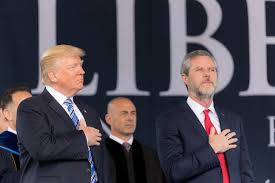
Donald Trump and Jerry Falwell, Jr., at Liberty University
And they continue to fervently support him.
They expect Trump to sponsor legislation that will—-by force of law—make their brand of Christianity supreme above all other religions.
Legislation such as The Religious Freedom Restoration Act.
This was signed into law on March 26, 2015, by Mike Pence, then Governor of Indiana.
This allows any individual or corporation to cite its religious beliefs as a defense when sued by a private party.
Officially, its intent is to prevent the government from forcing business owners to violate their religious beliefs.
Unofficially, its intent is to appease the hatred of gays and lesbians by the religious Right, a key constituency of the Republican party.
Thus, a bakery that doesn’t want to make a cake for a gay wedding or a restaurant that doesn’t want to serve lesbian patrons now has the legal right to refuse to do so.
And a hospital can legally turn away a gay patient if it wants to.
Islamic countries are notorious for their persecution of non-Muslims. Now the Religious Right wants to impose its own version of sharia law on American citizens.
2012 PRESIDENTIAL RACE, 2016 PRESIDENTIAL RACE, ABC NEWS, ADULTERY, ALTERNET, AMERICABLOG, AP, ATHEISTS, BABY BOOMER RESISTANCE, BARACK OBAMA, BBC, BIBLE, BILL MAHER, BIRTH CONTROL, BLOOMBERG NEWS, BUZZFEED, CATHOLICS, CBS NEWS, CIVIL LIBERTIES, CNN, CROOKS AND LIARS, DAILY KOS, DONALD TRUMP, ELEANOR ROOSEVELT, FIVETHIRTYEIGHT, FRANKLIN GRAHAM, HARPER’S MAGAZINE, HOMOSEXUALITY, HOMOSEXUALS, HUFFINGTON POST, ISLAM, JERRY FALWELL JR., JESUS CHRIST, JEWS, LESBIANS, LIBERALS, MEDIA MATTERS, MIKE PENCE, MITT ROMNEY, MOTHER JONES, MOVEON, MSNBC, MUSLIMS, NBC NEWS, NEW REPUBLIC, NEWSDAY, NEWSWEEK, NEWT GINGRICH, NON-CHRISTIANS, NPR, PBS NEWSHOUR, POLITICO, POLITICUSUSA, RAW STORY, RELIGION, RELIGIOUS FREEDOM RESTORATION ACT, REPUBLICAN PARTY, REUTERS, RICHARD FEYNMAN, RICK SANTORUM, SALON, SAUDI ARABIA, SCIENCE, SEATTLE TIMES, SLATE, SLAVERY, SPANISH INQUISITION, STORMY DANIELS, SUPREME COURT, TALKING POINTS MEMO, TEA PARTY, THE ATLANTIC, THE CHICAGO SUN-TIMES, THE CHICAGO TRIBUNE, THE DAILY BEAST, THE DAILY BLOG, THE GUARDIAN, THE HILL, THE HUFFINGTON POST, THE LOS ANGELES TIMES, THE NATION, THE NEW REPUBLIC, THE NEW YORK TIMES, THE NEW YORKER, THE VILLAGE VOICE, THE WALL STREET JOURNAL, THE WASHINGTON POST, THEOLOGY, THINKPROGRESS, TIME, TOMAS DE TORQUEMADA, TRUTHDIG, TRUTHOUT, TWO POLITICAL JUNKIES, U.S. NEWS & WORLD REPORT, UPI, USA TODAY, WAR, WOMEN, WONKETTE, X
In Bureaucracy, History, Law, Law Enforcement, Military, Politics, RELIGION, Social commentary on February 24, 2026 at 12:17 am
American Right-wing elements relentlessly claimed that President Barack Obama was waging “a war on religion.”
GOP candidates like Rick Santorum, Newt Gingrich and Mitt Romney intended to make this a major theme of their respective campaigns for President.
Obama supported a woman’s right to obtain
- Abortion—including in cases of rape and incest;
- Birth control; and
- Amniocentesis (pre-natal testing).
By promoting women’s rights, Obama was “waging a war against religion”-–according to American fascists.
Since access to such medical procedures as birth control and pre-natal testing has long been entirely legal, what’s all the fuss about?
It’s simple: The Right is not waging a “war for religious liberty.”
It’s waging a bitter struggle to establish a government that uses force or the threat of it to impose reactionary religious beliefs on religionists who do not share such religious beliefs.
And on atheists or agnostics, who share none at all.
These Rightists and their theocratic allies have less in common with Jesus Christ than with Tomas de Torquemada (1420 – 1498), the infamous Grand Inquisitor of the Spanish Inquisition.
Christ never ordered the torture or death of anyone. Torquemada—claiming to act in “defense” of the Roman Catholic Church—presided over the deaths of at least 2,000 “heretics.”

Tomas de Torquemada
Nor did these unfortunate victims of religious fanaticism meet their death quickly or painlessly. They died by perhaps the cruelest means possible—by being burned alive at the stake.
Torquemada didn’t hesitate to pronounce someone a heretic. He “knew” who such people were. They were Jews, Muslims, atheists. They were “lapsed Catholics” who, in his view, failed to show fervent devotion to the religious authorities—like himself—who tyrannically ruled their lives.
For such people, Torquemada believed, the only road to salvation lay in being “cleansed” of their sins. And nothing burns away impurities like fire.
But before the fire-stakes came the fire-mindset: The arrogance of “knowing” who qualified as “saved” and who would be forever “damned.”
Unless, of course, his or her soul had been “purified” by fire.
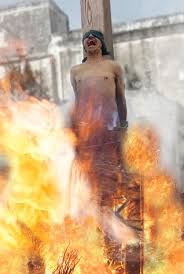
“Heretic” burned at the stake
Fundamentalist Christians can no longer sentence “heretics” to the stake.
But the mindset that ruled the Spanish Inquisition has not disappeared. It has been vividly displayed by no less a religious authority than Franklin Graham, son of America’s most famous preacher, Billy Graham.
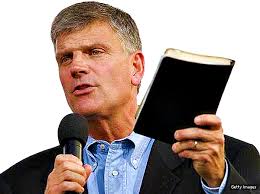
Franklin Graham
Appearing on the MSNBC program, “Morning Joe,” on February 21, 2012, Graham was asked if he thought that Barack Obama, Rick Santorum, Newt Gingrich and Mitt Romney qualified as Christians.
On Obama: “Islam sees him as a son of Islam… I can’t say categorically that [Obama is not Muslim] because Islam has gotten a free pass under Obama.”
On Santorum: “I think so. His values are so clear on moral issues. No question about it… I think he’s a man of faith.”
On Gingrich: “I think Newt Gingrich is a Christian, at least he told me he is.”
On Romney: “Most Christians would not recognize Mormons as part of the Christian faith. They believe in Jesus Christ. They have a lot of other things they believe in too, that we don’t accept, theologically.”
Thus, Graham pronounced as “saved” a notorious multiple-adulterer like Gingrich. He also gave a pass to Santorum, who married a woman who had lived “in sin” with an abortionist for six years.
But he unhesitatingly damned a longtime churchgoer like Obama or a devout Mormon like Romney (whose faith, most evangelicals like Graham believe, is actually a non-Christian cult).
Six years later, in 2018, Graham defended President Donald Trump, a notorious womanizer and multiple-adulterer, against charges that, in 2006, he had slept with porn star Stormy Daniels.
“I believe at 70 years of age the president is a much different person today than he was four years ago, five years ago, 10 years ago. He is not President Perfect.”
This differs greatly from his position on President Bill Clinton’s affair with Monica Lewinsky: “If he will lie to or mislead his wife and daughter, those with whom he is most intimate, what will prevent him from doing the same to the American public?”
It’s easy to imagine Graham transported to the French city of Toulouse in the 14th century. And to imagine him wearing the robes of Bernardo Gui, the chief inquisitor of the Dominican Order during the Medieval Inquisition (1184 – 1230s).
Gui closely studied the best methods for interrogating “heretics.” He set forth his findings in his most important and famous work, Practica Inquisitionis Heretice Pravitatis. or “Conduct of the Inquisition into Heretical Wickedness.”
In this, he offered a vivid example of how such an interrogation might go. The following is taken from that manual:
When a heretic is first brought up for examination, he assumes a confident air, as though secure in his innocence. I ask him why he has been brought before me. He replies, smiling and courteous, “Sir, I would be glad to learn the cause from you.”
This is not a dialogue between equals. The Inquisitor literally holds the power of life or agonizing death over the man or woman he is interrogating.
2012 PRESIDENTIAL RACE, 2016 PRESIDENTIAL RACE, ABC NEWS, ADULTERY, ALTERNET, AMERICABLOG, AP, ATHEISTS, BABY BOOMER RESISTANCE, BARACK OBAMA, BBC, BIBLE, BILL MAHER, BIRTH CONTROL, BLOOMBERG NEWS, BUZZFEED, CATHOLICS, CBS NEWS, CIVIL LIBERTIES, CNN, CROOKS AND LIARS, DAILY KOS, DONALD TRUMP, ELEANOR ROOSEVELT, FIVETHIRTYEIGHT, FRANKLIN GRAHAM, HARPER’S MAGAZINE, HOMOSEXUALITY, HOMOSEXUALS, HUFFINGTON POST, ISLAM, JERRY FALWELL JR., JESUS CHRIST, JEWS, LESBIANS, LIBERALS, MEDIA MATTERS, MIKE PENCE, MITT ROMNEY, MOTHER JONES, MOVEON, MSNBC, MUSLIMS, NBC NEWS, NEW REPUBLIC, NEWSDAY, NEWSWEEK, NEWT GINGRICH, NON-CHRISTIANS, NPR, PBS NEWSHOUR, POLITICO, POLITICUSUSA, RAW STORY, RELIGION, RELIGIOUS FREEDOM RESTORATION ACT, REPUBLICAN PARTY, REUTERS, RICHARD FEYNMAN, RICK SANTORUM, SALON, SAUDI ARABIA, SCIENCE, SEATTLE TIMES, SLATE, SLAVERY, SPANISH INQUISITION, STORMY DANIELS, SUPREME COURT, TALKING POINTS MEMO, TEA PARTY, THE ATLANTIC, THE CHICAGO SUN-TIMES, THE CHICAGO TRIBUNE, THE DAILY BEAST, THE DAILY BLOG, THE GUARDIAN, THE HILL, THE HUFFINGTON POST, THE LOS ANGELES TIMES, THE NATION, THE NEW REPUBLIC, THE NEW YORK TIMES, THE NEW YORKER, THE VILLAGE VOICE, THE WALL STREET JOURNAL, THE WASHINGTON POST, THEOLOGY, THINKPROGRESS, TIME, TOMAS DE TORQUEMADA, TRUTHDIG, TRUTHOUT, TWO POLITICAL JUNKIES, U.S. NEWS & WORLD REPORT, UPI, USA TODAY, WAR, WOMEN, WONKETTE, X
In Bureaucracy, History, Law, Law Enforcement, Military, Politics, RELIGION, Social commentary on February 23, 2026 at 12:05 am
Hamza Kashgari, a 23-year-old columnist in Saudi Arabia, decided to celebrate the birthday of the Islamic prophet Muhammed in a truly unique way.
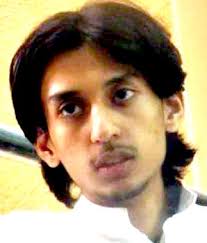
Hamza Kashgar
In early February, 2012, he posted on Twitter a series of mock conversations between himself and Muhammad:
“On your birthday, I will say that I have loved the rebel in you, that you’ve always been a source of inspiration to me, and that I do not like the halos of divinity around you. I shall not pray for you.”
“On your birthday, I find you wherever I turn. I will say that I have loved aspects of you, hated others, and could not understand many more.”
“On your birthday, I shall not bow to you. I shall not kiss your hand. Rather, I shall shake it as equals do, and smile at you as you smile at me. I shall speak to you as a friend, no more.”
“No Saudi women will go to hell, because it’s impossible to go there twice.”
The tweets sparked some 30,000 infuriated responses. Many Islamic clerics demanded that he face execution for blasphemy.
Kashgari posted an apology tweet: “I deleted my previous tweets because…I realized that they may have been offensive to the Prophet and I don’t want anyone to misunderstand.”
Soon afterward, Abdullah bin Abdulaziz Al Saud, then King of Saudi Arabia, ordered his arrest.
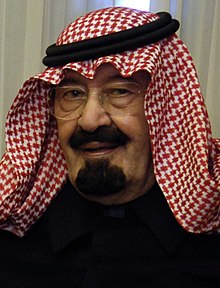
Saudi King King Abdullah
Kashgari fled to Malaysia, another majority-Muslim country. He was quickly arrested by police as he passed through Kuala Lumpur international airport. Three days later, he was deported to Saudi Arabia.
Human rights groups feared that he would be executed for blasphemy, a capitol offense in Saudi Arabia.
After nearly two years in prison, Kashgari was freed on October 29, 2013. Kashgari used Twitter to inform his supporters of his release.
Outrageous? By Western standards, absolutely.
Clearly there is no tolerance in Saudi Arabia for the freedoms of thought and expression that Americans take for granted.
Meanwhile, Right-wing American ayatollahs are working overtime to create just that sort of society—where theocratic despotism rules the most intimate aspects of our lives.
One of these is the former GOP Presidential candidate and U.S. Senator Rick Santorum. In early January, 2012, he said that states should have the right to outlaw birth control without the interference of the Supreme Court.
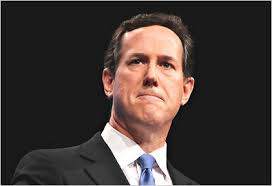
Rick Santorum
In an interview with ABC News, Santorum said he opposed the Supreme Court’s ruling that made birth control legal:
“The state has a right to do that [ban contraception]. I have never questioned that the state has a right to do that. It is not a Constitutional right. The state has the right to pass whatever statutes they have.
“That’s the thing I have said about the activism of the Supreme Court—they are creating rights, and it should be left up to the people to decide.”
In the landmark 1965 decision, Griswold v. Connecticut, the Court struck down a law that made it a crime to sell contraceptives to married couples. The Constitution, ruled the Justices, protected a right to privacy.
Two years later, in Eisenstadt v. Baird, the Court extended Griswold by striking down a law banning the sale of contraceptives to unmarried couples.
Santorum has left no doubt as to where he stands on contraception. On October 19, 2011, he said:
“One of the things I will talk about that no President has talked about before is I think the dangers of contraception in this country, the whole sexual libertine idea. Many in the Christian faith have said, ‘“Well, that’s okay. Contraception’s okay.’
“It’s not okay because it’s a license to do things in the sexual realm that is counter to how things are supposed to be. They’re supposed to be within marriage, they are supposed to be for purposes that are, yes, conjugal, but also…procreative.
“That’s the perfect way that a sexual union should happen. We take any part of that out, we diminish the act….And all of a sudden, it becomes deconstructed to the point where it’s simply pleasure.”
“How things are supposed to be”—according to Right-wing fanatics like Santorum and the evangelicals who support them.
Like the Saudi religious religious zealots who demand the death of a “blasphemer,” they demand that their religious views should govern everyone. That means Jews, Catholics, Islamics, atheists and agnostics.
American Christian fundamentalists and Islamic fundamentalists fervently agree on the following:
- Women should have fewer rights than men.
- Abortion should be illegal.
- There should be no separation between church and state.
- Religion should be taught in school.
- Religious doctrine trumps science.
- Government should be based on religious doctrine.
- Homosexuality should be outlawed.
The important difference—for Americans who value their freedom—is this:
The United States has a Supreme Court that can—and does—overturn laws that threaten civil liberties. Laws that GOP Presidential candidates clearly want to revive and force on those who don’t share their peculiar religious views.
Eleanor Roosevelt once said: “No one can make you feel inferior without your consent.”
The same holds true—in a democracy—for citizens who resist dictatorial politicians seeking power over them.
2008 PRESIDENTIAL RACE, 2012 PRESIDENTIAL RACE, 2016 PRESIDENTIAL RACE, 2024 PRESIDENTIAL ELECTION, ABC NEWS, ALTERNET, AMERICABLOG, ANCHOR BABY, AP, BABY BOOMER RESISTANCE, BARACK OBAMA, BBC, BC NEWS, BILL CLINTON, BIRTHERS, BLOOMBERG, BLUESKY, BUZZFEED, CBS NEWS, CITIZENSHIP, CNN, CROOKS AND LIARS, DAILY KOS, DONALD TRUMP, FACEBOOK, FIVETHIRTYEIGHT, HARPER’S MAGAZINE, HUFFINGTON POST, ILLEGAL ALIENS, immigration, MEDIA MATTERS, MOTHER JONES, MOVEON, MSNBC, NBC NEWS, NEW REPUBLIC, NEWSDAY, NEWSWEEK, NPR, PBS NEWSHOUR, PEW RESEARCH CENTER, POLITICO, POLITICUSUSA, RAFAEL "TED" CRUZ, RAW STORY, REPUBLICANS, REUTERS, SALON, SEATTLE TIMES, SLATE, TALKING POINTS MEMO, THE ATLANTIC, THE CHICAGO SUN-TIMES, THE CHICAGO TRIBUNE, THE DAILY BEAST, THE DAILY BLOG, THE GUARDIAN, THE HILL, THE HUFFINGTON POST, THE INTERCEPT, THE LOS ANGELES TIMES, THE NATION, THE NEW REPUBLIC, THE NEW YORK TIMES, THE NEW YORKER, THE U.S. SUPREME COURT, THE VILLAGE VOICE, THE WASHINGTON POST, THINKPROGRESS, TIME, TRUTHDIG, TRUTHOUT, TWO POLITICAL JUNKIES, U.S. NEWS & WORLD REPORT, UPI, USA TODAY, X
In Bureaucracy, History, Law, Politics, Social commentary on August 15, 2025 at 12:05 am
Donald Trump’s all-out war on immigrants isn’t new. It’s been building for 10 years.
During his 2016 campaign for President, he gave Republican voters a taste of the terror to come if he reached the Oval Office.
It started when Rafael “Ted” Cruz, the United States Senator from Texas, accused his rival, Trump, then a billionaire businessman, of having “New York values”:
“Everyone understands that the values in New York City are socially liberal, pro-abortion, pro-gay marriage and focus on money and the media.”
Among Right-wingers, “liberal,” “pro-abortion” and “pro-gay” are the ultimate in insults.
But Donald Trump was quick to respond with an explosive charge of his own: Rafael Cruz was not an American citizen—-and therefore not eligible to be President.
What made this accusation so effective was Cruz’ having been born outside the United States—in Calgary, Alberta, Canada, to an American mother and a Cuban father.
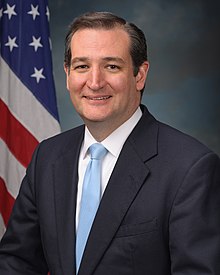
Rafael “Ted” Cruz
The U.S. Constitution specifically states that “No person except a natural born citizen…shall be eligible to the office of President.”
Cruz has argued that because his mother was an American, he became an American citizen at birth. But courts have never ruled on the issue of what constitutes a “natural-born” citizen.
And, at a campaign event in Nashua, New Hampshire, Trump smacked Cruz with an even more incendiary attack:
“Ted Cruz may not be a US citizen, right? But he’s an anchor baby. No, Ted Cruz is an anchor baby in Canada. But Canada doesn’t accept anchor babies.”
“Anchor baby” is a Politically Incorrect term for usually poor, nonwhite aliens entering the United States to have a child born on American soil, which grants automatic citizenship.
And if the child is a citizen, its parents stand an excellent chance of being allowed to stay.
Trump asserts that children born in the United States to illegal aliens are not American citizens, as they are today considered under the law.

Donald Trump
At first, the issue of Cruz’ eligibility seemed confined to Republican politicians and those likely to vote for them. But then others outside the Right began weighing in.
Mary McManamon, a Constitutional law professor at Widener University’s Delaware Law School, concluded in an Op-Ed for The Washington Post:
“Sen. Ted Cruz (R-Tex.) is not a natural-born citizen and therefore is not eligible to be president or vice president of the United States.”
How did this all start? With the ultimate target of Republican hatred—-Barack Obama.
Ever since Obama became a Presidential candidate in 2008, Republicans accused him of being ineligible to hold office.
Without a political scandal (such as Bill Clinton’s affair with Monica Lewinsky) to fasten on, the Republican party opted for slander: Obama was born in Kenya—not Honolulu, as his birth certificate clearly states—and thus was not an American citizen.
From this there could be only one conclusion: He would be an illegitimate President, and should be removed from office if elected.
And this smear campaign continued after he won the 2008 election. Right-wingers like Trump insisted that Obama “prove” his citizenship fitness to hold office.
During his first two years in office, Obama tried to ignore the charge.
But polls repeatedly showed that large segments of the country believed it. Thus was Adolf Hitler proved right: “The great masses of the people will more easily fall victim to a big lie than to a small one.”
Finally, even Obama’s closest advisers warned him: You must address this and put it to rest.
So, on April 27, 2011, the President released the long-form version of his Hawaii birth certificate.
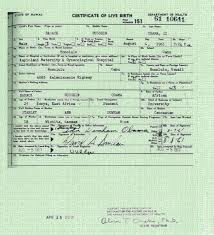
The long-form version of President Obama’s birth certificate
For the vast majority of Americans, this settled the issue. In 2012, to the fury of Republicans, Obama won a second, four-year term.
Fast forward to the 2016 Presidential race.
Donald Trump, seeking to destroy his foremost rival, lobbed the “anchor baby” charge against Rafael Cruz.
So long as Cruz stayed in the race, Trump continued to use the “birther” issue against him. And it continued to dog him, as it did Obama.
To most Americans, this conjures up the image of poor Mexicans flooding across the United States border to apply for welfare.
It’s a highly effective way to inflame the elderly, white voters who make up the base of the Republican party.
This has inflamed millions of Hispanic Americans—those who are here legally as well as those who are here illegally. And, in 2012, millions of Hispanics gave President Obama a second term.
Even so, the Pew Research Center shows that 48% of Latinos voted for Trump in 2024.
Majorities of Latino voters, regardless of age, said the economy was in bad shape. They wanted a bigger paycheck. And they were willing to re-elect a man who despised them in hopes of getting it.
The votes of elderly whites command the attention of Republican primary candidates. But Hispanics form one of the fastest-growing demographics, expected to increase from 19 percent to around 26 percent by 2060.
Trump’s slanders against the nationality of his political opponents and “mass deportations” campaign may come to haunt Republicans as they learn the truth of Shakespeare’s line: “The evil that men do lives after them.”
2012 PRESIDENTIAL RACE, ABC NEWS, ALTERNET, AMERICABLOG, AP, BABY BOOMER RESISTANCE, BARACK OBAMA, BBC, BLOOMBERG, BLUESKY, BUZZFEED, CBS NEWS, CNN, CROOKS AND LIARS, CUBAN MISSILE CRISIS, DAILY KOS, DEPARTMENT OF EDUCATION, DONALD J. TRUMP, FIDEL CASTRO, FIVETHIRTYEIGHT, HARPER’S MAGAZINE, HERMAN CAIN, HUFFINGTON POST, JOHN F. KENNEDY, LINDA MCMAHON, MEDIA MATTERS, MOTHER JONES, MOVEON, MSNBC, NBC NEWS, NEW REPUBLIC, NEWSDAY, NEWSWEEK, NIKITA KHRUSHCHEV, NPR, NUCLEAR TEST BAN TREATY, PBS NEWSHOUR, POLITICO, POLITICUSUSA, RAW STORY, REUTERS, RICK PERRY, SALON, Sarah Palin, SEATTLE TIMES, SLATE, SOVIET UNION, TALKING POINTS MEMO, THE ATLANTIC, THE CHICAGO SUN-TIMES, THE CHICAGO TRIBUNE, THE DAILY BEAST, THE DAILY BLOG, THE GUARDIAN, THE HILL, THE HUFFINGTON POST, THE INTERCEPT, THE LOS ANGELES TIMES, THE MISSILES OF OCTOBER, THE NATION, THE NEW REPUBLIC, THE NEW YORK TIMES, THE NEW YORKER, THE VILLAGE VOICE, THE WALL STREET JOURNAL, THE WASHINGTON POST, THINKPROGRESS, TIME, TRUTHDIG, TRUTHOUT, TWO POLITICAL JUNKIES, U.S. NEWS & WORLD REPORT, UPI, USA TODAY, VIETNAM WAR, X
In Bureaucracy, EDUCATION, History, Politics, Social commentary on March 28, 2025 at 12:06 am
Sixty-one years ago, on November 22, 1963, two bullets slammed into the neck and head of President John Fitzgerald Kennedy.
It has been said that he left his country with three great legacies:
- The Nuclear Test Ban Treaty;
- The Apollo moon landing; and
- The Vietnam war.
Of these, the following can be said with certainty:
- The Test Ban Treaty has prevented atmospheric testing—and poisoning—by almost all the world’s nuclear powers.
- After reaching the moon—in 1969—Americans quickly lost interest in space and have today largely abandoned plans for manned exploration. For America, as for JFK, beating the Russians to the moon was the end-goal.
- Under Presidents Lyndon Johnson and Richard Nixon, 58,000 Americans died in Vietnam; 153,303 were wounded; and billions of dollars were squandered in a hopeless effort to intervene in what was essentially a Vietnamese civil war.
But there was a fourth legacy—and perhaps the most important of all: The belief that mankind could overcome its greatest challenges through rationality and perseverance.
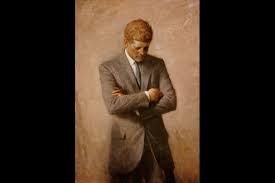
White House painting of JFK
At American University on June 10, 1963, Kennedy called upon his fellow Americans to re-examine the events and attitudes that had led to the Cold War. And he declared that the search for peace was by no means absurd:
“Our problems are man-made; therefore, they can be solved by man. And man can be as big as he wants. No problem of human destiny is beyond human beings.
“Man’s reason and spirit have often solved the seemingly unsolvable, and we believe they can do it again.”
Today, politicians from both parties cannot agree on solutions to even the most vital national problems.
For example: Republicans cannot agree with Democrats that the violent January 6, 2021 attempt by Donald Trump’s supporters to overturn the results of the 2020 Presidential election qualified as treason.
President Kennedy insisted on being well-informed. He speed-read several newspapers every morning and nourished personal relationships with the press—and not for altruistic reasons. These journalistic contacts gave Kennedy additional sources of information and perspectives on national and international issues.
During the 2012 Presidential campaign, Republican Presidential candidates celebrated their ignorance of both.
Former Godfather’s Pizza CEO Herman Cain famously said, “We need a leader, not a reader.” Thus he excused his ignorance for why President Barack Obama had intervened in Libya.
Former Texas Governor Rick Perry and Secretary of Energy showed similar pride in not knowing there are nine judges on the United States Supreme Court. He thought there were eight:
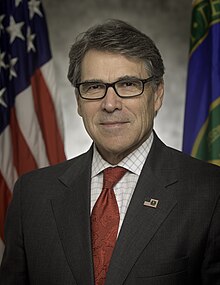
Rick Perry
“Here’s what I do know. That when I put an individual on the Supreme Court, just like I done in Texas, ah, we got nine Supreme Court justices in Texas, ah, they will be strict constructionists….”
In short, it’s the media’s fault if they ask you a question and your answer reveals your own ignorance, stupidity or criminality.
Sarah Palin rewrote history via “The Midnight Ride of Paul Revere”: “He warned the British that they weren’t going to be taking away our arms by ringing those bells and, um, making sure as he’s riding his horse through town to send those warning shots and bells that, uh, we were going to be secure and we were going to be free.”
In fact, Revere wasn’t warning the British about anything. Instead, he was warning his fellow Americans about an impending British attack—as his celebrated catchphrase “The British are coming!” made clear.
During the height of the Cuban Missile Crisis, Kennedy spoke with aides about a book he had just finished: Barbara Tuchman’s The Guns of August, about the events leading to World War 1.
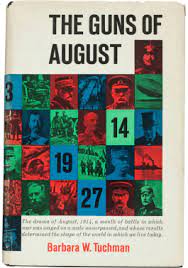
He said that the book’s most important revelation was how European leaders had blindly rushed into war, without thought to the possible consequences. Kennedy told his aides he did not intend to make the same mistake—that, having read his history, he was determined to learn from it.
Republicans attacked President Obama for his Harvard education and articulate use of language. Among their taunts: “Hitler also gave good speeches.”
And they resented his having earned most of his income as a writer of two books: Dreams From My Father and The Audacity of Hope. As if being a writer is somehow subversive.
When knowledge and literacy are attacked as “highfalutin’” arrogance, and ignorance and incoherence are embraced as sincerity, national decline lies just around the corner.
Many Americans believe that decline arrived with the 2016 election of Donald Trump. In fact, they believe it was Trump who announced it after winning the Nevada Republican primary: “We won with poorly educated. I love the poorly educated.”
And as if to underscore his contempt for education, newly-reelected President Trump intends to eliminate the Department of Education. His choice to temporarily head it: Linda McMahon, best known as the former president (1980 – 2009) of World Wrestling Entertainment.
Trump wants McMahon “to put herself out of a job.”
And McMahon agrees: “I want to invite all employees to join us in this historic final mission on behalf of all students.”
In retrospect, the funeral for President Kennedy marked the death of more than a rational and optimistic human being.
It marked the death of Americans’ pride in choosing reasoning and educated citizens for their leaders.
2012 PRESIDENTIAL RACE, 2016 PRESIDENTIAL RACE, ABC NEWS, ADULTERY, ALTERNET, AMERICABLOG, AP, ATHEISTS, BABY BOOMER RESISTANCE, BARACK OBAMA, BBC, BIBLE, BILL MAHER, BIRTH CONTROL, BLOOMBERG NEWS, BUZZFEED, CATHOLICS, CBS NEWS, CIVIL LIBERTIES, CNN, CROOKS AND LIARS, DAILY KOZ, DONALD TRUMP, ELEANOR ROOSEVELT, FACEBOOK, FIVETHIRTYEIGHT, FRANKLIN GRAHAM, HARPER’S MAGAZINE, HOMOSEXUALITY, HOMOSEXUALS, HUFFINGTON POST, ISLAM, JERRY FALWELL JR., JESUS CHRIST, JEWS, LESBIANS, LIBERALS, MEDIA MATTERS, MIKE PENCE, MITT ROMNEY, MOTHER JONES, MOVEON, MSNBC, MUSLIMS, NBC NEWS, NEW REPUBLIC, NEWSDAY, NEWSWEEK, NEWT GINGRICH, NON-CHRISTIANS, NPR, PBS NEWSHOUR, POLITICO, POLITICUSUSA, RAW STORY, RELIGION, RELIGIOUS FREEDOM RESTORATION ACT, REPUBLICAN PARTY, REUTERS, RICHARD FEYNMAN, RICK SANTORUM, SALON, SAUDI ARABIA, SCIENCE, SEATTLE TIMES, SLATE, SLAVERY, SPANISH INQUISITION, STORMY DANIELS, SUPREME COURT, TALKING POINTS MEMO, TEA PARTY, THE ATLANTIC, THE CHICAGO SUN-TIMES, THE CHICAGO TRIBUNE, THE DAILY BEAST, THE DAILY BLOG, THE GUARDIAN, THE HILL, THE HUFFINGTON POST, THE LOS ANGELES TIMES, THE NATION, THE NEW REPUBLIC, THE NEW YORK TIMES, THE NEW YORKER, THE VILLAGE VOICE, THE WALL STREET JOURNAL, THE WASHINGTON POST, THEOLOGY, THINKPROGRESS, TIME, TOMAS DE TORQUEMADA, TRUTHDIG, TRUTHOUT, TWO POLITICAL JUNKIES, U.S. NEWS & WORLD REPORT, UPI, USA TODAY, WAR, WOMEN, WONKETTE, X
In Bureaucracy, History, Law, Law Enforcement, Military, Politics, RELIGION, Social commentary on February 12, 2025 at 12:09 am
Bernardo Gui was the chief inquisitor of the Dominican Order during the Medieval Inquisition (1184 – 1230s).
Gui closely studied the best methods for interrogating “heretics.” He set forth his findings in his most important and famous work, Practica Inquisitionis Heretice Pravitatis: “Conduct of the Inquisition Into Heretical Wickedness.”
Here’s how such an interrogation might go:
When a heretic is first brought up for examination, he assumes a confident air, as though secure in his innocence. I ask him why he has been brought before me. He replies, smiling and courteous, “Sir, I would be glad to learn the cause from you.”
Interrogator: You are accused as a heretic, and that you believe and teach otherwise than Holy Church believes.
Accused Heretic: (Raising his eyes to heaven, with an air of the greatest faith) Lord, thou knowest that I am innocent of this, and that I never held any faith other than that of true Christianity.
Interrogator: You call your faith Christian, for you consider ours as false and heretical. But I ask whether you have ever believed as true another faith than that which the Roman Church holds to be true?
Accused Heretic: I believe the true faith which the Roman Church believes, and which you openly preach to us.
Interrogator: Perhaps you have some of your sect at Rome whom you call the Roman Church. I, when I preach, say many things, some of which are common to us both, as that God liveth, and you believe some of what I preach. Nevertheless you may be a heretic in not believing other matters which are to be believed.
Accused Heretic: I believe all things that a Christian should believe.
Interrogator: I know your tricks….But we waste time in this fencing. Say simply, Do you believe in one God the Father, and the Son, and the Holy Ghost?
Accused Heretic: I believe.
Interrogator: Do you believe in Christ born of the Virgin, suffered, risen, and ascended to heaven?
Accused Heretic: (Briskly) I believe.
Interrogator: Do you believe the bread and wine in the mass performed by the priests to be changed into the body and blood of Christ by divine virtue?
Accused Heretic: Ought I not to believe this?
Interrogator: I don’t ask if you ought to believe, but if you do believe.
Accused Heretic: I believe whatever you and other good doctors order me to believe.
Inquisitor: Those good doctors are the masters of your sect; if I accord with them you believe with me; if not, not.
Accused Heretic: I willingly believe with you if you teach what is good to me.
Inquisitor: You consider it good to you if I teach what your other masters teach. Say, then, do you believe the body of our Lord, Jesus Christ to be in the altar?
Accused Heretic: (Promptly) I believe that a body is there, and that all bodies are of our Lord.
Interrogator: I ask whether the body there is of the Lord who was born of the Virgin, hung on the cross, arose from the dead, ascended, etc.
Accused Heretic: And you, sir, do you not believe it?
Interrogator: I believe it wholly.
Accused Heretic: I believe likewise.
Men like Bernard Gui—and Franklin Graham—do not seek a golden future. They crave to return to a “golden” past—which includes the power Christians once held to forcibly impose their religious beliefs on others.
Among those slated for forced conversions by the Religious Right:
- Atheists
- Jews
- Women
- Homosexuals
- Lesbians
- Non-Christians
- Liberals
To gain absolute secular power over the lives of their fellow Americans, the Religious Right will support any candidate, no matter how morally despicable.
During the 2016 and 2020 Presidential races, evangelicals—and their leaders such as Franklin Graham and Jerry Falwell, Jr.—fervently supported Donald Trump, despite:
- His being twice divorced;
- His multiple affairs (including one with porn star Stormy Daniels);
- His documented ties to Russian oligarchs and Mafia chieftains;
- His viciousness, greed, lying and egomania.
Donald Trump and Jerry Falwell, Jr., at Liberty University
And they continue to fervently support him.
They expect Trump to sponsor legislation that will—-by force of law—make their brand of Christianity supreme above all other religions.
Legislation such as The Religious Freedom Restoration Act.
This was signed into law on March 26, 2015, by Mike Pence, then Governor of Indiana.
This allows any individual or corporation to cite its religious beliefs as a defense when sued by a private party.
Officially, its intent is to prevent the government from forcing business owners to violate their religious beliefs.
Unofficially, its intent is to appease the hatred of gays and lesbians by the religious Right, a key constituency of the Republican party.
Thus, a bakery that doesn’t want to make a cake for a gay wedding or a restaurant that doesn’t want to serve lesbian patrons now has the legal right to refuse to do so.
And a hospital can legally turn away a gay patient if it wants to.
Islamic countries are notorious for their persecution of non-Muslims. Now the Religious Right wants to impose its own version of sharia law on American citizens.
2012 PRESIDENTIAL RACE, 2016 PRESIDENTIAL RACE, ABC NEWS, ADULTERY, ALTERNET, AMERICABLOG, AP, ATHEISTS, BABY BOOMER RESISTANCE, BARACK OBAMA, BBC, BIBLE, BILL MAHER, BIRTH CONTROL, BLOOMBERG NEWS, BUZZFEED, CATHOLICS, CBS NEWS, CIVIL LIBERTIES, CNN, CROOKS AND LIARS, DAILY KOZ, DONALD TRUMP, ELEANOR ROOSEVELT, FACEBOOK, FIVETHIRTYEIGHT, FRANKLIN GRAHAM, HARPER’S MAGAZINE, HOMOSEXUALITY, HOMOSEXUALS, HUFFINGTON POST, ISLAM, JERRY FALWELL JR., JESUS CHRIST, JEWS, LESBIANS, LIBERALS, MEDIA MATTERS, MIKE PENCE, MITT ROMNEY, MOTHER JONES, MOVEON, MSNBC, MUSLIMS, NBC NEWS, NEW REPUBLIC, NEWSDAY, NEWSWEEK, NEWT GINGRICH, NON-CHRISTIANS, NPR, PBS NEWSHOUR, POLITICO, POLITICUSUSA, RAW STORY, RELIGION, RELIGIOUS FREEDOM RESTORATION ACT, REPUBLICAN PARTY, REUTERS, RICHARD FEYNMAN, RICK SANTORUM, SALON, SAUDI ARABIA, SCIENCE, SEATTLE TIMES, SLATE, SLAVERY, SPANISH INQUISITION, STORMY DANIELS, SUPREME COURT, TALKING POINTS MEMO, TEA PARTY, THE ATLANTIC, THE CHICAGO SUN-TIMES, THE CHICAGO TRIBUNE, THE DAILY BEAST, THE DAILY BLOG, THE GUARDIAN, THE HILL, THE HUFFINGTON POST, THE LOS ANGELES TIMES, THE NATION, THE NEW REPUBLIC, THE NEW YORK TIMES, THE NEW YORKER, THE VILLAGE VOICE, THE WALL STREET JOURNAL, THE WASHINGTON POST, THEOLOGY, THINKPROGRESS, TIME, TOMAS DE TORQUEMADA, TRUTHDIG, TRUTHOUT, TWO POLITICAL JUNKIES, U.S. NEWS & WORLD REPORT, UPI, USA TODAY, WAR, WOMEN, WONKETTE, X
In Bureaucracy, History, Law, Law Enforcement, Military, Politics, RELIGION, Social commentary on February 11, 2025 at 12:14 am
American Right-wing elements relentlessly claimed that President Barack Obama was waging “a war on religion.”
GOP candidates like Rick Santorum, Newt Gingrich and Mitt Romney intended to make this a major theme of their respective campaigns for President in 2012.
Obama supported a woman’s right
- to obtain abortion—including in cases of rape and incest;
- to obtain birth control; and
- to obtain amniocentesis (pre-natal testing).
By promoting women’s rights, Obama was “waging a war against religion”—according to American fundamentalists.
Since access to such medical procedures as birth control and pre-natal testing has long been entirely legal, what’s all the fuss about?
It’s simple: The Right is not waging a “war for religious liberty.”
It’s waging a bitter struggle to establish a government that uses force or the threat of it to impose reactionary religious beliefs on those who do not share such religious beliefs.
And on atheists or agnostics, who share none at all.
These Rightists and their theocratic allies have less in common with Jesus Christ than with Tomas de Torquemada (1420 – 1498), the infamous Grand Inquisitor of the Spanish Inquisition.
Christ never ordered the torture or death of anyone. Torquemada—claiming to act in “defense” of the Roman Catholic Church—presided over the deaths of at least 2,000 “heretics.”
Tomas de Torquemada
Nor did these unfortunate victims of religious fanaticism meet their death quickly or painlessly. They died by perhaps the cruelest means possible—by being burned alive at the stake.
Torquemada didn’t hesitate to pronounce someone a heretic. He “knew” who such people were: Jews, Muslims, atheists. They were “lapsed Catholics” who, in his view, failed to show fervent devotion to the religious authorities—like himself—who tyrannically ruled their lives.
For such people, Torquemada believed, the only road to salvation lay in being “cleansed” of their sins. And nothing burns away impurities like fire.
But before the fire-stakes came the fire-mindset: The arrogance of “knowing” who qualified as “saved” and who would be forever “damned.”
Unless, of course, his or her soul had been “purified” by fire.
“Heretic” burned at the stake
Fundamentalist Christians can no longer sentence “heretics” to the stake.
But the mindset that ruled the Spanish Inquisition has not disappeared. It has been vividly displayed by no less a religious authority than Franklin Graham, son of America’s most famous preacher, Billy Graham.
Franklin Graham
Appearing on the MSNBC program, “Morning Joe,” on February 21, 2012, Graham was asked if he thought that Barack Obama, Rick Santorum, Newt Gingrich and Mitt Romney qualified as Christians.
On Obama: “Islam sees him as a son of Islam… I can’t say categorically that [Obama is not Muslim] because Islam has gotten a free pass under Obama.”
On Santorum: “I think so. His values are so clear on moral issues. No question about it… I think he’s a man of faith.”
On Gingrich: “I think Newt Gingrich is a Christian, at least he told me he is.”
On Romney: “Most Christians would not recognize Mormons as part of the Christian faith. They believe in Jesus Christ. They have a lot of other things they believe in too, that we don’t accept, theologically.”
Thus, Graham pronounced as “saved” a notorious multiple-adulterer like Gingrich. He also gave a pass to Santorum, who married a woman who had lived “in sin” with an abortionist for six years.
But he unhesitatingly damned a longtime churchgoer like Obama or a devout Mormon like Romney (whose faith, most evangelicals like Graham believe, is actually a non-Christian cult).
Six years later, in 2018, Graham defended President Donald Trump, a notorious womanizer and multiple-adulterer, against charges that, in 2006, he had slept with porn star Stormy Daniels.
“I believe at 70 years of age the president is a much different person today than he was four years ago, five years ago, 10 years ago. He is not President Perfect.”
This differs greatly from his position on President Bill Clinton’s affair with Monica Lewinsky: “If he will lie to or mislead his wife and daughter, those with whom he is most intimate, what will prevent him from doing the same to the American public?”
It’s easy to imagine Graham transported to the French city of Toulouse in the 14th century. And to imagine him wearing the robes of Bernardo Gui, the chief inquisitor of the Dominican Order during the Medieval Inquisition (1184 – 1230s).
Gui closely studied the best methods for interrogating “heretics.” He set forth his findings in his most important and famous work, Practica Inquisitionis Heretice Pravitatis. or “Conduct of the Inquisition into Heretical Wickedness.”
In this, he offered a vivid example of how such an interrogation might go. The following is taken from that manual:
When a heretic is first brought up for examination, he assumes a confident air, as though secure in his innocence. I ask him why he has been brought before me. He replies, smiling and courteous, “Sir, I would be glad to learn the cause from you.”
This is not a dialogue between equals. The Inquisitor literally holds the power of life or agonizing death over the man or woman he is interrogating.
2012 PRESIDENTIAL RACE, 2016 PRESIDENTIAL RACE, ABC NEWS, ADULTERY, ALTERNET, AMERICABLOG, AP, ATHEISTS, BABY BOOMER RESISTANCE, BARACK OBAMA, BBC, BIBLE, BILL MAHER, BIRTH CONTROL, BLOOMBERG NEWS, BUZZFEED, CATHOLICS, CBS NEWS, CIVIL LIBERTIES, CNN, CROOKS AND LIARS, DAILY KOZ, DONALD TRUMP, ELEANOR ROOSEVELT, FACEBOOK, FIVETHIRTYEIGHT, FRANKLIN GRAHAM, HARPER’S MAGAZINE, HOMOSEXUALITY, HOMOSEXUALS, HUFFINGTON POST, ISLAM, JERRY FALWELL JR., JESUS CHRIST, JEWS, LESBIANS, LIBERALS, MEDIA MATTERS, MIKE PENCE, MITT ROMNEY, MOTHER JONES, MOVEON, MSNBC, MUSLIMS, NBC NEWS, NEW REPUBLIC, NEWSDAY, NEWSWEEK, NEWT GINGRICH, NON-CHRISTIANS, NPR, PBS NEWSHOUR, POLITICO, POLITICUSUSA, RAW STORY, RELIGION, RELIGIOUS FREEDOM RESTORATION ACT, REPUBLICAN PARTY, REUTERS, RICHARD FEYNMAN, RICK SANTORUM, SALON, SAUDI ARABIA, SCIENCE, SEATTLE TIMES, SLATE, SLAVERY, SPANISH INQUISITION, STORMY DANIELS, SUPREME COURT, TALKING POINTS MEMO, TEA PARTY, THE ATLANTIC, THE CHICAGO SUN-TIMES, THE CHICAGO TRIBUNE, THE DAILY BEAST, THE DAILY BLOG, THE GUARDIAN, THE HILL, THE HUFFINGTON POST, THE LOS ANGELES TIMES, THE NATION, THE NEW REPUBLIC, THE NEW YORK TIMES, THE NEW YORKER, THE VILLAGE VOICE, THE WALL STREET JOURNAL, THE WASHINGTON POST, THEOLOGY, THINKPROGRESS, TIME, TOMAS DE TORQUEMADA, TRUTHDIG, TRUTHOUT, TWO POLITICAL JUNKIES, U.S. NEWS & WORLD REPORT, UPI, USA TODAY, WAR, WOMEN, WONKETTE, X
In Bureaucracy, History, Law, Law Enforcement, Military, Politics, RELIGION, Social commentary on February 10, 2025 at 12:02 am
Hamza Kashgari, a 23-year-old columnist in Saudi Arabia, decided to celebrate the birthday of the Islamic prophet Muhammed in a truly unique way.
Hamza Kashgar
In early February, 2012, he posted on Twitter a series of mock conversations between himself and Muhammad:
“On your birthday, I will say that I have loved the rebel in you, that you’ve always been a source of inspiration to me, and that I do not like the halos of divinity around you. I shall not pray for you.
“On your birthday, I find you wherever I turn. I will say that I have loved aspects of you, hated others, and could not understand many more.
“On your birthday, I shall not bow to you. I shall not kiss your hand. Rather, I shall shake it as equals do, and smile at you as you smile at me. I shall speak to you as a friend, no more.
“No Saudi women will go to hell, because it’s impossible to go there twice.”
The tweets sparked some 30,000 infuriated responses. Many Islamic clerics demanded that he face execution for blasphemy.
Kashgari posted an apology tweet: “I deleted my previous tweets because…I realized that they may have been offensive to the Prophet and I don’t want anyone to misunderstand.”
Soon afterward, Abdullah bin Abdulaziz Al Saud, then King of Saudi Arabia, ordered his arrest.
Saudi King King Abdullah
Kashgari fled to Malaysia, another majority-Muslim country. He was quickly arrested by police as he passed through Kuala Lumpur international airport. Three days later, he was deported to Saudi Arabia.
Human rights groups feared that he would be executed for blasphemy, a capitol offense in Saudi Arabia.
After nearly two years in prison, Kashgari was freed on October 29, 2013. Kashgari used Twitter to inform his supporters of his release.
Outrageous? By Western standards, absolutely.
Clearly there is no tolerence in Saudi Arabia for the freedoms of thought and expression that Americans take for granted.
Meanwhile, Right-wing American ayatollahs are working overtime to create just that sort of society—where theocratic despotism rules the most intimate aspects of our lives.
One of these was the former GOP Presidential candidate and U.S. Senator Rick Santorum. In early January, 2012, he said that states should have the right to outlaw birth control without the interference of the Supreme Court.
Rick Santorum
In an interview with ABC News, Santorum said he opposed the Supreme Court’s ruling that made birth control legal:
“The state has a right to do that [ban contraception]. I have never questioned that the state has a right to do that. It is not a Constitutional right. The state has the right to pass whatever statutes they have.
“That’s the thing I have said about the activism of the Supreme Court—they are creating rights, and it should be left up to the people to decide.”
In the landmark 1965 decision, Griswold v. Connecticut, the Court struck down a law that made it a crime to sell contraceptives to married couples. The Constitution, ruled the Justices, protected a right to privacy.
Two years later, in Eisenstadt v. Baird, the Court extended Griswold by striking down a law banning the sale of contraceptives to unmarried couples.
Santorum has left no doubt as to where he stands on contraception. On October 19, 2011, he said:
“One of the things I will talk about that no President has talked about before is I think the dangers of contraception in this country, the whole sexual libertine idea. Many in the Christian faith have said, ‘“Well, that’s okay. Contraception’s okay.’
“It’s not okay because it’s a license to do things in the sexual realm that is counter to how things are supposed to be. They’re supposed to be within marriage, they are supposed to be for purposes that are, yes, conjugal, but also…procreative.
“That’s the perfect way that a sexual union should happen. We take any part of that out, we diminish the act….And all of a sudden, it becomes deconstructed to the point where it’s simply pleasure.”
“How things are supposed to be”—according to Right-wing fanatics like Santorum and the evangelicals who support them.
Like the Saudi religious zealots who demand the death of a “blasphemer,” they demand that their religious views should govern everyone. That means Jews, Catholics, Islamics, atheists and agnostics.
American Christian fundamentalists and Islamic fundamentalists fervently agree on the following:
- Women should have fewer rights than men.
- Abortion should be illegal.
- There should be no separation between church and state.
- Religion should be taught in school.
- Religious doctrine trumps science.
- Government should be based on religious doctrine.
- Homosexuality should be outlawed.
The important difference—for Americans who value their freedom—is this:
The United States has a Supreme Court that can—and does—overturn laws that threaten civil liberties. Laws that GOP Presidential candidates clearly want to revive and force on those who don’t share their peculiar religious views.
Eleanor Roosevelt once said: “No one can make you feel inferior without your consent.”
The same holds true—in a democracy—for candidates who seek dictatorial power over their fellow citizens. Don’t give them your consent.
2012 PRESIDENTIAL RACE, ALTERNET, AP, BARACK OBAMA, BAY OF PIGS, BBC, BERLIN WALL, BILL CLINTON, BRUCE GREENWOOD, BUZZFEED, CARLOS MARCELLO, CBS NEWS, CIA, CIVIL RIGHTS, CLIFF ROBERTSON, CNN, CUBAN MISSILE CRISIS, DAILY KOS, DAVID HALBERSTAM, DONALD J. TRUMP, FBI, FIDEL CASTRO, FRANK SINATRA, HERMAN CAIN, ICH BEN EIN BERLINNER SPEECH, INTERNET MOVIE DATABASE, J. EDGAR HOOVER, JAMES MARSDEN, JOHN F. KENNEDY, JOSEPH MCCARTHY, JOSEPH P. KENNEDY, LYNDON B. JOHNSON, MAFIA, MALCOM X, MARTIN LUTHER KING, MARTIN SHEEN, MOTHER JONES, MOVEON, MOVIES, NBC NEWS, NEWSWEEK, NEWT GINGRICH, NIKITA KHRUSHCHEV, NPR, NUCLEAR TEST BAN TREATY, POLITICO, PT-109, RAW STORY, REUTERS, RICK PERRY, ROBERT F. KENNEDY, ROBERT S. MCNAMARA, SALON, SAM GIANCANA, SANTOS TRAFFICANTE, Sarah Palin, SATURDAY NIGHT LIVE, SEATTLE TIMES, SLATE, SOVIET UNION, THE ATLANTIC, THE BEST AND THE BRIGHTEST, THE BUTLER, THE CHICAGO SUN-TIMES, THE CHICAGO TRIBUNE, THE DAILY BEAST, THE GUARDIAN, THE HILL, THE HUFFINGTON POST, THE LOS ANGELES TIMES, THE MISSILES OF OCTOBER, THE NEW YORK TIMES, THE RAT PACK, THE WALL STREET JOURNAL, THE WASHINGTON POST, THIRTEEN DAYS, TIME, TWILIGHT ZONE, TWITTER, U.S. NEWS & WORLD REPORT, UPI, USA TODAY, VIETNAM WAR, WILLIAM DEVANE, WILLIAM PETERSON
In Bureaucracy, Business, History, Law, Law Enforcement, Military, Politics, Social commentary on November 22, 2023 at 12:10 am
Sixty years ago, on November 22, 1963, two bullets slammed into the neck and head of President John Fitzgerald Kennedy.
It has been said that he left his country with three great legacies:
- The Nuclear Test Ban Treaty;
- The Apollo moon landing; and
- The Vietnam war.
Of these, the following can be said with certainty:
- The Test Ban Treaty has prevented atmospheric testing—and poisoning—by almost all the world’s nuclear powers.
- After reaching the moon—in 1969—Americans quickly lost interest in space and have today largely abandoned plans for manned exploration. For America, as for JFK, beating the Russians to the moon was the end-goal.
- Under Presidents Lyndon Johnson and Richard Nixon, 58,000 Americans died in Vietnam; 153,303 were wounded; and billions of dollars were squandered in a hopeless effort to intervene in what was essentially a Vietnamese civil war. From 1965 to 1972, the war angrily divided Americas as had no event since the Civil War.
But there was a fourth legacy—and perhaps the most important of all: The belief that mankind could overcome its greatest challenges through rationality and perseverance.
White House painting of JFK
At American University on June 10, 1963, Kennedy called upon his fellow Americans to re-examine the events and attitudes that had led to the Cold War. And he declared that the search for peace was by no means absurd:
“Our problems are man-made; therefore, they can be solved by man. And man can be as big as he wants. No problem of human destiny is beyond human beings.
“Man’s reason and spirit have often solved the seemingly unsolvable, and we believe they can do it again.”
Today, politicians from both parties cannot agree on solutions to even the most vital national problems.
For example: Republicans cannot agree with Democrats that the violent January 6, 2021 attempt by Donald Trump’s supporters to overturn the results of the 2020 Presidential election qualified as treason.
President Kennedy insisted on being well-informed. He speed-read several newspapers every morning and nourished personal relationships with the press—and not for altruistic reasons. These journalistic contacts gave Kennedy additional sources of information and perspectives on national and international issues.
During the 2012 Presidential campaign, Republican Presidential candidates celebrated their ignorance of both.
Former Godfather’s Pizza CEO Herman Cain famously said, “We need a leader, not a reader.” Thus he excused his ignorance for why President Barack Obama had intervened in Libya.
Former Texas Governor Rick Perry and Secretary of Energy showed similar pride in not knowing there are nine judges on the United States Supreme Court:
Rick Perry
“Well, obviously, I know there are nine Supreme Court judges. I don’t know how eight came out my mouth. But the, uh, the fact is, I can tell you—I don’t have memorized all of those Supreme Court judges. And, uh, ah—
“Here’s what I do know. That when I put an individual on the Supreme Court, just like I done in Texas, ah, we got nine Supreme Court justices in Texas, ah, they will be strict constructionists….”
In short, it’s the media’s fault if they ask you a question and your answer reveals your own ignorance, stupidity or criminality.
Sarah Palin rewrote history via “The Midnight Ride of Paul Revere”: “He warned the British that they weren’t going to be taking away our arms by ringing those bells and, um, making sure as he’s riding his horse through town to send those warning shots and bells that, uh, we were going to be secure and we were going to be free.”
In fact, Revere wasn’t warning the British about anything. Instead, he was warning his fellow Americans about an impending British attack—as his celebrated catchphrase “The British are coming!” made clear.
During the height of the Cuban Missile Crisis, Kennedy spoke with aides about a book he had just finished: Barbara Tuchman’s The Guns of August, about the events leading to World War 1.
He said that the book’s most important revelation was how European leaders had blindly rushed into war, without thought to the possible consequences. Kennedy told his aides he did not intend to make the same mistake—that, having read his history, he was determined to learn from it.
Republicans attacked President Obama for his Harvard education and articulate use of language. Among their taunts: “Hitler also gave good speeches.”
And they resented his having earned most of his income as a writer of two books: Dreams From My Father and The Audacity of Hope. As if being a writer is somehow subversive.
When knowledge and literacy are attacked as “highfalutin’” arrogance, and ignorance and incoherence are embraced as sincerity, national decline lies just around the corner.
Many Americans believe that decline arrived with the 2016 election of Donald Trump. In fact, they believe it was Trump who announced it after winning the Nevada Republican primary: “We won with poorly educated. I love the poorly educated.”
In retrospect, the funeral for President Kennedy marked the death of more than a rational and optimistic human being.
It marked the death of Americans’ pride in choosing reasoning and educated citizens for their leaders.
2012 PRESIDENTIAL RACE, ABC NEWS, ALTERNET, AP, BARACK OBAMA, BAY OF PIGS, BBC, BERLIN WALL, BILL CLINTON, BRUCE GREENWOOD, BUZZFEED, CARLOS MARCELLO, CBS NEWS, CIA, CIVIL RIGHTS, CLIFF ROBERTSON, CNN, CUBAN MISSILE CRISIS, DAILY KOS, DAVID HALBERSTAM, DONALD J. TRUMP, FBI, FIDEL CASTRO, FRANK SINATRA, HERMAN CAIN, ICH BEN EIN BERLINNER SPEECH, INTERNET MOVIE DATABASE, J. EDGAR HOOVER, JAMES MARSDEN, JOHN F. KENNEDY, JOSEPH MCCARTHY, JOSEPH P. KENNEDY, LYNDON B. JOHNSON, MAFIA, MALCOM X, MARTIN LUTHER KING, MARTIN SHEEN, MOTHER JONES, MOVEON, MOVIES, NBC NEWS, NEWSWEEK, NEWT GINGRICH, NIKITA KHRUSHCHEV, NPR, NUCLEAR TEST BAN TREATY, POLITICO, PT-109, RAW STORY, REUTERS, RICK PERRY, ROBERT F. KENNEDY, ROBERT S. MCNAMARA, SALON, SAM GIANCANA, SANTOS TRAFFICANTE, Sarah Palin, SATURDAY NIGHT LIVE, SEATTLE TIMES, SLATE, SOVIET UNION, THE ATLANTIC, THE BEST AND THE BRIGHTEST, THE BUTLER, THE CHICAGO SUN-TIMES, THE CHICAGO TRIBUNE, THE DAILY BEAST, THE GUARDIAN, THE HILL, THE HUFFINGTON POST, THE LOS ANGELES TIMES, THE MISSILES OF OCTOBER, THE NEW YORK TIMES, THE RAT PACK, THE WALL STREET JOURNAL, THE WASHINGTON POST, THIRTEEN DAYS, TIME, TWILIGHT ZONE, TWITTER, U.S. NEWS & WORLD REPORT, UPI, USA TODAY, VIETNAM WAR, WILLIAM DEVANE, WILLIAM PETERSON
In Bureaucracy, Business, History, Law, Law Enforcement, Military, Politics, Social commentary, Uncategorized on November 21, 2023 at 12:10 am
Elected to the House of Representatives in 1946, John F. Kennedy served six undistinguished years before being elected U.S. Senator from Massachusetts in 1952.
In 1956, his eloquence and political skill almost won him the Vice Presidential nomination at the Democratic National Convention. But the nominee, Adlai Stevenson, chose Tennessee Senator Estes Kefauver as his running mate–fortunately for Kennedy.
President Dwight D. Eisenhower, running for re-election, easily beat Stevenson.
Had Kennedy been on the ticket, his Catholicism would have been blamed for the loss. And this would have likely prevented his getting the Presidential nomination in 1960.
In 1957, his book, Profiles in Courage, won the Pulitzer Prize for history.
From 1957 to 1960, Kennedy laid plans for a successful Presidential race.
Many voters thought him too young and inexperienced for such high office. But he used his TV debates with then-Vice President Richard Nixon to calm such fears, transforming himself overnight into a serious contender.
Many Americans identified with Kennedy as they had with film stars. Compared with normally drab politicians, he seemed exciting and glamorous.
Since 1960, for millions of Americans, mere competence in a President isn’t enough; he should be charming and movie-star handsome as well.
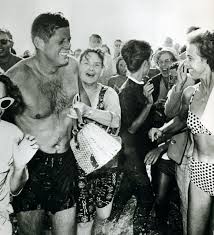
John F. Kennedy after taking a swim at Santa Monica Beach, 1960
But charismatic politicians face the danger of waning enthusiasm.
Many people were growing disillusioned with Kennedy before he died. He had raised hopes that couldn’t be met—especially among blacks.
And many whites bitterly opposed his support of integration, believing that Kennedy was “moving too fast” in changing race relations.
Still, for millions of Americans, Kennedy represented a time of change.
“Let’s get this country moving again” had been his campaign slogan in 1960. He had demanded an end to the non-existent “missile gap” between the United States and Soviet Union.
And he had said that America should create full employment and re-evaluate its policies toward Africa, Latin America and Asia.
His youth, the grace and beauty of his wife and the often-reported antics of his two young children—Caroline and John—added to the atmosphere that change was under way.
But Kennedy was not so committed to reform as many believed:
- As a Senator he had strongly opposed abolishing the Electoral College.
- He never protested the Red-baiting tactics of Senator Joseph R. McCarthy, a frequent dinner guest at the home of his father.
- As President, Kennedy never forgot that he had been elected by a margin of 112,881 votes. He often rationalized his refusal to tackle controversial issues by saying: “We’ll do it after I’m re-elected. So we’d better make damn sure I am re-elected.”
- He thought the United States should recognize “Red” China, but didn’t try to change American foreign policy toward that nation.
Nevertheless, many historians believe that. by vocally supporting civil rights and healthcare for the elderly, Kennedy laid the groundwork for Lyndon Johnson’s legislative victories.
Perhaps no aspect of Kennedy’s Presidency has received closer study than his assassination.
Hundreds of books and thousands of articles have hotly debated whether he was murdered by a lone “nut” or a deadly conspiracy of powerful men.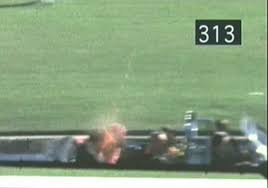

JFK’s assassination: The moment of impact
The murder has been the subject of two government investigations. The first, by the Warren Commission in 1964, concluded that an embittered ex-Marine and Marxist, Lee Harvey Oswald, acted alone in killing Kennedy.
Similarly, the Commission determined that nightclub owner Jack Ruby had killed Oswald on impulse, and not as the result of a conspiracy.
Millions of disbelieving Americans rejected the Warren Report—and named their own villains:
- The KGB;
- The Mob;
- Anti-Castro Cubans;
- Vice President Lyndon B. Johnson;
- Right-wing businessmen and/or military leaders;
- Fidel Castro.
Each of these groups or persons had reason to hate Kennedy:
- The KGB—for Kennedy’s humiliating the Soviet Union during the Cuban Missile Crisis.
- The Mob—in retaliation for the administration’s crackdown on organized crime.
- Anti-Castro Cubans—for JFK’s refusal to commit American military forces to overthrowing Castro at the Bay of Pigs invasion.
- Lyndon Johnson—lusting for power, he stood to gain the most from Kennedy’s elimination.
- Right-wing businessmen and/or military leaders—for believing that Kennedy had “sold out” the country to the Soviet Union.
- Fidel Castro—knowing the CIA was trying to assassinate or overthrow him, he had reason to respond in kind.
The second investigation, conducted in 1977-79 by the House Assassinations Committee, determined that Oswald and a second, unknown sniper had fired at Kennedy. (Oswald was deemed the assassin; the other man’s shot had missed.)
The Chief Counsel for the Committee, G. Robert Blakey, believed New Orleans Mafia boss Carlos Marcello organized the assassination, owing to his hatred of Robert Kennedy for his war on the crime syndicates.
Still, 60 years after JFK’s assassination, no court-admissible evidence has appeared to convict anyone other than Oswald for the murder.
The impact of Kennedy’s death on popular culture remains great. Millions saw him as a brilliant, courageous hero who had worked his way to the top.
But his sudden and violent end shocked those who believed there was always a happy ending.
If so gifted—and protected—a man as John F. Kennedy could be so suddenly and brutally destroyed, no one else could depend on a secure future.


 Bureaucracybuster's Blog
2012 PRESIDENTIAL RACE, 2016 PRESIDENTIAL RACE, ABC NEWS, ADULTERY, ALTERNET, AMERICABLOG, AP, ATHEISTS, BABY BOOMER RESISTANCE, BARACK OBAMA, BBC, BIBLE, BILL MAHER, BIRTH CONTROL, BLOOMBERG NEWS, BUZZFEED, CATHOLICS, CBS NEWS, CIVIL LIBERTIES, CNN, CROOKS AND LIARS, DAILY KOS, DONALD TRUMP, ELEANOR ROOSEVELT, FIVETHIRTYEIGHT, FRANKLIN GRAHAM, HARPER’S MAGAZINE, HOMOSEXUALITY, HOMOSEXUALS, HUFFINGTON POST, ISLAM, JERRY FALWELL JR., JESUS CHRIST, JEWS, LESBIANS, LIBERALS, MEDIA MATTERS, MIKE PENCE, MITT ROMNEY, MOTHER JONES, MOVEON, MSNBC, MUSLIMS, NBC NEWS, NEW REPUBLIC, NEWSDAY, NEWSWEEK, NEWT GINGRICH, NON-CHRISTIANS, NPR, PBS NEWSHOUR, POLITICO, POLITICUSUSA, RAW STORY, RELIGION, RELIGIOUS FREEDOM RESTORATION ACT, REPUBLICAN PARTY, REUTERS, RICHARD FEYNMAN, RICK SANTORUM, SALON, SAUDI ARABIA, SCIENCE, SEATTLE TIMES, SLATE, SLAVERY, SPANISH INQUISITION, STORMY DANIELS, SUPREME COURT, TALKING POINTS MEMO, TEA PARTY, THE ATLANTIC, THE CHICAGO SUN-TIMES, THE CHICAGO TRIBUNE, THE DAILY BEAST, THE DAILY BLOG, THE GUARDIAN, THE HILL, THE HUFFINGTON POST, THE LOS ANGELES TIMES, THE NATION, THE NEW REPUBLIC, THE NEW YORK TIMES, THE NEW YORKER, THE VILLAGE VOICE, THE WALL STREET JOURNAL, THE WASHINGTON POST, THEOLOGY, THINKPROGRESS, TIME, TOMAS DE TORQUEMADA, TRUTHDIG, TRUTHOUT, TWO POLITICAL JUNKIES, U.S. NEWS & WORLD REPORT, UPI, USA TODAY, WAR, WOMEN, WONKETTE, X
THE AMERICAN TALIBAN IS COMING FOR YOU: PART THREE (OF FOUR)
In Bureaucracy, History, Law, Law Enforcement, Military, Politics, RELIGION, Social commentary on February 25, 2026 at 12:10 amBernardo Gui was the chief inquisitor of the Dominican Order during the Medieval Inquisition (1184 – 1230s).
Gui closely studied the best methods for interrogating “heretics.” He set forth his findings in his most important and famous work, Practica Inquisitionis Heretice Pravitatis. or “Conduct of the Inquisition into Heretical Wickedness.”
Here’s how such an interrogation might go:
When a heretic is first brought up for examination, he assumes a confident air, as though secure in his innocence. I ask him why he has been brought before me. He replies, smiling and courteous, “Sir, I would be glad to learn the cause from you.”
Interrogator: You are accused as a heretic, and that you believe and teach otherwise than Holy Church believes.
Accused Heretic: (Raising his eyes to heaven, with an air of the greatest faith) Lord, thou knowest that I am innocent of this, and that I never held any faith other than that of true Christianity.
Interrogator: You call your faith Christian, for you consider ours as false and heretical. But I ask whether you have ever believed as true another faith than that which the Roman Church holds to be true?
Accused Heretic: I believe the true faith which the Roman Church believes, and which you openly preach to us.
Interrogator: Perhaps you have some of your sect at Rome whom you call the Roman Church. I, when I preach, say many things, some of which are common to us both, as that God liveth, and you believe some of what I preach. Nevertheless you may be a heretic in not believing other matters which are to be believed.
Accused Heretic: I believe all things that a Christian should believe.
Interrogator: I know your tricks….But we waste time in this fencing. Say simply, Do you believe in one God the Father, and the Son, and the Holy Ghost?
Accused Heretic: I believe.
Interrogator: Do you believe in Christ born of the Virgin, suffered, risen, and ascended to heaven?
Accused Heretic: (Briskly) I believe.
Interrogator: Do you believe the bread and wine in the mass performed by the priests to be changed into the body and blood of Christ by divine virtue?
Accused Heretic: Ought I not to believe this?
Interrogator: I don’t ask if you ought to believe, but if you do believe.
Accused Heretic: I believe whatever you and other good doctors order me to believe.
Inquisitor: Those good doctors are the masters of your sect; if I accord with them you believe with me; if not, not.
Accused Heretic: I willingly believe with you if you teach what is good to me.
Inquisitor: You consider it good to you if I teach what your other masters teach. Say, then, do you believe the body of our Lord, Jesus Christ to be in the altar?
Accused Heretic: (Promptly) I believe that a body is there, and that all bodies are of our Lord.
Interrogator: I ask whether the body there is of the Lord who was born of the Virgin, hung on the cross, arose from the dead, ascended, etc.
Accused Heretic: And you, sir, do you not believe it?
Interrogator: I believe it wholly.
Accused Heretic: I believe likewise.
Men like Bernard Gui—and Franklin Graham—do not seek a golden future. They crave to return to a “golden” past—which includes the power Christians once held to forcibly impose their religious beliefs on others.
Among those slated for forced conversions by the Religious Right:
To gain absolute secular power over the lives of their fellow Americans, the Religious Right will support any candidate, no matter how morally despicable.
During the 2016 Presidential race, evangelicals—and their leaders such as Franklin Graham and Jerry Falwell, Jr.—fervently supported Donald Trump, despite his:
Donald Trump and Jerry Falwell, Jr., at Liberty University
And they continue to fervently support him.
They expect Trump to sponsor legislation that will—-by force of law—make their brand of Christianity supreme above all other religions.
Legislation such as The Religious Freedom Restoration Act.
This was signed into law on March 26, 2015, by Mike Pence, then Governor of Indiana.
This allows any individual or corporation to cite its religious beliefs as a defense when sued by a private party.
Officially, its intent is to prevent the government from forcing business owners to violate their religious beliefs.
Unofficially, its intent is to appease the hatred of gays and lesbians by the religious Right, a key constituency of the Republican party.
Thus, a bakery that doesn’t want to make a cake for a gay wedding or a restaurant that doesn’t want to serve lesbian patrons now has the legal right to refuse to do so.
And a hospital can legally turn away a gay patient if it wants to.
Islamic countries are notorious for their persecution of non-Muslims. Now the Religious Right wants to impose its own version of sharia law on American citizens.
Share this: