The 1969 classic, Battle of Britain, features a scene that could today be filmed—live—at the next Conservative Political Action Conference (CPAC).
The movie dramatizes the heroic struggle of vastly outnumbered Royal Air Force (RAF) pilots against the numerically superior German air force, the Luftwaffe, during World War II.
Adolf Hitler, Germany’s Fuhrer, knew that to launch a successful naval invasion of Britain, he first must wipe the RAF from the skies.
The aerial combat began during the summer of 1940 and climaxed that September.

The turning point in the Battle—and the movie—occurs when a squadron of German bombers lost in bad weather at night accidentally bombs London. Attacks on London had been specifically forbidden by Hitler—for fear that they might bring the United States into the war.
An enraged British Prime Minister Winston Churchill orders a retaliatory attack on Berlin.
Since the eruption of World War II on September 1, 1939, with Hitler’s invasion of Poland. this is the first time that Berlin has been attacked. In fact, Hermann Goring, chief of the Luftwaffe, has said: “If ever a bomb falls on Berlin, you can call me Meyer.”
Now Hitler—who has ravaged Poland and France, and repeatedly bombed Britain, is enraged.
It’s perfectly OK for him to ravage other countries. It’s just not fair for his enemies to strike back.
He orders his faithful to assemble at the Reichstag, the German parliament, where he will outline his plans for knocking Britain out of the war.
Only then can he move on to his ultimate goal: Destroying his supposed ally, the Soviet Union.
In the movie, Battle of Britain, Hitler’s address is brilliantly—if briefly—staged, complete with rows of diehard Nazi women screaming their allegiance to their Fuhrer.
Hitler (played by Rolf Stiefel) starts his speech slowly, just as the real Hitler normally did to build to a shattering climax: “Last night, bombs were dropped on Berlin.
“So be it. Two can play at that game.
“If the RAF drops 200, 300, 400 bombs, then in one night we shall drop 2,000, 3,000, 4,000 bombs!”
His speech is interrupted by cheers from the Nazi faithful.

Adolf Hitler addressing the faithful in Battle of Britain
“If they attack our cities, then we will wipe theirs out!
“The hour will come when one of us must break. And it will never be National Socialist Germany!”
“NEVER! NEVER! NEVER!” screams the frenzied crowd.
“The English are filled with curiosity. They keep asking ‘Why doesn’t he come?’ Be patient. We are coming! We are coming!”
The Reichstag explodes with cheers of expected victory.
Britain went on to repulse the Luftwaffe’s attacks on its cities—and celebrate its victory at the end of the war.
That speech—in the movie and history—happened in 1940.
Fast forward to February 1, 2025: Newly re-elected President Donald Trump orders 25% tariffs on goods from Mexico and Canada, as well as 10% tariffs on imports from China.
- The White House says the tariffs will take effect on February 4.
On February 3, Trump announces a one-month pause of tariffs on Canada and Mexico after reaching agreements with each country that includes commitments to bolster border enforcement against drug smuggling.
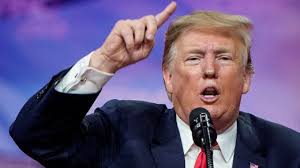
Donald Trump
On February 4, the United States imposes 10% tariffs on goods from China.
On February 27, Trump affirms plans to impose 25% tariffs on Canada and Mexico when the one-month delay expires on March 4.
- He also announces that an additional 10% tariff on goods from China will also take effect the same day.
On March 3, Trump reiterates plans to move forward with a fresh round of tariffs the following day.
On March 4, Trump’s tariffs on goods from Canada, Mexico and China take effect at 12:01 a.m. ET.
- China and Canada each respond with retaliatory tariffs, vowing additional measures.
- Mexican President Claudia Sheinbaum Pardo slamms Trump’s tariffs but says she will hold off on retaliatory measures until after a conversation with him.
On March 5, Trump orders a one-month delay of auto tariffs after a request from the “Big 3” U.S. automakers: Ford, General Motors and Stellantis, the parent company of Jeep and Chrysler.
On March 6, Trump temporarily pauses tariffs on Canadian and Mexican goods who are compliant with the United States-Mexico-Canada Agreement.
- Canadian Prime Minister Justin Trudeau says he will continue to impose tariffs on U.S. imports into the country until Trump cancels levies on Canadian products.

Justin Trudeau
Justin Trudeau – Prime Minister of Canada, CC BY 3.0 <https://creativecommons.org/licenses/by/3.0>, via Wikimedia Commons
On March 7, Trump says he is “strongly considering” large-scale banking sanctions, tariffs, and other sanctions on Russia until a cease fire and final settlement agreement is reached in the Russia-Ukraine war.
- He also suggests that Canada might soon be hit with reciprocal tariffs on its lumber and dairy products.
On March 11, Trump announces that he will impose an additional 25% tariff on all Canadian steel and aluminum imports effective March 12.
- He says the move was in retaliation to the Ontario government’s implementation of a 25% surcharge on all electricity exports to the U.S.
- Following this, Ontario says it will suspend its 25% surcharge on electricity exports to the U.S. after agreeing to discuss a renewed trade agreement.
 Bureaucracybuster's Blog
ABC NEWS, ADOLF HITLER, ALTERNET, AMERICABLOG, AP, BABY BOOMER RESISTANCE, BATTLE OF BRITAIN (MOVIE), BBC, BENITO MUSSOLINI, BLOOMBERG, BLUESKY, BUZZFEED, CANADA, CBS NEWS, CHINA, CLAUDIA SHEINBAUM PARDO, CNN, CROOKS AND LIARS, DAILY KOS, DEPARTMENT OF DEFENSE, DEPARTMENT OF HEALTH AND HUMAN SERVICES, DONALD TRUMP, EUROPEAN UNION, FIVETHIRTYEIGHT, GREECE, GREENLAND, HARPER’S MAGAZINE, HERMANN GORING, HUFFINGTON POST, JUSTIN TRUDEAU, LUFTWAFFE, MEDIA MATTERS, MEXICO, MOTHER JONES, MOVEON, MSNBC, NBC NEWS, NEW REPUBLIC, NEWSDAY, NEWSWEEK, NPR, PANAMA, PBS NEWSHOUR, PETE HEGSETH, POLITICO, POLITICUSUSA, RAW STORY, REUTERS, ROBERT F. KENNEDY JR., SALON, SEATTLE TIMES, SLATE, SOVIET UNION, TALKING POINTS MEMO, TARIFFS, THE ATLANTIC, THE CHICAGO SUN-TIMES, THE CHICAGO TRIBUNE, THE DAILY BEAST, THE DAILY BLOG, THE GUARDIAN, THE HILL, THE HUFFINGTON POST, THE INTERCEPT, THE LOS ANGELES TIMES, THE NATION, THE NEW REPUBLIC, THE NEW YORK TIMES, THE NEW YORKER, THE RISE ND FALL OF THE THIRD REICH (BOOK), THE VILLAGE VOICE, THE WASHINGTON POST, THINKPROGRESS, TIME, TRUTHDIG, TRUTHOUT, TWO POLITICAL JUNKIES, U.S. NEWS & WORLD REPORT, UPI, USA TODAY, WEHRMACHT, WILLIAM L. SHIRER, WINSTON CHURCHILL, WORLD WAR 11, X, YUGOSLAVIA
HITLER / TRUMP: “HOW DARE YOU ATTACK ME IN RETURN!”–PART ONE (OF TWO)
In Bureaucracy, Business, History, Military, Politics, Social commentary on March 26, 2025 at 12:05 amThe 1969 classic, Battle of Britain, features a scene that could today be filmed—live—at the next Conservative Political Action Conference (CPAC).
The movie dramatizes the heroic struggle of vastly outnumbered Royal Air Force (RAF) pilots against the numerically superior German air force, the Luftwaffe, during World War II.
Adolf Hitler, Germany’s Fuhrer, knew that to launch a successful naval invasion of Britain, he first must wipe the RAF from the skies.
The aerial combat began during the summer of 1940 and climaxed that September.
The turning point in the Battle—and the movie—occurs when a squadron of German bombers lost in bad weather at night accidentally bombs London. Attacks on London had been specifically forbidden by Hitler—for fear that they might bring the United States into the war.
An enraged British Prime Minister Winston Churchill orders a retaliatory attack on Berlin.
Since the eruption of World War II on September 1, 1939, with Hitler’s invasion of Poland. this is the first time that Berlin has been attacked. In fact, Hermann Goring, chief of the Luftwaffe, has said: “If ever a bomb falls on Berlin, you can call me Meyer.”
Now Hitler—who has ravaged Poland and France, and repeatedly bombed Britain, is enraged.
It’s perfectly OK for him to ravage other countries. It’s just not fair for his enemies to strike back.
He orders his faithful to assemble at the Reichstag, the German parliament, where he will outline his plans for knocking Britain out of the war.
Only then can he move on to his ultimate goal: Destroying his supposed ally, the Soviet Union.
In the movie, Battle of Britain, Hitler’s address is brilliantly—if briefly—staged, complete with rows of diehard Nazi women screaming their allegiance to their Fuhrer.
Hitler (played by Rolf Stiefel) starts his speech slowly, just as the real Hitler normally did to build to a shattering climax: “Last night, bombs were dropped on Berlin.
“So be it. Two can play at that game.
“If the RAF drops 200, 300, 400 bombs, then in one night we shall drop 2,000, 3,000, 4,000 bombs!”
His speech is interrupted by cheers from the Nazi faithful.
Adolf Hitler addressing the faithful in Battle of Britain
“If they attack our cities, then we will wipe theirs out!
“The hour will come when one of us must break. And it will never be National Socialist Germany!”
“NEVER! NEVER! NEVER!” screams the frenzied crowd.
“The English are filled with curiosity. They keep asking ‘Why doesn’t he come?’ Be patient. We are coming! We are coming!”
The Reichstag explodes with cheers of expected victory.
Britain went on to repulse the Luftwaffe’s attacks on its cities—and celebrate its victory at the end of the war.
That speech—in the movie and history—happened in 1940.
Fast forward to February 1, 2025: Newly re-elected President Donald Trump orders 25% tariffs on goods from Mexico and Canada, as well as 10% tariffs on imports from China.
On February 3, Trump announces a one-month pause of tariffs on Canada and Mexico after reaching agreements with each country that includes commitments to bolster border enforcement against drug smuggling.
Donald Trump
On February 4, the United States imposes 10% tariffs on goods from China.
On February 27, Trump affirms plans to impose 25% tariffs on Canada and Mexico when the one-month delay expires on March 4.
On March 3, Trump reiterates plans to move forward with a fresh round of tariffs the following day.
On March 4, Trump’s tariffs on goods from Canada, Mexico and China take effect at 12:01 a.m. ET.
On March 5, Trump orders a one-month delay of auto tariffs after a request from the “Big 3” U.S. automakers: Ford, General Motors and Stellantis, the parent company of Jeep and Chrysler.
On March 6, Trump temporarily pauses tariffs on Canadian and Mexican goods who are compliant with the United States-Mexico-Canada Agreement.
Justin Trudeau
Justin Trudeau – Prime Minister of Canada, CC BY 3.0 <https://creativecommons.org/licenses/by/3.0>, via Wikimedia Commons
On March 7, Trump says he is “strongly considering” large-scale banking sanctions, tariffs, and other sanctions on Russia until a cease fire and final settlement agreement is reached in the Russia-Ukraine war.
On March 11, Trump announces that he will impose an additional 25% tariff on all Canadian steel and aluminum imports effective March 12.
Share this:
Related