bureaucracybusters

Archive for May, 2013|Monthly archive page

CHENEY LIES DESCRIBE 9/11, NOT BENGHAZI: PART ONE (OF TWO)

In History, Politics on May 15, 2013 at 12:09 am

On May 13, 2013, former Vice President Dick Cheney appeared on the right-wing Sean Hannity radio show.

His mission: To assail President Barack Obama for a terrorist attack on the American embassy in Behghazi, Libya, on September 11, 2012.  Four Americans were killed, including Ambassador J. Christopher Stevens.  Ten others were injured.

Dick Cheney

Ironically, many of Cheney’s comments more accurately described the George W. Bush administration during the eight months before 9/11.  In that terrorist attack, 2,977 Americans died.

CHENEY ON BEHGHAZI:  I think it’s one of the worst incidences, frankly, that I can recall in my career….

That the State Department and White House ignored repeated warnings from the CIA about the threat. They ignored messages from their own people on the ground that they need more security.  They reduced what was already there. And the administration  either had no forces ready to respond to an attack, which should have been anticipated….

THE RECORD ON 9/11:   Among the most lethal offenses of the Bush Administration: The appointing of officials who refused to take seriously the threat posed by Al-Qaeda.

And this arrogance and indifference continued–-right up to September 11, 2001, when the World Trade Center and Pentagon became targets for destruction.

One of the few administration officials to take Al-Qaeda seriously was Richard Clarke, the chief counter-terrorism adviser on the National Security Council.

Clarke had been thus appointed in 1998 by President Bill Clinton. He continued to hold this role under President Bush, but with a major difference: The position was no longer given cabinet-level access.

This put him at a severe disadvantage when dealing with other, higher-ranking Bush officials–such as:

  • Vice President Dick Cheney
  • Secretary of Defense Donald Rumsfeld
  • Rumsfeld’s deputy, Paul Wolfowitz and
  • National Security Advisor Condoleeza Rice.

These turned out to be the very officials who refused to believe that Al-Qaeda posed a lethal threat to the United States.

During the entire first eight months of the Bush Presidency, Clarke was not permitted to brief President Bush a single time, despite mounting evidence of plans for a new al-Qaeda outrage.

And  during his first eight months in office before September 11, Bush was on vacation, according to the Washington Post, 42% of the time.

CHENEY ON BEHGHAZI:  …Well they tried to cover it up by constructing a false story, claiming there was confusion about what happened in the Benghazi compound. There was no confusion…..

The cover up included several officials up to and including President Obama and the cover up is still ongoing.

THE RECORD ON 9/11:  Eager to invade Iraq, President Bush searched for any excuse to convince America of the necessity of going to war. 

On the evening after the September 11 attacks, Bush took Clarke aside during a meeting in the White House Situation Room.

World Trade Center on September 11, 2001

“I want you, as soon as you can, to go back over everything, everything. See if Saddam [Hussein, the dictator of Iraq] did this. See if he’s linked in any way.”

Clarke was stunned: “But, Mr. President, Al Qaeda did this.”

“I know, I know,” said Bush. “But see if Saddam was involved. I want to know.”

On September 12, 2001, Bush attended a meeting of the National Security Council.

“Why shouldn’t we go against Iraq, not just Al Qaeda?” demanded Donald Rumsfeld, the Secretary of Defense.

Vice President Dick Cheney enthusiastically agreed.

Secretary of State Colin Powell then pointed out there was absolutely no evidence that Iraq had had anything to do with 9/11 or Al Qaeda. And he added: “The American people want us to do something about Al-Qaeda”–-not Iraq.

On November 21, 2001, only 10 weeks after 9/11, Bush told Rumsfeld: It’s time to turn to Iraq.

Bush and his war-hungry Cabinet officials knew that Americans demanded vengeance on Al Qaeda’s mastermind, Osama bin Laden, and not Iraqi dictator Saddam Hussein,. So they repeatedly fabricated “links” between the two:

  • Saddam had worked hand-in-glove with Bin Laden to plan 9/11.
  • Saddam was harboring and supporting Al Qaeda throughout Iraq.
  • Saddam, with help from Al Qaeda, was scheming to build a nuclear bomb.

Yet as early as September 22, 2001, Bush had received a classified President’s Daily Brief intelligence report, which stated that there was no evidence linking Saddam Hussein to 9/11.

The report added that there was scant credible evidence that Iraq had any significant collaborative ties with Al Qaeda.

Bush administration officials repeatedly claimed that Iraq possessed huge quantities of chemical and biological weapons, in violation of UN resolutions. And they further claimed that US intelligence agencies had determined:

  • the precise locations where these weapons were stored;
  • the identities of those involved in their production; and
  • the military orders issued by Saddam Hussein for their use in the event of war.

HOW TO BE A SMARTER EXECUTIVE: PART TWO (END)

In Bureaucracy, Business, History, Self-Help on May 14, 2013 at 12:00 am

I returned, and saw under the sun, that the race is not to the swift, nor the battle to the strong, neither yet bread to the wise, nor yet riches to men of understanding, nor yet favour to men of skill; but time and chance happeneth to them all.

–Ecclesiastes 9:11

It is one thing to gain executive power, and another to hold onto it.  It is altogether different to use it wisely and justly.

Many are the dictators who have ruled long, but not justly–such as Porfiro Diaz, whose 30-year regime was ended by the Mexican Revolution in 1911.

And many are those who wanted to rule justly but could not face up to the harsh realities of power.  One of these was Francisco Madero, who democratically succeeded Diaz–but was soon betrayed and executed by Victoriana Huerta, one of his own generals.

In Part One, I outlined a number of timeless suggestions by Niccolo Machiavelli, the Florentine statesman and patriot (1469-1527) for attaining and wisely employing executive power.

Niccolo Machiavelli

Many of this nation’s corporate executives and officials manning local, state and Federal agencies (including the Presidency) would do well to pay close attention to his advisories.  Among these:

  • EVALUATING A SUBORDINATE: For a prince to be able to know a minister there is this method which never fails.  When you see the minister think more of himself than of you, and in all his actions seek his own profit, such a man will never be a good minister, and you can never rely on him.  For whoever has in hand the state of another man must never think of himself but of the prince, and not mind anything but what relates to him.
  • TREATMENT OF SUBORDINATES: And on the other hand, the prince, in order to retain his fidelity, ought to think of his minister, honoring and enriching him, doing him kindnesses and conferring on him favors and responsible tasks, so that the great favors and riches bestowed on him cause him not to desire other honors and riches, and the offices he holds make him fearful of changes.  When princes and their ministers stand in this relation to each other, they can rely the one upon the other; when it is otherwise, the result is always injurious either for one or the other of them.
  • TAKING COUNSEL: There is no way of guarding oneself against flattery than by letting men understand that they will not offend you by speaking the truth.  But when every one can tell you the truth, you lose their respect.
  • A prudent prince must therefore take a third course, by choosing for his counsel wise men, and giving them alone full liberty to speak the truth to him, but only of those things that he asks and of nothing else.
  • MAKING DECISIONS: But he must be a great asker about everything and hear their opinions, and afterwards deliberate by himself in his own way, and in these counsels and with each of these men comport himself so that every one may see that the more freely he speaks, the more he will be acceptable.  Beyond these he should listen to no one, go about the matter deliberately, and be determined in his decisions.
  • SEEK THE TRUTH:  A prince, therefore, ought always to take counsel, but only when he wishes, not when others wish.  On the contrary, he ought to discourage absolutely attempts to advise him unless he asks it.  But he ought to be a great asker, and a patient hearer of the truth about those things of which he has inquired.  Indeed, if he finds that anyone has scruples in telling him the truth he should be angry.
  • UNWISE PRINCES CANNOT BE WISELY ADVISED: And since some think that a prince who gains the reputation of being prudent is so considered, not by his nature but by the good counselors he has about him, they are undoubtedly deceived.  It is an infallible rule that a prince who is not wise himself cannot be well advised, unless by chance he leaves himself entirely in the hands of one man who rules him in everything, and happens to be a very prudent man. In this case, he may doubtless be well governed, but it would not last long, for the governor would in a short time deprive him of the state.
  • FORTUNE: I think it may be true that fortune is the ruler of half our actions, but that she allows the other half or thereabouts to be governed by us.
  • I would compare her to an impetuous river that, when turbulent, inundates the plains, casts down trees and buildings, removes earth from this side and places it on the other; every one flees before it, and everything yields to its fury without being able to oppose it.
  • Still, when it is quiet, men can make provisions against it by dykes and banks, so that when it follows it will either go into a canal or its rush will not be so wild and dangerous.

GIVING ADVICE–SAFELY

In History, Politics, Self-Help on May 10, 2013 at 12:12 am

On the rare occasion when most people think of Niccolo Machiavelli, the image of the devil comes to mind.

Niccolo Machiavelli

In fact, “The Old Nick” became an English term used to describe Satan and slander Machiavelli at the same time.

The truth, however, is more complex. Machiavelli was a passionate Republican, who spent most of his adult life in the service of his beloved city-state, Florence.

The years he spent as a diplomat were tumultuous ones for Italy–with men like Pope Julius II and Caesare Borgia vying for power and plunging Italy into one bloodbath after another.

Machiavelli is best-known for his writing of The Prince, a pamphlet on the arts of gaining and holding power. Its admirers have included Benito Mussolini and Joseph Stalin.

But his longer and more thoughtful work is The Discourses, in which he offers advice on how to maintain liberty within a republic. Among its admirers were many of the men who framed the Constitution of the United States.

Also contrary to what most people believe about Machiavelli, he did not advocate evil for its own sake. Rather, he recognized that sometimes there is no perfect–or perfectly good–solution to a problem.

Sometimes it’s necessary to take stern–even brutal–action to stop an evil (such as a riot) before it becomes widespread.

His counsel remains as relevant today as it did during his lifetime (1469 – 1527)–especially for politicians.

But plenty of ordinary citizens can also benefit from the advice he has to offer–such as those who are asked to give advice to more powerful superiors.

Machiavelli warns there is danger in urging rulers to take a particular course of action:

“For men only judge of matters by the result, all the blame of failure is charged upon him who first advised it, while in case of success he receives commendations. But the reward never equals the punishment.”

This puts would-be counselors in a difficult position: “If they do not advise what seems to them for the good of the republic or the prince, regardless of the consequences to themselves, then they fail of their duty.

“And if they do advise it, then it is at the risk of their position and their lives, for all men are blind in this, that they judge of good or evil counsels only by the results.”

Thus, Machiavelli warns that an advisor should “take things moderately, and not to undertake to advocate any enterprise with too much zeal, but to give one’s advice calmly and modestly.”

The person who asked for the advice may follow it, or not, as of his own choice, and not because he was led or forced into it by the advisor.

Above all, the advisor must avoid the danger of urging a course of action that runs “contrary to the wishes of the many.”

“For the danger arises when your advice has caused the many to be contravened. In that case, when the result is unfortunate, they all concur in your destruction.”

Or, as President John F. Kennedy famously said after the disastrous invasion of Cuba at the Bay of Pigs in April, 1961: “Victory has a hundred fathers and defeat is an orphan.”

By “not advocating any enterprise with too much zeal,” the advisor gains two advantages:

“The first is, you avoid all danger.

“And the second consists in the great credit which you will have if, after having modestly advised a certain course, your counsel is rejected, and the adoption of a different course results unfortunately.”

Finally, the time to give advice is before a catastrophe occurs, not after. Machiavelli gives a vivid example of what can happen if this rule is ignored.

King Perseus of Macedon had gone to war with Paulus Aemilius–and suffered a humiliating defeat. Fleeing the battlefield with a handful of his men, he later bewailed the disaster that had overtaken him.

Suddenly, one of his lieutenants began to lecture Perseus on the many errors he had committed, which had led to his ruin.

“Traitor,” raged the king, turning upon him, “you have waited until now to tell me all this, when there is no longer any time to remedy it—” And Perseus slew him with his own hands.

Niccolo Machiavelli sums up the lesson as this:

“Thus was this man punished for having been silent when he should have spoken, and for having spoken when he should have been silent.”

Be careful that you don’t make the same mistake.

LEGALIZING BUMHOOD

In Bureaucracy, Law Enforcement, Politics, Social commentary on May 9, 2013 at 1:30 am

Look–out on the street!

It’s a bum!

It’s a drunk!

It’s Untermensch!

Yes, it’s Untermensch–strange visitor from an unknown pesthole who came to your neighborhood with powers and abilities far below those of normal men.

Untermensch!  Who can pollute the streets of mighty cities, hoist beer bottles in his bare hands.

And who, disguised as an innocent victim of oppression, fights a never-ending battle for booze, drugs and the welfare way.

* * * * *

The California Legislature is about to make the streets safe for DDMBs.

That’s Druggies, Drunks, Mentals and Bums, as they’re known to many of the first responders like paramedics and police who are forced to deal with them.  Or as “the homeless,” to those of Politically Correct persuasion.

Under a measure introduced in April by Assemblyman Tom Ammiano (D-San Francisco), DDMBs would be legally allowed to sleep and sit in public places and accost hard-working citizens for unearned money.

The bill has already passed the Assembly Judiciary Committee on a 7-2 vote, and must be approved by at least one other committee before possibly going to the full Assembly.

Titled “The Homeless Person’s Bill of Rights and Fairness Act,” it was first introduced on December 5, 2012.

The measure states that every person has a right to use public spaces, regardless of housing status.  Among the “rights” the bill would create:

  • “The right to rest in a public space in the same manner as any other person without being subject to criminal or civil sanctions, harassment, or arrest by law enforcement, public or private security personnel….because he or she is homeless, as long as that rest does not maliciously or substantially obstruct a passageway.”
  • “The right to decline admittance to a public or private shelter or any other accommodation, including social services programs, for any reason he or she sees fit, without being subject to criminal or civil sanctions, harassment, or arrest from law enforcement, public or private security personnel….”
  • “The right to assistance of counsel if a county chooses to initiate judicial proceedings under any law set forth in Section 53.5….  The county where the citation was issued shall pay the cost of providing counsel….”
  • Every local government and disadvantaged unincorporated community within the state shall have sufficient health and hygiene centers available 24 hours a day, seven days a week, for use by homeless people. These facilities may be part of the Neighborhood Health Center Program.”
  • “The right to solicit donations in public spaces in the same manner as any other person without being subject to criminal or civil sanctions, harassment, or arrest by law enforcement, public or private security personnel…because he or she is homeless.”
  • “‘Harassment’ [of DDMBs] means a knowing and willful course of conduct by law enforcement, public or private security personnel…directed at a specific person that a reasonable person would consider as seriously alarming, seriously annoying, seriously tormenting, or seriously terrorizing a person.”

“Seriously alarming” and “seriously annoying” behavior by DDMBs–such as aggressively demanding money from passersby–would, of course, not be considered illegal.

The bill further states: “Any person whose rights have been violated under this part may enforce those rights in a civil action.

“The court may award appropriate injunctive and declaratory relief, restitution for loss of property or personal effects and belongings, actual damages, compensatory damages, exemplary damages, statutory damages of one thousand dollars ($1,000) per violation, and reasonable attorneys’ fees and costs to a prevailing plaintiff.”

In short, the aim of the bill is three-fold:

  1. To arm society’s undesirables with the full force of law to demand unearned monies from those who actually work for a living;
  2. To arm them with the right to infest, with their psychotic behavior, drug/alcohol addiction and often disease-carrying belongings, any public place they choose; and
  3. To put hard-working, law-abiding “squares” on the defensive in protecting themselves against the filth, aggressiveness and risk of injury from such DDMBs.

In recent years, several cities concerned about the number of undesirables occupying public spaces have passed local ordinances banning them from sitting and lying on streets and sidewalks.

These include Los Angeles, Santa Cruz, Palo Alto and San Francisco (where it is unenforced).

Ammiano’s bill would forbid police from enforcing ordinances regarding resting in public places unless a county has provided sufficient support to such undesirables.

The legislation has as so far received little attention from the media.

For citizens who don’t want their children–and themselves–constantly menaced by

  • psychotic/alcoholic/drug-addicted bums,
  • their feeces/urine, and
  • their stolen shopping carts filled with filthy, bedbug-infested possessions

there is still time to make their views known.

“BRANDING” AND BARBARISM: PART THREE (END)

In Business, Law, Politics, Social commentary on May 8, 2013 at 12:00 am

When an American employer can compel his employees to be permanently tattooed with the company’s logo, it’s time for a complete overhaul of the nation’s employment laws.

That’s what happened to about 40 employees of Rapid Reality, a New York-based residentia real estate brokerage firm, in return for a 15% raise in commission.

Behind such an outrage lies the justifiable fear of employees that their employers will throw them into the street and pocket their earnings.

Click here: Rapid Realty discusses company tattoos – YouTube

And the terms of such an overhaul can best be summed up in a nationwide Employers Responsibility Act (ERA)

Eleven of its ts povisions have already been outlined.  Here are the remaining ones:

(12) The U.S. Departments of Justice and Labor would regularly monitor the extent of employer compliance with the provisions of this Act.

Among these measures: Sending undercover agents, posing as highly-qualified job-seekers, to apply at companies—and then vigorously prosecuting those employers who blatantly refused to hire despite their proven economic ability to do so.

This would be comparable to the long-time and legally-validated practice of using undercover agents to determine compliance with fair-housing laws.

(13) The Justice Department and/or the Labor Department would be required to maintain a publicly-accessible database on those companies that had been cited, sued/ and/or convicted for such offenses as discrimination, harassment, health and/or safety violations or employing illegal aliens. Employers would be legally required to regularly provide such information to these agencies, so that it would remain accurate and up-to-date.

Such information would arm job applicants with vital information about the employers they were approaching. They could thus decide in advance if an employer is deserving of their skills and dedication. As matters now stand, employers can legally demand to learn even the most private details of an applicant’s life without having to disclose even the most basic information about themselves and their history of treating employees.

(14) CEOs whose companies employ illegal aliens would be held directly accountable for the actions of their subordinates. Upon conviction, the CEO would be sentenced to a mandatory prison term of at least ten years.

This would prove a more effective remedy for controlling illegal immigration than stationing tens of thousands of soldiers on the U.S./ Mexican border. With CEOs forced to account for their subordinates’ actions, they would take drastic steps to ensure their companies complied with Federal immigration laws. Without employers eager to hire illegal aliens at a fraction of the money paid to American workers, the invasions of illegal job-seekers would quickly come to an end.

(15) A portion of employers’ existing Federal taxes would be set aside to create a national clearinghouse for placing unemployed but qualified job-seekers.

* * * * *

For thousands of years, otherwise highly intelligent men and women believed that kings ruled by divine right. That kings held absolute power, levied extortionate taxes and sent countless millions of men off to war–all because God wanted it that way.

That lunacy was dealt a deadly blow in 1776 when American Revolutionaries threw off the despotic rule of King George III of England.

But today, millions of Americans remain imprisoned by an equally outrageous and dangerous theory: The Theory of the Divine Right of Employers.

Summing up this employer-as-God attitude, Calvin Coolidge still speaks for the overwhelming majority of employers and their paid shills in government: “The man who builds a factory builds a temple, and the man who works there worships there.”

America can no longer afford such a dangerous fallacy as the Theory of the Divine Right of Employers.

The solution lies in remembering that the powerful never voluntarily surrender their privileges.

Americans did not win their freedom from Great Britain–-and its enslaving doctrine of “the divine right of kings”-–by begging for their rights.

And Americans will not win their freedom from their corporate masters–-and the equally enslaving doctrine of “the divine right of employers”–by begging for the right to work and support themselves and their families.

And they will most certainly never win such freedom by supporting right-wing political candidates whose first and only allegiance is to the corporate interests who bankroll their campaigns.

Corporations can–and do–spend millions of dollars on TV ads, selling lies–lies such as the “skills gap,” and how if the wealthy are forced to pay their fair share of taxes, jobs will inevitably disappear.

But Americans can choose to reject those lies–and demand that employers behave like patriots instead of predators.

In 1970, Congress finally recognized the threat organized crime posed to the Nation’s security and passed the Organized Crime Control Act.  This gave law enforcement agents and prosecutors powerful weapons against the Mafia and similar criminal groups.

It’s long past time that Congress be forced–by fed-up voters–to recognize the threat posed to the financial and social security of the Nation by the unchecked power of greed-fueled corporations.

It’s time for Congress to apply to corporate slave-masters the wisdom of Robert F. Kennedy’s warning about the Mafia: “If we do not on a national scale attack organized criminals with weapons and techniques as effective as their own, they will destroy us.”

“BRANDING” AND BARBARISM: PART TWO (OF THREE)

In Business, Law, Politics, Social commentary on May 7, 2013 at 12:05 am

When an American employer can compel his employees to be permanently tattooed with the company’s logo, it’s time for a complete overhaul of the nation’s employment laws.

That’s what happened to about 40 employees of Rapid Reality, a New York-based residentia real estate brokerage firm.  In return, they got a 15% raise in commission.

Although this story has received wide media attention, it has been treated as an oddity out of “Believe It or Not.”  No one has pointed out the sheer barbarity of such a proposal.  Or the sheer barbarity of a culture that bestows such unchecked power on corporate employers.

And the antidote to such employer barbarism: A nationwide Employers Responsibility Act (ERA).

Such legislation would legally require employers to demonstrate as much initiative for hiring as job-seekers are now expected to show in searching for work.

In Part One, I outlined its first two provisions.  Here are an additional nine:

(3) Employers would receive tax credits for creating professional, well-paying, full-time jobs.

This would encourage the creation of better than the menial, dead-end, low-paying and often part-time jobs which exist in the service industry. Employers found using such tax credits for any other purpose would be prosecuted for tax fraud.

(4) A company that acquired another—through a merger or buyout—would be forbidden to fire en masse the career employees of that acquired company.

This would be comparable to the protection existing for career civil service employees. Such a ban would prevent a return to the predatory “corporate raiding” practices of the 1980s, which left so much human and economic wreckage in their wake.

The wholesale firing of employees would trigger the prosecution of the company’s new owners. Employees could still be fired, but only for provable just cause, and only on a case-by-case basis.

(5) Employers would be required to provide full medical and pension benefits for all employees, regardless of their full-time or part-time status.

Increasingly, employers are replacing full-time workers with part-time ones—solely to avoid paying medical and pension benefits. Requiring employers to act humanely and responsibly toward all their employees would encourage them to provide full-time positions—and hasten the death of this greed-based practice.2-28-96

(6) Employers of part-time workers would be required to comply with all federal labor laws.

Under current law, part-time employees are not protected against such abuses as discrimination, sexual harassment and unsafe working conditions. Closing this loophole would immediately create two positive results:

  • Untold numbers of currently-exploited workers would be protected from the abuses of predatory employers; and
  • Even predatorily-inclined employers would be encouraged to offer permanent, fulltime jobs rather than only part-time ones—since a major incentive for offering part-time jobs would now be eliminated.

(7) Employers would be encouraged to hire to their widest possible limits, through a combination of financial incentives and legal sanctions. Among those incentives: Employers demonstrating a willingness to hire would receive substantial Federal tax credits, based on the number of new, permanent employees hired per year.

Employers claiming eligibility for such credits would be required to make their financial records available to Federal investigators. Employers found making false claims would be prosecuted for perjury and tax fraud, and face heavy fines and imprisonment if convicted.

(8) Among those sanctions: Employers refusing to hire could be required to prove, in court:

  • Their economic inability to hire further employees, and/or
  • The unfitness of the specific, rejected applicant.

Companies found guilty of unjustifiably refusing to hire would face the same penalties as now applying in cases of discrimination on the basis of age, race, sex and disability.

Employers would thus fund it easier to hire than to refuse to do so.  Job-seekers would no longer be prevented from even being considered for employment because of arbitrary and interminable “hiring freezes.”

(9) Employers refusing to hire would be required to pay an additional “crime tax.”

Sociologists and criminologists agree that “the best cure for crime is a job.” Thus, employers who refuse to hire contribute to a growing crime rate in this Nation. Such non-hiring employers would be required to pay an additional tax, which would be earmarked for agencies of the criminal justice system at State and Federal levels.

(10) The seeking of “economic incentives” by companies in return for moving to or remaining in cities/states would be strictly forbidden.

Such “economic incentives” usually:

  1. allow employers to ignore existing laws protecting employees from unsafe working conditions;
  2. allow employers to ignore existing laws protecting the environment;
  3. allow employers to pay their employees the lowest acceptable wages, in return for the “privilege” of working at these companies; and/or
  4. allow employers to pay little or no business taxes, at the expense of communities who are required to make up for lost tax revenues.

(11) Employers who continue to make such overtures would be prosecuted for attempted bribery or extortion:

  1. Bribery, if they offered to move to a city/state in return for “economic incentives,” or
  2. Extortion, if they threatened to move their companies from a city/state if they did not receive such “economic incentives.”

This would protect employees against artificially-depressed wages and unsafe working conditions; protect the environment in which these employees live; and protect cities/states from being pitted against one another at the expense of their economic prosperity.

“BRANDING” AND BARBARISM: PART ONE (OF THREE)

In Bureaucracy, Business, Law, Politics, Social commentary on May 6, 2013 at 12:07 am

Would you agree to be permanently mutilated in return for a 15% commission raise by your employer?

Rapid Reality, a New York-based residential real estate brokerage firm, made that offer to its 800 employees, and nearly 40 of them agreed to permanently ink themselves with the company logo.

“I don’t see myself going anywhere, and if I have it on my arm, it’ll force me to keep going and working hard,” Brooklyn-based broker Adam Altman said in a Rapid Realty video  while getting the tattoo. “It’s there for life. Rapid for life, yo.”

Rapid Realty tattoos

And who came up with this new idea in employer barbarism?  Why, no less than Anthony Lolli, the founder of the comopany.

“They wear it like a badge of honor,” said Lolli. “They get a lot of respect from the other agents with the amount of commitment that they have.”

Lolli claimed that the new tatoos help brokers close deals because clients “love the fact there’s someone who’s 100% dedicated to the business.”

Bragging about his brainchild, Lolli tweeted:  “Talk about marketing–they’re walking billboards!”

Click here: Rapid Realty discusses company tattoos – YouTube

For thousands of years, slaves in the ancient world were branded with the mark of their master.  So were slaves in America before the Civil War finally ended 300 years of slaveocracy throughout the South.

During the 20th century, the Nazis tattooed each arriving inmate to their ever-expanding series of extermination camps such as Treblinka and Auschwitz.

Concentration camp inmate tattoo

Behind the practice of branding has always been the equation of “Who/Whom?”  As in: “Who can do What to Whom?”  The one who does the branding is the Conqueror; the one being branded is the Vanquished.

The same holds true for the work-slaves of American corporations as it did for those of the ancient Romans and 20th-century Nazis.

Behind this is the fear American employees justifiably have that, no matter how well or faithfully they work, their employer will cast them into the street.  And, if he does, it will most likely be to pocket their salaries for himself.

The Thirteenth Amendment was supposed to end slavery within the United States.  But the corrupting financial  power of corporate America has turned American workers into so many wage-slaves.

All of which serves as another reason why the United States needs an Enployers Responsibility Act (ERA).

If passed by Congress and vigorously enforced by the U.S. Department of Justice and Labor, an ERA would ensure full-time, permanent and productive employment for millions of capable, job-seeking Americans.

And it would achieve this without raising taxes or creating controversial government “make work” programs.

Such legislation would legally require employers to demonstrate as much initiative for hiring as job-seekers are now expected to show in searching for work.

An Employers Responsibility Act would simultaneously address the following evils for which employers are directly responsible:

  • The loss of jobs within the United States owing to companies’ moving their operations abroad—solely to pay substandard wages to their new employees.
  • The mass firings of employees which usually accompany corporate mergers or acquisitions.
  • The widespread victimization of part-time employees, who are not legally protected against such threats as racial discrimination, sexual harassment and unsafe working conditions.
  • The refusal of many employers to create better than menial, low-wage jobs.
  • The widespread employer practice of extorting “economic incentives” from cities or states in return for moving to or remaining in those areas.  Such “incentives” usually absolve employers from complying with laws protecting the environment and/or workers’ rights.
  • The refusal of many employers to provide medical and pension benefits—nearly always in the case of part-time employees, and, increasingly, for full-time, permanent ones as well.
  • Rising crime rates, due to rising unemployment.

Among its provisions:

(1) American companies that close plants in the United States and open others abroad would be forbidden to sell products made in those foreign plants within the United States.

This would protect both American and foreign workers from employers seeking to profit at their expense. American workers would be ensured of continued employment. And foreign laborers would be protected against substandard wages and working conditions.

Companies found violating this provision would be subject to Federal criminal prosecution. Guilty verdicts would result in heavy fines and lengthy imprisonment for their owners and top managers.

(2) Large companies (those employing more than 100 persons) would be required to create entry-level training programs for new, future employees.

These would be modeled on programs now existing for public employees, such as firefighters, police officers and members of the armed services. Such programs would remove the employer excuse, “I’m sorry, but we can’t hire you because you’ve never had any experience in this line of work.” After all, the Air Force has never rejected an applicant because, “I’m sorry, but you’ve never flown a plane before.”

This Nation has greatly benefited from the humane and professional efforts of the men and women who have graduated from public-sector training programs. There is no reason for the private sector to shun programs that have succeeded so brilliantly for the public sector.

IS THERE A HITLER IN YOUR CEO?

In Bureaucracy, Business, Politics, Social commentary on May 3, 2013 at 12:35 am

Would-be CEOs and Fuehrers, listen up: Character is destiny.

Case in point: The ultimate Fuehrer and CEO, Adolf Hitler.

Ever since he shot himself in his underground Berlin bunker on April 30, 1945, historians have fiercely debated: Was der Fuehrer a military genius or an imbecile?

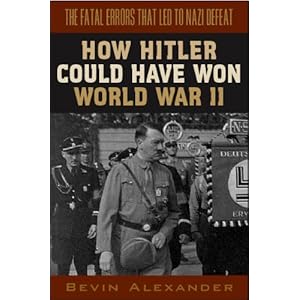
With literally thousands of titles to choose, the average reader may feel overwhelmed. But if you’re looking for an understandable, overall view of Hitler’s generalship, an excellent choice would be How Hitler Could Have Won World War II by Bevin Alexander.

How Hitler Could Have Won World War II

Among “the fatal errors that led to Nazi defeat” (as proclaimed on the book jacket) were:

  • Wasting hundreds of Luftwaffe pilots, fighters and bombers in a half-hearted attempt to conquer England.
  • Ignoring the pleas of generals like Erwin Rommel to conquer Syria, Iraq and Saudi Arabia–thus giving Germany control of most of the world’s oil.
  • Attacking his ally, the Soviet Union, while still at war with Great Britain.
  • Needlessly turning millions of Russians into enemies rather than allies by his brutal and murderous policies.
  • Declaring war on the United States after the Japanese attacked Pearl Harbor. (Had he not done so, Americans would have focused all their attention on conquering Japan.)
  • Refusing to negotiate a separate peace with Soviet dictator Joseph Stalin–thus granting Germany a large portion of captured Russian territory in exchange for letting Stalin remain in power.
  • Insisting on a “not one step back” military “strategy” that led to the unnecessary surrounding, capture and/or deaths of hundreds of thousands of German servicemen.

As the war turned increasingly against him, Hitler became ever more rigid in his thinking. He demanded absolute control over the smallest details of his forces. This, in turn, led to astounding and needless losses in German soldiers.

One such incident was immortalized in the 1962 movie, The Longest Day, about the Allied invasion of France known as D-Day.

On June 6, 1944, Rommel ordered the panzer tanks to drive the Allies from the Normandy beaches. But these could not be released except on direct order of the Fuehrer.

As Hitler’s chief of staff, General Alfred Jodl, informed Rommel: The Fuehrer was asleep–and, no, he, Jodl, would not wake him.

By the time Hitler awoke and issued the order, it was too late.

Nor could he accept responsibility for the policies that were clearly leading Germany to certain defeat. Hitler blamed his generals, accused them of cowardice, and relieved many of the best ones from command.

Among those sacked was Heinz Guderian, creator of the German panzer corps–and thus responsible for its highly effective “blitzkrieg” campaign against France in 1940.

Heinz Guderian

Another was Erich von Manstein, designer of the strategy that defeated France in six weeks–something Germany couldn’t do during the four years of World War 1.

Erich von Manstein

Finally, on April 29, 1945–with the Russians only blocks from his underground bunker in Berlin–Hitler dictated his “Last Political Testament.” Once again, he refused to accept responsibility for unleashing a war that would ultimately consume 50 million lives:

“It is untrue that I or anyone else in Germany wanted war in 1939. It was desired and instigated exclusively by those international statesmen who either were of Jewish origin or worked for Jewish interests.”

Hitler had launched the war with a lie–that Poland had attacked Germany, rather than vice versa. And he closed the war–and his life–with a final lie.

All of which, once again, brings us back to Niccolo Machiavelli, the father of political science.

In his classic book, The Discourses, he wrote at length on the best ways to maintain liberty within a republic. In Book Three, Chapter 31, Machiavelli declares: “Great Men and Powerful Republics Preserve an Equal Dignity and Courage in Prosperity and Adversity.”

It is a chapter that Adolf Hitler would have done well to read.

“…A truly great man is ever the same under all circumstances. And if his fortune varies, exalting him at one moment and oppressing him at another, he himself never varies, but always preserves a firm courage, which is so closely interwoven with his character that everyone can readily see that the fickleness of fortune has no power over him.

“The conduct of weak men is very different. Made vain and intoxicated by good fortune, they attribute their success to merits which they do not possess, and this makes them odious and insupportable to all around them.

“And when they have afterwards to meet a reverse of fortune, they quickly fall into the other extreme, and become abject and vile.

“Thence it comes that princes of this character think more of flying in adversity than of defending themselves, like men who, having made a bad use of prosperity, are wholly unprepared for any defense against reverses.”

Stay alert to signs of such character flaws among your own business colleagues–and especially your superiors. They are the warning signs of a future catastrophe.

WHY REGULAR JOBS PROGRAMS DON’T WORK

In Bureaucracy, Business, Politics, Self-Help, Social commentary on May 2, 2013 at 12:18 am

Imagine this: A future President seeks to disband the FBI—and offer bribes to career criminals to not rob, rape and murder. And to sell his proposal, he chooses as his slogan: “Let criminals be criminals.”

If that sounds impossible, consider this: Politicians on both the Right and Left have adopted just that mindset toward holding corporate employers accountable for their criminal greed and irresponsibility.

Case in point: The Obama administration has signaled that it may adopt a Georgia program that allows businesses to train jobless workers for two months without having to pay them.

Its supporters claim the program—Georgia Works—lets workers get their foot in the door and reduces businesses’ hiring risks. Unions assert that it exploits workers and violates federal labor laws.

The drawbacks to this program:

  • It’s only open to workers receiving unemployment insurance benefits.
  • Businesses have no obligation to hire participating workers.

Mississippi, in turn, has launched the Subsidized Transition Employment Program and Services. Funded with left-over stimulus dollars, it initially covers 100 percent of an employee’s wages, gradually reducing the subsidy for every 160 hours worked.

Its drawbacks:

  • It lasts only four months—from August to December, 2011.
  • Businesses will be excluded from the program if funds are exhausted or the September 30 enrollment deadline has passed.
  • Only 80 companies had signed up for the program by early September.

Then there’s the Minnesota solution. Instead of adopting Senator Al Franken’s proposal to use public monies to subsidize wages, Congress enacted the Hiring Incentives to Restore Employment Act. This gave businesses $13 billion worth of tax credits for hiring unemployed workers.

The drawbacks to this effort:

  • The measure has not been evaluated.
  • It does not require employers to hire.

In Connecticut, another jobs program, Platform to Employment, puts workers through a four-week training period followed by an eight-week tryout at a participating business.

During the tryouts, the employees’ wages are paid by The Workplace, Inc., a private company which raised enough funds to support 100 jobs starting this fall.

The drawbacks to this are:

  • Employers get, in effect, free labor.
  • Only those who have already exhausted 99 weeks of unemployment benefits are eligible.
  • Employers have no obligation to hire participating workers.
  • The funds will create only 100 jobs.
  • Employers are not required to participate in the program.

Meanwhile, the unemployment rate keeps steadily rising. In 2007, 228,000 people were unemployed for 99 weeks or longer, according to the Bureau of Labor Statistics.

Today more than 2 million Americans have been unemployed for at least 99 weeks—the cutoff point for unemployment insurance in the hardest-hit states.

And the longer a person is out of work, the less likely s/he is to find an employer willing to hire.

What all these “job creating” programs have in common is this: They apply plenty of carrots–but absolutely no sticks.

Bribes–in the form of tax credits or tax breaks–are liberally applied to entice employers to behave like patriots instead of parasites. But for employers whose refusal to hire condemns their country to economic catastrophe–there are no penalties whatsoever.

A policy based only on carrots is a policy of bribery. A policy based only on sticks is one of coercion. Some people can’t be bribed, and some can’t be coerced. But nearly everyone is open to a policy of rewards and punishments.

Thus, corporations across the country are now sitting atop $2 trillion in profits. But their CEOs are using those monies for:

  • Enriching themselves, their bought-off politicians, their families—and occasionally their mistresses.
  • Buying up other corporate rivals.
  • Creating or enlarging companies outside the United States.

In short, the one expense they refuse to underwrite is hiring their fellow Americans.

This is because:

  • They want to pay their un-American employees far lower wages than would be tolerated by employees within the United States.
  • They want to escape American employee-protection laws–such as those mandating worker’s compensation or forbidding sexual harassment.
  • They want to escape American consumer-protection laws–such as those banning the sale of lead-contaminated products (a hallmark of Chinese imports).
  • They want to escape American laws protecting the environment–such as those requiring safe storage of dangerous chemicals.

They want, in short, to enrich themselves at the direct expense of their country.

In decades past, this used to be called treason.

Yet no major political figure–on the Left or Right–has so far dared to blame employers for selling out their country and destroying its economic prosperity.

No job-seeker, however well-qualified and -motivated, can hire himself onto an employer who refuses to hire.

But corporate CEOs–and their paid political stooges–continue to blame the unemployed for being unable to find employers willing to honor their integrity, qualifications and initiative.

Related image

Americans generally–and the unemployed and under-employed in particular–must hold corporate America accountable for its criminal greed and irresponsibility.

Until they do, the United States will continue to sink further into decline–economically, socially and politically.

DOES TORTURE WORK?: PART THREE (END)

In Law, Law Enforcement, Politics, Social commentary on May 1, 2013 at 12:02 am

Throughout the Cold War, Republicans held themselves out as the ultimate practitioners of “real-politick,” at home and abroad. They convinced millions of Americans to believe that only their party could be trusted to not sell out America.

As a result, they held the White House–and often the Senate and/or House of Representatives–for most of the 20th Century.

According to Republicans and their Rightist supporters: A President–especially a Democratic one–could never be too aggressive or warlike.

  • President Harry S. Truman hemmed in the Soviet Union with a ring of military bases, making its further expansion into Europe impossible.
  • But the Right judged this as abject surrender. The reason: Truman refused to again turn Eastern Europe into a mass graveyard and ignite World War III by declaring war on the Soviet Union to “roll back” Communism.
  • President John F. Kennedy forced Nikita Khrushchev to withdraw Soviet nuclear missiles from Cuba.
  • But, according to Republicans, that was actually a defeat.  The reason: He didn’t risk thermonuclear war with the Soviet Union by launching an all-out invasion of that island.

After the 1991 collapse of the Soviet Union, Republicans lost their Great Red Bogeyman. Now they could only accuse Democrats of being “soft” on crime, not Communism.

Then, on September 11, 2001, the Republicans found their next great enemy to rally against–-and to accuse Democrats of actively supporting: Islamic terrorism.

This ensured the 2004 re-election of George W. Bush–-who had hid out from the Vietnam war in the Texas Air National Guard–over John Kerry, a genuine war hero who had seen heavy action in the same conflict.

In the last column, we saw that the FBI’s “kill them with kindness” approach to interrogation has yielded far better results than the “Jack Bauer/24” methods favored by the CIA and military.

But this has not prevented Republicans from attacking  even those FBI agents who have risked their lives at home and abroad to defend America from terrArabism.

According to the high priests of the Republican party, those agents are “naive” do-gooders who don’t have the guts to go “all the way” against America’s enemies.

But Niccolo Machiavelli, whose name is a byward for political ruthlessness, would disagree with those Republicans.

In his small and notorious book, The Prince, he writes about the methods a ruler must use to gain power. But in his larger and lesser-known work, The Discourses, he outlines the ways that liberty can be maintained in a republic.

Niccolo Machiavelli

For Machiavelli, only a well-protected state can hope for peace and prosperity.  Toward that end, he wrote at length about the best ways to succeed militarily.  And in war, humanity can prevail at least as often as severity.

Consider the following example from The Discourses:

Camillus [a Roman general] was besieging the city of the Faliscians, and had surrounded it….A teacher charged with the education of the children of some of the noblest families of that city [to ingratiate himself] with Camillus and the Romans, led these children…into the Roman camp. 

And presenting them to Camillus [the teacher] said to him, “By means of these children as hostages, you will be able to compel the city to surrender.”         

Camillus not only declined the offer but had the teacher stripped and his hands tied behind his back….[Then Camillus] had a rod put into the hands of each of the children…[and] directed them to whip [the teacher] all the way back to the city. 

Upon learning this fact, the citizens of Faliscia were so much touched by the humanity and integrity of Camillus, that they surrendered the place to him without any further defense.  

This example shows that an act of humanity and benevolence will at all times have more influence over the minds of men than violence and ferocity.

It also proves that provinces and cities which no armies…could conquer, have yielded to an act of humanity, benevolence, chastity or generosity.

This truth should be kept firmly in mind whenever Right-wingers start bragging about their own patriotism and willingness to get “down and dirty” with America’s enemies.

Many–like Newt Gingrich, Donald Trump, Rudolph Giuliani, Rick Santorum and Mitt Romney–did their heroic best to avoid military service. These “chickenhawks” talk tough and are always ready to send others into battle–but keep themselves well out of harm’s way.

Such men are not merely contemptible; they are dangerous.