bureaucracybusters

Posts Tagged ‘WORLD WAR ii’

WHAT “AMERICAN SNIPER” DOESN’T TELL: PART ONE (OF THREE)

In Bureaucracy, History, Military, Politics, Social commentary on January 28, 2015 at 12:02 am

Clint Eastwood’s latest movie, American Sniper, has become the most controversial film being considered for Best Picture at the upcoming Academy Awards ceremonies.

The Oscars telecast is scheduled for February 22.

The film depicts the life of Chris Kyle, who became the deadliest sniper in American history with 160 confirmed kills.

As a Navy SEAL who served four tours of duty in Iraq, he became known as “The Legend” to his fellow soldiers–and as “The Devil” to Iraqi insurgents.

A $20,000 bounty was placed on his head.

The criticism is coming from the Left, and has triggered outrage from the Right. Much of this criticism focuses on the movie’s failure to reveal what led the United States to invade Iraq on March 19, 2003.

A crucial scene in the movie occurs shortly after Kyle (Bradley Cooper) has completed his SEAL training.

He and his wife (Sienna Miller) are watching the collapse of the World Trade Center on TV. Then, suddenly, the film cuts to Iraq, where Kyle is now serving as a sniper.

Critics have charged that this implies a connection between the two events.

In fact, that was precisely what the administration of President George W. Bush wanted Americans to believe: That Saddam Hussein had worked hand-in-hand with Osama bin Laden to plan and execute the catastrophe of September 11, 2001.

So where did this all start? There is actually a dark historical parallel to the events leading up to the Iraq war.

A parallel that has its roots in Nazi Germany.

ADOLF HITLER

When Germany’s Fuehrer, Adolf Hitler, wanted to invade Poland in 1939, he mounted a sustained propaganda campaign to “justify” his ambitions.

Adolf Hitler

German “newspapers”-–produced by Joseph Goebbels, the club-footed Minister of Propaganda–-carried fictitious stories of how brutal Poles were beating and even murdering their helpless German citizens.

In theaters, German audiences saw phony newsreels showing Poles attacking and raping German women living in Poland.

For a time, Hitler not only deceived the Germans but the world.

Just before German tanks and troops invaded Poland on September 1, 1939, members of Hitler’s dreaded SS secret police rounded up prisoners from German concentration camps.

The inmates were dressed in Polish Army uniforms and driven to a German radio station at Gleiwitz, on the German/Polish border.  There they were shot by SS men.

Then Polish-speaking SS men “seized” the station and broadcast to Germany that a Polish invasion of Germany was now under way.

Hitler, addressing Germany’s rubber-stamp parliament, the Reichstag, dramatically asserted: “This night for the first time Polish regular soldiers fired on our territory. Since 5.45 a.m. we have been returning the fire, and from now on bombs will be met by bombs.”

Leaders of Britain and France were taken in by this ruse. They had pledged to go to war if Hitler attacked Poland.  But they didn’t want to take on Germany if Poland had been the aggressor.

By the time the truth became known, Poland was securely in German hands.

On August 22, 1939, Hitler had outlined his strategy to a group of high-ranking military officers:

“I shall give a propagandist reason for starting the war.  Never mind whether it is plausible or not. The victor will not be asked, later on, whether he told the truth or not. In starting and waging a war, it is not Right that matters, but Victory.”

GEORGE W. BUSH

American President George W. Bush followed a similar strategy while he prepared to invade Iraq: He ordered the topmost members of his administration to convince the American people of the war’s necessity.

Among those members: National Security Advisor Condoleeza Rice; Vice President Dick Cheney; Secretary of Defense Donald Rumsfeld; and Secretary of State Colin Powell.

Condaleeza Rice, Dick Cheney, George W. Bush and Donald Rumsfeld

Among their arguments-–all eventually revealed as lies-–were:

  • Iraq’s dictator, Saddam Hussein, had worked hand-in-glove with Osama Bin Laden to plan 9/11.
  • Saddam was harboring and supporting Al Qaeda throughout Iraq.
  • Saddam, with help from Al Qaeda, was scheming to build a nuclear bomb.
  • Iraq possessed huge quantities of chemical/biological weapons, in violation of UN resolutions.
  • Saddam was preparing to use those weapons against the United States.
  • American Intelligence agencies had determined the precise locations where those weapons were stored.
  • The war would be self-financing via the oil revenues that would come from Iraq.
  • Invading American forces would be welcomed as liberators.

ADOLF HITLER

Hitler intended Poland to be only his first conquest on what became known as “the Eastern Front.”  Conquering Poland would place his powerful Wehrmacht on the border of the country that was his ultimate target: The Soviet Union.

GEORGE W. BUSH

Similarly, Vice President Dick Cheney–the “power-behind-the-throne” of the Bush Presidency–had his own ambitions for conquering Iraq.

According to former Bush speechwriter David Frum: Cheney longed for war in Iraq to gain reliable control of that nation’s vital oil resources.

A successful occupation of Iraq would also allow the United States to threaten such bordering Islamic nations as Syria, Iran and even Saudi Arabia.

TRUTHS ABOUT “AMERICAN SNIPER” AND THE MILITARY

In Entertainment, History, Military, Politics, Social commentary on January 27, 2015 at 1:50 am

Clint Eastwood’s latest movie, American Sniper, has become the most controversial film now being considered for Best Picture at the upcoming Oscars.

The Academy Awards telecast is scheduled for February 22.

Clint Eastwood

The criticism is coming from the Left, and this has triggered outrage on the Right. Some of this criticism is correct and fair, but some of it isn’t.

CHARGE:  The film implies that the Iraq was was in response to 9/11.

There’s a scene where Kyle (Bradley Cooper) and his wife, Taya (Sienna Miller) are watching TV as the World Tradd Center crashes.  Then the scene cuts to him serving in Iraq.

FACT:  The movie is a biography of Kyle, who became the deadliest sniper in American history, not a documentary on the Iraq war.  And, in fact, Kyle did his service in Iraq.

Bradley Cooper as Chris Kyle in American Sniper

CHARGE:  The movie depicts a terrorist sniper who becomes Kyle’s nemesis.

Named “Mustafa,” he is portrayed as a Syrian Olympics champion marksman.  In a furious mano-a-mano duel with Kyle, he almost nails the SEAL sniper. But in the climax of the movie, he meets his end with a well-placed bullet from Kyle’s rifle.

FACT:  Mustafa is mentioned in a single–and short–paragraph in Kyle’s autobiography.  Writes Kyle: “I never saw him, but the other snipers later killed an Iraqi sniper we thought was him.”

So the climatic duel never happened. But Eastwood clearly thought he needed the duel to make a dramatic and satisfying finish for his movie.  This is what’s known as “dramatic license” in moviemaking.

CHARGE: The movie portrays Chris Kyle as tormented by his rising casualty rate among Iraqis.

During his fourth tour of duty in Iraq, as depicted in the film, he agonizes over his possible need to shoot a child who’s about to pick up a rocket launcher. “Don’t pick it up,” he mutters, and when the child drops it and runs off, Kyle is visibly relieved.

FACT:   Throughout his autobiography–on which the film is based–he refers to Iraqis as “savages.”  He brags of telling a military investigator: “I don’t shoot people with Korans.  I’d like to, but I don’t.”

And having been credited with 160 confirmed kills, he writes: “I only wish I had killed more….I believe the world is a better place without savages out there taking American lives.”

CHARGE:  Chris Kyle was a hate-filled killer, but the movie turns him into a hero.  

FACT:  It’s entirely natural for soldiers to hate their enemies.  They know that they–or their comrades–can be blown away at any moment.  So they fear and hate those intent on their destruction.

The toughening-up process starts in boot camp, where the restraints of individuality and pacifism are shattered.  The purpose of boot camp is to turn “boys” into “fighting men,” and this must be done in a matter of weeks.  So the process is shockingly brutal.

Soldiers who aren’t toughened up in boot camp are by the battlefield.  As General George S. Patton famously warned: “When you put your hand into a bunch of goo, that a moment before was your best friend’s face, you’ll know what to do.”

General George S. Patton

During the Indian wars, soldiers called Indians “Red niggers.”  In World War II–“the Good War”–America’s servicemen fought “Japs” and “Krauts.”  During the Vietnam war, Vietnamese became “gooks” and “dinks.”

Today our servicemen and women refer (unofficially) to their Islamic enemies as “ragheads” and “sand niggers.”

CHARGE:  “In Kyle’s version of the Iraq war, the parties consisted of Americans, who were good by virtue of being Americans, and fanatic Muslims, whose ‘savage, despicable evil’ led them to want to kill Americans simply because they are Christian.”  –Laura Miller, in Salon

FACT:  British military historian B.H. Liddell Hart noted in his introduction to the memoirs of World War II German General Heinz Guderian, the creator of the Blitzkreig theory:

Heinz Guderian

“[Guderian] did not question the cause which he and his troops were serving, or the duty of fighting for their country.  It was sufficient for him that she was at war and thus in danger, however it had come about.

“As a dutiful soldier, he had to assume that his country’s cause was just, and that she was defending herself against would-be conquerors.”

What proved true for Guderian proved equally true for Kyle–and for soldiers in armies throughout the world.

Moreover, every great war movie tells its story from a given viewpoint–such as American, German, Russian or British. Audiences are invited to identify with the leading character.

In All Quiet on the Western Front, the narrator is a young, idealistic German soldier who becomes disallusioned with the horrors of war.  When he dies at the end of the movie, we feel saddened by his loss, even though he served in the ranks of America’s adversaries.

Similarly, when we learn, at the end of American Sniper, that Chris Kyle was killed while trying to help a fellow veteran, we feel a similar loss.

In the end, a historical or biographical movie can tell only so much.  Its audience must then decide its meaning–and whether to learn more about the subjec through their own researches.

NEGOTIATING NAZI-REPUBLICAN STYLE: PART TWO (OF SIX)

In Bureaucracy, History, Law, Law Enforcement, Politics on July 2, 2014 at 12:52 pm

Robert Payne, author of the bestselling biography, The Life and Death of Adolf Hitler (1973), described Hitler’s “negotiating” style thusly:

“Although Hitler prized his own talents as a negotiator, a man always capable of striking a good bargain, he was totally lacking in finesse. 

“He was incapable of bargaining.  He was like a man who goes up to a fruit peddler and threatens to blow his brains out if he does not sell his applies at the lowest possible price.”

By studying Hitler’s mindset and “negotiating” methods, we can learn much about the mindset and “negotiating” style of today’s Republican party.

A classic example of Hitler’s “bargaining style” came in 1938, when he invited Austrian Chancellor Kurt von Schuschnigg to his mountaintop retreat in Obersalzberg, Germany.  Hitler, an Austrian by birth, intended to annex his native land to Germany.

 Kurt von Schuschnigg

Schuschnigg was aware of Hitler’s desire, but nevertheless felt secure in accepting the invitation.  He had been assured that the question of Austrian sovereignty would not arise.

The meeting occurred on February 12, 1938.

Shuschnigg opened the discussion with a friendly compliment.  Walking over to a large window, he admired the breathtaking view of the mountains.

HITLER: We haven’t come here to talk about the lovely view or the weather!

Austria has anyway never done anything which was of help to the German Reich….I am resolutely determined to make an end to all this business.  The German Reich is a great power.  Nobody can and nobody will interfere if it restores order on its frontiers.

SCHUSCHNIGG: I am aware of your attitude toward the Austrian question and toward Austrian history….As we Austrians see it, the whole of our history is a very essential and valuable part of German history….And Austria’s contribution is a considerable one.

HITLER: It is absolutely zero—that I can assure you!  Every national impulse has been trampled underfoot by Austria….

I could call myself an Austrian with just the same right—indeed with even more right—than you, Herr Schuschnigg. Why don’t you once try a plebiscite in Austria in which you and I run against each other? Then you would see!

SCHUSCHNIGG: Well, yes, if that were possible. But your know yourself, Herr Reich Chancellor, that it just isn’t possible. We simply have to go on living alongside one another, the little state next to the big one. We have no other choice.

And that is why I ask you to tell me what your concrete complaints are. We will do all in our power to sort things out and establish a friendly relationship, as far as it is possible to do so.

HITLER: That’s what you say, Herr Schuschnigg. And I am telling you that I intend to clear up the whole of the so-called Austrian question–one way or another. Do you think I don’t know that you are fortifying Austria’s border with the Reich?

SCHUSCHNIGG: There can be no suggestion at all of that—

HITLER: Ridiculous explosive chambers are being built under bridges and roads—

This was a lie, and Hitler knew it was a lie. But no matter. It gave him an excuse to threaten to destroy Austria—as he was to destroy so many other nations during the next seven years.

HITLER: I have only to give one command and all this comic stuff on the border will be blown to pieces overnight. You don’t seriously think you could hold me up, even for half an hour, do you?

Who knows—perhaps you will find me one morning in Vienna like a spring storm. Then you will go through something!  I’d like to spare the Austrians that.

The S.A. [Hitler’s private army of Stormtroopers] and the [Condor] Legion [which had bombed much of Spain into rubble during the three-year Spanish Civil War] would come in after the troops and nobody–not even I–could stop them from wreaking vengeance.

* * * * *

Schnuschigg made a cardinal mistake in dealing with Hitler: He showed fear.  And this was precisely what the Nazi dictator looked for in an opponent.

Contrary to popular belief, Hitler did not constantly rage at everyone.  On the contrary: he could, when he desired, be charming, especially to women.  He used rage as a weapon, knowing that most people feel intimidated by it.

In the case of Schuschnigg, he opened with insults and threats at the outset of their discussion.  Then there was a period of calm, to convince the Austrian chancellor the worst was over.

Finally, he once again attacked–this time with so much fury that Schuschnigg was terrified into submission.

With one stroke of a pen, Austria became a vassal-state to Nazi Germany.

Republicans used precisely the same “negotiating” style during the summer of 2011 to threaten the United States with financial ruin unless they got their way in budget negotiations.

And they threatened to do the same again that fall.

ONE DAY, TWO ANNIVERSARIES

In History, Military, Politics, Social commentary on June 6, 2014 at 12:01 am

“For it is the doom of men that they forget.”
–Merlin, in “Excalibur”

June 6–a day of glory and tragedy.

The glory came  70 years ago–on Tuesday, June 6, 1944.

On that morning, Americans awoke to learn–from radio and newspapers–that their soldiers had landed on the French coast of Normandy.

In Supreme Command of the Allied Expeditionary Force was American General Dwight D. Eisenhower.  Overall command of ground forces was given to British General Bernard Montgomery.

Operation Overlord, the Allied invasion to liberate France from Nazi Germany, proved one of the pivotal actions of World War II.

It opened shortly after midnight, with an airborne assault of 24,000 American, British, Canadian and Free French troops.  This was followed at 6:30 a.m. by an amphibious landing of Allied infantry and armored divisions on the French coast.

Field Marshal Erwin Rommel–the legendary “Desert Fox”–commanded the German forces.  For him, the first 24 hours of the battle would be decisive.

“For the Allies as well as the Germans,” he warned his staff, “it will be the longest day.”

The operation was the largest amphibious invasion in history.  More than 160,000 troops landed–73,000 Americans, 61,715 British and 21,400 Canadians.

Initially, the Allied assault seemed likely to be stopped at the water’s edge–where Rommel had always insisted it must be.  He had warned that if the Allies established a beachhead, their overwhelming advantages in numbers and airpower would eventually prove irresistible.

German machine-gunners and mortarmen wreaked a fearful toll on Allied soldiers.  But commanders like U.S. General Norman Cota led their men to victory through a storm of bullets and shells.

Coming upon a group of U.S. Army Rangers taking cover behind sand dunes, Cota demanded: “What outfit is this?”

“Rangers!” yelled one of the soldiers.

“Well, Goddamnit, then, Rangers, lead the way!” shouted Cota, inspiring the soldiers to rise and charge into the enemy.

The command also gave the Rangers the motto they carry to this day.

The allied casualty figures for D-Day have been estimated at 10,000, including 4,414 dead.  By nationality, the D-Day casualty figures are about 2,700 British, 946 Canadians and 6,603 Americans.

The total number of German casualties on D-Day isn’t known, but is estimated at 4,000 to 9,000.

Allied and German armies continued to clash throughout France, Belgium and Germany until May 7, 1945, when Germany finally surrendered.

But those Americans who had taken part in D-Day could be proud of having dealt a fatal blow to the evil ambitions of Adolf Hitler’s Third Reich.

So much for the glory of June 6.  Now for the tragedy–which occurred 46 years ago, on Thursday, June 6, 1968.

Twenty-four years after D-Day, Americans awoke to learn–mostly from TV–that New York Senator Robert F. Kennedy had died at 1:44 a.m. of an assassin’s bullet.

He had been campaigning for the Democratic Presidential nomination, and had just won the California primary on June 4.

This had been a make-or-break event for Kennedy, a fierce critic of the seemingly endless Vietnam war.

He had won the Democratic primaries in Indiana and Nebraska, but had lost the Oregon primary to Minnesota Senator Eugene McCarthy.

If he could defeat McCarthy in California, Kennedy could force his rival to quit the race.  That would lead to a showdown between him and Vice President Hubert Humphery for the nomination.

(President Lyndon B. Johnson had withdrawn from the race on March 31–just 15 days after Kennedy announced his candidacy on March 16.)

After winning the California and South Dakota primaries, Kennedy gave a magnaminous victory speech in the ballroom of the Ambassador Hotel in Los Angeles:

“I think we can end the divisions within the United States….We are a great country, an unselfish country, and a compassionate country.  And I intend to make that my basis for running over the period of the next few months.”

Then he entered the hotel kitchen–where Sirhan Sirhan, a 24-year-old Palestinian from Jordan, opened fire with a .22 revolver.

Kennedy was hit three times–once fatally in the back of the head.  Five other people were also wounded.

Kennedy’s last-known words were: “Is everybody all right?” and “Jack, Jack”–the latter clearly a reference to his beloved older brother, John Fitzgerald Kennedy.

Almost five years earlier, that brother–then President of the United States–had been assassinated in Dalas on November 22, 1963.

Then Robert Kennedy lost consciousness–forever, dying in a hospital bed 24 hours later.

Kennedy had been a U.S. Attorney General (1961-1964) and Senator (1964-1968).  But it was his connection to  President Kennedy for which he was best-known.

His assassination–coming so soon after that of JFK–convinced many Americans there was something “sick” about the nation’s culture.

One of the best summaries of Robert Kennedy’s legacy was given in Coming Apart: An Informal History of America in the 1960′s, by historian William L. O’Neil:

“…He aimed so high that he must be judged for what he meant to do, and, through error and tragic accident, failed at….He will also be remembered as an extraordinary human being who, though hated by some, was perhaps more deeply loved by his countrymen than any man of his time.

“That too must be entered into the final account, and it is no small thing.  With his death something precious disappeared from public life.”

“FAT MAN” AND BUREAUCRACY WARS

In Bureaucracy, Entertainment, History, Military, Politics, Social commentary on April 24, 2014 at 12:00 am

The 1989 movie, Fat Man and Little Boy, provides useful insights into the real-life workings of bureaucracies.

In it, the brilliant and ambitious physicist, J. Robert Oppenheimer (played by Dwight Schultz) comes–too late–to realize he’s made a deal with the devil.

The same proved true for the J. Robert Oppenhiemer of history.

Dwight Schultz as J. Robert Oppenheimer and Paul Newman as General Leslie Groves

Hired by Army General Leslie Groves (played by Paul Newman) to ramrod construction of an atomic bomb, Oppenheimer has no qualms about using it against Nazi Germany.

It’s believed, after all, that German scientists are furiously pursuing work on such a weapon.

The full horror of the extermination camps has not yet been revealed.  But “Oppie” and many other Jewish scientists working on the Manhattan Project can easily imagine the fate of Jews trapped within the borders of the Third Reich.

But then something unforeseen happens. On May 8, 1945, the Third Reich collapses and signs unconditional surrender terms.

Almost at the same time, the U.S. military learns that although some German physicists had tried to make an atomic bomb, they never even got close to producing one.

So Oppenheimer finds himself still working to build the most devastating weapon in history–but now lacking the enemy he had originally signed on to destroy.

Meanwhile, the U.S. Government has invested nearly $2 billion in the Manhattan Project–at a time when $2 billion truly meant the equivalent of $1 trillion today. Is all that money to go for nothing?

What to do?

Oppenheimer doesn’t have to make that decision. It’s made for him—by Groves, by Groves’ superiors in the Army, and ultimately by the new President, Harry S. Truman.

The bomb will be used, after all. It will just be turned against the Japanese, who are even more hated by most Americans than the Germans.

It doesn’t matter that:

  • The Japanese lack the technological skill of the Germans to produce an atomic bomb.
  • They are rapidly being pushed across the Pacific to their home islands.
  • American bombers are incinerating Japanese cities at wil.
  • The Japanese are desperately trying to find a way to surrender without losing face.

What matters is that Pearl Harbor is still fresh in the minds of Americans generally and of the American military in particular.

And that now that the Japanese are being pushed back into their home islands, they are fighting ever more fanatically to hold off certain defeat.

General Douglas MacArthur, who is scheduled to command the invasion of Japan, has estimated a million American casualties if this goes forward.

Oppenheimer, who has taught physics at the University of California at Berkeley, now finds himself being taught a lesson:

That, once set in motion, bureaucracies–like objects–continue to move forward unless something intervenes to stop them. And, in this case, there is no one willing to say: Stop.

So, on August 6, 1945, an American B-29 bomber drops “Little Boy” on Hiroshima.

An estimated 80,000 people die instantly.  By the end of the year, injury and radiation bring total casualties to 90,000-140,000.

On August 9, it’s the turn of Nagasaki.

Casualty estimates for the dropping of “Fat Man” range from 40,000 to 73,884, with another 74,909 injured, and another several hundred thousand diseased and dying due to fallout and other illness caused by radiation.

For Oppenheimer, the three years he has devoted to creating an atomic bomb will prove the pivotal event of his life. He will be praised and damned as an “American Prometheus,” who brought atomic fire to man.

Countless Americans–especially those who would have been ordered to invade Japan–will revere him as the man who brought the war to a quick end.

And countless Americans–and non-Americans–will condemn him as a man whose arrogance and ambition led him to arm mankind with the means of its own destruction.

Upon witnessing the first successful atomic explosion near Alamogordo, New Mexico, on July 16, 1945, Oppenheimer had been stunned by the sheer magnitude of destructiveness he had helped unleash.

Quoting the Hindu holy book, the Bhagavad Gita, he murmured: “Now I am become Death, the shatterer of worlds.”

Faced with the massive toll of lives taken by the device he had created, Oppenheimer became convinced that the only hope for humanity lay in abolishing nuclear weapons.

He vigorously opposed the creation of a “super” hydrogen bomb. His advice was overruled, however, and construction of this went forward at the same pace that Oppenheimer had once driven others to create the atomic bomb.

The first test of this even more terrifying weapon occurred on November 1, 1952. By 1953, just as Oppenheimer had predicted, the Soviet Union had launched its own H-bomb test.

In a famous meeting with President Truman, Oppenheimer reportedly said, “Mr. President, I have blood on my hands.”

Truman later claimed that he had offered Oppenheimer a handkerchief, saying, “Here, this will wash it off.”

It didn’t.

Accused during the hysteria of the Joseph McCarthy witch-hunts of being a Communist traitor, Oppenheimer found himself stripped of his government security clearance in 1954.

Unable to prevent the military bureaucracy from moving relentlessly to use the atomic bomb, he could not halt the political bureaucracy from its own rush into cowardice and the wrecking of others’ lives.

WONDER WOMAN: COARSENING THE CULTURE

In Business, Entertainment, Military, Social commentary on February 7, 2014 at 1:32 am

On November 7, 2013, American television culture took yet another step deeper into Toiletville.

It was the Two and Half Men episode, “Justice in Star-Spangled Hot Pants.”  And it starred Lynda Carter as the target of a crush that was both infantile and obscene.

Carter, of course, is the singer/actress best-known for her role as Wonder Woman (1975-1979).

And watching this episode of Men, it was hard to tell where the real-life Carter left off and the fictional character she was playing took over.

Lynda Carter as Wonder Woman

Here, in brief, was the plotline:

Alan Harper (Jon Cryer) learns that his roommate, Walden Schmidt (Ashton Kutcher) knows Lynda Carter.

Having an enormous crush on Carter from his years of watching her as Wonder Woman, Alan asks Walden to set him up on a date with her.

Against his better judgment, Walden agrees to invite her to the house for dinner.

Now, if Carter had been playing a fictional character, there wouldn’t have been anything wrong with this premise.

Nobody, for example, would have mistaken Laurence Olivier for Richard III.

But she wasn’t.  She was playing herself.

And, in her real-life self, she’s 62.  An admittedly good-looking 62, but, even so, a woman about 40 years older than the character (Alan) who wants to meet her.

And not simply meet her.  Bone her.

Bone her?  Yes–that’s exactly what he says when Walden initially turns down his request to introduce him to her: “Now I’ll never get to bone Lynda Carter.”

And since Carter was playing herself, it’s useful to recall that she is, in real-life, a married woman (since 1984 to attorney Robert Altman).

And the show achieves an even lower level of crassness when Walden says Alan is so desperate to meet Carter that he’d skulk around in the bushes in front of her house.

“Wow, Lynda Carter’s bush,” says Alan, practically salivating over the contemplation of a 62-year-old woman’s vagina.

But males aren’t the only gender who get to descend to new depths of bad taste in this episode.  There’s the character of Jenny (Amber Tamblyn), the lesbian sister of the departed character Charlie (Charlie Sheen).

Again, the show’s writers simply couldn’t resist the temptation to mix real-life with fantasy.

Jenny is, at first, not even aware who Lynda Carter is until Alan, shocked, clues her in on the infantile series she’s best-known for.

And, after meeting Carter, Jenny remain unimpressed.  There’s an edginess in her voice as she comes face-to-face with the actress who’s well-known for supporting gay and lesbian rights.

“I understand you’re into cuffs,” she tells Carter–a reference to the “magic bracelets” worn by her character, Wonder Woman.

But it’s also a double entendre, conjuring up the image of Carter (perhaps in her Wonder Woman outfit) staked out on a bed in a bondage fantasy.

For all of Alan’s over-the-top infatuation with Carter, it’s not him that she’s interested in.  It’s his buddy, Walden (Ashton Kutcher).

Lynda Carter and Ashton Kutcher

And to prove it, she gives him a real smackeroo of a kiss.

Which may well have conjured up, for him, real-life memories of his May-December marriage to the actress Demi Moore.

Kutcher was 27 when he tied the knot with Moore in 2005.  Moore, by contrast, was 42.

The marriage ended in 2013, amid tabloid reports that Kutcher had cheated on her with Sara Leal, a 22-year-old San Diego-based administrative assistant.

Kutcher, born in 1978, was still rolling around in his cradle while Carter–born in 1951–was wrapping up her third and final season as Wonder Woman.

So, for Kutcher, maybe it was a case of deja vu all over again.

On Veterans Day from 2001 to 2004, the American Broadcasting Company (ABC) aired the 1998 Steven Spielberg World War II classic, Saving Private Ryan, uncut and with limited commercial interruptions.

Both the grity, realistic battle scenes and profanity were left intact.

Storming the beach at Normandy in Saving Private Ryan

But in 2004, its airing was marked by pre-emptions by 65 ABC affiliates.

The reason: The backlash over Super Bowl XXXVIII’s halftime show controversy (starring the infamous bared breast of Janet Jackson).

The affiliates—28% of the network—did not clear the available timeslot for the film.

And this was even after the Walt Disney Company–which owns ABC–offered to pay all fines for language to the FCC.

No complaints, however, were lodged with the FCC.

It speaks volumes to the priorities–and values–of American television when a film honoring the wartime sacrifices of American soldiers is banned from network TV.

And it speaks volumes as well to the priorities–and values–of American television when a casually juvenile and crudity-laced series like Two and a Half Men becomes CBS’ biggest cash cow.

NEGOTIATING WITH NAZIS AND REPUBLICANS

In History, Military, Politics on October 21, 2013 at 10:21 pm

On October 1, Speaker of the House John Boehner (R-Ohio) said President Barack Obama told Congressional leaders at a White House meeting that “he will not negotiate.”

Boehner accused Democrats of being unwilling to negotiate key elements of the Affordable Care Act–in return for Republican agreement on a spending bill.

The Republicans were seeking–for now–a one-year delay in the rolling out of “Obamacare.”

Obama, in turn, said that he would not submit to Republican “extortion” and “blackmail.”

He said that the House should pass a “clean” spending bill–one without conditions–that met America’s obligations to its citizens and creditors.  Only then would be be willing to discuss possible changes in “Obamacare.”

Republicans countered with slogans such as: “If Obama will negotiate with [Russian President] Vladimir Putin, why won’t he negotiate with Congress?”

Seventy-three years ago, another democratic leader found himself accused of being unreasonable and unwilling to negotiate.

That leader was British Prime Minister Winston Churchill.  And those accusing him were among the most powerful men in the Third Reich.

Winston Churchill

This was not a favorable time for Britain.

On September 1, 1939, Adolf Hitler had ordered his Whermacht (army) to invade Poland.  In six weeks, Polish resistance vanished and Poland became the first of a series of Nazi vassal-states.

Then, on May 10, 1940, after waiting out the winter, Hitler’s army quickly overran Norway and Denmark.

And then it was the turn of France.

In six weeks, the German army accomplished what it couldn’t during the four years of World War 1.  It  bypassed the heavily defended Maginot Line and destroyed one French army after another.

The defeated French were forced to sign the armistice in the same railway car they had used in 1918 when they forced Germany to surrender after World War 1.

Although the British had committed their air force and army to defending France, both had been easily swept aside by the Wehrmact and Luftwaffe (air force).

Driven almost literally into the sea, the British evacuated about 338,226 men from the port of Dunkirk.  It was a miracle made possible by Hitler’s unexplained halt of the German advance and the arrival of a fleet of civilian and naval vessels from England.

“The battle of France is over,” Churchill warned his countrymen.  “The battle of Britain is about to begin.”

But not before Hitler offered his own version of “peace with honor.”

On July 19, the Fuehrer addressed the Reichstag, Germany’s rubber-stamp parliament:

“From Britain I now hear only a single cry–not of the people but of the politicians–that the war must go on….

Hitler addressing the Reichstag

“Mr. Churchill ought, for once, to believe me when I prophesy that a great Empire will be destroyed–an Empire which it was never my intention to destroy or even to harm.

“In this hour I feel it to be my duty before my own conscience to appeal once more to reason and common sense in Great Britain as well as elsewhere.

“I consider myself in a position to make this appeal since I am not the vanquished begging favors but the victor speaking in the name of reason.

“I see no reason why this war must go on.”

The assembled parliamentary deputies and bemedaled generals were convinced the British would accept Hitler’s “generous” offer of peace.

They took it for granted that the British would be grateful for the opportunity  Hitler was giving them to get out of the war.

The Fuehrer, they believed, had been truly magnanimous.  How could the British be insane enough to turn him down?

Soon enough, they–and the Fuehrer–got their answer.

Correspondent William L. Shirer, waiting to make a broadcast at the CBS studio in Berlin, listened as the BBC introduced one of its own correspondents.

Sefton Delmner, fluent in German, had covered Nazi Germany for years.  Although not authorized to speak for the British Government, his response could have come directly from Churchill himself.

Sefton Delmer

“Herr Hitler,” said Delmer in his most deferential German, “you have on occasion in the past consulted me as to the mood of the British public.

“So permit me to render Your Excellency this little service once again tonight.

“Let me tell you what we here in Britain think of this appeal of yours to what you are pleased to call our reason and common sense.  Herr Fuehrer and Reichskanzler [Reich Chancellor] we hurl it right back to you, right in your evil-smelling teeth.”

German officials listening to the broadcast in Shirer’s office were stunned.

“Can you make it out?” one demanded of Shirer.  “Can you understand those British fools?  To turn down peace now?  They’re crazy!”

Although devastated by the forthcoming bombing raids of Hitler’s Luftwaffe, England held out.

Months later, it gained two powerful allies: The Soviet Union (invaded by Hitler on June 22, 1941) and the United States (attacked by Japan on December 7, 1941).

In the end, by standing up to Fascist aggression, England and its democracy were saved.

Americans can only hope the same proves true for their country.

IS THERE A HITLER IN YOUR CEO?

In Bureaucracy, History, Military, Social commentary on September 2, 2013 at 12:01 am

Each Labor Day, American politicians offer lip-service tribute to those millions of American workers who make corportate profits a reality.

But no one ever says anything about those over-pampered, over-paid CEOs who all too often take credit for the work done by those millions of American workers.

Too many CEOs have–consciously or not–patterened themselves after the ultimate CEO: Adolf Hitler.

Ever since he shot himself in his underground Berlin bunker on April 30, 1945, historians have fiercely debated:  Was der Fuehrer a military genius or an imbecile?

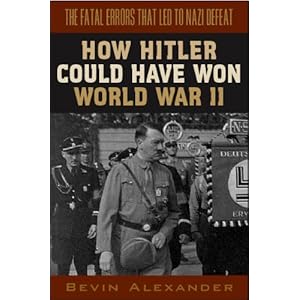
With literally thousands of titles to choose, the average reader may feel overwhelmed.  But if you’re looking for an understandable, overall view of Hitler’s generalship, an excellent choice would be How Hitler Could Have Won World War II by Bevin Alexander.

How Hitler Could Have Won World War II

Among “the fatal errors that led to Nazi defeat” (as proclaimed on the book jacket) were:

  • Wasting hundreds of Luftwaffe pilots, fighters and bombers in a half-hearted attempt to conquer England.
  • Ignoring the pleas of generals like Erwin Rommel to conquer Syria, Iraq and Saudi Arabia–thus giving Germany control of most of the world’s oil.
  • Attacking his ally, the Soviet Union, while still at war with Great Britain.
  • Needlessly turning millions of Russians into enemies rather than allies by his brutal and murderous policies.
  • Declaring war on the United States after the Japanese attacked Pearl Harbor.  (Had he not done so, Americans would have focused all their attention on conquering Japan.)
  • Refusing to negotiate a separate peace with Soviet dictator Joseph Stalin–thus granting Germany a large portion of captured Russian territory in exchange for letting Stalin remain in power.
  • Insisting on a ”not one step back” military “strategy” that led to the unnecessary surrounding, capture and/or deaths of hundreds of thousands of German servicemen.

As the war turned increasingly against him, Hitler became ever more rigid in his thinking.  He demanded absolute control over the smallest details of his forces.  This, in turn, led to astounding and needless losses in German soldiers.

One such incident was immortalized in the 1962 movie, The Longest Day, about the Allied invasion of France known as D-Day.

On June 6, 1944, Rommel ordered the panzer tanks to drive the Allies from the Normandy beaches.  But these could not be released except on direct order of the Fuehrer.

As Hitler’s chief of staff, General Alfred Jodl, informed Rommel: The Fuehrer was asleep–and, no, he, Jodl, would not wake him.

By the time Hitler awoke and issued the order, it was too late.

Nor could he accept responsibility for the policies that were clearly leading Germany to certain defeat.  Hitler blamed his generals, accused them of cowardice, and relieved many of the best ones from command.

Among those sacked was Heinz Guderian, creator of the German panzer corps–and thus responsible for its highly effective “blitzkrieg” campaign against France in 1940.

Heinz Guderian

Another was Erich von Manstein, designer of the strategy that defeated France in six weeks–something Germany couldn’t do during the four years of World War 1.

Erich von Manstein

Finally, on April 29, 1945–with the Russians only blocks from his underground bunker in Berlin–Hitler dictated his “Last Political Testament.”  Once again, he refused to accept responsibility for unleashing a war that would ultimately consume 50 million lives:

“It is untrue that I or anyone else in Germany wanted war in 1939.  It was desired and instigated exclusively by those international statesmen who either were of Jewish origin or worked for Jewish interests.”

Hitler had launched the war with a lie–that Poland had attacked Germany, rather than vice versa.  And he closed the war–and his life–with a final lie.

All of which, once again, brings us back to Niccolo Machiavelli, the father of political science.

In his classic book, The Discourses, he wrote at length on the best ways to maintain liberty within a republic.  In Book Three, Chapter 31, Machiavelli declares: “Great Men and Powerful Republics Preserve an Equal Dignity and Courage in Prosperity and Adversity.”

It is a chapter that Adolf Hitler would have done well to read.

“…A truly great man is ever the same under all circumstances.  And if his fortune varies, exalting him at one moment and oppressing him at another, he himself never varies, but always preserves a firm courage, which is so closely interwoven with his character that everyone can readily see that the fickleness of fortune has no power over him.

“The conduct of weak men is very different.  Made vain and intoxicated by good fortune, they attribute their success to merits which they do not possess, and this makes them odious and insupportable to all around them. 

And when they have afterwards to meet a reverse of fortune, they quickly fall into the other extreme, and become abject and vile.  

“Thence it comes that princes of this character think more of flying in adversity than of defending themselves, like men who, having made a bad use of prosperity, are wholly unprepared for any defense against reverses.”

Stay alert to signs of such character flaws among your own business colleagues–and especially your superiors.  They are the warning signs of a future catastrophe.

NEGOTIATING NAZI-REPUBLICAN STYLE: PART SEVEN (END)

In Bureaucracy, History, Politics, Social commentary on August 14, 2013 at 9:40 am

This fall, President Barack Obama faces a rerun of Republic extortion tactics.

Republicans remain determined to destroy his signature achievement–ensuring health insurance for all Americans.  As a result, major Republican leaders are urging their members to vote against any year-end government-funding bill that includes money for “Obamacare.”

Faced with such extortion demands in 2011, Obama could have faced down his enemies in two ways:

  1. Prosecuting them under the Racketeer Influenced Corrupt Organizations (RICO) Act and/or the USA Patriot Act; and/or
  2. Addressing the Nation as President John F. Kennedy did during the Cuban Missile Crisis and warning his fellow citizens that the Nation faced a moment of supreme danger.

Unfortunately, he chose to cave in to extortion and agree to the “sequester,” by which billions of dollars in Federal revenues were chopped across the board.

In Part Six of this series, I outlined how the President could apply the RICO Act and/or the USA Patriot Act to hold Republican extortionists criminally accountable.

In this part, I will outline his second option (which can be coupled with criminal prosecution).

Declare a National Crisis and Call for His Country’s Support

On October 22, 1962, President John F. Kennedy rallied his countrymen by warning them of the impending threat from a foreign enemy–Soviet nuclear missiles in Cuba.

President Obama can attain the same result–by calling on his countrymen to rally against a threat from a domestic enemy: The extortionists of the Republican Party.

During such a national address, President Obama can reveal such blunt truths as:

  • Republicans have adopted the same my-way-or-else “negotiating” stance as Adolf Hitler.
  • Like the Nazis, they are determined to gain absolute power–or destroy the Nation they claim to love.
  • They raised the debt ceiling seven times during the eight-year Presidency of George W. Bush.
  • But now that a Democrat holds the White House, raising the debt ceiling is unacceptable.
  • Despite Republican lies, we cannot revitalize the economy by slashing taxes on the wealthy and on cash-hoarding corporations while cutting benefits for millions of average Americans.
  • We will need both tax increases and sensible entitlement cuts to regain our economic strength.

Finally, President Obama can end his speech by directly calling for the active support of his countrymen.  Something like this:

“My fellow Americans, I have taken an oath to ‘preserve, protect and defend the Constitution of the United States.’

“But I cannot do this on my own. As citizens of a Republic, each of us carries that burden. We must each do our part to protect the land and the liberties we love.

“Tonight, I’m asking for your help.

“We stand on the edge of economic disaster.  Therefore, I am asking each of you to stand up for America tonight–by demanding the recall of the entire membership of the Republican Party.

“As President John F. Kennedy said:

‘In your hands, my fellow citizens, more than mine, will rest the final success or failure of our course. Since this country was founded, each generation of Americans has been summoned to give testimony to its national loyalty.’

“This is the moment when each of us must decide–whether we will survive as a Republic, or allow ruthless political fanatics to destroy what has lasted and thrived for more than 200 years.”

President Obama has taken forceful action against America’s foreign enemies—most notably Osama bin Laden.

If the Nation is to survive, he must now act just as forcefully against America’s domestic enemies.

Fortunately, there is still time for him to do so. The fact that a prosecutor chooses to not indict on one occasion doesn’t prevent him from doing so on another.

In doing so, he may find history repeating itself.

Joachim C. Fest, author of Hitler (l973), writes of the surprise that awaited Allied soldiers occupying Nazi Germany in 1945:

“Almost without transition, virtually from one moment to the next, Nazism vanished after the death of Hitler and the surrender.  It was as if National Socialism had been nothing but the motion, the state of intoxication and the catastrophe it had caused….

“Hitler’s propaganda specialists had talked constantly of invincible Alpine redoubts, nests of resistance, and swelling werewolf units, and had predicted a war beyond the war. But there was no sign of this.

“Once again it became plain that National Socialism, like Fascism in general, was dependent to the core on superior force, arrogance, triumph, and by its nature had no resources in the moment of defeat.”

With luck, the same will prove true for the extortionists and blackmailers of the Republican Party.

NEGOTIATING NAZI-REPUBLICAN STYLE: PART SIX (OF SEVEN)

In Bureaucracy, History, Politics, Social commentary on August 13, 2013 at 12:05 am

With the United States teetering on the brink of national bankruptcy in 2011, President Obama faced three choices:

  1. Counter Republican extortion attempts via RICO–the Racketeer Influenced Corrupt Organizations Act.
  2. Make a “Cuban Missile Crisis”-style address to the American people, seeking to rally them against a criminal threat to the financial security of the Nation.
  3. Cave in to Republican demands.

Unfortunately for Obama and the Nation, he chose Number Three.

As a result, the Nation now faces a rerun of Republican extortion tactics.

Republicans remain committed to defeating President Barack Obama’s Affordable Care Act–otherwise known as Obamacare–which provides health insurance to all Americans, and not simply the wealthiest 1%.

Republican Senators Marco Rubio of Florida, Ted Cruz of Texas and Mike Lee of Uta are urging their party to vote against any year-end bill to fund the government–unless funding is stripped from the President’s health care law.

Parts of the federal government would shut down on October 1 if Congress doesn’t approve a short-term funding bill before then.

During an August 9, 2013 press conference, Obama bluntly stated why Republicans are so determined to kill this program:

“The one unifying principle in the Republican Party at the moment is making sure that 30 million people don’t have health care and, presumably, repealing all those benefits I just mentioned — kids staying on their parents’ plan; seniors getting discounts on their prescription drugs….

“The idea that you would shut down the government unless you prevent 30 million people from getting health care is a bad idea.”

Even though President Obama refused to stand up to Republican extortion demands in 2011, he still has the opportunity to do so now.

Here is how he can do so.

Option 1: Racketeer Influenced Corrupt Organizations (RICO) Act

RICO has been applied to not only the Mafia but to individuals, businesses, political protest groups, and terrorist organizations.  In short, a RICO claim can arise in almost any context.

Such as the one President Barack Obama faced last summer when Republicans threatened to destroy the credit rating of the United States unless their budgetary demands were met.

RICO opens with a series of definitions of “racketeering activity” which can be prosecuted by Justice Department attorneys.  Among those crimes: Extortion.

Extortion is defined as “a criminal offense which occurs when a person unlawfully obtains either money, property or services from a person(s), entity, or institution, through coercion.”

The RICO Act defines “a pattern of racketeering activity” as “at least two acts of racketeering activity, one of which occurred after the effective date of this chapter and the last of which occurred within ten years…after the commission of a prior act of racketeering activity.”

And if President Obama had believed that RICO was not sufficient to deal with extortionate behavior, he could have relied on the USA Patriot Act of 2001, passed in the wake of 9/11.

In Section 802, the Act defines domestic terrorism.  Among the behavior that is defined as criminal:

“Activities that…appear to be intended…to influence the policy of a government by intimidation or coercion [and]…occur primarily within the territorial jurisdiction of the United States.”

The remedies for punishing such criminal behavior are now legally in place.  President Obama need only direct the Justice Department to apply them.

  • President Obama could direct Attorney General Eric Holder to investigate whether actions by Republican Congressman—and their Tea Party cohorts—broke Federal anti-racketeering and/or anti-terrorism laws.
  • Holder, in turn, could order the FBI to conduct that investigation.
  • If the FBI finds sufficient evidence that these laws had been violated, Holder could empanel criminal grand juries to indict those violators.

The fact that members of Congress would be criminally investigated and possibly indicted would not violate the separation-of-powers principle.  Congressmen have in the past been investigated, indicted and convicted for various criminal offenses.

Such indictments and prosecutions–and especially convictions–would serve notice on current and future members of Congress that the lives and fortunes of American citizens may not be held hostage as part of a negotiated settlement.

Option 2: Declare a National Crisis and Call for His Country’s Support

President John F. Kennedy did just that during the most dangerous crisis of his administration–and scored victory, nationally and internationally.

Addressing the Nation on October 22, 1962, Kennedy shocked his fellow citizens by revealing that the Soviet Union had installed offensive nuclear missiles in Cuba.

John F. Kennedy during the Cuban Missile Crisis

After outlining a series of steps he had taken to end the crisis, Kennedy sought to reassure and inspire his audience. His words are worth remembering today:

“The path we have chosen for the present is full of hazards, as all paths are, but it is the one most consistent with our character and courage as a nation and our commitments around the world.

“The cost of freedom is always high, but Americans have always paid it. And one path we shall never choose, and that is the path of surrender or submission.”

President Obama can send that same message to the extortionists of the Republican Party.