bureaucracybusters

Posts Tagged ‘WORLD WAR 11’

TWO WAYS TO AVOID A GOVERNMENT SHUTDOWN: PART TWO (OF THREE)

In Bureaucracy, History, Law Enforcement, Politics, Social commentary on September 23, 2013 at 12:10 am

Republicans are once again playing extortion politics–threatening to shut down the government unless they get their way.

And their way means abolishing The Affordable Care Act, otherwise known as Obamacare.

But this is a nightmare that doesn’t have to be.

There are, in fact, two ways to avoid it.

Assuming that President Obama doesn’t once again surrender to Republican extortion demands, he has two formidable weapons he can deploy:

First Option: RICO to the rescue

The Racketeer Influenced Corrupt Organizations (RICO) Act is a provision of the Organized Crime Control Act of 1970.  It authorizes prosecution for acts performed as part of an ongoing criminal organization.

It has been applied to not only the Mafia but to individuals, businesses, political protest groups, and terrorist organizations.  In short, a RICO claim can arise in almost any context.

Such as the one President Barack Obama faced in 2011 when Republicans threatened to destroy the credit rating of the United States unless their budgetary demands were met.

And such as the present case when Republicans are again threatening the security of the Nation with extortionate demands.

RICO opens with a series of definitions of “racketeering activity” which can be prosecuted by Justice Department attorneys.  Among those crimes: Extortion.

Extortion is defined as “a criminal offense which occurs when a person unlawfully obtains either money, property or services from a person(s), entity, or institution, through coercion.”

The RICO Act defines “a pattern of racketeering activity” as “at least two acts of racketeering activity, one of which occurred after the effective date of this chapter and the last of which occurred within ten years…after the commission of a prior act of racketeering activity.”

And if President Obama believes that RICO is not sufficient to deal with extortionate behavior, he can rely on the USA Patriot Act of 2001, passed in the wake of 9/11.

In Section 802, the Act defines domestic terrorism.  Among the behavior that is defined as criminal:

“Activities that…appear to be intended…to influence the policy of a government by intimidation or coercion [and]…occur primarily within the territorial jurisdiction of the United States.”

Demanding that the President de-fund Obamacare or face a potentially disastrous government shutdown clearly falls within the legal definition of “activities…intended…to influence the policy of a government by intimidation or coercion.”

The remedies for punishing such criminal behavior are now legally in place.  President Obama need only direct the Justice Department to apply them.

President Obama can direct Attorney General Eric Holder to investigate whether Republican Congressman—and their Tea Party cohorts—have violated Federal anti-racketeering and/or anti-terrorism laws.

  • Holder, in turn, can order the FBI to conduct such an investigation.
  • If the FBI finds sufficient evidence that these laws had been violated, Holder can empanel criminal grand juries to indict those violators.

The fact that members of Congress would be criminally investigated and possibly indicted would not violate the separation-of-powers principle.  Congressmen have in the past been investigated, indicted and convicted for various criminal offenses.

Such indictments and prosecutions–and especially convictions–would serve notice on current and future members of Congress that the lives and fortunes of American citizens may not be held hostage as part of a negotiated settlement.

On August 1, 2011, Chris Matthews, host of MSNBC’s “Hardball,” wrapped up his program with a search for “options” to avoid another round of Republican extortion tactics.

Chris Matthews

“I want to know what steps the president ‘could’ have taken to avoid this hostage-taking.

“…Is there another way than either buckling to the Republicans or letting the government and the country crash?

“How does he use the power of the presidency, the logic, emotion and basic patriotism of the people to thwart those willing to threaten, disrupt, even possibly destroy to get their way?”

The answer to his questions–then and now–is: Replace the law of fear with the rule of law.

Or, as Niccolo Machiavelli, the father of modern politics, instructed future leaders in The Prince:

I conclude, therefore, with regard to being loved and feared, that men love at their own free will, but fear at the will of the prince, and that a wise prince must rely on what is in his power and not on what is in the power of others….”

Instead, in 2011, Obama surrendered to Republican extortion demands.  As a result, the United States suffered a massive loss to its international credit rating.

But there was another way Obama could have stood up to Republican extortionists.  And it remains available to him now–if only he has the courage to act.

TWO WAYS TO AVOID A GOVERNMENT SHUTDOWN: PART ONE (OF THREE)

In Bureaucracy, History, Law Enforcement, Politics, Social commentary on September 20, 2013 at 12:15 am

Republicans are once again playing extortion politics–threatening to shut down the government unless they get their way.

And their way means abolishing The Affordable Care Act, otherwise known as Obamacare.

They’re enraged that millions of uninsured Americans might receive medical care on a par with that given members of the House and Senate.

So on September 20, the House will vote on a short-term government funding bill that will include a provision to defund Obamacare.

That provision is a no-go for Senate Democrats and President Obama.  If the House and Senate can’t work out a compromise, many functions of the federal government will be shut down indefinitely on Oct. 1.

Republicans have repeatedly threatened to shut down the government unless their constantly escalating demands were met.

In November, 1995, Newt Gingrich, then Speaker of the House of Representatives, carried out his threat. Gingrich unwisely admitted that he did so because President Bill Clinton had put him in the back of Air Force One during a recent trip to Israel.

The shutdown proved a disaster for Republicans. Clinton was handily re-elected in 1996 and Gingrich suddenly resigned from Congress in 1998.

Still, the Republicans continued their policy of my-way-or-else.  In April, 2011, the United States government almost shut down over Republican demands about subsidized pap smears.

During a late-night White House meeting with President Barack Obama and key Congressional leaders, Republican House Speaker John Boehner made this threat:

His conference would not approve funding for the government if any money were allowed to flow to Planned Parenthood through Title X legislation.

Facing an April 8 deadline, negotiators worked day and night to strike a compromise–and finally reached one.

Three months later–on July 9–Republican extortionists again threatened the Nation with financial ruin and international disgrace unless their demands were met.

esident Obama had offered to make historic cuts in the federal government and the social safety net–on which millions of Americans depend for their most basic needs.

But House Speaker John Boehner rejected that offer. He could not agree to the tax increases that Democrats wanted to impose on the wealthiest 1% as part of the bargain.

John Boehner

As the calendar moved ever closer to the fateful date of August 2, Republican leaders continued to insist: Any deal that includes taxes “can’t pass the House.”

President Obama had previously insisted on extending the debt ceiling through 2012. But in mid-July, he simply asked congressional leaders to review three options with their members:

  1. The “Grand Bargain” choice—favored by Obama–would cut deficits by about $4 trillion, including spending cuts and new tax revenues.
  2. A medium-range plan would aim to reduce the deficit by about $2 trillion.
  3. The smallest option would cut between $1 trillion and $1.5 trillion, without increased tax revenue or any Medicare and Medicaid cuts.

And the Republican response?

Said Rep. Darrell Issa, chairman of the Oversight and Government Reform Committee: “Quite frankly, [Republican] members of Congress are getting tired of what the president won’t do and what the president wants.”

Noted political analyst Chris Matthews summed up the sheer criminality of what happened within the House of Representatives.

Speaking on MSNBC’s “Hardball,” on July 28–five days before Congress reached its August 2 deadline to raise the debt-ceiling–Matthews noted:

“The first people to bow to the demands of those threatening to blow up the economy were the Republicans in the House, the leaders. The leaders did what the followers told them to do: meet the demands, hold up the country to get their way.

“Those followers didn’t win the Senate, or the Presidency, just the House.

“But by using the House they were able to hold up the entire United States government. They threatened to blow things up economically and it worked.

“They said they were willing to do that–just to get their way–not by persuasion, not by politics, not by democratic government, but by threatening the destruction of the country’s finances.

“Right. So what’s next? The power grid? Will they next time threaten to close down the country’s electricity and communications systems?”

With the United States teetering on the brink of national bankruptcy, President Obama faced three choices:

  1. Counter Republican extortion attempts via RICO–the Racketeer Influenced Corrupt Oganizations Act.
  2. Make a “Cuban Missile Crisis”-style address to the American people, seeking to rally them against a criminal threat to the financial security of the Nation.
  3. Cave in to Republican demands.

Unfortunately for Obama and the Nation, he chose Number Three.

The results were easily predictable: Emboldened by success, the extortionists continue to make even greater demands.

But this is a nightmare that doesn’t have to be.

There are, in fact, two ways to avoid it:

  1. The President can order the Justice Department to prosecute Republican extortion attempts via RICO–the Racketeer Influenced Corrupt Organizations Act.
  2. The President can make a “Cuban Missile Crisis” style address to the American people, seeking to rally them against a criminal threat to the security of the Nation.
IS THERE A HITLER IN YOUR CEO?

In Bureaucracy, History, Military, Social commentary on September 2, 2013 at 12:01 am

Each Labor Day, American politicians offer lip-service tribute to those millions of American workers who make corportate profits a reality.

But no one ever says anything about those over-pampered, over-paid CEOs who all too often take credit for the work done by those millions of American workers.

Too many CEOs have–consciously or not–patterened themselves after the ultimate CEO: Adolf Hitler.

Ever since he shot himself in his underground Berlin bunker on April 30, 1945, historians have fiercely debated:  Was der Fuehrer a military genius or an imbecile?

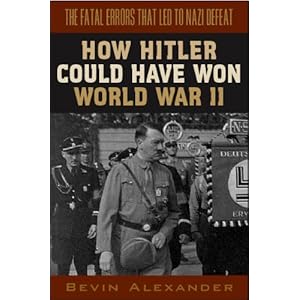
With literally thousands of titles to choose, the average reader may feel overwhelmed.  But if you’re looking for an understandable, overall view of Hitler’s generalship, an excellent choice would be How Hitler Could Have Won World War II by Bevin Alexander.

How Hitler Could Have Won World War II

Among “the fatal errors that led to Nazi defeat” (as proclaimed on the book jacket) were:

  • Wasting hundreds of Luftwaffe pilots, fighters and bombers in a half-hearted attempt to conquer England.
  • Ignoring the pleas of generals like Erwin Rommel to conquer Syria, Iraq and Saudi Arabia–thus giving Germany control of most of the world’s oil.
  • Attacking his ally, the Soviet Union, while still at war with Great Britain.
  • Needlessly turning millions of Russians into enemies rather than allies by his brutal and murderous policies.
  • Declaring war on the United States after the Japanese attacked Pearl Harbor.  (Had he not done so, Americans would have focused all their attention on conquering Japan.)
  • Refusing to negotiate a separate peace with Soviet dictator Joseph Stalin–thus granting Germany a large portion of captured Russian territory in exchange for letting Stalin remain in power.
  • Insisting on a ”not one step back” military “strategy” that led to the unnecessary surrounding, capture and/or deaths of hundreds of thousands of German servicemen.

As the war turned increasingly against him, Hitler became ever more rigid in his thinking.  He demanded absolute control over the smallest details of his forces.  This, in turn, led to astounding and needless losses in German soldiers.

One such incident was immortalized in the 1962 movie, The Longest Day, about the Allied invasion of France known as D-Day.

On June 6, 1944, Rommel ordered the panzer tanks to drive the Allies from the Normandy beaches.  But these could not be released except on direct order of the Fuehrer.

As Hitler’s chief of staff, General Alfred Jodl, informed Rommel: The Fuehrer was asleep–and, no, he, Jodl, would not wake him.

By the time Hitler awoke and issued the order, it was too late.

Nor could he accept responsibility for the policies that were clearly leading Germany to certain defeat.  Hitler blamed his generals, accused them of cowardice, and relieved many of the best ones from command.

Among those sacked was Heinz Guderian, creator of the German panzer corps–and thus responsible for its highly effective “blitzkrieg” campaign against France in 1940.

Heinz Guderian

Another was Erich von Manstein, designer of the strategy that defeated France in six weeks–something Germany couldn’t do during the four years of World War 1.

Erich von Manstein

Finally, on April 29, 1945–with the Russians only blocks from his underground bunker in Berlin–Hitler dictated his “Last Political Testament.”  Once again, he refused to accept responsibility for unleashing a war that would ultimately consume 50 million lives:

“It is untrue that I or anyone else in Germany wanted war in 1939.  It was desired and instigated exclusively by those international statesmen who either were of Jewish origin or worked for Jewish interests.”

Hitler had launched the war with a lie–that Poland had attacked Germany, rather than vice versa.  And he closed the war–and his life–with a final lie.

All of which, once again, brings us back to Niccolo Machiavelli, the father of political science.

In his classic book, The Discourses, he wrote at length on the best ways to maintain liberty within a republic.  In Book Three, Chapter 31, Machiavelli declares: “Great Men and Powerful Republics Preserve an Equal Dignity and Courage in Prosperity and Adversity.”

It is a chapter that Adolf Hitler would have done well to read.

“…A truly great man is ever the same under all circumstances.  And if his fortune varies, exalting him at one moment and oppressing him at another, he himself never varies, but always preserves a firm courage, which is so closely interwoven with his character that everyone can readily see that the fickleness of fortune has no power over him.

“The conduct of weak men is very different.  Made vain and intoxicated by good fortune, they attribute their success to merits which they do not possess, and this makes them odious and insupportable to all around them. 

And when they have afterwards to meet a reverse of fortune, they quickly fall into the other extreme, and become abject and vile.  

“Thence it comes that princes of this character think more of flying in adversity than of defending themselves, like men who, having made a bad use of prosperity, are wholly unprepared for any defense against reverses.”

Stay alert to signs of such character flaws among your own business colleagues–and especially your superiors.  They are the warning signs of a future catastrophe.

NEGOTIATING NAZI-REPUBLICAN STYLE: PART ONE (OF SEVEN)

In Bureaucracy, History, Politics, Social commentary on August 6, 2013 at 10:00 pm

Adolf Hitler, Germany’s Fuehrer for 12 years, had a favorite phrase: “So oder so.”

It meant: “One way or the other.”

That might sound innocuous.  But, in Hitler’s case, it carried a sinister tone–as did nearly everything else about the dictator who ruled Germany from 1933 to 1945.

Adolf Hitler

When Hitler faced what he considered a problem, he said he would solve it “one way or another.”  Which meant that if he didn’t get his way, he would apply whatever means it took until he did.

Indiana State Treasurer Richard Mourdock, who unsuccessfully campaigned in 2012 to become the Republican U.S. Senator from Indiana, had a similar view toward compromise.

Appearing on the May 9, 2012 edition of right-wing “Fox & Friends,” Mourdock said:

Richard Mourdock

“I have a mindset that says bipartisanship ought to consist of Democrats coming to the Republican point of view.”

Robert Payne, author of the bestselling biography, The Life and Death of Adolf Hitler (1973), described Hitler’s “negotiating” style thusly:

“Although Hitler prized his own talents as a negotiator, a man always capable of striking a good bargain, he was totally lacking in finesse.  He was incapable of bargaining.  He was like a man who goes up to a fruit peddler and threatens to blow his brains out if he does not sell his applies at the lowest possible price.”

Now, consider the similarity between Payne’s description of Hitler and Mourdock’s description of what “bipartisanship” means to him:

“I’ve said many times through this campaign that one of the things I hope to do is to help build a conservative majority in the United States Senate and continue to help the House build a Republican majority and have a Republican White House and then bipartisanship becomes having Democrats come our way.”

A classic example of Hitler’s “negotiating style” occurred in 1938, when he invited Austrian Chancellor Kurt von Schuschnigg to his mountaintop retreat in Obersalzberg, Germany.  Hitler, an Austrian by birth, intended to annex his native land to Germany.

Schuschnigg was aware of Hitler’s desire, but nevertheless felt secure in accepting the invitation.  He had been assured that the question of Austrian sovereignty would not arise.

By studying Hitler’s mindset and “negotiating” methods, we can learn much about the mindset and “negotiating” style of our own Republican party.

Shuschnigg opened the discussion with a friendly compliment.  Walking over to a large window, he admired the breathtaking view of the mountains.

HITLER: We haven’t come here to talk about the lovely view or the weather!

Austria has anyway never done anything which was of help to the German Reich….I am resolutely determined to make an end to all this business.  The German Reich is a great power.  Nobody can and nobody will interfere if it restores order on its frontiers.

SCHUSCHNIGG: I am aware of your attitude toward the Austrian question and toward Austrian history….As we Austrians see it, the whole of our history is a very essential and valuable part of German history….And Austria’s contribution is a considerable one.

HITLER: It is absolutely zero—that I can assure you!  Every national impulse has been trampled underfoot by Austria….

I could call myself an Austrian with just the same right—indeed with even more right—than you, Herr Schuschnigg. Why don’t you once try a plebiscite in Austria in which you and I run against each other? Then you would see!

SCHUSCHNIGG: Well, yes, if that were possible. But your know yourself, Herr Reich Chancellor, that it just isn’t possible. We simply have to go on living alongside one another, the little state next to the big one. We have no other choice.

And that is why I ask you to tell me what your concrete complaints are. We will do all in our power to sort things out and establish a friendly relationship, as far as it is possible to do so.

HITLER: That’s what you say, Herr Schuschnigg. And I am telling you that I intend to clear up the whole of the so-called Austrian question–one way or another. Do you think I don’t know that you are fortifying Austria’s border with the Reich?

SCHUSCHNIGG: There can be no suggestion at all of that—

HITLER: Ridiculous explosive chambers are being built under bridges and roads—

This was a lie, and Hitler knew it was a lie. But no matter. It gave him an excuse to threaten to destroy Austria—as he was to destroy so many other nations during the next seven years.

* * * * *

Lest this comparison be thought an exaggeration, consider this:

Republicans used precisely the same “negotiating” style during the summer of 2011 to threaten the United States with financial ruin unless they got their way in budget negotiations.

And they are threatening to do the same again this fall.

BUSHITLER AND WARS OF SHAME: PART TWO (END)

In History, Politics on March 26, 2013 at 12:01 am

Naturally the common people don’t want war, neither in Russia nor in England nor in America, nor for that matter in Germany.  That is understood.

But, after all, it’s the leaders of the country who determine the policy, and it’s always a simple matter to drag the people along whether it’s a democracy, a fascist dictatorshp, or a prliament, or a communist dictatorship….

All you have to do is tell them that they are being attacked, and denounce the pacifists for lack of patriotism and exposing the country to greater danger.  It works the same way in any country.

Rcichsmarshall Hermann Goering

March 19, 2013 marked the tenth anniversary of the start of America’s war against Iraq.  And the national news networks have been dutifully noting it.

Yet none of these networks has dared to point out there is a dark historical parallel to the events leading up to the Iraq war.  A parallel that has its roots in Nazi Germany.

ADOLF HITLER

Adolf Hitler knew that Poland’s government could never accept his demands for the Polish city of Danzig.

GEORGE W. BUSH

So, too, did George W. Bush make a demand he knew could never be accepted.  On the eve of launching war on Iraq, Bush issued a humiliating ultimatum to Saddam Hussein:

“Saddam Hussein and his sons must leave Iraq within 48 hours. Their refusal to do so will result in military conflict, commenced at a time of our choosing.”

ADOLF HITLER

Hitler never regretted his decision to invade Poland–-even asserting in his “final political testament” that: “It is untrue that I or anyone else in Germany wanted war in 1939.”

GEORGE W. BUSH

Similarly, Bush never regretted his decision to invade Iraq, which occurred on March 19, 2003.

Adolf Hitler

ADOLF HITLER

When he announced his attack on Poland before Germany’s rubber-stamp parliament, the Reichstag, Hitler–a decorated World War I veteran–said: “I am from now on just first soldier of the German Reich. I have once more put on that coat that was the most sacred and dear to me.”

GEORGE W. BUSH

On May 1, 2003, Bush–who hid out the Vietnam war in the Texas Air National Guard-–donned a flight suit and landed a Navy jet aboard the USS Abraham Lincoln.  A banner titled “Mission Accomplished” was displayed on the aircraft carrier as Bush announced–wrongly–that the war was over.

The effect–and intent–was to portray Bush as the triumphant warrior-chieftan he never was.

George W. Bush

ADOLF HITLER

In 1970, Albert Speer, Hitler’s former architect and Minister of Aramaments, published his bestselling postwar memoirs, Inside the Third Reich.  In a striking passage, he revealed how the Fuehrer really felt about German soldiers who were suffering and dying in a war he had provoked.

One evening during the middle of the war, Speer was traveling with Hitler on the Fuehrer’s private train.  Late at night, they enjoyed a lavish dinner in the elegant rosewood-paneled dining car.

As they ate, Hitler’s train slowed down and passed a freight train halted on a side track.

From their open cattle car, recalled Speer, wounded German soldiers from the Russian Front–starved, their uniforms in rags–stared across the few yards to their Fuehrer’s dining-car window.

Hitler recoiled at seeing these injured men intently watching him–and he sharply ordered an adjutant to lower the window shades.

GEORGE W. BUSH

Similarly, Bush showed his contempt for the soldiers suffering and dying in his own unprovoked war.

On March 24, 2004, at a White House Correspondents dinner, he joked publicly about the absence of Weapons of Mass Destruction (WMDs).

To Bush, the non-existent WMDs were nothing more than the butt of a joke that night.  While an overhead projector displayed photos of a puzzled-looking Bush searching around the Oval Office, Bush recited a comedy routine.

“Those weapons of mass destruction have gotta be somewhere,” Bush laughed, while a photo showed him poking around the corners in the Oval Office.

“Nope-–no weapons over there!  Maybe they’re under here,” he said, as a photo showed him looking under a desk.

In a scene that could have occurred under the Roman emperor Nero, an assembly of wealthy, pampered men and women–-the elite of America’s media and political classes–-laughed heartily during Bush’s performance.

Click here: Bush laughs at no WMD in Iraq – YouTube

In writing about the significance of human character, the ancient historian, Plutarch, said it best:

And the most glorious exploits do not always furnish us with the clearest discoveries of virtue or vice in men.

Sometimes a matter of less moment, an expression or a jest, informs us better of their characters and inclinations, than the most famous sieges, the greatest armaments, or the bloodiest battles whatsoever.

So add it all up:

  • Two all-powerful leaders.
  • Two nations lied into unprovoked wars.
  • Hitler’s war costs the lives of 4.5 million German soldiers.
  • Bush’s war costs the lives of 4,486 Americans.
  • Germany’s war results in the deaths of millions of Europeans and Russians.
  • America’s war results in the deaths of an estimated 655,000 Iraqis, according to a 2006 study in the Lancet medical journal.
  • Hitler is literally driven underground by his enemies and commits suicide to avoid capture, trial and certain execution for war crimes.
  • Bush retires from office with a lavish pension and full Secret Service protection.  He writes his memoirs and is paid $7 million for the first 1.5 million copies.
  • Hitler is branded as a symbol of demonic evil.
  • Bush becomes a target of ridicule for comics.

Who says history is irrelevant?  Or that it doesn’t repeat itself?

BUSHITLER AND WARS OF SHAME: PART ONE (OF TWO)

In History, Politics on March 25, 2013 at 12:01 am

March 19, 2013 marked the tenth anniversary of the start of America’s war against Iraq.  And the national news networks have been dutifully noting it.

Yet none of these networks has dared to point out there is a dark historical parallel to the events leading up to the Iraq war.  A parallel that has its roots in Nazi Germany.

ADOLF HITLER

When Germany’s Fuehrer, Adolf Hitler, wanted to invade Poland in 1939, he mounted a sustained propaganda campaign to “justify” his ambitions.

Adolf Hitler

German “newspapers”-–produced by Joseph Goebbels, the club-footed Minister of Propaganda–-carried fictitious stories of how brutal Poles were beating and even murdering their helpless German citizens.

In theaters, German audiences saw phony newsreels showing Poles attacking and raping German women living in Poland.

For a time, Hitler not only deceived the Germans but the world.

Just before German tanks and troops invaded Poland on September 1, 1939, members of Hitler’s dreaded SS rounded up a number of prisoners from German concentration camps.

They inmates were dressed in Polish Army uniforms and driven to a German radio station at Gleiwitz, on the German/Polish border. There they were shot by SS men. Then Polish-speaking SS men “seized” the station and broadcast to Germany that a Polish invasion of Germany was now under way.

Hitler, addressing Germany’s rubber-stamp parliament, the Reichstag, dramatically asserted: “This night for the first time Polish regular soldiers fired on our territory. Since 5.45 a.m. we have been returning the fire, and from now on bombs will be met by bombs.”

Leaders of Britain and France were taken in by this ruse. They had pledged to go to war if Hitler attacked Poland.  But they didn’t want to take on Germany if Poland had been the aggressor.

By the time the truth became known, Poland was securely in German hands.

On August 22, Hitler had outlined his strategy to a group of high-ranking military officers:

I shall give a propagandist cause for starting the war.  Never mind whether it is plausible or not. The victor will not be asked, later on, whether he told the truth or not. In starting and waging a war, it is not Right that matters, but Victory.

GEORGE W. BUSH

American President George W. Bush followed a similar strategy while he prepared to invade Iraq: He ordered the topmost members of his administration to convince the American people of the war’s necessity.

Among those members: National Security Advisor Condoleeza Rice; Vice President Dick Cheney; Secretary of Defense Donald Rumsfeld; and Secretary of State Colin Powell.

Condaleeza Rice, Dick Cheney, George W. Bush and Donald Rumsfeld

Among their arguments-–all eventually revealed as lies-–were:

  • Iraq’s dictator, Saddam Hussein, had worked hand-in-glove with Osama Bin Laden to plan 9/11.
  • Saddam was harboring and supporting Al Qaeda throughout Iraq.
  • Saddam, with help from Al Qaeda, was scheming to build a nuclear bomb.
  • Iraq possessed huge quantities of chemical/biological weapons, in violation of UN resolutions.
  • Saddam was preparing to use those weapons against the United States.
  • American Intelligence agencies had determined the precise locations where those weapons were stored.
  • The war would be self-financing via the oil revenues that would come from Iraq.
  • Invading American forces would be welcomed as liberators.

ADOLF HITLER

Hitler intended Poland to be only his first conquest on what became known as “the Eastern Front.”  Conquering Poland would place his powerful Wehrmacht on the border of the country that was his ultimate target: The Soviet Union.

GEORGE W. BUSH

Similarly, Vice President Dick Cheney–the “power-behind-the-throne” of the Bush Presidency–had his own ambitions for conquering Iraq.

According to former Bush speechwriter David Frum: Cheney longed for war in Iraq to gain reliable control of that nation’s vital oil resources.

ADOLF HITLER

Despite efforts by the British and French governments to resolve the crisis that Hitler had deliberately created, he refused all offers of compromise.

“I am only afraid,” Hitler told his generals at a military conference on August 22, 1939, “that some Schweinehund [pig dog] will make a proposal for mediation.”

GEORGE W. BUSH

Similarly, Bush made it clear to his closest aides that he sought a pretext for invading Iraq.

On the evening after the September 11 attacks, Bush held a private meeting with Richard Clarke, the counter-terrorism advisor to the National Security Council.

“I want you, as soon as you can, to go back over everything,” said Bush. “See if Saddam did this. See if he’s linked in any way.”

Clarke was stunned: “But, Mr. President, Al Qaeda did this.”

“I know, I know,” said Bush. “But see if Saddam was involved. I want to know.”

On September 12, 2001, Bush attended a meeting of the National Security Council.

“Why shouldn’t we go against Iraq, not just Al Qaeda?” demanded Donald Rumsfeld, the Secretary of Defense.

Vice President Dick Cheney enthusiastically agreed.

Secretary of State Colin Powell then pointed out there was absolutely no evidence that Iraq had had anything to do with 9/11 or Al Qaeda. And he added: “The American people want us to do something about Al-Qaeda”-–not Iraq.

On September 22, 2001, Bush had received a classified President’s Daily Brief intelligence report, which stated that there was no evidence linking Saddam Hussein to 9/11.

The report added that there was scant credible evidence that Iraq had any significant collaborative ties with Al Qaeda.

Yet on November 21, 2001, only 10 weeks after 9/11, Bush told Rumsfeld: It’s time to turn to Iraq.

George W. Bush