Posts Tagged ‘WORLD WAR 11’
2016 PRESIDENTIAL ELECTION, 9/11, ABC NEWS, ADOLF HITLER, AFGHANISTAN, ALTERNET, AP, ASIANS, BARACK OBAMA, BLACKS, BULLYING, BUZZFEED, CBS NEWS, CNN, COMMUNISM, CROOKS AND LIARS, DAILY KOZ, DONALD TRUMP, FACEBOOK, FASCISM, GEORGE W. BUSH, GREAT DEPRESSION, HILLARY CLINTON, HISPANICS, IRAQ, JEWS, MOTHER JONES, MOVEON, MUSLIMS, NAZI GERMANY, NAZI PARTY, NBC NEWS, NEWSWEEK, NPR, PAUL VON HINDENBURG, POLITICO, RACISM, RAW STORY, REPUBLICANS, REUTERS, ROBERT PAYNE, Ronald Reagan, SALON, SEATTLE TIMES, SLATE, THE ATLANTIC, THE CHICAGO SUN-TIMES, THE CHICAGO TRIBUNE, THE DAILY BEAST, THE GUARDIAN, THE HILL, THE HUFFINGTON POST, THE LIFE AND DEATH OF ADOLF HITLER, THE LOS ANGELES TIMES, THE LOS ANGELS TIMES, THE NATION, THE NEW YORK TIMES, THE WASHINGTON POST, TIME, TRUMP EFFECT, TWITTER, U.S. NEWS & WORLD REPORT, UP, UPI, USA TODAY, WORLD WAR 11
In Bureaucracy, History, Politics, Social commentary on September 7, 2017 at 12:30 am
In his bestselling 1973 biography, The Life and Death of Adolf Hitler, British historian Robert Payne harshly condemned the German people for the rise of the Nazi dictator.
“Ultimately the responsibility for the rise of Hitler lies with the German people, who allowed themselves to be seduced by him and came to enjoy the experience….[They] followed him with joy and enthusiasm because he gave them license to pillage and murder to their hearts’ content.
“They were his servile accomplices, his willing victims: Germany will rule the world; our enemies will be our slaves….
“If he answered their suppressed desires, it was not because he shared them, but because he could make use of them. He despised the German people, for they were merely the instruments of his will.”
On November 8, millions of ignorant, hate-filled, Right-wing Americans elected Donald Trump—a man reflecting their own hate and ignorance—to the Presidency.
Yet, in some ways, Americans had fewer excuses for turning to a Fascistic style of government than the Germans did.
Adolf Hitler joined the National Socialist German Workers (Nazi) Party in 1919—the year after World War 1 ended.
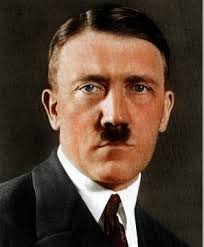
Adolf Hitler
It took him 14 years to win appointment to Chancellor (the equivalent of Attorney General) of Germany in 1933.
In 1923, he staged a coup attempt in Bavaria—which was quickly and brutally put down by police. He was arrested and sentenced to less than a year in prison.
After that, Hitler decided that winning power through violence was no longer an option. He must win it through election—or appointment.
He repeatedly ran for the highest office in Germany—President—but never got a clear majority in a free election.
When the 1929 Depression struck Germany, the fortunes of Hitler’s Nazi party rose as the life savings of ordinary Germans fell. Streets echoed with bloody clashes between members of Hitler’s Nazi Stormtroopers and those of the German Communist Party.
Germany seemed on the verge of collapsing.Germans desperately looked for a leader—a Fuhrer—who could somehow deliver them from the threat of financial ruin and Communist takeover.
In early 1933, members of his own cabinet persuaded aging German president, Paul von Hindenburg, that only Hitler’s appointment as Chancellor could do this.
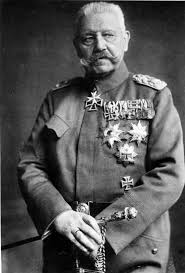
Paul von Hindenburg
Hindenburg was reluctant to do so. He considered Hitler a dangerous radical. But he allowed himself to be convinced that, by putting Hitler in the Cabinet, he could be “boxed in” and thus controlled.
So, on January 30, 1933, he appointed Adolf Hitler Chancellor of Germany.
On August 2, 1934, Hindenberg died, and Hitler immediately assumed the titles–and duties—of the offices of Chancellor and President. His rise to total power was now complete.
It had taken him 14 years to do so.
In 2015, Donald Trump declared his candidacy for President.Now, consider this:
- The United States was technically at war in the Middle East—but the fate of the United States was not truly threatened, as it had been during the Civil War.
- There was no draft; if you didn’t know someone in the military, you didn’t care about the casualties taking place.
- Nor were these conflicts—in Iraq and Afghanistan–imposing domestic shortages on Americans, as World War II had.
- Thanks to government loans from President Barack Obama, American capitalism had been saved from its own excesses during the George W. Bush administration.
- Employment was up. CEOs were doing extremely well.
- In contrast to the corruption that had plagued the administration of Ronald Reagan, whom Republicans idolize, there had been no such scandals during the Obama Presidency.
- Nor had there been any large-scale terrorist attacks on American soil—as there had on 9/11 under President George W. Bush.
- Yet—not 17 months after announcing his candidacy for President–enough Americans fervently embraced Donald Trump to give him the most powerful position in the country and the world.

Donald Trump
The message of Barack Obama’s 2008 campaign had been one of hope—“Yes, We Can!”
That of Donald Trump’s campaign was one of hatred toward everyone who was not an avid Trump supporter: “No, You Can’t!”
Whites comprised the overwhelming majority of the audiences at Trump rallies. Not all were racists, but many of those who were advertised it on T-shirts: “MAKE AMERICA WHITE AGAIN.”
They knew that demographics were steadily working against them. Birthrates among non-whites were rising. By 2045, whites would make up less than 50 percent of the American population.
The 2008 election of the first black President had shocked whites. His 2012 re-election had deprived them of the hope that 2008 had been an accident.
Then came 2016—and the possibility that a black President might actually be followed by a woman: Hillary Clinton. And the idea of a woman dictating to men was strictly too much to bear.
Since Trump’s election, educators have reported a surge in bullying among students of all ages, from elementary- to high-school. Those doing the bullying are mostly whites, and the victims are mostly blacks, Muslims, Jews, Hispanics, Asians.
It even has a name: “The Trump Effect.”
All of this should be remembered the next time an American blames Germans for their embrace of Adolf Hitler.
ABC NEWS, ADOLF HITLER, AFFORDABLE CARE ACT, ALBERT SPEER, ALTERNET, BARACK OBAMA, BUZZFEED, CBS NEWS, CNN, DAILY KOS, DEBT CEILING, DEPARTMENT OF HOMELAND SECURITY, DONALD TRUMP, EXTORTION, FACEBOOK, FASCISM, HOUSE SPEAKER JOHN BOEHNER, MOTHER JONES, MOVEON, NAZI GERMANY, NBC NEWS, NEGOTIATING, NEWSWEEK, NPR, OBAMACARE, PAP SMEARS, PLANNED PARENTHOOD, POLITICO, RAW STORY, REPUBLICAN PARTY, REPUBLICANS, SALON, SLATE, THE CHICAGO SUN-TIMES, THE CHICAGO TRIBUNE, THE DAILY BEAST, THE HUFFINGTON POST, THE LOS ANGELES TIMES, THE NEW YORK TIMES, THE WALL STREET JOURNAL, THE WASHINGTON POST, TIME, TRICKLE-DOWN ECONOMICS, TWITTER, U.S. NEWS & WORLD REPORT, USA TODAY, WARREN BUFFET, WORLD WAR 11
In Bureaucracy, History, Law, Military, Politics, Social commentary on July 21, 2017 at 12:21 am
On March 6, 2017, House Republican leaders unveiled the American Health Care Act (AHCA) as their replacement for “Obamacare.”
Conservative Republicans immediately declared that it didn’t repeal and replace Obamacare. And “moderates” complained that it would leave too many people uninsured.
Democrats, meanwhile, stayed silent. They had pushed hard in 2009-10 to provide all Americans with access to healthcare. And they weren’t going to participate in dismantling their signature legislation.
On March 13, the non-partisan Congressional Budget Office released its report estimating that about 18 million people would be uninsured in 2018 if the AHCA were enacted. The number of uninsured people would reach 19 million in 2020 and 24 million in 2026.
Still, Republicans plunged forward, with House leaders tweaking it slightly to win conservative and “moderate” votes.
Still, conservatives felt the bill helped too many people. And “moderates” feared that the millions of voters who would lose their insurance would vote them out of office at the next election.
On March 24, President Donald Trump, knowing the AHCA couldn’t pass the House, asked Speaker Paul Ryan to pull it off the floor.
And Ryan did so, only moments before a scheduled vote.
Finally, on May 4, House Republicans were ready to vote to pass the AHCA.
The vote was preceded by a pep rally, which featured beer, the “Rocky” theme song, the “Taking Care of Business” song, a prayer and the reciting of the Pledge of Allegiance.
Some Republicans, asked whether they had read the bill they supported, refused to answer.
That up to 24 million Americans would lose their medical insurance meant nothing to Right-wingers.
What did matter to them was:
- Destroying the legacy of Barack Obama, the nation’s first black President; and
- Initiating a huge transfer of wealth from the poor and middle-class to the 1% wealthiest.
On May 4, House Republicans passed the AHCA and sent it the Senate. There it was expected to be significantly revised.
But this, too, didn’t matter to House Republicans. They had “kept faith” with their hate-filled. Right-wing constituents—and assured their own re-elections.
Speaking in front of nearly 100 GOP lawmakers in the White House Rose Garden, Trump boasted that the AHCA would “finish off” the “catastrophe” of Obamacare.

Donald Trump
At a White House celebration, Trump boasted: “This has brought the Republican Party together.”
But then came disaster—for Republicans—in the Senate.
With Democrats abstaining, Republicans found themselves fighting each other.
Some wanted to gut “Obamacare” entirely, whatever the consequences for the 24 million Americans who would be left without insurance.
Others feared that slashing more than $700 billion from Medicaid—the Federal medical insurance program for the poor—would lead to millions of angry voters turning out Republicans at the polls.
(And slashing Medicaid—as opposed to expanding it, as President Obama had sought to do—was a major reason why Republicans wanted to overturn “Obamacare.”)
Senate Majority Leader Mitch McConnell (R-KY) desperately tried to hammer out a compromise between the two opposing sides. When this proved impossible, it was clear the “repeal and replace” bill wouldn’t pass the Senate.
At that point, President Trump tweeted his own solution: “Republicans should just ‘REPEAL’ failing ObamaCare now & work on a new Healthcare Plan that will start from a clean slate. Dems will join in!”
But this proved too politically risky for some Republicans.
On July 18, Republican Senators’ efforts to replace the ACA without a ready replacement collapsed.
As usual, Donald Trump had a ready “solution” to offer. Like Adolf Hitler issuing his “scorched earth” order in a doomed Berlin in 1945, the President said:
“Let Obamacare fail; it’ll be a lot easier. And I think we’re probably in that position where we’ll just let Obamacare fail.
“We’re not going to own it. I’m not going to own it. I can tell you the Republicans are not going to own it. We’ll let Obamacare fail, and then the Democrats are going to come to us and they’re going to say, ‘How do we fix it? How do we fix it?’ Or, ‘How do we come up with a new plan?’”
* * * * *
Allowing Obamacare to fail would deprive millions of Americans of healthcare. But that meant nothing to Donald Trump.
Just as destroying everything still remaining in Germany had meant nothing to Adolf Hitler.
Fortunately for Germany, one man—Albert Speer—finally broke ranks with his Fuhrer.
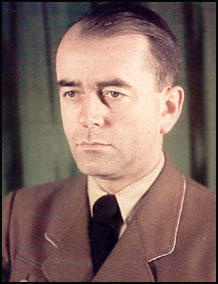
Albert Speer
Risking death, he refused to carry out Hitler’s “scorched earth” order. Even more important, he mounted a successful effort to block such destruction and persuade influential military and civilian leaders to disobey the order as well.
As a result, those targets slated for destruction were spared.
Since the election of America’s first black President, Republicans have waged a similar “scorched earth” campaign.
Acting as extortionists, they repeatedly threatened to shut down the government if they didn’t get their way in legislative matters. And they repeatedly blocked legislation to help the poor, the unemployed, the sick, women, the elderly, the disabled and the middle-class.
Like Adolf Hitler, their attitude has been: “If I can’t rule America, there won’t be an America.”
The country is still waiting for a Republican Albert Speer to step forward and save America from the self-destructive brutalities of its own Right-wing fanatics.
ABC NEWS, ADOLF HITLER, AFFORDABLE CARE ACT, ALBERT SPEER, ALTERNET, BARACK OBAMA, BUZZFEED, CBS NEWS, CNN, DAILY KOS, DEBT CEILING, DEPARTMENT OF HOMELAND SECURITY, DONALD TRUMP, EXTORTION, FACEBOOK, FASCISM, HOUSE SPEAKER JOHN BOEHNER, MOTHER JONES, MOVEON, NAZI GERMANY, NBC NEWS, NEGOTIATING, NEWSWEEK, NPR, OBAMACARE, PAP SMEARS, PLANNED PARENTHOOD, POLITICO, RAW STORY, REPUBLICAN PARTY, REPUBLICANS, SALON, SLATE, THE CHICAGO SUN-TIMES, THE CHICAGO TRIBUNE, THE DAILY BEAST, THE HUFFINGTON POST, THE LOS ANGELES TIMES, THE NEW YORK TIMES, THE WALL STREET JOURNAL, THE WASHINGTON POST, TIME, TRICKLE-DOWN ECONOMICS, TWITTER, U.S. NEWS & WORLD REPORT, USA TODAY, WARREN BUFFET, WORLD WAR 11
In Bureaucracy, History, Law, Military, Politics, Social commentary on July 20, 2017 at 12:50 am
Albert Speer, Minister of Armaments for the Third Reich, was appalled.
His Fuhrer, Adolf Hitler—the man he had idolized for 14 years—had just passed a death sentence on Germany, the nation he claimed to love above all others.
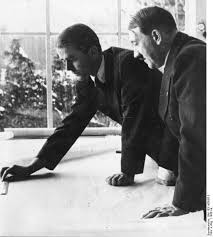
Albert Speer and Adolf Hitler pouring over architectural plans
On March 19, 1945, facing certain defeat, Hitler had ordered a massive “scorched-earth” campaign throughout Germany.
All German agriculture, industry, ships, communications, roads, food stuffs, mines, bridges, stores and utility plants were to be destroyed.
If implemented, it would deprive the entire German population of even the barest necessities after the war.
Now living in a bunker 50 feet below bomb-shattered Berlin, Hitler gave full vent to his most destructive impulses.
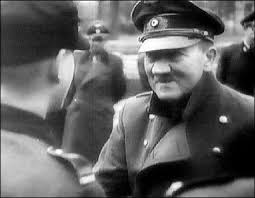
Adolf Hitler addressing boy soldiers as the Third Reich crumbles
“If the war is lost,” Hitler told Speer, “the nation will also perish. This fate is inevitable. There is no necessity to take into consideration the basis which the people will need to continue even a most primitive existence.
“On the contrary, it will be better to destroy these things ourselves, because this nation will have proved to be the weaker one and the future will belong solely to the stronger eastern nation.
“Besides, those who will remain after the battle are only the inferior ones, for the good ones have all been killed.”
Speer argued in vain that there must be a future for the German people. But Hitler refused to back down. He gave Speer 24 hours to reconsider his opposition to the order.
The next day, Speer told Hitler: “My Fuhrer, I stand unconditionally behind you!”
“Then all is well,” said Hitler, suddenly with tears in his eyes.
“If I stand unreservedly behind you,” said Speer, “then you must entrust me rather than the Gauleiters [district Party leaders serving as provincial governors] with the implementation of your decree.”
Filled with gratitude, Hitler signed the decree Speer had thoughtfully prepared before their fateful meeting.
By doing so, Hitler unintentionally gave Speer the power to thwart his “scorched earth” decree.
Speer had been the closest thing to a friend in Hitler’s life. Trained as an architect, he had joined the Nazi Party in 1931.
He met Hitler in 1933, when he presented the Fuhrer with architectural designs for the Nuremberg Rally scheduled for that year.
From then on, Speer became Hitler’s “genius architect” assigned to create buildings meant to last for a thousand years.
In 1943, Hitler appointed him Minister of Armaments, charged with revitalizing the German war effort.
Nevertheless, Speer now crisscrossed Germany, persuading military leaders and district governors to not destroy the vital facilities that would be needed after the war.
“No other senior National Socialist could have done the job,” writes Randall Hanson, author of Disobeying Hitler: German Resistance After Valkyrie.
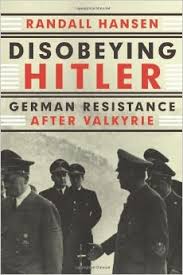
“Speer was one of the very few people in the Reich—perhaps even the only one—with such power to influence actors’ willingness/unwillingness to destroy.”
Despite his later conviction for war crimes at Nuremberg, Speer never regretted his efforts to save Germany from total destruction at the hands of Adolf Hitler.
Fast-forward to the United States and the 2008 election of the nation’s first black President.
On March 23, 2010, President Barack Obama signed into law the Affordable Care Act (ACA), nicknamed Obamacare. Its purpose: To provide access to healthcare for millions of poor and middle-class Americans who had heretofore been unable to obtain it.
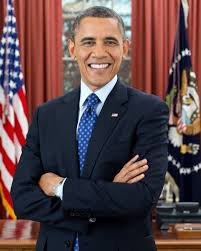
President Barack Obama
It became—and remains—Obama’s signature legislative accomplishment.
Republicans immediately declared “Obamacare” Public Enemy Number One and set out to repeal it. By March 2014 they had already voted against it 54 times, trying to undo or substantially change it.
In October, 2013, they shut down the Federal Government for 15 days. They hoped to extort Obama into de-funding the ACA: If he did, they would re-open Federal agencies.
But, facing pressure from voters unable to obtain basic government services, Republicans backed down.
During the 2016 Presidential campaign, every Republican candidate pledged to repeal Obamacare if s/he were elected.
Donald Trump—who won the Republican nomination and then the election—repeatedly made this the centerpiece of his campaign.
On October 25, he promised: “My first day in office, I am going to ask Congress to put a bill on my desk getting rid of this disastrous law and replacing it with reforms that expand choice, freedom, affordability.
“You’re going to have such great health care at a tiny fraction of the cost. And it’s going to be so easy.”
But after taking office on January 20, he found that replacing the ACA wasn’t so easy.
On March 6, 2017, House Republicans unveiled the American Health Care Act (AHCA). This was attacked by conservatives because it didn’t repeal and replace Obamacare. And “moderate” Republicans complained that it would leave too many people uninsured.
On March 13, 2017, the Congressional Budget Committee released its report estimating that about 18 million people would be uninsured in 2018 if the AHCA were enacted. The number of uninsured people would reach 19 million in 2020 and 23 million in 2026.
Still, Republicans plunged forward, with House leaders making slight changes to win conservative and moderate votes.
ABC NEWS, ADOLF HITLER, ALBERT SPEER, ALTERNET, AP, BARACK OBAMA, BBC, BUZZFEED, CBS NEWS, CNN, DAILY KOS, DEPARTMENT OF HOMELAND SECURITY, EXTORTION, FACEBOOK, FASCISM, MITCH MCCONNELL, MOTHER JONES, MOVEON, NAZI GERMANY, NBC NEWS, NEGOTIATING, NEWSWEEK, NPR, POLITICO, RAW STORY, REPUBLICAN PARTY, REPUBLICANS, REUTERS, SALON, SEATTLE TIMES, SLATE, THE ATLANTIC, THE CHICAGO SUN-TIMES, THE CHICAGO TRIBUNE, THE DAILY BEAST, THE GUARDIAN, THE HILL, THE HUFFINGTON POST, THE LOS ANGELES TIMES, THE NEW YORK TIMES, THE WALL STREET JOURNAL, THE WASHINGTON POST, TIME, TRICKLE-DOWN ECONOMICS, TWITTER, U.S. NEWS & WORLD REPORT, UPI, USA TODAY, WORLD WAR 11
In Bureaucracy, History, Law, Law Enforcement, Military, Politics, Social commentary on June 28, 2017 at 9:17 am
On December 13, 2014, the U.S. Senate passed a $1.1 trillion spending bill to fund almost the entire government through the September 30 end of the fiscal year.
But one Federal agency was pointedly exempted from full funding: The Department of Homeland Security (DHS). Its funding would expire on February 27.
With their newfound majorities in both houses of Congress, Republicans intended to hold the security of the United States as a hostage.
Their goal: To force President Barack Obama to rescind the changes he had made in American immigration policy.
With more than 240,000 employees, the DHS is the third largest Cabinet department, after the Departments of Defense and Veterans Affairs.
The Defense Department is charged with military actions abroad.
DHS is responsible for protecting the United States inside and outside its borders. Its goal is to prepare for, prevent and—if prevention fails—respond to man-made accidents, natural disasters and terrorism.

Among the agencies now operating under its mandate:
- U.S. Citizenship and Immigration Services
- U.S. Customs and Border Protection
- U.S. Coast Guard
- Federal Emergency Management Agency (FEMA)
- Federal Law Enforcement Training Center
- U.S. Immigration and Customs Enforcement (ICE)
- Transportation and Safety Administration (TSA)
- U.S. Secret Service
- Science and Technology Directorate
- Domestic Nuclear Detection Office
- Office of Intelligence and Analysis
- Office of Operations Coordination and Planning
Yet each of these agencies has a vital role to play in protecting the nation. A nation whose security Republicans were willing to threaten to get their way on a matter of domestic policy.
Right-wing Republicans argued that even if DHS’s funding were stopped, most of its employees would stay on the job. That’s because they perform work considered necessary to protect human life and property.
But while those employees were safeguarding the country, they wouldn’t be paid until the shutdown ended.
It’s hard to give your full attention to protecting the lives of others when you have to worry about paying a mortgage or feeding your family.
Of course, the Republicans responsible for this shutdown would have continued to receive their hefty paychecks.
Republicans chose to act as Mafia extortionists at a time when the United States appeared to be in the crosshairs of North Korean terrorism.
On November 14, 2014, Sony Pictures came under relentless attack by cyberterrorists, whom the FBI linked to North Korea.
The reason? Sony’s production of “The Interview,” a comedy depicting the assassination of North Korean dictator Kim Jong Un.
Calling themselves “Guardians of Peace,” or GOP, they shut down the company’s computer system and revealed employees’ personal information such as salaries, addresses, and Social Security numbers.
(Ironically, “Guardians of Peace” appropriated the same abbreviation–GOP–used by the Republicans for “Grand Old Party.”)

Warning issued by “Guardians of Peace” (GOP)
On December 17, 2014, Sony Pictures cancelled the Christmas Day premier of “The Interview” after the nation’s five largest movie chains refused to show the movie, following a terror threat posted online.
And then on February 5, 2015, Anthem Insurance announced that its database had been hacked–and sensitive medical information on up to 80 million customers and employees accessed.
According to an anonymous source, the hackers used malware that’s been used almost exclusively by Chinese cyberspies.
* * * * *
As the Third Reich came to its fiery end, Adolf Hitler sought to punish the German people for being “unworthy” of his “genius” and losing the war he had started.
His attitude was: “If I can’t rule Germany, then there won’t be a Germany.”
In his infamous “Nero Order,” he decreed the destruction of everything still remaining–industries, ships, harbors, communications, roads, mines, bridges, stores, utility plants, food stuffs.
Fortunately for Germany, one man—Albert Speer, the Minister of Armaments—finally broke ranks with his Fuhrer.
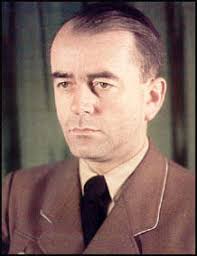
Albert Speer
Risking death, he refused to carry out Hitler’s “scorched earth” order. Even more important, he mounted a successful effort to block such destruction or persuade influential military and civilian leaders to disobey the order as well.
As a result, those targets slated for destruction were spared.
After the election of America’s first black President, Republicans waged a similar “scorched earth” campaign. Their avowed goal—as stated openly by Kentucky’s U.S. Senator Mitch McConnell—was “to make Barack Obama a one-term President.”
Literally during his first Inauguration, Republicans, in a secret meeting, agreed to block every effort he made to repair the economy.
Acting as extortionists, they repeatedly threatened to shut down the government if they didn’t get their way in legislative matters.
And just as repeatedly, they blocked legislation that would have helped the poor, unemployed, women, elderly, disabled or middle-class.
At the center of their fury lay the Affordable Care Act, providing medical care to all citizens.
Even after Congress passed it and the Supreme Court affirmed it, House Republicans shut down the government in October, 2013.
By doing so, they hoped to pressure Obama into killing his signature piece of legislation. The effort failed.
Like Adolf Hitler, their attitude has been: “If I can’t rule America, there won’t be an America.”
It remains to be seen whether a Republican Albert Speer will step forward to save America from the self-destructive excesses of this Nation’s own fanatics.
ABC NEWS, ADOLF HITLER, ALTERNET, AP, BBC, BUSINESS LEADERSHIP, BUZZFEED, CBS NEWS, CNN, DAILY KOS, DONALD TRUMP, ENGLAND, ERICH VON MANSTEIN, ERWIN ROMMEL, FACEBOOK, FBI, HEINZ GUDERIAN, HOW HITLER COULD HAVE WON WORLD WAR II, IOWA CAUCUSES, JAMES COMEY, JOSEPH STALIN, MIKE FLYNN, MOTHER JONES, MOVEON, MSNBC, NAZI GERMANY, NBC NEWS, NEWSWEEK, NPR, POLITICO, RAW STORY, REUTERS, RUSSIA INVESTIGATION, SALON, SEATTLE TIMES, SLATE, SOVIET UNION, THE ATLANTIC, THE CHICAGO SUN-TIMES, THE CHICAGO TRIBUNE, THE DAILY BEAST, THE GUARDIAN, THE HILL, THE HUFFINGTON POST, THE LOS ANGELES TIMES, THE NEW YORK TIMES, THE WALL STREET JOURNAL, THE WASHINGTON POST, TIME, TWITTER, U.S. NEWS & WORLD REPORT, U.S. SENATE INTELLIGENCE COMMITTEE, UPI, USA TODAY, VLADIMIR PUTIN, WORLD WAR 11
In Bureaucracy, History, Military, Politics, Social commentary on June 8, 2017 at 1:11 pm
“We will have so much winning if I get elected [President] that you may get bored with winning.”
It was vintage Donald Trump, speaking at a September, 2015 Capitol Hill rally to protest President Barack Obama’s nuclear deal with Iran.
That was before Trump became President–and, since then, has been entangled in multiple investigations into contacts between Russian Intelligence agents and high-level officials of his 2016 Presidential campaign.
That was before he was forced to fire retired General Mike Flynn as his national security adviser. The reason: Flynn’s close ties to Russia and its dictator, Vladimir Putin, had recently come to light in the press.
That was before he fired James Comey, the FBI director who had refused to give him a pledge of personal loyalty.
That was before Comey testified before the United States Senate’s Intelligence Committee and publicly branded Trump a liar on nationwide television.
And that was before an anonymous White House source told CNN: “He now lives within himself, which is a dangerous place for Donald Trump to be. I see him emotionally withdrawing. He’s gained weight. He doesn’t have anybody whom he trusts.”
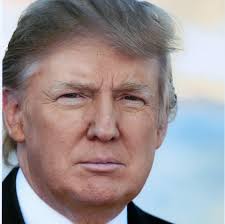
Donald Trump
Trump’s boast reflected he mindset–if not the words–of an earlier CEO whose ego carried him–and his country–to ruin: Adolf Hitler.
Literally thousands of books have been written on Hitler’s six-year stint as a self-appointed field commander. But for an overall view of Hitler’s generalship, an excellent choice is How Hitler Could have Won World War II by Bevin Alexander.

Among the fatal errors that led to the defeat of the defeat of the Third Reich:
- Wasting hundreds of Luftwaffe [air force] pilots, fighters and bombers in a halfhearted attempt to conquer England.
- Ignoring the pleas of generals like Erwin Rommel to conquer Syria, Iraq and Saudi Arabia, thus giving Germany control of most of the world’s oil.
- Attacking his ally, the Soviet Union, while still at war with Great Britain.
- Turning millions of Russians into enemies rather than allies by his brutal and murderous policies.
- Needlessly declaring war on the United States after the Japanese attacked Pearl harbor. (Had he not done so, Americans would have focused all their attention on defeating Japan.)
- Refusing to negotiate a separate peace with Soviet dictator Joseph Stalin–thus granting Germany a large portion of captured Russian territory in exchange for letting Stalin remain in power.
- Insisting on a “not-one-step-back” military “strategy” that led to the needless surrounding, capture and/or deaths of hundreds of thousands of German servicemen.
As the war turned increasingly against him, Hitler became ever more rigid in his thinking.
He demanded absolute control over the smallest details of his forces. This, in turn, led to astonishing and unnecessary losses among their ranks.
One such incident was immortalized in the 1962 movie, The Longest Day, about the Allied invasion of France known as D-Day.
On June 6, 1944, General Erwin Rommel ordered the panzer tanks to drive the Allies from the Normandy beaches. But these could not be released except on direct orders of the Fuehrer.

Panzer tank
As Hitler’s chief of staff, General Alfred Jodl, informed Rommel: The Fuehrer was asleep–and was not to be awakened. By the time Hitler awoke and issued the order, it was too late.
Nor could Hitler accept responsibility for the policies that were leading Germany to certain defeat. He blamed his generals, accused them of cowardice, and relieved many of the best ones from command.
Among those sacked was Heinz Guderian, creator of the German Panzer corps–and responsible for the blitzkreig victory against France in 1940.
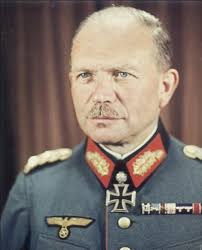
Heinz Guderian
Another was Erich von Manstein, designer of the strategy that defeated France in six weeks–which Germany had failed to do during four years of World War 1.
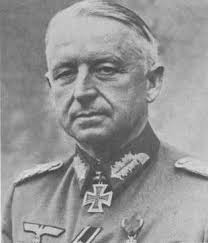
Erich von Manstein
Finally, on April 29, 1945–with the Russians only blocks from his underground Berlin bunker–Hitler dictated his “Last Political Testament.”
Once again, he refused to accept responsibility for unleashing a war that would ultimately consume 50 million lives:
“It is untrue that I or anyone else in Germany wanted war in 1939. It was desired and instigated exclusively by those international statesmen who either were of Jewish origin or worked for Jewish interests.”
Hitler had launched the invasion of Poland–and World War II–with a lie: That Poland had attacked Germany. Fittingly, he closed the war–and his life–with a final lie.
Joachim C. Fest, author of Hitler (1973), writes of the surprise that awaited Allied soldiers occupying Nazi Germany in 1945: “Almost without exception, virtually from one moment to the next, Nazism vanished after the death of Hitler and the surrender.
“It was as if National Socialism had been nothing but the motion, the state of intoxication and the catastrophe it had caused….
“Once again it became plain that National Socialism, like Fascism in general, was dependent to the core on superior force, arrogance, triumph, and by its nature had no resources in the moment of defeat.”
The ancient Greeks believed that “a man’s character is his destiny.” For Adolf Hitler–and the nations he ravaged–that proved fatally true.
It remains to be seen whether the same will prove true for Donald Trump–and the United States.
ABC NEWS, ADOLF HITLER, ALTERNET, AP, BBC, BUZZFEED, CBS NEWS, CNN, DAILY KOS, DIMITRI SHOSTAKOVICH, DONALD TRUMP, FACEBOOK, FBI, GREAT TERROR, JAMES COMEY, JEFF SESSIONS, JOSEPH STALIN, KEITH SCHILLER, MIKE FLYNN, MIKHAIL TUKHACHEVESKY, MOTHER JONES, MOVEON, NAZI GERMANY, NBC NEWS, NEWSWEEK, NICCOLO MACHIAVELLI, NIKITA KHRUSHCHEV, NIKOLAI ZHILAYEV, NPR, POLITICO, RAW STORY, REUTERS, ROBERT MEULLER 111, ROD ROSENSTEIN, RUSSIAN ESPIONAGEky, SALON, SEATTLE TIMES, SENATE INTELLIGENCE COMMITTEE, SERGEY KISLYAK, SERGEY LAVOV, SLATE, SOVIET UNION, THE ATLANTIC, THE CHICAGO SUN-TIMES, THE CHICAGO TRIBUNE, THE DAILY BEAST, THE DISCOURSES, THE GUARDIAN, THE HILL, THE HUFFINGTON POST, THE LOS ANGELES TIMES, THE NEW YORK TIMES, THE WALL STREET JOURNAL, THE WASHINGTON POST, TIME, TWITTER, U.S. NEWS & WORLD REPORT, UPI, USA TODAY, WEHRMACHT, WORLD WAR 11
In Bureaucracy, History, Law, Law Enforcement, Military, Politics, Social commentary, Uncategorized on June 7, 2017 at 12:15 am
Nikolai Sergeyvich Zhilayev (pronounced Zill-lay-ev) was a Russian musicologist and the teacher of several 20th-century Russian composers.
Among these: Dimitri Shostakovich.
Among his friends–to his ultimate misfortune–was Mikhail Tukhachevsky, the former military hero now falsely condemned and executed as a traitor by Soviet dictator Joseph Stalin.
In 1938, Zhilayev, too, became a casualty of what has become known as The Great Terror.
In his posthumously-published memoirs, Testimony, Shostakovich, his pupil and friend, described how Zhilayev faced his end with a calmness that awed even the NKVD (the predecessor to the KGB) secret police sent to arrest him.
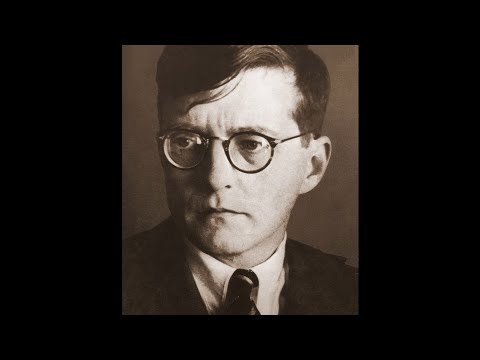
Dimitri Shostakovich
“He had a large picture of Tukhachevsky in his room, and after the announcement that Tukhachevsky had been shot as a traitor to the homeland, Zhilayev did not take the picture down.
“I don’t know if I can explain how heroic a deed that was….As soon as the next poor soul was declared an enemy of the people, everyone destroyed in a panic everything connected with that person.
“If the enemy of the people wrote books, they threw away his books. If they had letters from him, they burned the letters. The mind can’t grasp the number of letters and papers burned in that period…
“And naturally, photographs flew into the fire first, because if someone informed on you, reported that you had a picture of an enemy of the people, it meant certain death.
“Zhilayev wasn’t afraid. When they came for him, Tukhachevsky’s prominently hung portrait amazed even the executioners.”
“What, it’s still up?” one of the secret police asked.
“The time will come,” Zhilayev replied, “when they’ll erect a monument to him.”
As, in fact, has happened.

Mikhail Tukhachevsky appears on a 1963 Soviet Union postage stamp
Third hero–James Brien Comey (December 14, 1960)
Comey served as United States Attorney (federal prosecutor) for the Southern District of New York (2002-2003).
As United States Deputy Attorney General (2003-2005), he opposed the warrantless wiretapping program of the George W. Bush administration. He also argued against the use of water boarding as an interrogation method.
In 2005, he entered the private sector as General Counsel and Senior Vice President for Lockheed Martin, the biggest contractor for the Department of Defense.
On July 29, 2013, the United States Senate voted 93 -1 to confirm Comey as director of the FBI, the seventh in its history.

James B. Comey
He directed the FBI from his appointment in 2013 by President Barack Obama until his firing on May 9 by President Donald Trump.
In a move that Joseph Stalin would have admired, Trump gave no warning of his intentions. Instead, he sent Keith Schiller, his longtime bodyguard, to the FBI with a letter announcing Comey’s dismissal.
Trump had three reasons for firing Comey:
- Comey had refused to pledge his personal loyalty to Trump. Trump had made this “request” during a private dinner at the White House in January. After refusing to make that pledge, Comey told Trump that he would always be honest with him. But that didn’t satisfy Trump’s demand that the head of the FBI act as his personal secret police chief.
- Trump had tried to coerce him into dropping the FBI’s investigation into former National Security Adviser Mike Flynn, for his secret ties to Russia and Turkey. Comey had similarly resisted that demand.
- Comey had recently asked the Justice Department to fund an expanded FBI investigation into contacts between Trump’s 2016 Presidential campaign and Russian Intelligence agents.
As a Presidential candidate and President, Trump has:
- Steadfastly denied those revelations;
- Repeatedly attacked the “fake news” media reporting these revelations. Chief among his targets: CNN, The New York Times and The Washington Post; and
- Attacked the Intelligence agencies responsible for America’s security.
On May 10–the day after firing Comey–Trump met in the Oval Office with Russian Foreign Minister Sergey Lavov and Russian Ambassador Sergey Kislyak.
Kislyak is reportedly a top recruiter for Russia’s SVR foreign intelligence agency. He has been closely linked with Jeff Sessions, now Attorney General, and fired National Security Adviser Mike Flynn.
“I just fired the head of the F.B.I.,” Trump told the two dignitaries. “He was crazy, a real nut job. I faced great pressure because of Russia. That’s taken off.”
During that meeting he gave the Russians sensitive Intelligence on ISIS that had been supplied by Israel.
Two days later, on May 12, Trump tweeted a threat to the fired FBI director: “James Comey better hope that there are no ‘tapes’ of our conversations before he starts leaking to the press.”
But shortly afterward, it appeared Trump was the one who should worry: Reports surfaced that Comey had written memos to himself immediately after his private meetings with Trump.
He had also told close aides that Trump was trying to pressure him into dropping the investigation into close ties between Russian Intelligence agents and Trump campaign staffers.
The firing led directly to a result Trump did not anticipate: Acting Attorney General Rod Rosenstein yielded to demands from Democrats and appointed former FBI Director Robert Meuller III as a special prosecutor to investigate those ties.
And, on June 8, James Comey was scheduled to give his much-anticipated version of events before the United States Senate Intelligence Committee.
ABC NEWS, ADOLF HITLER, ALTERNET, AP, BBC, BUZZFEED, CBS NEWS, CNN, DAILY KOS, DIMITRI SHOSTAKOVICH, DONALD TRUMP, FACEBOOK, FBI, GREAT TERROR, JAMES COMEY, JEFF SESSIONS, JOSEPH STALIN, KEITH SCHILLER, MIKE FLYNN, MIKHAIL TUKHACHEVESKY, MOTHER JONES, MOVEON, NAZI GERMANY, NBC NEWS, NEWSWEEK, NICCOLO MACHIAVELLI, NIKITA KHRUSHCHEV, NIKOLAI ZHILAYEV, NPR, POLITICO, RAW STORY, REUTERS, ROBERT MEULLER 111, ROD ROSENSTEIN, RUSSIAN ESPIONAGEky, SALON, SEATTLE TIMES, SENATE INTELLIGENCE COMMITTEE, SERGEY KISLYAK, SERGEY LAVOV, SLATE, SOVIET UNION, THE ATLANTIC, THE CHICAGO SUN-TIMES, THE CHICAGO TRIBUNE, THE DAILY BEAST, THE DISCOURSES, THE GUARDIAN, THE HILL, THE HUFFINGTON POST, THE LOS ANGELES TIMES, THE NEW YORK TIMES, THE WALL STREET JOURNAL, THE WASHINGTON POST, TIME, TWITTER, U.S. NEWS & WORLD REPORT, UPI, USA TODAY, WEHRMACHT, WORLD WAR 11, WORLD WAR ii
In Bureaucracy, History, Law, Law Enforcement, Military, Politics, Social commentary on June 6, 2017 at 12:02 am
…A truly great man is ever the same under all circumstances. And if his fortune varies, exalting him at one moment and oppressing him at another, he himself never varies, but always preserves a firm courage, which is so closely interwoven with his character that everyone can readily see that the fickleness of fortune has no power over him.
The conduct of weak men is very different. Made vain and intoxicated by good fortune, they attribute their success to merits which they do not possess. And this makes them odious and insupportable to all around them. And when they have afterwards to meet a reverse of fortune, they quickly fall into the other extreme, and become abject and vile.
–Niccolo Machiavelli, The Discourses
Three heroes, two villains.
Two of the heroes are Russian; the third is an American.
The villains: One Russian (actually, Georgian); one American.
First up–in order of disappearance: Mikhail Nikolayevich Tukhachevsky (pronounced too-ka-chev-sky)
Tukhachevsky (February 4, 1893 – June 12, 1937) was a leading Soviet military leader and theoretician from 1918 to 1937.
He commanded the Soviet Western Front during the Russian-Polish War (1920-21) and served as Chief of Staff of the Red Army (1925-1928).
He fought to modernize Soviet armament, as well as develop airborne, aviation and mechanized forces. Almost singlehandedly, he created the theory of deep operations for Soviet forces.

Mikhail Tukhachevsky
All of these innovations would reap huge dividends when the Soviet Union faced the lethal fury of Adolf Hitler’s Wehrmacht.
In 1936, Tukhachevsky warned Soviet dictator Joseph Stalin that Nazi Germany might attack without warning–and ignite a long and murderous war.
Stalin–the son of a Georgian cobbler–resented Tukhachevsky’s coming from a noble family. A monumental egomaniac, he also hated that Tukhachevesky’s fame rivaled his own.
Warned of the approaching German danger, Stalin shouted: “What are you trying to do–frighten Soviet authority?”
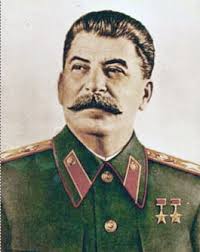
Joseph Stalin
The attack that Tukhachevsky warned against came five years later on June 22, 1941, leaving at least 20 million Russians dead.
But Tukhachevsky wasn’t alive to command a defense.
The 1930s were a frightening and dangerous time to be alive in the Soviet Union. In 1934, Stalin, seeing imaginary enemies everywhere, ordered a series of purges that lasted right up to the German invasion.
In 1937-38, the Red Army fell prey to Stalin’s paranoia.
Its victims included:
- Three of five marshals (five-star generals);
- Thirteen of 15 army commanders (three- and four-star generals);
- Fifty of 57 army corps commanders; and
- One hundred fifty-four out of 186 division commanders.
And heading the list of those marked for death was Marshal Mikhail Tukhachevsky.
Arrested on May 22, 1937, he was interrogated and tortured. As a result, he “confessed” to being a German agent plotting to overthrow Stalin and seize power.
On his confession, which survives in the archives, his bloodstains can clearly be seen.
On June 11, the Soviet Supreme Court convened a special military tribunal to try Tukhachevsky and eight generals for treason.
It was a sham: The accused were denied defense attorneys, and could not appeal the verdict–which was foregone: Death.
In a Russian version of poetic justice, five of the eight generals who served as Tukhachevsky’s judges were themselves later condemned and executed as traitors.
Within hours of the verdict, Tukhachevsky was summoned from his cell and shot once in the back of the head.
From 1937 until 1956, Tukhachevsky was officially declared a traitor and fifth-columnist.
Then, on February 25, 1957, Soviet Premier Nikita Khrushchev delivered his bombshell “Secret Speech” to the 20th Congress of the Communist Party of the Soviet Union.
In this, he denounced Stalin (who had died in 1953) as a ruthless tyrant responsible for the slaughter of millions of innocent men, women and children. He condemned Stalin for creating a “personality cult” around himself, and for so weakening the Red Army that Nazi Germany was able to easily overrun half of the Soviet Union from 1941 to 1943.
On January 31, 1957, Tukhachevsky and his co-defendants were declared innocent of all charges and were “rehabilitated.”
Today, he is once again considered a Russian hero and military genius.
Next hero: Nikolai Sergeyvich Zhilayev (pronounced Zill-lay-ev)
Zhilayev (November 18, 1881 – January 20, 1938) was a Russian musicologist and the teacher of several 20th-century Russian composers. Among these: Dimitri Shostakovich.
Zhilayev, a member of the Russian Academy of Art-Sciences, taught at the Moscow Conservatory. Among his friends–to his ultimate misfortune–was Mikhail Tukhachevsky.
In 1938, he, too, became a casualty of what has become known as The Great Terror.
In his posthumously-published memoirs, Testimony, Shostakovich, his pupil and friend, described how Zhilayev faced his end with a calmness that awed even the NKVD (the predecessor to the KGB) secret police sent to arrest him.
ABC NEWS, ADOLF HITLER, AFFORDABLE CARE ACT, ALBERT SPEER, ALTERNET, AMERICABLOG, AP, BABY BOOMER RESISTANCE, BARACK OBAMA, BLOOMBERG, BUZZFEED, CBS NEWS, CNN, CROOKS AND LIARS, DAILY KOS, DAILY KOZ, DEBT CEILING, DEPARTMENT OF HOMELAND SECURITY, DONALD TRUMP, DRUDGE REPORT, EXTORTION, FACEBOOK, FASCISM, FIVETHIRTYEIGHT, HARPER’S MAGAZINE, HOUSE SPEAKER JOHN BOEHNER, HUFFINGTON POST, MEDIA MATTERS, MOTHER JONES, MOVEON, MSNBC, NAZI GERMANY, NBC NEWS, NEGOTIATING, NEWSWEEK, NPR, OBAMACARE, PAP SMEARS, PBS NEWSHOUR, PLANNED PARENTHOOD, POLITICO, POLITICUSUSA, RAW STORY, REPUBLICAN PARTY, REPUBLICANS, REUTERS, SALON, SEATTLE TIMES, SLATE, TALKING POINTS MEMO, THE ATLANTIC, THE CHICAGO SUN-TIMES, THE CHICAGO TRIBUNE, THE DAILY BEAST, THE DAILY BLOG, THE GUARDIAN, THE HILL, THE HUFFINGTON POST, THE LOS ANGELES TIMES, THE NATION, THE NEW REPUBLIC, THE NEW YORK TIMES, THE VILLAGE VOICE, THE WALL STREET JOURNAL, THE WASHINGTON POST, THINKPROGRESS, TIME, TRICKLE-DOWN ECONOMICS, TRUTHDIG, TRUTHOUT, TWITTER, TWO POLITICAL JUNKIES, U.S. NEWS & WORLD REPORT, UPI, USA TODAY, WARREN BUFFET, WORLD WAR 11
In Bureaucracy, History, Law, Politics, Social commentary on March 15, 2017 at 12:22 am
On December 13, 2014, the U.S. Senate passed a $1.1 trillion spending bill to fund almost the entire government through the September 30 end of the fiscal year.
But one Federal agency was pointedly exempted from full funding: The Department of Homeland Security (DHS). Its funding would expire on February 27, 2015.
With their new-found majorities in both houses of Congress, Republicans intended to hold the security of the United States as a hostage.
Their goal: To force President Barack Obama to rescind the changes he had made in American immigration policy.
Finally, just as DHS’ funding was about to expire, House Republicans capitulated. They approved a bill the Senate passed to fund DHS without any added conditions.
In 2009, the top goal of the Republican party became to block passage of the Affordable Care Act (ACA)–informally known as “Obamacare.” Its purpose: To provide all Americans–and not simply the richest 1%–with healthcare insurance.
Despite this opposition, the ACA passed the House and Senate–and was signed into law by President Obama on March 23, 2010.
And from then on, Republicans’ foremost goal was to repeal “Obamacare”–which they damned as “fiscally irresponsible.”
In 2003, President George W. Bush had lied the United States into a needless, bloody war in Iraq–which has cost the nation more than $2 trillion.
But Republicans fully supported that expense–and still do.
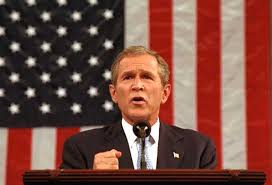
George W. Bush
Even after the Supreme Court affirmed its Constitutionality in 2012, House Republicans voted–unsuccessfully–more than 60 times to repeal or alter “Obamacare.”
In October, 2013, they shut down the Federal Government for 15 days. They hoped to pressure Obama into de-funding his signature piece of legislation, in return for their re-opening the government.
Facing pressure from voters unable to receive basic government services, Republicans backed down.
Their attempted putsch had failed.
Fast forward to 2017.
Republicans still hold the House and Senate–and now the Presidency under Donald J. Trump.
Donald J. Trump
And they are mounting an all-out effort to strip millions of poor Americans of their only access to medical care.
On March 9, Trump met at the White House with leaders of conservative groups to push his own plan to “repeal and replace” the Affordable Care Act.
A major provision of this plan will allow insurance companies to adhere only to the regulations of the state they’re located in. The predictable result: The majority of companies will relocate to the state with the most lax regulations.
Intriguingly, Trump–who has put his name on 268 of the 515 entities he owns–has said he does not want the “Obamacare” replacement plan named after him.
It’s possible he fears it will prove highly unpopular–and that he will be stained by its infamy.
Nevertheless, the press has already started to call it “Trumpcare.”
At the White House meeting, Trump attacked groups–such as the Heritage Foundation and Tea Party Patriots–for calling the House GOP proposal “Obamacare lite.” And he warned: “You are helping the other side.”
And he made it clear to conservative leaders that he had a fallback plan: If “Trumpcare” proves a failure–that is, fails to pass Congress–he will allow the ACA to fail and blame the Democrats.
Thus, Trump admitted that he is prepared to allow the American healthcare system to collapse and let millions die for lack of medical care–all for his own political gain.
As William Henry Harrison put it: “There is nothing more corrupting, nothing more destructive of the noblest and finest feelings of our nature, than the exercise of unlimited power.”
* * * * *
As the Third Reich came to its fiery end, Adolf Hitler sought to punish the German people for being “unworthy” of his “genius” and losing the war he had started.
His attitude was: “If I can’t rule Germany, then there won’t be a Germany.”
In his infamous “Nero Order,” he decreed the destruction of everything still remaining–industries, ships, harbors, communications, roads, mines, bridges, stores, utility plants, food stuffs.
Fortunately for Germany, one man–Albert Speer–finally broke ranks with his Fuhrer.

Albert Speer
Risking death, he refused to carry out Hitler’s “scorched earth” order. Even more important, he mounted a successful effort to block such destruction and persuade influential military and civilian leaders to disobey the order as well.
As a result, those targets slated for destruction were spared.
Since the election of America’s first black President, Republicans have waged a similar “scorched earth” campaign.
Their avowed goal–as stated openly by Kentucky’s U.S. Senator Mitch McConnell–was “to make Barack Obama a one-term President.”
Literally during Obama’s first Inauguration, they agreed, in a secret meeting, to block every effort he made to repair the economy ruined under the George W. Bush administration.
Acting as extortionists, they repeatedly threatened to shut down the government if they didn’t get their way in legislative matters.
And they repeatedly blocked legislation to help the poor, the unemployed, the sick, women, the elderly, the disabled and the middle-class.
Like Adolf Hitler, their attitude has been: “If I can’t rule America, there won’t be an America.”
The country is still waiting for a Republican Albert Speer to step forward and save America from the self-destructive brutalities of its own Right-wing fanatics.
ABC NEWS, ADOLF HITLER, AFFORDABLE CARE ACT, ALBERT SPEER, ALTERNET, AMERICABLOG, AP, BABY BOOMER RESISTANCE, BARACK OBAMA, BLOOMBERG, BUZZFEED, CBS NEWS, CNN, CROOKS AND LIARS, DAILY KOS, DAILY KOZ, DEBT CEILING, DEPARTMENT OF HOMELAND SECURITY, DONALD TRUMP, DRUDGE REPORT, EXTORTION, FACEBOOK, FASCISM, FIVETHIRTYEIGHT, HARPER’S MAGAZINE, HOUSE SPEAKER JOHN BOEHNER, HUFFINGTON POST, MEDIA MATTERS, MOTHER JONES, MOVEON, MSNBC, NAZI GERMANY, NBC NEWS, NEGOTIATING, NEWSWEEK, NPR, OBAMACARE, PAP SMEARS, PBS NEWSHOUR, PLANNED PARENTHOOD, POLITICO, POLITICUSUSA, RAW STORY, REPUBLICAN PARTY, REPUBLICANS, REUTERS, SALON, SEATTLE TIMES, SLATE, TALKING POINTS MEMO, THE ATLANTIC, THE CHICAGO SUN-TIMES, THE CHICAGO TRIBUNE, THE DAILY BEAST, THE DAILY BLOG, THE GUARDIAN, THE HILL, THE HUFFINGTON POST, THE LOS ANGELES TIMES, THE NATION, THE NEW REPUBLIC, THE NEW YORK TIMES, THE VILLAGE VOICE, THE WALL STREET JOURNAL, THE WASHINGTON POST, THINKPROGRESS, TIME, TRICKLE-DOWN ECONOMICS, TRUTHDIG, TRUTHOUT, TWITTER, TWO POLITICAL JUNKIES, U.S. NEWS & WORLD REPORT, UPI, USA TODAY, WARREN BUFFET, WORLD WAR 11
In Bureaucracy, History, Law, Politics, Social commentary on March 14, 2017 at 12:06 am
During the summer of 2011, Republicans refused to raise the debt ceiling unless Democrats agreed to massively cut social programs for the elderly, poor and disabled.
If Congress failed to raise the borrowing limit of the federal government by August 2, the date when the U.S. reached the limit of its borrowing abilities, America would begin defaulting on its loans.
As Warren Buffett, CEO of Berkshire Hathaway, explained the looming economic catastrophe:
“If you don’t send out Social Security checks, I would hate to think about the credit meeting at S&P and Moody’s the next morning.
“If you’re not paying millions and millions and millions of people that range in age from 65 on up, money you promised them, you’re not a AAA.”
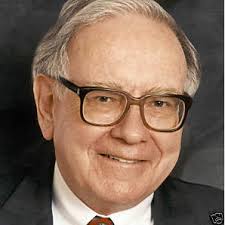
Warren Buffett
A triple-A credit rating is the highest possible rating that can be achieved.
And while Republicans demanded that the disadvantaged tighten their belts, they rejected any raising of taxes on their foremost constituency–the wealthiest 1%.
As the calendar moved ever closer to the fateful date of August 2, Republican leaders continued to insist: Any deal that includes taxes “can’t pass the House.”
To prevent the government from defaulting on its loans, President Barack Obama agreed to sign the Republican-crafted Budget Control Act (BCA) of 2011.
The Act provided for a Joint Select Committee on Deficit Reduction to produce legislation by late November to decrease the deficit by $1.2 trillion over ten years.
When the so-called “Super Committee” failed to reach agreement, the second part of the BCA went into effect.
This directed automatic across-the-board cuts (known as “sequestrations”) split evenly between defense and domestic spending, beginning on January 2, 2013.
A major casualty of sequestration was the Centers for Disease Control and Prevention (CDC). And this threatened the safety of the Nation Republicans claim to love:
- In 2013, the CDC was forced to cut 5%, or more than $285 million, from its budget.
- The sequester cut $195 million from the National Centers for Emerging and Zoonotic Infectious Diseases, a CDC program that tries to prevent illness and death from infectious disease.
- For fiscal 2014, CDC’s budget was $5.9 billion, down from the $6.5 billion allotted in 2010.

Centers for Disease Control and Prevention
In October, 2014, for the first time in United States history, the CDC faced an unexpected outbreak of the dreaded Ebola virus.
To Americans’ horror, the agency initially seemed unable to deal effectively with the threat.
Moreover, the Nation was confronting the Ebola crisis without a Surgeon General–thanks to NRA-funded Republican Senators.
President Obama had nominated Dr. Vivek Murthy for the spot in November, 2013, when the previous surgeon general left the position. But the Senate still hadn’t approved Murthy.
And support for him declined since he tweeted on October 16, 2002, that “guns are a health care issue.”
At the same time, Republicans rushed to blame President Obama for the continuing Ebola menace in West Africa–and the danger it posed to Americans.
“I think this Ebola outbreak in Africa is a serious problem,” said House Speaker John Boehner. “And I’m a bit surprised the administration hasn’t acted more quickly to address what is a serious threat, not only to Africans but to others around the world.”
“The President made a lot of commitments to combat Ebola, actions which I supported,” said North Carolina U.S. Senator Richard Burr. “But it has become clear that the administration’s capacity to fulfill these promises in a timeline that sufficiently addresses this crisis does not exist.”
But then a new Republican-inspired crisis threatened America.
On December 13, 2014, the U.S. Senate passed a $1.1 trillion spending bill to fund almost the entire government through the September 30 end of the fiscal year.
But one Federal agency was pointedly exempted from full funding: The Department of Homeland Security (DHS).
President George W. Bush had created this agency to safeguard the country against terrorism. But he didn’t imagine that his fellow Republicans might willingly jeopardize the security of the Nation.
President Obama had requested $38.2 billion to fund DHS through fiscal year 2015. But Republicans ensured that its funding would end on February 27.
Why?
Republicans had gained control of the House of Representatives after the 2010 elections. And then they gained control of the Senate with the 2014 elections.
With their new-found majorities in both houses of Congress, they intended to hold the security of the United States as a hostage.
Their goal: To force Obama to rescind the changes he had made in American immigration policy.

It is Homeland Security that was charged with implementing those changes. And Republicans intended to strip it of funding to do so.
And if that meant allowing DHS to “twist slowly, slowly in the wind” (to use a phrase made infamous by the Nixon administration) while Republicans played out their latest power-game, so be it.
This was no small matter.
With more than 240,000 employees, DHS is the third largest Cabinet department, after the Departments of Defense and Veterans Affairs.
The Defense Department is charged with protecting the United States through military action abroad. DHS is responsible for safeguarding the Nation inside and outside its borders.
Its goal is to prepare for, prevent and–if prevention fails–respond to man-made accidents, natural disasters and terrorism.
ABC NEWS, ADOLF HITLER, AFFORDABLE CARE ACT, ALBERT SPEER, ALTERNET, AMERICABLOG, AP, BABY BOOMER RESISTANCE, BARACK OBAMA, BLOOMBERG, BUZZFEED, CBS NEWS, CNN, CROOKS AND LIARS, DAILY KOS, DAILY KOZ, DEBT CEILING, DEPARTMENT OF HOMELAND SECURITY, DONALD TRUMP, DRUDGE REPORT, EXTORTION, FACEBOOK, FASCISM, FIVETHIRTYEIGHT, HARPER’S MAGAZINE, HOUSE SPEAKER JOHN BOEHNER, HUFFINGTON POST, MEDIA MATTERS, MOTHER JONES, MOVEON, MSNBC, NAZI GERMANY, NBC NEWS, NEGOTIATING, NEWSWEEK, NPR, OBAMACARE, PAP SMEARS, PBS NEWSHOUR, PLANNED PARENTHOOD, POLITICO, POLITICUSUSA, RAW STORY, REPUBLICAN PARTY, REPUBLICANS, REUTERS, SALON, SEATTLE TIMES, SLATE, TALKING POINTS MEMO, THE ATLANTIC, THE CHICAGO SUN-TIMES, THE CHICAGO TRIBUNE, THE DAILY BEAST, THE DAILY BLOG, THE GUARDIAN, THE HILL, THE HUFFINGTON POST, THE LOS ANGELES TIMES, THE NATION, THE NEW REPUBLIC, THE NEW YORK TIMES, THE VILLAGE VOICE, THE WALL STREET JOURNAL, THE WASHINGTON POST, THINKPROGRESS, TIME, TRICKLE-DOWN ECONOMICS, TRUTHDIG, TRUTHOUT, TWITTER, TWO POLITICAL JUNKIES, U.S. NEWS & WORLD REPORT, UPI, USA TODAY, WARREN BUFFET, WORLD WAR 11
In Bureaucracy, History, Law, Politics, Social commentary on March 13, 2017 at 12:36 am
Albert Speer, Minister of Armaments for the Third Reich, was appalled.
His Fuhrer, Adolf Hitler–the man he had idolized for 14 years–had just passed a death sentence on Germany, the nation he claimed to love above all others.
Albert Speer and Adolf Hitler pouring over architectural plans
On March 19, 1945, facing certain defeat, Hitler had ordered a massive “scorched-earth” campaign throughout Germany.
All German agriculture, industry, ships, communications, roads, food stuffs, mines, bridges, stores and utility plants were to be destroyed.
If implemented, it would deprive the entire German population of even the barest necessities after the war.
Click here: Hitler’s “Scorched Earth” Decree and Albert Speer’s Response
Now living in a bunker 50 feet below bomb-shattered Berlin, Hitler gave full vent to his most destructive impulses.
Adolf Hitler addressing boy soldiers as the Third Reich crumbles
“If the war is lost,” Hitler told Speer, “the nation will also perish. This fate is inevitable. There is no necessity to take into consideration the basis which the people will need to continue even a most primitive existence.
“On the contrary, it will be better to destroy these things ourselves, because this nation will have proved to be the weaker one and the future will belong solely to the stronger eastern nation.
“Besides, those who will remain after the battle are only the inferior ones, for the good ones have all been killed.”
Speer argued in vain that there must be a future for the German people. But Hitler refused to back down. He gave Speer 24 hours to reconsider his opposition to the order.
The next day, Speer told Hitler: “My Fuhrer, I stand unconditionally behind you!”
“Then all is well,” said Hitler, suddenly with tears in his eyes.
“If I stand unreservedly behind you,” said Speer, “then you must entrust me rather than the Gauleiters [district Party leaders serving as provincial governors] with the implementation of your decree.”
Filled with gratitude, Hitler signed the decree Speer had thoughtfully prepared before their fateful meeting.
By doing so, Hitler unintentionally gave Speer the power to thwart his “scorched earth” decree.
Speer had been the closest thing to a friend in Hitler’s life. Trained as an architect, he had joined the Nazi Party in 1931.
He met Hitler in 1933, when he presented the Fuhrer with architectural designs for the Nuremberg Rally scheduled for that year.
From then on, Speer became Hitler’s “genius architect” assigned to create buildings meant to last for a thousand years.
In 1943, Hitler appointed him Minister of Armaments, charged with revitalizing the German war effort.
Nevertheless, Speer now crisscrossed Germany, persuading military leaders and district governors to not destroy the vital facilities that would be needed after the war.
“No other senior National Socialist could have done the job,” writes Randall Hanson, author of Disobeying Hitler: German Resistance After Valkyrie.
“Speer was one of the very few people in the Reich–perhaps even the only one–with such power to influence actors’ willingness/unwillingness to destroy.”
Despite his later conviction for war crimes at Nuremberg, Speer never regretted his efforts to save Germany from total destruction at the hands of Adolf Hitler.
Fast-forward to the United States since the 2008 election of President Barack Obama.
Republicans have adopted the same my-way-or-else “negotiating” stance as the German Fuhrer. Like him, they are determined to gain and hold absolute power–or destroy the Nation they claim to love.
During his eight years in the White House, Ronald Reagan presided over a tripling of the national debt–and raised the debt limit 17 times.
President George W. Bush nearly doubled it again.
During the George W. Bush Presidency, Republicans in Congress raised the debt ceiling seven times–when the national debt grew to $10.627 trillion due to tax cuts for the rich and wars in Afghanistan and Iraq.
But none of that mattered to Republicans–so long as one of them held the White House.
Then Barack Obama, a Democrat–worse, a black one–became President.
Suddenly, “fiscal integrity” became the byword of Republicans. And in its name, they repeatedly threatened to shut down the government if their legislative demands weren’t met.
In April, 2011, the United States government almost shut down over Republican demands about subsidized pap smears.
During a late-night White House meeting with President Obama and key Congressional leaders, Republican House Speaker John Boehner made this threat:
His conference would not approve funding for the government if any money were allowed to flow to Planned Parenthood through Title X legislation.
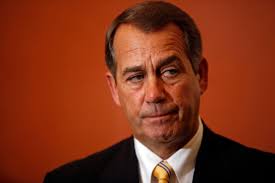
John Boehner
Facing an April 8 deadline, negotiators worked day and night to strike a compromise–and finally reached one.
Three months later–on July 9–Republican extortionists again threatened the Nation with financial ruin and international disgrace unless their demands were met.
By refusing to raise the debt ceiling, they would force the government to default on paying the bills it owed.
President Obama had offered to make historic cuts in the federal government and the social safety net–on which millions of Americans depend for their most basic needs.
But Boehner rejected that offer. He would not agree to the tax increases that Democrats wanted to impose on the wealthiest 1% as part of the bargain.


 Bureaucracybuster's Blog
2016 PRESIDENTIAL ELECTION, 9/11, ABC NEWS, ADOLF HITLER, AFGHANISTAN, ALTERNET, AP, ASIANS, BARACK OBAMA, BLACKS, BULLYING, BUZZFEED, CBS NEWS, CNN, COMMUNISM, CROOKS AND LIARS, DAILY KOZ, DONALD TRUMP, FACEBOOK, FASCISM, GEORGE W. BUSH, GREAT DEPRESSION, HILLARY CLINTON, HISPANICS, IRAQ, JEWS, MOTHER JONES, MOVEON, MUSLIMS, NAZI GERMANY, NAZI PARTY, NBC NEWS, NEWSWEEK, NPR, PAUL VON HINDENBURG, POLITICO, RACISM, RAW STORY, REPUBLICANS, REUTERS, ROBERT PAYNE, Ronald Reagan, SALON, SEATTLE TIMES, SLATE, THE ATLANTIC, THE CHICAGO SUN-TIMES, THE CHICAGO TRIBUNE, THE DAILY BEAST, THE GUARDIAN, THE HILL, THE HUFFINGTON POST, THE LIFE AND DEATH OF ADOLF HITLER, THE LOS ANGELES TIMES, THE LOS ANGELS TIMES, THE NATION, THE NEW YORK TIMES, THE WASHINGTON POST, TIME, TRUMP EFFECT, TWITTER, U.S. NEWS & WORLD REPORT, UP, UPI, USA TODAY, WORLD WAR 11
AMERICA: ONCE IT FOUGHT FASCISTS, NOW IT ELECTS THEM
In Bureaucracy, History, Politics, Social commentary on September 7, 2017 at 12:30 amIn his bestselling 1973 biography, The Life and Death of Adolf Hitler, British historian Robert Payne harshly condemned the German people for the rise of the Nazi dictator.
“Ultimately the responsibility for the rise of Hitler lies with the German people, who allowed themselves to be seduced by him and came to enjoy the experience….[They] followed him with joy and enthusiasm because he gave them license to pillage and murder to their hearts’ content.
“They were his servile accomplices, his willing victims: Germany will rule the world; our enemies will be our slaves….
“If he answered their suppressed desires, it was not because he shared them, but because he could make use of them. He despised the German people, for they were merely the instruments of his will.”
On November 8, millions of ignorant, hate-filled, Right-wing Americans elected Donald Trump—a man reflecting their own hate and ignorance—to the Presidency.
Yet, in some ways, Americans had fewer excuses for turning to a Fascistic style of government than the Germans did.
Adolf Hitler joined the National Socialist German Workers (Nazi) Party in 1919—the year after World War 1 ended.
Adolf Hitler
It took him 14 years to win appointment to Chancellor (the equivalent of Attorney General) of Germany in 1933.
In 1923, he staged a coup attempt in Bavaria—which was quickly and brutally put down by police. He was arrested and sentenced to less than a year in prison.
After that, Hitler decided that winning power through violence was no longer an option. He must win it through election—or appointment.
He repeatedly ran for the highest office in Germany—President—but never got a clear majority in a free election.
When the 1929 Depression struck Germany, the fortunes of Hitler’s Nazi party rose as the life savings of ordinary Germans fell. Streets echoed with bloody clashes between members of Hitler’s Nazi Stormtroopers and those of the German Communist Party.
Germany seemed on the verge of collapsing.Germans desperately looked for a leader—a Fuhrer—who could somehow deliver them from the threat of financial ruin and Communist takeover.
In early 1933, members of his own cabinet persuaded aging German president, Paul von Hindenburg, that only Hitler’s appointment as Chancellor could do this.
Paul von Hindenburg
Hindenburg was reluctant to do so. He considered Hitler a dangerous radical. But he allowed himself to be convinced that, by putting Hitler in the Cabinet, he could be “boxed in” and thus controlled.
So, on January 30, 1933, he appointed Adolf Hitler Chancellor of Germany.
On August 2, 1934, Hindenberg died, and Hitler immediately assumed the titles–and duties—of the offices of Chancellor and President. His rise to total power was now complete.
It had taken him 14 years to do so.
In 2015, Donald Trump declared his candidacy for President.Now, consider this:
Donald Trump
The message of Barack Obama’s 2008 campaign had been one of hope—“Yes, We Can!”
That of Donald Trump’s campaign was one of hatred toward everyone who was not an avid Trump supporter: “No, You Can’t!”
Whites comprised the overwhelming majority of the audiences at Trump rallies. Not all were racists, but many of those who were advertised it on T-shirts: “MAKE AMERICA WHITE AGAIN.”
They knew that demographics were steadily working against them. Birthrates among non-whites were rising. By 2045, whites would make up less than 50 percent of the American population.
The 2008 election of the first black President had shocked whites. His 2012 re-election had deprived them of the hope that 2008 had been an accident.
Then came 2016—and the possibility that a black President might actually be followed by a woman: Hillary Clinton. And the idea of a woman dictating to men was strictly too much to bear.
Since Trump’s election, educators have reported a surge in bullying among students of all ages, from elementary- to high-school. Those doing the bullying are mostly whites, and the victims are mostly blacks, Muslims, Jews, Hispanics, Asians.
It even has a name: “The Trump Effect.”
All of this should be remembered the next time an American blames Germans for their embrace of Adolf Hitler.
Share this: