bureaucracybusters

Posts Tagged ‘WORLD WAR 1’

GOOD NEWS IN THE TERROR WARS

In History, Military, Politics, Social commentary on April 6, 2015 at 12:19 am

On February 7, the Syrian Observatory for Human Rights released some encouraging news for those fighting Islamic terrorism.

More than 210,000 people have been killed in Syria’s uprising-turned-civil war.

Conflict began on March 15, 2011.  The trigger: Protests demanding political reforms and the ouster of dictator Bashar al-Assad.

According to the Observatory, which is based in Coventry, England:

  • The estimated death toll now stands at 210,041.
  • More than 35,827 rebels have been killed and over 45,385 Syrian army soldiers.
  • The umber of foreign fighters killed is nearly 25,000.
  • The real number of non-Syrian casualties is estimated to be 85,000 more than the documented number.

The Observatory’s director, Rami Abdelrahman, damned not the killers but those nations refusing to be sucked into this constantly escalating violence:

“It is shameful that the international community has done nothing to show that it will defend human rights.  They are just looking on at this tragedy. The Syrian people dying are just statistics to them.”

If those dying in Syria are “just statistics,” then they are statistics of terrorists and potential terrorists who will never pose a threat to the United States.

Think of it:

  • In four years, 210,000 actual or potential enemies of Western Civilization have chosen to slaughter each other.
  • Additional thousands are certain to follow their example.
  • And the United States cannot be held in any way responsible for it.

Here are seven excellent reasons why America should not send soldiers to bomb and/or invade Syria.

1. Intervening in Syria could produce unintended consequences for American forces–and make the United States a target for more Islamic terrorism.

American bombs or missiles could land on one or more sites containing stockpiles of chemical weapons.  Imagine the international outrage that will result if the release of those weapons kills hundreds or thousands of Syrians.

Within the Islamic world, the United States will be seen as waging a war against Islam, and not simply another Islamic dictator.

Almost certainly, an American military strike on Syria would lead its dictator, Bashar al-Assad, to attack Israel–perhaps even with chemical weapons.

Assad could do this simply because he hates Jews–or to lure Israel into attacking Syria.

If that happened, the Islamic world–which lusts to destroy Israel more than anything else–would rally to Syria against the United States, Israel’s chief ally.

2.  Since 1979, Syria has been listed by the U.S. State Department as a sponsor of terrorism.

Among the terrorist groups it supports are Hizbollah and Hamas. For years, Syria provided a safe-house in Damascus to Ilich Ramírez Sánchez–the notorious terrorist better known as Carlos the Jackal.

There are no “good Syrians” for the United States to support–only murderers who have long served a tyrant and other murderers who now wish to become the next tyrant.

3.  The United States doesn’t know what it wants to do in Syria, other than “send a message.”

Carl von Clausewitz, the Prussian military theorist, wrote: “War is the continuation of state policy by other means.”  But President Barack Obama hasn’t stated what he intends gain by attacking Syria.

Obama has said he’s “not after regime-change.”  If true, that would leave Assad in power–and free to go on killing those who resist his rule.

4. The Assad regime is backed by–among others–the Iranian-supported terrorist group, Hezbollah (Party of God).  Its enemies include another terrorist group–Al Qaeda.

Hezbollah is comprised of Shiite Muslims, who form a minority of Islamics.  A sworn enemy of Israel, it has  kidnapped scores of Americans suicidal enough to visit Lebanon and truck-bombed the Marine Barracks in Beirut in 1983, killing 299 Americans.

Flag of Hezbollah

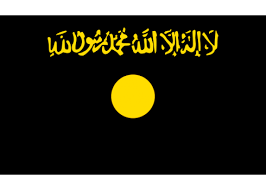
Al-Qaeda, on the other hand, is made up of Sunni Muslims, who form the majority of that religion.  It considers Shiite Muslims to be “takfirs”–heretics–and thus worthy of extermination.

Al Qaeda has attacked the mosques and gatherings of liberal Muslims, Shias, Sufis and other non-Sunnis.   Examples of sthese ectarian attacks include the Sadr City bombings, the 2004 Ashoura massacre and the April, 2007 Baghdad bombings.

Flag of Al Qaeda

When your enemies are intent on killing each other, it’s best to stand aside and let them do it.

5.  China and Russia are fully supporting the Assad dictatorship–and the brutalities it commits against its own citizens.

This reflects badly on them–not the United States.

6.  The United States could find itself in a shooting war with Russia and/or China.

What happens if American and Russian warships–or armies–start exchanging fire?  Or if Russian President Vladimir Putin orders an attack on Israel, in return for America’s attack on Russia’s ally, Syria?

It was exactly that scenario–Great Powers going to war over conflicts between their small-state allies–that triggered World War l.

7.  While Islamic nations like Syria and Egypt wage war within their own borders, they will lack the resources to launch attacks against the United States.

When Adolf Hitler invaded the Soviet Union in 1941, then-Senator Harry Truman said: “I hope the Russians kill lots of Nazis and vice versa.”

That should be America’s view whenever its sworn enemies start killing themselves off.   Americans should welcome such self-slaughters, not become entrapped in them.

TEN REASONS WHY THE U.S. SHOULDN’T ATTACK SYRIA

In Bureaucracy, History, Military, Politics on September 19, 2014 at 12:40 am

Here are ten excellent reasons for not sending American soldiers to bomb and/or invade Syria.

1. The United States just disengaged from Iraq.

On Dec. 15, 2011, the American military formally ended its mission there. The war–begun in 2003–had killed 4,487 service members and wounded another 32,226.

2. The United States is still fighting a brutal war in Afghanistan.

By early 2012, the United States had about 90,000 troops in Afghanistan, with 22,000 of them due home by the fall.

No schedule has been set for the pace of the withdrawal of the 68,000 American troops who will remain, only that all are to be out by the end of 2016.

The initial goal of this war was to destroy Al Qaeda–especially its leader, Osama Bin Laden.

But, over time, Washington policy-makers embarked on a “nation-building” effort.  That meant trying to turn primitive, xenophobic Afghans into a modern-day, right-supporting people.

American soldiers in Afghanistan

So the American military wound up occupying the country for the next ten years.  This increasingly brought them into conflict with the local population.

A series of murderous attacks on American soldiers by their supposed Afghan comrades-in-arms led to the inevitable result:  American forces no longer trust their Afghan “allies” to stand shoulder-to-shoulder with them against the Taliban.

3. The war in Iraq fell victim to the law of unintended consequences.

The Bush administration invaded Iraq to turn it into a base–from which to intimidate its neighboring states: Jordan, Saudi Arabia, Kuwait, Turkey, Syria and Iran.

This demanded the quick pacification of Iraq. But the Iraqi insurgency totally undermined that goal, forcing U.S. troops to focus all their efforts inward.

Another unintended result of the war: Saddam Hussein’s Iraq had been a counter-weight to the regional ambitions of Iran.  The destruction of the Iraqi military created a power-vacumn.

Into this–eagerly–stepped the Iranian mullahs.

4. Intervening in Syria could produce similar unintended consequences for American forces–and make the United States a target for more Islamic terrorism.

American bombs or missiles could land on one or more sites containing stockpiles of chemical weapons.  Imagine the international outrage that will result if the release of those weapons kills hundreds or thousands of Syrians.

U.S. warship firing Tomahawk Cruise missile

Within the Islamic world, the United States will be seen as waging a war against Islam, and not simply another Islamic dictator.

Almost certainly, an American military strike on Syria would lead its dictator, Bashar al-Assad, to attack Israel–perhaps even with chemical weapons.

Assad could do this simply because he hates Jews–or to lure Israel into attacking Syria.

If that happened, the Islamic world–which lusts to destroy Israel more than anything else–would rally to Syria against the United States, Israel’s chief ally.

5.  Since 1979, Syria has been listed by the U.S. State Department as a sponsor of terrorism.

Among the terrorist groups it supports are Hizbollah and Hamas. For years, Syria provided a safe-house in Damascus to Ilich Ramírez Sánchez–the notorious terrorist better known as Carlos the Jackal.

There are no “good Syrians” for the United States to support–only murderers who have long served a tyrant and now wish to become the next tyrant.

6.  The United States doesn’t know what it wants to do in Syria, other than “send a message.”

Carl von Clausewitz, the Prussian military theorist, wrote: “War is the continuation of state policy by other means.”  But President Barack Obama hasn’t stated what he intends gain by attacking Syria.

Obama has said he’s “not after regime-change.”  If true, that would leave Assad in power–and free to go on killing those who resist his rule.

So it appears that Obama’s “message” is: “You can continue killing your own people–so long as you don’t use weapons that upset American TV viewers.”

7. The Assad regime is backed by–among others–the Iranian-supported terrorist group, Hizbollah (Party of God).  Its enemies include another terrorist group–Al Qaeda.

When your enemies are intent on killing each other, it’s best to stand aside and let them do it.

8.  China and Russia are fully supporting the Assad dictatorship–and the brutalities it commits against its own citizens.

This reflects badly on them–not the United States.

9.  The United States could find itself in a shooting war with Russia and/or China.

The Russians have sent two warships to Syria, in direct response to President Obama’s threat to “punish” Assad for using chemical weapons against unsurgents.

What happens if American and Russian warships start trading salvos?  Or if Russian President Vladimir Putin orders an attack on Israel, in return for America’s attack on Russia’s ally, Syria?

It was exactly that scenario–Great Powers going to war over conflicts between their small-state allies–that triggered World War l.

10.  While Islamic nations like Syria and Egypt wage war within their own borders, they will lack the resources to launch attacks against the United States.

When Adolf Hitler invaded the Soviet Union in 1941, then-Senator Harry Truman said: “I hope the Russians kill lots of Nazis and vice versa.”

That should be America’s view whenever its sworn enemies start killing themselves off.   Americans should welcome such self-slaughters, not become entrapped in them.

WHAT THE MAJOR HAS TO TELL US

In Entertainment, History, Military, Politics, Social commentary on April 11, 2014 at 12:10 am

Major Dundee is a 1965 Sam Peckinpah Western focusing on a Union cavalry officer (Charlton Heston) who leads a motley troop of soldiers into Mexico to rescue three children kidnapped by Apaches.

Along the way they liberate Mexican villagers and clash with French lancers trying to establish the Austrian Archduke Maximillian 1 as emperor of Mexico.

The Wild Bunch is universally recognized as Peckinpah’s greatest achievement.  It has certainly had a far greater impact on audiences and critics than Major Dundee.  According to Heston, this was really the movie Peckinpah wanted to make while making Dundee, but he couldn’t quite get his hands around it.

As a result, Dundee’s virtues have been tragically overlooked.  It has a larger cast of major characters than Bunch, and these are men you can truly like and identify with:

  • The charm of Benjamin Tyreen (Richard Harrs), a Confederate lieutenant forced into Union service;
  • The steady courage of Sergeant Gomez;
  • The quiet dignity of Aesop (Brock Peters), a black soldier;
  • The quest for maturity in a young, untried bugler Tim Ryan (Michael Anderson, Jr.);
  • The on-the-job training experience of Lt. Graham (Jim Hutton); and
  • The stoic endurance of Indian scout Sam Potts (James Coburn).

These men are charged with a dangerous and dirty mission, and do it as well as they can, but you wouldn’t fear inviting them to meet your family.

Major Dundee | Rotten Tomatoes

Major Dundee (Charlton Heston)

That was definitely not the case with The Wild Bunch, four hardened killers prepared to rip off anyone, anytime, and leave a trail of bodies in their wake.  The only place where you would have felt safe seeing them, in real-life, was behind prison bars.

The Wild Bunch

Dundee is an odyssey movie, in the same vein as Saving Private Ryan.  Both films start with a battle, followed by the disappearance of characters who need to be searched for and brought back to safety.

Just as Dundee assembles a small force to go into Mexico, so, too, does Captain John Miller (Tom Hanks) do the same, with his hunting ground being France.

Dundee’s men retrieve the kidnapped children and survive a near-fatal battle with Indians.  Miller’s men twice clash with the Germans before finding their quarry, James Ryan.

Before Dundee can return to the United States, he must face and defeat a corps of French soldiers.  Before Miller can haul Ryan back to safety, he must repulse a German assault.

Both groups of soldiers–Dundee’s and Miller’s–are transformed by their experiences in ways neither group could possibly articulate.  (Miller, being a highly literate schoolteacher, would surely do a better job of this than the tight-jawed Dundee.)

Dundee’s soldiers return to a United States that’s just ended its Civil War with a Union victory–and the death of slavery.  Miller’s soldiers return to a nation that is now a global superpower.

Of course, Ryan was fortunate in having Steven Spielberg as its director.  With his clout, there was no question that Ryan would emerge as the film he wanted.

Peckinpah lacked such clout.  And he fought with everyone, including the producer, Jerry Bressler, who ultimately held the power to destroy his film.  This guaranteed that his movie would emerge far differently than he had envisioned.

In 2005, an extended version of Dundee was released, featuring 12 minutes of restored footage.  (Much of the original footage was lost after severe cuts to the movie.)

In this, we fully see how unsympathetic a character the martinet Dundee really is.  Owing to Heston’s record of playing heroes, it’s easy to overlook Dundee’s arrogance and lethal fanaticism and automatically view him as a hero.  If he is indeed that, he is a hero with serious flaws.

And his self-imposed mission poses questions for us today:

  • Where is the line between professional duty and personal fanaticism?
  • How do we balance the success of a mission against its potential costs–especially if they prove appalling?
  • At what point–if any–does personal conscience override professional obligations?

Whether intentionally or not, in Major Dundee, Peckinpah laid out a microcosm of the American history that would immediately follow the Civil War.

Former Confederates and Unionists would forego their regional animosities and fight against a recognized mutual enemy—the Indians.  This would prove a dirty and drawn-out war, shorn of the glory and (later) treasured memories of the Civil War.

Just as Dundee’s final battle with French lancers ended with an American victory won at great cost, so, too, would America’s forays into the Spanish-American War and World Wars 1 and 11 prove the same.

Ben Tyreen’s commentary on the barbarism of French troops (“Never underestimate the value of a European education”) would be echoed by twentieth-century Americans uncovering the horrors of Dachau and Buchenwald.

America would learn to project its formidable military power at great cost.  Toward the end of the movie, Teresa Santiago (Senta Berger), the ex-patriot Austrian widow, would ask Dundee: “But who do you answer to?

It is a question that still vividly expresses the view of the international community as this superpower colossus hurtles from one conflict to the next.

GOOD NEWS IN THE TERROR WARS

In History, Military, Politics, Social commentary on March 26, 2014 at 12:25 am

On February 15, the Syrian Observatory for Human Rights released some encouraging newws for those fighting Islamic terrorism.

More than 140,000 people have been killed in Syria’s uprising-turned-civil war.

Conflict began on March 15, 2011.  The trigger: Protests demanding political reforms and the ouster of dictator Bashar al-Assad.

According to the Observatory, which is based in Britain:

  • The death toll is now at 140,041.
  • More than 30,000 rebels have been killed and over 50,000 from pro-Assad forces.
  • The true toll on both sides was likely much higher–by perhaps more than 60,000.

And the Observatory’s director, Rami Abdelrahman, had a solution to offer to this constantly escalating violence:

“It is shameful that the international community has done nothing to show that it will defend human rights.  They are just looking on at this tragedy. The Syrian people dying are just statistics to them.”

If those dying in Syria are “just statistics,” then they are statistics of terrorists and potential terrorists who will never pose a threat to the United States.

Think of it:

  • In three years, 140,041 actual or potential enemies of Western Civilization have chosen to kill each other off.
  • Additional thousands are certain to follow their example.
  • And the United States cannot be held in any way responsible for it.

Here are seven excellent reasons why America should not send soldiers to bomb and/or invade Syria.

1. Intervening in Syria could produce unintended consequences for American forces–and make the United States a target for more Islamic terrorism.

American bombs or missiles could land on one or more sites containing stockpiles of chemical weapons.  Imagine the international outrage that will result if the release of those weapons kills hundreds or thousands of Syrians.

Within the Islamic world, the United States will be seen as waging a war against Islam, and not simply another Islamic dictator.

Almost certainly, an American military strike on Syria would lead its dictator, Bashar al-Assad, to attack Israel–perhaps even with chemical weapons.

Assad could do this simply because he hates Jews–or to lure Israel into attacking Syria.

If that happened, the Islamic world–which lusts to destroy Israel more than anything else–would rally to Syria against the United States, Israel’s chief ally.

2.  Since 1979, Syria has been listed by the U.S. State Department as a sponsor of terrorism.

Among the terrorist groups it supports are Hizbollah and Hamas. For years, Syria provided a safe-house in Damascus to Ilich Ramírez Sánchez–the notorious terrorist better known as Carlos the Jackal.

There are no “good Syrians” for the United States to support–only murderers who have long served a tyrant and other murderers who now wish to become the next tyrant.

3.  The United States doesn’t know what it wants to do in Syria, other than “send a message.”

Carl von Clausewitz, the Prussian military theorist, wrote: “War is the continuation of state policy by other means.”  But President Barack Obama hasn’t stated what he intends gain by attacking Syria.

Obama has said he’s “not after regime-change.”  If true, that would leave Assad in power–and free to go on killing those who resist his rule.

4. The Assad regime is backed by–among others–the Iranian-supported terrorist group, Hezbollah (Party of God).  Its enemies include another terrorist group–Al Qaeda.

Hezbollah is comprised of Shiite Muslims, who form a minority of Islamics.  A sworn enemy of Israel, it has  kidnapped scores of Americans suicidal enough to visit Lebanon and truck-bombed the Marine Barracks in Beirut in 1983, killing 299 Americans.

Flag of Hezbollah

Al-Qaeda, on the other hand, is made up of Sunni Muslims, who form the majority of that religion.  It considers Shiite Muslims to be “takfirs”–heretics–and thus worthy of extermination.

Al Qaeda has attacked the mosques and gatherings of liberal Muslims, Shias, Sufis and other non-Sunnis.   Examples of sthese ectarian attacks include the Sadr City bombings, the 2004 Ashoura massacre and the April, 2007 Baghdad bombings.

Flag of Al Qaeda

When your enemies are intent on killing each other, it’s best to stand aside and let them do it.

5.  China and Russia are fully supporting the Assad dictatorship–and the brutalities it commits against its own citizens. This reflects badly on them–not the United States.

6.  The United States could find itself in a shooting war with Russia and/or China.

The Russians have sent two warships to Syria, in direct response to President Obama’s threat to “punish” Assad for using chemical weapons against unsurgents.

What happens if American and Russian warships start trading salvos?  Or if Russian President Vladimir Putin orders an attack on Israel, in return for America’s attack on Russia’s ally, Syria?

It was exactly that scenario–Great Powers going to war over conflicts between their small-state allies–that triggered World War l.

7.  While Islamic nations like Syria and Egypt wage war within their own borders, they will lack the resources to launch attacks against the United States.

When Adolf Hitler invaded the Soviet Union in 1941, then-Senator Harry Truman said: “I hope the Russians kill lots of Nazis and vice versa.”

That should be America’s view whenever its sworn enemies start killing themselves off.   Americans should welcome such self-slaughters, not become entrapped in them.

“DR. STRANGELOVE” LIVES: PART THREE (END)

In Bureaucracy, History, Military, Politics, Social commentary on March 19, 2014 at 12:21 am

He’s General Jack D. Ripper–the man who sends a nuclear bomber wing off to attack the Soviet Union.  And this triggers all-out thermonuclear war between the U.S.S.R and America.

Sterling Hayden as General Jack D. Ripper

While others feel he has clearly gone insane, Ripper is certain he’s done the right thing–and for the right reason: To stop “the most monstrously conceived and dangerous Communist plot” of all: Fluoridation.

And Ripper has assigned himself the task of saving “our precious bodily fluids”–although the result can only be universal destruction.

Fortunately, Ripper is only a fictitious character–played by Sterling Hayden in Stanley Kubrick’s classic 1964 dark comedy, “Dr. Strangelove.”

But America has had its share of irrational behavior among its Presidents.

RICHARD NIXON: In 1970, while deciding whether to widen the Vietnam war by invading Cambodia, he repeatedly watched the movie “Patton.”

Richard Nixon

In 1974, as journalistic and Justice Department investigations of Watergate increasingly threatened his Presidency, his behavior grew increasingly erratic.

He drank heavily, took pills by the handful, and, on at least one occasion, was seen talking to pictures of Presidents that adorned the walls of the White House.

In the final weeks of his administration, as impeachment for Watergate abuses seemed inevitable, Nixon inspired fears of a military coup in his Secretary of Defense.

James Schlesinger warned all military commands to ignore any direct orders from the White House–or any other source–without the counter-signature of the SecDef himself.

* * * * *

GEORGE W. BUSH:  In June, 2001, he met with Russian President Vladimir Putin in Slovenia.  Bush judged others–even world leaders–through the lens of his own fundamentalist Christian theology.

And Putin was quick to take advantage of it.

Vladimir Putin and George W. Bush

BUSH:  Let me say something about what caught my attention, Mr. President, was that your mother gave you a cross which you had blessed in Israel, the Holy Land.

PUTIN:  It’s true.

BUSH:  That amazes me, that here you were a Communist, KGB operative, and yet you were willing to wear a cross.  That speaks volumes to me, Mr. President.  May I call you Vladimir?

Falling back on his KGB training, Putin seized on this apparent point of commonality to build a bond.  He told Bush that his dacha had once burned to the ground, and the only item that had been saved was that cross.

BUSH:  Well, that’s the story of the cross as far as I’m concerned.  Things are meant to be.

Afterward, Bush and Putin gave an outdoor news conference.

“Is this a man that Americans can trust?” Associated Press correspondent Ron Fournier asked Bush.

“Yes,” said Bush. “I looked the man in the eye. I found him to be very straightforward and trustworthy. We had a very good dialogue.

“I was able to get a sense of his soul, a man deeply committed to his country and the best interests of his country.  I wouldn’t have invited him to my ranch if I didn’t trust him.”

In early 2003, Bush telephoned French President Jaques Chirac, hoping to enlist his support–and troops–for his long-planned invasion of Iraq.

Failing to convince Chirac that overthrowing Saddam Hussein was politically advantageous, Bush took a different tack.

BUSH: Jaques, you and I share a common faith.  You’re Roman Catholic, I’m Methodist, but we’re both Christians committed to the teachings of the Bible.  We share one common Lord.

Gog and Magog are at work in the Middle East.  Biblical prophecies are being fulfilled.

This confrontation is willed by God, who wants to use this conflict to erase His people’s enemies before a new age begins.

When the call ended, Chirac asked his advisors: “Gog and Magog–do any of you know what he’s talking about?”

When no one did, Chirac ordered: Find out.

The answer came from Thomas Roemer, a professor of theology at the University of Lausanne.

Romer explained that the Old Testament book of Ezekiel contains two chapters (38 and 39) in which God rages against Gog and Magog, sinister and mysterious forces menacing Israel.

Jehovah vows to slaughter them ruthlessly. In the New Testament book of Revelation (20:8) Gog and Magog are depicted as gathering nations for battle: “And fire came down from God out of Heaven, and devoured them.”

Chirac decided to oppose joining the upcoming invasion of Iraq.  France, he said, would not fight a war based on an American Presient’s interpretation of the Bible.

The incident is chronicled in 500 Days: Secrets and Lies in the Terror Wars, by investigative journalist Kurt Eichenwald.

Click here: 500 Days: Secrets and Lies in the Terror Wars: Kurt Eichenwald

Bush’s war cost the lives of 4,486 Americans–and an estimated 655,000 Iraqis.

Bush, however, was not the first President to invoke Gog and Magog.

Ronald Reagan predicted that this Biblical confrontation would pit the United States against the Soviet Union–which had abandoned God at the time of the Russian Revolution.

Evangelical Christians twice elected Ronald Reagan and George W. Bush to the Presidency.

In light of this, voters should think carefully before choosing candidates who accept superstitious beliefs over rational inquiry.

“DR. STRANGELOVE” LIVES: PART TWO (OF THREE)

In Bureaucracy, History, Military, Politics, Social commentary on March 18, 2014 at 12:15 am

In December, 1916, a group of outraged aristocrats, led by Prince Felix Yusspov, one of the wealthiest men in Russia, decided to take action.

They would murder Grigori Rasputin and–they believed–save the Czar from his corrupting influence.

On the night of December 29, 1916, Yusspov lured Rasputin to his estate on the pretext of meeting his lovely wife, Irina.

While Rasputin waited eagerly to meet the princess, Yusspov plied him with cakes and glasses of wine–all poisoned with potassium cyanide.  When these had no effect, Yusspov drew a revolver and shot him in the back.

Shortly afterward, Rasputin, with superhuman strength, tried to escape from the palace.  The rest of the assassins shot him several more times, wrapped his body in chains, and dumped it into an icy river.

The conspirators were hailed as heroes by the outraged aristocracy.  They believed that Rasputin’s death would ensure the salvation of the monarchy.

But it didn’t.  The notoriety of Rasputin’s life had by now fully attached itself to Nicholas and Alexandra.

In February, 1917, food riots broke out in St. Petersburg, and the Czar was forced to abdicate.   On July 17, 1916, he and his family–including Alexandra, their four daughters and Alexei–were executed by the Bolsheviks.

Click here: Nicholas and Alexandra: Robert K. Massie: 9780345438317: Amazon.com: Books

But Nicholas II was not the only world leader who placed his faith in the supernatural.

A modern-day example of this was Ronald Reagan, the 40th President of the United States from 1981 to 1989.

Ronald Reagan

Nancy Reagan met an astrologer named Joan Quigley on “The Merv Griffin Show” in 1973.

Quigley supposedly gave Nancy–and through her, Reagan himself–astrological advice during the latter’s campaign for the Republican Presidential nomination in 1976.

That effort failed to unseat President Gerald Ford–who was defeated that November by Jimmy Carter.

Four years later, in 1980, Reagan defeated Carter to become the 40th President of the United States.

On March 30, 1981, a mentally-disturbed loner named John W. Hinckley shot and critically wounded Reagan.  Hinckley’s motive: Fixiated on actress Jodie Foster, he believed that by shooting the President he could gain her affection.

For Nancy, the assassination attempt proved a watershed.

Shortly after the shooting, Merv Griffin told her that Quigley had told him: If Nancy had called her on that fateful day, she–Quigley–could have warned that the President’s astrological charts had foretold a bad day.

From that moment on, Nancy made sure to regularly consult Quigley on virtually everything that she and the President intended to do.

Click here: The President’s Astrologers – Joan Quigley, Nancy Reagan, Politicians and Their Families, Ronald Reagan : People.c

Many–if not most–of these calls from the White House to Quigley’s office in San Francisco were made on non-secure phone lines.

Joan Quigley

This meant that foreign powers–most notably the Soviet Union and Communist China–could have been privy to Reagan’s intentions.

Nancy passed on Quigley’s suggestions in the form of commands to Donald Regan, chief of the White House staff.

As a result, Regan kept a color-coded calendar on his desk to remember when the astrological signs were good for the President to speak, travel, or negotiate with foreign leaders.

Green ink was used to highlight “good” days, red for “bad” days, and yellow for “iffy” days.

A list provided by Quigley to Nancy made the following recommendations–which Nancy, in turn, made into commands:

Late Dec thru March    bad
Jan 16 – 23    very bad
Jan 20    nothing outside WH–possible attempt
Feb 20 – 26    be careful
March 7 – 14    bad period
March 10 – 14    no outside activity!
March 16    very bad
March 21    no
March 27    no
March 12 – 19    no trips exposure
March 19 – 25    no public exposure
April 3    careful
April 11    careful
April 17    careful
April 21 – 28    stay home

Donald Regan, no fan of Nancy’s, chafed under such restrictions: “Obviously, this list of dangerous or forbidden dates left very little lattitude for scheduling,” he later wrote.

Forced out of the White House in 1987 by Nancy, Regan struck back in a 1988 tell-all memoir: For the Record: From Wall Street to Washington.

The book revealed, for the first time, how Ronald Reagan actually made his Presidential decisions.

All–including decisions to risk nuclear war with the Soviet Union–were based on a court astrologer’s horoscopes.  Rationality and the best military intelligence available played a lesser, secondary role.

In 1990, Quigley confirmed the allegations an autobiography, What Does Joan Say?: My Seven Years As White House Astrologer to Nancy and Ronald Reagan.

Click here: What Does Joan Say?: My Seven Years As White House Astrologer to Nancy and Ronald Reagan: Joan Quigley

The title came from the question that Ronald Reagan asked Nancy before making important decisions–including those that could risk the destruction of the United States.

Among the success Quigley took credit for:

  • Strategies for winning the Presidential elections of 1980 and 1984;
  • Visiting a graveyard for SS soldiers in Bitburg, Germany;
  • Pursuing “Star Wars” as a major part of his strategy against the Soviet Union;
  • The Intermediate-Range Nuclear Forces Treaty; and
  • Moving from seeing the Soviet Union as the “Evil Empire” to accepting Mikhail Gorbachev as a peace-seeking leader.

Thirty-three years after he became President, Ronald Reagan remains the most popular figure among Republicans.

His name is constantly invoked by Right-wing candidates, while his deliberately-crafted myth is held up as the example of Presidential greatness.

“DR. STRANGELOVE” LIVES: PART ONE (OF THREE)

In Bureaucracy, History, Military, Politics, Social commentary on March 17, 2014 at 12:58 am

Most people–especially Americans–like to believe they choose rational men and women for their political leaders.

This is especially true when it comes to deciding who will govern the country for the next four years as President of the United States.

And those voters like to believe that, once elected, the new President will base his or her decisions on a firm foundation of rationality and careful consideration.

Unfortunately, this isn’t always true.

And in an age when a Presidential decision can, in a matter of minutes, hurl nuclear bombers and missiles to lay waste entire nations, it’s essential for Americans to realize this.

Of course, Americans have no monopoly on leaders who rule by irrationality.

The classic foreign-affairs version of this is that of Nicholas 11, Czar of All the Russias, his wife, the Czarina Alexandra, and the “mad monk” from Siberia, Grigori Rasputin.

Rasputin arrived in St. Petersburg, Russia, in 1905.  Founded by Czar Peter the Great in 1703, it was then the capitol of Russia–and the center of Russian cultural life.

(When Russia entered World War 1 against Germany in 1914, the Imperial government renamed the city Petrograd, meaning “Peter’s City”, to remove the German words “saint” and “burg.”

(After the Bolsheviks came to power in 1917, they renamed it Leningrad in honor of Vladimir Lenin, the first Communist dictator.  After the Soviet Union collapsed in 1991, the city reclaimed its original name: St. Petersburg.)

Rasputin carried with him the auroa of a holy man and a healer.  A woman friend of the Empress made his fateful introduction to the royal family in late 1095. 

It was Rasputin’s claim to be a healer that cemented his relationship with the Czar and Czarina–and especially the latter.

For Nicholas and Alexandra lived with a frightening secret–one known to only a handful of trusted doctors: Their only son, Alexei–next in line to the throne when his father died–was a hemophiliac.

Nicholas 11 and Alexandra

A disease inherited on the mother’s side, hemophilia prevents the blood from clotting normally.  A slight cut can result in massive–and fatal–bleeding.  Even a slight bruise cause internal bleeding.

Doctors had told the Czar there was nothing they could do to cure his young son.  If an accident happened, all that could be done was to await the outcome.

Alexei

So when Nicholas and Alexandra learned of Rasputin’s supposed reputation as a healer, they dared to hope that a miracle might be possible for their son.

And on several occasions, Rasputin seemed to deliver on his reputation–and claims–of being able to work miracles in God’s name.

One such instance occurred in October, 1912.  Alexei, riding in a train carriage, received an unexpected jolt, and began bleeding internally.

His condition became steadily worse.  He was given the last rites, and Russians were informed that the Czarevich was ill and needed their prayers to recover.  No mention of hemophilia was made.

Finally, Alexandra sent word–via telegram–of the situation to Rasputin, who was then in Siberia.  He promptly sent back a telegram: “The Little One will not die.  Do not allow the doctors to bother him too much.”

From that moment, Alexei underwent a steady recovery.

For Rasputin–and the royal family–it was a fateful moment.

Rasputin had been exiled to Siberia because the Czar was outraged by his notorious womanizing.  Drunk on his newfound celebrity at court, Rasputin had found himself sought out by scores of women.

Grigori Rasputin

They came in all ages and comprised both rich and poor.  For jaded aristocratic women, going to bed with a semi-literate peasant was a novel and deliciously carnal experience.

And Rasputin, who claimed to be a holy man, had a ready formula for relieving the guilt so many women felt after such encounters.

Rasputin preached a gospel that one could not truly repent until one had committed sin.  So first came the sinning, and then the repenting–and this, in turn, brought the sinner closer to God.

But Rasputin’s outrageous reputation made the Czar a target for scandal.  Gossips even whispered that Rasputin and the Czarina were lovers.

So, in 1912, Nicholas had sent Rasputin packing back to Siberia.

But with his apparent healing of Alexei, Czarina Alexandra demanded that he be returned to the nation’s capitol.

For her, Rasputin offered the only promise of hope for her constantly endangered son.

With Rasputin’s return, the rumors–increasingly uttered in public–started up again.

In 1914, Russia was drawn into World War 1 against Imperial Germany.  The Russian army–poorly equipped and trained–suffered a series of disastrous reverses early on.

The Czar decided to take personal command of the war effort–which meant spending most of his time at the front.

This, in turn, left the Czarina, Alexandra, behind in St. Petersburg, to essentially run the country.  And at her side, “guiding” her decisions, was the semi-literate peasant, Grigori Rasputin.

Rasputin, in turn, was the subject of countless and scandalous affairs–with wives, daughters, aristocrats and chambermaids.

Enemies of Nicholas II–including the Communistic Bolsheviks–relished the scandals as a way to attack the Czar through one of his intimates.

Finally, a group of outraged aristocrats, led by Prince Felix Yusspov, one of the wealthiest men in Russia, decided to “save” the Czar–by murdering Rasputin.

GETTING HELP FROM YOUR ENEMIES: PART TWO (END)

In History, Military, Politics on January 7, 2014 at 12:15 am

Here’s another reason to welcome the coming of the New Year:

Al-Qaeda and Hezbollah have gone to war–with each other.

Al-Qaeda terrorists–now taking aim at Hezbollah terrorists

This is an event the United States could not have predicted or instigated.  But it is definitely one in which Americans can take hope.

In Part One, two of those reasons were outlined.  Here are the remaining eight:

Third, the United States is still fighting a brutal war in Afghanistan. By early 2012, the United States had about 90,000 troops in Afghanistan, with 22,000 of them due home by the fall.

There has been no schedule set for the pace of the withdrawal of the 68,000 American troops who will remain, only that all are to be out by the end of 2014.

The initial goal of this war was to quickly destroy Al Qaeda–especially its leader, Osama Bin Laden–and its Taliban protectors.

But, over time, Washington policy-makers embarked on a “nation-building” effort.  And U.S. forces wound up occupying the country for the next ten years.

This increasingly brought them into conflict with primitive, xenophobic Afghans, whose mindset remains that of the sixth century.

On February 21, 2013, protests erupted throughout Afghanistan as reports emerged that NATO personnel at Bagram Air Base had burned copies of the Koran.

The books had been confiscated from suspected insurgents and inadvertently marked for incineration.

The incident sparked rabid anti-American demonstrations. At least 30 people, including four American troops, were killed, and many were wounded.

Two American military officers were murdered by a trusted member of the Afghan military.

As a result, American forces no longer trust their “brothers” in the Afghan army to stand shoulder-to-shoulder with them against the Taliban.

One American officer stated that he would no longer meet with his Afghan counterparts unless there were five armed U.S. troops in the same room.

Fourth, intervening in Syria could produce similar unintended consequences for American forces–and make the United States a target for more Islamic terrorism.

Fifth, since 1979, Syria has been listed by the U.S. State Department as a sponsor of terrorism. Among the terrorist groups it supports are Hezbollah and Hamas.

For many years, Syria provided a safe-house in Damascus to Ilich Ramírez Sánchez–the notorious terrorist better known as Carlos the Jackal.

Sixth, according to U.S. defense reports, Syria has weapons of mass destruction–and the ballistic missiles to deliver them. Syria has an active chemical weapons program, including significant reserves of the deadly nerve agent sarin.

The recent destruction of much of Syria’s WMD stockpile–at the demand of President Barack Obama–doesn’t erase its ability to create more.  And this is likely to re-occur as soon as the United States becomes preoccupied with other concerns.

Seventh, the United States had no part in creating the Assad regime. Thus, Americans have no moral obligation to support those Syrians trying to overthrow it.

Eighth, China and Russia are fully supporting the Assad dictatorship–and the brutalities it commits against its own citizens. This reflects badly on them–not the United States.  America should focus world outrage against these longtime Communist dictatorships for propping up another one.

Ninth, the United States could find itself in a shooting war with Russia and/or China.

The Russians sent two warships to Syria in 2013 in response to President Obama’s threat to “punish” Assad for using chemical weapons against insurgents.

What happens if American and Russian warships start trading salvos?  Or if Russian President Vladimir Putin orders an attack on Israel, in return for America’s attack on Russia’s ally, Syria?

It was exactly that scenario–Great Powers going to war over conflicts between their small-state allies–that triggered World War l.

Tenth, while Islamic nations like Syria and Egypt wage war within their own borders, they will lack the resources–and incentive–to launch attacks against the United States.

Every dead Hezbollah and Al-Qaeda member makes the United States that much safer.  Every dead supporter of Hezbollah or Al-Qaeda makes the United States that much safer.

The peoples of the Middle East have long memories for those who commit brutalities against them.  In their veins, the cult of the blood feud runs deep.

When Al-Qaeda blows up civilians in Beirut, it’s certain that their relatives will urge Hezbollah to take brutal revenge.  And it’s equally certain that Hezbollah will do so.

Similarly, when Hezbollah does, those who support Al-Qaeda will demand even more brutal reprisals against Hezbollah.

No American could instill such hatred in Al-Qaeda for Hezbollah–or vice versa.  This is entirely a war of religious and sectarian hatred.

This conflict could easily become the Islamic equivalent of “the Hundred Years’ War” that raged from 1337 to 1453 between England and France.

When Adolf Hitler invaded the Soviet Union in 1941, then-Senator Harry Truman said: “I hope the Russians kill lots of Nazis and vice versa.”

That should be America’s view whenever its sworn enemies start killing off each other.  Americans should welcome such self-slaughters, not become entrapped in them.

TEN REASONS WHY THE U.S. SHOULDN’T ATTACK SYRIA

In Bureaucracy, History, Military, Politics on September 3, 2013 at 1:00 am

Here are ten excellent reasons for not sending American soldiers to bomb and/or invade Syria.

1. The United States just disengaged from Iraq. On Dec. 15, 2011, the American military formally ended its mission there. The war–begun in 2003–had killed 4,487 service members and wounded another 32,226.

2. The United States is still fighting a brutal war in Afghanistan. By early 2012, the United States had about 90,000 troops in Afghanistan, with 22,000 of them due home by the fall. There has been no schedule set for the pace of the withdrawal of the 68,000 American troops who will remain, only that all are to be out by the end of 2014.

The initial goal of this war was to destroy Al Qaeda–especially its leader, Osama Bin Laden–and its Taliban protectors. But, over time, Washington policy-makers embarked on a “nation-building” effort.

So the American military didn’t wrap up its campaign as quickly as possible and then leave the country to its own devices. Instead, U.S. forces wound up occupying the country for the next ten years.

This increasingly brought them into conflict with primitive, xenophobic Afghans, whose mindset remains that of the sixth century.

A series of murderous attacks on American soldiers by their supposed Afghan comrades-in-arms led to the inevitable result:  American forces no longer trust their Afghan “allies” to stand shoulder-to-shoulder with them against the Taliban.

3. The war in Iraq fell victim to the law of unintended consequences. The Bush administration invaded Iraq to turn it into a base–from which to intimidate its neighboring states: Jordan, Saudi Arabia, Kuwait, Turkey, Syria and Iran.

But this demanded that the United States quickly pacify Iraq. The Iraqi insurgency totally undermined that goal, forcing U.S. troops to focus all their efforts inward.

Another unintended result of the war: Saddam Hussein’s Iraq had been a counter-weight to the regional ambitions of Iran, but the destruction of the Iraqi military created a power-vacumn. Into this–eagerly–stepped the Iranian mullahs.

4. Intervening in Syria could produce similar unintended consequences for American forces–and make the United States a target for more Islamic terrorism.

American bombs or missiles could land on one or more sites containing stockpiles of chemical weapons.  Imagine the international outrage that will result if the release of those weapons kills hundreds or thousands of Syrians.

U.S. warship firing Tomahawk Cruise missile

Within the Islamic world, the United States will be seen as waging a war against Islam, and not simply another Islamic dictator.

Almost certainly, an American military strike on Syria would lead its dictator, Bashar al-Assad, to attack Israel–perhaps even with chemical weapons.

Assad could do this simply because he hates Jews–or to lure Israel into attacking Syria.

If that happened, the Islamic world–which lusts to destroy Israel more than anything else–would rally to Syria against the United States, Israel’s chief ally.

5.  Since 1979, Syria has been listed by the U.S. State Department as a sponsor of terrorism.

Among the terrorist groups it supports are Hizbollah and Hamas. For years, Syria provided a safe-house in Damascus to Ilich Ramírez Sánchez–the notorious terrorist better known as Carlos the Jackal.

There are no “good Syrians” for the United States to support–only murderers who have long served a tyrant and now wish to become the next tyrant.

6.  The United States doesn’t know what it wants to do in Syria, other than “send a message.”

Carl von Clausewitz, the Prussian military theorist, wrote: “War is the continuation of state policy by other means.”  But President Barack Obama hasn’t stated what he intends gain by attacking Syria.

Obama has said he’s “not after regime-change.”  If true, that would leave Assad in power–and free to go on killing those who resist his rule.

So it appears that Obama’s “message” is: “You can continue killing your own people–so long as you don’t use weapons that upset American TV viewers.”

7. The Assad regime is backed by–among others–the Iranian-supported terrorist group, Hizbollah (Party of God).  Its enemies include another terrorist group–Al Qaeda.

When your enemies are intent on killing each other, it’s best to stand aside and let them do it.

8.  China and Russia are fully supporting the Assad dictatorship–and the brutalities it commits against its own citizens. This reflects badly on them–not the United States.

9.  The United States could find itself in a shooting war with Russia and/or China.

The Russians have sent two warships to Syria, in direct response to President Obama’s threat to “punish” Assad for using chemical weapons against unsurgents.

What happens if American and Russian warships start trading salvos?  Or if Russian President Vladimir Putin orders an attack on Israel, in return for America’s attack on Russia’s ally, Syria?

It was exactly that scenario–Great Powers going to war over conflicts between their small-state allies–that triggered World War l.

10.  While Islamic nations like Syria and Egypt wage war within their own borders, they will lack the resources to launch attacks against the United States.

When Adolf Hitler invaded the Soviet Union in 1941, then-Senator Harry Truman said: “I hope the Russians kill lots of Nazis and vice versa.”

That should be America’s view whenever its sworn enemies start killing themselves off.   Americans should welcome such self-slaughters, not become entrapped in them.