bureaucracybusters

Posts Tagged ‘TROJAN WAR’

VANITY AND NOTHINGNESS: PART THREE (END)

In Bureaucracy, History, Law, Military, Politics, Social commentary on September 10, 2026 at 1:37 am

Upon his return to the Presidency in 2025, Donald Trump turned his “artistic” gifts on the White House.   

On June 9, 2025, contractors began paving over the grass of the White House Rose Garden with stone tiles to create a patio.

This had been a special project of then-First Lady Jacqueline Kennedy. In 1962 she and designer Rachel Lambert “Bunny” Mellon created a classic, symmetrical space for official state functions and press events.

They installed a central open lawn surrounded by formal flower beds, seasonal plantings, and flowering crabapple trees.

The destruction of the rose garden ignited a firestorm of criticism. But Trump insisted that the paving go on anyway.

Like Adolf Hitler, Trump believes that “bigger is better” in architecture.

On July 31, 2025, the Trump administration announced that a 90,000 square feet addition would be made to the White House to incorporate a 650-person capacity ballroom.  

In October, 2025, Trump ordered the demolition of the White House’s historic East Wing to clear space for it. It’s the most expensive project in Trump’s roster, with an $800 million estimated price tag, according to New York.

American taxpayers are expected to foot more than half the bill, despite Trump’s repeated denials of this. In March, 2026, he told reporters that construction on the ballroom “is taxpayer-free. We have no taxpayer putting up 10 cents.”

East Wing of White House torn down as Trump clears space for his ballroom | PBS News Hour Classroom

Demolition of the East Wing of the White House

Trump intends this to be a monument to himself: By October, 2025, senior officials within the Trump administration were using the title, “The President Donald J. Trump Ballroom.” 

On August 31, the Supreme Court—packed with six Right-wing Justices—granted Trump approval to continue construction on his ballroom. This had been halted after a lower court issued a temporary block on the project earlier that month.

After the ruling, Trump wrote on Truth Social: “We are living in the Golden Age of America, and this Building will be one of the Greatest ever constructed in Washington, D.C. When completed in the Summer of 2028, the magnificent Ballroom and Military Complex will be something that the entire Country is very proud of.”

In a rare burst of candor, Trump told New York Magazine that his construction projects are essentially monuments to himself: “Nobody will do it once I’m gone. When I leave here, nobody will.” 

For Trump, there can’t be too many monuments to his memory. Among these:

  • Like a Roman emperor, Trump has put his face on a new commemorative gold-finished $1 coin issued by the U.S. Mint—allegedly to celebrate America’s 250th anniversary.
  • He has mused about changing the name of the Strait of Hormuz to “Trump Strait.” How he would get the Iranians to accept that name remains unclear.
  • In May, 2005, the US Department of Agriculture was decorated with a banner featuring Trump’s face. Since then, the Department of Justice, the Department of the Interior, and the Department of Labor have sported similar banners. 

Achieving immortality—at least in how people remember them long after they’ve passed on—has long been a desire of tyrants. But once they’re dead, they no longer have control over the lives of their once-subject peoples.

So the way they’re remembered can prove vastly different from how they wanted to be regarded. 

Alexander the Great thirsted be remembered as the world’s greatest conqueror, bringing Greek civilization to the nations he ravished.

Alexander the Great

Modern historians view him as a brilliant military leader—but also as a ruthless and megalomanic tyrant who slaughtered whole peoples and caused widespread destruction. Moreover, his empire collapsed quickly after his death. 

Leon Trotsky—the Russian revolutionary and bitter foe of Joseph Stalin—wrote: “Nero, too, was a product of his epoch. Yet after he perished his statues were smashed and his name was scraped off everything.

“The vengeance of history is more terrible than the vengeance of the most powerful General Secretary. I venture to think that this is consoling.”

By the time he died in 1953, Soviet dictator Joseph Stalin had an estimated 6,000 statues of himself erected across the Soviet Union and Eastern Europe, holding the world record for the most statues raised to a living person. 

After his death and the start of de-Stalinization under Nikita Khrushchev, the vast majority of these statues were quietly removed, demolished, or melted down.

Finally, there is this classic poetic commentary on the uncertainty of immortality, courtesy of Percy Bysshe Shelley: 

I met a traveller from an antique land
Who said: Two vast and trunkless legs of stone
Stand in the desert. Near them, on the sand,
Half sunk, a shattered visage lies, whose frown,
And wrinkled lip, and sneer of cold command,
Tell that its sculptor well those passions read
Which yet survive, stamped on these lifeless things,
The hand that mocked them and the heart that fed:
And on the pedestal these words appear:
“My name is , king of kings:
Look on my works, ye Mighty, and despair!”
Nothing beside remains. Round the decay
Of that colossal wreck, boundless and bare
The lone and level sands stretch far away.

VANITY AND NOTHINGNESS: PART TWO (OF THREE)

In Bureaucracy, History, Law, Military, Politics, Social commentary on September 9, 2026 at 12:10 am

With his popularity rating hovering at 33% to 39%, President Donald Trump desperately fears a third impeachment action against him if Democrats retake the House of Representatives in the fast-approaching midterm elections scheduled for November 3.       

Thus, his almost crazed lust to be remembered forever. And for all his slim grasp of history, he knows that presidents and kings (of which he thinks himself the latter) are remembered for the wars they’ve won and the monuments they’ve left behind. 

Easily won wars, of course, are the best. And on January 3, 2026, Trump got just that.

American forces bombed military facilities and infrastructure in the capital city of Caracas and across northern Venezuela. And they captured Venezuelan President Nicolás Maduro and his wife, Cilia Flores. Both were flown to New York City to face federal drug trafficking and narco-terrorism charges.

Flag of Venezuela

Flag of Venezuela

Savoring that triumph, Trump conspired with Israeli Prime Minister Benjamin Netanyahu to overturn the leadership of Israel’s mortal enemy and America’s longtime antagonist: Iran.

Trump predicted several times that the war would be over in four to six weeks—the same timetable Adolf Hitler gave for the completion of his victory over the Soviet Union in 1941.

And just as “Operation Barbarossa” proved a fatal mistake, so Trump’s latest stab at playing Generalissimo has proven a total disaster. Six months into his war, he still has no plan for winning it or withdrawing from it without losing face.

Then there is his mania for monuments. 

Upon his return to the Presidency in 2025, he turned his “artistic” gifts on the White House. On June 9, 2025, contractors began paving over the grass of the White House Rose Garden to create a patio.

This had been a special project of then-First Lady Jacqueline Kennedy. In 1962 she and designer Rachel Lambert “Bunny” Mellon created a classic, symmetrical space for official state functions and press events.

They installed a central open lawn surrounded by formal flower beds, seasonal plantings, and flowering crabapple trees.

By September, 2026 his administration had altered over 100 structures in Washington, D.C., alone, according to New York, which reported that the projects have collectively cost over a billion dollars.

On December 18, 2025, The John F. Kennedy Memorial Center for the Performing Arts became The Donald J. Trump and John F. Kennedy Memorial Center for the Performing Arts.

Not, of course, by an act of Congress. That happened in January, 1964, two months after the assassination of President John F. Kennedy.
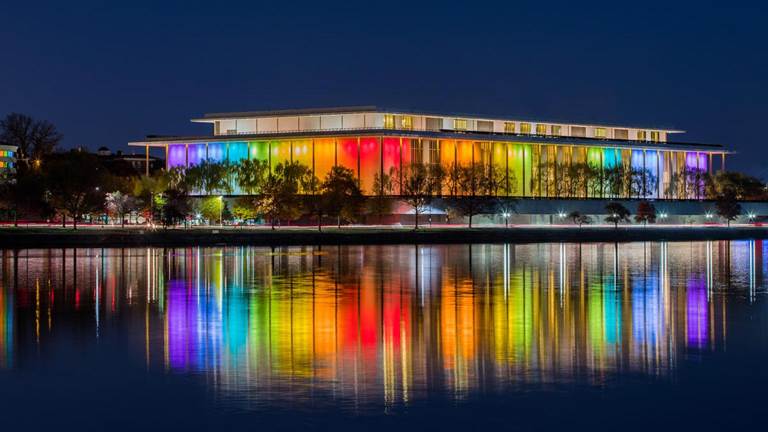
Free Events at the Kennedy Center

John F. Kennedy Memorial Center for the Performing Arts.

Congress passed and President Lyndon B. Johnson signed into law legislation renaming the Center as a “living memorial” in his honor: The John F. Kennedy Memorial Center for the Performing Arts. 

In Trump’s case, getting his name added to the Center was much simpler. First, he fired the longstanding board that had overseen the Center, and put his own handpicked board members on it.

Then his chosen thralls declared: “We’re adding Trump’s name to this building.”

No doubt to his amazement, there were serious objections to this—and lawsuits backing up those objections. 

On May 29, 2026, U.S. District Judge Christopher Cooper in Washington, D.C., ruled that Trump’s name was illegally added to the Center:

“The Kennedy Center’s organic statute makes crystal clear that the Center is to be named for President Kennedy, and it cannot bear any other formal name or public memorial based on the Board’s unilateral say-so. Congress gave the Kennedy Center its name, and only Congress can change it.”

And he ordered that Trump’s name be removed from the building within two weeks—by June 12, two days before Trump’s 80th birthday.

Trump has, predictably, appealed the ruling to the Supreme Court.

He thus joined the ranks of arts-obsessed tyrants like Joseph Stalin and Adolf Hitler. For 12 years, Hitler served as the arbiter of culture in Nazi Germany. Stalin held that role for almost 30. 

Hitler considered himself an unappreciated artist. At 18, he had applied for admission to the Academy of Fine Arts Vienna, but was rejected twice. If he had a friend, it was the architect Albert Speer, with whom he felt an artistic kinship.

Even as the Third Reich collapsed, he found time to pore over architectural models he intended to turn into gigantic buildings.

In Hitler and the Power of Aesthetics, author Frederic Spotts argues that Hitler saw the world corrupted by “evils” he must first destroy so he could re-create it to conform to his artistic ideals.

Hitler and the Power of Aesthetics by Frederic Spotts | Goodreads

Like Hitler, Trump sees himself as an unrecognized artist through his erection of buildings. And, again like Hitler, he believes that he has a mission to replace ugliness with beauty.

But he’s clearly more focused on the demolition process than on the creation of beauty. 

On October 20, 2025, demolitions crews—on his orders—gutted the East Wing of the White House to create a massive, 90,000 square feet, 650-person capacity ballroom. 

And he has threatened to demolish the John F. Kennedy Center for the Performing Arts if his name is not added to it.

Meanwhile, he intends to close the Center for two years, to hide the embarrassing truth that artists and audiences no longer want to go there while he runs it.

THE RIGHT’S NEW TARGET: “THE ODYSSEY”–PART TWO (END)

In Business, Entertainment, History, Military, Politics, Social commentary on July 29, 2026 at 12:10 am

Most of what Americans believe about the ancient world comes from blockbuster movies—many of them dating back to the 1940s, 1950s and 1960s.

Among those beliefs: 

THE ISRAELITES WERE THE GOOD GUYS. That’s because Biblical movies were based (often loosely) on Old Testament stories. And the Old Testament was written by Israelites.

  • The Israelites were never portrayed as being as ruthless as their enemies, despite this instruction in Jeremiah 51:22-23: “With you I will shatter men and women, old people and children, young men and maidens. With you I will shatter shepherds and flocks, farmers and oxen, captains and rulers.” 
  • “Sansom and Delilah” (1949) and “The Ten Commandments” (1956), pitted noble Israelites against, respectively, evil Philistines and Egyptians. 
  • Even when a major figure like King David (Gregory Peck in “David and Bathsheba” (1951) committed major sins like adultery and murder, the movie ended on a high note: God forgives him and sends rain to quench a parched Israel.

A big difference once existed between how audiences treated movies based on Greek mythology and those based on the Bible.

Audiences were content to enjoy films based on Greek myths without taking them seriously. But those watching movies based on Bible stories assumed they were watching history unfolding before them.

This was never truer than audiences’ reaction to director Mel Gibson’s 2004 blockbuster, The Passion of the Christ. Orthodox Christians flocked to the movie, which blamed Jesus’ crucifixion on Jewish high priests, not the Roman governor, Pontius Pilate.

A sepia colored image showing the face of bearded man covered in blood, on his head is a crown of thorns.

Now audiences seem to believe that “The Odyssey” is delivering history, not mythology. When the first trailer was released in December, critics said that Odysseus’s boat looked like a “Viking ship.” 

“I wonder whether we have become inclined to treat mythological material as though it were historical material,” said Susan Deacy, professor of Classics at the University of Roehampton and the author of The Greek Gods and Their Worlds. “Yet the Odyssey is continually being reimagined, with pretty well every age producing its own Homer.” 

Many viewers were surprised to hear British actors, such as Tom Holland, speaking with American accents and using modern, contemporary expressions. 

But Deacy said this is based on cinematic tradition, not historical accuracy. The ancient Greeks did not speak either modern American English or formal British English. So conversational language may actually be closer to the spirit of Homer’s oral storytelling than the formal style often used in historical films.

Susan Deacy

Susandeacy, CC0, via Wikimedia Commons

Audiences didn’t “treat mythological material as though it were historical material” in 2004, when Wolfgang Peterson’s “Troy” hit movie screens. It featured Brad Pitt as Achilles, Eric Bana as Hector, Orlando Bloom as Paris, Sean Bean as Odysseus and Diane Kruger as Helen.

Among its deviations from Homer and Greek mythology:

  • Menelaus, the husband of Helen, is killed by Hector (instead of returning to Sparta with Helen).
  • Agamemnon is killed during the fall of Troy by Briseis, the woman once held captive by Achilles. (According to Greek myth, he was murdered, upon his return home, by his wife, Clytemnestra.)
  • Achilles infiltrates Troy in the wooden horse—and is killed on the city’s last night. (Greek mythology has him killed at the gates of Troy before the Greeks erected the Trojan horse.)
  • Most incredibly, Paris and Helen escape Troy to presumably find happiness somewhere else. (In Greek mythology, Menelaus intends to kill Helen for running off with Paris. But when he sees her, she bares her still-magnificent breasts and yells: “Kill me!” He’s so dumbstruck by her beauty he drops his sword and walks hand-in-hand with her to his ship for the voyage home.)

For those seeking a movie that adhere closely to the Iliad, the winner, hands down, is “The Fury of Achilles” (1962). It’s an Italian drama set in the tenth year of the Trojan War directed by Marino Girolami and starring Gordon Mitchell as Achilles.

It lacks the spectacle of “Troy” (owing to CGI) but is surprisingly sympathetic to its main characters—Achilles, Hector and Priam.

In one deeply moving scene, Achilles tells Briseis that every other Greek soldier hopes to return home, but he is doomed to die at Troy. He knows he has a vulnerable spot, but he doesn’t know where it is. He knows he is fated to kill Hector, Troy’s finest warrior—and that he himself will die soon afterward. 

Fury of Achilles (1962) - IMDb

Hector is similarly treated with sympathy, knowing he must die—and that when he does, his beloved city will soon follow him. But then he kills Achilles’ dear companion, Patroclus, and feels obligated to accept Achilles’ challenge to single combat.

And finally there is Priam, king of Troy, who, as in Homer, movingly pleads to Achilles for the body of his son, Hector. Achilles answers: “Your son is luckier than I. He has a father who mourns him. Who will mourn me when I’m gone? My father is dead.”

And elderly Priam replies: “If I am still alive when you are dead, I will mourn you as another son I have lost.”

At which point a sorrowful Achilles hands over the body of Hector to his grieving father—and the movie, like the Iliad, comes to an end.

THE RIGHT’S NEW TARGET: “THE ODYSSEY”–PART ONE (OF TWO)

In Business, Entertainment, History, Military, Politics, Social commentary on July 28, 2026 at 12:17 am

Once again, the Right is enraged—this time, at a movie. 

And not just any movie—“The Odyssey,” which looks to be the blockbuster hit of the summer.

It’s based on the epic poem, allegedly written by Homer, who lived between the eighth and ninth centuries. And while Homer likely earned nothing from his work, the film version of it opened with an estimated $124.5 million in domestic ticket sales and another $139.6 million from overseas, 

Its director, Christopher Nolan, garnered the 2023 Best Picture Oscar for “Oppenheimer.” With a production budget of $250 million, it’s among the most expensive R-rated movies ever made. Universal is spending $125 million to market it.

Picture of director Christopher Nolan smiling at the premiere of The Odyssey in New York

Christopher Nolan

PhilipRomano, CC BY-SA 4.0 <https://creativecommons.org/licenses/by-sa/4.0&gt;, via Wikimedia Commons

The movie stars Matt Damon (the “Ryan” in 1998’s “Saving Private Ryan”) as Odysseus, Tom Holland as his son, Telemachus; Anne Hathaway as his long-suffering wife, Penelope; Zendaya as the goddess, Athena; Robert Pattinson as the suitor Antinous and Charlize Theron as the sea nymph Calypso.

So far, so good—for the Right.

But then comes the “controversial” part: Nolan cast Lupita Nyong’o, a black actress, as Helen of Troy and Elliot Page (a “transitioning” actor) as a soldier.

Right-wingers are furious that that a black woman has been cast as Helen. 

Film poster showing Odysseus (Matt Damon) standing in a battle position, with the Trojan Horse behind him, engulfed in ash and smoke.

Right-wing commentator Matt Walsh wrote on X: “Not one person on the planet actually thinks that Lupita Nyong’o is ‘the most beautiful woman in the world.’ But Christopher Nolan knows that he would be called racist if he gave ’the most beautiful woman’ role to a white woman. Nolan is technically talented but a coward.” 

Elon Musk charged: “Chris Nolan has lost his integrity.” And he vowed that that before the end of 2026, his AI tool Grok “will make a full-length movie of ‘The Odyssey’ that is historically accurate and true to the art of Homer.” 

“By historically accurate, he means whiter than Christmas at Cracker Barrel,” comedian Colman Domingo joked during his stint as guest host on “Jimmy Kimmel Live!”

The Right’s fury can’t be based on the historical record—because the Odyssey is not history, but mythology. And according to ancient Greek myth, Helen was hatched from an egg laid after her mother was visited by Zeus in the form of a swan.

The Helen that Right-wingers envision is a product of Hollywood movie casting.

Sponsored Ad - Odyssey, The

Troy did exist, and was located in northwestern Anatolia, in present-day Çanakkale province, Turkey. It lay just a few miles south of the Dardanelles strait, which connects the Aegean Sea to the Black Sea. This put the city in a highly strategic position controlling major ancient trade routes.

As a result, the famous Trojan War might well have been fought over conflicts in trade, rather than the alleged seduction/kidnapping of Helen, Queen of Sparta, by Paris, prince of Troy.

On the other hand, wars have been fought over perceived slights to the ego of one ruler by another. In William Shakespeare’s play, Henry V, the French Dauphin mocks Henry by sending him tennis balls, implying that Henry is a callow youth rather than a serious monarch. This leads Henry to invade France.

As for Elliot Page: Transgender surgery did not exist in the time of Homer. But homoerotic relationships certainly did—most famously among Greek soldiers.

Today, Right-wingers like Secretary of Defense Pete Hegseth fear that homosexuals make poor soldiers. But their choice in sex partners did not prevent the army of Alexander the Great from conquering most of the known world of his time.

The truth is that most of what Americans think they know about the ancient world comes not from scholarly books but blockbuster movies—many of them dating back to the 1940s, 1950s and 1960s.

Among those beliefs:

THE ANCIENT ROMANS SPOKE WITH BRITISH ACCIDENTS. That’s because British actors played Roman aristocrats in so many movies during the 1950s and 1960s. 

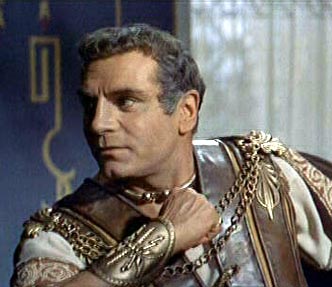
  • Laurence Oliver, Peter Ustinov and Charles Laughton played high-born Romans in “Spartacus” (1960) and Richard Burton and Rex Harrison played them in “Cleopatra” (1963).
  • Romans didn’t speak English. They spoke Latin—which at that time was the language of world commerce. Today, it’s not used as a primary mother tongue in any community. A movie whose characters spoke Latin would find itself with an extremely small audience. 

Laurence Olivier - Spartacus

Laurence Oliver in “Spartacus”

SPARTANS WERE THE GOOD GUYS. “The 300 Spartans” (1962) and “300” (2006) celebrate the three-day battle of Thermopylae, where 300 Spartans and 6,700 other Greeks held the narrow pass against a huge Persian army. If the Spartans existed today, these films could serve as recruiting advertisements for their skill at war.

So far, so good.

What these films don’t say:

  • The Spartans ruled a slave empire whose people farmed the land, supplied food and served as military laborers. Their forced labor gave Spartans the freedom to focus completely on military training. 
  • Once a year, Spartans were allowed to murder any helot they desired, just to remind their slaves who was boss.
  • Spartan men were required to live apart from their wives in all-male barracks—and sneak out to have conjugal visits with their wives.
  • Homosexuality played a major role in the lives of Spartans.