Upon his return to the Presidency in 2025, Donald Trump turned his “artistic” gifts on the White House.
On June 9, 2025, contractors began paving over the grass of the White House Rose Garden with stone tiles to create a patio.
This had been a special project of then-First Lady Jacqueline Kennedy. In 1962 she and designer Rachel Lambert “Bunny” Mellon created a classic, symmetrical space for official state functions and press events.
They installed a central open lawn surrounded by formal flower beds, seasonal plantings, and flowering crabapple trees.
The destruction of the rose garden ignited a firestorm of criticism. But Trump insisted that the paving go on anyway.
Like Adolf Hitler, Trump believes that “bigger is better” in architecture.
On July 31, 2025, the Trump administration announced that a 90,000 square feet addition would be made to the White House to incorporate a 650-person capacity ballroom.
In October, 2025, Trump ordered the demolition of the White House’s historic East Wing to clear space for it. It’s the most expensive project in Trump’s roster, with an $800 million estimated price tag, according to New York.
American taxpayers are expected to foot more than half the bill, despite Trump’s repeated denials of this. In March, 2026, he told reporters that construction on the ballroom “is taxpayer-free. We have no taxpayer putting up 10 cents.”
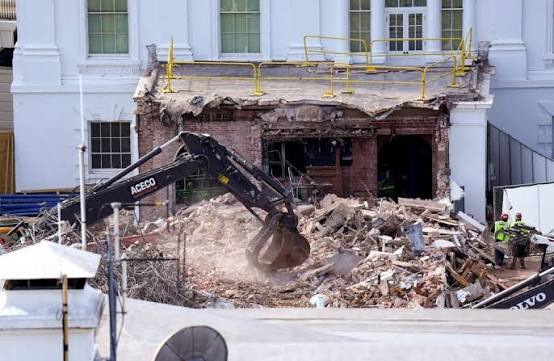
Demolition of the East Wing of the White House
Trump intends this to be a monument to himself: By October, 2025, senior officials within the Trump administration were using the title, “The President Donald J. Trump Ballroom.”
On August 31, the Supreme Court—packed with six Right-wing Justices—granted Trump approval to continue construction on his ballroom. This had been halted after a lower court issued a temporary block on the project earlier that month.
After the ruling, Trump wrote on Truth Social: “We are living in the Golden Age of America, and this Building will be one of the Greatest ever constructed in Washington, D.C. When completed in the Summer of 2028, the magnificent Ballroom and Military Complex will be something that the entire Country is very proud of.”
In a rare burst of candor, Trump told New York Magazine that his construction projects are essentially monuments to himself: “Nobody will do it once I’m gone. When I leave here, nobody will.”
For Trump, there can’t be too many monuments to his memory. Among these:
- Like a Roman emperor, Trump has put his face on a new commemorative gold-finished $1 coin issued by the U.S. Mint—allegedly to celebrate America’s 250th anniversary.
- He has mused about changing the name of the Strait of Hormuz to “Trump Strait.” How he would get the Iranians to accept that name remains unclear.
- In May, 2005, the US Department of Agriculture was decorated with a banner featuring Trump’s face. Since then, the Department of Justice, the Department of the Interior, and the Department of Labor have sported similar banners.
Achieving immortality—at least in how people remember them long after they’ve passed on—has long been a desire of tyrants. But once they’re dead, they no longer have control over the lives of their once-subject peoples.
So the way they’re remembered can prove vastly different from how they wanted to be regarded.
Alexander the Great thirsted be remembered as the world’s greatest conqueror, bringing Greek civilization to the nations he ravished.

Alexander the Great
Modern historians view him as a brilliant military leader—but also as a ruthless and megalomanic tyrant who slaughtered whole peoples and caused widespread destruction. Moreover, his empire collapsed quickly after his death.
Leon Trotsky—the Russian revolutionary and bitter foe of Joseph Stalin—wrote: “Nero, too, was a product of his epoch. Yet after he perished his statues were smashed and his name was scraped off everything.
“The vengeance of history is more terrible than the vengeance of the most powerful General Secretary. I venture to think that this is consoling.”
By the time he died in 1953, Soviet dictator Joseph Stalin had an estimated 6,000 statues of himself erected across the Soviet Union and Eastern Europe, holding the world record for the most statues raised to a living person.
After his death and the start of de-Stalinization under Nikita Khrushchev, the vast majority of these statues were quietly removed, demolished, or melted down.
Finally, there is this classic poetic commentary on the uncertainty of immortality, courtesy of Percy Bysshe Shelley:
I met a traveller from an antique land
Who said: Two vast and trunkless legs of stone
Stand in the desert. Near them, on the sand,
Half sunk, a shattered visage lies, whose frown,
And wrinkled lip, and sneer of cold command,
Tell that its sculptor well those passions read
Which yet survive, stamped on these lifeless things,
The hand that mocked them and the heart that fed:
And on the pedestal these words appear:
“My name is Ozymandias, king of kings:
Look on my works, ye Mighty, and despair!”
Nothing beside remains. Round the decay
Of that colossal wreck, boundless and bare
The lone and level sands stretch far away.


ADOLF HITLER, AFFORDABILITY, ALBERT SPEER, ALEXANDER THE GREAT, ALTERNET, AMERICABLOG, AP, BABY BOOMER RESISTANCE, BBC, BENJAMIN NETANYAHU, BLOOMBERG, BLUESKY, BUZZFEED, CBS NEWS, CNN, CROOKS AND LIARS, DAILY KOS, DE-STALINIZATION, DEMOCRATS, DONALD TRUMP, FIVETHIRTYEIGHT, FREDERIC SPOTTS, HARPER’S MAGAZINE, HITLER AND THE POWER OF AESTHETICS (BOOK), HOWARD STERN, HUFFINGTON POST, IRAN, ISRAEL, JAQUELINE KENNEDY, JOHN F. KENNEDY MEMORIAL CENTER FOR THE PERFORMING ARTS, JOSEPH STALIN, LEON TROTSKY, LYNDON B. JOHNSON, MEDIA MATTERS, MENELAUS, MIDTERM ELECTIONS, MONUMENTS, MOTHER JONES, MOVEON, MSNBC, NBC NEWS, NEWSDAY, NEWSWEEK, NICOLAS MADURO, NIKITA KHRUSHCHEV, NPR, OPERATION BARBAROSSA, PBS NEWSHOUR, PERCY BYSSHE SHELLEY, PETE HEGSETH, POLITICO, POLITICUSUSA, PRINCESS DIANA, RAW STORY, REUTERS, SALON, SEATTLE TIMES, SLATE, SOVIET UNION, STRAIT OF HORMUZ, T.E. LAWRENCE, TALKING POINTS MEMO, THE ATLANTIC, THE CHICAGO SUN-TIMES, THE CHICAGO TRIBUNE, THE DAILY BEAST, THE DAILY BLOG, THE GUARDIAN, THE HILL, THE HUFFINGTON POST, THE INTERCEPT, THE LOS ANGELES TIMES, THE NATION, THE NEW REPUBLIC, THE NEW YORK TIMES, THE NEW YORKER, THE ODYSSEY (POEM), THE VILLAGE VOICE, THE WASHINGTON POST, THINKPROGRESS, THIRD REICH, TIME, TROJAN WAR, TROY, TRUTH SOCIAL, TRUTHDIG, TRUTHOUT, TWO POLITICAL JUNKIES, U.S. NEWS & WORLD REPORT, UPI, USA TODAY, VENEZUELA, VICTORY ARCH, WHITE HOUSE BALLROOM, WHITE HOUSE ROSE GARDEN, X
VANITY AND NOTHINGNESS: PART THREE (END)
In Bureaucracy, History, Law, Military, Politics, Social commentary on September 10, 2026 at 1:37 amUpon his return to the Presidency in 2025, Donald Trump turned his “artistic” gifts on the White House.
On June 9, 2025, contractors began paving over the grass of the White House Rose Garden with stone tiles to create a patio.
This had been a special project of then-First Lady Jacqueline Kennedy. In 1962 she and designer Rachel Lambert “Bunny” Mellon created a classic, symmetrical space for official state functions and press events.
They installed a central open lawn surrounded by formal flower beds, seasonal plantings, and flowering crabapple trees.
The destruction of the rose garden ignited a firestorm of criticism. But Trump insisted that the paving go on anyway.
Like Adolf Hitler, Trump believes that “bigger is better” in architecture.
On July 31, 2025, the Trump administration announced that a 90,000 square feet addition would be made to the White House to incorporate a 650-person capacity ballroom.
In October, 2025, Trump ordered the demolition of the White House’s historic East Wing to clear space for it. It’s the most expensive project in Trump’s roster, with an $800 million estimated price tag, according to New York.
American taxpayers are expected to foot more than half the bill, despite Trump’s repeated denials of this. In March, 2026, he told reporters that construction on the ballroom “is taxpayer-free. We have no taxpayer putting up 10 cents.”
Demolition of the East Wing of the White House
Trump intends this to be a monument to himself: By October, 2025, senior officials within the Trump administration were using the title, “The President Donald J. Trump Ballroom.”
On August 31, the Supreme Court—packed with six Right-wing Justices—granted Trump approval to continue construction on his ballroom. This had been halted after a lower court issued a temporary block on the project earlier that month.
After the ruling, Trump wrote on Truth Social: “We are living in the Golden Age of America, and this Building will be one of the Greatest ever constructed in Washington, D.C. When completed in the Summer of 2028, the magnificent Ballroom and Military Complex will be something that the entire Country is very proud of.”
In a rare burst of candor, Trump told New York Magazine that his construction projects are essentially monuments to himself: “Nobody will do it once I’m gone. When I leave here, nobody will.”
For Trump, there can’t be too many monuments to his memory. Among these:
Achieving immortality—at least in how people remember them long after they’ve passed on—has long been a desire of tyrants. But once they’re dead, they no longer have control over the lives of their once-subject peoples.
So the way they’re remembered can prove vastly different from how they wanted to be regarded.
Alexander the Great thirsted be remembered as the world’s greatest conqueror, bringing Greek civilization to the nations he ravished.
Alexander the Great
Modern historians view him as a brilliant military leader—but also as a ruthless and megalomanic tyrant who slaughtered whole peoples and caused widespread destruction. Moreover, his empire collapsed quickly after his death.
Leon Trotsky—the Russian revolutionary and bitter foe of Joseph Stalin—wrote: “Nero, too, was a product of his epoch. Yet after he perished his statues were smashed and his name was scraped off everything.
“The vengeance of history is more terrible than the vengeance of the most powerful General Secretary. I venture to think that this is consoling.”
By the time he died in 1953, Soviet dictator Joseph Stalin had an estimated 6,000 statues of himself erected across the Soviet Union and Eastern Europe, holding the world record for the most statues raised to a living person.
After his death and the start of de-Stalinization under Nikita Khrushchev, the vast majority of these statues were quietly removed, demolished, or melted down.
Finally, there is this classic poetic commentary on the uncertainty of immortality, courtesy of Percy Bysshe Shelley:
Share this:
Related