bureaucracybusters

Posts Tagged ‘THE LOS ANGELES TIMES’

LIFE LESSONS FROM PAULA DEEN: PART THREE (END)

In Bureaucracy, Business, Law, Social commentary on June 28, 2013 at 12:14 am

Celebrity Chef Paula Deen, her brother Earl “Bubba” Hiers, her company, and the corporations that operate a pair of restaurants she owns in Savannah, Georgia., are being sued by former employee Lisa Jackson.

A complaint filed in the U.S. District Court for the Southern District of Georgia in November, 2012, claimed that she was subjected to “violent, sexist, and racist behavior” during her five years’ employment by Deen.

In the deposition she filed in May, 2013, she proved to be her own worst enemy.  Consider the following:

Speaking of her employee, Karl Schumacher, Deen said:

A.  Karl is the most judgmental person I know.  And out of every team member on our team, he is certainly the most prejudice.

Q.  Prejudice against who?

A.  You name it.

Q.  African-Americans?

A.  Gays, you name it. If you drink, you’re a bad person.  If you use four-letter words, you’re a bad person.  If you don’t think like he thinks, you’re a bad person.

Q.  Is he–?

A.  He is a one-man jury.

Stupid Mistake #16:  She admits that she had retained an employee who was openly prejudiced toward a wide range of people: “Gays, you name it.”

Q.  Is he prejudice against African-Americans?

A.  I–no, I don’t–no, I would say the answer to that one would be no.

Stupid Mistake #17:  Having already admitted the Schumacher was “a one-man jury” and “the most prejudice” of her employees, Deen suddenly claims he isn’t prejudiced against blacks. 

MackWorks, a business consulting firm, conducted an investigation of Uncle Bubba’s, which is owned by her brother, Earl “Bubba” Hiers.

Q.  Okay.  And in order to determine that it was the opinion of these high-priced consultants that Miss Jackson had been the victim of discrimination sufficient to give her cause to file an EEOC [U.S. Equal Employment Opportunity Commission] all you would have had to do was read that report, correct?

A.  I didn’t read the report.

Q.  Okay.  And what, if any, investigation have you done to determine if it is your brother who is lying, as opposed to Miss Jackson and Mr. Schumacher and the people at MackWorks?

A.  I know my brother.  I know his character.  If I ask him something, he would not lie to me, nor would I to him.  There was nothing to investigate.

Stupid Mistake #18:  After an independent consulting firm gives her a scathing report about her brother’s restaurant, she doesn’t read it. 

Stupid Mistake #19:  She admits she didn’t read it.

Stupid Mistake #20:  She admits she took no action to discover the truth for herself: “There was nothing to investigate.”

* * * * *

I have not searched through the entire deposition as given by Paula Deen.  But the portion I have reviewed convinces me this was a lawsuit–and a disaster–waiting to happen.

The media has focused its attention on Deen’s admission to having used the “N-word.”  But clearly she was running a dysfunctional operation–replete with alcoholism, racial prejudice, sexual harassment and theft.

Much has been made of Deen’s serving as an ambassador of Southern culture and cooking.  But if only some of the accusations made against her hold up, she must also serve as an ambassador of a South decent Americans want to forget–and forever put behind them.

That was definitely an era when blacks knew their place–which was as slaves in the kitchens or fields of the Southern planter class who owned them.

According to Jackson, those are the days Deen would love to return to.

As proof, she cited an exchange that occurred when she was appointed by Deen to handle the catering and staff for Bubba’s wedding in 2007.

When she asked Deen what the servers should wear, Deen allegedly replied:

“Well what I would really like is a bunch of little niggers to wear long-sleeve white shirts, black shorts and black bow ties, you know in the Shirley Temple days, they used to tap dance around.

“Now, that would be a true Southern wedding wouldn’t it? But we can’t do that because the media would be on me about that.”

Deen has given lip service to knowing that the days of Southern racism are past.  But according to the complaint filed against her by her former employee, Lisa Jackson, that past remains very much alive:

  • Requiring black employees to use separate bathrooms and entrances from whites.
  • Holding black employees to “different, more stringent standards” than whites.
  • Allowing her brother, Earl “Bubba” Hiers, to regularly made offensive racial remarks.
  • Allowing Hiers to make inappropriate sexual comments.
  • Allowing Hiers to force the plaintiff, Lisa Jackson, to look at pornography with him.
  • Allowing Hiers to often violently shake employees.
  • Allowing Hiersto come to work in “an almost constant state of intoxication.”
  • Enabling Hiers’ behavior by ignoring Jackson’s efforts to discuss his behavior.
  • Holding “racist views herself.”

Many of Deen’s supporters have claimed she is the victim of anti-Southern prejudice.

But the truth appears that only in the South could she have run so gigantic and lucrative an empire for so long in such prejucial and dysfunctional fashion.

The wonder is not that the Food Network refused to renew her contract after June, 2013.  The wonder is that she has managed to stay in business this long.

LIFE LESSONS FROM PAULA DEAN: PART TWO (OF THREE)

In Bureaucracy, Business, Law, Social commentary on June 27, 2013 at 12:00 am

Celebrity Chef Paula Deen, her brother Earl “Bubba” Hiers, her company, and the corporations that operate a pair of restaurants she owns in Savannah, Georgia, are being sued by her former employee Lisa Jackson.

A complaint filed in the U.S. District Court for the Southern District of Georgia in November, 2012, claimed that she was subjected to “violent, sexist, and racist behavior” during her five years’ employment by Deen.

There are many lessons to be learned from the deposition Deen gave in the case in May.  Such as:

Q, Okay.  Have you used it [the “N-word”] since then?

A.  I’m sure I have, but it’s been a very long time.

Stupid Mistake #7:  Having admitted she used it in the past, she compounds her mistake by admitting she had used it since. 

Stupid Mistake #8:   There is an entirely legal way to avoid incriminating oneself–and being prosecuted for perjury.  It’s contained in the words: “Not that I can recall.”

Q. Can you remember the context in which you have used the N word?

A.  No.

Q.  Has it occurred with sufficient frequency that you cannot recall all of the various context in which you’ve used it?

A.  No.

Q.  Well, then tell me the other context in which you’ve used the N word.

A.  I don’t know, maybe in repeating something that was said to me.

Q.  Like a joke?

A  No, probably a conversation between blacks.  I don’t–I don’t know.

Stupid Mistake #9:  The vast majority of restaurant kitchens are staffed by blacks or Hispanics, whose exchanges are often obscene and homophobic.  If Deen had said she had quoted such a conversation between employees, she could have legitimately claimed she did so entirely for the sake of accuracy.  She could have blamed them for using the  N-word, and cast herself strictly in the role of reporter.

Back to the deposition:

Q.  Okay.

A.  But that’s just not a word that we use as time has gone on.  Things have changed since the 60s in the South.  And my children and my brother object to that word being used in any cruel or mean behavior.

Q.  Okay.

A.  As well as I do.

Q.  Are you aware that your brother has admitted to using that word at work?

A.  I don’t know about that.

Stupid Mistake #10:  She had previously admitted to attending her brother’s deposition, where he admitted to, among other offenses, using the N-word in the workplace.  So this is a direct contradiction of her earlier admission.

Q  Okay.  Now, if you had learned of Mr. Hiers engaging in racially or sexually inappropriate behavior in the workplace, what, if any, actions would you have taken?

A.  I certainly would have addressed it.

Stupid Mistake #11:  Previously she had been asked: “Did any of the things that your brother admitted to doing, including…using the N word in the workplace, did any of that conduct cause you to have any concerns about him continuing to operate the business?”  And she had replied: “No.”  So this amounts to yet another contradiction.

Q.  Have you ever addressed Mr. Hiers’ racially or sexually inappropriate conduct?

A. No.

Stupid Mistake #12:  She admitted to having learned about her brother’s use of the N-word in the workplace–and then admitted to having never addressed it.

Q.  And you are aware of his admitting to engaging in racially and sexually inappropriate  behavior in the workplace in his deposition in this case?

A.   No.

Stupid Mistake #12:  This directly contradicts her previous admission that she had learned of his engaging in such behavior during his deposition.

Q.  Are you aware of Mr. Hiers admitting that he engaged in racially and sexually inappropriate behavior in the workplace?

A.  I guess.

Q.  Okay.

A.  If I was sitting here I would have heard it.

Stupid Mistake #13:  She admits once again to having been apprised of her brother’s offensive behavior.

Q.  Okay.  Well, have you done anything about what you heard him admit to doing?

A.  My brother and I have had conversations.  My brother is not a bad person.  Do humans behave inappropriately?  At times, yes.  I don’t know one person that has not.  My brother is a good man.  Have we told jokes?  have we said things that we should not have said, that–yes, we all have.  We all have done that, every one of us.

Stupid Mistake #14:  She admits to having talked with her brother about his offensive behavior–but she did not say she did anything to stop it or punish him for it.

Q.  You said you have had such conversations with [your brother]. When did you do so?

A.  When Karl told me he was stealing, I addressed that with Bubba.

Q.  And as a result of Mr. Hiers stealing, he received a pay increase and the money he had taken was recharacterized as wages, is that correct?

A.  I don’t know how it was settled.  I know that Karl was paying Lisa Jackson more than my brother was being paid, so if there was a salary increase, it would have been long overdue.

Stupid Mistake #15:  She admits that even though she learned that one of her employees was stealing from her, she had nevertheless retained him.

LIFE LESSONS FROM PAULA DEEN: PART ONE (OF THREE)

In Bureaucracy, Business, Law, Social commentary on June 26, 2013 at 12:01 am

The purpose of this website is to highlight the ways public and private bureaucracies actually operate–as opposed to how they usually want others to believe they operate.

Occasionally, a case comes along that is so filled with blatant violations of law and common sense that it offers a road map of what others should do to avoid similar disaster.

Such a case is that of celebrity chef Paula Deen.

Paula Deen

Let’s start at the beginning.

Deen, her brother Earl “Bubba” Hiers, her company, and the corporations that operate a pair of restaurants she owns in Savannah, Georgia, are being sued by former employee Lisa Jackson.

A complaint filed in the U.S. District Court for the Southern District of Georgia in November, 2012, claimed that she was subjected to “violent, sexist, and racist behavior” during her five years’ employment by Deen.

Jackson’s complaint describes her as a “white female” who has biracial nieces.

It was for that reason that she left Uncle Bubba’s Oyster House, which was run by Hiers, in August, 2010.

Jackson’s complaint alleges the following:

  • Black employees were required to use separate bathrooms and entrances from whites.
  • Black employees were held to “different, more stringent standards” than whites.
  • Hiers regularly made offensive racial remarks.
  • Hiers made inappropriate sexual comments.
  • Hiers forced Jackson to look at pornography with him.
  • Hiers often violently shook employees.
  • Hiers came to work in “an almost constant state of intoxication.”
  • Dean enabled Hiers’ behavior by ignoring Jackson’s efforts to discuss his behavior.
  • Deen “holds racist views herself.”

The allegation that black employees were ordered to use separate bathrooms and entrances harkens back to the ugly days of the pre-civil rights South.  That was an era where most blacks knew their place–or were murdered by the Ku Klux Klan.

In May, 2013, Deen gave her own deposition in the case.  She denied many of the allegations against Hiers-–but ended up admitting that she was aware of his offensive behaviors:

Q.  Okay.  Are you aware–-you were here during your brother’s deposition, right?

A.  Yes.

Q.  So you are aware of the things that he’s admitted to?

A.  Absolutely.

Q.  Did any of the things that your brother admitted to doing, including reviewing–-reviewing pornography in the workplace, using the N word in the workplace, did any of that conduct cause you to have any concerns about him continuing to operate the business?

A.  No.  My brother and I, 25 years ago…each started a business and we each had $200 to start that business.  My brother built the most successful long-service business in Albany, Georgia, with his $200.  My brother is completely capable unless he’s being sabotaged.

Stupid Mistake #1:  Deen acknowledged that, if she hadn’t known about her brother’s behavior prior to his deposition, she was present during this and thus learned about it then.

Stupid Mistake #2:  Deen acknowledged that even after she officially became aware of his behavior, she did not feel there was any reason to sever him from the company.

Getting back to Deen’s deposition:

Q.  Now, does his sense of humor include telling jokes about matters of a sexual nature?

A.  We have all told off-colored jokes.

Q.  Okay.  Does his sense of humor include telling jokes of a racial nature?

A.  I’m sure those kind of jokes have been told.  Every man I’ve ever come in contact with has one.

Stupid Mistake #3:  Deen acknowledged that off-color jokes were told in her workplace, and that she was clearly aware of it.

Stupid Mistake #4:  Deen made light of the telling of jokes that the vast majority of employers would not tolerate in their workplaces.

Then came–for Deen–the most deadly part of the deposition:

Q.  Okay.  Miss Deen, have you told racial jokes?

A.  No, not racial.

Q.  Okay, have you ever used the N word yourself?

A.  Yes, of course.

Stupid Mistake #5:  She knew that the charge of racial discrimination stood at the very heart of the lawsuit facing her.  Yet, when asked if she had ever used the N-word, she replied, “Yes, of course,” as if this were the most natural thing in the world.

Q.  Okay.  In what context?

A.  Well, it was probably when a black man burst into the bank that I was working at and put a gun to my head.

Q. Okay, and what did you say?

A.  Well, I don’t remember, but the gun was dancing all around my temple.  I didn’t…feel real favorable towards him.

Q.  Okay.  Well, did you use the N word to him as he pointed a gun in your head at your face?

A.  Absolutely not.

Q.  Well, then, when did you use it?

A.  Probably in telling my husband.

Stupid Mistake #6:  What is discussed between husband and wife is protected legally as marital privilege.  Her attorney should have objected and told her not to answer the question.  If she had not admitted to using it privately with her husband, she might not have been asked if she had used it since then.

RACE AND CRIME: PART TWO (END)

In Law, Law Enforcement, Politics, Social commentary on June 20, 2013 at 12:00 am

“How effective is a police officer with a blindfold on?”

That’s the question posed by an ad sponsored by the Captains Endowment Association of the New York Police Department (NYPD).

The ad will appear in the June 20th edition of the New York Post, as well as on Twitter and Facebook.  And it will appear in response to an upcoming bill proposed by Democrats on the New York City Council.

This latest foray into Political Correctness “will ban cops from identifying a suspect’s age, gender, color or disability,” Roy Richter, president of the Association, told the Post.

“When we have wanted suspects and patterns of crimes, those are very important descriptive terms to let officers know who to look for.”

Under this bill, police could describe a suspect only in terms of the color of his/her clothing–or risk being sued for profiling.

And, according to the Post, the bill is on a fast track–it’s being sent straight to the floor for a vote versus going through the “normal committee process.”

Ad of the NYPD Captains Endowment Association

The timing of the proposed bill may have been prompted by the release of the NYPD’s report on “Crime and Enforcement Activity in New York City” for 2012.

It outlines the racial makeup of the city’s crime population–both that of its victims and its perpetrators.  And it reveals that crime is centered overwhelmingly in minority-group neighborhoods

During the first six months of 2012, 96% of shooting victims were blacks or Hispanics–and in 97% of all cases, the shooters were other blacks or Hispanics.

Blacks and Hispanics comprise 89% of murder victims–and 86% of murder suspects.  Of felony assault victims, 81% are non-whites, as are 88% of the suspects.

Thus, while Blacks make up 22.8% of New York City’s population, they comprise

  • 51.4% of its murder and non-negligent manslaughter arrests;
  • 48.6% of its rape arrests;
  • 62.1% of its robbery arrests;
  • 52.3% of its felonious assault arrests;
  • 52.0% of its grand larceny arrests;
  • 75.0% of its shooting arrests;
  • 45.3% of its drug felony arrests;
  • 52.5% of its felony stolen property arrests;
  • 66.0% of its violent crime suspects;

While Hispanics make up 28.6% of the city’s population, they account for:

  • 36.7% of its murder and non-negligent manslaughter arrests;
  • 42.8% of its rape arrests;
  • 29.0% of its robbery arrests;
  • 33.6% of its felonious assault arrests;
  • 28.5% of its grand larceny arrests;
  • 22.0% of its shooting arrests;
  • 40.0% of its drug felony arrests;
  • 28.9% of its felony stolen property arrests;
  • 26.1% of its violent crime suspects;

Blacks, Hispanics and their liberal allies have long claimed that the startling numbers of blacks and Hispanics arrested, convicted and incarcerated only prove that racist white cops, prosecutors and judges have rigged the system against them.

But this ignores a fundamental–and ugly–truth: The vast majority of victims of black and Hispanic criminals are other blacks and Hispanics.

But pretending that crime doesn’t flourish in black and Hispanic neighborhoods hasn’t stopped the police from making arrests there.

So now members of the City Council have decided to prevent such arrests by making it impossible for police to identify non-white suspects.

Fortunately, several prominent black figures have dared to speak bluntly to the crisis of lawlessness within their community.

One of these is Jesse Jackson.  Speaking at a meeting of Operation PUSH (People United to Save Humanity) in Chicago on November 27, 1993, Jackson famously said:

“There is nothing more painful to me at this stage in my life than to walk down the street and hear footsteps and start thinking about robbery.

“Then look around and see somebody white and feel relieved. After all we have been through.  Just to think we can’t walk down our own streets–how humiliating.”

Jesse Jackson

During a 1998 interview on the PBS investigative series, Frontline, Jackson attacked the “criminal chic” style of dress that has become popular among young black men:

“Well, what does that style [wearing baggy britches or $200 Nike stringless tennis shoes] come from?  It comes from jail.

“That’s recycled jail culture, where they cannot wear belts because they may hang themselves or hurt themselves or hurt someone.  Or they can’t have strings in their tennis shoes.

“So when you find youth having jail culture recycled into them, it is almost as if you’re eating your own vomit.   It’s a kind of recycled sickness.”

Another prominent black who has dared to confront the realities of black criminality is comedian Bill Cosby.

Bill Cosby

Addressing the 20th National Action Network conference in April, 2011, Cosby didn’t mince words before his largely black audience:

“Tell me where Jesus would allow drug dealing on the corner?  Tell me where Jesus would allow people to shoot guns for no reason, missing and then hitting a child who is paralyzed for life?

“And we don’t do anything but have a funeral.  But let a cop shoot [a black man], and you set his car on fire and burn up the police stations.”

Until there is a sharp decline in the crime-rates for blacks and Hispanics, it will be common sense, not racism, that leads white parents to warn their children: Stay out of predominently black and Hispanic neighborhoods.

And for those parents to follow their own advice.

RACE AND CRIME: PART ONE (OF TWO)

In Law, Law Enforcement, Social commentary on June 19, 2013 at 1:17 am

Are some races more prone to crime–and especially violence–than others?

It remains a hotly-debated topic.  But while the origins of crime remain debatable, the races of its perpetrators and victims can be–and have been–statistically tabulated.

And those statistics haven’t changed much during the last 40 years.

Consider this:

In 1971, Robert Daley, a reporter for the New York Times, became a deputy police commissioner for the New York Police Department (NYPD).

In that capacity, he saw the NYPD from the highest levels to the lowest–from the ornate, awe-inspiring office of  Police Commissioner Patrick Murphy to the gritty, sometimes blood-soaked streets of New York.

He spent one year on the job before resigning–later admitting that when he agreed to take the job, he got more than he bargained for.

It proved to be a tumultuous year in the NY’D’s history:  Among those challenges Daley and his fellow NYPD members faced were the murders of several police officers, committed by members of the militant Black Liberation Army.

Two of those murdered officers were Waverly Jones and Joseph Piagentini.  Jones was black, Piagentini white; both were partners.  Both were shot in the back without a chance to defend themselves.

Writing about these murders in a bestselling 1973 book–Target Blue: An Inside’s View of the N.Y.P.D.–Daley noted:

  • Jones and Piagentini were the sixth and seventh policemen–of ten–murdered in 1971.
  • About 18 men were involved in these murders.  All were black.
  • The city’s politicians knew this–and so did Commissioner Murphy.  None dared say so publicly.

“But the fact remained,” wrote Daley, “that approximately 65% of the city’s arrested murderers, muggers, armed robbers, proved to be black men; about 15% were of Hispanic origin; and about 20% were white [my italics].

The overall racial breakdown of the city was approximately:

  • whites, 63%;
  • blacks, 20%;
  • Hispanics 17%.

Stated another way: Blacks, who made up 20% of the city’s population, were responsible for 65% of the city’s major crimes.

Or, as Daley himself put it: “So the dangerous precincts, any cop would tell you, were the black precincts.”

That was 40 years ago.

Now, consider the following statistics released by the NYPD for “Crime and Enforcement Activity in New York City” in 2012.  Its introduction states:

“This report presents statistics on race/ethnicity compiled from the New York City Police Department’s records management system.”

Then follows this chart:

Misdemeanor Criminal Mischief
Victim, Suspect, Arrestee Race/Ethnicity                                                                  

American Indians:               Victims:  0.7%      Suspects:  0.3%      Arrestees:   0.3%

Asian/Pacific Islanders:    Victims:  8.4%      Suspects:   3.2%     Arrestees:   3.9%

Blacks:                                        Victims:  36.5%    Suspects:  49.6%    Arrestees:  36.5%

Whites:                                      Victims:  28.9%    Suspects:  17.0%     Arrestees:  22.9%

Hispanics:                              Victims:   25.4%    Suspects:  29.8%    Arrestees: 36.4%

Total  Victims:      40,985       

Total Suspects:     11,356  

Total Arrests:         7,825

Then come the guts of the report:

Murder and Non-Negligent Manslaughter Victims:

  • Black (60.1%)
  • Hispanic (26.7%)
  • White victims (8.7%)
  • Asian/Pacific Islanders (4.2%)

Murder and Non-Negligent Manslaughter Arrestees:

  • Black (51.4%)
  • Hispanic (36.7%)
  • White (9.2%)
  • Asian/Pacific Islander (2.6%)

Rape Victims:

  • Black (37.9%)
  • Hispanic (36.9%)
  • White victims (19.2%)
  • Asian/Pacific Islanders (5.4%)

Rape Arrestees:

  • Black (48.6%)
  • Hispanic (42.8%)
  • White (5.0%)
  • Asian/Pacific Islander (3.1%)

Other Felony Sex Crimes Victims:

  • Black (40.7%)
  • Hispanic (33.6%)
  • White victims (19.6%)
  • Asian/Pacific Islanders (5.9%)

Known Other Felony Sex Crime Arrestees:

  • Black (42.3%)
  • Hispanic (39.8%)
  • White (12.6%)
  • Asian /Pacific Islander (5.1%)

Robbery Victims:

  • Hispanic (36.1%)
  • Black (31.9%)
  • White victims (18.3%)
  • Asian/Pacific Islanders (12.8%)

Robbery Arrestees:

  • Black (62.1%)
  • Hispanic (29.0%)
  • White (6.2%)
  • Asian/Pacific Islander (2.5%)

Felonious Assault Victims:

  • Black (47.8%)
  • Hispanic (33.6%)
  • White (12.4%)
  • Asian/Pacific Islanders (5.5%)

Felonious Assault Arrestees:

  • Black (52.3%)
  • Hispanic (33.6%)
  • White (9.4%)
  • Asian/Pacific Islanders (4.5%)

Grand Larceny Victims:

  • White (42.4%)
  • Black (25.0%)
  • Hispanic (20.1%)
  • Asian/Pacific Islanders (11.8%)

Grand Larceny Arrestees:

  • Black (52.0%)
  • Hispanic (28.5%)
  • White (14.6%)
  • Asian/Pacific Islanders (4.8%)

Shooting Victims:

  • Black (74.1%)
  • Hispanic (22.2%)
  • White (2.8%)
  • Asian/Pacific Islanders (0.8%)

Shooting Arrestees:

  • Black (75.0%)
  • Hispanic (22.0%)
  • White (2.4%)
  • Asian/Pacific Islander (0.6%)

Drug Felony Arrest Population:

  • Black (45.3%)
  • Hispanic (40.0%)
  • White (12.7%)
  • Asian Pacific Islanders (1.9%)

The Drug Misdemeanor Arrest Population

  • Black (49.9%)
  • Hispanic (34.5%)
  • White (13.3%)
  • Asian Pacific Islanders (2.1%)

The Felony Stolen Property Arrest Population:

  • Black (52.5%)
  • Hispanic (28.9%)
  • White (14.5%)
  • Asian/Pacific Islanders (4.0%)

The Misdemeanor Stolen Property Arrest Population:

  • Black (47.1%)
  • Hispanic (30.2%)
  • White (16.9%)
  • Asian/Pacific Islanders (5.4%)

Violent Crime Suspects:

  • Black (66.0%)
  • Hispanic (26.1%)
  • White (5.8%)
  • Asian/Pacific Islanders (1.9%)

Reported Crime Complaint Juvenile Victims:

  • Black (43.5%)
  • Hispanic (38.7%)
  • White (11.6%)
  • Asian/Pacific Islander (5.8%)

Juvenile Crime Complaint Arrestees:

  • Black (58.6%)
  • Hispanic (32.6%)
  • White (5.8%)
  • Asian/Pacific Islander (2.8%)

Appendix B of the report offers a breakdown of New York City’s racial makeup:

                                                                 Total Numbers        Percentage of the City’s Population

  • White                                               2,722,904                         (33.3%)
  • Black                                            1,861,295                      (22.8%)
  • Hispanic                                     2,336,076                     (28.6)
  • Asian/Pacific Islanders                1,030,914                         (12.6%)

Thus, while Blacks make up 22.8% of New York City’s population, they comprise

  • 51.4% of its murder and non-negligent manslaughter arrests;
  • 48.6% of its rape arrests;
  • 42.3% of its known other felony sex crime arrests;
  • 62.1% of its robbery arrests;
  • 52.3% of its felonious assault arrests;
  • 52.0% of its grand larceny arrests;
  • 75.0% of its shooting arrests;
  • 45.3% of its drug felony arrests;
  • 49.9% of its drug misdemeanor arrests;
  • 52.5% of its felony stolen property arrests;
  • 47.1% of its misdemeanor stolen property arrests;
  • 66.0% of its violent crime suspects;
  • 58.6% of its juvenile crime complaint arrests.

While Hispanics make up 28.6% of the city’s population, they account for:

  • 36.7% of its murder and non-negligent manslaughter arrests;
  • 42.8% of its rape arrests;
  • 39.8% for its known other felony sex crime arrests;
  • 29.0% of its robbery arrests;
  • 33.6% of its felonious assault arrests;
  • 28.5% of its grand larceny arrests;
  • 22.0% of its shooting arrests;
  • 40.0% of its drug felony arrests;
  • 34.5% of its drug misdemeanor arrests;
  • 28.9% of its felony stolen property arrests;
  • 30.2% of its misdemeanor stolen property arrests;
  • 26.1% of its violent crime suspects;
  • 26.1% of its juvenile crime complaint arrests.

LET ALLAH SORT IT OUT

In Bureaucracy, History, Military, Politics, Social commentary on June 18, 2013 at 12:05 am

Even confirmed imbeciles can sometimes get it right.

Or, in the case of former Alaska Governor Sarah Palin, partially right.

Speaking at the annual meeting of the Faith and Freedom Coalition on June 15, Palin said the United States should not intervene in Syria while Barack Obama holds the Presidency:

“Until we have a commander in chief who knows what he is doing… let Allah sort it out!”

Actually, she got it half-right: “Let Allah sort it out”–regardless of who is President.

Recently, noted draft-dodger and former President Bill Clinton had different advice for President Obama.

Clinton urged Obama to intervene in Syria:

“Suppose I had let a million people, two million people be refugees out of Kosovo, a couple hundred thousand people die, and they say, ‘You could have stopped this by dropping a few bombs. Why didn’t you do it?’ And I say, ‘because the House of Representatives voted 75% against it?’

“You look like a total wuss, and you would be.”

This is truly heady stuff, coming from a man who has proudly boasted how he outwitted his draft board and thus escaped military service in Vietnam.

Apparently, it’s OK for other Americans to put on a military uniform and risk their lives in pointless missions on behalf of foreigners who hate us.  It’s just not OK for bullet-shy types like Bill Clinton to do it.

Clinton doesn’t seem aware, or concerned, that, in Syria, two of America’s most deadly enemies are now waging war–with each other.

Yes, it’s Hezbollah (Party of God) vs. Al-Qaeda (The Base).

Hezbollah is comprised of Shiite Muslims, who form a minority of Islamics.  A sworn enemy of Israel, it has  kidnapped scores of Americans suicidal enough to visit Lebanon and truck-bombed the Marine Barracks in Beirut in 1983, which killed 299 Americans.

Flag of Hezbollah

Al-Qaeda, on the other hand, is made up of Sunni Muslims, who form the majority of that religion.  It is intolerent of non-Sunni Muslims and has instigated violence against them.  It denounces them as “takfirs”–heretics–and thus worthy of extermination.

Al Qaeda has attacked the mosques and gatherings of liberal Muslims, Shias, Sufis and other non-Sunnis.   Examples of sectarian attacks include the Sadr City bombings, the Ashoura massacre and the April, 2007 Baghdad bombings.

Flag of Al Qaeda

In a June 1 column entitled, “Stop the Madness,” Dr. James J. Zogby, the founder and president of the Arab American Institute, warns:

“What began as a popular revolt against a brutal and ossified dictatorship, Syria has now degenerated into a bloody battlefield pitting sects and their regional allies against each other in a ‘dance unto death.’

“On the one side, is the Ba’ath regime, supported by Russia, Iran, Hizbullah, and elements in the Iraqi government.

“Arrayed against them are a host of Syrians (some of whom have defected from the armed forces and others who have formed militias receiving arms and support from a number of Arab states and Turkey) and a cast of thousands of foreign Sunni fighters (some of whom have affiliated with al Qaeda) who have entered Syria to wage war on behalf of their brethren.”

Clinton, of course, isn’t the only one urging Obama to put American lives on the line for a cause that only Islamic terror groups and right-wing Americans find compelling.

Arizona U.S. Senator John McCain has repeatedly urged the Obama administration to militarily intervene in Syria.  He has demanded that the United States create a “no-fly” zone over Syria to deny Syrian dictator Bashar al Assad the use of his air force against his rebellious subjects.

McCain, unlike Clinton, did serve in Vietnam–as a U.S. Navy pilot.  In October 1967, while on a bombing mission over Hanoi, he was shot down, seriously injured, and captured by the North Vietnamese.  He remained a prisoner of war until his release in 1973.

Now McCain apparently wants today’s young servicemen to have the same opportunities he did–to be blown out of the sky and taken prisoner for another worthless cause.

Just as Sarah Palin was partially correct in urging “let Allah sort it out,” so, too, was Clinton partially correct in his “total wuss” remarks.

President Obama can rightly be called a “total wuss”–but not for keeping Americans out of harm’s way in a war they have no stake in.

He can legitimately be called a “total wuss”–for surrendering to the demands of the same neocons who lied America into a needless 10-year war in Iraq. 

But it’s not too late for Obama to recover from his mistake.

He can establish an all-volunteer brigade for those Americans willing to fight and possibly die in yet another pointless war.  And he can offer to fly them to the border of Syria so they can carry out their self-appointed “conquer or die” mission.

If these armchair strategists refuse to put their own lives on the line in defense of a “cause” they claim to believe in, Obama should have the courage to brutally–and repeatedly–point this out.

WITNESS-SECURITY: A BLOODSTAINED HISTORY: PART SIX (OF TEN)

In Bureaucracy, History, Law, Law Enforcement on June 17, 2013 at 12:16 am

Mafia Hitman Joseph Barboza had become known throughout the New England underworld as “The Animal.”

He relished his new alias and his reputation as a temperamental killer.

Everyone who dealt with Barboza—including Mafia Boss Raymond Patriarca—feared his explosive temper.

Granted an audience with Patriarca, Barboza was transfixed by the capo’s diamond ring.  Later, he bragged that he had thought of biting off Patriarca’s finger to get the ring.

“He’s crazy,” Patriarca often told his closest associates.  “Someday we’ll have to whack him out.”

Only one other mob gunman could match Barboza’s reputation for deadliness: Steve Hughes, the top triggerman for the McLaughlins.

Barboza spent more than a year trying to eliminate Hughes, until his chance finally came on September 23, 1966.

On that day, Hughes and a loanshark friend, Sammy Lindenbaum, went for a drive along Route 114 in Middleton, Massachusetts.

They paid no attention as another car—carrying Barboza and a crony, Joseph Amico—rapidly closed on them.

With Amico behind the wheel, Barboza aimed a high-powered rifle out the window and dropped Hughes and Lindenbaum in their seats.

Barboza’s moment of supreme triumph was short-lived.  His rising notoriety disturbed Patriarca, who believed in taking a low profile and avoiding the antagonism of the press and police.

Patriarca began searching for an excuse to part with his top muscleman.   He found it on October 6, 1966, when Boston police arrested Barboza and three companions.

Inside Barboza’s car, police found a loaded .45 automatic and an M-1 carbine.  Barboza, then out on bail on a stabbing charge, was shipped off to Walpole State Prison for parole violation.

There he waited vainly for the Patriarca Family to post the $50,000 bond demanded for his release.

Tired of waiting, two of his fellow enforcers decided to lend a hand: Thomas DePrisco and Arthur Bratsos began raiding Patriarca gambling dens to collect the money.

Their fund-raising efforts ended violently one night when their intended victims drew pistols and shot Bratsos and DePrisco to death.

When he learned of the deaths of his friends, Barboza exploded.  He damned Patriarca as a “fag” and swore to kill several of the capo’s top associates, whom he blamed for the slayings.

Word of this outburst reached Patriarca, who sent back a threat of his own: Barboza was a dead man, in or out of prison.

Fearing for his own life, Barboza yielded to the proddings of two FBI agents seeking evidence against Patriarca.  He agreed to act as a federal witness against his former mob cronies.

In exchange, he demanded protection for himself, his wife and young daughter, and the dropping of his parole and all charges now facing him.

Although Barboza’s terms were stiff, Boston District Attorney Gary Byrne and the prosecutors of the Justice Department felt they were getting the best of the bargain.

They saw in Barboza a dramatic, unprecedented opportunity to strike down a powerful crime cartel.

This, in turn, would enable federal lawmen to recruit new informants and witnesses for additional—and successful—prosecutions..

To achieve these goals, however, the Justice Department had to prove it could protect Barboza against mob reprisals.

As a first step in this process, Byrne released the ex-hitman to the protective custody of the FBI.  But the FBI found its budget and manpower strained by the assignment.

Realizing that a combined effort was necessary, the Bureau called in a handpicked security detail of sixteen deputy U.S. marshals.

Heading the detail was Deputy Marshal John Partington, a former agent with the IRS Intelligence Division and a specialist in organized crime.

John Partington (on right)

Equally important, Partington understood the criminal mentality: Not only did Barboza need to be protected, he needed to be kept in a proper state of mind to testify in court.

The marshals transferred Barboza to Thatcher’s Island, an isolated lighthouse station off the coast of Gloucester.  Occupied by two houses and approachable only by sea, the island seemed a perfect security spot.

Every two weeks, a new detail of marshals arrived to relieve the sixteen men on duty.  Food and supplies were regularly shipped in aboard Coast Guard vessels.

Eventually, the press learned of the security detail on ”Baron’s Island”—so  nicknamed because “Baron” had once been a Barboza alias.

The disclosure led to a series of attempts by mob hitmen to eliminate Barboza.

Thatcher’s Island

The first attempt came in September, 1967.  Patriarca ordered a 325-pound stock swindler named Vincent Teresa to take a crew of hitman, infiltrate the island and dispose of Barboza.

But the FBI learned of the plot and tipped off the security detail.

When Teresa’s $112,000, forty-three foot yacht, The Living End, cruised around the island, the hitman couldn’t find an unprotected spot to land.

Everywhere they looked they saw deputy U.S. marshals, armed with pistols and carbines, patrolling the beach.  Barboza never appeared in sight.

Then a Patriarca assassin, Maurice “Pro” Lerner, thought of making a one-man, commando-style assault on the island.  An experienced skindiver, he brought along his own scuba gear for just such an attack.

But he quickly dropped the idea: he estimated the odds of getting a successful shot at Barboza were a million to one.

Copyright@1984 Taking Cover: Inside the Witness Security Program, by Steffen White and Richard St. Germain

WITNESS-SECURITY: A BLOODSTAINED HISTORY: PART FIVE (OF TEN)

In Bureaucracy, History, Law, Law Enforcement on June 14, 2013 at 12:05 am

The Witness Security Program owes its creation to one of the most-feared assassins the Mafia has ever produced: Joseph Barboza, who took pride in his underworld alias, “The Animal.”

It was a nickname he had lived up to.  “I was an enforcer,” he boasted to the House Select Committee on Crime in 1972, “who kept the other enforcers in line.”

Barboza had done so as a top hitman earning $900 a week from the most powerful Mafia family in New England.  Ruling that family was Raymond Patriarca, based in Providence, Rhode Island.

Joseph “The Animal” Barboza

But even before entering the Mafia, Joseph Barboza had spent most of his life as a career criminal.  He was born in 1932, in New Bedford, Massachusetts, to Portuguese immigrant parents.

By the time he was thirty, he had served two prison sentences—one for burglary, the other for assault with a deadly weapon.

Even his jailers couldn’t restrain him.  At Norfolk Prison Colony, he got drunk on illicit “hooch” and led an inmates’ riot, culminating in a short-lived escape-attempt.

When Barboza wasn’t serving time in prison, he made his living as a boxer (winning three professional matches and earning a rating in Ring magazine).  He supplemented his income through a career as a freelance loanshark and extortionist.

By 1963, his growing notoriety had brought him to the attention of Enrico Henry Tameleo, the underboss, or second-in-command, to Raymond Patriarca.

Since 1948, Patriarca had been “the policymaker, judge and overlord of organized crime” throughout New England, according to a 1966 FBI report.

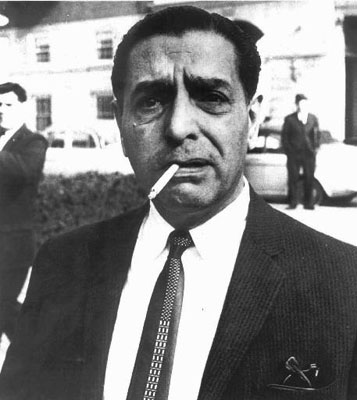
Raymond Patriarca

Tameleo offered a Barboza a job and fulltime income as an enforcer for the Patriarca Family.  Barboza instantly agreed.  He had always dreamed of becoming a “made man” of the Mafia.

(Tameleo didn’t warn him that this was impossible.  Barboza was of Portuguese descent, and only full-blooded Sicilians and Italians could hold Mafia membership.)

Tameleo sent Barboza to shake down 20 nightclubs whose owners had refused to pay “protection insurance” to the mob.

The owners changed their minds after one or two visits from Barboza and his wrecking crew.  Furniture would be smashed and customers terrorized until the owners began paying $1,000 a month to Patriarca’s collectors.

Meanwhile, the always fragile peace of the New England underworld was being shattered by an escalating wave of gangland violence.

In 1961, the two most powerful factions of the region’s “Irish Mafia” had gone to war.  On one side was the Charleston mob of Bernard McLaughlin.  On the other was the Winter Hill gang of James “Buddy” McLean.

The “Irish Gang War” triggered a police crackdown on all the New England organized crime groups—including Patriarca’s.  That was when Patriarca demanded that the fighting stop.

To ensure that it did, he sent his underboss, Tameleo, to arrange a peace conference between the McLeans and McLaughlins.  Both sides agreed to a truce because Tameleo was widely respected for his skills as a negotiator.

But when the conference opened in January, 1965, Tameleo was outraged to find the McLaughlins had come armed–a direct violation of the “rules of order.”  Patriarca also grew furious at this spurning of his efforts as underworld peacemaker.

As a result, the Patriarca Family threw its full weight behind the McLeans.

During 1965, Joseph Barboza moved from being a “mere” legbreaker for the Patriarca Family to becoming its top assassin.  His first important victim was Edward Deegan, a McLaughlin member who had raided several Patriarca gambling dens.

Barboza invited Deegan to join him in a burglary of the Lincoln National Bank in Boston.  Unaware that he had been marked for death, Deegan agreed.

On the night of March 12, 1965, the burglars struck.  As the four men emerged from the bank, Barboza and two cronies emptied their pistols into Deegan.

This killing proved a turning point for Barboza.  He became the top hitman for the Patriarca Family and the McLean mob.  He carried out more  hits than any other assassin during the war.  Later, in a hastily-written autobiography, he would boast of his string of killings.

(But he was always careful to describe his actions in the third-person, as though someone else had actually been responsible.  In this way he protected himself against prosecution for murder, where no immunity existed.)

In June, Jimmy “The Bear” Flemmi, a close friend of Barboza’s, was gravely wounded by a shotgun blast.  Barboza soon learned that the attackers had been Steve Hughes and Edward “Punchy” McLaughlin.

Swearing vengeance, Barboza quickly set out to claim his next victim.  He was especially intent on disposing of Hughes, who had become the top triggerman of the McLaughlins.

On October 20, 1963, Edward McLaughlin was waiting at a bus stop when Barboza casually walked up behind him.  Disguised in a wig and glasses, Barboza drew his pistol and pumped five bullets into McLaughlin.

Less than a month later, on November 11, the hitman visited the Mickey Mouse Club, a tavern in Revere Reach.  This time his intended target was a bartender and McLaughlin member named Ray DiStassio.

Talking with DiStassio at that moment was an innocent bystander, John R. O’Neill.  Barboza simply drew and shot both men dead.

Copyright@1984 Taking Cover: Inside the Witness Security Program, by Steffen White and Richard St. Germain

FIRST AMENDMENT DANGERS

In Business, Law, Social commentary on June 13, 2013 at 12:07 am

WARNING: Believing that the First Amendment gives you the legal right to express your opinion may be hazardous to your career.

The First Amendment to the United States Constitution says: “Congress shall make no law respecting an establishment of religion, or prohibiting the free exercise thereof; or abridging the freedom of speech, or of the press; or the right of the people peaceably to assemble, and to petition the Government for a redress of grievances.”

Of course, that refers only to Congress.  It says nothing about employers–and especially those self-appointed pseudo-gods who claim to be the personification of virtue and infallibility.

If you doubt it, just ask Johnny Cook, who until recently worked as a bus driver for the Haralson County Middle School in Georgia.

In late May, a sixth-grade student boarding Cook’s school bus said he was still hungry.  Cook asked why, and the student said he hadn’t been given any lunch.

The reason: He had been forty cents short for buying a reduced lunch.  So he hadn’t been given anything, not even the peanut butter offered to everyone else.

Furious, Cook vented his spleen on his Facebook page on May 21:

“This child is already on reduced lunch [program] and we can’t let him eat. Are you kidding me? I’m certian  there was leftover food thrown away today.

“But kids were turned away because they didn’t have .40 on there account. As a tax payer I would much rather feed a child than throw it away. I would rather feed a child than to give food stamps to a crack head.”

Just two days later, Cook was fired over that post.

Johnny Cook and friends

The “official reason,” as given by Superintendent Brett Stanton, was that Cook had violated the school’s social media policy by daring to express his opinion publicly.

The policy states:

“Students who post or contribute any comment or content on social networking sites that cause a substantial disruption to the instructional environment are subject to disciplinary procedures.

“Employees who post or contribute any comment or content on social networking sites that causes a substantial disruption to the instructional environment are subject to disciplinary procedures up and including termination.”

This is similar to the policies–and atmosphere–of the Joseph McCarthy “smear and fear” era of the 1950s.  You didn’t have to actually be proven an actual Communist, or even a Communist sympathizer.

All that was neeeded to condemn you to permanent unemployment was to become “controversial.”  That way, the employer didn’t have to actually prove the employee’s unfitness.

The Almighty Employer need only declare: “Your usefulness to me is over.”

Consider the statement offered by Superintendent Stanton:  “I can assure you it did not happen,” he told the CBS affiliate in Atlanta.

And how could he be so certain?  Because, said Stanton, he had thoroughly investigated the incident.

“The video surveillance footage clearly shows that the student never went through the lunch lines at the county middle school,” Stanton said.

Therefore, Stanton said, the boy couldn’t have been offered the bagged lunch for students in his situation.

When asked if someone should have noticed the boy wasn’t eating lunch, he had a ready excuse for that: “When you have almost 1,000 students, it’s very difficult to notice.”

Stanton wouldn’t discuss Cook’s termination because it’s a personnel matter, but did say the school district has a strict Facebook policy.

CBS Atlanta contacted the sixth-grader’s family–who backed up Cook’s story.

Cook, who is married and the father of two kids, told CBS Atlanta that he felt in his “heart of hearts the kid was telling the truth.”

A petition has been posted to Change.org demanding that Cook be reinstated.  It has so far gained more than 10,000 signatures.

Nor is Cook the only victim of employers who have no regard for the First Amendment.

Ashley Warden, a waitress at an Oklahoma City Chili’s insulted “stupid cops” on her Facebook page.   In 2012, her potty-training toddler pulled down his pants in his grandmother’s front yard–and a passing officer gave Warden a public urination ticket for $2,500.

Warden was quickly fired.  In an official statement, Chilli’s gave this excuse:

“With the changing world of digital and social media, Chili’s has Social Media Guidelines in place, asking our team members to always be respectful of our guests and to use proper judgement when discussing actions in the work place.  After looking into the matter, we have taken action to prevent this from happening again.”

Put more honestly: “We have taken action to prevent” other employees from daring to exercise their own First Amendment rights.

Employers need to be legally forced to show as much respect for the free speech rights of Americans as Congress is required to.

Until this happens, the workplace will continue to resemble George Orwell’s vision of 1984–a world where anyone can become a “non-person” for the most trivial of reasons.

NICCOLO MACHIAVELLI VS. OSCAR PISTORIUS

In Entertainment, History, Law, Politics, Social commentary on June 10, 2013 at 12:00 am

He’s the O.J. Simpson of South Africa–a gifted athlete charged with cold-blooded murder.

For Oscar Pistorius, life began as a struggle, on November 22, 1986.  Born with fibular hemimelia (congenital absence of the fibula) in both legs, at 11 months old, he was forced to undergo the amputation of both legs below the knee.

But still he persisted to lead an active–even an extraordinary–life.  As a child and teenager, he played rugby union, water polo and tennis, and took part in Olympic wrestling.

After a serious rugby knee injury, Pistorius was introduced to running in January, 2004, while undergoing rehabilitation at the University of Pretoria’s High Performance Centre.

Fitted with racing blades, he has been dubbed “Blade Runner” and “the fastest man with no legs.”   He took part in the 2004 Summer Paralympics in Athens and came in third in the 100-metere event.

At the 2012 Summer Olympics, he became the first double leg amputee to participate in the Olympics.  He entered the men’s 400-meters and 4 x 400 meters relay races.

Oscar Pistorius

At the 2012 Summer Paralympics, he won gold medals in the men’s 400-metre race and the 4 X 100 metres relay.

And then, having achieved so much against so much adversity, he found himself facing trial for a ghastly crime: The February 14 murder of his 29-year-old girlfriend, model and paralegal Reeva Steenkamp, whom he shot three times through a locked bathroom door.

Reeva Steenkamp

Pistorius claims he thought Steenkamp was a nighttime intruder. The state alleges that he and his girlfriend  argued before her death and he intentionally killed her.

The case has been postponed to August 19, 2013.

Throughout South Africa, women believe the odds are high that Pistorius will escape justice for murder owing to his sports celebrity status.  And those women may well turn out to be right.

According to one study, South Africa has “the highest rate [of violence against women] ever reported in research anywhere in the world.”

According to statistics, a woman gets raped in South Africa every four minutes. Only 66,196 incidents were reported to police in 2012 and their investigations led to only 4,500 convictions.

In fact, the murder of Pistorius’ girlfriend happened one day before she planned to wear black in a “Black Friday” protest against the country’s disgracefully high number of rapes.

“If data for all violent assaults, rapes and other sexual assaults against women are taken into account, then approximately 200,000 adult women are reported as being attacked in South Africa every year,” said Lerato Moloi of the South African Institute for Race Relations.

The real figure is considerably higher, she said, since most cases never are reported.

The rate of murders of women in South Africa is equally appalling:

  • A woman is killed by an intimate partner every eight hours in South Africa.
  • No perpetrator is identified in 20 percent of killings, according to a study published by the South African Medical Research Council.
  • That is double the rate of such murders in the United States.

If Pistorius wins acquittal because of his status as a celebrity athlete, Niccolo Machiavelli will nce again be proven a relevant prophet for our time.

Niccolo Machiavelli

In The Discourses, his seminal work on how to preserve freedom within a republic, Machiavelli warns: “Well-ordered republics establish punishments and rewards for their citizens, but never set off one against the other.”

Specifically:

“The services of Horatius had been of the highest importance to Rome, for by his bravery he had conquered the Curatii.  But the crime of killing his sister was atrocious, and the Romans were so outraged by this murder that he was put upon trial for his life, notwithstanding his recent great services to the state.”

While Rome might seem guilty of ingratitude, writes Machiavelli, “the people were to blame rather for the acquittal of Horatius than for having him tried.

“And the reason for this is, that no well-ordered republic should ever cancel the crimes of its citizens by their merits….

“Having established rewards for good actions and penalties for evil ones, and having rewarded a citizen for good conduct who afterwards commits a wrong, he should be chastised for that without regard to his previous merits.

“And a state that properly observes this principle will long enjoy its liberty, but if otherwise, it will speedily come to ruin.

“For if a citizen who has rendered some eminent service to the state should add to the reputation and influence which he has thereby acquired the confident audacity of being able to commit any wrong without fear of punishment, he will in a little while become so insolent and overbearing as to put an end to all power of the law.”

Americans learned the truth of this after the 1995 acquittal of O.J. Simpson for the slasher-murders of his ex-wife, Nicole Brown, and a waiter-eyewitness, Ronald Goldman.

In September, 2007, he led a group of men into a hotel room at the Palace Station casino in Las Vegas, Nevada, and, at gunpoint, seized sports memorabilia which he claimed had been stolen from him.

He was arrested and eventually convicted for criminal conspiracy, armed robbery, kidnapping and assault with a deadly weapon.

On December 5, 2008, Simpson was sentenced to 33 years in prison with the chance of parole in  nine years, in 2017.