The first year of Trump’s White House has seen more firings, resignations, and reassignments of top staffers than any other first-year administration in modern history. His Cabinet turnover exceeds that of any other administration in the last 100 years.
With the Trump administration rapidly approaching its halfway point—January 20, 2019—it’s time to size up its litany of casualties.
Among these:
FIRED:
Preet Bharara – U.S. Attorney for the Southern District of New York
Sally Yates – Assistant United States Attorney General
James Comey – FBI Director
Rex Tillerson – Secretary of State
Andrew McCabe – FBI Deputy Director
Jeff Sessions – United States Attorney General
RESIGNED:
Katie Walsh – Deputy White House Chief of Staff
Michael T. Flynn – National Security Adviser
Walter Shaub – Office of Government Ethics Director
Michael Dubke – Communications Director
Sean Spicer – Press Secretary
Reince Priebus – Chief of Staff
Anthony Scaramucci – Communications Director
Steve Bannon – Chief Strategist
Sebastian Gorka – Deputy Assistant to the President
Tom Price – Secretary of Health and Human Services
Omarosa Manigault-Newman – Director of Communications for White House Office of Public Liaison
Dr. Brenda Fitzgerald – Director of the Center for Disease Control and Prevention
Rob Porter – White House Staff Secretary
Hope Hicks – White House Communications Director
Gary Cohn – Director of the National Economic Council
H.R. McMaster – National Security Adviser
Tom Bossert – Homeland Security Adviser
Scott Pruitt – Director, Environmental Protection Agency
Don McGahn – White House Counsel
Nikki Haley – United States Ambassador to the United Nations
David Shulkin – Secretary of the Veterans Administration
This listing, however, does not tell the full story.
Among those who were fired—and the real reasons why:
Jeff Sessions – Fired as Attorney General because he refused to quash Special Counsel Robert S. Mueller’s probe into proven connections between Russian Intelligence agents and high-ranking members of Trump’s Presidential campaign.
On the day after the November, 2018 mid-term elections, Trump fired him.
James Comey– Fired as FBI Director because he refused to pledge his personal loyalty to Trump. Trump also hoped to end the FBI’s investigation of links between Russian Intelligence agents and members of his 2016 Presidential campaign.
Trump later admitted to Russian Foreign Minister Sergey Lavrov and Russian Ambassador Sergey Kislyak: “I just fired the head of the FBI….I faced great pressure because of Russia. That’s taken off.”
Don McGahn – Resigned as White House Counsel after repeatedly clashing with Trump about the best strategy for dealing with Mueller’s investigation.
Tom Bossert– Trump’s Homeland Security Adviser, was fired by John Bolton, the new National Security Adviser.
Sally Yates – Fired by Trump as Acting Attorney General for her aggressive pursuit of Michael Flynn’s treasonous contacts with Russian Intelligence officials during the 2016 Presidential campaign. She had also refused to uphold Trump’s executive order on immigration and denounced it as unlawful.
Preet Bharara– Fired by Trump as United States Attorney for the Southern District of New York. Although an Obama appointee, Trump had initially asked him to stay on—and then abruptly fired him. The possible reason: He was known as one of Wall Street’s fiercest watchdogs and a widely respected prosecutor. Trump believes that corporations should be immune from their crimes—and, as President, has worked to confer such immunity upon them.
Rex Tillerson – Trump’s Secretary of State, was fired without warning while on a trip to Africa. The reason: In 2017, word leaked to the press that Tillerson had called Trump “a moron.”
Steve Bannon – Although he officially resigned, Trump fired his Fascistic chief strategist after Bannon heatedly clashed with other members of the White House.
Anthony Scaramucci – Although he officially resigned, he was in fact fired by Trump at the urging of John Kelly. The reason: An obscenity-laced interview with The New Yorker, where he attacked members of the Trump administration—most notably Bannon.
Among those who resigned—and the real reasons why:
Scott Pruitt – Although he technically resigned as head of the Environmental Protection Agency, he was in effect fired. He was under several federal ethics investigation for lavish spending, conflicts of interests with corporate lobbyists, and enlisting his official government staffers to run personal errands.
Rob Porter – The White House Staff Secretary resigned after after two of his ex-wives accused him of physical and emotional abuse.
Michael Flynn– Although he officially resigned, he was in fact fired as National Security Adviser. The reason: He had discussed, with Russian Ambassador Sergey Kislyak, ending the Obama administration’s sanctions against Russia. Then he lied about it to Vice President Mike Pence. When these facts became public, Flynn was sent packing.
In January, 2018, the White House banned the use of personal cell phones in the West Wing. The official reason: National security.
The real reason: To stop staffers from leaking to reporters.
More ominously, well-suited men roam the halls of the West Wing, carrying devices that pick up signals from phones that aren’t government-issued. “Did someone forget to put their phone away?” one of the men will ask if such a device is detected. If no one says they have a phone, the detection team start searching the room.
Phone detector
The devices can tell which type of phone is in the room.
This is the sort of behavior Americans have traditionally—and correctly—associated with dictatorships
In his memo outlining the policy, Chief of Staff John Kelly warned that anyone who violated the phone ban could be punished, including “being indefinitely prohibited from entering the White House complex.”
Yet even these draconian methods may not end White House leaks.
White House officials still speak with reporters throughout the day and often air their grievances, whether about annoying colleagues or competing policy priorities.
Aides with private offices sometimes call reporters on their desk phones. Others get their cell phones and call or text reporters during lunch breaks.
According to an anonymous White House source: “The cellphone ban is for when people are inside the West Wing, so it really doesn’t do all that much to prevent leaks. If they banned all personal cellphones from the entire [White House] grounds, all that would do is make reporters stay up later because they couldn’t talk to their sources until after 6:30 pm.”
Other sources believe that leaks won’t end unless Trump starts firing staffers. But there is always the risk of firing the wrong people. Thus, to protect themselves, those who leak might well accuse tight-lipped co-workers.
Within the Soviet Union (especially during the reign of Joseph Stalin) fear of secret police surveillance was widespread—and absolutely justified.
Among the methods used to keep conversations secret:
Turning on the TV or radio to full volume.
Turning on a water faucet at full blast.
Turning the dial of a rotary phone to the end—and sticking a pencil in one of the small holes for numbers.
Standing six to nine feet away from the hung-up receiver.
Going for “a walk in the woods.”
Saying nothing sensitive on the phone.
The secret police (known as the Cheka, the NKVD, the MGB, the KGB, and now the FSB) operated on seven working principles:
Your enemy is hiding.
Start from the usual suspects.
Study the young.
Stop the laughing.
Rebellion spreads like wildfire.
Stamp out every spark.
Order is created by appearance.
Trump has always ruled through bribery and fear. He’s bought off (or tried to) those who might cause him trouble—like porn actress Stormy Daniels. And he’s threatened or filed lawsuits against those he couldn’t or didn’t want to bribe—such as contractors who have worked on various Trump properties.
But Trump can’t buy the loyalty of employees working in an atmosphere of hostility—which breeds resentment and fear. And some of them are taking revenge by sharing with reporters the latest crimes and follies of the Trump administration.
The more Trump wages war on the “cowards and traitors” who work most closely with him, the more some of them will find opportunities to strike back. This will inflame Trump even more—and lead him to seek even more repressive methods against his own staffers.
This is a no-win situation for Trump.
The results will be twofold:
Constant turnovers of staffers—with their replacements having to undergo lengthy background checks before coming on; and
Continued leaking of embarrassing secrets by resentful employees who stay.
Trump became famous on “The Apprentice” for telling contestants: “You’re fired.”
Since taking office as President, he has bullied and insulted even White House officials and his own handpicked Cabinet officers. This has resulted in an avalanche of firings and resignations.
The first year of Trump’s White House has seen more firings, resignations, and reassignments of top staffers than any other first-year administration in modern history. His Cabinet turnover exceeds that of any other administration in the last 100 years.
With the Trump administration rapidly approaching its halfway point—January 20, 2019—it’s time to size up its litany of casualties.
The list is impressive—but only in a negative sense.
In his infamous treatise, The Prince, Niccolo Machiavelli warns that it is safer to be feared than loved. And he lays out his reason thusly:
“From this arises the question whether it is better to be loved than feared, or feared more than loved. The reply is, that one ought to be both feared and loved, but as it is difficult for the two to go together, it is much safer to be feared than loved….
“And men have less scruple in offending one who makes himself loved than one who makes himself feared; for love is held by a chain of obligations which, men being selfish, is broken whenever it serves their purpose; but fear is maintained by a dread of punishment which never fails.”
But Machiavelli immediately follows this up with a warning about the abuses of fear:
“Still, a prince should make himself feared in such a way that if he does not gain love, he at any rate avoids hatred: for fear and the absence of hatred may well go together….”
Niccolo Machiavelli
It’s a warning that someone should have given President Donald Trump long ago.
Not that he would have heeded it.
On May 10, 2018, The Hill reported that White House Special Assistant Kelly Sadler had joked derisively about Arizona United States Senator John McCain.
McCain, a Navy pilot during the Vietnam war, was shot down over Hanoi on October 26, 1967, and captured. He spent five and a half years as a POW in North Vietnam—and was often brutally tortured. He wasn’t released until March 14, 1973.
Recently, he had opposed the nomination of Gina Haspel as director of the CIA.
The reason: In 2002, Haspel had operated a “black” CIA site in Thailand where Islamic terrorists were often waterboarded to make them talk.
For John McCain, waterboarding wastorture, even if it didn’t leave its victims permanently scarred and disabled.
Aware that the 81-year-old McCain was dying of brain cancer, Sadler joked to intimates about the Senator’s opposition to Haspel: “It doesn’t matter. He’s dying anyway.”
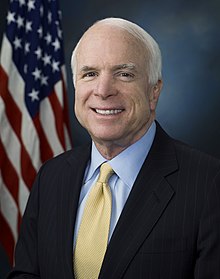
John McCain
Leaked to CNN by an anonymous White House official, Sadler’s remark sparked fierce criticism—and demands for her firing.
South Carolina Republican Senator Lindsey Graham, a close friend of McCain, said: “Ms. Sadler, may I remind you that John McCain has a lot of friends in the United States Senate on both sides of the aisle. Nobody is laughing in the Senate.”
“People have wondered when decency would hit rock bottom with this administration. It happened yesterday,” said former Vice President Joe Biden.
“John McCain makes America great. Father, grandfather, Navy pilot, POW hero bound by honor, an incomparable and irrepressible statesman. Those who mock such greatness only humiliate themselves and their silent accomplices,” tweeted former Massachusetts governor and 2012 Republican presidential candidate Mitt Romney.
Officially, White House Press Secretary Sarah Huckabee Sanders refused to confirm or deny Sadler’s joke: “I’m not going to get into a back and forth because people want to create issues of leaked staff meetings.”
Unofficially, Sanders was furious—not at the joke about a dying man, but that someone had leaked it. After assailing the White House communications team, she pouted: “I am sure this conversation is going to leak, too. And that’s just disgusting.”
Sarah Huckabee Sanders
No apology has been offered by any official at the White House—including President Trump.
In fact, Senior White House communications adviser Mercedes Schlapp reportedly expressed her support for Sadler: “I stand with Kelly Sadler.”
On May 11—the day after Sadler’s comment was reported—reporters asked Sanders if the tone set by Trump had caused Sadler to feel comfortable in telling such a joke.
“Certainly not!” predictably replied Sanders, adding: “We have a respect for all Americans, and that is what we try to put forward in everything we do, but in word and in action, focusing on doing things that help every American in this country every single day.”
On May 14 Trump revealed his “respect” for “all Americans”—especially those working in the White House.
“The so-called leaks coming out of the White House are a massive over exaggeration put out by the Fake News Media in order to make us look as bad as possible,” Trump tweeted.
“With that being said, leakers are traitors and cowards, and we will find out who they are!”
In a move that Joseph Stalin would have admired, Trump ordered an all-out investigation to find the joke-leaker.
In January, 2018, the White House had banned the use of personal cell phones in the West Wing. The official reason: National security.
The real reason: To stop staffers from leaking to reporters.
Officials now have two choices:
Leave their cell phones in their cars, or,
When they arrive for work, deposit them in lockers installed at West Wing entrances. They can reclaim their phones when they leave.
Several staffers huddle around the lockers throughout the day, checking messages they have missed. The lockers buzz and chirp constantly from 6 a.m. to 8 p.m. Monday through Friday.
Donald Trump has often been compared to Adolf Hitler. But his reign bears far more resemblance to that of Joseph Stalin.
Germany’s Fuhrer, for all his brutality, maintained a relatively stable government by keeping the same men in office—from the day he took power on January 30, 1933, to the day he blew out his brains on April 30, 1945.
Heinrich Himmler, a former chicken farmer, remained head of the dreaded, black-uniformed Schutzstaffel, or Protection Squads, known as the SS, from 1929 until his suicide in 1945.
In April, 1934, Himmler was appointed assistant chief of the Gestapo (Secret State Police) in Prussia, and from that position he extended his control over the police forces of the whole Reich.
Hermann Goering, an ace fighter pilot in World War 1, served as Reich commissioner for aviation and head of the newly developed Luftwaffe, the German air force, from 1935 to 1945.
And Albert Speer, Hitler’s favorite architect, held that position from 1933 until 1942, when Hitler appointed him Reich Minister of Armaments and War Production. He held that position until the Third Reich collapsed in April, 1945.
Soviet Premier Joseph Stalin, by contrast, purged his ministers constantly. For example: From 1934 to 1953, Stalin had no fewer than three chiefs of his secret police, then named the NKVD:
Genrikh Yagoda – (July 10, 1934 – September 26, 1936)
Nikolai Yezhov (September 26, 1936 – November 25, 1938) and
Lavrenty Beria (November, 1938 – March, 1953).
Stalin purged Yagoda and Yezhov, with both men executed after being arrested.
Joseph Stalin
He reportedly wanted to purge Beria, too, but the latter may have acted first. There has been speculation that Beria slipped warfarin, a blood-thinner often used to kill rats, into Stalin’s drink, causing him to die of a cerebral hemorrhage.
Nor were these the only casualties of Stalin’s reign.
For almost 30 years, through purges and starvation caused by enforced collections of farmers’ crops, Stalin slaughtered 20 to 60 million people.
The 1930s were a frightening and dangerous time to be alive in the Soviet Union. In 1934, Stalin, seeing imaginary enemies everywhere, ordered a series of purges that lasted right up to the German invasion.
An example of Stalin’s paranoia occurred one day while the dictator walked through the Kremlin corridors with Admiral Ivan Isakov. Officers of the NKVD (the predecessor to the KGB) stood guard at every corner.
“Every time I walk down the corridors,” said Stalin, “I think: Which one of them is it? If it’s this one, he will shoot me in the back. But if I turn the corner, the next one can shoot me in the face.”
In 1937-38, the Red Army fell prey to Stalin’s paranoia.
Its victims included:
Three of five marshals (five-star generals);
Thirteen of 15 army commanders (three- and four-star generals);
Fifty of 57 army corps commanders; and
One hundred fifty-four out of 186 division commanders.
And heading the list of those marked for death was Marshal Mikhail Tukhachevsky.
Arrested on May 22, 1937, he was interrogated and tortured. As a result, he “confessed” to being a German agent plotting to overthrow Stalin and seize power.
On his confession, which survives in the archives, his bloodstains can clearly be seen.
On June 11, the Soviet Supreme Court convened a special military tribunal to try Tukhachevsky and eight generals for treason.
It was a sham: The accused were denied defense attorneys, and could not appeal the verdict—-which was foregone: Death.
In a Russian version of poetic justice, five of the eight generals who served as Tukhachevsky’s judges were themselves later condemned and executed as traitors.
Since taking office as the nation’s 45th President, Donald Trump has sought to rule by fear.
Donald Trump
In fact, he candidly shared his belief in this as a motivator to journalist Bob Woodward during the 2016 Presidential race: “Real power is—I don’t even want to use the word—fear.”
It is unknown if Trump ever read The Prince, Niccolo Machiavelli’s infamous treatise on attaining political power. If so, he doubtless is familiar with its most famous passage:
“From this arises the question whether it is better to be loved than feared, or feared more than loved. The reply is, that one ought to be both feared and loved, but as it is difficult for the two to go together, it is much safer to be feared than loved….
“For it may be said of men in general that they are ungrateful, voluble, dissemblers, anxious to avoid danger and covetous of gain; as long as you benefit them, they are entirely yours: they offer you their blood, their goods, their life and their children, when the necessity is remote, but when it approaches, they revolt.
“And the prince who has relied solely on their words, without making other preparations, is ruined; for the friendship which is gained by purchase and not through grandeur and nobility of spirit is bought but not secured, and at a pinch is not to be expended in your service.
“And men have less scruple in offending one who makes himself loved than one who makes himself feared; for love is held by a chain of obligations which, men being selfish, is broken whenever it serves their purpose; but fear is maintained by a dread of punishment which never fails.”
A forgotten anniversary is fast approaching: This December 2 will mark the 17th anniversary of the collapse of Enron Corporation.
Based in Houston, Texas, Enron had employed 22,000 staffers and was one of the world’s leading electricity, natural gas, communications and paper companies.
In 2000, it claimed revenues of nearly $101 billion. Fortune had named Enron “America’s Most Innovative Company” for six consecutive years.
But then the truth emerged in 2001: Enron’s reported profitability was based not on brilliance and innovation but on systematic and creative accounting fraud.
And, on December 2, 2001, Enron filed for bankruptcy under Chapter 11 of the United States Bankruptcy Code.
Enron’s $63.4 billion in assets made it the largest corporate bankruptcy in U.S. history—until WorldCom’s bankruptcy in 2002.
The California electricity crisis (2000-2001) was caused by market manipulations and illegal shutdowns of pipelines by Texas energy companies.
The state suffered from multiple large-scale blackouts. Pacific Gas & Electric, one of the state’s largest energy companies, collapsed, and the economic fall-out greatly harmed Governor Gray Davis’ standing.
The crisis was made possible by Governor Pete Wilson, who had forced the passage of partial de-regulation legislation in 1996.
Enron seized its opportunity to inflate prices and manipulate energy output in California’s spot markets. The crisis cost the state $40 to $45 billion.
The true scandal of Enron was not that it was eventually destroyed by its own greed.
The true scandal was that its leaders were never Federally prosecuted for almost driving California—and the entire Western United States—into bankruptcy.
Under the pro-oil company administration of George W. Bush, no such prosecutions ever occurred. But Americans had a right to expect such redress under “liberal” President Bill Clinton.
Once the news broke that Enron had filed for bankruptcy, commentators almost universally oozed compassion for its thousands of employees who would lose their salaries and pensions.
No one, however, condemned the “profits at any cost” dedication of those same employees for pushing California to the brink of ruin.
To put this in historical perspective:
Imagine a historian writing about the destruction of Hitler’s Schutzstaffel (Guard Detachment), or SS, as a human interest tragedy.
Imagine its Reichsfuehrer, Heinrich Himmler, being blamed for failing to prevent its collapse—as CEO Kenneth Lay was blamed for Enron’s demise.
Imagine that same historian completely ignoring the horrific role the SS had played throughout Nazi-occupied countries—and its primary role in slaughtering six million Jews in the Holocaust.
Nor did anyone in the media or government declare that the solution to such extortionate activity lay within the United States Department of Justice via RICO—the Federal Racketeer Influenced Corrupt Organizations Act.
Passed by Congress in 1970, this was originally aimed at the kingpins of the Mafia. Since the mid-1980s, however, RICO has been successfully applied against both terrorist groups and legitimate businesses engaged in criminal activity.
Under RICO, people financially injured by a pattern of criminal activity can bring a claim in State or Federal court, and obtain damages at three times the amount of their actual claim, plus reimbursement for their attorneys’ fees and costs.
Such prosecutions would have pitted energy-extortionists against the full investigative might of the FBI and the sweeping legal authority of the Justice Department.
Consider this selection from the opening of the Act:
(1) “racketeering activity” means (A) any act or threat involving…extortion; (B) any act which is indictable under any of the following provisions of title 18, United States Code: sections 891-894 (relating to extortionate credit transactions), section 1343 (relating to wire fraud)Section 1344 (relating to financial institution fraud), section 1951 (relating to interference with commerce, robbery, or extortion), section 1952 (relating to racketeering)….
With the 17th anniversary of Enron’s demise coming up, the mantra of “de-regulation” should be ruthlessly turned against those who have most ardently championed it.
Republicans have ingeniously dubbed the estate tax—which affects only a tiny minority of ultra-rich—“the death tax.” This makes it appear to affect everyone.
Democrats should thus recast de-regulation in terms that will prove equally popular. For example:
“Greed Relief”
“Greed Protection”
“Legalized Extortion”
And here are some possible slogans:
“The Energy Industry: Giving You the Best Congress Money Can Buy.”
“De-regulation: Let Criminals Be Criminals.”
Today the coal industry is pumping millions into TV ads touting the non-existent wonders of “clean coal.” And Chevron spends millions assuring us that “all those profits” go strictly toward making the world a better place for others. (Presumably not a penny is left for its altruistic executives.)
When faced with such outright lying by the most vested of financial interests, it’s well to recall the warning given by Niccolo Machiavelli more than 500 years ago:
All those who have written upon civil institutions demonstrate…that whoever desires to found a state and give it laws, must start with assuming that all men are bad and ever ready to display their vicious nature, whenever they may find occasion for it.
If their evil disposition remains concealed for a time, it must be attributed to some unknown reason; and we must assume that it lacked occasion to show itself. But time, which has been said to be the father of all truth, does not fail to bring it to light.
Hans Bernd Gisevius holds a unique position in the history of the Third Reich.
He was one of the few plotters of the July 20, 1944 bomb attack on Adolf Hitler to survive the wave of arrests that followed.
A covert opponent of the Nazi regime, he served as a liaison in Zurich between the American Office of Strategic Services (OSS) and German resistance forces in Germany.
Not only did he outlive the Reich, he took revenge on it at the Nuremberg trials. In April, 1946, for three days he gave damning evidence against former Reichsmarshall Hermann Goring and his accomplices.
Hans Bernd Gisevius at Nuremberg
In 1946, he published his autobiography, To the Bitter End, sharply indicting the Reich and its leaders—many of whom Gisevius had known personally. He also condemned the German people, charging that they pretended ignorance of the atrocities being committed.
In his introduction, Gisevius notes: “This book is not intended as a history of the Third Reich. The author has selected a few prominent incidents out of the confusion of contemporaneous events and has attempted to use these as points through which to trace the broad curves of the historical process.”
To the Bitter End opens with the February 27, 1933 arson attack on the Reichstag building, home of the German parliament. By the time the fire was put out, most of the building was gutted.
On January 30, 1933, Adolf Hitler had been appointed Chancellor of Germany. Now he used the fire to gain unprecedented control over the country.
Reichstag fire
The next day, at Hitler’s request, President Paul von Hindenburg signed the Reichstag Fire Decree into law. This suspended most civil liberties in Germany, including:
Freedom of speech, press, association and public assembly
Habeas corpus and
Secrecy of the mails and telephone.
The next major event Gisevius chronicled has since become known as “The Night of the Long Knives.”
On June 30, 1934, Hitler ordered a massive purge of his private army, the S.A., or Stormtroopers. This was carried out by Hitler’s elite army-within-an-army, the Schutzstaffel, or Protective Squads, better known as the SS.
The S.A. Brownshirts had been instrumental in securing Hitler’s rise to Chancellor of Germany. They had intimidated political opponents and organized mass rallies for the Nazi Party.
Ernst Rohem, their commander, urged Hitler to disband the regular German army, the Reichswehr, and replace it with his own legions as the nation’s defense force.
Frightened by Rohem’s ambitions, the generals of the Reichswehr warned Hitler: Get rid of Rohem—or we’ll get rid of you.
So Rohem died in a hail of SS bullets—along with several hundred of his longtime S.A. cronies.
SS firing squad
A third crisis that paved the way for Hitler’s assuming supremacy over the German armed forces came in early 1938.
Hitler had been wanting to replace two high-ranking military officials: General Werner von Fritsch and Colonel General Werner von Blomberg. He intended to go to war—and despised their hesitation to do so.
On January 12, 1938, Blomberg married Erna Gruhn, with Hitler and Reichsmarshall Hermann Goring attending as witnesses. Soon afterward, Berlin police discovered that Gruhn had a criminal record as a prostitute and had posed for pornographic photographs.
Marrying a woman with such a background violated the standard of conduct expected of officers. Hitler was infuriated at having served as a witness, but he also saw the scandal as an opportunity to dispose of Blomberg.
Shortly after Blomberg was forced to resign in disgrace, the SS presented Hitler with a file that falsely accused Werner von Fritsch of homosexuality. Fritsch angrily denied the accusation but resigned on February 4, 1938.
From that point on, Hitler was in de facto command of the German Armed Services.
To the Bitter End vividly depicts how, step by step, Hitler gained total control of Germany—and plunged it headlong into World War II.
None of these steps, by itself, was fatal. But, taken together, they led to the deaths of 60 million men, women and children, the utter destruction of Germany and the domination of Eastern Europe (including East Germany) for 44 years after the Reich collapsed.
Since Donald Trump took office as the 45th President of the United States, Americans have seen him move, step by step, toward his goal of absolute power. Among these moves:
Firing FBI Director James Comey for pursuing an investigation into Russian subversion of the 2016 election.
Repeatedly attacking his own Attorney General, Jeff Sessions, for not “protecting” him from investigators pursuing the Russia investigation.
Firing Sessions and replacing him with Matthew Whittaker, who had loudly criticized the probe led by Special Counsel Robert S. Mueller.
Relentlessly attacking the free press as “the enemy of the American people.”
Brutally attacking Federal judges whose rulings displease him.
On multiple occasions, urging Deputy Attorney General Rod Rosenstein to vengefully prosecute Hillary Clinton, his 2016 rival for the Presidency.
The United States may yet fall victim to a nuclear war triggered by an insult-happy Trump, or a dictatorship where he turns the Justice Department into his personal SS.
If so, a future American chronicler may, like Hans Bernd Gisevius, leave behind a record of a nation betrayed by lost opportunities and a brutal tyrant.
“And the most glorious episodes do not always furnish us with the clearest discoveries of virtue or vice in men.
“Sometimes a matter of less moment, an expression or a jest, informs us better of their characters and inclinations than the most famous sieges, the greatest armaments, or the bloodiest battles.”
So warned the ancient historian, Plutarch, in the introduction to his biography of Alexander the Great.
It’s well to keep this warning in mind when recalling the story of 17-year-old Tyler Linfesty, now known as “Plaid Shirt Guy.”
On September 6, Linfesty, a high school senior, attended President Donald Trump’s campaign rally in Billings, Montana. He had wanted to see the President of the United States speak in his home state.
And, much to his surprise, he was randomly chosen by the Trump campaign for “VIP status.” He would be seated directly behind Trump.
But this came with a warning: “You have to be enthusiastic, you have to be clapping, you have to be cheering for Donald Trump.”
Before he attended the rally, Trump staffers urged him to wear a “Make America Great Again” cap, but he refused.
Owing to his varied facial expressions and his plaid shirt, he quickly became known on the Internet as “Plaid-Shirt Guy.”
Tyler Linfesty
Then, while the rally was still going, Linfesty was approached by a Trump minion who said: “I’m gonna replace you.”
He hadn’t been heckling Trump. Nor had he held up an anti-Trump sign.
So why was he suddenly ejected?
Without being given a reason, Linfesty was forced to come up with one himself. And his best guess: He didn’t cheer when Trump made statements he disagreed with.
He had applauded those parts of Trump’s speech he did agree with—such as opposition to NAFTA. He also agreed with Trump’s claim that the 2016 Democratic presidential nomination was stolen from Vermont Senator Bernie Sanders.
But there were parts of Trump’s speech he disagreed with—such as Trump’s claim that his “tax reform law” benefits the middle class.
(It doesn’t—its foremost beneficiaries comprise the top 1%.)
Thus, Linfesty looked skeptical when Trump said it was harder to win the Electoral College than the popular vote.
(It isn’t. A candidate need only win those states with the most electoral votes. He needn’t win the popular vote—just as Trump failed to win it against Hillary Clinton by nearly three million votes.)
Donald Trump
And when Trump said he could have won the popular vote, Linfesty turned to several people near him and mouthed “What?”
As Linfesty explained to CNN’s Don Lemon: “I had to be real with myself. I’m not going to pretend to support something I don’t support.”
Apparently this was too much for those staging the rally.
“I saw this woman walking toward me on the left,” Linfesty told the BillingsGazette. “She just said to me, ‘I’m going to replace you.’ I just walked off. I knew I was getting out for not being enthusiastic enough, but I decided not to fight it.”
But being removed from the Trump speech was not the end for Linfesty.
He was then detained by the United States Secret Service.
“Some Secret Service guys escorted me into this backroom area, and they just sat me down for 10 minutes,” said Linfesty. The agents looked at his ID, then released him—and told him not to return.
The Secret Service is charged with protecting the President (and, in a lesser-known duty, protecting the national currency). It is not charged with regulating the free speech rights of Americans.
It is, in short, not supposed to operate as the dreaded, black-uniformed SS of Nazi Germany.
Ironically, earlier that morning, Trump had tweeted a thank-you to North Korea’s brutal dictator Kim Jong-Un.
The reason: Kim had said he had “unwavering faith in President Trump.”
Thus, a dictator who flatters Trump gets treated to praise, while an American exercising his right to free speech faces possible arrest.
Speaking to the Gazette, Linfesty said: “I didn’t really have a plan. I was just going to clap for things I agreed with and not clap for things I didn’t agree with.”
And he insisted to CNN’s Don Lemon that his facial expressions had been honest: “I would have made those faces if anyone were to say that to me. I was not trying to protest, those were just my actual, honest reactions.
“Each time I see one of these rallies I see somebody behind Donald Trump clapping and cheering and being super enthusiastic and I’ve always wondered myself, ‘Are those people being really genuine?’”
Two months to the day after Linfesty’s ordeal, Democrats recaptured the House of Representatives, but failed to win a majority in the Senate. The next day, Trump fired Attorney General Jeff Sessions.
Since May, 2017, Trump had brutally insulted Sessions for refusing to suppress Special Counsel Robert Mueller’s probe of Russia’s subversion of the 2016 Presidential election.
The Linfesty episode—coupled with the firing of Sessions—bodes ill for Americans who expect Federal law enforcement to operate in a fair and incorruptible manner.
SS Obergruppenfuhrer (General) Reinhard Heydrich laid the foundations for the “Final Solution of the Jewish question.” This resulted in the extermination of six million Jewish men, women and children.
Nevertheless, he was dogged throughout his 11-year career in the Third Reich by rumors that he was himself part-Jewish.
Similarly, former Pennsylvania United States Senator Rick Santorum has made banning abortion a center-piece of his political life, in and out of office. Even so, he found himself accused, during his 2012 campaign for President, of being “soft” on abortion.
In January, 2012, in advance of the South Carolina primary, pink fliers attacking Santorum’s credentials as an anti-abortionist began turning up on windshields at many political events in that state.
Their author was Elizabeth Leichert, an anti-abortion activist.
Dated January 18, 2012, the flier read:
“Like many Christians I know, I was originally very attracted to Rick Santorum’s positions – especially on the Right to Life issue.
“But that was before I began digging into his record….
“Did you know Rick Santorum’s wife, Karen, had a six-year affair with an abortionist named Tom Allen?
“…This abortion doctor was 30 years her senior! In fact, he delivered her as a baby!
“The only reason they broke up was that Karen wanted kids – while Tom was busy killing them.
Karen Garver and Dr. Thomas Allen
“In fact, he [Tom Allen] said, ‘Karen had no problems with what I did for a living,’ and said that Rick Santorum was ‘pro-choice and a humanist.’
“And this was only two years before Rick Santorum ran for Congress!
“After learning these facts, when it comes to Rick Santorum, I can’t help but think of him as a wolf in sheep’s clothing.
“We’ve certainly seen candidates over the years use their “faith” as a campaign issue. We’ve certainly seen candidates who tell us they’re pro-life and then act quite differently once elected.
“I’m afraid that’s describes Rick Santorum to a tee!
“You see, the attacks on him for funding Planned Parenthood are 100% true.
“He’s even stated in a TV interview that he supports Title X funding, which sends our tax dollars to Planned Parenthood! You can see for yourself on youtube.
“He’s also time and again endorsed pro-abortion Republicans who work to defeat any efforts by Congress to save the lives of the unborn.
“I’m writing you because I believe this race for President is critical. I’m worried the facts about Rick Santorum won’t get out in time for this South Carolina Primary, and pro-lifers will be fooled into voting someone like Rick Santorum who DOES NOT share our values.
“He just wants to be President so badly, he’ll say anything to be elected. Period.”
The flier was signed, “In Christ, Elizabeth Leichert.”
Asked for his reaction, Santorum replied: “It’s ugly, it’s cheap, it’s tawdry. It has no relationship to the issues at hand in this race, and we’re gonna treat it just like the ridiculous stuff that you see where you treat it for the value it is, which is zero.”
The report might have been “ugly, cheap and tawdry.” But it was also true.
As Karen Garver, the future Mrs. Santorum lived with obstetrician and abortionist Dr. Thomas E. Allen in Pittsburgh, Pennsylvania, for most of her 20s during the 1980s.
As a young nursing student, she shared his bed and liberal views on abortion, despite an age difference of 40 years.
Even more striking: Allen had delivered Karen as a baby in 1960. Her father, a pediatrician, got many client referrals through Allen.
‘When she moved out to go be with Rick,” Dr. Allen said in an interview in 2005, “she told me I’d like him, that he was pro-choice and a humanist. But I don’t think there’s a humanist bone in that man’s body.”
Today, as Karen Santorum, she is the Catholic mother of seven and fiercely opposes abortion and birth control.
Karen Santorum
On April 10, 2012, in Gettysburg, Pennsylvania, Santorum suspended his campaign. The nomination eventually went to former Utah Governor Mitt Romney.
In 2015, Rick Santorum once again declared himself a Republican candidate for President in 2016. But on February 3, 2016, he dropped out of the race and endorsed Florida U.S. Senator Marco Rubio.
Unlike 2012, no mention was made of his wife’s unorthodox past—or of Santorum’s hypocritical embrace of it.
But abortion is the issue within the Republican party that ignites the greatest passion and fanaticism. No doubt this is because it combines an element of sex with the desire to repress the rights of others.
Just as no one in Nazi Germany could be safe from the charge of “race defilement,” no one in the current Republican party can ever be safe from the charge of being “soft” on abortion.
“Fanatics can justify practically any atrocity to themselves,” wrote the author Mercedes Lackey. “The more untenable their position becomes, the harder they hold to it, and the worse the things they are willing to do to support it.”
“All revolutions,” said Ernst Rohm, leader of Adolf Hitler’s brown-shirted thugs, the S.A., “devour their own children.”
Ernst Rohm
Fittingly, he said this as he sat inside a prison cell awaiting his own execution.
On June 30, 1934, Hitler had ordered a massive purge of his private army, the S.A., or Stormtroopers. The purge was carried out by Hitler’s elite army-within-an-army, the Schutzstaffel, or Protective Squads, better known as the SS.
The S.A. Brownshirts had been instrumental in securing Hitler’s rise to Chancellor of Germany on January 30, 1933. They had intimidated political opponents and organized mass rallies for the Nazi Party.
But after Hitler reached the pinnacle of power, they became a liability.
Ernst Rohm, their commander, urged Hitler to disband the regular German army, the Reichswehr, and replace it with his own legions as the nation’s defense force.
Frightened by Rohm’s ambitions, the generals of the Reichswehr gave Hitler an ultimatum: Get rid of Rohm—or they would get rid of him.
So Rohm died in a hail of SS bullets—as did several hundred of his longtime S.A. cronies.
SS firing squad
Among the SS commanders supervising those executions was Reinhard Heydrich—a tall, blond-haired formal naval officer who was both a champion fencer and talented violinist.
Ultimately, he would become the personification of the Nazi ideal—”the man with the iron heart,” as Hitler eulogized at Heydrich’s funeral just eight years later.
Reinhard Heydrich
Even so, Heydrich had a problem: He could never escape vicious rumors that his family tree contained a Jewish ancestor.
His paternal grandmother had married Reinhold Heydrich, and then Gustav Robert Suss. For unknown reasons, she decided to call herself Suss-Heydrich.
Since “Suss” was widely believed in Germany to indicate Jewish origin, the “stigma” of Jewish heritage attached itself to the Heydrich family.
Heydrich joined the SS in 1931 and quickly became head of its counterintelligence service. But his arrogance and overweening ambition created a great many enemies.
Only a year later, he became the target of an urgent investigation by the SS itself. The charge: That he was part-Jewish, the ultimate sin in Hitler’s “racially pure” Nazi Germany.
The investigation cleared Heydrich, but the rumor of his “tainted” origins persisted, clearly tormenting the second most powerful man in the SS. Even his superior, Heinrich Himmler, the Reichsfuhrer-SS, believed it.
When Heydrich was assassinated in 1942 by Czech commandos in Prague, Himmler attended his funeral. He paid tribute to his former subordinate at the service: ”You, Reinhard Heydrich, were a truly good SS-man.”
But he could not resist saying in private: “He was an unhappy man, completely divided against himself, as often happened with those of mixed race.”
Those who dare to harshly judge others usually find themselves assailed just as harshly.
A modern-day example is Rick Santorum, the former United States Senator from Pennsylvania (1995 – 2007) and a Republican candidate for President in 2012 and 2016.
Rick Santorum
From his entry into politics, Santorum has been a fierce opponent of legalized abortion and even birth control. Among his comments on these issues:
On why abortion should be illegal even in rape cases:“I believe and I think the right approach is to accept this horribly created—in the sense of rape—but nevertheless a gift in a very broken way, the gift of human life, and accept what God has given to you.”
On criminal penalties for doctors who perform abortion: “I believe that, that any doctor who performs an abortion—that—I would advocate that any doctor that performs an abortion should be criminally charged for doing so.”
On de-funding Planned Parenthood: “I can’t imagine any other organization with its roots as poisonous as the roots of Planned Parenthood getting federal funding of any kind. This is an organization that was founded on the eugenics movement, founded on racism.”
On opposing birth control:“One of the things I will talk about [if elected President in 2012] that no President has talked about before is I think the dangers of contraception in this country, the whole sexual libertine idea. Many in the Christian faith have said, ‘Well, that’s okay. Contraception’s okay.’ It’s not okay, because it’s a license to do things in the sexual realm that is counter to how things are supposed to be.”
Like the Nazis, Republicans are eager to lecture their fellow citizens on “how things are supposed to be.” And to enforce their beliefs on “how things are supposed to be” with draconian laws.
So it no doubt shocked Santorum—and his anti-abortion supporters—when he found himself accused of being “soft” on abortion.
The attack came in the form of pink fliers appearing on car windshields at many South Carolina political events in January, 2012.
They were the work of Elizabeth Leichert, an anti-abortion activist.
Dated January 18, 2012, the flier read:
“Like many Christians I know, I was originally very attracted to Rick Santorum’s positions – especially on the Right to Life issue.
“But that was before I began digging into his record….
“Did you know Rick Santorum’s wife, Karen, had a six-year affair with an abortionist named Tom Allen?”
It’s the sort of outrage that could have easily been committed by the SS or KGB.
But, to the shame of the United States, it was committed by the Mesa Police Department.
Even more shamefully, the officer responsible for yet another killing of an unarmed man got to walk away from it.
In January, 2016, Daniel Shaver crawled on his hands and knees and begged for his life while facing six armed Arizona police officers.
One of the officers, Philip Brailsford, was carrying an AR-15 rifle with the phrase “You’re Fucked” etched into the weapon.
Shaver couldn’t see the etching. But the commands of Sergeant Charles Langley—captured on a police body camera—were clearly audible.
They were the type to be expected from a dictator literally holding the power of life and death over others: Humiliating and fear-inspiring.
Shaver, 26, on a work-related trip to Mesa from Granbury, Texas, had been doing rum shots with a woman he had met earlier that day. He had also been showing off a pellet gun he used to take out rodents in his work in pest control.
Daniel Shaver and his wife, Laney
At some point, a caller informed the Mesa Police Department that a man was pointing a rifle out of a fifth-floor window at a La Quinta Inn.
When officers arrived at the Inn, they ordered Shaver and the woman to come out of the hotel room. They did so and immediately complied with commands from Sergeant Langley.
Then occurred this exchange:
LANGLEY:Stop right there! Stop! Stop! Get on the ground both of you! Lay down on the ground. Lay down on the ground.
If you make a mistake, another mistake, there is a very severe possibility that you’re both going to get shot. Do you understand? Who else is in the room?
SHAVER: Nobody.
Philip Brailsford
[Langley then asked if they were sober enough to understand his commands. Both Shaver and the woman said they were.]
SHAVER: What—?
LANGLEY: Shut up. I’m not here to be tactful or diplomatic with you. You listen, you obey. For one thing: Did I tell you to move young man?
SHAVER: No.
LANGLEY:Put both hands on the top of your head and interlace your fingers. Take your feet and cross your left foot over your right foot.
Young man you’re not to move you’re to put your eyes down and look down at the carpet. You’re to keep your fingers interlaced behind your head. You’re to keep your legs crossed.
If you move we’re going to consider that a threat and we’re going to deal with it and you may not survive.
[Langley ordered the woman to crawl toward him. She did so and was handcuffed off-camera.]
LANGLEY: Young man listen to my instructions and do not make a mistake. You are to keep your legs crossed. Do you understand me?
SHAVER: Yes, sir.
LANGLEY:You are to put both of your hands palms down straight out in front of you push yourself up to a kneeling position. I said keep your legs crossed! I didn’t say this as a conversation.
[Shaver put his hands behind his back.]
LANGLEY (shouting): I said put your hands up hands in the air! You do that again, we’re shooting you do you understand?
SHAVER: Please do not shoot me.
LANGLEY: Then listen to my instructions!
SHAVER: I’m trying to do what you say—
LANGLEY:Don’t talk! Listen! Hands straight up in the air! Do not put your hands down for any reason. You think you’re gonna fall, you better fall on your face. Your hands go back into the small of your back or down we are going to shoot you. Do you understand me?
SHAVER: Yes, sir.
LANGLEY: Crawl towards me, crawl towards me.
Shaver started crawling toward Langley and Brailsford, sobbing. At one point, he reached back toward his pants leg—possibly to pull up his shorts.
Suddenly Brailsford opened fire so quickly it sounded like a single shot—although Shaver was struck five times.
Brailsford later claimed he believed that Shaver was reaching for a gun.
The video makes clear that Shaver was thoroughly covered by the officers. Any of them could have approached Shaver while he was prone and handcuffed him.
No gun was found on Shaver’s body. Two pellet rifles used in Shaver’s pest-control job were later found in the hotel room.
In May, 2016, Brailsford was charged with second-degree murder.
After deliberation for less than six hours over two days, jurors found Brailsford not guilty of second degree murder as well as of a lesser charge of reckless manslaughter.
“The justice system miserably failed Daniel (Shaver) and his family,” said Mark Geragos, an attorney for Shaver’s widow, Laney Sweet.
Brailsford was fired from the Mesa Police Department two months after the shooting.
Langley retired as a police officer and moved to the Philippines—where police death squads operate under orders from the country’s president, Rodrigo Duterte.
According to a Washington Post database, there were at least 963 fatal police shootings in 2016.
Steffen White’s Email: Sparta480@aol.com Former reporter, legal investigator and troubleshooter. Columnist at Bureaucracybuster.com. Fighting political and bureaucratic arrogance, incompetence and/or indifference.
When making complaints in writing, carefully review your email or letter before sending it. Remove any words that are vulgar or profane. Don't make sweeping accusations: "Your agency is a waste."
Don't attribute motives to people you've had problems with, such as: "The postal clerk refused to help me because he's a drunk." If the person actually appeared to be drunk, then be precise in your description: "As he leaned over the counter I could smell beer on his breath. Behind him, in a waste basket, I saw an empty bottle of Coors beer."
Show how the failure of the official to address your problem reflects badly on the company or agency: "This is not the level of service your ads would lead potential customers to expect."
If necessary, note any regulatory agencies that can make life rough for the company or agency if your complaint isn't resolved. For the phone company, for example, cite the FCC or the PUC. But do this only after you have stated you hope your complaint can be settled amicably and privately within the company.





 Bureaucracybuster's Blog
ABC NEWS, ADMIRAL IVAN ISAKOV, ADOLF HITLER, ALBERT SPEER, ALTERNET, ANDREW MCCABE, ANTHONY SCARAMUCCI, AP, BETTE DAVIS, BOB WOODWARD, BUZZFEED, CBS NEWS, CHEKA, CIA, CNN, COUNTER-SURVEILLANCE, CROOKS AND LIARS, DAILY KOZ, DAVID SHULKIN, DEMOCRATIC PARTY, DON MCGAHN, DONALD TRUMP, DR. BRENDA FITZGERALD, FACEBOOK, FBI, FSB, GARY COHN, GENRIKH YAGODA, GINA HASPEL, H.R. MCMASTER, HEINRICH HIMMLER, HERMANN GOERING, HOPE HICKS, HOUSE OF REPRESENTATIVES, JAMES COMEY, JEFF SESSIONS, JOE BIDEN, JOHN BOLTON, JOHN KELLY, JOHN MCCAIN, JOSEPH STALIN, KATIE WALSH, KELLY SADLER, KGB, LAVRENTY BERIA, LINDSEY GRAHAM, MICHAEL DUBKE, MICHAEL FLYNN, MIKE PENCE, MIKHAIL TUKHACHEVSKY, MOTHER JONES, MOVEON, MSNBC, NBC NEWS, NEWSWEEK, NICCOLO MACHIAVELLI, NICK AYERS, NIKKI HALEY, NIKOLAI YEZHOV, NKVD, NPR, OMAROSA MANIGAULT-NEWMAN, PAUL MANAFORT, PBS NEWSHOUR, POLITICO, PREET BHARARA, RAW STORY, REINCE PRIBUS, REPUBLICAN PARTY, REUTERS, REX TILLERSON, ROB PORTER, ROBERT S. MUELLER, SALLY YATES, SALON, SARAH SANDERS, SCOTT PRUITT, SEAN SPICER, SEATTLE TIMES, SEBASTIAN GORKA, SERGEY KISLYAK, SERGEY LAVROV, SLATE, SOVIET UNION, SS, STEVE BANNON, STORMY DANIELS, SURVEILLANCE, THE APPRENTICE, THE ATLANTIC, THE CHICAGO SUN-TIMES, THE CHICAGO TRIBUNE, THE DAILY BEAST, THE GUARDIAN, THE HILL, THE HUFFINGTON POST, THE LOS ANGELES TIMES, THE NATION, THE NEW YORK TIMES, THE PRINCE, THE WASHINGTON POST, TIME, TOM BOSSERT, TOM PRICE, TWITTER, U.S. NEWS & WORLD REPORT, UPI, USA TODAY, WALTER SHAUB, WILBUR ROSS
OUT OF EVIL, CHAOS: PART FOUR (OF FIVE)
In Bureaucracy, History, Law, Law Enforcement, Military, Politics, Social commentary on December 17, 2018 at 12:26 amThe first year of Trump’s White House has seen more firings, resignations, and reassignments of top staffers than any other first-year administration in modern history. His Cabinet turnover exceeds that of any other administration in the last 100 years.
With the Trump administration rapidly approaching its halfway point—January 20, 2019—it’s time to size up its litany of casualties.
Among these:
FIRED:
RESIGNED:
This listing, however, does not tell the full story.
Among those who were fired—and the real reasons why:
Among those who resigned—and the real reasons why:
Share this: