bureaucracybusters

Posts Tagged ‘SOVIET UNION’

HOW TO MAKE PEACE–FOR AMERICA–IN THE MIDEAST

In Bureaucracy, History, Military, Politics, Uncategorized on November 16, 2015 at 12:01 am

There can be peace–for the United States--in the Middle East.

But to achieve this, Western Europe and the United States will have to make radical changes in their approach to that part of the world.

First, the United States must embark on a crash program to develop alternatives to oil.  

The Islamic world offers only one reason for American concern: oil.

Yet its consumption threatens the future of the world through global warming. And it keeps America tethered to regimes that are fundamentally unstable and hostile to the West.

Second, once the United States weans itself from its dependency on fossil fuels, it can safely end its relationship with such regimes.

That means putting an end to spending billions of dollars every year to prop up regimes like those in Iraq and Egypt.  And it also means stopping the supply of big-ticket military hardware (like fighter planes and missiles) to Islamic regimes.

When the Shah of Iran was overthrown in 1979, he was probably the best-armed Islamic leader in the Middle East. His army and air force bristled with sophisticated American weaponry he had bought with billions of dollars in oil revenues.

Related image

Shah of Iran

But he had thoroughly alienated his people. Liberals thought him a tyrant, and conservatives thought him a traitor to Islam.  So when Ayatollah Ruhollah Khomeini flew to Iran from his self-exile in Paris, no one in the Shah’s army and air force raised a hand in his defense.

Third, the United States should end its “Permanent Bodyguard” relationship with Israel.

Every nation--including Israel–has the absolute right to defend itself from aggression. But no nation–including Israel–should have the right to expect another nation to act as its permanent bodyguard.

Millions of Americans believe they are morally obligated to defend Israel owing to the barbarism of the Holocaust. But America was never a party to this, and has nothing to atone for.

But there is another reason many Americans feel committed to Israel. And it has nothing to do with concern for the fates of Israelis.

It lies in the mythology of the Christian Right: Many fundamentalist Christians believe that, for Jesus Christ to awaken from his 2,000-year slumber, Israel must first re-conquer every inch of territory it supposedly held during the reign of Kings David and Solomon.

Related image

Right-wing Christian fantasy: Dead man hovering

After Christ returns, they believe, the Jews will face a choice: Become Christians or go to hell. For evangelical Christians, Jews remain the eternal “Christ killers.”

And if Jews must assume temporary control of the Middle East to bring about the return of a man who died 2,000 years ago, so be it.

This is the view of many Right-wing members of the House of Representatives and Senate. Obviously, people who hold such totally irrational views shouldn’t be allowed to hold public office.

Unfortunately, such unbalanced views are shared by millions of equally irrational evangelical Christians.

Fourth, the United States and its European allies should erect a “Sand Curtain” around the Middle East.

For 44 years–1947 to 1991–the United States and the Soviet Union were locked in a Cold War. Essentially, the United States drew a ring around the Soviet Union–including those nations its armies had seized following the defeat of Nazi Germany in 1945.

The United States said, in effect: “We can’t liberate the countries you’re now occupying”–because trying to do so would have triggered a nuclear World War III. “But we won’t allow you to occupy and enslave any other countries.  And if you try to do so, it will mean total war.”

That’s why the United States did nothing to aid Hungarians when they rose up against their Soviet occupiers in 1956. That rebellion was quickly and brutally crushed.

And that’s why America stood by when Soviet tanks rolled into Prague in 1968 when Czechoslovakia dared to relax controls over its citizens.

Fifth, a “Sand Curtain” around the Middle East would work as follows:

America would withdraw all of its forces from the Middle East–but keep a good portion stationed in Europe.

It would then publicly announce: “From now on, you are the masters of your own destinies–so long as what you do affects only those of you living in the Middle East.

“We recognize that barbarism and violence have always been a part of life in the Middle East. And we don’t expect this to change.

“So go ahead and destroy as many of your own citizens as you wish–either because they’re Jewish or Christians, or because Sunni Muslims hate Shiite Muslims and Shiite Muslims hate Sunni Muslims.

“Just don’t do anything that poses a threat to those living outside your barbaric lands.  In short: Europe and the United States are strictly off-limits to you.

“And if you aim your aggression at either, we will consider this an act of war and use all the weapons at our disposal–including nuclear ones–to wipe you from the face of the Earth.

The United States cannot enforce peace between Islamics and Israelis. Nor between Christians and Islamics. Nor between Islamics and Islamics.

But it can impose an embargo to confine such barbarism to only the Middle East.

HOSTAGE NEGOTIATION, KGB-STYLE

In Bureaucracy, History, Military, Politics, Social commentary on November 3, 2015 at 1:47 am

Retrieving  hostages is always a difficult task.

The first concern is always: Saving the lives of the hostages taken.

The secondary concern–for American police agencies–is: Preserving the lives of the hostage-takers.

While some people question the point of taking pains for the lives of captors, there are several reasons for doing so.

The first is that if others are behind the hostage-taking, their identities will never be revealed without testimony from their confederates.

The second is that people who feel they have been marked for death are likely to go out in a blaze of glory–taking their hostages with them.

During the late 1960s and early 1970s, American law enforcement agencies began creating Special Weapons and Tactics (SWAT) teams. These units were armed with automatic weapons and trained to enter barricaded buildings.  They were also given special training in hostage negotiation.

Their men came from the most physically and mentally fit officers of those departments.  And the police departments whose SWAT teams were universally recognized as the best were the LAPD and NYPD.

At the Federal level, the FBI’s Hostage Rescue Team (HRT) stands as the go-to unit for other Federal law enforcement agencies.  Created in 1982, its duties include:

  • Apprehending barricaded subjects;
  • Executing helicopter operations and rescue missions;
  • Executing mobile assaults;
  • Performing high-risk raids, searches, arrests, and warrants;
  • Coordinating manhunt and rural operations; and
  • Providing force protection for FBI personnel overseas.

Hostage Rescue Team

The first commandment for American SWAT teams–local, state and Federal–is: Don’t try to enter a barricaded area unless (1) hostages’ lives are directly at risk; and (2) there is no other way to effect their rescue.

Even if hostages are murdered before a SWAT team arrives on the scene, officers will usually try to enter into negotiations with their captors.  They will send in food and other comfort items in hopes of persuading the criminals to surrender peacefully.

These negotiations can last for hours or days–so long as police feel they have a chance of success.

But there is another way agencies can try to rescue hostages.  It might be called, “The KGB Method.”

The KGB served as a combination secret police/paramilitary force throughout the 74-year life of the Soviet Union.  Its name (“Commitee for State Security”) has changed several times since its birth in 1917: Cheka, NKVD, MGB and KGB.

After the collapse of the Soviet Union in 1991 and the formation of the Russian Federation, its name was officially changed to the FSB (Federal Security Service).

By any name, this is an agency known for its brutality and ruthlessness.  The numbers of its victims literally run into the millions.

On September 30 1985, four attaches from the Soviet Embassy in Beirut, Lebanon, were kidnapped by men linked to Hizbollah (“Party of God”), the Iranian-supported terrorist group.

The kidnappers sent photos of the four men to Western news agencies.  Each captive was shown with an automatic pistol pressed to his head.

The militants demanded that Moscow pressure pro-Syrian militiamen to stop shelling the pro-Iranian militia in Lebanon’s northern port city of Tripoli.

And they threatened to execute the four Soviet captives, one by one, unless this demand was met.

The Soviet Union began negotiations with the kidnappers, but could not secure a halt to the shelling of Tripoli.

Only two days after the kidnappings, the body of Arkady Katov, a 30-year-old consular secretary, was found in a Beirut trash dump.  He had been shot through the head.

That was when the KGB took over negotiations.


Insignia of the KGB

They kidnapped a man known to be a close relative of a prominent Hizbollah leader. Then they castrated him, stuffed his testicles in his mouth, shot him in the head, and sent the body back to Hizbollah.

The KGB then informed the Hizbollah leader: We know the names of other close relatives of yours, and the same will happen to them if our diplomats are not released immediately.

Soon afterward, the remaining three Soviet attaches were released only 150 yards from the Soviet Embassy.

Hizbollah telephoned a statement to news agencies claiming that the release was a gesture of “goodwill.”

In Washington, D.C., then-CIA Director William Casey decided that the Soviets knew the language of Hizbollah.

Click here: Hostages? No Problem Soviets Offer ‘How-to’ Lesson In Kidnapping – Philly.com

Both the United States and Israel–the two nations most commonly targeted for terrorist kidnappings–have elite Special Forces units.

Military hostage-rescue units operate differently from civilian ones.  They don’t care about taking alive hostage-takers for later trials.  The result is usually a pile of dead hostage-takers.

These Special Forces could be ordered to similarly kidnap the relatives of whichever Islamic terrorist leaders are responsible for the latest outrages.

Ordering such action would instantly send an unmistakable message to Islamic terrorist groups: Screw with us at your own immediate peril.

In the United States, such elite units as the U.S. Navy SEALS, Green Berets and Delta Force stand ready.  They require only the orders.

THE CHICKEN KIEV IS COMING HOME TO ROOST

In Bureaucracy, History, Military, Politics, Social commentary on November 2, 2015 at 3:01 pm

On September 30, Russian President Vladimir Putin started launching airstrikes against Syria.

The objective: To bolster the dictatorship of Syrian President Bashar al-Assad, who is now caught up in civil war.

This began on March 15, 2011, triggered by protests demanding political reforms and the ouster of al-Assad.  More than 310,000 people have been killed in the fighting.

The Obama administration is worried about Russian intentions. And Republicans are furious, demanding that American military forces directly confront those of Russia.

Yet despite Right-wing alarms about Russia, there is no reason for alarm–by Americans.

Putin’s intervention in Syria’s civil war offers three possible outcomes for the United States.

And they’re all positive.

Vladimir Putin

First, the Russians will kill thousands of America’s sworn enemies.

Russians are well-known for their disregard for human life. During their invasion of Germany in 1945, Russian soldiers literally nailed civilians to barn doors, squashed them under their tanks, and raped countless women of all ages.

In Syria, they will slaughter everyone who gets in their way. Thus, they will kill far more of America’s Islamic enemies than even our own military–hamstrung by do-gooder “rules of engagement”–could possibly eliminate.

Second, Russia will replace the United States as “The Great Satan” in the eyes of most Islamics.  

The Soviet Union waged a ruthless war against Afghanistan from 1979 to 1989. Out of that war grew Al-Qaeda.  Millions of Islamics still hate Russians for their brutalities.

From 1999 to 2009, Russia fought a brutal war against Islamics in Chechnya. Chechens responded with terrorism across Russia.

Russia’s intervention in Syria will only harden its image as an enemy of Islam–even if it’s supporting one group of Islamics (the Assad regime) against others.

If Islamic terrorism starts raging throughout Russia, Putin may be forced to back down from his military moves against Syria and Ukraine.

Third, if Russian planes get shot down or Russian soldiers killed, Russia will suffer the casualties–not the United States.

The Soviet Union never fully recovered from its losses in Afghanistan–13,310 soldiers  killed, 35,478 wounded.

If Russia starts taking heavy losses in Syria or at home through terrorism, this could lead to widespread unrest.  Even Vladimir Putin could find himself in danger of being replaced.

And for Russia, the chicken Kiev has already come home to roost.

On October 31, Airbus A321, a Russian airliner, broke up in mid-air, then crashed in Egypt’s Sinai Peninsula, killing all 224 people on board.

The plane was carrying holidaymakers from the Red Sea resort of Sharm el-Sheikh to St Petersburg when it crashed into a mountainous area of central Sinai.

In Egypt, a militant group affiliated to the Islamic State of Iraq and Syria (ISIS) claimed that it had brought down the plane “in response to Russian airstrikes that killed hundreds of Muslims on Syrian land.”

At this point, it’s too early in the investigation to know whether this is true.

Egyptian analysts began examining the contents of the two “black box” recorders recovered from the airliner.  But this process could take days.

And there is more to determining what caused an airline crash than examining the contents of “black boxes.”

On July 17, 2014, Malaysia Airlines Flight 17 (MH17/MAS17) was traveling from Amsterdam to Kuala Lumpur when it crashed in Ukraine.  All 283 passengers and 15 crew on board were instantly killed.

Boeing 777-2H6ER 9M-MRD Malaysian (6658105143).jpg

Malaysia Airlines Flight 17

Not until October 13, 2015, did the Dutch Safety Board release a final report on their investigation into the incident. Its conclusion: The airliner was downed by a Buk surface-to-air missile launched from Eastern Ukraine by pro-Russian insurgents.

It could easily take a year for investigators to reach a verdict on the cause of the Airbus A321 disaster.

Meanwhile, the crash has already proved emotionally wrenching for Russians.

Flags across Russia are flying at half-staff and Russian Orthodox priests are conducting services to pray for its victims.

President Putin declared a nationwide day of mourning.  In St. Petersburg, home to most of the victims, authorities ordered the mourning to last for three days.

Many Russians no doubt already believe the plane was brought down by a surface-to-air missile.  And there is good reason for this.

American military officials have told Fox News that it “appears likely/probable” that U.S.-made Stinger missiles have fallen into the hands of ISIS combatants.

The Stinger is a shoulder-fired surface-to-air weapon. During the Soviet Union’s invasion of Afghanistan, the United States supplied huge numbers of these weapons to Afghan forces. They proved devastating against Russian planes and helicopters.

And how might have ISIS fighters acquired such a weapon? From American-supplied army bases they have occupied in recent days.

AQMI Flag.svg

 Flag of ISIS

There’s also the possibility that a bomb could have been smuggled aboard. 

Even if the investigation finds the plane wasn’t shot down or blown up, many Russians will blame Putin’s intervention for their loss.

And if the investigation finds that terrorists were responsible, there may well be major protests throughout Russia against Putin.

And if this loss is followed by others equally dramatic and costly, all bets are off for the long-term future of the Putin regime.

“BRIDGE OF SPIES” TELLS UNPLEASANT TRUTHS ABOUT GOVERNMENT: PART TWO (END)

In Bureaucracy, History, Law, Military, Politics, Social commentary on October 27, 2015 at 12:01 am

“Bridge of Spies” vividly recaptures a now-forgotten time in American history.

It was the time of “the Cold War.”  A time when:

  • America was almost universally seen as “The Good Guy,” in contrast to “The Bad Guy” of the Soviet Union;
  • The United States and the Soviet Union held each other at bay with arsenals of nuclear weapons;
  • Wisconsin Senator Joseph R. McCarthy terrorized the nation, accusing anyone who disagreed with him of being a Communist–and leaving ruined lives in his wake;
  • American TVs blared commercials warning that Soviet Premier Nikita Khrushchev had boasted: “We will bury you”; and
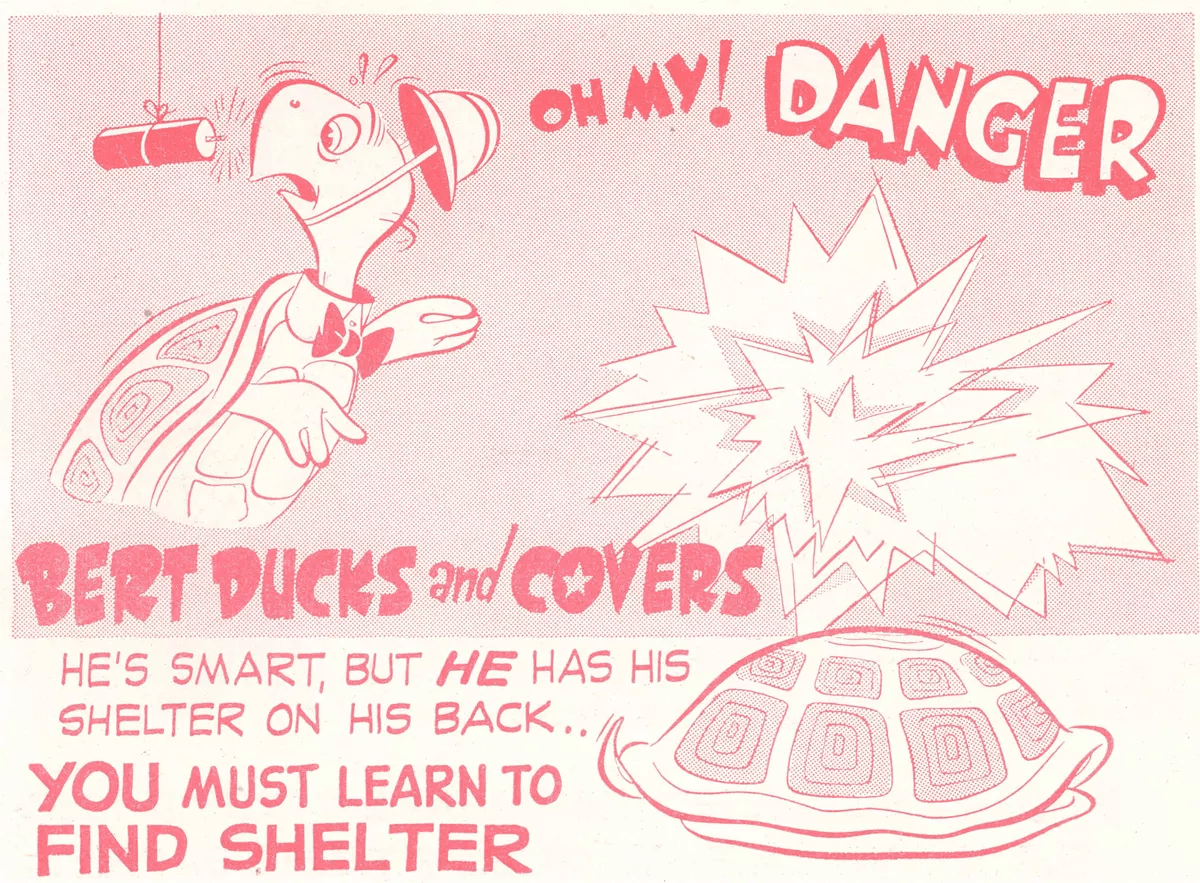
  • Children and teenagers were taught in school that they could survive a nuclear attack through “duck and cover” drills. They were instructed to keep their bathtubs filled with water for safe drinking, in the event of a Soviet nuclear strike.

Bert2.png (300×232)

Bert the Turtle teaches schoolchildren to “Duck and Cover”

Yet even in this poisonous atmosphere of fear and denunciation, some men stood out as heroes–simply by holding fast to their consciences.

One of these was a New York insurance attorney named James B. Donovan (played by Tom Hanks). Asked by the Justice Department to defend arrested Soviet spy Rudolph Abel (Mark Rylance) Donovan did what no one expected.

He gave Abel a truly vigorous defense, arguing that the evidence used to convict him was the legally-tainted product of an invalid search warrant.

Upon Abel’s conviction and sentencing to 45 years’ imprisonment, Donovan again shocked the political and legal communities by appealing the case to the Supreme Court.

Donovan argued that Constitutional protections should apply to everyone–including non-Americans–tried in American courts.  To do less made a mockery of the very freedoms we claimed to champion.

He lost by a vote of 5-4.  But the arguments he made would resurface 50 years later when al-Qaeda suspects were hauled into American courts.

James B. Donovan

In 1961, Donovan was again called upon to render service by a Federal agency–this time the CIA.  It wanted his help in negotiating the release of its spy, Francis Gary Powers, shot down over the Soviet Union in 1960 while flying a high-altitude U-2 spy plane.

Throughout “Bridge of Spies,” audiences learn some unsettling truths about how the American government–and governments generally–actually operate.

The first three of these were outlined in Part one of this series:

Truth #1: Appearance counts for more than reality.

Truth #2: Individual conscience can wreck the best-laid plans of government.

Truth #3: High-ranking government officials will ask citizens to take risks they themselves refuse to take.

Now for the remaining truths revealed in this movie.

Truth #4: Appeals to fear often prevail when appeals to humanity are ignored.

After crossing into East Germany, Donovan enters into negotiations with Wolfgang Vogel, a lawyer representing the East German government.

Vogel offers to exchange Frederic Pryor, an American economics graduate student seized by the East German secret police, for Abel. Donovan replies this is a deal-breaker; the United States (which is never mentioned during the negotiations) wants Powers, not Pryor.

Nevertheless, Donovan is equally concerned for Pryor, and adds him to the list of hostages to be released in return for Abel.

Then a new complication arises: The East German government that holds Pryor threatens to pull out. claiming to be insulted because Donovan did not inform them that the USSR was a party to the negotiation.

His reasoned, legal arguments having failed, Donovan resorts to a threat. He conveys a warning to the president of East Germany:

Abel has not yet revealed any Soviet secrets. But if this deal fails, he may well do so to earn favors from the United States government. And, in that case, the Soviets will blame you–Erich Honecker, the  president of East Germany–for the resulting damage.

Where arguments based on humanity have failed, this one–based on fear–works.  A prisoner-exchange is arranged.

Truth #5: Personal loyalty can supersede bureaucratic inventions.

On February 10, 1962, Donovan, Abel and several CIA agents arrive at the Glienicke Bridge, which connects East and West Germany. The Soviets have Powers, but not Pryor–who is to be released at Checkpoint Charlie, a crossing point between East and West Berlin.

    Glienicke Bridge, the “Bridge of Spies” 

The CIA agent in charge of the American delegation tells Abel he can cross into East Germany, even though Pryor has not been released.

But Abel has learned that Donovan has negotiated the release of not only Powers but Pryor. Out of loyalty to the man who has vigorously defended him, he waits on his side of the bridge until word arrives that Pryor has been released.

Then Abel crosses into East Germany while Powers crosses into the Western sector.

Donovan returns home. Before flying off to West Germany, he had told his wife he was going on a fishing trip in Scotland.

His wife and children learn the truth about the risks he ran and the success he attained only when a television newscast breaks the news:

Francis Gary Powers has been returned to the United States. And the man responsible is James Donovan, once the most reviled man in America for having defended a notorious Soviet spy.

“BRIDGE OF SPIES” TELLS UNPLEASANT TRUTHS ABOUT GOVERNMENT: PART ONE (OF TWO)

In Bureaucracy, History, Law, Military, Politics, Social commentary on October 26, 2015 at 12:27 am

Steven Spielberg’s new movie, “Bridge of Spies,” is that rarity among films: An intelligent mixture of history and drama, stripped of gratuitous sex and violence.

It’s also a film that accurately reveals unsettling truths about how government agencies really operate.

Truth #1: Appearance counts for more than reality.

The movie opens with the FBI’s arrest of KGB spy Rudolph Abel (Mark Rylance). The evidence against him is overwhelming. This–plus the “Red Scare” climate of 1957–will guarantee his conviction.

But the Eisenhower administration doesn’t want the upcoming trial to be seen as a hangman’s court.  It must have at least the appearance of a fair proceeding.

So the Justice Department (through the Brooklyn Bar Association) asks a New York insurance attorney named James B. Donovan (Tom Hanks) to take on Abel’s defense. He’s expected to make a reasonably competent effort but not go all out on behalf of his client.

Truth #2: Individual conscience can wreck the best-laid plans of government.

Donovan has never handled a spy case before. And he has no delusions that Abel isn’t the spy he’s charged with being. But he’s determined to give Abel the same committed defense he would give to any other client.

Rudolph Abel (Mark Rylance) and James Donovan (Tom Hanks) in court

This comes as a shock to the prosecutors, the judge, his law firm and even his family.

A CIA agent approaches Donovan in a nearly deserted restaurant and asks him to reveal any secrets that might help win Abel’s conviction.

Donovan replies: “This conversation isn’t happening.”

“No, of course not,” replies the CIA agent, assuming Donovan is agreeing to keep the overture secret.

“No, I mean this conversation isn’t happening,” angrily says Donovan, who leaves the agent fuming.

Donovan becomes a pariah; his mailbox is stuffed with hate mail and one night a would-be drive-by killer riddles his house with bullets.

Abel is convicted and sentenced to 45 years’ imprisonment. But Donovan–again shocking everyone he knows–pursues an appeal up to the Supreme Court.

He argues that the evidence against Abel is tainted by an invalid search warrant. No American citizen could be convicted under such circumstances; and the Constitutional protections that hold true for Americans should hold equally true for non-Americans charged with crimes in American courts.

Donovan’s arguments will be heard a half-century later, when al-Qaeda suspects are hauled before American courts.

He puts on an impressive case on Abel’s behalf, but loses 5-4 at the Supreme Court.

That seems to be the end of Donovan’s relationship with Abel.  But events soon dictate otherwise.

Before the judge could pronounce a death sentence on Abel, Donovan had argued that this might be a mistake. The day might come, he told the judge, when an American spy might fall into Soviet hands.

And then the United States would need to swap Abel to secure the release of its own agent.

The judge, moved by that argument, had given Abel a lengthy prison term instead.

On May 1, 1960, Francis Gary Powers, a former Air Force pilot, is flying a high-altitude U-2 plane above the Soviet Union for the CIA. The plane is equipped with state-of-the-art cameras, and Powers intends to photograph military sites and other important complexes.

Suddenly, a surface-to-air missile slams into the plane. Powers ejects before it crashes, but fails to commit suicide with a poison pin concealed in a phony silver dollar.  He’s captured by the KGB and brutally interrogated, but maintains his silence.

At about the same time, Frederic Pryor, an American economics graduate student living in West Germany, visits his German girlfriend living in Soviet-dominated East Germany.

The Soviets are starting to build their infamous Berlin Wall, which will stop the flow of refugees from East to West.  Pryor tries to bring his girlfriend and her father into West Berlin, but he’s stopped and arrested by agents of Stasi, the East German police, who accuse him of being a spy.

Meanwhile, the Soviet Union wants its spy, Abel, returned, before he can spell its secrets. In turn, the new Kennedy administration wants Powers returned, before he can be made to spill American secrets.

Truth #3: High-ranking government officials will ask citizens to take risks they themselves refuse to take.

In 1961, Donovan is once again sought out by the American government–this time by no less than CIA Director Allen Dulles.

And he’s asked to go where no official American representative can go–East Germany. His new assignment: Negotiate the exchange of Powers for Abel.

The CIA wants its spy back. And it’s willing to send Donovan into East Germany to negotiate his release. But it’s not willing to back him up if he’s arrested by Stasi, the notorious East German secret police.

In such a case, Donovan could spend the rest of his life in a Communist prison cell.

THE TRUTH AS THE ENEMY

In Bureaucracy, History, Politics, Social commentary on October 12, 2015 at 10:56 am

In politics, sometimes your best friends turn out to be your worst enemies.

Take the case of Kevin McCarthy in his September 30 appearance on Fox News.

McCarthy, the Republican member of the House of Representatives from Bakersfield, California, was undoubtedly feeling relaxed.

After all, he wasn’t being interviewed by such “enemies” of the Right as The New York Times or MSNBC political commentator Rachel Maddow.

He was being interviewed by Sean Hannity, a Right-wing political commentator whose books include Conservative Victory: Defeating Obama’s Radical Agenda and Deliver Us From Evil: Defeating Terrorism, Despotism, and Liberalism

Related image

Sean Hannity

The topic under discussion: Who would be the next Republican Speaker of the House, now that John Boehner had announced his decision to leave not only the Speakership but the House itself in November.

Now Hannity wanted to know what would happen when the next Republican Speaker took office.  And McCarthy–who was in the running for the position–was eager to tell him:

“What you’re going to see is a conservative Speaker, that takes a conservative Congress, that puts a strategy to fight and win. And let me give you one example. Everybody thought Hillary Clinton was unbeatable, right?

“But we put together a Benghazi special committee. A select committee. What are her [poll] numbers today? Her numbers are dropping. Why? Because she’s untrustable. But no one would have known that any of that had happened had we not fought to make that happen.”

Related image

Kevin McCarthy

In 51 words, McCarthy revealed that:

    • The House Select Committee on Benghazi was not a legitimate investigative body;
    • Its true purpose was not to investigate the 2012 deaths of four American diplomats during a terrorist attack in Benghazi, Libya;
    • Its real purpose all along had been to destroy the Presidential candidacy of Hillary Clinton;
    • To accomplish this, its members had spent 17 months and wasted more than $4.5 million of American taxpayers’ funds.

On October 8, Republicans were expected to choose their nominee for Speaker.  On that same date, McCarthy announced that he was withdrawing his name from consideration:

“Over the last week it has become clear to me that our Conference is deeply divided and needs to unite behind one leader. I have always put this Conference ahead of myself. Therefore I am withdrawing my candidacy for Speaker of the House.”

When reporters asked McCarthy if his revelation was the reason he withdrew, he replied, “Well, that wasn’t helpful.”

But then he quickly replayed the official Republican version: “But this Benghazi committee was only created for one purpose: to find the truth on behalf of the families for the four dead Americans.”

Democrats and Republicans were united in their anger that the real reason for the Benghazi “investigation” had been revealed.

Democrats were furious that McCarthy, in an unguarded moment, had revealed that their major Presidential candidate had been the victim of a Republican smear campaign disguised as a legitimate inquiry.

And Republicans were furious that McCarthy, in an unguarded moment, had revealed that the “legitimate inquiry” had been nothing more than a Republican smear campaign.

For McCarthy, the Benghazi Committee had legitimately served the nation–not by uncovering relevant details about a terrorist act but by causing Hillary Clinton’s poll numbers to drop.

In 1981, President Ronald Reagan had attacked the leaders of the Soviet Union thusly: “They reserve unto themselves the right to commit any crime, to lie, to cheat.”

McCarthy’s comments demonstrated that the Republican Party had adopted the same mindset and tactics as the dictators of the former Soviet Union.

They also proved that the best way to obtain the truth is often the “kill them with kindness” approach.

Veteran attorneys have long taken this approach when cross-examining witnesses.

Witnesses always expect the opposing counsel to immediately start screaming at them. But that only causes the witness to stay alert and say as little as possible.

So the smart attorney comes on as courteous, friendly, even sympathetic.

In one such case: A laborer claimed to have permanently injured his shoulder in a railway accident, leaving him unable to work.  He claimed he could no longer raise his arm above a point parallel with his shoulder.

The railway’s attorney asked him a few sympathetic questions about his injuries. And the witness quickly volunteered that he was in constant pain and a near-invalid.

“And, as a result of the accident, how high can you raise your arm?” asked the attorney.

The witness slowly raised his arm parallel with his shoulder.

“Oh, that’s terrible,” said the attorney. Then: “How high could you get it up before the accident?”

Unthinkingly, the witness extended his arm to its full height above his head–to the laughter of the judge, jury and spectators.

In light of Kevin McCarthy’s unintended revelation, no one is laughing now.

“LET VLADIMIR DO IT”

In Bureaucracy, History, Military, Politics on October 7, 2015 at 12:40 am

Russia has started launching airstrikes in Syria to bolster the dictatorship of Syrian “president” Bashar al-Assad.

The Obama administration is worried. And Republicans are furious, with some of them demanding that American military forces directly confront the Russians..

But there is actually no reason for alarm.

On the contrary, there are several major reasons why the United States should quit Syria–now.

First, since 1979, Syria has been listed by the U.S. State Department as a sponsor of terrorism.

Among the terrorist groups it supports are Hezbollah and Hamas. For years, Syria provided a safehouse in Damascus to Ilich Ramírez Sánchez–-the notorious terrorist better known as Carlos the Jackal.

Ilich Ramírez Sánchez–“Carlos the Jackal” 

Second, there are no “good Syrians” for the United States to support–-only murderers who have long served a tyrant and other murderers who now wish to become the next tyrant.

Third, the United States doesn’t know what it wants to do in Syria, other than “send a message.”

Carl von Clausewitz, the Prussian military theorist, wrote: “War is the continuation of state policy by other means.”  But President Barack Obama hasn’t stated what his “state policy” is toward Syria–or what he intends to gain by attacking it.

President Obama has said he’s “not after regime-change.” If true, that would leave Syria’s brutal dictator, Bashar al-Assad in power–-and free to go on killing those who resist his rule.

Fourth, Russia is intervening to support its longtime ally, Assad, which is now engulfed in civil war.

This began on March 15, 2011, triggered by protests demanding political reforms and the ouster of al-Assad.  More than 310,000 people have been killed in the fighting.

Fifth, the Assad regime is backed by the Iranian-supported terrorist group, Hezbollah (Party of God). Its enemies include another terrorist group–Al Qaeda.

Hezbollah is comprised of Shiite Muslims.  A sworn enemy of Israel, it has  kidnapped scores of Americans suicidal enough to visit Lebanon and truck-bombed the Marine Barracks in Beirut in 1983, killing 299 Americans.

Flag of Hezbollah

Al-Qaeda, on the other hand, is made up of Sunni Muslims. Besides plotting 9/11, It has attacked the mosques and gatherings of liberal Muslims, Shias, Sufis and other non-Sunnis.

When your enemies are intent on killing each other, it’s best to stand aside and let them do it.

Flag of Al Qaeda

Sixth, the United States hasn’t defeated ISIS through air power alone–and neither will Russia. 

President Barack Obama authorized airstrikes against ISIS in September, 2014.  Since then, the United States Air Force has dropped thousands of bombs on ISIL convoys.

But this has not destroyed ISIS.  And this failure has only led to demands by hawkish Republicans and Democrats for “boots on the ground.”

Seventh, China and Russia are fully supporting the Assad dictatorship–-and the brutalities it commits against its own citizens.

Any move by the United States to directly attack the Assad regime could ignite an all-out war with Russia and/or China.

What happens if American and Russian forces start trading salvos? Or if Russian President Vladimir Putin orders an attack on Israel, in return for America’s attack on Russia’s ally, Syria?

It was exactly that scenario–Great Powers going to war over conflicts between their small-state allies–-that triggered World War l.

Eighth, while Islamic nations like Syria and Iraq wage war within their own borders, they will lack the resources to launch attacks against the United States.

* * * * *

The United States owes Syria–and the Syrians–nothing. But it does owe its own citizens security from Islamic terrorism.

That’s why it’s time to “let Vladimir do it.”

Putin’s intervention in Syria’s four-year civil war offers three possible outcomes for the United States.  And they’re all positive.

First, the Russians will kill thousands of America’s sworn enemies.

Russians are well-known for their disregard for human life.  During their invasion of Germany in 1945, Russian soldiers literally nailed civilians to barn doors, squashed them under their tanks, and raped countless women of all ages.

In Syria, they will slaughter everyone who gets in their way. Thus, they will kill far more of America’s Islamic enemies than even our own military–hamstrung by do-gooder “rules of engagement”–could possibly eliminate.

SecondRussia will replace the United States as “The Great Satan” in the eyes of  most Islamics.  

The Soviet Union waged a ruthless war against Afghanistan from 1979 to 1989. Out of that war grew Al-Qaeda.  Millions of Islamics still hate Russians for their brutalities.

From 1999 to 2009, Russia fought a brutal war against Islamics in Chechnya. Chechens responded with terrorism across Russia.

Russia’s intervention in Syria will only harden its image as an enemy of Islam–even if it’s supporting one group of Islamics (the Assad regime) against others.

If Islamic terrorism starts raging throughout Russia, Putin may be forced to back down from his military moves against Syria and Ukraine.

Third, if Russian planes get shot down or Russian soldiers kiled, Russia will suffer the casualties–not the United States.

The Soviet Union never fully recovered from its losses in Afghanistan–13,310 soldiers killed, 35,478 wounded.

If Russia starts taking heavy losses in Syria or at home through terrorism, this could lead to widespread unrest.  Even Vladimir Putin could find himself in danger of being replaced.

THE FAULT LIES IN US

In Bureaucracy, History, Politics, Self-Help, Social commentary on September 25, 2015 at 12:01 am

During a GOP primary debate on June 13, 2011, CNN moderator John King noted that FEMA–the Federal Emergency Management Agency–was about to run out of money.

And so he asked Republican Presidential candidate Mitt Romney:

“There are some people who say do it on a case-by-case basis and some people who say, you know, maybe we’re learning a lesson here that the states should take on more of this role.

“How do you deal with something like that?”

“Absolutely,” Romney replied. “Every time you have an occasion to take something from the federal government and send it back to the states, that’s the right direction.

“And if you can go even further, and send it back to the private sector, that’s even better.

“Instead of thinking in the federal budget, what we should cut–we should ask ourselves the opposite question: What should we keep?

“We should take all of what we’re doing at the federal level and say, what are the things we’re doing that we don’t have to do?

“And those things we’ve got to stop doing, because we’re borrowing $1.6 trillion more this year than we’re taking in.”

FLIP!

Mitt Romney vs. FEMA

On October 30, 2012, one day after Hurricane Sandy lashed the densely-populated East Coast of the United States, reporters wanted to know if Romney still wanted to eliminate FEMA.

And, as he had on so many other issues, Mitt Romney once again refused to answer questions.

“Governor, are you going to eliminate FEMA?” a pool eporter shouted to Romney.

Hurricane Sandy

Romney refused to answer.

The reporter asked Romney at least five times: “If you’re elected President, would you eliminate FEMA?” and “What would you do with FEMA?”

No reply.

Another reporter asked: “Governor, are you going to see some storm damage?”

Again, no answer.

“Governor,. has Chris Christie invited you to come survey storm damage?”

No answer.

“Governor, you’ve been asked 14 times, why are you refusing to answer the question?”

Again, Romney refused to reply.

Finally, under mounting public pressure, he gave this reply:

FLOP!

Mitt Romney pro-FEMA

“I believe that FEMA plays a key role in working with states and localities to prepare for and respond to natural disasters.

“As president, I will ensure FEMA has the funding it needs to fulfill its mission, while directing maximum resources to the first responders who work tirelessly to help those in need.”

In a court of law, a defendant has the right to refuse to take the witness stand and answer questions.  And jurors are told by the judge they should not assume the defendant is guilty for doing so.

Courtrooms are often places for a game of let’s-pretend:

  • Let’s pretend that a man who’s accused of rape or murder is innocent–even if he refuses to answer legitimate questions; and
  • Let’s pretend that a truly innocent man wouldn’t want to clear himself from a totally false charge

But this is the real world.

And, in it, unlike a courtroom, experience teaches that:

  • People who are honest want to testify to that truth; and
  • People who refuse to answer legitimate questions usually do have something to hide.

Think of Richard Nixon refusing to answer questions about Watergate.

Think of Ronald Reagan refusing to take questions about Iran-Contra.

Think of George W. Bush refusing to take questions about why he ignored months of terrorism warnings before 9/11.

And think of Mitt Romney refusing to answer questions on any number of subjects.

So it’s natural to distrust those who refuse to give specific answers to specific questions–especially when those questions apply to matters that direclty affect people’s lives.

For millions of Americans who profess to be deeply religious, Jesus’ words in Matthew 7:7-8 should have been instructive:

Ask, and it shall be given you.  Seek, and ye shall find.  Knock, and it shall be opened unto you.

For every one that asketh receiveth.  And he that seeketh findeth. And to him that knocketh it shall be opened.

In a democracy, those words are a call to citizen action:

Ask.

Seek.

Knock.

In the Soviet Union, the truth about the workings of government and the realities of everyday life was carefully guarded.

Only those who gained special access to the Kremlin’s hidden archives could learn at least some of that truth.

Everyone else had to settle for the official, self-serving, lie-filled pronouncements of the Soviet leadership.

But Americans have no such excuse.

They do have access to a wide range of news from differing sources–ranging from the far left to the far right.  At least 1,382 daily newspapers–both domestic and foreign– provide information on a wide range of national and international issues.

More than 20 nationwide broadcasting networks exist.  Among these: ABC, CBS, CNN, Fox, NBC, PBS, Telemundo, The CW.

Nevertheless, millions of Americans remain ignorant of the well-revealed truth about the issues that most affect their lives.

As a result, Cassius’ words to Brutus in William Shakespeare’s Julius Caesar apply to them:

“The fault, dear Brutus, is not in our stars but in ourselves that we are underlings.”

TEN REASONS WHY THE UNITED STATES SHOULD QUIT SYRIA

In Bureaucracy, History, Military, Politics, Social commentary on September 21, 2015 at 11:26 am

There are ten excellent reasons for withdrawing American soldiers from their current war on ISIS forces in Syria.

1. It’s been only four years since the United States disengaged from Iraq. On December 15, 2011, the American military formally ended its mission there. The war–begun in 2003–had killed 4,487 service members and wounded another 32,226.

2. The United States is still fighting a brutal war in Afghanistan. Although the United States’ military role formally ended in December, 2014, airstrikes against Taliban positions continue and U.S. troops remain in combat positions.

U.S. Special Operations troops, serving as advisors and trainers of struggling Afghan government forces, still unleash military operations against the Taliban.

3. Intervening in Syria could produce unintended consequences for American forces–and make the United States a target for more Islamic terrorism.

American bombs or missiles could land on one or more sites containing stockpiles of chemical weapons. Imagine the international outrage that will result if the release of those weapons kills hundreds or thousands of Syrians.

U.S. warship firing Tomahawk Cruise missile

Within the Islamic world, the United States will be seen as waging a war against Islam, and not simply another Islamic dictator.

4.  Since 1979, Syria has been listed by the U.S. State Department as a sponsor of terrorism.

Among the terrorist groups it supports are Hezbollah and Hamas. For years, Syria provided a safe-house in Damascus to Ilich Ramírez Sánchez–the notorious terrorist better known as Carlos the Jackal.

Ilich Ramírez Sánchez–“Carlos the Jackal” 

5.  There are no “good Syrians” for the United States to support–only murderers who have long served a tyrant or now wish to become the next tyrant.

With no history of democratic government, Syrians aren’t thirsting for one now.

6. The United States had no part in creating the dictatorial regime of “President” Bashir al-Assad.

Thus, Americans have no moral obligation to support those Syrians trying to overthrow it since 2011.

7.  The United States doesn’t know what it wants to do in Syria, other than “send a message.”

Carl von Clausewitz, the Prussian military theorist, wrote: “War is the continuation of state policy by other means.”

But President Barack Obama hasn’t stated what his “state policy” is toward Syria. He’s said he’s “not after regime-change.” If true, that would leave Assad in power–and free to go on killing those who resist his rule.

8. The Assad regime is backed by–among others–the Iranian-supported terrorist group, Hezbollah (Party of God).  Its enemies include another terrorist group–Al Qaeda.

Hezbollah is comprised of Shiite Muslims.  A sworn enemy of Israel, it has  kidnapped scores of Americans suicidal enough to visit Lebanon and truck-bombed the Marine barracks in Beirut in 1983, killing 241 Americans.

Flag of Hezbollah

Al-Qaeda, on the other hand, is made up of Sunni Muslims. Besides plotting 9/11, It has attacked the mosques and gatherings of liberal Muslims, Shias, Sufis and other non-Sunnis.

Examples of these sectarian attacks include the Sadr City bombings, the 2004 Ashoura massacre and the April, 2007 Baghdad bombings.

Flag of Al Qaeda

When your enemies are intent on killing each other, it’s best to stand aside and let them do it.

9.  The United States could find itself in a shooting war with Russia.

The Russians recently sent tanks and artillery units to Syria, in addition to hundreds of Russian troops.  This is almost certainly an effort by Russian President Vladimir Putin  to bolster President Bashar al-Assad’s embattled regime.

What happens if American and Russian tanks and/or artillery units start trading salvos?  Or if Putin orders an attack on Israel, in return for America’s attack on Russia’s ally, Syria?

It was exactly that scenario–Great Powers going to war over conflicts between their small-state allies–that triggered World War l. The difference between 1941 and 2015: Today’s Great Powers have nuclear arsenals.

10.  While Islamic nations like Syria and Iraq wage war within their own borders, they will lack the resources to launch attacks against the United States.

Every dead supporter of Hezbollah or Al-Qaeda–or ISIS–makes the United States that much safer.

The peoples of the Middle East have long memories for those who commit brutalities against them.  In their veins, the cult of the blood feud runs deep.

When Al-Qaeda blows up civilians in Damascus, their relatives will urge Hezbollah to take brutal revenge.  And Hezbollah will do so.

Similarly, when Hezbollah destroys a mosque, those who support Al-Qaeda will demand even more brutal reprisals against Hezbollah.

No American could instill such hatred in Al-Qaeda for Hezbollah–or vice versa.  This is entirely a war of religious and sectarian hatred.

This conflict could easily become the Islamic equivalent of “the Hundred Years’ War” that raged from 1337 to 1453 between England and France.

When Adolf Hitler invaded the Soviet Union in 1941, then-Senator Harry Truman said: “I hope the Russians kill lots of Nazis and vice versa.”

That should be America’s view whenever its sworn enemies start killing themselves off.   Americans should welcome such self-slaughters, not become entrapped in them.

LADIES AND GENTLEMEN, THE PSYCHO PRESIDENT OF THE UNITED STATES: PART TWO (END)

In Bureaucracy, History, Military, Politics, Social commentary on September 16, 2015 at 12:05 am

Americans like to believe they choose rational men and women for their political leaders.

This is especially true when it comes to deciding who will govern the country for the next four years as President of the United States.

But this has not always been the case.

One such irrational President was Richard M. Nixon, elected in 1968 and re-elected in 1972.

In 1970, while deciding whether to widen the Vietnam war by bombing Cambodia, he repeatedly watched the movie “Patton.”  Then he ordered the bombing to begin.

Richard Nixon

In 1974, as Justice Department investigations of Watergate increasingly threatened his Presidency, his behavior grew increasingly erratic.

He drank heavily, took pills by the handful, and, on at least one occasion, was seen talking to pictures of Presidents that adorned the walls of the White House.

In the final weeks of his administration, as impeachment for his Watergate abuses seemed increasingly certain, Nixon inspired fears of a military coup in his Secretary of Defense.

James Schlesinger warned all military commands to ignore any direct orders from the White House–or any other source–without the counter-signature of the SecDef himself.

On his last night in the White House–August 8, 1974–Nixon summoned Secretary of State Henry Kissinger to the Oval Office.

Half-rambling, half-crying, Nixon asked Kissinger to kneel with him on the White House rug and pray for God’s forgiveness. Kissinger, though Jewish, had never shown any interest in religion.  Neverheless, he reluctantly did so.

Later that night, Nixon called Kissinger and pleaded with him to never tell anyone “that I cried, and I was not strong.” Kissinger promised to keep his secret–and then promptly leaked it.

Nixon, however, was not the only President whose irrationality played havoc with history.

In June, 2001, George W. Bush met with Russian President Vladimir Putin in Slovenia.  Bush judged others–even world leaders–through the lens of his own fundamentalist Christian theology.

And Putin was quick to take advantage of it.

Related image

George W. Bush and Vladimir Putin 

BUSH:  Let me say something about what caught my attention, Mr. President, was that your mother gave you a cross which you had blessed in Israel, the Holy Land.

PUTIN:  It’s true.

BUSH:  That amazes me, that here you were a Communist, KGB operative, and yet you were willing to wear a cross.  That speaks volumes to me, Mr. President. May I call you Vladimir?

Falling back on his KGB training, Putin seized on this apparent point of commonality to build a bond. He told Bush that his dacha had once burned to the ground, and the only item that had been saved was that cross.

BUSH:  Well, that’s the story of the cross as far as I’m concerned. Things are meant to be.

Afterward, Bush and Putin gave an outdoor news conference.

“Is this a man that Americans can trust?” Associated Press correspondent Ron Fournier asked Bush.

“Yes,” said Bush. “I was able to get a sense of his soul, a man deeply committed to his country and the best interests of his country. I wouldn’t have invited him to my ranch if I didn’t trust him.”

In early 2003, Bush telephoned French President Jaques Chirac, hoping to enlist his support–and troops–for his long-planned invasion of Iraq.

Failing to convince Chirac that overthrowing Saddam Hussein was politically advantageous, Bush took a different tack.

BUSH: Jaques, you and I share a common faith. You’re Roman Catholic, I’m Methodist, but we’re both Christians committed to the teachings of the Bible. We share one common Lord.

Gog and Magog are at work in the Middle East.  Biblical prophecies are being fulfilled.

This confrontation is willed by God, who wants to use this conflict to erase His people’s enemies before a new age begins.

When the call ended, Chirac asked his advisors: “Gog and Magog–do any of you know what he’s talking about?”

When no one did, Chirac ordered: Find out.

The answer came from Thomas Roemer, a professor of theology at the University of Lausanne.

Romer explained that the Old Testament book of Ezekiel contains two chapters (38 and 39) in which God rages against Gog and Magog, sinister and mysterious forces menacing Israel.

Jehovah vows to slaughter them ruthlessly. In the New Testament book of Revelation (20:8) Gog and Magog are depicted as gathering nations for battle: “And fire came down from God out of Heaven, and devoured them.”

Chirac decided to oppose joining the upcoming invasion of Iraq.  France, he said, would not fight a war based on an American Presient’s interpretation of the Bible.

Click here: 500 Days: Secrets and Lies in the Terror Wars: Kurt Eichenwald

Bush’s war cost the lives of 4,486 Americans–and an estimated 655,000 Iraqis.

Bush, however, was not the first President to invoke Gog and Magog.

Ronald Reagan predicted that this Biblical confrontation would pit the United States against the Soviet Union–which had abandoned God at the time of the Russian Revolution.

Evangelical Christians twice elected Ronald Reagan and George W. Bush to the Presidency.

In light of this, voters should think carefully before choosing candidates who accept superstitious beliefs over rational inquiry.