bureaucracybusters

Posts Tagged ‘SALLY YATES’

PURGE-TIME IN STALIN’S RUSSIA AND TRUMP’S AMERICA: PART ONE (OF TWO)

In Bureaucracy, History, Law Enforcement, Politics, Social commentary on September 25, 2017 at 2:06 am

Donald Trump—as both Presidential candidate and President—has often been compared to Adolf Hitler.

Yet, in at least one sense, this comparison is inaccurate.  As Germany’s Fuhrer (1933-1945) Hitler kept on the members of his Cabinet for no less than 12 years.

Adolf Hitler

Among these:

  • Hermann Goering had repeatedly shown himself as the incompetent Reichsmarshall of the German air force, the Luftwaffe. Yet Hitler kept him on because Goering had been one of the “Old Fighters” who had supported Hitler long before the Nazis came to power.  Only in April, 1945, when Hitler falsely believed that Goering was trying to supplant him as Fuhrer, did he expel him from the party and order his arrest.
  • Rudolf Hess joined the Nazi party in 1920, and served as Deputy Fuhrer to Hitler from 1933 to 1941. That was when he flew to Scotland on a self-assigned mission to make peace with England. The British, believing him mad, locked him in the Tower of London until 1945.  Afterward, he was convicted at Nuremberg for war crimes and sentenced to life imprisonment.
  • Joachim von Ribbentrop had been a champagne salesman before Hitler appointed him Foreign Minister in 1938, and held that post until the Reich’s defeat in 1945.  Although his arrogance and incompetence made him universally disliked by other high-ranking Nazi officials, Hitler never considered firing him.
  • Heinrich Himmler, appointed Reichsfuhrer-SS in 1929, held that position throughout the 12 years (1933-1945) the Third Reich lasted. It was to Himmler that Hitler entrusted the most important project of his life: The destruction of European Jewry. Only after learning—in the final days of the Reich—that Himmler had sought to make peace with the Allies did Hitler expel him from the party and order his arrest.

Joseph Stalin, dictator of the Soviet Union (1928-1953) serves as a far better comparison figure for Trump.

Joseph Stalin

In 1936, Stalin ordered the first of a series of purges—from high-ranking members of the Communist party to impoverished peasants.  Among the most prominent of his victims:

  • Grigory Zimoviev, former member of the Central Committee of the Communist party. He was arrested in 1934 on trumped-up charges of “moral complicity” in the assassination of Leniningrad party boss Sergei Kirov.  He was executed in 1936.
  • Leon Trotsky, onetime second-in-command only to Vladimir Lenin, clashed with Stalin before the November 7, 1917 Russian Revolution. They remained locked in combat until Lenin’s death of a cerebral hemorrhage in 1924. Stalin drove Trotsky out of the Communist party and even out of the Soviet Union. In 1940, on Stalin’s orders, he was assassinated while living under guard in Mexico.
  • Genrikh Grigoryevich Yagoda served as director of the NKVD secret police (the precursor of the KGB) from 1934 to 1936. He supervised the arrest, show trial and execution of former Central Committee members Lev Kamenev and Grigory Zimoviev. Arrested in 1937, he was falsely charged with treason and conspiracy against the Soviet government. Yagoda was shot soon after the trial. His wife Ida Averbakh was also executed in 1938.
  • Nikolai Yezhov became head of the NKVD secret police  in 1936.  He oversaw what historians have since named the Great Terror until 1939. Arrested in April, he was replaced by Lavrenty Beria. In 1940, Yezhov himself was executed by the executioners he had once commanded.

Like Joseph Stalin, Donald Trump has presided over a series of purges since reaching the White House.

Related image

Donald Trump

Like Stalin, Trump demands unconditional loyalty from those who serve in his administration. And, also like Stalin, he does not believe that loyalty is a two-way street.

Moreover, it doesn’t take much to offend Trump’s fragile ego. When “Saturday Night Live” started doing skits showcasing his chief strategist, Steve Bannon, as a Rasputin-like figure who manipulated Trump, Bannon’s days were clearly numbered.

The same proved true for Anthony Scaramucci, who was to become White House communications director.  All that it took to secure his dismissal was an expletive-ridden phone interview with The New Yorker‘s Ryan Lizza. It didn’t help Scaramucci that he bragged about purging the entire White House communications staff and even siccing the FBI on leakers.

Others have left the White House owing to its increasingly paranoid atmosphere. Reports have surfaced of staffers being ordered to turn over their cell phones for inspection. The reason: To ensure they weren’t communicating with reporters by text message or through encrypted apps.

Then there is the very real—and justified—fear of being caught up in Special Counsel Robert Mueller III’s ever-widening investigation into collusion between Russian Intelligence agents and members of Trump’s 2016 Presidential campaign.

One of those who has reportedly hired top-notch legal talent is Hope Hicks, interim White House communications director. According to Politico, the 28-year-old has retained the services of veteran criminal defense lawyer Robert Trout, who once worked for the Justice Department.

Even if a White House staffer is not ultimately indicted and convicted, the costs of hiring top-flight legal talent can prove ruinous.

During the 2016 campaign, Trump claimed a $9 billion fortune: “I’m really rich!”  But he has shown no willingness to spend any of it defending those officials he has hired.

And for an administration already plagued with a shortage of desperately-needed talent, even worse may soon be to come.
TURNING THE WHITE HOUSE INTO THE RED HOUSE: PART THREE (END)

In Bureaucracy, History, Military, Politics, Social commentary on April 5, 2017 at 12:08 am

“We do not need a reckless President who believes she is above the law.”  

As chants of “Lock her up!” spread across the floor of the Republican National Convention, Michael T. Flynn voiced his agreement. “Lock her up—that’s right.”  

Movie-star handsome, the former United States Army lieutenant general and director of the Defense Intelligence Agency was clearly enjoying his moment as a keynote speaker.

Clapping his hands, he continued: “I’m gonna tell you what. It’s unbelievable—unbelievable.  

“I have called on Hillary Clinton to drop out of the race, because she—she—put our nation’s security at extremely high risk for their careless use of a private email server.

Flynn Lead 'Lock Her Up' Chant in 2016 | Michael Flynn once led a "lock her  up" chant at the Republican convention http://ti.me/2AkfEQL | By  TIMEFacebook

Michael Flynn at the Republican convention

“Lock her up–lock her up. You guys [the audience] are good. Damn right—that’s exactly right. There’s nothing wrong with that.

“You know why we’re saying that? We’re saying that because if I—a guy who knows this business—if I did a tenth of what she did, I would be in jail today.”

That was July 18, 2016.

Six months and two days later, he was riding even higher: On January 20—the day Donald J. Trump became President—Flynn took office as the nation’s 25th National Security Adviser.

Two days later, The Wall Street Journal reported that Flynn was under investigation by U.S. counterintelligence agents for his communications with Russian officials. 

On February 8, Flynn flatly denied having spoken to Russian ambassador Sergey Kislyak in December, 2016, about removing the sanctions placed on Russia by the outgoing Obama administration.

The sanctions had been placed in retaliation for Russia’s efforts to manipulate the 2016 Presidential election.

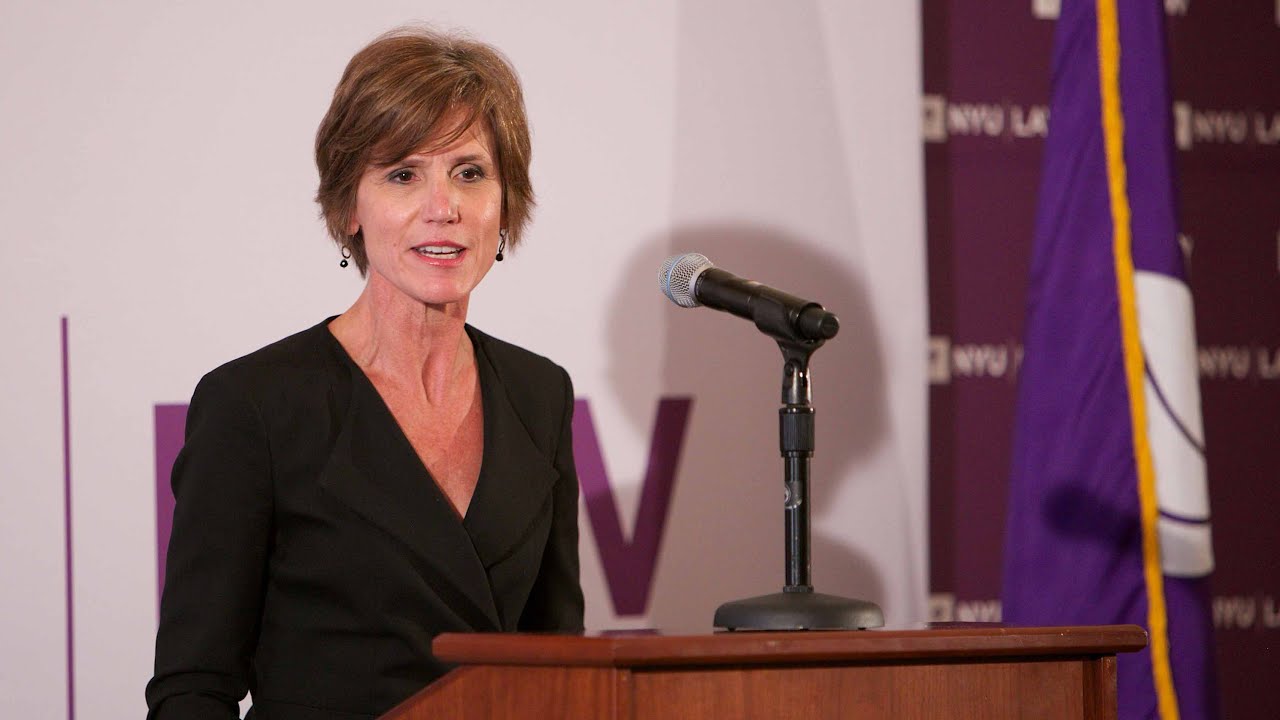
On February 13, The Washington Post reported that Acting Attorney General Sally Yates had warned Trump in late January that Flynn had lied about his contacts with Kislyak—and that he could be blackmailed by Russian Intelligence. 

Image result for Image of Attorney General Sally Yates

Sally Yates

Flynn was forced to resign that same day–after only 24 days as National Security Adviser.

Officially, the reason given was that he had misled Vice President Mike Pence. But Flynn’s deception had already been known—via the warning to Trump by Yates.

Only after Yates’ warning became known to the media was Flynn forced to resign.  

Even worse for Flynn: The same Washington Post story reported that, in December, 2015, he had appeared on Russia Today, the news network that American Intelligence agencies consider “the Kremlin’s principal international propaganda outlet.” 

He had also received more than $45,000 as a “speaking fee” from the network for a talk on world affairs. At the gala where Flynn received the fee, he sat next to Vladimir Putin for dinner.

Flynn did not file the required paperwork for the trip. Nor did he report the “fee” to the Pentagon.  

On March 30, The Wall Street Journal reported that Flynn had offered to testify to the FBI or the Senate and House Intelligence committees in exchange for immunity from prosecution. So far, neither the FBI nor the Congressional Intelligence committees has agreed to such a deal.

Meanwhile, as a Presidential candidate and President, Donald Trump has steadfastly denied the revelations about collaboration between members of his 2016 Presidential campaign and Russian Intelligence agents. 

Donald Trump

He has repeatedly attacked the “fake news” media reporting these revelations. Chief among his targets: CNN, The New York Times and The Washington Post

He has also derided the Intelligence agencies responsible for America’s security.

On October 7, 2016, the Department of Homeland Security and the Office of the Director of National Intelligence issued a joint statement blaming the Russian government for the hacking of Democratic National Committee emails. Its motive: “To interfere with the US election process.”

Two days later, Trump publicly stated: “But I notice, anytime anything wrong happens, they like to say the Russians are– Maybe there is no hacking. But they always blame Russia.”

On March 4, Trump unleashed a series of tweets accusing former President Barack Obama of tapping his Trump Tower phones prior to the election: “How low has President Obama gone to tapp my phones during the very sacred election process. This is Nixon/Watergate. Bad (or sick) guy!”

One month later, Trump has offered no evidence to support that accusation. Nor have the FBI and Justice Department provided any. Yet Trump has refused to apologize or retract the libel.  

Former Obama White House Press Secretary Josh Earnest has his own take on Trump’s motivation. Appearing on the March 5 edition of ABC’s This Week, he said:

“We know exactly why President Trump tweeted what he tweeted.

“Because there is one page in the Trump White House crisis management playbook. And that is simply to tweet or say something outrageous to distract from the scandal, and the bigger the scandal, the more outrageous the tweet.”  

In time, the epitaph for the Trump administration may prove to be a bitter parody of The Muppet Movie song, “The Rainbow Connection”:  

Why are there so many
Tales about Russians
And Right-wingers taking bribes?

Russians are Commies
And have lots of rubles
For traitors with something to hide.

So I’ve been told
And some choose to believe it.
It’s clear as the old KGB.

Someday we’ll find it
The Russian Connection–
The bribers, the traitors–you’ll see.

TURNING THE WHITE HOUSE INTO THE RED HOUSE: PART TWO (OF THREE)

In Bureaucracy, History, Law Enforcement, Military, Politics, Social commentary on April 4, 2017 at 12:16 am

Slightly more than two months after taking office, President Donald Trump has become haunted by “the Russian connection.”   

Throughout 2016, the CIA, FBI and National Security Agency (NSA) found numerous ties between officials of the Trump Presidential campaign and Russian Intelligence agents.  

And many of those he has appointed to office have strong ties to the government of Russian President Vladimir Putin.

One of these is Secretary of State Rex Tillerson. In 2013, as the chief executive of ExxonMobil, he was presented with the 2013 Order of Friendship award. He had just signed deals with the state-owned Russian oil company Rosneft. Its chief, Igor Sechin, is a loyal Putin lieutenant.

Secretary Tillerson in March 2017.jpg

Rex Tillerson

Another such official is Attorney General Jeff Sessions. During the 2016 campaign, Sessions–then serving as a surrogate for Donald Trump’s campaign–twice spoke with Russian Ambassador Sergey Kislyak.

But during his Senate nomination hearings, Sessions denied that he had had “communications with the Russians” during the campaign.

The discovery of numerous contacts between Trump campaign officials and Russian Intelligence agents led the FBI to launch an investigation into Russia’s efforts to influence the outcome of the 2016 Presidential election. That investigation is still ongoing.

And the House and Senate Intelligence Committees have launched their own investigations into the same.

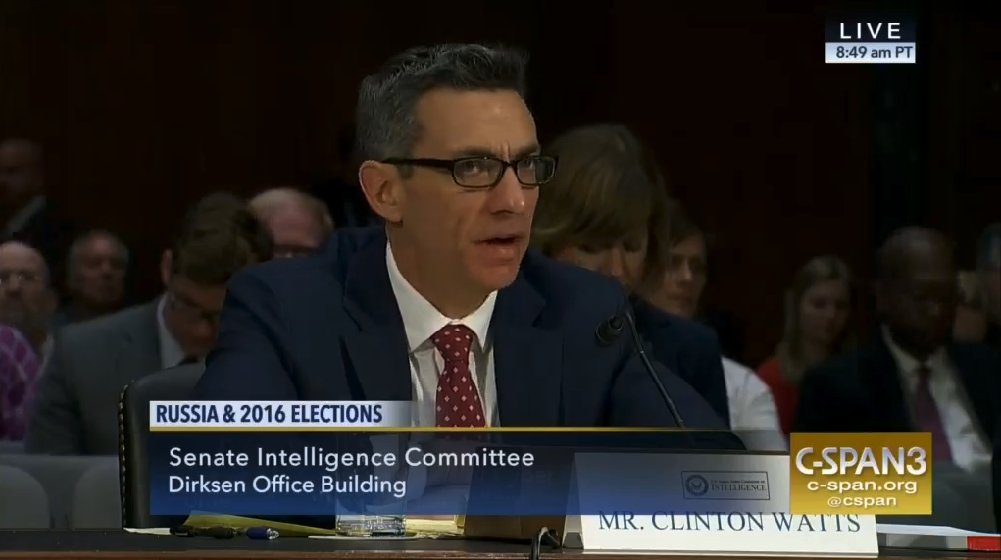
On March 30, Clinton Watts, an expert on cyber warfare, testified before the U.S. Senate Select Committee on Intelligence. As part of his testimony, he presented a prepared statement on “Disinformation: A Primer In Russian Active Measures And Influence Campaigns.” 

Image result for Images of the seal of the U.S. Senate Select Committee on Intelligence

FROM WATTS’ STATEMENT: Russia certainly seeks to promote Western candidates sympathetic to their worldview and foreign policy objectives. But winning a single election is not their end goal.

Russian Active Measures hope to topple democracies….from the inside out [by] creating political divisions….

[Their ultimate goals are]  the dissolution of the European Union and the break up of the North American Treaty Organization (NATO).  

Achieving these two victories against the West will allow Russia to reassert its power globally and pursue its foreign policy objectives bilaterally through military, diplomatic and economic aggression.

Trump has repeatedly praised Russian President Vladimir Putin. On December 18, 2015, Trump appeared on MSNBC’s “Morning Joe.” Its host, Joe Scarborough, was upset by Trump’s praise for Putin: 

SCARBOROUGH: Well, I mean, [he’s] also a person who kills journalists, political opponents, and invades countries. Obviously that would be a concern, would it not?

TRUMP: He’s running his country, and at least he’s a leader. Unlike what we have in this country.

SCARBOROUGH: But again: He kills journalists that don’t agree with him.

TRUMP: I think our country does plenty of killing, also, Joe, so, you know. There’s a lot of stupidity going on in the world right now, Joe. A lot of killing going on. A lot of stupidity. And that’s the way it is. 

On July 22, 2016, Wikileaks released 19,252 emails and 8,034 attachments hacked from computers of the highest-ranking officials of the Democratic National Committee (DNC). Early reports traced the leak to Russian hackers. 

At a press conference in Doral, Florida, Trump declared: “Russia, if you are listening, I hope you are able to find the 33,000 emails that are missing–I think you will probably be rewarded mightily by our press.”  

This was nothing less than treason–calling upon a foreign power, hostile to the United States, to interfere in its Presidential election.

On December 16, 2016, FBI Director James B. Comey and Director of National Intelligence James R. Clapper Jr. agreed with a CIA assessment that Russia intervened in the 2016 election in part to help Donald Trump win the White House. 

Related image

Trump, however, has steadfastly denied any such role by Russia: “I think it’s ridiculous,” he told “Fox News Sunday.” “I think it’s just another excuse. I don’t believe it….No, I don’t believe it at all.”   

On October 19, 2016, Trump’s admiration of Putin became a major target for his Democratic opponent, Hillary Clinton.  

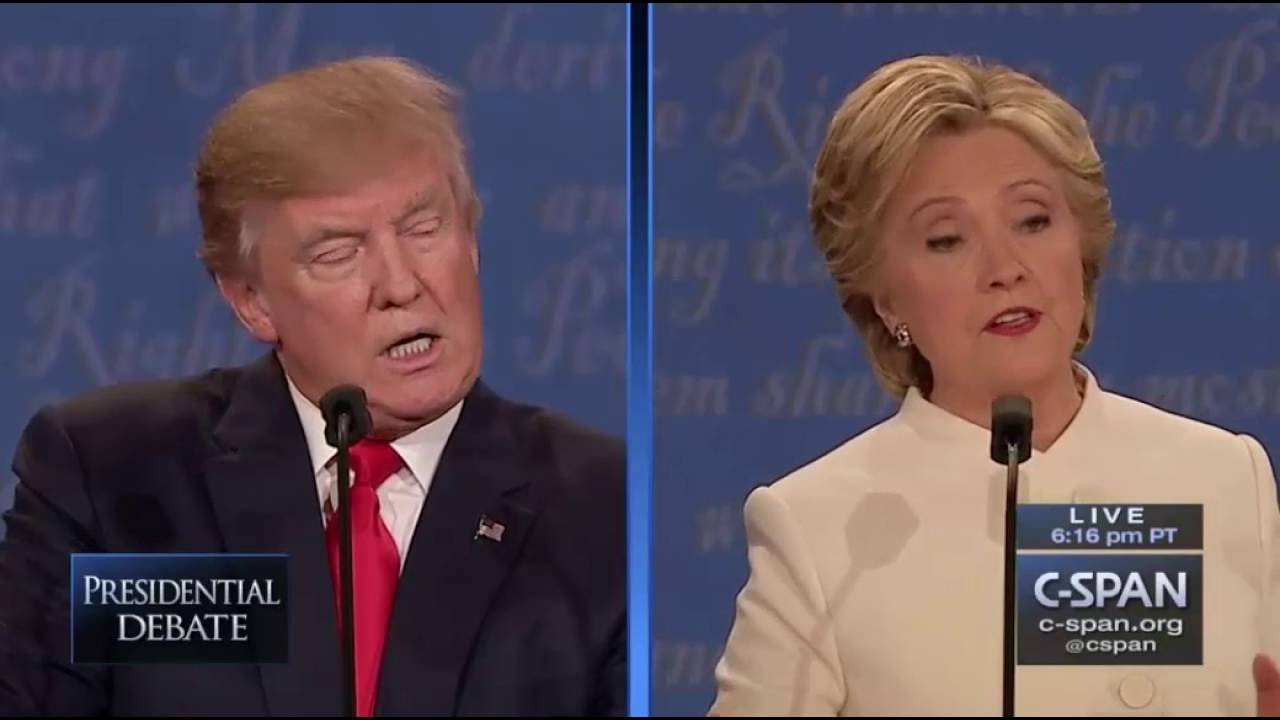
This occurred during their third and last Presidential debate.    

CLINTON: … that the Russians have engaged in cyber attacks against the United States of America, that you encouraged espionage against our people, that you are willing to spout the Putin line, sign up for his wish list, break up NATO, do whatever he wants to do, and that you continue to get help from him, because he has a very clear favorite in this race. 

So I think that this is such an unprecedented situation. We’ve never had a foreign government trying to interfere in our election.

We have 17–17 intelligence agencies, civilian and military, who have all concluded that these espionage attacks, these cyber attacks, come from the highest levels of the Kremlin and they are designed to influence our election. I find that deeply disturbing.  And I think it’s time you take a stand…

TRUMP: She has no idea whether it’s Russia, China, or anybody else.

CLINTON: I am not quoting myself.

TRUMP: She has no idea.

CLINTON: I am quoting 17…

TRUMP: Hillary, you have no idea.

CLINTON: … 17 intelligence–do you doubt 17 military and civilian…

TRUMP: And our country has no idea.

CLINTON: … agencies.

TRUMP: Yeah, I doubt it. I doubt it. 

TURNING THE WHITE HOUSE INTO THE RED HOUSE: PART ONE (OF THREE)

In Bureaucracy, History, Law Enforcement, Military, Politics, Social commentary on April 3, 2017 at 12:56 am

Clinton Watts is a consultant and researcher on cyberwarfare. He has served as

  • A U.S. Army infantry officer;
  • An FBI Special Agent on a Joint Terrorism Task Force (JTTF);
  • The Executive Officer of the Combating Terrorism Center at West Point (CTC); and
  • As a consultant to the FBI’s Counter Terrorism Division (CTD) and National Security Branch (NSB). 

In a statement he prepared for the U.S. Senate Select Committee on Intelligence, he outlined cyberwarfare measures that Russia used to influence the 2016 Presidential campaign. 

He delivered this on March 30. Part of this reads as follows: 

Through the end of 2015 and start of 2016, the Russian influence system….began pushing themes and messages seeking to influence the outcome of the U.S. Presidential election.

Russia’s overt media outlets and covert trolls sought to sideline opponents on both sides of the political spectrum with adversarial views toward the Kremlin. The final months leading up to the election have been the predominate focus of Russian influence discussions to date.

Image result for Images of Clinton Watts

Clinton Watts

However, Russian Active Measures were in full swing during both the Republican and Democratic primary season and may have helped sink the hopes of candidates more hostile to Russian interests long before the field narrowed. 

The final piece of Russia’s modern Active Measures surfaced in the summer of 2016 as hacked materials from previous months were strategically leaked.

On 22 July 2016, Wikileaks released troves of stolen communications from the Democratic National Committee and later batches of campaign emails. Guccifer 2.0 and DC Leaks revealed hacked information from a host of former U.S. government officials throughout July and August 2016.

For the remainder of the campaign season, this compromising material powered the influence system Russia successfully constructed in the previous two years.

Meanwhile, Donald Trump–as both Presidential candidate and President–has steadfastly refused to acknowledge the efforts of Vladimir Putin’s government to ensure his election. 

Consider his exchange about this with Democratic Presidential nominee Hillary Clinton during the third and final Presidential debate on October 19, 2016:

Related image

CLINTON: So I actually think the most important question of this evening, Chris, is, finally, will Donald Trump admit and condemn that the Russians are doing this and make it clear that he will not have the help of Putin in in this election, that he rejects Russian espionage against Americans, which he actually encouraged in the past?

Those are the questions we need answered. We’ve never had anything like this happen in any of our elections before.

CHRIS WALLACE: Well?

TRUMP: That was a great pivot off the fact that she wants open borders, OK? How did we get on to Putin?

[After insisting that Clinton wants “open borders” and “people are going to pour into this country,” Trump deigned to address Wallace’s question.]

TRUMP: Now we can talk about Putin. I don’t know Putin. He said nice things about me.

If we got along well, that would be good. If Russia and the United States got along well and went after ISIS, that would be good. He has no respect for her. He has no respect for our president.

And I’ll tell you what: We’re in very serious trouble, because we have a country with tremendous numbers of nuclear warheads–1,800, by the way–where they expanded and we didn’t, 1,800 nuclear warheads. And she’s playing chicken.  

FROM WATTS’ STATEMENT: This pattern of Russian falsehoods and social media manipulation of the American electorate continued through Election Day and persists today.

Many of the accounts we watched push the false Incirlik story in July now focus their efforts on shaping the upcoming European elections, promoting fears of immigration or false claims of refugee criminality.  

They’ve not forgotten about the United States either. This past week, we observed social media campaigns targeting Speaker of the House Paul Ryan hoping to foment further unrest amongst U.S. democratic institutions, their leaders and their constituents. 

As we noted two days before the Presidential election in our article describing Russian influence operations, Russia certainly seeks to promote Western candidates sympathetic to their worldview and foreign policy objectives.

But winning a single election is not their end goal. Russian Active Measures hope to topple democracies through the pursuit of five complementary objectives: 

  1. Undermine citizen confidence in democratic governance;
  2. Foment and exacerbate divisive political fractures;
  3. Erode trust between citizens and elected officials and democratic institutions;
  4. Popularize Russian policy agendas within foreign populations;
  5. Create general distrust or confusion over information sources by blurring the lines between fact and fiction.

From these objectives, the Kremlin can crumble democracies from the inside out creating political divisions resulting in two key milestones:

  1. The dissolution of the European Union and 
  2. The break up of the North American Treaty Organization (NATO).  

FROM THE TRUMP-CLINTON DEBATE:

TRUMP: … from everything I see, [Putin] has no respect for this person.

CLINTON: Well, that’s because he’d rather have a puppet as president of the United States.

TRUMP: No puppet. No puppet.

CLINTON: And it’s pretty clear…

TRUMP: You’re the puppet!

CLINTON: It’s pretty clear you won’t admit…

TRUMP: No, you’re the puppet.