On July 17, 2014, Malaysia Airlines Flight 17 MH 17/MAS17, an international flight, took off from Amsterdam for Kuala Lumpur International Airport.
It was scheduled to reach its destination in 11 hours and 45 minutes. But the flight–and its 283 passengers and 15 crew–never made it.
Instead, as the plane cruised above Hrabove in Donetsk Oblast, Ukraine, it came under fire by Russian-backed Ukrainian separatists. A single Buk surface-to-air missile slammed into the aircraft, almost instantly killing everyone on board.
.jpg)
Malaysia Airlines Flight 17
Since March, 2014, pro-Russian groups have aggressively–and often violently–tried to destabilize the Ukrainian government.
The reason: Ukraine has been showing an increasing desire to align itself with the West, especially the European Union. And Russian President Vladimir Putin has made clear his intention of preventing that.
A former KGB agent, Putin has called the 1991 breakup of the Soviet Union as “a major geopolitical disaster of the [20th] century.”
According to John Bolton, a former United States ambassador to the United Nations: “It’s clear he wants to re-establish Russian hegemony within the space of the former Soviet Union. Ukraine is the biggest prize, that’s what he’s after. The occupation of the Crimea is a step in that direction.”
The most damning evidence for Russian separatists’ culpability in the airliner’s destruction came from United States military officials who cited:
- Sensors that traced the path of the missile;
- Shrapnel patterns in the wreckage; and
- Voice print analysis of separatists’ conversations where they claimed credit for the strike.
Furthermore, data and photos from various social media sites all indicated that the missile had been fired by the separatists.
But the Republican Party quickly found another culprit to blame for the tragedy: President Barack Obama.
Just hours after the shootdown, Arizona Republican Senator John McCain appeared on the Sean Hannity show, which is carried on the Right-wing Fox News.
“It’s just been cowardly,” McCain said. “It’s a cowardly administration that we failed to give the Ukrainians weapons with which to defend themselves.”
McCain then told Hannity what he would do in response to the deadly crash:
“First, give the Ukrainians weapons to defend themselves and regain their territory. Second of all, move some of our troops in to areas that are being threatened by Vladimir Putin, in other countries like the Baltics and others.
“Move missile defense into the places where we got out of, like the Czech Republic and Poland and other places. And impose the harshest possible sanctions on Vladimir Putin and Russia. And that’s just for openers.”
Yet America’s frustrations with Russia generally–and Vladimir Putin in particular–long predate those of Barack Obama.
And relations between the United States and post-Soviet Russia were definitely not helped by the naivety of President George W. Bush.
In June 2001, Bush and Vladimir Putin met in Slovenia. During the meeting a truly startling exchange occurred.
Vladimir Putin and George W. Bush
Putin, a former KGB Intelligence officer, had clearly done his homework on Bush. When he mentioned that one of the sports Bush had played was rugby, Bush was highly impressed.
“I did play rugby,” said Bush. “Very good briefing.”
But more was to come.
BUSH: Let me say something about what caught my attention, Mr. President, was that your mother gave you a cross which you had blessed in Israel, the Holy Land.
PUTIN: It’s true.
BUSH: That amazes me, that here you were a Communist, KGB operative, and yet you were willing to wear a cross. That speaks volumes to me, Mr. President. May I call you Vladimir?
Putin instantly sensed that Bush judged others–even world leaders–through the lens of his own fundamentalist Christian theology.
Falling back on his KGB training, Putin seized on this apparent point of commonality to build a bond. He told Bush that his dacha had once burned to the ground, and the only item that had been saved was that cross.
“Well, that’s the story of the cross as far as I’m concerned,” said Bush, clearly impressed. “Things are meant to be.”
Afterward, Bush and Putin gave an outdoor news conference.
“Is this a man that Americans can trust?” Associated Press correspondent Ron Fournier asked Bush.
“Yes,” said Bush. “I looked the man in the eye. I found him to be very straightforward and trustworthy. We had a very good dialogue.
“I was able to get a sense of his soul, a man deeply committed to his country and the best interests of his country. I wouldn’t have invited him to my ranch if I didn’t trust him.”
Of course, no one from the Right is now willing to recall such embarrassing words.
It’s far more politically profitable to pretend that all of America’s tensions with Russia began with the election of Barack Obama.
And that those tensions will vanish once another Rightist President enters the White House.


9/11 ATTACKS, ABC NEWS, ADOLF HITLER, AFGHANISTAN, AL QAEDA, BARCK OBAMA, BASHAR AL-ASSAD, CARL VON CLAUSEWITZ, CARLOS THE JACKAL, CBS NEWS, CHEMICAL WEAPONS, CHINA, CNN, FACEBOOK, HARRY TRUMAN, IRAN, ISLAM, ISRAEL, MUSLIMS, NAZI GERMANY, NBC NEWS, OSAMA BIN LADEN, RUSSIA, SOVIET UNION, SYRIA, TERRORISM, THE LOS ANGELES TIMES, THE NEW YORK TIMES, THE WASHINGTON POST, TWITTER, VLADIMIR PUTIN, WORLD WAR 1
GOOD NEWS IN THE TERROR WARS
In History, Military, Politics, Social commentary on March 26, 2014 at 12:25 amOn February 15, the Syrian Observatory for Human Rights released some encouraging newws for those fighting Islamic terrorism.
More than 140,000 people have been killed in Syria’s uprising-turned-civil war.
Conflict began on March 15, 2011. The trigger: Protests demanding political reforms and the ouster of dictator Bashar al-Assad.
According to the Observatory, which is based in Britain:
And the Observatory’s director, Rami Abdelrahman, had a solution to offer to this constantly escalating violence:
“It is shameful that the international community has done nothing to show that it will defend human rights. They are just looking on at this tragedy. The Syrian people dying are just statistics to them.”
If those dying in Syria are “just statistics,” then they are statistics of terrorists and potential terrorists who will never pose a threat to the United States.
Think of it:
Here are seven excellent reasons why America should not send soldiers to bomb and/or invade Syria.
1. Intervening in Syria could produce unintended consequences for American forces–and make the United States a target for more Islamic terrorism.
American bombs or missiles could land on one or more sites containing stockpiles of chemical weapons. Imagine the international outrage that will result if the release of those weapons kills hundreds or thousands of Syrians.
Within the Islamic world, the United States will be seen as waging a war against Islam, and not simply another Islamic dictator.
Almost certainly, an American military strike on Syria would lead its dictator, Bashar al-Assad, to attack Israel–perhaps even with chemical weapons.
Assad could do this simply because he hates Jews–or to lure Israel into attacking Syria.
If that happened, the Islamic world–which lusts to destroy Israel more than anything else–would rally to Syria against the United States, Israel’s chief ally.
2. Since 1979, Syria has been listed by the U.S. State Department as a sponsor of terrorism.
Among the terrorist groups it supports are Hizbollah and Hamas. For years, Syria provided a safe-house in Damascus to Ilich Ramírez Sánchez–the notorious terrorist better known as Carlos the Jackal.
There are no “good Syrians” for the United States to support–only murderers who have long served a tyrant and other murderers who now wish to become the next tyrant.
3. The United States doesn’t know what it wants to do in Syria, other than “send a message.”
Carl von Clausewitz, the Prussian military theorist, wrote: “War is the continuation of state policy by other means.” But President Barack Obama hasn’t stated what he intends gain by attacking Syria.
Obama has said he’s “not after regime-change.” If true, that would leave Assad in power–and free to go on killing those who resist his rule.
4. The Assad regime is backed by–among others–the Iranian-supported terrorist group, Hezbollah (Party of God). Its enemies include another terrorist group–Al Qaeda.
Hezbollah is comprised of Shiite Muslims, who form a minority of Islamics. A sworn enemy of Israel, it has kidnapped scores of Americans suicidal enough to visit Lebanon and truck-bombed the Marine Barracks in Beirut in 1983, killing 299 Americans.
Flag of Hezbollah
Al-Qaeda, on the other hand, is made up of Sunni Muslims, who form the majority of that religion. It considers Shiite Muslims to be “takfirs”–heretics–and thus worthy of extermination.
Al Qaeda has attacked the mosques and gatherings of liberal Muslims, Shias, Sufis and other non-Sunnis. Examples of sthese ectarian attacks include the Sadr City bombings, the 2004 Ashoura massacre and the April, 2007 Baghdad bombings.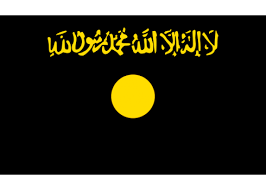
Flag of Al Qaeda
When your enemies are intent on killing each other, it’s best to stand aside and let them do it.
5. China and Russia are fully supporting the Assad dictatorship–and the brutalities it commits against its own citizens. This reflects badly on them–not the United States.
6. The United States could find itself in a shooting war with Russia and/or China.
The Russians have sent two warships to Syria, in direct response to President Obama’s threat to “punish” Assad for using chemical weapons against unsurgents.
What happens if American and Russian warships start trading salvos? Or if Russian President Vladimir Putin orders an attack on Israel, in return for America’s attack on Russia’s ally, Syria?
It was exactly that scenario–Great Powers going to war over conflicts between their small-state allies–that triggered World War l.
7. While Islamic nations like Syria and Egypt wage war within their own borders, they will lack the resources to launch attacks against the United States.
When Adolf Hitler invaded the Soviet Union in 1941, then-Senator Harry Truman said: “I hope the Russians kill lots of Nazis and vice versa.”
That should be America’s view whenever its sworn enemies start killing themselves off. Americans should welcome such self-slaughters, not become entrapped in them.
Share this: