Posts Tagged ‘PBS NEWSHOUR’
2016 PRESIDENTIAL CAMPAIGN, ABC NEWS, AL FRANKEN, ALTERNET, AP, BARACK OBAMA, BERNIE SANDERS, BOB CORKER, BUZZFEED, CBS NEWS, CNN, CROOKS AND LIARS, DAILY KOZ, DAVID BROOKS, DEMOCRATIC PARTY, DONALD TRUMP, ELIZABETH WARREN, FACEBOOK, HILLARY CLINTON, JEB BUSH, JEFF FLAKE, JOE SCARBOROUGH, JOSEPH MCCARTHY, KIM JONG-UN, LATE NIGHT WITH STEPHEN COLBERT, LIBERALS, MARCO RUBIO, MARK SHIELDS, MIKA BRZEZINSKI, MOTHER JONES, MOVEON, NBC NEWS, NEWSWEEK, NOCCOLO MACHIAVELLI, NPR, PBS NEWSHOUR, POLITICO, RAW STORY, REPUBLICAN PARTY, REPUBLICANS, REUTERS, SALON, SEATTLE TIMES, SLANDER, SLATE, TED CRUZ, THE ATLANTIC, THE CHICAGO SUN-TIMES, THE CHICAGO TRIBUNE, THE DAILY BEAST, THE GUARDIAN, THE HILL, THE HUFFINGTON POST, THE LOS ANGELES TIMES, THE NATION, THE NEW YORK TIMES, THE PRINCE, THE WASHINGTON POST, TIME, TWITTER, U.S. NEWS & WORLD REPORT, UP, UPI, USA TODAY
In History, Politics, Social commentary on November 29, 2017 at 12:36 pm
A major reason for Donald Trump’s appeal during the 2016 Presidential campaign was: “He’s not like other politicians.”
And he wasn’t.
The vast majority of politicians adhere to an unwritten rule: Even when you criticize another politician, you do so in a reasonably dignified manner.
Trump threw that rule—along with many others—out the window. In its place, he gave his opponents—Republican and Democrat—a series of disparaging nicknames.
And, as President, he has continued to do so.
His main sources of public defamation have been Twitter and the speeches he makes. Among the insulting nicknames have included:
- “Jeff Flakey” – Jeff Flake, Arizona United States Senator.
- “Crazy Megyn” – Megyn Kelly, Fox News’ then-anchor, perhaps the only member of this Right-wing propaganda outlet that Trump disliked.
- “Liddle Bob Corker” – Bob Corker, United States Senator from Tennessee
- “Psycho Joe” and “Dumb as a Rock Mika” – Joe Scarborough and Mika Brzezinski, hosts of MSNBC’s “Morning Joe.”
- “Lyin’ Ted” – Texas United States Senator Eduardo “Ted” Cruz.
- “Crazy Bernie” – Vermont United States Senator Bernie Sanders.
- “Low Energy Jeb” – Jeb Bush, the former governor of Florida.
- “Crooked Hillary” – Hillary Clinton, former First Lady, New York United States Senator and Secretary of State.
- “Little Marco” – Florida United States Senator Marco Rubio.
- “Rocket Man” – North Korean dictator Kim Jong Un (because of his series of missile launches)
- “Al Frankenstein” – Al Franken, United States Senator from Minnesota.
- “Pocahontas” – Elizabeth Warren, United States Senator from Massachusetts.
Syndicated columnist Mark Shields and New York Times columnist David Brooks appear every Friday on the PBS Newshour to review the week’s major political events.
On May 27, 2016, Shields—a liberal, and Brooks, a conservative—reached some disturbingly similar conclusions about the character of Republican Presidential front-runner Donald Trump.
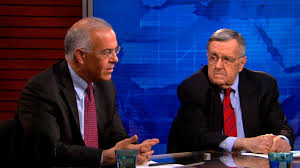
David Brooks and Mark Shields
MARK SHIELDS: “Donald Trump gratuitously slandered Ted Cruz’s wife. He libeled Ted Cruz’s father for being potentially part of Lee Harvey Oswald’s assassination of the president of the United States, suggesting that he was somehow a fellow traveler in that.
“This is a libel. You don’t get over it….
“…I think this man may be addicted to the roar of the grease paint and the sound of the crowd, or however it goes, smell of the crowd.”

Donald Trump
DAVID BROOKS: “Trump, for all his moral flaws, is a marketing genius. And you look at what he does. He just picks a word and he attaches it to a person. Little Marco [Rubio], Lyin’ Ted [Cruz], Crooked Hillary [Clinton].
“And that’s a word. And that’s how marketing works. It’s a simple, blunt message, but it gets under.
“It sticks, and it diminishes. And so it has been super effective for him, because he knows how to do that. And she [Hillary Clinton] just comes with, ‘Oh, he’s divisive.’
“These are words that are not exciting people. And her campaign style has gotten, if anything…a little more stagnant and more flat.”
Only one opponent—who was not a Presidential candidate—managed to stand up to Trump: Massachusetts U.S. Senator Elizabeth Warren. Whenever Trump attacks her, Warren strikes back—sometimes even more harshly.
As Mark Shields noted:
“Elizabeth Warren gets under Donald Trump’s skin. And I think she’s been the most effective adversary. I think she’s done more to unite the Democratic party than either Hillary Clinton or Bernie Sanders.”
From June 15, 2015, when he launched his Presidential campaign, until October 24, 2016, Trump used Twitter to fire almost 4,000 angry, insulting tweets at 281 people and institutions that had somehow offended him.
Warren has dared to do what no other Democrat—or Republican—has: Attack Trump head-on, with the kind of blunt, insulting language he has lavished on his opponents.
Among the jabs she has thrown at him on Twitter:
- “But here’s the thing. You can beat a bully—not by tucking tail and running, but by holding your ground.”
- “You care so much about struggling American workers, @realDonaldTrump, that you want to abolish the federal minimum wage?”
- “@realDonaldTrump: Your policies are dangerous. Your words are reckless. Your record is embarrassing. And your free ride is over.”
Nor is Twitter her only weapon.
On March 31, Warren appeared on The Late Show, with Stephen Colbert. Her take on the egotistical billionaire:
“Donald Trump is looking out for exactly one guy, and that guy’s name is Donald Trump. He smells that there’s change in the air and what he wants to do is make sure that that change works really, really well for Donald Trump.
“The truth is, he inherited a fortune from his father, he kept it going by cheating and defrauding people, and then he takes his creditors through Chapter 11.”
When Colbert said that Trump had never broken the law, Warren replied that he had never broken the law “and been caught.”
For David Brooks, Warren’s tactics prove a depressing, lose/lose situation:
“And so the tactics…is either you do what Elizabeth Warren has done, like full-bore negativity, that kind of [get] under the skin, or try to ridicule him and use humor. Humor is not Hillary Clinton’s strongest point.”
As a whole, Democrats have shown themselves indifferent to or ignorant of the power of effective language.
ABC NEWS, ALTERNET, AMERICA: INSIDE OUT, AMERICABLOG, AP, BABY BOOMER RESISTANCE, BBC, BLOOMBERG NEWS, BUZZFEED, CBS NEWS, CNN, CROOKS AND LIARS, DAILY KOZ, DAVID SHOENBRUN, DONALD TRUMP, DRUG-TESTING, EMPLOYERS RESPONSIBILITY ACT, FACEBOOK, FISHER INVESTMENTS, FIVETHIRTYEIGHT, FORBES MAGAZINE, HARPER’S MAGAZINE, HUFFINGTON POST, KENNETH FISHER, MEDIA MATTERS, MEDICAL INSURANCE, MOTHER JONES, MOVEON, MSNBC, NBC NEWS, NEW REPUBLIC, NEWSDAY, NEWSWEEK, NPR, PBS NEWSHOUR, POLITICO, POLITICUSUSA, RAW STORY, REPUBLICANS, REUTERS, Ronald Reagan, SALON, SEATTLE TIMES, SLATE, TALKING POINTS MEMO, THE ATLANTIC, THE CHICAGO SUN-TIMES, THE CHICAGO TRIBUNE, THE DAILY BEAST, THE DAILY BLOG, THE GUARDIAN, THE HILL, THE HUFFINGTON POST, THE LOS ANGELES TIMES, THE NATION, THE NEW REPUBLIC, THE NEW YORK TIMES, THE NEW YORKER, THE VILLAGE VOICE, THE WASHINGTON POST, THINKPROGRESS, TIME, TRUTHDIG, TRUTHOUT, TWITTER, TWO POLITICAL JUNKIES, U.S. NEWS & WORLD REPORT, UNEMPLOYMENT, UP, UPI, USA TODAY, WAL-MART, WEALTH GAP
In Bureaucracy, History, Law, Law Enforcement, Politics, Social commentary on November 1, 2017 at 12:15 am
America can quickly find employment for willing-to-work job-seekers—by installing a nationwide Employers Responsibility Act. Its last seven provisions would read as follows:
(9) Employers refusing to hire would be required to pay an additional “crime tax.”
Sociologists and criminologists agree that “the best cure for crime is a job.” Thus, employers who refuse to hire contribute to a growing crime rate in this Nation. Such non-hiring employers would be required to pay an additional tax, which would be earmarked for agencies of the criminal justice system at State and Federal levels.
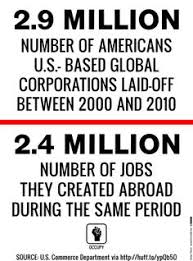
(10) The seeking of “economic incentives” by companies in return for moving to or remaining in cities/states would be strictly forbidden.
Such “economic incentives” usually:
- allow employers to ignore existing laws protecting employees from unsafe working conditions;
- allow employers to ignore existing laws protecting the environment;
- allow employers to pay their employees the lowest acceptable wages, in return for the “privilege” of working at these companies; and/or
- allow employers to pay little or no business taxes, at the expense of communities who are required to make up for lost tax revenues.
(11) Employers who continue to make such overtures would be criminally prosecuted for attempted bribery or extortion:
- Bribery, if they offered to move to a city/state in return for “economic incentives,” or
- Extortion, if they threatened to move their companies from a city/state if they did not receive such “economic incentives.”
This would protect employees against artificially-depressed wages and unsafe working conditions; protect the environment in which these employees live; and protect cities/states from being pitted against one another at the expense of their economic prosperity.
(12) The U.S. Departments of Justice and Labor would regularly monitor the extent of employer compliance with the provisions of this act.
Among these measures: Sending undercover agents, posing as highly-qualified job-seekers, to apply at companies—and then vigorously prosecuting those employers who blatantly refused to hire despite their proven economic ability to do so.
This would be comparable to the long-time and legally-validated practice of using undercover agents to determine compliance with fair-housing laws.
(13) The Justice Department and/or the Labor Department would be required to maintain a publicly-accessible database on those companies that have been cited, sued and/or convicted for such offenses as:
- discrimination,
- harassment,
- health and/or safety violations or
- violating immigration laws.
Employers would be legally required to regularly provide such information to these agencies, so that it would remain accurate and up-to-date.
Such information would arm job applicants with vital information about the employers they were approaching. They could thus decide in advance if an employer is deserving of their skills and dedication.
As matters now stand, employers can legally demand to learn even the most private details of an applicant’s life without having to disclose even the most basic information about themselves and their history of treating employees.
(14) CEOs whose companies employ illegal aliens would be held directly accountable for the actions of their subordinates. Upon conviction, the CEO would be sentenced to a mandatory prison term of at least 10 years.
This would prove a more effective remedy for controlling illegal immigration than stationing tens of thousands of soldiers on the U.S./Mexican border. With CEOs forced to account for their subordinates’ actions, they would take drastic steps to ensure their companies complied with Federal immigration laws.
Without employers eager to hire illegal aliens at a fraction of the money paid to American workers, the invasions of illegal job-seekers would quickly come to an end.
(15) A portion of employers’ existing Federal taxes would be set aside to create a national clearinghouse for placing unemployed but qualified job-seekers.
* * * * *
For thousands of years, otherwise highly intelligent men and women believed that kings ruled by divine right. That kings held absolute power, levied extortionate taxes and sent countless millions of men off to war—all because God wanted it that way.
That lunacy was dealt a deadly blow in 1776 when American Revolutionaries threw off the despotic rule of King George III of England.
But today, millions of Americans remain imprisoned by an equally outrageous and dangerous theory: The Theory of the Divine Right of Employers.

Summing up this employer-as-God attitude, Calvin Coolidge still speaks for the overwhelming majority of employers and their paid shills in government: “The man who builds a factory builds a temple, and the man who works there worships there.”
America can no longer afford such a dangerous fallacy as the Theory of the Divine Right of Employers.
Americans did not win their freedom from Great Britain—and its enslaving doctrine of “the divine right of kings”—-by begging for their rights.
And Americans will not win their freedom from their corporate masters–-and the equally enslaving doctrine of “the divine right of employers”—-by begging for the right to work and support themselves and their families.
Corporations can—and do—spend millions of dollars on TV ads, selling lies—lies such as the “skills gap,” and how if the wealthy are forced to pay their fair share of taxes, jobs will inevitably disappear.
But Americans can choose to reject those lies—and demand that employers behave like patriots instead of predators.
ABC NEWS, ALTERNET, AMERICA: INSIDE OUT, AMERICABLOG, AP, BABY BOOMER RESISTANCE, BBC, BLOOMBERG NEWS, BUZZFEED, CBS NEWS, CNN, CROOKS AND LIARS, DAILY KOZ, DAVID SHOENBRUN, DONALD TRUMP, DRUG-TESTING, EMPLOYERS RESPONSIBILITY ACT, FACEBOOK, FISHER INVESTMENTS, FIVETHIRTYEIGHT, FORBES MAGAZINE, HARPER’S MAGAZINE, HUFFINGTON POST, KENNETH FISHER, MEDIA MATTERS, MEDICAL INSURANCE, MOTHER JONES, MOVEON, MSNBC, NBC NEWS, NEW REPUBLIC, NEWSDAY, NEWSWEEK, NPR, PBS NEWSHOUR, POLITICO, POLITICUSUSA, RAW STORY, REPUBLICANS, REUTERS, Ronald Reagan, SALON, SEATTLE TIMES, SLATE, TALKING POINTS MEMO, THE ATLANTIC, THE CHICAGO SUN-TIMES, THE CHICAGO TRIBUNE, THE DAILY BEAST, THE DAILY BLOG, THE GUARDIAN, THE HILL, THE HUFFINGTON POST, THE LOS ANGELES TIMES, THE NATION, THE NEW REPUBLIC, THE NEW YORK TIMES, THE NEW YORKER, THE VILLAGE VOICE, THE WASHINGTON POST, THINKPROGRESS, TIME, TRUTHDIG, TRUTHOUT, TWITTER, TWO POLITICAL JUNKIES, U.S. NEWS & WORLD REPORT, UNEMPLOYMENT, UP, UPI, USA TODAY, WAL-MART, WEALTH GAP
In Bureaucracy, History, Law, Law Enforcement, Politics, Social commentary on October 31, 2017 at 12:10 am
An Employers Responsibility Act (ERA) would simultaneously address the following evils for which employers are directly responsible:
- The loss of jobs within the United States owing to companies’ moving their operations abroad—solely to pay substandard wages to their new employees.
- The mass firings of employees which usually accompany corporate mergers or acquisitions.
- The widespread victimization of part-time employees, who are not legally protected against such threats as racial discrimination, sexual harassment and unsafe working conditions.
- The refusal of many employers to create better than menial, low-wage jobs.
- The widespread employer practice of extorting “economic incentives” from cities or states in return for moving to or remaining in those areas. Such “incentives” usually absolve employers from complying with laws protecting the environment and/or workers’ rights.
- The refusal of many employers to provide medical and pension benefits—nearly always in the case of part-time employees, and, increasingly, for full-time, permanent ones as well.
- Rising crime rates, due to rising unemployment.
Among its provisions:
(1) American companies that close plants in the United States and open others abroad would be forbidden to sell products made in those foreign plants within the United States.
This would protect both American and foreign workers from employers seeking to profit at their expense. American workers would be ensured of continued employment. And foreign laborers would be protected against substandard wages and working conditions.
Companies found violating this provision would be subject to Federal criminal prosecution. Guilty verdicts would result in heavy fines and lengthy imprisonment for their owners and top managers.
(2) Large companies (those employing more than 100 persons) would be required to create entry-level training programs for new, future employees.
These would be modeled on programs now existing for public employees, such as firefighters, police officers and members of the armed services.
Such programs would remove the employer excuse, “I’m sorry, but we can’t hire you because you’ve never had any experience in this line of work.” After all, the Air Force has never rejected an applicant because, “I’m sorry, but you’ve never flown a plane before.”
This Nation has greatly benefited from the humane and professional efforts of the men and women who have graduated from public-sector training programs. There is no reason for the private sector to shun programs that have succeeded so brilliantly for the public sector.
(3) Employers would receive tax credits for creating professional, well-paying, full-time jobs.
This would encourage the creation of better than the menial, dead-end, low-paying and often part-time jobs which exist in the service industry. Employers found using such tax credits for any other purpose would be prosecuted for tax fraud.
(4) A company that acquired another—through a merger or buyout—would be forbidden to fire en masse the career employees of that acquired company.
This would be comparable to the protection existing for career civil service employees. Such a ban would prevent a return to the predatory “corporate raiding” practices of the 1980s, which left so much human and economic wreckage in their wake.
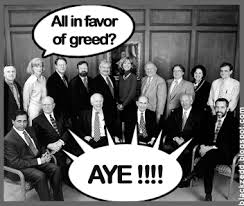
The wholesale firing of employees would trigger the prosecution of the company’s new owners. Employees could still be fired, but only for provable just cause, and only on a case-by-case basis.
(5) Employers would be required to provide full medical and pension benefits for all employees, regardless of their full-time or part-time status.
Increasingly, employers are replacing full-time workers with part-time ones—solely to avoid paying medical and pension benefits.
Requiring employers to act humanely and responsibly toward all their employees would encourage them to provide full-time positions—and hasten the death of this greed-based practice.
(6) Employers of part-time workers would be required to comply with all federal labor laws.
Under current law, part-time employees are not protected against such abuses as discrimination, sexual harassment and unsafe working conditions. Closing this loophole would immediately create two positive results:
- Untold numbers of currently-exploited workers would be protected from the abuses of predatory employers; and
- Even predatorily-inclined employers would be encouraged to offer permanent, fulltime jobs rather than only part-time ones—since a major incentive for offering part-time jobs would now be eliminated.
(7) Employers would be encouraged to hire to their widest possible limits,through a combination of financial incentives and legal sanctions. Among those incentives:
Employers demonstrating a willingness to hire would receive substantial Federal tax credits, based on the number of new, permanent employees hired per year.
Employers claiming eligibility for such credits would be required to make their financial records available to Federal investigators. Employers found making false claims would be prosecuted for perjury and tax fraud, and face heavy fines and imprisonment if convicted.
(8) Among those sanctions: Employers refusing to hire could be required to prove, in court:
- Their economic inability to hire further employees, and/or
- The unfitness of the specific, rejected applicant.
Companies found guilty of unjustifiably refusing to hire would face the same penalties as now applying in cases of discrimination on the basis of age, race, sex and disability.
Two benefits would result from this:
- Employers would thus fund it easier to hire than to refuse to do so; and
- Job-seekers would no longer be prevented from even being considered for employment because of arbitrary and interminable “hiring freeze.”
ABC NEWS, ALTERNET, AMERICA: INSIDE OUT, AMERICABLOG, AP, BABY BOOMER RESISTANCE, BBC, BLOOMBERG NEWS, BUZZFEED, CBS NEWS, CNN, CROOKS AND LIARS, DAILY KOZ, DAVID SHOENBRUN, DONALD TRUMP, DRUG-TESTING, EMPLOYERS RESPONSIBILITY ACT, FACEBOOK, FISHER INVESTMENTS, FIVETHIRTYEIGHT, FORBES MAGAZINE, HARPER’S MAGAZINE, HUFFINGTON POST, KENNETH FISHER, MEDIA MATTERS, MEDICAL INSURANCE, MOTHER JONES, MOVEON, MSNBC, NBC NEWS, NEW REPUBLIC, NEWSDAY, NEWSWEEK, NPR, PBS NEWSHOUR, POLITICO, POLITICUSUSA, RAW STORY, REPUBLICANS, REUTERS, Ronald Reagan, SALON, SEATTLE TIMES, SLATE, TALKING POINTS MEMO, THE ATLANTIC, THE CHICAGO SUN-TIMES, THE CHICAGO TRIBUNE, THE DAILY BEAST, THE DAILY BLOG, THE GUARDIAN, THE HILL, THE HUFFINGTON POST, THE LOS ANGELES TIMES, THE NATION, THE NEW REPUBLIC, THE NEW YORK TIMES, THE NEW YORKER, THE VILLAGE VOICE, THE WASHINGTON POST, THINKPROGRESS, TIME, TRUTHDIG, TRUTHOUT, TWITTER, TWO POLITICAL JUNKIES, U.S. NEWS & WORLD REPORT, UNEMPLOYMENT, UP, UPI, USA TODAY, WAL-MART, WEALTH GAP
In Bureaucracy, History, Law, Law Enforcement, Politics, Social commentary on October 30, 2017 at 12:41 am
President Donald Trump wants huge tax cuts for corporations. He wants to cut the corporate income tax rate from its current 35% to 20%.
He claims that, with this extra income, CEOs will invest in their businesses and create tens of thousands of new jobs.

Donald Trump
But that’s not what some of the biggest S&P 500 companies are saying they’ll do. The people they are seeking to please are investors, not workers. And, least of all, those seeking work but unable to find employers willing to hire.
Darius Adamczyk, CEO of Honeywell International Inc., said “tax reform” would “offer greater flexibility for Honeywell.” He added that the corporation would invest more cash in the United States to pay for mergers and acquisitions, share buybacks and paying down debt.
He didn’t say anything about hiring more workers.
According to Moody’s Investors Service, American corporations have stockpiled nearly $1.8 trillion in cash overseas.
Apple has more than $240 billion of that total.
Apple’s CEO Tim Cook says the company wants to bring back offshore cash if tax rates for doing so were lower: “What we would do with it, let’s wait and see exactly what it is, but as I’ve said before we are always looking at acquisitions.”
Apple expects a tax windfall if Trump’s tax-cutting plan passes Congress. And analysts openly expect Apple to use those monies to boost its capital return program via buybacks, dividends and perhaps making a big acquisition.
What analysts don’t expect Apple to do with its tax cut monies is create new American jobs.
Most of the offshore cash brought home by U.S. companies in past tax holidays was used to buy back shares or make acquisitions, not to fund investments in production capacity or jobs.
Corporations were not legally required to use those tax cut savings to hire more workers. And Trump’s tax cut proposal has no such requirement, either.
According to John Divine, staff writer for U.S. News & World Report‘s Money section: “As long as there are no strings attached on how or where companies spend these savings, taxpayers get a raw deal.”
Tax cuts for the wealthy have been a favorite—perhaps the favorite—Republican mantra since 1980, when former California Governor Ronald Reagan ran for and became President.
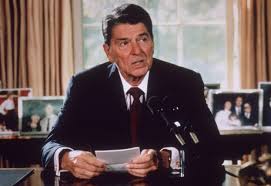
Ronald Reagan
Reagan, like every major Republican Presidential candidate since, promised that giving tax cuts to the wealthy would prove highly beneficial to ordinary workers.
The official name for this policy was “supply side economics.” In reality, it was known—and functioned—as “trickle down economics.”
“A rising tide lifts all boats,” claimed Reagan. A more realistic slogan for the results of his economics policies would have been: “A rising tide lifts some yachts.”
Among those charting Reagan’s economics legacy as President was former CBS Correspondent David Schoenbrun. In his bestselling autobiography, America Inside Out: At Home and Abroad from Roosevelt to Reagan, he noted:
- On January 28, 1981, keeping a pledge to his financial backers in the oil industry, Reagan abolished Federal controls on the price of oil.
- Within a week, Exxon, Texaco and Shell raised gasoline prices and prices of home heating oil.
- Reagan saw it as his duty to put a floor under prices, not a ceiling above them.
- Reagan believed that when government helped business it wasn’t interfering. Loaning money to bail out a financially incompetent Chrysler was “supporting the free enterprise system.”
- But putting a high-profits tax on price-gouging corporations or filing anti-trust suits against them was “Communistic” and therefore intolerable.
- Tax-breaks for wealthy businesses meant helping America become stronger.
- But welfare for the poor or the victims of a predatory marketplace economy weakened America by sapping its morale.
“In short,” wrote Schoenbrun, “welfare for the rich is good for America. But welfare for the poor is bad for America, even for the poor themselves, for it encourages them to be shiftless and lazy.
“Somehow, loans to the inefficient management of American corporations would not similarly encourage them in their inefficient methods.”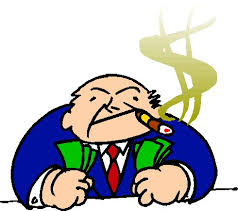
To be unemployed in America is considered by most Americans—including the unemployed—the same as being a bum.
And Republicans are quick to point accusing fingers at those willing-to-work Americans who can’t find willing-to-hire employers.
According to Republicans such as Mitt Romney and Herman Cain: If you can’t find a job, it’s entirely your fault.
And when Republicans are forced—by public pressure or Democratic majorities—to provide benefits to the unemployed, these nearly always come at a price.
Those receiving subsistence monies are, in many states, required to undergo drug-testing, even though there is no evidence of widespread drug-abuse among the unemployed.
But America can put an end to this “I’ve-got-mine-and-the-hell-with-you” job-killing arrogance of people like Kenneth Fisher.
The answer lies in three words: Employers Responsibility Act (ERA).
If passed by Congress and vigorously enforced by the U.S. Departments of Justice and Labor, an ERA would ensure full-time, permanent and productive employment for millions of capable, job-seeking Americans.
And it would achieve this without raising taxes or creating controversial government “make work” programs.
Such legislation would legally require employers to demonstrate as much initiative for hiring as job-seekers are now expected to show in searching for work.
How it would work will be outlined in the next two columns.
ABC NEWS, ADOLF HITLER, ALTERNET, AMERICABLOG, AP, ARAB SHEIKS, “DROOPERS”, BABY BOOMER RESISTANCE, BBC, BLACKS, BLOOMBERG NEWS, BUMS, BUZZFEED, CAITLYN JENNER, CBS NEWS, CNN, COSTUMES, CRAZED KILLERS, CROOKS AND LIARS, DAILY KOS, DAILY KOZ, ESCAPED MENTAL PATIENTS, FACEBOOK, FAT PERSONS, FIVETHIRTYEIGHT, GEISHAS, HALLOWEEN, HARPER’S MAGAZINE, HILLARY CLINTON, HOMOSEXUALS, HUFFINGTON POST, ILLEGAL ALIENS, INDIAN SNAKE CHARMERS, MEDIA MATTERS, MEXICANS, MOTHER JONES, MOVEON, MSNBC, NAUGHTY PRIESTS, NBC NEWS, NEW REPUBLIC, NEWSDAY, NEWSWEEK, NPR, NURSES, PBS NEWSHOUR, PIMPS, POLITICAL CORRECTNESS, POLITICO, POLITICUSUSA, RAW STORY, REUTERS, ROBERT E. LEE, SALON, SAN FRANCISCO CASTRO DISTRICT, SEATTLE TIMES, SEXY CONVICTS, SEXY HAREM SLAVES, SEXY PRISON GUARDS, SLATE, TALKING POINTS MEMO, TERRORISTS, THE ATLANTIC, THE CHICAGO SUN-TIMES, THE CHICAGO TRIBUNE, THE DAILY BEAST, THE DAILY BLOG, THE GUARDIAN, THE HILL, THE HUFFINGTON POST, THE INTERCEPT, THE LOS ANGELES TIMES, THE NATION, THE NEW REPUBLIC, THE NEW YORK TIMES, THE NEW YORKER, THE VILLAGE VOICE, THE WALL, THE WASHINGTON POST, THINKPROGRESS, TIME, TRUTHDIG, TRUTHOUT, TWITTER, U.S. NEWS & WORLD REPORT, UP, UPI, USA TODAY
In Business, History, Politics, Social commentary on October 26, 2017 at 12:58 am
Halloween isn’t just for kids anymore.
In 2017, about 179 million Americans will participate in Halloween, and will spend an estimated $9.1 billion. Yes, that’s with a “b”. That will be up from 2016, when 171 million Americans spent $8.4 billion.
The average American will spend $25 on candy, $30 on Halloween decor, and costumes (men will spend $96 each, women $77).

Those putting out this avalanche of money will, of course, be adults. And a lot of those costumes will be worn by adults at parties across the nation.
This will be especially true in San Francisco.
In 1979, Halloween in its Castro District shifted from being a children’s event to a celebration among homosexuals.
The massive crowds quickly overwhelmed the streets, mass transit and due to the Castro’s location along two major transport corridors, disrupted traffic flow well outside the neighborhood.
In 2002, 500,000 people celebrated Halloween in the Castro and four people were stabbed.
It continued to grow into a massive annual street party until 2006, when a shooting wounded nine people and prompted the city to call off the event.
In 2007, 600 police were deployed in the Castro on Halloween. By 2010, San Francisco had banned the event in the Castro, directing celebrants to various balls and parties elsewhere.
But there’s another force working to suppress Halloween joy among its participants: Political Correctness.
A number of articles highlight a series of costumes it’s now Politically Incorrect to wear on Halloween. As a result, it’s now virtually impossible to enjoy this occasion without fearing that you’ll hurt the Politically Correct sensitivities of almost every group imaginable.
For example:
Adolf Hitler: PC types damn it as offensive and upsetting to many people—such as Jews generally and Holocaust survivors in particular. (The same could be said for any actor who portrays Hitler in a movie, such as Downfall or The Bunker.)
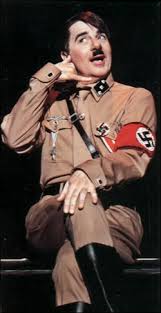
Homeless Persons: Such costumes will hurt the feelings of bums who won’t be attending Halloween parties anyway.

Illegal Alien: It’s not nice to spotlight people who constantly violate the immigration laws of the United States.

Terrorist: You might upset Islamics, who make up the vast majority of the world’s terrorists.

Others on the list of groups that uber-liberals believes it’s Politically Incorrect to dress up as include:
- Blacks (if you’re white).
- Naughty priests: It’s offensive to mock religious hypocrites who violate the bodies of children.
- Caitlyn Jenner: It’s cruel to make fun of a man who, as a man, won gold medals as an Olympic athlete—and then had sophisticated surgery to make himself look like a woman.
- Mexicans (such as a woman wearing a mariachi outfit or a man sporting a sombrero, serape and drooping moustache).
- Pimp: It’s offensive to blacks—especially those who make their living through the sale of women’s bodies.
- Sexy nurse: Because nursing is a serious profession—and everybody knows that nurses never enter into romances with doctors.
- Fat costumes: It will hurt the feelings of people who can barely fit into an airplane seat—many of them because they simply eat too much.
- Crazed Killer: Because it’s not fair to make fun of psychopathic murderers who prey on innocent men, women and children.
- Sexy Convict/Prison Guard: You could be accused of “trivializing” the United States prison system.
- The Wall: Wearing an imitation brick wall reminds people that millions of Hispanics have illegally violated America’s immigration laws—and millions more intend to.
- Arab Sheik: It’s not nice to dress like an OPEC board member in a long flowing robe and headdress.
- Sexy Harem Slave: Consider this the flip side of “Arab Sheik.” It’s uncool to remind people that women throughout the Islamic world are treated like chattel.
- “Droopers”: An obvious parody of the “Hooters” outfit, this features a fake pair of drooping breasts, thus winning it dual charges of “ageism” and “sexism.”
- Geisha: You could be accused of “cultural appropriation.”
- Hillary in Prison: Depicting a woman who often skirted the law as paying the price for it is anti-feminist.
- Robert E. Lee: Once a Southern icon of the Civil War, he is now damned as a racist defender of slavery.
- Escaped Mental Patient: Wearing an imitation straitjacket makes fun of real-life whackjobs who need to be restrained—for their own safety and that of others.
- Indian Snake Charmer: This costume supposedly appropriates Middle Eastern culture and has “disturbing sexual undertones”—if you equate snakes with penises.
If you follow the guidelines of these articles, you might as well skip Halloween altogether.
Yet no one objects to children—or adults—dressing up as pirates like Blackbeard, who once terrorized the oceans as modern-day terrorists menace the world.
No one objects to those who dress up like skeletons—when almost everyone has lost a friend or family member to death.
No one objects to those who dress up as witches, who have been associated with evil for hundreds of years.
No one objects to those who dress up as Satan—the literal personification of evil for millions of Christians, Jews and Muslims.
The whole idea of Halloween is to momentarily step into a character that’s utterly different from you.
So if you are a terrorist, try dressing up at Halloween as Dr. Albert Schweitzer or Florence Nightingale.
ABC NEWS, AIRLINES, ALTERNET, AMERICABLOG, ANTHEM INC., AP, BABY BOOMER RESISTANCE, BBC, BLOOMBERG, BUSINESS, BUZZFEED, CBS NEWS, CHINA, CNN, COMPUTER SECURITY, CREDIT CARDS, CREDIT REPORTING AGENCIES, CROOKS AND LIARS, CYBERSECURITY, DAILY KOS, DAILY KOZ, DAIRY QUEEN, EQUIFAX, FIVETHIRTYEIGHT, HACKING, HARPER’S MAGAZINE, HUFFINGTON POST, JOHN HERING, JPMORGAN/CHASE, LILY TOMLIN, LOOKOUT, LUGGAGE THEFTS, MA BELL, MEDIA MATTERS, MOTHER JONES, MOVEON, MSNBC, NBC NEWS, NEW REPUBLIC, NEWSDAY, NEWSWEEK, NPR, PBS NEWSHOUR, POLITICO, POLITICUSUSA, RAW STORY, REUTERS, ROWAN & MARTIN'S LAUGH-IN, SALON, SEATTLE TIMES, SLATE, SOCIAL SECURITY, STAPLES, TALKING POINTS MEMO, TARGET, THE ATLANTIC, THE CHICAGO SUN-TIMES, THE CHICAGO TRIBUNE, THE DAILY BEAST, THE DAILY BLOG, THE GUARDIAN, THE HILL, THE HUFFINGTON POST, THE INTERCEPT, THE LOS ANGELES TIMES, THE NATION, THE NEW REPUBLIC, THE NEW YORK TIMES, THE NEW YORKER, THE VILLAGE VOICE, THE WALL STREET JOURNAL, THE WASHINGTON POST, THINKPROGRESS, TIME, TRUTHDIG, TRUTHOUT, TWITTER, TWO POLITICAL JUNKIES, U.S. NEWS & WORLD REPORT, UP, UPI, USA TODAY, X
In Bureaucracy, Business, History, Law, Politics, Self-Help, Social commentary on September 12, 2017 at 12:01 am
Comedian Lily Tomlin rose to fame on the 1960s comedy hit, Rowan & Martin’s Laugh-In, as Ernestine, the rude, sarcastic switchboard operator for Ma Bell.
She would tap into customers’ calls, interrupt them, make snide remarks about their personal lives. And her victims included celebrities as much as run-of-the-mill customers.

Lily Tomlin as Ernestine
She introduced herself as working for “the phone company, serving everyone from presidents and kings to the scum of the earth.”
But perhaps the line for which her character is best remembered was: “We don’t care. We don’t have to. We’re the phone company.”
Clearly, too many companies take the same attitude as Ernestine: “We don’t care. We don’t have to.”
This is especially true for companies that are supposed to safeguard their customers’ most sensitive information.
Companies like:
- Kmart
- Staples
- Dairy Queen
- Target Home Depot
- JPMorgan/Chase
- Anthem Insurance
All these corporations suffered data breeches that exposed tens of millions of individuals’ private information–such as:
- Names
- Birthdates
- Credit card numbers
- Social Security numbers
- Member ID numbers
- Addresses
- Email addresses
- Employment Information
- Phone numbers
And now hackers have compromised Equifax, the consumer credit reporting agency.

One out of every two Americans stands to be a victim. Some 143 million consumers’ sensitive data is potentially compromised.
From mid-May to July, 2017, there was a flaw in Equifax’s website software. This allowed hackers to access 143 million Americans’ supposedly private information. Only after this massive robbery had occurred did the company discover the breach and close the loophole.
On September 8, PBS Newshour correspondent William Brangham outlined the dimensions of this catastrophe:
“It’s everything that would be in your credit report. So, it’s Social Security number. It’s your name, it’s your address, it’s your driver’s license information, it’s your employers, it’s your payment history, it’s what bank accounts you have….
“The thing that a thief could do with this information is, one, they could hack into your existing accounts once they have all that information. They could also set up new ones pretending to be John Yang or William Brangham and set up new accounts and then rack up big charges on those.
“So, the great irony here is that Equifax is a company that actually sells identity theft protection, and here it is they have theoretically allowed a huge breach that could trigger a ton of identity theft.“
According to Brangham, the two most outrageous aspects of this catastrophe are:
“[Equifax] found out about this on July 29, and we only found out about this breach on—this week. So, you’re supposed to, in these kinds of cases, immediately jump to do something about it. And it seems like they didn’t give consumers much time.
“And, secondly, several executives at the company, after they found out about the breach, sold about $18.8 million worth of stock in their company before this news got out, the implication being they didn’t want their stock to tank and their stock to lose value.”
Asked, “What are we supposed to do?” Brangham replied:
- Freeze your credit account—thus blocking anyone from setting up a new bank account, loan or mortgage in your name without you being alerted to it.
- Alert credit reporting companies Equifax, Transunion and Experian.
- Monitor your bank and credit cards for suspicious activity.
An October 22, 2014 “commentary” published in Forbes magazine raised the highly disturbing question: “Cybersecurity: Does Corporate America Really Care?”
And the answer is clearly: No.
Its author is John Hering, co-founder and executive director of Lookout, which bills itself as “the world leader in mobile security for consumers and enterprises alike.”
Click here: Cybersecurity: Does corporate America really care?
“One thing is clear,” writes Hering. “CEOs need to put security on their strategic agendas alongside revenue growth and other issues given priority in boardrooms.”
Hering warns that “CEOs don’t seem to be making security a priority.” And he offers several reasons for this:
- The sheer number of data compromises;
- Relatively little consumer outcry;
- Almost no impact on the companies’ standing on Wall Street;
- Executives may consider such breaches part of the cost of doing business.
“There’s a short-term mindset and denial of convenience in board rooms,” writes Hering. “Top executives don’t realize their systems are vulnerable and don’t understand the risks. Sales figures and new products are top of mind; shoring up IT systems aren’t.”
There are three ways corporations can be forced to start behaving responsibly on this issue.
- Smart attorneys need to start filing class-action lawsuits against companies that refuse to take steps to protect their customers’ private information. There is a name for such behavior: Criminal negligence. And there are laws carrying serious penalties for it.
- There must be Federal legislation to ensure that multi-million-dollar fines are levied against such companies—and especially their CEOs—when such data breaches occur.
- Congress should enact legislation allowing for the prosecution of CEOs whose companies’ negligence leads to such massive data breaches. They should be considered as accessories to crime, and, if convicted, sentenced to lengthy prison terms.
Only then will the CEO mindset of “We don’t care, we don’t have to” be replaced with: “We care, because we’ll lose our money and/or freedom if we don’t.”
2016 PRESIDENTIAL CAMPAIGN, ABC NEWS, ALTERNET, AMERICABLOG, AP, BABY BOOMER RESISTANCE, BASKET OF DEPLORABLES SPEECH, BBC, BILL CLINTON, BLOOMBERG NEWS, BUZZFEED, CBS NEWS, CELINDA LAKE, CNN, CROOKS AND LIARS, DAILY KOZ, DONALD TRUMP, EMPLOYERS RESPONSIBILITY ACT, FACEBOOK, FISHER INVESTMENTS, FIVETHIRTYEIGHT, FORBES MAGAZINE, HARPER’S MAGAZINE, HILLARY CLINTON, HOUSE OF REPRESENTATIVES, HUFFINGTON POST, KENNETH FISHER, MEDIA MATTERS, MEDICAL INSURANCE, MOTHER JONES, MOVEON, MSNBC, NBC NEWS, NEW REPUBLIC, NEWSDAY, NEWSWEEK, NPR, PBS NEWSHOUR, POLITICO, POLITICUSUSA, POPULISM, RAW STORY, REPUBLICANS, REUTERS, SALON, SEATTLE TIMES, SLATE, TALKING POINTS MEMO, THE ATLANTIC, THE CHICAGO SUN-TIMES, THE CHICAGO TRIBUNE, THE DAILY BEAST, THE DAILY BLOG, THE GUARDIAN, THE HILL, THE HUFFINGTON POST, THE LOS ANGELES TIMES, THE NATION, THE NEW REPUBLIC, THE NEW YORK TIMES, THE NEW YORKER, THE VILLAGE VOICE, THE WASHINGTON POST, THINKPROGRESS, TIME, TRUTHDIG, TRUTHOUT, TWITTER, TWO POLITICAL JUNKIES, U.S. HOUSE OF REPRESENTATIVES, U.S. NEWS & WORLD REPORT, U.S. SENATE, UNEMPLOYMENT, UP, UPI, USA TODAY, WAL-MART, WEALTH GAP
In Bureaucracy, Business, History, Law, Politics, Social commentary on September 6, 2017 at 12:10 am
America can quickly find employment for willing-to-work job-seekers—by installing a nationwide Employers Responsibility Act. Its last seven provisions would read as follows:
(9) Employers refusing to hire would be required to pay an additional “crime tax.”
Sociologists and criminologists agree that “the best cure for crime is a job.” Thus, employers who refuse to hire contribute to a growing crime rate in this Nation. Such non-hiring employers would be required to pay an additional tax, which would be earmarked for agencies of the criminal justice system at State and Federal levels.
(10) The seeking of “economic incentives” by companies in return for moving to or remaining in cities/states would be strictly forbidden.
Such “economic incentives” usually:
- allow employers to ignore existing laws protecting employees from unsafe working conditions;
- allow employers to ignore existing laws protecting the environment;
- allow employers to pay their employees the lowest acceptable wages, in return for the “privilege” of working at these companies; and/or
- allow employers to pay little or no business taxes, at the expense of communities who are required to make up for lost tax revenues.
(11) Employers who continue to make such overtures would be criminally prosecuted for attempted bribery or extortion:
- Bribery, if they offered to move to a city/state in return for “economic incentives,” or
- Extortion, if they threatened to move their companies from a city/state if they did not receive such “economic incentives.”
This would protect employees against artificially-depressed wages and unsafe working conditions; protect the environment in which these employees live; and protect cities/states from being pitted against one another at the expense of their economic prosperity.
(12) The U.S. Departments of Justice and Labor would regularly monitor the extent of employer compliance with the provisions of this act.
Among these measures: Sending undercover agents, posing as highly-qualified job-seekers, to apply at companies—and then vigorously prosecuting those employers who blatantly refused to hire despite their proven economic ability to do so.
This would be comparable to the long-time and legally-validated practice of using undercover agents to determine compliance with fair-housing laws.
(13) The Justice Department and/or the Labor Department would be required to maintain a publicly-accessible database on those companies that have been cited, sued and/or convicted for such offenses as:
- discrimination,
- harassment,
- health and/or safety violations or
- violating immigration laws.
Employers would be legally required to regularly provide such information to these agencies, so that it would remain accurate and up-to-date.
Such information would arm job applicants with vital information about the employers they were approaching. They could thus decide in advance if an employer is deserving of their skills and dedication.
As matters now stand, employers can legally demand to learn even the most private details of an applicant’s life without having to disclose even the most basic information about themselves and their history of treating employees.
(14) CEOs whose companies employ illegal aliens would be held directly accountable for the actions of their subordinates. Upon conviction, the CEO would be sentenced to a mandatory prison term of at least 10 years.
This would prove a more effective remedy for controlling illegal immigration than stationing tens of thousands of soldiers on the U.S./Mexican border. With CEOs forced to account for their subordinates’ actions, they would take drastic steps to ensure their companies complied with Federal immigration laws.
Without employers eager to hire illegal aliens at a fraction of the money paid to American workers, the invasions of illegal job-seekers would quickly come to an end.
(15) A portion of employers’ existing Federal taxes would be set aside to create a national clearinghouse for placing unemployed but qualified job-seekers.
* * * * *
For thousands of years, otherwise highly intelligent men and women believed that kings ruled by divine right. That kings held absolute power, levied extortionate taxes and sent countless millions of men off to war—all because God wanted it that way.
That lunacy was dealt a deadly blow in 1776 when American Revolutionaries threw off the despotic rule of King George III of England.
But today, millions of Americans remain imprisoned by an equally outrageous and dangerous theory: The Theory of the Divine Right of Employers.
Summing up this employer-as-God attitude, Calvin Coolidge still speaks for the overwhelming majority of employers and their paid shills in government: “The man who builds a factory builds a temple, and the man who works there worships there.”
America can no longer afford such a dangerous fallacy as the Theory of the Divine Right of Employers.
Americans did not win their freedom from Great Britain—and its enslaving doctrine of “the divine right of kings”—-by begging for their rights.
And Americans will not win their freedom from their corporate masters–-and the equally enslaving doctrine of “the divine right of employers”—-by begging for the right to work and support themselves and their families.
Corporations can—and do—spend millions of dollars on TV ads, selling lies—lies such as the “skills gap,” and how if the wealthy are forced to pay their fair share of taxes, jobs will inevitably disappear.
But Americans can choose to reject those lies—and demand that employers behave like patriots instead of predators.
2016 PRESIDENTIAL CAMPAIGN, ABC NEWS, ALTERNET, AMERICABLOG, AP, BABY BOOMER RESISTANCE, BASKET OF DEPLORABLES SPEECH, BBC, BILL CLINTON, BLOOMBERG NEWS, BUZZFEED, CBS NEWS, CELINDA LAKE, CNN, CROOKS AND LIARS, DAILY KOZ, DONALD TRUMP, EMPLOYERS RESPONSIBILITY ACT, FACEBOOK, FISHER INVESTMENTS, FIVETHIRTYEIGHT, FORBES MAGAZINE, HARPER’S MAGAZINE, HILLARY CLINTON, HOUSE OF REPRESENTATIVES, HUFFINGTON POST, KENNETH FISHER, MEDIA MATTERS, MEDICAL INSURANCE, MOTHER JONES, MOVEON, MSNBC, NBC NEWS, NEW REPUBLIC, NEWSDAY, NEWSWEEK, NPR, PBS NEWSHOUR, POLITICO, POLITICUSUSA, POPULISM, RAW STORY, REPUBLICANS, REUTERS, SALON, SEATTLE TIMES, SLATE, TALKING POINTS MEMO, THE ATLANTIC, THE CHICAGO SUN-TIMES, THE CHICAGO TRIBUNE, THE DAILY BEAST, THE DAILY BLOG, THE GUARDIAN, THE HILL, THE HUFFINGTON POST, THE LOS ANGELES TIMES, THE NATION, THE NEW REPUBLIC, THE NEW YORK TIMES, THE NEW YORKER, THE VILLAGE VOICE, THE WASHINGTON POST, THINKPROGRESS, TIME, TRUTHDIG, TRUTHOUT, TWITTER, TWO POLITICAL JUNKIES, U.S. HOUSE OF REPRESENTATIVES, U.S. NEWS & WORLD REPORT, U.S. SENATE, UNEMPLOYMENT, UP, UPI, USA TODAY, WAL-MART, WEALTH GAP
In Bureaucracy, Business, History, Law, Politics, Social commentary on September 5, 2017 at 12:01 am
An Employers Responsibility Act (ERA) would simultaneously address the following evils for which employers are directly responsible:
- The loss of jobs within the United States owing to companies’ moving their operations abroad—solely to pay substandard wages to their new employees.
- The mass firings of employees which usually accompany corporate mergers or acquisitions.
- The widespread victimization of part-time employees, who are not legally protected against such threats as racial discrimination, sexual harassment and unsafe working conditions.
- The refusal of many employers to create better than menial, low-wage jobs.
- The widespread employer practice of extorting “economic incentives” from cities or states in return for moving to or remaining in those areas. Such “incentives” usually absolve employers from complying with laws protecting the environment and/or workers’ rights.
- The refusal of many employers to provide medical and pension benefits—nearly always in the case of part-time employees, and, increasingly, for full-time, permanent ones as well.
- Rising crime rates, due to rising unemployment.
Among its provisions:
(1) American companies that close plants in the United States and open others abroad would be forbidden to sell products made in those foreign plants within the United States.
This would protect both American and foreign workers from employers seeking to profit at their expense. American workers would be ensured of continued employment. And foreign laborers would be protected against substandard wages and working conditions.
Companies found violating this provision would be subject to Federal criminal prosecution. Guilty verdicts would result in heavy fines and lengthy imprisonment for their owners and top managers.
(2) Large companies (those employing more than 100 persons) would be required to create entry-level training programs for new, future employees.
These would be modeled on programs now existing for public employees, such as firefighters, police officers and members of the armed services.
Such programs would remove the employer excuse, “I’m sorry, but we can’t hire you because you’ve never had any experience in this line of work.” After all, the Air Force has never rejected an applicant because, “I’m sorry, but you’ve never flown a plane before.”
This Nation has greatly benefited from the humane and professional efforts of the men and women who have graduated from public-sector training programs. There is no reason for the private sector to shun programs that have succeeded so brilliantly for the public sector.
(3) Employers would receive tax credits for creating professional, well-paying, full-time jobs.
This would encourage the creation of better than the menial, dead-end, low-paying and often part-time jobs which exist in the service industry. Employers found using such tax credits for any other purpose would be prosecuted for tax fraud.
(4) A company that acquired another—through a merger or buyout—would be forbidden to fire en masse the career employees of that acquired company.
This would be comparable to the protection existing for career civil service employees. Such a ban would prevent a return to the predatory “corporate raiding” practices of the 1980s, which left so much human and economic wreckage in their wake.
The wholesale firing of employees would trigger the prosecution of the company’s new owners. Employees could still be fired, but only for provable just cause, and only on a case-by-case basis.
(5) Employers would be required to provide full medical and pension benefits for all employees, regardless of their full-time or part-time status.
Increasingly, employers are replacing full-time workers with part-time ones—solely to avoid paying medical and pension benefits.
Requiring employers to act humanely and responsibly toward all their employees would encourage them to provide full-time positions—and hasten the death of this greed-based practice.
(6) Employers of part-time workers would be required to comply with all federal labor laws.
Under current law, part-time employees are not protected against such abuses as discrimination, sexual harassment and unsafe working conditions. Closing this loophole would immediately create two positive results:
- Untold numbers of currently-exploited workers would be protected from the abuses of predatory employers; and
- Even predatorily-inclined employers would be encouraged to offer permanent, fulltime jobs rather than only part-time ones—since a major incentive for offering part-time jobs would now be eliminated.
(7) Employers would be encouraged to hire to their widest possible limits,through a combination of financial incentives and legal sanctions. Among those incentives:
Employers demonstrating a willingness to hire would receive substantial Federal tax credits, based on the number of new, permanent employees hired per year.
Employers claiming eligibility for such credits would be required to make their financial records available to Federal investigators. Employers found making false claims would be prosecuted for perjury and tax fraud, and face heavy fines and imprisonment if convicted.
(8) Among those sanctions: Employers refusing to hire could be required to prove, in court:
- Their economic inability to hire further employees, and/or
- The unfitness of the specific, rejected applicant.
Companies found guilty of unjustifiably refusing to hire would face the same penalties as now applying in cases of discrimination on the basis of age, race, sex and disability.
Two benefits would result from this:
- Employers would thus fund it easier to hire than to refuse to do so; and
- Job-seekers would no longer be prevented from even being considered for employment because of arbitrary and interminable “hiring freeze.”
2016 PRESIDENTIAL CAMPAIGN, ABC NEWS, ALTERNET, AMERICABLOG, AP, BABY BOOMER RESISTANCE, BASKET OF DEPLORABLES SPEECH, BBC, BILL CLINTON, BLOOMBERG NEWS, BUZZFEED, CBS NEWS, CELINDA LAKE, CNN, CROOKS AND LIARS, DAILY KOZ, DONALD TRUMP, EMPLOYERS RESPONSIBILITY ACT, FACEBOOK, FISHER INVESTMENTS, FIVETHIRTYEIGHT, FORBES MAGAZINE, HARPER’S MAGAZINE, HILLARY CLINTON, HOUSE OF REPRESENTATIVES, HUFFINGTON POST, KENNETH FISHER, MEDIA MATTERS, MEDICAL INSURANCE, MOTHER JONES, MOVEON, MSNBC, NBC NEWS, NEW REPUBLIC, NEWSDAY, NEWSWEEK, NPR, PBS NEWSHOUR, POLITICO, POLITICUSUSA, POPULISM, RAW STORY, REPUBLICANS, REUTERS, SALON, SEATTLE TIMES, SLATE, TALKING POINTS MEMO, THE ATLANTIC, THE CHICAGO SUN-TIMES, THE CHICAGO TRIBUNE, THE DAILY BEAST, THE DAILY BLOG, THE GUARDIAN, THE HILL, THE HUFFINGTON POST, THE LOS ANGELES TIMES, THE NATION, THE NEW REPUBLIC, THE NEW YORK TIMES, THE NEW YORKER, THE VILLAGE VOICE, THE WASHINGTON POST, THINKPROGRESS, TIME, TRUTHDIG, TRUTHOUT, TWITTER, TWO POLITICAL JUNKIES, U.S. HOUSE OF REPRESENTATIVES, U.S. NEWS & WORLD REPORT, U.S. SENATE, UNEMPLOYMENT, UP, UPI, USA TODAY, WAL-MART, WEALTH GAP, WONKETTE
In Bureaucracy, Business, History, Law, Politics, Social commentary on September 4, 2017 at 12:38 am
Hillary Clinton gave only one memorable speech during the 2016 Presidential campaign—and then quashed any benefits that might have come from it.
This was the “basket of deplorables” speech, delivered at a New York fundraiser on September 9, 2016. It was the only Clinton speech to be widely quoted by Democrats and Republicans.
She divided Donald Trump’s supporters into two groups. The first group were the “deplorables,” for whom she showed open contempt:
“You know, to just be grossly generalistic, you could put half of Trump’s supporters into what I call the basket of deplorables. Right? The racist, sexist, homophobic, xenophobic, Islamaphobic—you name it.
“And unfortunately there are people like that. And he has lifted them up.
“He has given voice to their websites that used to only have 11,000 people—now 11 million. He tweets and retweets their offensive hateful mean-spirited rhetoric. Now, some of those folks—they are irredeemable, but thankfully they are not America.”
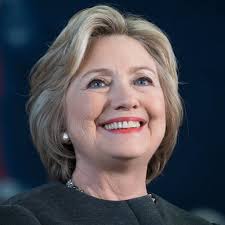
Hillary Clinton
But the second group, she said, consisted of poor, alienated Americans who rightly felt abandoned by their employers and their government:
“But….that other basket of people are people who feel that the government has let them down, the economy has let them down. Nobody cares about them. Nobody worries about what happens to their lives and their futures, and they’re just desperate for change. It doesn’t really even matter where it comes from.
“They don’t buy everything [Trump] says, but he seems to hold out some hope that their lives will be different. They won’t wake up and see their jobs disappear, lose a kid to heroin, feel like they’re in a dead-end. Those are people we have to understand and empathize with as well.”
After giving this speech, Clinton threw away the good it might well have done her.
First, the day after making the speech, she apologized for it: “Last night I was ‘grossly generalistic,’ and that’s never a good idea. I regret saying ‘half’—that was wrong.”
Many of Trump’s followers were racists, sexists and xenophobes—who deserved condemnation, not apologies. By apologizing, she looked weak, indecisive.
Second, having eloquently reached out to many of the men and women who were a prime constituency for Donald Trump, she made no effort to follow up.
She could have used this moment to offer an economic package that would quickly and effectively address their vital needs for jobs and medical care.
But that would have required her to put one together long ago. And all she had to offer now was boilerplate rhetoric, such as: “Education is the answer.”
Meanwhile, Donald Trump, adopting the role of a populist, appealed to blue-collar voters.
Trump visited “Rustbelt” states like Michigan and Pennsylvania, and vowed to “bring back” jobs that had been lost to China, such as those in coal mining and manufacturing. Clinton didn’t deign to show up, assuming she had those states “locked up.”
Donald Trump
Most economists agree that, in a globalized economy, such jobs are not coming back, no matter who becomes President.
Even so, voters went for the man who promised them a better future, and shunned the woman who didn’t promise them any future at all.
In May, 2016, Democratic pollster CeLinda Lake had warned Clinton to revamp her economic platform.
“Democrats simply have to come up with a more robust economic frame and message,” Lake said after the election.
“We’re never going to win those white, blue-collar voters if we’re not better on the economy. And 27 policy papers and a list of positions is not a frame. We can laugh about it all we want, but Trump had one.”
Actually, Trump and Clinton had one thing in common when it came to tackling unemployment: Both of them ignored the single greatest cause of unemployment among Americans: The refusal of employers to hire.
Employers like Kenneth Fisher, chief executive officer of Fisher Investments, who said, in 2012: “Believe it or not, I’m for fewer jobs, not more.”
In the Christmas Eve, 2012 issue of Forbes, he asserted: “Job Growth is Overrated.”
“Throughout 2012 we heard politicians and pundits of all stripes yammering endlessly on the need for job growth—that we don’t have enough jobs. It’s pure rubbish.”
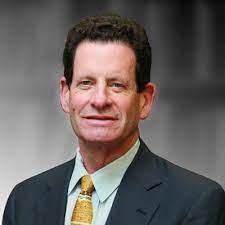
Kenneth Fisher
According to Fisher, jobs are actually signs of weakness in the economy. Fewer employees can produce more products—and that’s good for us all.
For Fisher—a billionaire—the template for future economic success is Walmart, the nation’s largest private employer: “With Walmart you get an awe-inspiring company at 13 times my January 2014 earnings estimate, with a 2.2% dividend yield.”
But America can put an end to this “I’ve-got-mine-and-the-hell-with-you” job-killing arrogance of people like Kenneth Fisher.
The answer lies in three words: Employers Responsibility Act (ERA).
If passed by Congress and vigorously enforced by the U.S. Departments of Justice and Labor, an ERA would ensure full-time, permanent and productive employment for millions of capable, job-seeking Americans.
And it would achieve this without raising taxes or creating controversial government “make work” programs. Such legislation would legally require employers to demonstrate as much initiative for hiring as job-seekers are now expected to show in searching for work.
2016 PRESIDENTIAL CAMPAIGN, ABC NEWS, ALTERNET, AP, BARACK OBAMA, BERNIE SANDERS, BUZZFEED, CBS NEWS, CNN, CROOKS AND LIARS, DAILY KOZ, DAVID BROOKS, DEMOCRATIC PARTY, DONALD TRUMP, ELIZABETH WARREN, FACEBOOK, HILLARY CLINTON, HUMOR, JEB BUSH, JOHN KASICH, LIBERALS, MARCO RUBIO, MARK SHIELDS, MOTHER JONES, MOVEON, NBC NEWS, NEWSWEEK, NPR, PBS NEWSHOUR, POLITICO, RAND PAUL, RAW STORY, REPUBLICAN PARTY, REPUBLICANS, REUTERS, RICK PERRY, SALON, SATIRE, SEATTLE TIMES, SLANDER, SLATE, TED CRUZ, THE ATLANTIC, THE CHICAGO SUN-TIMES, THE CHICAGO TRIBUNE, THE DAILY BEAST, THE GUARDIAN, THE HILL, THE HUFFINGTON POST, THE LOS ANGELES TIMES, THE NATION, THE NEW YORK TIMES, THE PRINCE, THE WASHINGTON POST, TIME, TWITTER, U.S. NEWS & WORLD REPORT, UP, UPI, USA TODAY
In Bureaucracy, History, Politics, Social commentary on August 29, 2017 at 1:12 am
Tyrants are conspicuously vulnerable to ridicule. Yet Democrats have proven unable or unwilling to make use of this powerful weapon.
Donald Trump—as political candidate and President—has repeatedly assaulted the press as “fake news.” He has similarly attacked the judiciary and Intelligence agencies such as the CIA and FBI. But no Democrat has dared to label him a “fake President.”
Similarly, he has branded Hillary Clinton “Crooked Hillary.” But Democrats—despite Trump’s often-publicized admiration for Russian dictator Vladimir Putin—have never called him “Red Donald.” Nor charged him with using dictatorial methods via the damning barb: “TrumPutin.”
Had Democrats met his insults with effective ones of their own during the campaign, the results might well have been different.
Democrats and liberals (the two are not always the same) have similarly failed to produce funny anti-Trump jokes. Jokes are an effective weapon because they highlight traits that people are already familiar with—such as Trump’s dictatorial nature:
- One day, while walking down a corridor, newly-elected President Trump passes Hillary Clinton. “It’s so nice to see you,” says Trump. “I thought I had you shot.”
- What’s the difference between Donald Trump and Adolf Hitler? Nothing—but Trump doesn’t know it.
Or his egomania:
- Donald Trump commissions a sculptor to draw up blueprints for a statue of Abraham Lincoln. Version #1 shows a towering Lincoln reading the Gettysburg address. Trump: “That’s very good, but there’s something missing.” Version #2: Trump standing next to Lincoln, who’s reading the Gettysburg address. Trump: “That’s better, but something’s still missing. Try to fix it.” Version #3: Trump, sitting in the Oval Office, reading the Gettysburg Address. Trump: “Yes, that’s it. You finally got it right.”
Nor have Democrats assailed the ignorant semi-literates who comprise most of Trump’s voters:
- Why do Donald Trump’s supporters always travel in threes? One who can read, one who can write, and one to keep his eye on the two intellectuals.
Incredibly for this YouTube-obsessed age, Democrats have never assailed Trump with barrages of satirical musical videos.
Trump’s notorious “bromance” with Vladimir Putin could be satirized by converting the Beatles’ hit, “With a Little Help From My Friends” into “With a Little Help From My Vlad”:
What do I do when the bank calls me in?
(Does it worry you to be in debt?)
How do I feel when I need rubles fast?
(Do you worry Vlad might say “Nyet”?)
No, I get by with a little help from my Vlad.
Mm, I can lie with a little help from my Vlad.
Mm, you’re gonna fry with a little help from my Vlad.
In the hands of a creative writer, the Beatles’ “Can’t Buy Me Love” could become “Can’t Buy Me Class”:
I’ll sell you a load of crap my friend
If it makes you feel all right.
I’ll don a Klansman’s robes and hat
‘Cause it makes me Super White.
‘Cause I don’t care too much for humble.
Money can’t buy me class.
Can’t buy me class
Everybody tells me so.
Can’t buy me class—no, no, no, no.
Many Americans have wondered how so many millions of their fellow citizens could have voted for Trump.
“Springtime for Hitler,” the signature tune of the hit play and movie, The Producers, could become “Springtime for Trumpland”—and help mightily in clearing up that mystery:
America was having trouble
What a sad, sad story.
Needed a new leader
To restore its former glory.
Where oh where was he?
Who could that man be?
We looked around and then we found
The man for you and me.
And now it’s…
Springtime for Trump goons and bigotry—
Winter for Reason and Light.
Springtime for Trumpland and infamy—
Come on, Trumpsters, let’s go pick a fight.
Parody song-writers could easily attack the obvious racism of Trump and those who elected him. This would be especially easy after his praise for white supremacist demonstrators in Charlottesville, Virginia:
LITTLE NAZIS
(To be sung to the tune, “Little Boxes)
Little Nazis in the White House
Little Nazis made of Fascist hate.
Little Nazis in the White House
Little Nazis all the same.
There’s a big one and a small one
And a fat one and an Orange One–
And they’re all made out of Fascist hate
And they all look just the same.
And the voters in the “heartland”
All went off to the polling booth
Where they pulled hard on the levers
And the Nazis got a win.
And there’s bigots and oppressors
And screaming misogynists–
And they’re all made out of Fascist hate
And they all sound just the same.
And some go off to lynchings
Where they hang their black neighbors high.
And they all have stupid children
And the children flunk at school.
And the children go to Nazi sites
And learn their perversity.
Then they turn out like their parents
And they’re all scum just the same.
For any of this to happen, Democrats would need to acquire two qualities they have all-too-often lacked: Creativity and courage.
Specifically:
- The creativity to produce audience-captivating humor; and
- The courage to ruthlessly attack Trump as he attacks others.


2016 PRESIDENTIAL CAMPAIGN, ABC NEWS, AL FRANKEN, ALTERNET, AP, BARACK OBAMA, BERNIE SANDERS, BOB CORKER, BUZZFEED, CBS NEWS, CNN, CROOKS AND LIARS, DAILY KOZ, DAVID BROOKS, DEMOCRATIC PARTY, DONALD TRUMP, ELIZABETH WARREN, FACEBOOK, HILLARY CLINTON, JEB BUSH, JEFF FLAKE, JOE SCARBOROUGH, JOSEPH MCCARTHY, KIM JONG-UN, LATE NIGHT WITH STEPHEN COLBERT, LIBERALS, MARCO RUBIO, MARK SHIELDS, MIKA BRZEZINSKI, MOTHER JONES, MOVEON, NBC NEWS, NEWSWEEK, NOCCOLO MACHIAVELLI, NPR, PBS NEWSHOUR, POLITICO, RAW STORY, REPUBLICAN PARTY, REPUBLICANS, REUTERS, SALON, SEATTLE TIMES, SLANDER, SLATE, TED CRUZ, THE ATLANTIC, THE CHICAGO SUN-TIMES, THE CHICAGO TRIBUNE, THE DAILY BEAST, THE GUARDIAN, THE HILL, THE HUFFINGTON POST, THE LOS ANGELES TIMES, THE NATION, THE NEW YORK TIMES, THE PRINCE, THE WASHINGTON POST, TIME, TWITTER, U.S. NEWS & WORLD REPORT, UP, UPI, USA TODAY
BULLIES AND COWARDS: PART ONE (OF TWO)
In History, Politics, Social commentary on November 29, 2017 at 12:36 pmA major reason for Donald Trump’s appeal during the 2016 Presidential campaign was: “He’s not like other politicians.”
And he wasn’t.
The vast majority of politicians adhere to an unwritten rule: Even when you criticize another politician, you do so in a reasonably dignified manner.
Trump threw that rule—along with many others—out the window. In its place, he gave his opponents—Republican and Democrat—a series of disparaging nicknames.
And, as President, he has continued to do so.
His main sources of public defamation have been Twitter and the speeches he makes. Among the insulting nicknames have included:
Syndicated columnist Mark Shields and New York Times columnist David Brooks appear every Friday on the PBS Newshour to review the week’s major political events.
On May 27, 2016, Shields—a liberal, and Brooks, a conservative—reached some disturbingly similar conclusions about the character of Republican Presidential front-runner Donald Trump.
David Brooks and Mark Shields
MARK SHIELDS: “Donald Trump gratuitously slandered Ted Cruz’s wife. He libeled Ted Cruz’s father for being potentially part of Lee Harvey Oswald’s assassination of the president of the United States, suggesting that he was somehow a fellow traveler in that.
“This is a libel. You don’t get over it….
“…I think this man may be addicted to the roar of the grease paint and the sound of the crowd, or however it goes, smell of the crowd.”
Donald Trump
DAVID BROOKS: “Trump, for all his moral flaws, is a marketing genius. And you look at what he does. He just picks a word and he attaches it to a person. Little Marco [Rubio], Lyin’ Ted [Cruz], Crooked Hillary [Clinton].
“And that’s a word. And that’s how marketing works. It’s a simple, blunt message, but it gets under.
“It sticks, and it diminishes. And so it has been super effective for him, because he knows how to do that. And she [Hillary Clinton] just comes with, ‘Oh, he’s divisive.’
“These are words that are not exciting people. And her campaign style has gotten, if anything…a little more stagnant and more flat.”
Only one opponent—who was not a Presidential candidate—managed to stand up to Trump: Massachusetts U.S. Senator Elizabeth Warren. Whenever Trump attacks her, Warren strikes back—sometimes even more harshly.
As Mark Shields noted:
“Elizabeth Warren gets under Donald Trump’s skin. And I think she’s been the most effective adversary. I think she’s done more to unite the Democratic party than either Hillary Clinton or Bernie Sanders.”
From June 15, 2015, when he launched his Presidential campaign, until October 24, 2016, Trump used Twitter to fire almost 4,000 angry, insulting tweets at 281 people and institutions that had somehow offended him.
Warren has dared to do what no other Democrat—or Republican—has: Attack Trump head-on, with the kind of blunt, insulting language he has lavished on his opponents.
Among the jabs she has thrown at him on Twitter:
Nor is Twitter her only weapon.
On March 31, Warren appeared on The Late Show, with Stephen Colbert. Her take on the egotistical billionaire:
“Donald Trump is looking out for exactly one guy, and that guy’s name is Donald Trump. He smells that there’s change in the air and what he wants to do is make sure that that change works really, really well for Donald Trump.
“The truth is, he inherited a fortune from his father, he kept it going by cheating and defrauding people, and then he takes his creditors through Chapter 11.”
When Colbert said that Trump had never broken the law, Warren replied that he had never broken the law “and been caught.”
For David Brooks, Warren’s tactics prove a depressing, lose/lose situation:
“And so the tactics…is either you do what Elizabeth Warren has done, like full-bore negativity, that kind of [get] under the skin, or try to ridicule him and use humor. Humor is not Hillary Clinton’s strongest point.”
As a whole, Democrats have shown themselves indifferent to or ignorant of the power of effective language.
Share this: