Posts Tagged ‘NICCOLO MACHIAVELLI’
2016 PRESIDENTIAL ELECTION, A BRONX TALE, ABC NEWS, ALTERNET, AP, BILL CLINTON, BUZZFEED, CBS NEWS, CHAZZ PALMINTERI, CNN, CROOKS AND LIARS, DAILY KOZ, DONALD TRUMP, FACEBOOK, H.R. MCMASTER, JEFF SESSIONS, JOHN KELLY, MOTHER JONES, MOVEON, NBC NEWS, NEWSWEEK, NICCOLO MACHIAVELLI, NPR, POLITICO, RAW STORY, REINCE PREBIUS, REPUBLICAN PARTY, REUTERS, ROBERT DE NIRO, Ronald Reagan, SALON, SEATTLE TIMES, SERGEI KISLYAK, SLATE, THE ATLANTIC, THE CHICAGO SUN-TIMES, THE CHICAGO TRIBUNE, THE DAILY BEAST, THE GUARDIAN, THE HILL, THE HUFFINGTON POST, THE LOS ANGELES TIMES, THE NATION, THE NEW YORK TIMES, THE PRINCE, THE WASHINGTON POST, TIME, TWITTER, U.S. NEWS & WORLD REPORT, UP, UPI, USA TODAY
In Bureaucracy, History, Law, Law Enforcement, Politics, Social commentary on December 11, 2018 at 12:27 am
A reputation for being feared can be useful.
But it’s dangerous to constantly employ cruelties or punishments.
Whoever does so, warns Niccolo Machiavelli, “is always obliged to stand with knife in hand, and can never depend on his subjects, because they, owing to continually fresh injuries, are unable to depend upon him.”
Such a President is Donald Trump, who, as a Presidential candidate in 2016, told journalist Bob Woodward: “Real power is—I don’t even want to use the word—fear.”
As a Presidential candidate and President, Trump has repeatedly used Twitter to attack hundreds of real and imagined enemies in politics, journalism, TV and films.
From June 15, 2015, when he launched his Presidential campaign, until October 24, 2016, Trump fired almost 4,000 angry, insulting tweets at 281 people and institutions that had somehow offended him.
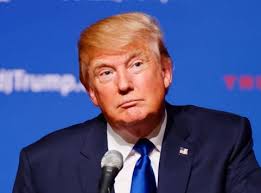
Donald Trump
The New York Times needed two full pages of its print edition to showcase them. Making one inflammatory statement after another, he offended one group of potential voters after another. Among those groups:
- Latinos
- Asians
- Blacks
- The disabled
- Women
- Prisoners-of-war
Since becoming President on January 20, 2017, Trump has attacked and/or infuriated a wide array of influential agencies or groups. Among these:
- “Obamacare” patients: Trump authorized the directors of Federal agencies to waive requirements of the Affordable Care Act—which provides medical insurance to 22 million otherwise uninsured Americans—to the “maximum extent permitted by law.”
- The CIA: Appearing at CIA headquarters on his first full day in office, Trump addressed about 400 case officers. Standing before the star-studded memorial wall honoring 117 CIA officers who had fallen in the line of duty. Trump ignored their sacrifice. Instead, he boasted of the size of his Inaugural crowd and how many times he had appeared on the cover of Time.
- Civil rights advocates: Trump signed an executive order banning Muslims from entering the United States.
- He also ordered the Department of Homeland Security to massively expand the number of people subject to detention and deportation.
- Women: Trump has publicly insulted numerous women—such as Carly Fiorina, Megyn Kelly and Rosie O’Donnell—on their looks.
- He’s been accused by 22 women of making improper sexual advances.
- And he successfully backed Supreme Court nominee Brett Kavanaugh, whom Dr. Christine Blasey Ford accused of sexually assaulting her when they were teenagers.
- Medicare patients: During the 2016 campaign, Trump said he would allow Medicare to negotiate down the price of prescription drugs. But after meeting with pharmaceutical lobbyists on January 31, 2017, Trump said: “I’ll oppose anything that makes it harder for smaller, younger companies to take the risk of bringing their product to a vibrantly competitive market. That includes price-fixing by the biggest dog in the market, Medicare.”
And he has bullied and insulted even White House officials and his own handpicked Cabinet officers:
- Jeff Sessions: Trump waged a Twitter-laced feud against his Attorney General. Sessions’ “crime”? Recusing himself from investigations into well-established ties between Russian Intelligence agents and members of Trump’s Presidential campaign.
- On the day after the November, 2018 mid-term elections, Trump fired him.
- Commerce Secretary Wilbur Ross: Trump told him: “I don’t trust you. I don’t want you doing any more negotiations….You’re past your prime.”
- Chief of Staff Reince Priebus: Suffered repeated humiliations by Trump—such a being ordered to kill a fly that was buzzing about.
- On another occasion, Trump told an associate that Priebus was “like a little rat. He just scurries around.”
- On July 28, 2017, Priebus resigned.
- Chief of Staff John Kelly: Trump similarly ridiculed Priebus’ replacement, a former Marine Corps general. Kelly tried to limit the number of advisers who had unrestricted access to Trump—and bring discipline to his schedule.
- Instead of being grateful, Trump became furious. Kelly told colleagues: “He’s an idiot. It’s pointless to try to convince him of anything. He’s gone off the rails. We’re in Crazytown. I don’t even know why any of us are here. This is the worst job I’ve ever had.”
- The United States Secret Service: Before taking office as President, Trump infuriated this agency by keeping his longtime private security force—and adding its members to the elite federal agency. Thus, he clearly sent the insulting message: “You’re not good enough, and I don’t trust you.”
Trump’s repeated humiliations—and firings—of high-ranking administration officials have led to a near-paralysis of his government. Many agencies remain plagued by staff shortages. And many of the replacements are not of “top drawer” quality.
If Trump ever read Niccolo Machiavelli’s The Prince, he’s clearly forgotten the Florentine’s warning on the need to avoid hatred at all costs.
The new musical version of the play/movie A Bronx Tale allows Mafia capo Sonny to sing his lesson on fear versus love to Calogero, the teenager who idolizes him:
Listen now what I tell ya
This advice is you know whose
Love or fear—
It’s up to you kid
But you live with what you choose.
And it’s true: You live with what you choose.
Make being loved your top priority, and you risk being labeled a weakling who can be rolled—as Bill Clinton did.
But make being feared your goal, and you risk creating an atmosphere of hatred and paranoia—as Donald Trump has.
2016 PRESIDENTIAL ELECTION, A BRONX TALE, ABC NEWS, ALTERNET, AP, BILL CLINTON, BUZZFEED, CBS NEWS, CHAZZ PALMINTERI, CNN, CROOKS AND LIARS, DAILY KOZ, DONALD TRUMP, FACEBOOK, H.R. MCMASTER, JEFF SESSIONS, JOHN KELLY, MOTHER JONES, MOVEON, NBC NEWS, NEWSWEEK, NICCOLO MACHIAVELLI, NPR, POLITICO, RAW STORY, REINCE PREBIUS, REPUBLICAN PARTY, REUTERS, ROBERT DE NIRO, Ronald Reagan, SALON, SEATTLE TIMES, SERGEI KISLYAK, SLATE, THE ATLANTIC, THE CHICAGO SUN-TIMES, THE CHICAGO TRIBUNE, THE DAILY BEAST, THE GUARDIAN, THE HILL, THE HUFFINGTON POST, THE LOS ANGELES TIMES, THE NATION, THE NEW YORK TIMES, THE PRINCE, THE WASHINGTON POST, TIME, TWITTER, U.S. NEWS & WORLD REPORT, UP, UPI, USA TODAY
In Bureaucracy, History, Politics, Social commentary on December 10, 2018 at 12:27 am
It’s probably the most-quoted passage of Niccolo Machiavelli’s infamous book, The Prince:
“From this arises the question whether it is better to be loved than feared, or feared more than loved. The reply is, that one ought to be both feared and loved, but as it is difficult for the two to go together, it is much safer to be feared than loved.
“For it may be said of men in general that they are ungrateful, voluble, dissemblers, anxious to avoid danger and covetous of gain. As long as you benefit them, they are entirely yours: they offer you their blood, their goods, their life and their children, when the necessity is remote, but when it approaches, they revolt.
“And the prince who has relied solely on their words, without making other preparations, is ruined. For the friendship which is gained by purchase and not through grandeur and nobility of spirit is bought but not secured, and at a pinch is not to be expended in your service.
“And men have less scruple in offending one who makes himself loved than one who makes himself feared. For love is held by a chain of obligations which, men being selfish, is broken whenever it serves their purpose. But fear is maintained by a dread of punishment which never fails.”
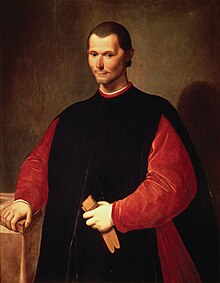

Niccolo Machiavelli
So—which is better: To be feared or loved?
In the 1993 film, A Bronx Tale, 17-year-old Calogero (Lillo Brancato) poses that question to his idol, the local Mafia capo, Sonny (Chazz Palminteri).
“That’s a good question,” Sonny replies. “It’s nice to be both, but it’s very difficult. But if I had my choice, I would rather be feared.”
Sonny has “done 10 years in the joint.” There he got an education in power—from the works of Machiavelli. Now he wants to pass on those hard-learned lessons to Calogero.
“Fear lasts longer than love. Friendships that are bought with money mean nothing. You see how it is around here. I make a joke, everybody laughs. I know I’m funny, but I’m not that funny. It’s fear that keeps them loyal to me.”

Sonny gives advice to his adopted son, Calogero
But Sonny warns there is a trick to being feared: “The trick is not being hated. That’s why I treat my men good, but not too good.
“I give too much, then they don’t need me. I give them just enough where they need me, but they don’t hate me.”
Many who quote Machiavelli in defense of being feared overlook this vital point: “Still a Prince should make himself feared in such a way that if he does not gain love, he at any rate avoids hatred, for fear and the absence of hatred may well go together.”
Presidents who desire above all to be loved risk inviting their enemies to see them as weaklings.
Case in point: Bill Clinton.
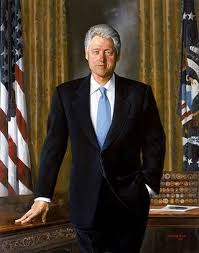
Bill Clinton
Clinton needed to be loved. He once said that if he were in a room with 100 people and 99 of them liked him but one didn’t, he would spend all his time with that one person, trying to win him over.
But while he could charm voters, he could not bring himself to retaliate against his sworn Republican enemies.
Clinton sought to endear himself to Republicans by:
- Adopting NAFTA–the Republican-sponsored North American Free Trade Act, which later proved so devastating to American workers;
- Siding with Republicans against poor Americans on welfare; and
- Championing the gutting of the Depression-era Glass-Steagall law, which barred investment banks from commercial banking activities.
In 1998, emboldened by Clinton’s refusal to stand up to them, House Republicans moved to impeach him over a sex scandal with White House intern Monica Lewinsky. But his Presidency survived when the Senate refused to convict.
To establish a fearful reputation, a leader must act decisively and ruthlessly when the interests of the organization are threatened. Punitive action must be taken promptly and confidently.
One or two harsh actions of this kind can make a leader more feared than a reign of terror.
Case in point: Ronald Reagan.
Always smiling, quick with a one-liner (especially at press conferences), seemingly unflappable, he projected a constantly optimistic view of his country and its citizens.
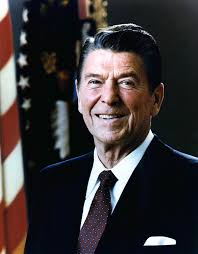
Ronald Reagan
But there was a steely, ruthless side to Reagan that appeared when he felt crossed.
On August 3, 1981, nearly 13,000 air traffic controllers walked out after contract talks with the Federal Aviation Administration collapsed. As a result, some 7,000 flights across the country were canceled on that day at the peak of the summer travel season.
Reagan branded the strike illegal. He threatened to fire any controller who failed to return to work within 48 hours.
On August 5, Reagan fired more than 11,000 air traffic controllers who hadn’t returned to work. The mass firing slowed commercial air travel, but it did not cripple the system as the strikers had forecast.
Reagan’s action stunned the American labor movement. Reagan was the only American President to have belonged to a union—the Screen Actors Guild. He had even been president of this, from 1947 to 1954.
There were no more strikes by Federal workers during Reagan’s tenure in office.
ABC NEWS, ALTERNET, AP, BUZZFEED, CBS NEWS, CIA, CLIFF ROBERTSON, CNN, CROOKS AND LIARS, DAILY KOS, DAILY KOZ, DONALD TRUMP, FACEBOOK, GLOBAL WARMING, ILLEGAL ALIENS, illegal immigration, IMMIGRATION AND CUSTOMS ENFORCEMENT (ICE), MASS MIGRATIONS, MEXICAN REVOLUTION, MEXICO, MIGRANT CARRAVAN, MOTHER JONES, MOVEON, MSNBC, NBC NEWS, NEWSWEEK, NICCOLO MACHIAVELLI, NPR, PBS NEWSHOUR, POLITICO, RAW STORY, REUTERS, ROBERT REDFORD, SALON, SEATTLE TIMES, SLATE, THE ATLANTIC, THE CHICAGO SUN-TIMES, THE CHICAGO TRIBUNE, THE DAILY BEAST, THE DISCOURSES, THE GUARDIAN, THE HILL, THE HUFFINGTON POST, THE LOS ANGELES TIMES, THE NATION, THE NEW YORK TIMES, THE WALL STREET JOURNAL, THE WASHINGTON POST, THREE DAYS OF THE CONDOR, TIJUANA, TIME, TWITTER, U.S. NEWS & WORLD REPORT, UPI, USA TODAY
In Bureaucracy, History, Law, Law Enforcement, Military, Politics, Social commentary, Uncategorized on December 6, 2018 at 12:11 am
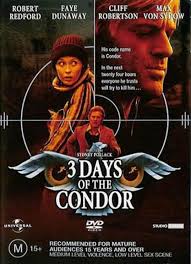
There’s a great exchange in the 1975 classic, Three Days of the Condor, that serves as a prophecy of what’s to come.
As the world heats up, more mass migrations will occur. Millions of people will retreat from the undeveloped “shithole countries” that Donald Trump detests and try to enter the United States and Europe.
This will be entirely natural. What will also be entirely natural is that those who have a decent life will want to hold onto it—and not be overwhelmed by millions who don’t share their same race, values, education and religion.
In Three Days of the Condor, Higgins, the deputy director of the CIA’s New York Division confronts Joe Turner, an idealistic ex-CIA employee on the realities of espionage.
Higgins (played by Cliff Robertson): “It’s simple economics. Today it’s oil, right? In ten or fifteen years, food. Plutonium. Maybe even sooner. Now, what do you think the people are gonna want us to do then?”
Joe Turner (played by Robert Redford): “Ask them?”
Higgins: “Not now—then! Ask ’em when they’re running out. Ask ’em when there’s no heat in their homes and they’re cold. Ask ’em when their engines stop. Ask ’em when people who have never known hunger start going hungry. You wanna know something? They won’t want us to ask ’em. They’ll just want us to get it for ’em!”
That day has come for millions of desperate people in Central and Latin America. And it is coming for all of us in the foreseeable future.
On October 13, a caravan of at least 5,000 men, women and children from El Salvador, Guatemala and Honduras set out for the United States. Many of them claim they have been threatened by street gangs such as MS-13 or by government officials.
On October 18, President Trump threatened to deploy the United States military and close the U.S.-Mexico border to keep the caravan from entering the country.
And then Trump did just that.
By November 19, migrants had begun piling up in Tijuana, which borders San Diego.
And that’s when Tijuana residents began carrying signs reading “No illegals,” “No to the invasion” and “Mexico First.” And marching in the streets wearing Mexico’s red, white and green national soccer jersey and vigorously waving Mexican flags.
“We want the caravan to go; they are invading us,” said Patricia Reyes, a 62-year-old protester. “They should have come into Mexico correctly, legally, but they came in like animals.”
And the situation will only worsen in the months ahead.
Trump has ordered Immigration and Customs Enforcement (ICE) to draft new rules to limit the number of asylum-seekers.
As increasing numbers of migrants pour into Tijuana, access to housing, schools, hospitals and other social services will become increasingly strained. Violent clashes between Tijuana’s 1.6 million residents and its thousands of uninvited arrivals will almost certainly be the result.
Tijuana’s mayor, Juan Manuel Gastélum, says Tijuana lacks the funds to continue supporting the migrants. He has requested support from Mexico’s federal authorities.
For decades, the Mexican Government did nothing to stop millions of its own citizens from routinely violating America’s immigration laws.
The reason: Mexicans still remember the bloody upheaval known as the Mexican Revolution (1910-1920) which slaughtered one to two million men, women and children. Massacres were common on all sides, with men shot by the hundreds in bullrings or hung by the dozen on trees.
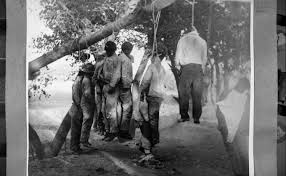
A Mexican “fruit tree”
As a result, every successive Mexican government has lived in the shadow of another such wholesale bloodletting. These officials have thus quietly turned the United States border into a safety valve.
If potential revolutionaries leave Mexico to find a better life in the United States, the Government doesn’t have to fear the rise of another “Pancho” Villa.
Suddenly, with the escape route to “El Norte” shut off, Mexicans have discovered that “illegal alien” is no longer a dirty phrase.
More than 500 years ago, Niccolo Machiavelli outlined the reason for such conflicts. In The Discourses, his masterwork on preserving liberty within a republic, he writes:
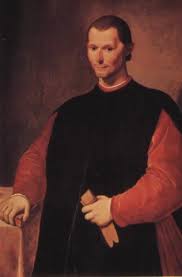
Niccolo Machiavelli
It was a saying of ancient writers, that men afflict themselves in evil, and become weary of the good, and that both these dispositions produce the same effects.
For when men are no longer obliged to fight from necessity, they fight from ambition, which passion is so powerful in the hearts of men that it never leaves them, no matter to what height they may rise.
The reason for this is that nature has created men so that they desire everything, but are unable to attain it. Desire being thus always greater than the faculty of acquiring, discontent with what they have and dissatisfaction with themselves result from it.
This causes the changes in their fortunes—for as some men desire to have more, while others fear to lose what they have, enmities and war are the consequences. And this brings about the ruin of one province and the elevation of another.
Those who want the United States to allow unchecked immigration are ignorant of such truths—or deliberately ignore them.
ABC NEWS, ADOLF HITLER, ALTERNET, AP, BILL CLINTON, BUZZFEED, CALIFORNIA ENERGY CRISIS, CBS NEWS, CHEVRON, CNN, COAL INDUSTRY, CROOKS AND LIARS, DAILY KOZ, DE-REGULATION, DEMOCRATS, ENRON, FACEBOOK, FBI, GEORGE W. BUSH, GRAY DAVIS, HEINRICH HIMMLER, HOLOCAUST, MAFIA, MOTHER JONES, MOVEON, MSNBC, NBC NEWS, NEWSWEEK, NICCOLO MACHIAVELLI, NPR, PACIFIC GAS AND ELECTRIC, PBS NEWSHOUR, PETE WILSON, POLITICO, RAW STORY, REPUBLICANS, REUTERS, RICO ACT, SALON, SEATTLE TIMES, SLATE, SS, THE ATLANTIC, THE CHICAGO SUN-TIMES, THE CHICAGO TRIBUNE, THE DAILY BEAST, THE GUARDIAN, THE HILL, THE HUFFINGTON POST, THE LOS ANGELES TIMES, THE NATION, THE NEW YORK TIMES, THE SS, THE WALL STREET JOURNAL, THE WASHINGTON POST, TIME, TWITTER, U.S. DEPARTMENT OF JUSTICE, U.S. NEWS & WORLD REPORT, UPI, USA TODAY
In Bureaucracy, History, Law, Law Enforcement, Politics, Social commentary on November 29, 2018 at 12:05 am
A forgotten anniversary is fast approaching: This December 2 will mark the 17th anniversary of the collapse of Enron Corporation.
Based in Houston, Texas, Enron had employed 22,000 staffers and was one of the world’s leading electricity, natural gas, communications and paper companies.
In 2000, it claimed revenues of nearly $101 billion. Fortune had named Enron “America’s Most Innovative Company” for six consecutive years.
But then the truth emerged in 2001: Enron’s reported profitability was based not on brilliance and innovation but on systematic and creative accounting fraud.
And, on December 2, 2001, Enron filed for bankruptcy under Chapter 11 of the United States Bankruptcy Code.
Enron’s $63.4 billion in assets made it the largest corporate bankruptcy in U.S. history—until WorldCom’s bankruptcy in 2002.

The California electricity crisis (2000-2001) was caused by market manipulations and illegal shutdowns of pipelines by Texas energy companies.
The state suffered from multiple large-scale blackouts. Pacific Gas & Electric, one of the state’s largest energy companies, collapsed, and the economic fall-out greatly harmed Governor Gray Davis’ standing.
The crisis was made possible by Governor Pete Wilson, who had forced the passage of partial de-regulation legislation in 1996.
Enron seized its opportunity to inflate prices and manipulate energy output in California’s spot markets. The crisis cost the state $40 to $45 billion.
The true scandal of Enron was not that it was eventually destroyed by its own greed.
The true scandal was that its leaders were never Federally prosecuted for almost driving California—and the entire Western United States—into bankruptcy.
Under the pro-oil company administration of George W. Bush, no such prosecutions ever occurred. But Americans had a right to expect such redress under “liberal” President Bill Clinton.
Once the news broke that Enron had filed for bankruptcy, commentators almost universally oozed compassion for its thousands of employees who would lose their salaries and pensions.
No one, however, condemned the “profits at any cost” dedication of those same employees for pushing California to the brink of ruin.
To put this in historical perspective:
- Imagine a historian writing about the destruction of Hitler’s Schutzstaffel (Guard Detachment), or SS, as a human interest tragedy.
- Imagine its Reichsfuehrer, Heinrich Himmler, being blamed for failing to prevent its collapse—as CEO Kenneth Lay was blamed for Enron’s demise.
- Imagine that same historian completely ignoring the horrific role the SS had played throughout Nazi-occupied countries—and its primary role in slaughtering six million Jews in the Holocaust.
Nor did anyone in the media or government declare that the solution to such extortionate activity lay within the United States Department of Justice via RICO—the Federal Racketeer Influenced Corrupt Organizations Act.

Passed by Congress in 1970, this was originally aimed at the kingpins of the Mafia. Since the mid-1980s, however, RICO has been successfully applied against both terrorist groups and legitimate businesses engaged in criminal activity.
Under RICO, people financially injured by a pattern of criminal activity can bring a claim in State or Federal court, and obtain damages at three times the amount of their actual claim, plus reimbursement for their attorneys’ fees and costs.
Such prosecutions would have pitted energy-extortionists against the full investigative might of the FBI and the sweeping legal authority of the Justice Department.
Consider this selection from the opening of the Act:
(1) “racketeering activity” means (A) any act or threat involving…extortion; (B) any act which is indictable under any of the following provisions of title 18, United States Code: sections 891-894 (relating to extortionate credit transactions), section 1343 (relating to wire fraud)Section 1344 (relating to financial institution fraud), section 1951 (relating to interference with commerce, robbery, or extortion), section 1952 (relating to racketeering)….
With the 17th anniversary of Enron’s demise coming up, the mantra of “de-regulation” should be ruthlessly turned against those who have most ardently championed it.
Republicans have ingeniously dubbed the estate tax—which affects only a tiny minority of ultra-rich—“the death tax.” This makes it appear to affect everyone.
Democrats should thus recast de-regulation in terms that will prove equally popular. For example:
“Greed Relief”
“Greed Protection”
“Legalized Extortion”
And here are some possible slogans:
“The Energy Industry: Giving You the Best Congress Money Can Buy.”
“De-regulation: Let Criminals Be Criminals.”
Today the coal industry is pumping millions into TV ads touting the non-existent wonders of “clean coal.” And Chevron spends millions assuring us that “all those profits” go strictly toward making the world a better place for others. (Presumably not a penny is left for its altruistic executives.)
When faced with such outright lying by the most vested of financial interests, it’s well to recall the warning given by Niccolo Machiavelli more than 500 years ago:
All those who have written upon civil institutions demonstrate…that whoever desires to found a state and give it laws, must start with assuming that all men are bad and ever ready to display their vicious nature, whenever they may find occasion for it.
If their evil disposition remains concealed for a time, it must be attributed to some unknown reason; and we must assume that it lacked occasion to show itself. But time, which has been said to be the father of all truth, does not fail to bring it to light.
2003 IRAQ WAR, ABC NEWS, ALTERNET, ASIANS, BARACK OBAMA, BIRTH CONTROL, BLACKS, BUZZFEED, CBS NEWS, CNN, DAILY KOS, DISABLED, DONALD TRUMP, ED MARTIN, FACEBOOK, HILLARY CLINTON, HUMAYUN KHAN, KATRINA PIERSON, LATINOS, MARCO GUTIERREZ, MEDICAID, MEDICARE, MOTHER JONES, MOVEON, MSNBC, MUSLIMS, NBC NEWS, NEWSWEEK, NICCOLO MACHIAVELLI, NPR, OBAMACARE, POLITICO, PRISONERS OF WAR, RAW STORY, SALON, SLATE, SOCIAL SECURITY, TEA PARTY, THE CHICAGO SUN-TIMES, THE CHICAGO TRIBUNE, THE DAILY BEAST, THE DISCOURSES, THE HUFFINGTON POST, THE LOS ANGELES TIMES, THE NEW YORK TIMES, THE PRINCE, THE WALL STREET JOURNAL, THE WASHINGTON POST, TIME, TWITTER, U.S. NEWS & WORLD REPORT, USA TODAY, WAYNE ROOT, WOMEN
In Bureaucracy, History, Military, Politics, Social commentary on November 22, 2018 at 12:06 am
No shortage of pundits have sized up Donald Trump—first as a Presidential candidate, and now as the nation’s 45th President.
But how does Trump measure up in the estimate of Niccolo Machiavelli, the 16th-century Florentine statesman?
It is Machiavelli whose two great works on politics—The Prince and The Discourses—remain textbooks for successful politicians more than 500 years later.
Niccolo Machiavelli
Let’s start with Trump’s notoriety for hurling insults at virtually everyone, including:
- Latinos
- Asians
- Muslims
- Blacks
- The Disabled
- Women
- Prisoners-of-War
These insults delight his white, under-educated followers. But they have alienated millions of other Americans who might have voted for him.
Now consider Machiavelli’s advice on gratuitously handing out insults and threats:
-
“I hold it to be a proof of great prudence for men to abstain from threats and insulting words towards any one.
-
“For neither the one nor the other in any way diminishes the strength of the enemy—but the one makes him more cautious, and the other increases his hatred of you, and makes him more persevering in his efforts to injure you.”
For those who expected Trump to shed his propensity for constantly picking fights, Machiavelli had a stern warning:
-
“…If it happens that time and circumstances are favorable to one who acts with caution and prudence he will be successful. But if time and circumstances change he will be ruined, because he does not change the mode of his procedure.
-
“No man can be found so prudent as to be able to adopt himself to this, either because he cannot deviate from that to which his nature disposes him, or else because, having always prospered by walking in one path, he cannot persuade himself that it is well to leave it…
-
“For if one could change one’s nature with time and circumstances, fortune would never change.”
Then there is Trump’s approach to consulting advisers:
Asked on MSNBC’s “Morning Joe” who he consults about foreign policy, Trump replied; “I’m speaking with myself, number one, because I have a very good brain and I’ve said a lot of things.”

Donald Trump
This totally contrasts with the advice given by Machiavelli:
-
“A prudent prince must [choose] for his counsel wise men, and [give] them alone full liberty to speak the truth to him, but only of those things that he asks and of nothing else.
-
“But he must be a great asker about everything and hear their opinions, and afterwards deliberate by himself in his own way, and in these counsels…comport himself so that every one may see that the more freely he speaks, the more he will be acceptable.”
And Machiavelli has potent advice on the selection of advisers:
- “The first impression that one gets of a ruler and his brains is from seeing the men that he has about him.
- “When they are competent and loyal one can always consider him wise, as he has been able to recognize their ability and keep them faithful.
- “But when they are the reverse, one can always form an unfavorable opinion of him, because the first mistake that he makes is in making this choice.”
Consider some of the advisers Trump relied on in his campaign for President:
- Founder of Latinos for Trump Marco Gutierrez told MSNBC’s Joy Reid: “My culture is a very dominant culture. And it’s imposing, and it’s causing problems. If you don’t do something about it, you’re gonna have taco trucks every corner.”
- At a Tea Party for Trump rally at a Harley-Davidson dealership in Festus, Missouri, former Missouri Republican Party director Ed Martin reassured the crowd that they weren’t racist for hating Mexicans.
From the outset of his Presidential campaign, Trump polled extremely poorly among Hispanic voters. Comments like these didn’t increase his popularity.
- Wayne Root, opening speaker and master of ceremonies at many Trump campaign events, told Virginia radio host Rob Schilling: People on public assistance and women getting birth control through Obamacare should not be allowed to vote.
Comments like this are a big turn-off among the 70% of women who have an unfavorable opinion of him—and anyone who receives Medicaid, Medicare or Social Security.
- Trump’s spokeswoman, Katrina Pierson, claimed that Barack Obama and Hillary Clinton were responsible for the death of Captain Humayun Khan—who was killed by a truck-bomb in Iraq in 2004.
Obama became President in 2009—-almost five years after Khan’s death. And Clinton became Secretary of State the same year.
When your spokeswoman becomes a nationwide laughingstock, your own credibility goes down the toilet as well.
Finally, Machiavelli offers a related warning that especially applies to Trump: Unwise princes cannot be wisely advised.
-
“It is an infallible rule that a prince who is not wise himself cannot be well advised, unless by chance he leaves himself entirely in the hands of one man who rules him in everything, and happens to be a very prudent man. In this case, he may doubtless be well governed, but it would not last long, for the governor would in a short time deprive him of the state.”
All of which would lead Niccolo Machiavelli to warn, if he could witness American politics today: “This bodes ill for your Republic.”
ABC NEWS, ADOLF HITLER, ALTERNET, AMERICABLOG, AP, ASSASSINATION, BABY BOOMER RESISTANCE, BBC, BLOOMBERG, BUZZFEED, CBS NEWS, CNN, CONSPIRACIES, CROOKS AND LIARS, DAILY KOS, DAY OF THE JACKAL, DONALD TRUMP, FACEBOOK, FIVETHIRTYEIGHT, FREDERICK FORSYTHE, GAIUS CASSIUS, HARPER’S MAGAZINE, HUFFINGTON POST, JULIUS CAESAR, LINCOLN MEMORIAL, MAR-A-LAGO, MARCUS BRUTUS, MARK ANTHONY, MEDIA MATTERS, MOTHER JONES, MOVEON, MSNBC, NBC NEWS, NEW REPUBLIC, NEWSDAY, NEWSWEEK, NICCOLO MACHIAVELLI, NPR, PBS NEWSHOUR, PLOTS, POLITICO, POLITICUSUSA, RAW STORY, REUTERS, RICHARD M. NIXON, SALON, SEATTLE TIMES, Secret Service, SLATE, TALKING POINTS MEMO, THE ATLANTIC, THE CHICAGO SUN-TIMES, THE CHICAGO TRIBUNE, THE DAILY BEAST, THE DAILY BLOG, THE DISCOURSES, THE GUARDIAN, THE HILL, THE HUFFINGTON POST, THE INTERCEPT, THE LOS ANGELES TIMES, THE NATION, THE NEW REPUBLIC, THE NEW YORK TIMES, THE NEW YORKER, THE VILLAGE VOICE, THE WALL STREET JOURNAL, THE WASHINGTON POST, THINKPROGRESS, TIME, TRUTHDIG, TRUTHOUT, TWO POLITICAL JUNKIES, U.S. NEWS & WORLD REPORT, UPI, USA TODAY, VIETNAM WAR, WHITE HOUSE STAFFER, X
In Bureaucracy, History, Law Enforcement, Politics, Social commentary on October 12, 2018 at 1:06 am
Niccolo Machiavelli, the father of modern political science, wrote that there are three periods of danger in a conspiracy:
- Dangers in organizing the plot
- Dangers in executing the conspiracy
- Dangers following the execution of the plot.
The first two were covered in Part Two of this series. Now, as to the third:
Dangers following the Execution of the Conspiracy: There is really but one—someone is left who will avenge the murdered prince. These can be brothers, sons or other relatives, who have been spared by negligence or for other reasons.
But of all the perils that follow the execution of a conspiracy, the most certain and fearful is the attachment of the people to the murdered prince. There is no remedy against this, for the conspirators can never secure themselves against a whole people.
An example of this occurred in the case of Julius Caesar, who, being beloved by the people, was avenged by them.
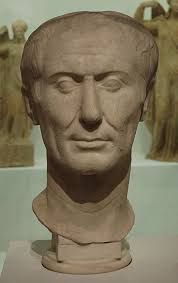
Julius Caesar
Machiavelli closes his chapter “Of Conspiracies” with advice to rulers on how they should act when they find a conspiracy has been formed against them.
If they discover that a conspiracy exists against them, they must, before punishing its authors, strive to learn its nature and extent. And they must measure the danger posed by the conspirators against their own strength.
And if they find it powerful and alarming, they must not expose it until they have amassed sufficient force to crush it. Otherwise, they will only speed their own destruction. They should try to pretend ignorance of it. If the conspirators find themselves discovered, they will be forced by necessity to act without consideration.
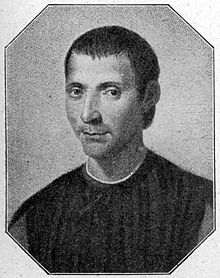
Niccolo Machiavelli
The foregoing was taken from Book Three, Chapter Six, of Machiavelli’s masterwork, The Discourses on Livy, which was published posthumously in 1531. But elsewhere in this volume, he notes how important it is for rulers to make themselves loved—or at least respected—by their fellow citizens:
Note how much more praise those Emperors merited who, after Rome became an empire, conformed to her laws like good princes, than those who took the opposite course.
Titus, Nerva, Trajan, Hadrian, Antoninus and Marcus Auelius did not require the Praetorians nor the multitudinous legions to defend them, because they were protected by their own good conduct, the good will of the people, and by the love of the Senate.
On the other hand, neither the Eastern nor the Western armies saved Caligula, Nero, Vitellius and so many other wicked Emperors from the enemies which their bad conduct and evil lives had raised up against them.
In his better-known work, The Prince, he warns rulers who—like Donald Trump–are inclined to rule by fear:
A prince should make himself feared in such a way that if he does not gain love, he at any rate avoids hatred: for fear and the absence of hatred may well go together.
Donald Trump
* * * * *
If Trump is aware of Machiavelli’s warnings, he has shown no signs of it.
Most Presidents have sought to make themselves seem friendly and caring toward their fellow Americans.
This held true even for Richard M. Nixon, when he made an impromptu visit to the Lincoln Memorial and engaged in a rambling dialogue with Vietnam war protesters.
The encounter happened around 4 a.m. on May 9, 1970, shortly after the invasion of Cambodia. Nationwide outrage had exploded on college campuses, climaxing in the killing of four students at Kent State University on May 4.
So young Vietnam antiwar protesters who had descended on Washington, D.C. were startled when Nixon suddenly appeared in their midst.
Even more startling: He had come with only a small number of Secret Service agents and his devoted White House valet, Manolo Sanchez.
Nixon, in his awkward way of trying to establish rapport, asked some of the students where they were from. When they said they attended Syracuse University, Nixon replied that it had a great football team.
But Nixon and the protesters were separated by too many differences–in their views on sexuality, civil rights, dissent and war—to find common cause.
Still, Nixon at least made an effort to understand and reach an accommodation with his critics.
Since taking office on January 20, Donald Trump has made none.
Instead, he has:
- Held a series of “victory rallies” with his Right-wing followers—which comedian Bill Mahrer calls “hillbilly Nurembergs.”
- Attacked the integrity of Federal judges who struck down his travel ban on Muslims.
- Called the nation’s most prestigious news media “the enemy of the American people.”
- Slandered truthful stories about his staffers’ ties to Russian Intelligence agents as “fake news.”
- Falsely accused his predecessor, President Barack Obama, of wiretapping him.
These and other infamous actions have led to only 45% of Americans approving of his performance—while 52% disapprove.
By Machiavelli’s standards, Trump has made himself the perfect target for a conspiracy: “When a prince becomes universally hated, it is likely that he’s harmed some individuals—who thus seek revenge. This desire is increased by seeing that the prince is widely loathed.”
ABC NEWS, ADOLF HITLER, ALTERNET, AMERICABLOG, AP, ASSASSINATION, BABY BOOMER RESISTANCE, BBC, BLOOMBERG, BUZZFEED, CBS NEWS, CNN, CONSPIRACIES, CROOKS AND LIARS, DAILY KOS, DAY OF THE JACKAL, DONALD TRUMP, FACEBOOK, FIVETHIRTYEIGHT, FREDERICK FORSYTHE, GAIUS CASSIUS, HARPER’S MAGAZINE, HUFFINGTON POST, JULIUS CAESAR, LINCOLN MEMORIAL, MAR-A-LAGO, MARCUS BRUTUS, MARK ANTHONY, MEDIA MATTERS, MOTHER JONES, MOVEON, MSNBC, NBC NEWS, NEW REPUBLIC, NEWSDAY, NEWSWEEK, NICCOLO MACHIAVELLI, NPR, PBS NEWSHOUR, PLOTS, POLITICO, POLITICUSUSA, RAW STORY, REUTERS, RICHARD M. NIXON, SALON, SEATTLE TIMES, Secret Service, SLATE, TALKING POINTS MEMO, THE ATLANTIC, THE CHICAGO SUN-TIMES, THE CHICAGO TRIBUNE, THE DAILY BEAST, THE DAILY BLOG, THE DISCOURSES, THE GUARDIAN, THE HILL, THE HUFFINGTON POST, THE INTERCEPT, THE LOS ANGELES TIMES, THE NATION, THE NEW REPUBLIC, THE NEW YORK TIMES, THE NEW YORKER, THE VILLAGE VOICE, THE WALL STREET JOURNAL, THE WASHINGTON POST, THINKPROGRESS, TIME, TRUTHDIG, TRUTHOUT, TWO POLITICAL JUNKIES, U.S. NEWS & WORLD REPORT, UPI, USA TODAY, VIETNAM WAR, WHITE HOUSE STAFFER, X
In Bureaucracy, History, Law Enforcement, Military, Politics, Social commentary on October 11, 2018 at 12:19 am
More than 500 years ago, Niccolo Machiavelli, the Florentine statesman, authored The Discourses on Livy, a work of political history and philosophy. In it, he outlined how citizens of a republic can maintain their freedoms.
One of the longest chapters—Book Three, Chapter Six—covers “Of Conspiracies.” In it, those who wish to conspire against a ruler will find highly useful advice.
And so will those who wish to foil such a conspiracy.
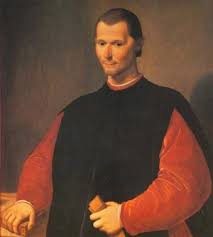
Niccolo Machiavelli
Writes Machiavelli:
For conspirators, there are three ways their efforts can be foiled:
- Discovery through denunciation;
- Discovery through incautiousness;
- Discovery through writings.
Discovery through Denunciation: This occurs through treachery or lack of prudence among one or more conspirators.
Treachery is so common that you can safely tell your plans to only your most trusted friends who are willing to risk their lives for your sake. You may find that you have only one or two of these.
But as you are bring more people into the conspiracy, the chances of discovery greatly increase. It’s impossible to find many who can be completely trusted: For their devotion to you must be greater than their sense of danger and fear of punishment.
Discovery through Carelessness: This happens when one of the conspirators speaks incautiously, so that a third person overhears it Or it may occur from thoughtlessness, when a conspirator tells the secret to his wife or child, or to some other indiscreet person.
When a conspiracy has more than three or four members, its discovery is almost certain, either through treason, imprudence or carelessness.
If more than one conspirator is arrested, the whole plot is discovered, for it will be impossible for any two to agree perfectly as to all their statements.
If only one is arrested, he may—through courage and stubbornness—be able to conceal the names of his accomplices. But then the others, to remain safe, must not panic and flee, since this is certain to be discovered.
If one of them becomes fearful—whether it’s the one who was arrested or is still at liberty—discovery of the conspiracy is certain.
The best way to avoid such detection is to confide your project to your intended fellow conspirators at the moment of execution—and not sooner.
A classic example of this occurred in ancient Persia: A group of nobles assembled to discuss overthrowing a usurper to the throne. The last one to arrive was Darius.
When one of the conspirators asked, “When should we strike?” Darius replied: “We must either go now at this very moment and carry it into execution, or I shall go and denounce you all. For I will not give any of you time to denounce me.”
At that, they went directly to the palace, assassinated the usurper and proclaimed Darius their new king.

Discovery through Writings: You may talk freely with anyone man about everything, for unless you have committed yourself in writing, the “Yes” of one man is worth as much as the “No” of another.
Thus, you should guard most carefully against writing, as against a dangerous rock, for nothing will convict you quicker than your own handwriting.
You may escape, then, from the accusation of a single individual, unless you are convicted by some writing or other pledge, which you should be careful never to give.
If you are denounced, there are means of escaping punishment:
- By denying the accusation and claiming that the person making it hates you; or
- Claiming that your accuser was tortured or coerced into giving false testimony against you.
But the most prudent course is to not tell your intentions to anyone, and to carry out the attempt yourself.
Even if you’re not discovered before you carry out your attack, there are still two dangers facing a conspirator:
Dangers in Execution: These result from:
- An unexpected change in the routine of the intended target;
- The lack of courage among the conspirators; or
- An error on their part, such as leaving some of those alive whom the conspirators intended to kill.
Adolf Hitler, who claimed to have a sixth-sense for danger, was famous for changing his routine at the last minute.
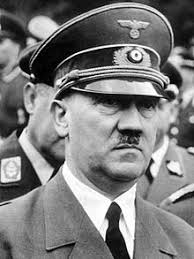

Adolf Hitler
On November 9, 1939, this instinct saved his life. He had been scheduled to give a long speech at a Munich beer hall before the “Old Fighters” of his storm troopers.
But that evening he cut short his speech and left the beer hall. Forty-five minutes later, a bomb exploded inside a pillar—before which Hitler had been speaking.
Conspirators can also be doomed by their good intentions.
In 44 B.C., Gaius Cassius, Marcus Brutus and other Roman senators decided to assassinate Julius Caesar, whose dictatorial ambitions they feared.
Cassius also intended to murder Mark Anthony, Caesar’s strongest ally. But Brutus objected, fearing the plotters would look like butchers, not saviors. Even worse, he allowed Anthony to deliver a eulogy at Caesar’s funeral.
This proved so inflammatory that the mourners rioted, driving the conspirators out of Rome. Soon afterward, they were defeated in a battle with the legions of Anthony and Octavian Caesar—and forced to commit suicide to avoid capture and execution.
ABC NEWS, ADOLF HITLER, ALTERNET, AMERICABLOG, AP, ASSASSINATION, BABY BOOMER RESISTANCE, BBC, BLOOMBERG, BUZZFEED, CBS NEWS, CNN, CONSPIRACIES, CROOKS AND LIARS, DAILY KOS, DAY OF THE JACKAL, DONALD TRUMP, FACEBOOK, FIVETHIRTYEIGHT, FREDERICK FORSYTHE, GAIUS CASSIUS, HARPER’S MAGAZINE, HUFFINGTON POST, JULIUS CAESAR, LINCOLN MEMORIAL, MAR-A-LAGO, MARCUS BRUTUS, MARK ANTHONY, MEDIA MATTERS, MOTHER JONES, MOVEON, MSNBC, NBC NEWS, NEW REPUBLIC, NEWSDAY, NEWSWEEK, NICCOLO MACHIAVELLI, NPR, PBS NEWSHOUR, PLOTS, POLITICO, POLITICUSUSA, RAW STORY, REUTERS, RICHARD M. NIXON, SALON, SEATTLE TIMES, Secret Service, SLATE, TALKING POINTS MEMO, THE ATLANTIC, THE CHICAGO SUN-TIMES, THE CHICAGO TRIBUNE, THE DAILY BEAST, THE DAILY BLOG, THE DISCOURSES, THE GUARDIAN, THE HILL, THE HUFFINGTON POST, THE INTERCEPT, THE LOS ANGELES TIMES, THE NATION, THE NEW REPUBLIC, THE NEW YORK TIMES, THE NEW YORKER, THE VILLAGE VOICE, THE WALL STREET JOURNAL, THE WASHINGTON POST, THINKPROGRESS, TIME, TRUTHDIG, TRUTHOUT, TWO POLITICAL JUNKIES, U.S. NEWS & WORLD REPORT, UPI, USA TODAY, VIETNAM WAR, WHITE HOUSE STAFFER, X
In Bureaucracy, History, Law Enforcement, Military, Politics, Social commentary on October 10, 2018 at 12:01 am
In the 1973 movie, The Day of the Jackal, a methodical assassin devises an ingenious plan to kill French President Charles de Gaulle.
Despite the best efforts of French security forces to entrap him, he eludes them time and again—and comes within an ace of assassinating de Gaulle.

The Day of the Jackal is fiction, based on a 1971 novel by Frederick Forsythe. In real life, most would-be political assassins lack the skills and sophistication of Forsythe’s anti-hero.
Take the case of the man who, on March 18, 2017, jumped over a bicycle rack outside the security perimeter of the White House. Within two minutes, agents of the U.S. Secret Service had tackled and arrested him.
Then, hours later, a motorist drove up to a White House checkpoint and claimed to have a bomb. Secret Service agents immediately arrested him and seized the stolen 2017 Chevrolet Impala. After a careful search, no explosives were found.
Both men will face criminal prosecution—and probably years in prison.
Even if they had been armed, President Donald J. Trump would not have faced any danger.
For the fifth time since taking office on January 20, he was in Florida, vacationing at his Mar-a-Lago resort.
That does not mean, of course, that future assassins will prove so inept.
More than 500 years ago, Niccolo Machiavelli, the father of modern political science, offered sound advice for would-be conspirators—and for rulers seeking to thwart conspiracies.
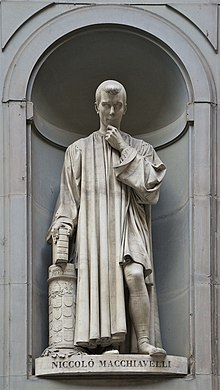
Niccolo Machiavellil
Niccolo Machiavelli: When a prince becomes universally hated, it is likely that he’s harmed some individuals—who thus seek revenge. This desire is increased by seeing the prince is widely loathed.
A prince, then, should avoid incurring such universal hatred….
By doing this, he protects himself from such vengeance-seekers. There are two reasons for this:
(1) Men rarely risk danger to avenge a wrong; and
(2) Even if they want to avenge a wrong, they know they will face almost universal condemnation because the prince is held in such high esteem.
So much for Machiavelli.
Now consider some of the tweets of “White House Staffer,” a self-proclaimed member of the Trump administration who claims 160,000 Twitter followers.
Since January 27, 2017, he has blasted a series of short, information-crammed tweets about daily life in the Executive Mansion.
[NOTE: Although I can’t confirm the legitimacy of his status or his tweets, I believe they are real. They contain too many small, intimate secrets of life in a paranoia-laced White House to not be genuine.]
March 1, 2017: Well the good times didn’t last long here. POTUS is back to flipping out on us.
March 13: POTUS [President of the United States] is thinking about suspending daily press briefings until the media “learn to be nice.” [Steve] Bannon [a top Trump adviser] is pushing for it.
March 16: Sean Hannity was asked to be Press Secretary last week. He turned it down because he didn’t want to take the pay cut. [Sean] Spicer survives.

Donald Trump
Niccolo Machiavelli: He who is threatened, and decides to avenge himself on the prince, becomes a truly dangerous man.
Anger is most likely aroused by injury to a a man’s property or honor. A prince should carefully avoid injuring either, for such a victim will always desire vengeance.
White House Staffer – February 25, 2017: The President keeps saying we’re a finely tuned machine. If that’s true why has he been fricking screaming at us all week? He’s losing it.
February 27: [Steve] Bannon is the scariest person here. He’s broken so much White House stuff by throwing it in anger. Plates, phones, chairs, etc.
February 27: It’s one thing to swear but [Steve] Bannon does it in front of the women here. C**t this, c**t that. He can’t finish a sentence without it.
Machiavelli draws a distinction between plots and conspiracies. A plot may be formed by a single individual or by many. The first isn’t a conspiracy, since that would involve at least two participants.
A single plotter avoids the danger faced by two or more conspirators: Since no one knows his intention, he can’t be betrayed by an accomplice.
Anyone may form a plot, whether he is prominent or insignificant, because everyone is at some time allowed to speak to the prince. And he can use this opportunity to satisfy his desire for revenge.
On the other hand, says Machiavelli, the dangers of assassination by a trusted intimate are slight: Few people dare to assault a prince. Of those who do, few or none escapes being killed in the attempt, or immediately afterward. As a result, only a small number of people are willing to incur such certain death.
Those who take part in a conspiracy against a ruler are “the great men of the state, or those on terms of familiar intercourse with the prince.”
These are men who have access to him. Julius Caesar, for example, was stabbed to death by members of the Roman Senate, who feared his assuming dictatorial powers.
And Adolf Hitler was conspired against by colonels and generals of the German Army. He was in fact holding a war conference when a briefcase bomb exploded, killing three officers and a stenographer, but leaving Hitler only slightly injured.
9/11, ABC NEWS, ACADEMI, AFGHANISTAN, ALTERNET, ANDROID, AP, APPLE IOS, BARACK OBAMA, BLACKWATER, BOOZ ALLEN HAMILTON, BUZZFEED, CBS NEWS, CENTRAL INTELLIGENCE AGENCY, CNN, COFER BLACK, COLD WAR, CONTRACT EMPLOYEES, CROOKS AND LIARS, DAILY KOZ, DONALD TRUMP, EDWARD SNOWDEN, ENRIQUE PRADO, ERIK PRINCE, FACEBOOK, GEORGE W. BUSH, GREEN BERETS, IRAQ, LEGACY OF ASHES (BOOK), LOCKHEED MARTIN, MERCENARIES, MICROSOFT WINDOWS, MOTHER JONES, MOVEON, NATIONAL SECURITY AGENCY, NAVY SEALS, NBC NEWS, NEWSWEEK, NICCOLO MACHIAVELLI, NPR, PAUL BREMER, POLITICO, RAW STORY, REUTERS, ROBERT RICHER, SALON, SEATTLE TIMES, SLATE, SMARTPHONES, THE ATLANTIC, THE CHICAGO SUN-TIMES, THE CHICAGO TRIBUNE, THE DAILY BEAST, THE GUARDIAN, THE HILL, THE HUFFINGTON POST, THE LOS ANGELES TIMES, THE NATION, THE NEW YORK TIMES, THE PENTAGON, THE WASHINGTON POST, TIM WEINER, TIME, TORTURE, TOTAL INTELLIGENCE SOLUTIONS, TWITTER, U.S. NEWS & WORLD REPORT, UNITED STATES AIR FORCE, UNITED STATES ARMY, UPI, USA TODAY, WIKILEAKS, XE SERVICES
In Bureaucracy, Business, History, Military, Politics, Social commentary on August 27, 2018 at 12:07 am
The United States has been fighting in Afghanistan for almost 17 years—with no end in sight.
Between 2001 and 2017, America spent an estimated $714 billion on this conflict.
Now Blackwater founder Erik Prince claims he can attain a victory that has eluded the United States Air Force, Army (including Green Berets) and Navy SEALs.
His proposed solution: His private army of mercenaries—and $3.5 billion in taxpayer monies.

Erik Prince
By Miller Center [CC BY 2.0 (https://creativecommons.org/licenses/by/2.0)%5D, via Wikimedia Commons
In 1997, Prince created Blackwater, a private security company providing support to military and police agencies.
In August, 2003, Blackwater got the first of a series of Federal contracts to deploy its forces in Iraq. For $21 million, it would safeguard Paul Bremer, the proconsul running the American occupation in Iraq.
Ultimately, Blackwater got $1 billion to provide security for American officials and soldiers in Iraq and Afghanistan.
According to human rights organizations, Blackwater abused Iraqis and engaged in torture to obtain information.
In September, 2007, Blackwater guards killed 17 Iraqi civilians and injured 20 more in a Baghdad traffic circle.
Five guards were charged with murder. Three were convicted in October, 2014, of 14 manslaughter charges and in April 2015 sentenced to 30 years in prison. These sentences were deemed unfair upon appeal and await re-sentencing.
As a result of its highly controversial activities in Iraq, Prince renamed the company Xe Services in 2009 and then Academi in 2011.
Now, against opposition by the Pentagon, Prince is pressing Trump to let Academi privatize the war in Afghanistan.
Since the end of the Cold War, the American military and Intelligence communities have grown increasingly dependent on private contractors.
In his 2007 bestseller, Legacy of Ashes: The History of the CIA, Tim Weiner writes:
“Patriotism for profit became a $50-billion-a-year business….The [CIA] began contracting out thousands of jobs to fill the perceived void by the budget cuts that began in 1992.
“A CIA officer could file his retirement papers, turn in his blue identification badge, go to work for a much better salary at a military contractor such as Lockheed Martin or Booz Allen Hamilton, then return to the CIA the next day, wearing a green badge….”
Much of the CIA became totally dependent on mercenaries. They appeared to work for the agency, but their loyalty was actually to their private–and higher-paying—companies.
Writes Weiner: “Legions of CIA veterans quit their posts to sell their services to the agency by writing analyses, creating cover for overseas officers, setting up communications networks, and running clandestine operations.”
One such company was Total Intelligence Solutions, founded in 2007 by Cofer Black, who had been the chief of the CIA’s counter-terrorism center on 9/11. His partners were Robert Richer, formerly the associate deputy director of operations at the CIA, and Enrique Prado, who had been Black’s chief of counter-terror operations at the agency.
Future CIA hires followed suit: Serve for five years, win that prized CIA “credential” and sign up with a private security company to enrich themselves.
This situation met with full support from Right-wing “pro-business” members of Congress and President George W. Bush.
They had long championed the private sector as inherently superior to the public one. And they saw no danger that a man dedicated to enriching himself might put greed ahead of safeguarding his country.
But there are dangers to hiring men whose first love is profit. Recent examples include:
- Edward Snowden deliberately joined Booz Allen Hamilton to secure a job as a computer systems administrator at the National Security Agency (NSA). This gave him access to thousands of highly classified documents—which, in 2013, he began publicly leaking to a wide range of news organizations.
- His motive, he has claimed, was to warn Americans of the privacy-invading dangers posed by their own Intelligence agencies.
- On March 7, 2017, WikiLeaks published a “data dump” of 8,761 documents codenamed “Vault 7.”
- The documents exposed that the CIA had found security flaws in software operating systems such as Microsoft Windows, Android and Apple iOS. These allowed an intruder—such as the CIA—to seize control of a computer or smartphone. The owner could then be photographed through his iPhone camera and have his text messages intercepted.
- According to anonymous U.S. Intelligence and law enforcement sources, the culprits were CIA contract employees.
But there are those who have offered a timely warning against the use of mercenaries. One of these is Niccolo Machiavelli, the Florentine statesman of the Renaissance.
Niccolo Machiavelli
In The Prince, Machiavelli writes:
“Mercenaries…are useless and dangerous. And if a prince holds on to his state by means of mercenary armies, he will never be stable or secure. For they are disunited, ambitious, without discipline, disloyal. They are brave among friends; among enemies they are cowards.
“They have neither the fear of God nor fidelity to man, and destruction is deferred only as the attack is. For in peace one is robbed by them, and in war by the enemy.
“The cause of this is that they have no love or other motive to keep them in the field beyond a trifling wage, which is not enough to make them ready to die for you.”
Centuries after Machiavelli’s warning, Americans are realizing the bitter truth of it firsthand.
2016 PRESIDENTIAL ELECTION, 2020 TRUMP PRESIDENTIAL CAMPAIGN, ABC NEWS, ALTERNET, AP, BREITBART NEWS, BUZZFEED, CBS NEWS, CELEBRITY APPRENTICE, CIA, CNN, CROOKS AND LIARS, DAILY KOZ, DAVID BROOKS, DEMOCRATIC NATIONAL COMMITTEE, DEPARTMENT OF JUSTICE, DIRECTOR OF NATIONAL INTELLIGENCE, DONALD TRUMP, DONALD TRUMP JUNIOR, FACEBOOK, FBI, FERGUS CULLEN, GOOD MORNING AMERICA, HILLARY CLINTON, JAMES B. COMEY, JAMES R. CLAPPER, JARED KUSHNER, JEFF FLAKE, JOHN ALLEN NEWMAN, JOHN KELLY, LARA TRUMP, MAGNITSKY ACT, MARK SHIELDS, MEET THE PRESS, MICHAEL HAYDEN, MICHELLE OBAMA, MIKE PENCE, MOTHER JONES, MOVEON, MSNBC, NATALIA VESELITSKAYA, NATIONAL SECURITY AGENCY, NBC NEWS, NEWSWEEK, NICCOLO MACHIAVELLI, NPR, OMAROSDA MANIGAULT-NEWMAN, PAUL MANAFORT, PBS NEWSHOUR, PHILIP KLEIN, POLITICO, RAW STORY, REPUBLICAN NATIONAL CONVENTION, REPUBLICAN PARTY, REUTERS, RINAT AKHMETSHIN, ROBERT MUELLER, ROGER STONE, RUSSIA, RUSSIAN INTELLIGENCE, SALON, SARAH HUCKABEE SANDERS, SEATTLE TIMES, SECOND AMENDMENT, Secret Service, SLATE, THE APPRENTICE, THE ATLANTIC, THE CHICAGO SUN-TIMES, THE CHICAGO TRIBUNE, THE DAILY BEAST, THE GUARDIAN, THE HILL, THE HUFFINGTON POST, THE LOS ANGELES TIMES, THE NATION, THE NEW YORK TIMES, THE PRINCE, THE WASHINGTON EXAMINER, THE WASHINGTON POST, THREATS, TIME, TRUMP TOWER, TWITTER, U.S. NEWS & WORLD REPORT, UPI, USA TODAY, VIOLENCE, VLADIMIR PUTIN, WHITE HOUSE SITUATION ROOM, WIKILEAKS
In Bureaucracy, History, Law, Law Enforcement, Politics, Social commentary on August 24, 2018 at 12:48 am
Omarosa Manigault-Newman has struck a chord of fear in President Donald Trump that rivals the fear he has struck in others.
She has done so by using many of his own tactics against him: Deceit, intimidation, media manipulation.
Syndicated Columnist Mark Shields noted on the August 17 edition of The PBS Newshour: “In a White House where most of the people are recent acquaintances of the president, she goes back longer than anybody, except the president’s daughter. She goes back 15 years. She is a Donald Trump protege and product….
“But what she does, obviously, like Elizabeth Warren, she gets under Donald Trump’s skin. And she has said things that, you know, may be subject to fact-check, but the reality is, she has tape.
“She has tape of Donald Trump groveling before her, pretending that he didn’t know that John Kelly had the day before brought her to the Situation Room…which therefore confirms the suspicion widely held that Donald Trump doesn’t have the stomach for confronting people who work for him, that he lies.
“And you can see that he obviously is absolutely upset by her, and she’s got everybody in the White House, every male, quaking in his Guccis about those tapes. I can tell you that.”
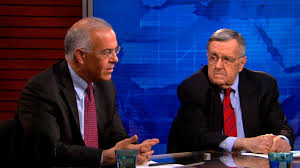
David Brooks and Mark Shields
New York Times Columnist David Brooks, speaking on the same episode of The Newshour, outlined why her attacks on Trump have been so effective.
“Well, what’s interesting about her is, she plays by reality show rules. She plays by Trump rules. And most people who go against Trump don’t quite play by his rules. And she plays by his rules, which is no rules, that do whatever you can, it doesn’t matter what the norms and standards are.
“And taping somebody in the Situation Room is a rather serious offense and, to me, a pretty great betrayal of any—how any White House should work. I mean, if we’re walking around each other in the hallway taping each other, just think about doing that.
“That’s just a betrayal of how normal life should happen….And so she said, they’re going to lie about me, they’re going to screw me, so I’m ready.”
In perhaps the most-quoted passage of The Prince, Niccolo Machiavelli wrote:
“From this arises the question whether it is better to be loved than feared, or feared more than loved. The reply is, that one ought to be both feared and loved, but as it is difficult for the two to go together, it is much safer to be feared than loved.
“For it may be said of men in general that they are ungrateful, voluble, dissemblers, anxious to avoid danger and covetous of gain. As long as you benefit them, they are entirely yours: they offer you their blood, their goods, their life and their children, when the necessity is remote, but when it approaches, they revolt.
“And the prince who has relied solely on their words, without making other preparations, is ruined. For the friendship which is gained by purchase and not through grandeur and nobility of spirit is bought but not secured, and at a pinch is not to be expended in your service.”
Niccolo Machiavelli
Donald Trump has always used fear to instill and maintain loyalty among his closest associates—and to intimidate his many enemies.
But Machiavelli offers a warning on the uses of fear:
“Still, a prince should make himself feared in such a way that if he does not gain love, he at any rate avoids hatred, for fear and the absence of hatred may well go together.
“Cruelties ill committed are those which, although at first few, increase rather than diminish with time….In taking a state, the conqueror must arrange to commit all his cruelties at once, so as not to have to recur to them very day, and so as to be able, by not making fresh changes, to reassure people and win them over by benefiting them.
“Whoever acts otherwise, either through timidity or bad counsels,” warns Machiavelli, “is always obliged to stand with knife in hand, and can never depend on his subjects, because they, owing to continually fresh injuries, are unable to depend upon him.”
From the onset of his Presidency, Trump has violated this warning with a vengeance. And now he is “obliged to stand with knife in hand.”
Omarosa is the first former Trump loyalist to emerge as a fervent Trump critic. And she may have even worse in store for him.
Warns David Brooks:
“All sorts of signs are pointing in this direction, that we’re going to wind up with an election where….people are basically going to be voting, when race is a hot button issue, with a man who has a history of bigoted comments, and then voting along those lines.”
With Democratic voters—many of them blacks and Hispanics—energized, Trump’s obvious racism could sweep Republicans from the House of Representatives.
Omarosa seems determined to make that happen.


.jpg&imgrefurl=https%3A%2F%2Fen.wikipedia.org%2Fwiki%2FJulius_Caesar&docid=i5zp8D4W-fCkiM&tbnid=pa1aoGEpET-OGM%3A&vet=1&w=1117&h=1769&bih=414&biw=745&ved=0ahUKEwjsvNnh8-rSAhULe7wKHWZBDxoQMwhQKBUwFQ&iact=c&ictx=1)


2016 PRESIDENTIAL ELECTION, A BRONX TALE, ABC NEWS, ALTERNET, AP, BILL CLINTON, BUZZFEED, CBS NEWS, CHAZZ PALMINTERI, CNN, CROOKS AND LIARS, DAILY KOZ, DONALD TRUMP, FACEBOOK, H.R. MCMASTER, JEFF SESSIONS, JOHN KELLY, MOTHER JONES, MOVEON, NBC NEWS, NEWSWEEK, NICCOLO MACHIAVELLI, NPR, POLITICO, RAW STORY, REINCE PREBIUS, REPUBLICAN PARTY, REUTERS, ROBERT DE NIRO, Ronald Reagan, SALON, SEATTLE TIMES, SERGEI KISLYAK, SLATE, THE ATLANTIC, THE CHICAGO SUN-TIMES, THE CHICAGO TRIBUNE, THE DAILY BEAST, THE GUARDIAN, THE HILL, THE HUFFINGTON POST, THE LOS ANGELES TIMES, THE NATION, THE NEW YORK TIMES, THE PRINCE, THE WASHINGTON POST, TIME, TWITTER, U.S. NEWS & WORLD REPORT, UP, UPI, USA TODAY
WHEN PRESIDENTS ACT LIKE MAFIA BOSSES: PART TWO (END)
In Bureaucracy, History, Law, Law Enforcement, Politics, Social commentary on December 11, 2018 at 12:27 amA reputation for being feared can be useful.
But it’s dangerous to constantly employ cruelties or punishments.
Whoever does so, warns Niccolo Machiavelli, “is always obliged to stand with knife in hand, and can never depend on his subjects, because they, owing to continually fresh injuries, are unable to depend upon him.”
Such a President is Donald Trump, who, as a Presidential candidate in 2016, told journalist Bob Woodward: “Real power is—I don’t even want to use the word—fear.”
As a Presidential candidate and President, Trump has repeatedly used Twitter to attack hundreds of real and imagined enemies in politics, journalism, TV and films.
From June 15, 2015, when he launched his Presidential campaign, until October 24, 2016, Trump fired almost 4,000 angry, insulting tweets at 281 people and institutions that had somehow offended him.
Donald Trump
The New York Times needed two full pages of its print edition to showcase them. Making one inflammatory statement after another, he offended one group of potential voters after another. Among those groups:
Since becoming President on January 20, 2017, Trump has attacked and/or infuriated a wide array of influential agencies or groups. Among these:
And he has bullied and insulted even White House officials and his own handpicked Cabinet officers:
Trump’s repeated humiliations—and firings—of high-ranking administration officials have led to a near-paralysis of his government. Many agencies remain plagued by staff shortages. And many of the replacements are not of “top drawer” quality.
If Trump ever read Niccolo Machiavelli’s The Prince, he’s clearly forgotten the Florentine’s warning on the need to avoid hatred at all costs.
The new musical version of the play/movie A Bronx Tale allows Mafia capo Sonny to sing his lesson on fear versus love to Calogero, the teenager who idolizes him:
Listen now what I tell ya
This advice is you know whose
Love or fear—
It’s up to you kid
But you live with what you choose.
And it’s true: You live with what you choose.
Make being loved your top priority, and you risk being labeled a weakling who can be rolled—as Bill Clinton did.
But make being feared your goal, and you risk creating an atmosphere of hatred and paranoia—as Donald Trump has.
Share this: