President Donald Trump has two major legal problems.
First, he’s under investigation by Independent Counsel and former FBI director Robert Mueller, who’s armed with top-flight investigators and an unlimited budget.
And, second, his attorney, Rudolph Giuliani, is rushing from one TV talk show to another, making incriminating statements that Mueller can use against Trump.
Giuliani is a former United States Attorney and United States Associate Attorney General. So he should know that the more he speaks about Trump, the more potential leads he provides Mueller’s investigators to follow.
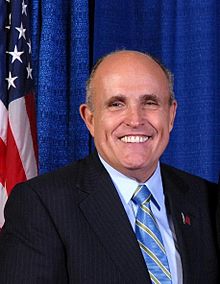
Rudolph Giuliani
Thus, he said, on Fox News’ “Sean Hannity” program, that Trump paid back his personal lawyer, Michael Cohen, the $130,000 in hush money that Cohen paid porn actress Stormy Daniels.
The reason: To ensure her silence over an alleged affair with Trump.
Giuliani’s statement, on May 3, contradicted Trump, who had previously denied knowing about the payment. It also contradicted Cohen’s February statement that Trump did not reimburse the $130,000.
Not content to stop there, Giuliani added: “Imagine if that came out on October 15, 2016, in the middle of the last debate with Hillary Clinton“—thus giving a political motive to the action.
Donald Trump
Giuliani, appearing on a Right-wing Fox News show, clearly felt comfortable. After all, he wasn’t being interrogated by a reporter for CNN or The New York Times.
It’s precisely that sense of safety that experienced cross-examiners hope to instill in witnesses—just before they lower the hatchet.
But Hannity—an ardent supporter of Trump—wasn’t trying to ensnare Giuliani.
Hannity asked if Trump would testify before Special Counsel Robert Mueller.
GIULIANI: “Well, right now, a lot of things point in the direction of, they made up their mind that [former FBI Director James] Comey is telling the truth and not the president.
“When you look at those questions about what does the president think, what does the president feel, what does the president really desire, those are all questions intended to trap him in some way and contradicting what is in fact a very, very solid explanation of what happened.
“He fired Comey because Comey would not, among other things, say that he wasn’t a target of the investigation. He’s entitled to that. Hillary Clinton got that. Actually, he couldn’t get that. So, he fired him and he said, I’m free of the guy, and he went on Lester Holt.”

James Comey
Later in the interview, Giuliani returned to the Cohen payment of $130,000 to Stormy Daniels:
GIULIANI: “Having something to do with paying some Stormy Daniels woman $130,000, I mean, which is going to turn out to be perfectly legal. That money was not campaign money, sorry, I’m giving you a fact now that you don’t know. It’s not campaign money. No campaign finance violation.”
HANNITY: “They funneled it through a law firm.”
GIULIANI: “Funneled it through a law firm and the president repaid it.”
HANNITY: “I didn’t know he did.”
GIULIANI: “Yes. Zero.”
HANNITY: “So the president—“
GIULIANI: “Just like every, Sean—“
HANNITY: “So this decision was made by—“
GIULIANI: “Sean, everybody—everybody was nervous about this from the very beginning. I wasn’t. I knew how much money Donald Trump put in to that campaign. I said $130,000. You’re going to do a couple of checks for 130,000.
“When I heard Cohen’s retainer of $35,000 when he was doing no work for the president, I said that’s how he’s repaying—that’s how he’s repaying it with a little profit and a little margin for paying taxes for Michael.”
HANNITY: “But do you know the president didn’t know about this? I believe that’s what Michael said.”
GIULIANI: “He didn’t know about the specifics of it as far as I know. But he did know about the general arrangement that Michael would take care of things like this. Like, I take care of things like this for my clients. I don’t burden them with every single thing that comes along. These are busy people….
“A settlement payment which is a very regular thing for lawyers to do. The question there was, the only possible violation there would be wasn’t a campaign finance violation, which usually results in a fine by the way, not this big storm troopers coming in and breaking down his apartment and breaking down his office.
“That was money that was paid by his lawyer, the way I would do out of his law firm funds or whatever funds, it doesn’t matter. The president reimbursed that over a period of several months.”
HANNITY: “But he had said he didn’t, I distinctly remember that he did it on his own—“
GIULIANI: “He did….”
**********
So, Giuliani:
- Admits that Trump fired FBI Director James Comey for patently illegal reasons. [Comey accuses Trump of demanding a pledge of personal loyalty; Trump denies this.]
- Exonerates Michael Cohen for acting as a fixer to buy the silence of a porn actress about an extramarital affair.
- Claims that arranging hush money payments is a routine practice among lawyers (“Like, I take care of things like this for my clients”).
If Trump were a reader, he might now recall the famous warning by the French philosopher Voltaire: “Lord, protect me from my friends. I can take care of my enemies.”


 Bureaucracybuster's Blog
2016 PRESIDENTIAL CAMPAIGN, ABC NEWS, ALTERNET, AP, “FAT TONY” SALERNO, BUZZFEED, CARLO GAMBINO, CARMINE GALANTE, CBS NEWS, CNN, CROOKS AND LIARS, DAILY KOZ, DONALD TRUMP, EMANUEL GAMBINO, FACEBOOK, FBI, JOSEPH R. MCCARTHY, MAFIA, MICHAEL COHEN, MOTHER JONES, MOVEON, MSNBC, NBC NEWS, NEWSWEEK, NPR, PAM BONDI, PAUL CASTELLANO, POLITICO, RAW STORY, REPUBLICANS, REUTERS, ROY COHN, SALON, SAMMY "THE BULL" GRAVANO, SEATTLE TIMES, SLATE, THE ATLANTIC, THE CHICAGO SUN-TIMES, THE CHICAGO TRIBUNE, THE DAILY BEAST, THE GUARDIAN, THE HILL, THE HUFFINGTON POST, THE LOS ANGELES TIMES, THE NATION, THE NEW YORK TIMES, THE WASHINGTON POST, TIME, TWITTER, U.S. NEWS & WORLD REPORT, UPI, USA TODAY
TEFLON DON, MEET TEFLON PRESIDENT: PART ONE (OF TWO)
In Bureaucracy, History, Law Enforcement, Politics, Social commentary on July 4, 2018 at 1:08 amHe was tall, broad-shouldered and bushy-haired. He spoke in a heavily New York-accented voice, and his speech was often laced with crudities and obscenities.
He loved to strut in public, wearing $2,000 custom-made suits, and surrounded by a phalanx of tough-looking bodyguards. He loved being noticed, especially in restaurants and discos, by “my public.” Making the cover of Time magazine was probably the greatest thrill of his life.
And he loved to brag: He was the toughest, the smartest, the guy nobody dared cross. And when he wasn’t bragging about himself, he was disparaging even his closest associates.
He was rumored to be implicated in a long string of felonies. He knew the FBI was watching him. But he continually met openly with his cronies at the same place—a social club in Little Italy.
He ordered his subordinates to be extremely cautious when they talked on the phone. But he totally ignored his own advice—and created a litany of incriminating tapes that would destroy him.
No, he wasn’t Donald Trump.
He was John Gotti, once the boss of the most powerful crime family in America.
John Gotti’s 1990 mugshot
And he shared more than a few striking similarities with Donald Trump—another New Yorker who has since become President of the United States.
Like Trump, Gotti spent a good portion of his time in court—although Trump’s 3,500 lawsuits (filed by and against him) completely dwarf Gotti’s four high-profile trials.
Like Trump, he seemed invincible in court: He won three of those legal confrontations—and thus earned the nickname, “The Teflon Don.”
And, like Trump, he loved to taunt the FBI agents he knew were stalking him. After each court victory he gave a press conference, claiming he had been framed by FBI agents who hated Italians.
Warned to knock it off, to show humility instead of arrogance, Gotti told his would-be protectors to go to hell. He wasn’t going to be anything but what he was.
Years afterward, the FBI learned the reason for the Teflon: Gotti had used jury tampering and witness intimidation to beat the rap.
It was the fourth trial that did him in—and sent him away for life.
Unlike Trump, he wasn’t born into a wealthy family, with a father who gave him $200 million to start his own real estate business. Instead, he grew up in poverty, resenting a father who worked as a day laborer and liked to gamble.
He was born on October 27, 1940—almost six years before Trump (June 14, 1946). He turned to crime at the age of 12, working with street gangs affiliated with the New York City Mafia. By 1966 he had been jailed twice.
He hijacked trucks at John F. Kennedy Airport. Arrested three times for hijacking, he pleaded guilty and was sentenced to three years at Pennsylvania’s Lewisburg Federal Penitentiary.
Paroled in 1972, Gotti’s big break came in 1973. Emanuel Gambino, the nephew of the Mafia’s “Boss of all Bosses” Carlo Gambino, was kidnapped and murdered. Gambino sent a trio of hitmen—one of them Gotti—after the culprit: James McBratney. Although not the actual killer, Gotti was identified by eyewitnesses as a participant.
Carlo Gambino
Through a plea bargain arranged by attorney Roy Cohn, Gotti received a four-year prison sentence for attempted manslaughter.
Cohn had earned an infamous reputation as chief counsel for Red-baiting Wisconsin United States Senator Joseph R. McCarthy in the 1950s. After leaving government service in 1954, Cohn went into private practice. Among his clients: Mafia bosses “Fat Tony” Salerno and Carmine Galante—and real estate mogul Donald Trump.
Released from prison in July, 1977, after only two years, Gotti finally received his dream gift: He was fully initiated as a “made man” into the Gambino Family.
Gambino himself had died of natural causes in 1976, and was now succeeded by his son-in-law, Paul “Big Paul” Castellano.
Gambino had represented the “old-school” Mafia: Men who shunned publicity like the plague and cultivated the image of a harmless small businessman. Although he had ordered his “soldiers” to steer clear of the drug trade, which brought too much heat, Gambino reaped millions from loansharking, extortion, hijacking, bookmaking and labor racketeering.
Castellano sought to “legitimize” the Mafia by moving it into legitimate business. He launched Dial Poultry, a poultry distribution business that once supplied 300 butchers in New York City. He profited as well by supplying construction concrete. No one could pour concrete for a project worth more than $2 million without the approval from the “Concrete Club”—a mob-controlled enterprise.
Paul Castellano
“Big Paul,” who had never “whacked” anyone, didn’t see himself as a gangster. He liked socializing with bankers and even once told his maid (with whom he was having an extramarital affair) that “I could even do a favor for a President.”
John Gotti, by contrast, was neither publicity-shy like Gambino nor seeking to enter the legitimate business world like Castellano. There was no point, he reasoned, in being a gangster if you weren’t going to act like one.
For Gotti, those two traits—his love of publicity and desire to be “a real gangster”—would prove a fatal combination.
Share this: