On December 18, 2025, The John F. Kennedy Memorial Center for the Performing Arts became The Donald Trump and John F. Kennedy Memorial Center for the Performing Arts.
And all that it took for this to happen was for Trump’s handpicked board overseeing the John F. Kennedy Center to declare: “We’re adding Trump’s name to this building.”
Specifically, White House Press Secretary Karoline Leavitt announced on X: “I have just been informed that the highly respected Board of the Kennedy Center, some of the most successful people from all parts of the world, have just voted unanimously to rename the Kennedy Center to the Trump-Kennedy Center, because of the unbelievable work President Trump has done over the last year in saving the building.”
Donald Trump
This totally ignored three vital truths:
First, in 1955, President Dwight D. Eisenhower established a commission for a new public auditorium to showcase the performing arts in the nation’s capital. It was to be called The National Cultural Center.
Second, in January, 1964, two months after the assassination of President John F. Kennedy, Congress passed and President Lyndon B. Johnson signed into law legislation renaming the Center as a “living memorial” in his honor: The John F. Kennedy Memorial Center for the Performing Arts.
Third, adding Trump’s name to the Center legally would require a similar act of Congress—which has not occurred.
Thus, putting Trump’s name on the building without a Congressional act carries all the legitimacy of a graffiti vandal spray-painting his name on the Center.
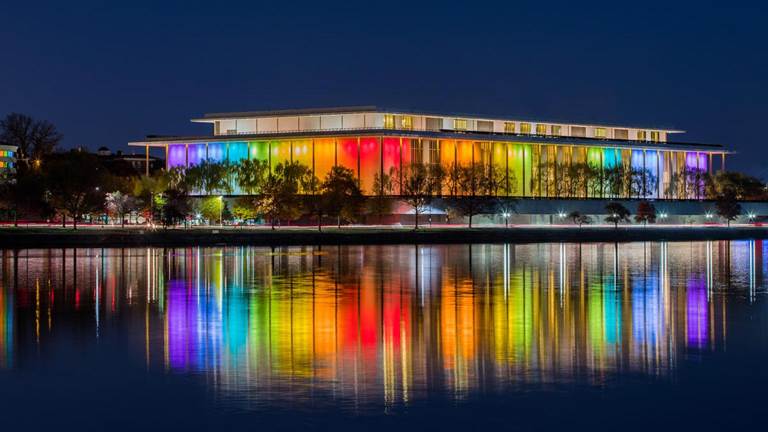
Trump spent most of 2025 putting his stamp on the Center. First he purged most of the board that governs the institution. Then he replaced its members with pliable ideologues and sycophants, capped by installing itself as the new chairman.
On December 18, his underlings blatantly renamed the center itself.
Given Trump’s well-known admiration for dictators such as Vladimir Putin, Xi Jinping and Kim Jong-Un, it was inevitable that he would seek to remake the arts in his own image.
In doing so, he’s following in the footsteps of propaganda-obsessed tyrants like Joseph Stalin and Adolf Hitler
Consider this blurb from the 2015 nonfiction book, Fear and the Muse Kept Watch: The Russian Masters from Akhmatova and Pasternak to Shostakovich and Eisenstein Under Stalin, by Andy McSmith:
“For those artists visible enough for Stalin to take an interest in them, it was Stalin himself who decided whether they lived in luxury or were sent to the Lubyanka, the headquarters of the secret police, to be tortured and sometimes even executed.
“McSmith brings together the stories of these artists―including [writer] Isaac Babel, [poet and novelist] Boris Pasternak, [composer] Dmitri Shostakovich, and many others―revealing how they pursued their art under Stalin’s regime and often at great personal risk.
“It was a world in which the poet Vladimir Mayakovsky, whose bright yellow tunic was considered a threat to public order under the tsars, struggled to make the communist authorities see the value of avant garde art; Babel publicly thanked the regime for allowing him the privilege of not writing; and Shostakovich’s career veered wildly between public disgrace and wealth and acclaim.”
Adolf Hitler similarly installed himself as the arbiter of culture in Nazi Germany.
In Hitler and the Power of Aesthetics, Frederic Spotts argues that Hitler saw the world corrupted by “evils” he must first destroy so he could re-create it to conform to his artistic ideals.
Hitler considered himself an unappreciated artist. At 18, he had applied for admission to the Academy of Fine Arts Vienna, but was rejected twice. If he had a friend, it was the architect Albert Speer, with whom he felt an artistic kinship.
Even as the Third Reich collapsed, he found time to pore over architectural models he intended to turn into gigantic buildings.
In Hitler’s Germany, culture was not only the end to power but the means of achieving it. His artistry—expressed in spectacles, festivities, parades, rallies and political dramas, as well as in architecture, painting and music—destroyed any sense of individuality and linked the German people with his own drives.
Like Hitler, Trump sees himself as an unrecognized artist. Of the 515 entities he owns, 268 of them—52%—bear his last name. He often refers to his properties as “the swankiest,” “the most beautiful.”
Upon his return to the Presidency in 2025, he turned his “artistic” gifts on the White House. On June 9, contractors began paving over the grass of the White House Rose Garden with stone tiles to create a patio.
Again like Hitler, Trump believes that “bigger is better” in architecture.
On July 31, 2025, the Trump administration announced that a 90,000 square feet addition would be made to the White House to incorporate a 650-person capacity ballroom. In October, Trump ordered the demolition of the White House’s historic East Wing to clear space for it.
The estimated cost has ballooned from $200 million to $400 million.
Trump has repeatedly pushed to enlarge the ballroom—from a 90,000-square-feet addition capable of seating 650 guests to one that can seat, first, 999 guests and then to 1,000 guests at formal dinners.
Tyrants always hail such projects as “gifts for the nation.” In reality, they are self-glorifying monuments to the dictator’s own ego.


 Bureaucracybuster's Blog
ALEX PRETTI, ALTERNET, AMERICABLOG, AP, BABY BOOMER RESISTANCE, BBC, BLOOMBERG, BLUESKY, BUZZFEED, CBS NEWS, CESARE BORGIA, CNN, CROOKS AND LIARS, DAILY KOS, DONALD TRUMP, FIVETHIRTYEIGHT, GREGORY BOVINO, HARPER’S MAGAZINE, HUFFINGTON POST, KAROLINE LEAVITT, KRISTI NOEM, MEDIA MATTERS, MINNESOTA, MINNIEAPOLIS, MOTHER JONES, MOVEON, MSNBC, NBC NEWS, NEWSDAY, NEWSWEEK, NICCOLO MACHIAVELLI, NPR, PBS NEWSHOUR, POLITICO, POLITICUSUSA, RAW STORY, REUTERS, SALON, SEATTLE TIMES, SLATE, TALKING POINTS MEMO, THE ATLANTIC, THE CHICAGO SUN-TIMES, THE CHICAGO TRIBUNE, THE DAILY BEAST, THE DAILY BLOG, THE GUARDIAN, THE HILL, THE HUFFINGTON POST, THE INTERCEPT, THE LOS ANGELES TIMES, THE NATION, THE NEW REPUBLIC, THE NEW YORK TIMES, THE NEW YORKER, THE PRINCE (BOOK), THE VILLAGE VOICE, THE WASHINGTON POST, THINKPROGRESS, TIME, TODD BLANCE, TRUTHDIG, TRUTHOUT, TWO POLITICAL JUNKIES, U.S. NEWS & WORLD REPORT, UNITED STATES CUSTOMS AND BORDER PATROL, UNITED STATES DEPARTMENT OF HOMELAND SECURITY, UPI, USA TODAY, X
MACHIAVELLI: HOW TYRANTS ESCAPE RESPONSIBILITY FOR THEIR CRIMES
In Bureaucracy, History, Law Enforcement, Politics, Social commentary on February 11, 2026 at 12:10 amOn January 24, 2026, Alex Jeffrey Pretti, a 37-year-old American intensive care nurse for the United States Department of Veterans Affairs, was shot multiple times and killed by agents of United States Customs and Border Protection (CBP) in Minneapolis, Minnesota.
Pretti was filming law enforcement agents with his phone attacking Minnesota residents. At one point, he stood between an agent and a woman whom the agent had pushed to the ground, putting his arm around her.
Pretti reached to wrap his arms around the fallen woman, apparently trying to help her up.
Alex Pretti
An agent shoved Pretti, and Pretti and the woman fell, still embracing. He was then pepper-sprayed and wrestled to the ground by several federal agents. Both of his arms were pinned down by his head. The agent that pepper-sprayed Pretti hit him with the pepper spray canister multiple times.
Pretti was legally licensed to carry a handgun, and was wearing one in a holster on his hip. An agent removed Pretti’s firearm. Another agent heard someone yell “Gun!” He drew his pistol and shot Pretti at close range.
The shooter was standing behind Pretti and not under direct threat, but fired three more shots into Pretti’s back, as he lay on the pavement with one hand still holding his phone and his other hand holding his glasses.
The agent who pepper-sprayed Pretti took out his gun and, together with the first shooter, fired six more shots at Pretti as he lay motionless on the ground.
The two agents fired a total of 10 shots in five seconds.
The killing of Alex Pretti ignited a firestorm of anger and horror throughout the country against the Trump administration. Protests were held in Seattle, Washington; Portland, Oregon, Durham, North Carolina, Oak Park, Illinois, Los Angeles and Boston.
Arousing even greater fury were inflammatory and slanderous accusations made against Pretti by Trump administration officials.
“He was there to perpetuate violence, and he was asked to show up and to continue to resist by a governor who’s irresponsible and has a long history of corruption and lying, and we won’t stand for it anymore,” said Secretary of Department of Homeland Security Kristi Noem.
Noem did not offer any evidence to back up her slander.
Kristi Noem
And White House Deputy Chief of Staff Stephen Miller called Pretti “a domestic terrorist who tried to assassinate law enforcement.”
Like Noem, Miller did not offer any evidence to support his slander.
Bystander video verified and reviewed by Reuters, the BBC, The Wall Street Journal and the Associated Press gave the lie to the Trump administration’s attacks on Pretti.
Faced with overwhelming—and video—evidence that Pretti had been shot while helplessly pinned to the ground, Trump officials started backpeddling.
“I don’t think anybody thinks that they were comparing what happened on Saturday to the legal definition of domestic terrorism,” said Deputy Attorney General Todd Blanche on Fox News.
“I have not heard the president characterize Mr Pretti in that way [as a domestic terrorist]” said White House Press Secretary Karoline Leavitt.
The ultimate pullback (so far) by the Trump administration was the demotion of Gregory Bovino, commander-at-large of the Border Control in Minneapolis.
Bovino had become the face of ICE brutality—ICE agents using tear gas against peaceful protesters, battering down a door to enter a house, smashing car windows and dragging people from vehicles.
Bovino had stated that Pretti intended to inflict “maximum damage and massacre law enforcement.”
On January 26, two days after Pretti’s death, Bovino was dismissed as commander-at-large and returned to El Centro, California.
More than 500 years ago, Niccolo Machiavelli, the father of modern political science, outlined how tyrants try to deflect public anger against the agents they appointed.
In Chapter Seven of The Prince, he writes:
“When the duke [Cesare Borgia] occupied the Romagna he found it under the rule of weak masters, who rather plundered their subjects than ruled them, and gave them more cause for disunion than for union.
“The country was full of robbery, quarrels, and every kind of violence; and so, wishing to bring back peace and obedience to authority, he considered it necessary to give it a good governor. Thereupon he promoted Messer Ramiro d’Orco [de Lorqua], a swift and cruel man, to whom he gave the fullest power.
“This man in a short time restored peace and unity with the greatest success. Afterwards the duke considered that it was not advisable to confer such excessive authority, for he had no doubt but that he would become odious.
“And because he knew that the past severity had caused some hatred against himself….he desired to show that, if any cruelty had been practiced, it had not originated with him, but in the natural sternness of the minister.
“Under this pretense he took Ramiro, and one morning caused him to be executed and left on the piazza at Cesena with the block and a bloody knife at his side. The barbarity of this spectacle caused the people to be at once satisfied and dismayed.”
The Trump administration’s pullback proves that what Machiavelli wrote 500 years ago remains entirely relevant today.
Share this: