Posts Tagged ‘Kamala Harris’
1968 PRESIDENTIAL CAMPAIGN, 2020 PRESIDENTIAL CAMPAIGN, ABC NEWS, ALTERNET, AMERICABLOG, AMERICAN INDIANS, AP, BABY BOOMER RESISTANCE, BARBARA GARSON, BLACK LIVES MATTER, BLOOMBERG, BUZZFEED, CBS NEWS, CIVIL RIGHTS, CNN, COMING APART: AMERICA IN THE 1960S (BOOK), CROOKS AND LIARS, DAILY KOZ, DEMOCRATS, DRUDGE REPORT, EUGENE MCCARTHY, FACEBOOK, FIVETHIRTYEIGHT, GEORGE BERNARD SHAW, GROSS NATIONAL PRODUCT, HARPER’S MAGAZINE, JIM SLATTERY, JOHN F. KENNEDY, Kamala Harris, KANSAS STATE UNIVERSITY, LOOK MAGAZINE, LYNDON B. JOHNSON, MCBIRD!, MEDIA MATTERS, MISSISSIPPI, MOTHER JONES, MOVEON, MSNBC, NBC NEWS, NEWSWEEK, NPR, PBS NEWSHOUR, POLITICO, POLITICUSUSA, RAW STORY, REPUBLICANS, REUTERS, ROBERT F. KENNEDY, SALON, SEATTLE TIMES, SIRHAN SIRHAN, SLATE, SOPHOCLES, STANLEY TRETICK, TALKING POINTS MEMO, TET OFFENSIVE, THE ATLANTIC, THE CHICAGO SUN-TIMES, THE CHICAGO TRIBUNE, THE DAILY BEAST, THE DAILY BLOG, THE GUARDIAN, THE HILL, THE HUFFINGTON POST, THE LOS ANGELES TIMES, THE NATION, THE NEW REPUBLIC, THE NEW YORK TIMES, THE VILLAGE VOICE, THE WASHINGTON POST, THINKPROGRESS, TIME, TIME MAGAZINE, TRUTHDIG, TRUTHOUT, TWITTER, TWO POLITICAL JUNKIES, U.S. NEWS & WORLD REPORT, UNIVERSITY OF KANSAS, UPI, USA TODAY, VIETNAM WAR, WILLIAM L. O'NEIL, WONKETTE
In Bureaucracy, History, Law, Law Enforcement, Military, Politics, Social commentary on August 11, 2020 at 12:07 am
On March 18, 1968, Presidential candidate Robert F. Kennedy did what few politicians have ever done: He accepted public responsibility for a war that had since become a national disaster—the Vietnam war.
Addressing a packed audience of students and faculty at Kansas State University, he said:
“Let me begin this discussion with a note both personal and public. I was involved in many of the early decisions on Vietnam, decisions that helped set us on our present path.
“It may be that the effort was doomed from the start; that it was never really possible to bring all the people of South Vietnam under the rule of the successive governments we supported—governments, one after another, riddled with corruption, inefficiency, and greed; governments which did not and could not successfully capture and energize the national feeling of their people.
“If that is the case, as it well may be, then I am willing to bear my share of the responsibility, before history and before my fellow citizens. But past error is no excuse for its own perpetuation. Tragedy is a tool for the living to gain wisdom, not a guide by which to live.
“Now as ever, we do ourselves best justice when we measure ourselves against ancient tests, as in the Antigone of Sophocles: ‘All men make mistakes, but a good man yields when he knows his course is wrong, and repairs the evil. The only sin is pride.’
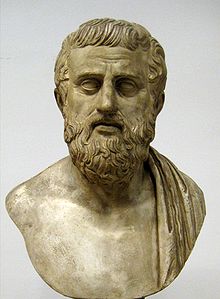
Sophocles
And he dared to attack the war as more than a military and political disaster: He saw it as a stain on America’s moral fiber:
“Can we ordain to ourselves the awful majesty of God—to decide what cities and villages are to be destroyed, who will live and who will die, and who will join the refugees wandering in a desert of our own creation?
“If it is true that we have a commitment to the South Vietnamese people, we must ask, are they being consulted—in Hue, or Ben Tre, or in the villages from which the three million refugees have fled?
“If they believe all the death and destruction are a lesser evil than the Wet Cong, why did they not warn us when the Viet Cong came into Hue, and the dozens of other cities, before the Tet Offensive? Why did they not join the fight?
“Will it be said of us, as Tacitus said of Rome: ‘They made a desert and called it peace?'”
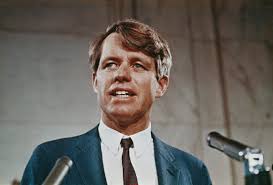
Robert F. Kennedy
The students gave him an ovation worthy of a rock star.
Time correspondent Hays Gorey said the electricity between Kennedy and the K.S.U. students was “real and rare.” “A good part of it is John F. Kennedy’s, of course, but John Kennedy …himself couldn’t be so passionate, and couldn’t set off such sparks.”
Jim Slattery, who would later be elected to Congress from Kansas, reread the K.S.U. speech during the second Iraq war and decided it was so powerful “because Kennedy was talking about what was right!”
As Kennedy started to leave, students rushed the platform where he stood, knocking over chairs and grabbing at him. They stroked his hair and ripped his shirtsleeves.
Later that day, Kennedy addressed another wildly enthusiastic audience—at the University of Kansas, in Lawrence, Kansas.
Then he addressed the glaring disparities between rich and poor Americans—a topic now generally ignored by Democrats and turned into an attack line by Republicans:
“All around us, all around us….men have lost confidence in themselves, in each other. It is confidence which has sustained us so much in the past. Rather than answer the cries of deprivation and despair….hundreds of communities and millions of citizens are looking for their answers, to force and repression and private gun stocks— so that we confront our fellow citizen across impossible barriers of hostility and mistrust.
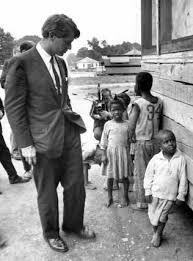
Robert F. Kennedy talking with black children
“And again, I don’t believe that we have to accept that. I don’t believe that it’s necessary in the United States of America. I think that we can work together. I don’t think that we have to shoot at each other, to beat each other, to curse each other and criticize each other, I think that we can do better in this country. And that is why I run for President of the United States….
“I have seen children in Mississippi starving, their bodies so crippled from hunger and their minds have been so destroyed for their whole life that they will have no future. I have seen children in Mississippi—here in the United States—with a gross national product of $800 billion dollars.
“I have seen children in the Delta area of Mississippi with distended stomachs, whose faces are covered with sores from starvation, and we haven’t developed a policy so we can get enough food so that they can live, so that their children, so that their lives are not destroyed, I don’t think that’s acceptable in the United States of America and I think we need a change.”
1968 PRESIDENTIAL CAMPAIGN, 2020 PRESIDENTIAL CAMPAIGN, ABC NEWS, ALTERNET, AMERICABLOG, AMERICAN INDIANS, AP, BABY BOOMER RESISTANCE, BARBARA GARSON, BLACK LIVES MATTER, BLOOMBERG, BUZZFEED, CBS NEWS, CIVIL RIGHTS, CNN, COMING APART: AMERICA IN THE 1960S (BOOK), CROOKS AND LIARS, DAILY KOZ, DEMOCRATS, DRUDGE REPORT, EUGENE MCCARTHY, FACEBOOK, FIVETHIRTYEIGHT, GEORGE BERNARD SHAW, GROSS NATIONAL PRODUCT, HARPER’S MAGAZINE, JIM SLATTERY, JOHN F. KENNEDY, Kamala Harris, KANSAS STATE UNIVERSITY, LOOK MAGAZINE, LYNDON B. JOHNSON, MCBIRD!, MEDIA MATTERS, MISSISSIPPI, MOTHER JONES, MOVEON, MSNBC, NBC NEWS, NEWSWEEK, NPR, PBS NEWSHOUR, POLITICO, POLITICUSUSA, RAW STORY, REPUBLICANS, REUTERS, ROBERT F. KENNEDY, SALON, SEATTLE TIMES, SIRHAN SIRHAN, SLATE, SOPHOCLES, STANLEY TRETICK, TALKING POINTS MEMO, TET OFFENSIVE, THE ATLANTIC, THE CHICAGO SUN-TIMES, THE CHICAGO TRIBUNE, THE DAILY BEAST, THE DAILY BLOG, THE GUARDIAN, THE HILL, THE HUFFINGTON POST, THE LOS ANGELES TIMES, THE NATION, THE NEW REPUBLIC, THE NEW YORK TIMES, THE VILLAGE VOICE, THE WASHINGTON POST, THINKPROGRESS, TIME, TIME MAGAZINE, TRUTHDIG, TRUTHOUT, TWITTER, TWO POLITICAL JUNKIES, U.S. NEWS & WORLD REPORT, UNIVERSITY OF KANSAS, UPI, USA TODAY, VIETNAM WAR, WILLIAM L. O'NEIL, WONKETTE
In Bureaucracy, History, Law, Law Enforcement, Military, Politics, Social commentary, Uncategorized on August 10, 2020 at 1:37 am
He remains forever frozen in time—young, vigorous, with tousled hair and a high-pitched voice calling on Americans to do better for those less fortunate.
It’s been 52 years since his life was brutally cut short—yet he remains forever the age at which he died: 42. Born in 1925, he would turn 95 on November 20 if he were alive today.
And he exuded an idealism which seems totally out of place with today’s “I’ve-got-mine-so-screw-you” politics.
On March 16, 1968, from the Caucus Room of the Old Senate Office building, New York Senator Robert F. Kennedy declared his candidacy for President of the United States.
Eight years earlier, on January 2, 1960, his brother, Massachusetts Senator John F. Kennedy had announced his own candidacy for the Democratic presidential nomination from the same place.
Ten months later, on November 8, that campaign had ended in victory with his election. And that victory, in turn, ended in bitter sorrow with his assassination two years, 10 months and two days later on November 22, 1963.
Robert F. Kennedy’s presidential campaign would not last as long as his late brother’s. Nor would it end in the victory he and his supporters yearned for.

Robert F. Kennedy
Eighty-two days later, he was dead—shot in the back of the head by Sirhan Sirhan, a Palestinian Arab furious at Kennedy’s avowed support for Israel.
For Kennedy, making up his mind to run for the Presidency was no easy task.
Since the assassination of his brother, millions of Americans had assumed—as his admirers or detractors—that he would one day become President.
For his admirers, there was an element of “the once and future king” about this young, intense man with tousled hair and a high-pitched voice.He—they believed—was the man who would somehow avenge his martyred brother by restoring “Camelot” and returning youth, energy and idealism to the White House.
A playwright—Barbara Garson—had even written a 1967 satire depicting then-President Lyndon B. Johnson as the MacBeth-like murderer of John Ken O-Dunc. In the end, he was confronted and killed by Robert Ken O’Dunc.

His detractors saw him as a ruthless upstart who wanted to foist too-liberal policies on the United States. They distrusted his sympathy for the downtrodden—especially blacks and Hispanics. Worse, they saw the Kennedy family as trying to found a dynasty of Presidents that could last until the mid-1980s.
But the real Robert Kennedy was long torn between running against Johnson—whom he had long personally loathed—and letting someone else do so.
Kennedy’s hatred of Johnson—and his irrational belief that LBJ was somehow responsible for his brother’s death—was well-known. And Kennedy feared that if he ran against Johnson, his many enemies would charge he was doing so out of personal animosity.
And there was another reason: Johnson, who had won the Presidency in a landslide in 1964, was certain to seek re-election in 1968. If Kennedy challenged him for the nomination, it might well split the party and result in the election of a Republican that November. And he—Kennedy—would be blamed for it.
Throughout 1966-7, Kennedy was urged to run against Johnson. Still, he dithered.
Then, on March 12, Minnesota United States Senator Eugene McCarthy entered the New Hampshire Democratic primary against Johnson—and won a surprising 42.2% of the vote to Johnson’s 49.4%. Four days later, Robert Kennedy announced his own candidacy.
McCarthy’s supporters were outraged: Their candidate had dared to do what Kennedy had not—directly take on Johnson. And now that he had shown it could be done, the opportunistic Kennedy had jumped in.
On March 18—two days after announcing his candidacy—Kennedy gave his first campaign speech at Kansas State University in Manhattan, Kansas. This was the heart of conservative country, and Kennedy didn’t know how his audience would accept many of his decidedly liberal proposals.
“Do you think they’ll boo him?” his wife, Ethel, asked a friend before the speech. “Will they hate him?”
Arriving at the university, Kennedy ate breakfast at the student union—and told a group of university officials and student leaders: “Some of you may not like what you’re going to hear in a few minutes, but it’s what I believe; and if I’m elected President, it’s what I’m going to do.”

Kansas State University
As events unfolded, he—and Ethel—had no reason to worry.
Kennedy had served as United States Attorney General from 1961 to 1964. Yet he had not limited himself to simply fighting organized crime and enforcing civil rights. He had aggressively urged his brother, the President, to take a hard line on fighting the Communist forces in Vietnam.
But now he did something almost no other politician had—or has—ever done: He publicly accepted responsibly for the disaster the war had become since 1965:
“Let me begin this discussion with a note both personal and public. I was involved in many of the early decisions on Vietnam, decisions that helped set us on our present path.
“It may be that the effort was doomed from the start; that it was never really possible to bring all the people of South Vietnam under the rule of the successive governments we supported.”
ABC NEWS, ALTERNET, AMERICABLOG, ANCHOR BABIES, AP, BABY BOOMER RESISTANCE, BARACK OBAMA, BUZZFEED, CBS NEWS, CNN, CROOKS AND LIARS, DAILY KOZ, DONALD TRUMP, DRUDGE RETORT, FACEBOOK, FBI, FIVETHIRTYEIGHT, HARPER’S MAGAZINE, ILLEGAL ALIENS, illegal immigration, IMMIGRATION AND CUSTOMS ENFORCEMENT (ICE), JUSTICE DEPARTMENT, Kamala Harris, MEDIA MATTERS, MEXICO, MICHELLE OBAMA, MOTHER JONES, MOVEON, MSNBC, NBC NEWS, NEWSWEEK, NPR, PBS NEWSHOUR, POLITICO, POLITICUSUSA, RACKETEER INFLUENCED CORRUPT ORGANIZATIONS ACT, RAW STORY, REUTERS, SALON, SAN FRANCISCO, sanctuary cities, SEATTLE TIMES, SLATE, TALKING POINTS MEMO, THE ATLANTIC, THE CHICAGO SUN-TIMES, THE CHICAGO TRIBUNE, THE DAILY BEAST, THE DAILY BLOG, THE GUARDIAN, THE HILL, THE HUFFINGTON POST, THE LOS ANGELES TIMES, THE NATION, THE NEW REPUBLIC, THE NEW YORK TIMES, THE VILLAGE VOICE, THE WALL STREET JOURNAL, THE WASHINGTON POST, THINKPROGRESS, TIME, TRUTHDIG, TRUTHOUT, TWITTER, TWO POLITICAL JUNKIES, U.S. NEWS & WORLD REPORT, U.S.-MEXICO WALL, UPI, USA TODAY, USA TODAY DONALD TRUMP, WAL-MART, WONKETTE
In Bureaucracy, Business, History, Law, Law Enforcement, Politics, Social commentary on February 14, 2020 at 12:06 am
According to President Donald Trump, stopping illegal immigration is easy.
Just build a massive, impenetrable wall along the U.S./Mexican border to keep out Mexican immigrants.
“Building a wall is easy, and it can be done inexpensively,” Trump said in an interview. “It’s not even a difficult project if you know what you’re doing.”
Really?
Among the obstacles to erecting such a barrier:
- The United States/Mexican border stretches for 1,954 miles—and encompasses rivers, deserts and mountains.
- Environmental and engineering problems.
- Squabbles with ranchers who don’t want to give up any of their land.
- Building such a wall would cost untold billions of dollars.
- Drug traffickers and alien smugglers could easily tunnel under it into the United States—as they are now doing.
There are, in fact, cheaper and more effective remedies for combating illegal immigration.
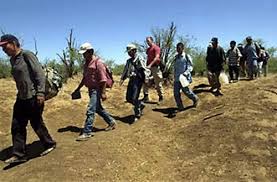
Illegal aliens crossing into the United States
(1) The Justice Department should vigorously attack the “sanctuary movement” that officially thwarts the immigration laws of the United States.
Among the 31 “sanctuary cities” of this country: Washington, D.C.; New York City; Los Angeles; Chicago; San Francisco; Santa Ana; San Diego; Salt Lake City; Phoenix; Dallas; Houston; Austin; Detroit; Jersey City; Minneapolis; Miami; Denver; Baltimore; Seattle; Portland, Oregon; New Haven, Connecticut; and Portland, Maine.
These cities have adopted “sanctuary” ordinances that do not allow municipal funds or resources to be used to enforce federal immigration laws, usually by not allowing police or municipal employees to inquire about one’s immigration status.
(2) The most effective way to combat this movement: Indict the highest-ranking officials of those cities which have actively violated Federal immigration laws.
This would include Mayors, members of the Board of Supervisors and chiefs of police, as well as any other officials who are found obstructing Federal immigration laws.
(3) Even if some indicted officials escaped conviction, the results would prove worthwhile.
City officials would be forced to spend huge sums of their own money for attorneys and face months or even years of prosecution.
And this, in turn, would send a devastating warning to officials in other “sanctuary cities” that the same fate lies in store for them.
(4) CEOs whose companies—like Wal-Mart—systematically employ illegal aliens should be held directly accountable for the actions of their subordinates.
They should be indicted by the Justice Department under the Racketeer Influenced Corrupt Organizations (RICO) Act, the way Mafia bosses are prosecuted for ordering their own subordinates to commit crimes.
Upon conviction, the CEO should be sentenced to a mandatory prison term of at least 20 years.
This would prove a more effective remedy for combating illegal immigration than stationing tens of thousands of soldiers on the U.S./Mexican border.
CEOs forced to account for their subordinates’ actions would take drastic steps to ensure that their companies strictly complied with Federal immigration laws.
(5) The Government should stop granting automatic citizenship to “anchor babies” born to illegal aliens in the United States.
A comparable practice would be allowing bank robbers who had eluded the FBI to keep their illegally-obtained loot.
A person who violates the bank robbery laws of the United States is legally prosecutable for bank robbery, whether he’s immediately arrested or remains uncaught for years. The same should be true for those born illegally within this country.
If they’re not here legally at the time of birth, they should not be considered citizens and should—like their parents—be subject to deportation.
(6) The United States Government–from the President on down–should scrap its apologetic tone on the right to control its national borders.
First Lady Michelle Obama—accompanied by Margarita Zavala, the wife of then-Mexican President Felipe Calderon—was visiting a second-grade class in Silver Spring, Maryland.
A second-grade girl said: “My Mom, she says says that Barack Obama is taking everybody away that doesn’t have papers.”
“Yeah, well, that’s something that we have to work on right?”
Replied Mrs. Obama. “To make sure that people can be here with the right kind of papers, right?”
The girl then said: “But my mom doesn’t have any….”
Obama: “Well, we’ll have to work on that. We have to fix that, and everybody’s got to work together in Congress to make sure that happens.”
The Mexican Government doesn’t consider itself racist for strictly enforcing its immigration laws.
The United States Government should not consider itself racist for insisting on the right to do the same.
(7) Voting materials and ballots should be published in one language: English.
In Mexico, voting materials are published in one language—Spanish.
Throughout the United States, millions of Mexican illegals refuse to learn English and yet demand that voting materials and ballots be made available to them in Spanish.
(8) The United States should impose economic and even military sanctions against countries–such as China and Mexico–whose citizens make up the bulk of illegal aliens.
Mexico, for example, uses its American border to rid itself of those who might demand major reforms in the country’s political and economic institutions.
Such nations must learn that dumping their unwanted’s on the United States now comes at an unfavorably high price. Otherwise those dumpings will continue.
ABC NEWS, ALTERNET, AP, BUZZFEED, CALIFORNIA ATTORNEY GENERAL, CBS NEWS, CNN, CROOKS AND LIARS, DAILY KOZ, DISTRICT ATTORNEY OF SAN FRANCISCO, DONALD TRUMP, FACEBOOK, GEORGETOWN UNIVERSITY’S INSTITUTE OF POLITICS AND PUBLIC SERVICE, ILLEGAL ALIENS, IMMIGRATION LAWS, JOE BIDEN, Kamala Harris, LAW ENFORCEMENT, MO ELLEITHEE, MOTHER JONES, MOVEON, MSNBC, NBC NEWS, NEWSWEEK, NPR, PBS NEWSHOUR, POLITICO, RAW STORY, REUTERS, SALON, SAN FRANCISCO, SEATTLE TIMES, SENATE JUDICIARY COMMITTEE, SLATE, THE ATLANTIC, THE CHICAGO SUN-TIMES, THE CHICAGO TRIBUNE, THE DAILY BEAST, THE GUARDIAN, THE HILL, THE HUFFINGTON POST, THE LOS ANGELES TIMES, THE NATION, THE NEW YORK TIMES, THE TRUTHS WE HOLD (BOOK), THE WASHINGTON POST, TIME, TWITTER, U.S. NEWS & WORLD REPORT, UNITED STATES SENATE, UPI, USA TODAY, VIOLENT CRIME CONTROL AND LAW ENFORCEMENT ACT OF 1994
In Bureaucracy, History, Law, Law Enforcement, Politics, Social commentary on December 11, 2019 at 12:05 am
Kamala Harris spent seven years (2004 – 2011) as District Attorney of San Francisco and another six years (2011 – 2017) as California Attorney General. Then, in 2016, she won election to the United States Senate.
In 2018, she decided to become the first black woman President of the United States.
But after 11 months of trying to prove herself the most Politically Correct candidate among Democrats, she withdrew from the race on December 3.
“I’ve taken stock and looked at this from every angle, and over the last few days have come to one of the hardest decisions of my life,” Harris said in a statement. “My campaign for president simply doesn’t have the financial resources we need to continue.”
To tout her candidacy, she had published her memoirs: The Truths We Hold. In these, she described herself as a “progressive prosecutor.”
Harris knew that law enforcement issues are a lightning rod for both liberal and conservative voters. So she tried to portray herself as appealing to both.
But there’s one aspect of her law enforcement record she didn’t mention in her book.
Among the truths she holds secret: When she served as District Attorney for San Francisco, she set up a secret unit to keep even convicted illegal alien felons out of prison—and in the United States.
Today, with millions of illegal aliens from Central and Latin America flooding into the United States, the spotlight has shifted from the incarceration of blacks to that of Hispanics.
Illegal immigration—and what to do about it—is now the hottest political issue in the country.
For liberals of the Democratic party, “open borders” appears to be the solution to illegal immigration.
Yet the vast majority of Americans reject this. They support legal immigration—but oppose illegal immigration.
Moreover, Donald Trump has ignited a white-hot fury against illegal aliens from Central and Latin America.
And Kamala Harris’ record as San Francisco District Attorney was hardly reassuring on this issue.

U.S. Senator Kamala Harris
Secretly, she created a program, called Back on Track, to train convicted illegal aliens for jobs they could not legally hold. This was a flagrant violation of Federal immigration law.
Completion led to the expunging of a felony conviction, making it highly popular among convicted criminals.
One such alumnus was Alexander Izaguirre, an illegal alien who had been arrested twice within eight months—for purse-snatching and selling cocaine.
In July, 2008, four months after pleading guilty to selling cocaine, Izaguirre assaulted Amanda Kiefer, a legal San Francisco resident.
Snatching her purse, he jumped into an SUV, then tried to run Kiefer down. Terrified, she leaped onto the hood and saw Izaguirre and a driver laughing.
The driver slammed on the brakes, sending Kiefer flying onto the pavement and fracturing her skull.
Back on Track became a centerpiece of Harris’ campaign for state Attorney General.
Until she was questioned by the Los Angeles Times about the Izaguirre case, Harris had never publicly admitted that the program included illegal aliens.
Harris claimed she first learned that illegal aliens were training for jobs only after Izaguirre was arrested for the Kiefer assault. Apparently not one of her fellow prosecutors ever mentioned this to her.
Harris said it was a “flaw in the design” of the program to let illegal aliens into the program. “I believe we fixed it,” she told the Times.
Harris never released statistics on how many illegal aliens were included since the program started in 2005.
She said that after Izaguirre’s arrest she never asked—or learned—how many illegal aliens were in Back on Track. A strange lapse in curiosity for a prosecutor charged with enforcing the law.
When Harris learned that illegal aliens were enrolled, she allowed those who were following the rules to finish the program and have their criminal records expunged.
It is not the duty of local law enforcement, she said, to enforce Federal immigration laws.
So much for her oath to faithfully defend the Constitution of the United States and that of the state of California “against all enemies, foreign and domestic.”
From 2005 to 2009, 113 admitted drug dealers graduated from Back on Track. Another 99 were kicked off the program for failing to meet the requirements. They were sentenced under their guilty plea, the D.A.’s office claimed.
Harris told the Times that graduates of Back on Track were less likely than other offenders to commit crimes again. But her spokeswoman refused to offer detailed statistics to back this up.
When Harris became San Francisco District Attorney, she vowed she would “never charge the death penalty.”
Her opposition to capital punishment would be better-suited to a public defender.
Meanwhile, Amanda Kiefer left California. Interviewed by the Times, she said she could not understand why San Francisco police and prosecutors would allow convicted illegal aliens back onto the streets.
“If they’re committing crimes,” she said, “I think there’s something wrong that they’re not being deported.”
It’s a sentiment that law-abiding Americans agree with. And it should go double for those who are charged with enforcing the law.
2016 PRESIDENTIAL CAMPAIGN, 2020 PRESIDENTIAL CAMPAIGN, ABC NEWS, ADOLF HITLER, ALTERNET, AMERICABLOG, ANDREW JACKSON, AP, BABY BOOMER RESISTANCE, BASKET OF DEPLORABLES SPEECH, BUZZFEED, CBS NEWS, CNN, CROOKS AND LIARS, DAILY KOZ, DEMOCRATS, DONALD TRUMP, FACEBOOK, FIVETHIRTYEIGHT, HILLARY CLINTON, Kamala Harris, MOTHER JONES, MOVEON, MSNBC, MUNICH CONFERENCE, NBC NEWS, NEVILLE CHAMBERLAIN, NEWSWEEK, NPR, NYLE DIMARCO, PBS NEWSHOUR, POLITICO, POLITICUSUSA, RACISM, RAW STORY, REPUBLICANS, RETARDED (WORD), REUTERS, SALON, SEATTLE TIMES, SEXISM, SLATE, TALKING POINTS MEMO, THE ATLANTIC, THE CHICAGO SUN-TIMES, THE CHICAGO TRIBUNE, THE DAILY BEAST, THE DAILY BLOG, THE GUARDIAN, THE HILL, THE HUFFINGTON POST, THE LOS ANGELES TIMES, THE NATION, THE NEW YORK TIMES, THE WASHINGTON POST, THINKPROGRESS, TIME, TRUTHDIG, TWITTER, U.S. NEWS & WORLD REPORT, UPI, USA TODAY, XENOPHOBIA
In Bureaucracy, History, Politics, Social commentary on September 9, 2019 at 12:46 am
Frontier general and President Andrew Jackson once said: “One man with courage makes a majority.”
Today, that is a sentiment sadly lacking among Democrats.
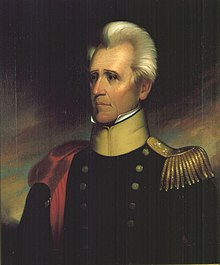
Andrew Jackson
Consider these two examples—each by a prominent Democratic candidate for President.
On September 9, 2016, Democratic Presidential Nominee Hillary Clinton delivered a speech at a New York fundraiser. It was the only Clinton speech during the campaign to be widely quoted by Democrats and Republicans.
Running against Republican Presidential Nominee Donald Trump, she divided his supporters into two groups.
The first group were the “deplorables,” for whom she showed open contempt:
“You know, to just be grossly generalistic, you could put half of Trump’s supporters into what I call the basket of deplorables. Right? The racist, sexist, homophobic, xenophobic, Islamaphobic–you name it. And unfortunately there are people like that. And he has lifted them up.
“He has given voice to their websites that used to only have 11,000 people–now 11 million. He tweets and retweets their offensive hateful mean-spirited rhetoric. Now, some of those folks—they are irredeemable, but thankfully they are not America.”
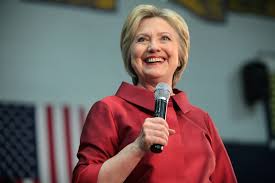
Hillary Clinton (Gage Skidmore photo)
But the second group, she said, consisted of poor, alienated Americans who rightly felt abandoned by their employers and their government:
“But….that other basket of people are people who feel that the government has let them down, the economy has let them down, nobody cares about them, nobody worries about what happens to their lives and their futures, and they’re just desperate for change. It doesn’t really even matter where it comes from.
“They don’t buy everything [Trump] says, but he seems to hold out some hope that their lives will be different. They won’t wake up and see their jobs disappear, lose a kid to heroin, feel like they’re in a dead-end. Those are people we have to understand and empathize with as well.”
Then, the day after making the speech, she apologized for it: “Last night I was ‘grossly generalistic,’ and that’s never a good idea. I regret saying ‘half–that was wrong.”
Many of Trump’s followers were racists, sexists and xenophobes–who deserved condemnation, not apologies.
Having eloquently reached out to many of the men and women who were a prime constituency for Trump, she then failed to offer an economic package to quickly and effectively address their vital needs for jobs and medical care.
The reason: She had refused to put one together long ago.
So now all she had to offer were platitudes, such as: “Education is the answer.”
Worst of all, she was running against Donald Trump—a man who never apologized for anything he said or did. As a result, she looked weak, indecisive, even cowardly.
Trump, on the other hand, looked strong and unwavering. He turned her speech against her, tweeting: “Wow, Hillary Clinton was SO INSULTING to my supporters, millions of amazing, hard working people. I think it will cost her at the Polls!”
It did.
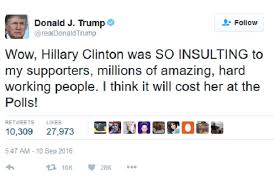
Now, fast-forward almost three years to the day of Clinton’s “basket of deplorables” speech.
On September 6, 2019, Democratic Presidential Candidate Kamala Harris chaired a Londonderry, New Hampshire, town hall meeting.
United States Senator Kamala Harris
A member of the audience asked her: “Somehow a racist bigot gets into the White House and then he says if you’re not my color you need to go back to your own country. So I am scared for this country. I am scared for the people of color in this country.
“So what are you going to do in the next one year, to diminish the mentally retarded action of this guy?”
Kamala Harris Laughs, Says Description of Trump as “Mentally Retarded” by Rally Attendee “Well Said” https://www.youtube.com/watch?v=U0Sx57OYT_M
The question triggered laughter and applause from the audience—and laughter and a “Well said, well said” response from Harris.
She then thanked the questioner for “having the courage to stand up and say it is that there are a lot of people living with extreme fear right now in our country, extreme fear.”
But then video of the exchange reached Twitter, Suddenly, Harris found herself attacked not for what she had said but for what someone she didn’t even know had said.
“I hate amplifying content I know the right will seize on and twist for their own hypocritical gain, but this hurts my heart. #CripTheVote,” tweeted Kendally Brown.
Deaf actor and activist Nyle DiMarco tweeted: “1)R-word is unacceptable. It is a slur, an insult. 2) Kamala should have handled this better. An apology is needed.”
Having laughed and applauded the speaker’s remark, Harris then claimed to CBS News that she hadn’t heard him say “retarded.”
And to NBC News said: “I would never condone anyone using that word in any way, shape or form, even including the guy — against the guy I’m running against.”
She should have deflected the criticism with a line like: “You’ll have to speak to the man who used it”—and moved on to another topic.
When British Prime Minister Neville Chamberlain caved to Adolf Hitler’s demand for control of Czechoslovakia, he both disheartened democracy’s supporters and emboldened a murderous tyrant.
Almost 81 years after the infamous Munich Conference, Democrats have not learned the truth taught by Andrew Jackson.
ABC NEWS, ALTERNET, AP, BUZZFEED, CALIFORNIA ATTORNEY GENERAL, CBS NEWS, CNN, CROOKS AND LIARS, DAILY KOZ, DISTRICT ATTORNEY OF SAN FRANCISCO, DONALD TRUMP, FACEBOOK, GEORGETOWN UNIVERSITY’S INSTITUTE OF POLITICS AND PUBLIC SERVICE, ILLEGAL ALIENS, IMMIGRATION LAWS, JOE BIDEN, Kamala Harris, LAW ENFORCEMENT, MO ELLEITHEE, MOTHER JONES, MOVEON, MSNBC, NBC NEWS, NEWSWEEK, NPR, PBS NEWSHOUR, POLITICO, RAW STORY, REUTERS, SALON, SAN FRANCISCO, SEATTLE TIMES, SENATE JUDICIARY COMMITTEE, SLATE, THE ATLANTIC, THE CHICAGO SUN-TIMES, THE CHICAGO TRIBUNE, THE DAILY BEAST, THE GUARDIAN, THE HILL, THE HUFFINGTON POST, THE LOS ANGELES TIMES, THE NATION, THE NEW YORK TIMES, THE TRUTHS WE HOLD (BOOK), THE WASHINGTON POST, TIME, TWITTER, U.S. NEWS & WORLD REPORT, UNITED STATES SENATE, UPI, USA TODAY, VIOLENT CRIME CONTROL AND LAW ENFORCEMENT ACT OF 1994
In Bureaucracy, History, Law, Law Enforcement, Politics, Social commentary on July 4, 2019 at 12:08 am
Kamala Harris spent seven years (2004 – 2011) as District Attorney of San Francisco and another six years (2011 – 2017) as California Attorney General. Then, in 2016, she won election to the United States Senate.
Now she wants to be the first black woman President of the United States. And to tout her candidacy, she’s published her memoirs: The Truths We Hold. In these, she describes herself as a “progressive prosecutor.”
Harris knows that law enforcement issues are a lightning rod for both liberal and conservative voters. So she’s trying to portray herself as appealing to both.
“It’s a presidential campaign, and every aspect of a candidate’s record is going to be scrutinized and they’re going to have to answer for it,” said Mo Elleithee, a longtime Democratic operative who leads Georgetown University’s Institute of Politics and Public Service.
Former Vice President Joe Biden chaired the Senate’s Judiciary Committee when he backed the 1994 Violent Crime Control and Law Enforcement Act. This created stricter penalties for drug offenders and funneled billions of dollars toward more police and new prisons. Now he’s being accused of helping create an era of mass incarceration among blacks.
Today, with millions of illegal aliens from Central and Latin America flooding into the United States, the spotlight has shifted from the incarceration of blacks to that of Hispanics.
Illegal immigration—and what to do about it—is now the hottest political issue in the country. And it may well undo Harris’ chances to become President.
For liberals of the Democratic party, “open borders” appears to be the solution to illegal immigration. Yet the vast majority of Americans reject this. They support legal immigration—but oppose illegal immigration.
Moreover, Donald Trump has ignited a white-hot fury against illegal aliens from Central and Latin America.
And Kamala Harris’ record as San Francisco District Attorney is hardly reassuring on this issue.
Among the truths she holds secret: When she served as District Attorney for San Francisco, she set up a secret unit to keep even convicted illegal alien felons out of prison—and in the United States.
U.S. Senator Kamala Harris
Her program, called Back on Track, trained them for jobs they could not legally hold. This was a flagrant violation of Federal immigration law. Completion led to the expunging of a felony conviction, making it highly popular among convicted criminals.
One such alumnus was Alexander Izaguirre, an illegal alien who had been arrested twice within eight months—for purse-snatching and selling cocaine.
In July, 2008, four months after pleading guilty to selling cocaine, Izaguirre assaulted Amanda Kiefer, a legal San Francisco resident.
Snatching her purse, he jumped into an SUV, then tried to run Kiefer down. Terrified, she leaped onto the hood and saw Izaguirre and a driver laughing.
The driver slammed on the brakes, sending Kiefer flying onto the pavement and fracturing her skull.
The program, Back on Track, became a centerpiece of Harris’ campaign for state Attorney General.
Until she was questioned by the Los Angeles Times about the Izaguirre case, Harris had never publicly admitted that the program included illegal aliens.
Harris claimed she first learned that illegal aliens were training for jobs only after Izaguirre was arrested for the Kiefer assault. Apparently not one of her fellow prosecutors ever mentioned this to her.
Harris said it was a “flaw in the design” of the program to let illegal aliens into the program. “I believe we fixed it,” she told the Times.
Harris never released statistics on how many illegal aliens were included since the program started in 2005.
She said that after Izaguirre’s arrest she never asked—or learned—how many illegal aliens were in Back on Track. A strange lapse in curiosity for a prosecutor charged with enforcing the law.
When Harris learned that illegal aliens were enrolled, she allowed those who were following the rules to finish the program and have their criminal records expunged.
It is not the duty of local law enforcement, she said, to enforce Federal immigration laws.
So much for her oath to faithfully defend the Constitution of the United States and that of the state of California “against all enemies, foreign and domestic.”
From 2005 to 2009, 113 admitted drug dealers graduated from Back on Track. Another 99 were kicked off the program for failing to meet the requirements. They were sentenced under their guilty plea, the D.A.’s office claimed.
Harris told the Times that graduates of Back on Track were less likely than other offenders to commit crimes again. But her spokeswoman refused to offer detailed statistics to back this up.
When Harris became San Francisco District Attorney, she vowed she would “never charge the death penalty.”
Her opposition to capital punishment would be better-suited to a public defender.
Meanwhile, Amanda Kiefer left California. Interviewed by the Times, she said she could not understand why San Francisco police and prosecutors would allow convicted illegal aliens back onto the streets.
“If they’re committing crimes,” she said, “I think there’s something wrong that they’re not being deported.”
It’s a sentiment that law-abiding Americans agree with. And it should go double for those who are charged with enforcing the law.
ABC NEWS, ALTERNET, AP, BUZZFEED, CBS NEWS, CNN, CROOKS AND LIARS, DAILY KOZ, DISTRICT ATTORNEY OF SAN FRANCISCO, FACEBOOK, ILLEGAL ALIENS, IMMIGRATION LAWS, JEFF SESSIONS, Kamala Harris, LAW ENFORCEMENT, LIBBY SCHAAF, MOTHER JONES, MOVEON, NBC NEWS, NEWSWEEK, NPR, POLITICO, RAW STORY, REUTERS, SALON, SAN FRANCISCO, SEATTLE TIMES, SLATE, THE ATLANTIC, THE CHICAGO SUN-TIMES, THE CHICAGO TRIBUNE, THE DAILY BEAST, THE GUARDIAN, THE HILL, THE HUFFINGTON POST, THE LOS ANGELES TIMES, THE NATION, THE NEW YORK TIMES, THE WASHINGTON POST, TIME, TOM HOMAN, TWITTER, U.S. NEWS & WORLD REPORT, UNITED STATES ATTORNEY GENERAL, UPI, USA TODAY
In Bureaucracy, History, Law, Law Enforcement, Politics, Social commentary on March 12, 2018 at 12:10 am
Libby Schaaf has been the Democratic mayor of Oakland since 2015. But she also considers herself a mayor to illegal aliens—who, by their very presence, are violating American immigration laws.
On February 24, she released the following statement: “Earlier today, I learned from multiple credible sources that the U.S. Immigration and Customs Enforcement (ICE) is preparing to conduct an operation in the Bay Area, including Oakland, starting as soon as within the next 24 hours….
“My priority is for the well-being and safety of all residents—particularly the most vulnerable….”
Acting ICE Director Tom Homan disagreed: “What she did is no better than a gang lookout yelling ‘police’ when a police cruiser comes in the neighborhood, except she did it to an entire community. This is beyond the pale.”
And so did United States Attorney General Jeff Sessions.
On March 7, he appeared in Sacramento, California, to deliver a speech before some 200 law enforcement officers. His topic: An upcoming Federal lawsuit to block three new California immigration laws from taking effect.
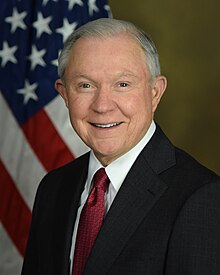
U.S. Attorney General Jeff Sessions
The purpose of these laws: To provide statewide protections for those who knowingly violate United States immigration laws.
“Here’s my message to Mayor Schaaf,” said Sessions. “How dare you, how dare you needlessly endanger the lives of our law enforcement officers to promote a radical open borders agenda.”
Attacking “sanctuary cities”—which illegally shield violators of Federal immigration laws from arrest—Sessions said: “There is no nullification. There is no secession. Federal law is the supreme law of the land.”
But California United States Senator Kamala Harris—a potential candidate for the Democratic Presidential nomination in 2020—sees matters differently.
“I think Mayor Schaaf is doing exactly what she believes is in the best interest of her community and I support that 100 percent,” she said on March 9.
But conspiring to violate United States immigration laws Harris is nothing new for Kamala Harris..
From 2004 to 2011, Harris had served as District Attorney for San Francisco. In total defiance of the law, she set up a secret unit to keep even convicted illegal aliens out of prison—and in the United States.
Click here: San Francisco D.A.’s program trained illegal immigrants for jobs they couldn’t legally hold – Los Angeles Times
U.S. Senator Kamala Harris
Her program, called Back on Track, trained them for jobs they could not legally hold.
This was a flagrant violation of Federal immigration law.
One such alumnus was Alexander Izaguirre, an illegal alien who had pled guilty to selling cocaine. Four months later, in July, 2008, he assaulted Amanda Kiefer, a legal San Francisco resident.
Snatching her purse, he jumped into an SUV, then tried to run Kiefer down. Terrified, she leaped onto the hood and saw Izaguirre and a driver laughing.
The driver slammed on the brakes, sending Kiefer flying onto the pavement and fracturing her skull.
The program, Back on Track, became a centerpiece of Harris’ campaign for state Attorney General.
Until she was questioned by the Los Angeles Times about the Izaguirre case, Harris had never publicly admitted that the program included illegal aliens.
Harris claimed she first learned that illegal aliens were training for jobs only after Izaguirre was arrested for the Kiefer assault. Apparently not one of her fellow prosecutors ever mentioned this to her.
Harris said it was a “flaw in the design” of the program to let illegal aliens into the program. “I believe we fixed it,” she told the Times.
Harris never released statistics on how many illegal aliens were included since the program started in 2005.
She said that after Izaguirre’s arrest she never asked—or learned—how many illegal aliens were in Back on Track. A strange lapse in curiosity for a prosecutor charged with enforcing the law.
When Harris learned that illegal aliens were enrolled, she allowed those who were following the rules to finish the program and have their criminal records expunged.
It is not the duty of local law enforcement, she said, to enforce Federal immigration laws.
So much for her oath to faithfully defend the Constitution of the United States and that of the state of California “against all enemies, foreign and domestic.”
From 2005 to 2009, 113 admitted drug dealers graduated from Back on Track. Another 99 were kicked off the program for failing to meet the requirements. They were sentenced under their guilty plea, the D.A.’s office claimed.
Harris told the Times that graduates of Back on Track were less likely than other offenders to commit crimes again. But her spokeswoman refused to offer detailed statistics to back this up.
When Harris became San Francisco District Attorney, she vowed she would “never charge the death penalty.”
Her opposition to capital punishment would be better-suited to a public defender.
Meanwhile, Amanda Kiefer left California. Interviewed by the Times, she said she could not understand why San Francisco police and prosecutors would allow convicted illegal aliens back onto the streets.
“If they’re committing crimes,” she said, “I think there’s something wrong that they’re not being deported.”
It’s a sentiment that law-abiding Americans agree with. And it should go double for those who are charged with enforcing the law.
ABC NEWS, ALTERNET, ANCHOR BABIES, AP, BARACK OBAMA, BUZZFEED, CBS NEWS, CNN, CROOKS AND LIARS, DAILY KOZ, DONALD TRUMP, FACEBOOK, FBI, ILLEGAL ALIENS, illegal immigration, IMMIGRATION AND CUSTOMS ENFORCEMENT (ICE), JUSTICE DEPARTMENT, Kamala Harris, MEXICO, MICHELLE OBAMA, MOTHER JONES, MOVEON, NBC NEWS, NEWSWEEK, NPR, POLITICO, RACKETEER INFLUENCED CORRUPT ORGANIZATIONS ACT, RAW STORY, REUTERS, SALON, SAN FRANCISCO, sanctuary cities, SEATTLE TIMES, SLATE, THE ATLANTIC, THE CHICAGO SUN-TIMES, THE CHICAGO TRIBUNE, THE DAILY BEAST, THE GUARDIAN, THE HILL, THE HUFFINGTON POST, THE LOS ANGELES TIMES, THE NATION, THE NEW YORK TIMES, THE WALL STREET JOURNAL, THE WASHINGTON POST, TIME, TWITTER, U.S. NEWS & WORLD REPORT, U.S.-MEXICO WALL, UPI, USA TODAY, WAL-MART
In Bureaucracy, Business, History, Law, Law Enforcement, Politics, Social commentary on January 17, 2018 at 12:56 am
The Federal Government is heading for a shutdown by January 19.
A major reason for this is Presidential Donald Trump’s demand that Congress fund a massive, impenetrable wall along the U.S.-Mexican border.
Its purpose: To end illegal immigration from Mexico.
And Democrats—seeing this as an election-year issue—are totally opposed to the wall.
During his 2016 Presidential campaign, Trump repeatedly boasted: “I will build a great, great wall on our southern border, and I will make Mexico pay for that wall.”
But there are serious obstacles to erecting such a barrier:
- The United States/Mexican border stretches for 1,954 miles—and encompasses rivers, deserts and mountains.
- Environmental and engineering problems.
- Squabbles with ranchers who don’t want to give up any of their land.
- Building such a wall would cost untold billions of dollars.
- Drug traffickers and alien smugglers could easily tunnel under it into the United States—as they are now doing.
There are, in fact, cheaper and more effective remedies for combating illegal immigration.
Illegal aliens crossing into the United States
(1) The Justice Department should vigorously attack the “sanctuary movement” that officially thwarts the immigration laws of the United States.
Among the 31 “sanctuary cities” of this country: Washington, D.C.; New York City; Los Angeles; Chicago; San Francisco; Santa Ana; San Diego; Salt Lake City; Phoenix; Dallas; Houston; Austin; Detroit; Jersey City; Minneapolis; Miami; Denver; Baltimore; Seattle; Portland, Oregon; New Haven, Connecticut; and Portland, Maine.
These cities have passed ordinances that ban municipal funds or resources from being used to enforce federal immigration laws. As a result, police or municipal employees are not allowed to inquire about citizens’ immigration status.
(2) Indict the highest-ranking officials of those cities who have actively violated Federal immigration laws.
In San Francisco, for example, former San Francisco District Attorney Kamala Harris—who is now California’s United States Senator—created a secret and illegal program called Back on Track, which provided training for jobs that illegal aliens could not legally hold.
(3) Even if some indicted officials escaped conviction, the results would prove worthwhile.
City officials would be forced to spend huge sums of their own money for attorneys and face months or even years of prosecution.
And this would send a devastating warning to officials in other “sanctuary cities” that the same fate lies in store for them.
(4) CEOs whose companies—like Wal-Mart—systematically employ illegal aliens should be held directly accountable for the actions of their subordinates.
They should be indicted by the Justice Department under the Racketeer Influenced Corrupt Organizations (RICO) Act, the way Mafia bosses are prosecuted for ordering their own subordinates to commit crimes.
Upon conviction, the CEO should be sentenced to a mandatory prison term of at least 20 years.
Convicting a score of CEOs would prove a more effective remedy for combating illegal immigration than stationing tens of thousands of soldiers on the U.S./Mexican border.
Word would quickly get around—and CEOs across the nation would take drastic steps to ensure that their companies strictly complied with Federal immigration laws.

(5) The Government should stop granting automatic citizenship to “anchor babies” born to illegal aliens in the United States.
A comparable practice would be allowing bank robbers who had eluded the FBI to keep their illegally-obtained loot.
A person who violates the bank robbery laws of the United States can be prosecuted for bank robbery, whether he’s immediately arrested or remains uncaught for years. The same should be true for those born illegally within this country.
If they’re not here legally at the time of birth, they should not be considered citizens and should—like their parents—be subject to deportation.
(6) The United States Government—from the President on down—should scrap its apologetic tone on the right to control its national borders.
In 2010, Michelle Obama visited New Hampshire Estates Elementary School in Silver Spring, Maryland.
A second-grader said: “My mom, she says that Barack Obama is taking everybody away that doesn’t have papers.”
“Yeah, well, that’s something that we have to work on right?” replied Mrs. Obama. “To make sure that people can be here with the right kind of papers, right?”
The girl then said: “But my mom doesn’t have any….”
Obama: “Well, we’ll have to work on that. We have to fix that, and everybody’s got to work together in Congress to make sure that happens.”
Mexico doesn’t consider itself racist for strictly enforcing its immigration laws. Neither should the United States.
(7) Voting materials and ballots should be published in one language: English.
In Mexico, voting materials are published in one language—Spanish.
Throughout the United States, millions of Mexican illegals refuse to learn English and yet demand that voting materials and ballots be made available to them in Spanish.
(8) The United States should impose economic and even military sanctions against countries—such as China and Mexico—whose citizens make up the bulk of illegal aliens.
Mexico, for example, uses its American border to rid itself of those who might demand major reforms in the country’s political and economic institutions.
Such nations must learn that dumping their unwanted’s on the United States now comes at an unfavorably high price. Otherwise those dumpings will continue.
ABC NEWS, ALTERNET, ANCHOR BABIES, AP, BARACK OBAMA, BUZZFEED, CBS NEWS, CNN, CROOKS AND LIARS, DAILY KOZ, DONALD TRUMP, FACEBOOK, FRANCISCO SANCHEZ, HISPANICS, illegal immigration, IMMIGRATION AND CUSTOMS ENFORCEMENT (ICE), Kamala Harris, KATHRYN STEINLE, MEXICO, MOTHER JONES, MOVEON, MSNBC, NBC NEWS, NEWSWEEK, NPR, POLITICO, RACIAL PROFILING, RAW STORY, REUTERS, SALON, SAN FRANCISCO, SEATTLE TIMES, SLATE, THE ATLANTIC, THE CHICAGO SUN-TIMES, THE CHICAGO TRIBUNE, THE DAILY BEAST, THE GUARDIAN, THE HILL, THE HUFFINGTON POST, THE LOS ANGELES TIMES, THE NATION, THE NEW YORK TIMES, THE WASHINGTON POST, TIME, TWITTER, U.S. NEWS & WORLD REPORT, UPI, USA TODAY
In History, Law, Law Enforcement, Politics, Social commentary on December 1, 2017 at 12:32 am
Political Correctness kills.
If you doubt it, ask the family of Kathryn Steinle.
Kathryn Steinle
Steinle was shot on July 2, 2015, while out for an evening stroll with her father along the San Francisco waterfront. They were walking near Pier 14—one of the city’s busiest tourist areas—when a pistol shot rang out.
Steinle, hit in the aorta, collapsed, crying, “Dad, help me, help me.”
Her father immediately gave her CPR before paramedics arrived and rushed Steinle to a hospital, where she died.
Steinle, 32, had worked for a medical technology company.
And her accused killer?
Francisco Sanchez, 45, had a history of seven felony convictions. He had been deported to his native Mexico five times, most recently in 2009.

Francisco Sanchez
On March 26, 2015, agents of U.S. Immigration and Customs Enforcement (ICE) turned Sanchez over to San Francisco police on an outstanding warrant.
On March 27, a San Francisco Superior Court judge dismissed charges of possession and distribution of marijuana against Sanchez.
Sanchez was released on April 15.
ICE had issued a detainer for Sanchez in March, requesting to be notified if he would be released. But the detainer was not honored.
San Francisco has been a “sanctuary city” since 1989. Its officials—acting as though they govern a city-state instead of a small, tourism-dependent city—openly defy Federal immigration laws.
Thus, city and local money cannot be spent on cooperating with Federal immigration authorities.
According to Freya Horne, counsel for the San Francisco Sheriff’s Department, Federal detention orders were not a “legal basis” for holding someone.
So Sanchez was released on April 15—without anyone notifying ICE.
Seventy-eight days later, illegal alien Francisco Sanchez crossed paths with American citizen Kathryn Steinle—and Steinle died.
San Francisco does not turn over illegal aliens to ICE unless there’s an active warrant for their arrest.
It’s a policy shared by cities openly defying Federal immigration laws and their enforcers.
San Francisco is just one of 31 “sanctuary cities”: Washington, D.C.; New York City; Los Angeles, Chicago; Santa Ana; San Diego; Salt Lake City; Phoenix; Dallas; Houston; Austin; Detroit; Jersey City; Minneapolis; Miami; Denver; Baltimore; Seattle; Portland, Oregon; New Haven, Connecticut; and Portland, Maine.
But the Steinle case is is not the first time San Francisco officials have defied Federal immigration authorities—with brutal consequences for American-born citizens.
One of those officials—Kamala Harris—is now California’s Attorney General.
Kamala Harris
From 2004 to 2011, Harris served as San Francisco District Attorney. In total defiance of Federal immigration law, she set up a secret unit to keep even convicted illegal aliens out of prison—and in the United States.
Click here: San Francisco D.A.’s program trained illegal immigrants for jobs they couldn’t legally hold – Los Angeles Times
Her program, Back on Track, trained them for jobs they could not legally hold.
One such alumnus was Alexander Izaguirre, an illegal alien who had pleaded guilty to selling cocaine. Four months later, in July, 2008, he assaulted Amanda Kiefer, a legal San Francisco resident.
Snatching her purse, he jumped into an SUV, then tried to run Kiefer down. Terrified, she leaped onto the hood and saw Izaguirre and the driver laughing.
The driver slammed on the brakes, sending Kiefer flying onto the pavement and fracturing her skull.
The program, Back on Track, became a centerpiece of Harris’ successful 2010 campaign for State Attorney General.
Until she was questioned by the Los Angeles Times about the Izaguirre case, Harris had never publicly admitted that the program included illegal aliens.
According to Harris:
- She first learned that illegal aliens were training for jobs only after Izaguirre was arrested for the Kiefer assault.
- It was “a flaw in the design” of the program to include illegal aliens.
- “I believe we fixed it,” she told the Times.
- After Izaguirre’s arrest, she never asked—or learned—how many illegal aliens were in Back on Track.
- When Harris learned that illegal aliens were enrolled, she allowed those who were following the rules to finish the program and have their criminal records expunged.
- Harris said it is not the duty of local law enforcement to enforce Federal immigration laws.
From 2005 to 2009, 113 admitted drug dealers graduated from Back on Track. Another 99 were kicked off the program for failing to meet its requirements. They were sentenced under their guilty pleas, the District Attorney’s office claimed.
Meanwhile, Amanda Kiefer left California.
Interviewed by the Times, she said she could not understand why San Francisco police and prosecutors would allow convicted illegal aliens back onto the street.
“If they’re committing crimes,” she said, “I think there’s something wrong that they’re not being deported.”
On November 30, 2017, more than two years after Steinle’s death, a San Francisco jury acquitted Sanchez of second-degree murder. He was found guilty of being a felon in possession of a firearm.
Sanchez claimed that he found the gun wrapped in a piece of cloth under a swivel chair at the pier. He said he picked it up and it accidentally fired, hitting Steinle in the back.
Thus, the lives of illegal aliens—even those with a criminal background—are deemed more valuable than those of law-abiding American citizens.
ABC NEWS, ALTERNET, AP, ARCHIE PARNELL, BBC, BILL CLINTON, BUZZFEED, CBS NEWS, CNN, DAILY KOS, DAVID GERGEN, DONALD TRUMP, ERIN BURNETT OUTFRONT, FACEBOOK, GERALD FORD, HOUSE OF REPRESENTATIVES, JON OSSOFF, Kamala Harris, KAREN HANDEL, MICK MULVANEY, MOTHER JONES, MOVEON, NBC NEWS, NEWSWEEK, NPR, POLITICO, RALPH NORMAN, RAW STORY, REUTERS, RICHARD NIXON, Ronald Reagan, SALON, SEATTLE TIMES, SLATE, THE ATLANTIC, THE CHICAGO SUN-TIMES, THE CHICAGO TRIBUNE, THE DAILY BEAST, THE GUARDIAN, THE HILL, THE HUFFINGTON POST, THE LOS ANGELES TIMES, THE NEW YORK TIMES, THE WALL STREET JOURNAL, THE WASHINGTON POST, TIME, TWITTER, U.S. NEWS & WORLD REPORT, UPI, USA TODAY
In Bureaucracy, History, Politics, Social commentary on June 23, 2017 at 12:26 am
On June 20, a friend of mine named Dave wrote Kamala Harris, his United State Senator from California.
A longtime Democrat, he was concerned that the party had declined to the point of political insignificance.
In 2010, Democrats had lost the House; in 2014, they lost the Senate. Then, in 2016, after Barack Obama had held the White House for eight years, they lost it again to Donald J. Trump.
In 1996, Speaker of the House Newt Gingrich had written a memo entitled: “Language: A Key Mechanism of Control.” It urged Republicans to attack Democrats with such words as “corrupt,” “selfish,” “destructive,” “hypocrisy,” “liberal,” “sick,” and “traitors.”
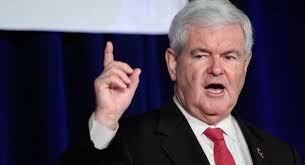
Newt Gingrich
Democrats, for the most part, have failed to craft effective counterattacks on their integrity and ability.
As a veteran writer, Dave wanted to pass on to Harris some specific ways that Democrats could do this.
“Above all,” wrote Dave, “Democrats should not simply borrow but co-opt a page from the Republican playbook and CONSTANTLY brand Republicans as TRAITORS.
“America’s foremost Intelligence agencies have proven, categorically, that Russian Intelligence agents played a major role in securing Trump’s election.
“And Trump’s firing [FBI Director] James Comey to short-circuit the Russia investigation—as he himself admitted in an interview with NBC’s Lester Holt—only proves how much he wants to hide his guilt.”
On June 21, Harris’ office responded as follows:
Dear Mr. —–,
Thank you for reaching out to voice your concerns about the workings of our government and the state of our nation. The importance of civic involvement cannot be overstated, and it is an honor to serve as your United States Senator. I have heard your concerns, and my legislative work will continue to be guided by the needs of constituents like you.
I believe that each and every American has the right to education, public safety, and health care. I have dedicated my time in the Senate to fighting for the most vulnerable among us and defending the inalienable rights guaranteed by our Constitution.
It is for this reason that I introduced the Access to Counsel Act, which guarantees legal counsel for those detained while entering the United States, passed a bipartisan resolution condemning ethnic and religious hate crimes, and introduced the Empowering Federal Employment for Veterans Act, a bipartisan bill to boost federal employment opportunities for the veterans who gave so much to defend our nation.
I am proud of the progress we have made during our time in the Senate. And still, I know our work has just begun.
As a career prosecutor and the former Attorney General of California, I understand that our constitutionally-guaranteed rights must be diligently protected. I will fight to protect these rights, and make sure that our voices not silenced or forgotten.
As your senator, I will spend my time in Congress advocating for every Californian and every American.
Thank you again for reaching out. If you have additional questions or concerns, please do not hesitate to visit my website at —.——.——-.— or call my Washington, D.C. office at (—) — —-.
Sincerely,
Kamala D. Harris
United States Senator
Dave wasted no time in replying to what he considered a thoroughly unresponsive reply:
On June 20 I sent you an email outlining ways that Democrats can successfully mount attacks on Republicans generally and Donald Trump in particular.
Your email says better than anything I can why so many people have given up on the Democratic party.
NOTHING in this email even REMOTELY addresses the issue I raised in mine. It’s boilerplate that could have been sent out to ANY constituent of ANY member of Congress. No doubt I could have told you I was suffering from a poison ivy rash and you would have sent me the same “reply.”
And yours is NOT unique in its “outreach” to constituents. I have seen letters and emails from other Congressional members whom people I know contacted. And those “replies” had NOTHING to do with the subjects those constituents had written about.
Since Trump’s election, Democrats have had FOUR opportunities to upset his agenda via four special elections. The most recent of these occurred on June 20—and, for the fourth time, the Democratic nominee got flushed down the toilet.
So I would think that if someone directly addressed some of the reasons WHY Democrats keep blowing elections, YOU would have had the decency to directly respond to the subject. But of course you did not.
At the end of your email, you (or, more likely, your staffer) wrote: “If you have additional questions or concerns, please do not hesitate to visit my website at ——.——-.— or call my Washington, D.C. office at (—) — —-.”
After getting the completely UNresponsive “response” cited above, I do not see any reason to expect that any further emails or letters to you will garner a direct reply to whatever issue I have addressed.
Prepare yourself for a Trump re-election in 2020. The cowardly, Politically Correct approach Democrats habitually take to campaigning will guarantee it.
The tragedy is that, while your party DESERVES to go into the trashcan of history, those who depend on its members for protection against Republican greed and cruelty deserve far better.


 Bureaucracybuster's Blog
1968 PRESIDENTIAL CAMPAIGN, 2020 PRESIDENTIAL CAMPAIGN, ABC NEWS, ALTERNET, AMERICABLOG, AMERICAN INDIANS, AP, BABY BOOMER RESISTANCE, BARBARA GARSON, BLACK LIVES MATTER, BLOOMBERG, BUZZFEED, CBS NEWS, CIVIL RIGHTS, CNN, COMING APART: AMERICA IN THE 1960S (BOOK), CROOKS AND LIARS, DAILY KOZ, DEMOCRATS, DRUDGE REPORT, EUGENE MCCARTHY, FACEBOOK, FIVETHIRTYEIGHT, GEORGE BERNARD SHAW, GROSS NATIONAL PRODUCT, HARPER’S MAGAZINE, JIM SLATTERY, JOHN F. KENNEDY, Kamala Harris, KANSAS STATE UNIVERSITY, LOOK MAGAZINE, LYNDON B. JOHNSON, MCBIRD!, MEDIA MATTERS, MISSISSIPPI, MOTHER JONES, MOVEON, MSNBC, NBC NEWS, NEWSWEEK, NPR, PBS NEWSHOUR, POLITICO, POLITICUSUSA, RAW STORY, REPUBLICANS, REUTERS, ROBERT F. KENNEDY, SALON, SEATTLE TIMES, SIRHAN SIRHAN, SLATE, SOPHOCLES, STANLEY TRETICK, TALKING POINTS MEMO, TET OFFENSIVE, THE ATLANTIC, THE CHICAGO SUN-TIMES, THE CHICAGO TRIBUNE, THE DAILY BEAST, THE DAILY BLOG, THE GUARDIAN, THE HILL, THE HUFFINGTON POST, THE LOS ANGELES TIMES, THE NATION, THE NEW REPUBLIC, THE NEW YORK TIMES, THE VILLAGE VOICE, THE WASHINGTON POST, THINKPROGRESS, TIME, TIME MAGAZINE, TRUTHDIG, TRUTHOUT, TWITTER, TWO POLITICAL JUNKIES, U.S. NEWS & WORLD REPORT, UNIVERSITY OF KANSAS, UPI, USA TODAY, VIETNAM WAR, WILLIAM L. O'NEIL, WONKETTE
IDEALISM DIED WITH RFK: PART TWO (OF THREE)
In Bureaucracy, History, Law, Law Enforcement, Military, Politics, Social commentary on August 11, 2020 at 12:07 amOn March 18, 1968, Presidential candidate Robert F. Kennedy did what few politicians have ever done: He accepted public responsibility for a war that had since become a national disaster—the Vietnam war.
Addressing a packed audience of students and faculty at Kansas State University, he said:
“Let me begin this discussion with a note both personal and public. I was involved in many of the early decisions on Vietnam, decisions that helped set us on our present path.
“It may be that the effort was doomed from the start; that it was never really possible to bring all the people of South Vietnam under the rule of the successive governments we supported—governments, one after another, riddled with corruption, inefficiency, and greed; governments which did not and could not successfully capture and energize the national feeling of their people.
“If that is the case, as it well may be, then I am willing to bear my share of the responsibility, before history and before my fellow citizens. But past error is no excuse for its own perpetuation. Tragedy is a tool for the living to gain wisdom, not a guide by which to live.
“Now as ever, we do ourselves best justice when we measure ourselves against ancient tests, as in the Antigone of Sophocles: ‘All men make mistakes, but a good man yields when he knows his course is wrong, and repairs the evil. The only sin is pride.’
Sophocles
And he dared to attack the war as more than a military and political disaster: He saw it as a stain on America’s moral fiber:
“Can we ordain to ourselves the awful majesty of God—to decide what cities and villages are to be destroyed, who will live and who will die, and who will join the refugees wandering in a desert of our own creation?
“If it is true that we have a commitment to the South Vietnamese people, we must ask, are they being consulted—in Hue, or Ben Tre, or in the villages from which the three million refugees have fled?
“If they believe all the death and destruction are a lesser evil than the Wet Cong, why did they not warn us when the Viet Cong came into Hue, and the dozens of other cities, before the Tet Offensive? Why did they not join the fight?
“Will it be said of us, as Tacitus said of Rome: ‘They made a desert and called it peace?'”
Robert F. Kennedy
The students gave him an ovation worthy of a rock star.
Time correspondent Hays Gorey said the electricity between Kennedy and the K.S.U. students was “real and rare.” “A good part of it is John F. Kennedy’s, of course, but John Kennedy …himself couldn’t be so passionate, and couldn’t set off such sparks.”
Jim Slattery, who would later be elected to Congress from Kansas, reread the K.S.U. speech during the second Iraq war and decided it was so powerful “because Kennedy was talking about what was right!”
As Kennedy started to leave, students rushed the platform where he stood, knocking over chairs and grabbing at him. They stroked his hair and ripped his shirtsleeves.
Later that day, Kennedy addressed another wildly enthusiastic audience—at the University of Kansas, in Lawrence, Kansas.
Then he addressed the glaring disparities between rich and poor Americans—a topic now generally ignored by Democrats and turned into an attack line by Republicans:
“All around us, all around us….men have lost confidence in themselves, in each other. It is confidence which has sustained us so much in the past. Rather than answer the cries of deprivation and despair….hundreds of communities and millions of citizens are looking for their answers, to force and repression and private gun stocks— so that we confront our fellow citizen across impossible barriers of hostility and mistrust.
Robert F. Kennedy talking with black children
“And again, I don’t believe that we have to accept that. I don’t believe that it’s necessary in the United States of America. I think that we can work together. I don’t think that we have to shoot at each other, to beat each other, to curse each other and criticize each other, I think that we can do better in this country. And that is why I run for President of the United States….
“I have seen children in Mississippi starving, their bodies so crippled from hunger and their minds have been so destroyed for their whole life that they will have no future. I have seen children in Mississippi—here in the United States—with a gross national product of $800 billion dollars.
“I have seen children in the Delta area of Mississippi with distended stomachs, whose faces are covered with sores from starvation, and we haven’t developed a policy so we can get enough food so that they can live, so that their children, so that their lives are not destroyed, I don’t think that’s acceptable in the United States of America and I think we need a change.”
Share this: