When German President Paul von Hindenburg appointed Adolf Hitler Chancellor of Germany on January 30, 1933, not all Germans rejoiced.
Millions of them, in fact, hoped that the radical Fascist would be “boxed in” by “the establishment.”
President Hindenburg was known to despise Hitler. And a Hindenburg ally, Franz von Papen, was Vice Chancellor.
Yet it was Von Papen who was largely responsible for Hitler’s coming to power.
He believed that the longtime agitator could be controlled once he was in the government. The cabinet, after all, was not under Nazi domination. And so he convinced Hindenburg to appoint Hitler as Chancellor.
Almost immediately, Hitler began to outmaneuver those who sought to restrain him.
Adolf Hitler
As part of his deal with Papan, Hitler appointed his longtime supporter, Herman Goring, interior minister of Prussia—thus arming the Nazis with the largest police force in Germany.
On February 1, 1933, Hitler presented Article 48 to the cabinet. This allowed the police to take people into “protective custody” without charges. Hindenburg signed it into law on February 4 as the “Decree for the Protection of the German People.”
In March, the Reichstag (parliament) passed the Enabling Act, which allowed Hitler to rule by decree without interference from legislators. Germany, it was claimed, needed “an iron hand” because it was supposedly threatened by a Communist revolution.
The Enabling Act was authorized to last only four years. But it was renewed in 1937 and, in 1941, extended for the rest of Hitler’s lifetime.
On August 2, the aged Hindenburg died. Hitler immediately consolidated the positions of President and Chancellor—and ordered the German Armed Forces to swear an oath of personal loyalty to him.
Hitler’s mastery of Germany was now complete.
Fast forward 84 years from Adolf Hitler’s gaining total power in Germany to January 30, 2018.
President Donald Trump can say—as truthfully as Adolf Hitler: I am the destiny of America.
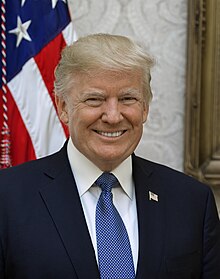
Donald Trump
Among his tumultuous actions during his first year as President, Trump:
- Fired Acting Attorney General Sally Yates after she notified him that National-Security Adviser Michael Flynn had misled the FBI.
- Fired FBI Director James Comey for investigating the Trump Presidential campaign’s links to the Kremlin.
- Attacked the integrity of the American Intelligence community—while praising Russian President Vladimir Putin.
- Falsely claimed that former President Barack Obama had illegally wiretapped him during the 2016 Presidential campaign.
- Tried to fire Independent Counsel Robert Mueller, but was talked out of it.
Syndicated columnist Mark Shields and New York Times columnist David Brooks appear every Friday on the PBS Newshour to review the week’s major political events.
On January 26, Brooks—a conservative, and Shields, a liberal—reached similar conclusions about the recent news that President Trump had tried to fire Independent Counsel Robert Mueller during the summer of 2017.
After Comey’s firing, Mueller had been assigned to oversee the previously-confirmed FBI investigation of Russian government efforts to influence the 2016 presidential election.

David Brooks and Mark Shields
DAVID BROOKS: “First, it should be pointed out that White House staff has repeatedly said there was no effort to fire Mueller, when they clearly have been lying for months about that….
“I was in Dayton, Ohio, this morning. And a friend said, in this presidency, I’m just stunned every day. I’m stunned every hour. And at some point, you get out of stunned. There’s no more stun.
“And I found this when I saw our story. If I had seen that story seven or eight months ago, I would have been, ‘Oh, I can’t believe this is happening.’ Now I’m inured. I’m used to it. I have been numbed.
“And I came to think, even if he fired Mueller, maybe we’re all just—we’re like, we have been numbed to the things that happen and nobody gets upset anymore. I think people would get upset if he actually did try to fire Mueller, but we have defined deviancy down and gotten used to a set of behavior that would have been shocking to us a year ago.”
MARK SHIELDS: “I think there would be a firestorm at this point [if Trump fired Mueller]….
“How long and how intense, I don’t know, because I remain just perplexed at the limit of the finite limits of our outrage, or our sense of outrage….
“But I think it really comes down to, who’s going to stand with [Mueller]? And I look at the Republicans on the Hill and, you know, the lack, the tower of Jell-O that is the speaker of the House….”
JUDY WOODRUFF: “…Could this campaign…by some Republicans in the House and with support from the White House to undermine the FBI…have a long-lasting effect on the Justice Department in the end?”
DAVID BROOKS: “Yes, I think so.
“And the FBI is filled with honest brokers….There are a lot of agencies that are filled with honest brokers, and the idea that everybody in this city is a politician is just not true.
“It’s always amazing to me that a lot of people in government, they are not actually that political. They believe in the public service and they try to do their jobs, but they’re not sort of super political people.”


ABC NEWS, ALTERNET, BUZZFEED, CBS NEWS, CNN, DAILY KOS, DONALD TRUMP, FACEBOOK, HERMAN WOUK, HOUSE OF REPRESENTATIVES, HUMPHREY BOGART, JOSE FERRER, MOTHER JONES, MOVEON, NBC NEWS, NEWSWEEK, NPR, PENNSYLVANIA, POLITICO, RAW STORY, RICK SACCONE, SALON, SLATE, THE CAINE MUTINY, THE CHICAGO SUN-TIMES, THE CHICAGO TRIBUNE, THE DAILY BEAST, THE HUFFINGTON POST, THE LOS ANGELES TIMES, THE NEW YORK TIMES, THE WALL STREET JOURNAL, THE WASHINGTON POST, TIME, TWITTER, U.S. NEWS & WORLD REPORT, USA TODAY, VAN JOHNSON
TRUMP: CAPTAIN QUEEG ON THE CAMPAIGN TRAIL: PART ONE (OF TWO)
In Bureaucracy, Entertainment, History, Politics, Social commentary on March 13, 2018 at 12:03 amWatching President Donald Trump’s campaigning for Pennsylvania State Representative Rick Saccone, some viewers might have flashed back to the climatic scene in the 1954 movie, The Caine Mutiny.
On March 10, Trump appeared at a rally for Saccone, who is campaigning in a special election for a Republican seat in the United States House of Representatives.
In 2016, Trump carried the 18th congressional district by 20 points. But now his favored candidate is fighting for his political life against Democrat Conor Lamb.
Nationwide, Republicans fear that if Saccone loses in the heart of “Trump country,” this could be a prelude to massive rejections by voters in November.
How did this come to be? Let’s start with The Caine Mutiny.
Based on Herman Wouk’s bestselling novel, it centers on the minesweeper USS Caine. Stationed in the Pacific during World War II, its captain is by-the-book Lt. Commander Philip Francis Queeg (Humphrey Bogart).
Movie poster for “The Caine Mutiny”
Queeg intends to restore a sense of discipline to the ship’s lax seamen. But he can’t admit mistakes, and his bullying approach to command alienates both officers and crew.
Soon after, a typhoon overtakes the Caine. Queeg becomes paralyzed with fear. His executive officer, Steve Maryk (Van Johnson), relieves the captain of command to prevent the loss of the ship. Maryk turns the Caine into the wind and rides out the storm.
Maryk is tried by court-martial for mutiny. His case looks hopeless: Queeg has been found sane by three Navy psychiatrists.
Naval Prosecutor Lt. Commander John Challee depicts Maryk as a reckless mutineer. And Queeg portrays himself as the persecuted victim of a malignant conspiracy by his own officers.
Knowing that Queeg reacts badly to stress, Maryk’s attorney, Lt. Barney Greenwald (Jose Ferrer) relentlessly cross-examines him:
GREENWALD: Were all your officers disloyal?
QUEEG: I didn’t say that. Only some were disloyal.
GREENWALD: Mr Keith and Mr Maryk?
QUEEG: Yes.
GREENWALD: Did you turn your ship upside down searching for a phantom key?
QUEEG: I don’t know what lies have been sworn to here, but a key definitely did exist.
PROSECUTOR LT. COMMANDER JOHN CHALLEE: The witness is understandably agitated. I request a recess.
QUEEG: I don’t want a recess. I’ll answer all questions right here and now.
GREENWALD: Did you conduct such a search?
QUEEG: Yes, I did. My disloyal officers failed me, and the key couldn’t be found.
GREENWALD: Wasn’t this whole fuss over a quart of strawberries?
QUEEG: The pilfering of food in large amounts or small is a very serious occurrence on board a ship.
GREENWALD: You were told that the mess boys ate the berries. There was no key.
QUEEG: The key was not imaginary. I don’t know anything about mess boys eating strawberries.
GREENWALD: Have you no recollection of a conversation with Ensign Harding? Didn’t he tell you that the mess boys ate the strawberries?
QUEEG: I remember he was grateful for his transfer.
GREENWALD: Do you know where Ensign Harding is now? He’s in San Diego. He can be flown up here in three hours if necessary. Would it serve any useful purpose to have him testify?
QUEEG: Now, there’s no need for that.
[He reaches into the pocket of his Navy coat and removes two little steel balls, which he rolls together whenever he feels under stress. He starts rolling them together now and continues to do so throughout the rest of the proceeding.]
Humphrey Bogart as Captain Philip Francis Queeg
Now that I recall, he might have said something about mess boys. I questioned many men, and Harding was not the most reliable officer.
GREENWALD: The defense has no other recourse than to produce Ensign Harding.
QUEEG: Now, there’s no need for that. I know exactly what he’ll tell you–lies. He was no different from any other officer in the wardroom. They were all disloyal. I tried to run the ship properly, by the book, but they fought me at every turn. If the crew wanted to walk around with their shirt-tails out, let them. Take the tow line–defective equipment.
But they began spreading wild rumors about steaming in circles. And then “Old Yellowstain.” I was to blame for Maryk’s incompetence and poor seamanship. Lt. Maryk was the perfect officer, but not Queeg.
But the strawberries, ah, that’s where I had them. They laughed at me and made jokes. But I proved beyond a shadow of a doubt and with geometric logic that a duplicate key to the wardroom icebox did exist. I could have produced that key if they hadn’t pulled the Caine out of action. I know now they were only trying to protect some fellow officer.
Naturally, I can only cover these things from memory. If I’ve left anything out, just ask me specific questions and I’ll be glad to answer them one by one.
[The courtroom falls silent–except for the tinkling of the steel balls that Queeg keeps rolling in his right hand. The judges stare at him as he does so. They say nothing, but it’s clear they know they’re looking at a man at the end of his sanity–and naval career.]
GREENWALD: No further questions, sir.
Maryk is acquitted.
* * * * *
So much for fiction. Now for the terrifying reality.
Share this:
Like this: