A truly great man is ever the same under all circumstances. And if his fortune varies, exalting him at one moment and oppressing him at another, he himself never varies, but always preserves a firm courage, which is so closely interwoven with his character that everyone can readily see that the fickleness of fortune has no power over him.
–Niccolo Machiavelli, The Discourses
For President Barack Obama, the last two months of his eight-year Presidency will be an agony.
Perhaps only his wife, Michelle, truly knows the torments he will so stoically endure.
For stoicism–enduring pain or hardship without complaint or showing emotions–has long been central to Obama’s character.
In 2011, two years into his Presidency, he faced an accusation never before leveled against an American President: That he was not an American citizen–and thus not entitled to hold the office he held.
His accuser-in-chief: Donald Trump, an egomaniacal, thrice-married “reality-TV” host and real estate mogul who had filed for corporate bankruptcy four times.
At first Obama ignored the accusation, assuming it was so ridiculous no one could believe it. But, promoted by Right-wing Fox News and Republican leaders, millions of Fascistic Americans thought it actually might be true.
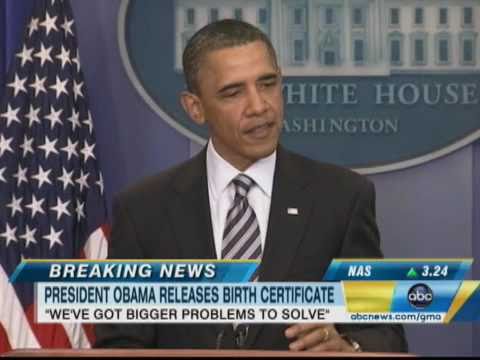
So, on April 27, 2011, the President called a press conference–where he released the long-form version of his Hawaii birth certificate.
President Obama’s birth certificate
“We do not have time for this kind of silliness,” said Obama, speaking as a father might to a roomful of spiteful children. “We have better stuff to do. I have got better stuff to do. We have got big problems to solve.
“We are not going to be able to do it if we are distracted, if we spend time vilifying each other, if we just make stuff up and pretend that facts are not facts.”
And on May 1, the President announced the solving of one of those “big problems”: Osama bin Laden, mastermind of the September 11, 2001 terrorist attacks, had been tracked down and shot dead by elite U.S. Navy SEALS in Pakistan.
To understand Obama’s agony as he ends his term, imagine the following alternate history:
On April 14, 1865, the slavery-sympathizing actor John Wilkes Booth enters Ford’s Theater in Washington, D.C.
His mission: Assassinate President Abraham Lincoln.
Armed with a knife and Derringer, he reaches the unguarded Presidential box. But just as he’s about to push open the door to his–and Lincoln’s–destiny, he halts.
He’s just thought of a more monstrous fate for the President.
Silently, he leaves the theater–and the world never learns how close Lincoln came to death at the hands of an assassin.
Instead, Booth waits out the next four years–until the election of 1868, when Lincoln’s second term is up.
Lincoln has chosen Andrew Johnson, his Vice President, to succeed him.
For the outgoing President, it’s more than a matter of politics. A Johnson victory will secure the legacies Lincoln has created during the last eight years:
- The Thirteenth Amendment, which bans slavery.
- The stationing of Union troops in the South, to ensure that blacks are not re-enslaved.
- The granting of the vote to blacks.
But Johnson is a lackluster candidate, and, after eight years of war and Reconstruction, Americans are eager for “change.”
Suddenly, an unexpected challenger steps forward: The celebrated Shakespearean actor John Wilkes Booth!
Booth promises that, if elected, he will overturn everything Lincoln has done–most especially the Thirteenth Amendment.
He’ll tear up the surrender treaty that officially ended the Civil War and let the Southern states restore the Confederacy.
His campaign slogan: “Let America Enslave Again.”
He calls the President an ape, a buffoon, a dictator with the blood of countless Americans on his hands.
Newspaper reporters covering Johnson often fall asleep during his speeches. Booth whips up his audiences without even trying.
John Wilkes Booth
On November 4, 1868, John Wilkes Booth becomes the seventeenth President of the United States.
It won’t be until 1933 that Presidents begin taking the Oath of Office on January 20. So Abraham Lincoln will remain President until March 4, 1869.
Meanwhile, John Wilkes Booth has never held public office. He needs to pick a cabinet and learn the basics of what it means to be President.
And only one man is qualified to teach him–the man who now holds that office.
Lincoln knows that, in only a matter of months, everything he has worked for will be ruthlessly overturned. Like a beautiful garment pulled apart, thread by thread, until nothing is left but a pile of rubbish on the floor.
But he is a patriot, and a believer in destiny. Fate–or God–has thrust him into the Presidency. And he will carry out the duties that go with that role, however tormenting they now are, right to the end.
He hopes that Divine Providence will bestow a bright future on his beloved country, however bleak its present now looks.
* * * * *
When Barack Obama entered the White House in 2009, he couldn’t imagine spending his last two months in office tutoring the man who had reviled him throughout his Presidency.
It will be his last gift as President to a nation that has often proved ungrateful for his dedicated service.


 Bureaucracybuster's Blog
2016 PRESIDENTIAL ELECTION, 2020 PRESIDENTIAL ELECTION, 9/11 ATTACKS, ABC NEWS, ABRAHAM LINCOLN, ALTERNET, AMERICABLOG, AP, APPOMATTOX DEMOCRATS, ARNOLD SCHWARTZENEGGER, ASIANS, BABY BOOMER RESISTANCE, BARACK OBAMA, BBC, BLACKS, BLOOMBERG NEWS, BUZZFEED, CBS NEWS, CHARLES ROYSTER, CIVIL RIGHTS ACT OF 1964, CIVIL WAR, CNN, CONFEDERATE STATES OF AMERICA, COVID-19, CROOKS AND LIARS, DAILY KOZ, DAVID BROOKS, DELTA VARIANT, DONALD TRUMP, FACEBOOK, FIVETHIRTYEIGHT, FORT SUMTER, GEORGE W. BUSH, HARPER’S MAGAZINE, HILLARY CLINTON, HISPANICS, HUFFINGTON POST, JOHN OLIVER, JOHNSON & JOHNSON VACCINE, JONATHAN CAPEHART, KGB, LYNDON B. JOHNSON, MASKS, MEDIA MATTERS, MERYL STREEP, MODERNA VACCINE, MOTHER JONES, MOVEON, MSNBC, MUSLIMS, NBC NEWS, NEIL YOUNG, NEW REPUBLIC, NEWSDAY, NEWSWEEK, NPR, PBS NEWSHOUR, PHIZER VACCINE, POLITICO, POLITICUSUSA, PRISONERS-OF-WAR, RACISM, RAW STORY, RECONSTURCTION, REPUBLICANS, REUTERS, ROBERT E. LEE, RUSSIA, SALON, SEATTLE TIMES, SLATE, TALKING POINTS MEMO, THE ATLANTIC, THE CHICAGO SUN-TIMES, THE CHICAGO TRIBUNE, THE DAILY BEAST, THE DAILY BLOG, THE DESTRUCTIVE WAR (BOOK), THE DISABLES, THE GUARDIAN, THE HILL, THE HUFFINGTON POST, THE LOS ANGELES TIMES, THE NATION, THE NEW REPUBLIC, THE NEW YORK TIMES, THE NEW YORKER, THE SOUTH, THE VILLAGE VOICE, THE WASHINGTON POST, THINKPROGRESS, TIME, TREASON, TRUTHDIG, TRUTHOUT, TWITTER, TWO POLITICAL JUNKIES, U.S. NEWS & WORLD REPORT, ULYSSES S. GRANT, UPI, USA TODAY, VACCINATIONS, VLADIMIR PUTIN, WHITES, WOMEN, WONKETTE
FOUR MAPS TO INFAMY: PART ONE (OF TWO)
In Bureaucracy, History, Medical, Politics, Social commentary on July 28, 2021 at 12:14 amThroughout its history the South has been a hotbed of treason, racism and ignorance.
Today, it proudly continues holding fast to these traditions—even as it places the entire country in danger of contagion and dictatorship.
From 1860 to 1865, the South—Texas, Arkansas, Louisiana, Tennessee, Mississippi, Alabama, Georgia, Florida, South Carolina, North Carolina and Virginia—produced the greatest case of mass treason in America’s history.
It was called the Confederate States of America—and produced the South’s first map of infamy.
Union (blue) and Confederate (red) states: 1860 – 1865
Júlio Reis, CC BY-SA 3.0 <https://creativecommons.org/licenses/by-sa/3.0>, via Wikimedia Commons
According to The Destructive War, by Charles Royster, it wasn’t the cause of “states’ rights” that led 13 Southern states to withdraw from the Union in 1860-61. It was their demand for “respect,” which, in reality, translates into “e-g-o.”
“The respect Southerners demanded did not consist simply of the states’ sovereignty or of the equal rights of Northern and Southern citizens, including slaveholders’ right to take their chattels into Northern territory.
“It entailed, too, respect for their assertion of the moral superiority of slaveholding society over free society,” writes Royster.
It was not enough for Southerners to claim equal standing with Northerners; Northerners must acknowledge it. But this was something that the North was less and less willing to do.
Finally, its citizens dared to elect Abraham Lincoln in 1860.
Lincoln and his new Republican party damned slavery—and slaveholders—as morally evil, obsolete and ultimately doomed. And they were determined to prevent slavery from spreading any further throughout the country.
Southerners found all of this intolerable.
Lincoln—during his First Inaugural Address—bluntly said that he did not intend to “directly or indirectly…interfere with the institution of slavery in the States where it exists. I believe I have no lawful right to do so, and I have no inclination to do so.”
Abraham Lincoln
But that was not enough for Southerners.
Only 10% of Southerners owned slaves. The other 90% of the population “had no dog in this fight,” as Southerners liked to say.
Yet they so admired and aspired to be like their “gentleman betters” that they threw in their lot with them.
On April 12, 1861—just over a month since Lincoln’s inauguration on March 4—Southern batteries opened fire on Union Fort Sumter in Charleston Harbor, South Carolina.
This ignited the American Civil War, costing the lives of 750,000.Americans—at a time when the population of the United States stood at 31,443,321.
Four years later, Confederate General Robert E. Lee surrendered the Army of Northern Virginia to Union General Ulysses S. Grant at Appomattox Courthouse.
Huge sections of the South had been laid waste by Union troops and more than 258,000 Southerners had been killed.
And slavery, the mainstay of Southern plantation life, had been ended forever.
The South had paid a high price for its investment in treason.
Infamy’s second map dates from 1964 to 2016.
In 1964, Democratic President Lyndon B. Johnson pushed the Civil Rights Act through Congress, ending more than a century of blatant discrimination against blacks.
The South—which before the Civil War had been solidly Democratic—suddenly went solidly Republican.
To understand this mammoth shift, it’s vital to realize: In Lincoln’s time, the Republicans were the party of progressives.
The party was founded on an anti-slavery platform. Its members were thus reviled as “Black Republicans.” And until the 1960s, the South was solidly Democratic.
Democrats were the ones defending the status quo—slavery—and opposing the rights of freed blacks in the South of Reconstruction and long afterward.
When, in the early 1960s, Democrats championed the rights of blacks, Southerners bolted for the Republican party—which held to the same values that slavery/discrimination-supporting Democrats once did.
After signing the Civil Rights Act of 1964 into law, President Lyndon B. Johnson told an aide: “We have just lost the South for a generation.”
Johnson was wrong: A generation lasts 20 to 30 years. It’s been 56 years since the signing of the Act, and the South is still solidly within the Republican camp.
1968 election (Southern states in red)
TheSouth’s third map of infamy culminates with the election of Donald Trump as President in 2016.
Repeatedly, when asked why they supported Trump, his followers said: “He says what I’ve been thinking!”
And what Trump appealed to, above all else, was hatred.
From June 15, 2015, when he launched his Presidential campaign, until October 24, 2016, Trump fired almost 4,000 angry, insulting tweets at 281 people and institutions that had somehow offended him.
Donald Trump
The New York Times needed two full pages of its print edition to showcase them.
Among his targets:
Others he clearly delighted in insulting during the campaign included:
Whites comprised the overwhelming majority of the audiences at Trump rallies. Not all were racists, but many of those who were advertised it on T-shirts: “MAKE AMERICA WHITE AGAIN.”
And the vast majority of the white votes Trump got were in the South.
Share this: