bureaucracybusters

Posts Tagged ‘CEOS’

IT’S ALL ABOUT THE EGO

In Bureaucracy, Business, History, Politics, Social commentary on October 29, 2013 at 12:58 pm

Why do so many CEOs hate President Barack Obama?

It isn’t because they’re being over-taxed and -regulated,d as so many on the Right would have you believe.

According to a January 16, 2013 story published in Bloomberg:

  • U.S. corporations’ after-tax profits have grown by 171% under Obama.
  • This is more than has existed under any President since World War II.
  • Corporate profits are now at their highest level, relative to the economy, since the government began keeping records in 1947.
  • Profits are more than twice as high than during Ronald Reagan’s Presidency.
  • They are more than 50% greater than during the late-1990s Internet boom.

Click here: Corporate Profits Soar as Executives Attack Obama Policy – Bloomberg

So if money isn’t the issue, what is?

In a word: Ego.

Jonathan Alter, author of The Center Holds: Obama and His Enemies, provides some eye-opening insights into relations between the President and business leaders.

He notes, for example, that even before taking office as President in 2009, Obama pushed through Congress the second $350 billion portion of the $700 billion Troubled Asset Relief Program (TARP)

And he stablilized the almost-wrecked American financial system with stress tests and regulatory reforms.

So Obama believed that business CEOs would be grateful for his efforts on their behalf.

And what did the President get in return?

  • The rise of the Tea Party, angered by government bailouts to mega-corporations–and the subsequent loss of a Democratic House of Representatives; and
  • Ingratitude and resentment from the very CEOs whose corporations he had saved.

CEOs visiting the White House often believed the President didn’t take them seriously.

For example, many of them wanted a tax amnesty on their overseas earnings.  And Obama would ask: How will the government make up for the lost Treasury revenues that would come from such a huge tax break?

Many CEOs thought he was not taking them seriously.

Obama was in fact being serious, and was hoping that his greed-obsessed visitors would help him find an answer that would satisfy both parties.

What the President apparently didn’t understand was this: Most CEOs weren’t used to being dealt with on an equal basis.

They were used to people cowering before them, or instantly agreeing with anything they said.

For Obama, who had taught Constitutional law at the University of Chicago from 1992 to 2004, such  intellectual querys were routine.  He had enjoyed the cut-and-thrust of such exchanges with his law students.

But his law students had not been billionaires with billionaire-sized egos.

One Wall Street CEO charged that Obama regarded intellectuals as a cut above political operatives–and two cuts above businessmen.

As Alter writes: “Being worth a billion dollars wasn’t going to get the President…to believe that your insights were better than anyone else’s.”

Obama was angered that many CEOs felt that nothing should change–even after the excesses of greed-fueled banks almost destroyed the nation’s economy in 2008.

Thus, bank CEOs had furiously opposed the Dodd-Frank bank re-regulations that had been imposed to prevent a recurrence of such abuses.

Obama felt that bankers were ungrateful for his pushing through the second part of the TARP program that had saved their corporations from the CEOs’ own self-destructive greed.

As Alter sums up: “The complex psychology of business confidence was only partly about their tax rates and the threat of regulation; the real problem was personal.

“They [businessmen] had an intuitive sense that Obama didn’t particularly like them, and they responded in kind.”

These are not the kinds of insights you’ll get by reading the highly sanitized bios of corporate chieftains.

As a result, during the 2012 Presidential race, Mitt Romney received nearly $150 million, or more than 15% of his total money raised, from New York.  Which meant mostly from Wall Street.

“We got a lot of Barack Obama’s Wall Street money,” said Spencer Zwick, Romney’s finance director, after the campaign.

A passage from Finley Hooper’s classic Roman Realities puts an ancient-world spin on Obama’s relations with wealthy businessmen.

Assessing the reasons for why so many patricians hated Julius Caesar, Hooper writes:

“Caesar…like a teacher, seemed always to be directing affairs in a world of children–chiding one, patting another–yet too far above them all to care about hurting any.

“To less gifted men, however, his aloofness, even if mixed with kindness, was thought to be patronizing.  They could not believe that in his heart he really cared about them.

“Caesar never bothered to ask for another man’s opinion.  He lacked the tact by which a talented person might reasure others that they have worth, too.

“Pardons, jobs or favors did not completely satisfy the recipients’ craving for attention….

“Caesar…was a supreme egotist wrapped up in his own sense of well-being and good service to the state.

“…For all his experience and sophistication, he had never learned how ungrateful men can be–especially those who feel ignored.”

It has been President Obama’s bad luck–like that of Julius Caesar– to find himself at odds with powerful men whose profits he has greatly expanded.

IS THERE A HITLER IN YOUR CEO?

In Bureaucracy, History, Military, Social commentary on September 2, 2013 at 12:01 am

Each Labor Day, American politicians offer lip-service tribute to those millions of American workers who make corportate profits a reality.

But no one ever says anything about those over-pampered, over-paid CEOs who all too often take credit for the work done by those millions of American workers.

Too many CEOs have–consciously or not–patterened themselves after the ultimate CEO: Adolf Hitler.

Ever since he shot himself in his underground Berlin bunker on April 30, 1945, historians have fiercely debated:  Was der Fuehrer a military genius or an imbecile?

With literally thousands of titles to choose, the average reader may feel overwhelmed.  But if you’re looking for an understandable, overall view of Hitler’s generalship, an excellent choice would be How Hitler Could Have Won World War II by Bevin Alexander.
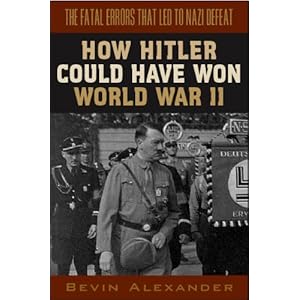
How Hitler Could Have Won World War II

Among “the fatal errors that led to Nazi defeat” (as proclaimed on the book jacket) were:

  • Wasting hundreds of Luftwaffe pilots, fighters and bombers in a half-hearted attempt to conquer England.
  • Ignoring the pleas of generals like Erwin Rommel to conquer Syria, Iraq and Saudi Arabia–thus giving Germany control of most of the world’s oil.
  • Attacking his ally, the Soviet Union, while still at war with Great Britain.
  • Needlessly turning millions of Russians into enemies rather than allies by his brutal and murderous policies.
  • Declaring war on the United States after the Japanese attacked Pearl Harbor.  (Had he not done so, Americans would have focused all their attention on conquering Japan.)
  • Refusing to negotiate a separate peace with Soviet dictator Joseph Stalin–thus granting Germany a large portion of captured Russian territory in exchange for letting Stalin remain in power.
  • Insisting on a ”not one step back” military “strategy” that led to the unnecessary surrounding, capture and/or deaths of hundreds of thousands of German servicemen.

As the war turned increasingly against him, Hitler became ever more rigid in his thinking.  He demanded absolute control over the smallest details of his forces.  This, in turn, led to astounding and needless losses in German soldiers.

One such incident was immortalized in the 1962 movie, The Longest Day, about the Allied invasion of France known as D-Day.

On June 6, 1944, Rommel ordered the panzer tanks to drive the Allies from the Normandy beaches.  But these could not be released except on direct order of the Fuehrer.

As Hitler’s chief of staff, General Alfred Jodl, informed Rommel: The Fuehrer was asleep–and, no, he, Jodl, would not wake him.

By the time Hitler awoke and issued the order, it was too late.

Nor could he accept responsibility for the policies that were clearly leading Germany to certain defeat.  Hitler blamed his generals, accused them of cowardice, and relieved many of the best ones from command.

Among those sacked was Heinz Guderian, creator of the German panzer corps–and thus responsible for its highly effective “blitzkrieg” campaign against France in 1940.

Heinz Guderian

Another was Erich von Manstein, designer of the strategy that defeated France in six weeks–something Germany couldn’t do during the four years of World War 1.

Erich von Manstein

Finally, on April 29, 1945–with the Russians only blocks from his underground bunker in Berlin–Hitler dictated his “Last Political Testament.”  Once again, he refused to accept responsibility for unleashing a war that would ultimately consume 50 million lives:

“It is untrue that I or anyone else in Germany wanted war in 1939.  It was desired and instigated exclusively by those international statesmen who either were of Jewish origin or worked for Jewish interests.”

Hitler had launched the war with a lie–that Poland had attacked Germany, rather than vice versa.  And he closed the war–and his life–with a final lie.

All of which, once again, brings us back to Niccolo Machiavelli, the father of political science.

In his classic book, The Discourses, he wrote at length on the best ways to maintain liberty within a republic.  In Book Three, Chapter 31, Machiavelli declares: “Great Men and Powerful Republics Preserve an Equal Dignity and Courage in Prosperity and Adversity.”

It is a chapter that Adolf Hitler would have done well to read.

“…A truly great man is ever the same under all circumstances.  And if his fortune varies, exalting him at one moment and oppressing him at another, he himself never varies, but always preserves a firm courage, which is so closely interwoven with his character that everyone can readily see that the fickleness of fortune has no power over him.

“The conduct of weak men is very different.  Made vain and intoxicated by good fortune, they attribute their success to merits which they do not possess, and this makes them odious and insupportable to all around them. 

And when they have afterwards to meet a reverse of fortune, they quickly fall into the other extreme, and become abject and vile.  

“Thence it comes that princes of this character think more of flying in adversity than of defending themselves, like men who, having made a bad use of prosperity, are wholly unprepared for any defense against reverses.”

Stay alert to signs of such character flaws among your own business colleagues–and especially your superiors.  They are the warning signs of a future catastrophe.

GREED-TESTING FOR CEOS: PART TWO (END)

In Bureaucracy, Business, History, Politics on May 22, 2013 at 12:34 am

Robert Benmosche, the CEO of American International Group (AIG) recently offered some blunt advice to college graduates searching for work.

“You have to accept the hand that’s been dealt you in life,” Benmosche said in an interview on Bloomberg Television. “Don’t cry about it. Deal with it.”

As is typical of one-percenters, Benmosche blames willing-to-work college graduates for the refusal of rich employers to offer jobs instead of excuses.

AIG’s way of “accepting the hand that’s been dealt you in life” was to go crying to the Federal Government for a bailout loan–which eventually ballooned to $182 billion.

If college graduates should “deal with” the hardships of finding a responsible, hiring-inclined employer with a stiff upper lip, as Benmosche advises, the same advice should work wonders on greed-fueled CEOs.

Greed-test CEOs for future government loans.

After all, drug-testing welfare recipients has become the new mantra for Republicans.

Some bills have even targeted people who seek unemployment insurance and food stamps, despite scanty evidence that the poor and jobless are disproportionately on drugs.

The concept of background screening is actually sound. But Republicans are aiming it at the wrong end of the economic spectrum.

Since 2008, the government has handed out billions of dollars in bailouts to CEOs of the wealthiest corporations in the country.

The reason: To rescue the economy from the calamity produced by the criminal greed and recklessness of those same corporations.

In 2008, Alan Greenspan, the former chairman of the Federal Reserve, testified before Congress about the origins of the Wall Street “meltdown.”

He admitted that he was “shocked” at the breakdown in U.S. credit markets and said he was “partially” wrong to resist regulation of some securities.

“Those of us who have looked to the self-interest of lending institutions to protect shareholder’s equity–myself especially–are in a state of shocked disbelief,” said Greenspan, who had ruled the Fed from 1987 to 2006.

As a disciple of the right-wing philosopher, Ayan Rand, Greenspan had fiercely held to her belief that “The Market” was a divine institution. As such, “it” alone knew what was best for the nation’s economic prosperity.

“Enlightened self-interest,” he believed, would guarantee that those who dedicated their lives to making money would not allow mere greed to steer them–and the country–into disaster.

As he saw it, any attempt to regulate greed-based appetites could only harm that divine institution.

Greenspan proved wrong. And the nation will be literally paying for such misguided confidence in profit-addicted men for decades to come.

So if Republicans want to protect the “poor, oppressed taxpayer,” they should demand background investigations for those whose addiction truly threatens the economic future of this country.

That is–the men (and occasionally women) who run the nation’s most important financial institutions, such as banks, insurance and mortgage companies.

Thus, in the future, all CEOs–and their topmost executives–of financial institutions seeking Federal bailouts should be required to:

  • Undergo “full field investigations” by the FBI and IRS.
  • Submit full financial disclosure forms concerning not only themselves but all members of their immediate families.
  • Be subject to Federal prosecution for perjury if they provide false information or conceal evidence of criminal violations.
  • Periodically submit themselves for additional background investigation.
  • Be subject to arrest, indictment and prosecution if the background investigation turns up evidence of criminal activity.

In addition:

  • If a bailout-seeking financial institution refuses to comply with these criteria, it should be refused the loan.
  • If a CEO and/or other top officials are judged ineligible for a loan, the company should be asked to replace those executives with others who might qualify.
  • Those alternative executives should be subject to the same background investigation requirements as just outlined.
  • If the institution refuses to replace those executives found ineligible, the Government should refuse the loan.
  • If the Government is forced to take over a troubled financial institution, its CEO and top executives should be replaced with applicants who have passed the required security screening.

The United States has a long and embarrassing history in worshipping wealth for its own sake. Part of this can be traced to the old Calvinistic doctrine that wealth is a proof of salvation, since it shows evidence of God’s favor.

Another reason for this worship of mammon is the belief that someone who is wealthy is automatically endowed with wisdom and integrity.

Following these beliefs to their ultimate conclusion will transform the United States into a plutocracy–a government of the wealthy, by the wealthy, for the wealthy.

Every day we see fresh evidence of the destruction wrought by the unchecked greed of wealthy, powerful men.

When they–and their paid shills in Congress–demand, “De-regulate business,” it’s essential to remember what this really means.

It means: “Let criminals be criminals.”

GREED-TESTING FOR CEOS: PART ONE (OF TWO)

In Bureaucracy, Business, History, Politics, Social commentary on May 21, 2013 at 1:28 am

Robert Benmosche, the CEO of American International Group (AIG) has some blunt advice to college graduates searching for work in a tight job market.

“You have to accept the hand that’s been dealt you in life,” Benmosche said in an interview on Bloomberg Television. “Don’t cry about it. Deal with it.”

Typical advice from a one-percenter whose company, AIG, suffered a liquidity crisis when its credit ratings were downgraded below “AA” levels in September 2008.

And how did AIG “deal with” its own crisis?  It went crying to its Uncle Sugar, the United States Government, for a bailout.

Which it promptly got.

The United States Federal Reserve Bank, on September 16, 2008, made an $85 billion loan to the company to meet increased collateral obligations resulting from its credit rating downgrade–and thus saving it from certain bankruptcy.

In return, the Government took an 80% stake in the firm.

(The bailout eventually ballooned to $182 billion in exchange for a 92%  stake.)

College graduates, said Benmosche, need to seize the opportunities that become available to them, even if their options are limited.

“They want me to talk to the students and give them a sense of encouragement, especially with the high unemployment,” said Benmosche.

“My advice will be, ‘Whatever opportunity comes your way, take it. Take it and treat it as if it’s the only one that’s coming your way, because that actually may be the truth.’”

Of course, willing-to-work college graduates who can’t find willing-to-hire employers won’t be able to count on a generous bailout from the Federal Government.

To which most of them will owe hundreds of thousands of dollars in student loans.

It’s long past time to apply to “untouchable” CEOs like Robert Benmosche the same criteria that right-wing Republicans demand be applied to welfare recipients.

Throughout the past year Republican lawmakers have pursued welfare drug-testing in Congress and more than 30 states.

Some bills have even targeted people who claim unemployment insurance and food stamps, despite scanty evidence the poor and jobless are disproportionately on drugs.

The concept of background screening is actually sound. But Republicans are aiming it at the wrong end of the economic spectrum.

Since 2008, the government has handed out billions of dollars in bailouts to the wealthiest corporations in the country.

The reason: To rescue the economy from the calamity produced by the criminal greed and recklessness of those same corporations.

For example:

  • The Troubled Asset Relief Program (TARP) has invested $118.5 billion in restoring liquidity to the financial markets.
  • Federal Reserve rescue efforts: $1.5 trillion invested.
  • Federal stimulus programs designed to save or create jobs and jumpstart the economy from recession. $577.8 billion invested.
  • American International Group: Multifaceted bailout to help insurers through restructuring, minimize the need to post collateral and get rid of toxic assets. $127.4 billion invested.
  • FDIC bank takeovers: Cost to FDIC fund that insures losses depositors suffer when a bank fails. $45.4 billion billion invested.
  • Other financial initiatives designed to rescue the financial sector. $366.4 billion invested.
  • Other housing initiatives designed to rescue the housing market and prevent foreclosures. $130.6 billion invested.

Total of federal monies invested: $3 trillion.

It’s important to note that these figures–supplied by the Federal Reserve, Treasury Department, Federal Deposit Insurance Corporation, Congressional Budget Ooffice and the White House–date from November 16, 2009.

And it’s equally important to remember that welfare recipients did not

  • hold CEO positions at any of the banks so far bailed out;
  • run such insurance companies as American International Group (AIG);
  • administer the Federal Home Loan Mortgage Corporation, known as Freddie Mac;
  • command the Federal National Mortgage Association, known as Fannie Mae.

The 2010 documentary “Inside Job” chronicles the events leading to the 2008 global financial crisis. One of its most insightful moments occurs at a party held by then-Treasury Secretary Henry Paulson.

“We can’t control our greed,” the CEO of a large bank admits to his fellow guests.

“You should regulate us more.”

Greed is defined as an excessive desire for wealth or goods. At its worst, greed trumps rationality, judgment and concern about the damage it may cause.

Greed begins in the neurochemistry of the brain. A neurotransmitter called dopamine fuels our greed. The higher the dopamine levels in the brain, the greater the pleasure we experience.

Cocaine, for example, directly increases dopamine levels. So does money.

Harvard researcher Hans Breiter has found, via magnetic resonance imaging studies, that the craving for money activates the same regions of the brain as the lust for sex, cocaine or any other pleasure-inducer.

Dopamine is most reliably activated by an experience we haven’t had before. We crave recreating that experience.

But snorting the same amount of cocaine, or earning the same sum of money, does not cause dopamine levels to increase. So the pleasure-seeker must increase the amount of stimuli to keep enjoying the euphoria.

In time, this incessant craving for pleasure becomes an addiction. And feeding that addiction–with ever more money–becomes the overriding goal.

Thus, the infamous line–”Greed is good”–in the 1987 film, “Wall Street,” turns out to be both false and deadly for all concerned.

But the situation need not remain this way.